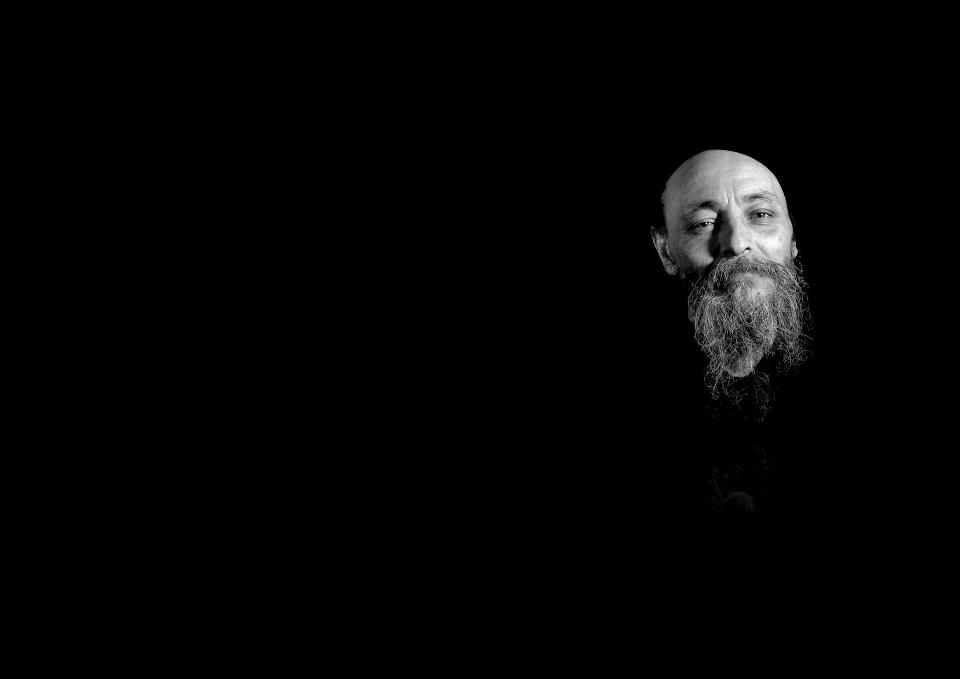
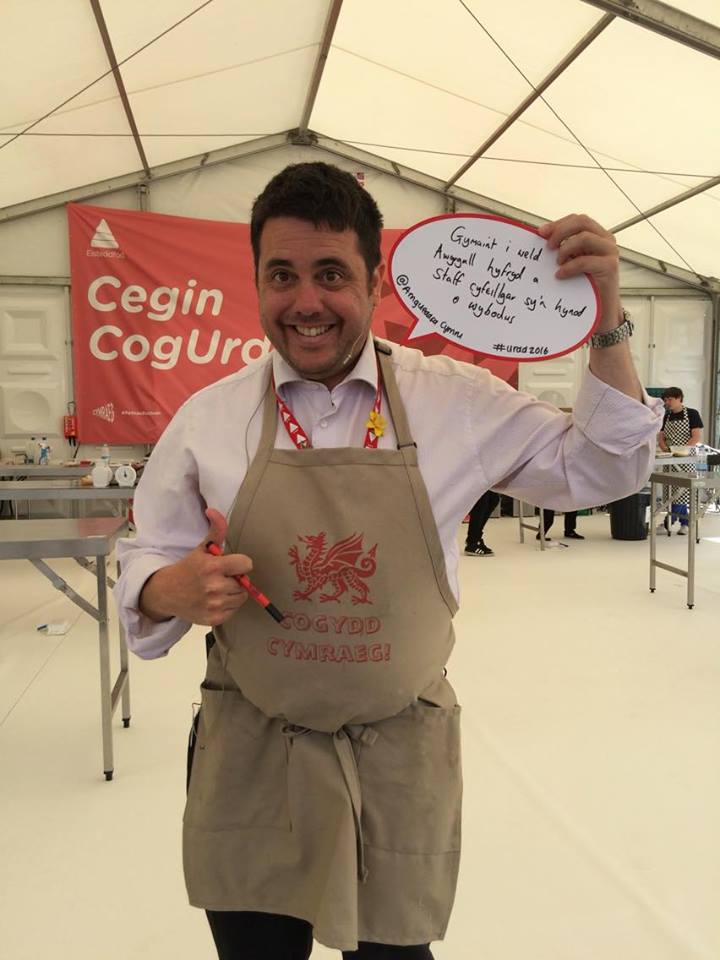
All posts by Guy O'Donnell

Hi I am Guy the project coordinator for Get The Chance. I am a trained secondary teacher of Art and Design and have taught at all Key Stages in England and Wales. I am also an experienced theatre designer and have designed for many of the theatre companies in Wales.

Interview Adeola Dewis “Art can allow new, creative ways of seeing the everyday to emerge”


207372_10150558342515296_7621089_n

Hi Adeola, You are currently a Visual Artist and Research Fellow at the University of South Wales. Is it possible to give our readers some background information on yourself?

Yes, I am actually coming to the end of my research fellowship. It was an 18 month contract with the University of South Wales and part of a large AHRC (Arts and Humanities Research Council) funded project called ‘Representing Communities.’ I am an artist, researcher,  a mother of 3 boys and a Caribbean woman resident in Wales since 2003. A lot of my work is informed by my day to day experiences.

217083_10150558346030296_8002310_n

You held a President’s Award scholarship for PhD research at Cardiff University, Wales and have received several grants from the Arts Council of Wales to develop and realise collaborative arts projects. Was there a moment in your career when you knew the areas you wanted to focus on?

 by Maria Nunes 02

When I was little I wanted to be movie star! (laughs) Drawing has always been part of my life from as far back as I can remember, and dance as well.  I knew I loved art and always wanted to be an artist or arts practitioner. I have very supportive parents and they really fostered my love for culture and always believed in my art, what I could do and the difference art could make to circumstances. It was during my first degree in Trinidad that I actually became convinced that I could be an artist, that I could make art and have exhibitions. My lecturers were also great examples of successful practicing artists. Being Trinidadian, Carnival was always part of my life. It was during my MA at Howard Gardens that I became interested in Carnival performance as a way of engaging the ideas of integrated arts. This Carnival interest has evolved to include ideas around re-presenting self in public spaces and what that means for social issues around notions of belonging and un-belonging, visibility and how we react to social, political, personal situations through temporary transitory performances and rituals.

13522001_10154421603905649_2608251298474307930_n

You mentioned your parents I wonder if there are any individuals or organisations that helped support you in developing your skills and knowledge?

 I have a long list of individuals that have helped in the development of my work but again I think the core always goes back to family – my parents, my sisters, my boys, my husband and so on. When I moved to Wales I felt in some ways as if I had to start again, to prove myself, make new contacts and forge my own little space within this art world. It was a really insecure space to be in to be honest. I joined organisations like W.I.D (Welsh Independent Dace) and C.A.D.M.A.D both of which no longer exist. S.W.I.C.A (South Wales Intercultural Community Arts) helped a lot as well, providing a space to explore and meet other artists with a range of different skills. My first solo exhibition in Cardiff was in g39 when it was on Mill Lane which was funded by the Arts Council of Wales. I feel like an ole timer now! The Butetown History & Arts Centre was also a great support to help me show my work. They too have recently lost their funding. I think the key thing though is about meeting people, travelling, experiencing, talking about your work and interests and being true to what you want to do. As part of this current research I have developed connections with the Butetown Community Centre and individuals working with and in community.

13567136_10154421631600649_1652986525087605783_n

Awareness of Carnival (which you have a great deal of personal experience and knowledge in) as an art form is growing. In your opinion what is needed to help the art form develop?

 That’s a great question. Carnival can be seen as a public participatory celebration of a people. It is moving and fluid and reflects issues within a society through song, dance, costume and so on. Development is a tricky word, because what does that really mean and for whom? In some regards Carnival development needs an injection of cash and government support. But I would argue that a Carnival really belongs to the people and ‘development’ could also be about handing-over and seeing what emerges over time. I am still learning about this Welsh space and I think there are carnivalesque ’emancipatory’ performances that occur in spaces like stadiums and on the streets on rugby match days. Carnival to me, becomes meaningful if the people need it. It’s tricky when it is just another fashionable purely aesthetic street parade.

SNV31470

You are currently focusing on first generation Caribbean migrants associated with Butetown, facilitating ideas of community re-presentation. How did this project develop and what responses have you had to date?

by Carrole Fox

I have absolutely loved being a part of this project! I had the opportunity to work with Elder Caribbean migrants and to be immersed within Butetown learning about their rich history and why the space was so attractive to people travelling from the Caribbean. The project has culminated in several exhibitions including one at the Cardiff Story Museum, one in the Butetown Community Centre that includes a series of photographs of the Butetown Domino Club members by local photographer Simon Campbell.

by John Briggs 02

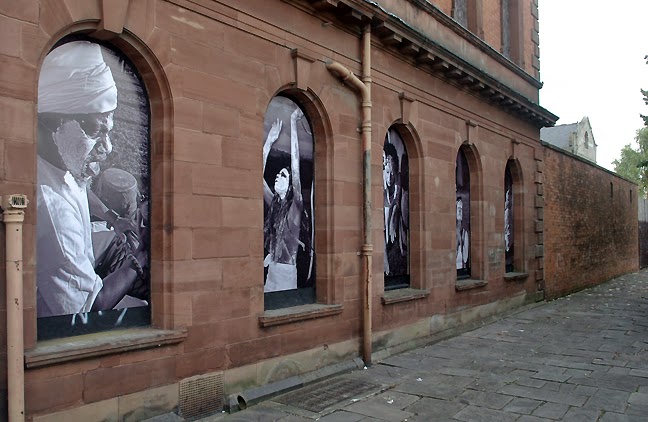
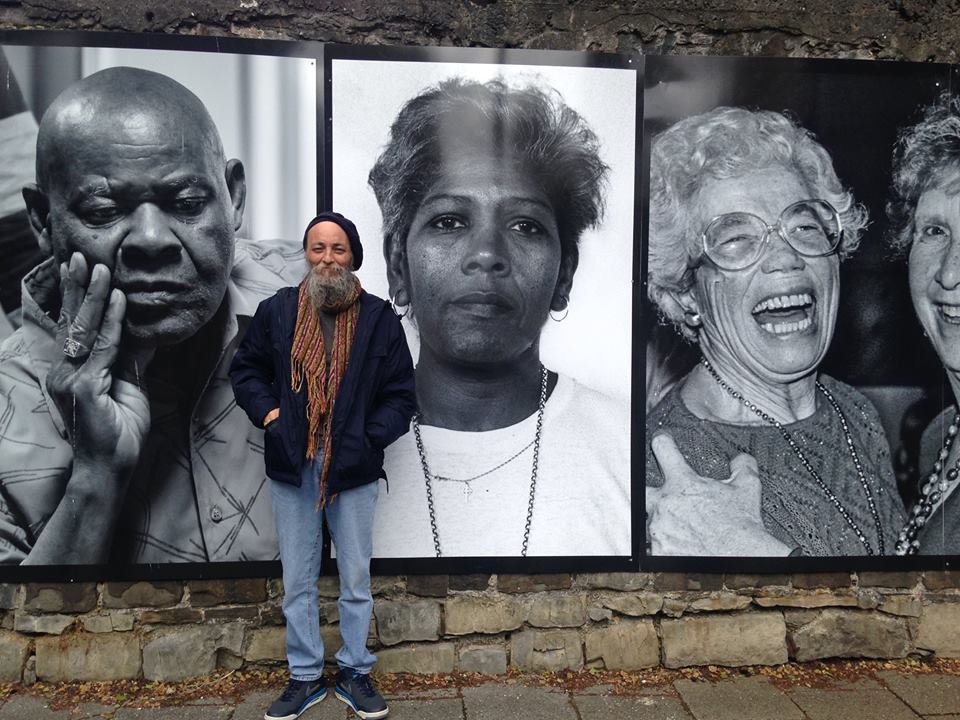
The other end-of-project exhibition is on the Network Rail wall opposite Loudoun Square on Bute Street. It is a series of portraits by different photographers who have made Butetown a focus in their work – Simon Campbell, Keith Murrell, John Briggs and Andrew McNeill. We even managed to get a photo by Bert Hardy.

13507087_10154421643555649_3080952284288185602_n

This Bute Wall exhibition looks at Butetown, the diversity, the elders and ideas of community wellbeing and representation. Generally responses have been positive.

Butetown Elders by Simon Campbell

Do you think that arts and culture in Wales represents the diversity of the citizens and communities you have worked with?

 Well I think if we look closely enough we will see people representing themselves in so many ways. I think representation is crucial and the diverse fabric of Wales has been actively engaged in places like Cardiff Story Museum and Glamorgan Archives. In my experience I am not convinced that the diversity is always reflected in the visual art world but again, it is about where we look, what is made visible and what inevitably becomes less visible. But I feel positive. I think there is good work happening, a lot of talent and room for alternative ways of engaging arts.

You frequently support workshop activity with members of the public, do you think this type of activity is important and why?

 Yes, I think workshops are important. As an artist working with the public opens you up to different people and conversations and experiences which as I mentioned earlier are crucial to art development and relevance. Also, I think one of the aims of art is that it is for everybody. It can challenge, inform, educate and really allow new and creative ways of seeing the everyday to emerge. Workshops are an opportunity to share art with different people and it also allows you to think about ways of making art-making/doing accessible and relevant to a diverse groupings

by John Briggs

What are the opportunities for those interested in carnival in Wales?

Carnival is huge! There is room for everybody. First there is the question of what aspect of Carnival interests you. I know the performance department at the Atrium are starting to actively use carnival as part of their teaching. Any formal art – music, costume and set design, painting, sculpture, dance can lend itself to Carnival. The main ingredient especially with performance is not the qualification but the desire and passion to want to do it. We have the Butetown Carnival on the bank holiday weekend in August. It is a great opportunity to create and explore the potential of a Carnival in Wales. Those interested can contact Keith Murrell founder of BACA (Butetown Arts and Culture Association) at the Butetown Community Centre.

13413535_10154588301796874_6196259796899434927_n

If you were in charge of funding the arts in Wales what would be your priorities?

 My priority will probably be informed by spending time with different artists and communities and seeing how their visions relate to the broader political agenda for the country.

When you aren’t involved in culture or research what do you like to do in your spare time?

 I feel like I am always involved in one kind of culture or another. I love spending time with my boys. I love drawing. I love dancing and laughing and learning. I also enjoy watching world cinema.

Many Thanks for your time Adeola

 Thank you!

“Which is why I am writing this” Creatives and critics on the EU referendum

 Creatives and critics from and based in Wales respond to the vote to leave the EU.
Beth House Founder/Creative Producer
Taking Flight Theatre Company
beth
 
I have been shocked and dismayed by Thursday’s vote in which just over half of the British public expressed their desire to leave the EU. As a theater maker working with marginalised groups, much of the funding of organisations we come into contact with- organisations, which support the most marginalised and disenfranchised among us-, comes from EU pots.
The aim of Taking a Flight is to provide employment opportunities for Deaf, disabled and sensory impaired performers. Whilst I don’t anticipate that the government of the day would reverse laws and Acts which have already been passed to protect the rights of disabled people, I fear that, with the UK’s poor track record for supporting disabled people and protecting funding and support, that the UK will begin to lag behind Europe in this- and many other areas. This will happen.
My immediate response of panic has been much more personal, as I feel already there has been a paradigm shift in the attitude of many people towards “the other”-I have heard in the street, on social media and on the news, Joe Public using the result of this referendum as an excuse to be overtly, unashamedly and publicly racist. It feels as if this referendum has opened the door for the metaphorical tattooing of the bulldog on the forehead and the waving of the Union Jack in the faces of those who remain supporters of membership of the EU- and those perceived as “other”.
Lastly, I am disappointed at the number of people who appear to have voted “leave” in error- who decided to vote against the government – a protest vote which has cost us- and our children- dearly.
I wish I could share the “lets make the best of it” attitude- that the best art is inspired by diversity, but I’m afraid that with so many of my friends of European origin already planning to leave, and so many friends speaking of “winding up” all their EU contracts, with the pound at an 31 year low and the threat of further knocks to the industry I love and make my living- such as if us- at, I cannot bring myself to optimism at this point.

James Doyle-Roberts (Co-Artistic Director, Citrus Arts based in Pontypridd)
james roberts

On the day of the result I was in a cheap hotel room next to London City Airport. The social housing estate next door is soon to be demolished to make way for yet more tiny 1-bedroom flats which claim to be “luxury” (as they always do), and will temporarily house workers rather than families, until they can’t afford to live there anymore.

This is how economic “growth” works, and is why I’m on the side of the social benefits that the EU delivers in our communities in Wales where it invests in apprenticeships, tourism and communities, so they can keep their shared spaces connected to their sense of self. And yes, that includes people who come from abroad who want to contribute to those communities.

At 6 am that morning, I woke up with the referendum result already in my mind. I checked my phone, and my heart sank into an empty-feeling stomach.

I’d already voted to Remain without a moment of doubt; I still respect some friends who have sound ideological reasons to distrust the EU’s current state, but don’t think their global revolution is coming soon and know a better bet on our current future when I see one.

The last thing I saw on TV the night before was the early Sunderland result declared alongside footage of cheering Leave supporters. This clip was different to the usual election results being declared to a band of victorious party-faithful, this was the kind of cheer we’d all seen in earlier weeks of the violence that accompanied the opening games of Euro 2016, it was cheering with anger and a F**k You attitude– the worst kind of victory cry.

I went downstairs to the breakfast room to see a man in his 50’s cheering loudly every time Johnson or Farage appeared on the TV above the heads of an international mix of fellow guests and staff. He’d clearly been having his own all-night Brexit party, surrounded by empty bottles and was enjoying himself by loudly addressing the staff (mostly non-white), in that particular smirking, dismissive, ‘you-know-what-I-mean’ way that the odious Farage has normalised into our political discourse in the past eight years.

I was being paid a small amount of money to attend Greenwich & Docklands International Festival (GDIF) and the networking events around it. Alongside my thoughts asking “what’s the point of going, now we have the repercussions of this terrible result to deal with?” I was also thinking “and so, here it begins . . .”, as I left Bully-Boy to his ugly antics.

The lump in my throat grew each time I thought of the future of my little boy, 19 months old, growing up in a society where facts and expertise become disposable when pitted against volume and vitriol. What kind of society are we allowing our media to shape where honesty and propriety are represented as just “one side of the argument”?

At the GDIF Marketplace event (where artists can meet programmers from around the world to sell our shows), the atmosphere was how I imagine a wedding party to be where the Bride or Groom have bolted, but the guests decide to stay to consume the food & drink anyway because it’s all been paid for. There was no banquet on offer, just opportunities to build relationships with fellow artists around Europe and the wider world, and chances for us to make the best of the funds we could collectively gather between us if we cooperate.

Speakers welled-up & choked as they tried to contextualise why we were all there. Scottish delegates had confidence that they would go their own way, anyway; I felt like apologising for Wales’ strong vote to leave the EU.

There is still hope for a way out of what looks like an ugly future, but without any current leaders with the integrity to step-up & confront the lies, it is up to us to build it together by talking to each other, our neighbours, the people we randomly meet, and not being afraid of Bully-Boy and his gang.

Rachel Tresize Author and Playwright 
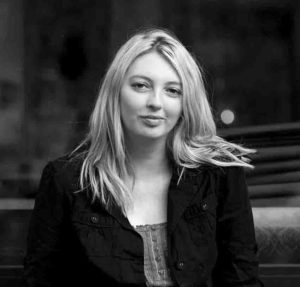
Rachel

I’m absolutely devastated by the referendum results, not least here in my own Rhondda Valley where residents have benefited from so much EU funding in the past. I studied on an Erasmus scheme when I was twenty years old. It was such an inspiring experience to meet and study with so many students from all over the world and inimitable in introducing me to the world outside of my own area. As a writer I travel frequently to EU countries and am translated in Danish, Italian, Croatian and soon Slovenian and I would like young Welsh students and authors to have these same opportunities. I’m worried now that these ties will be severed due to financial and travel restrictions.

 Gemma Louise Treharne-Foose  Get the Chance Critic

f93a65fd6e91cb6f2f9e2bd3aa32a3ff
 

I’ve been a lucky recipient of EU-funded programmes over the years. I had a paid for apprenticeship after University to train as a researcher in TV production because I lived in the valleys. I have been happy to take advantage of the programmes and funding available to me because of my postcode and because people think I need a ‘leg up’ or a head start. But these programmes and funding pools are a sticking plaster for the real problems going on in the valleys. Long term unemployment, dreadful infrastructure and crumbling services. I’ve had lots of conversations with others living here that it’s ridiculous that in 2015/2016 we are still relying on charity handouts – whether they are from Westminster, Cardiff Bay or Brussels.

I think the remain campaign never really addressed this malaise and the deeper frustrations and resentment, unfortunately. I fear for how much worse things will be here now. EU-funded projects were the only thing helping people back to work in many areas in RCT as UK-Govt services (like Job centres) have ceased or been closed down. As much as I agree with the reasons to remain, I have struggled to articulate to friends and colleagues from wealthier and more prosperous communities why people here aren’t jumping up and down and doffing their cap because of handouts from the EU. I think there’ll be some harsher realities coming our way, though.

Sophie McKeand  Welsh Poet Young People’s Laureate Wales 2016-2018
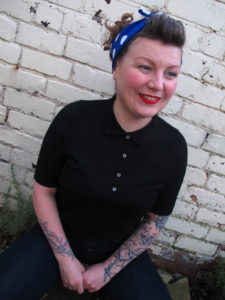
Sophie_McKeand_Feb2016_a-003

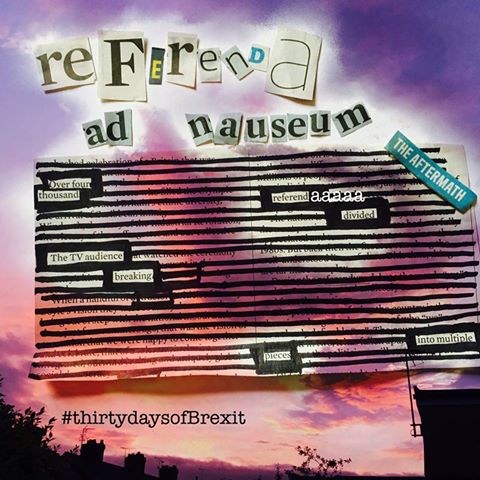
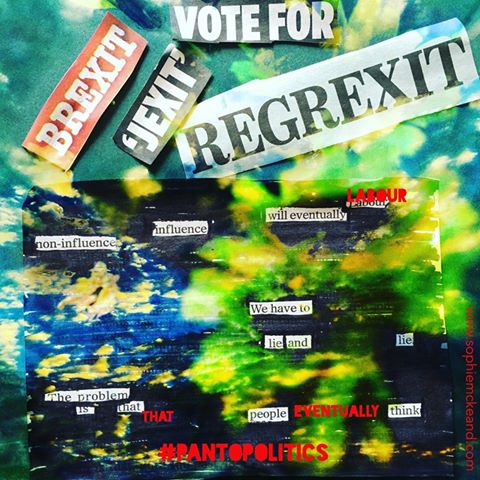
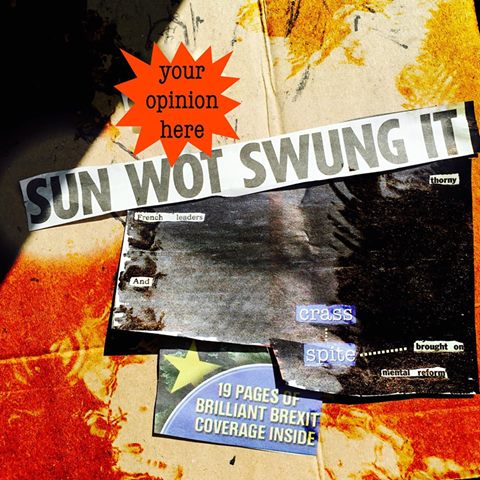
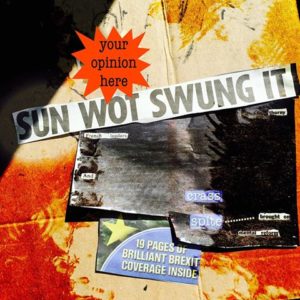
I’ve chosen to respond to the Brexit debacle by creating blackout/cutup poems every day for thirty days using only that day’s papers using the hashtag #thirtydaysofBrexit. These are protest poems in response to the right-wing media bias we’ve all been subjected to.
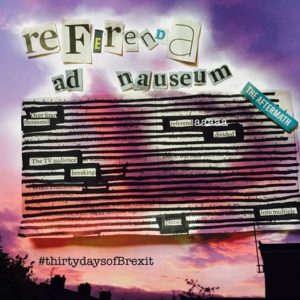
Sophie FB1

This needs challenging, questioning and changing dramatically. Our media is homogenised and overtly right-wing which is why Jeremy Corbyn is getting such a roasting.
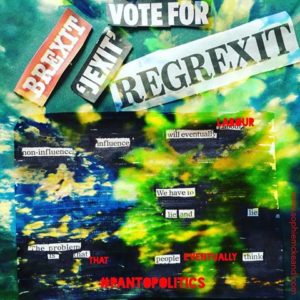
SOPHIE IMAGE 2

I personally believe he is, hated by the political and media establishment, the underdog the British public will get behind in the future. We’re sick of cock-swinging politics and many like his quiet socialism, his let’s-have-tea-with-your-nan approach. I think he is someone who could reach out to Plaid Cymru, the SNP and Northern Ireland, creating a united group of countries.
sOPHIE FB 3

https://www.instagram.com/sophie_mckeand/

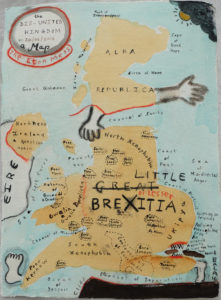
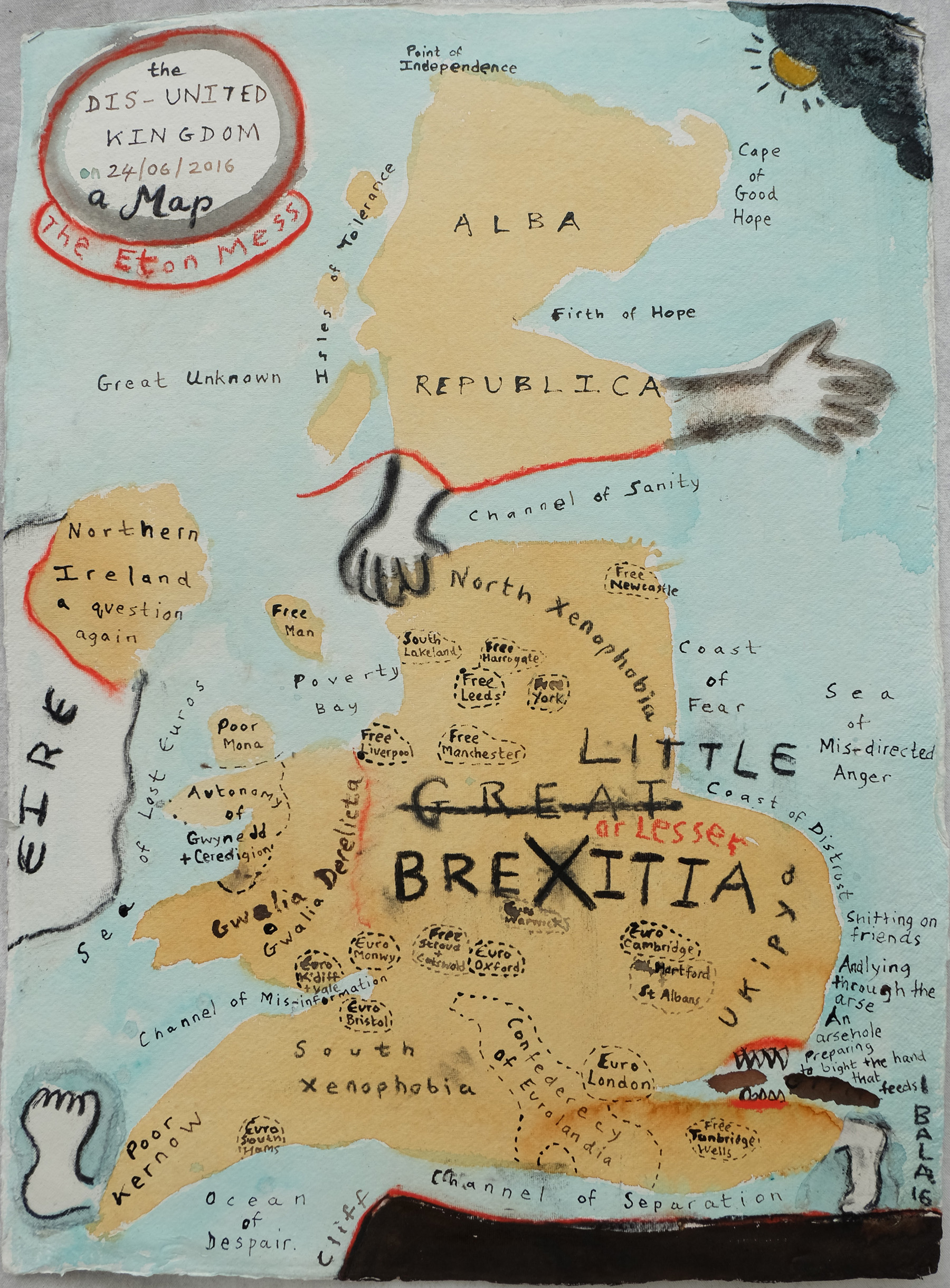
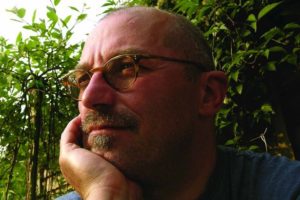
Iwan Bala Visual Artist 
iwan bala
 
'Dis-United Kingdom'

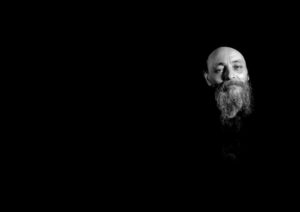
Keith Murrell Community Artist 

216064_10151508187706874_1938320101_n

I should preface my response by saying that I didn’t vote

I’m not registered at the moment because I have no permanent address – I know there is still an option to register but I don’t feel like sharing my personal circumstances with the bureaucracy. Having said that: I’ve never been overly engaged with the ‘democratic process’ and have very little (none) faith in the political party system – I’ve only voted a couple of times in my life and that was about issues rather ideologies … at the previous general election I voted ‘Green’ not because I thought they could win but in order to show support and help them to keep their deposit. Had I been registered this time around I would have voted to remain: this in itself is more of an instinctive reaction to the politics of those who want to leave, rather than any shining virtues of the EU.

I personally have little regard for ‘national identity’, borders, or flags and I tend to think more in terms of community and the planet. In that respect, I’d find it more plausible to think of myself as a citizen of an actual place (i.e. Europe) than being a subject in some archaic theme park called GB, UK or whatever it might say on the vellum.

In practical terms: I think the EU is of great value with regards to the advancement of things such as Human Rights, Employment Law and Environmental issues, etc. On the other hand, I’m not particularly enamoured about the impact of European funding for ‘socially targeted’ projects. Having worked on several such projects with a total value of several £millions I witnessed most of that money being directed towards vested interests more than improving the communities intended… and at worst Euro funding has been used to disrupt, dis-empower and displace communities… Butetown has had more than £1billion of EU money and where is it now?

Outside of Cardiff – the areas of Wales which receive the most EU funding voted to leave and irrespective of the politics behind the individual votes this must be seen as indictment of the public and voluntary sector in the delivering the EU programme.

With regards to the political campaigns the apparent choice was between buffoons and liars (clowns to left, jokers to the right …) I didn’t hear anything convincing from either side but then again I wasn’t paying much attention.

Regardless, I reckon the high turnout was due to the media hyperbole rather than any actual knowledge of or even interest in the EU … it’s quite bizarre to think that people might be more concerned about the goings on in Brussels than their own Town Hall.

In the event, I was a little surprised – and disappointed – with the result: mainly because it demonstrates the prevalence of such retrogressive attitudes – and might encourage / permit more people to think more along these lines. Then again, it seems that there was a generational factor in the voting with the implication that the younger people think differently and in time they will lead the debate – if losing this referendum mobilise young people then that will be a good thing …

But my Facebook timeline was inundated with angry / fearful posts about the future without the EU – and my response was “it’s actually not that bad” …

The media, pundits, etc have great fondness for using terms like ‘historic’, ‘pivotal’ and ‘once in a lifetime’ because it makes their role in the affair all the more important – every major political, sporting or scientific event is presented this way – and the public buys it because it makes their lives seem less mundane – but in reality nobody is interested in history but historians: you couldn’t go into into your local pub or corner shop and hear about the economic impact of the Versaille Treaty – very few people in Wales were preoccupied with Wales’ history in the European Championships until the TV reminded us and if Wales should actually win it will pale into insignificance in little more than a decade

I don’t claim to know anything about macro-economics (which makes me better informed than most) but I do know that the actual economy has very little to do with elections (although I will also say that every penny earned and spent is a vote cast)

I personally don’t have any property, investments or pension to speak of and I have quite a low maintenance lifestyle – so market shifts mean little to me – but for those that have those concerns I would say that ‘there is many a slip between cup and lip’ so there will always be the potential that they could lose out but similarly there’s about as much chance that the pendulum will swing and at some point they may be ahead – and this has been the case from the Bible to Barings Bank

I don’t have a passport and have never travelled outside of Wales & England – so again the whole notion of passports, visas, etc has little impact on me directly – but I don’t know that I would be too bothered about filling in some forms if I wanted to visit somewhere that badly – and perhaps people should travel around Wales a bit more 🙂

Dr Emily Garside
Dr Emily Garside

I am sad, I am angry, I am disappointed. Above all I am frustrated. Frustrated with the politicians who led us to here, with the media who helped further campaigns fought on little or misinformation. And I’m frustrated with those who say because it was a ‘democratic’ vote we must all sit back and quietly accept the decision. I accept that the vote was democratic, I accept people’s right to vote Leave. I don’t have to be happy about it. Thatcher was elected democratically and I’m still angry with that, and the implications of what she did while in office. And much like what Thatcher’s government did to this country, to the poorest areas and to the arts, I fear that the decision to leave Europe will be felt for generations to come. And much like in Thatcher’s reign, Wales is a place where the hits will be felt hardest.

In Wales you really don’t have to look far to see one of those little signs with the European flag that let you know the building that was repaired, the social space rebuilt or the arts centre allowed to continue is still there because of European funding. So much of Wales has been rebuilt in literal and cultural terms by the EU, and that so many areas, so many voters let xenophobic notions and unfounded immigration fears blind them to that scares me.

I fear for our artists and our art. I fear for the millions in lost funding that the arts in all their forms are reliant on. Wales has always been outward facing in it’s art. We invite the world to share our stages for Eisteddfod every year. We hold festivals that people travel to from the world over. And we collaborate, we share, we create. It’s in our very nature as a nation of artists. And it is this loss of collaboration I fear most. When paperwork halts free movement, when isolationism means the hurdles are too great to overcome to collaborate and yes, when we no longer have access to the funding we do now, because we cut ourselves off.

It seems reductive, gauche even to reduce my fears about arts in Wales to funding and travel, but these are the vital tools that give our arts life. In cutting off the vital lifeline of European funding, and building barriers to ease of travel to share what work we can still create, what then? I think of all the work unmade, the opportunities not shared, and it breaks my heart.

The ‘leave’ campaign seems to be fought and now won on a backward looking attitude, a yearning for a country that in fact never was. If we look at Wales before EU funding we were crumbling, our arts were suffering. There are no ‘good old days’ to go back to. What an open Europe has done is open the doors to collaboration, to inspiration and to forward thinking, forward motion. To quote Tony Kushner ‘The world only spins forward’, and yet we seem to have voted to try and stop.

What now? That’s the question isn’t it. When you (democratically) vote in a government you know roughly what’s coming, for better or worse. You know policies, personalities and in four years you have the hope that they’ll be gone. Europe is a leap in the dark. The fear is real because the answer to the question of ‘what now?’ is ‘nobody knows’.

The most anger I feel is towards those who tell us all to ‘just calm down’ as if this was a bad football score (not that I hope to jinx Wales’ chances, football is about the only ray of hope I can see right now, and I don’t even like the sport!).  But maybe there’s hope in that. In the anger. If there’s one thing the arts does well it’s respond to crisis. And that is where I do have hope. I have hope in the voices of the artists, and will of the arts companies to keep fighting. To keep working however we can.

Yvonne Murphy Omidaze Productions
Yvonne Murphy thumb

The referendum result is not binding. It is advisory. Parliament is not bound to commit itself in that same direction. I do not believe the referendum was managed in a fair and democratic way and since the Leave campaign spoke so highly of sovereignty I wish British Parliament to enact it’s sovereign right in overruling the referendum result in the best interests of Britain and ALL its people and its future generations.

And so I have launched a petition. Here is the wording:

Sovereign British Parliament to debate EU referendum result & vote to overrule.

The British Parliament is sovereign and it is accountable to the people through elections at which we choose those whom we want to represent us, NOT through referendums. MPs are our representatives & are there to decide what, in their judgement, is good for us and the country.

Many Leave voters placed a vote of protest against a range of things not connected to the EU, from austerity cuts, to rising inequality in Britain without actually understanding the facts or the full implication of their vote. This is why we elect MPs in our democratic country to make these decisions. e.g capital punishment was thankfully abolished in the 60’s although a clear majority of the population remained in favour of it. The nearly 50% of the population who voted remain need a hearing.

It takes a few days for a petition to parliament to be processed and approved. So while I wait for that to happen I have written this article/blog. The petition circulating and gathering millions of votes asking for a second referendum (which I signed) was started in May by a Leave campaigner worried that we would get a Remain result! I do not particularly want a second referendum. I want parliament to deal with this.  I didn’t want a referendum in the first place. Nor did at least half the country. So why did we have one?

We had a referendum because David Cameron took a high risk strategy with our country’s future to appease the right wing bullies in his party, to silence UKIP and stop the migration of Tory MPs to that party. He took that risk because he did not for one moment think the country would vote out. Even the man who ran against him (Boris) did not for one moment think we should leave (which is why he is now furiously back peddling) he simply wanted to ‘play the game’ and raise his profile so he could go for leadership next time round. The Co-leader of the Leave campaign Iain Duncan-Smith in a interview on Friday called the result ‘startling’ not once but twice and appeared to be thinking on the hoof of the next steps ‘well I think what we need to do is get together a group of cross party MPs…and maybe some people from outside…some Lawyers…to work out how to progress….’ No way? Great plan. And so the people of Britain were used as pawns in the games of these rich privileged elite Eton boys to further their own careers.

What they had not understood is how angry the British people are. The divide between the rich and the poor and inequality has grown out of all proportion. We are one of the richest countries in the world and yet food banks have become the accepted norm in every town in Britain. When I told colleagues this on a recent trip to India they thought I was joking. They stood dumbfounded that such poverty existed in the UK. And it does. There are parents going without food in order that their children can eat. Today. In modern Britain. It is a disgrace.

And this is why people voted. They simply could not see or understand how it could get any worse. Because they were lied to by the Leave campaign. They were told if we left the UK millions of pounds would suddenly appear in the coffers of the NHS. They were told immigration was the cause of all their woes and the door would be shut. And this was the worst part. This emphasis and blame on immigrants which has opened the door to far right facism, racism and hatred on our streets and in our communities.

And worse still it has opened the door across Europe to Far Right Extremism with the National Front in France calling for France to follow suit and leave the very institution that was formed post World War II to ensure Facism never again gripped Europe and the world.

Shame on you Boris, Gove and particularly Farage. Shame on all of you for dividing our country. For peddling fear and hatred and intolerance. For picking at a scab until it bled. And shame on you for your lies.

Those who voted Leave were told we would get our country back. From whom? From our fellow countrymen? From the EU citizens who lived here, raise their families, contribute to our society, pay our taxes? Our country is now falling apart before our very eyes. They were told it would be an end to EU regulations. Like the ones which mean our children no longer swim in filthy polluted seas as I did as a child? Or the ones that ensure that workers have to be paid a fair wage and have decent working conditions? Or the one that gave us the Human Rights Act? Or the ones that say that the poorer more deprived areas in the EU (the very ones that voted Leave) must have the lions share of funding? Because they have. I remember Wales in 1992 when I first came here. It is a different country now and that is mainly due to being cited a ‘poor country within the EU’ and receiving a shed load of EU investment.

People in this country are not struggling because we are in the EU. They are struggling because we do not share equally the wealth we have at our disposal and the EU is a mechanism which actually helps share that wealth not hinders it. Without EU membership we will be MUCH MUCH worse off. Economically, culturally and spiritually. Many people voted Leave because they felt things couldn’t get any worse and then voted for the very thing that will absolutely ensure that it does.

 “For many millions of people, this was not just a vote about Europe. It was a howl of anger at politicians and institutions who they felt they were out of touch and had let them down…The British people deserve the chance not to be stuck with the appalling consequences of a Leave campaign that stoked that anger with the lies of Farage, Johnson and Gove.” Mr Farron Lib Dems A spokesperson for the Liberal Democrats said people would feel “betrayed” with the outcome of Brexit and suggested the result had been won on a false prospectus.

And so in the words of the Independent

“All that remains is for someone to have the guts to stand up and say that Brexit is unachievable in reality without an enormous amount of pain and destruction, that cannot be borne. And David Cameron has put the onus of making that statement on the heads of the people who led the Brexit campaign.”

 Which is why I am starting the petition.

Which is why I am writing this.

Which is why I cannot quite believe that Labour – at a time when they should be stepping up and holding every Tory MP (on both sides of the campaign) to account who have brought this mess upon us are instead too busy have a row about leadership (again!!!) and allowing the Torys to rewrite history and yet another false narrative. Park your differences for a few months, unite and serve your country and not your own self-interests and do your job which is to OPPOSE not self-combust at a time when we need an opposition most.

And for my colleague who said

“My only question is what would happen with MPs who want to Remain who represent Leave areas? They’d never get re-elected…”

I say well that is a risk all MPs should be prepared to take. They are there to work in our best interests and not their own and sometimes that means taking the very difficult and unusual decision to NOT do what those who have elected them ask them to do. Because they are our representatives. They have the facts. They have the education. They have the time to read the policy documents which we do not. That is their job. And they must now debate in parliament if the result of this referendum is actually in our country’s best interest. And if the majority truly believe it is not then they must overrule it and face the consequences. That is leadership. Leadership is not easy. That is why they are paid the salaries they are paid. And now they must ALL step up and look into their souls and decide.

Barbara Michaels 3rd Act Critic 
js47465302jpg

Brexit and the Arts in Wales

Now that the initial furore and panic is over, what is the future for the arts on Wales? As with in other parts of the United Kingdom, we have to wait and see. What is certain, however, is that for a time (and who knows how long that time will last?) everything will be in a state of flux.

Disturbingly, when budgets and funding are up for consideration – some might call it up for grabs – the arts are always in the firing line. In Wales, when the arts scene – and I refer particularly to theatre – is expanding as never before, to cut funding at this stage would be close to criminal. This does not apply only to our capital city, where we are spoilt for choice, but to rural areas – take the prestigious Theatre Clywd, for instance. New talent in both writing and performance are emerging all the time, and being given the chance to explore all manner of genres.

My fervent hope is that our government realise this and will continue to give them support. Many of our young people are dismayed by the result of the referendum. It is up to the powers that be to prove to them, and to all of us, that there is indeed Life After Brexit.

Helen Joy 3rd Act Critic
d6429ed76fa53769c7aa197eac03e5d0
An open conversation on Facebook between people who all know me but who don’t necessarily know each other, held in the week of the EU Referendum result.
Each contributor is represented by a different colour text.
 Time for something slightly different: how do you think the vote to leave the EU will affect Arts and Art funding?

The arts economy is marginal at the best of times. I can’t see this having an exaggerated effect on funding. A great deal of Arts Council funding comes from the lottery rather than government revenues.

Some 2yr + bids being wound up where applying for EU funding. Not arts bids.

It’s the cutting of cultural ties I worry about, the Little Britain mentality and the feeling that we can go it alone. I’ve always liked feeling European.

We are used now to a sense of continental culture, the arts seem to benefit from both being carriers of local identity AND being representative of something wider.

If a cultural tie depends on the blessing of a bureaucrat, or still worse funding from one, what is it worth? The ‘cultural economy’ as a whole is huge; it was revealed a few years ago that this country earns more from computer game design than from agriculture. However, it had never asked for or received a penny of government funding, so nobody noticed.’ Culture’ is what people do of their own volition. Start steering it with subsidy, and it becomes something else. That’s how we get the grotesque spectacle of state-funded ‘satirists’ on the BBC.

Sure, to quote Raymond Williams, ‘culture is ordinary’. However, the BBC isn’t the State, that’s a line peddled by James Murdoch.

It’s no longer disputed that the licence fee is a tax (one I don’t pay); the BBC’s establishmentarian bias on many topics is now beyond satire, not least on the referendum issue. It’s notable that two of the best cultural institutions in London, Shakespeare’s Globe and the Handel Festival, don’t ask for or receive state funding.

Maybe I just like the way the BBC presents the bias. In a world completely reliant on private funding or ‘sponsorship’ we’d have a lot less culture and most of it would have to satisfy the paymasters. I’d rather satisfy the Arts Council’s remit than try to please Monsanto.

Culture always has to satisfy the paymasters. I’d prefer those paymasters to be you, me and the people around us! Would you say that our film industry was more dynamic and creative than America’s? Most of the TV I watch now is American-made.

Wouldn’t argue with your first point about culture and who pays for it but if I had to rely on things I could sell I’d be doing something very different. I don’t have anything sensible to say about film and TV. I could happily live without it.

Have they actually had any, or is this part of the current campaign to whistle up hysteria? I’m currently dealing with people on my local FB page, putting up pictures of people they accuse of racist remarks, without any evidence to back it up.

We need to build new structures we need to encourage philanthropy we need to not be scared of making money

Did you know that artists, writers, musicians here (Ireland) pay NO tax? Legacy from Charlie Haughey.

Who decides whether what they do is ‘art’ ?

No idea, presume Arts Council.

I think it’s older than Haughey’s time ; John Huston moved his family to Ireland back in the 60’s, I believe. So the bureaucrats sit in judgment on the artists, who have to meet their criteria? H’m. Curious how there always seem to be salaried posts for arts bureaucrats, but not for artists. A friend once showed me the telephone extension list at the UK Arts Council: more names than the Menin Gate. You’d get more money to artists by summoning them all to Trafalgar Square on a given day and dropping the annual budget in pound coins out of a helicopter.

So not even arts bureaucrats, but the Revenue Commissioners, are the judge of the artistic merit of your work:

http://www.citizensinformation.ie/…/artists_exemptionArtist’s exemption from income tax. Some income earned by artists, writers, sculptors and painters in Ireland from the sale of their work may be exempt from income tax. How to obtain exemption from income tax if you are an artist and satisfy certain criteria…

No was Haughey who introduced it.

Or just work to a different model – fund public art but let the market decide on everything else, like an accountant or pianist. Arts Council England – radio 4 now – believe arts will solve problems on our streets

Hearing this, a vision comes to me of a fat abbot, standing outside the glorious choir of some great abbey, saying ‘Without us, who would feed gruel to the poor?’

That’s interesting, not such a surprise I suppose. I’d like to know more.

 

Review Billy Elliot The Musical, WMC, by Barbara Michaels

The-West-End-produciton-of-Billy-Elliot-will-close-after-11-years-on-April-9-PHOTO-Alastair-Muir-700x455
 
 out of 5 stars (4 / 5)
 

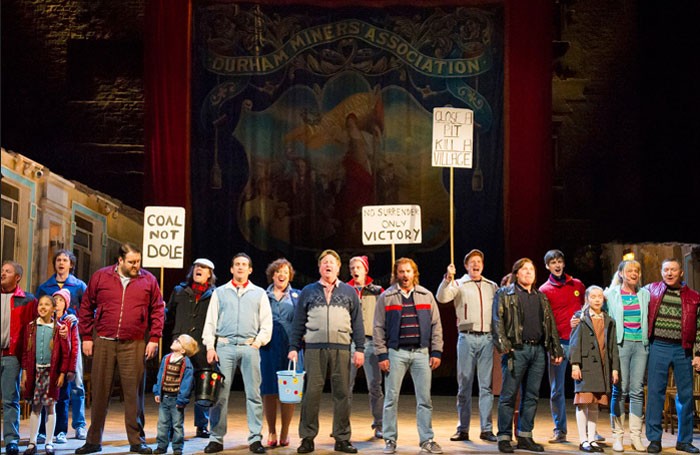
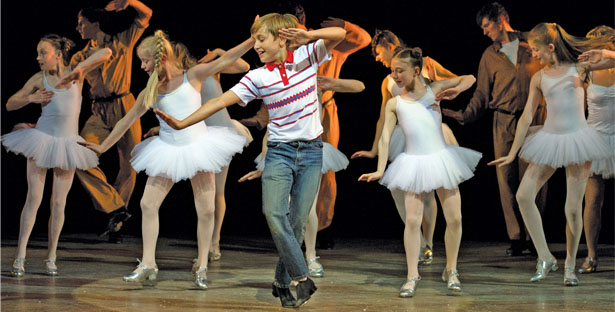
The wow factor is very much to the fore in this production of Billy Elliot – one of the most heart-warming of musicals, it tugs at the heartstrings from the moment it opens. Brought up in the tough environment of a small mining town in the north-east of England during the 1984/85 miners’ strike, young Billy’s passion for dancing leads him to follow his dream. Abandoning his boxing lessons, he secretly joins a ballet class. The only boy, Billy is the subject of much speculation and teasing – some of it malicious. On the home front, it’s even more so. Billy’s elder brother pours scorn on Billy’s dancing and does his best to nip the young boy’s emerging talent in the bud. Spurred on by his ballet teacher, who knows talent when she sees it, Billy is determined to carry on dancing.

Of the four boys who alternate in the super-demanding role of Billy, Lewis Smallman was the one chosen to open in Cardiff. His was a Billy that we all know – a schoolboy going straight to the biscuit tin when he gets home. But this Billy is still grieving for the loss of his mum, and Smallman manages this part of the role with an expertise beyond his young years, but it is his skill as a dancer that rightly steals the show.

There is star quality here. This Billy is equally at home in the comically camp dance number in which Billy and his friend Michael (Elliot Stiff) dress up on girls’ clothes to the elegant precision of a version of Swan lake performed with an older Billy (Luke Cinque-White)in a dreamlike sequence in the second half – not in the original film but blending in perfectly. Martin Walsh, as Billy’s Dad, struggling both with the deprivations of the strike with no money coming and the problems of a recently bereaved father trying to bring up a young son on his own, brings a depth of understanding to the role, displaying both toughness and vulnerability. As Billy’s dancing teacher Mrs Wilkinson, who knows talent when she sees it, Annette McLaughlin has the role off pat – under no illusions as to her own teaching, and generous in spirit, cigarette puffing when the opportunity arises and with the big-hearted generosity that characterises the north.
deal_1385044073

Peter Darling’s choreography for the tour differs slightly from the West End production, particularly in the foot-tapping number ‘Born to Boogie’ but most of the sensational dance numbers are the same – and pretty amazing they are, too, doing full justice to Elton John’s lyrical and swinging score in musical numbers that make you want to jump from your seat and join in. A small caveat –which seems almost invidious in the face of such talent – is that several cast members, including Smallman, have not entirely overcome the difficulties of the north east of England dialect.

The darker side of the story is the miner’s strike, and the stand-off between Thatcher’s government and the National Union of Mineworkers, with scenes played out at the pit face of one of the mines threatened with closure, and in the working men’s club where the miners hold their meetings, and the soup kitchen which is established there for the hungry miners and their families during the strike. Light relief is there, too, in the shape of Grandma – not always quite with it (she hides her pasty in the bedclothes much to her grandson’s disgust!). Andrea Miller’s Grandma is a great cameo, displaying a love and empathy for, and with, Billy and his dreams with which many grandparents will identify.

Overall, though, Billy Elliot belongs to the young, and the ensemble of dancers and singers more than do it justice. Bravo!

Runs until 16th July at the WMC
https://www.wmc.org.uk/Productions/2016-2017/DonaldGordonTheatre/BillyElliot/

Writer: Lee Hall
Music: Elton John
Choreographer: Peter Darling
Director: Stephen Daldry

Welsh Playwrights, An interview with Tony Wright

2

Get the Chance values the role playwrights living and working in Wales bring to the cultural life of our nation.  Here is our first interview in this series with Welsh playwright Tony Wright.

Hi Tony great to meet you, can you give our readers some background information on yourself please?

Sure, so my name is Tony Wright my dad was Jamaican and my mum was Welsh and is from the Valleys. I grew in in Tremorfa, which is near to Splott in Cardiff. I left school without any formal qualifications.

So what got you interested in writing then Tony?

When I was 14 my sister brought a book home the Contender, it was a boxing book and this was the first book I picked up myself and was interested in. This developed an interest in literature for me so I then started to go to the library myself to read. Inspired by the book I tried boxing but it wasn’t really for me, it was too painful!

When I was 16 my friends formed a band called Level Vibes and I was the guitarist. I didn’t stay with the band for very long and I quickly realised that I couldn’t really play guitar but I could write lyrics, so I started to write lyrics for the band. I wrote a couple of things and my claim to fame is I wrote a song for a Benji Webb who now fronts the band called Skindred. Benji cut his first 12-inch single for a song I wrote called ‘Plant a Seed.’

http://www.barddgriot-productions.com/#!eyes–dont–lie-bottom–page-plant-a-see/ctc7

That’s a great claim to fame! So what did you do then?

I realised then that I could write! I set up my own band Digital and we did a few gigs at Grassroots in Cardiff. Which is a drop in youth centre with a music studio, an excellent place! Two of my songs stayed in the set for Level Vibes and their profile really developed they were talked about as the Welsh UB40. Level Vibes members also included rap poet Leon Charles

http://www.walesonline.co.uk/news/wales-news/1970s-butetown-in-photos-2075339

http://www.literaturewales.org/writers-of-wales/i/129552/desc/charles-leon/

Digital didn’t really take off and when I was about 30 I was offered the chance to access some adult education courses and went to the Friary and Coleg Glen Hafren in Cardiff I learnt during the adult education courses that I was dyslexic. I think dyslexia wasn’t as widely known then. My tutors informed me I should have had an A grades but because of my dyslexia I got a C’s, which made me really angry and frustrated. I continued to want to learn and managed to get to university and studied a combined studies course on Media, History and Cultural studies. Much of my studies were based on subcultures and Rude Boy culture. During the course I learnt about scriptwriting. Again my tutor informed me that they thought I had dyslexia. I had a test and was diagnosed with severe dyslexia. I realised I if I had have been diagnosed earlier I would have received support but I didn’t and still don’t let my dyslexia hold me back.

Whilst on the course I wrote my first full-length script called ‘Climbing Out’ about a mixed race guy from Splott who was given the chance to move down to Cardiff Bay. I thought it was good and I just had to do something with it. So I went to Splott with no money just my script and spoke to people on the street and asked them if they wanted to be in my film! John Allen who worked at Chapter supported me; he very kindly gave us a space to work in. We booked the YMCA in Splott for 4 nights and it was one of the best things I have ever done. It was hard and a struggle we funded the performances ourselves with some in-kind support. At that time there wasn’t many mixed race black actors seen acting in Wales. The audience loved it, they where mainly the community and friends. For lots of the audience it was the first time they had seen a play with people in it that they could identify with and they said, “We want to see more!”

To do that yourself takes a lot of drive and ambition Tony, did you approach the Arts Council of Wales or similar organisations for funding or support?

Yes I went to Arts Council Wales for funding but I was unsuccessful in my application at the time, as I didn’t have 2 years trading or bank accounts. This was a barrier for me but they were flexible and asked to see if I had some evidence of trading. From then on we started to develop a relationship and discuss how they could support me. Since then I have had lots of support from ACW officers Jennifer Stoves, Melanie Hawthorn and Nick Davies. They know my work and me.

So with the success of your first play I wonder if you then wanted to develop your play writing skills?

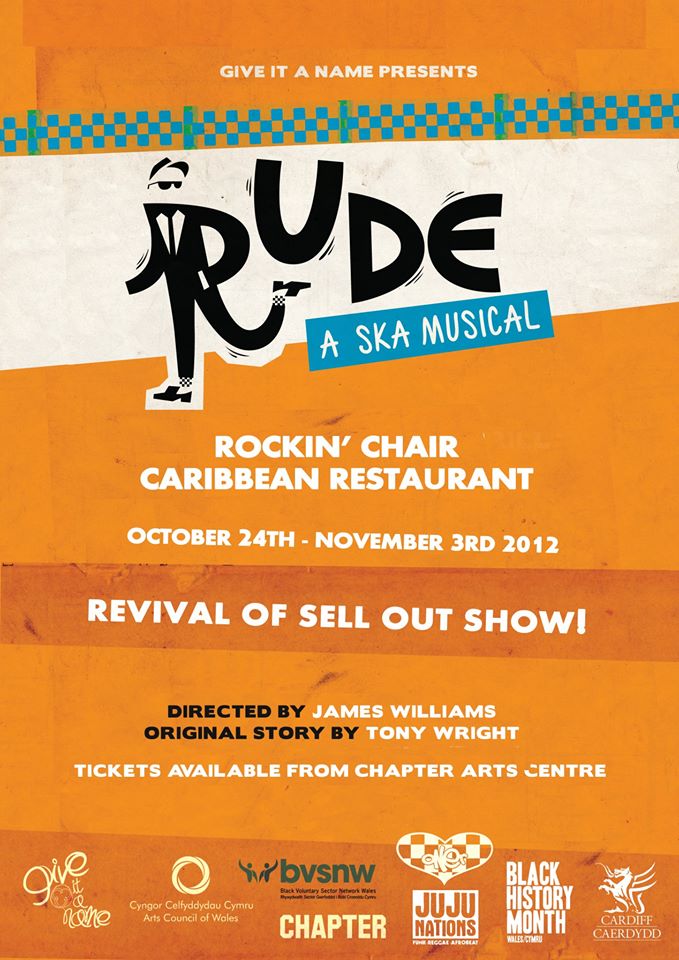
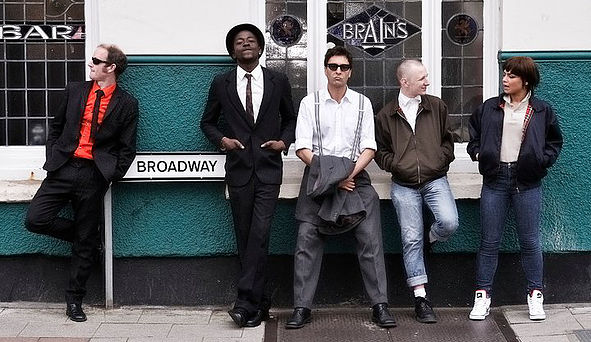
258611_10151260965619283_1828133446_oWell they say to write about what you know so… my next project developed out of my knowledge of Reggae sound systems and Rude Boy culture, music was and is the thing that brings lots of my friends together. ‘Rude’ is became a Ska musical about a mixed race guy in Cardiff called Roddy, the play focus’ on him looking back at his teenage rude boy-self and the characters, culture and music that informed his youth.

c5d116_53266f2aa02a4056883dcaf7ef98311d

The cast of Rude 

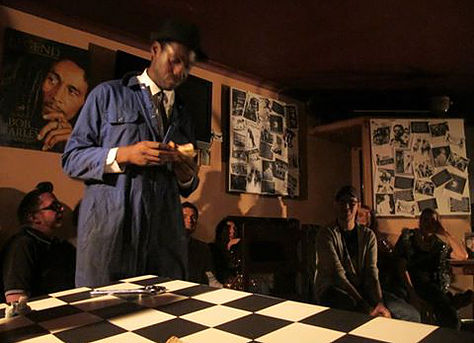
The project developed when I met with a guy called Dave Norton and James Williams. I met Dave in a bar and we got talking and I found out that Dave was an actor and producer with his own theatre company called ‘Give it a Name.’ We started working on it together in 2009 it was produced twice in 2009 and 2012,  the second time as part of Black History Month. The play featured Shekira Johnson, Brent Morgan, John Norton, Dean Rehman, Joe Shire, and Olly Wood. James Williams who is a Musical Director was also the plays director. We performed it in the Rockin’ Chair Bar and Grill, in Riverside, Cardiff which was a Caribbean restaurant.

Performing it there meant we took theatre into a place it’s not normally shown. It was all staged in the restaurant. There were people sitting eating and the play was happening around them. The actors improvised with the audience it was excellent. There was one part of the show where the cast pretend to fight and one of the local bouncers jumped in to stop the fight thinking it was real! We had to say, “No Dave mate it’s a play!” James also got the excellent band together. They were Jenny Bradley, Fran Dimech, Chay Lockyer, Eric Martin Jr, and Gregg Price.

c5d116_758052df476b40c2b893a55de7a69038

I love the fact that the production was performed in a restaurant and not a traditional theatre space and really involved the audience. So to bring us up to date what have you been up to recently?

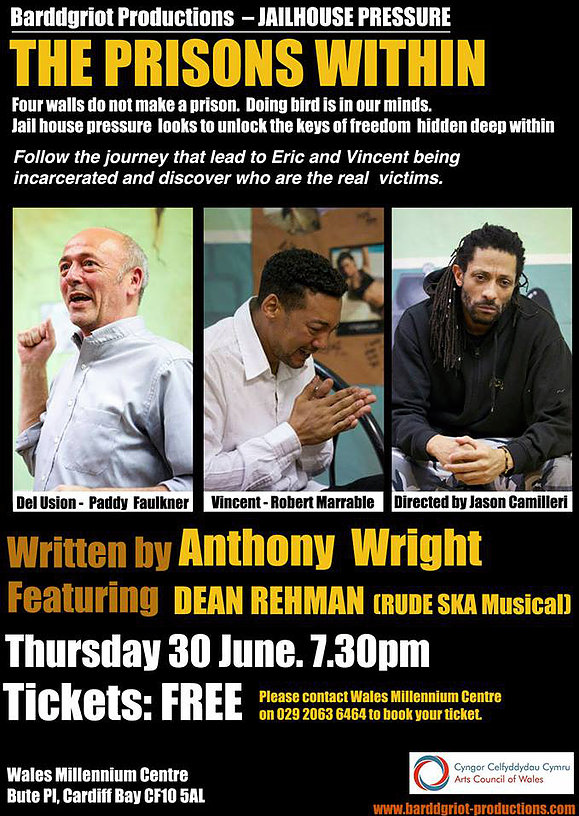
Well I am 53 I have been thinking to myself no more Art stuff. All my mates are retiring and I am thinking about getting a job! I started doing some voluntary work at Butetown History and Arts Centre and enjoyed meeting the different people that use the building. Whilst volunteering there I supported a project with MIND and a campaign called ‘Time to Change’ I was approached to work one project called Mental Notes – Beyond Words. I developed a piece of drama called ‘The Prisons Within’ I personally know a lot of people who have gone to prison with mental health problems and the importance of getting help. The play is set in a prison with two men in the same cell. In turns out one has OCD and one has depression. Del Lusion is one character and he is a symptom of mental health problems. He winds up the other character in the play. During the play the two characters get to know each other and talk about how they ended up in prison.

AJP_ECH_241114notes_04JPG

 The Prison Withins cast members Paddy Faulkner and Jason Camilleri

The play ends on a positive note and shows that you need to talk if you have mental health issues. The play was performed by actors Paddy Faulkner, Robert Marrable and Jason Camilleri and directed by Jemma Llewellyn

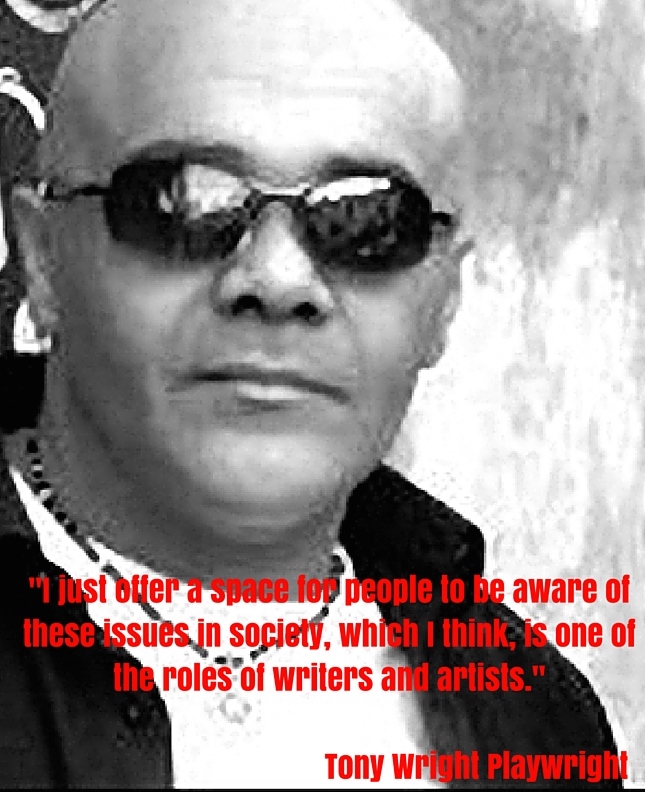
With the play I don’t offer any solutions to mental health problems I just offer a space for people to be aware of these issues in society, which I think, is one of the roles of writers and artists.

Sounds great I believe the production is going to be staged again soon? When will we be able to see the production Tony?

The play will be performed at The Wales Millennium Centre on Thursday the 30th June at 7.30 pm. The cast for this performance will include Jonny Hollywood/Robert Marrable and Paddy Faulkner. It will be directed by Jason Camilleri.

c5d116_c7409f916c754b359a34340a194aeb1c

The play will also be performed at Parc Prison, Bridgend as part of their staff training next month.

If you would like a free ticket  go to my website and send me a message. http://www.barddgriot-productions.com/#!lets_talk/con8

One of the reasons I formed my company Barddgriot- Productios was to maintain working with a talented multi-cultural team of people living in and working in Wales. As I have mentioned I have had the pleasure of working with a wealth of talented people in my career. I have also been supported by people like Director Greg Cullen who directed a short play I wrote at the Royal Welsh College of Music and Drama. I hope to continue to work with more of the brilliant artists and writers in Wales in the future!

http://www.barddgriot-productions.com

Thanks for your time Tony

Interview Ellie Kate Edwards and Penarth Circus

13428622_10154372315925649_9127920171093585876_n

Our project coordinator recently spoke to Ellie Kate Edwards about her background in Circus and her plans for a new Circus School and festival events in Penarth.

Hi Ellie you have a background in training with Circomedia and No Fit State Circus. Is it possible to give our readers some background information on yourself?

 Yes, I am from a little village In Caerphilly. I spent most of my childhood around horses and adventuring in the mountains. I loved dance and music. I was inspired by circus when I saw NoFit State’s ‘Immortal’ in Barry. It was the start of my obsession with circus. At the time I was studying social work and left the course to follow my passion. I started training in the South of Spain with a beautiful travelling community. They had an aerial rig in the most idyllic setting. I would train all day long getting blinded by the sun . I used to love looking at the sky line of the mountains while I was upside down. It was there that I decided to follow circus as a career and returned to study in Bristol.

13450836_10154372318785649_7938954852302804786_n

Photographic Credit Paul Ripley

Thanks, was  there a moment when you thought, “this is the career for me?”

Absolutely, it’s an incredibly demanding and competitive career. I sometimes I think it must be very nice to have a fixed contract, paid holidays and some security in your work. Having said that I love circus and I would feel totally at a loss without it.  I have put countless hours into my passion and when you put so much love and work into something it becomes part of you.  I wouldn’t want to change that.

Are there any individuals or organisations that helped support you once you realised a career in circus was for you?

I have had a huge support from Nofit State all the way through my career. From helping with audition pieces, a traineeship and guidance with new circus ventures. There has always been someone from NoFit State with the right bit of support at exactly the right moment.

Awareness of circus as an art form is growing, organisations like No Fit State are leading the way in circus across the world.  In your opinion what is need to help the art form develop?

Circus is at a very exciting time in its development, It will be very interesting to see which directions it will take. When we train in circus schools we are allowed a period of time where we can be very creative and inquisitive with circus as a new art form, we can develop our skills as individuals find the material which is unique to each circus performer within their discipline and so prevent ever trapeze artist from performing the same routine.

Once we leave circus schools we very quickly learn that the opportunity for this creative exploration is limited and to make a career in circus we very quickly have to produce the work which is in demand. If we could access funding we could return to this with time to collaborations with other circus performers and artists from different art forms. We could again explore the opportunities to make circus political and find the possibilities for progression. There are a lot of possibilities and avenues to be explored still but circus performers and directors need to time and resources to research. I have recently started to put on circus events in my local area. I am finding that there are many venues who want to have circus shows in there venue as it reaches a large and diverse audience. The problem is it costs a lot of money to bring circus shows to venues and so it can only happen if the venue, company or a combination are prepared to take big financial risks. Opportunities to find match funding or funding to help venues set us as a circus venue could help this to happen.

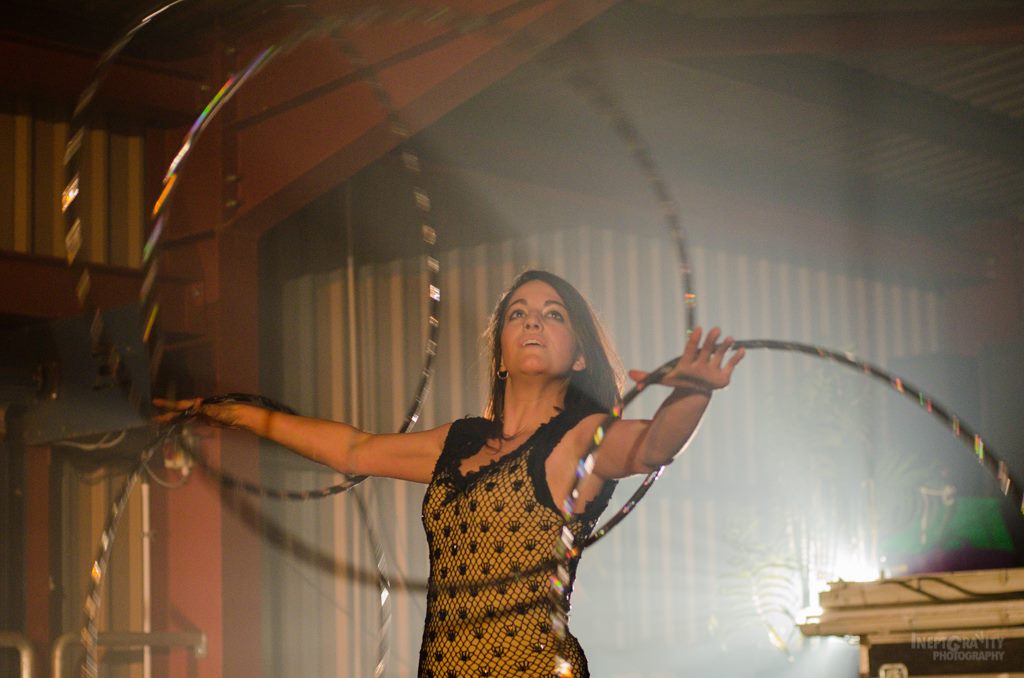
Ineptgravity Photography

Photographic Credit Ineptgravity Photography.

You frequently support workshop activity with members of the public, do you think this type of activity is important and why?

Circus has always been a temporary moment of magic which would bring communities together to share the experience. Although the tent would get packed away and the circus would leave it would leave behind a mark and memories on a landscape. I think that re engaging with this shared creative energy which brings communities together can only be a positive thing.  I love how accessible circus is. There is something for everyone. It is a joy full activity to learn with constant challenges but also many small victories along the way. To begin with it is subtly physical and great for our physical and mental wellbeing. It teaches children to support and look after each other and allows adults to connect and get stronger and fitter but through a creative medium.

What are the opportunities for those interested in circus in Wales?

 You are lucky to live in Wales!  The opportunities are vast. No Fit state run a full program of classes for adults and young people in Cardiff the community there is vibrant supportive and addictive. You can also check out the opportunities for circus in other areas of Wales. There are many established community circuses offering training in different areas around Wales.

13445421_10154372321955649_6388892122230608134_n

Photographic Credit Thomas Madhavan.

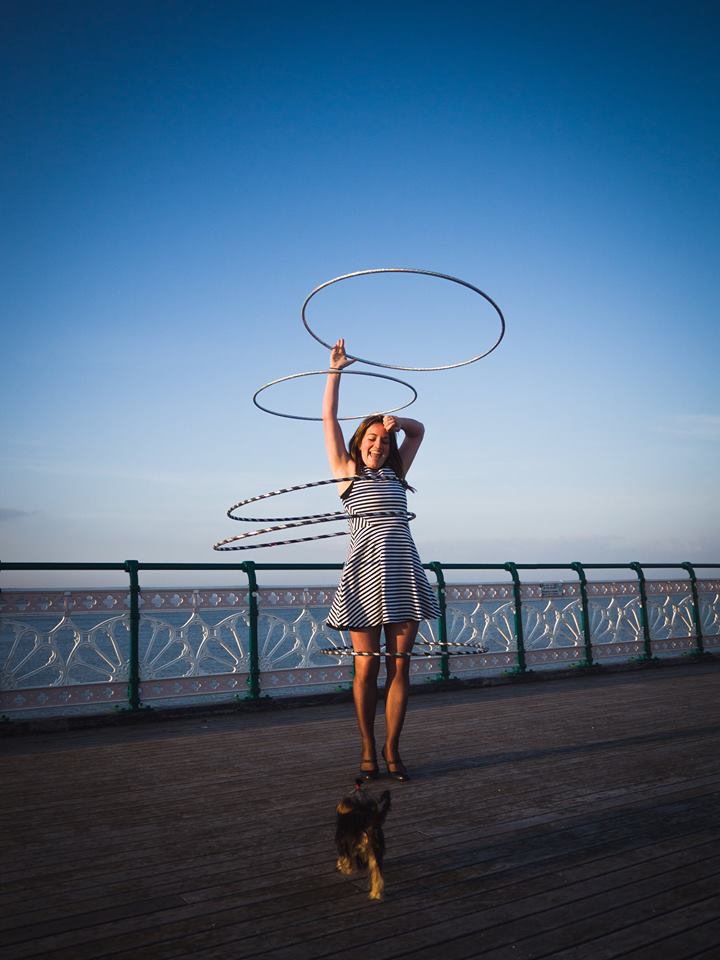
Elaine Bennett Co-founder of Penarth Circus and myself are so passionate about circus we would like to bring it to our doors steps. So we have started Circus Penarth. Over the summer we will be putting on workshops at many events and also we will be bringing some spectacular performances to Penarth Pier and other Vale of Glamorgan venues. We are hoping to start classes in Penarth over the winter.

That sounds great! If you were in charge of funding the arts in Wales what would be your priorities?

I would priorities bringing arts to vulnerable communities who could benefit from creativity. I think art can be used as a tool for empowerment and progress so why not channel it to communities who need this.  Having gained so much from the support of NoFit State Circus I would love to see the community in Cardiff continue to develop so they can keep giving this support to other people.  I would definitely prioritise keeping this community in Cardiff and  finding them a permanent community space. I would make the opportunities for funding more transparent and accessible to artists who are starting out and I would put a lot of energy in to keeping artists working as artists.

When you aren’t performing what do you like to do in your spare time?

I like to climb mountains, paddle in the sea and watch my little boy grow up very quickly. I love playing the piano accordion and currently I enjoy spending lots of my free time on Penarth Pier.

You are involved in some summer events at Penarth Pier can we know more?

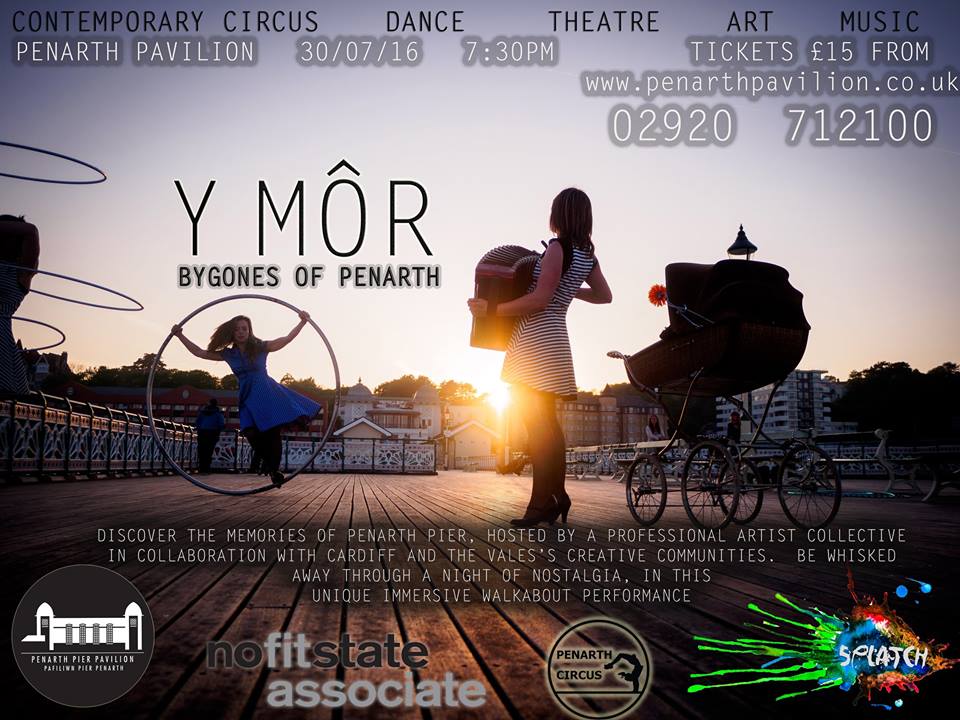
 Yes.  We are organising and event called Y Môr – Bygones of Penarth, It will be performed in and around Penarth Pavilion on the 30th of July.  The event will involve local creative communities who will be supported by a professional cast and directed by Olga Ina Morati. We hope to bring the pier and pavilion to life in an immersive promenade performance recreating memories from Penarth pier through different points in history.

Over the summer we will also be performing and facilitating workshops at different Penarth events and festivals. Every Saturday in August we will be organising different circus and theatre acts as well as street shows to perform on the pier. We will keep you updated with our performances and visiting acts on our Penarth Circus Facebook page.

https://www.facebook.com/groups/231548013900190/

How do we get involved in your circus projects?

We are looking for community members who are interested in sharing their memories of Penarth Pier for Y Mor – Bygones of Penarth and also any creative individuals or groups who would like to get involved in the evenings events. If you are interested please contact us on; cardiffsplatch@gmail.com or through our Facebook page.

 Sounds great, many thanks for your time

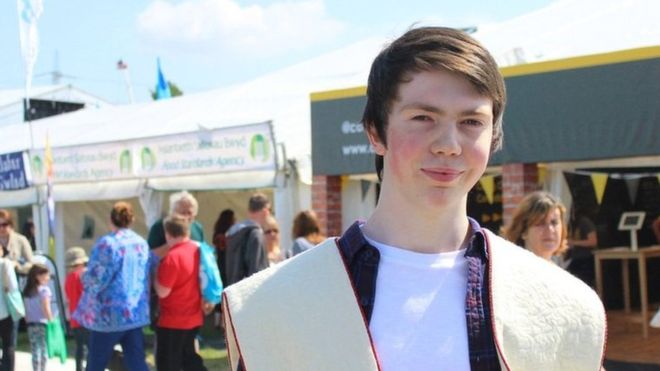
Ennillodd Gwynfor Dafydd o Rhondda Cynnon Taf Y Gadair yn yr Eisteddfod 2016 am ei gerdd, sydd am y Cymoedd yn Ne Cymru cyn yr oes diwydiannol/Gwynfor Dafydd from Rhondda Cynnon Taf wins The Chair at The Eisteddfod 2016 for his poem about the post-industry valleys of South Wales.

_89867343_gwynfor2

Ennillodd Gwynfor Dafydd o Rhondda Cynnon Taf Y Gadair yn yr Eisteddfod 2016 am ei gerdd, sydd am y Cymoedd yn Ne Cymru cyn yr oes diwydiannol/Gwynfor Dafydd from Rhondda Cynnon Taf wins The Chair at The Eisteddfod 2016 for his poem about the post-industry valleys of South Wales.

Bywgraffiad

Bachgen deunaw oed o Donyrefail ydw i, sydd ar hyn o bryd yn ddisgybl yn Ysgol Llanhari, a chyn hynny fe fûm yn ddisgybl yn Ysgol Gynradd Gymraeg Tonyrefail. Yr wyf wrth fy modd yn astudio ieithoedd, ac felly os caf y graddau gofynnol, gobeithiaf fynd i Goleg yr Iesu yng Nghaegrawnt y flwyddyn nesaf er mwyn astudio Sbaeneg ac Almaeneg ab initio.

Cerdd am fro fy mebyd ydyw’r gerdd hon sy’n ymateb i erthygl a ddarllenais i â’r pennawd ‘The unbearable sadness of the Welsh valleys.’ Felly, mae hi’n trafod themâu megis ‘anghyfiawnder cymdeithasol’, ‘tlodi’ a ‘diweithdra’ a’r problemau anochel a ddaw law y llaw â hyn. Er hyn, fe geir y teimlad bod cymuned yn mynd i gamu ymlaen erbyn y gerdd olaf, a herio’r sefydliad er mwyn creu cymuned decach a sosialaidd.

I am an eighteen-year-old boy from Tonyrefail, and am currently a student at Ysgol Llanhari, and before that I attended Ysgol Gynradd Gymraeg Tonyrefail. I enjoy studying languages, and am hoping to go to Cambridge next year to study Spanish and German ab initio, if I obtain the necessary grades.

This is a poem about the unjust treatment of the place in which I was born, responding to a poignant article that I had read with the headline ‘The unbearable sadness of the Welsh valleys.’ Therefore, it discusses themes such as ‘social inequality’, ‘poverty’, ‘unemployment’ and the inevitable consequences of this. However, there is hope in the last poem that the community will challenge the establishment and fight to build an egalitarian and socialist society.

 
‘The unbearable sadness of the Welsh valleys’ – Mark Easton, BBC.
 ‘”Why don’t you leave?” I ask an unemployed man in his 50s. “Because I’m a valleys boy,” comes the reply. “This is home.”’
 Yn datŵ damweiniol
ar noson feddwol, creithiwyd
y lle hwn
yn ddwfn i’r croen
ac i’r cnawd. Nid
fy ffawd, nid fy newis i
oedd deffro i ddyffryn
graffiti a gwm cnoi
lle mae brain yn toi’r
tafarndai a’r capeli a’r siopau.
 
Ond felly y bu.
 
Mae’r graffiti a’r gwm yn glynu,
y tatŵ yn gwrthod crychu,
ac eto,
rwy’n gofyn yn gyson:
 
Ai ni yw dy bobl
ynteu dy wystlon?
 
II
‘Many parts of the UK have suffered from the decline of heavy industry, and the Welsh valleys are a grim emblem of this.’
 
Cerdd Tad-cu beunydd fynyddoedd ei fro,
fel y gwnaeth ganwaith gynt â’i dad-cu e –
yn dilyn ei lwybr at y pyllau glo
a’i mowldiodd yn dalp o bentrefi’r de:
Ceibiwyd ei gefn i frwydro’r gwynt a’r glaw,
weldiwyd ei draed i’r pridd yn gusan hir,
siapiwyd ei ddwylo’n llyw i’w reddfol raw,
a thynnodd ef ddau blentyn bach o’r tir.
Ond heddiw, ar gyfeiliorn, mae ar daith
yn chwilio am fyd sy’n gorwedd fel rhith
dan y bryniau mud a’r twmpathau maith,
a neb i olrhain ei gam ond y gwlith.
Mewn tanchwa drachwantus, daeth gwifrau du
a pheilonau haearn i ardd Tad-cu.
 
III
‘There are no shops around here and the bus to town stops at 6pm. There are children who’ve never been more than a mile or two from their front door.’
 
Mae hi yno’n aros
bob nos yn yr orsaf fysiau.
 
Ni ŵyr pam.
Ni ŵyr i ble mae’r bysiau’n mynd.
Ond gŵyr mai bws yw’r ateb.
 
Rwyt ti wedi ei gweld.
 
Ffroenaist y patrymau
coch
ar hyd ei breichiau.
 
Baglaist dros y caniau gwag
oedd yn ei gwarchae
gan guchio’r minlliw
a staeniodd dy jîns.
 
Cuddiaist glustiau dy blant rhag ei rhegfeydd
(Sh*t. F*ck it. C*nt.)
a gwarafun gweld bod merch fel hon
yn griddfan mewn cynghanedd.
 
A phregethaist dan dy wynt
fod bysiau’n gorffwys
ar ôl chwech.
 
IV
‘Tonight, the place feels abandoned, and many people appear to have given up on God.’
 
Mae’r lle, heno, mor llonydd
â Duw (fel y mae bob dydd),
ei dreigl ar stop, a’i siopau
i gyd â’u shutters ar gau –
rhesi clòs o ddrysau clo
yn hisian … lle bu croeso.
 
Ac mae, heno, gymuned
yn y dump yn chwarae dead
hen le llwyd sy’n casglu llwch,
hen aelwyd mewn anialwch
unig, gwag, cans daeth i’r cwm
hualau … lle bu cwlwm.
 
A heno’n ein cyfannu,
nid oes ond gwe’r gwifrau du –
yn ddi-hid, cyfalaf ddaeth
i hawlio bro brawdoliaeth,
ac mewn ’stâd ddigymen, stêl,
mae’r hen dŷ ’n marw’n dawel.
 
V
‘”Politicians kick us and then they kick us again,” a local despairs.’
 
Mae tlodi’n halogi’n heolydd ni
a’i flas dros weflau’r mynyddoedd tost.
Treiddia ei rym drwy gracs y tai
am nad ydyw’n licio’u cod post.
 
Ymhell, bell dros y dŵr bas
mae ’sgidiau glân a syber-glyd
a droediant yn drwm ar ein strydoedd ni
o bell, bell â’u gwadnau di-hid.
 
Yno, ym mêr y muriau mawrion
mae rhagfarn eu cloc haearnaidd yn byw.
Yma, fe gosbir pawb ’r un fath:
pob hil, pob oed, pob rhyw.
 
Yr un yw’r gri o’r fynwent draw
yn y rhesi hir o feini rhad
a brynodd i’r pellfuddugwyr gynt
eu rhyfel drud ar faes y gad.
 
Ond clywch y drwm yn curo’n rymus
rhwng y cyrff a fwydodd y gweryd â’u gwaed
sy’ heddiw’n had i’r to iau
a dyf o’r dicter dan eu traed.
 
Daw’r curiadau anochel yn amlach,
eu cnulio’n atseinio’n uwch bob tro.
Llyfa’r tir ei wefusau’n wancus
wrth gyfarch eneidiau ‘glanach’ i’r gro.
 
Mae tlodi’n halogi’n heolydd ni,
tlodi sy’n dilyn cod post.
A’r un yw’r ffawd bob ochr i’r ffin –
’dyn ni i gyd yn cyfri’r gost…
Cwm Cnoi
http://www.s4c.cymru/urdd/e_index.php

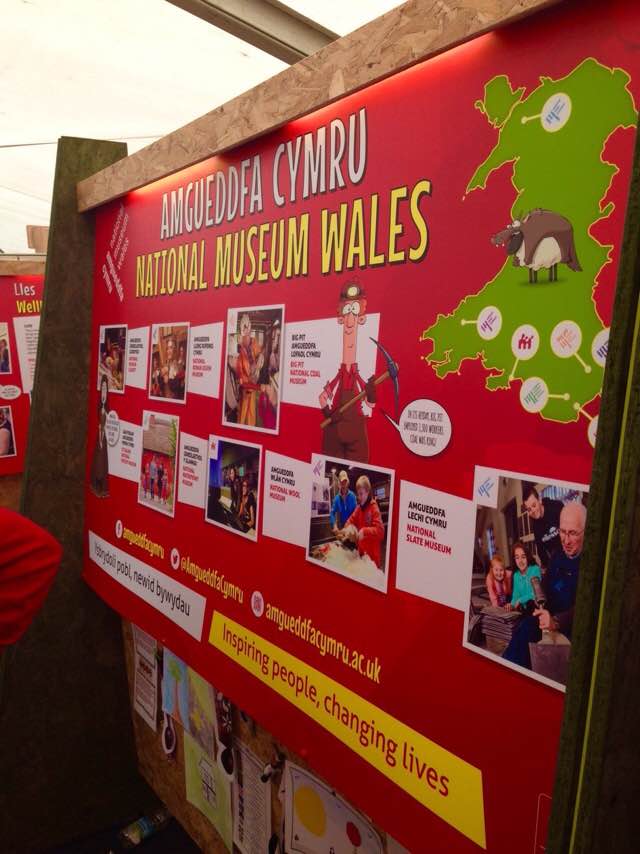
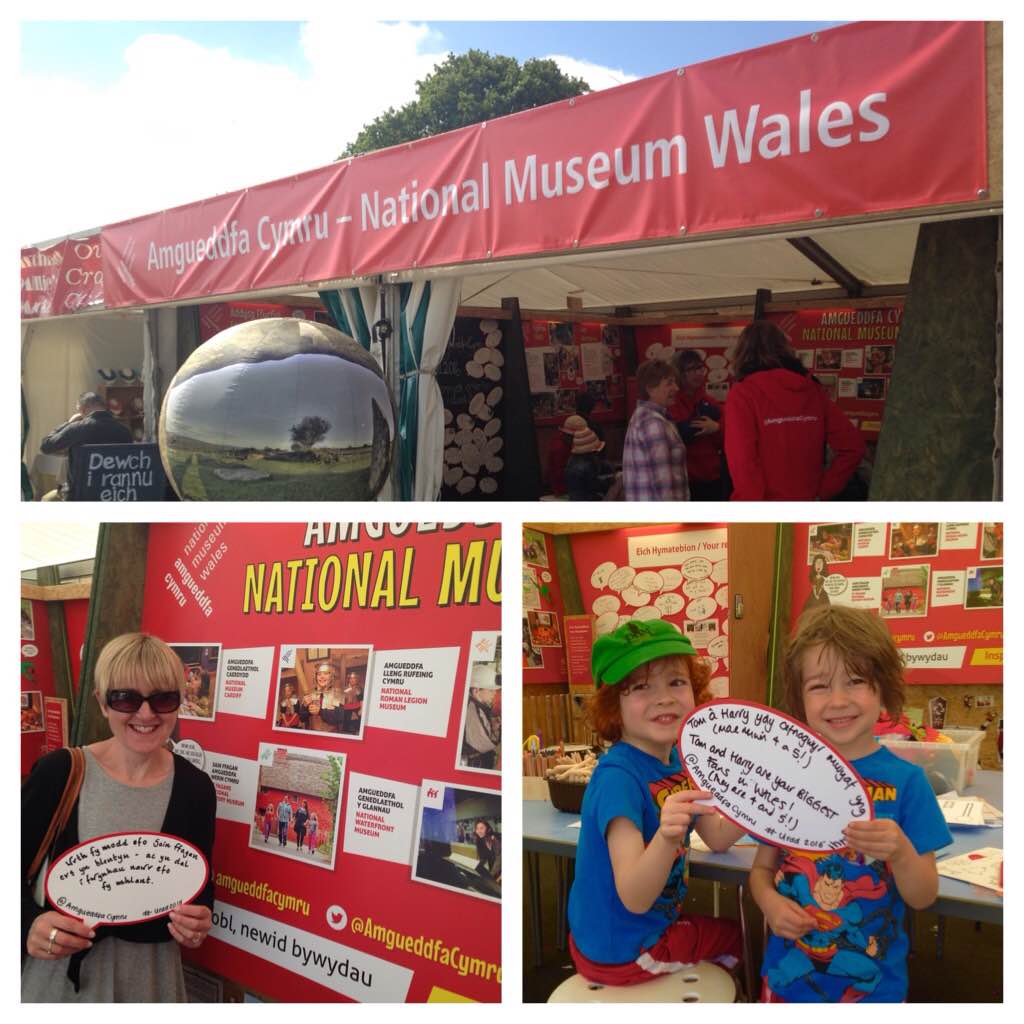
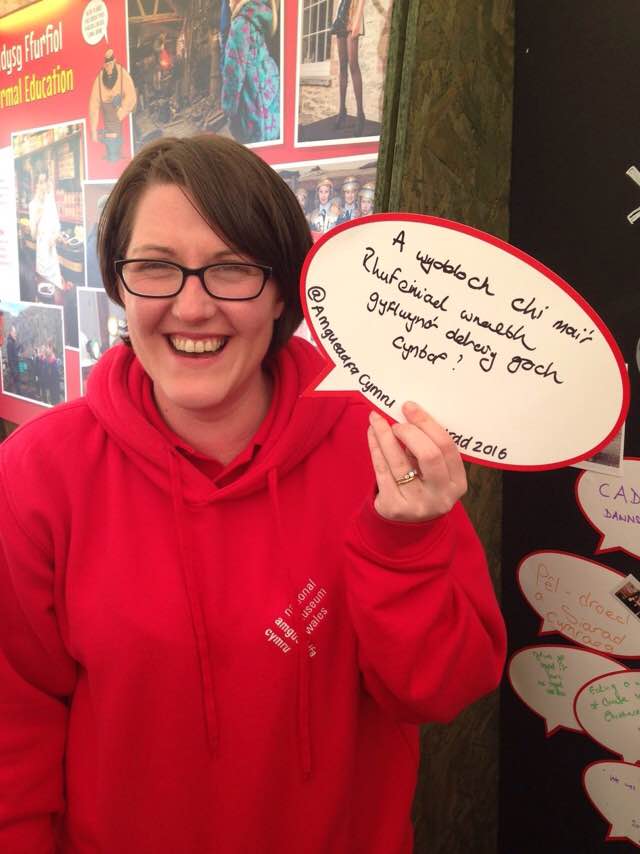
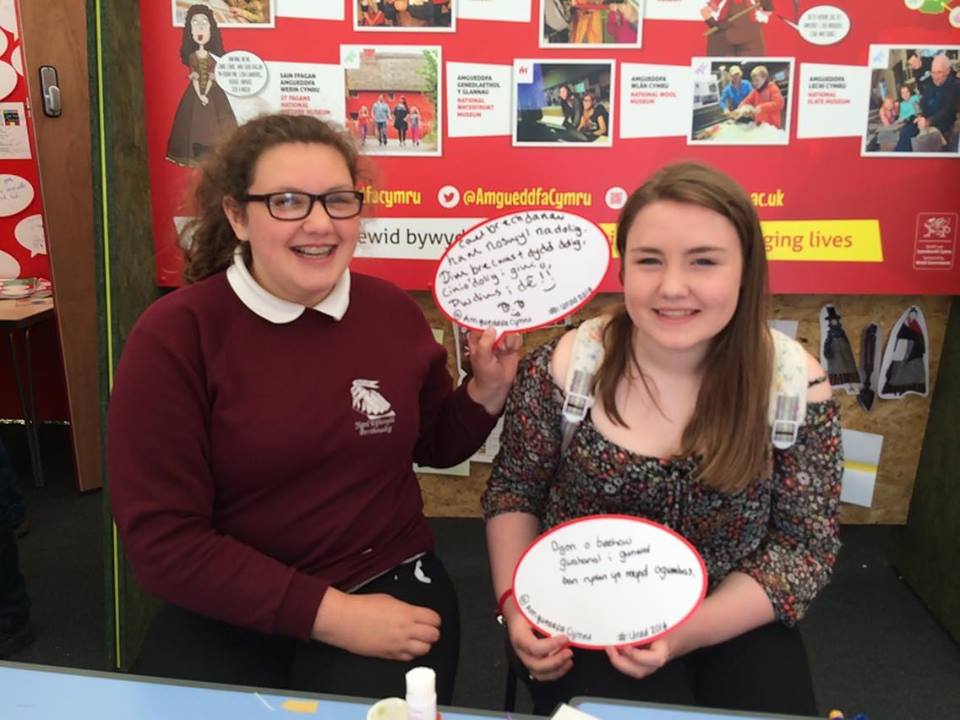
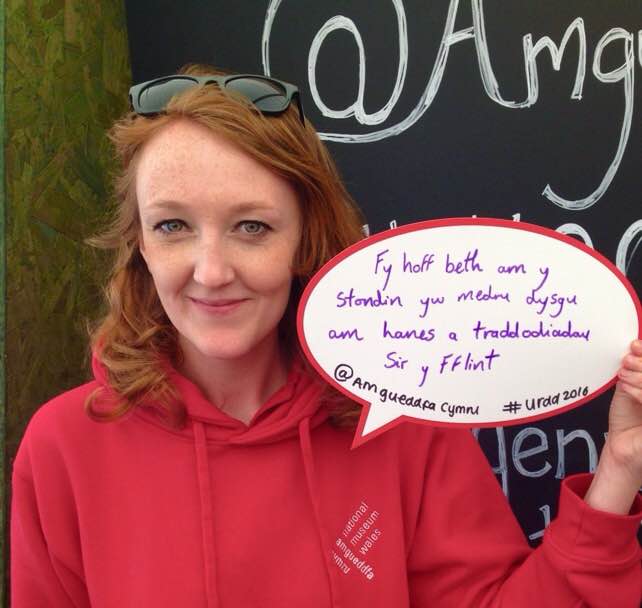
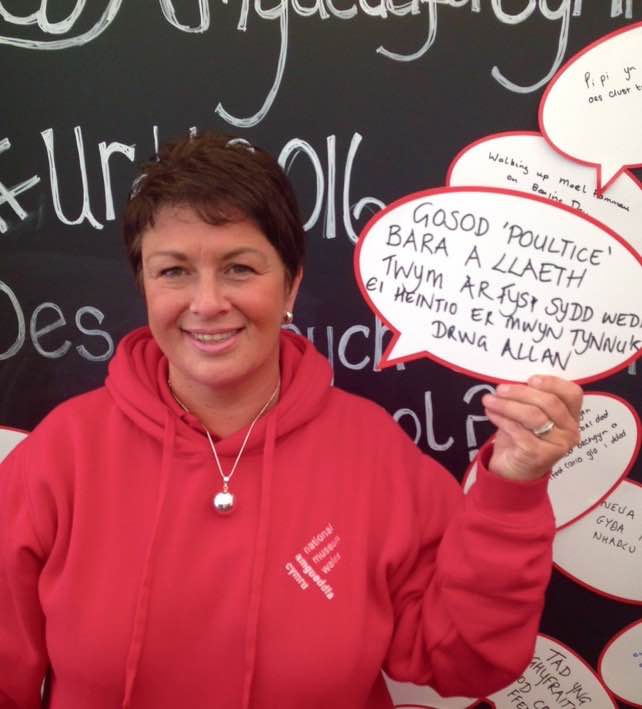
Dyma’ch Cyfle yn cydweithio gyda staff Amgueddfa Genedlaethol Cymru yn Eisteddfod yr Urdd 2016.Get the Chance is collaborating with staff from National Museum Wales at the Urdd Eisteddfod 2016

FullSizeRender
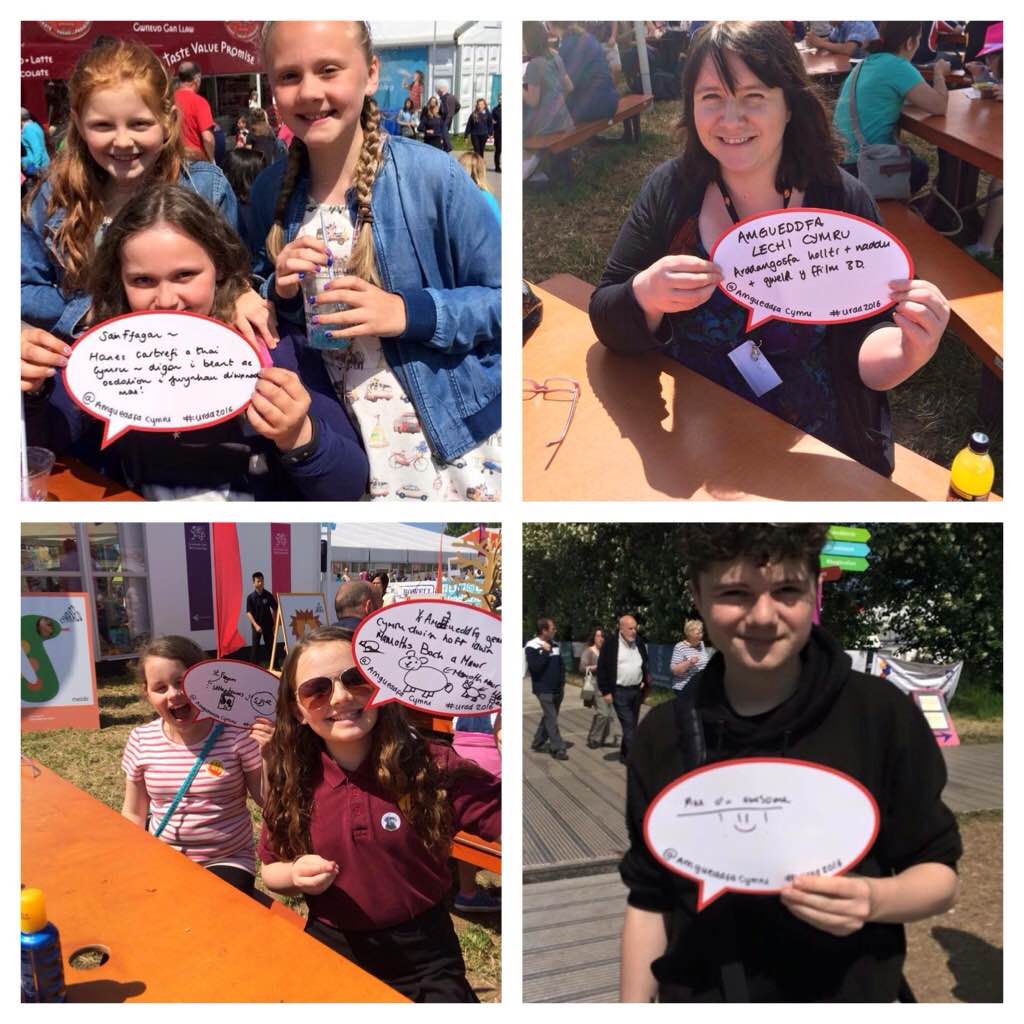
Mae Dyma’ch Cyfle/Get the Chance yn cydweithio gyda staff o’r Amgueddfa Genedlaethol Cymru yn Eisteddfod yr Urdd 2016 yn Sir Fflint.
Dyma’ch Cyfle /Get the Chance is collaborating with staff from National Museum Wales at this years Urdd Eisteddfod in Flintshire.
IMG_3459
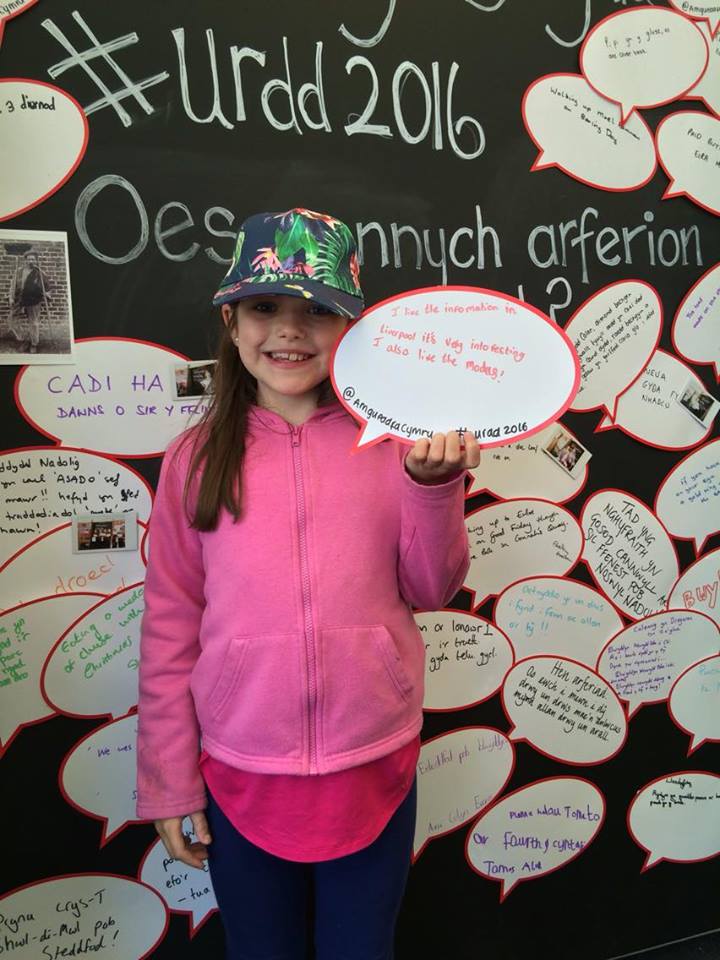
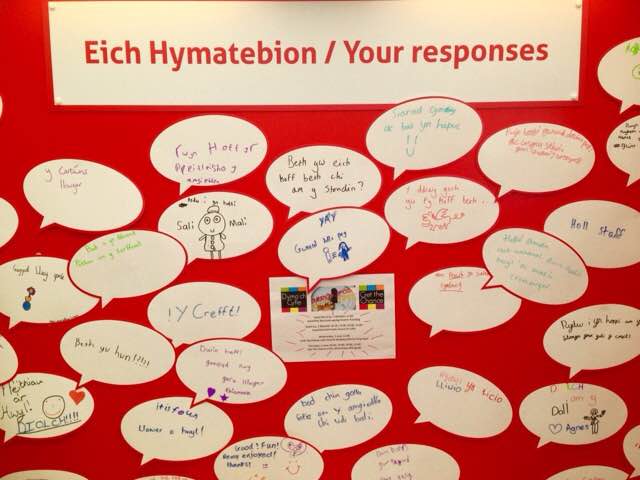
Rydym yn cefnogi aelodau o’r cyhoedd i rhoi adborth ar y perthnasau gyda Amgueddfa Genedlaethol Cymru a traddodiadau diwylliannol.
We are supporting members of the public give us feedback on the relationships with Wales National Museums and Cultural traditions.


IMG_3460
Rydym hefyd yn rhannu adborth ar yr Eisteddfod ei hun.
We are also sharing feedback on the Eisteddfod itself.
(null)
IMG_3454
13341977_1063881383686947_1938836649_n
IMG_3455
13318764_1063895690352183_1897234170_n
IMG_3456
13318749_1063881073686978_1228650407_n
 
IMG_3453 (1)
13329928_1063885527019866_1677774721_n
 
IMG_3483
 
IMG_3484
Menter gymdeithasol wedi’i leoli yn Ne Cymru yw Dyma’ch Cyfle, yn gweithio tuag at greu cyfleoedd i amrywiaeth o bobl sydd am brofi ac ymateb i chwaraeon, celfyddyd, diwylliant a digwyddiadau byw

  • Mae Dyma’ch Cyfle’n arddangos gweithgaredd ar wefan cylchgrawn ar-lein getthechance.wales/
  • Mae’r wefan yn cynnwys gweithgreddau gweithdy, adolygiadau, erthyglau golygyddol a llawer mwy
  • Mae’r wefan yn blatfform i’n haelodau i rannu, trafod a gwerthuso eu hymatebion personol gyda’u rhwydweithiau a’r byd ben baladr
  • Dyma’ch Cyfle yw’r gymdeithas sy’n cynrychioli aelodau Beirniaid Ifanc Cymru, Beirniaid Cymunedol Cymru a 3ydd Act

 
Digwyddiadau ar stondin Amgueddfa Cymru, Eisteddfod yr Urdd Fflint 2016
 
Dydd Mercher, 1 Mehefin 11:00 – Gweithdy Beirniadu gydag Aneirin Karadog
Dydd Iau, 2 Mehefin 10:30, 12:00, 14:00, 15:00 – Gweithdai Beirniadu Dyma’ch Cyfle
 
 
Get The Chance is a social enterprise based in South Wales, working to create opportunities for a diverse range of people to experience and respond to sport, arts, culture and live events
 

  • Get The Chance uses its online magazine website getthechance.wales/ to showcase its activity
  • The website content will feature workshop activity and outcomes, reviews, editorial features and much more
  • Our website is a platform for our members to share, discuss and evaluate their personal responses with their networks and the wider world
  • Get the Chance is the host organisation for members of Young Critics Wales, Community Critics Wales and 3rd Act Critics

 
Activities on Amgueddfa Cymru-National Museum Wales’s stall, Urdd Eisteddfod 2016
 
Wednesday, 1 June 11:00 – Critic Workshop with Aneirin Karadog (Welsh language)
Thursday, 2 June 10:30, 12:00, 14:00, 15:00 – Get a Chance Critic Workshops (Bilingual)

Digwyddiadau ar stondin Amgueddfa Cymru, Eisteddfod yr Urdd Fflint 2016/Activities on Amgueddfa Cymru-National Museum Wales’s stall, Urdd Eisteddfod 2016

eisteddfodyrurdd2
Menter gymdeithasol wedi’i leoli yn Ne Cymru yw Dyma’ch Cyfle, yn gweithio tuag at greu cyfleoedd i amrywiaeth o bobl sydd am brofi ac ymateb i chwaraeon, celfyddyd, diwylliant a digwyddiadau byw

  • Mae Dyma’ch Cyfle’n arddangos gweithgaredd ar wefan cylchgrawn ar-lein getthechance.wales/
  • Mae’r wefan yn cynnwys gweithgreddau gweithdy, adolygiadau, erthyglau golygyddol a llawer mwy
  • Mae’r wefan yn blatfform i’n haelodau i rannu, trafod a gwerthuso eu hymatebion personol gyda’u rhwydweithiau a’r byd ben baladr
  • Dyma’ch Cyfle yw’r gymdeithas sy’n cynrychioli aelodau Beirniaid Ifanc Cymru, Beirniaid Cymunedol Cymru a 3ydd Act

Digwyddiadau ar stondin Amgueddfa Cymru, Eisteddfod yr Urdd Fflint 2016
 Dydd Mercher, 1 Mehefin 11:00 – Gweithdy Beirniadu gydag Aneirin Karadog
Dydd Iau, 2 Mehefin 10:30, 12:00, 14:00, 15:00 – Gweithdai Beirniadu Dyma’ch Cyfle
 
Get The Chance is a social enterprise based in South Wales, working to create opportunities for a diverse range of people to experience and respond to sport, arts, culture and live events

  • Get The Chance uses its online magazine website getthechance.wales/ to showcase its activity
  • The website content will feature workshop activity and outcomes, reviews, editorial features and much more
  • Our website is a platform for our members to share, discuss and evaluate their personal responses with their networks and the wider world
  • Get the Chance is the host organisation for members of Young Critics Wales, Community Critics Wales and 3rd Act Critics

 Activities on Amgueddfa Cymru-National Museum Wales’s stall, Urdd Eisteddfod 2016
 Wednesday, 1 June 11:00 – Critic Workshop with Aneirin Karadog (Welsh language)
Thursday, 2 June 10:30, 12:00, 14:00, 15:00 – Get a Chance Critic Workshops (Bilingual)

Preview Milieu with Rhys Milsom

Q3IrgLS9

Our project coordinator recently spoke to Get the Chance Creative Associate Rhys Milsom about the multi-disciplinary arts event he curates ,Milieu.

Hi Rhys, can you tell us about Milieu?

Sure, Milieu is a quarterly night of literature, art and photography. Always held at Little Man Coffee Co, and always free entry, the events so far have been jam-packed, with barely any standing room left. Milieu is French for ‘middle’ but also stands for ‘social environment’. This is key, as the art exhibitions are held downstairs in Little Man and the literature is held upstairs. Therefore, people meet in the middle as they go from the exhibitions to the readings and create a social environment for themselves doing so! Milieu is all about promoting up-and-coming, and established, writers and artists.

Sounds great! What are your aims with the event?

The aim is to give these writers and artists the chance to showcase their work in an environment that is creative, fun and inclusive to everyone who appreciates the arts. So far, Milieu has seen writers such as Rhian Elizabeth, Dan Tyte, Matthew David Scott and Rhys Milsom read and artists such as Liam Barrett, Pip Barrett and Jaydon Martin exhibiting their work.

Thats a great list of Wales based writers and artists, when is the next event planned?

The next event is June 10th at Little Man and we have Adam Jenkins, Renn, Gary Raymond and David Lllewellyn reading from their work with Liam Barrett exhibiting his art.

Come down and immerse yourself into a creative nucleus of Cardiff!

Thanks for your time Rhys.

https://www.facebook.com/events/1604132006545049/
 

Review (BSL) A Sunny Disposition The Other Room by Heather Patterson and Gareth Freeman

 
Screen Shot 2016-05-24 at 06.30.53
This is a BSL review of A Sunny Disposition, written and directed by Nicola Reynolds, performed  at The Other Room, Cardiff. A written transcription is available below the video.

Hello, my name is Heather Patterson and this is Gareth Freeman.

We recently went to see a performance in Porters which had a small theatre inside a pub! Gareth felt the pub had a relaxing and welcoming atmosphere. The BSL interpreter was on hand to give information before the performance started.

We watched a performance called ‘A Sunny Disposition’ which was performed by a single actor throughout for approximately an hour. The story was about the effects of alcoholism and it’s knock on effects on others.

Heather asked Gareth how he felt watching the performance and he said that the story hit home as he has personal experiences of this in the family. Gareth felt that the story was realistic and he could connect with it. Heather mentioned the impact, the memories and how it can affect you as a person.

Heather asked Gareth how he managed to watch the performance using a BSL interpreter? It was generally felt by Gareth that the story was not lost in translation, he possibly missed the understanding of some signs used due to the regional dialects used in BSL but this did not affect the overall enjoyment. The venue was perfect for this type of performance as you are so close to the acting to be able to read all the emotions in the actors face and body language.

In the Q&A session Gareth wanted to asked questions but felt he did not have the confidence to do so. He wanted to say how much this performance related to his own experiences. The Q&A session was interesting and we both enjoyed that part.

We felt that that the story was realistic, emotional and understood the issues that it had a powerful impact on us. We both agreed having addiction issues were not easy for the person and others living with it.

Heather asked Gareth if this performance should be seen by more deaf people and he felt that everyone was different but encourages them to see it. Gareth will definitely be going to see more performances in Porters as it gives him an avenue to relate to his feelings/personal issues through theatre. Having theatre in BSL enables Gareth to have a social life, to enjoy watching things on an equal par to others (those who can hear) and generally feel less isolated.

We were most impressed that the writer wrote the story based on her own personal experiences, this helped us to really absorb the story and the performance. We will certainly look forward to another story by the same writer.

Thank you for watching us.