At half 9 at night, the last thing you would be expecting to
see is a sock puppet show. I love a good puppet, but I equally love an usual
concept. Scottish Falsetto Sock Puppet Theatre (SFSPT) sure are the unusual.
Opened to the world of adult puppetry and it becoming more
familiar a concept, we have all heard of the adult themed ‘Avenue Q’ and a few
years ago, ‘Hand to God’. Even cartoons have become more adult friendly,
opening up a whole new world in performing arts.
And while I hesitate to compare SFSPT to such shows (a joke
in the performance itself reflecting this), it is agreeable that this concept
Is not as unusual as it may once were. Yet I was still pleasantly surprised and
excited.
Puppetry come comedy, the FSPT does not rely on humour alone
to get by. There is a theme, and it is ever changing (as we hear from its 15 or
so years of its presence). This round is Circus themed –with The Greatest
Showman being so prevalent in the last year, SFSPT draw upon this to create a
narrative, but feels free to go a little off course, ad lib where necessary and
it is all just as funny as the original plan. We are at times asked to use our
imagination, thinking of a sock puppet out of shot on a tightrope or completing
an another amazing feat.
They keep the information present – keeping to events and
news from the last year, even making jokes and making it clear that some of the
audience may find some too obscure, we cannot help but love it and definitely
feel included.
With only one man, two puppets, and maybe around 5
character’s, it is a feat of genius and skill at set and ‘costume’ changes with
one hand- a magical experience we all wish we knew the answer to. He manages to
give each character its own personality, even with their interaction with one
another being quick. Of course there are times when a Australian accent is
suddenly Scottish and he soon realises it. But this only adds to the humour –
there is no masking mistakes, only inclusion of them.
The narrative went a little off course and dark humoured,
but you know what, I was not mad at it. I was sufficiently entertained, laughed
my socks off (pardon the pun) and had a really interesting and splendid time.
Scottish Falsetto Sock Puppet Theatre is not exactly breaking theatrical boundaries, but my gosh was it a lot of fun. If you fancy something unusual, ridiculous (is a good way) and a good laugh, then this show is a total must.
Let me tell you, if you like boundary breaking, the plain and simple truth and interesting physicality to name but a few, then you need Mr and Mrs Clark in your life.
A long-time fan, I have always admired their work, their
concepts and how they bring these to the stage. They are never similar, never
the same but always ground breaking and perfectly formed.
Louder Is Not Always Clearer draws upon the performance artist Jonny Cotsen and his life as a deaf person. The show Is autobiographical to an extent, but also makes you really see yourself. Using a range of media, physical theatre techniques, theatrical techniques and fine art, Cotsen brings us into his world, his difficulties but poses it in a way to create slight difficulty for us. Almost acting as if we are those who may not be as open minded and accommodating, we feel similar to how Cotsen has felt during his life – wanting to participate but being discriminated for something he cannot control.
An example of this is with use of sign language. I can
imagine not every performance goes this way, depending on who is in the
audience, but he begins a conversation with someone who can sign, finding them
by openly asking through this communication who can indeed sign. And to this
day, I still have no idea the conversation. This made me feel isolated,
confused and this was very clever. As to an extent, this is what he himself has
experienced on the other end.
He, with use of props, physicality and vocalisation makes
fun of those who are ignorant. Those who are surprised by how he can drive a
car, have children, those who almost shout at him to ‘hear’ them, normal things
that everyone can do – and through these, they are comical, sometimes heart
warming, sometimes astonishing at the ignorance and completely understandable.
Cotsen commands the stage. Unlike some of Mr and Mrs Clark’s
pieces which are abundant with physical theatre, there are times of peace, of
silence, of contemplation, and even at these points you cannot take your eyes
off Cotsen – he is simply a fantastic performer.
Louder Not Always Clearer is honest, it has no fear, it has no bullsh*t. It is unashamed, unapologetic and something fully needed in the forefront of society. Feel seen, feel informed but ultimately, come away feeling Cotsen’s emotions and with anger at those who are ignorant.
Think back to the Agatha Christies. Miss Marple, Poirot.
Think even to the extent of Sherlock Holmes. These crime stories, full of
mystery and far fetched narratives. Number Please felt very reminiscent of these.
When a telephone operator hears a murder on the telephone,
she is dragged into a world of secrecy, double crossing and spies. Enter train
chases, over the top character’s, and London (because a murder always happens
in London and alien invasion, but that is Doctor Who and off topic).
This female lead company came to bring us fun, frivolities
and intrigue. And they execute some of this. I am glad that it was meant to be ‘hammed
up’ as the characters seemed quite one dimensional, and my worry was for the
stereotyping of women. Saving this, the 1950’s styled era saw a strong female
lead, solving the murder and uncovering the mystery.
While I had a lot of fun and enjoyed their performance, I
could not help but wonder whether it was meant to be unintentionally of an
amateur persuasion or whether this was the point; a metta/ironic take on the absurdity
and predictability of these genres.
What cannot be argued is that the performers put their all
into their performances. Every facial expression was executed, every pun and
the fact they high-kneed ran for a good 5 minutes non stop is something to be
admired.
Number Please is a fun, easy going, easy watching show. If you want to just sit back and have a little giggle, this is for you.
The last thing you would expect in a city like Edinburgh is
to be swept away to the ocean.
But swept away, we were.
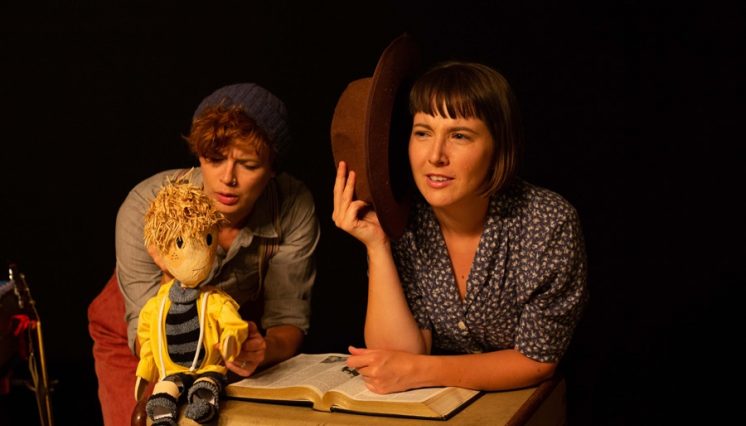
Ned and the Whale is the story of a nervous boy, obsessed
with facts to keep him safe who gets taken into a magical and fanciful world
inside a book, meeting exciting and interesting characters, helping each of
them along the way, and in turn, they help him to overcome his fears.
Flossy and Boo bring this story to us in the form of
puppetry, recycled props and costumes, musical interludes and comedy. Now, anyone
who knows me, knows I am obsessed with puppets and Ned and The Whale are no
exception. They are little things of beauty, and Anja Conti, (Flossy) and Laura
Jeffs-White (Boo) manage to move them with ease and such perfection, that we
even forget that there are real humans behind them.
But do not take that as they forget where they are – their facial
expressions mimic the character’s and shows that they are really invested in
their work and the story.
When not handling puppets, they are either other interesting
and hilarious characters such as the twins in a cave obsessed with slime and
parties with rocks, or a stranded pirate, missing his disappeared crew. Each
character I fully formed, well thought out and with their own clever unique qualities.
This isn’t Flossy and Boo, this IS the pirate, this IS the twins.
And then added to this, another dimension as Laura and Anja –
those who know this group will know how well a relationship they have on and
off stage, and how they play on this; calling out each other’s silliness, being
other funny and likeable characters. Usually these are as Flossy and Boo as we
know it, but this time around we know them as Anja and Laura, and love them just
the same.
Audience interaction is key for children’s shows, and this
is no exception. Child or adult, we all are given eye contact, smiles, no one
is excluded; we all get ‘slime’ put on our heads, we are all asked for
suggestions and we all love the whimsy and comedy.
Musical interludes are delightful, simple with acoustic guitars
or banjos, with beautiful harmonies and funny concepts. Personally, I could
happily sit with an album of just their music and walk away happy.
Ned and The Whale is a triumph of a production; fun, comical and magical, it still manages to teach us vital lessons of life and we leave the tent they are in, smiling and elated.
With the current climate, and the news of a new, and not
much wanted Prime Minister, a political play is just what we need.
Twice Over compares the political climate when our only two
women Prime Minister’s have be in office; with the use of two women, both in
their 20’s but at different time points (the 80’s and 2017) we see how ideals
have changed, how attitudes have changed yet the confidence in politics
remaining the same.
This production is very simple; two performers, a guitar,
basic lighting and basic set. For something with intricate and complex issues
in its narrative, this simplicity is all that is really needed to bring the
concept across.
Part poetry, part scripted, part verbatim, I found it
difficult to follow. The writing was
interesting and I loved the approach taken, but I couldn’t define the
difference in these writing styles and suddenly we would be hearing rhyming
couplets, the next an almost political speech. If there was an added dramatic
change to these, whether this was performative or even a lighting change, it would have complimented it more and gave
more complexity.
The music was beautiful – again, simple but really effective
and gave a nice break to the very hard going narration.
I really applaud the Twice Over production for taking on such an important subject, triumphing women and feminism. There is a way to go with this production, with a little tweaking, it could be a really hard-hitting production. Never the less, with politics in the current times, it is definitely worth seeing.
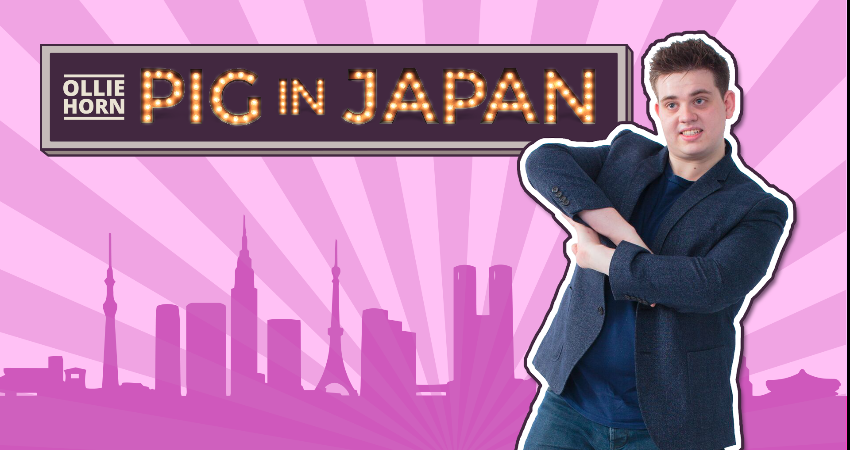
Ollie Horn, a young comedian by chance decides to move to
Japan. He has no experience in TV, as an actor or presenter, but almost
overnight, becomes semi famous on Japanese television.
Horn brings his comic styling as well as evidence in the
form of video to tell us about his time in Japan, why he went, what he
experienced and why he was on their tele.
Horn is energetic, in good timing and definitely funny. He
does well to explain Japanese culture but is admittedly still slightly clueless
after admittingly not integrating as much as he should. His antics are nothing
short of what you would expect from the hyper realistic and unusual Japan.
If you have been to Japan, the jokes land a little funnier –
true statements about how clean the country is and the polite interactions of
the Japanese is a general ‘stereotype’ but also rings true; comedy based on
these observations just jumps a little further for the experienced traveller.
His comic timing is on point – bringing a statement to us,
this is often accompanied by a short video clip, sometimes rewound, zoomed in
to emphasise, adding meaning, a purpose and additional laughter; we do not have
to imagine, we plainly see – seeing is definitely believing.
Lastly, Horn interacts with us well – his confidence illuminates his story telling, and while not every gag gets a laugh, he continues a momentum that never stops. Laughter or not, Horn can put on an honest and funny performance.
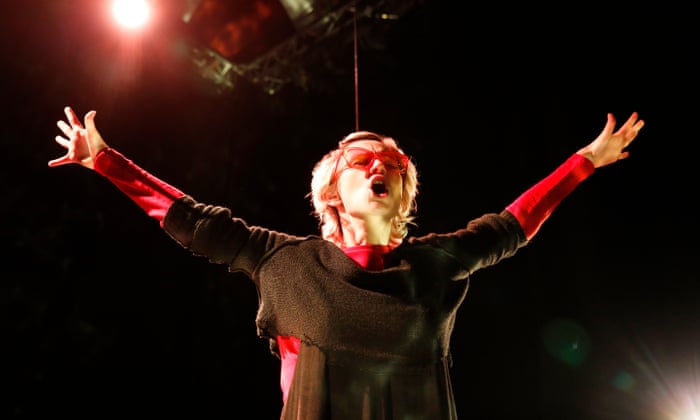
Sometimes it’s quite nice to see a celebrity on stage. In Wales, they feel like they are in abundance on the Welsh Theatre scene, with the pool of the industry in this country being small. So it was a surprise to watch For All I Care, and not realising until after that the performer was Hannah Daniel of Keeping Faith fame.
This surprise is a good surprise. I entered the performance
and found myself so engrossed that it was not until I read later on that day of
who she was; a performer who I (only too recently) had just seen in a huge
binge of Keeping Faith series 1 and 2.
For All I Care is a one woman show looking at mental
health, Wales and the magic that is the NHS. Daniel takes on around 6
characters in total – we see majority of the play focussing on the relationship
between Clara and Nyri; two very different women leading very different lives.
Clara is a young woman suffering with her mental health, and attempted suicide.
Nyri is a mental health nurse who tries to help Clara, but she is not totally
altogether herself. Daniel also takes on other intermittent characters such as
Marco, the mental health Doctor, Nyri’s son, Alex the younger man Nyri sleeps
with and ‘The Devil’; Clara’s controlling crime boss.
Daniel does a brilliant job of chopping and changing these
characters – to help with this the basic staging has 3 microphones hanging from
the ceiling. She picks these up when another character comes in to the scene,
into the main character’s story. This creates a barrier; it is so disassociated
and almost hyper-real that it works; it suspends our disbelief and we see that
other person, almost as if another actor had walked in. My only criticism is
that we know Daniel is capable of more, and for me, it felt like there needed
to be more definition of each character, whether this meant more of a physical
change, more pronounced vocal differences or both.
The narrative itself is a fresh take on mental health; with
this once taboo subject being encouraged more into main media and society,
there’s many a play I have seen where the medical professional is clean nosed
and almost angelic. Clara has real problems; real psychological issues. And while
Nyri may not be to this level, her life is not perfect; she still makes
mistakes, she has her own issues and her own past. She is more relatable and
more likeable than other productions that make us almost shake our head at the
lack of realism to a medical character.
For All I Care is a lovely piece; it provides a fresh narrative, and really has the ability to showcase a performer as a solo talent, with some minor tweaking.
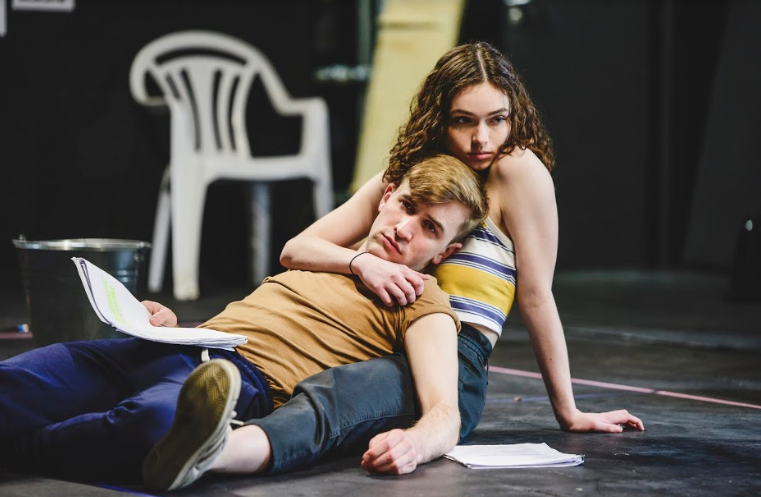
As their showcase production of the Professional Pathways Programme at The Other Room, Yasmin and Samantha are presenting Crave by Sarah Kane, at The Other Room running between April 30th and May 11th 2019.
I met up with Director Samantha Jones, Producer Yasmin
Williams and Assistant Director Nerida Bradley to chat about Crave, Sarah Kaneand the Professional Pathways Programme.
Why Crave? Why Sarah Kane? Why Now?
Being completely technical, for the Professional Pathways
Programme I think this is exactly what we needed. There are no limitations, no
rules, no guidance and that’s exactly what we needed from a script as a
challenge and a gift.
When next are we going to get the opportunity to stage
whatever we want with no limitations – Sarah Kane, obviously. It’s exactly the
kind of work we’d like to see more of in Cardiff. The way it plays with form, but
also what it says and what it means to people.
The Other Room opened with Sarah Kane and this play was an
artistic turning point for her career. So, it just felt right, being the first
Professional Pathways Programme at The Other Room and a turning point in our
careers, to stage this play.
There are loads of reasons why this play is relevant now, but
really what’s so great about Sarah Kane is that she’s so real she’ll always be
relevant and so will Crave.
What does
Sarah Kane mean to you as artists and people?
As an artist she’s bold and experimental. Her work is full of
anger, but doesn’t fall into the trap of angst or the box people tried to put
her in. She’s angry but it still feels feminine without the work needing to be
about femininity. Just feminine through the way she uses language. Everything
in the text is earned and the artists involved in her plays have to raise their
game to her level.
As a person, she doesn’t make you feel judged, she just makes
you feel and reflect. She can make you feel anything with her words. When I
first read one of her plays, I had to read the others and read them all in one
sitting. She’s just great.
What’s your
aim with this piece?
Is it enough to say truth? Sarah Kane said, “I write the
truth and it kills me,” so it’s important to stay true to that.
But also, Crave is
written in a way that allows us to play and experiment. She was bold and
experimental in writing this play, so we need to be the same in presenting it
too.
It’s about what it means to be a human, the loneliness that
comes with that, what love is, etc. We all have different perspectives and
feelings in regard to this play, as I’m sure you will when you see it. Everyone
will feel different things as the play is so true it relates to everyone individually.
We want the audience to reflect and feel something about the themes, but more
importantly about themselves.
Sam, considering how open the script is to a director’s interpretation, how are you approaching Crave as director?
Crave is a play
that is always moving and changing as you work on it, so it’s more of a
facilitation process, rather than direction and I wouldn’t have it any other
way.
It’s key working with Nerida, not only as one of the best assistants
around, but as someone who loves Sarah Kane and understands the text in a way
that is different, but just as brilliant, to me. The whole team, including Yasmin
and the actors, the same. The moment someone puts their stamp on Sarah Kane is
the moment the it dies. So, everyone in the room has a voice.
Yas, with
the everchanging, undefined nature of the script and production process, how
are you approaching Crave as
producer?
One of the great things about the Professional Pathways
Programme is that this is the first full-show I’ve produced on my own, and I’ve
been trusted to do so. The experience has sort of confirmed my theory that
nobody really knows what a producer is and it’s an everchanging role in
theatre. But given me confidence in knowing that’s okay. There is no set of rules
for a producer as the job changes so much from show-to-show.
Part of what makes producing Crave so great, is that I have to be involved in the creative discussion to do the job. It might be easier to produce if things were more set in stone, but as the piece is constantly moving forward and growing I need to stay on my toes and get involved in the room. It’s very hands on and it needs to be as I have to stay connected, artistically, to the production.
How have
you found the past year at The Other Room as part of their Professional
Pathways Programme?
The
Professional Pathways Programme has been a great way to step into the world of
professional theatre making. Building new relationships, especially with each
other as this year has just made us want to work with each other more in the
future. Opportunities to work with new writing with things like SEEN and Spring
Fringe Script, working with Royal Welsh College of Music and Drama have also
been super beneficial.
Learning how
a theatre building works and runs, beyond the shows, has probably been the
biggest thing to learn. And now getting to work on whatever play we want, being
able to produce it and put it on for a full-run is the perfect way to end the
year. Overall, it’s been an invaluable experience for both of us.
Nerida, as
you’re on arts placement at The Other Room and assistant director on Crave, how have you seen Yas and Sam
grow over the last year?
They were always capable of doing this. But they’ve just had the chance to prove it. They’ve not just done the job but really added to the discussion and put their ideas forward. In particular they’ve absolutely smashed the year in transforming SEEN and working on Spring Fringe Script amongst other things. It’s just so great that they’ve been given the opportunity and platform to show what they can do as well as learn and move forward.
Crave runs at The Other Room in Cardiff between April 30th and May 11th 2019. Presented in collaboration with the Royal Welsh College of Music and Drama and The Other Room’s Professional Pathways Programme. You can read more about the production and the Professional Pathways Programme HERE.
Crave by Sarah Kane at The Other Room, Cardiff 30th April – 11th May 2019 Directed by Samantha Jones Produced by Yasmin Williams Starring: C – Emily John M – Johnna Watson B – Benjamin McCann A – Callum Howells Assistant Directed by Nerida Bradley Set Designed by Zoe Brennan and Mimi Donaldson Sound Designed by Joshua Bowles Lighting Designed by Ryan Joseph Stafford Stage Managed by Millie McElhinney Deputy Stage Managed by Emily Behague
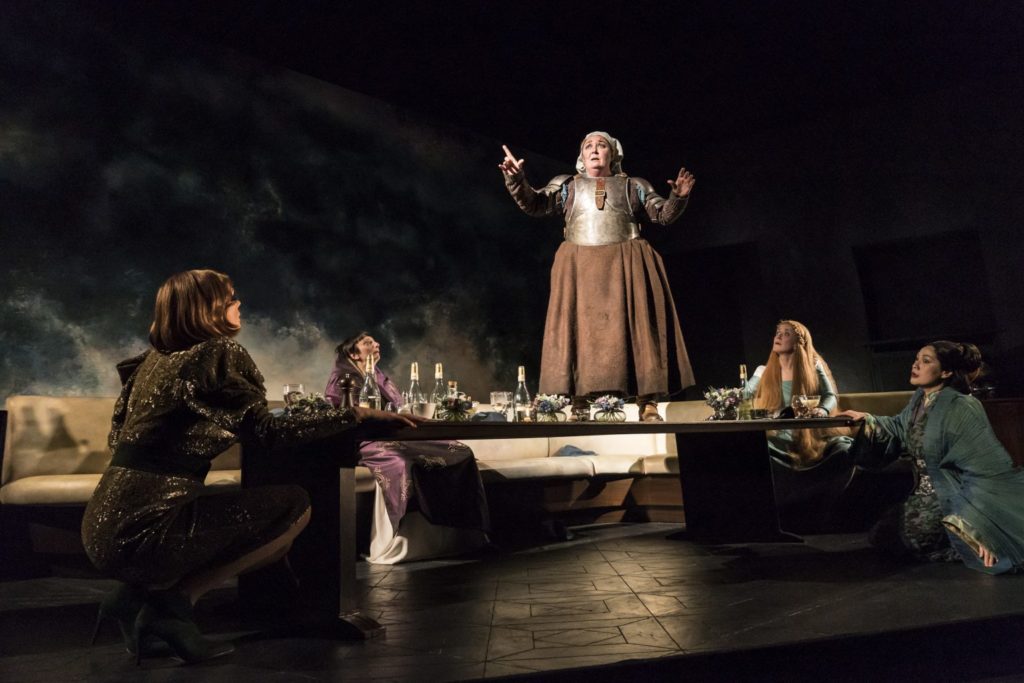
Upon the National Theatre stage – a stage I only saw a short time ago transformed into a slanted living room, I now see a chic and expensive looking restaurant set.
Coming into celebrate, we meet a whole host of historical female figures – all with their own blood thirsty, unbelievable and hilarious stories, the cross over between the time set play in the 1980’s with much older eras makes this play instantly comical and poignant to the power of women.
In a time of the Me Too movement, and continued fight for equality, a play focussing on how extraordinary women have always been, the struggles the still face and the pressures we experience is not exactly new. But Churchill, having written this 1982, seems to have been way ahead of her time in writing a piece of theatre that we have only really been seeing develop across fringe and west end stages in the last few years. While at the time of Maggie Thatcher; a time where the glass ceiling began to break, we have still found ourselves continuing the fight till 2019. And so Top Girls feels even more inspiring to this day.
The performers, as expected at the NT are impeccable. A beautiful all female cast, not a single male is seen on stage and this emphasises the sheer power of the play.
The first half features these hammed up yet interesting characters – perhaps a little stereotyped – they cover a range of feminist topics that we were unaware that would be an issue in their era. They did try to cross over conversations, perhaps to make this seem more like a natural meal amongst friends than a staged one. I am not sure how much I felt it worked; it was a struggle to tell what each person was saying at different times.
The second half really brought up the sense of family, of growing up and a dysfunctional family and their relationship with one another and men. Again, the interactions were perfect and we felt real emotion in the scenes.
A play that could have easily aged badly, Top Girls is as important as ever – funny, clever and poignant, any female identifying as a feminist needs this play in their life.
Five Green Bottles by Joe Wiltshire-Smith debuted for the first time at the 2018 Cardiff Fringe Festival in the basement of Little Man Coffee Shop. After seeing it then, I remember saying, “this is the sort of work I’d expect at the Sherman.” And less than a year later, here we are.
It’s a strange experience watching this play for the second time. It relies so heavily on its audience not knowing the twists for its strengths, so for that reason I won’t be spoiling anything.
One thing that has changed is the ending, which is just as
frantic, but slightly clearer in a subtle way. This is the major improvement
along with the obvious production value that the Sherman’s excellent studio
space offers.
The direction from Becca Lidstone is particularly interesting as she adapts from a coffee shop basement with a small amount of tech to a world-class theatre space. The step-up in production value is obvious – but the content of what was initially presented isn’t lost.
It does seem darker and more sinister than before. I’m unsure
whether that is because I know what is coming and pick up on the small details
or if it’s an artistic choice, but it works.
One thing that is noticeable is the cutting-down of humour. The first time there were more laughs and that could be down to the intimate space of Little Man’s basement. However, it comes across much more mature as the humour is controlled perfectly by Lidstone and doesn’t dominate as much as before.
Becca does a great job of starting the play at face-value and
allowing the subtext do its work, bubbling under the surface to create a darker
tone.
The transitions are full of dance and music which contrasts nicely to the dark undertones and creates a feeling of the 60’s. At times, though, this feels a little out of place, particularly as the play progresses.
Aly Cruickshank’s performance is excellent. With a name like
his, and the accent he puts on, you would think he’s a Scottish native. His
performance really stands out as he presents himself as likeable but holds a manipulative
presence that makes him so hateable.
Angharad Berrow is also utterly brilliant. Her performance is
less sinister than Cruickshank’s and comes across really naturally. Berrow
handles her character with great detail and performs delicately with moments
presented as normal that are truly horrific in the context of the play.
Tobias Weatherburn’s performance is really understated, cold and transformative from the person he is off stage. In particular, the way he handles Dave’s insecurities and desperation for acceptance from other men is phenomenal.
Olivia Martin’s performance is interesting. Her character, Maureen, is snide and laid back. She mostly holds the same dynamic throughout, but the moment she switches is even more powerful for this.
The set from Ceci Calf is really nice and naturalistic, taking us into the 60’s with simplicity.
Garrin Clarke’s lighting design is great. The single light that shines through the window, as if it were the moon, is particularly lovely and the changing of colours is seamless, creating the perfect atmosphere for the moment.
The sound design from Nick Laws is also strong, the use of
music in the transitions set the scene and there seems to be a slight
distortion in said music as the play progresses which is subtly superb.
The script by Joe Wiltshire-Smith is meticulously plotted and
paced with great dialogue, moments of humour and a subtle, dark undertone.
None of the characters are supposed to be likeable, which is important and a good choice, but they do need redeeming or relatable qualities. Dave stands out and is instantly recognisable with clear insecurities which Aly Cruickshank’s character, ‘Neddy’, exploits. Dave’s shielding of himself provides a brilliant and bubbling conflict with ‘Neddy’.
Unfortunately, the same can’t be said for all of the
characters. This is where we come onto the main issues of the play. The
character of ‘Neddy’ and the purpose of the play.
Neddy’s process and mind are not explored enough, so whilst we see his manipulation of other characters mould slowly and sadistically, his actions by the end are not justified in his own twisted way. This leads to the ending falling somewhat flat and into the second issue.
Why has this piece been written? What does it offer its audience? What does it explore? It doesn’t offer clarity on the history, it doesn’t explore the issue nor the mindset of the characters and isn’t escapism. It’s not a character study and whilst it is well written, directed, acted and designed – after all is said and done there is no takeaway for the audience.
The conversations I had after the play ranged from talking
about the historical facts and questioning the purpose of the play. I’ve seen
technically worse plays that are much more ‘must-see’ because of what they
offer their audience.
Ultimately, this is an incredibly brave story that Joe Wiltshire-Smith has attempted to tackle for his first full-play. For Spilt Milk too. However, there just doesn’t seem to be a focus or point to the piece.
Some will disagree on this and say it doesn’t need a point or
to explore anything. But, that is what separates ‘good’ from ‘great’. A little
more focus and this could be an absolute stellar piece of theatre. As it is,
there’s just something missing.
Five Green Bottles is an enjoyable, brilliantly crafted piece of theatre only let down by a slight lack of purpose.
Five Green
Bottles at the Sherman Theatre, Cardiff
9th – 13th April 2019
Written by Joe Wiltshire-Smith
Co-writer: Kirsty Phillips
Directed by Becca Lidstone
Starring:
Angharad Berrow
Aly Cruickshank
Olivia Martin
Tobias Weatherburn
Assistant Director: Joe Wiltshire-Smith
Producer: Tobias Weatherburn
Stage Manager: Hadley Taylor
Production Design: Ceci Calf
Sound Designer: Nick Laws
Lighting Designer: Garrin Clarke
Set Assistant: Aleks Carlyon
Technical Assistant: Theodore Hung
Creating opportunities for a diverse range of people to experience and respond to sport, arts, culture and live events. / Lleisiau amrywiol o Gymru yn ymateb i'r celfyddydau a digwyddiadau byw

 (3 / 5)

 (5 / 5)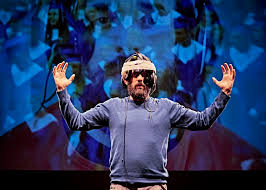
 (2 / 5)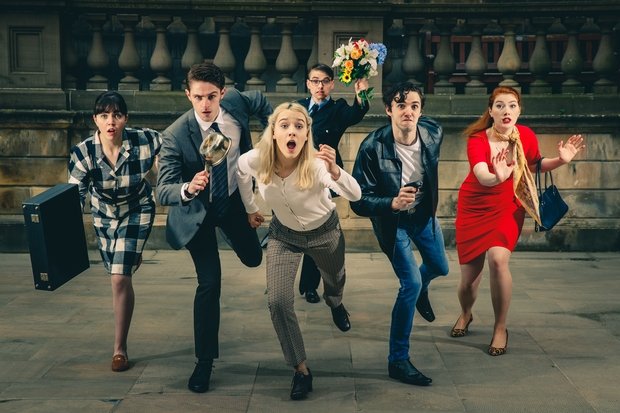

 (4 / 5)