A star performance of Rachmaninov’s third piano concerto – said to be one of the most difficult and challenging of piano concertos in the concert pianist’s repertoire -by the multi-talented South Korean pianist Yeol Eum Son was the choice of the BBC National Orchestra of Wales for their opening concert of the season. Performed to a packed audience at St David’s Hall in Cardiff last night. (October 6th) and broadcast on BBC Radio 3, what a night it was! A diminutive figure in a black evening dress, soloist Yeol Eum Son gave those fortunate enough to secure a ticket an evening to remember. This powerful concerto, composed in 1909 but not given full acknowledgement until several years later, then becoming increasingly popular in the 1930’s when it was performed to great acclaim by Vladimir Horowitz, was given a supremely sensitive all-embracing performance throughout by Yeol Eum Som.
The opening movement, Allegro ma non tanto, was interpreted with sensitivity and skill, with Yeol caressing the keys as a lover might caress his or her beloved, to change into a powerful full throttle engagement with the keyboard. With her fingers flying so fast that at times the sight of them became a blur, this tiny almost unbelievably slender young woman switched effortlessly from the gentlest of melodies to the powerful octave-spanning moves that make this concerto a concerto to be feared for some soloists., thus making this performance a rare and special occasion. Yeol Eum Son’s ability to control and shape every poetic nuance – much in evidence in the great solo cadenza – plus her fearless and bravura attack on the most difficult of passages is awe-inspiring.
For the Intermezzo: Adagio-unpoco piu mosso – a set of variations by the orchestra alone gives temporary rest to the soloist, notable among these at this performance being the short flute solo, performed with feeling despite its brevity, followed by solos from oboe, clarinet and horn. Then the piano bounces back with a powerful yet melodic attack on the keys ferocious in its brilliance, segueing seamlessly into the Finale Alla breveand a vigorous ending.
Full credit to the BBC National Orchestra of Wales under the direction of their leader first violinist Lesley Hadfield. The rapport between the soloist and the conductor Ryan Bancroft, who have worked together many times was extraordinary and no doubt contributed to the high standard of a performance that had the audience shouting for more and bringing the soloist back four times. Broadcast on BBC Radio Three, this memorable performance gave its audience and those who listened at home, a night to remember and an opening night that bodes well for this great symphony orchestra during the coming season.
Please note due to ill health, Barbara reviewed only the first half of the performance.
Coming next:: Mahler’s Symphony No. 9, conducted by Markus Stenz .Thursday, 17/November, 2022, at 7.30 pm at St David’s Hall, Cardiff.
Cardiff Classical 2022-23 opened with a bang last night at St David’s Hall with two of the most raucous, romantic and indeed riotous concertos of the last century. The opening concert, entitled ‘Romance and Riots’, featured Sergey Rachmaninov’s sumptuous Third Piano Concerto and Igor Stravinsky’s Rite of Spring – two orchestral works by two celebrated Russian composers, written just four years apart, and yet they couldn’t be more different.
Led by American conductor Ryan Bancroft and performed by the BBC National Orchestra of Wales with German-based South Korean pianist Yeol Eum Son, the concert traverses multiple (often contrasting) sounds, rhythms and stories, and paints these classic concertos in gorgeous new colours. The NOW perfectly captures the dramatic dynamic contrast and sheer epic scale of the music, while Bancroft and Son give incredibly precise, passionate, and characterful performances.
As a conductor Bancroft guides the orchestra through the character and emotion of the piece, making it just as exhilarating a physical performance as it is a musical one. Son is an extraordinary soloist and an immensely expressive performer, drawing the audience in with every movement, from the intense, juddering chords to the glimmering crescendos. There is a real power to her performance that meant that the audience was feeling every note and emotion of the piece right along with her.
And what can be said of The Rite of Spring that hasn’t been said already? As Jonathan James mentioned in an excellent and memorable pre-show talk, to say that the piece caused something of a stir in its 1913 debut is quite the understatement: the avant-garde music – stoked by political and class discontent – caused a riot in the theatre, with the dancers and musicians gamely playing through the mayhem right until the final bars. The piece itself is, as James explained, “order disguised as anarchy”; a volcanic, visceral retelling of a young woman who dances herself to death to appease the gods of Spring. Its epic discordance and jazzy polyrhythms would go on to inspire future composers from Gustav Holst to Bernard Hermann – but the original remains as shocking today as it was a century ago.
This is pianist Yeol Eum Son’s first time working with both conductor Ryan Bancroft and the BBC National Orchestra of Wales. She performs next in Madrid, performing Ravel’s Concerto for the Left Hand in D major on 20-21 October, before heading back to Cardiff’s RWCMD to perform Stravinsky once more – this time, the Firebird Suite – along with pieces by Lekeu, Hirtz, Janáček and Kapustin, which sounds like the perfect complement to tonight’s programme.
NOW can be next seen playing the 1001 Arabian Nights family concerts in Cardiff and Swansea, before performing Bach, Liebermann and Schmidt at the end of the month and Elgar’s Cello Concerto in November. Bancroft next conducts the Malmö Symphony Orchestra in Sweden, playing pieces from Dvořák, Copland and Netzel, the latter two with Peter Friis Johansson on piano.
Branwen Davies appointed to lead the re-established Urdd Youth Theatre Company.
Today (6 October) Urdd Gobaith Cymru announce Branwen Davies as the Urdd Youth Theatre Coordinator. Branwen will lead the organisation’s re-established Youth Theatre Company, which is credited for creating opportunities and introducing young people to the arts as they discover the world of the theatre.
As the Urdd enters the final act of its centenary year, Wales’ largest youth organisation is looking forward to the future by re-launching the Urdd Youth Theatre Company. Thanks to a £1 million* investment by the Welsh Government, the Urdd Youth Theatre Company will offer new opportunities to young people aged 16-25 across Wales who have an interest in any aspect of the arts.
Today, under the experienced and creative guidance of Branwen Davies, the Urdd invites young people aged between 16-25 to register their interest to join the Company.
Branwen Davies, Urdd Gobaith Cymru Youth Theatre Company Coordinator said:
“Over the years many have benefited from and enjoyed being part of the Urdd’s Youth Theatre productions, gaining life-long experiences that have helped shaped their careers.
As part of the Urdd Youth Theatre Company, I’m looking forward to offering exciting and invaluable experiences to young people who are interested or curious about all aspects of theatre – performing, designing, stage management – there’s something for everyone. I want to give young people who have an interest but no previous experience in the arts an opportunity to explore and gain new skills. Collaborating with experts and specialists from across the arts will be both fun and challenging as we work with young people from across Wales to stretch horizons, build confidence and gain news skills.”
The Urdd Youth Theatre Company was first established in the 1970s and has been credited for nurturing and influencing talent across the arts. Over the years the Company has created a strong portfolio of original stage productions, offering young people the chance to perform and tour across Wales whilst developing their skills
Sian Eirian, Urdd Eisteddfod and Arts Director said:
“It is a great privilege to announce the appointment of Branwen Davies as the Urdd Youth Theatre Company Coordinator. The centenary has been an exciting year for the Urdd as we celebrate our history and roots, but it’s also an opportunity to grab new and future opportunities for our young people in the Welsh language.
Over the years Urdd Youth Theatre Company has influenced and provided a strong foundation for thousands of young people, with many names carving a successful career in the theatre. On behalf of the Urdd, I am proud to re-launch the Urdd Youth Theatre Company and look forward to seeing the Company grow under Branwen’s leadership.
Branwen brings a wealth of experience to the Youth Theatre Company. Branwen’s name and talent is recognised across the arts; she has extensive experience working with Theatr Genedlaethol Cymru, the National Dance Company of Wales, and most recently as Literary Manager at the Sherman Theatre. Branwen has also been a Theatre and Performance lecturer at universities across Wales. I know that Branwen will create amazing opportunities for members of the Urdd Youth Theatre Company and I would encourage anyone between the age of 16-25 to register their interest and join the team.
I would also like to thank the Welsh Government for their financial support of £1 million over five years which has enabled us to realise the dream of re-establishing Urdd Youth Theatre Company.”
Yr Urdd yn penodi Branwen Davies i arwain ail-lansiad Cwmni Theatr Ieuenctid.
Heddiw (6 Hydref 2022) mae’r Urdd yn falch o gyhoeddi penodiad Branwen Davies fel Trefnydd Theatr Ieuenctid yr Urdd wrth i’r Mudiad ail-lansio’r Cwmni dylanwadol gan estyn cyfleon newydd i Gymry ifanc ym myd y theatr.
Wrth i’r Urdd ddechrau act olaf blwyddyn y canmlwyddiant, mae’r Mudiad yn edrych ymlaen i’r dyfodol drwy ail-lawnsio Cwmni Theatr Ieuenctid yr Urdd. Diolch i fuddsoddiad o £1 miliwn* gan Lywodraeth Cymru, bydd Y Cwmni yn cynnig cyfleon newydd i Gymry ifanc sydd â diddordeb neu chwilfrydedd ym mhob agwedd o fyd y theatr.
Dan arweiniad profiadol a chreadigol Branwen Davies, mae’r Urdd yn gwahodd bobl ifanc rhwng 16-25 oed i gofrestru eu diddordeb i ymuno â’r Cwmni.
Dywedodd Branwen Davies, Trefnydd Cwmni Theatr Ieuenctid yr Urdd:
“Yn y gorffennol mae sawl un wedi manteisio a mwynhau bod yn rhan o gynyrchiadau’r Theatr Ieuenctid a’r profiad wedi aros yn y cof.
“Rydw i’n edrych ymlaen i gynnig profiadau cyffrous ac amhrisiadwy i bobl ifanc sydd â diddordeb neu yn chwilfrydig am bob agwedd o’r theatr – perfformio, cynllunio, rheoli llwyfan – mae rhywbeth i bawb. Rydw i’n awyddus i roi cyfle i bobl ifanc sydd ddim wedi cael profiad blaenorol ond sydd a diddordeb ac sydd a rhywbeth i gynnig ac a fydd yn buddio o’r cyfle. Mi fydd cydweithio â phobl ifanc o wahanol ardaloedd o Gymru dan arweiniad arbenigwyr cyffroes ym myd y theatr yn ymestyn gorwelion, magu hyder, agor meddyliau yn her ond hefyd yn hwyl!”
Mae Cwmni Theatr Ieuenctid yr Urdd wedi meithrin a dylanwadu talent ar hyd y celfyddydau ers yr 1970au. Dros y blynyddoedd mae’r Cwmni wedi creu portffolio cryf o gynyrchiadau llwyfan gwreiddiol, gan gynnwys Y Brenin Arthur, Jwdas Iscariot, a’r Opera Pishyn Tair. Ers yr 1970au mae’r Cwmni wedi cynnig cyfleon amhrisiadwy i filoedd o Gymry ifanc ar draws y wlad, ac wedi bod yn lwyfan cychwynnol cadarn i rai o enwau disglair y celfyddydau heddiw.
Dywedodd Sian Eirian, Cyfarwyddwr Eisteddfod a Chelfyddydau’r Urdd:
“Braint o’r mwyaf yw cael cyhoeddi penodiad Branwen Davies yn Drefnydd Cwmni Theatr Ieuenctid yr Urdd. Mae’r canmlwyddiant wedi bod yn flwyddyn hynod o gyffrous i’r Urdd wrth i ni ddathlu ein hanes a’n gwreiddiau, ond mae hefyd yn gyfle i fachu cyfleoedd newydd i’n pobl ifanc yn yr iaith Gymraeg i’r dyfodol.
“Dros y blynyddoedd mae Cwmni Theatr Ieuenctid yr Urdd wedi meithrin sgiliau, dylanwadu a chreu sylfaen gadarn i filoedd o bobl ifanc – gyda sawl enw yn llwyddo i greu gyrfa lwyddiannus ym myd y theatr. Ar ran yr Urdd mae’n fraint gennyf ail-lansio’r Cwmni Theatr Ieuenctid ac rwy’n edrych ymlaen i weld Y Cwmni yn tyfu dan arweiniad Branwen.
“Daw Branwen â chyfoeth o brofiad i’r Cwmni. Mae enw a thalent Branwen yn nodedig ym myd y celfyddydau, ac mae ganddi brofiad helaeth o weithio hefo Theatr Genedlaethol Cymru, Cwmni Dawns Cenedlaethol Cymru, ac yn fwyaf diweddar fel Rheolwr Llenyddol Theatr y Sherman. Mae hi hefyd wedi darlithio yn y maes mewn Prifysgolion ar draws y wlad. Gwn y bydd Branwen yn creu cyfleon anhygoel ymhob agwedd o fyd y theatr i aelodau Y Cwmni, ac felly rwy’n annog pob person sydd rhwng 16-25 oed i gofrestru eu diddordeb ac ymuno â ni.
“Hoffwn hefyd ddiolch i Lywodraeth Cymru am eu cefnogaeth ariannol o £1 miliwn dros gyfnod o bum mlynedd sydd wedi ein galluogi i wireddu’r freuddwyd o ail-sefydlu Cwmni Theatr Ieuenctid yr Urdd.”
For The Osmonds, family isn’t just important: it’s everything.Hailing from a small town in Utah, they shot to the stratosphere during their tenure on The Andy Williams Show in the 1960s and have kept climbing the charts ever since. Having sold over 100 million records, The Osmonds became household names, known for their clean-cut image and teen idol status – and now, Jay Osmond himself is bringing their story to the stage in a brand new musical which is currently touring across the UK.
Directed by Shaun Kerrison and choreographed by Olivier Award-winning Bill Deamer, this “living memoir” charts the rise and fall (and rise again) of the legendary all-singing, all-dancing supergroup. Written and produced by Jay Osmond, who not only played drums in the band but co-wrote and choreographed many of their songs, the musical crams 50+ years and 30+ megahits in just over 2 hours. It’s a nostalgic, whirlwind tour through some of the most memorable tracks of the 60s and 70s, from Puppy Love to Crazy Horses.
Mentored by Walt Disney, Chuck Norris, and Elvis Presley, the Osmonds were finding their feet in the industry at the same time that they were finding their feet as young men. As the Osmonds’ brood grew so did the Osmonds brand, with youngsters Donny, Marie and Jimmy embarking on their own successful solo careers. While family was paramount to them,it wasn’t always easy, as we see from George Osmond’s (Charlie Allen) militaristic parenting style. In a clever twist, the Osmond brothers and their younger counterparts often share the stage here, with the older incarnations of the characters looking back on pivotal moments in their youth and – in one of the show’s most effective and affecting scenes – actually perform a song with their younger selves.
The cast is superb across the board. As Jay Osmond, theincredible Alex Lodge leads the ensemble with aplomb, breaking the fourth wall and bringing the audience in on the jokes and the dance routines. It’s clear that the cast share just as special a bond as the Osmonds themselves: Henry Firth as Wayne (stepping in for Danny Nattrass), Tristan Whincup as Donny (stepping in for Joseph Peacock), Ryan Anderson as Merrill, and Jamie Chatterton as Alan, all bring energy, verve and style to their performance of Let Me In, One Bad Apple, and Yo-Yo. While the set (though eye-catching) could maybe benefit from little more inventiveness, and the pacing could be stronger in parts, the stellar performances make this an absolute must-see.
Georgia Lennon lends a little bit of country to Marie Osmond’s ballad Paper Roses while Lyle Wren performs a hilarious version of Jimmy Osmond’s novelty hit Long Haired Lover From Liverpool. Huge kudos must go to the supremely talented actors playing the young Osmonds: Nicolas Teixeira, Oliver Forde, Jack Sherran, Louis Stow, and Lonan Johnson.Their pitch-perfect harmonies are absolutely sublime, and theduet getween young Donny (Teixiera) and Andy Williams (Dance Captain Matt Ives, stepping in for Alex Cardall) was an adorable highlight. (Ives also plays about twenty other characters, all equally distinct and all equally brilliant).
The sincerity of the Osmonds has always been a key part of their appeal – “we call them friends, not fans”, Jay says – and his decision to premiere the show in the UK was inspired in no small part due to the Osmond-mania that met them in Blighty, with admirers climbing up flagpoles and abseiling down hotels just to get a glimpse of the brothers. And on this particular leg of their UK tour, disaster struck when due to sickness/injury, they happened to be nine cast members down on the opening night of their Welsh premiere (even Jamie Chatterton, who plays Alan, had to be cleared by physio to perform due to an injury). So they had to make a hard decision: cancel the show, perform it as a concert, or put on the show with a reduced cast. The decided that the show must go on – and I’m thrilled that they did, because they gave the performance of a lifetime. If you want to Love Them For A Reason, you couldn’t have a better one.
You would be forgiven for feeling a little put out that Tamara Harvey, Artistic Director at Theatr Clwyd is moving on to pastures new, and not just any old pastures but the lush, green pastures of the Royal Shakespeare Company, for one of her last directorial projects here at Theatr Clwyd, is an absolute triumph! No amount of jam sandwiches or ginger beer could have crafted a more nostalgic atmosphere than the one produced by the cast and creatives of The Famous Five, A New Musical. In conjunction with Chichester Festival Theatre, which this year celebrates its 60th anniversary, this exciting new musical is full of wonderful characterisation, whimsical songs, and clever nods to our modern world. A world which Enid Blyton, author of the wonderful Famous Five book series, never experienced, having been born before the turn of the 20th century and passing away in 1968. And yet, there are moments in the production where we realise, she was more ahead of her time than we originally thought; unearthing topics such as gender insecurity, anxiety, and bullying.
The set, designed by award-winning costume and set designer Lucy Osborne, transports the audience from onboard a train, at the beach, to Quentin’s lab and beyond. On arrival into the auditorium the set is laid out like a map of Kirrin with a miniature castle, cottage, tents, and trees and for those familiar with the books, we find ourselves pointing out locations and names we recognise from rainy days spent reading Blyton’s classics! Like a patchwork picnic blanket, there is feeling of the design being slightly ‘mended;’ a table is a piece of wood which has washed up on the beach, a rabbit is made from a potato sack and the goats are old suitcases with heads, legs, and a tail! Much like the Famous Five gang themselves, seemingly thrown together in a slight bungle but a total success all the same!
The story of this new musical is in keeping with the framework and foundations of the Famous Five book series but original in its plot and even acknowledges current environmental and climate change issues, yet it doesn’t shy away from the vintage feeling of Enid Blyton. There’s even a song dedicated to Aunt Fanny’s infamous picnic, performed wonderfully by Lara Denning, with a dash of Waitress about it! The music is punchy and the lyrics wordy and relevant to each character, giving us a taste of their personalities, flaws, and all. There are some beautiful harmonies created throughout the ensemble numbers and some stunning individual vocals from all performers. The piece is cast perfectly, and each has their moment to shine (in the case of Sam Harrison, several memorable personalities to boot!) Mention must also go to the Musicians of Kirrin, who were costumed to fit in with the rest of the cast and often played whilst moving around the stage, and to the band, who were just visible through the backcloth, a nice touch.
Scene-stealer extraordinaire has to go to Timmy the dog! Cleverly designed and directed by Rachael Canning and performed by Ailsa Dalling, it was a challenge not to have a constant eye on Timmy, despite the adventuresome action going on elsewhere! The use of puppetry throughout was awe-inspiring, from the sack rabbits to the suitcase goats and the birds and bats, but Timmy the dog really was something special. Everything from the barking, yelping, tail wagging, panting, running, and pouncing took the audience under its spell and had us believe we were seeing a real dog on stage. When Timmy is captured and placed in a cage, we feel emotion for this material creation!
This production has everything: sentimentality, uplifting songs, emotion, comedy and much more. This was a flawless musical, everything in its place, with a simple message and a boundless energy which would please theatregoers of all ages, whether they’d read an Enid Blyton adventure or not!
The Famous Five, A New Musical completes its run at Theatr Clwyd on October 15th and will then move to the Chichester Theatre Festival and will run from October 21st until November 12th.
What follows is Vicky Edwards’ syndicated interview with Jay Osmond.
Jay Talking They say you should never meet your heroes, but seriously? I mean, asking a 70s kid to interview an ACTUAL Osmond? The guy who sang Crazy Horses? WILD horses wouldn’t have stopped me.
Any fears about heroes having feet of clay prove unfounded. Jay Osmond is lovely. Meeting me to chat about the World premiere of The Osmonds: a New Musical, I’m curious about the show he calls a ‘living memoir.’
“I wrote this book called Stages about my life. It turned into more of a travelogue, so I always wanted to do a backstage version that included not only the good times, but the bad and sad times too,” he explains.
A friend and producer of Jay’s had an idea. “He said ‘why don’t you write a living memoir and put it on stage?’ And I thought ‘Exactly!’ I have always loved the stage – for me it was one last frontier to conquer.
“I wrote it from the heart. It was hard; I had to play my drums a lot to get my emotions out, but it all boiled down to this: why did we do what we did? It was because we wanted to help people; to use those talents to do some good in the world. I wanted to put that purpose into the show. I think you can do almost anything in life if you have a purpose.”
And you’d need a sense of purpose to get 30+ songs and Jay’s story into a two-hour production.
“It was a challenge,” he admits. “It’s about the four brothers who were at the start. I was one of them. The story starts at the 50th anniversary and then goes way back. Each of us has a different perspective, so this is very much my perspective; hard times, fun times, why we did what we did and how we did it as a family.”
The result is a show that, by all accounts, has broad appeal. Great music and a great story, in which Jay pulls back the curtain to reveal the real family behind all these hits – parents George and Olive Osmond and their nine children; it taps into something richer and is a show that will speak to everyone.
Shrugging modestly, Jay concedes only that “Our music really is multi-generational.”
He’s more effusive, however, about the show’s creative team, praising them and recalling the moment during the workshopping process when he realised that they had created something special.
“To see people laugh, cry and sing along – I knew then that it would work. We have been so blessed with the talented people involved.”
Jay started his barbershop quartet with Brothers Alan, Wayne and Merrill. They had no idea they would go on to become one of the most famous groups in history. Singing initially to fund hearing aids for their two older brothers, Virl & Tom, they were discovered by Walt Disney in 1961. Mentored by Walt, they were invited to appear on The Andy Williams show, achieving global fame. Adding brother Donny to the group, international tours and high profile TV appearances followed. Selling millions of records worldwide, earning dozens of awards and more than fifty gold and platinum records, The Osmonds remain pop royalty.
And even though he was voted one of the top 10 drummers in the country during the 1970s, co-wrote many of The Osmonds’ hit records and choreographed their shows – as well as being an accomplished TV producer – Jay brushes off his achievements. And again, the modesty is authentic. Our Jay is not a man who puts on an ‘interview’ persona. The kindness and warmth is sincere – and never more so than when he talks about the fans.
“We call them friends, not fans,” he corrects me gently, “and we hear them when they tell us that our music helped them at difficult times in their lives.”
Their ‘friends’, it transpires, were a big part of the decision to premiere the show in the UK.
“This is where our family was so welcomed. Osmond-mania kind of happened everywhere, but there was something about the UK; our family was so accepted and so loved here. We have been to almost every place on the tour list at some point and they are places that hold so many memories. We’ll go to Canada and America too, sure, but it feels right to begin here.”
It also feels like the perfect show for a world emerging from the misery of the pandemic.
“I think it really is,” he says, smiling. “I want it to be a celebration of helping people out. I want people to walk out of the theatre feeling lifted and excited about life; to feel joy. That’s my goal. I am humbled by the fact that we have been blessed with people who have loved our music and that we might have played a small part in their lives when they have faced challenges. I want them to know how much they have helped me and my family. They are part of The Osmonds. It will feel like a high school reunion when they come to the show!”
Or as one ‘friend’ said to Jay recently: “This is not just your story; it’s ours too.”
And that’s something he’s very respectful of. But then respect has always been important to The Osmonds.
“It’s a really big part of our belief system and of our perception. We had talent, but we didn’t do what we did to be famous or to make money; we did it to serve people. When we collected our People’s Choice Award, immediately after, Mom and Dad reminded us to do our chores. Our parents always reminded us what was important: Do what is right and the consequences follow. We have had to make a lot of choices along the way, but it’s been a great journey.”
Ah, but it’s not over yet, Jay. Next stop the show. And it looks set to be a spectacular jaunt down Osmond memory lane.
Take 5: five quick-fire questions for Jay Osmond
What’s your favourite Osmonds song and why?
Love me for a Reason. Because ‘let the reason be love’ is a message that is so powerful. But Crazy Horses would be my next choice.
You did karate as a young man. Still doing the fancy kicks?
No, not nowadays. But I keep fit. I’m a walker – I love to walk. And I love football. I’m also doing the Pure Trim diet at the moment. It’s organic and very pure and I have lost 30lb in the last 6 months.
Big families usually mean hand-me-downs. Did you have hand-me-downs?
We had so many clothes thrown at us in the 70s that we didn’t need to hand down. But when I look back at some of the things we wore – wow! But hey, it was the 70s and we all wore crazy stuff. I can’t wait for people to see the costumes in this show!
What’s your most memorable moment of being in The Osmonds?
So many, but one that stands out is the night we went to watch Led Zeppelin in concert. We were introduced to the guys and they were just the nicest people! Robert Plant asked us to join them on stage for Stairway to Heaven. We weren’t sure that their audience would appreciate us, but eventually we said OK. Robert introduced us as his brand new friends. I played percussion and conga. It was incredible!
What is your philosophy for life?
Go about life and do good. Because when you do good, you feel good. And have a purpose. Be a light to others. To me, that’s the goal in life. It’s the key.
How do you want people to be feeling when they have seen your show?
I want people to walk out of the theatre feeling lifted and excited about life; to feel joy. That’s my goal.
Dyma ddrama sy’n aros yn y cof ac yn agored i sawl dehongliad gwahanol. Tri chymeriad sydd ynddi ond mae rôl y trydydd cymeriad yn aneglur yn enwedig ar gychwyn y ddrama. Stori dau berson sydd yma mewn gwirionedd – dau sydd wedi profi cariad, siom a diflastod – pobl broffesiynol sy’n profi enwogrwydd yn gynnar yn ystod eu gyrfaoedd. Mae taith y cwpwl wedi dechrau yn hynod o gyffrous gan eu bod yn ysgrifennwyr sgriptiau i’r theatr a’r sgrin. Maent yn profi cyfnod hynod o doreithiog ac yn derbyn llwyddiant ar Broadway a thu hwnt. Gellir dweud eu bod wedi cyrraedd y brig – y ‘big time’ – ac yn mwynhau’r holl sylw, y mawl a’r bri a ddaw yn sgil hyn oll.
Ond nid yw’r freuddwyd fawr yn para, yn enwedig felly i’r cymeriad I sy’n cael ei gwthio i’r naill ochr tra bod ei chariad yn derbyn contract enfawr Sci Fi gan gwmni enfawr. Mae’n profi teimladau o dristwch a bradychiad, diffyg hunanhyder ac ansicrwydd. Er ei bod yn caru ei phartner, nid oes lle bellach iddi hi yn ei freuddwyd fawr ef, ac mae hithau’n cael ei gwthio naill ochr. Ceir yma deimlad bod y ddau bellach ddim yn rhannu’r un breuddwydion na dyheadau. O ganlyniad, mae cymeriad I yn symud nôl adre ac yn ceisio ymdopi â byw bywyd gwahanol a newydd. Ers y gwahanu,nid yw`n ysgrifennu bellach ond yn hytrach yn gweithio mewn siôp ac yn datgan ei bod yn hapusach ei byd. Ond tybed a ydy’r boen ac effaith y ‘rejection’ dal yn fyw yn y cof ?
Mae Hammond wedi creu sgript ddiddorol sy’n llifo’n berffaith o un olygfa i’r llall ac mae’r cymeriadau yn rhai gonest, aml haenog a chymhleth. Yn ystod y monologau (sy’n digwydd lawr llwyfan ac yn uniongyrchol i’r gynulleidfa) mae’r ddau yn olrhain eu teimladau yn ystod y cyfnod byr yma pan, ar y dechrau, roedd eu perthynas yn dda cyn i bethau droi’n sur. Dyma arwyddocad teitl y ddrama – “Right Where We Left Us” – Mae cymeriad I wedi’i effeithio’n enbyd gan y toriad yn y berthynas ac mae’n ail greu ac ail ddadansoddi’r camau, y camgymeriadau, yr arwyddion a arweiniodd at y rhwyg rhyngddynt. Cawn y teimlad bod y rhwyg hwn a’r gwahanu wedi effeithio ar y ddau ohonynt, ond hi efallai sy’n dioddef fwyaf.
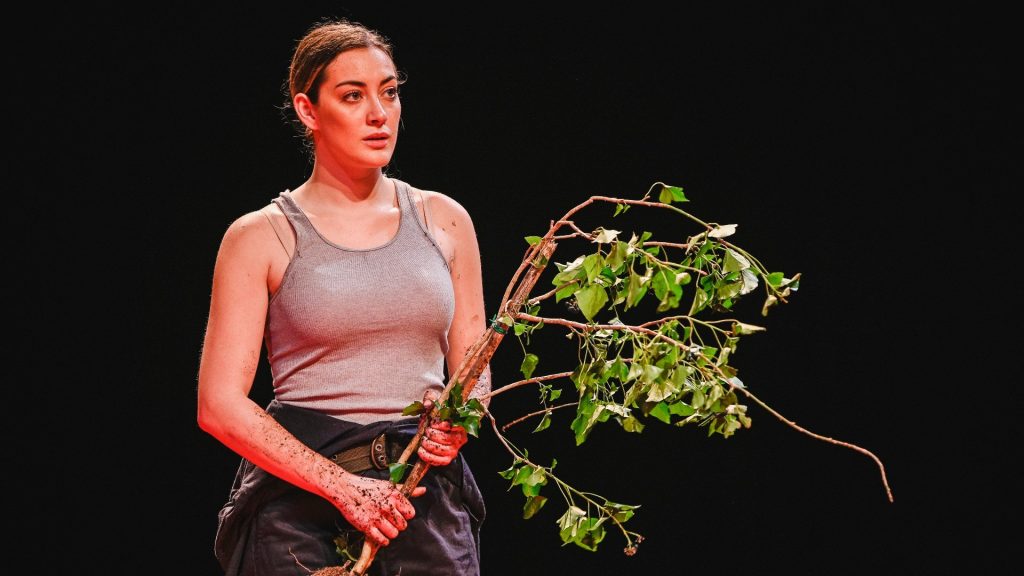
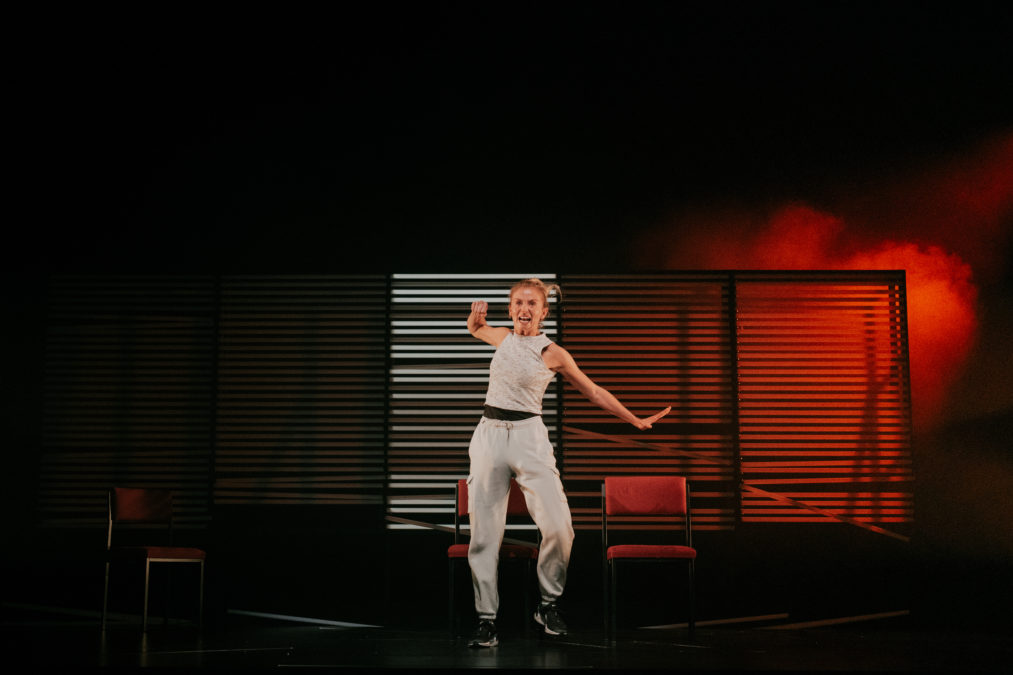
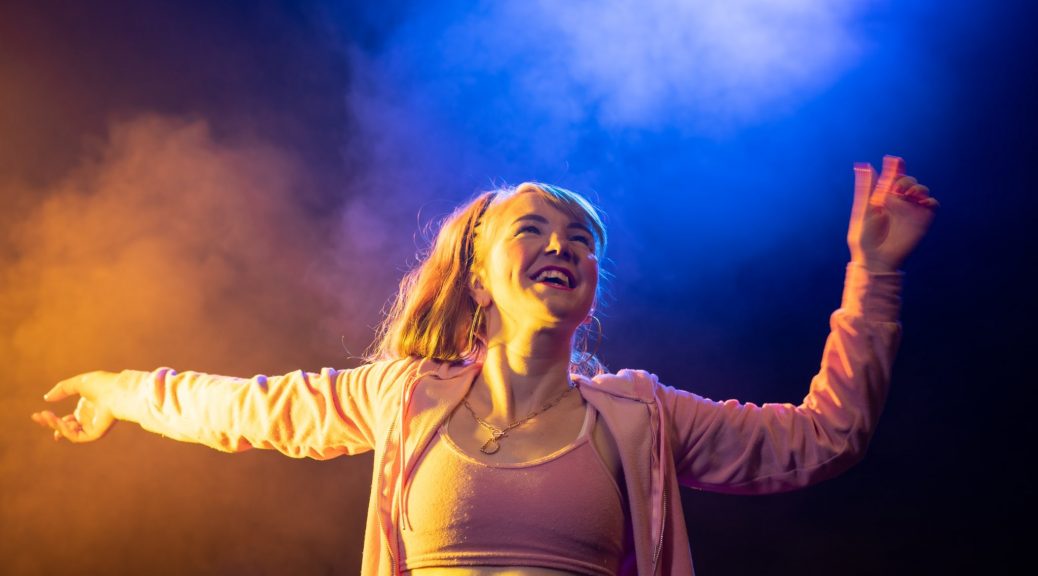
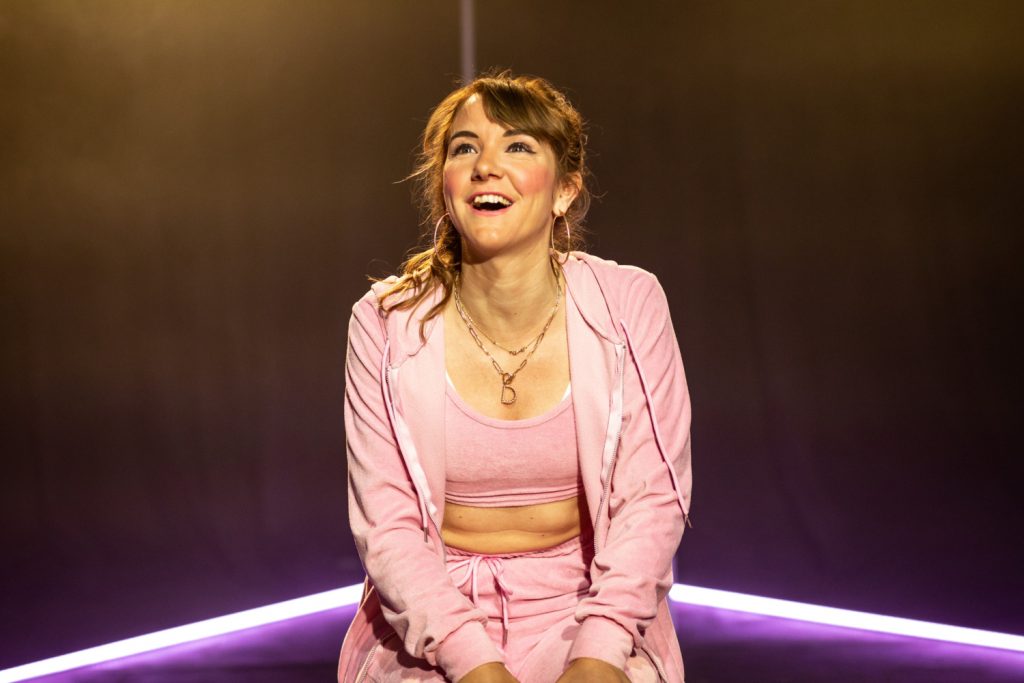
Mae’r ddau actor, Hannah Daniel a Jacob Ifan, yn cydweithio’n arbennig ac mae eu portread o’r cymeriadau yn real a phoenus. Mae portread Hannah Daniel o’r cymeriad toredig yma ar brydiau yn adeiladau at uchafbwyntiau dramatig effeithiol. Ydy, mae hi wedi ei brifo gan y golled ond mae’n ceisio bod yn ddewr, yn barod i wynebu ei hunllefau personol er mwyn symud ymlaen. Dim ond yn araf bach drwy’r ddrama daw hyn i’r amlwg i’r gynulleidfa fod cymeriad I mewn sesiwn therapi ac yn ceisio wynebu ei hunllefau hi, ac mae atgof yw P yn ei meddwl. Dyna pwy felly yw’r trydydd cymeriad sef T, y therapydd sy’n ceisio arwain ei glaf i (gobeithio!) le gwell. Mae’r set, sef platfform syml, lliwgar yn symbol o enwogrwydd ffug Holywoodaidd a’r goleuo annaturiol yn awgrymu anghysonderau’r bywyd hwn. Roedd hyn yn effeithiol ond heb dynnu gormod o sylw o’r action a’r sgript. Mae’r ddrama’n gorffen ar nodyn ansicr ond calonogol ac felly’n agored i ddehongliad y gynulleidfa. Fy marn yw bod y clo’r ddrama yn un sy’n awgrymu bod pawb, ar ôl amser, yn medru gwella a symud ymlaen ar ôl trawma a thor perthynas.
Dyma ddrama oedd yn gweddu’n dda i’r gwagle ac i’r theatr hyfryd hon. Llongyfarchiadau mawr i’r holl dîm artistig ac os cewch chi gyfle, ewch i’w gweld. Mae perfformiadau yng Nghanolfan Chapter tan Hydref y 5ed ac mae modd prynu’r sgript hefyd.
It could be that Dal y Mellt is S4C’s most ambitious drama to date. Episode one certainly promised much from a series that looks set to deliver. Adapted from the hit novel by Iwan ‘Iwcs’ Roberts, the narrative weaves mystery, comedy and crime seamlessly to create a world that is universally recognisable whilst being inherently Welsh.
The first thing to note is its scope. Dal y Mellt spreads across the country, taking in the busy streets of Cardiff and the beautiful vistas of Gwynedd in between visits to London Euston and Chester. Connections to Ireland via the Holyhead-Dublin ferry will come into play as the series progresses, making this a drama of ambitious scale. We are no longer confined to a narrative centred on small town Wales or even a singular region. Instead, Dal y Mellt combines the best of previous Welsh dramas to extend its reach to the whole of Wales and beyond. It does so not as a gimmick but in keeping with a kind of unspoken contemporary tradition of intimate character portrayals (Keeping Faith; Enid a Lucy), expansive landscape shots (Hinterland; Hidden), and a complex narrative web (Yr Amgueddfa; 35 Diwrnod). The cinematography, with its stylistic shots and trained lighting, ensures that it works by adding a touch of quality that underlines its movielike proportions.
https://www.youtube.com/watch?v=7j-oBxViuGw
Dubbed “a hoot of a heist”, there are already some familiar tropes that appear in episode one, including plans sprawled out on a table, secret meetings in an art gallery, and a car chase involving the police. What feels so fresh about this context however is that they’re given a Welsh spin. Gronw (Dyfan Roberts) holds down his drawings of a ship’s decks with a cup of tea and other items from his traditional farmhouse kitchen. The National Museum of Wales provides the backdrop to a conversation between wayward lad Carbo (Gwïon Morris Jones) and garage-owning gangster Mici Ffin (Mark Lewis Jones). Carbo drives through country lanes and takes a detour through some very muddy fields to get away from the cops. Each incident is tinged with humour which lightens the mood. The result is a series that is not gothic a la Peaky Blinders or violent like The Sopranos but nevertheless takes some of their ingredients and mixes it with a distinctly Welsh flavour. It means that the characters are all believable, reflective of their particular locations; and the story remains grounded even as the plot becomes more elaborate and outlandish.
Mici Ffin (Mark Lewis Jones) a Carbo (Gwion Morris Jones)
The characters of Mici Ffin and Les are worth particular mention from this first episode, Mark Lewis Jones and Graham Land making for an instantly likeable double act whose straight faces only add to their comedic value. The fluffy seats and dice dangling from the rear-view mirror of their Capri conjure up a Del Boy and Rodney type partnership which also expresses a lovable incompetence reminiscent of Horace and Jasper. Their dealings with happy-go-lucky protagonist Carbo are a delight to witness, the cheekiness of his responses toward them making him an affable rogue. Morris Jones brings a dexterity of emotion to the role to create a character of both confidence and vulnerability. It is a combination that wins admiration from the viewing public, no more so than in the final scenes, as we witness his fear and ingenuity play out whilst dangling from a forklift tractor. It indicates to Mici the importance of this lad in the events to come, events which remain very much a mystery at the episode’s end.
The eclectic soundtrack, with its reggae-inspired beats and operatic moments, reflects an expansive taste across genre, location and emotion. It is a drama of dark and light; witty and gritty; familiar yet full of mystery. Dal y Mellt is not easy to categorise, combining as it does various elements, but it definitely looks set to entertain audiences with a narrative full of adventure and intrigue. If Y Golausaw it go off the boil, this looks to be a series that brings S4C’s dramatic output back to something that represents their best.
The first episode will be broadcast on Sunday 2nd October 2022 on S4C at 9pm. You can then watch the full series on BBC iPlayer or S4C Clic.
Reviewed by Gareth Williams
Get The Chance is a social enterprise based in South Wales, working to create opportunities for a diverse range of people to experience and respond to sport, arts, culture and live events. To donate to our work, please click here.
In our latest Playwright interview Director of Get The Chance Guy O’Donnell chats to Welsh Playwright and Director of Chippy Lane Productions Ltd, Rebecca Jade Hammond. Rebecca discusses her career to date, her latest play Right Where We Left Us and her thoughts on opportunities for Playwrights in Wales.
Hi Rebecca, great to meet you, can you give our readers some background information on yourself please?
Born in Cardiff, I am a Welsh writer, dramaturg, actor, lecturer and Artistic Director/Founder of critically acclaimed Chippy Lane Productions Ltd.
In the last few years I have been shortlisted for the Papatango Writing Prize, placed in the top 10% for both the BBC Writers Room and the Verity Bargate Award, and longlisted for Theatre Uncut and the Traverse Theatre. I recently worked with National Theatre Wales and Lagos Theatre Festival on a Writers Exchange. I am published by Methuen Drama and represented by The Haworth Agency.
Academically I lecture at Royal Welsh College of Music & Drama, Mountview and Italia Conti.
As an actor, I trained at Royal Central School of Speech and Drama and have appeared in several big television series including Bafta Cyrmru-nominated comedy The Tuckers (BBC), Silent Witness (BBC) and Trollied (Sky One), Mrs Sidhu Investigates (ITV) and I’m currently filming The Wet Look (Channel 4) starring Iwan Rheon and Steve Speirs.
So, what got you interested in the arts?
The first formative experience I had at the theatre was The Snow Spider (Sherman Theatre, 1993). I had no idea what I was watching but I knew I wanted to be part of it more than anything else in the world.
Credit John Angus
I think I’ve always gravitated towards the arts. Though none of my family have ever been interested in the arts, the idea of building and making something artistic was always something that felt natural to me. At a young age dancing was my life, I was obsessed with ballroom, disco, tap, ballet and cheerleading, until I realised I could sing. I remember being part of West Glamorgan Children’s choir and singing on my own at St David’s Hall at ten years old with a 120 piece orchestra and a full house and thinking, ‘This is magic! More please!’. That led me into Sherman Youth Theatre, Everyman Theatre and Orbit Musical Society. Then to University and Drama School at Royal Central School of Music & Drama. It is a path none of my family have walked, and at times has felt lonely but I have always taken what I do incredibly seriously.
Can you tell us about your writing process? Where do your ideas come from?
The play I have in production at the moment, Right Where We Left Us, is actually my fourth play. My first never got beyond a second draft, I hope to bring that back one day. It’s set on Gwaelod-Y-Garth Mountain and it felt so powerful finishing it. My second did very well in lots of literary competitions, and is another I hope to return to. My third is in development with a London theatre, so we hope and pray that it goes somewhere but one never really knows. You have power in your pen but beyond that you need to find an advocate and believer in your work to take it to production.
I have written about grief, grooming, county-lines, ambition, war, death, PTSD, youth, mental health and love. An eclectic mix but on reflection what binds them altogether is the human heart. The human reaction to these epic themes. I am consumed with how we pick ourselves up from the rubble of trauma and try to get back to life, back to home, back to some form of peace and solace.
In terms of my process, ideas and inspiration come to me in freefall, and get noted on my phone. The list is seemingly random and pretty extensive, a snippet would include:
Bricks
Reckoning
Patterning
Horn – Nick Drake
The ecstasy of quietness
I look at these concepts and ideas as seeds that I can come back to later when I eventually get back to writing something new again.
Can you describe your writing day? Do you have a process or a minimum word count?
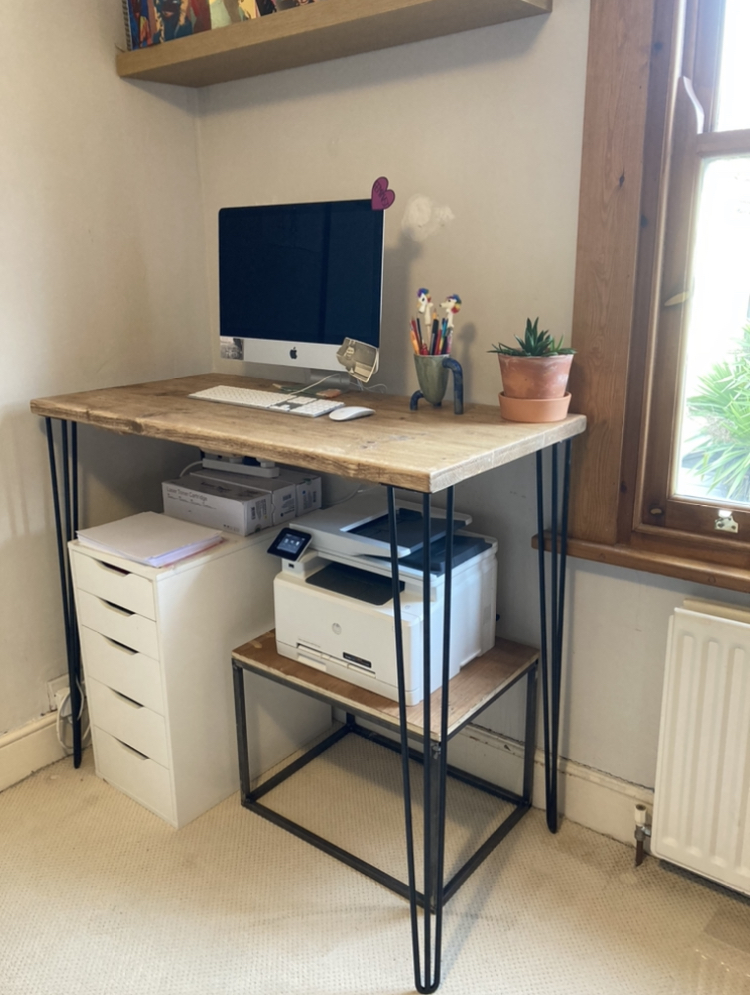
My process usually consists of mornings in my writing shed or at my desk with a Spotify playlist. Or in Cafe Nero in Wimbledon (the staff even know my ideal spot now!) – I need background hum as I can’t work in silence and I love a little bit of chaos and life. I then walk the dog in the afternoon to debrief with myself. I tend to take more time on things than I used to. Allowing more time between drafts to digest and move forward. Things always come out in the wash when you give it the time and space to breathe. I don’t have a word count or page count. I tend to write for as long as I can handle it and have been known to write for twelve hours without eating if I am in the zone, but wouldn’t recommend this!
Rebecca’s Writing Desk
Your latest play Right Where We Left Us , is described as “a heartfelt examination of what happens instead of “happy ever after” Where did the initial spark for the play come from and can you update us on its development?
This play is an acknowledgement of the fragile nature of creative minds and a reminder that our industry is always in a state of delicacy. If the past few years have taught me anything it’s to keep the people you love close and to rid yourself of negative energies.
I wanted to write a piece that explored the murky world of creative collaboration and navigating professional and personal relationships. Right Where We Left Us explores the darkness of ambition and jealousy and how the healing of time can change your priorities and future plans. I long for it to resonate with so many and provide hope for anyone struggling to move forward. To know that you have the power to be ok. You have the power to change the narrative.
This play was born from the shock of having everything put on hold. As the third wave of the pandemic made it seem impossible to ever get back to the stage I wanted to write a love letter to creative collaboration and the great American memory plays.
The script has been honed throughout various development periods with support from The Bush Theatre, Paines Plough, Theatre503, Sherman Theatre, Chapter Arts Centre and The Carne Trust.
At every stage of development our audiences have seen themselves in the characters, feeling the frustration and longing of lost opportunities and lost love. Our urgency comes from the vulnerability and fear we are all experiencing as hundreds of us are forced to walk away and try to find a new path. We ask if it is ever possible to find fulfilment once the creative drive is gone? Are lost loves better left in memory? Can someone else ever give you closure? Will you alone ever be enough?
This production will reunite the Welsh creative team from sell-out show Blue, which The Guardian described as “smart and superbly acted” (4 Stars, 2019). Chippy Lane Productions are fast becoming one of Wales foremost new writing companies, at our core is a drive to champion underrepresented emerging talent. Methuen Drama have also agreed to publish this play.
The play will be performed by 2 alternating acting companies, this sounds fascinating, are you able to tell us more about this choice? Are they both performing the same play each night or will it be different?
While the show will be performed by 2 alternating acting companies, the character of T will work across both casts. The companies will alternate shows and while the script will be the same for each, it’s up to an audience to discover the differences!
In the script, the characters have no assigned gender. So as we developed the play we workshopped the characters with actors of all genders. We soon found that the play resonated differently depending on who the performers were. The power dynamics across age, gender and class all changed the experience of watching the play and added nuance and detail in different sections of the story. We wanted to give the audience the opportunity to experience these different versions of the play as we are sure they will be able to see themselves reflected in the characters at different moments. Joyfully, it also means we were able to offer employment to two more actors, which after the past few years feels like a small win for a company who wants to champion Welsh and Wales based voices.
There are a range of organisations supporting Welsh and Wales-based writers. I wonder if you feel the current support network and career opportunities feel ‘healthy’ to you? Is it possible to sustain a career as a writer in Wales and if not what would help?
I wrote about this recently for The Stage as I feel really strongly about it.
The lack of funding across Wales for the arts directly affects a lack of development schemes that go beyond the beginning stages of playwriting. This means that the same canon of (mainly male) Welsh playwrights receive those rare opportunities of having work commissioned. This stunts the progress of more diverse writers, limiting opportunities to have their voices heard on Welsh stages and on stages across the UK.
In 2018, I set up the Welsh Female Writers Group in response to the lack of female voices being commissioned. My hope was to create an inclusive space for female and non-binary creatives to write, no matter their level of experience. More than 120 writers have joined our workshops. Some have gone on to work professionally for stage and screen, set up companies and collaborate together to make work. However, there are still many more voices struggling to get opportunities, commissions, productions and publishing.
I can’t control the future of funding in Wales, or improve the lack of programming opportunities at venues. What I can do is continue to shed light on this vital issue and keep the door open for any Welsh playwright wanting support from Chippy Lane to champion their developing careers. Chippy Lane prides itself on inclusive practice and will do everything we can to affect change in our sector.
If you were able to fund an area of the arts in Wales what would this be and why?
Writing initiatives and development funding for grassroot companies to pair with venues across Wales to make work and tell new regional stories that connect to the respective areas. We need initiatives that take playwrights through to productions. We need venues and companies to take the leap into programming newer / younger writers and supporting them with commissions so our cannon is more diverse and not the same voices heard yearly.
What excites you about the arts in Wales?
There is a wealth of exciting new talent coming through Wales. Whether born here or settling here to train, I truly believe it is an exciting time of positive change.
With the appointment of Chelsey Gillard at The Torch and Steffan Donnelly at Theatr Genedlaethol Cymru it feels like the theatrical keepers of the major buildings and companies are beginning to shift and change for the better in Wales. Along with new work being made by Mari Izzard and Nia Morais at Sherman Theatre, Katie Elin-Salt and Eleri Jones’ show at Theatr Clwyd in the summer. Emily White won the George Devine Award and Faebian Averies won the BBC Audio Drama Award and Connor Allen’s show at Wales Millennium Centre. It feels like the rumblings of more diverse theatre being made is happening and it’s exciting to see.
What was the last really great thing that you experienced that you would like to share with our readers?
I visit the theatre a lot. In 2019 I saw 147 shows and kept a spreadsheet of all of the productions I saw. For what? I have no idea, but for me one of the most difficult things about the pandemic and in particular 2020 was inability to frequent the theatre. In many ways the theatre is my church, a sanctuary for me to learn, laugh and weep. However, since coming back to my usual theatre-going habits I’ve felt like something was missing. I’m not certain whether it’s the heavy weight of the outside world seeping into the auditoriums, but nothing has really cut me deep or moved me since The Passover in early 2020 (pre-pandemic) until now.
The Normal Heart at The National floored me, it will be one that amongst the mountain of shows I’ve seen will sit with me always and I feel privileged I got to see.
After it finished I felt like I’d come through a war. I could feel the anger of Kramer’s pain in writing it. I felt helpless and powerless and thought about all the lives lost unnecessary. How they fought so hard for acknowledgement and support. It actually haunted me so much that I wrote to the Welsh government to ask if this could be considered as a key text on the curriculum for English and Drama.
“Don’t lose that anger. Just have a little more patience and forgiveness. For yourself as well.” (Kramer, L. 1986)
Creating opportunities for a diverse range of people to experience and respond to sport, arts, culture and live events. / Lleisiau amrywiol o Gymru yn ymateb i'r celfyddydau a digwyddiadau byw