
All posts by admin

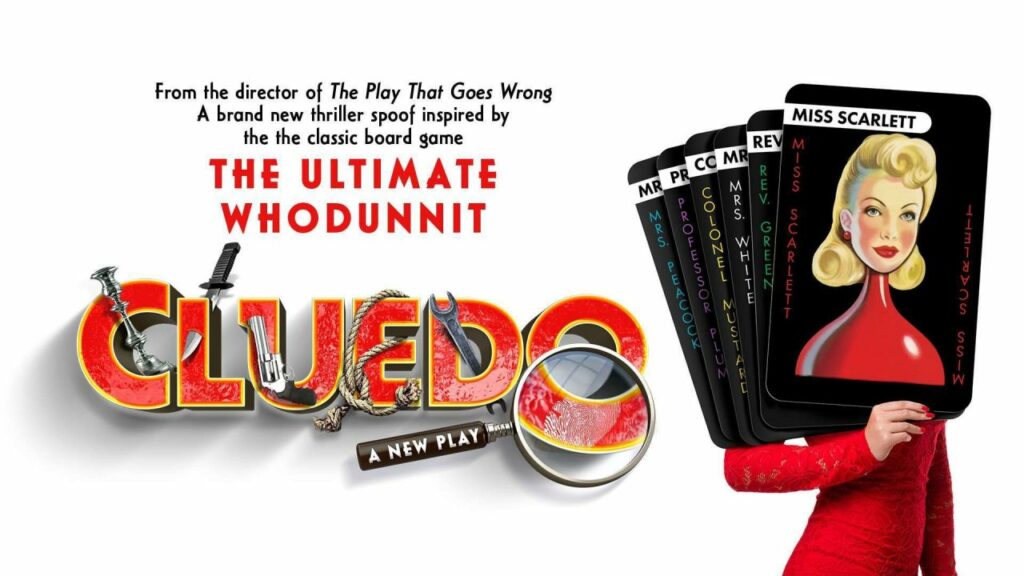
Review Cluedo, New Theatre, Cardiff by Rhys Payne

 out of 5 stars (4 / 5)

One of my greatest achievements in life is the fact that I once won an entire game of Cluedo in one guess! For those who haven’t played this game before, it is a board game created by entertainment aficionado Hasbro where the whole point is trying to figure out who the murderer is, where the crime happened and what weapon was involved. Everyone starts the game with a series of cards that cannot be the final guess as they are not in the mystery case file sitting in the centre of the board. As you travel around Boddy Manor you guess the key ideas and through skills of inference and the help from other players you can whittle down to the perpetrator, crime scene locations and how it was done. Once you think you have solved the case and want to make a prediction you have to remove yourself from the game so that if you are wrong the game can continue. On one such occasion, I was able to guess in my first go, I was able to suggest the three concepts and so made my formal prediction which was absolutely spot on! This was met by a flurry of confused and surprised faces as this game usually lasts for a very long time but instead I had won in one round! I have always loved a good murder mystery event ever since attending an in-person immersive murder mystery party when I was very young where we were all given a character to portray for the evening. In fact, during the recent global lockdowns (that appear to be a thing of the past now!) I took part in three online murder mysteries organised by the fantastic sharp teeth theatre. With all this in mind, you can imagine my excitement when it was announced that not only would there be a staged murder mystery but also it was based on the board game that I was miraculously won in one round much to the surprise of all my friends.

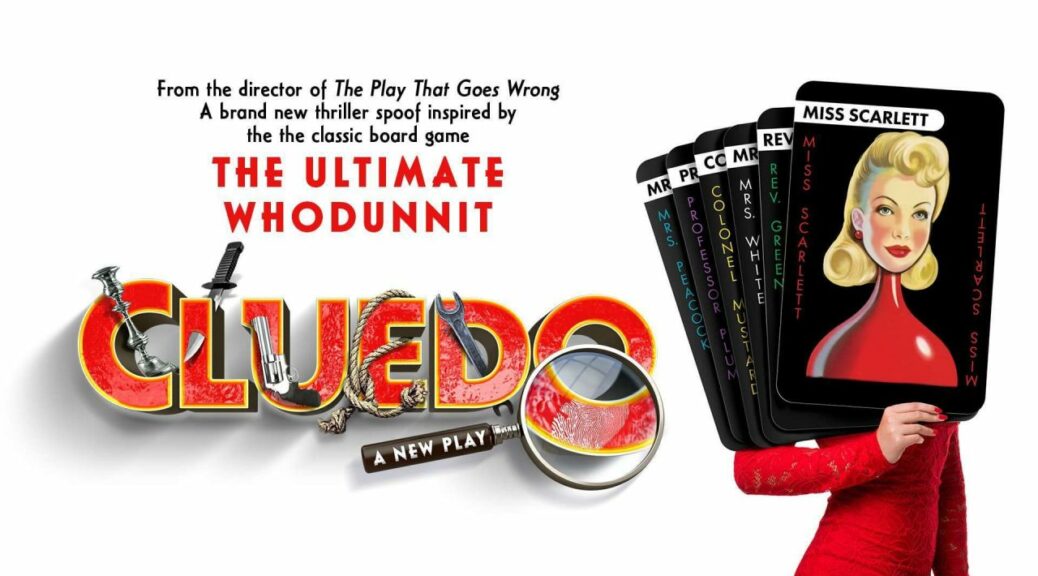
Cluedo the stage play is a staged adaptation of the much-loved board game where a group of people are invited to the mysterious Boddy Manor only to discover that the owner of the house is blackmailing everyone involved. Their attendance at this event is suddenly thrown into absolute chaos as a series of dead bodies are discovered which means this group has to discover who is commuting these horrendous acts. The stage version has everything that people love about the classic board game including the iconic weapons, memorable locations, and much-loved characters (eg Miss Scarlett, Professor Plum and Mrs Peacock) complete within their eccentric looks and mysterious secret tunnels connecting rooms to each other. We first meet Jean-Luke Worrell who plays the wonderfully over the top butler who appears to have orchestrated the whole event. He is seen to introduce each character (who clever light clues representing each character) and his constant over-acting and four wall breaks really fitting in with the master of ceremonies vibe portrayed throughout. I personally believe that this character was so wonderfully exaggerated that they delivered many of the hilarious moments in the show which contrasted beautifully with the fact that they were all dragged into a murder investigation. In the closing moments of the show, we see a hilariously prolonged death sequence involving this character where just when the audience thinks they have died, they spring back to life to perform a tap sequence, incredibly soulful rendition and emotional monologue that had the audience howling with laughter throughout. The butler then introduces the rest of the characters during a carousel of arrivals which I really enjoyed as it represented the moment in the actual board game where everyone reads about the characters involved. However, unlike the board game, these characters are not simply Miss Scarlett, Professor Plum and Mrs Peacock etc but instead these art pseudonyms for people who had committed some form of illegal activity that they are being blackmailed for. After the extent of their crimes is revealed by the owner of the manor, the evening takes a turn for the worse as Mr Boddy is found dead. Before he could pass, however, the newly deceased had managed to distribute a murder weapon to every character which initially was intended to be used to kill the butler which helps to drop breadcrumbs throughout the story of who is committing these atrocities. The characters are then tasked with solving the ‘who dunnit’ before the police arrive and there is a public scandal that leads to more bodies being discovered as the evening progresses.
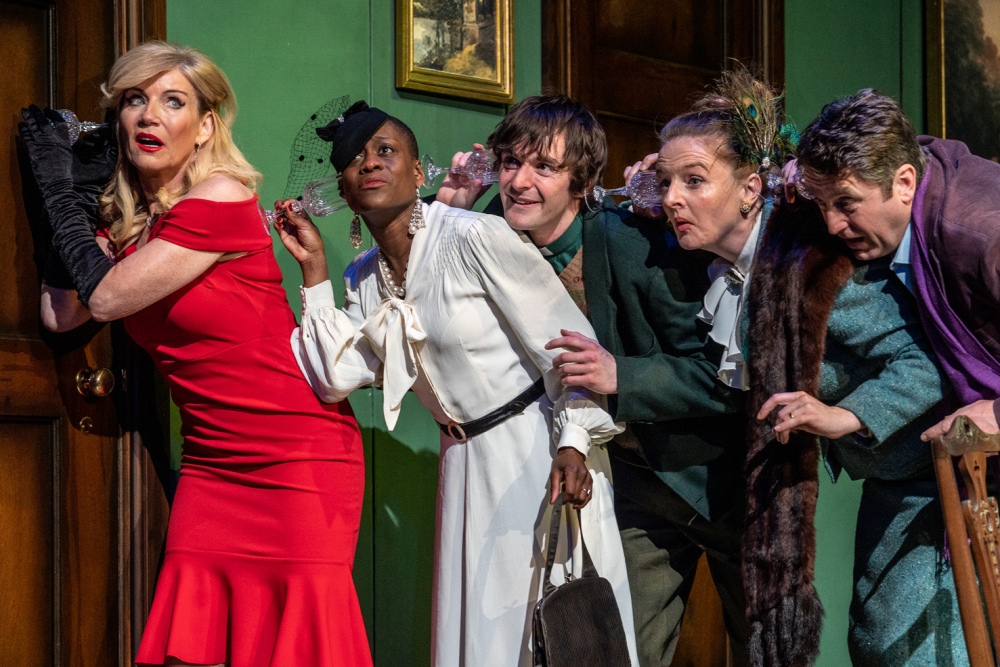
Despite being a play all about murder, the creative team behind this project have managed to craft this production in a way making it child friendly (but not in a childish way) so that everyone in the family can enjoy. They have injected this show with many hilarious moments which creates a sort of ‘the play that goes wrong’ sort of vibe with a series of brilliant physical comedy moments and witty I liners. There are moments when mostly reverend green (played by the wonderfully talented Tom Babbage) walks into opening doors, is squashed in slow motion by a falling chandelier and hilariously misinterprets instructions that have the audience cackling. As this story progresses, this character becomes a bigger and bigger part leading to a very shocking revelation in the closing moments of play. There are also moments facilitated by the butler where the entire play rewinds to discuss an alternative ending which was cleverly performed by all involved. These inclusions help to make the play friendly to experience for any audience while still playing in the nostalgia of older audience members which was very cleverly developed. We do get a much greater understanding of every potential suspect in this case (that you do in the board gane) mostly due to the fact that in the play they are fully realised and physicalised with backstories, motives etc which I thought was a great inclusion that all work together to make the closing moments of the play even more striking.
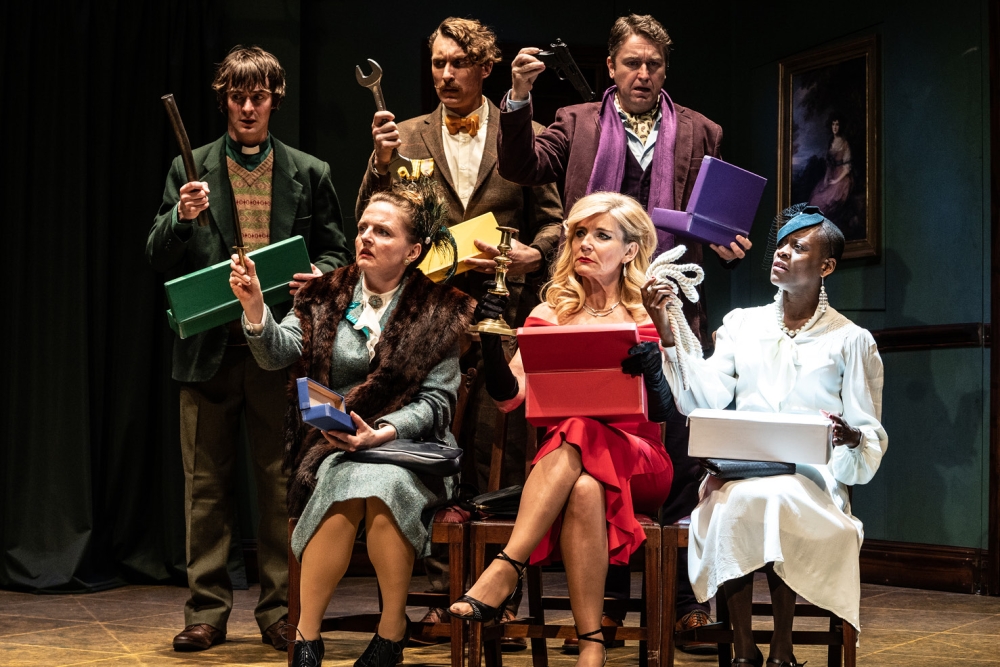
Overall Cluedo the stage play is a family-friendly experience that has moments of nostalgia for older audience members and many hilarious moments that everyone can enjoy. It is a unique theatre experience that is available in the New Theatre Cardiff until Saturday the 9th of April so if you are looking for a murder mystery event involving a series of wonderfully over-the-top characters then this is one for you! As a side note, from this play, I want to use Cluedo as the next theme for a fancy dress party as I think that would be amazing fun!
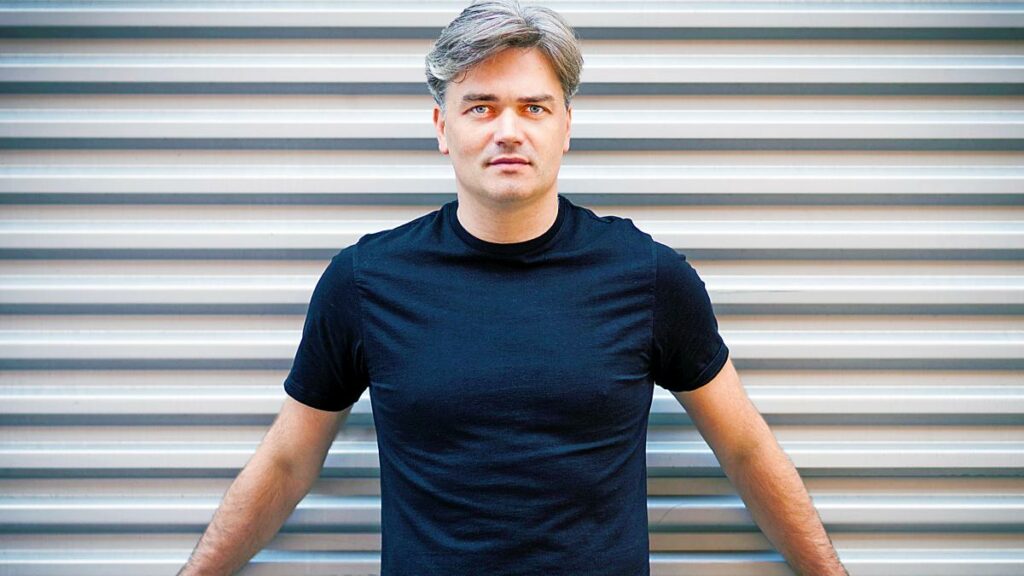
Review SoundState & London Philharmonic Orchestra Southbank Centre by James Ellis

Photo credit: Benjamin Ealovega

 out of 5 stars (2 / 5) Arditti Quartet

 out of 5 stars (3 / 5) Mark Knoop

 out of 5 stars (4 / 5) London Philharmonic Orchestra

Arditti Quartet Programme:

Christian Mason: This present moment used to be the unimaginable future (UK premiere)
Clara Maïda: … das spinnt for amplified string quartet
Betsy Jolas: String Quartet No.8 (Topeng) (UK premiere)
Tansy Davies: Nightingales: Ultra-Deep Field (UK premiere)

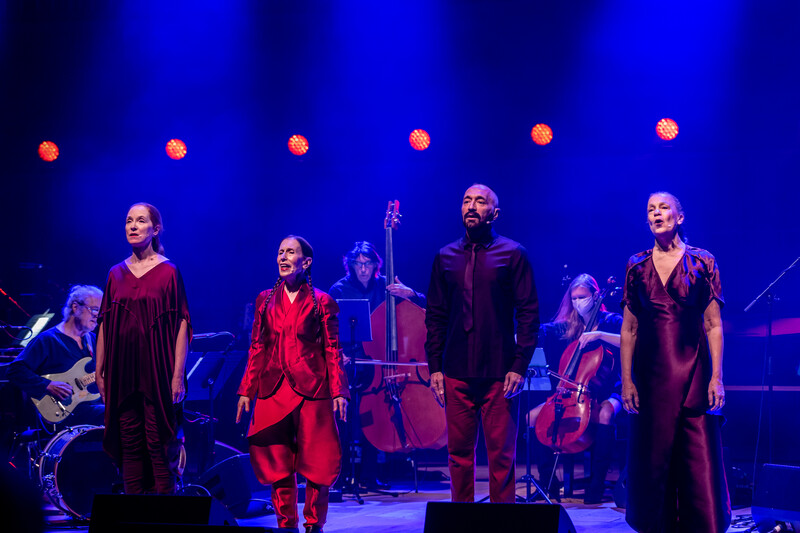
After the giddy thrill of seeing Meredith Monk live for the first time, I wanted to check out more of the Southbank Centre’s SoundState festival. In an intimate afternoon, the Arditti Quartet tackled new work, pushing the boundaries and listeners with the medium of the string quartet. I must put my cards on the table, and say I struggled with this repertoire. I find it hard to believe coming from me, who has always been on a journey of new discoveries. Christian Mason’s opening piece had an interesting use of space with two of the players standing towards the back corners of the Purcell Room, the piece ending with them all leaving the stage still playing.

It would be hard to pinpoint any markers within this music. My concern lies in the blunt method of music making, a hang over from the Second Viennese School. It would be reductive to say this felt like a Webern Fan Club, though his influence was there along with other serialists. The expected shrillness and unhinged sounds couldn’t formulate any visual stimuli, perhaps more abstract sights would be fitting? There was little in rest bite of the anxious, nimbly bow play, the strange prodding of the senses. For once I cried out for a melody…never thought I’d say that. I left flustered and with a headache.

There was some tinkering with show times on this Saturday at the festival and Sex Magic by Liza Lim was given a later slot, giving a three hour break after Arditti for Mark Knoop’s recital. I would miss Liza’s show and was sad to do so. Knoop’s concert had some curious work, a premier from Akiko Ushijima and more. Materia opened with rowdy electronics and Knoop proving his tricks as a musicians itching to take on bold pieces. A dance between man and the electric gave off a wondrous show. They complimented each other, the brittle noises joining the elongated piano writing.

Canon in C from 3 Canons for Ursula by Nancarrow was less impressive. Not the MIDI type playing the composer is notorious for, essentially piano music so complex a human could not physically play it. There is elegance in this Canon, Knoop fitting this choice and it left you hungry for more of that outrageous music. For my sins, I sadly, missed the final piece on the programme: Matthew Shlomowitz’s Explorations in polytonality and other musical wonders Volume 1. From what I did see I must express how invigorating it was hearing these strident works up close and personal. Will absolutely see more of Knoop.

Rushing over to the other side of the centre, a chance encounter with the London Philharmonic gave rise to a super evening from France and Germany. I’ve spoken in recent reviews about the unrepresented nature of female composers. With Lili Boulanger, a French artist who died tragically young, her sister Nadia is best remembered as one of the big teachers of composers in the 20th century. Lili’s Psalm 129 was only a few minutes in length, though had a big impact and a bigger heart. It is the early Debussy likeness and soundtrack feel that stand her apart, way ahead of her time. The chorus really pelting out some sublime harmonies, though brief and still teary. Olivier Messiaen’s Le tombeau resplendissant is a fine example of his early output of music, the influence of Stravinsky and his Catholic faith being most on stage. The exhilaration and veneration seeps throughout all the orchards groups shining with bold, rampant passages. Messiaen withdrew the piece from his canon for reasons we may never know, a strange decision since the piece is brilliant and a great gateway to the hurtling, mouth dropping later scores.

Edward Gardner continued to show his casual brilliance with Brahms’ A German Requiem. The might of the large orchestra and massed London Philharmonic Choir and The Rodolfus Choir. The singing also help up extremely well the constant declarations in this mass being direct and clearly executed. Baritone Roderick Williams remained highly skilled during his solos, a friend at the concert remarked his German was “on point”. Always soft and centrally one of England’s finest baritones, this cant be denied. The one solo featuring soprano Christiane Karg sat with the choir was a pleasant feature, praise indeed for her even it was the only time she sang. I’ll take or leave Brahms and this German Requiem may not always grab me, but I can’t deny the effort that was put in this and it execution bordered on the exemplary.

SoundState continues until the 3rd April.

SoundState | South Bank London

Review Dance to the Bone, Neon Candle and Sherman Theatre by Hanna Lyn Hughes

 out of 5 stars (4 / 5)

Co-directed by Joe Murphy and Matthew Holmquist, Dance to the Bone is a gig theatre show performed at the Sherman Theatre in Cardiff inspired by the dancing plagues of medieval times which explores what it would be like if a plague of this kind were to break out today and how society might react.

The evening started with a folky rock belter with leading vocals by Oliver Hoare who co-wrote the drama with Eleanor Yates, singing “I wanna take you dancing”. I could sense the audience twitching in their seats, itching to throw a limb or two and start a dancing plague of their own. I found myself in awe of the multi talentedness of the cast and particularly loved the music which was a catchy and refreshing mix of folk rock.

The story line is fast paced and the dialogue sharp witted with themes of grief and trauma running throughout. Joanne Bevan (Yasemin Ozdemir), our protagonist works at an insurance company with her brother, John (Jack Beale) both of which have recently lost their grandmother, with Joanne seemingly especially affected by this loss. Choreographed by Krystal Lowe, Ozdemir’s energetic dance solo was a mix of thrashing, kicking and more traditional dance moves which included some very impressive backbends. When the other characters eventually caught the dancing fever, I was particularly impressed by Beale’s agility as he writhed and flailed around with excitement during his impassioned speech about the expectations around his role as a big brother and “man of the house”.

The show ends with the ensemble finally dancing altogether under the warm glowing light bulbs hanging from above; each embracing different ways of moving, some floated ethereally and some kicked, punched and swiped the air purposefully.

All in all, an impressive display of talent and a well rounded, thoroughly enjoyable show.

Review James Larter & Meredith Monk with Bang on a Can by James Ellis

Photo Credit: Victoria Frankowski

 out of 5 stars (4 / 5)James Larter

 out of 5 stars (5 / 5)Meredith Monk & Bang on a Can
St-Martin-in-the-Field Church in London maintains a calendar of concerts all year. The raw energy of percussionist James Larter should shock an idle Friday afternoon audience in an hour of sizzling, sonic sounds. One might run afar from the music of composer and mathematician Xenakis, yet his Psappha was a powerhouse of force, James greatly showing off the demands of the work with ease and determination. Richard Rodney Bennett and his Marimba Concerto (the first movement) followed featuring on piano Tyler Hay, representing the allusive orchestra in this reduction. Perhaps the most stringent of the programme, Bennett’s time with Pierre Boulez shows here, with some moods of brief Messiaen, the composer being well known for more traditional film scores. James here flexed his percussive muscles with the marimba his gym rack, with Hay a smooth and well equipped companion.

Composer Param Vir introduced his premier work: Drum of Deathless, in a solo arengment. Taken from time spent in a freezing monetary in South Korea, Via has flung into the air a work of great magnitude, quite showy as James chants and clamours away beautifully. Both small percussion and the marimba are on offer, with a dexterity needed in the transfer of sounds. Temple bowls added flavour to an already spicy broth in what could proof to be a percussion favourite in years to come. James’ own piece Bedawi, utilised electronic beats, call to prayers and a middle-eastern inspired musicality. This wrapped things up well, evocative in nature, though slightly too shorty feeling more like an encore. James is one to watch.

Leading to an evening at the Royal Festival Hall with a music legend, an woman of charm and filled with vim. There was much anticipation for Meredith Monk’s first concert back in the UK for some years. During lockdown I began to engage much more with her canon: Zoom workshops, a kick starter (which I gladly pledged to) and my interview with her all added to my quest to know more, to get a more rounded sense of this interdisciplinary artist.

Entitled Memory Game, the night would feature hand picked work from Meredith’s extensive output. Starting with The Games, a galactic examination of fascism in the guise of a science fiction opera. What lovely things to hear, as always with this music. Meredith’s singers: Theo Bleckmann, Katie Geissinger and Allison Sniffing are individually brilliant in their vast scope of roles. The joy of the absurd thrives here and the thrills that feature leaves faces beaming. The dance work is also unexpected, grounded in simplistic modes of expression, yet always achieves its goal. The utter delight that was Tokyo Cha Cha from Turtle Dreams Cabaret held up as funny and endlessly charming. Migrations from The Games, saw Ukrainian tributes with blue and yellow lighting, as this touching moment stirred hearts, with Meredith near wailing, child like in voice. Double Fiesta ended with that rush hour speed, the ear worm of the night. A few encores also appears this hungry audience, the show being under 90 minutes.

I’d have loved to have heard Hocket and The Boat Song from Facing North, since Theo Bleckmann was present who premiered the work with Meredith. Though Theo’s ludicrous Gamemaster’s Song, another selection from The Games, had a bouncy keyboard riff and oodles of poses and vocal frontiers for him. The Memory Song also from the opera a sweetly scented venture into the characters thoughts as they venture out into space, with a shopping list of things now gone to them. Spaceship which opened the night gave the musicians time to wrap up and enter this universe of thoughtful ideas, harmony never comprised, melodies never to approachable. The years of collaboration with Bang on a Can Allstars also shows. The instrumentalists shined with funk, patience and the passion for every bar of music. It’s the sincerity that surprises you the most in Meredith’s art. A lack of sung words also open up much more interpretation, with a general minimalistic vein exposed. Few would argue she remains an unique voice. Few other artists have chirped, shrieked, scoffed and teased their voice like Meredith has and we love her all the more for it.

The evening ended on a high note with a relaxed post show talk with Meredith and musicians from the night. I finally had the chance to meet her in person and she always speaks so kindly of Wales, hoping to return one day. Photos and autographs were greatly appreciated, as I left filled with love and warmth.

Join Zoom song and dance workshops with Meredith Monk and her singers, see her website for details.

Meredith Monk will continue with Memory Game with her Singers and Ban on a Can All-Stars, with film screenings and Cellular Songs on tour at the Rewire Festival in The Hague, with the Cellular Songs in Nantes, Paris and Luxembourg.

Review English National Ballet, The Forsythe Evening Sadler’s Wells, Review by James Ellis

Photo Credit: Laurent Liotardo

 out of 5 stars (3 / 5)

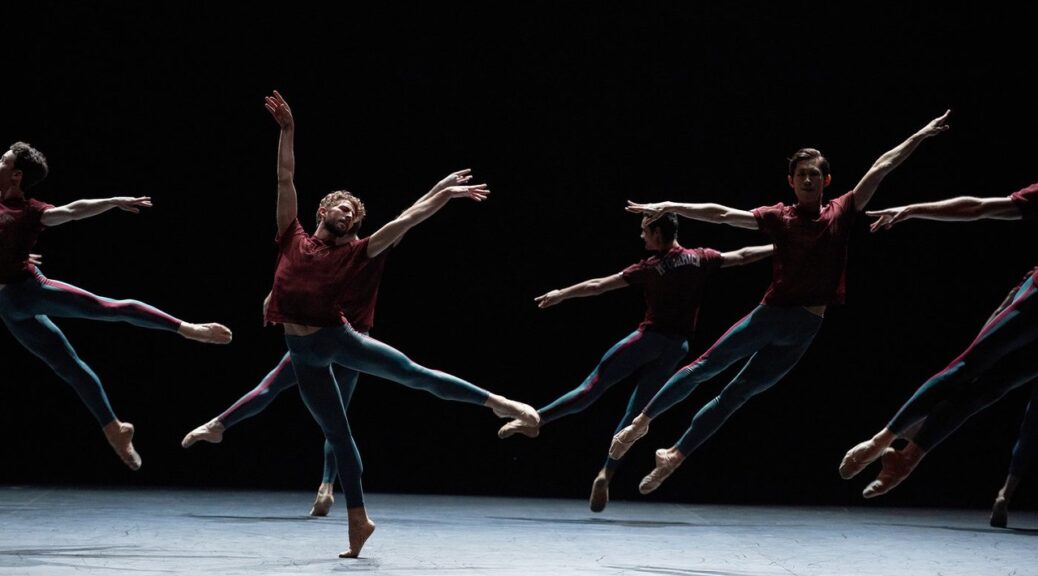
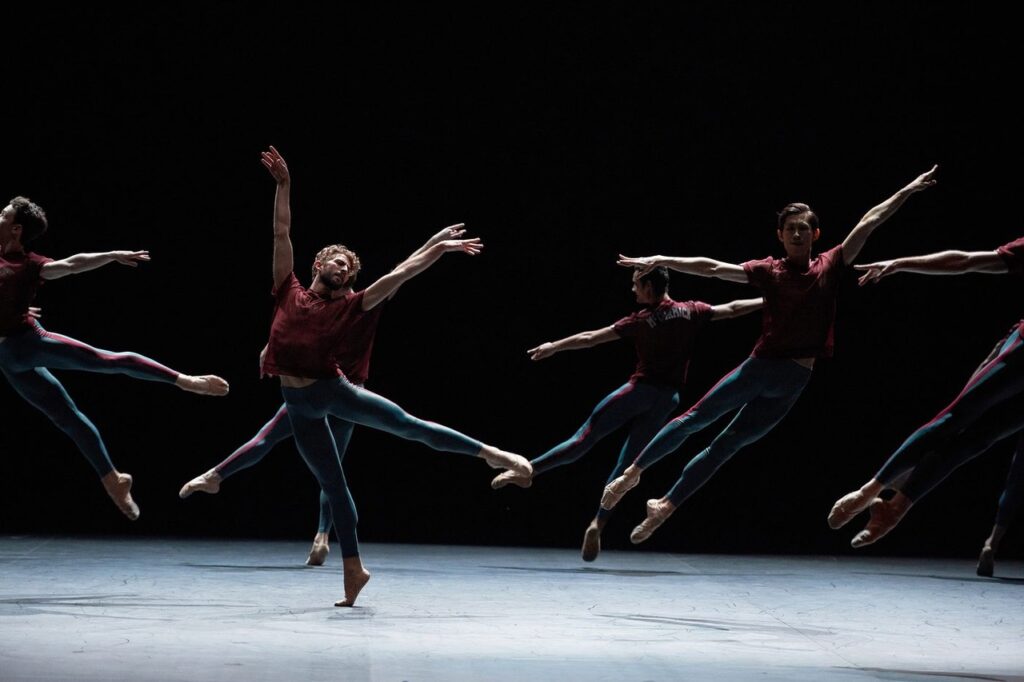
A return to London, a return to dance. I could not ignore the allure of Sadler’s Wells and the newest offering from English National Ballet. With choreography and stage design by William Forsythe, this was very much his evening. The showing off of his dance work bled into every moment of the night. The soundtrack over the brief night would randomly feature James Blake, Barry White and a variety of other musical taste. I pondered throughout, does it work?

The dancing on display cannot be underestimated. Yet, the music didn’t always necessarily ground the pieces and we had a choice of various petite performances of blinks and you’d miss them proportions. I want to say it felt more like strident ballet sequences fitted with pop and peculiar musical choices, having a certain charm but just not really making much momentum. The second part of the night entitled Playlist had a more club anthem feel, the audience clearly swept away with it’s frantic mania. This remained a curious take on ballet both old and new, more so of the later. There was an angular, almost cubist approach to movement, the men and women getting stirring duets or flourishing ensemble motifs. You almost want to recreate some of the poses at home.

It was the short nature of the entire night which made for a pleasant variation, two short parts with plenty of insight and intrigue. Like on this press night, this should please a lot of people, the choice of music should help break down some barriers and make ballet per se more accessible. The choreographer appears to be making waves in dance and work like this can only continue his. passions. A night like this can only define the talents of some spectacular dancers with builds that could leave most of us reeling.

Spend a night at the Fosythe Evening. It is a guaranteed success.

The Forsythe Evening runs at Sadler’s Wells till 10 April 2022

Review London Mozart Players & Isata Kanneh-Mason, St Davids Hall by James Ellis

Photo Credit: John Davis

 out of 5 stars (4 / 5)

It’s all go for St David’s Hall and their International Concert Series. Though what surprised me the most for this concert was the surprising gaps of empty seats in the auditorium for the London Mozart Players. The rugby was of course on, it seems.

In a finely crafted concert, the focus was mainly in the first half of the 19th century, with a touch of the early 20th century to boot. In Prokofiev’s 1st Symphony (dubbed the ‘Classical’) we see the ground work for the early days of the composer, one who would go on to effect the musical landscape for years. It is rigid in style, even with some charming elements. Written the year of his countries shattering revolution, one must also consider the music later which would delight and disgust in equal measure. You’d never think listening to this symphony that a prickly, angular vision would form from the composer. No doubt, this is a rare sighting of a Russian work of music right now for obvious reasons.

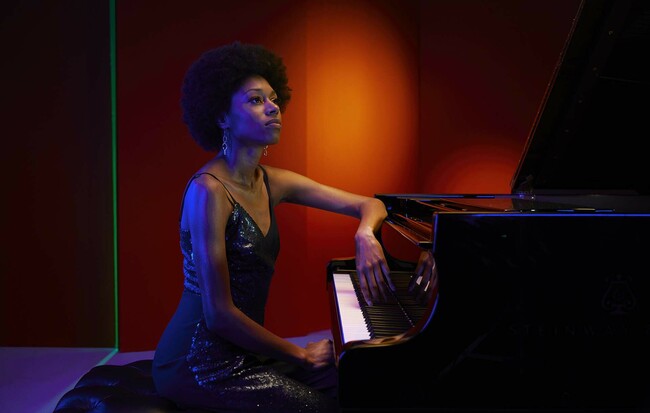
The treat of the night came from Isata Kanneh-Mason for Clara Schumann’s Piano Concerto. I’ve spoken in the past how beguiling Robert Schumann’s music is, yet his wife has for the longest time remained in his shadow. Very much a power couple with a turbulent relationship, the Schumann’s remain some of the finest artist of their era. Clara’s Piano Concerto has a live, chattering quality hard not to love. From a renowned family of musicians, Isata has all the grace and standing the piece demands, even with some wonderful, clamouring moments. This was a testament to the underrated beauty of this female composer and only proves just how much we need her music. Time for Clara to shine…

A cheeky return after the intermission with Rossini and his overture to The Italian Girl in Algiers. Amazing how funny an overture can be, the timpani standing out in it’s blasts. The choppy, whimsy Rossini is well known for is heard as well as an undercurrent of malice. Ending with Mendelssohn’s 4th Symphony made for a familiar and effective finale. Known as the ‘Italian’, named so as he wrote the piece on tour, it shines with a breezy pace, never giving up its style or panache. Bulgarian conductor Delyana Lazarova all night, slashed away at each score, an intense scope on the music never let up, formulated by the players. The spritely musicians offered us an intimate evening, something which this Cardiff audience would love to see again.

Review Madam Butterfly, WNO by Gwyneth Stroud

Photo-credit-Richard-Hubert-Smith

 out of 5 stars (4 / 5)

It’s incredible to think that there has been just one WNO production of Madam Butterfly for around 40 years. Revived many times, of course, but still remarkable. So it’s difficult to put to one side the Japanese post-colonial setting with which so many of us are so familiar.

But lay it aside we must, and approach this new production, directed by Lindy Hume, with an open mind.

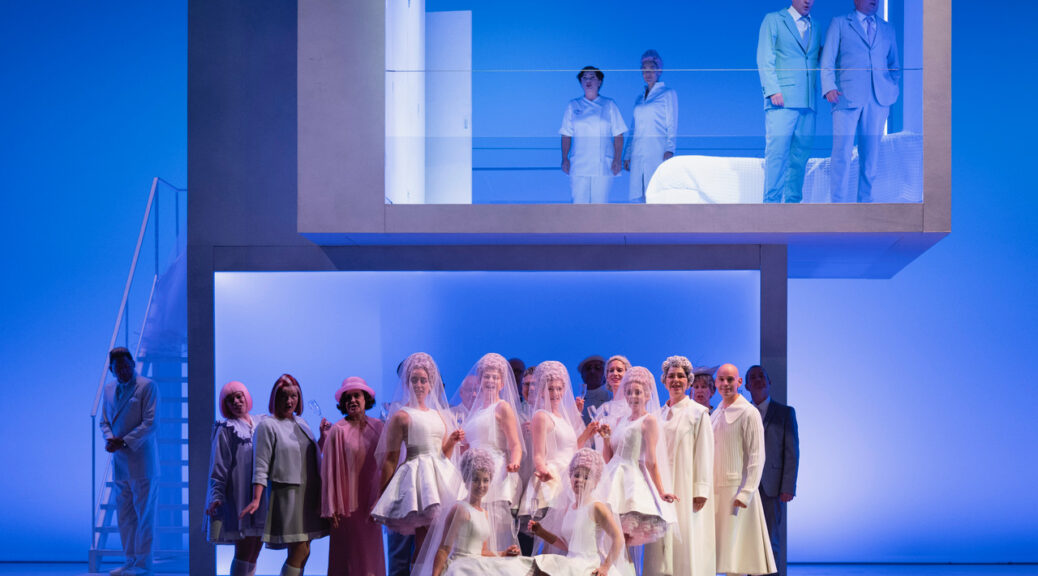
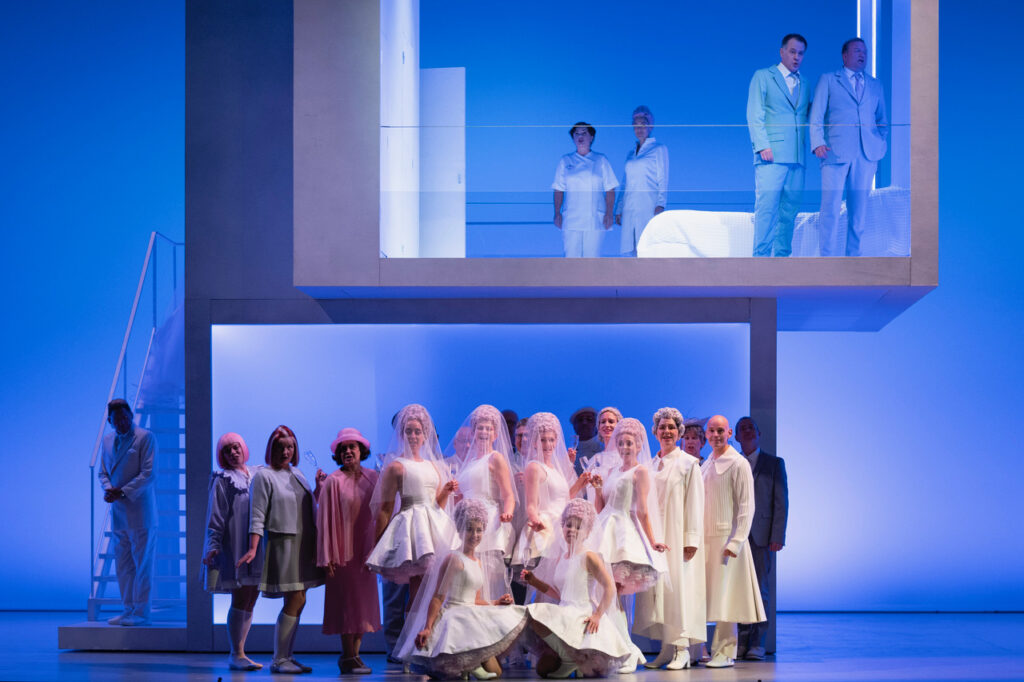
It’s worth it. We are catapulted into the future – quite when is not important – and the effect is startling. Unencumbered by place and time, our attention is focused on other aspects of stage management – set, lighting – and of course the music. Costume by Isabella Bywater, is stark, and yet subtle. White is the predominant theme here, but from which era? We see late50s/early60s-inspired dresses; boots straight out of the 70s; nods to early 80s New Romantics, all adding to our sense of dislocation of time and place.

Set and lighting take centre stage here. The Pinkertons’ Americanised home could be found anywhere, a stripped, blank cubic canvas in and around which the action centres. Framed in a harsh neon square of light, Butterfly and Suzuki in particular appear trapped by confinement. Contrast this with the soft and skilful use of colour washes by Lighting Designer Elanor Higgins, on the outer walls of the stage. Rose petals, the sea and the sky, dusk, daybreak are all beautifully captured through the medium of lighting alone.

Alexia Voulgaridou manages to capture both the tender love and the horror felt by Cio Cio San on learning her fate. Leonardo Caimi’s tenor is fabulous in demonstrating his sense of entitlement and Western superiority, and both Goro and Suzuki (sung by Tom Randle and Kezia Bienek) fulfil the demands of their roles well. Other parts are sung by Keel Watson, Sion Goronwy, Neil Balfour and Sian Meinir. As ever, one of the highlights was the magnificent orchestra under the baton of James Southall, and the ever-reliable chorus. The scene accompanying the hauntingly beautiful Humming Chorus will stay will long endure.

A bold production which, via its dislocation of time and place, serves to demonstrate that this saga of power and entitlement is, arguably, as relevant to us today as it has ever been.

Summer Season announced at Theatr Clwyd

Theatr Clwyd today announce a massive summer season of activity. The season boasts an incredible mixture of musicals, comedy, drama, music, and family activities. The venue welcomes the return of many community performers that have not been able to take to the stage since before the pandemic.

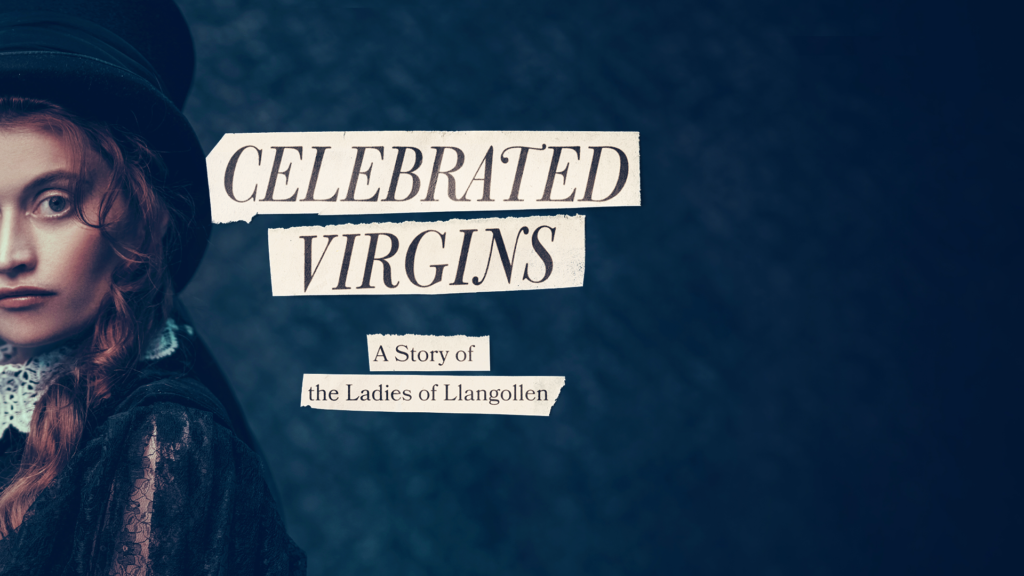
Theatr Clwyd produces brand new productions in this season. Celebrated Virgins, A Story of the Ladies of Llangollen (20 May-4 June) is a brand-new production written by Katie Elin-Salt and directed by Eleri B Jones. Based on the true story of Eleanor Butler and Sarah Ponsonby. When they fell in love, they were forced to leave their homes and cast out by society. Taking up residence in Llangollen they became minor celebrities, forced to witness their own lives written about by those who could never understand. Now, they are back, ready to take back the story that’s rightfully theirs – on their own terms.

A Pretty Sh*tty Love (8-23 July) is a drama that is based on the true story of a couple and their journey. Hayley wanted to fall in love – to find her prince. She never found it though, she never looked in the right place. Then along came Carl. This is a new play by acclaimed playwright Katherine Chandler and directed by Francesca Goodridge. This show contains challenging themes.

There are also two brand new musicals being co-produced with Theatr Clwyd this season. First up is Milky Peaks (1-12 April) Milky Peaks: the warmest welcome in the cold bosom of Snowdonia. However, under the gleaming pebble-dash, strange forces are rising: both political and supernatural. Can three lost souls and a shabby drag queen save the community’s heart? Milky Peaks reunites writer Seiriol Davies with collaborators Matthew Blake, Alex Swift, Dylan Townley and Áine Flanagan, the producers who co-created the critically acclaimed How to Win Against History. Advisory age 14+

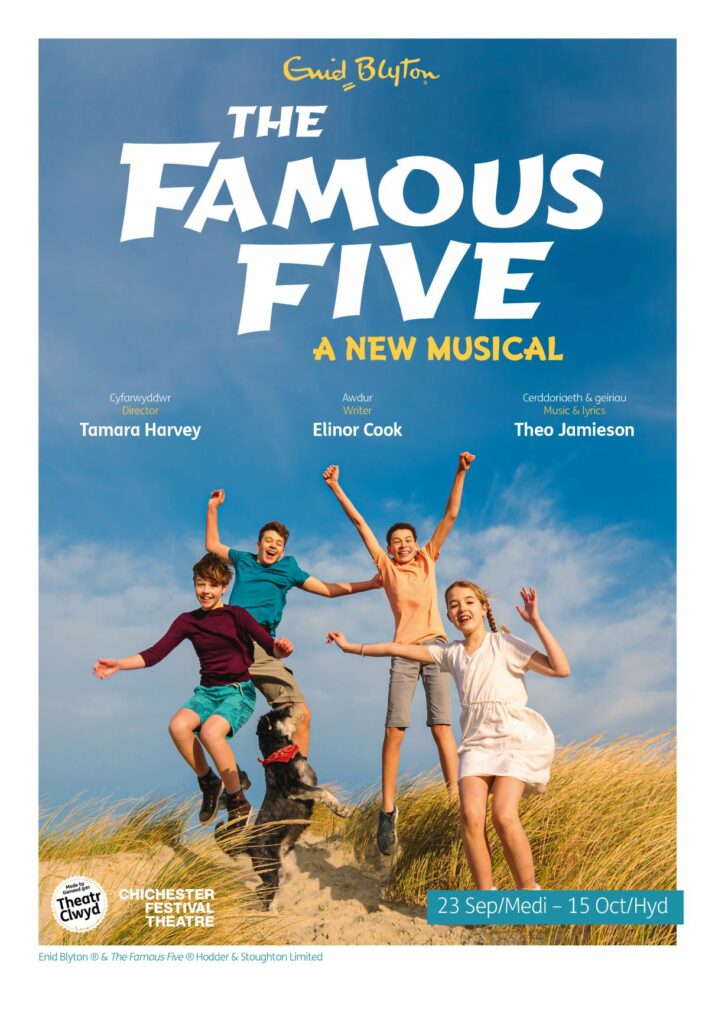
Secondly in the Autumn Season The Famous Five: A Brand New Musical (23 Sept-15 Oct). Based on Enid Blyton’s multi-million-selling novels, this brand-new musical written by Elinor Cook, with music and lyrics by Theo Jamieson, is an exciting and heart-warming family treat celebrating adventure, bravery and friendship for everyone aged 7+. The show will be directed by Theatr Clwyd Artistic Director Tamara Harvey, and will be co-produced with Chichester Festival Theatre. When George and her dog Timmy find out that her cousins Julian, Anne and Dick are coming to stay, they’re pretty sure the whole summer is ruined. But out in the bay lies Kirrin Island and a ruined castle filled with mysteries to solve. Together they embark on a daring mission with the future of the planet at stake – a mission that might just be the making of the Famous Five…

The pantomime on offer this Autumn will be Robin Hood, The Rock ‘n’ Roll Panto! (19 Nov-14 Jan) The show will have all sing-along songs, fabulous frocks and dazzling sets that you’re used to. The venue can now announce that beloved panto dame Phylip Harries will return for all the usual panto fun.

Back to summer activities, and the Flintshire venue will welcome many touring productions. The Rise and Fall of Little Voice (18-23 Apr) stars Shobna Gulati (Coronation Street), Ian Kelsey (Emmerdale) and introducing the two-time Drama Desk Award Nominee Christina Bianco. This Northern fairy-tale explores small-town dreams and finding your voice. The show includes power ballads by Judy Garland and Shirley Bassey. Boeing Boeing (24-28 May) is an award winning comical-farce brought to you by London Classic Theatre. The Play That Goes Wrong (26-30 Apr) once again returns following its 2018 sell-out run in Mold. For musical lovers, Willy Russell’s tragic tale Blood Brothers (2-7 May) follows the story of twins separated at birth.

The venue once again welcomes National Dance Company Wales with their trio of dance performances One Another (10-11 May) and Ballet Cymru present their Mold debut, Dream (29 May) a vibrant, fresh, and joyous new ballet based on Shakespeare’s A Midsummer Night’s Dream.

There is plenty of comedy this season with monthly comedy clubs as well as Mark Watson’s show This Can’t Be It (12 June) after its postponement in January. Kiri Pritchard-McLean brings her tour Home Truths (30 Oct) as she returns home to Anglesey talking about all things from rescue chickens to learning Welsh.

This summer sees the return of Family Arts Festival (29-31 July) the weekend will be jam packed with boredom busting events, activities, workshops and shows all at low cost. Keep your eyes peeled on social media for more details. If you can’t wait for that, come along to Julia Donaldson’s much loved children’s story The Gruffalo (13-15 May) full of songs, laughter and monstrous fun, also join Twirlywoos Live! (20-21 May) for an adventure in their big red boat.

With music from Dionne Bennett and the Royal Welsh College in their performance Blue Summer (22 June) and Rush Theatre presenting The King of Reggae (1 May) there is something for everyone and there will more classical music concerts to be announced on the 8 May.

Theatr Clwyd welcomes back the following community performers to the venue, Jaxx Martine’s Popstarz Academy (26 June), Footsteps Dance (28-29 June), Shirley School of Dancing (1-2 July), Clint & Nikki Theatre (4-9 July), Whitton Morris School of Dance (14-16 July) and Elsberdance (21-23 July) and Elite School of Dance (25-27 July).

Theatr Clwyd Members enjoy priority booking until the 22 March when all events will be on sale for the public.
To book these and many more please visit Theatr Clwyd’s website www.theatrclwyd.com or by calling 01352 344101. If you would like to become a member or to learn more about exclusive membership benefits, please visit www.theatrclwyd.com/give/membership

REVIEW MAHLER’S FIFTH SYMPHONY, BBC NATIONAL ORCHESTRA OF WALES, ST DAVID’S HALL BY JAMES ELLIS

 out of 5 stars (4 / 5)

I’ve been slow to return to our BBC National Orchestra after restrictions have lifted. For me, they remained a large part of my concert going in Cardiff, with many dates in the cultural calendar. 

Finally back to seeing them, a concert of Grace Williams and Mahler would dominate an evening. Born in Barry, Williams is evocative in her Sea Sketches, a vision of the Welsh coast during her exile in London in WWII. They give off a clear British feel, Benjamin Britten would trump this mood with his opera Peter Grimes a year later. Written for just string orchestra, it finds a way to depict the sea through scales and a tense underlay of notes. The chippy Sailing Song lifts the air and Breakers impresses, with he final movement Calm Sea in Summer being the most celebrated extract. More of Williams in the canon could only be a good thing.

The German conductor Christoph König is in demand internationally. It was in the 5th Symphony by Mahler that he really got to show off, bringing these stalwart players to attention. I might be sad to say that some moments in the brass were a little off, yet for a work which is about 70 minutes long, we can let that go. Also live on Radio Cymru, this large Cardiff audience lapped up this grand picture that the infusion from he Austrian composer. Some highly intense moments with the percussion and brass add to this sound world, the famous Adagietto a soft and somber ten minutes, a must needed rest bite from the dower thoughts and irony.  

I’ll confess this work is over played, been forgotten by major orchestra for the some decades. BBC NOW have embraced the piece, with most of his other symphonic works along the way. My heart yearns for the lesser heard things, the 2nd and 3rd Symphonies are extremely powerful examples. The visions of the Alps, forrest, waltzes, misery and the universe are never far away from Mahler, the 5th having some of the finest examples. The composer went through a lot in life and at this time I’m thinking of my own heart break, loss and health conditions. 

We hope the orchestra will continue with a more adventurous programme, something they were well regarded for in the past.

Review Taro, St David’s Hall By James Ellis

 out of 5 stars (4 / 5)

Percussion. Perhaps my favourite instruments and part of the orchestra. With students from the Royal Welsh College, dubbed Taro, they presented an exhilarating bend of music for the sleepy lunchtime slot at St David’s Hall.

Steve Reich is the grand old master of the minimalists, some might feel his looping effects make for a one trick pony. His ideas have not processed a lot of over the decades. Through this, the music is always delightful and unique. The musicians here started off with the first movement of his Mallet Quartet, which features a smashing melodic line, the sheen of marimbas creating a landscape of joy. With his Six Marimbas, we got the same themes and little variations. Turns out the students have this piece as their music exam the day after the concert.

Though they might lack the machine like drill of Colin Currie and his ensemble, they impress, this never being easy music to take lightly. Focus and endurance are the name of the game…
Ivan Trevino and his 2+1 continued a minimalist exercises, in a piece feeling quite sincere and formulated. The stand out piece of the concert has to go to Trio Per Uni by Nebosha Zivkovitch. With three of the players sharing a bass drum and a smattering of bongos and metallic bowls. Inspired by the pounding nature of Japanese Taiko drumming, this alumni composer has written a piece that should see a fair amount of popularity, such is its appeal. I found it stirring and easily accessable, the slamming wall of sound never ending, with the occasional shout from the three guys playing. Sensational.

A light, bright Ravel arrangement of his Alborada del Gracioso followed by Safri Duo. I’ll take or leave this French composer, who usually relied on a lot of pith in his musical output. With a shared marimba for two players, the piano work gets even more silly, with the flurry of high notes and as an adolescent guide to daydreaming. Nice stuff, if a little saccharine. A first year student at RWC, Elaina Charalambous and her Kinesthetic had a lovely feel to it. The plodding bars for ten percussionists had sometimes absurd moments of tutti, really giving the work a wink and a whistle to the listener. Certainly another young composer of note.