
All posts by admin

Review James Larter & Meredith Monk with Bang on a Can by James Ellis

Photo Credit: Victoria Frankowski

 out of 5 stars (4 / 5)James Larter

 out of 5 stars (5 / 5)Meredith Monk & Bang on a Can

St-Martin-in-the-Field Church in London maintains a calendar of concerts all year. The raw energy of percussionist James Larter should shock an idle Friday afternoon audience in an hour of sizzling, sonic sounds. One might run afar from the music of composer and mathematician Xenakis, yet his Psappha was a powerhouse of force, James greatly showing off the demands of the work with ease and determination. Richard Rodney Bennett and his Marimba Concerto (the first movement) followed featuring on piano Tyler Hay, representing the allusive orchestra in this reduction. Perhaps the most stringent of the programme, Bennett’s time with Pierre Boulez shows here, with some moods of brief Messiaen, the composer being well known for more traditional film scores. James here flexed his percussive muscles with the marimba his gym rack, with Hay a smooth and well equipped companion.

Composer Param Vir introduced his premier work: Drum of Deathless, in a solo arengment. Taken from time spent in a freezing monetary in South Korea, Via has flung into the air a work of great magnitude, quite showy as James chants and clamours away beautifully. Both small percussion and the marimba are on offer, with a dexterity needed in the transfer of sounds. Temple bowls added flavour to an already spicy broth in what could proof to be a percussion favourite in years to come. James’ own piece Bedawi, utilised electronic beats, call to prayers and a middle-eastern inspired musicality. This wrapped things up well, evocative in nature, though slightly too shorty feeling more like an encore. James is one to watch.

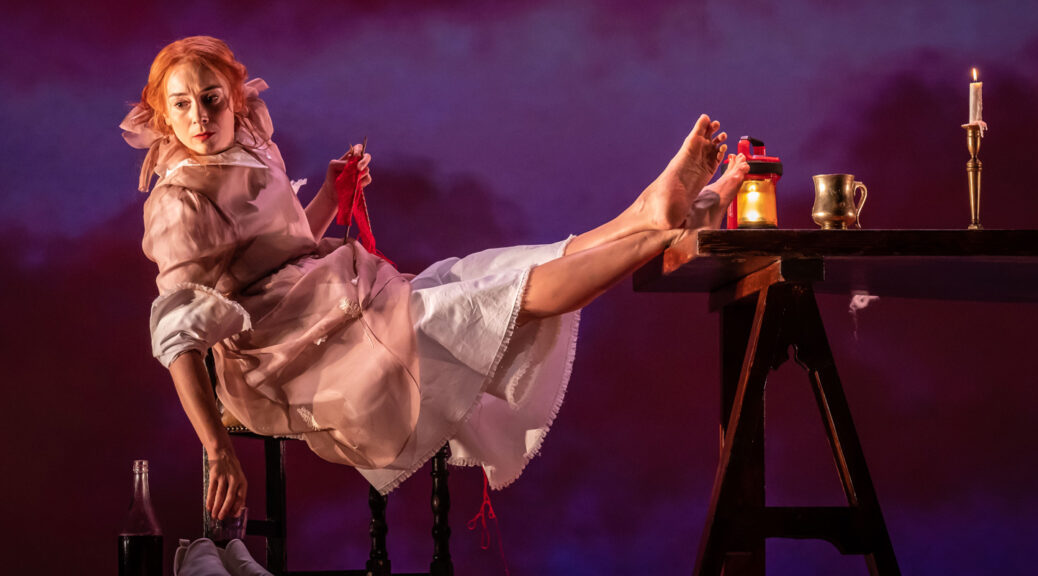
Leading to an evening at the Royal Festival Hall with a music legend, an woman of charm and filled with vim. There was much anticipation for Meredith Monk’s first concert back in the UK for some years. During lockdown I began to engage much more with her canon: Zoom workshops, a kick starter (which I gladly pledged to) and my interview with her all added to my quest to know more, to get a more rounded sense of this interdisciplinary artist.

Entitled Memory Game, the night would feature hand picked work from Meredith’s extensive output. Starting with The Games, a galactic examination of fascism in the guise of a science fiction opera. What lovely things to hear, as always with this music. Meredith’s singers: Theo Bleckmann, Katie Geissinger and Allison Sniffing are individually brilliant in their vast scope of roles. The joy of the absurd thrives here and the thrills that feature leaves faces beaming. The dance work is also unexpected, grounded in simplistic modes of expression, yet always achieves its goal. The utter delight that was Tokyo Cha Cha from Turtle Dreams Cabaret held up as funny and endlessly charming. Migrations from The Games, saw Ukrainian tributes with blue and yellow lighting, as this touching moment stirred hearts, with Meredith near wailing, child like in voice. Double Fiesta ended with that rush hour speed, the ear worm of the night. A few encores also appears this hungry audience, the show being under 90 minutes.

I’d have loved to have heard Hocket and The Boat Song from Facing North, since Theo Bleckmann was present who premiered the work with Meredith. Though Theo’s ludicrous Gamemaster’s Song, another selection from The Games, had a bouncy keyboard riff and oodles of poses and vocal frontiers for him. The Memory Song also from the opera a sweetly scented venture into the characters thoughts as they venture out into space, with a shopping list of things now gone to them. Spaceship which opened the night gave the musicians time to wrap up and enter this universe of thoughtful ideas, harmony never comprised, melodies never to approachable. The years of collaboration with Bang on a Can Allstars also shows. The instrumentalists shined with funk, patience and the passion for every bar of music. It’s the sincerity that surprises you the most in Meredith’s art. A lack of sung words also open up much more interpretation, with a general minimalistic vein exposed. Few would argue she remains an unique voice. Few other artists have chirped, shrieked, scoffed and teased their voice like Meredith has and we love her all the more for it.

The evening ended on a high note with a relaxed post show talk with Meredith and musicians from the night. I finally had the chance to meet her in person and she always speaks so kindly of Wales, hoping to return one day. Photos and autographs were greatly appreciated, as I left filled with love and warmth.

Join Zoom song and dance workshops with Meredith Monk and her singers, see her website for details.

Meredith Monk will continue with Memory Game with her Singers and Ban on a Can All-Stars, with film screenings and Cellular Songs on tour at the Rewire Festival in The Hague, with the Cellular Songs in Nantes, Paris and Luxembourg.

Review English National Ballet, The Forsythe Evening Sadler’s Wells, Review by James Ellis

Photo Credit: Laurent Liotardo

 out of 5 stars (3 / 5)

A return to London, a return to dance. I could not ignore the allure of Sadler’s Wells and the newest offering from English National Ballet. With choreography and stage design by William Forsythe, this was very much his evening. The showing off of his dance work bled into every moment of the night. The soundtrack over the brief night would randomly feature James Blake, Barry White and a variety of other musical taste. I pondered throughout, does it work?

The dancing on display cannot be underestimated. Yet, the music didn’t always necessarily ground the pieces and we had a choice of various petite performances of blinks and you’d miss them proportions. I want to say it felt more like strident ballet sequences fitted with pop and peculiar musical choices, having a certain charm but just not really making much momentum. The second part of the night entitled Playlist had a more club anthem feel, the audience clearly swept away with it’s frantic mania. This remained a curious take on ballet both old and new, more so of the later. There was an angular, almost cubist approach to movement, the men and women getting stirring duets or flourishing ensemble motifs. You almost want to recreate some of the poses at home.

It was the short nature of the entire night which made for a pleasant variation, two short parts with plenty of insight and intrigue. Like on this press night, this should please a lot of people, the choice of music should help break down some barriers and make ballet per se more accessible. The choreographer appears to be making waves in dance and work like this can only continue his. passions. A night like this can only define the talents of some spectacular dancers with builds that could leave most of us reeling.

Spend a night at the Fosythe Evening. It is a guaranteed success.

The Forsythe Evening runs at Sadler’s Wells till 10 April 2022

Review London Mozart Players & Isata Kanneh-Mason, St Davids Hall by James Ellis

Photo Credit: John Davis

 out of 5 stars (4 / 5)

It’s all go for St David’s Hall and their International Concert Series. Though what surprised me the most for this concert was the surprising gaps of empty seats in the auditorium for the London Mozart Players. The rugby was of course on, it seems.

In a finely crafted concert, the focus was mainly in the first half of the 19th century, with a touch of the early 20th century to boot. In Prokofiev’s 1st Symphony (dubbed the ‘Classical’) we see the ground work for the early days of the composer, one who would go on to effect the musical landscape for years. It is rigid in style, even with some charming elements. Written the year of his countries shattering revolution, one must also consider the music later which would delight and disgust in equal measure. You’d never think listening to this symphony that a prickly, angular vision would form from the composer. No doubt, this is a rare sighting of a Russian work of music right now for obvious reasons.

The treat of the night came from Isata Kanneh-Mason for Clara Schumann’s Piano Concerto. I’ve spoken in the past how beguiling Robert Schumann’s music is, yet his wife has for the longest time remained in his shadow. Very much a power couple with a turbulent relationship, the Schumann’s remain some of the finest artist of their era. Clara’s Piano Concerto has a live, chattering quality hard not to love. From a renowned family of musicians, Isata has all the grace and standing the piece demands, even with some wonderful, clamouring moments. This was a testament to the underrated beauty of this female composer and only proves just how much we need her music. Time for Clara to shine…

A cheeky return after the intermission with Rossini and his overture to The Italian Girl in Algiers. Amazing how funny an overture can be, the timpani standing out in it’s blasts. The choppy, whimsy Rossini is well known for is heard as well as an undercurrent of malice. Ending with Mendelssohn’s 4th Symphony made for a familiar and effective finale. Known as the ‘Italian’, named so as he wrote the piece on tour, it shines with a breezy pace, never giving up its style or panache. Bulgarian conductor Delyana Lazarova all night, slashed away at each score, an intense scope on the music never let up, formulated by the players. The spritely musicians offered us an intimate evening, something which this Cardiff audience would love to see again.

Review Madam Butterfly, WNO by Gwyneth Stroud

Photo-credit-Richard-Hubert-Smith

 out of 5 stars (4 / 5)

It’s incredible to think that there has been just one WNO production of Madam Butterfly for around 40 years. Revived many times, of course, but still remarkable. So it’s difficult to put to one side the Japanese post-colonial setting with which so many of us are so familiar.

But lay it aside we must, and approach this new production, directed by Lindy Hume, with an open mind.

It’s worth it. We are catapulted into the future – quite when is not important – and the effect is startling. Unencumbered by place and time, our attention is focused on other aspects of stage management – set, lighting – and of course the music. Costume by Isabella Bywater, is stark, and yet subtle. White is the predominant theme here, but from which era? We see late50s/early60s-inspired dresses; boots straight out of the 70s; nods to early 80s New Romantics, all adding to our sense of dislocation of time and place.

Set and lighting take centre stage here. The Pinkertons’ Americanised home could be found anywhere, a stripped, blank cubic canvas in and around which the action centres. Framed in a harsh neon square of light, Butterfly and Suzuki in particular appear trapped by confinement. Contrast this with the soft and skilful use of colour washes by Lighting Designer Elanor Higgins, on the outer walls of the stage. Rose petals, the sea and the sky, dusk, daybreak are all beautifully captured through the medium of lighting alone.

Alexia Voulgaridou manages to capture both the tender love and the horror felt by Cio Cio San on learning her fate. Leonardo Caimi’s tenor is fabulous in demonstrating his sense of entitlement and Western superiority, and both Goro and Suzuki (sung by Tom Randle and Kezia Bienek) fulfil the demands of their roles well. Other parts are sung by Keel Watson, Sion Goronwy, Neil Balfour and Sian Meinir. As ever, one of the highlights was the magnificent orchestra under the baton of James Southall, and the ever-reliable chorus. The scene accompanying the hauntingly beautiful Humming Chorus will stay will long endure.

A bold production which, via its dislocation of time and place, serves to demonstrate that this saga of power and entitlement is, arguably, as relevant to us today as it has ever been.

Summer Season announced at Theatr Clwyd

Theatr Clwyd today announce a massive summer season of activity. The season boasts an incredible mixture of musicals, comedy, drama, music, and family activities. The venue welcomes the return of many community performers that have not been able to take to the stage since before the pandemic.

Theatr Clwyd produces brand new productions in this season. Celebrated Virgins, A Story of the Ladies of Llangollen (20 May-4 June) is a brand-new production written by Katie Elin-Salt and directed by Eleri B Jones. Based on the true story of Eleanor Butler and Sarah Ponsonby. When they fell in love, they were forced to leave their homes and cast out by society. Taking up residence in Llangollen they became minor celebrities, forced to witness their own lives written about by those who could never understand. Now, they are back, ready to take back the story that’s rightfully theirs – on their own terms.

A Pretty Sh*tty Love (8-23 July) is a drama that is based on the true story of a couple and their journey. Hayley wanted to fall in love – to find her prince. She never found it though, she never looked in the right place. Then along came Carl. This is a new play by acclaimed playwright Katherine Chandler and directed by Francesca Goodridge. This show contains challenging themes.

There are also two brand new musicals being co-produced with Theatr Clwyd this season. First up is Milky Peaks (1-12 April) Milky Peaks: the warmest welcome in the cold bosom of Snowdonia. However, under the gleaming pebble-dash, strange forces are rising: both political and supernatural. Can three lost souls and a shabby drag queen save the community’s heart? Milky Peaks reunites writer Seiriol Davies with collaborators Matthew Blake, Alex Swift, Dylan Townley and Áine Flanagan, the producers who co-created the critically acclaimed How to Win Against History. Advisory age 14+

Secondly in the Autumn Season The Famous Five: A Brand New Musical (23 Sept-15 Oct). Based on Enid Blyton’s multi-million-selling novels, this brand-new musical written by Elinor Cook, with music and lyrics by Theo Jamieson, is an exciting and heart-warming family treat celebrating adventure, bravery and friendship for everyone aged 7+. The show will be directed by Theatr Clwyd Artistic Director Tamara Harvey, and will be co-produced with Chichester Festival Theatre. When George and her dog Timmy find out that her cousins Julian, Anne and Dick are coming to stay, they’re pretty sure the whole summer is ruined. But out in the bay lies Kirrin Island and a ruined castle filled with mysteries to solve. Together they embark on a daring mission with the future of the planet at stake – a mission that might just be the making of the Famous Five…

The pantomime on offer this Autumn will be Robin Hood, The Rock ‘n’ Roll Panto! (19 Nov-14 Jan) The show will have all sing-along songs, fabulous frocks and dazzling sets that you’re used to. The venue can now announce that beloved panto dame Phylip Harries will return for all the usual panto fun.

Back to summer activities, and the Flintshire venue will welcome many touring productions. The Rise and Fall of Little Voice (18-23 Apr) stars Shobna Gulati (Coronation Street), Ian Kelsey (Emmerdale) and introducing the two-time Drama Desk Award Nominee Christina Bianco. This Northern fairy-tale explores small-town dreams and finding your voice. The show includes power ballads by Judy Garland and Shirley Bassey. Boeing Boeing (24-28 May) is an award winning comical-farce brought to you by London Classic Theatre. The Play That Goes Wrong (26-30 Apr) once again returns following its 2018 sell-out run in Mold. For musical lovers, Willy Russell’s tragic tale Blood Brothers (2-7 May) follows the story of twins separated at birth.

The venue once again welcomes National Dance Company Wales with their trio of dance performances One Another (10-11 May) and Ballet Cymru present their Mold debut, Dream (29 May) a vibrant, fresh, and joyous new ballet based on Shakespeare’s A Midsummer Night’s Dream.

There is plenty of comedy this season with monthly comedy clubs as well as Mark Watson’s show This Can’t Be It (12 June) after its postponement in January. Kiri Pritchard-McLean brings her tour Home Truths (30 Oct) as she returns home to Anglesey talking about all things from rescue chickens to learning Welsh.

This summer sees the return of Family Arts Festival (29-31 July) the weekend will be jam packed with boredom busting events, activities, workshops and shows all at low cost. Keep your eyes peeled on social media for more details. If you can’t wait for that, come along to Julia Donaldson’s much loved children’s story The Gruffalo (13-15 May) full of songs, laughter and monstrous fun, also join Twirlywoos Live! (20-21 May) for an adventure in their big red boat.

With music from Dionne Bennett and the Royal Welsh College in their performance Blue Summer (22 June) and Rush Theatre presenting The King of Reggae (1 May) there is something for everyone and there will more classical music concerts to be announced on the 8 May.

Theatr Clwyd welcomes back the following community performers to the venue, Jaxx Martine’s Popstarz Academy (26 June), Footsteps Dance (28-29 June), Shirley School of Dancing (1-2 July), Clint & Nikki Theatre (4-9 July), Whitton Morris School of Dance (14-16 July) and Elsberdance (21-23 July) and Elite School of Dance (25-27 July).

Theatr Clwyd Members enjoy priority booking until the 22 March when all events will be on sale for the public.
To book these and many more please visit Theatr Clwyd’s website www.theatrclwyd.com or by calling 01352 344101. If you would like to become a member or to learn more about exclusive membership benefits, please visit www.theatrclwyd.com/give/membership

REVIEW MAHLER’S FIFTH SYMPHONY, BBC NATIONAL ORCHESTRA OF WALES, ST DAVID’S HALL BY JAMES ELLIS

 out of 5 stars (4 / 5)

I’ve been slow to return to our BBC National Orchestra after restrictions have lifted. For me, they remained a large part of my concert going in Cardiff, with many dates in the cultural calendar. 

Finally back to seeing them, a concert of Grace Williams and Mahler would dominate an evening. Born in Barry, Williams is evocative in her Sea Sketches, a vision of the Welsh coast during her exile in London in WWII. They give off a clear British feel, Benjamin Britten would trump this mood with his opera Peter Grimes a year later. Written for just string orchestra, it finds a way to depict the sea through scales and a tense underlay of notes. The chippy Sailing Song lifts the air and Breakers impresses, with he final movement Calm Sea in Summer being the most celebrated extract. More of Williams in the canon could only be a good thing.

The German conductor Christoph König is in demand internationally. It was in the 5th Symphony by Mahler that he really got to show off, bringing these stalwart players to attention. I might be sad to say that some moments in the brass were a little off, yet for a work which is about 70 minutes long, we can let that go. Also live on Radio Cymru, this large Cardiff audience lapped up this grand picture that the infusion from he Austrian composer. Some highly intense moments with the percussion and brass add to this sound world, the famous Adagietto a soft and somber ten minutes, a must needed rest bite from the dower thoughts and irony.  

I’ll confess this work is over played, been forgotten by major orchestra for the some decades. BBC NOW have embraced the piece, with most of his other symphonic works along the way. My heart yearns for the lesser heard things, the 2nd and 3rd Symphonies are extremely powerful examples. The visions of the Alps, forrest, waltzes, misery and the universe are never far away from Mahler, the 5th having some of the finest examples. The composer went through a lot in life and at this time I’m thinking of my own heart break, loss and health conditions. 

We hope the orchestra will continue with a more adventurous programme, something they were well regarded for in the past.

Review Taro, St David’s Hall By James Ellis

 out of 5 stars (4 / 5)

Percussion. Perhaps my favourite instruments and part of the orchestra. With students from the Royal Welsh College, dubbed Taro, they presented an exhilarating bend of music for the sleepy lunchtime slot at St David’s Hall.

Steve Reich is the grand old master of the minimalists, some might feel his looping effects make for a one trick pony. His ideas have not processed a lot of over the decades. Through this, the music is always delightful and unique. The musicians here started off with the first movement of his Mallet Quartet, which features a smashing melodic line, the sheen of marimbas creating a landscape of joy. With his Six Marimbas, we got the same themes and little variations. Turns out the students have this piece as their music exam the day after the concert.

Though they might lack the machine like drill of Colin Currie and his ensemble, they impress, this never being easy music to take lightly. Focus and endurance are the name of the game…
Ivan Trevino and his 2+1 continued a minimalist exercises, in a piece feeling quite sincere and formulated. The stand out piece of the concert has to go to Trio Per Uni by Nebosha Zivkovitch. With three of the players sharing a bass drum and a smattering of bongos and metallic bowls. Inspired by the pounding nature of Japanese Taiko drumming, this alumni composer has written a piece that should see a fair amount of popularity, such is its appeal. I found it stirring and easily accessable, the slamming wall of sound never ending, with the occasional shout from the three guys playing. Sensational.

A light, bright Ravel arrangement of his Alborada del Gracioso followed by Safri Duo. I’ll take or leave this French composer, who usually relied on a lot of pith in his musical output. With a shared marimba for two players, the piano work gets even more silly, with the flurry of high notes and as an adolescent guide to daydreaming. Nice stuff, if a little saccharine. A first year student at RWC, Elaina Charalambous and her Kinesthetic had a lovely feel to it. The plodding bars for ten percussionists had sometimes absurd moments of tutti, really giving the work a wink and a whistle to the listener. Certainly another young composer of note. 

UPROAR: Scenes From A Street, RWCMD Review By Lauren Mallin

 out of 5 stars (4 / 5)

Escapism.

That is what we are all coveting right now, isn’t it? To be transported to a world devoid of distractions, anxiety, and exhaustion – even for just a couple of hours. I was lucky enough to find a welcome slice of escapism thanks to the talents of contemporary classical music ensemble UPROAR’s latest production, Scenes From A Street.

Now, full disclosure. I am not a classical music expert. Nor have I ever claimed to be. However, I do champion anyone who wants to break barriers and make the arts an ever expanding and inclusive space. UPROAR’s claim to seek ‘new ways to break down the fears and misconceptions about new music’ had me instantly intrigued. Fear and misconception are words that are easily equated to artistic practices like contemporary classical, due to many people (myself included) feeling as though they can’t engage because they lack knowledge. This promising welcome from UPROAR gave me the confidence to take that leap and give myself over to the classical world for the evening.

Scenes From A Street consists of works from five composers based in Wales, each presenting a piece which captures UPROAR’s ethos of bringing ‘contemporary classical music into the heart of everyday culture’ – a phrase we don’t hear often enough. Again, there is no prerequisite here to be an aficionado of classical. If anything, having little prior knowledge presents the experience in its truest form, allowing full immersion in the musical story.

Each piece provided a unique sound and style, instantly transporting the mind to various locations, scenes and scenarios. The entire experience is one that initiates all the senses and emotions, resulting it a truly unique experience and allowing the audience to really feel what is played out in front of them. From states of calm and innocence to unsettling doses frenzy and panic; if you are looking for a way to allow your brain to switch off from worldly distractions, Scenes From A Street provides this with ease. Immersion and escapism were particularly present in Guto Pryderi Puw’s ‘Popping Candy’ – a beautiful ode to the delightful fizzy fun found in the nostalgia of the popular childhood treat. It was especially lovely (and skilful) to present the audience with their own pack of popping candy at interval, taking the immersive musical experience to new levels and allowing us to create our own crackling composition while awaiting the next musical morsel.

Of course, the skill of the composers shines through that of the musicians tasked with breathing life into their work. There is nothing quite like witnessing an ensemble lost in the rapture of a skilfully crafted piece of music. It is almost bewitching to bear witness to the passion, enthusiasm and connection each musician has to the works they are performing. A truly joyous and moving experience and each member of UPROAR’s ensemble deserves the highest ovation. A special word of commendation is also directed to the wonderful staff at RWCMD – extremely welcoming, helpful and knowledgeable, which is never to be underestimated.

All in all, to the untrained ear of contemporary classical like myself, UPROAR’s Scenes From A Street will feel wildly new – but that is exactly what they set out to achieve. Although it can feel daunting at times I would highly recommend, regardless of your musical persuasions, to give yourself over to the music and allow any fears and misconceptions of contemporary classical to escape. You never forget your first, and I’ll never forget my first evening with UPROAR.

UPROAR Scenes From A Street is playing at Aberystwyth Arts Centre on 25th March and Borough Theatre @ The Priory Centre, Abergavenny on 8th April 2022.

REVIEW HARPS OF THE ROYAL WELSH COLLEGE, ST DAVID’S HALL BY JAMES ELLIS

 out of 5 stars (4 / 5)

This St David’s Day is filled with worries. We’re in the post-pandemic timeline, with the worry of war also everywhere. My own thoughts on nationhood are usually compromised today and sometimes not feeling Welsh enough does enter my mind.

If only for an hour, the Harp Ensemble from the Royal Welsh College made everything okay, with a fine programme native to Wales and artists inspired by our country. Monika Stadler evokes the Preseli Skies in a light opener, the ladies of the ensemble warming up for this concert. It’s the interplay between each harp that was highly stimulating. You didn’t know where to look at times. Melodies abound in this fine little piece.

David Watkins’ Petite Suite was another sure fire delight, the Nocturne in the centre particularly noteworthy, the Fire Dance finale had some pleasant dynamics as well. In a more austere choice, one of Wales’ biggest 20th century composers: William Mathias and his Zodiac Trio made more of a chin stroking choice. Each movement is the Zodiac sign of the musicians who premiered the work (Pisces, Aries and Taurus) and Mathias isn’t afraid to try more experimental modes, even if it still feels quite conservative in nature. Flickers of Messiaen and serialism hit the ear, though the combination of harp, flute and viola might not sound as enjoyable as you would think. Through this, I still want to hear more of Mathias, who seemed to have a big impact on Welsh music.

Our host for the concert, tenor Rhydian Jenkins delivered three sublime Welsh songs. The delights of Mae Hiraeth yn y Môr and Llanrwst really made this special, Jenkins having a bright, easy voice with a little strain in the high bits (he mentioned how hard the latter song opens with some very high notes). Dafydd y Garreg Wen in an arrangement by Meinir Heulyn saw Jenkins sing with the return of all six harpists in another superb song which proves why we are known as the land of song. Wrapping things up with the Jig-a-Jig from Catrin Finch’s Celtic Concerto in an arenment by Jeff Howard. Having heard this before, Finch’s mastery over the harp is evoked in this pristine and sunny work, with it’s opening a tune worthy delight, never waining and always uplifting. Perhaps things wont be so bad after all?

Harps of the Royal Welsh College: Nia Evans, Cerys Rees, Jemima Small, Matilda Whates, Yasmin Richards & Bethany Coggon. Tenor, Rhydian Jenkins, flute Lila Bhattacherjee and viola, Michael Cilburn.

Review Death on the Nile by Valerie Speed

 out of 5 stars (4.5 / 5)

In the midst of storm Dudley, a group of strangers take refuge from the calamity outside. Remaining hidden in the darkness of the cinema auditorium seems like the most sensible thing to do. Settle back and escape into the world of others. To a place that couldn’t contrast more with the climate we currently found ourselves in. Egypt.

Of course, it wasn’t just seeking shelter that took me to the cinema. I had been eagerly anticipating this new remake of Death on the Nile. Although, if I’m honest, having seen repeatedly the 1978 production starring Peter Ustinov as Hercule Poirot, (which I loved) I did wonder if I might get bored, convinced as I was that I knew the story so well that there would be no surprises. One review described this remake as a ‘dumb, lumbering adaptation…’. Not very promising. Yet, how wrong could I be.

Death on the Nile is one in a series of crime novels written by Agatha Christie, featuring her Belgian detective Hercule Poirot. Naturally, then we will expect a murder mystery; a simple set up of victim, a line up on suspects and to be taken through the means, motive, and opportunity to the conclusion of whodunnit. The plot remains the same. A young, wealthy newlywed, Linnet Ridgeway, is murdered while honeymooning in Egypt. She is surrounded by friends and family along with her new husband, each, we discover with some reason to kill. Add to this the arrival of her husband’s scorned betrothed, and the set up for murder to ensue is complete.

Director and star, Kenneth Branagh, it seems to me, had two problems to overcome for this film to work. The first, how can suspense and intrigue be maintained when Death on the Nile is such a well-known story. The second, when even his own creator, Agatha Christie, eventually described Hercule Poirot as a ‘detestable, bombastic, tiresome, ego-centric little creep’ how do you make the main character who will drive the narrative, likeable enough, not to be irksome, fully rounded enough not to be a stilted caricature, and risk losing the audience midway.

This remake begins, not in Egypt but in the trenches of the First World War, the commanding officer reading out the orders that have been received. The fate of the soldiers is sealed. Death hangs over each man. A young Poirot, though, suggests a brilliant but risky strategy. Hope rises once more. His plan is executed. I could hear the muffled gasps in the audience, a moment of tension. The outcome made me flinch with horror. Our first mini rollercoaster. So, the dye was cast, just as much as this vignette gave an insight into how Poirot evolved it made sure the audience understood that we were not going to be on firm ground. We had to be ready to feel uncomfortable at times and be caught off guard.

Fast forward and Poirot looks as he was described by Agatha Christie, enjoying the hospitality of a jazz club, and observing intently the lives of others play out. This is our first introduction to the main characters in this detective story.  Already there are tensions so when the same people congregate in the luxury of Egypt, we know something sinister is going to happen, we’re just not quite sure when.

Life for these people is lavish, sumptuous. These are the rich, surrounded by beauty, able to have anything they desire, and here they display a carefree decadence and gaiety. But in a moment, this can all too quickly be dampened with a sense of foreboding and trouble walks in. It’s dangerous to be complacent.

Deftly handled by Branagh, his sleight of hand, does solve those two problems. What is delivered is the suspense and drama you hope for from a murder mystery.

What those early added scenes do is create a feeling of being destabilised which is the pattern threading through the entire film.  The audience is moved moment to moment from a sense of doom, to calm and to a sense of horror. I, for example, came very quickly undone. Convinced as I was that I knew the killer from the off, as the jazz club scene played out, I became less convinced of this certainty until I was just as intrigued to find out what was going to unfold as if I was coming to the story anew.

As the film progresses, it feels to me that the timeline changes slightly from the earlier makes of this film. The characteristics, life stories and actions of a couple of the characters from previous films are subsumed into different characters. The effect is that you never have one of those moments when you’re able to say, ‘oh here it comes, I know what’s going to happen now’ because nothing maps exactly onto what has gone before.

The film is also beautifully shot. The cinematography is sublime, with glimpses of beautiful vistas of the Nile and the banks of the Nile. And yet, with all its beauty, the effect of seeing the boat, as big as it is, on which the characters reside being dwarfed by the vastness of the landscape adds as a metaphor for no longer being grounded or anything being certain. So easily life can be capsized. The small world in which the action is unfolding looks suddenly isolated and vulnerable, much as we begin to see the remaining potential victims with a killer on the loose.

There are moments when I and the rest of the audience gasp aloud. As you will know if you are familiar with Death on the Nile, or expect if you are not, there is more than one murder. Committed most shockingly. There is a grotesque reality about the way the bodies are seen stored in the most undignified of ways amongst the cold meats. But that is a reality of death in these most horrendous of circumstances. It is cruel.

Much is made of the idea of love in this film. Finding love, losing love. Seizing every opportunity to hold onto it when, living in an era of societal expectations, everything can be lost in a moment, and any survivor left forever heartbroken, no longer the person they were. In this lies motivation. If the audience already know the who, the means and the opportunity, then motivation can remain a seam to explore. The ongoing theme of life and loss, of how everything can be transitory is another way the audience is kept engaged.

There have been some reviews which have suggested Branagh is over dramatic in his portrayal of Poirot. For me though, I loved his portrayal. Of course, Poirot will have moments of melodrama – he’s ‘ego-centric’. Far from hiding his flaws, they are pointed out by one of the characters in the film, and fully acknowledged. With some regret, Poirot acknowledges he is not the man he wanted to be – he wanted to be a farmer – but the man he was turned into and remained as.

We do see a softer, more human side to Poirot. With the sultry, sassy, Salome Otterbourne, played by Sophie Okenedo, Poirot just might fall in love. It would be wonderful to think Branagh would consider a third Poirot film and for that story to unfold. Bringing to life the work of Agatha Christie for a whole new generation.