For my finale Prom this season, an appearance from the BBC Symphony was offered for the last Monday concert. Mighty Conductor Karina Canellakis excited with an array of varied delights in a concert that had a lot going for it.
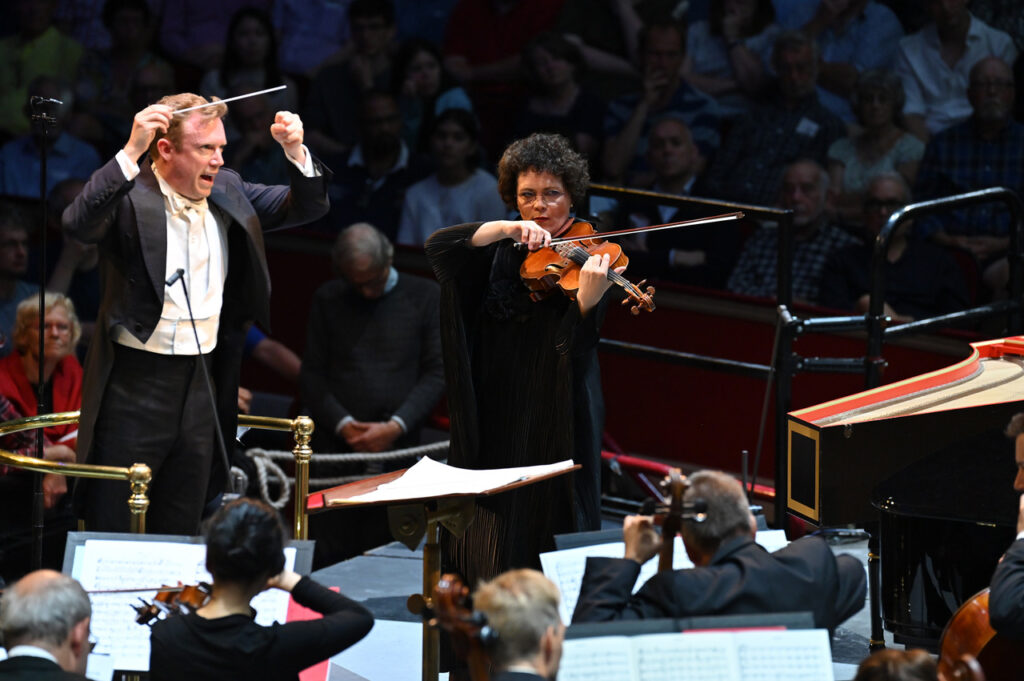
Beethoven’s The Creatures of Prometheus overture thrills in its few minutes, a tantalising taste of the full ballet score. This makes a great concert opener with it’s charm on it’s sleeve, Karina getting off to a fabulous start here. Of note was the world premiere and BBC commission from Besty Jolas of bTunes. Here in the Albert Hall with us at the age of 96, this added a special weight to proceedings. Her odd piece used theatrical elements that could have been utilised more. We saw the lead violinist conduct for the first few bars, as the pianist and conductor arrive late flustered.
This funny little moment lead into a harsh and insightful sound world, Betsy creating some intriguing compositions. Pianist Nicolas Hodges got busy with lid slamming, string plucking and smashing tone clusters, also notated into the score for him. The whole things was barmy, trying to pass off as a playlist of music, it seems to have gone down well and with her presence on the night proved a success.
The 1st Symphony makes for gateway Mahler and here it was executed with a fiery focus. All the hallmarks Arte here in what would be heard later in his music. This graduation piece shows a vast array of musical brilliance, the meshing of popular songs, the waltzes, Alpine bliss and mirky underwater stand out as check points. With a pristine beauty, this held up as a highlight of my Proms live this year. There is a promise in this first symphony, perhaps one of the finest firsts ever written. The panache of it’s delivery, the mighty mood swings and the composer himself having conducted this more than any other of his works proves its importance. Highlight include the Frère Jacques variation, a evocative double bass solo and all round impassioned occupation that sells it and more. Would to hear Karina conduct the following on two symphonies by Mahler now.
A second wind from the Berlin Phil after the rowdy Mahler 7, would proved mixed. The Violin concert from Alfred Schnittke proved a rare discovery and a really strange piece with a lot going for it. Soloist Tabea Zimmermann proved a jaw-dropping display in pretty harsh passages along more fund bits. Some of her cadenza might not have been as stimulating as the rest, though the orchestra alas proved quite brilliant in the whole endeavour. Razor sharp pastiche mingles with serious experimentation in all its brow raising brilliance. The touch of a harp, piano, celeste and harpsichord could only be Schnittke, in this most memorable of violin concertos. Should do a good job in haunting me over the next few days.
Daniel Harding replaced Kirill Petrenko from the night prior, therefore replacing the Shostakovich 10th Symphony with Bruckner’s 4th Symphony. Whilst I’ll admit the performance was a grand affair, the definition of professional…I have to say this was one of the dullest symphonies I’ve ever heard. Bruckner seems to loiter is past German romanticism that leaves little room for new horizons nor any real depth to the style. A lot of this just felt like a load of frivolity with no real sense of it’s influences. I still can’t make out if it’s “German sounding’ either. The finale almost won me over with broad, bold outburst where things started to take off, quieter moments having some genuine appeal. Though I’ve heard the Shostakovich originally planned many times, I dare say I would have much gathered heard that again.
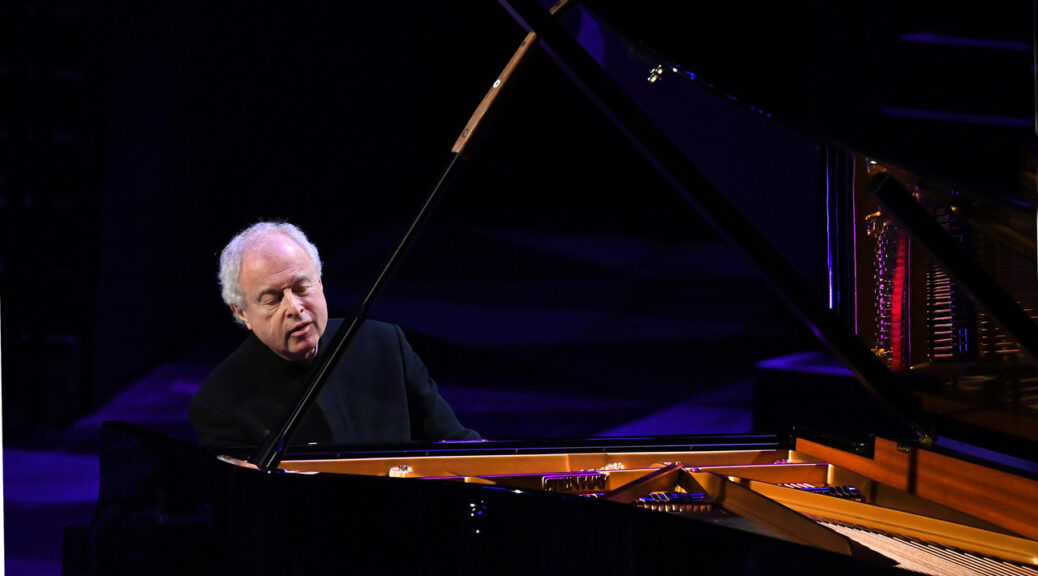
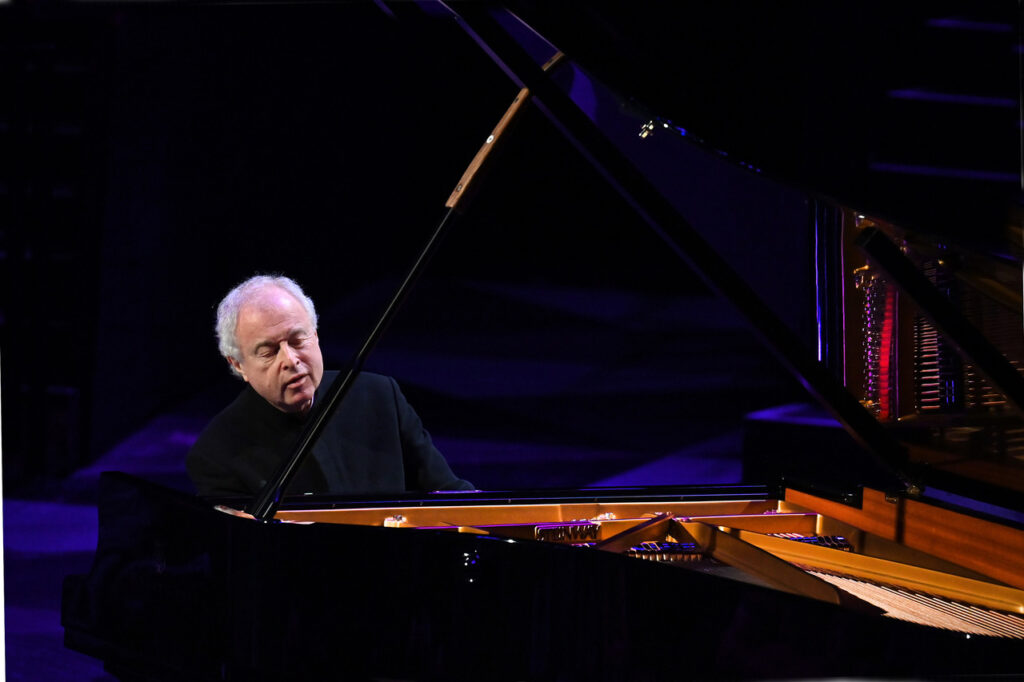
Sir András Schiff relaxed a Sunday morning Proms audience in a intimate affair in the grandeur of the Albert Hall. You see another side to Beethoven in his late piano sonatas. Still filled with innovations, their refections and anguish still pound through and the electricity still lies within them.
Schiff is extremely no thrills, at least the view of his back and part of the keys would prove this where I was sitting. Playing all this from memory proves his chops, his previous Bach whistle stop concerts also proof of his sheer talent. His writing out of the pieces makes it look so easy when it might be a nightmare to play. The dexterity and energy require cant be underestimated, Schiff tackling all these, though his reserved manner might shut fool people.
A debate about having small, more intimate Proms prevails. All I know is the sounds ring out from the piano, though I was in the stalls and may very much be a different story in the high up gallery. This massive audience all came to hear him play and that is enough to justify the recital in the space. Whilst the first two buttery sonatas performed are firsts for the Proms, it was the Sonata No. 32 in C minor which stood out, as if a big beast on the war path. The violence and the weird imagery made it stick out, a fine choice to wrap things up.
Itching for more Proms, the Berlin Philharmonic began a two ninth fest featuring the huge 7th Symphony from Gustave Mahler. It’s been a while for me where I’ve seen a instrumental blend this fine and musicianship this stellar. One can never picture taken on his big works on a whim, the lesser favoured piece is finally getting the love it deserves. It’s funnier than usual as well, with merry tunes and drinking songs which as ever, are met with black doubts and lingering uncertainties. Here the woodwind shines, the brass enthral and the percussion (when used) add that extra bite to proceedings.
The large set of strings delivers jabs, swoons and haunts us all. This feat of musicianship was made crystalline by conductor Kirill Petrenko, who’s flamboyant flair and care for the orchestra is very telling of his persona. These five movements remain quite strange in their form, moments for guitar and mandolin or the cowbells evoking the Austrian Alps are another quirky touch. I found the near 90 minutes whizzed by, some Mahler can drag and this being so fresh and alive it was never a test. The composer wouldn’t have believed a performance like this could be done of this work, so tight and polished. Great work indeed.
BBC Proms continues till 10 September 2022. Listen live to all concert on BBC Radio 3 or listen back to all concerts on BBC Sounds.
The National Youth Theatre of Wales isn’t a company like other theatre companies, so its work can’t be lined up against standard productions. It’s more akin to a BTEC Performing Arts course in which the end-of-year show is designed to give all students an equal opportunity to participate. Because of this, there aren’t individual stars whose performances can be picked out. In The In-Between, the main plotline features a heroine but she is played by different performers at different times.
Reviewing is not course moderating. Reviewers can’t comment on the process that lies behind the end product, even though the workshopping will have been a key part of an educational process and will be very valuable to the student. The performance is only the tip of an iceberg, however exciting it may be.
Equally, you can’t say much about the script, which is specially worked up for this production and which may never be used again. So, there are difficulties reviewing The In-Between.
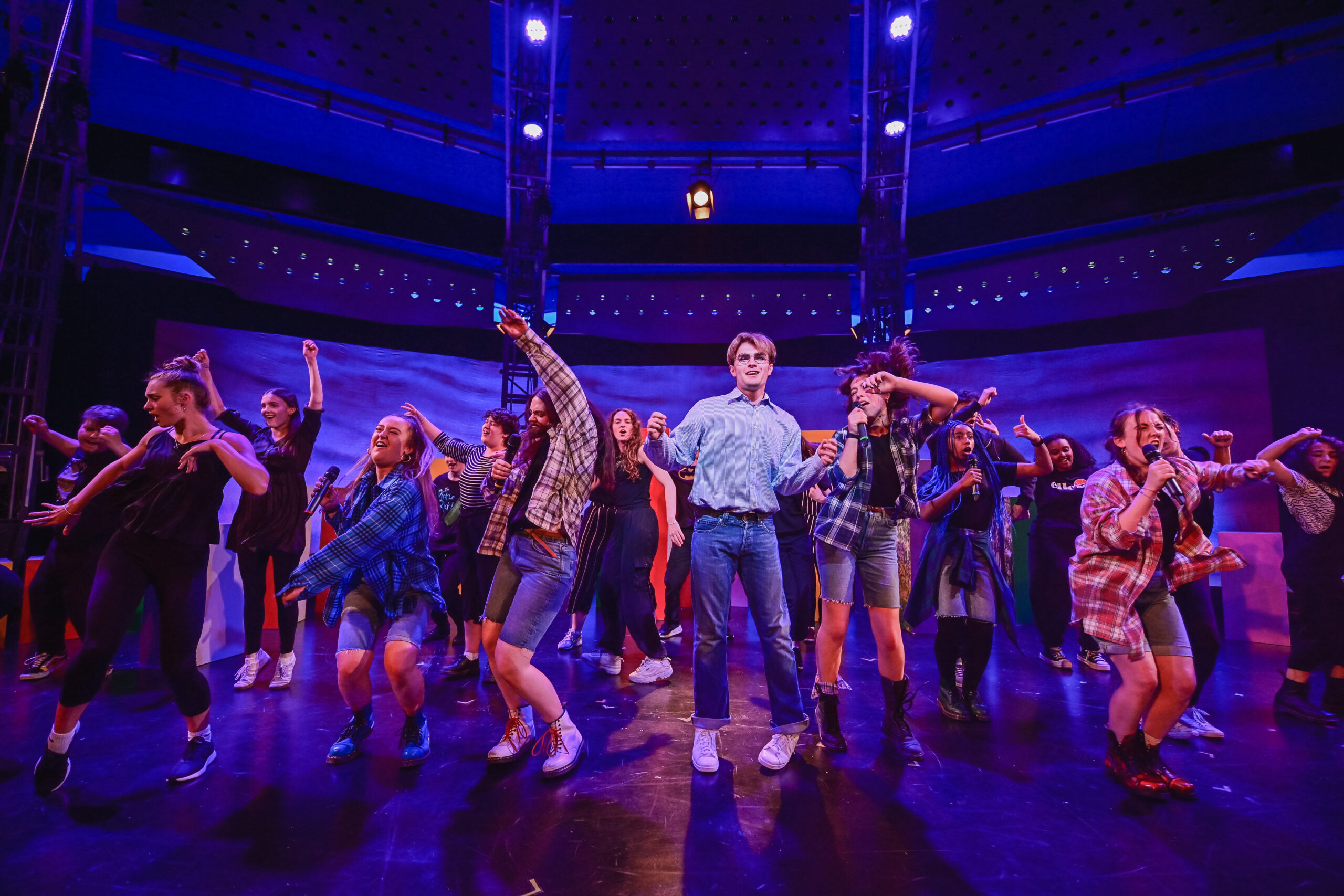
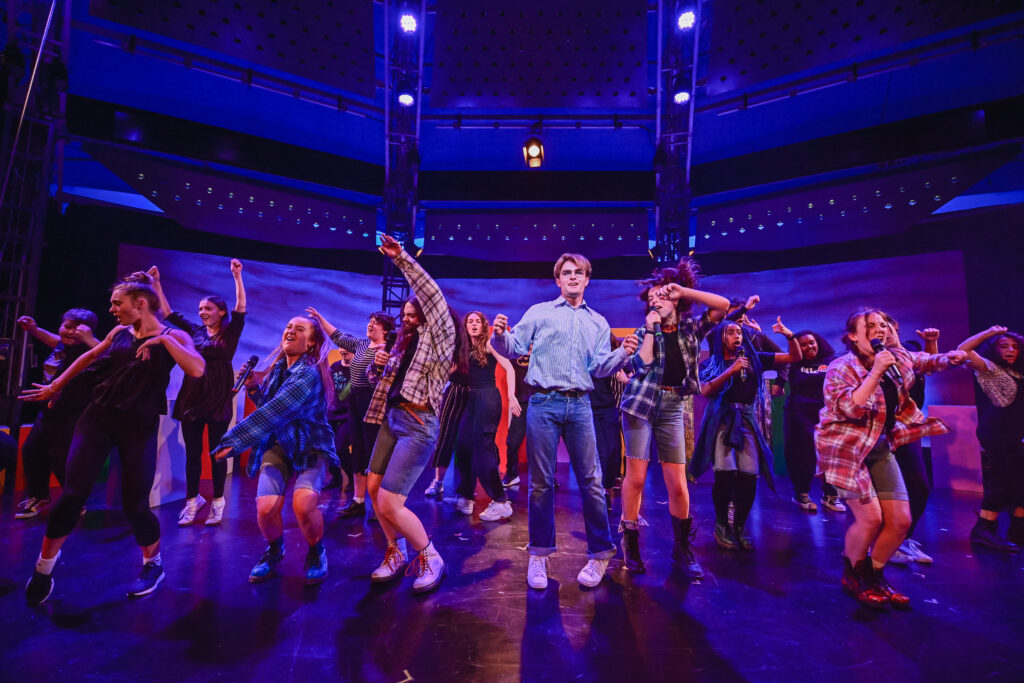
To stick to facts, the production features twenty-three performers, backed by a creative team of twenty-five. It’s no small undertaking. The combined work of these people (assisted by staff at Theatr Clwd) is compressed into a fifty-five minute, single act showcase. The linking theme is the story of Fay, a student on a performing arts course who is considering dropping out. The show starts with Fay’s failure to hand in her homework, or perform ‘her’ song for her lecturer. It ends with her predictably deciding to stay on and at the end, supported by the entire cast, she sings what is quite an effective pop song, celebrating the state of being in between training and working.
As Fay’s story unfolds, group activity is choreographed around a series of small sketches. There is a constant supply of business, much of which centres on a stolen letter. This handwritten letter, in which Fay tells her lecturer she is dropping out, is recognised as being an anachronism and a bit of a joke. Dialogue throughout is in English but it’s peppered with Welsh in an evocative way. Overhead screens carry the script, like subtitles, and a signer works at the side of the stage for deaf members of the audience. There were a couple of fluffed lines and the screens seemed to get stuck at one point but generally everything was done enthusiastically and well.
– Only I did want a bit more. I wanted more character acting, allowing a dramatic penetration of Fay’s crisis of confidence. The self-conscious conversations about the problems of working in the industry didn’t achieve this in any depth, since students really know little about what awaits them down the line. There might have been a second person, a friend, who does leave the course, recognising that there are other things in life beside the performing arts. (Sacrilege!) The snatches of character acting there were – like the cameo of a grandmother and the emergency call handler who breaks out into ‘Staying Alive’ to demonstrate the kiss of life (!) – were delivered properly, making you think the cast members could easily have done more of the same.
Perhaps I wanted more conventional acting because I don’t greatly like musicals, even though I recognise their popularity and their economic importance for theatres and for television. Unless there is an exceptional score, as in West Side Story or Mac The Knife, personally I never feel musicals rise above the level of light entertainment. I prefer shows that make a demand on my intelligence rather than ones that aim to make me tap my feet. I like plays where verbal control and projection goes into lines rather than songs and when physical agility is present in movements and gestures and not just in dances.
I am also intrigued by work where the two genres overlap. However, in The In-Between there is no question but that music theatre is the be-all and end-all. It comes with the fairy tale suggestion that fame and fortune do wait around the corner for the girl who is determined to make it come what may. I didn’t engage with this idea. I wasn’t bothered about whether Fay delivered her course work or not. I started thinking instead about the cast and the fact that there were more than four times as many young women as young men performing. A BTEC computer course would probably reverse this statistic. (In contrast, the production team is almost evenly split and the script was written by a woman and a man.) Maybe this production could have referenced the social conditioning behind gender imbalances.
I would have enjoyed an exploration of late adolescence in which anxiety really came centre stage. Anxiety is hardly the sole preserve of those on performing arts courses: it is wide-spread and not just in the student community. Watching one character overcome anxiety in a convincing way would have been interesting. Watching another fall victim to it might have been moving. Could there have been a second half?
You could say my taste means I am not the target audience but another feature of this particular type of work is that it has no target. It was pleasing to see the large audience in the temporary auditorium at Theatr Clwd (where the buildings are being redeveloped) was an unusual mixture of young and old and the show did have something for everyone – we laughed and applauded – but it didn’t have quite enough of anything in particular to mark it out.
Maybe the title – and the subject of Fay’s delayed solo – says it all. The show itself is in-between genres. It left me in between admiring it for what it contained and for what it allowed its young performers to do but fussing about what it left out. For a student show, it was very entertaining. As a piece of contemporary theatre, it fell a bit short.
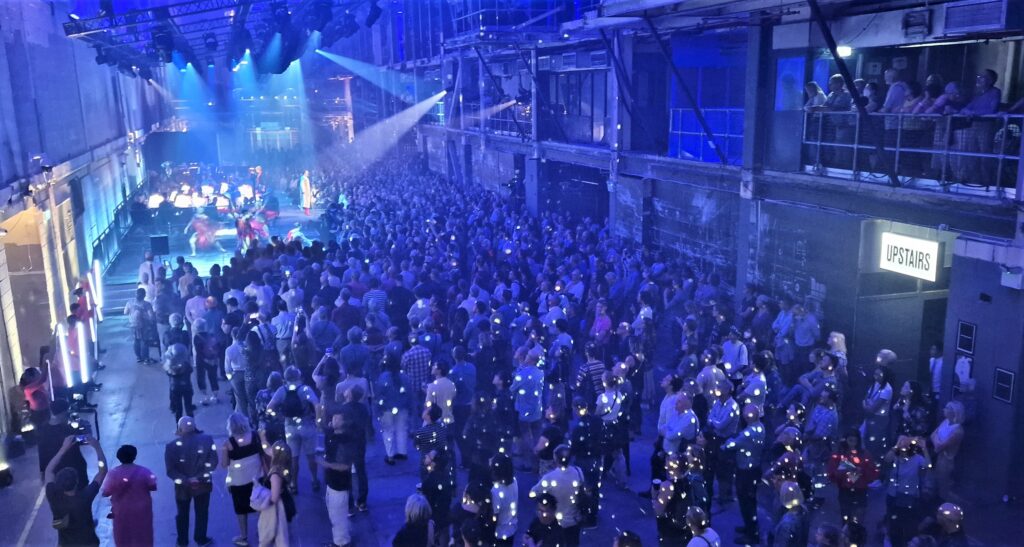
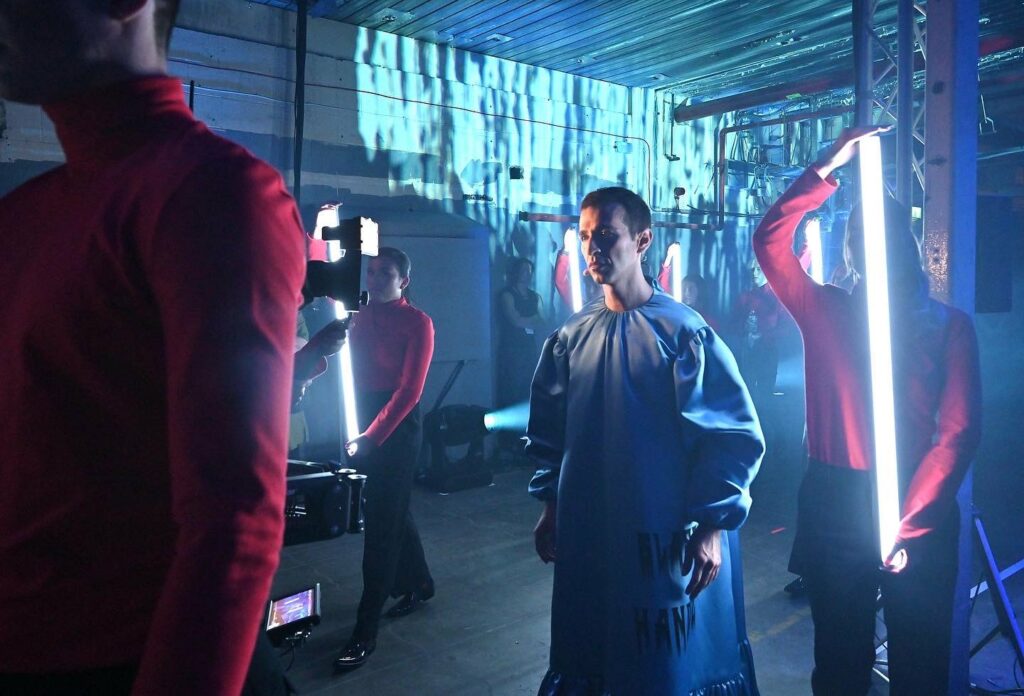
In a return to the BBC Proms in London, a new venue for the festival would call. Whilst I’ll confess the Printworks in Canada Water is a bit out of the way for this travelling reviewer, it was a fleeting chance to see another side of London. In a more laid-back, approachable look on classical music, the venue itself on first appearance looked cluttered, very busy.
As things went on, I found the whole thing to be truly wonderful, the direction of James Bonas with a metaphorical butterfly net keeping everything grounded, yet delightful.
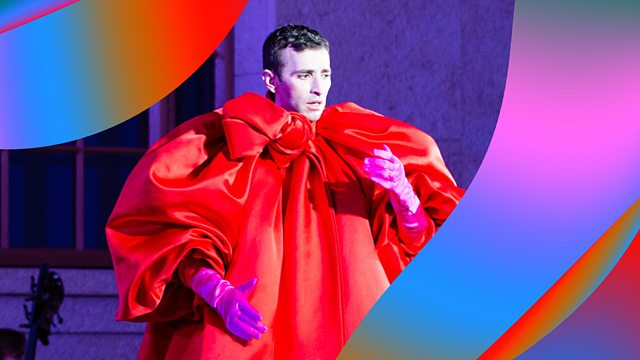
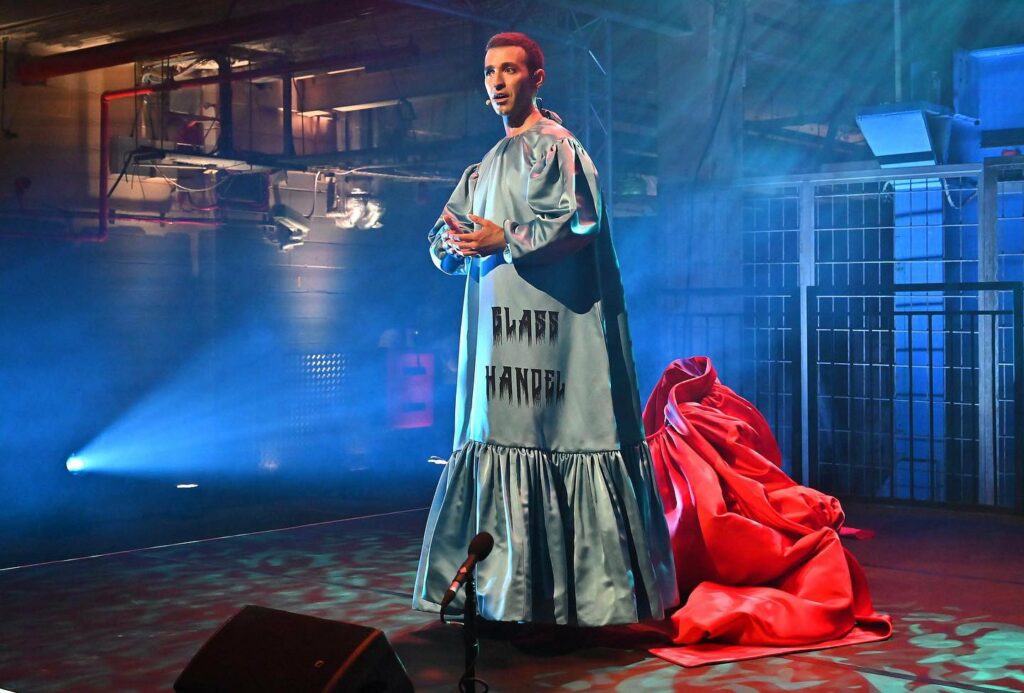
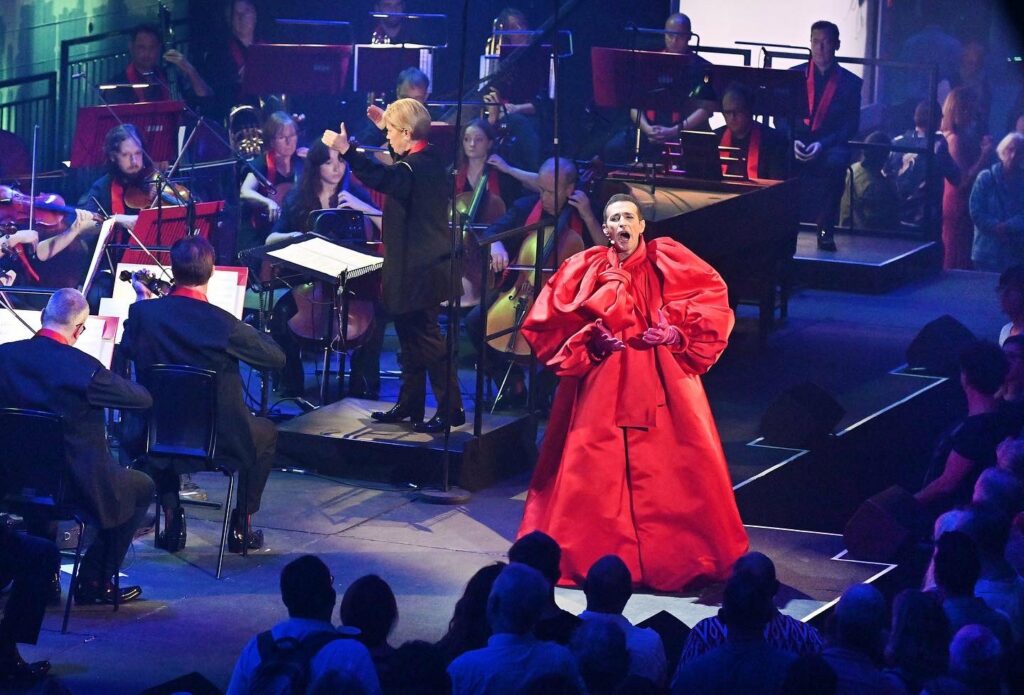
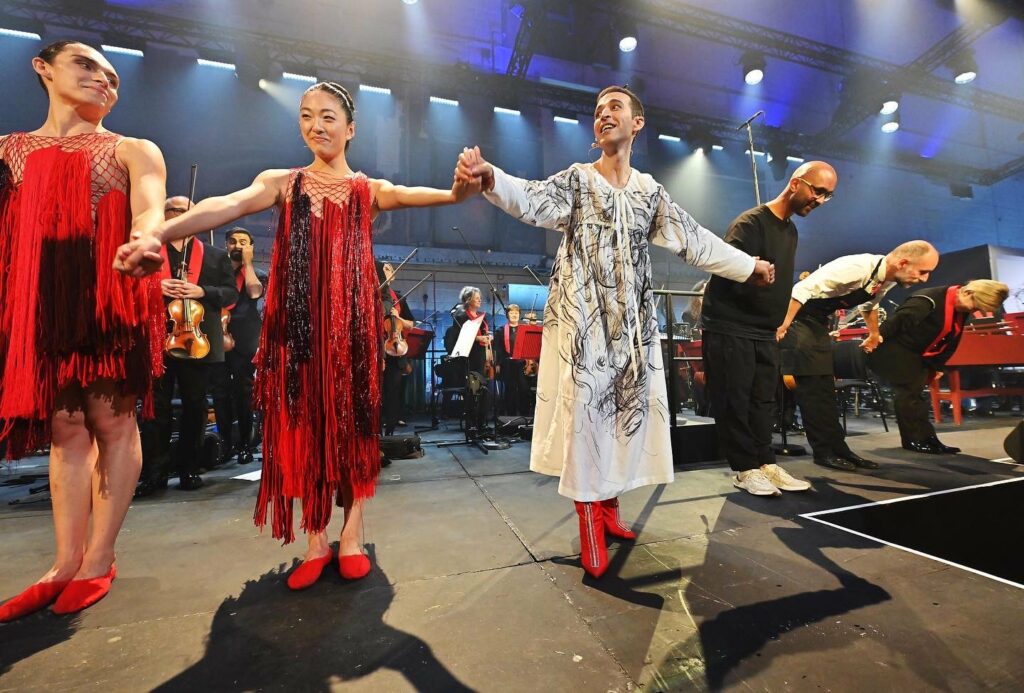
The head turning array of soloist, orchestra, dance, art, beat-boxing and sound design filled the venue with the ambition of a classic happening. The star of the show was very much American counter-tenor Anthony Roth Costanzo who has dazzled audiences across the pond and over the world. It is his clear sex appeal and queer ideals that dust the show with beautiful goings on. In both the bejewelled Handel and Phillip Glass repertoire (extracts from both their operas, some never heard at the Proms along with a world premier from Glass) he proves his broad taste and mighty passions, his voice sharp and touching.
All the other goings on segway well into each aria, the dancers never quite getting the limelight (with emotive choreography by Justin Peck). The live painting of Glenn Brown was only truly visible to one side of the vast elongated factory. Players from English National Opera and conductor Karen Kamensek never wained is this apparent gamble that paid off all round. Costumes by Raf Simons are billowy, colourfull fun creations, slight and web like for the dancers, exaggerated for Costanzo.
Jason Singh would beatbox and add whispy vocal tricks to make space between the notes of the arias. What almost attempted to steal the show was the finely crafted surreal video work which graced the brick walls. The likes of James Ivory with Pix Talarico, Tilda Swinton and Daniel Askill and more had unsettling, vivid and witty films that got away with a lot of it’s demands.
A surreal trip to Bristol would herald a gig of epic proportions. Having discovered Dareshack in my last visit to Brizzle, I marvelled at the cafe establishment which is also a hairdressers, along with other goings on. The other Dareshack on Wine Street would host this fine gig and has a more bar like feel.
The warm up act for the evening was The Pleasure Dome, though the name is deceptive. Whilst I went along with their intense, cutting rock, I found the sound levels to be exceptionally loud. It appeared I was the “old man” for this set and it almost bordered on a feat of endurance. Lead singer Bobby Spender arrived on stage, bare chested and chugging a beer. There is a slight feel of Ozzy to him, even if I wasn’t able to make out a single word in any of the songs. On bass, Loz Fancourt provided additional support in the makeup within the wall of noise. Drummer Bert Elvin had the energy of a horse who I was drawn to for most of their time on stage. I noted Bobby getting extremely liberal usage of feedback pedals, I assume the source of the screeching in my ears throughout. I’ll stay on the case and be down to see more of The Pleasure Dome in the future.
With the breakup of the band Prince Rama, front-woman Taraka has been establishing her own strident solo act, though is still very much an all round artist. A technical glitch made a brief predicament for the start of her show, though things would set off pretty quickly. With a mattress and bed sheets on stage, Taraka made for joyful viewing and listening. It is her dreamy, post-punk vibes that holds everything together. The trippy mix of binary numbers, Shepard tones and spam voice-messages that make for quirky patter in her songs. It’s all very charming and her stage presence shines. Even an impromptu pillow fight with the audience was a liberating few moments.
As if were weren’t treated enough, her encores would prove her versatility with an intimate guitar show, the audience invited to join her on stage. She even shared with us a brand new song not performed before, another thrill just for this Bristol crowd. This giddy audience seemed to lap up what she offered and her funny, wry talk also made for a great time.
Taraka would prove a great success in Cardiff, we could easily see her at the Festival of Voice or down Womaby Street very soon. This is one singer to keep a keen eye on!
Taraka continues on tour to End of the Road Festival, Salisbury, Paradiso in Amsterdam and Endless Summer in Marseille.
The Pleasure Dome are again in Bristol at Exchange on 24 September and back at Dareshack on 7 October. They also continue on tour around England & Wales.
Another quirky Bristol encounter saw me in the well known Thekla, a docked boat on the river which hosts gigs. The warm up act Morly was soft and subtle, gentle vocals joined with the patter of Nord keys. Lot’s of loveliness, though I craved a little variety.
The buzz for the main line up was finally to begin (after a postponed gig), was palpable. Alexandra Savior has made waves online, some die-hard fans were present as they sang along to most of her songs. Her autumnal style is warm and cheery, she seems to sing to us though also for herself. Past relationships would reach their zenith in her craft, with her song Crying All The Time a real treat which could turn heads for its blunt beauty. Her band also were razor sharp and you can feel the collaboration oozes in no doubt many gigs.
What I really wanted to hear was Howl, my gateway song for Alexandria and sadly we would not hear it this time. One feels her star is still on the rise, even with the successes already achieved. You can really feel her growing pains in these songs, a young woman coming into her own, confident and sharp. This rocking concert made for a special Friday night treat. You can see the bigger venues opening up to her. The grooving and good buzz around the whole space is a testament to her talents. Go see her on tour.
Alexandra Savior continues on tour in the UK, Europe & Turkey.
A heatwave joined for the latest excursion to Penarth for Cardiff Opera for their latest concert. Having seen their Julius Cesare by Handel, this unassuming collection of young singers and instrumentalists offering up to the Welsh capital events both popular and rare.
The Siegfried Idyll from Richard Wagner is perhaps one of the finest depictions of a forrest. It’s a much more gentle side to the arrogant and racist composer, presenting the piece to his wife Cosmina on Christmas morning. Later recycled into the opera of the same titular hero, this is gateway Wagner for people not to sure of the five hour epics which follow. It was the strings here which let down the side on a few occasions, some problems might have been with the vibrato. Though it all, the sweetness and charm of the work still shone through, conductor William Stevens with a no thrills command of the score.
In a hefty follow up, Mahler’s The Song of the Earth sees ancient Chinese poetry mixed with the composer’s angsty, Austrian existentialism in a heady brew. This is Mahler’s good bye to the world, at least for me much more then the 9th and 10th symphonies (the latter incomplete at his death). The woodwind was fairly tight here, the players reduced to a very small size for such a work got away with it, though it may not have captured that universal metal the composer demands.
Fine footed tenor Robert Felstead get some lush moments of nature and drinking, the rowdiness of the role a bolstering, unshaven thrill. For me the real joy came with soprano Rebecca Chellappah who sings the majority of this song cycle with grace, has an affirmed sense of drama and musicality. The Farewell takes up half the piece and is a devastating departure, Rebecca awash in this grand movement of the passing of time, as nature thrives. All that was missing was the celeste for the final flurry in the last few bars.
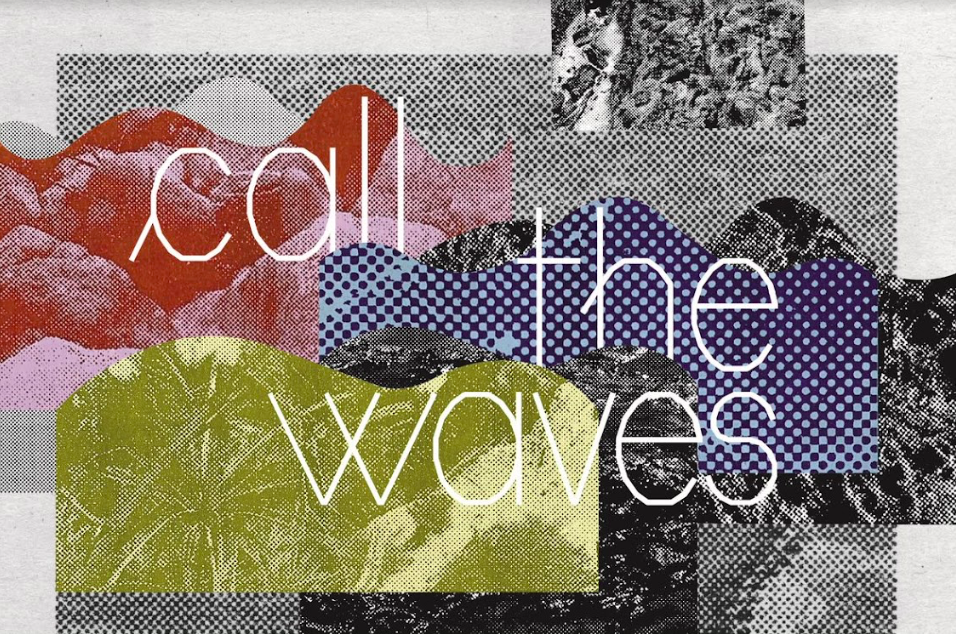
It is water, the lifeblood of all things that is the major component of Chapter’s latest exhibit. A diverse group of mostly female artists and other academics have teamed together to tell an absorbing tale of their relationship with water on both a personal and cultural level. The lands of Wales, Palestine and Morocco feature, spread out in the gallery and not cluttering any of the work.
The first room with Kandace Siobhan Walker sees a fishing net looming over us with polaroids, song lyrics and sea-scape video that welcome us with much poetry and retro charms. Noureddine Ezarraf had made fabric pieces which I’ll confess don’t ignite the senses, though do have subtle nuances, both works marbled with black lining over the soft, amber palettes.
Bint Mbareh has found her own little nook, with a live performance of Stellar Footprints in her fabric fort. As we watch seeing only her feet and bottom legs, she asked us to feel as if we had water dropping on us and around us, then requested we walk around her structure so that she could capture the sounds. Speaking to Bint after, she admitted more needed to be done to capture the energy of the audience, who fizzled out after a while, giving up on the stomping, as if we were wading through water. She invited us beforehand for a select few of us to join her in the fort towards the end, some did though the piece appeared to be over. With a bit more rehearsal this could be quite tight, Bint’s vocals singing through especially exquisite towards the end.
Fern Thomas’ work sees wordy verses spread out all over the wall, as a rock on rope gently sways in our line of sight. A rich spiritual heritage fills the words and a universal mood comes across in these words of love and respect for water. The final room filled with the pieces by Alia Mossallam and Maya Al Khaldi had headphones with folk singing mothers looping and a little study area with desks and carpets (we are encouraged to add to the embroidery, with staff offering needles). I found this room quite absorbing, letters from the British government in Egypt allude to corruption and racism, the carpet spreading up to the wall a really nice touch as well. Veils also hang from the ceiling a slight flutter to the end of a exhibit with history and culture as it core.
Calls the Waves continues at Chapter Arts Centre till 20th November 2022 along with further workshops, talks and further performances.
Creating opportunities for a diverse range of people to experience and respond to sport, arts, culture and live events. / Lleisiau amrywiol o Gymru yn ymateb i'r celfyddydau a digwyddiadau byw


 (4 / 5)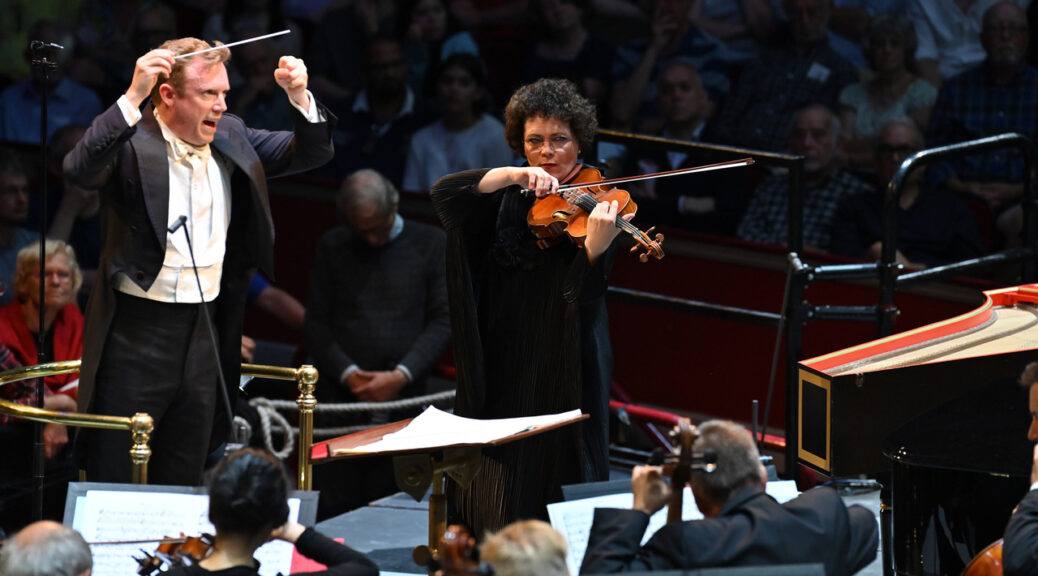
 (3 / 5)