

All posts by BarbaraMichaels

REVIEW, EDWARD SCISSORHANDS AT WALES MILLENNIUM CENTRE CARDIFF BY BARBARA MICHAELS


Ballet, based on original story and film by Tim Burton
Adaptation: Caroline Thompson
Devised and directed by Matthew Bourne
Music; Danny Elfman and Terry Davies


 out of 5 stars (4.5 / 5)


Making a welcome return to Cardiff, Edward Scissorhands is arguably not only the most hauntingly beautiful of Bourne’s innovative and unique productions but the most in depth and soul searching. Brought up to date with new music, the story of a boy that is different and as a result suffers jibes and discrimination, Bourne infuses this new production with an added poignancy cognisant with contemporary mores and awareness of mental health issues.


Based around the central character of a boy with an abnormality which causes him to face problems in the world – a world unknown and alien to him – Edward Scissorhands is complex and far from easy to relate in balletic form, although Bourne can be forgiven for the occasional grunt or shout. Created by an eccentric inventor, Edward is left unfinished with elongated scissors in place of hands when his creator unexpectedly dies, leaving him to face the challenges of an unknow world. As with all Bourne ballets, the dance is an amazing mix of classical and modern plus maximum use of mime, danced with empathy and expertise by Bourne’s New Adventure Company.


On Press night, the lithe and lissom Liam Mower, who back in 2015 first danced the central role of Edward – arguably one of the most difficult roles in Bourne’s diverse repertoire. – brings to the stage a knowledge and perception of the character, targeting the highs and lows of a young man who is desperate to be accepted despite fighting against prejudice and suspicion.


Not only do the principal dancers shine, but the whole of Bourne’s young and enthusiastic New Adventures Company show expertise in the different dance genres, segueing seamlessly from one to the other, under the tuition of New Adventures Take Part Creative Director Kerry Biggin who on opening night in Cardiff, danced the principal female role of Peg Boggs, the young housewife who befriends Edward. Opposite her, Dominic North dances a self-assured Bill Boggs.


Bourne’s choreography, inclusive of both the lifts and Grandes jetés of classical ballet and bang up to date acrobatics of street dance (seen also in Bourne’s ballet The Car Man) is in this respect unique. Lez Brotherston’s atmospheric set designs make an important contribution to the success of this ballet, aided and abetted by Howard Harrison’s atmospheric lighting. Worth noting that Brotherston also designed the great costumes.


Overall, a ballet that with a dark element yet with comic touches throughout that lighten the load. Does Edward overcome the problems of the title? It would be a spoiler to tell!


REVIEW: THE WIFE OF CYNCOED, SHERMAN THEATRE, CARDIFF BY BARBARA MICHAELS

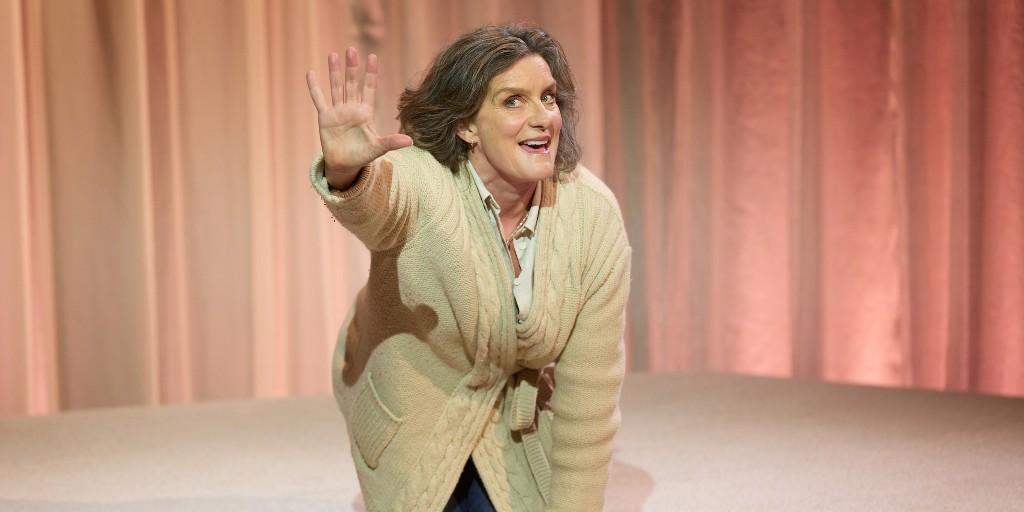
Image Mark Douet

Writer: Matt Hartley

Director: Hannah Noone

Designer April Dalton

Composer and Sound Designer Sam Jones

 out of 5 stars (4 / 5)

Reviewing a new play – and, furthermore, a one-woman play – is guaranteed to send a frisson of excitement down the spine of even the most seasoned of reviewers. The Wife of Cyncoed does that in spades, an added bonus being that the monologue is played out by none other than Vivien Parry – and what a tour de force it is for this Welsh actress!

On stage non-stop in a monologue that lasts for one and a half hours with no interval, Parry – who performed in a preview on her 60th birthday – gives it all she has got from start to finish. Taking place in the upmarket Cardiff suburb of Cyncoed and the atmospheric Lakeside area, this – the first production of the season for the Sherman – has a make-or-break quality about it, in reference to both the plotline and the setting.

Fear you not – this monologue from the pen of writer Matt Hartley could be set pretty well anywhere. The story – that of Jayne, a newly divorced woman whose life takes an unexpected turn, offering her an opportunity that she may or may not be brave enough to take – manages to be both entertaining and poignant, a tale of self-discovery, and second chances, of a road that may or may not be taken.

A monologue is a genre that depends not only on the writing but on the delivery (think Alan Bennett’s Talking Heads and the iconic Thora Hird). In Hartley’s monologue, the multi-talented Parry, seen recently in Cabaret in London’s West End and well-known to Welsh audiences for her sterling work with Theatr Clwyd, steps up to the challenge head on. Parry taking command of the stage from her first entry. Not only does she become Jayne but in using different voices with maximum effect changes character to reflect other people in her story, in particular her two grown up children, with whom- to say the least of it – she doesn’t always see eye to eye.

Parry gives a brilliant and empathetic performance, but could do with slowing down her delivery a tad at times in the first hour. Having said that: full marks and more for amazing movement and dance, giving full justice to the underlying message, described by Hartley as “A a howl of rage against how older women are perceived and overlooked.,” and getting under the skin of the character warts and all.  Staging is at a minimum (not even a chair) but Katy Morison’s clever lighting and Sam Jones atmospheric sound track provide this with effect while remaining unobtrusive when necessary.

Could this be one for Edinburgh Fringe? Yes. For Hartley’s monologue – the story of a woman of a certain age with the message that life is for living – could be set anywhere.

Runs until 23rd March 2024 at Sherman Theatre, Cardiff

Review Annie, Wales Millennium Centre by Barbara Michaels

 out of 5 stars (3.5 / 5)

Based on the book by Thomas Meehan
Music: Charles Strouse
Lyrics: Martin Charnin
Director: Nikolai Foster
Choreographer: Nick Winston.
Set and Costume Designer: Colin Richmond
Reviewer: Barbara Michaels

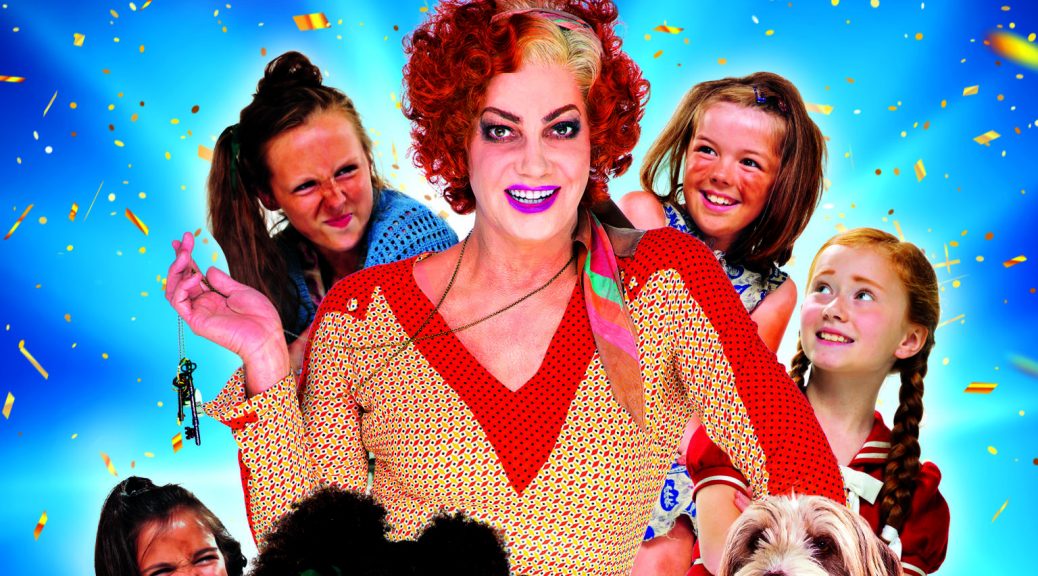
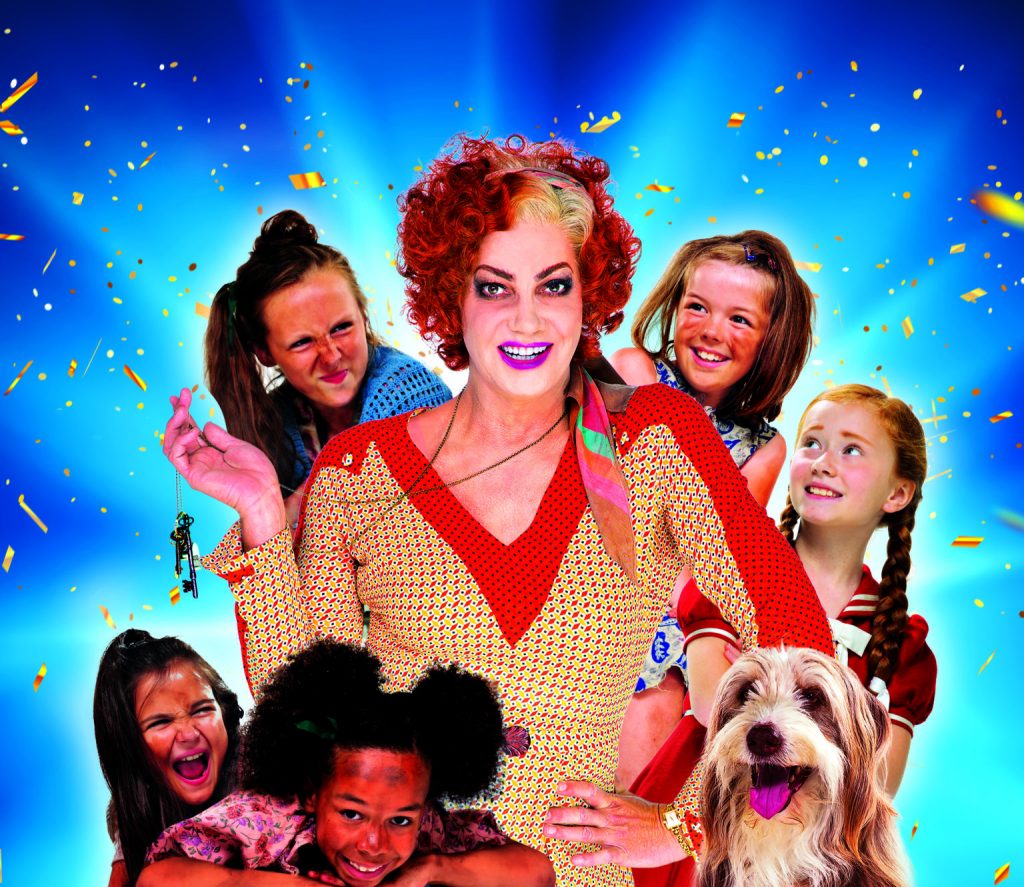
Back on stage again, and touring after a highly successful London run, ‘Annie’ the musical, based on the book by Thomas Meehan and the popular comic strip Little Orphan Annie, the original Broadway production of Annie the musical, back in the Seventies, was an outstanding success, running for six years. Not surprising, really – the rags to riches story of eleven-year-old orphan Annie couldn’t fail to grab at the heart strings. The same is true now in this latest production, directed by Nikolai Foster. A musical with the heart-warming theme of a young girl living in an orphanage from which she is determined to escape and find her parents, never fails to be popular with audiences around the UK.

This time around, the darker side is given more prominence. Set in New York, in the Thirties, the time of the Great Depression when President Roosevelt and his cabinet were struggling to find a way through, set designer Colin Richmond uses random jigsaw pieces to emphasize the disjointed existence led by many – not least the orphans, of whom eleven-year-old Annie is the ringleader, under the tyrannical rule of the scary Miss Hannigan.

While the problems of the situation then can be seen to have relevance to our lives in the UK today, with the aftermath of the Pandemic, the lengthy prequel in the form of radio bulletins coming over speakers is overlong, given that the action speaks for itself. Nevertheless, this rejigged version scores, albeit much of it being carried on the shoulders of the highly watchable Craig Revel Horwood, segueing in high heels onto the stage of the Donald Gordon theatre for the second time – the last time was 2019 – in the role that he has made his own.

As the scheming harridan intent on looking after number one, Revel Horwood takes command of the stage, giving it welly with gusto in Easy Street in Act I, and proving yet again – as if we needed reminding -that judging Strictly is not by any means his only talent. Revel Horwood acts and dances with expertise; his timing is spot on. A true pro – although given n that this is the fifth production in which he has played the role, it is hardly surprising.

On opening night in Cardiff, the leading role of Annie was played by Zoe Akinyosade. A challenging role for any young aspiring actress, this young actress and singer ‘gets’ Annie, although there are times when she needs to guard against her voice becoming over shrill, this being exampled in her solo Tomorrow in Act II. There was a tendency for this to be the case with several of the young performers, compensated for by the verve with which they performed the energetic moves required by Nick Winston’s clever and innovative choreography.

The popular Alex Bourne, who played the role in the West End production, is a lovable Daddy Warbucks –the business tycoon who becomes an avuncular figure as he faces the challenges involved in becoming Annie’s adoptive Dad. The wistful Something Was Missing, sung by Warbucks and Annie in Act I and later reprised in Act II, scored Brownie points with this reviewer, while Paul French’s Rooster cuts the mustard on all fronts. Full marks to all the young performers for some superb dance moves.

As if performing with a posse of young actors wasn’t enough in itself, to challenge the adult performers, there is also a cuddly dog who trots back and forth obediently across the stage discreetly rewarded by the necessary treats.

Runs until Saturday July 8th at Wales Millennium Stadium

Review Peaky Blinders – The Redemption of Thomas Shelby,Ballet Rambert, Wales Millennium Centre, Cardiff by Barbara Michaels

Peaky Blinders – The Redemption of Thomas Shelby

Ballet Rambert, Wales Millennium Centre, Cardiff

Writer and Creator: Steven Knight, CBE

Choreographer and Director: Benoit Swan Pouffer

Composer and Orchestration: Roman GianArthur

Reviewer: Barbara Michaels

 out of 5 stars (3.5 / 5)

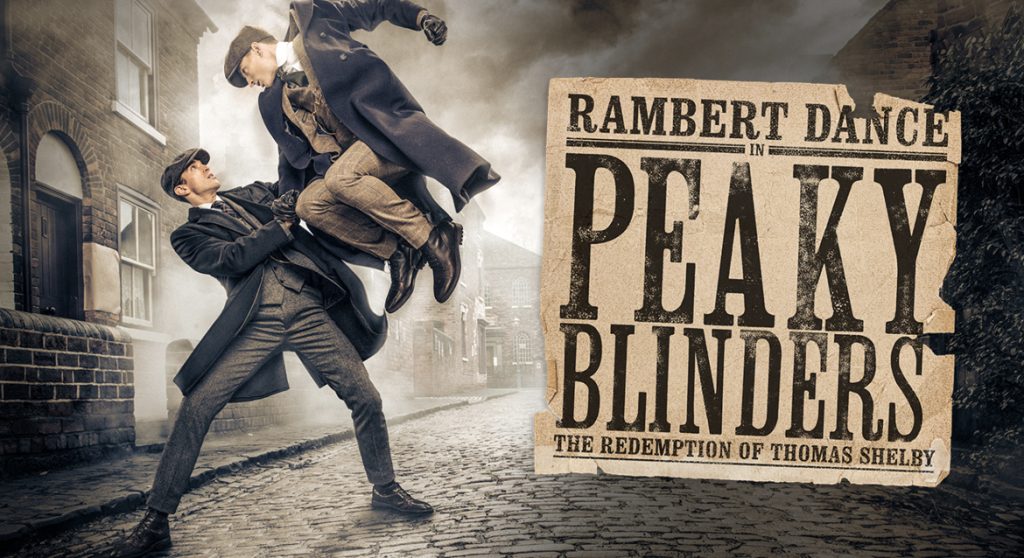
No need to stress if you didn’t watch the TV series.  Ballet Rambert’s Peaky Blinders is in a class of its own, unique both as a production and as a dance form. Although danced in the main in contemporary dance style with more than a touch of street dancing – razors, knives etc – choreographer and director Benoit Swan Pouffer uses classical dance moves too. Not only uses them but dares to improvise, building on to the traditional with innovative use of classical ballet moves – with a dancer even performing a plié in mid-air.

Beginning with a brilliantly depicted scene from the battlefields of World I, the ballet moves through the life of one Tommy Shelby down the years, showing through him the ways in which those who fought in this horrendous war were affected throughout their lives even in they survived – a living death, as it were.  As it moves on through the post-war years, Tommy’s life segues into a violent world full of murders and gang warfare, with knives and razors flashed – the latter hidden in and the raison d’ètre for – the peaked caps that gave the gang its name. This historically accurate production is not for the faint-hearted, but is well worth taking a deep breath and immersing oneself in what it portrays through dance form.

Creator Steven Knight, who wrote the original script for TV and together with Pouffer, adapted it into dance form, uses a live band on stage throughout for gunfire, air raid sirens and a plethora of music and sounds which works well in tandem with ever-changing themes composed and orchestrated by Roman GianArthur. Natasha Chivers’ lighting aids and abets, of particular note being the scene with searchlight beams and in the second half where an opium-fuelled Tommy descends into a living hell.  Benjamin Zephaniah’s voiceover is both necessary and succinct, while set designer Moi Tran’s clever sets lend an authentic and atmospheric touch throughout: a colourful carousel lends a light touch for one scene. Having the dancers on two levels gives additional scope but at this venue means that audiences in stall seats are unable to see the dancers’ legs!  Ben Zephaniah’s voiceover is both necessary and well done but pre-recorded vocals – recordings of different tracks which, despite being relevant, are over-loud for much of the time.  

The love story between Shelby and his long-time sweetheart disappears and resurfaces throughout lending a necessary lightness of touch, as does a great scene in the second half with dancers dressed in costumes by costume designer Richard Gellar reminiscent of photos of Marilyn Monroe in her early days (a la Moulin Rouge or Talk of the Town for those old enough to remember these iconic London night spots!)

Ballet Rambert is justifiably famed for the high standard of its dancers, and this production underlies this with memorable moves executed with skill. Mention must be made here, in addition to the expertise of the dancers – notably Naya Lovell, Simone Damberg Würtz and Caiti Carpenter -of Musa Motha who, despite losing a leg to cancer when he was just ten years old, does not let that factor deter him in any way, resulting in a performance that is a privilege to watch not only for its depiction of the role but its perfection of technique.

Runs until Saturday March 25th at Wales Millennium Centre Cardiff, then touring.

Review The Magic Flute Welsh National Opera, Cardiff Millennium Centre

Music: Wolfgang Amadeus Mozart

Libretto: Emanuel Schikaneder

Director and English translator: Daisy Evans

Designer Loren Elstein

 out of 5 stars (3 / 5)

With its contending forces of good and evil, Mozart’s sardonic fairy-tale The Magic Flute, has more than a hint of the pantomimic.  To use the words of the vernacular, Daisy Evans new production for the Welsh national Opera, sung in English with Welsh sub-title, sure does that in spades. Opera afficionados used to the more traditional – as in WNO’s much loved version last staged in 2005 – need to take a breath and prepare.

Mozart’s ‘Flute,’ first performed in Vienna in 1781, is reset by Evans into today’s world, with more than a hint of Star Wars, laser beams, fluorescent multi coloured lights et al. Not always easy to follow if you neglected to read the excellent programme notes. The connecting link which runs throughout is Schikanender’s libretto telling the story of the quest of Tamino, a Prince who sets out to find and rescue Pamina, daughter of the Queen of the Night.  Pamina has been kidnapped by the villainous Monostatos by order of Sarastro, head of a mystic cult. Encouraged by ladies of court, Tamino is helped by the magic flute and Papageno, the bird catcher who lives in a hut in the woods and whose idea of heaven is hearth and home with the girl of his dreams.  The story, with its mix of wonderful music, soaring arias, lovers’ tiffs and misunderstandings, set against a background of birdsong and mysticism, strongly references the fight between good and evil, the power of womanhood, all being brought to the fore by Evans, who has added and subtracted spoken passages in a translation that allows at times for a contemporary use of words that does not always sit well.

And thereby lies the rub, for in her endeavour to give the fairy-tale that is The Magic Flute a modern twist, Evans goes overboard. Mozart’s light-hearted touch is lost at times amidst a welter of light beams, however skilfully used and puppetry, however effectively used. Under the direction of puppeteer Matthew Forbes flocks of birds flutter intermittently around Papageno’s head.  Used throughout, this is a clever idea (although it might have been preferable to dress those manipulating the strings in black) but a tad over used – it is possible to have too much of a good thing.

Nevertheless, consisting as this opera does of some of the composer’s most memorable arias and lyrical duets, this production does still keeps much of the romance, comedy and mysticism of the original. Thanks being due in no small measure to the expertise of the orchestra of the Welsh National Opera under the baton of Freddie Brown and the admirable chorus. The latter, despite being attired in headgear similar to that of a beekeeper in the second half, is as always in fine fettle, although under used in this production. At Saturday night’s (March 11th) performance, British-born soprano April Koyejo-Audiger made her WNO debut with a pleasing soprano and good sense of timing opposite South African singer Thando Mjandana, whose melodic tenor stands him in good stead in the lyrical duets with Koyejo-Audiger. Neal Davies is a quirky Papageno who combines comedy with sympathy both for being put-upon and for his unwanted single existence.

Audiences familiar with this opera are known to wait with baited breath for the high-octave reach called for by the Queen of the Night. Lyric-dramatic coloratura Julia Sitkovetsky does not disappoint with a soaring performance in high-octave and extremely difficult solos which even the most accomplished of singers can struggle to reach.  Carmarthenshire-born Alun Rhys-Jenkins, whose specialises in tenor character roles, plays the supposedly frightening Monostatos for laughs more than terror, with a touch of the game show host at times in the role of sidekick to a far from sinister Sarastro sung by a bewigged Jonathan Lemalu with more than a touch of the Georgian gentleman.

A minimal and modernistic set is the background to an innovative and clever production. Whether or not this is a welcome addition to the multiple performances world-wide of one of Mozart’s most popular operas remains to be seen.

Snap: Less is sometimes more!

Runs until March 17th in Cardiff, then touring.

Tags: Alun Rhys-Jenkins, April Koyejo-Audiger,Cardiff, Daisy Evans, Emanuel Schikaneder, Freddie Brown, Jonathan Lemalu, Julia Sitkovetsky, Loren Elstein, Matthew Forbes, Neal Davies, Thando Mjandana, The Magic Flute, Wales Millennium Centre, Welsh National Opera, Wolfgang Amadeus Mozart,

Review BBC National Orchestra of Wales, St David’s Hall, Cardiff, Barbara Michaels

Piano Concerto No 3 by Sergey Rachmaninov

Soloist: Yeol Eum Son

Conductor: Ryan Bancroft

 out of 5 stars (5 / 5)

A star performance of Rachmaninov’s third piano concerto – said to be one of the most difficult and challenging of piano concertos in the concert pianist’s repertoire -by the multi-talented South Korean pianist Yeol Eum Son was the choice of the BBC National Orchestra of Wales for their opening concert of the season. Performed to a packed audience at St David’s Hall in Cardiff last night. (October 6th) and broadcast on BBC Radio 3, what a night it was! A diminutive figure in a black evening dress, soloist Yeol Eum Son gave those fortunate enough to secure a ticket an evening to remember. This powerful concerto, composed in 1909 but not given full acknowledgement until several years later, then becoming increasingly popular in the 1930’s when it was performed to great acclaim by Vladimir Horowitz, was given a supremely sensitive all-embracing performance throughout by Yeol Eum Som.

The opening movement, Allegro ma non tanto, was interpreted with sensitivity and skill, with Yeol caressing the keys as a lover might caress his or her beloved, to change into a powerful full throttle engagement with the keyboard. With her fingers flying so fast that at times the sight of them became a blur, this tiny almost unbelievably slender young woman switched effortlessly from the gentlest of melodies to the powerful octave-spanning moves that make this concerto a concerto to be feared for some soloists., thus making this performance a rare and special occasion. Yeol Eum Son’s ability to control and shape every poetic nuance – much in evidence in the great solo cadenza – plus her fearless and bravura attack on the most difficult of passages is awe-inspiring.

For the Intermezzo: Adagio-un poco piu mosso – a set of variations by the orchestra alone gives temporary rest to the soloist, notable among these at this performance being the short flute solo, performed with feeling despite its brevity, followed by solos from oboe, clarinet and horn. Then the piano bounces back with a powerful yet melodic attack on the keys ferocious in its brilliance, segueing seamlessly into the Finale Alla breve and a vigorous ending.

Full credit to the BBC National Orchestra of Wales under the direction of their leader first violinist Lesley Hadfield. The rapport between the soloist and the conductor Ryan Bancroft, who have worked together many times was extraordinary and no doubt contributed to the high standard of a performance that had the audience shouting for more and bringing the soloist back four times. Broadcast on BBC Radio Three, this memorable performance gave its audience and those who listened at home, a night to remember and an opening night that bodes well for this great symphony orchestra during the coming season.

Please note due to ill health, Barbara reviewed only the first half of the performance.

Coming next:: Mahler’s Symphony No. 9, conducted by Markus Stenz . Thursday, 17/November, 2022, at 7.30 pm at St David’s Hall, Cardiff.

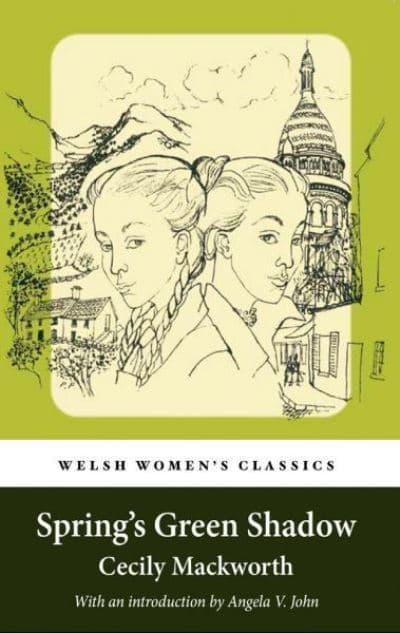
Review Spring’s Green Shadow by Cecily Mackworth Publisher: Honno Welsh Women’s Press Review By Barbara Michaels

 ISBN 1912905493,9781912905492,

 price £10.23 paperback, £7.59 Kindle (Amazon)

One of the latest additions to the Welsh Women’s Classics series published by Honno Welsh Women’s Press, Spring’s Green Shadow is a novel based on a true story – that of the author herself.  Cecily Mackworth, born in the early years of the twentieth century, (1911) was a journalist, author, and poet born and brought up in Wales who later lived in Paris during a period of political turbulence.

First published in 1952, set in both Wales and Paris, this new edition of Mackworth’s novel has a lengthy introduction by historian and biographer Angela John, an honorary professor of Swansea University.

And thereby lies the rub, for worthy and meticulous in detail as is John’s introduction, it also to some extent gives the game away.  In many respects, Cecily Mackworth’s own story can be seen as similar to that of the novel’s fictional heroine, Laura Gethryn. However, any sense of deja vue is justified giving as it does the raison d’ȇtre of the novel.

As the story opens the reader is introduced to Laura, the intellectually inclined and high-spirited daughter of a father left broken and emasculated by the first World War and a mother, made demanding and bad tempered by events.  The early years of Laura’s life are spent living with her parents in Monmouthshire where her father’s family have been landowners for many generations. Continually berated by her parents for not conforming to the dictates of the time regarding a woman’s role in life and a daughter’s duty – i.e.to make a good marriage – Laura’s frustration erupts into action when she comes under the influence of the working-class intellectual Mr Howells. Rebelling against her mother’s refusal to allow her to pursue her education, Laura escapes to begin a new life with the Howells family

The focus on woman’s emancipation gives a contemporary feel to this novel, despite it being evocative of a bygone era.  Mackworth’s brilliant descriptive powers give a vivid and at times uncomfortable portrayal of life as it was back in the early part of the twentieth century for an ambitious woman writer determined to bring some unpleasant truths to the notice of the powers that be.

 While it has to be said that this part of her book is to a degree biographical, giving as it does a close resemblance to Mackworth’s own experiences as a woman who was herself involved in at times dangerous confrontations regarding a number of controversial issues., it is none the worse for doing so.

Not only is Spring’s Green Shadow an interesting read in its own right as a novel, it has the additional benefit of historical worth, documenting as it does the mores of an era in which long-held beliefs both at home and abroad were questioned as the winds of change blew over Europe.

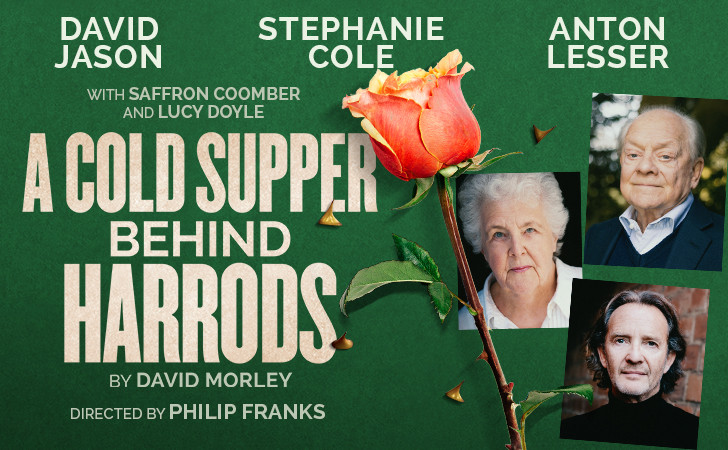
Review A Cold Supper Behind Harrods, David Morley by Barbara Michaels

 out of 5 stars (4 / 5)

A Cold Supper Behind Harrods  Now Streaming

Script: David Morley

Director; Philip Franks

Reviewer: Barbara Michaels

A hybrid, yes – but with an all-star cast.  With a live performance staged at the Oxford Playhouse by the Original Theatre Company in association with Perfectly Normal Productions and screened for one night only, A Cold Supper Behind Harrods, written originally as a radio play and broadcast as such by BBC Radio 4 back in September 2012, is now being streamed with the original cast and available on line for a modest fee.

Dubious as one’s early approach to virtual theatre might have been, the value of such screenings is now a given, and deservedly so. And this one is top of the class. Despite the starry cast, amazingly so when you learn that they are performing a live reading from the script after just one quick run-through beforehand.

The result –iconic! Admittedly, all three of the main protagonists are names you will recognise, and are theatrical veterans who have been around a long time. To whit – Stephanie Cole (ladies first), David Jason and Anton Lesser, all highly skilled thespians.  Nevertheless, as is admitted in the Q and A afterwards, for all of them something completely new.

Not surprisingly, all of them rose to the challenge admirably, despite being faced with David Morley’s complex storyline, centred around the SOE (Special Operations Executive) during World War II.  Three SOE agents meet up again fifty years after the war, the purpose being to be interviewed for a television documentary investigating the murder by the Gestapo of their late female and much-loved colleague.

Initial pleasantries between the three-give way to more disturbing issues as a web of lies and deceptions emerges, leading at last to the real truth.  Inspired by real life characters and events, it makes for gripping entertainment, made even better by an outstanding cast and Adrian Linford’s deceptively simple set.

https://youtu.be/vsqNDO3emUc

David Jason, stage veteran of such iconic television series as the unforgettable Only Fools and Horses, as agent John Harrison proves once again that age is no barrier when it comes to sheer brilliance.  As Harrison crumbles beneath the weight of knowledge revealed, Jason is utterly believable.

As the female agent Vera, Stephanie Cole is at her best playing irascible females and she doesn’t disappoint, with that roguish smile shining through at odd moments, while Anton Lesser projects a cool calm that later erupts into menace.

Adhering to Morley’s original script, which was inspired by the playwright’s meeting with two WWII veterans, the story is fictional, with love, revenge and feelings of guilt at its core.  

Don’t miss it.  This is a play that will pull you in from the start to the finish.

Watch at originaltheatreonline.com                                                   

Memories of Talking Heads By Barbara Michaels

The new BBC 1 TV series Talking Heads brings back a personal memory of Dame Thora Hird, DBE, to Barbara Michaels

If any of you were fortunate enough to have seen Thora Hird in Cream Cracker Under the Settee, one of Alan Bennet’s witty and often heart-breaking monologues in the series, Talking Heads,  premiered back in 1988,  you will fully understand why I rank meeting and interviewing Thora Hird as one of the high spots of my career.  I interviewed Thora at home in her London flat, with her husband Jimmy Scott pottering around making us coffee in the kitchen.

Forward to 1994. The next time I met her was when I sat next to her at a long prearranged gala performance hosted by Melvyn Bragg, at which she was the guest of honour.  Sadly, it was not long after Jimmy, to whom she was married for 57 years, had died.  In the darkened auditorium she wept silently, with tears coursing down her cheeks.  Widowed myself just over two years previously, I understood only too well what she was feeling.

But wonderful trouper that she was, when the spotlight shone on her (at least she was spared having to walk on stage) she stood up, all traces of the tears gone, and made a speech without a wobble in her voice. 

It was her audience who choked back their tears then.

Since that day, there has been a hugely prestigious list of actresses including Dame Eileen Atkins, Stephanie Cole and Dame Penelope Wilton who have performed in the monologues.  This time around, the list includes Imelda Staunton (did you see her in Finding Your Feet on Channel 4 recently?) and Dame Harriet Walter.

Great actresses, all of them.  But it is Thora I will always remember.   Perhaps it is just as well that Cream Cracker Under the Settee has not been included in the remake.  The reason why?  It calls for an actress  over 70 years of age (as Thora was) and, under the lockdown rules, the BBC felt unable to include anyone of that ilk!

Showbiz Chatter, Maureen Lipman – A Tale of Two Kitchens

Not surprised to see the indomitable Maureen Lipman, who was 74 this month, taking part recently in an online cookalong project to cook something delicious for a neighbour or friend in need.  Maureen, who is due to start filming more episodes of Coronation Street in June, made a nutritious bean and barley soup in the small kitchen of her home in Paddington. The kitchen looked perfectly adequate but it brought back memories of the much larger kitchen of the family home where she lived with her late husband, the playwright Jack Rosenthal, and two children, Amy and Adam.  The house had a large garden, at the bottom of which stood a red telephone box, which was presented to Maureen when she was appearing as Beatie in the British Telecom adverts.

Maureen’s kitchen in that house was her pride and joy.  I went there to do a big article and photoshoot about said kitchen, which was painted in sunny yellow with blue painted cupboards and the latest in worktops.  It was a full-on day. Maureen and Jack were due to go to a wedding later, but like the true pro she is, Maureen didn’t let that faze her.

Jack, and Maureen’s mother Zelma, however, were a different matter. Both kept wandering in; Jack to enquire the whereabout s of different of items of clothing (a shoe lace broke, causing a major problem), while Zelma – a lovely lady whose mission in life seemed to be making sure everyone was fed – appeared at intervals to offer sustenance.

 I still remember one particular shot with Maureen perched atop her kitchen counter with a red rose between her teeth!  Not your traditional kitchen photo, but that’s Maureen. I have interviewed her several times over the years and she is one of the spunkiest people I have ever met, going on stage many years ago in a demanding play after major spinal surgery, and in 1998 taking on the challenge of learning some fast dance routines as Aunt Eller in the musical Oklahoma!

Barbara Michaels