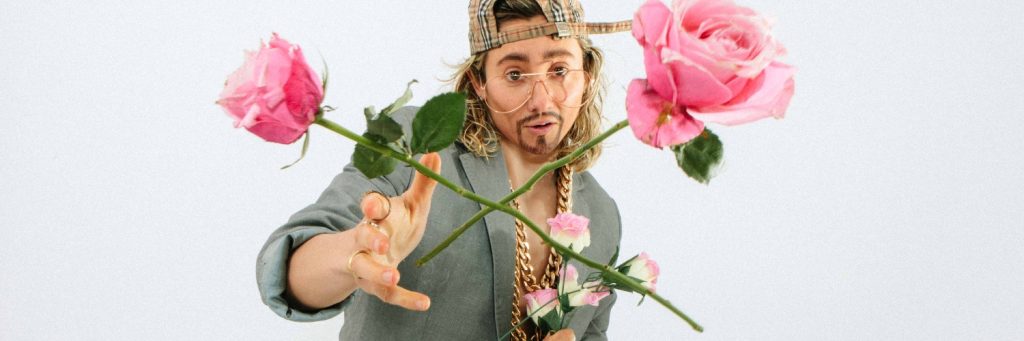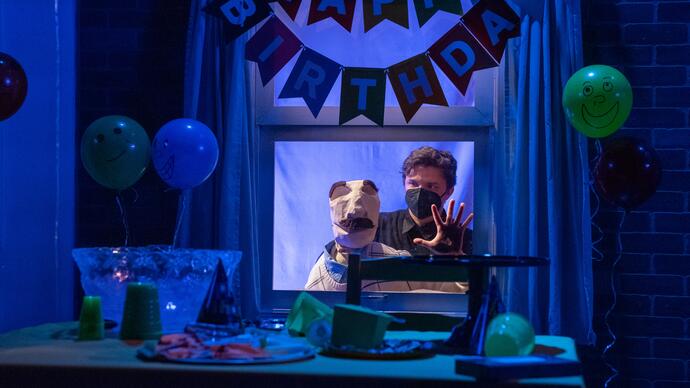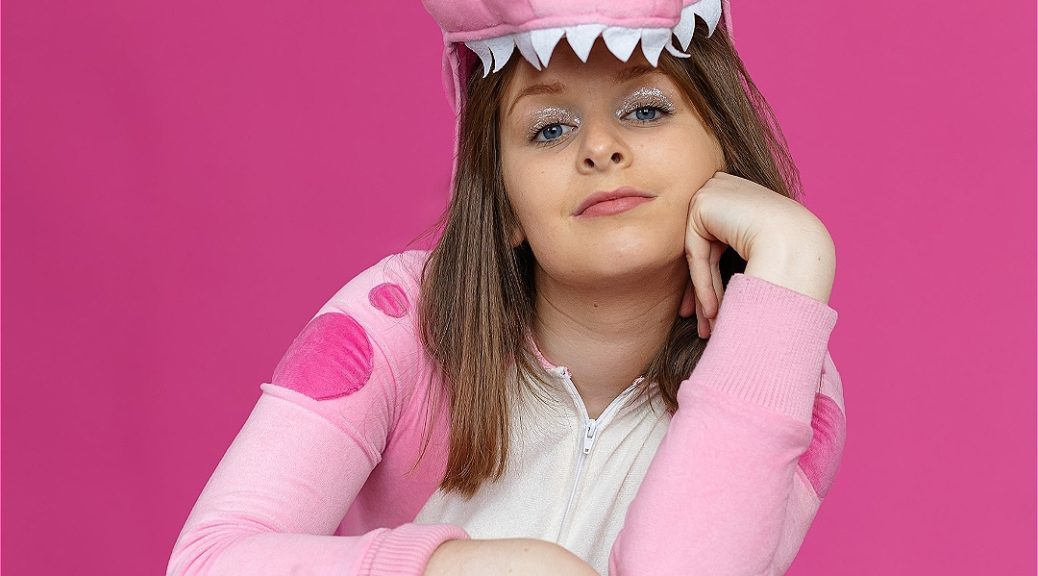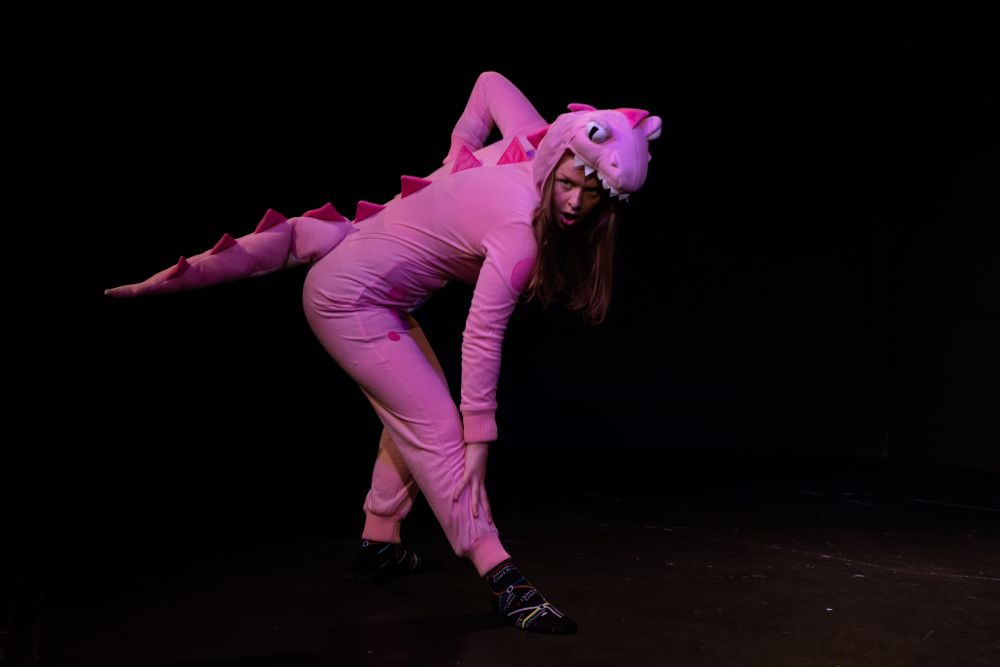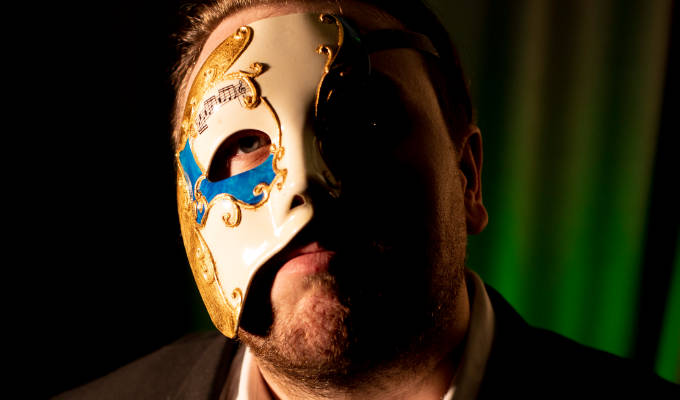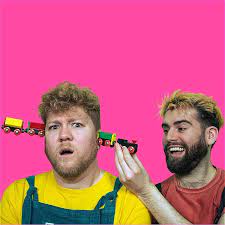
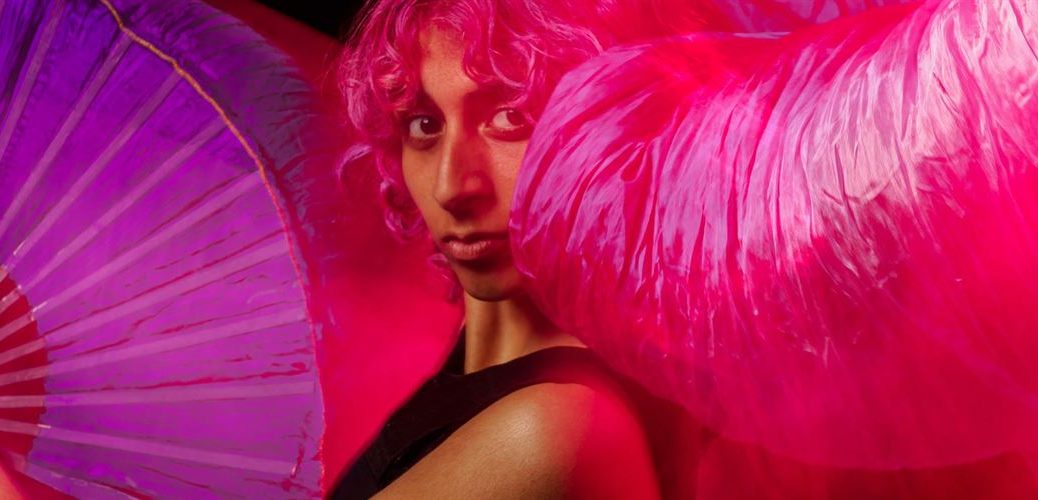

Have you ever thought of how hetero-normative nature documentaries are. No? Bi-Curious George has, and they are here to shake the natural world.
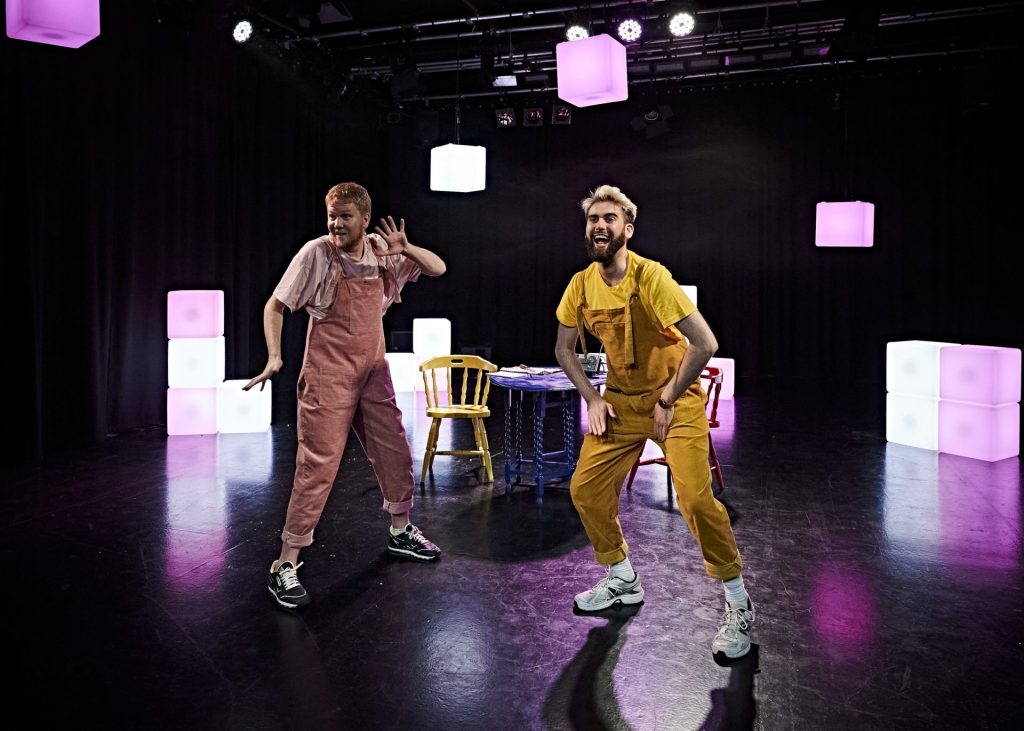
This is a Drag King, Cabaret show like no other. Comedic, yet informative, this is a live, stage documentary with song, dance, comedy and a whole heap of camp. Think of a Queer David Attenborough meets Steve Irwin. Then triple it and add some comedy and sparkle.
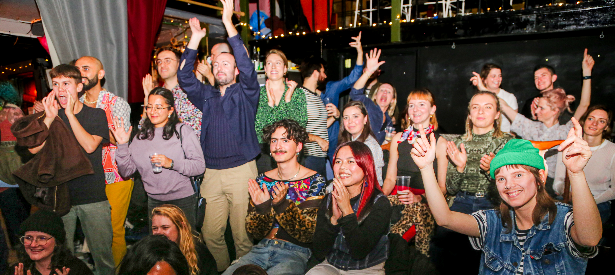
George is a natural on stage. A performance of sheer perfection, we all felt as if we were their friend, as they interacted with us one by one, whether that is by audience interaction or just general eye contact. There are a many people in a room but we are all welcomed. They also made sure that everyone was comfortable – usually audience interaction is something forced upon participants, but George begins by ensuring we are comfortable at the door and then early on, giving us a signal just in case. This is a safe room and that is brilliant to impose upon within a production without taking away its essence or interrupting the discourse.
George brings us a range of factual stories of real animals, real queer relationships, intercourse, courtship and unions. But this is enhanced with songs that have been changed to fit queer narratives, with effective and, in themselves, comedic costumes and guests. The guests themselves are excellent – a singing shrimp, a almost mute magician making balloon animals from plastic bags (trust me when I say, it is something to behold, as this act was of pure genius) which add different levels and elements to the overall production, adding in the cabaret element, with George as our compere.
Queer Planet is probably one of the most genius ideas for a production I have ever seen. It is so excellently executed, with perfection as a performance, informative as a piece of education, yet at the same time, creating a easy safe and welcoming space for all with comedy, pizzazz and genius yet ridiculous concepts and costumes.
I think most people have heard of the famous Emperor of Caligula; a fierce ruler, with many a famous story about him, like any infamous Roman Emperor. Roman tales are rarely of happy exploits and kindness. And this has not stopped here.
Caligula and the Sea is a growing of age tale of Caligula, from boyhood to ruling an empire. With this, growing through adolescence and adulthood, through turbulent relationships with the God of the sea and his closest companion and how easily power can destroy those innocent relationships.
The production itself has taken an interesting approach; dressed in 1920 – 1940’s garb, there are still elements of ancient Rome, with miniature columns in the garden to Roman armour, it brings a modernity to the story, yet harking back to its roots. However, it did seem a little out of place and there wasn’t much to tie this together with the overall production or story.
The scene they created, with the overbearing blue sheet representing the sea, using this for movement and puppetry was well done and it added to the imposition that Neptune has in the narrative. It was a centre piece to the production, always looming and always above Caligula. It was in itself a visual metaphor to his downfall after thinking he was more than of the immortal power.
Neptune was represented as the waves, as a warrior, as a woman, as puppetry creatures, and this was interesting and mesmerising in the work that went into the different physicality and puppetry skills. It added to the concept of Gods being able to shape shift upon the Earth, yet they were also never frightening. The was something trustworthy, echoing Caligula’s relationship with the God.
The main performers of Caligula and Chaerea had a natural magnetism to one another; bouncing off each other as friends, as brothers, as lovers. In the blink of an eye we see their entire relationship as it evolves and the moments that it goes all too wrong. The heartbreak and turmoil – it becomes evident in Chaerea’s performance and you want only to reach out and support him.
Caligula and the Sea is a unique telling of the story of Caligula’s life and has many theatrical elements to enhance this summary of his rise and fall. It only felt a slight disconnect in the over all aesthetic and felt it would either benefit from completely immersing in one era or the other.
Based in the USA, Someone of Significance features the story of two people who fall in love against the obstacles of life, careers, of each other. The two couldn’t be more different and were it not for a chance encounter, Rosie, a black, left, working class woman and Brad, a white, CEO of a property corporation, would never have met. They have similarities, they have differences, but over a lifetime, their love continues.
For a two person play, the production values are minimal, and this is all that is needed. Props and staging that is changed upon the stage and in front of our eyes, while under the guise of a dimmed light, help to set the scene. Often based in rooms alone, this adds to the secrecy of their union and career, with its limited furniture and lack of distractions.
Each performer has their own corner with a range of clothing and accessories which they change into intermittently for each scene. Unless it is a drastic change, this often seemed unnecessary to the scene and often overlooked. When they changed something to showcase the passage of time, this is obvious and helps to bring the idea of time to the story line. Sometimes, it only felt like a reason for a break during the production, which could have been utilised differently.
The performers themselves were very good. With clear skill and a good approach to naturalism, they were convincing enough as their two characters. They interacted well and bounced off one another but I found it hard to feel this budding love that they were meant to share. Perhaps it was their limitation of stage and direction; often they stood in the same place, facing the audience but there was little movement around the stage to give levels and something with more action. Yes, there was the occasional sitting or a moment when Brad is involved in yoga, but it often felt as if there were invisible X marks the spot for each scene, and it was always the same spot.
Someone of Significance has a great narrative and intention, with good performers who understood their assignment. But it missed something special to believe in the true connection of these characters and left the performers at the will of direction, creating a limitation on the movement on stage.
What was your original inspiration behind the Rocky Horror Show?
Someone asked me to entertain the Christmas staff party at the EMI Film Studios and so I wrote a song (Science Fiction Double Feature) and with the help of some jokes, performed to much laughter and applause.
In the New Year I wondered whether it might serve as as prologue to the germ of an idea that I had for a musical. I shared that thought with Jim Sharman who had directed Jesus Christ Superstar. Jim liked the concept and away we went.
Why do you think it is still successful today, half a century later?
It is simply a Musical Comedy and as long as it rocks, and the audience are laughing what more could you wish for?
It’s very inclusive, it’s very easy to watch. It’s not rocket science as far as narrative is concerned – Brad and Janet are a couple that we kind of recognise as Adam and Eve or Romeo and Juliet, like a stereotypical couple – we can all relate to them.
It is also a fairy tale which allows us to feel comfortable with its rites of passage storyline. A retelling of Hansel and Gretel if you like, with Frankfurter standing in for the wicked witch.
Richard O’Brien
The Rocky Horror Show creates an atmosphere that is different from other theatre shows.What about the show do you believe makes audiences feel comfortable joining in?
The innocent rather naughty fun of it draws not only a ‘theatre’ crowd but also people who want a fun evening and a guaranteed return on the investment of their ticket price.
What was happening in your life at the time you wrote The Rocky Horror Show?
I was a recent father of my first child and out of work when I wrote the show. 1972-73 was a moment of change. Glamrock and overt sexuality was around, gay people were coming out and there was a ‘buzz’ in the air. There are certain parts of the world where we are a little bit more free to be ourselves. London is certainly one of them. Back in the Seventies you had gay bars, but now you don’t need to because if you walk into most bars in London there will be a gay man behind the bar. That is rather nice.
The Rocky Horror Picture Show (1975)
How do you believe the show supports those who are questioning their identity or sexuality?
The support for the LBGT community was unintended but it is a very welcome addition to the laughter and toe tapping.
Has the show supported your own journey surrounding your identity?
It must have been, to some extent, cathartic but I have always gone my own way and played the cards that I was dealt at birth the best way that I can.
Do you have a favourite character?
I would have loved to have played Rocky, that would have been cool, wouldn’t it? But one thing is essential, you have to be rather handsome, and you know, muscular, and that ain’t going to work. I could have played Janet. They’re all so stupidly wonderful these characters, they’re iconographic.
How do you think the live shows compare to the film?
The live show has an energy that the movie doesn’t have – it wasn’t intentional, but the film was very slow. Once some fans came up to me and said, “did you leave the gaps between the lines so that we the audience could say our lines?”. I said, “Well, ok yes”. But no we didn’t. The movie is a very surreal, almost dreamlike journey, the live show is far more rock and roll.
From the 2022 tour of The Rocky Horror Show
What’s your favourite part of the show?
The noise at the end of Rocky is wonderful – it is empowering and exhilarating at the same time it is quite joyous. Rocky never fails to deliver. Each performance lifts the heart and the nightly laughter and roars of approval leave the whole cast with a sense of wellbeing and accomplishment that you rarely get from any other shows.
The Rocky Horror Show remains a huge hit around the world. Do you think the show would be as successful if written today?
Timing is very important as is luck. Zeitgeist sums it up. There are lots of variables in this equation, for instance, would it have been as successful if someone other than Tim Curry had played the lead?
How has the show developed over time? Have there been any adaptations in the past 50 years?
It has remained much the same through the years. If it ain’t broke don’t fix it.
How different do you think your life might have been without Rocky?
I have no idea but, I would have had a good life because I am made that way. My journey has been a different one than others. I guess some people have a game plan. I would imagine they’re rather humourless. Most of us get an opportunity and we wing it. Luck plays an awfully big part in our lives. You should never underestimate that. I am the luckiest person on the planet. I shall be happy as long as I can keep singing.
The Rocky Horror Show is currently touring the UK as part of its 50th anniversary. It plays in Cardiff’s New Theatre in April – more information and how to book tickets here.
The Sherman Theatre turns 50 this year, and there’s no better way to celebrate than with the golden line-up they have planned for their anniversary: Gary Owen’s much-anticipated Romeo & Julie, Nia Morais’ magical Imrie – and the Sherman Youth Theatre’s Ghost Cities. It’s a new take on Gary Owen’s 2004 drama Ghost City, directed by Justin Teddy Cliffe and incorporating new material by the Sherman’s Introduction to Playwrighting Participants Mared Seeley, Loki Skyrme-Croft, Lauren Hindmarsh and Emma Phelps.
The cast of Ghost Cities. Image credit: Chris Lloyd
Set in Cardiff over a single night, Ghost Cities follows the capital’s lonely souls in a series of interconnected vignettes. There is little to link them directly, save a postcode and a prayer: a universal yearning for connection, understanding, and empathy. I haven’t seen the original play, but there seems to be a nice synergy between the original and its additions. You might be able to spot some of the new material, but it synthesises well with Owen’s text into a cohesive and rewarding whole. And while not every story carries the same sway (some seem as weightless as ghosts), others linger like spectres – largely due to the skill and enthusiasm of its cast and creative team.
The cast of Ghost Cities. Image credit: Chris Lloyd
Designer Ruby Brown (supported by The Fenton Arts Trust) and lighting director Rachel Mortimer have worked wonders with the set. Fragments of what’s happening onstage are projected onto an imposing pyramid, distorted and partial; casting doubt on whether what we’re seeing is what’s really happening. At one point, the pyramid becomes the inner core of a Matrix-like computer algorithm; at another, the live feed of an increasingly sinister political broadcast. These are just some of the many striking images that make the play gripping: a hooded stranger leaning against a door, a phone line stretched across the void, a eulogy illumined by a single beam of light as if from heaven.
The cast of Ghost Cities. Image credit: Chris Lloyd
After The It in 2020 and Treasure Island last year, this is the third Sherman Youth Theatre production I’ve had the privilege to attend – and it’s incredible to see such talented young actors continue to grow in their skill and their craft. They navigate brilliantly through drama, comedy, and even tinges of horror, creating a very specific world for the stories to inhabit: the standouts for me were a teacher explaining her gender transition to a previously scornful student, a hilarious night out at Walkabout that ends in both hope and disaster, and a Deliveroo rider philosophising on the meaning of life. All the while, a disenfranchised young man haunts the stage, very much alive and very much at our elbow – we, and the characters, may just overlook him at our own risk.
The cast of Ghost Cities. Image credit: Chris Lloyd
Ghost Cities is a celebration of Cardiff in its hidden corners. It begins with a single voice and ends with many: in doing so, it seems to say that a city is a living thing, and we are its lifeblood: our lives, our stories, the connections we make and the ones we might miss.
Ghost Cities is performed by Rashid Ali, Lily Cole, Rhys Evans, Theo Greenwood, Daisy Griffiths, Twm Llwyd, Edith McCarron, Maya McDarren, Orrin Niziblian, Pringles North, Elian Owen, Jim Pesticcio, Lucia Taher, Brooke Thomas, Nia Thomas, Rory Tune, Indigo Wernick, and Jett Wood.
Ghost Cities is performing between 2 – 4 March at the Sherman Theatre. More information and how to book tickets here. Tonight’s production is a double bill with the Youth Theatre’s ‘Chaos’.
The cast of Ghost Cities. Image credit: Chris Lloyd
Based on the best-selling novel Pigeon by author Alys Conran, this stage adaptation by Bethan Marlow sees Welsh and English subtly woven together, with every performance using integrated captioning in such a creative way as to lead me to undertake an experimental review in its honour:
A review of the new digital play, exploring where film and theatre meet, follows two teenagers, one a drug runner and the other the daughter of an addict, as they navigate a dangerous adult world.
Do cats tan? Could you bring me out a blanket?
Tom Powell, The Silence and The Noise, film.
This Be The Verse
BY PHILIP LARKIN
They fuck you up, your mum and dad.
They may not mean to, but they do.
They fill you with the faults they had
And add some extra, just for you.
But they were fucked up in their turn
By fools in old-style hats and coats,
Who half the time were soppy-stern
And half at one another’s throats.
Man hands on misery to man.
It deepens like a coastal shelf.
Get out as early as you can,
And don’t have any kids yourself.
‘’There are 8 reasons why teenagers take drugs: other people, misinformation, popular media, escape and self medication, boredom, rebellion, instant gratification, lack of confidence.’’
Two teenagers ‘both alike in dignity’, acting out the roles they think they should be playing and railing against the tiny crooked worlds they inhabit on instinct and experience unbalanced and afraid.
Daize and Ant , star crossed indeed and lost in an adult place where parenting and drugs are failing them and where hope and stability come from each other.
This Shakespearean duologue creeps under the skin like a needle. It is a slippery painful rush of child and adult feeling its way through the awkward brilliance of its performers. Exceptional and tragic, closed and candid, ‘you’re not a laugh a minute you know’.
I am reminded of being a lay member on the local restorative justice panel and wishing I could magic better lives for the young people we met. These teenagers couldn’t just say No, their worlds were governed differently. Victims of circumstance. I think of them often and wonder what we should do differently as we are the village raising the child and we have a combined responsibility.
Powell forces me to return to the debates in my head – where does responsibility lie and what does it look like? Is Ant so upset by his mother’s infidelity that he looks to make money in the easiest and quickest way (sic), justifying his decisions within a dubious moral framework? How does his complicated and dangerous choice compare to Daize’s addicted and failing mother which leaves her daughter to defend herself with a knife and eat cat food? No one should have to eat cat food. It is an axis on which the play turns.
It is all relative. It is not what happens but how we deal with it. This film schleps through nature and nurture and their consequences on transitional minds.
The story telling is adept – our actors are acting out teenagers acting as adults and breaking into juvenility. It is the most powerful and upsetting screenplay. Like those young people all those years ago in the justice system, I want to take them home and protect them, restore their innocence in some naïve and offensive way. That is how convincing they are.
But Ant takes Daize home and the bravado and the arguments become a search for the relative peace of a family set up, leaving death and chaos behind them. Perhaps this Romeo and Juliet get a happier ending.
Just over a year ago, I attended The Da Vinci Codeat Theatr Clwyd. Although I enjoyed this production, I felt that the book simply didn’t translate well to the stage, mainly due to the amount of detail included in the plot which there just wasn’t time to delve into in two hours. However, the same certainly cannot be said of The Shawshank Redemption.
Based on Stephen King’s 1982 novella Rita Hayworth and the Shawshank Redemption, this production examines topics from injustice to friendship and most notably, hope, in a place where the word ‘hope’ seems impossible: Shawshank Maximum Security Penitentiary. The 1994 movie starred Tim Robbins and Morgan Freeman and was nominated for seven Academy Awards. Among the movie’s fans were stand-up comedians Dave Johns and Owen O’Neill who realised the potential for Shawshank as a theatre production. The Gaiety Theatre in Dublin, where this current tour will end, agreed, and an adaptation of the original novella was first produced there in 2009. It then transferred to London and the adaptation was rewritten and put on in Edinburgh in 2013, with its adapters co-starring alongside Omid Djalili as Red.
For those not familiar with The Shawshank Redemption– it tells the story of Andy Dufresne who, despite claiming to be innocent, is given a double life sentence for the brutal murder of his wife and her lover. Incarcerated at the notorious Shawshank facility, Andy strikes up an unlikely friendship with the prison ‘fixer’, Red, and as their relationship strengthens, things seem to be looking up. However, when Warden Stammas decides to exploit Andy’s talents for accountancy, a desperate plan is hatched.
As the play begins, we are transported to the penitentiary. The set is simple but extremely effective with the prison walls surrounding the stage on both sides and upstage, allowing for a feeling of claustrophobia throughout. The main bulk of the set remains, but as the story unfolds, each scene is set within the walls: a postered wall and a bed for Andy’s cell, a desk, chair and wireless for the warden’s office, a long mess table and chairs for meal times. The transition between scenes is flawless, with the actors completing all set and prop movement seamlessly. Most scene transitions are also marked with a prison siren or alarm to signal a new location or place in time. The fluidity of the piece is extremely impressive, the action narrated by the character Red, portrayed perfectly by Ben Onwukwe. Red speaks directly to the audience, often regarding sensitive prison topics such as gambling, rape, corruption and so on, and he draws us in, allowing us to empathise not only with him, but with other inmates at Shawshank so we better understand life within the walls- we are allowed on a journey with each character over the course of the ‘twenty years’ we spend with them. And it’s not without a great sense of humour and plenty of comedic elements. Also noteworthy is
Red’s final monologue which he delivers as he completes a full costume change, reflective of his character’s change from despair to hope. A ‘changed’ man?
Joe Absolom’s Andy is the perfect mix of kind, compassionate, determined, if not a little arrogant in his own self-sufficient way. Absolom provides the character with just enough ‘crazy’ to have you questioning his every move. Consequently, even those familiar with the story begin to question the outcome! Credit must go to the lighting team- providing an appropriate atmosphere throughout. From the spotlights on the new ‘fresh’ inmates at the very beginning, to the effect provided for Andy’s fluttering butterfly at the end. Lighting is also used effectively to depict the men watching a Rita Hayworth movie, giving the impression that a projector is being used, as well as for scene transitions and instances of violence which are cleverly choreographed alongside appropriate light and dark moments.
Dave Johns and Owen O’Neill were certainly spot-on in believing that The Shawshank Redemption could work well in the medium of theatre. The prison setting makes for a fast paced, adjustable, well thought out production, which shifts from scene to scene effortlessly. With the addition of successful sound, lighting, costume and a fantastic cast, this is a must-see production.
The Shawshank Redemption continues its UK Tour on March 6th at the Belgrade Theatre in Coventry and finishes on May 13th at the Gaiety Theatre, Dublin. Head to the website to book your tickets:
We last chatted as part of the series that Get the Chance ran during the height of the Covid Pandemic in April 2020. During this period many Welsh or Wales based arts graduates were hugely impacted by the Pandemic. Their usual opportunities to meet agents, prepare for final year exhibitions or productions took place in later years or sadly not at all. To raise awareness of the diverse talent graduating during the year GTC offered any Welsh or Wales based graduate the opportunity to be showcased on our website.
So, I guess the big question is what impact did Covid have on your career?
Obviously with there not being any work during Covid, it was kind of a chance for me reflect on what I had learned through my education years and decide where I wanted to go when Covid eventually eased off. At the time, one thing that I wanted to take a step back from was theatrical acting and focus on more on acting for camera, as theatre was something I did so much in my education years. I found that taking that break from working and having time to focus on where I wanted to go, helped me come up with a plan. My plan was simple, get an agent and have more experience in acting for camera at a professional standard. I was very fortunate to get both of these achievements just as we were coming out of the last lockdown which worked out perfectly ready for me to get back out there as the industry started to open back up.
One of the biggest lessons I learned through Covid was maintaining a positive mindset, keeping yourself occupied (even if it’s not related to what you want to do) and not letting rejection get you down. A way I do this now is by having a full time job so that I always have a income coming in, so pressuring myself in getting specifically acting jobs doesn’t really concern me as I always have some kind of money available, so the stress of worrying about bills and car insurance isn’t present, but taking priority to the acting jobs as this is where I’m taking my career.
Did any positives come out of this period that has been helpful for your current work?
Definitely my representation. My agent at Vella Wozniak has been the best thing to happen to me in my professional work. They are constantly submitting me for jobs, having update meetings where we talk about future plans and all the positivity that comes with it. All of the clients have a group chat where we all help each other out with supporting each other, sharing information and just industry related help. Having the representation that I have just makes me feel better about my talent and capability in the industry and I’m very thankful for it.
I believe you are in preproduction for a new YouTube fan series based around Dr Who? With Russell T Davies returning to write for the series and a new Doctor and Assistant announced what changes do you think this might bring to the world of Dr Who?
David Tennant as The Doctor is what inspired me to be a actor in the first place. With Russell T Davies back and David Tennant it’s like my dream come true, especially because we’re getting 3 episodes with him and Catherine Tate back for the 60th anniversary! I have very high hopes when Ncuti Gatwa takes over fully next Christmas too. He’s such a talented actor who I’m sure will bring something unique and new to the role. I think the biggest changes we’ll see are going to be in the production values, going off Bad Wolfs previous production of His Dark Materials and the quality of that show. I’m also expecting there to be more spin off shows, obviously this is just my own prediction, but with the success of other projects like the MCU having its own cinematic universe, I think Doctor Who will go down that route which will make it at the forefront of mainstream television again.
What currently inspires you about the arts in the Wales?
I don’t think a lot of people realise how much there is going on in Wales, especially Cardiff in terms of the filmmaking and acting industry. You have the BBC, Bad Wolf Studios, Sex Education, Doctor Who, Casualty, The Millennium Centre, New Theatre, Chapter Arts Centre, extra work, filmmaking apprenticeships… The list goes on. There’s always been this idea that moving to London or studying in London is the way forward in acting but when you take a step back and look at what we have in Wales, You can actually see that everything you need is on your doorstep and it’s only growing bigger.
What was the last really great thing that you experienced that you would like to share with our readers?
It’s so hard to pick one experience. It’s got to be the support I’ve received from friends, family and my representation, Glynis and all of the team at Vella Wozniak. It’s been nothing but positivity all around and I consider myself very lucky to receive the support that I have. The plans that we have in coming this year fills me with nothing but excitement and I can’t wait to share the hard work we’ve put into it with everyone.
Thank you.
You can follow Lewis and find out more about his work at the links below.
Hi Chris, great to meet you, can you give our readers some background information on yourself please?
Shwmae! I am a writer. I was born in Abergavenny, raised in Ebbw Vale, and then Cwmbrân, and now living in Bridgend with my fiancé. I had a Welsh language education in Pontypool (and now I predominately identify as a Welsh language theatre maker). I studied my BA in Drama at Aberystwyth University, and my MA in International Dramaturgy at the University of Amsterdam. I’ve been writing for theatre for about 10 years now, having had many fantastic opportunities to exercise and explore new work. I’ve been fortunate to work with Theatr Bara Caws, Theatr Genedlaethol Cymru, Theatr Iolo, Theatrau Sir Gar, National Theatre Wales, Dutch National Opera, Ensemble Modern, Cwmni Theatr Frân Wen and Cwmni Theatr Arad Goch. I’ve also worked in a pharmacy, as a teaching assistant and a drama club facilitator. It’s all relative!
So, what got you interested in the arts?
I have my parents to thank for that. Neither of them work in the arts, but they regularly took my sister and I to the theatre from a very young age. The stating point was likely seeing ‘Budgie the Little Helicopter’ at the New Theatre, Cardiff. They also took us to Kids Week in London (a brilliant initiative) during the summer, all the way up until we were 16. They always encouraged broad-mindedness in any art form we watched. We went to all sorts of theatre across the country, as well as the cinema, museums, art galleries, as well as the weekly movie nights we would have at home.
Why do you write?
I see the world in a very creative way. Ideas come to me all the time from all corners of life. Human behaviour and experience is theatrical. I have too many ideas. Writing is a method in which to make sense of things. News bulletins and anecdotes and shared-experiences and reading historical documents translate into creative artforms that I visualise. To me, everything has creative potential. I can’t always deal with things ‘just’ as they are, or as matter of fact. I like to imagine and interpret all the time, and ask – ‘why are things like that?’
Can you tell us about your writing process? Where do your ideas come from?
Anywhere. And new ideas usually catch you off-guard! There’s been many a situation where I have had to say: ‘Stop a minute, I have to write this down!’. From there, it’s usually many weeks of toying, thinking, contemplating, researching. If the idea disappears after 6 weeks, then I can’t love it that much to begin immediately. I don’t always start with ‘something to say’. That usually comes later. If I have an idea, and later on it begins to resonate with my own personal opinions, experiences or perspective on things (or challenges them) – and the idea sits with me long enough (I get bored quite easily too) – then I know I may have something. I also thrive on collaboration. I like to work with a director very early on to really uncover a play.
Can you describe your writing day? Do you have a process or a minimum word count?
I personally don’t think there’s such a thing as a writing day because, every time I sit down to ‘write’, I usually scroll on Twitter or stare blankly somewhere. You have to let the ideas come to you. Sometimes they come in chronologically, order sometimes in a random order. The ‘process’ is trusting that it is a process that requires time. I also think it’s healthy to have a different approach and process with each new play. Let the work dictate to you what it needs. I recently completed the first draft of a new play entirely by hand in a notebook because I wanted to try not writing any of it at home and to make the process more mobile. Now I have to find time to type it up . . .
This spring you have two new Welsh Language productions on tour, Cariad yn Oes y Gin produced by Theatr Bara Caws which is described as “A dark comedy about the experiences of a young, bohemian and rebellious couple as they seek a new, adventurous life.” And Golygfeydd o’r Pla Du, a Theatrau Sir Gâr Production, supported by Theatr Genedlaethol Cymru which is described as “A mischievous, black (death) comedy about crisis and corruption, packed with scandal, songs, singing goats and horse sh*t. Welcome to the Black Death – there’s nothing funnier.”
There is clearly a theme of dark comedy in your work! What inspired both productions and what are your ambitions for the tours?
‘Cariad yn Oes y Gin’ was inspired by asking how something so destructive, like gin, was discovered for the first time. I was interested in how, in 1736, it affected people on a societal level, and how a bridge once build between the lower and upper classes was suddenly eradicated because of gentrification. I also wanted to see it through the lens of a young, care-free (and rather naive couple) who get a big slice of reality when paving their own way through life.
Mali O’Donnell and Sion Emyr in ‘Cariad yn Oes y Gin’ – Kristina Banholzer
I’ve thought a lot about the nature of love and relationships over the past couple of years, and how one must adapt and, sometimes, compromise in a true relationship, whilst also holding on to their very true selves. Gin, a new and destructive drink in society, becomes a symbol of freedom and power for this young, rabble-rousing couple.
‘Golygfeydd o’r Pla Du’ R&D – Ray’s Photographs
‘Golygfeydd o’r Pla Du’ began life as wanting to be popcorn-theatre for Welsh language audiences in the vain of some of my heroes: Mel Brooks, Monty Python and The League of Gentleman. It’s written for 4 actors sharing around 35 characters. It’s fast, it’s polymathic and outrageous. Of course, like all theatre work, it quickly evolved into something more than just a satirical comedy, and I began to see how crisis, such as a pandemic, brings out the true nature of people. It seems there are many out there who benefited from the COVID-19 pandemic, and the play aims to make an acknowledgment of that through satire.
Both productions take place in an historical context. Do you think the plays period and themes will resonate with contemporary audiences?
I think so. I find it easier to contemplate what is going around us in the present through a historical lens. There’s a sense that enough time has settled for us to learn from history and to see things exactly as they are through the ‘then’. The ‘Gin Craze’ saw many people’s freedoms being curbed, not just on the basis that the drink was doing so much harm to people, but the working classes were entirely to blame for the increase in violence. You’d be surprised at how much corruption and scandal became evident as a result of the Black Death. People began to see the cracks in their leadership and in the feudal system. The ‘Peasant’s Revolt’ came shortly after that. It wasn’t all ‘Partygate’ or how much of public funding was spent on a private jet flight of 30 minutes, but the gesture of abuses of power was very much the same. Through history, we see lessons that have never been learnt.
There are a range of organisations supporting Wales based writers. I wonder if you feel the current support network and career opportunities feel ‘healthy’ to you? Is it possible to sustain a career as a writer in Wales and if not, what would help?
Yes, it certainly feels healthy. I was very fortunate to be invited to a few of those schemes myself (particularly the Sherman Theatre’s schemes in 2016 – 2018 curated by Philip and Christine Carne, Brad Birch, Gethin Evans and David Mercatali). My worry is that there still aren’t schemes to commit to writers long-term – to take risks. Theatr Bara Caws, Theatrau Sir Gar, Theatr Iolo, Blackwood Miners Institute . . . they’ve all taken a risk on me by following through. It takes time, but I don’t know a single aspiring/emerging writer who wouldn’t want to take that time if it meant the end-goal was getting their work seen and discussed by a paying audience.
Is it sustainable being a writer? No, not really. But I recommend training and taking work in other aspects of the arts, if possible: box office, outreach, education, administration, technical . . . whatever. It all feeds into your understanding of the working mechanism that makes up an arts organisation and gives you a greater appreciation of it. However, never work for free.
If you were able to fund an area of the arts what would this be and why?
Access. It’s a financial barrier for many companies, and the costs are increasing for everything. A ‘Dream Scheme’ would be to see core arts organisations given additional resources and funding to ensure that all aspects of access can be addressed: in-house software for captioning, cheaper/free hire of captioning software (Theatr Gen’s access app Sibrwd is super-easy, for example)
https://youtu.be/mc-LV1crMVc
More funding to ensure BSL interpreters/Audio describers are given more performances and more preparation time, access costs being subsidies by larger funding bodies (but not necessarily included in core production budgets) and that wide-spread training is free, accessible and continuous.
What currently inspires you about the arts in Wales?
An identity that has shifted from that of coal miners and choirs and drowned villages to telling the real, contemporary stories of the diverse people of Wales. Also, our awakened sense of nationhood sat in the context of the British Empire. I’ve seen a lot of Welsh language work in the past few years that touches on this in an exciting way. To put all that into context, I went to see ‘The Corn is Green’ by Emlyn Williams at the National Theatre last year. Without going on about it, there’s a reason why that play ISN’T being performed in Wales and HASN’T for a very long time.
What was the last really great thing that you experienced that you would like to share with our readers?
Oh, I went to see Damien Chazelle’s new film ‘Babylon’ recently!
https://youtu.be/5muQK7CuFtY
In it, I saw two of my favourite films slammed together in an orgiastic, unapologetic party: ‘Singin’ in the Rain’ meeting ‘The Wolf of Wall Street’. It actually made me think a little about ‘Cariad yn Oes y Gin’ (I love it when that happens – you’re nervous about an idea you’ve thought of, and then see someone else execute it in a different context, making you confident that your idea will work!). For all the drug-fuelled, addicted splendour that ‘Wolf’ and ‘Babylon’ brought, the party has to die down eventually, because people get hurt. That’s what we see in Dylan and Nansi’s journey in ‘Gin’.
Thanks for your time
Croeso, wir!
Creating opportunities for a diverse range of people to experience and respond to sport, arts, culture and live events. / Lleisiau amrywiol o Gymru yn ymateb i'r celfyddydau a digwyddiadau byw