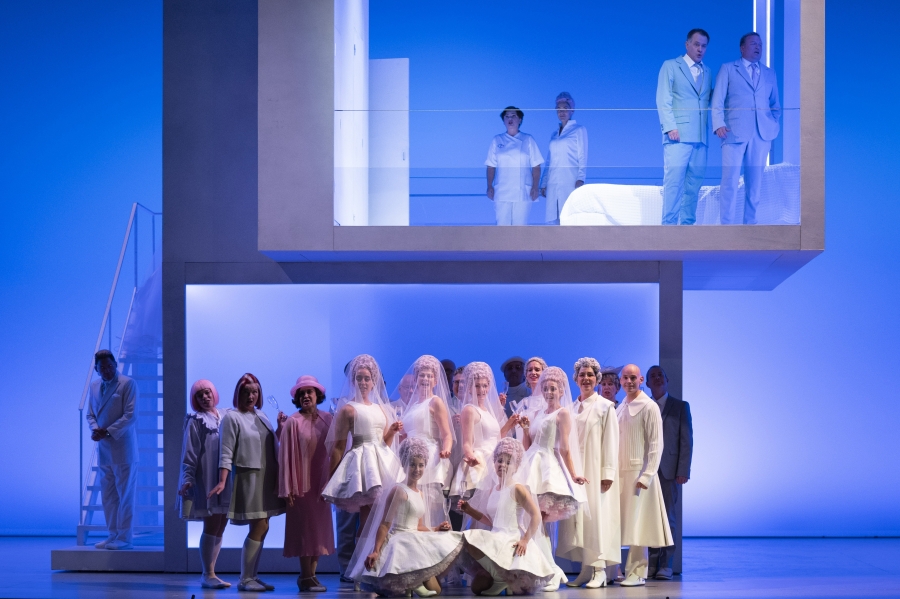
WNO Madam Butterfly – photo credit Richard Hubert Smith (4 / 5)
Under the direction of Lindy Hume, the Welsh National Opera’s Madam Butterfly is set in an imaginary dystopic future to convey the cruelty of imperialism. The opera is no longer set in Japan but in an exotic oasis for the pleasure of wealthy American men. It reminded me of the 1964 Russian propaganda film I Am Cuba by Mikhail Kalatozov. In the film, Cuba is the seductive playground of rich Americans, a country turned prostitute by Batista. Although too propagandistic in narrative, the unorthodox cinematography of I Am Cuba, with its extreme wide-angles and complex tracking-shots, made the film unsettling and powerful. Alas, Lindy Hume’s anti-colonial vision for Madam Butterfly loses force by decontextualising the drama.
The opera begins with women in white short tulle dresses and tall pink wigs. Among them is Cio-cio-sa/Butterfly, who is to wed American soldier Pinkerton. The action takes place in and around a two-storey rotating white cube. Hume sought to emphasise the exploitation of Butterfly who is sold as trophy bride and quickly discarded. Butterfly is a victim of a misogynistic colonial society. Yet, by erasing Japan from Madam Butterfly, the colonial othering of Cio-cio-sa is lost. Relationships of power are all dependent on context. They cannot be abstracted. Cio-cio-san is the trophy bride because she is a Japanese young girl to be collected like a colourful butterfly.
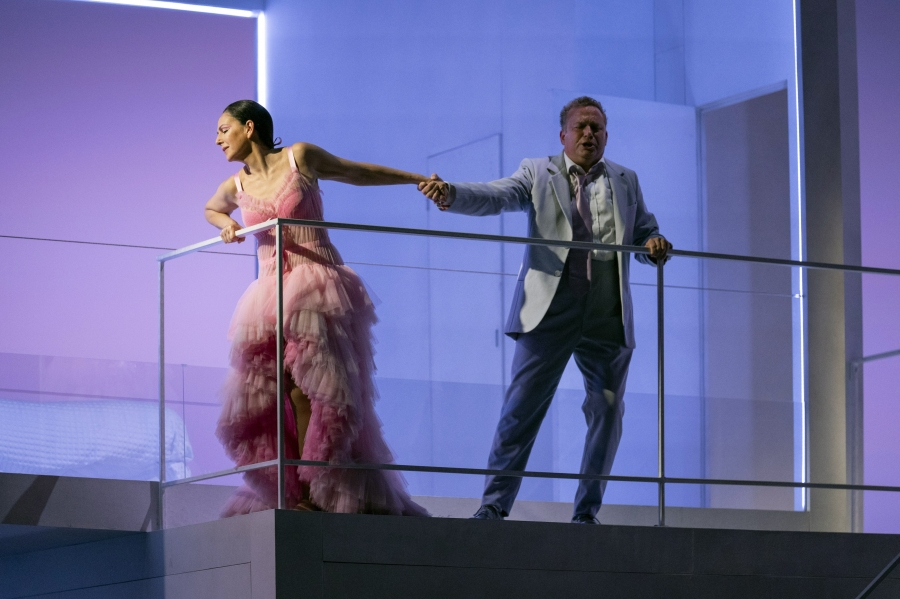
WNO Madam Butterfly Alexia Voulgaridou Cio Cio San Peter Auty Pinkerton photo credit Richard Hubert Smith
In addition, there is a lot more to Cio-cio-san than Hume’s direction implies. She is here painted as a victim, disregarding how 15-year-old Cio-cio-san, notwithstanding being still a child, escapes her family and clan. She goes against her home society to affirm her own will. She stays loyal to her American husband and to his country to the very end. The tragedy lies in the fact that she finds her downfall in her loyalty and shame. Alexia Voulgaridou gives a rounded performance making one forget the awkward futuristic setting designed by Isabella Bywater.
Voulgaridou gives an impeccable performance as Cio-cio-san. Her voice is powerful and agile; it develops in intensity as the tragedy unfolds. Her interpretation is subtle and convincing. Kezia Bienek, as Suzuki, is also noteworthy. She conveys the melancholy of her role as Cio-cio-san’s sister perfectly. Together, Voulgaridou and Bienek deliver a beautiful duet full of warmth.
Julian Boyce as Imperial Commissioner and Tom Randle as Goro give solid and sophisticated performances, less impressive is Peter Auty’s Pinkerton. Excellent is the orchestra conducted with fervour and depth by Carlo Rizzi. The impressive performances, the orchestra, and Puccini’s music make one forget the contrived setting.
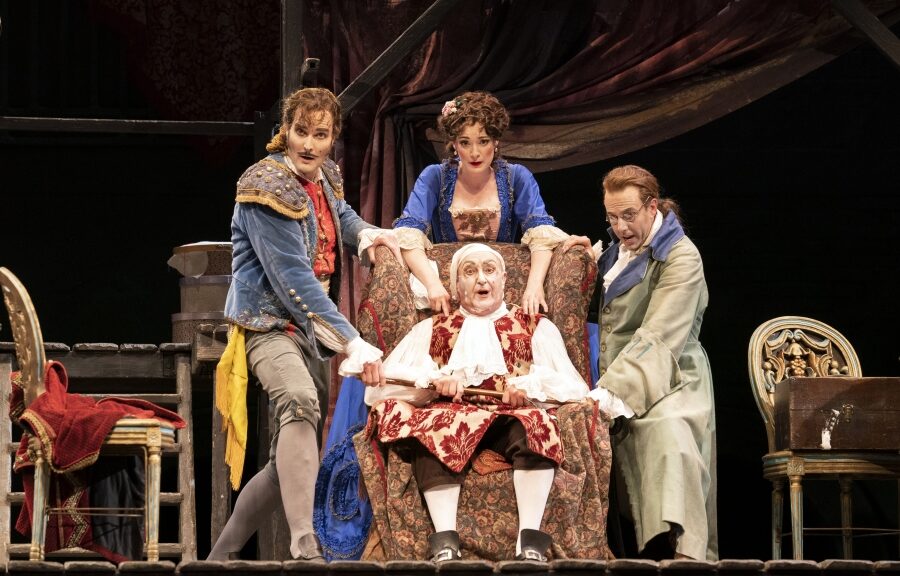
WNO The Barber of Seville Cast of The Barber of Seville photo credit Richard Hubert Smith
(2.5 / 5)
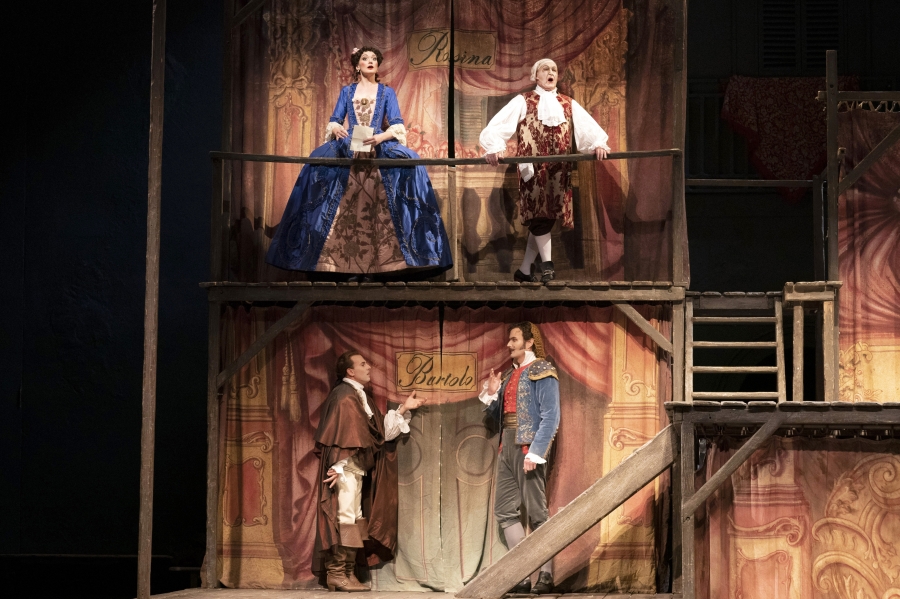
After the long 18-month pause due to the pandemic, the Welsh National Opera comes back with a Barber of Seville that is plagued by odd production choices but ultimately rescued by some strong performances. The WNO rehashes Giles Havergal’s 35-year-old production that has all the action confined into a small compact set to give the impression of a travelling theatre company. The elements of meta-theatre, actors congratulating each other and the ‘special effects’ of wind and thunder performed on stage, are a little too trite. The faded colours and claustrophobic nature of the two-floor set do a disservice to the brilliance and energy of Rossini’s masterpiece. The confined space also impedes the movement of the performers significantly.
Sung in English, the Barber loses its spirit and kick. Nicholas Lester, as Figaro, was disappointing and uncomfortable with a truly awkward English translation by Robert David Macdonald. Nico Darmanin’s Almaviva was also unimpressive. This struggling Barber was rescued by Heather Lowe’s Rosina and Andrew Shore as Dr Bartolo, both giving excellent and funny performances. Heather Lowe’s coloratura mezzo soprano is agile and strong. She delivers with confidence a rounded performance. Keel Watson also gave a strong performance as Don Basilio.
The irrepressible fun and joy of Rossini’s Barber is here constrained. Some strong performances breathe life into the WNO’s Barber and give the audience a pleasant but unsatisfying welcome back to theatre.
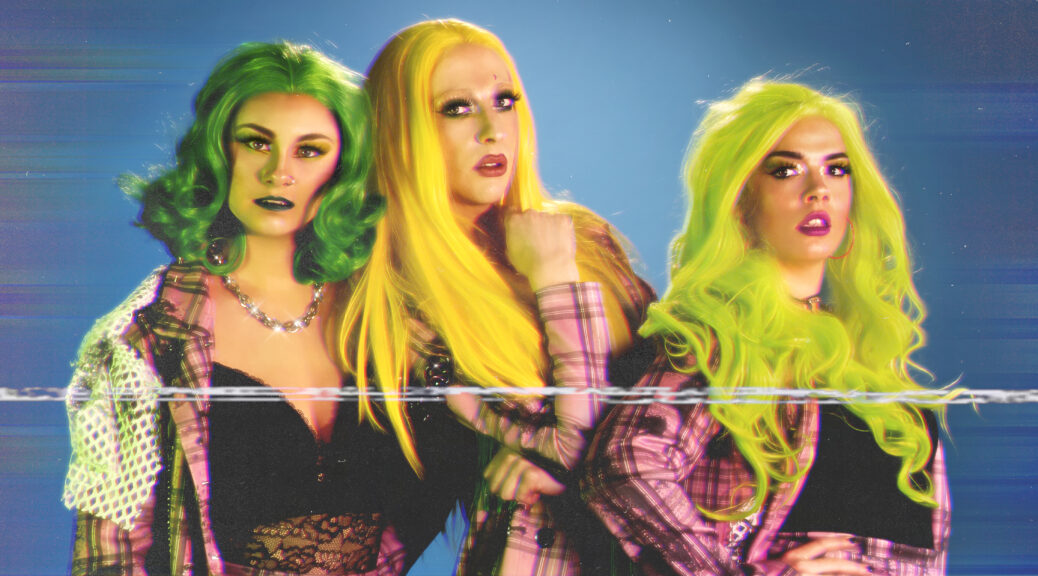
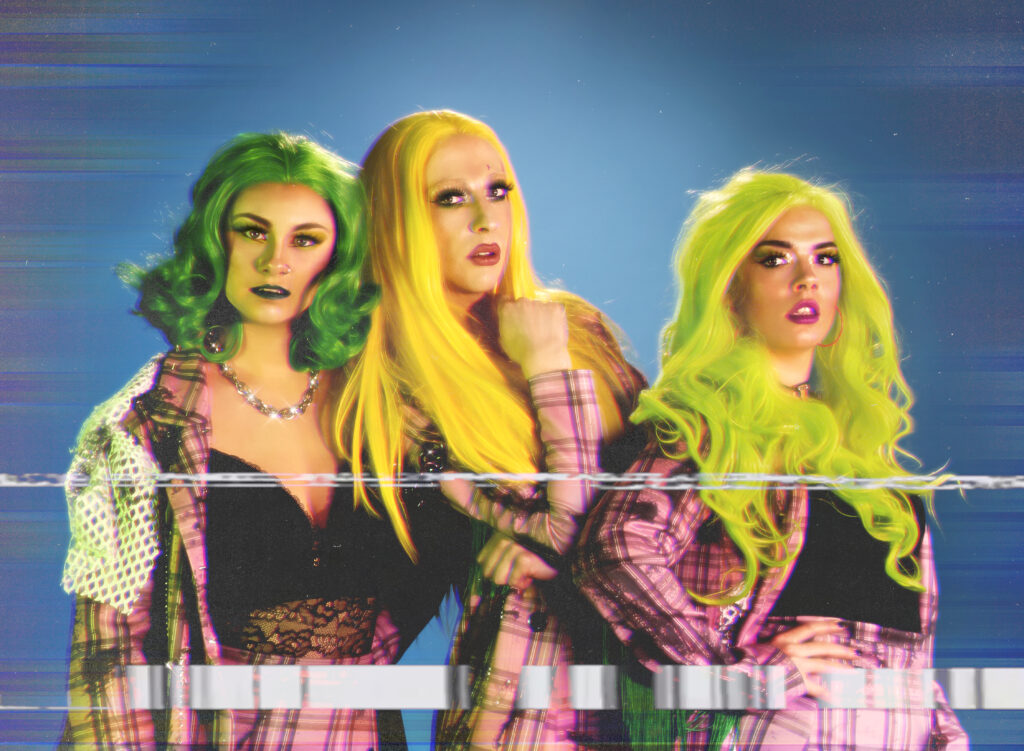
Get ready for a good night out in your living room with Boogie On Up, a series of digital drag performances by Bonnie & the Bonnettes. The exuberant musical trio, made of Hattie Eason, Cameron Sharp, and Rebecca Glendenning, wants to inject fun into our lockdown lives with sequins-embroidered masks and a repertoire full of classic hits, feel-good ‘gay anthems’, some rock, some pop, and a new song by Newcastle-based artist MXYM.
Last year, Bonnie & the Bonnettes succeeded in fusing moving theatre with comedy and music with And She (see review). The pandemic made them want to go back to drag, which they did when they started off, and give the audience a “cracking night out,” as Hattie put it.
Rebecca said: “We wanted to offer our audience something to keep them going and give them a similar feeling to that of when they come to see us live.”
The performances are geared to make people sing and dance in their homes. That’s why the trio went back to their origin of drag performance.
Cameron said: “Drag is something we’ve always done and that we always like to do. I think that’s what people need right now, some relief from tension.” Hattie adds that she was feeling a little nostalgic about being in a theatre and “the rush of excitement, which the audience also feels. It’s the feel of a goodnight out.”
Cameron also tells me: “For us it’s important to give people that sense of community and togetherness. Drag comes from the Queer community. That community now with lockdown can’t happen. So this is our little way of making that community visible and present in people’s lives.”
Hattie said: it’s a way for us to reach people through the universal language of music. I remember a lady coming to me after a show and telling me of an amazing and euphoric night out of when she was a teenager. That’s why we have included 1980s songs. I’d like the songs to bring back great memories for people.’
Rebecca said: ‘in our drag performance we can go places that we might not get to otherwise. We can do some hilarious comedy that it’s just there to make people laugh. You can do it at a very high standard. The whole point is to have an absolute scream!’
Without the energy of a live audience, Rebecca, Hattie, and Cameron encouraged one another during recording and fill the performance with so much energy to get across to the audience. They’d like to see people dancing and singing and posting their videos online with the hashtag #boogieonup
Boogie On Up is in association with Northern Stage and Live Theatre in Newcastle. The eight videos were made by TJMov. The original song is by Newcastle-based songwriter MXYM.
The Coronavirus pandemic has pushed artists to make online videos. This has too often resulted on mediocre videos of a dance or theatre piece, forgetting that film has different rules. With Draw From Within,Rambert were careful to avoid this mistake by commissioning choreographer and filmmaker Wim Vandekeybus. The camera movements are integral part of the show. Yet, Draw From Within fails to draw the audience in because, ironically, not enough attention has been given to the needs of film-making. Rambert’s dancing is impeccable; the visual impact is non-existent.
The intro is perhaps the most cinematic part of the show. We see two dancers talking on top of a roof and then follow the flame of a match down the stairs. The show takes nearly thirty minutes to take off and it quickly lands nowhere. According to Vandekeybus, Draw From Within is about “threat but also about liberation, about death but also about birth.” He says he wanted to “go under the skin and draw upon our innate human qualities: the human heart beat that unites us, the arc of a human life, the blood which courses through our veins.” With no story, no dramatic visuals, and dreadful music, I doubt many viewers kept away from the allure of their phones.
I have no idea why Rambert chose to make the video of a real-time live-stream show instead of making a dance film, which would have given them more flexibility. It suggests a simplistic understanding of what is a really ‘live show’ (in person). A live show has intimacy and an energy flow between performers and audience. It is irreplaceable. Live TV conveys reality as it’s happening not intimacy. Film is a very different medium from the stage. It is a two-dimensional visual product that requires many elements to work together to draw the audience in. If you have no story, it’d better look good. Draw From Within looks boring.
The obsession with narrative found in film-making is due to the necessity of keeping people with you for hours. It is lazy and performance artists should not follow the rule-book of commercial film-making, yet they should study the rule-book anyway instead of dismissing films as not art. Covid-19 is disrupting the arts but it is also an opportunity to go beyond the fixed boundaries of theatre, dance, film, performance art, circus. The arts are in great need of innovation. This can only come when artists watch, listen, and reflect on other types of performance. Now is the time.
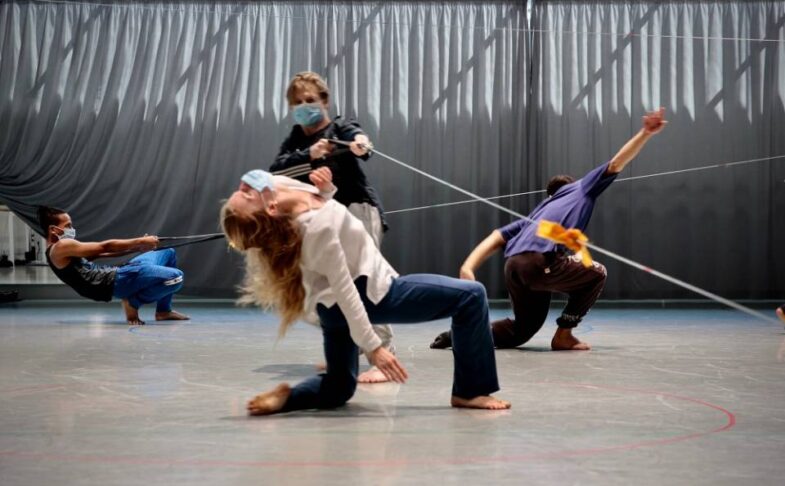
As the lockdown confined us into our homes, choreographers and performance artists began exploring how to do dance digitally. Choreographer Matteo Marfoglia decided instead to bring socially-distanced dance to people who were especially vulnerable: people in care homes and in hospitals.
The project, funded by the Arts Council Stabilisation Fund, is an adaptation of Matteo’s 2016 show Crossword, which was a co-production between National Dance Company Wales and Festival of Voice, uses dialogues as music. During lockdown Matteo kept trying to think of what he could still do without necessarily using video, as soon as it would be legal to do so. He says,
“A lot of arts was going towards the digitalised form. I couldn’t find myself in that world yet. I asked myself ‘What can I still do that makes me feel I can contribute something and which doesn’t necessarily need to go digital’?”
“I woke up at three in the morning and said ‘we can do that!’. There is no contact between dancers in Crossword. I began to think of what places might be in most need of art. I initially thought of hospitals and health settings.”
Crossword became an opportunity to bring dance to people who might be at a particularly vulnerable time in their lives, but also people who might have never seen contemporary dance. That included one of the residents in a care home, who was a 94-year-old ballerina in the Royal Ballet.
“She was a dancer in the Royal Ballet and her daughter was also a dancer in the Royal Ballet. She said, ‘I have never seen contemporary dance. I’m so glad I got to see contemporary dance.’.”
Matteo tells me that the music gathered people like an invisible smoke insinuating itself inside the hospital. He says,
“In hospitals, chefs from the kitchen and nurses were clasping a cup of tea on their break came to watch the show. They were watching it through the windows so there was no interaction. For residents in care homes, the show was also an opportunity to be outside and talk to someone they didn’t know, and watch something new to them. Some people had never seen contemporary dance.”
Matteo wondered how best to enter that world with dance and movement. He felt it was a little ‘naughty’ intrusion because people would normally expect the beautiful music and graceful movement of ballet. They got something very different: an emotional journey that goes beyond a story and uses words as music.
In Crossword, the music is made of dialogues in the Italian language. The show was first designed around the theme of voice, to be part of the Festival of Voice. Matteo wanted to explore how to turn dialogues into music.
“At that point I was interested in dialogues and how voices in dialogues can be music, not just as a song or needing an instrument. I worked a lot with Italian dialogues, taking fragments from different conversations. From that we created a soundtrack.”
“The dancers were all British so they didn’t understand what was going on and I didn’t tell them.
We really used it as music. We devised the show for them to respond physically and emotionally.”
The first reaction in most audiences was the search for meaning and some found it frustrating. He tells me,
“We always look for meaning in language for us to connect to it. How can we find a way to emotionally connect through a language that we don’t understand, through something that is not the meaning, so is it the tone? The speed in which people talk, which triggers an emotion?
“For me it was trying to connect both the performers and the audience to an emotional state which goes beyond the literal understanding of words, but more about how the words are being said.
“One of the residents said ‘once the journey started I forgot that that was language.’ Once they let go of meaning, it started to be sound. It became an emotional journey.”
Contemporary dance is still largely ‘different’ for most of us. It has no straight narrative, or no narrative at all. For many, it is like a foreign language. Crossword has been an opportunity to embrace that ‘foreignness’, a ‘foreignness’ that has multiple dimensions. Crossword made use of the ‘foreignness’ of Italian language to create music and movement; it drew on the ‘foreignness’ of contemporary dance and music made of dialogues to bring the audience through an emotional journey; and it took contemporary dance to a foreign land, that of hospitals and care homes, who have been at the centre of the pandemic and where, perhaps more than anywhere else, body and mind need healing.
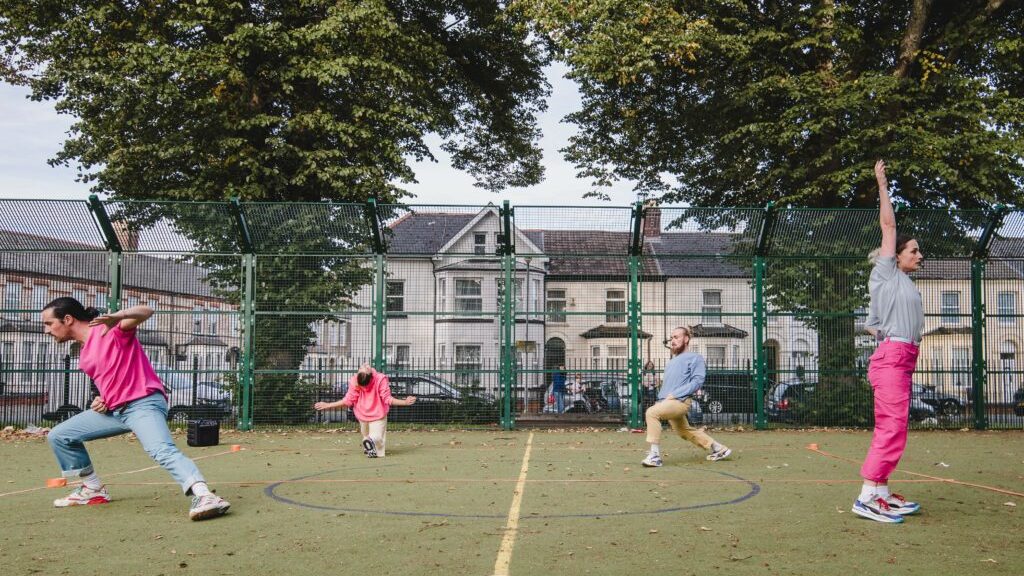
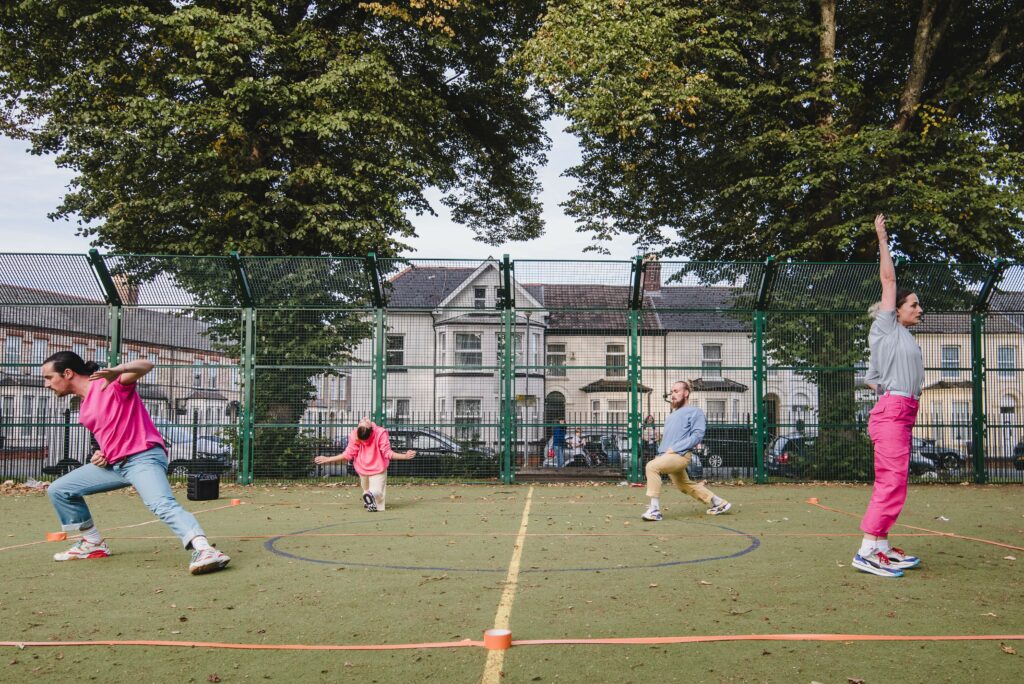
Gemma Connell is a dance artist based in Wales, whose latest work, footSTEPS, is a series of dance films in starkly different locations. Born in south Manchester and with Welsh ancestry, Gemma started dancing in her local youth club. She explains,
‘I come from a working class family and a very big family, certainly couldn’t afford dance lessons. So it was the youth club, it was things that were free that were there for me.’
She later went to Warwick University to study English literature, but found herself spending most of her time dancing and setting up shows. It was then when she decided that she wanted to devote her life to the arts. I ask her what dance is for her and she tells me,
‘Dance for me has always been therapeutic. It’s my way of processing the world, It’s my way of working through things that I find difficult. It’s a way of expressing myself when I can’t find the words.’
Used to moving freely, the lockdown in the spring brought a new challenge. She didn’t have enough space at home to dance, she tells me,
‘You try and dance and you’re gonna hit the coffee table. I felt trapped and I think footSTEPS was a way of trying to get that freedom back. Dance and dancing outside was a way of dealing with that.’
Once allowed to go over 5 miles from the house, Gemma and her partner Ian Abbott, who is the Director of Photography , decided to explore different locations and experiment making short dance films. footSTEPS thus became her escape.
‘I felt very free the first couple of times we tried to create these dance films. I suddenly found myself really excited about dancing again.’
Image: Ian Abbott
The first season of footSTEPS is set in south Wales. The locations include Chepstow Castle, Wentwood Forest, a bus graveyard, an underpass in Newport, and a beach in the Vale of Glamorgan. In her dances, Gemma interacts with the features of each place and reacts to their different feel. Bringing contemporary dance into a castle felt like a meeting of two eras, while the bus graveyard had an apocalyptic feel to it. She says,
‘There’s something for me with being at a castle of one time meeting another. We film in this medieval space but I’m very much in modern clothes and doing this kind of dance that they definitely wouldn’t have done back then.’
‘The bus graveyard for me was quite eerie. It looked a little bit like the apocalypse. As if humanity had disappeared and everything had been left. It made me a little bit nervous that site. I think it comes across in the movement as well. There’s something about me trying to create a boundary, a barrier around me. I seem to be making circles around myself.’
In each film, Gemma improvises bringing together different dance styles to respond to her immediate environment; yet there is a consistency in her moves. I ask her what Covid made her realise about dance. She tells me,
‘The tactile nature of the way I work. I do a lot of contact work. Covid means you aren’t allowed to touch anybody or anything, that you’re not allowed to get close to people. As a dancer, I’m used to being in contact with people all of the time. I found that very, very difficult.’
I remark that in our everyday life we, non-dancers, tend to suppress movement. We are not at ease with our body. I ask her how dancers gain that confidence to express themselves through movement. She tells me,
‘The late Ken Robinson used to talk about this and I think he’s brilliant. He said that people are educated out of their body and into their heads. I really do believe that. I work a lot with young people. As young people, they get less and less comfortable with their body or with moving in a certain ways. I do think that that is related to an education system which is focusing on academic achievements. There are so many kinds of intelligence. I think dance is one of those kinds of intelligence. Embodied knowledge certainly is.’
For non-dancers, dance is something one might do in a club or a dance class. We do not dance on the street, in a park, or forest. Gemma takes her dance into the wild, into historic settings, and urban sites. She frees it not just from the confinement of lockdown, but from the restrictions our society imposes on dance. Movement is how Gemma, as a dancer, deals with life and expresses her emotions. We might do well to follow the example of footSTEPS and dance wherever and whenever we feel like it.
The lockdown with its different rhythms, the enclosed physical spaces, and enforced digital presence has been an opportunity and a challenge for artistic creation. National Dance Company Wales and Literature Wales have come together to produce Plethu/Weave, a series of four solo performances where dancers interpret a poem.
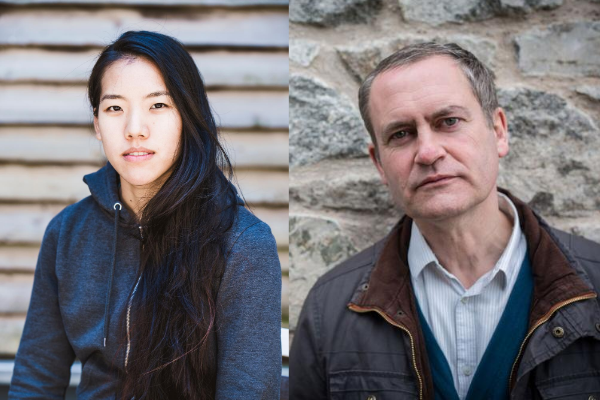
Dancer and choreographer Faye Tan has created a subtle piece of just over one minute to the poem Ust by National Poet for Wales Ifor ap Glyn. The poem Ust (Shh) is highly physical in sound and imagery. It speaks of words as a body that moves and is translated beautifully by Faye in her delicate and yet intense movements.
Faye was born in Singapore and has trained in ballet and contemporary dance at the Singapore Ballet Academy and School of The Arts before graduating from the Rambert School in London. She then joined Verve, the postgraduate company of the Northern School of Contemporary Dance in Leeds. She was always interested in learning new dance styles and has often taken extra classes to try new things. She tells me she likes “being a chameleon.” She likes the variety and exploration that contemporary dance allows. She says,
“I always try to remember that there’s this whole spectrum of movement and amount of energy, and a whole spectrum of options to use when you dance because it’s contemporary dance. There is no expectation from the genre to do something in a certain way.”
At dance school she developed her physicality and learned the vocabulary of dance. As a professional dancer, she is learning to express herself in dance in a more subtle way. She says,
“In training there was a lot of discovering of the limits of my physicality, how high I can go, how much I can push myself. It was when I joined a company in Singapore, after the training, that it was more about what the work needs rather than physical training. I felt allowed to quieten down physically and discover nuances.”
Faye Tan/Ifor ap Glyn
I ask her about working with poet Ifor ap Glyn. She tells me that they were matched by NDCWales and Literature Wales. “It was like a blind date”, she says with a giggle. She describes the poem saying that it felt like “I could zoom to a moment in time.”
I ask her what was her process, she tells me,
“I spent a couple of days at home in my living room thinking of movements and the words and how they would come together. I decided because I was confined as well and I couldn’t go out very much, I thought I’m going to do it on my balcony with quiet a plain background so that the body is the focus.”
The evocative moves that lend a body to the words capture the delicate motion of the poem and its intensity. It seems effortless, yet Faye tells me that in the beginning she had a creative block. She tells me,
“I did not expect the creative block. The concept was very exciting. But I had to be performer, choreographer, and director. I enjoy working with other bodies.
I am not surprised me at her initial creative block. Lockdown confined the movements of all of us and separated us from other people. In Faye’s dance, I glimpse at the experience of confinement. Her moves happen in a small space and are trapped in close-ups. In Ust, Faye’s movements draw out Ifor ap Glyn’s words in beautiful harmony, or better, cynghanedd.
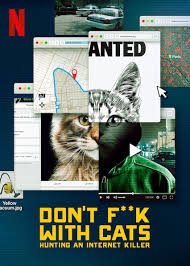
The Netflix true crime mini-series Don’t F**k with Cats is not a documentary. If you expect a documentary exploring the who, what, how, and why of a crime, you will be disappointed. You will also miss what Don’t F**k with Cats is all about. The show is about the porous boundary between reality and social media. It’s about us watching videos created for social media, the reality behind the videos, and how real social media are in bringing people together to act in ‘real’ life. The weakness of the show is that director Mark Lewis is not fully aware of that.
Don’t F**k with Cats follows is a bunch of amateur sleuths investigating a killer. It is an entertaining and disturbing Miss Marple on Facebook. Gripping, fun, and shocking, but showing little awareness of what true crime is about and spoiling it all by blaming the audience for being voyeurs. The show fails to grasp the relationship between reality and cyber-reality, how social media make us actors not mere audience.
It begins when a shocking video of a young man killing a couple of kittens is posted online. Facebookers in horror, anger, and condemnation. Then Deanna Thompson, a data analyst for a casino in Las Vegas, who uses the alias of Baudi Moovan on FB forms a group to track down the killer. Baudi and a man using the alias John Green are the key investigators of the group looking for clues in the video to identify something that might lead them to the location of the killer.
The killer is a narcissist seeking attention. When the group has taken the wrong turn, he seems to throw them a bone to get them to chase him. Does the investigation encourage the killer to commit more crimes? I personally doubt that the killer, Luka Magnotta, would have stopped killing had the group stopped chasing him. People become serial killers because they get away with crime after crime, and their crimes escalate. Don’t F**k with Cats should have included an expert commenting on this, especially given the fact that the amateur sleuths ask themselves the question.
Don’t F**k with Cats is not a documentary! It is a show playing with our curiosity while at the same time wanting to expose our thirst for blood, real blood. We are the sick people watching and enjoying the crime. Filmmakers like playing innocent (see this analysis of Vice), but if they choose to lead us in a direction, they are to blame. Not to mention the fact that they do so to profit from it. Crucially, Don’t F**k with Cats does not focus on the crime. It gives us no details of it, nor does it explore the personality of the killer.
The show focuses on the investigation. It is the investigation done by ordinary people that is engrossing. Director Mark Lewis should have had a little more awareness of the structure of his own show and how it ‘reads’ to the audience, and have spared us the preaching.
Don’t F**k with Cats fails to focus on the most interesting and socially relevant element: the investigators are ordinary people. It is us. We do not experience social media passively, like a film or TV show. We are actors. We discuss, condemn, form opinions, and influence people using mainstream and non-mainstream media. We create misinformation and spread conspiracy theories. We also collect evidence, we shine a light onto police brutality, we organise protests. All on and through social media. The old saying, ‘Police don’t solve the crime, people do’ is at the basis of Don’t F**k with Cats. It is its strength. Someone should tell the director.
In the wake of the Black Lives Protests, it has become clear that the majority culture has missed a few episodes so a look at Spike Lee‘s BlacKkKlansman is needed. The film makes subtle points in a non-subtle way. The most important is that white liberal middle-class Christian male identity is the ‘original’ identity politics. Don’t get me wrong. There is nothing wrong with being a white liberal middle-class Christian man, the problem lies in the refusal to see that our society has been shaped in that image and our consciousness reflecting specific prejudices and values.
Society is not a neutral space where individuals interact with other individuals, as libertarians think. Society has structures of power, which create obstacles for the Other (the non-white liberal middle-class Christian man). Culture is the narratives that emerge from social relationships and that legitimise them. The image of a neutral individual colour-blind, gender-blind, etc. is ‘white privilege’, the privilege of not being racialised, gendered, othered. White privilege means never having to ask yourself what it means to be white. BlacKkKlansman explores what it means to be black and what it means to be Jewish, but also how white Christian nationalism has shaped whiteness.
BlacKkKlansman tells the true story of Ron Stallworth (played by John David Washington), an African-American detective in the Colorado Springs Police Department, who infiltrated the Ku Klux Klan in the 1970s. He does so by establishing contact with Klan’s leaders on the phone and through a Jewish colleague, Flip Zimmerman (played by Adam Driver). Spike Lee oscillates between teaching his audience about American history and identity politics and portraying the KKK as fools, between tragic and comic mishandling both. I grew up with Spike’s movies. They shaped my consciousness, so I miss the old Spike.
In BlacKkKlansman, Spike Lee has played it safe giving us a crowd-pleaser, but one that is muddled and weakened by the tension between comedy and melodrama. Gone are Jungle Fever and Do the Right Thing with their uncompromising look into a messy reality told with ironic anger. Yet, buried underneath the self-satisfied humour and self-righteous preaching, BlacKkKlansman offers a few glimpses of the making of racial identity that are worth considering.
In the film, the KKK repertoire of language, symbols, and rituals is contrasted with that of the Black Power Movement. The storytelling of White Supremacists watching DW Griffiths’ A Birth of a Nation, is counterposed with Harry Belafonte’s telling of the lynching of black people. American culture has been shaped by Christian nationalism and capitalist individualism. It has been presented as the default, the universal, while suppressing the experiences of the Other and depicting them through stereotypes and labels, and confining them into social roles (e.g. women as mothers and wives). Above all, it has hidden the systemic violence and oppression black people have suffered and are still suffering.
BlacKkKlansman shows that racism and systemic inequality have been legitimised and reproduced by the cultural process of Othering. Racism is not merely individual prejudice, but a whole set of norms and material obstacles that keep the Other in ‘their place’.
The film highlights that race is embodied but also performed. Ron Stallworth does a ‘white voice’ to fool the Klan, but can only infiltrate it because of the ‘white body’ of his colleague Flip Zimmerman. To persuade his boss to let him go under cover with the Klan, Ron tells him there are those who speak ‘King’s English’ and those who speak ‘Jive’. He’s perfectly fluent in both. Ron needs Flip Zimmerman to play him as a white man with the Klan. In a moment of camaraderie, under instruction from Ron, Flip tries to perform a speech by a black power leader, only to be outperformed by another colleague (on blackness, performance, and politics see Patrick Johnson’s Appropriating Blackness).
The image we have of the body is also highly racialised (voice, hair, skin etc.). White privilege means whites do not normally ask themselves what it means to be white. Yet, there are many shades of white. Foreign-born and Jews are not considered ‘whites’. Zimmerman had never considered himself anything other than white because he had not grown up as part of a Jewish community. It is the Klan’s idea of whiteness that leads him to confront his identity.
Flip tells Ron that he was not raised to be Jewish, it was never part of his life, he had never gone to bar mitzvahs, and never had a bar mitzvah. He never had Jewish friends, he was just another ‘white kid’. Flip’s Jewishness is called out by a colleague mentioning his ‘Jewish necklace.’ Flip replies that ‘it’s not a Jewish necklace, but the Star of David.’ Asked whether he’s Jewish, he says: ‘I don’t know. Am I?’ Zimmerman realises he too is Other as he faces white supremacists.
The most poignant scenes are the real footage of Charlottesville’s ‘Unite the Right Rally,’ where a white supremacist drove his car deliberately into a crowd of anti-fascist protesters and killed Heather Heyer, to whom the film is dedicated. It may seem far away from our British and European sensibilities and yet it is very close, we just have not talked about it much (please read Paul Gilroy’s There Ain’t No Black in the Union Jack). BlaKkKlansman is weighed down by its pedagogical impulse, yet it’s a lesson many have not yet heard.
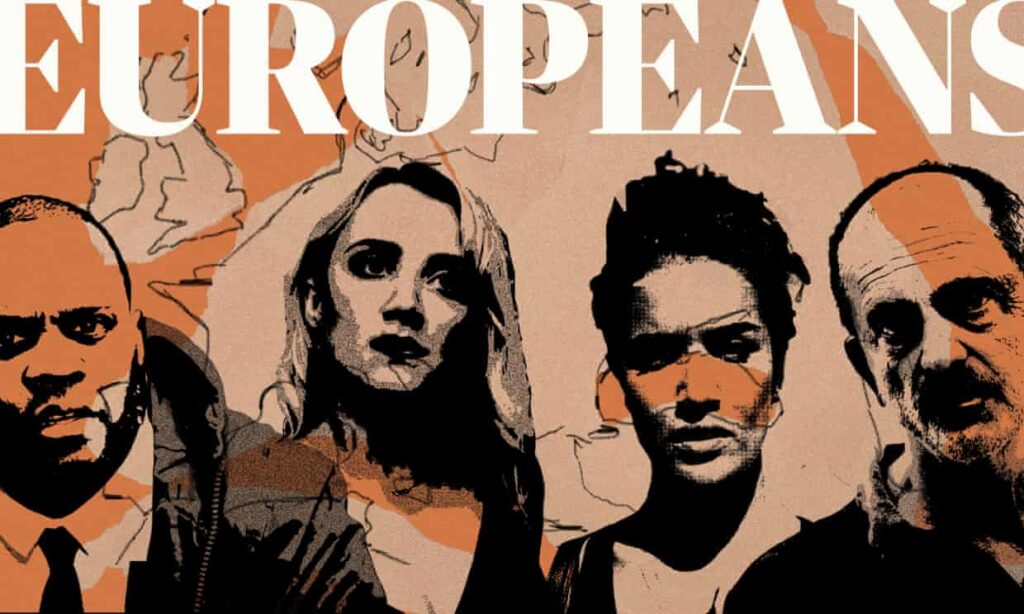
If you, like me, are tired of the formulaic plot-driven writing that saturates our screens, head for The Guardian channel on YouTube. There you will find Europeans, a series of seven short films with seven writers, each from a different European country: Poland, Spain, Germany, France, Sweden, UK, and Ireland. The Guardian shows that it’s ahead of the game in producing documentaries and now drama. The writing of Europeans is fresh and original. The format allows the films to go beyond the demands of TV, where short films have no presence, and crucially the constraints of national cultural traditions.
The films are so different you wonder whether they were responding to different briefs, but that is precisely what’s good about them. They are not made to fit into a category, although all of them have a strong theatrical voice. This is partly because each film is a monologue delivered to camera exploring Europeans relationship with Europe.
The series opens with the French film One Right Answer, the most overtly political episode of the series written by Alice Zeniter and performed by Sabrina Ouazani. A young woman talks of her experience of democracy betrayed. She voted for her first time against the Treaty of Nice in the European referendum of 2005. The referendum was lost and yet the result ignored. She was against the neoliberal Europe dominated by consumerism and the free market, but little transpires as to what she believes in. Sabrina Ouazani gives credibility to the monologue, but it doesn’t go past the disillusionment with the process rather than touch on a generation’s aspirations for Europe.
Borders, the second episode comes from Poland and was written by Jakub Żulczyk and performed by Jacek Koman. It is the story of a lorry driver who has travelled Europe everywhere but has been nowhere because always on the move. Before Schengen, he travelled east and would read books during the long waits at the border. The lorry driver had to sacrifice time with his family to put food on the table. Today, he travels to Germany in a Europe that has no borders. A Europe where his son earns well and can spend time with his family.
In the UK episode, Dim Sum, written by Clint Dyer and performed by Javone Prince, a bailiff acts tough while he empties a house. It is the longest piece, which allows the monologue to be interspersed with short bursts from the people whose house is being emptied. The bailiff, a black man, presents himself as the product of British society, where people only care about themselves and trample on others to be rich. He is British and has nothing to do with Europe, though he is not blind to the deep racism that casts him and his children as outsider in their own country. The bailiff does his job with no compassion, and yet, that one time, when a pregnant woman from a European country opened the door, slightly trembling and then crying, that time left a scar. The captivating writing gives life to a rounded character. Javone Prince’s intensity makes us relive with the bailiff the memory of that encounter.
Equally dramatic is Terra Firma, the Spanish episode, written by Blanca Doménech and performed beautifully by Paula Iwasaki. A woman tells us of when she left her rural village for London only to find herself exploited in demeaning jobs. Now back home, as she walks down the streets of her village, her anger at the dehumanising economy is mixed with a feeling of guilt for betraying her roots. She looks up, to the statue of Mary during a procession, and all is forgiven. She is lifted up, away from the the everyday struggle, from the pain, and feel worthy as a human. Thus she can be true to herself.
For the German episode, Neanderthal, the writer, Marius von Mayenburg, has chosen a Neanderthal man, performed by Robert Beyer, to tell a poetic tale warning of the danger of forgetting the past. It is the story of a tribe that thought themselves stronger than others, which led to war. As he tells the tale, the setting changes from a museum, to the woods, to a theatre, just as a country and a continent change throughout history, and yet repeat the same story, that “Those who don’t want to live together, will die together.” Only in friendship there is life and the future.
Written by Jonas Jonasson, Top of the Class, the Swedish episode makes fun of the Swedish attitude of superiority saying that “We didn’t really join the EU, we rather decided they could join us.” It blames social media for reducing politics to soundbites and creating divisions. The shortest episode, it is performed well by Viktor Åkerblom, but it feels a little too underdeveloped.
The Irish Fake Tan, written by Lisa McInerney, alludes to Brexit by presenting an Irish woman splitting up from her British boyfriend. Lighter in tone, the woman, played delightfully by Evanna Lynch, is the embodiment of an Ireland that no longer needs Britain and can fit anywhere.
I was particularly touched by Dim Sum, Terra Firma, and Neanderthal, which convey complexity through elegant simplicity. They are part of a whole. The films may seem very different dramas, but you get a sense of cohesion, partly achieved by the excellent direction of Amy Hodge, who conveys the emotions in a few careful shots. This cohesion out of difference is just what Europe is, or dreams to be. Europe is not defined by the past but by a dream of the future. Europe looks to what has been to imagine what can be. It is my hope that The Guardian will now commission a series that speaks of our hopes, our dreams, our imagined future.
Creating opportunities for a diverse range of people to experience and respond to sport, arts, culture and live events. / Lleisiau amrywiol o Gymru yn ymateb i'r celfyddydau a digwyddiadau byw

 (4 / 5)
 (2.5 / 5)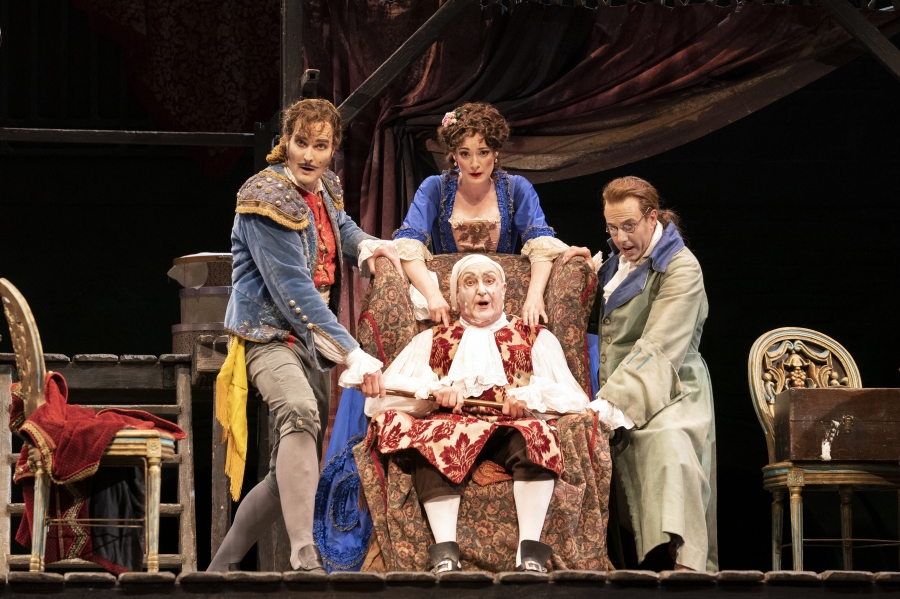
 (3 / 5)
 (5 / 5)