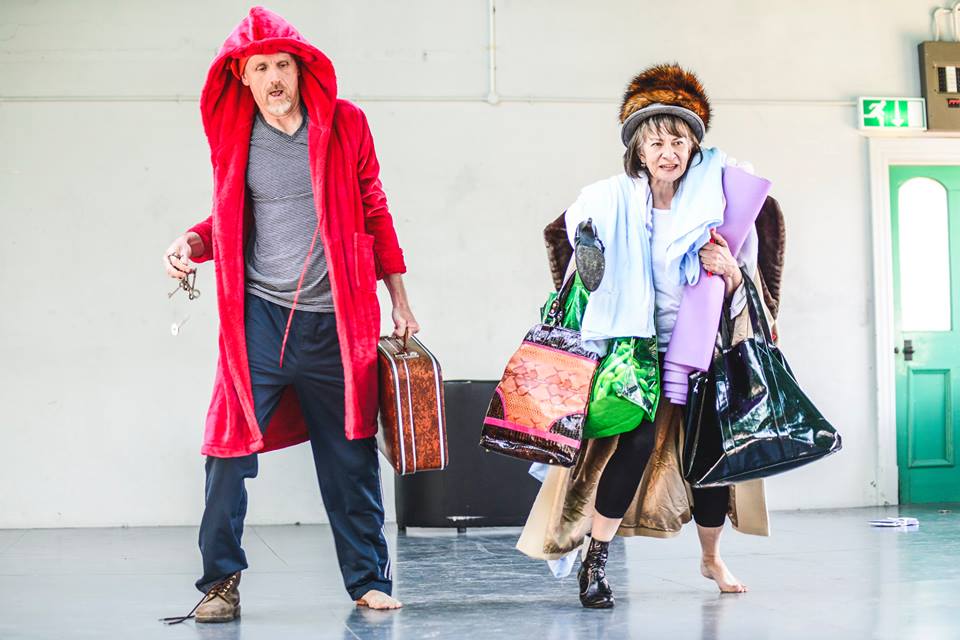
(3 / 5)
With another General Election almost upon us, Theatr Clwyd’s staging of My Country seems particularly apt. A political play of sorts, its backdrop is last year’s divisive and historic EU referendum. In the days following the vote, the National Theatre set about touring the nation, interviewing a variety of people to hear their views on the referendum, their town, their country, their lives, and their future. The result is a smorgasbord of opinion, brought brilliantly to life on stage by Director Rufus Norris and Poet Laureate Carol Ann Duffy.
In a similar way to London Road, My Country uses a verbatim script, with Duffy weaving together some wonderfully rhythmic dialogue. She manages to capture the very conflicting and often contrasting views of people extremely well. Using the natural cadence of the English language, she has created a piece of work that is both musical in its tone and voice, and clear in its content and subject matter. It is not burdensome on the listener, with six actors representing six regions of the UK. Each actor plays between eight and twelve characters from their part of Britain. The play can get busy with these various personalities, but thankfully not so busy that one gets lost. Each is brilliantly engaging in their own way: Laura Elphinstone brings a cheeky humour to her North East; Adam Ewan a lovable snobbery to some of his South West folk; and Seema Bowri’s East Midlands characters are charmingly no-nonsense and frank. They complement one another fantastically well. As a cast, they work together brilliantly.
Keeping the six in check is Britannia, played by Penny Layden. Acting as Chairperson, she is a humble yet authoritative character. She enters the room quite ordinarily at the start, in a plain and simple blue suit. Putting down her bag, she clicks on the lights and manoeuvres the seven tables on stage. She greets the audience, then each of the six cast members in turn. They sit at their tables, and she announces the intentions of the meeting in a simple and unassuming way. Then, one by one, they lift up pictures of the people who they are representing – a diverse group that includes some recognisable faces from the political class. When it comes to then recreating their famous speeches, Layden is superb in bringing Boris Johnson, Nigel Farage and David Cameron (to name but three) to life. She not only captures their familiar accents but manages to achieve the individual nuances of their movements and gestures. It is a delight to behold.
Even as she impersonates the Westminster elite with a sense of joviality however, Layden still manages to retain Britannia’s unpretentious and sincere nature. If she were to be too satirical in her performance, the later scenes, holding much more dramatic weight, would perhaps not have worked quite as effectively. Here, there is much more emotional depth. Fractures start appearing. The six on stage start shouting and arguing with each other. Britannia seeks to keep them under control. At one stage, she appears to go through an identity crisis of her own. For a 75-minute production, it manages to say a lot in a relatively short space of time.

Ultimately, this is a play about “the sacrament of listening”. The six actors descend into more bickering and arguing as the play goes on. Britannia has to call them back each time – to “listen” again. They get so caught up in themselves that they forget to listen. We are all the same. It is the reason to feel both heartbroken and ashamed as Christian Patterson, who plays Cymru, assumes the voice of Dylan, a little boy from Merthyr Tydfil. Now and again, above the commotion, he softly speaks: “Be kind… No argues”. But nobody listens to him.
The National Theatre, under the direction of Norris, has undertaken to listen to people from across the country. Duffy has endeavoured to listen with such precision that she has used their exact words to create a multifaceted and beautifully rhythmic script. She has taken their stories and opinions seriously enough to include views from all sides – some funny, some extreme; some uplifting, others uncomfortable. They cannot be accused of being hypocritical in their content. They have listened. They call us to listen to. It is a simple yet powerful message to take away. And one, at this time in particular, that may be worth acting upon.
My Country can be seen at:
Cambridge Arts Theatre
Mon 12 – Sat 17 June 2017
https://www.cambridgeartstheatre.com/whats-on/my-country
Theatre Royal Stratford East
Mon 19 – Sat 24 June 2017
https://www.nationaltheatre.org.uk/shows/my-country-at-theatre-royal-stratford-east
https://www.theatrclwyd.com/en/whats-on/national-theatre-country-work-progress/
Category Archives: Theatre
Review Lightning Path | Llwybr Mellt, Chapter Arts Centre by Kathryn Lewis

“Lightning Path | Llwybr Mellt combines skilled puppetry with beautiful animated projections and original music, to tell a tale of our times. Ella wonders why her family farm is flooding. Her Grandfather worries about eels not coming up the river anymore. On a magical journey with Harri the flying hare to changing landscapes across the world. Ella meets curious creatures and people that help her learn new ways of understanding and caring.”
Kathryn : “I went to see Lightning Path|Llwybr Mellt from Small World Theatre with my two daughters; aged 10 and 12 at Chapter Arts Centre Cardiff. Going in to the theatre we were asked to sit near the front, which immediately proved how British everyone was, not wanting to sit next to anyone else, when there was the space to leave gaps. We were faced with three trunks on stage in front of a screen. My daughter asks why, I explain there will be a mixture of puppetry and animation.
We are initially surprised when we discover the performers were already on stage, which causes some giggling from behind us. We are introduced to the characters. Some of the audience is confused when Harri the hare starts talking in Welsh. When Harri speaks, Ella repeats his message in English, but while it seems obvious to the adults in the audience that she is acting as translator, not all the children seem to get it. Ella also sang in Welsh, without translation. Although I don’t personally speak Welsh, I thought it was a meaningful attempt at making an inclusive, bilingual piece, but it made the dialogue seem bulky. Having to translate Harri constantly, slowed it and made it word heavy. I wondered if doing it in one language at a time might have helped it flow better, or finding a different way to translate the two languages. (Obviously words on a screen wouldn’t have worked for everybody, due to the age of most of the audience). This production was signed too, which I thought was great, and I could see the benefit of this for some of the audience members.

The story told of Ella and her Grandfather, the flooding and the lack of eels. This led Ella and Harri to travel the world in search of the missing eels, which then led her to the realisation that “Man” was to blame for ice melting in the Arctic, trees being felled in the rainforest, desertification, and plastic in the oceans. I felt the story tried to fit a lot in to an hour piece, it felt very full and a little rushed, with the music and animation being a welcome break in the speed.
The puppetry was very well done, especially the movement of the hare, I enjoyed the shadow puppetry on screen, and how they mixed it with animation, and the basic set changes using the trunks, fabric, and lighting. The use of torches to show the eels, included the audience, and again got the attention of those young children who were finding the hour more of a struggle.

I left feeling like it was a work in progress in terms of the dialogue/story. This was because it felt a little rushed trying to fit in so much information, introduce so many characters, and environments and explain the ecological issues. Then how this linked in with the eels, and all the while translating Harri’s input, in an hour show. I almost wanted Ella and Harri’s story about learning about the environment to be introduced more simply, and her curiosity to be enough. The background story of her grandfather, the cow, the eels and the lightning, explained why Ella was curious, because she could see the environmental impact in her own back yard. It inspired her to find out more, and, after her trip, inspired her to do something about it, but this almost felt like a whole separate story. Ella asked her grandfather to plant trees to stop their land flooding, this may have encouraged younger children to think about what their influence can be or what they can do, especially with the vivid imagery of the sea turtle and the plastic in the ocean.

It was easy to see how much work and artistry had gone into this production. I think that the hour length was perfect for the very young audience, but personally think that the dialogue could have been edited down.”
Sylvia (12) : “It was good in some parts, but quite boring in others. I liked the animation on the screen and the way they used the props. I would recommend it for children below the age of 10. I liked the way they talked about saving the planet, but they could have made it easier to understand.”
Charli (10) : “I think it was quite boring because I couldn’t really understand it. I think it would be good for kids younger than me. It also encourages people not to throw rubbish everywhere.”
Review Rose, Home Theatre by Elizabeth Lambrakis

(4 / 5)
This is a one woman show performed by the great South African actress Janet Suzman. Lasting just over 2 hours it is a tour de force, telling the compelling and poignant story of an elderly Jewish woman looking back over her long life. It spans much of the 20th century, from a hand to mouth childhood in a Ukrainian village up to a comparatively affluent retirement divided between Florida and Israel. Encompassing Stalinist oppression, the Warsaw ghetto under the Nazis, escape to Palestine on board the infamous SS ‘Exodus’, and then resettlement in America, she tells of her family, lovers, husbands, children and grandchildren. It is a story punctuated by loss and grief, as well as love and redemption.
If the aim of theatre is to educate then this play certainly achieves that, as we learn so much listening to this character’s story. But that’s not to say that this is a dry didactic piece. It is entertaining too, drawing us in with the wonderfully engaging power of the story. Written by the award-winning American playwright Martin Sherman the writing is never dull, often moving and sometimes amusing, a narrative that carries the audience along on the colourful and eventful journey through Rose’s life.
As for Janet Suzman’s performance it is an impressive feat for any actor, never mind someone of her age, to perform a monologue of this length and power with such apparent ease and charisma. We were quite simply blown away by it, and it won a richly deserved standing ovation.
A mention should also be made of the director Richard Beecham, as well as the design, lighting and sound team (Simon Kenny, Chris Davey and Adrienne Quartly), whose various contributions combined to make this into a memorable piece of theatre.
An Interview with Campbell Lawrie, Paul Hamlyn Club Coordinator and Drama Class Supervisor at the Citizens Theatre, Glasgow

Hi Campbell Great to meet you, can you give our readers some background information on yourself please?
My name is Campbell Lawrie and I am the Paul Hamlyn Club Coordinator and Drama Class Supervisor at the Citizens Theatre in Glasgow. This is my ninth year with the company but have been working as the Paul Hamlyn Club Coordinator for the last three years.

The Citizens Theatre, Glasgow
http://www.citz.co.uk/about/paul_hamlyn_foundation/
So what got you interested in the arts ?
In first year of secondary school my English teacher thought drama and storytelling would help boost my confidence because at the time I was quite shy. Drama wasn’t a course that was offered at my school so my teacher helped me find courses across Ayrshire – where I’m originally from. As soon as I started performing I fell in love with bringing a story to life and witnessing the effect this can have on others. I was hooked after that and knew that I wanted to use theatre as a tool to change people’s lives.

You coordinate the Paul Hamlyn Club at The Citizens Theatre, Glasgow. Can you please tell us more about this initiative and your role?
The Citizens Theatre was very lucky to be one of five venues across Britain to be gifted a sum of money to identify and tackle the barriers that local, disadvantaged people may encounter when trying to access the arts.
My role is to coordinate the different strands of work we deliver in order to do this and also to create relationships with those affected. The role is very hands on. I regularly visit groups and their members in the local community and also welcome the individuals we engage with into the theatre and gain their feedback.

The Paul Hamlyn Foundation is funding the Paul Hamlyn Clubs to “Attract and build relationships with audiences from disadvantaged groups within their local communities.” How has your organisation approached this objective?
The Citizens Theatre was originally approached because of the amount of work we were already carrying out in the local community and across Glasgow. Using the gift we were able to refocus our efforts in attracting the local community to the theatre and there are currently four different strands of work under the Paul Hamlyn Club banner helping to achieve this objective. For those who live in Gorbals area of Glasgow, where the Citizens Theatre company has been based for the past 72 years, we offer heavily subsidised tickets to those who sign up to the Gorbals Card scheme.
![]()
http://www.citz.co.uk/about/gorbalscard/
The area is still one of the most heavily deprived areas of Scotland and ensuring our neighbours can attend our shows is our way of thanking those who have supported us over the years. We also run a Deaf Theatre Club working alongside Inkblot Collective to deliver an accessible programme for our Deaf audience and we work with two local schools to help engage a new generation of theatre goers.
http://www.citz.co.uk/Take_part/deaf_theatre_club/
The Paul Hamlyn Citizens is the fourth strand of work. This involves visiting local organisations and charities to discuss the barriers faced in accessing theatre and inviting them to join the PHCitizens to access tickets to shows throughout the year at 50p per ticket. Our PHCitizens ambassadors are always on hand during shows and events to answer any questions or queries those attending through the Paul Hamlyn Club may have.

Have your new audiences chosen to see any specific type of work at your venue?
We have learned that our new audiences are willing to engage with most types of work because they know they have nothing to lose through attending. Our new audiences see coming to the theatre as a social event more than anything and the shows, the free interval ice-creams, the post-show chats etc are all just added extras. There is an amazing atmosphere at Paul Hamlyn events as many stay behind to discuss the shows and this in turn helps create a larger community network. In saying this, comedies and musicals, especially if they are Scottish shows, prove to be more popular than most but Shakespeare, classics and new writing still appeal and have drawn in equally large numbers.

What impact has had this project in your venue had on the larger organisation?
The impact of the project can be seen across the organisation. Every department has been involved in its delivery in one way or another: backstage have provided talks and presentations, FOH ambassadors greet and welcome the wide range of new patrons who come through our doors and one of our box office assistants is even completing Level 3 BSL. Our community work which has been aided through Paul Hamlyn has also been recognised in helping secure some money for our Capital Project. Accessibility is always at the forefront of people’s minds and this has helped emphasise our stance that we are the Citizens Theatre – we exist for and because of Glasgow’s Citizens.

http://www.citz.co.uk/press/release/2.5_million_regeneration_capital_grant_fund_award_marks_new_milestone_in_ci/
In the current funding climate many venues and organisation have very limited budgets. Is it possible to share some of your learning that organisations could implement to support new audiences that doesn’t require large amounts of funding?
Funding obviously plays a huge part in making theatre accessible to all but small things like listening to your local community and sharing your resources/spaces with local organisations or individuals can help strengthen relationships. Finding out what your patrons want you to be and how else they would like to use the building is important in making the patrons feel comfortable in coming through the doors. An extension of this is having dedicated, friendly staff to welcome your new audience. We held an open day event, for example, to promote the theatre and our learning work to local, disadvantaged people.

We held workshops, talks and demonstrations throughout the building while outside a local band played and local organisations and businesses promoted their produce and work. The event cost very little because the local community were very generous in donating nearly everything we required and this in turn strengthened our network and individual relationships. I feel that a lot of the time people prefer putting names and faces to the organisation. Offering unsold tickets to your local contacts is also a good way to engage your new audience.

Get the Chance works to support a diverse range of members of the public to access cultural provision In relation to your own project are you aware of any barriers for audiences to access cultural provision.
I think the barriers faced will vary greatly depending on where you are based. The Citizens Theatre is in a highly deprived area with an extremely diverse cultural background meaning we have encountered barriers such as language, affordability and childcare. Some people also feel intimidated entering a building they have only ever walked past or think it isn’t physically accessible. We have heard that a lot of people think theatre is elitist and “not for them”. Transport and programming also come up as common answers to what stops people coming along.
Thanks Campbell, finally some more personal questions. What excites you about the arts? What was the last really great cultural activity event that you experienced that you would like to share with our readers?
The cast of My Country with director Rufus Norris, gatherer Campbell Lawrie and some of the interviewees from Glasgow.
I genuinely get excited when a theatre show tackles social issues and politics head-on. Any piece of art that encourages debate or triggers a passionate response from its audience while also being entertaining has, in my eyes, achieved its goal. I was very lucky to have worked on the recent production of My Country by National Theatre. My role was to gather information from the Scottish people on their views on Brexit and the political climate following the Brexit vote. Listening to each person’s unique story on how they decided they were going to vote and knowing that snippets of these stories were going to heard by people all over Britain really excited me because the project, like the issue, encouraged debate but this time it was a debate between everyday people – not the media and not the politicians.
http://citizenstheatre.blogspot.co.uk/2017/03/my-country-work-in-progress-divides.html
There is, on the other hand, one show that has stuck with me for ten years and remains my favourite piece of theatre – Headlong and Citizens Theatres production of Angels in America in 2007. I have no words to describe how that show made me feel but it did make me want to work at the Citizens Theatre. I guess in that way, that show changed my life.

https://headlong.co.uk/productions/angels-america/
http://www.citz.co.uk
Get the Chance to be a theatre critic with Taking Flight Theatre Company

Interested in theatre, dance, visual art, gigs, poetry, film and more?
Want to access a free workshop which will give you an insight into the role of a critic?
Then, this is for you! The workshop and performance will be BSL supported. It will be suitable for D/deaf participants.
All participants will be able to:
-Access the workshop for free and see a performance of The Tempest by Taking Flight Theatre Company
-Be supported by Get the Chance to continue to review a range of events and performances.
The Tempest
“Join the Magic Staff Liner Corporation and indulge yourself with a jaunt on the newest addition to their fleet- their number one luxury ocean liner, The Remembrance. Let their crew take care of your every worry, your every woe on their 10 year anniversary cruise to the Island that Time Forgot.
Expect lots of laughs, physical comedy and live original music, but most of all expect the unexpected.
This performance has live integrated BSL interpretation and audio description.”
What’s involved?
You will take part in a 90 minute workshop with Guy O’Donnell Director of social enterprise and online magazine website Get the Chance getthechance.wales
During the workshop you will be given an insight into the role of the arts critic. You will be given instruction on how to create a review and upload your response online. Participants will look at blogging, video, social media and much more! All workshop participants will get the opportunity for their reviews to feature on the Get the Chance website.
If you have one please bring a laptop, tablet and/or smartphone.
The workshop is limited to 10 places. All participants will be expected to write a response to the performance.
Suitable for ages 14+
The workshop is on July the 11th at Cyfarthfa Museum from 5-6.30pm
Schedule
5-6.30 pm – Workshop
6.30-7pm -break
7pm -Performance of The Tempest
To book a place please email
getthechance1@gmail.com
Collaborating with Theatr Clwyd to develop a Welsh critical network

Get the Chance has collaborated with Theatr Clwyd to run a free ‘Get the Chance to be a theatre critic’ workshop and provide free tickets to Theatr Clwyd’s production of The Importance of Being Earnest. The event was supported by Gwennan Mair Jones, Director of Creative Engagement, Theatr Clwyd.
http://www.deeside.com/theatr-clwyds-new-director-creative-engagement-will-promote-power-performing-arts-young-people-wider-community/
Get the Chance was able to run this activity through funding from Arts Council Wales Sharing Together. “A strategic initiative to encourage the development of networking opportunities.”

https://www.theatrclwyd.com/en/whats-on/get-chance-theatre-critic/
12 new critics attended the event ranging in age from 14-80 years. During the workshop we discussed the role of the critic, differing methods of giving critical feedback and the role of the press and marketing department. Many of the those attending are strong advocates for the venue and cultural provision in general. Some of the group attended youth theatre and community engagement workshops at the venue. Some of the group had an education background and had brought young people to see performances in the venue. Some of the older participants have attended performances from the theatres construction in 1976 to the present day.
The participants are all excellent examples of Creative Citizens. Get the Chance is developing a socially engaged, democratic audience development model called Creative Citizens Cymru. Many of the fundamental principles of this model are very similar to the principal goals of the Well-being of Future Generations (Wales) Act.

Some of the reviews for The Importance of Being of Earnest have been posted on the Get the Chance website
getthechance.wales/2017/05/24/review-importance-earnest-theatr-clwyd-elizabeth-lambrakis/
getthechance.wales/2017/05/21/audio-review-importance-earnest-hannah-bywood/
getthechance.wales/2017/05/21/review-importance-earnest-theatr-clwyd-bethany-mcaulay/
getthechance.wales/2017/05/21/review-importance-ernest-theatr-clwyd-karis-alaina-clarke/
It was a very welcome opportunity for Get the Chance to develop its critical network in North Wales. We thank the Arts Council of Wales for funding this opportunity and the support of colleagues at Theatr Clwyd.
All of the participants will earn Spice Time Credits for their time spent volunteering with Get the Chance Wales.
http://www.justaddspice.org/get-involved/get-started-with-time-credits
An online survey has been created to continue some of the conversations raised during the workshops we have been running. If you run a venue or company and are interested in supporting the democratisation of critical networks we invite you to contribute your thoughts to the survey. https://www.surveymonkey.co.uk/r/W27RC3Q
This is the third event Get the Chance has ran through this funding stream, blog posts of the other events can be found below
getthechance.wales/2016/11/26/launch-creative-citizens-cymru-2/
getthechance.wales/2017/01/22/get-chance-takepart/
Guy O’Donnell the director of Get the Chance organised a similar event a few years ago and a blog post on this event can be found at the link below.
http://community.nationaltheatrewales.org/profiles/blogs/critical-feedback-to-the-response-event
Review Sister Act – Venue Cymru by Karis Clarke

(4 / 5)
Click on the link below to listen to an audio review of this production by Karis Clarke.
This was my first outing to Venue Cymru and I wasn’t disappointed. Set on the stunning North Wales coastline the venue was alive with activity. The atmosphere was light and expectation high as several audience members dashed around in habits!
Sister Act is the musical comedy based on the movie starring Whoopi Goldberg, and, unless you were living in a convent yourself back in 1992, it is highly unlikely you don’t have some knowledge of the film. (It’s popularity has ensured a regular repeats on TV at least once a year since circa 1995).
The stage version, unlike the film is set in the diva disco era of the 70’s and features original music from ALAN MENKEN, and the general feel of the show has Mowtown vibe that is more than fitting to the outstanding vocal talents of the lead.

But it’s not all about the star in this show. Deloris Van Cartier is a fantastic character full of witty one liners, side ways glances and comical physicality that Alexander Burke pulls off admirably. However the ensemble made the show for me. The combined talents of the supporting cast were superior. Acting, singing dancing and playing a variety of musical instruments on set allowed for a fluidity which you can sometimes loose with larger productions. However this cast owned the stage, literally, they knew every inch. Their management of the stage movement is a credit to Revel Horwood’s direction. The scene changes were flawless and were choreographed to perfection.
https://youtu.be/xqcEcIvEVCI
Credit should also be given to the set design, the main stay an impressive church interior yet with the cleaver use of lighting and props it easily faded into the background and made the transition between church, nightclub, street, police station and back to church with very little effort.
The musicality was, as one of the songs repeats, ‘Fab -U- Lous Baby,’ unfortunately this was also a slight disappointment for me as none of the songs from the movie were featured. So although the end of the play saw the majority of the full house clapping and on their feet I am sure if “I will follow him” had been played the roof would have lifted. However the original score was witty, befitting and more than enjoyable. It’s easy to see how Alan Menken has Oscars under his belt.
https://soundcloud.com/norwichtheatreroyal/alexandra-burke-performs-fabulous-baby
Stand out moments of the show were any time the “gangsters” featured. (They stole the show a little bit from the nuns). …..Joe Vetch (playing Eddie the sweaty police officer who saves the day) singing “I could be that guy ……Sister Mary Robert played by Alice Stokoe, who had a stunning voice singing a very Disney esq type song called “The Life I Never Had”…….. and the scene when the Sisters stand together for Deloris.
All in all there was nothing not to like, the show delivered everything thing it promised. One particular moment I found touching was on the final bow Alexandra Burke broke the fourth wall and you saw her thank the audience. She genuinely seemed to appreciate the standing ovation they received and this shone through as she skipped off stage laughing with co cast not as Deloris but as herself and within those few seconds, in my eyes I saw true star quality.
So unless you have lead in your feet and no soul in your heart I defy you not to enjoy this 4 stars production. Unfortunately for North Wales the runs ends on May 27th but you can still catch performances around the UK up until the 3rd September check www.sisteractuktour.co.uk for more details.
Starring ALEXANDRA BURKE and Directed and choreographed by Strictly CRAIG REVEL HORWOOD, Set and Costume MATTHEW WRIGHT (based on TheTouchtone Motion Picture “Sister Act”)
Get the Chance to be a theatre critic with Motherlode and The Coliseum, Aberdare.

Interested in theatre, dance, visual art, gigs, poetry, film and more?
Want to access a free workshop which will give you an insight into the role of a critic?
Then, this is for you! The workshop and open rehearsal will be BSL supported. It will be suitable for D/deaf participants.
All participants will be able to:
-Access the workshop for free and see an open rehearsal of Exodus Motherlode’s new work in progress.
-Receive a press ticket to see and review a future production at The Coliseum, Aberdare.
-Receive a complimentary ticket to see a performance of Exodus at Bristol Ferment. (Does not include travel)
http://www.bristololdvic.org.uk/ferment.html
-Be supported by Get the Chance to continue to review a range of events and performances.
Exodus
“Aberdare, South Wales. The night the last factory closed.
Nan and her neighbours find themselves locked in a designer factory at the end of the valley. Draped in gaudy couture, they dream of escape to a new and better land – free from politics and the grind. Provoked by the hundreds of Welsh people who settled in South America in 1865, Exodus is a new adventure from the valleys.”
What’s involved?
You will take part in a 90 minute workshop with Guy O’Donnell Director of social enterprise and online magazine website Get the Chance getthechance.wales
During the workshop you will be given an insight into the role of the arts critic. You will be given instruction on how to create a review and upload your response online. Participants will look at blogging, video, social media and much more! All workshop participants will get the opportunity for their reviews to feature on the Get the Chance website.
If you have one please bring a laptop, tablet and/or smartphone.
The workshop is limited to 10 places. All participants will be expected to write a response to the open rehearsal
Suitable for ages 14+
The workshops is on Thursday, June 29th 1-5pm at The Coliseum, Aberdare.
http://www.rct-arts.org/information/coliseum
Schedule
1-2.30pm- Workshop
2.30-3pm -break
3pm- 5pm-Open Rehearsal & conversation with the team
To book a place please email
getthechance1@gmail.com


![]()
Iphigenia in Splott, a conversation in text by Leslie R Herman Jones

This response started as a real text convo between me in NYC and Joel (JF) in our home in Adamsdown, Cardiff. It inspired me to continue in this format. Instead of commenting that the language in the play was strong, and potentially offensive to some audiences, the response enters into the spirit of the drama and uses its vernacular. The other person in this scripted response is my daughter Tillie as TJ, who attended the performance with me. – LJ.
LJ: I saw Iphigenia in Splott in NYC on Wednesday night.
JF: What was it about?
LJ: A drunken slag on Clifton St….
JF: Anyone I know?
LJ: Her world; her straight-talking shit-faced attitude.
JF: Was it set in the Clifton pharmacy getting her methadone fix?
LJ: I said a drunk not a druggie.
JF: Oh….
LJ: Her hopes, fears, delusions… how the world impacts on her and she impacts on the world…
JF: What’s her name?
LJ: Iphigenia. Effie for short.
JF: How did it go down?
LJ: New York is a pretty gritty city, you know…
JF: You would know, born and bred there.
LJ: Yes I would. So, I think they got it. Apart from a smattering of laughs in the right places (but not all the right places), Sophie Melville’s Effie silenced the house throughout with her intimidating, in-your-face performance of this real toughie from Splott, Cardiff. New Yorkers understandably missed a few laughs for which you’d really have to be there to fully appreciate. As well, some of the micro-cultural and geo-specific references may have gotten lost in translation, but overall the impact was powerful.
JF: And you knows your Caadiff, too, innit love?
LJ: Living in the ‘Diff for 35 years and off Clifton Street for ten of them ? I’ve got the T-shirt, love,… with the distinct privilege of calling The Clifton my local…
JF: We’ve seen a bit down the Clifton…
LJ: I’ve definitely avoided the likes of Effie down Clifton Street, the wounded urban warrior, bruised and battered but still standing; spitting and swearing, daring you and scaring you just by staring at you…..
JF: Yep….
LJ: Melville’s impressive performance as Effie clearly kept the audience gripped — holding on tight while she soared (Bar scene) and sank (Birthing scene) and dragged us ducking and diving through the gutter of her frenzied and high-risk out of control life.
JF: Woa! Who wrote the play?
LJ: Gary Owen.
JF: Fair play. Sounds like she did justice to the part.
LJ: She did, though she may have missed some of the nuances of the authentic Splott voice and persona that are thoroughly embedded in Owen’s script, falling just short of the highest highs and the lowest lows possible with such a tragic figure.
JF: Who directed it?
LJ: Sherman Theatre’s, Artistic Director, Rachel O’Riordan. And quite strategically. The simple set (Hayley Grindle) served this small stage. A few chairs scattered randomly, and a light fixture of fluorescent strip lights, some falling off (Lighting Designer, Rachel Mortimer) reflected a cheap and nasty flat above a shop on Clifton Street.
JF: Grunge chic…
LJ: Charting Effie’s movements across the stage was great sport — if you’re into sports and sporting analogies.
JF: Sure, I could be…
LJ: O’Riorden’s tactical staging cleverly anticipated the high points of the story by directing Effie to, say, shift a chair a number of beats beforehand, then having her double back to start a scene in order to arrive at that chair at just the right point, to score!
JF: lol
LJ: And with a pivot or a dart or a scramble across around and through the Cardiff landscape, satisfying-for-natives references to Cardiff landmarks throughout the script, O’Riordan’s use of this minimalistic set, with zero props, demanded that Melville command the space and permitted the beautifully steely script to tell the story.
JF:Sounds like you enjoyed it.
LJ: TJ cried. It was rather sad, but I didn’t cry.
JF:Why didn’t you?
LJ: I suppose it was all a bit too real. Its was so close to real life, it hurt more physically than emotionally. I ached for a while afterwards.
JF: Come back, Cardiff misses you.
LJ: I’ll be back in August.
Iphigenia in Splott played at 59E59, NYC as part of their Brits Off Broadway season, from 9 May to 4 June.
http://www.59e59.org/moreinfo.php?showid=283
Review Mixed Grill?, Beyond Face, Barbican Theatre Plymouth, by Hannah Goslin

(2 / 5)
My first time at the Barbican, this little theatre tucked away in an alley opposite Plymouth Aquarium is a little gem in itself.
For my first trip here, I came to see Mixed Grill? by Beyond Face. The production uses many elements of music, video, real life story telling and picking up on history and present day topics related to race, with some physical theatre/dance fusions thrown in. One could say this is for sure a multi-media production.
The premise of the show is to highlight and explore race, from two mixed raced performers where they share their personal stories and feelings but also make comments on well-known worldly stories. They support this with mixture of music that represents the Caribbean and Britain and combine this with a narrative of making a traditional Caribbean curry for their British friends. Not only does the smell of real life cooking add to the senses and bring you into the room, but the naturalism of the performances invites you to the discussion.
A simple set, we see a bookcase with blank frames, adding to the tales of not feeling placed or at home with who you are and where you are. Other than that, it is set like a standard kitchen and with all the appliances and ingredients for the performers to make this curry, it is very lifelike and relatable. This puts us in the room and makes us feel affiliated with the performers, giving us the option to side with their ideals and opinions on race.
The performers themselves pick up on very good points – showing physically with black and white liquid the ‘one drop system’ in America which was originally unknown to me; transpiring their uneasiness with their own difficulties when it has come to race and their stories and, for example, the male performer and the 50/50 life he had growing up in London where he was accepted but other times not, through dance and physicality. They were lovely additions but it did feel as if a lot of the other points they made could have been presented this way.
While you can tell they have theatrical backgrounds and a want to show important points through this, the script was lengthy and, at times, were just chatting but without conviction. Such a huge amount of facts and points must have been hard to recite and therefore lost a little personalisation and theatricality – unfortunately it felt over rehearsed and scripted. As previously said, the physicality, while it was good but seemingly also felt in production still, perhaps throwing more of this into the performance to compliment the speeches would have made this feel less like a lecture and more of a performance. With this also comes projection – at times their voices did not quite fill the room or music drowned them out and this was a real shame as I really wanted to hear what they were saying from the important points to the comedy they were also trying to bring.
Saying all of this, Mixed Grill is a great concept, comical and a joy to watch but it still felt in a scratch stage and could become something really interesting and amazing – physicality, energy and more theatrical projection is needed just to push it that little bit further! And there is something about this pair and their approach to comedy and vast knowledge and research into an obviously personal subject that makes you really root for their success.