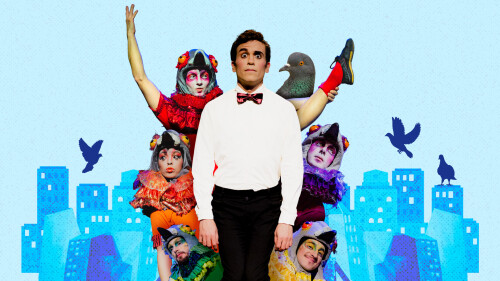

I’m sure with such a title, many would wonder what a stand up horror show would entail. The name itself was intriguing and was happy to entertain the intrigue.
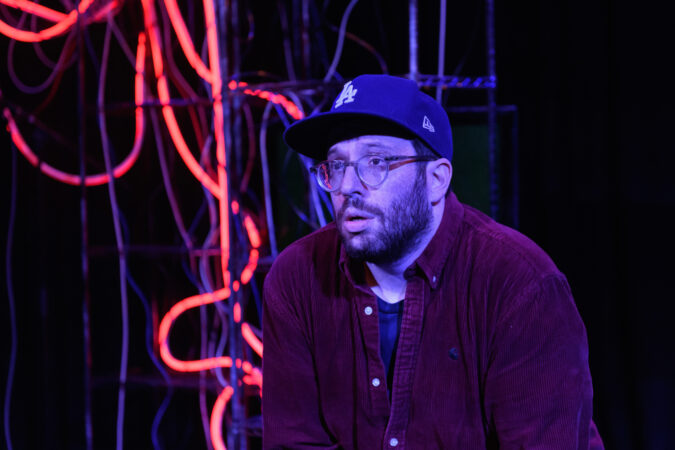
The Stand Up Horror Show is a one man show that I would say was loosely based on horror but more played on the satirical of a “bad” comedian. Humour was created by foiled tricks and obvious puns, which, when you got into the swing of it, was certainly comedic.
The horror aspect was somewhat lacking. Our comedian wore a somewhat scary mask, brought out magic tricks based on the occult and witchery and modernised and created humour with well known Grimm fairy tales. Granted, without the term “horror”, I wouldn’t know what genre could replace this but the label of horror isn’t quite what was brought on stage.
However, we had lots of fun. The performer was very good at ad libbing, improv and picking up on curve balls from audience members. He allowed us to join in and be a part of the comedy without telling us what was funny and when unplanned changes were created from our interaction, we certainly felt part of something.
The Stand Up Horror Show is getting there. It feels like it has the basis to become something more honed and slick, but could also do with more direction to live up to its name.
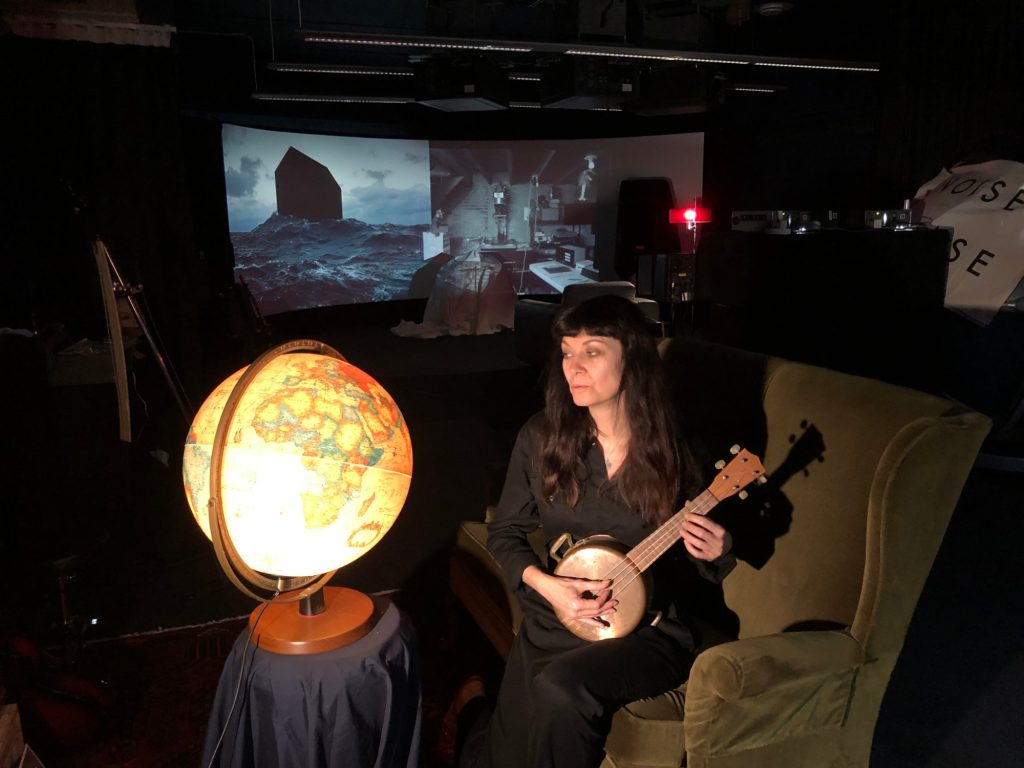
If i’m entirely honest, I couldn’t spend time on a spin bike for more than 10 minutes, let alone 1 whole hour and while acting as well.
This is what makes Spin so unique. This one hour production, based on eating disorders, the social pressures of bodies, particularly female identifying bodies and the influence we can have on each other, comes from the point of view of one person who has (in her opinion at the start) changed her life around to become a spin class instructor. During this time, 80-90% of the production is this one performer constantly on a spin bike, lacking sweat and not missing a single breath. This is commitment and talent.
This monologue features information on her past, her own eating and fitness journey, the impressions enforced on us from the media, on her and her sister that anything that isn’t thin is wrong and disgusting and we see her almost convincing herself that what she is saying, is what she believes. But we know it isn’t, and so does she. We witness her go through a turmoil of changing opinions, guilt and questioning of realism.
As mentioned previously, she manages to perform this on a spin bike and if not, she is up on stage, with every bit of power and action in her. If she has been drinking coffee, I for sure need to know what brand for that energy level. But of course, this is more than a caffeine hit; this is a well constructed level of fitness and performance talent to allow her to do both simultaneously.
The narrative, written by Kate Sumpter (also our performer) is very raw and honest. It touches on our own insecurities, no matter our body types, how judgemental we are without necessarily knowing that we are and how utterly influenced we are. I found myself questioning, as I always feel I do as a curvy woman, when performances, on stage or screen, talk about weight and eating issues and the performer(s) are a thin, beautiful person that I would love to be. And I caught myself, during the narrative she expresses of everyone judging bodies, doing the exact same, wondering what this person had to complain about. I checked myself and knew that what Sumpter had written, was emanating subconsciously within me. It isn’t a thought I believe, representing my own insecurities and realised very quickly that this production is hugely important in recognising that unconscious bias that we all have.
Spin is a tour de force of performance ability, physically and mentally and is extremely well written for anyone, female identifying or other, who struggles on the whole spectrum of body issues and influences from the media. It puts everything in perspective and makes you question your own subconscious.
What more could you want from a play than no boundaries commentry on female love, life, sex and feminist punk music? Sugar Coat effortlessly encompasses the whole lot and more.
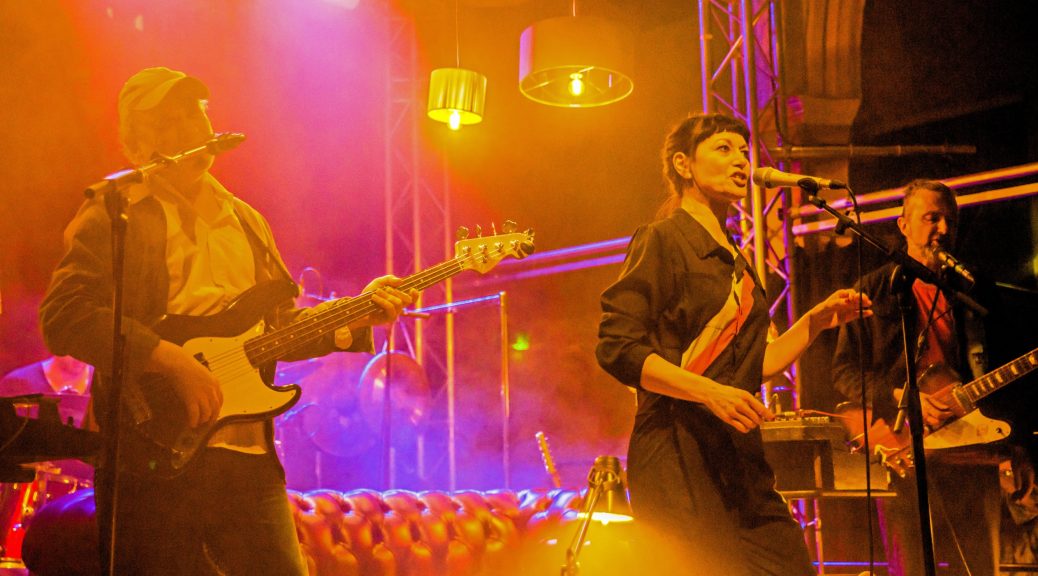
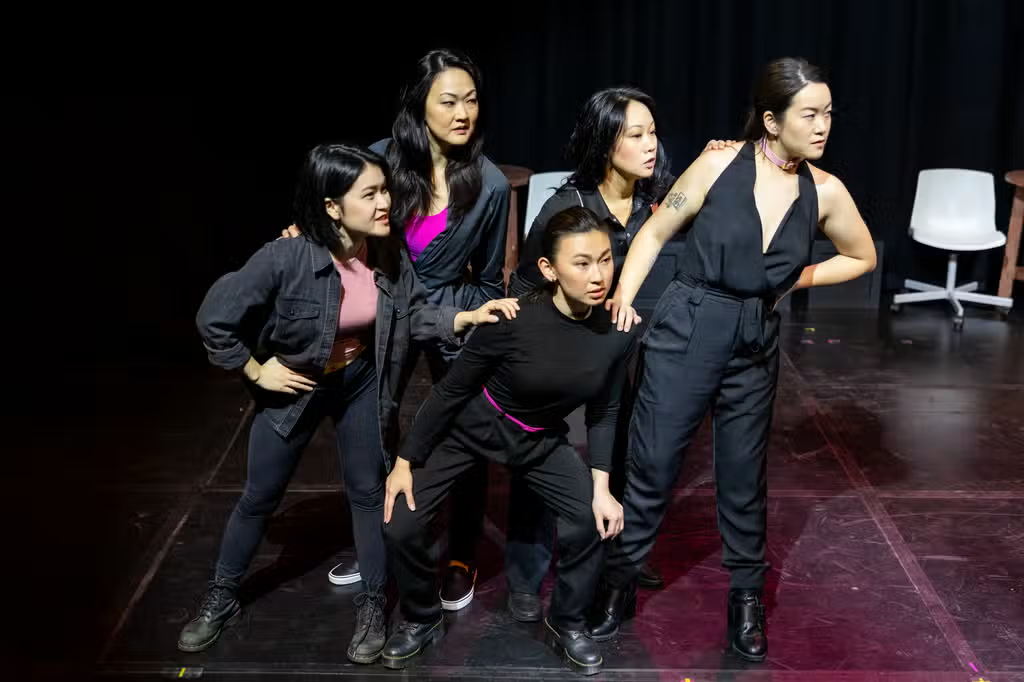
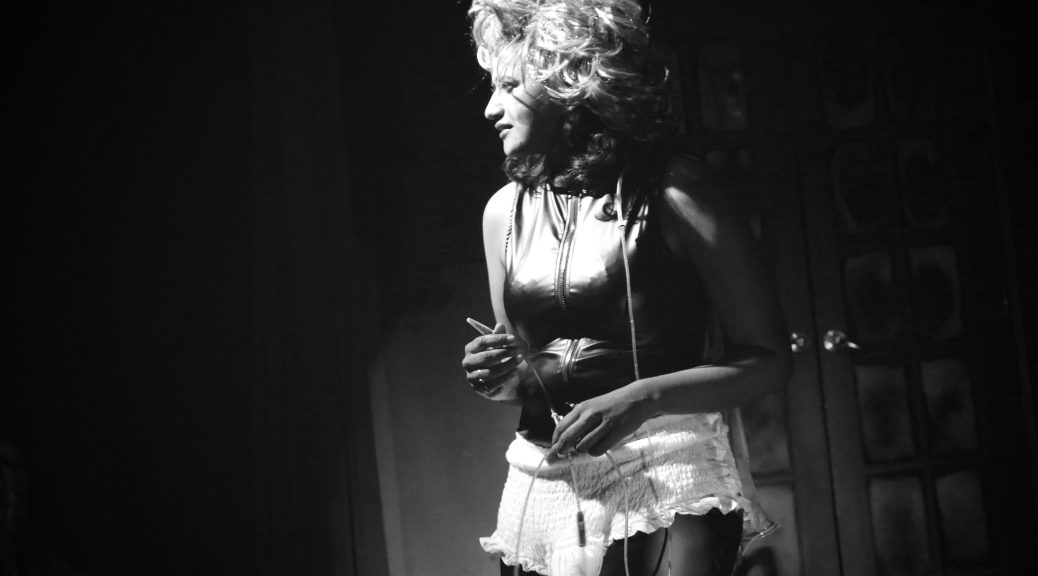
With a live female and non-binary band, this play is a verbatim meets rock musical theatrical production. We follow a girl from childhood, through her teens and her 20’s, through heartbreak, sexual assault, love and therapy and the relationships, emotions and feelings that come with it. It is an emotional rollercoaster yet full of laughs and a great big hug in words, where there are no boundaries on topics or themes.
It may not be the right thing to pick out as the stand out, but as a punk rock fan, I loved that the story began as if we were welcoming a band at a gig – they embodied this rock n roll ethos and it did make you question what you were about to view. This approach to a theatre production felt like something new and interesting, and immediately hooked me and my personal passions. The second stand out for me was how plain and transparent sex, issues, thoughts and emotions were talked about. There was no beating around the bush (pardon the pun), masking realities – they were out right calling spades a spade and talking candidly about physical and emotional items. For the prudish, this is not for you. But it was liberating and great to see fear and censorship thrown out the window instantly.
The themes were ones of difficulty but also ones of liberation – miscarriage, sexual assault, transition to adulthood and femininity, of first times, of cheating and of polyamory. They were themes that today’s youth go through and never speak about and to know, even as a 30 year old woman, that they were thoughts, feelings and situations that happen (for good or bad) to others through the coming-of-age period, was actually reassuring even 12 years past going through it myself.
The music was well constructed and fit well with the narrative – mirroring what was being experienced and, for someone who feels a lot within music, drummed up a lot of feelings within me. There were also times to bring out your inner rock star and refreshing and fun to see an all female/non-binary cast take this celebration and run with it, encompassing all there is to come with rock stars.
My only qualm was that it felt like the blueprint for this production was repetitive. We have a verbatim monologue, we are introduced or re-introduced to other characters who say their bit, then we are back to monologues. We are then in dispersed with music and back to the same. And while all of this was perfection and excellently executed, I found myself wanting something to break up that cycle, which never came to fruition. A happy ending of sorts, with the idea that other plays and stories could be told of what happens next, this didn’t feel enough of a cliff-hanger for me to be happy with it as an ending.
Sugar Coat is emotional, comedic, laid back and fun; it cuts into trauma and lays out growing up as a female and all the issues and confusion that comes with this. It has some sick music and taps into lovers of 90’s rock, but the format felt repetitive and needed something to break into this predictive plan.
With the increased popularity from For the Black Boys, which originated at Royal Court and exploded into the theatre scene, it is great that the baton is continued with another play based on black culture and even more emphasis on its queer community.
BLACK SUPERHERO is the story of David; struggling with his past, present and future, a life of drugs, drink and sense of being unsuccessful, he is also in love with his friend who happens to be a famous acting superhero. We see David struggle with his unrequited love, of forces dragging him back to his vices and the memories of a not so idyllic childhood that his sister encountered. Life is passing him by, and so is everyone else.
True Royal Court style, the set is ambiguous and futuristic – there is a sense of something you may see in a Marvel movie; the Superhero’s secret hideout, or even the villain’s lair, with the set almost cutting away to reveal new scenes. This is emphasised with moments of David’s imagination, when he pictures his love interest in his starring role, flying down into the set in his tights and mask. There’s the constant feeling of displacement but also familiarity; where you can set this play at any time or any place. However, with the themes of race and queerness, we can only hope that societal discrimination is improved if the production were to be staged again in the future and therefore not so realistic.
Each character is fully formed and naturalistic – they all have their own quirks and opinions, but none are stereotypical. This is a great and very real approach and especially opens up the cultural themes for anyone who doesn’t sit within the black or queer communities. All the performers bounce off each other, and so their relationships feel fully realised and real. We believe in David’s past and his trauma; we believe in his and his sister’s relationship and we believe in the heartbreak that comes along with the story. We very much feel as if we are walking into these rooms, breaking down the wall and intruding into life.
While a brilliant and emotional play, one that many can identify with on lots of different emotional and cultural levels, there felt a slight anti-climax with its narrative. Perhaps being so used to something happening in a crescendo or out of the blue at Royal Court that almost slaps you surprisingly in the face, this conclusion and tying up of relationships and issues felt perfectly normal and a “happy ending” many would wish to see. There’s nothing to say that this was wrong but for BLACK SUPERHERO, I very much wanted something more, whether that be narrative-ly or production value-wise.
Theatre is very much a powerful tool to highlight topics of the time, to create political commentary and express the injustices and emotions of people. With the last 3 years adding to the feeling of the world getting seemingly worse, there’s something to be said of a production that makes these comments but encourages us to see the humility of it all.
Adam Scott-Rowley’s, YOU ARE GOING TO DIE, does just this. Featuring Scott-Rowley completely in the nude, he vulnerably cycles through different ages, different people, thoughts and attitudes to give a holistic view of our world, of growing older and of experiencing oneself in a climate slowly getting worse. He creates highs and lows of comedy vs reflection, of matter of fact hilarity vs deep emotion which is poignant and effective; a emotional and thought provoking rollercoaster.
The action is already started as we take our seats; Scott-Rowley sat on a lit up toilet, with music and lights that make you feel as if you are entering a Berlin rave club, there’s this feeling of voyeurism on him while the audience chatter and wait for the start. There is something amazingly powerful of watching as the audience slowly come to the realisation that a production has started without this being clear.
Scott-Rowley is able to contort his body and facial structure to create different characters and scenarios – you rarely find that you truly know who he is or what his natural form is as he so amazingly transforms. He creates characters we know or see in modern world, or frighteningly creates people we know we have been or will become. There’s a tongue and cheek to it at times, but it is subtly and easily transformed into serious commentary. Abstract, with little dialogue and heavily leaning of physical theatre, some makes you laugh and intends comedic effect, some is beautiful and a work of art in itself and some is grotesque and full of truth. There’s a fluidity and seemingly subtle transition to the different “scenes” (if you could call it that) and a return to different characters, adding to a sense of monotonous repetition of life but also hitting home humorous but entirely serious points of who we are in a world going up in smoke.
YOU ARE GOING TO DIE is a physical theatre masterpiece. It is entirely absorbing, entertaining, humorous but hitting really poignant spots in every audience member.
If you are not familiar with the style of Bouffon theatre, then you are severely missing out.
Myself having trained in this art and a huge fan of Red Bastard, was so pleased to see and be invited to a show using this type of theatre, so little seen or experienced in modern theatre, while being the right genre to grace our stages.
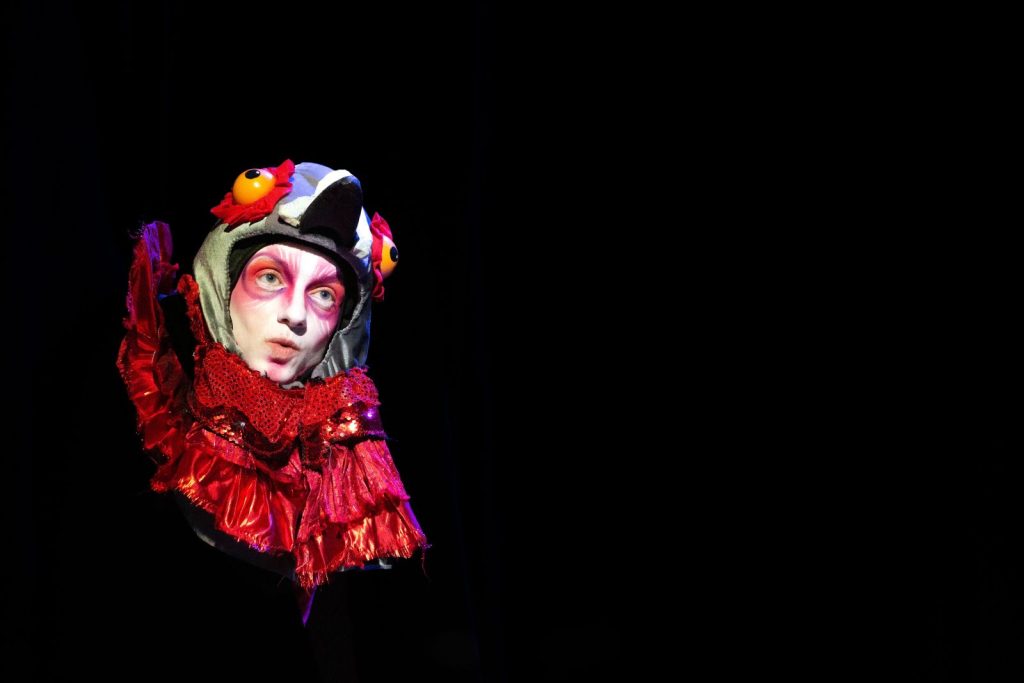
A brief outline of Bouffon; grotesque creatures are made with costume and physicality, to comment on taboos of the world. These clowns address these topics without barriers and put them almost uncomfortably into your face, leaving you not knowing whether to laugh, cry or be thought provoked.
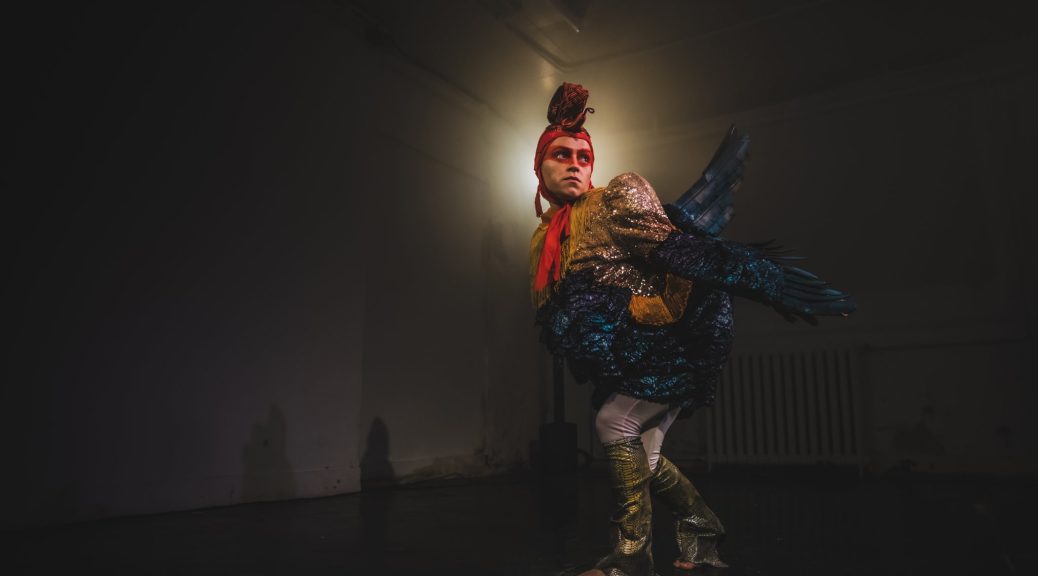
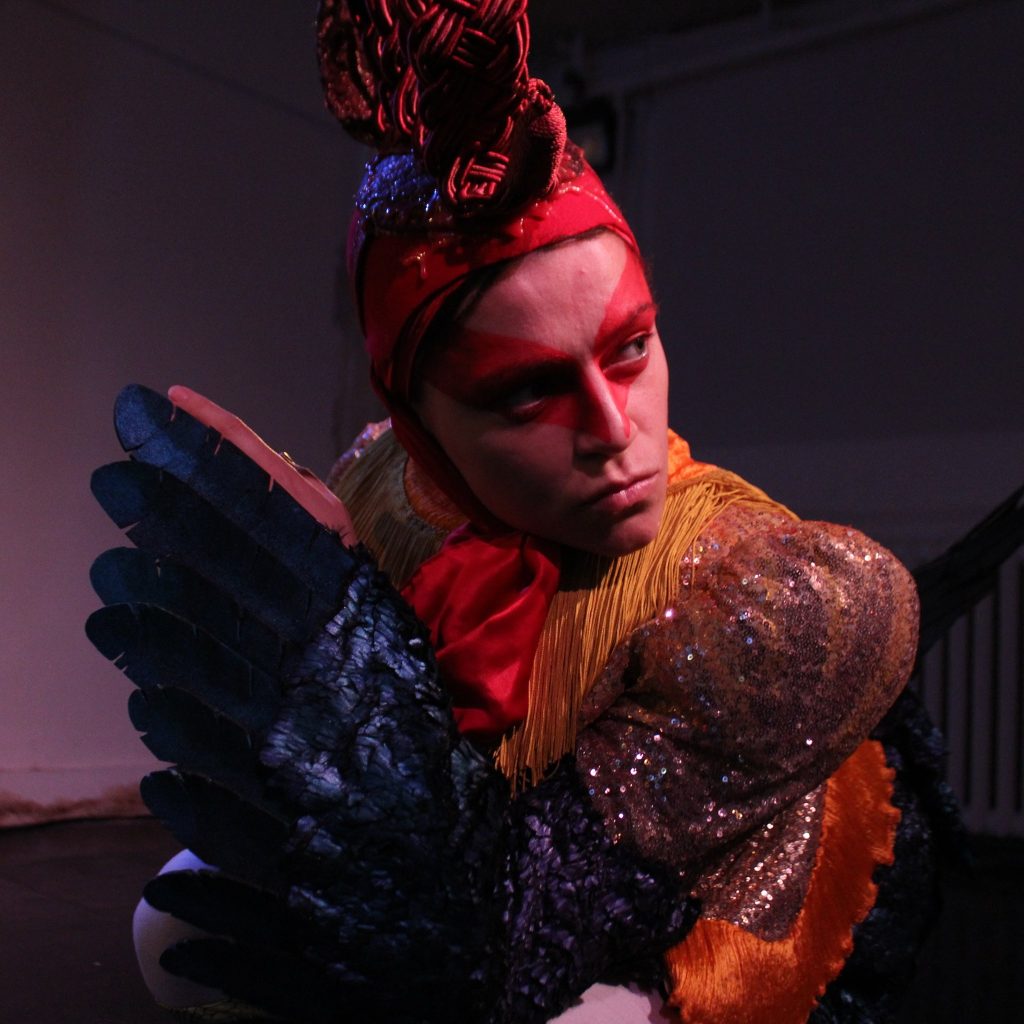
OMELETTEMACHINE, loosely based on Shakespeare’s Hamlet, addressing issues around family trauma, of power and mental violence and to some degree, of capitalism. A clowned chicken meets egg is forcibly made to work in his father’s butchery, unable to leave and tortured to massacre fellow chickens. He is unable to leave, and if so, commits punishments of almost cannibalism with “rotten” egg eating, smashing of eggs and chopping of chicken meat.
This production is very powerful; Bouffon aims to make the audience uncomfortable and Giacomin does this in spades. He isn’t afraid of addressing the audience, bringing them into the folds of his torture. This is through direct interaction, through the use of raw meat and blood-like liquid, through the beginning projection of live chicks in a factory. Real blades are used, unceremoniously chopping at raw meat; raw chickens still in tact and grotesquely danced on stage or come through the audience on a electric toy car. It’s these elements of surprise that are comedic but make you uneasy. It entirely and fantastically achieves what it is meant to, really making you think. And if you’re vegetarian like myself, there’s a barrier of disgust but admiration for the boundaries that are being pushed to make comments on these topics. A sense of “working for the man” comes to mind when Giacomin uses repetition to advertise his father’s butchers, with monotonous and repeated tasks and conversations. There’s the family trauma but also a sense of working for something and someone you are against.
Giacomin has the style of Bouffon on instant look; plumped up with padding and contorted physicality, he is comedic and difficult to look at, moving his face into an almost unrecognisable clown. When we reach the end of the production, he lays himself bare, releasing the shackles of his costume and returning to his natural features and this is when you truly realise the lengths he has taken in his bodily and facial contortion to create the character. If we had not seen him undress on stage before us, you would almost think they were two different actors. He is childlike, to meet the idea of his father’s control yet somehow uncomfortably adult, with the mixture of the two creating a feeling uneasiness. He is full of emotions of anger, of fear, of borderline mental illness and it makes it subtly chaotic, your body itchy with uncomfortability but entirely thought provoked. This is a triumph of Bouffon.
OMELETTEMACHINE is brilliant – it is everything that Bouffon is meant to be and leaves you laughing, uncomfortable and yet with a profound thought on family relationships and the capitalist world.
I love when you go to a production and come away having seen perfection.
The Messiah Complex, by Bag of Beard, is the Utopian, almost post-apocalyptic-world story of Sethian, interned in a mental asylum for his faith and the actions that lead him towards this situation. We see flashbacks of what happened along with what led to these, analysed within the controlling and manipulative asylum, equally flawed and equally cult-like. The story makes it hard to side with anyone within the story, both deeply poisoned in their thinking, but also very similar in their approach to life. A world where it is illegal to have faith, believed to lead to crimes, war, disease but those who control this belief, themselves, have arguable opinions and actions themselves. Two cults against one another.
The Messiah Complex in its aesthetic and narrative very much made me think of The Royal Court Theatre and their productions – greeted with Sethian already in a trance, he is surrounded by a square of light with projection images running behind him – very abstract and visually appealing, creating an atmosphere instead of waiting for it. The narrative being easily believable yet also wide enough a concept to be almost futuristic.
I could not distinguish a “better” performer in the production. All very different characters, all were entirely formed, believable to the point of feeling intrusive; we could have cut the fourth wall away and be looking directly into the house, the cell, their world. Sethian is kind, he is clearly in love and at the same time, clearly influenced and mentally affected by this. His wife Sophia is likeable, but clearly powerful and influential, convincing Sethian with her looks, her love, her mind to believe in the religion, the cult and he will do anything to satisfy that. The nurse, also entirely influenced, if not also brainwashed by the government and information of the time, has a level of authority and vacancy of emotion, but at the same time is frustrated and wants to help – she is human despite her initial appearance.
All three interact with one another impeccably, their relationships clearly formalised well and this gives levels to the production, feeling the real emotion and connections. The Utopian but entirely possible story line is visualised easily before our eyes and gives you a trembling feeling on inevitability; the emotions shown especially by Sethian adding to this realism.
The Messiah Complex, while only at their first run of the show, is already perfection. It has the right levels of fiction to potential fact, easily supported by the clearly skilled and full embodiment of the actors of their characters and the story. It is heartbreaking but also quite frightening in its realism. This is a play not to miss and meant for a larger stage for sure!
I am sad that, with this likely the last Vault’s Festival, I haven’t had the chance to visit as much as previous years. But how intriguing, to come across two pieces of Queer Theatre, touching on similar themes.
Acid’s Reign is a drag show come informative theatre, highlighting in a cabaret yet theatre narrative, the impact of various pollutants on the World and how it is slowly being destroyed. When I say that there are similar themes, Queer Planet and Acid’s Reign both touch on nature and the element of same sex or a-sexual animals that is not taught in biology class. It was interesting that these were approached for different reasons, but also really great to see different genres of Theatre taking up the political and educational baton with their shows.
Acid’s Reign uses various Drag Queens and Kings to feature as representations of nature – Acid (Joshua Oakes-Rogers) themselves are the “bad guy” that faces support towards redemption, representing a younger character to highlight generational attitudes towards the environment. They are witty, funny, and time of corpse-ing or loss of lines is hilariously well managed, creating layers of comedy and enjoyment that was unintended. They want to build a series of clubs because the World is beyond repair and this is where Mother Nature, played by Son of Tutu (Everybody’s talking about Jamie, film) begins a Christmas Carol style story of different “ghosts” visiting and trying to change Acid’s mind. Son of Tutu holds the stage, certainly embodying the Mother image but also had incredible comedic effect, even in the background.
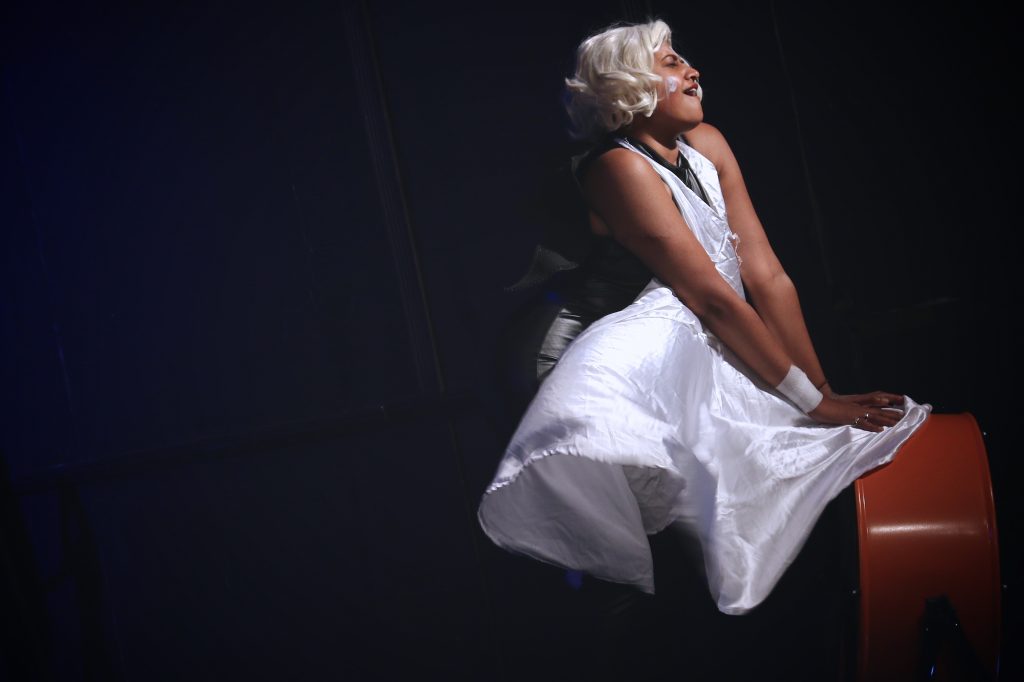
Scarlett Harlett (Ru Paul’s Drag Race UK) plays the insatiable A-shell, Queen of the Sea, with her wall-shakingly amazing singing voice and continuous innuendo, her character reminding me of a dirty old Hollywood star meets Patsy from Ab Fab. For me, she stood out the most. Maybe some as a Drag Race fan, but I also felt she really commanded the stage and was always on point, even if not at the centre of the story.
Jamie Fuxx brings some masculine energy as our Drag King, Land, bringing yet another incredible singing voice to the mix and some hilarious tongue n cheek dirtiness to the stage. They slot into the cast impeccably, adding to the cacophony of different voices and characters.
Finally, Air is represented by audio, apt in what it is represented. The characters are enveloped with this, as if air can move and embody different persons and helps to culminate the activity and story. Acid is redeemed, and along the way we have been given nuggets of educational facts, some known, some unknown, tinged with comedic effect but also clearly affecting Acid in their solemn response and over all change of heart. We equally come away entertained, but thought provoked.
Acid’s Reign has a cast of incredible talents, all with their own approach and techniques but all with incredible voices and typical comedy skills from Drag/Cabaret shows. But something was missing for me. Perhaps it was just that the show needed a clear format – is this a traditional Cabaret show, where there’s an element of improvisation and crowd inspiration. Is this a musical and therefore represented by the songs that are changed slightly for the message. Or is this a straight play, with the addition of song, trying to bring a message and sticking to a written script. There’s nothing to say that any of it needs to be put in a certain box and cannot be more than one of these things, but at times it felt like too much was trying to be achieved and so lost the spark and perfection of a fully formed production. This clear path may come as a result of many productions, of working on it over years, and we may just be at the beginning of its development.
Acid’s Reign is a brilliant show – it is funny, it is informative, it is entertaining and a feast for the eyes. However, likely still in its infant stage of production, there is so much potential for the show, with the ability to open an important theme to an ever increasing audience as Queer Theatre and Drag comes more mainstream.
Have you ever thought of how hetero-normative nature documentaries are. No? Bi-Curious George has, and they are here to shake the natural world.
This is a Drag King, Cabaret show like no other. Comedic, yet informative, this is a live, stage documentary with song, dance, comedy and a whole heap of camp. Think of a Queer David Attenborough meets Steve Irwin. Then triple it and add some comedy and sparkle.
George is a natural on stage. A performance of sheer perfection, we all felt as if we were their friend, as they interacted with us one by one, whether that is by audience interaction or just general eye contact. There are a many people in a room but we are all welcomed. They also made sure that everyone was comfortable – usually audience interaction is something forced upon participants, but George begins by ensuring we are comfortable at the door and then early on, giving us a signal just in case. This is a safe room and that is brilliant to impose upon within a production without taking away its essence or interrupting the discourse.
George brings us a range of factual stories of real animals, real queer relationships, intercourse, courtship and unions. But this is enhanced with songs that have been changed to fit queer narratives, with effective and, in themselves, comedic costumes and guests. The guests themselves are excellent – a singing shrimp, a almost mute magician making balloon animals from plastic bags (trust me when I say, it is something to behold, as this act was of pure genius) which add different levels and elements to the overall production, adding in the cabaret element, with George as our compere.
Queer Planet is probably one of the most genius ideas for a production I have ever seen. It is so excellently executed, with perfection as a performance, informative as a piece of education, yet at the same time, creating a easy safe and welcoming space for all with comedy, pizzazz and genius yet ridiculous concepts and costumes.
I think most people have heard of the famous Emperor of Caligula; a fierce ruler, with many a famous story about him, like any infamous Roman Emperor. Roman tales are rarely of happy exploits and kindness. And this has not stopped here.
Caligula and the Sea is a growing of age tale of Caligula, from boyhood to ruling an empire. With this, growing through adolescence and adulthood, through turbulent relationships with the God of the sea and his closest companion and how easily power can destroy those innocent relationships.
The production itself has taken an interesting approach; dressed in 1920 – 1940’s garb, there are still elements of ancient Rome, with miniature columns in the garden to Roman armour, it brings a modernity to the story, yet harking back to its roots. However, it did seem a little out of place and there wasn’t much to tie this together with the overall production or story.
The scene they created, with the overbearing blue sheet representing the sea, using this for movement and puppetry was well done and it added to the imposition that Neptune has in the narrative. It was a centre piece to the production, always looming and always above Caligula. It was in itself a visual metaphor to his downfall after thinking he was more than of the immortal power.
Neptune was represented as the waves, as a warrior, as a woman, as puppetry creatures, and this was interesting and mesmerising in the work that went into the different physicality and puppetry skills. It added to the concept of Gods being able to shape shift upon the Earth, yet they were also never frightening. The was something trustworthy, echoing Caligula’s relationship with the God.
The main performers of Caligula and Chaerea had a natural magnetism to one another; bouncing off each other as friends, as brothers, as lovers. In the blink of an eye we see their entire relationship as it evolves and the moments that it goes all too wrong. The heartbreak and turmoil – it becomes evident in Chaerea’s performance and you want only to reach out and support him.
Caligula and the Sea is a unique telling of the story of Caligula’s life and has many theatrical elements to enhance this summary of his rise and fall. It only felt a slight disconnect in the over all aesthetic and felt it would either benefit from completely immersing in one era or the other.
Creating opportunities for a diverse range of people to experience and respond to sport, arts, culture and live events. / Lleisiau amrywiol o Gymru yn ymateb i'r celfyddydau a digwyddiadau byw