
Tag Archives: Cardiff

REVIEW: BLUE at Chapter Arts Centre by Gareth Ford-Elliott

 out of 5 stars (5 / 5)

Blue is a powerful drama set by the Welsh, Carmarthenshire coast which centres around the Williams family dinner in the looming absence of a father figure.

The play starts when daughter Elin brings former teacher, Thomas, home to sleep with him. However, to Elin’s surprise her brother is in and her mother home early. A confusion over Thomas’ presence ensues and drives the play forward.

Thomas finds himself awkwardly caught in a family argument under tragic circumstances but is ultimately the trigger for improvement and progress amongst the family.

The writing from Rhys Warrington is brilliant. Meticulously paced and incredibly detailed, the script starts out light-hearted and funny but as it progresses, and delves deeper into the characters, we notice something isn’t normal. At no point does anything feel forced, the play flows naturally and develops with great care.

Blue is subtly political in talking about lack of funding for the NHS. But doesn’t stray from the importance of the characters involved whose lives are being ruined by these cuts.

It’s fair to say, Rhys Warrington is off to a great start with his first feature-length play and I can’t wait to see what he writes next.

The direction from Chelsey Gillard is simply stunning. Every aspect of the script is explored diligently. This play could have been easily mismanaged but Gillard controls it masterfully. Beautifully allowing performers time to draw scenes out and the design elements to set the scene. Chelsey Gillard is forging a name for herself as one of the pioneering directors of contemporary Welsh theatre and her achievement with Bluehas only boosted that claim.

The performances are exceptional from every performer. Sophie Melville is brilliant as Elin. Proving once again what a talent she is, Melville encapsulates the final stages of teenage angst with growing mid-20’s maturity brilliantly.

Gwydion Rhys plays Elin’s shy brother, Huw, expertly. His eyes lighting up the moment Thomas asks about Minecraft. A heart-breaking and simultaneously heart-warming moment as it’s clear this is the first time someone has taken an interest in his interests outside of his online alternate-reality. We can all relate in some way to Huw and Rhys’ portrayal is a testament to this.

Jordan Bernarde’s performance as Thomas is handled with as much care as the character is attentive to the others. We can sense Thomas’ awkwardness and even though we’re aware he’s really there to sleep with Elin, we see his kind-hearted nature too. It’s only when Thomas exits the play that you realise the impact Bernarde’s performance has on the production.

Choosing a standout performance is near-impossible, but if we are to do so, it has to be Nia Roberts in portraying the matriarch figure, Lisa Williams. Everything is perfect from Roberts in this performance. At the mention of her husband, everything about her character changes, from tone to body-language – perfect. This performance will standout as one of the best in Wales this year.

The sound design from Tic Ashfield is very understated and effective. The sound mostly soothes into the background, almost unnoticeable if you’re not looking for it – but is powerful and essential to the production.

Oliver Harman’s design is simple and functional. Detailed to what one would expect any living/dining room to look like, with nothing left to waste. The blue door is, in particular, a nice touch.

Ceri James’ lighting is an essential tool for setting the mood, which James does excellently. Subtly changing throughout and providing a nice alternative to blackouts between scenes which is specifically good. The slight blue tint in some of the lighting is also lovely.

It’s frustrating when a production leaves the design elements as an after-thought and whilst it’s very subtle in Blue, the design, on all fronts, contribute hugely to Blue’s artistic success.

It’s important to stress what a team effort this production is. Huge credit must also go to Rebecca Jade Hammond for creating and producing this piece, as well as all involved at Chippy Lane and Chapter in the making of Blue.

BLUE is a heart-breaking drama about a family split in their grief of a father figure who is both no longer present and not yet absent.

BLUE performed at Chapter Arts Centre, Cardiff
World Premiere 5th – 16th February 2019
Running time approximately 90 minutes
Created and Produced by Rebecca Jade Hammond
Written by Rhys Warrington
Directed  by Chelsey Gillard
Cast:
Elin – Sophie Melville
Thomas – Jordan Bernarde
Lisa – Nia Roberts
Huw – Gwydion Rhys
Designer: Oliver Harman
Lighting Designer: Ceri James
Sound Designer and Composer: Tic Ashfield
Dramaturg: Matthew Bulgo
Co-Producers: Chippy Lane Production and Chapter
Stage Manager: Bethan Dawson
Production Assistant: Sophie Hughes
BSL Interpreter: Sami Thorpe
Photography: Kirsten McTernan
Marketing and PR: Chloe Nelkin Consulting & PR

REVIEW: Laurie Black: SPACE CADETTE at The Other Room by Gareth Ford-Elliott

 out of 5 stars (3 / 5)

Laurie Black is sick of humankind and decides to take us on her journey to be the first woman on the moon. A contemporary cabaret show that showcases Black’s musical and comedy abilities through her quirky, green alter-ego (who might not be an alter-ego).

Black takes us on her journey
escaping Earth and encountering David Bowie’s alien spaceship (yes) before
landing on the moon. The journey, which takes three-days but feels like an hour,
is a fairly simple one as far as plot goes but exists to give context and thematic
links to the main event of comedy and music.

Black’s music is a varied mix of genre that, for the most part, has a somewhat futuristic feel. She exploits the sounds of synths, piano and a small drum machine well on stage. But, it is Black’s enthralling voice which captures the audience the most. Not relying solely on her voice however, Black is also a great songwriter using witty pop culture references, the occasional political statement and comedic wordplay.

Mostly original music,
there are some covers of popular songs in Space
Cadette.
Starman by David Bowie stands out as a strong point where the
audience are encouraged to sing along with the “la, la, la”s. There are also covers
of Radiohead, Muse and Leonard Cohen as well as a funny reference to The
Proclaimers.

The comedy and storytelling that comes between the songs was usually good. Nothing to make you belly-laugh, but enough to keep you interested. It is fair to say also, that the comedy suffered due to the low turnout on the night. Some jokes are sleepers which will have you chuckling two-hours after the show as you walk home in the rain – which Black correctly predicts.

The stage set-up is simple.
For the most part it’s just a microphone stand and a piano. This worried me at
first, but as the show goes on, it isn’t an issue as Black keeps the attention
on her. Except for one moment when she gets out her mini-moon that she passes
around the audience.

There’s a lot of frustration in the show that gets channelled into humour and songs. On Black’s journey to the moon, we see further into her persona and whilst the outer-shell is hard, by the end we can tell she secretly loves us. There’s no particular agenda to the piece but an overriding theme of frustration at the current state of the world.

Space Cadette is part of The Other Room’s ‘Spring Fringe’ curated spring season. One of eight shows coming to Cardiff’s only pub theatre over the next eight weeks. Tickets can be found for Space Cadette and other Spring Fringe shows HERE, with an ever-growing discount for the more shows you book. If you can’t make the show, but like the sound of Laurie Black, you can find her music on most streaming services online.

Space Cadette is
an enchanting, funny cabaret show from Adelaide Fringe 2018 winner, Laurie
Black. An exploration to the moon that has so much to say about Earth.

SPACE CADETTE at The Other Room, Cardiff
5th February – 8th February 2019
Created and performed by Laurie Black
Technician: Garrin Clarke

Review: BOOT by Phill Brewer at The Atrium by Gareth Ford-Elliott

 out of 5 stars (3 / 5)

BOOT by Phill Brewer, the debut production from Volition, is a chilling exploration of events in its protagonist’s story. Refusing to adopt a chronological form, Brewer’s style of monological storytelling perfectly matches the harsh world and erratic character he creates.

In essence, it’s a romantic tragedy that follows a man who, rightly or wrongly, can’t let his love for a woman go. He goes to extreme lengths to protect her physically and emotionally, sacrificing himself in the process.

A lot of people would portray this as a classic showing of toxic masculinity. With the violence, male entitlement and refusal to show weakness – it certainly can be interpreted that way. However, Volition’s aim is to represent a character’s voices, in their own words, and present them to an audience. Allowing the audience leave with their own opinions of that situation.

On the other hand, whilst BOOT has those classic tropes of toxic masculinity, the protagonist doesn’t gain from the situation. It’s a character who is as much a victim of circumstance, as he is of his own actions. Seeing it through his words, we see his perspective and reasoning, rather than simply blaming toxic masculinity.

You can read it in many ways, or merely as the story without the social-political views. It’s this viewing experience that separates Volition from various various other theatre companies. Often people ask, “what is the message?” Whereas for Volition it’s more, “what did you think?” It’s a really fresh take for modern theatre that seems to be obsessed with artist’s voices and messages – not that there is anything wrong with that, but certainly room for both.

The play starts in the boot of a car with the male protagonist and that is where it ends. The writing from Phill Brewer is smart in its aim to present the protagonist’s story in his own words, as in between the bumpy ride, we see the turbulent story that brought him to this position.

It starts at the right place, hits the right notes throughout and ends leaving you with the perfect balance of satisfaction and intrigue.

There is room for it to grow as a script. Generally some sharpening and a little addition of humour wouldn’t go amiss to help bring out the character. But overall it’s a really solid script with massive potential.

Written as a monologue, Rebecca Riley makes a good decision as director to perform this as an ensemble piece which brings the script to life really nicely. It’s paced well with the only real issues being minor blocking ones and, at times, an issue of tone.

The play starts at 100, with the protagonist freaking out. This just feels a bit intense to start and, whilst it makes sense, could do with some work as it somewhat kills the opening ten-fifteen minutes. Especially as we never really build back to that level.

The direction of the ensemble is really nice from Riley, who uses physicality beautifully to add to the piece.

The acting from lead, Connor Hughes, is strong. The moments of clear emotion are great, but Hughes does a good job of also showing what’s bubbling underneath. Because of this, it’s really easy to know what the character is feeling and everything from the script makes sense on stage.

The ensemble generally do a good job of bringing the piece to life and really help with the pacing of the script. There are a few instances of over-acting from the ensemble members, which may well be a directing issue, that sometimes takes focus away from the lead. But, overall a good addition to the production.

BOOT shows a level of lighting design I was not expecting coming in. The use of red lighting is really evocative, as well as the box light to represent the boot of the car. In this aspect, Zach Ashley did a really good job.

It is a shame there isn’t more explored in the sound design. This can be put down to lack of resources and time. However, often the noise of moving ensemble takes away from the show. More sound design could cover this and add something of its own. But generally, the design aspects are above expectation.

There is room for improvement with this production, especially in nailing the ensemble work, a little work on the script as well as incorporating the design elements that feel missing. But, on the whole this is a really enjoyable piece of theatre with a really interesting discussion to follow it.

BOOT has real potential, perhaps let down by the lack of time and resources afforded to it. A great script, visionary director and a solid lead make this a really promising debut from Volition.

BOOT performed at The Atrium, Cardiff
From December 11th-12th 2018
Presented by Volition
Written by Phill Brewer
Directed by Rebecca Emily Riley
Stage Manager – Zach Ashley
Cast:
Connor Hughes
Tasha Walton
Sergio Taddia
Tilly Jordan
Jose Pedro Fortuna
Photo Credit – Adam Robinson

Preview: BOOT by Phill Brewer and Volition

Boot by Phill Brewer is a new play coming to Cardiff on Tuesday 11th and Wednesday 12th of December 2018. The debut production from new theatre company Volition, will be performed at The Atrium.

Set in Swansea, Boot follows an unnamed man trapped in a car boot who ponders over the events in his life that led him to this position. It’s a dark comedy that studies one man’s inner conflict and ambition in an ever changing world, presented as a mix between gritty realism and abstract physical performance.

Originally performed as a one man show at a sell-out performance in Matthew’s Yard, Croydon, Boot has since been developed by Brewer and reworked into an ensemble piece by Rebecca Riley (director).

The inspiration for some of the stories and scenes come from things that Brewer has witnessed in his time growing up in London. Some personal experience, stories from friends and general experience from the streets of London.

The aim of the piece is to present the story and let the audience decide for themselves the morals of the situations. Both Brewer and Riley say they want the audience to leave divided and talking about the show.

“BOOT is the perfect piece of writing to work on for me as the character is both the antagonist and the protagonist of his own story. His
battle is one of inner conflict, something that is universally relatable.” – Rebecca Riley, director.

The company, Volition, is made up of Phill Brewer and Rebecca Riley. Long-term friends who studied theatre together at Brit School of Performing Arts and Technology and now live in Cardiff.

The aim of the company is to provide a voice and platform for young people whilst creating theatre that is ambiguous, not making comment or judgement.

Rebecca Riley (centre) and Phill Brewer (right) with lead actor, Connor Hughes. Photo Credit Adam Robinson


There is a rebellious vibe about the company – but one that is very open to discussion and passionate about theatre as a means for discussion. Boot seems the perfect place for this exciting new company to start and the audience are key to their work so get your tickets here to be part of it.

BOOT performed at The Atrium, Cardiff
From December 11th-12th 2018
Presented by Volition
Written by Phill Brewer
Directed by Rebecca Emily Riley
Stage Manager – Zach Ashley
Cast:
Connor Hughes
Tasha Walton
Sergio Taddia
Tilly Jordan
Jose Pedro Fortuna.

Review: Humanequin at Wales Millennium Centre by Gareth Ford-Elliott

 out of 5 stars (3 / 5)

Humanequin by Kelly Jones is a groundbreaking collection of three stories from young transgender people in South Wales. It is raw in its monologue format and informative in its direct approach.

The stories come straight from real life and that reality is enhanced by having three transgender actors on stage. The fact that Humanequin is the first transgender play, with an all transgender cast performed in Wales, makes it truly groundbreaking. And the production is stronger for it.

The thing with this production is, it isn’t necessarily about the theatrical quality, that I am reviewing here. It is much more about what we as an audience take away from it. This is about telling and normalising the stories of transgender for the people of Cardiff and wider society. So to start without mentioning that would be a disservice.

The direction of this production from Jain Boon could be stronger. There is some nice blocking and movement in this piece. And moments that are strong. But overall, it lacks the intensity necessary for a piece like this.

Sammy Woodward stands out as the actor with the most emotional range and they really feel in the moment with their character. Emily Joh Miller grows into her performance whilst Harry Bryant keeps a steady pace throughout. The three work quite well together, but there is that lack of intensity and chemistry between the three.

Georgina Miles’ set design is simple, yet effective. The most prominent pieces of set are some blocks and three metal grates that get moved around to change the setting. There is also a tree with tags for leaves. On these tags are written names of trans people who have been lost over the years. This tree is a really nice touch and whilst not actively used in the performance, watches over the actors and certainly adds a lot. The set is nothing extravagant, but effective in its job.

Chris Young’s sound design is really complimentary to the production with Ceri James’ lighting design representing the emotion of the piece well. The main criticism for these two is there isn’t enough. At times these aspects of design are really strong, but in others they are absent, in a way that doesn’t translate well.

As a cis woman, Kelly Jones takes on a big task of writing for a group of people we very rarely hear about. But, a task she handles well as far as the content goes.

It’s more Jones’ playwriting that lets her down. It’s not a bad script by any means, and as a piece that is ultimately meant to educate, it does a very good job. But as a compelling piece of drama it is lacking.

The three intertwined stories told as monologue is a form I personally love, but here it doesn’t work for some reason.

Characterisation also gets lost in an attempt to normalise the characters. Aspects of their personalities seem trivial. As well as this, some of the politics is very on-the-nose. Not an issue in itself, but again, it just doesn’t feel right here. It seems forced. Something that is maybe necessary for the piece, but needs to be worked into the production in a stronger way.

One decision made in the writing process that was really good, was to not make every story all “doom and gloom”. It would be easy to make this a sympathetic piece of theatre that looks at the struggles of trans people with the far too often real life consequences. And that reality is not ignored here. But neither is the reality that these are people. They act out, they do things that seem irrational at the time. But like any good playwright, Jones examines and explains them by the end of the story.

Perhaps in another performance context such as being held in a different venue, at an earlier time, in a school or university, as part of an education programme or whatever it is, this could be a fantastic production. And for people who know little about trans-issues, this would certainly be a very informative and emotional way to be introduced to these issues. So that must be commended. But, for the audience that, on the night I was there, seemed very clued up on these issues, it perhaps lacked the dramatic value that we go to the theatre for.

Not necessarily to be entertained, but to leave having found or felt something. And whilst for an audience without knowledge of trans-issues, this would be great. For those with that knowledge, it doesn’t offer much.

If this piece moves forward, the decision needs to be made whether this is an educational piece or a different form of theatre. Because both have their place and both are necessary for the growth of trans-theatre and the awareness of trans-issues in wider society. But this just feels like it’s biting off more than it can chew.

Humanequin is a strong, educational piece of theatre about the experiences of young transgender people in South Wales. Its flaws pale in comparison to its importance.

Humanequin by Kelly Jones
Performed at the Wales Millennium Centre
Presented by Mess Up The Mess Theatre Company, Youth Cymru and TransForm Cymru.
Performed by:
Sammy Woodward as Rae
Harry Bryant as Max
Emily Joh Miller as Meg
Directed by Jain Boon
Designer: Georgina Miller
Sound Designer: Chris Young
Lighting Designer: Ceri James
Stage Manager: Katie Torah
Technical Assistant: Dawn Hennessey
Producer: Jay Smith
Creative Assistant: Kay R. Dennis
Community Artist: Bill Taylor-Beales
Education Producer: Rachel Benson
Artistic Director for Mess Up The Mess: Sarah Jones

Review: The Island at Oasis Cardiff by Gareth Ford-Elliott

The performance of The Island by Athol Fugard, John Kani and Winston Ntshona from Fio at Oasis Cardiff, a community centre for refugees and asylum seekers, was a beautiful way for anyone to get introduced to Fio.

It wasn’t a classic “theatre night”, but more a community evening that had a play at the end of it. There was food served originating from various different countries, the opportunity to have your photo taken and talk with other audience members and refugees from all over the world.

All this before Oasis World Choir, a choir of refugees, took to the stage to perform, inviting the audience to sing along. They performed a mix of pop songs and songs written by themselves. It was a real mix of cultures brought together by music and truly was a beautiful thing to witness. The general themes of the songs were about hope and unity.

As someone who grew up in a close-knit, music based community in West Ireland, it took me right back to that community feeling. But this was totally different, a group of people from all over the world, from various backgrounds.

Some of the music was brilliant. Some of it was a bunch of people having a sing-song, the choir and the audience which was fun. But there were some really beautiful individual performances from various members of the choir.

The Island from Fio

 out of 5 stars (3 / 5)

The Island follows two black prisoners, John and Winston, who rehearse and perform a theatrical version of the Greek myth of Antigone during their time on Robben Island in Apartheid South Africa. Based on a true story, the two prisoners use this play as a way to speak about the current state of affairs of their country. It is a story of brotherhood, jealousy, oppression and protest with an important message of equality at its heart.

The play, originally performed in 1973, has its issues. There is a lot of character building, but a lack of character motivation at times. Whilst there are moments of real importance, the energy of the play stagnates too often. The restrictions of censorship in Apartheid South Africa when this play was written is a reasons for this. Only touching on certain issues that couldn’t be explicitly spoken about in detail. Whereas for a modern audience, in full knowledge of the realities of apartheid, it maybe doesn’t hold the power it did in 1973.

That aside, it tells an important story of struggle against the state. A story that is as relevant around the world today as it was in 1973. You could tell similar stories about the prisons in the USA, Brazil, North Korea, Thailand and even in post-Mandela South Africa. And despite the lack of detail and skirting around the harshest of realities, when this production does suck you in, it is hard not to feel it.

Because of the possibility of telling this story anywhere in the current world, you have to question Fio’s choice to cover this time period. Why this piece? Why now? What is it saying that is new? The answer to that last question is, nothing. We are not getting anything new. If anything, this is a watered-down version of what happened.

However, it is important to learn from history. And Fio were not making this piece of theatre to say anything new. They were making it to speak about the past of South Africa and how we, as the UK, move forward with commonwealth nations considering the past we share. Fio are clear to state the UK’s complicity in South Africa’s apartheid period.

I must mention that it does feel wrong to criticise a script written in a state of censorship. If you’re familiar with Iranian film, an industry full of censorship, you will know how much allegory is relied on to criticise the state and how often details are left to interpretation. The Apple (1998), written and directed by Samira Makhmalbaf, takes the real life story of two young women locked up by their father, and combines that with the symbolism of an apple, a symbol of opportunity, temptation and “the fall of man”, to speak about sexism in the country.

Is it the pinnacle of filmmaking? No. But you don’t get screened at Cannes for nothing. And The Island didn’t win Tony Awards for its technical playwrighting. But more for what it meant at that time.

Less about Fio’s choice to stage it though, Abdul Shayek’s direction fluctuates as the play progresses. The parts that stand out in the script are expressed well in this production. Most of the play is handled with care and directed to good effect. But there are areas that stagnate, times where the energy drops and moments that seem to lack importance.

The design was the strongest aspect of this production. The set was simple, yet effective. Four metal poles holding up a caged ceiling. This set was utilised well by the actors and combined with sound and lighting design, works well together, particularly in dream-like sequences, to produce emotive design. In a space like the Oasis, effectively a sports hall, this is not an easy feat and they deserve credit.

Performances from Joe Shire and Wela Mbusi are both strong. Portraying a brotherly relationship that shows real love, yet also jealousy. The moments of intimacy are beautiful, however some moments of conflict early in the play seem forced. The movement from the performers at times is really strong, which movement director Andile Sotiya deserves credit for.

The Island from Fio split my opinion a great deal and I still can’t decide, in my opinion, whether Fio made the right choice in staging it. Aspects were brilliant, but other parts fell flat. On one hand telling stories about history is important. But on the other hand, was this the right play to put in front a 2018 audience in Wales? Especially viewing it on this night, sharing a room with refugees, I couldn’t help but want to hear their stories more than one I have heard a thousand times. Stories that affect the present. But then, what is the present if we ignore history?

Overall though, the piece was an enjoyable piece of theatre, both from a general spectators perspective and from a critics perspective. Plenty to talk about afterwards both artistically and politically. Not to mention, the event as a whole was really beautiful and made for a heart-warming evening full of hope.

The Island by Athol Fugard, John Kani, and Winston Ntshona
Presented by Fio at Oasis Cardiff on November 9th 2018
Director: Abdul Shayek
Winston: Wela Mbusi
John: Joe Shire
Movement Director: Andile Sotiya
Lighting Design: Ryan Joseph Stafford
Sound Design: Dan Lawrence
Design Consultant: Becky Davies
Stage Manager: Jeremy Barnaby
Executive Producer: Shane Nickels
Producer: Nicole May
Assistant Stage Manager: Cait Gerry
Assistant Director: Yuqun Fan
Assistant Producer: Jasmine Okai
Community Engagement Officer: Naz Syed
Audio Description Consultant: Alastair Sil
Caption Consultant & Creator: Ben Tinniswood

Review of Cardiff Boy at The Other Room by Roger Barrington


 out of 5 stars (2.5 / 5)

I was almost a Cardiff Boy. My elder brother is. Unfortunately for myself, in a moment of extreme recklessness my family moved from Cardiff after my brother’s birth and so I became, a Brecon Boy… that was the start of my problems! I have always wanted to be a Cardiff Boy –  well, until last evening.

Kevin Jones’s monologue tells the story of an invigorated Testosterone  angst-ridden Cardiff teenager and is based partly upon his real-life experience.

Our protagonist is a sensitive artistic lad, existing in the hurly-burly of Welsh laddish behaviour, drunken binging and alpha male aggressiveness. I’ve experienced this myself, although in a slightly different capacity when as a leftish orientated serving police officer, I was out of alignment with the vast majority of my colleagues, united in preserving the status quo. For the sake of fitting in, sometimes I had to say things or act in a way that was naturally alien to me. So, I get our hero’s situation.

Being a typical teenager, he is struggling to find his place in society and lacks self-esteem. Instead he prefers to act as a voyeuristic photographer, surreptitiously sneaking pictures of his mates in varying states of sobriety. With numerous references to Cardiff locations, you are shown that the nature of your social interaction is largely dictated to by your environs.

It is a nostalgic play. Looking back to the 1990’s and in particular the popular music of that period, that reminds us how important that sensory pleasure can influence our life and our relationships with our friends.

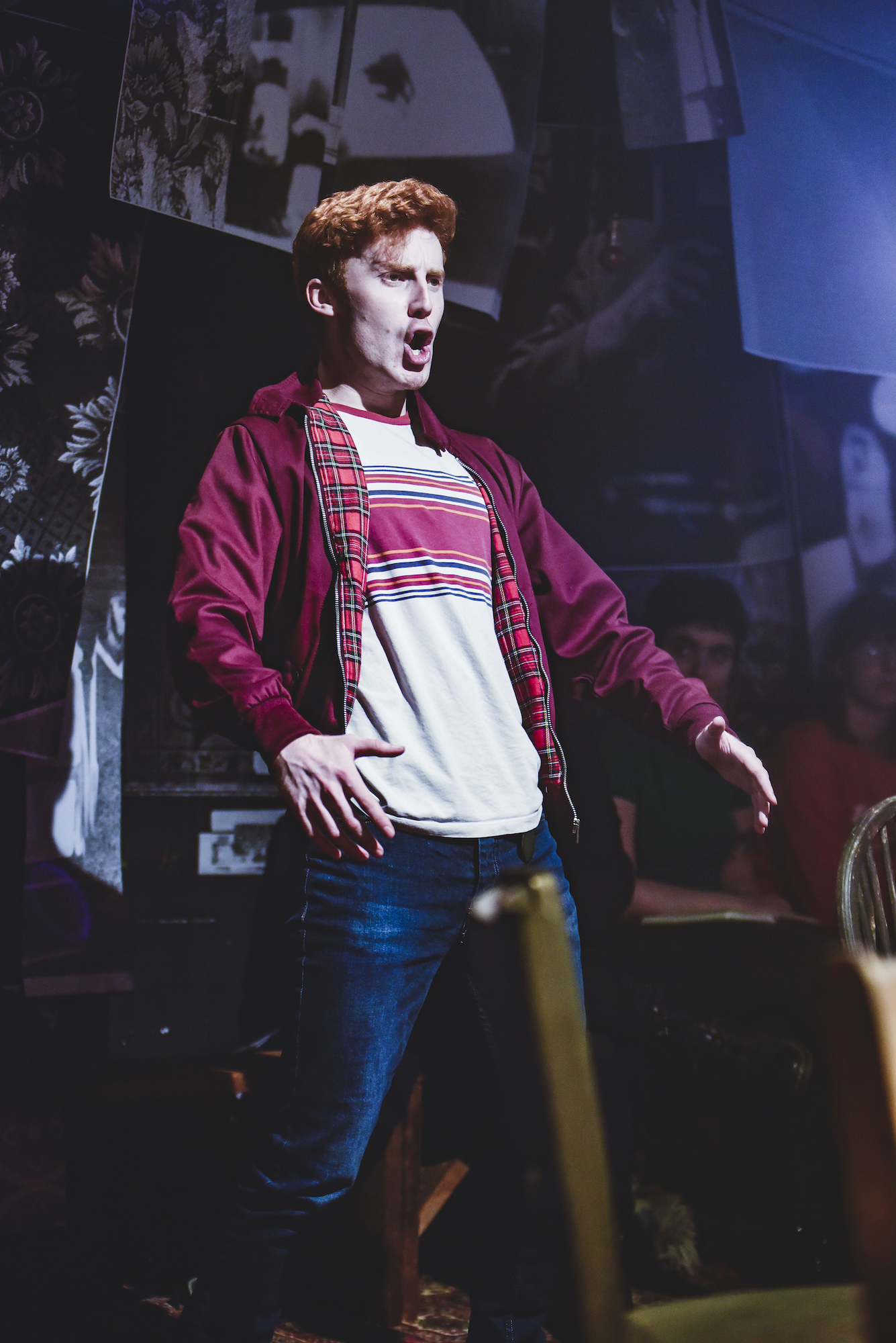
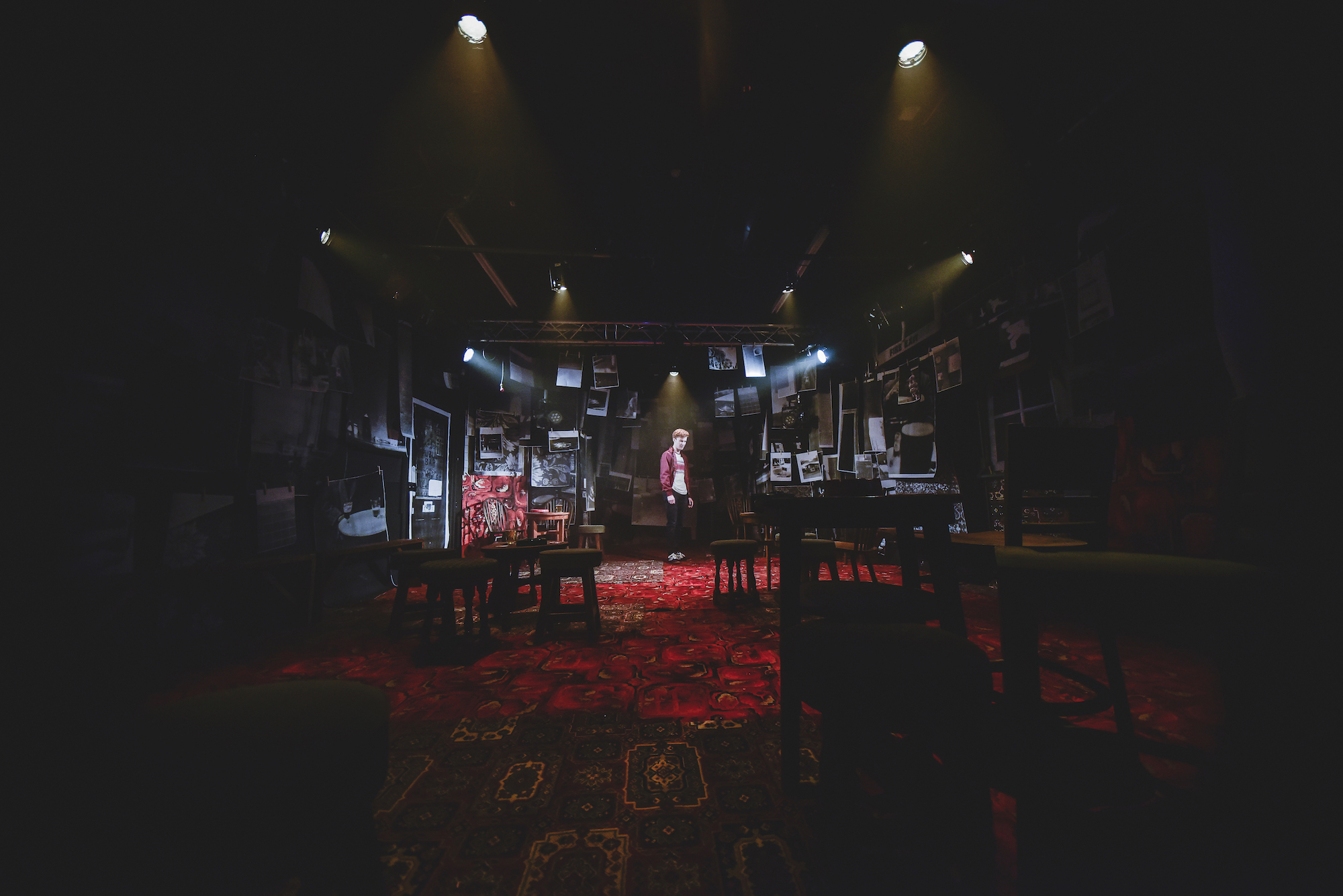
The first part of the playlet is the best. Actor Jack Hammett provides a likable, engaging character and he energetically glides around the room engaging members of the audience with direct eye contact. He is able to do this due to the created space being a rather dingy bar setting with tables and chairs  located around – a kind of Aberdare’s Moulin Rouge. 

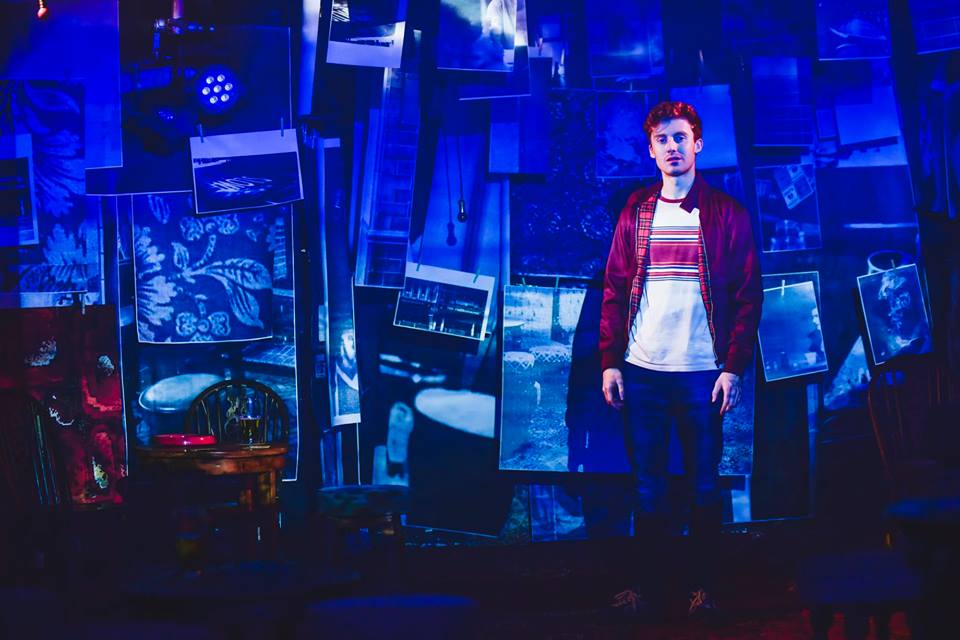
Surrounding the room are photographs pegged up – obviously our guy’s work. Lighting is used creatively and overall the direction and design work well enough.

However, where the play falls down is the decline into a more melodramatic second part which leads you to the ultimate destination; that it sometimes it takes a tragedy to discover the meaning and value of friendship.

The dialogue is fairly sharp and there are funny jokes within the script, but despite this and Jack Hammet’s likeable performance, upon reflection you realise that this is rather slight fare.

I must include a caveat here. The nostalgic setting of the 1990’s, (music, early reference to Princess Diana seeking a divorce etc), reminded me that I was in middle age when the action would have taken place. My own experiences of this nature occurred in the 1970’s. So I think I probably have a very different perspective of this play to the rest of the audience on the press night I attended.

This isn’t the first time that I have felt out of place in Caridff Fringe Theatre – the Festival back in the early summer is a case in point. It appears to me that the Cardiff Fringe Theatre scene is created by young people for a young audience. Being part of the London Fringe Theatre for twenty years, I cast my mind back to try to remember if it was the same there in the 1990’s and early 2000’s. I believe that it wasn’t like the situation in Cardiff although admittedly younger people were in the majority. Is it due to the fact that Fringe Theatre is populated by younger people with the energy and creative desire to showcase their work? When they get older, they replace their enthusiasm with a more prosaic approach to life dictated to  by the trials and tribulations of growing up, and of course, in many cases raising a family.

This site promotes diversity and all power to it. But, how about diversity in fringe theatre? I have witnessed many an exciting production of classic theatre works on the London Fringe Festival Theatre scene


Roger Barrington

Continue reading Review of Cardiff Boy at The Other Room by Roger Barrington

Review: Cardiff Boy at The Other Room by Gareth Ford-Elliott

 out of 5 stars (5 / 5)

Kevin Jones’ monologue Cardiff Boy is a nostalgic jump into the 90’s with a story as relevant today as it was in the 90’s. A story of male friendship that explores toxic masculinity with a killer 90’s soundtrack.

Narrated by “the quiet one” of the group, the story follows a group of young Cardiff lads as we join them on a night out. The use of set, sound and lighting design really add to Jones’ descriptive and emotive piece, which is guided well by director Matthew Holmquist and actor Jack Hammett.

Jones’ writing in this piece has its strength in the language. Whilst the plot is fairly basic, it is the expression of the characters that really stands out. Jones uses a clever mix of comedy and archetypal characters to juxtapose the hard hitting moments of the play. This works very well and makes the play relatable, enjoyable whilst also saying something unique.

There’s more you want to know about the characters and paths that are left unexplored. But not in an unsatisfying way. Details such as the protagonist’s relationship with his father is touched upon, but quickly brushed over by the protagonist. A detail that could be explored, but the lack of clarity of which is harrowingly too real for many young men.

When the audience enter the space of The Other Room, we leave behind Porters, the pub within which the theatre resides. However, with Cardiff Boy, The Other Room literally feels like the other room of the pub, such is the strength of the set design.

photo credit Kirsten McTernan


Sitting down you’re greeted by benches and chairs scattered throughout the room, with tables on which to rest your drinks. And as Hammett wanders between you and the other audience members, it is hard not to feel a strong sense of place.

This is heightened with the hanging photographs of 90’s Cardiff, which act as a sort of scrapbook of the protagonist’s photography collection. Photography and perception is used at various times by the protagonist to set the scene, with the city and locations generally described in great detail. Looking around at these fragments of Cardiff hanging from the ceiling, creates a very evocative feeling that makes it easy to get drawn in.

The directing of Matthew Holmquist is another strength of this piece. Not an easy piece to take on, such is the temperamental nature of the script. Without a brave director, that temperament could easily become a major flaw. But, the tone of the piece is handled brilliantly by Holmquist who allows the moments of emotion time to breath, without letting them take over.

Jack Hammett does a good job of portraying the protagonist and his mates as he bops around the room. In particular moments of vulnerability, which defines his “quiet” character, stand out. Ultimately a play about difference in men, Hammett does a great job in portraying this.

The use of sound is crucial to this play, and it doesn’t fail to impress. The soundtrack is obviously brilliant for anyone who enjoys 90’s music. Often used to comedic effect, the music, like the photographs, has a deeper meaning to the protagonist of the piece. Sound is also key in setting the scene and does so well.

The only issue for sound designer Joshua Bowles to work on would be that the level of the sound often drowns out Hammett’s voice. On occasion this works, for example in the club, where you can never hear anyone anyway, however, probably an occurrence too regular were that the desired effect.

photo credit Kirsten McTernan


The use of lighting from Ryan Stafford is understated. Often going unnoticed until you try to see it, the lighting adds to the overall piece well. A tough play for lighting, as the stage is the entire room, Stafford manages to keep it effective without distracting. Even when there are flashing lights, you barely notice it because the music, direction and acting are all working together with the lighting to set the scene.

Perhaps this is the biggest compliment to Cardiff Boy and Red Oak Theatre as a wider company. A company that views the roles of the designers as importantly as the director, writer or actor. Something that is weirdly rare when you consider how well it has worked in Cardiff Boy and how vital these professions are to the theatre industry.

It’s good also to see that with this in mind, Red Oak are committed and passionate about developing young artists with a paid assistant director (Nerida Bradley) and assistant designer (Lauren Dix). A company no doubt restricted by a budget won’t always do this, so it’s nice to see Red Oak committing to young artists in this way.

Along with this, it is heartening for a piece that started at a scratch night, to grow into such a strong piece of theatre. Again showing Red Oak’s commitment to new work and new artists.

Overall, Cardiff Boy is a wonderful production. It’s hard to say anything stands out in this production as everything works so well together to achieve its aim. However, April Dalton’s design, assisted by Lauren Dix, is phenomenal and deserves recognition.

The play’s greatest strength is the team behind it because with another team, and another company, Jones’ emotive script could be easily forgotten.

Cardiff Boy by Kevin Jones
Presented by Red Oak Theatre
Running From: 30 October – 11 November 2018
Performed at The Other Room, Cardiff
Director: Matthew Holmquist
Cast: Jack Hammett
Designer: April Dalton
Lighting Designer: Ryan Stafford
Stage Manager: Joshua Bowles
Sound Designer: Joshua Bowles
Producer: Ceriann Williams
Assistant Director: Nerida Bradley
Assistant Designer: Lauren Dix

‘Street’ and ‘Izzy’s Manifestos’ from Spilt Milk by Gareth Ford-Elliott

Spilt Milk’s double bill of Street by Susan Monkton and Izzy’s Manifestos by Kevin Jones (23/10 – 26/10 2018) is their second production of the year, having staged the impressive Five Green Bottles by Joe Wiltshire-Smith at the Cardiff Fringe in May. Along with various scratch nights, the company are a busy one, offering various opportunities for Cardiff’s creative scene.

And this double bill showcases exactly that. A work-in-progress piece from emerging writer and actor Susan Monkton, as well as a more polished piece from Kevin Jones.

The evening starts as any Spilt Milk night would, with a warm welcome at the door and an invitation to the bar, where lovely Kate and Leo from AJ’s Coffee House will serve you. The setting of AJ’s is intimate, cosy and always makes for a nice evening of theatre, this being no different.

Street by Susan Monkton  out of 5 stars (3 / 5)

Street is only Susan Monkton’s second piece of writing that she has shared with the public, and with it being a work-in-progress, that has been taken into account for the review.

The play follows a young woman, Laura (portrayed by Ella Maxwell), as she walks home from a one night stand, only to be met with a bomb explosion on City Road in Cardiff. She tends to the wounds of Sammy, a young boy, before fleeing the scene. This causes guilt in her mind to circle, until a knock at the door from a police officer assures her that the boy is okay, and that she’s done nothing wrong. The opposite in fact, she is “my hero” in Sammy’s words.

Overall, it feels as though the writer has found a topic, but not really explored in depth the character or the situation. The point of the play, why the story needed to be told by this character and the writer’s aims aren’t really clear.

The police officer scene is fairly awkward, in part because the officer speaks over the sound system as a voice-over. But it also feels unrealistic for the officer to show up, bring her pair of shoes and comfort her.

Aspects like Sammy being revealed as a refugee is a detail that feels thrown in, unnecessary and really takes characterisation away from him. Almost to ramp up the tragedy, but ends up falling into the trope of white heroinism.

The setting of City Road is a multicultural area of Cardiff and in the national discussion of refugees and terrorism, it is impossible to get away from the topic of Islam. The connotations of these aspects of the play really need looking into as combined with the white heroism, it creates a potentially problematic play.

A play that focuses on the victims and tragedy of the situation could have more responsibility in considering the connotations of the setting, characterisation and main themes.

The opening monologue about Laura’s night out is a bit odd in contrast to the rest of the piece. However, it does portray Laura as someone ultimately not ready to be a hero. That continues to be a big theme throughout the play, but a theme that makes the protagonist fairly passive. Things happen to her rather than because of her actions.

There are some really strong moments of humour early in the play, which is definitely a strong area of Monkton’s writing having seen her previous work. There is also strong characterisation for Laura and some really emotional writing. The script shows real promise but it requires work and needs to be more careful in certain areas.

Ella Maxwell does an excellent job in portraying Laura, really throwing herself into the script, bringing out the humour when appropriate, but also handling the more emotional parts of the play really well also.

Street is directed with real care from Becca Lidstone with close attention to detail. Paced well with key points in the script really standing out. No doubt that some of Maxwell’s excellent work is down to this direction, not to take any credit away.

There were moments where sound effects used felt awkward which Lidstone and sound designer Nick Laws could work on. They seemed to be chucked in and rather than adding to the scene, distracted somewhat.

Overall it is worth going to see to give feedback on the script and for Ella Maxwell’s great performance. But certainly a play that needs work.

Street by Susan Monkton
Cast: Ella Maxwell as Laura
Directed by: Becca Lidstone
Produced by: Tobias Weatherburn
Sound Design and Stage Manager: Nick Laws
Venue: AJ’s Coffee House
From Spilt Milk Theatre

Izzy’s Manifestos by Kevin Jones  out of 5 stars (4 / 5)

Izzy’s Manifestos by Kevin Jones was initially performed at the Edinburgh Fringe Festival in 2017. However, has been developed and brought back as a brand-new production by Spilt Milk.

The play follows a young girl called Izzy, who, after her father’s death when she is fourteen, creates manifestos by which she lives her life. It is an unpredictable, hilarious, yet potentially heart-breaking piece of theatre.

I say potentially, as the script certainly doesn’t live up to it’s high potential. That’s not to say it’s not of a high quality. It is really funny and a strong piece of theatre. However, it ends abruptly and leaves you wanting more.

Before the play starts, Angharad Berrow goes around the room, in character, telling people that the play was about to start. This along with Berrow’s energy sets the tone for the play which moves very quickly, jumping from stage to stage of Izzy’s life.

Izzy is witty, excited, evil and brilliantly portrayed by Angharad Berrow. Not afraid to break the fourth wall, which works well as there are planned and unplanned examples of this, all of which Berrow handles very well.

The piece is well directed by Luke Hereford and despite lack of emotion in the character, Hereford finds other ways of displaying what is under the surface of the character. In particular, manipulating tone and pace to good effect. This really shows what a promising director he really is.

The main issue here comes in that there seems something missing at the end. Some emotion. Izzy spends the whole play (and previous years of her life) ignoring her father’s death and not grieving. When she finally lets herself think of her father, which she admits to the audience, there doesn’t seem to be a consequence of this. The story seems focused on Izzy reaching that point – but not on what that might mean for her moving forward. The ending is generally rushed and seems unfinished.

It’s hard to say exactly what it needs, but it needs some more care and to show more emotion in the conclusion. Just as the play feels like it’s getting somewhere, it finishes.

It was the only major issue with the play, but it was the difference between four and five stars. Other than that, it is a really enjoyable piece of theatre on all fronts and definitely worth seeing.

Izzy’s Manifestos by Kevin Jones
Cast: Angharad Berrow as Izzy
Directed by Luke Hereford
Produced by: Tobias Weatherburn
Sound Design and Stage Manager: Nick Laws
Venue: AJ’s Coffee House
From Spilt Milk Theatre

Review by Gareth Ford-Elliott

Review: ‘Jurassic Kingdom – Where dinosaurs come to life’ by Eloise Stingemore

The dinosaurs have been let loose and have arrived at Cardiff’s, Bute Park.

The beautiful grounds of one of Cardiff’s most loved parks has been turned into a prehistoric world this summer, where over 30 interactive, life sized replicas rome the grounds. Brave explorers come face to face with a 26m long Diplodocus and the notorious Tyrannosaurus Rex, all of which come to life before your eyes, with their tails, eyes, heads and arms moving and making you jump with their raging roars.

In the education marque one can watch a 30-minute viewing experience produced by the BBC, which plays on a large projection screen and documents the dinosaurs time wandering the earth right up until the ice age.

One aspects of this attraction aside from the dinosaurs themselves which are fantastic, is the excavation, which will keep mini-dinosaur palaeontologists entertained for hours as they dig for bones.

There are a herd of street food and drink vendors for when the gang gets peckish or thirsty. A retail marquee sells a range of educational and entertaining branded merchandise so dinosaur-lovers can remember their experience.

This is the first outdoor dinosaur experience of its kind in the UK and a truly entertaining and educational experience for children of all ages.

The event is open daily from 10am to 6pm with last entry at 5pm. When selecting tickets you will be asked to select a time slot and entry is at hourly time slots from 10am to 5pm. Once inside the event visitors can stay as long they wish but it will close at 6pm.

Tour dates be found here: http://www.jurassickingdom.uk