All posts by Guy O'Donnell

Hi I am Guy the project coordinator for Get The Chance. I am a trained secondary teacher of Art and Design and have taught at all Key Stages in England and Wales. I am also an experienced theatre designer and have designed for many of the theatre companies in Wales.

An interview with Rachel Pedley-Miller, founding director of Avant Cymru

Rachel Pedley-Miller

The Director of Get the Chance Guy O’Donnell recently got the chance to chat to Rachel Pedley-Miller, founding director of Avant Cymru. Rachel discussed her career to date, Blue Scar Avants latest work in development, the support she has received from Angela Gould/RCT Theatres and the importance of working with local communities in all aspects of her professional practice.

Hi Rachel great to meet you, can you give our readers some background information on yourself please?
I started dancing aged 2, my Mam had learned to dance in the Ponty YMCA with Pat and Heather Rees and she wanted me to learn to dance as well. I loved every dance class and by my teens I was training 6 days a week in various styles and had started drama and music lessons. There were also various community arts opportunities I could join in with to keep developing my understanding. I had amazing teachers who trained me to teach, which meant I could afford to do extra classes, through gaining work at the dance studios.
I was really lucky to start training under Maggie Patterson through the Pineapple Performing Arts Troup. Maggie created opportunities for me and the rest of our crew to gain professional work opportunities while training, we danced for TV, Film, theatre and live events. It was here that I started training with Jimmy Williams (lockin’ dancer) and Kate Prince (of Zoonation) who started my introduction to Hip Hop Dance.
It was great to grow up in the dance community, it taught me the importance of sharing experiences, giving back and that you can always continue to learn, not only because there so are many dance styles to learn, but also because these styles have come from diverse communities and learning about the history behind the techniques is just as important as performing the moves themselves.
You are one of the directors of AVANT Cymru and support a lots go great community arts activity in the Valleys, could you tell us more about this work?
During the school holidays I spent a lot of time with my grandparents. My grandfather is very community minded, he was part of ‘Cor Meibion Male Voice Choir’ (who sing at community events all over Wales and beyond, including the  Principality Stadium before internationals!) He also looked after the community, shopping for the elderly and doing carpentry work for others as favours to friends. His community ethics have played an important part in my desire to come home to the Rhondda. It has created a desire to make work with a community who create opportunities for themselves and who love to celebrate culture.
Avant was founded at the end of 2014 when I had moved back home to the Rhondda and had started to go to networking opportunities around Wales. At these networking meetings (such as NTW TEAM workout, Ponty’ Arts meetings, Sherman JMK training opportunities, Equity Branch meeting, What’s Next Valleys meetings to name a few) I met likeminded artists such as Alan and Darius (co-directors) who wanted to create high quality, relevant and imaginative work.
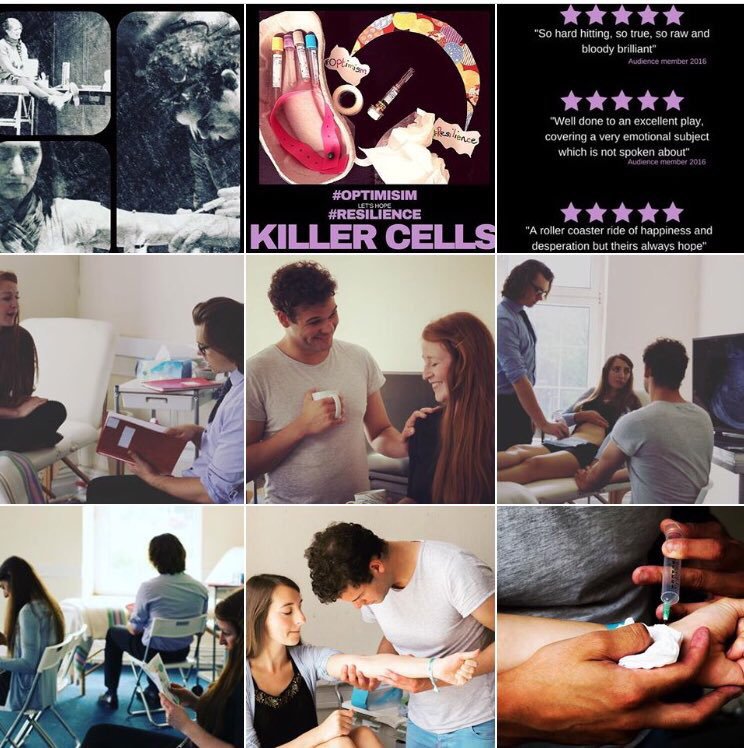
Killer Cells

Our work includes ‘Over By Here’, ‘Killer Cells’ and now ‘Blue Scar’. In all Avant’s  work we create opportunities for either our students from our weekly classes or for the community to shape the shows. We firmly believe in going out into the community to hear what is relevant and working with the community to develop art that is wanted and needed. Even though we are theatre makers, this means that we have also collaborated with other art styles. For example visual artists such as Claire Louise Prosser, on projects such as the Bus Stops in Tonyrefail. When researching for Over By Here we found out that the public wanted the beaten up bus stops to be more colourful, Claire came on board and led project Bus Stops which led to one teenager commenting “Thank you for doing this, the bus stops show that people care and it makes me feel safer in town”.
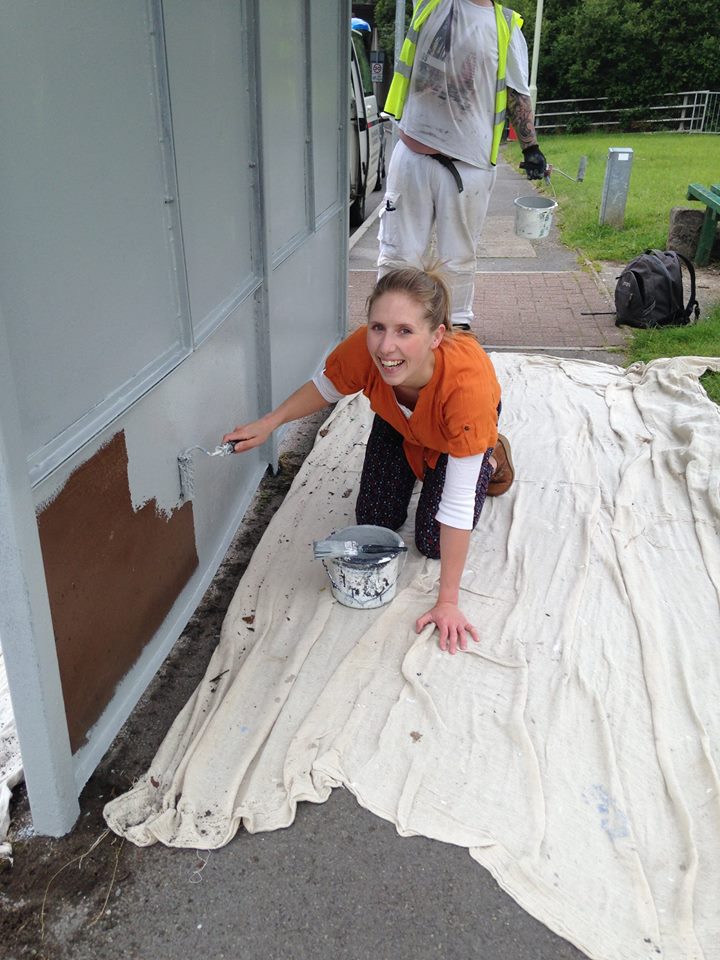
Artist Claire Louise Prosser

We are also about to undertake a film project with Gary Lewis called ‘Land of Our Fathers’ for the Age Cymru Gwanwyn Festival. We have chosen the media of film as the residents of the care home we will be working with may not be able to access live performances, by creating a film this can be played back to them in their care situation.
Avant are a forward thinking theatre company who have plans to create versatile work in the Rhondda and perform this work locally, nationally and internationally, to celebrate the Rhondda and its people in all sorts of creative ways. We are really excited to be working with RCT Theatres on a number of these projects.
More recently you have been working towards a sharing of a production called Blue Scar, I believe this production involves Urban Art Forms is that correct?
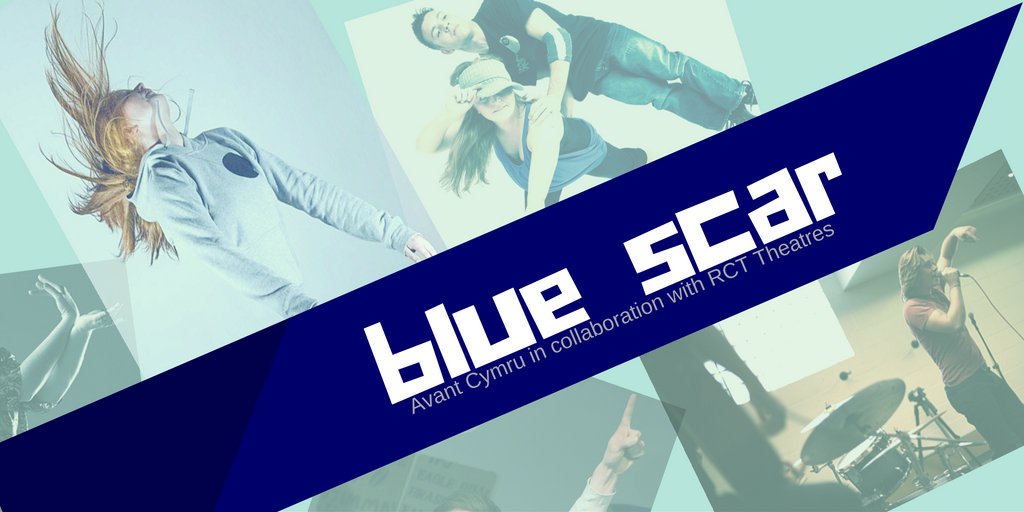
Blue Scar is a Hip Hop inspired project. We were asked to research and develop a hip hop dance project with RCT Theatres and Creu Cymru’s  welsh dance consortium. Our first plan of action was to speak to the community. We were inspired by the history of ‘Lockin’, which was created by young people at the end of the 1970’s early 1980’s watching cartoons such as the Loony Toons and recreating the actions that the cartoon characters performed. The style of dance is very animated with big facial expressions and poses. So we wanted to know what young people in the late 1970s/early 80’s were doing in the Rhondda to make Welsh hip hop.
We visited audiences at the Park and Dare and Coliseum before the Pantomime, we went to the local libraries and we spoke to people on Rhondda Facebook groups. The answer that came back was that the children liked to play up the mountain, occasionally some of these games resulted in cuts and bruises and because of the coal dust they often resulted in blue scars.
Blue scars became a point of discussion, miners had them from their work down the mines, but they were also a mark of the area. People spoke proudly of the time they earned their blue scar, from falling off their Gambo (go cart) or from playing kiss chase on the tip. These stories became our inspiration.
We then set out to speak to students in our regular classes and at Treorchy Comp who hadn’t heard of blue scars and wanted to help us make the show relevant to their generation. So as part of the R&D we worked with the young people and involved them  to lead the narrative, asking them how they share stories at home. Niamh performed with us on the night of the R&D, her character learns of how her mother gained her blue scar playing up the mountains. Niamh’s grandmother came to watch the show, which prompted her to tell Niamh tales from when she was young, and how she too used to play up the mountain.
Blue Scar, shaped by the community became a cross generational project because of the narrative, which made it vital for us to work with the right artists. To really create a Welsh hip hop piece we wanted to blend traditional welsh music and dance with hip hop styles. We did a call out for artists and we began to develop ideas.
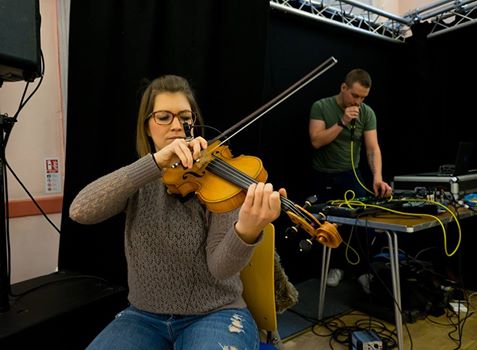
Angharad Jenkins and Dean Yhnell working on Blue Scar

James Humphreys created a script based on the comments from the community, Gary Lewis created a film showcasing Avant’s students participation. Dean Yhnell from BeatTechnique got in contact; he had previously worked with musician Angharad Jenkins on the 10 minute musical project produced by Leeway Productions.
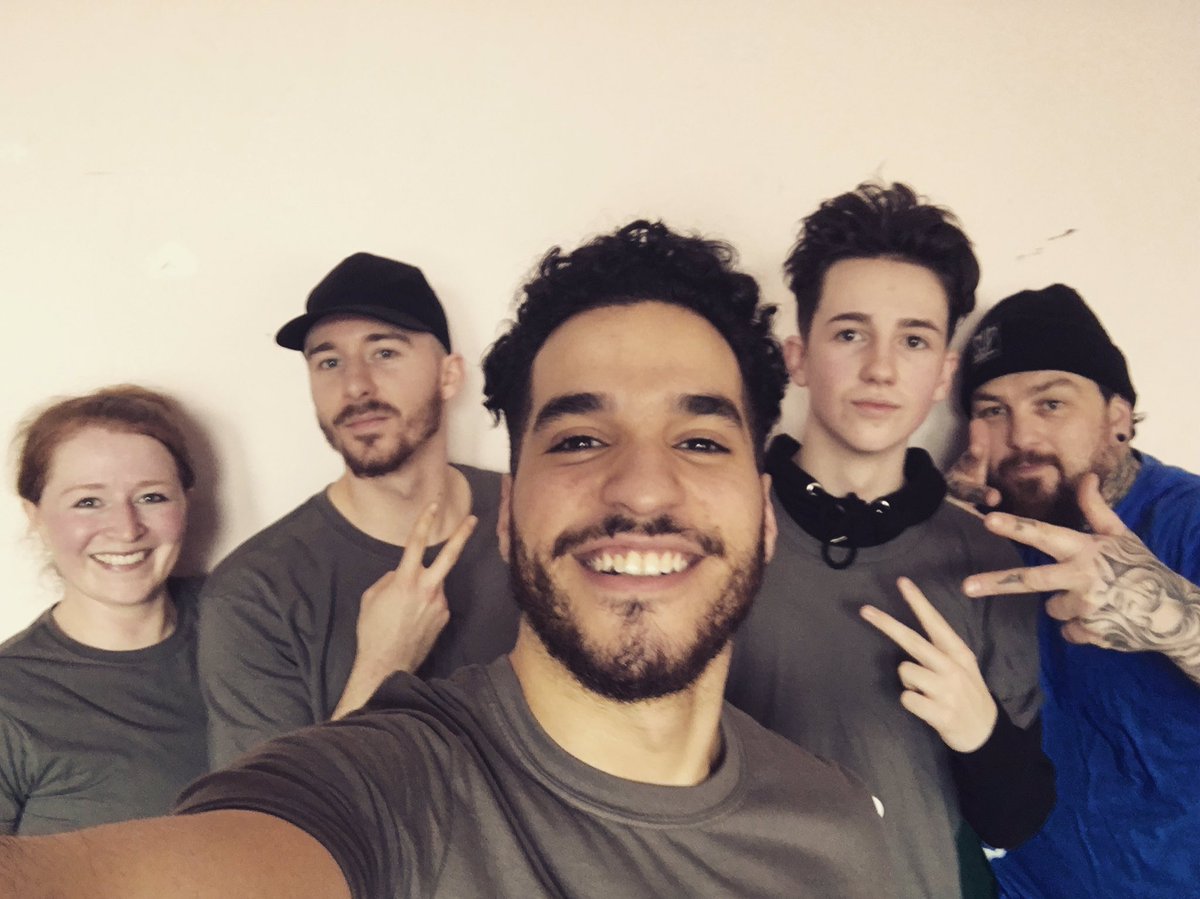
The Blue Scar Dancers

They were keen to work together again, working with Darius they created the tracks and Bethan England came in to sing. Tommy Boost, Ahmed Zada and myself were able to bring three different hip hop techniques breakin, lockin and poppin and then we were lucky to bring in BBoy Slammo and Patrick Thomas. BBoy Slammo has been teaching breakin in the Rhondda for over a decade and Patrick is a member of his crew, having these two bboys on board has been vital to showcase the legacy of hip hops dance community that already exists in the Rhondda. Bboy Slammo is an internationally known breaker who is one of the founding organiser for Breakin’  the Bay at the WMC.
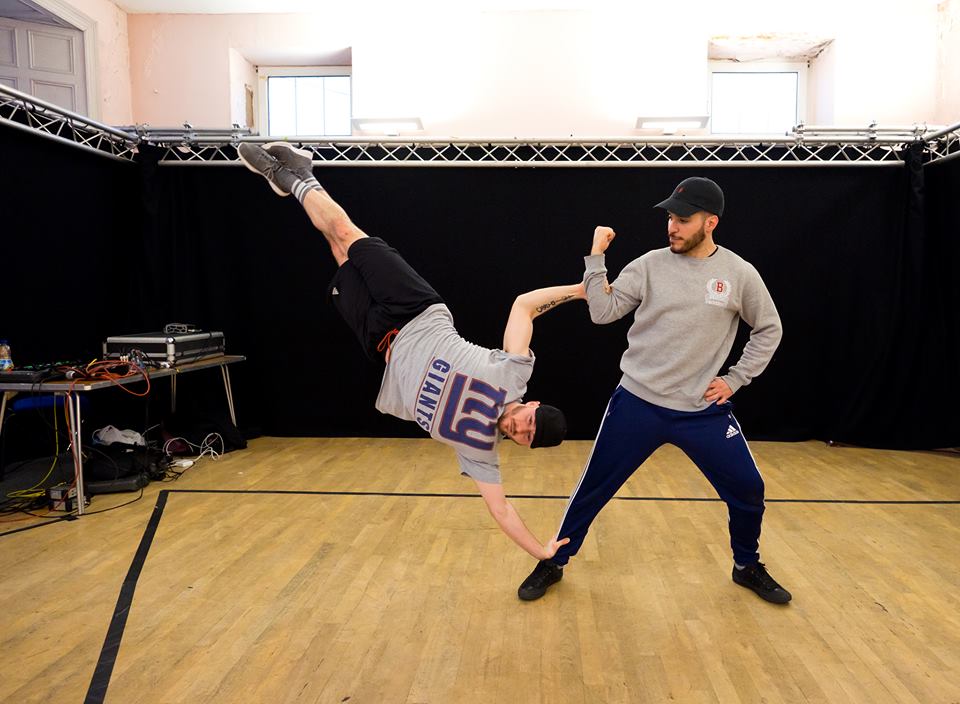
Blue Scar

The whole team were able to bring different elements to the project and inspired by the communities ideas we got to work, creating a Welsh hip hop dance piece.
Angela Gould, (Theatre Programme and Audience Development Manager RCT) and the RCT Theatres staff have been strong supporters of your career, why is the support of someone like Angela important?
Angela Gould has created the #CreativeHub at the Park and Dare, which is creative space for companies to produce new work. The Park and Dare staff are the most amazing team an artist could wish for. The tech team provide staging and tech, they bend over backwards to make sure we have everything required to provide the best audience experience possible. The venue team are amazing, Tom helps to get in place translations and timetables so everything is accessible and the team help produce programmes and marketing so we can facilitate the community outreach. Angela is incredible, she is there from the start to discuss ideas, then bends over backwards to mentor and challenge us. She takes the time to listen to audiences and know our community, we are so grateful to Angela and RCT theatres for their support. We firmly believe in collaboration and the #CreativeHub has been an amazing place for Avant to grow and develop. We are looking forward to producing Killer Cells over the summer and developing Blue Scar into a production for next year together with RCT Theatres.
Get the Chance works to support a diverse range of members of the public to access cultural provision. Are you aware of any barriers to equality and diversity for either Welsh or Wales based artists? 
We love to invite Get the Chance to all stages of our work, we are aware of the fantastic work they are doing promoting theatre and culture in Wales, demonstrating that there is a variety of cultural experience that appeals to diverse audiences. We know the reviewers have the opportunity to see a range of work and are informed on current theatre practices, so their reviews help shape future developments. For example Get the Chance critic Gemma Treharne-Foose came to watch the small production of Killer Cells, we had been working on the characters and story and her feedback confirmed to us that the digital aspect needed investment. So for the 2017 tour we have acted on this feedback and we are investing in the digital aspect of the story.
getthechance.wales/2016/09/29/review-killer-cells-gemma-treharne-foose/
We have found that fear is a barrier for new audiences because the unknown can make people anxious. By inviting Get the Chance in the stages of development and by sharing our ideas and plans we are able to inform new audiences, so they are guided and have an idea of what to expect when they attend a show. Get the Chance is breaking down these fears and bringing new audiences to the theatre.
Many thanks Rachel. If you were able to fund an area of the arts in Wales what would this be and why?
This is a difficult question as I would like to see more spending in the arts all over, I believe arts and participation is good for health, wellbeing education and regeneration. I would like to see more funding going into buildings such as the Park and Dare. They have already started work on improving the building, which includes new carpets, paint in the foyer and the lift is being rebuilt, however further funding is still needed to help complete the other jobs the team have planned.
http://www.rct-arts.co.uk
I’d love to see money put into a collaborative CPD programme. In dance, for example we have fantastic dance teachers and studios, but it would be amazing to have collaborative spaces such as Pineapple or Broadway Dance Studios in Wales, where the public can access dance and professionals can access the training needed 7 days a week and during the day time. It is important to create new training opportunities in Wales, so we can continue to learn and develop.
What excites you about the arts in Wales? What was the last really great thing that you experienced that you would like to share with our readers? 
I truly believe that Wales is an exciting country for the arts. There are so many cultural opportunities and emerging companies and individuals who are being shaped by established and experienced venues and organisations. There are networking opportunities, training performances and jobs it is evident that the people of Wales, want to make cultural experiences happen in a variety of places and in a variety of ways. From engaging in local opportunities in the Rhondda, taking part in Age Cymru’s Gwanwyn Festival, being a Sherman 5 member at the Paul Hamlyn Funded project at Sherman Theatre and by being a TEAM panel member for National Theatre Wales. I have personally found that no matter who you are there is a cultural opportunity for you. It is hard to name one event because the variety of experiences is exciting. I know that I am looking forward to seeing ‘Hard As Nails’ at the Park and Dare and ‘Killology’ at the Sherman, I have my tickets booked for both!
I am really proud to say that Avant are part of the Welsh art community, creating work in the Rhondda, with fantastic partners in RCT Theatres, at the Park and Dare and traveling to exciting venues such as the Sherman, the Willow Globe and Volcano later this year.
 

An interview with artist Ruby Walker on the Strictly Cinema project Bridgend

fb_img_1479160598649

Our project coordinator recently spoke to Bridgend based artist Ruby Walker. Ruby discussed the Strictly Cinema project in Maesteg Town Hall, Bridgend, community access to cultural provision and fancy dress!

Hi Ruby great to meet you, can you give our readers some background information on yourself please?

I studied illustration in Wrexham and by fate ended in Cardiff, after being excepted on the Welsh development agency’s program, I was successful in obtaining a grant from the Princes Youth Business Trust to set up as a freelance illustrator. Through my work other opportunities became present. Art direction, set painting and other visual mediums in television, film, theatre and the arts changed my direction. I became involved in project’s with HTV drama workshops, S4C, Cardiff council and the Welsh National Opera.  In 2000 I went abroad to Australia, Thailand and Greece and returned in 2005.  Since my return my day job is Art Materials Specialist/Visual merchandising for the Pen and Paper Stationery Company in Royal Arcade. I have been a volunteer for Strictly Cinema since last November, and became a member of the board this year. Film is my guilty pleasure as those who know me I’m obsessed with film history that includes Welsh history in this equation.

So what got you interested in the arts?

Drawing started when I was six, people joked I had paint for blood. But my other passion was Cinema I saw The Red Shoes at a very early age I was transfixed by this incredible visual feast of colour and movement. I never really wanted any other job as I was lucky I knew some form of art was for me. So I guess I’ve been involved all my life, and will carry on creating, learning and developing.

Strictly Cinema is described a “unique ‘social cinema’ event combining Cinema, Dance/Bingo and Food and takes place last Wed of every month at Maesteg Town Hall.” It sounds great can you tell us more?

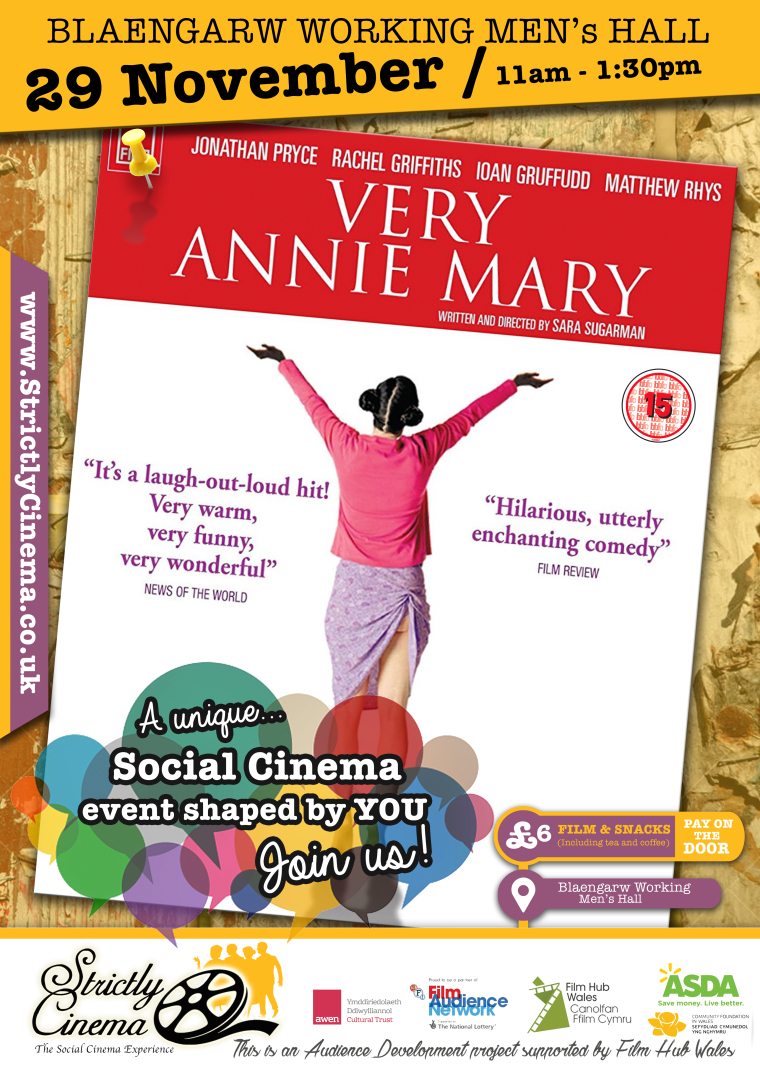
I had been looking to be involved in a cinema project since I moved to Bridgend two years ago. Ceri Evans manager with Awen the local cultural trust directed me to Strictly Cinema. It is unique. A day time event offering film, buffet, special features, bingo and raffle. What’s important is the social experience for our customer’s. Making new friendships, seeing new films in such a beautiful building as the town hall. We involve the customers with the film choices, and add there thoughts and ideas to inspire future programs. Our last event featured the silent movie ‘Maid of Cefn Ydfa’ by silent filmmaker William Haggar based on the true story of local girl Ann Thomas with live harp, plus locally made ‘Very Annie Mary’ director Sara Sugarman. Most of our audience either knew someone in the film, or have great memories of the places featured in the film. Great talking points for the day.

very-annie-mary-garw-poster

The project seems very community focused, I believe you have shown community made films prior to the main feature, do you think involving local communities is important?

If any thing if its locally made it’s of great interest to our customers. Our main facilitator on such features is Andre Van Wyk who works as an Arts development Officer for Bridgend Council, a role which he is extremely passionate about. Usually on the day we collate new stories of interest though talking with our customer’s, and discuss the details in our committee meetings. There are always gems in the mix that’s what makes it so inspired. It’s of great importance to voice local stories, it keeps local history alive.

fb_img_1479160531610

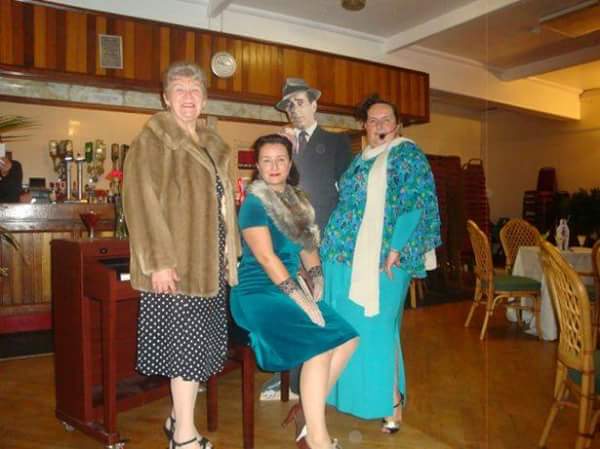
Ruby with volunteers in fancy dress at a showing of Casablanca

In your personal opinion what sort of support networks are there for projects of this nature in Wales? Can more be done?

There  can always  be more done! Cuts to the Arts are the norm. We recently received a grant through Film Hub Wales and the Audience Development Fund. Thinking creatively is a complex maze and if you think your idea is inspired with research, advice and knowledge it’s achievable.

Finally bringing us up to date, what have you got coming up next?

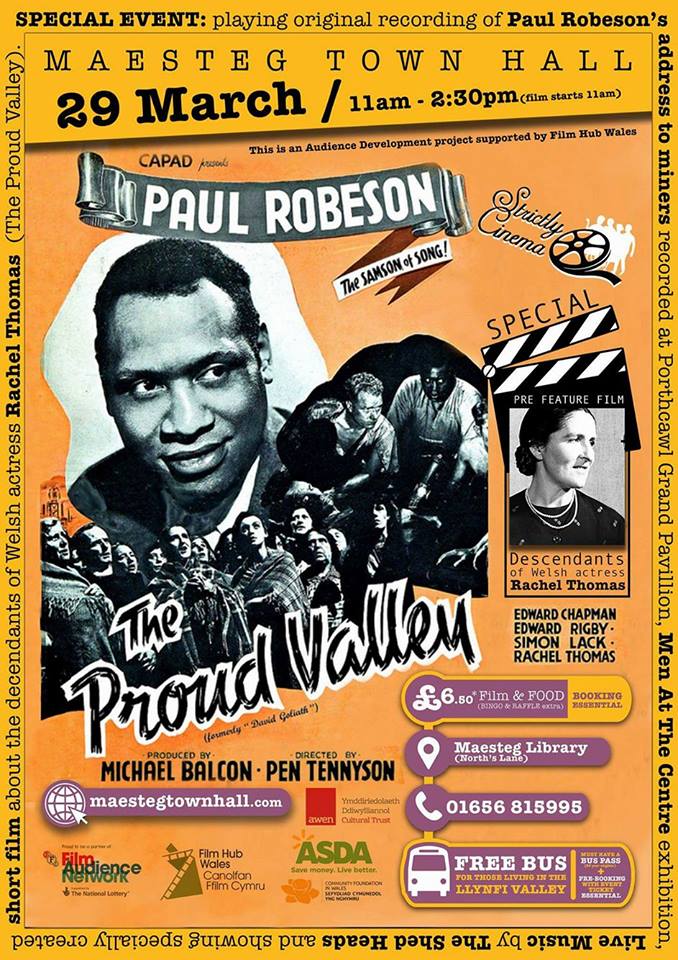
Our next feature is ‘The Proud Valley ‘ on the 29th March. The film starts 11am and the event finishes around 2.30pm. Booking is essential via http://www.maestegtownhall.com

We will also have some very special activity for this performance we will be screening a pre-film interview with the family descendants of Welsh actress Rachel Thomas.

“Rachel Thomas, film and television actress, best remembered for her role as a miner’s wife in the film ‘Proud Valley’. In 1968 she starred in the television version of How Green Was My Valley and in 1971 appeared in the film version of Under Milk Wood, with Elizabeth Taylor and Richard Burton. She was also a mainstay of Pobl y Cwm, the BBC Wales television soap opera.”

We have also just confirmed that Tony Mullins (Maesteg Operatic Society) will be performing some Paul Robeson spirituals as well!

Thanks Ruby, sounds great, see you there!

An Interview with scriptwriter David Lloyd


“Hey everybody, my name is David Lloyd and as much as I hate to blow my own trumpet, Im going to be like Marvin Gay and tell you my life story. You see, I’m 22 years old and I am currently attending my third year of BA Hons Scriptwriting at the University of South Wales based in Cardiff. From my past writing experience I find myself drawn more specifically to psychological dramas, but I do try to widen my genre field. Admittedly, I would jump higher than a grass hopper on a pogo stick at any opportunities, but I do prefer writing for film and television where I find myself working on amateur short films with the master film production students.”
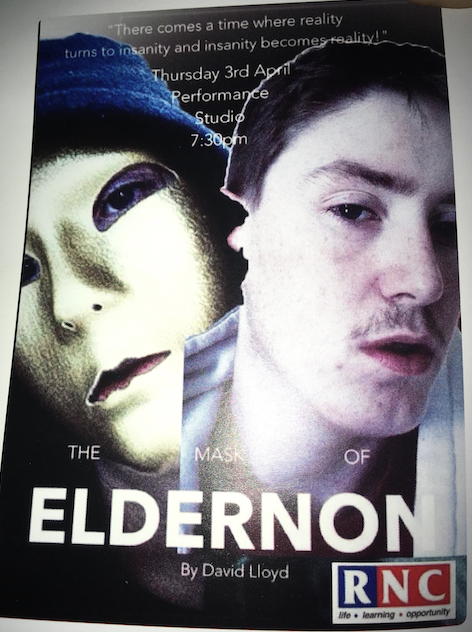
“Since I was a child (where others say I still am!) I have held a passion for creative writing, but it wasn’t until I had performed in my first self-written theatre play where I knew which career path I intended to pursue. The performance, title ‘The Mask of Eldernon’ was a psychological drama based upon a mass murderer who suffered from a split personality disorder where the protagonist was both the victim and the culprit. It was performed by myself and four of my peers as part of our course at the Royal National College for the Blind (RNC) in Hereford.”
http://www.rnc.ac.uk
“Oh… perhaps this would be a good time to mention how I am in fact visually impaired- it’s funny how some things slip your mind. Anyway, the diagnosis for my sight loss is a condition called Retinitis Pigmentosa (RP) and I have a detached retina which was caused from fluid seeping in beneath my eye. From six months of age. I also have an extremely rare metabolic disorder called LCHAD where my liver is unable to process fatty acids so I must stick to a three gram diet and I sustain my energy from an overnight feed. In result of this condition I have problems with my muscles and my energy levels and it attacks the nerves in my hands, feet and eyes which is what caused the site loss, but enough about the reason that would make me the perfect Olympic athlete, let us return to the topic of RNC.”
“Being a college which specialises in visual impairment, the purpose of me attending was mainly to be taught independence and mobility skills. As well as this, in the two years I attended I managed to obtain a Level 3 Diploma in Performing Arts, a single award in Brail and a C in re-sitting my A Level English Literature. I feel  my biggest achievement was the confidence I had built with the help from my friends. Being amongst other people who had gone through the same experiences and had tackled the same difficulties as I have has really opened my eyes. The whole experience has change my life completely and inspired me to chase my dreams and overcome any obstacles that stand in my way… except from a Rubiks cube, those things are very hard!”

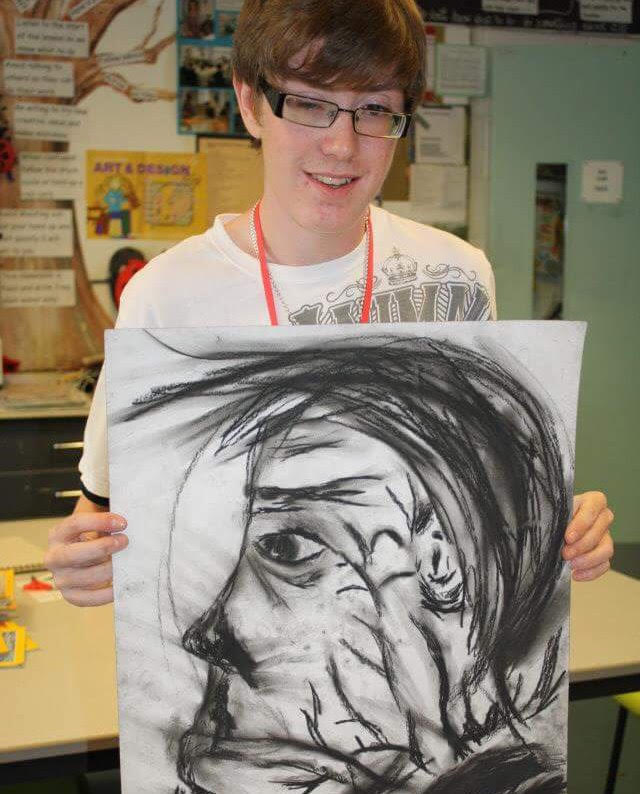
“Speaking of difficulties, despite the little deterioration that I already had, I have lost a significant amount of site in my right eye during my A Levels and couldn’t see how I was going to cope, especially when I was studying art and design, but I suppose If Van Gogh was able to paint with one ear missing then surely I could do it with one eye… yeah? you see what I did there? One ear, one eye- oh forget it. Anyway, this sudden site loss meant that I had to apply drastic changes to my work method, like studying films in class, but having to wait until I went home to hear the audio description, reading out of large print text books and perhaps the cruelest… sitting in the front row to see the board. The changes in my artistic techniques however, did allow me to stumble upon a hidden talent of drawing surrealistic images derived from my imagination with the smudging of compressed chalk.

Now for those who don’t know, compressed chalk can get extremely messy and stick to pretty much anything it comes into contact with, so you can imagine the site of it being used by a visually impaired student and then going home to a recently cleaned house… to a recently cleaned house with white walls… a recently cleaned house with white walls and an angry mother following the fingerprints… well you get the idea. So despite the change in methods, the giant printed books and the cloak covered fingerprints, I was able to obtain my Alevels in English Literature, Art and Media Studies, I had been accepted into RNC and I didn’t even have to bribe anyone either, which is always a plus.”

“Which then ledd me to the most scariest three letters I thought I’d never meet: U… N… I (which is just an abbreviation for the ten letter word, but this sounds cooler). I remember when I first started and feeling so scared of joining a new university in a city I wasn’t familiar with, but I kept thinking to myself ‘I just need to bite my tongue, hold my breath and jump into any opportunity that comes my way’ … but then naturally start breathing normally otherwise I wont be there for long. I understand how this may seem easier said than done, but with the support of the lecturers and my fellow peers and the provided equipment university became a life changing experience. Admittedly it was difficult adjusting to uni life what with the independence required for maintaining my condition, the continuity of eating and finding a healthy balance between work and social activity, but reflecting on it now makes me realise how these difficulties and mistake I had made have helped me become a better person and do you want to know what else… I wouldn’t have changed it for the world.”
 

Review The Magic Flute Mid Wales Opera by Barbara Michaels


 out of 5 stars (4 / 5)
 
Mid Wales Opera’s exciting new production of Mozart’s The Magic Flute opened appropriately in the Company’s home venue of Theatre Hafren in Newtown to a packed audience, proving once again that opera, once regarded as mainly for the elite or the cognoscenti, is gaining in popularity across Wales. And rightly so, given that Wales has given birth to some of the best singers in the world. Mozart’s sardonic fairy-tale, with its contending forces of good and evil, has more than a hint of the pantomimic, but is none the worse for that, consisting as it does of some of the composer’s most memorable arias and lyrical duets.
This opera has it all – romance, comedy and mysticism. The connecting link which runs throughout is the quest of Tamino, a Prince no less, who sets out to find and rescue Pamina, who has been kidnapped.by the villain Monostatos by order of Sastro, head of a mystic cult.  Tamino is helped by the magic flute and  Papageno, the birdcatcher who  lives in a hut in the woods and whose idea of heaven is hearth and home with Papagena, the girl of his dreams, and a clutch of little Papagenos to make it complete.  The story, with its  mix of wonderful music , soaring arias,   lovers’ tiffs and misunderstandings, set against a background of birdsong and mysticism, also manages to reference the power of womanhood and the number three, the latter being a send-up of the Masonic w which is both spooky and hilarious.
In the role of Tamino, William Wallace is a perpetually perplexed fresh-faced Tamino with a clear tenor, heard to advantage in his duets with Pamina. Frederick Long’s Papageno pulls out all the stops in a performance that bears evidence of Long’s familiarity with the opera and grasp of the role – truly a delight.  The latter also applies to Papagena, sung by Laura Ruhi Vidal, who makes her appearance in Act II,
This wouldn’t be opera without the element of evil, the equivalent of the Wicked Fairy in pantomime, here in the shape of the Queen of the Night, Pamina’s wicked and scheming mother  ( making a change  from the classic wicked stepmother.).  This is possibly one of the most demanding soprano roles in the history of opera, with an incredibly high range with which even the most accomplished of soprano can struggle.
Full credit to soprano Samantha Hay who, cocktail-hatted,  masked and black ball gowned, takes command of the stage with confidence, soaring to the difficult top F. A creditable performance deserving of the calls of “Brava!” awarded to her at the end. The forces of evil are well represented, with Matt R J Ward as the sinister Monostatos, swooping down like a predatory crow on the unsuspecting and naïve young Pamina, sung prettily by Moscow-born Galina Averina, who has worked with Dame Kiri Te Kana and WNO’s Dennis O’Neill.
Mention must also be made of the three ladies, an enthusiastic performance and some great costumes – I particularly like the red cross outfits in Act I. The orchestra, under the baton of conductor Jonathan Lyness, segues seamlessly between the familiar themes despite Lyness’ reduced orchestration.
Scenically, the production is helped by Declan Randall’s excellent lighting – a necessary facto, as, due no doubt to budget restrictions and the difficulties of touring, scenery is kept to the minimum, a lack particularly noticeable in Act I. Not even a token bush or tree in sight in the opening scene set in a forest, although designer Richard Studer’s ploy of using  a backdrop of a giant sun /or moon works to some extent.
http://www.midwalesopera.co.uk/productions.php
THE MAGIC FLUTE Mid Wales Opera, Theatre Hafren, Newtown
Music: Wolfgang Amadeus Mozart
Libretto: Emanuel Schikaneder
Artistic Director: Richard Studer
Reviewer: Barbara Michaels


Top Tunes with Sophie Smith from Outpost Coffee and Vinyl

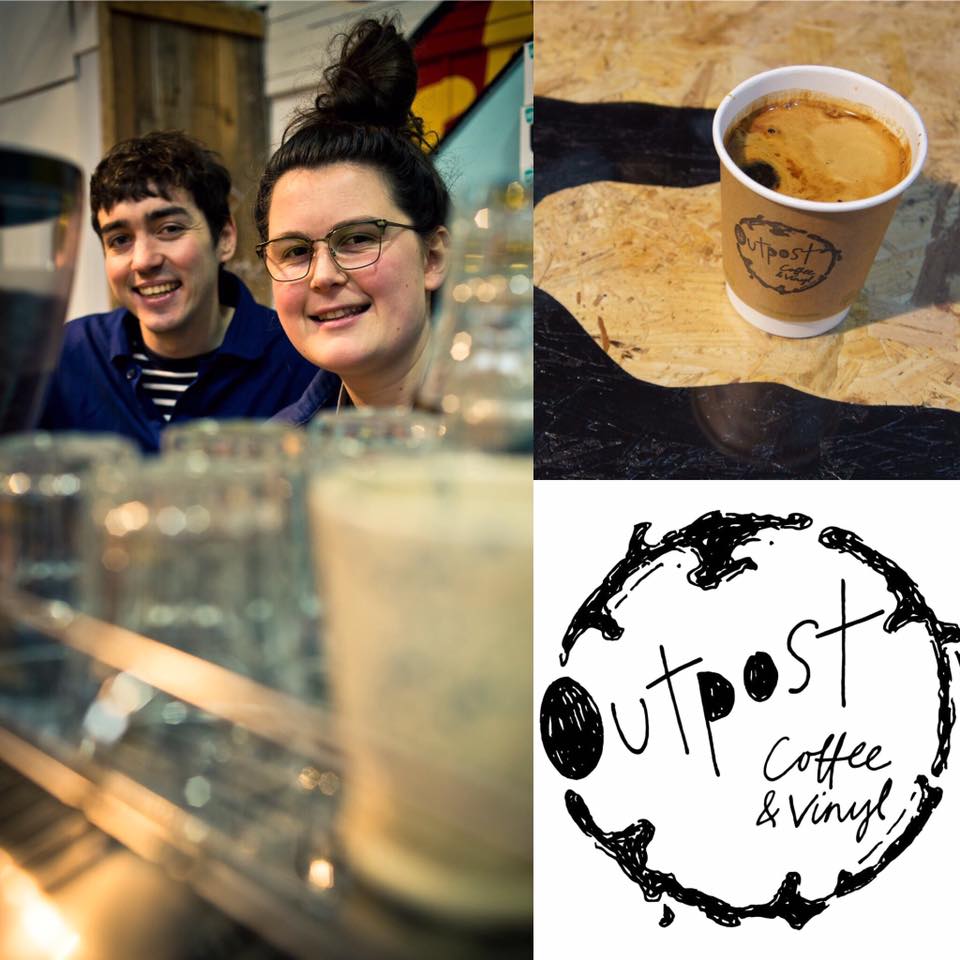
Sophie and Matt from Outpost, portrait by Jon Pountney.

Top Tunes is a new feature for Get the Chance in collaboration with Outpost Coffee and Vinyl  http://www.outpostrecords.co.uk
The Director of Get the Chance, Guy O’Donnell recently got the chance to chat to Sophie Smith one of the founders of Outpost Coffee and Vinyl. Their aims are,
“To introduce you to new music, get you tasting amazing coffees and enjoying freshly baked treats. Cardiff is full of amazing music, food and drink, so come and check it out! We want to meet new people, introduce you to exciting things and see your lovely faces time and time again. We hope to create an environment that you can come and chat, socialise and enjoy, no pressure, no strings attached. So come and say hello!”
Hi Sophie, this chat is specifically about music and the role it has played in your personal and professional life. Firstly to start off what are you currently listening to? 
Tennis

Ron Gallo

& William Onyeabor

We are interviewing a range of people about their own musical inspiration, so we want to ask you to list 5 records/albums which have personal resonance to you.
1 Brian Eno – Another Green World

2 The The – Soul Mining
https://youtu.be/5T8vi7d4uLY
3 Haim – Days Are Gone

4 Talking Heads – Stop Making Sense

5 LCD Sound System – This Is Happening

Thanks Sophie, just to put you on the spot could you choose one  from the five listed above and tell us why you have chosen this?
“Brian Eno’s Another Green World is one of my all time favourite records, it has such an interesting story behind it. The production on it is so layered, it’s a great album to listen to on vinyl. It took me a long time to track down & is one of my most prized possessions!”
http://www.outpostrecords.co.uk
 

Review Madam Butterfly, WNO, WMC by Barbara Michaels


You can listen to Barbara reading her review at the Soundfile below just click on the link.

Madam Butterfly Wales Millennium Centre Cardiff
Music: Giacomo Puccini
Libretto: Guiseppe Giacosa and Luigi Illica
Director: Joachim Herz
Revival Director: Sarah Crisp
Reviewer: Barbara Michaels
 out of 5 stars (4 / 5)
That most heartrending of operas, Puccini’s Madam Butterfly is staged by Welsh National Opera as the second in their Love’s Poisoned Chalice season. Following on after La Boheme, which opened the season, Butterfly is, like the former, one of the most popular operas and as a consequence – in these days of cuts to the arts funding – one of those most often performed.
Once again, it is a case of reach for the tissues as the story of the Japanese fifteen-year-old geisha, Cio-Cio San, who gives her heart to, and marries, a bounder of an American naval lieutenant, one Benjamin Franklin Pinkerton who doesn’t take the marriage seriously, unfolds towards its tragic end. In restaging this opera which they first performed back in 1978, WNO have wisely adhered to the original format directed by Joachim Herz and first performed at La Scala Milan in 1904.
Sepia toned sets emphasise that this is old Japan – and the gulf between the two worlds and their values runs as an undercurrent throughout, at times becoming more prominent. The political undertones are emphasised throughout the libretto, epitomised by recurrent musical themes in the orchestration, as well, as in the repeated playing of the Star Spangled Banner.
This time round WNO has honed and polished their performance of the poignant story set to Puccini’s wonderful score to a state of near-perfection. This is due in no small part to Karah Son’s portrayal of the central role of Butterfly. Not only has the South Korean soprano a voice of the utmost clarity, with a seemingly effortless ability to soar to the high notes which the role demands, but Son excels both in Act I, as the innocent young girl who believes in true love everlasting (only to be thoroughly deceived and let down by that cad and absolute bounder Pinkerton) and in Act II, where she achieves the difficult shift to the more mature Butterfly, bringing depth to the tragic denouement   This requires not only a change in characterisation but in style of singing, and this Son does, notably so in the beautiful aria One fine day..
In the role of the bad guy (and what a cad Pinkerton is to abandon his young wife so callously) Jonathan Burton’s tenor is pleasing, particularly in his duets with Son. His portrayal of the callous and worldly Pinkerton contrasts well with the naivety of the young Japanese girl who has never been further than Nagasaki, but Burton does at times lack facial expression. One could perhaps argue that this is intentional on the part of the director in that Pinkerton is a reflection of the attitudes that existed during that era. Nevertheless I would have liked a tad more expressiveness from Burton, as this can at times make him appear a tad wooden in the role.
Welsh baritone David Kempster brings gravitas to the role of the Consul who does his best to avert the tragedy, while as the bowler-hatted marriage broker Goro, Simon Crosby Buttle skips around the stage in great form. As ever, the WNO chorus is an added bonus, particularly so as the posse of Butterfly’s geisha friends in Act I, and the rendering with the orchestra, under conductor Lawrence Foster, of the humming chorus in Act II.
A production honed to near perfection which should not be missed. Catch it if you can.
Runs at the Wales Millennium Centre 17, 18 February, then touring,
 

Top Tunes with Caroline Finn, Artistic Director of National Dance Company Wales

Top Tunes is a new feature for Get the Chance in collaboration with Outpost. http://www.outpostrecords.co.uk 
The Director of Get the Chance Guy O’Donnell recently got the chance to chat to Caroline Finn, Artistic Director of National Dance Company Wales. Caroline discussed her career to date, the spring 2017 tour of The Green House and choose her 5 Top Tunes!
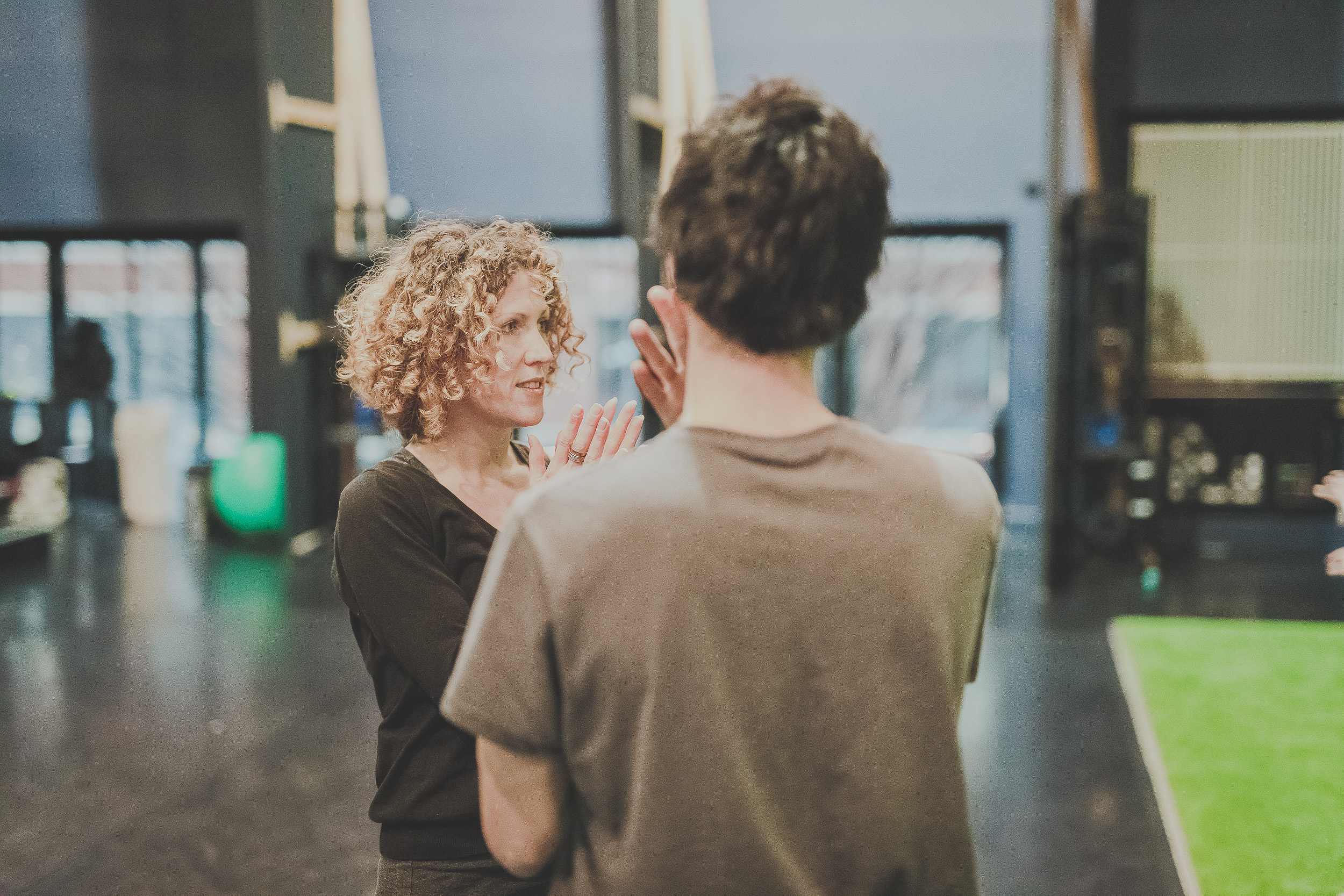
Caroline in rehearsals for The Green House

Caroline in rehearsals with the company for The Green House

Click the Soundcloud file below to listen to the interview described.


Hi Caroline great to meet you, can you give our readers some background information on yourself please?
Hi there! Well, I am currently the Artistic Director of National Dance Company Wales, based in Cardiff. But I guess my story begins way back when I was 11 years old and decided I wanted to become a professional dancer. I went to The Arts Educational School, Tring Park until I was 18 and then moved to New York to study at the Juilliard School. My first professional job was with Ballet Theatre Munich and subsequently I also danced with ballet Preljocaj in France and Compagnie Carolyn Carlson. In 2009 I decided to focus on working as a freelance choreographer and travelled all over the world making works for various companies before coming here to Cardiff!
 Thanks, this chat is specifically about music and the role it has played in your personal and professional life. Firstly to start off what are you currently listening to? 
I am currently only listening to the soundtrack for my new work, The Green House, which will form part of our Spring tour this year. It’s all-consuming!
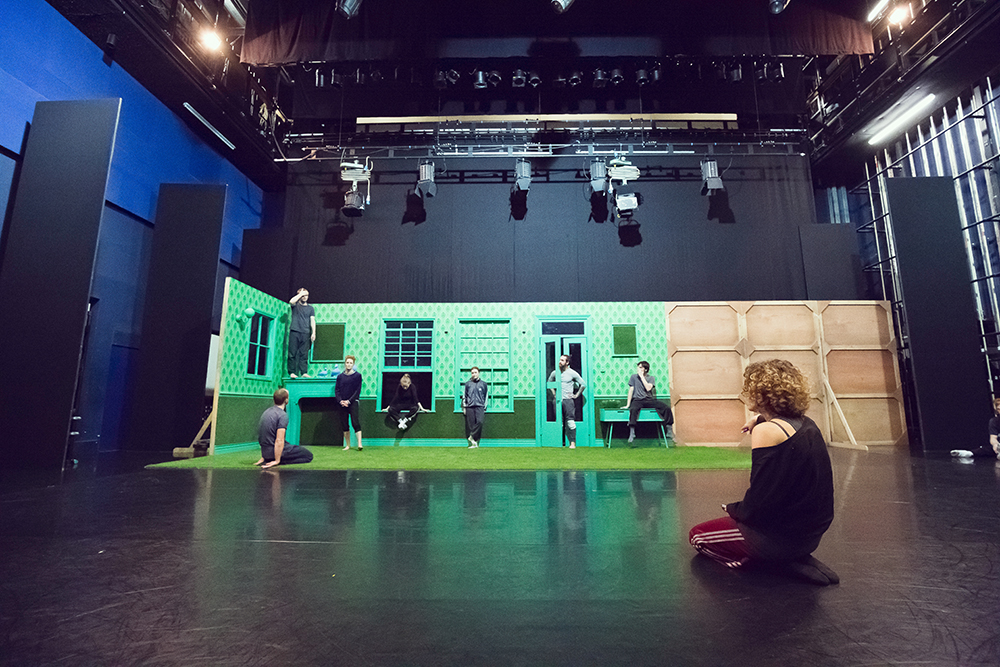
Caroline in rehearsals for The Green House

Caroline in rehearsals with the company for The Green House

Music has always played a big part in my life- I learnt to play the piano and violin as a child and of course at Juilliard I was constantly surrounded by and influenced by some wonderful musicians.
In terms of choreography, the inspiration for my work often comes from hearing a particular piece of music which immediately generates stories, emotions or images for me. I then try to build on that, finding other musical tracks which compliment it. The soundtracks to my works are often quite eclectic and can span a range of musical genres from Balkan folk music to Radiohead. The Green House for example has a bit of Max Steiner (look him up – you’ve almost certainly heard his work before), mixed in with Shostakovich and a Brazilian film soundtrack. It’s incredibly varied!

 We are interviewing a range of people about their own musical inspiration, so we want to ask you to list 5 records/albums which have personal resonance to you and why. 
 1 Beethoven Symphony no. 7 in A major

2 Beirut- the Gulag Orkestar

3 Radiohead -Creep

4 Travis -The Man Who

5 Olafur Arnalds -Stare

Just to put you on the spot could you choose one track from the five listed above and tell us why you have chosen this?
I think I would have to say Creep by Radiohead. Maybe because listening to it takes me back to a very specific time and place in my life and I think that so many people can relate to those lyrics. I know there have been many cover versions over the years but I particularly love Frank Bennett’s because he takes it right back to the 1950’s. Surely it’s the measure of a great song when there can be such incredible cover versions?

I actually used Frank Bennett’s for a piece I created for Phoenix Dance Theatre in 2015 called Bloom.

Spring Tour 2017 – The Green House | Profundis

National Dance Company Wales presents an evocative double bill of new work Spring 2017
The Green House
Caroline Finn
What happens when we prune ourselves to perfection? Caroline Finn takes us on a nostalgic journey, asking us to peer into The Green House. On a twisted TV set, characters discover the fine line between fantasy and reality.
The Green House is Finn’s second theatrical work as Artistic Director for the Company, following the overwhelming success of Folk in 2016.
‘Finn knows how to choose a resonant image, and how to orchestrate emotions’ The Guardian
Profundis
Roy Assaf
“It’s about Profundis. It’s not about Profundis…”
Playful, vibrant and provocative. Profundis dares us to ask questions about what things are, and what they are not. Roy Assaf’s thoughtful movement is accompanied by whimsical wordplay and an exotic soundtrack featuring Egypt’s Umm Kulthum.
‘a tapestry of exquisitely detailed gestures adorned with sparkling stories’ Buzz Magazine
Suitable for age 12+
* Watch Dance Class
12.45 – 2pm
See * below for dates
Get a unique behind-the-scenes look at how our dancers prepare just hours before a show.
You can observe, sketch, record and photograph the ballet or contemporary class on stage, giving you a glimpse into NDCWales life.
Perfect for dance students, artists, photographers and anyone interested in peeking behind the curtain. Expand your portfolio, practice drawing from movement or just observe with interest.
Free to attend but please book a space – email megan@ndcwales.co.uk for more info
Discover Dance
#GetDancing with National Dance Company Wales
The perfect 90-minute introduction to dance for families and schools. Suitable for age 7+
More info & dates here
http://www.ndcwales.co.uk/en/what-s-on/calendar/spring-tour-2017

Get the Chance Creative Associate Jonny Cotsen on #Fresh2Deaf

Get the Chance Creative Associate Jonny Cotsen on #Fresh2Deaf
Dance is a universal language. That’s why I think it is so special. Some people choose to sing in the shower every morning but me…I dance in the kitchen to start my day, and now I have some new moves thanks to Jukebox Collective and Chris Fonseca.
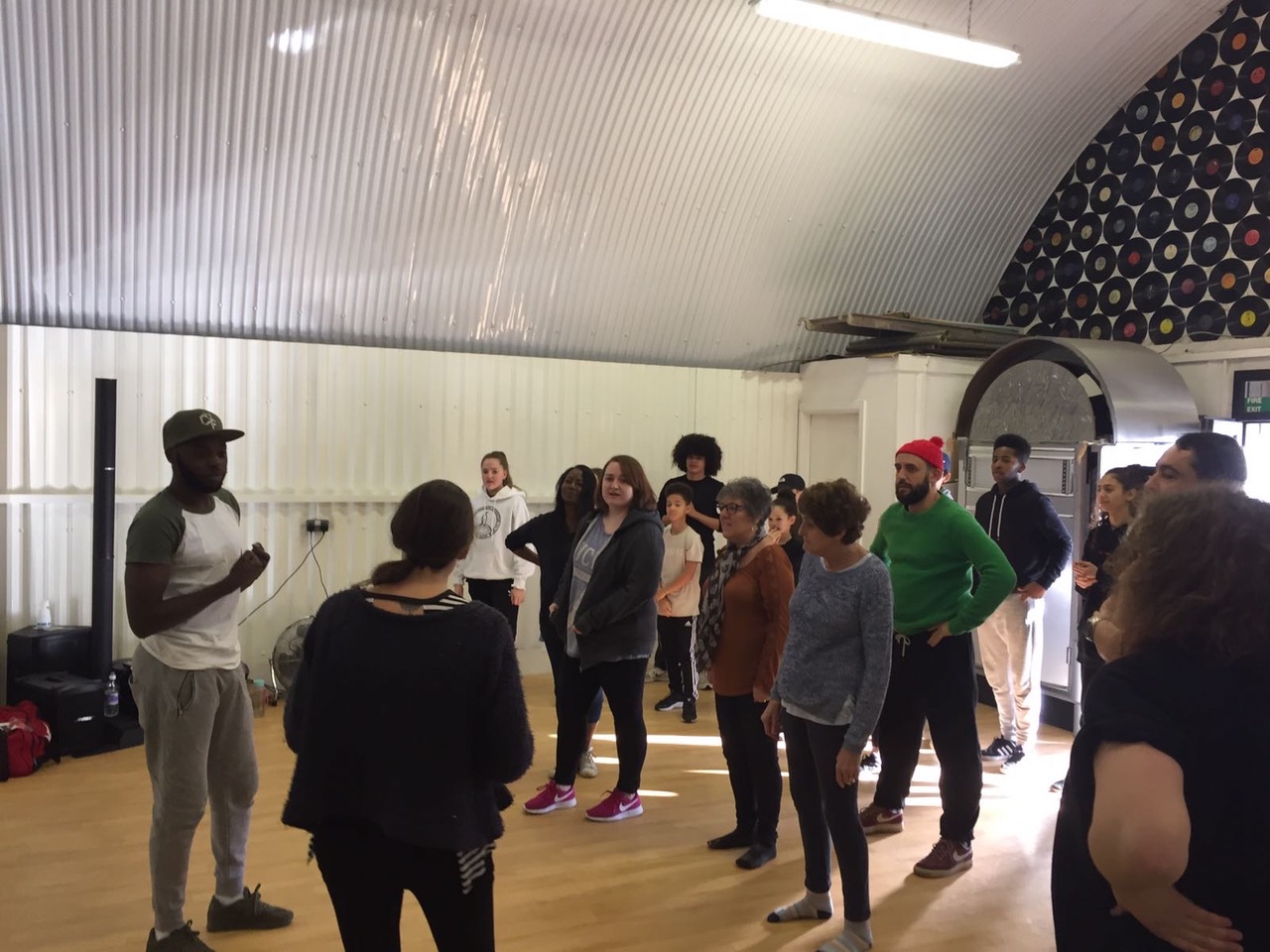
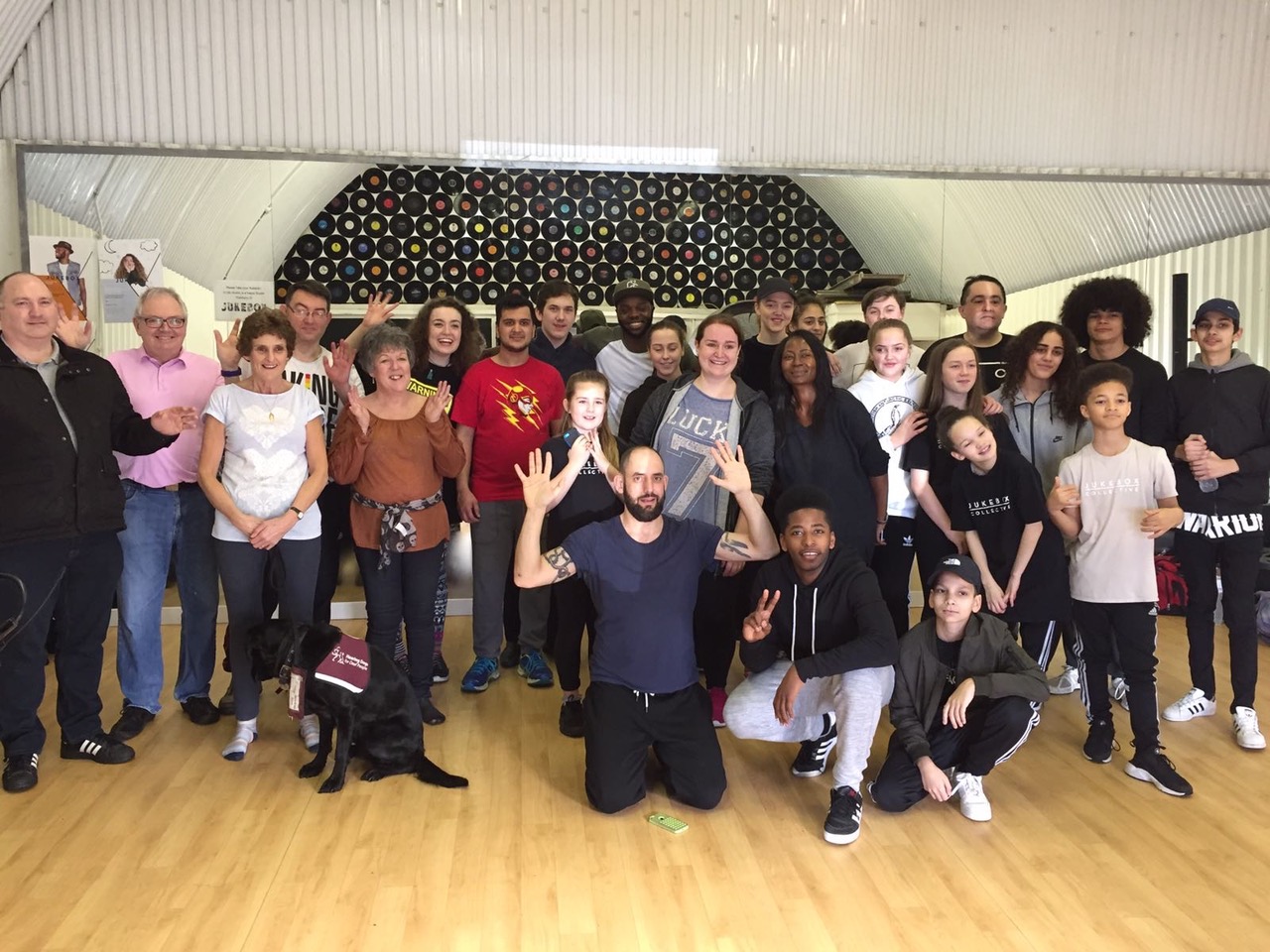
I walked into Jukebox Collective Studios based underneath the railway track in town on a cold, wet and grey Cardiff day, not knowing what to expect but excited about what was ahead. I was hoping that it would be a dance class that I could follow; where I could follow the moves of the teacher and which would make allowances for my complete lack of coordination…oh, and hearing! The class was physical, emotional and ended up being more inspiring than I could have ever imagined. I have tried to do a few dance classes in the past, but this is one is definitely the most memorable.
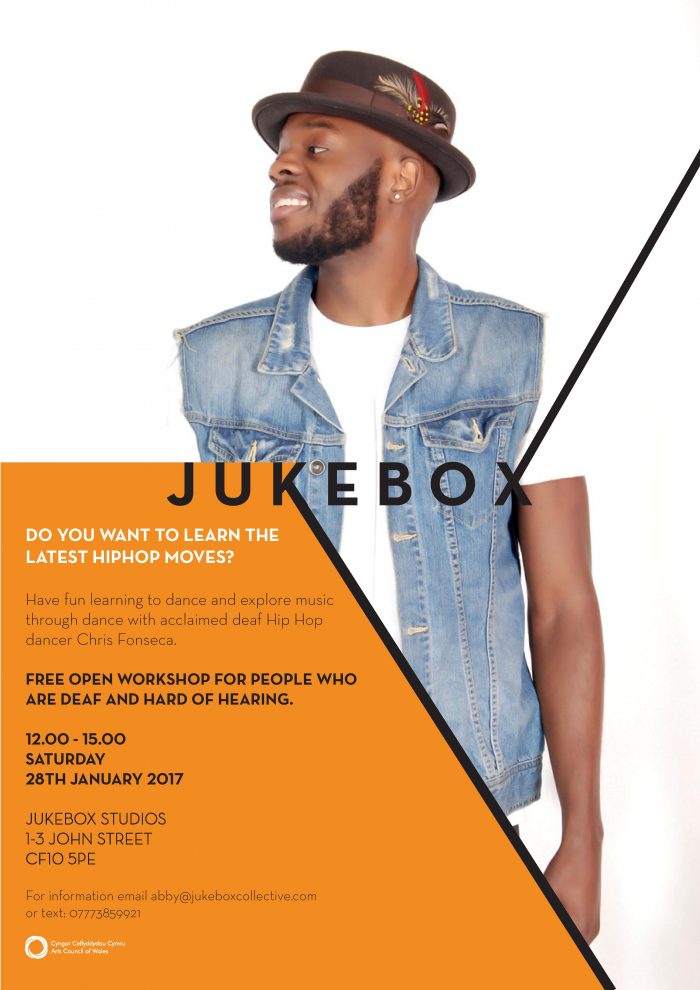
Chris Fonseca who led the dance class is completely deaf. Chris is a London-based dancer and choreographer has defied all by continuing to teach and dance despite his deafness. He shot to fame by being part of Smirnoff Ice’s “ Keep It Moving” campaign. Whenever I saw the advert or the promo poster it made my spine tingle because of Smirnoff’s hashtag #KeepItMoving and #deafdancers. The advert reiterated the fact that dance is a universal language and like he says in the advert… “We can’t hear the lyrics but we FEEL the beat!”

After seeing the advert so much last Summer I was a) desperate to meet him and b) I wanted to make this happen in Cardiff!

I was fortunate enough that Jukebox Collective wanted to bring this experience to Cardiff. Jukebox Collective are a creative company focused on the delivery of the highest quality performing arts education, performance and consultancy. It was founded by Liara Barussi, and is recognised as a leading company for dance in the UK. Jukebox studios has a particular emphasis on the training and professional development of young people.
With the exciting news that Jukebox Collective had become a new Regularly Funded Organisation funded by Arts Council Wales, we exchanged ideas of running an inclusive group within their existing academies. I was delighted to be asked to work with them to consult and advise on how to make this happen. I have always been a big fan of their work especially their involvement with ‘Breakin’ the Bay’ conventions, an annual event at the WMC (worth checking out if you haven’t seen to see it!!).

Inspired by what they had seen of Chris from the Smirnoff adverts, they were really keen to set up the first ever deaf dance group in Wales. I met up with Sylvia Kulesza, who co-ordinated the project and a plan was hatched to bring Chris to Cardiff for an open session at the studios. The hope was that this session would inspire deaf people and Jukebox could then run regular dance sessions for deaf people. I could barely contain my excitement of the idea and loved that Sylvia shared my passion and enthusiasm for making this happen. Sylvia also came up with the idea of calling it #Fresh2Deaf!
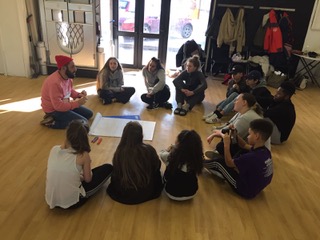
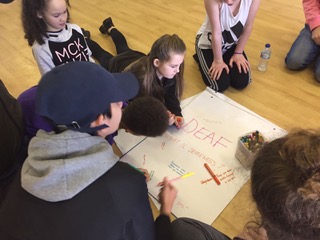
As part of the plan, I agreed to do a Deaf Awareness workshop the week prior to the dance class for the Jukebox Academies who range in age from 11 to 19 years.

I wanted the Deaf Awareness workshop to be engaging, fun and informative. I felt it was really important for them to learn how to communicate with deaf people, to understand the right terminology and have a better understanding of deafness. The students were great. We did lots of deaf-aware games, learnt basic finger-spelling and signs, and of course each one of them got their own ‘sign-name’. I felt so blessed to do this with such lovely and passionate group of young people.

The following week was the first ever #Fresh2Deaf open session!!
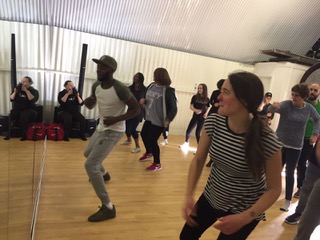
As well as the students from Jukebox Academy, half of the class were deaf and we all had the feeling that we were not going let our impairment put us off because we were all there for the joy of dance. Chris was really calm and made us feel really confident. Watching someone like Chris chase his dreams is really inspiring to watch and I can see how he can influence younger deaf people.
Chris used sign-language and an interpreter relayed the message for those that did not know sign-language. The attraction that Chris has to hip-hop is magnetic! He can’t hear the music so he relies on the vibrations from the heavy deep bass to count the music while he teaches so that he can stay on beat.

“I love hip-hop music because the bass is so strong on it, and I just love that,” he said. “The structure of the rhythm is something that I really connect to easily. All it takes is one beat, and I’m there!”
After a quick and very physical warm-up, Chris taught us how tocount the beat through vibrations, so that we could stay in time with the beat. The music was blasting so loud that the bass was heavy enough for every one of us especially those that were deaf to FEEL. I was initially worried about the older deaf members in the group but they had just as much energy as the younger ones. Seeing the older member made me think that age is no deterrent to dance, the same as our disability. Jane, who is 63 years old and goes to Bridgend Deaf Club told me afterwards that it was one of the best times she had.
It was also lovely to see some of the Jukebox Collective Academy students mixing with the younger deaf people. Taylor, one of the more experienced academy students was doing basic signing and fingerspelling too. That really excited me!
After the workshop we had a Q&A with Chris (and we needed a breather!). It was really interesting to hear him speak so openly about his life, his influences, his passion and he spoke with so much enthusiasm. Since his advert has been aired, he said that people have come up to him and said they have been inspired. Chris said there have been lots of really positive responses which are really lovely and heart-warming so he says his aim is to give something back to the deaf community and get more recognition of sign language. He wanted to show the importance of deaf culture and get hearing people interested in learning dance through deaf persons experience.

I have always thought and felt that dance was something that as a deaf person is not an easy thing to do because there is that major barrier, hearing the music! A lot of hearing people think that if you are deaf then there is no way that you can dance. Chris defies that perception and you have to admire him for that. Ever since I got into the Arts, with my vision in life to make the Arts more accessible and more inclusive, I like Chris, am working daily to break down those barriers!
My final thoughts…I recently got a tweet from Cardiff’s Boiler House, a venue that does graffiti and pop-up events, who reminded me that I had a conversation with them about 5 years ago I had spoken with them about my vision to do hip-hop dance classes in Cardiff for deaf people. I totally forgot I had that conversation and it just reminded me that you have to believe in yourself to make it happen and never give up believing! I hope Jukebox Collective #Fresh2Deaf project will lead the way to make this a reality to happen in Wales.

How do you know if you don’t try?
Contact abby@jukeboxcollective.com for more information about #Fresh2Deaf workshops
 

An Interview with Elise Davison on Access and Breaking out of the Box 3

The Director of Get the Chance Guy O’Donnell recently got the chance to chat to Elise Davison Artistic Director of Taking Flight Theatre Company. Elise discussed her career to date, the arts in Wales, access issues and Breaking out of the Box 3.

This short video is an introduction from Elise Davison Artistic Director of Flight Theatre company. Elise introduced herself and briefly discusses Breaking out of the Box 3. There is an audio sound file interview with Elise below and a written one below that.

Hi Elise great to meet you, can you give our readers some background information on yourself please?
Hi, I started out as performer and toured for about 10 years living out of suitcase and having a reasonably successful career. I was also a drama teacher so that plugged any gaps on my theatre work. In 2008 I set up Taking Flight Theatre company with Beth House and in 2009 I moved to Cardiff, had my first child and I started directing. In 2010 I hung up my acting shoes and began my life as a theatre director and I love it!
So what got you interested in the arts?
My mum and my grandmother both danced to a high standard and despite some really exciting opportunities – neither of them went on to pursue it as a career and I think they both regretted it. I always thought I would be a dancer and studied ballet until I was 21. I realised, however, years before that that my real passion was for acting and so I went to Warwick University to study theatre – it was a very academic course and after graduating I felt I needed more practical training so I went to drama school in Birmingham ( I wanted to come to Cardiff then but it didn’t work out!)
Taking Flight have organised an event called Breaking out of the Box 3, I wonder if you can tell us more about this event?
Yes – it’s an access symposium focussing in particular about ways to increase access for blind and visually impaired audience members. We’ve got a really exciting line up and we will explore practical approaches to audio description and tactile access materials. We will discuss ways to access the blind and visually impaired audiences and hear about the innovative Ramps on the Moon initiative happening in England at the moment. I am really looking forward to it.
http://www.takingflighttheatre.co.uk/breaking-out-of-the-box-3/
Get the Chance works to support a diverse range of members of the public to access cultural provision Are you aware of any barriers to equality and diversity for either Welsh or Wales based artists?
There are always barriers especially surrounding with access, but as a country need to recognise these barriers and realise that we have a joint responsibility to start breaking these down. I feel there has been a lot of progress in the last few years in Wales to tackle some of these barriers but there is still such a long way to go.
As an inclusive company Taking Flight also carefully consider their potential audiences.  I wonder if you think there are any barriers for them to access cultural provision in Wales? On a positive I wonder if you can think of any examples of good practice?
One thing always strikes me as odd – there are often a lot of forums discussing access with no one who will be using that access present to say what they actually need. In 2015 TF did a lot of work with the D/deaf community in Wales to find out why they weren’t accessing theatre and how we could start to address this. The stories about mistrust of venues came flooding out. Stories of broken hearing loop, broken captions and shows billed as being interpreted not being. We realised that so much need to be done to make people trust that access would be provided before we could even start to build our audience. The blind and visually impaired audience also struggled to trust that their access requirements would be met. In addition it was hard to get the message out to the right people that shows were accessible. It was then that we started to look at our marketing and began developing BSL and audio flyers and made sure that the correct access symbols were clearly displayed.
The Hynt card is a great scheme and Sherman 5 have done some excellent work engaging new audiences.
http://www.hynt.co.uk/en/
http://www.shermantheatre.co.uk/sherman5/
If you were able to fund an area of the arts in Wales what would this be and why?
I’m going to be a bit predictable and say access but I feel so strongly about this. I feel people are put off by the cost and the fact that it eats into your budget so much. I would make access costs an extra pot which sits on top of grant limits. This is because – I believe it is a human right to be able to access the arts and sometimes this is denied due to financial constraints – or companies are forced to choose which access to provide. In an ideal world -all shows should be captioned, be BSL interpreted and be audio described – or have that provision available so that D/deaf and disabled people have the same choice as non disabled people. Access is expensive, so I would like to take the barrier of cost away so people can be freer to experiment with creative access.
What excites you about the arts in Wales? What was the last really great thing that you experienced that you would like to share with our readers?
I love the arts community in Wales – it’s a wonderful place to live and make theatre. It’s a generous and support network and I feel honoured to be part of it. I’ve just comeback from an access forum (organised by Rhian Lewis at National Theatre Wales) where Jo Verrent spoke about Unlimited and it was wonderful, there were some amazing discussions, passion and desire to make a change.
http://community.nationaltheatrewales.org/group/access-forum?commentId=3152760%3AComment%3A248505
I’m massively looking forward to seeing Graeae’s production of House of Bernarda Alda especially as one of TF’s associate artists Chloe Clarke is performing in it!
http://graeae.org/our-work/house-bernarda-alba/
 
Thanks for your time Elise.

Review Ghost in the Shell by Jonathan Evans


 out of 5 stars (5 / 5)
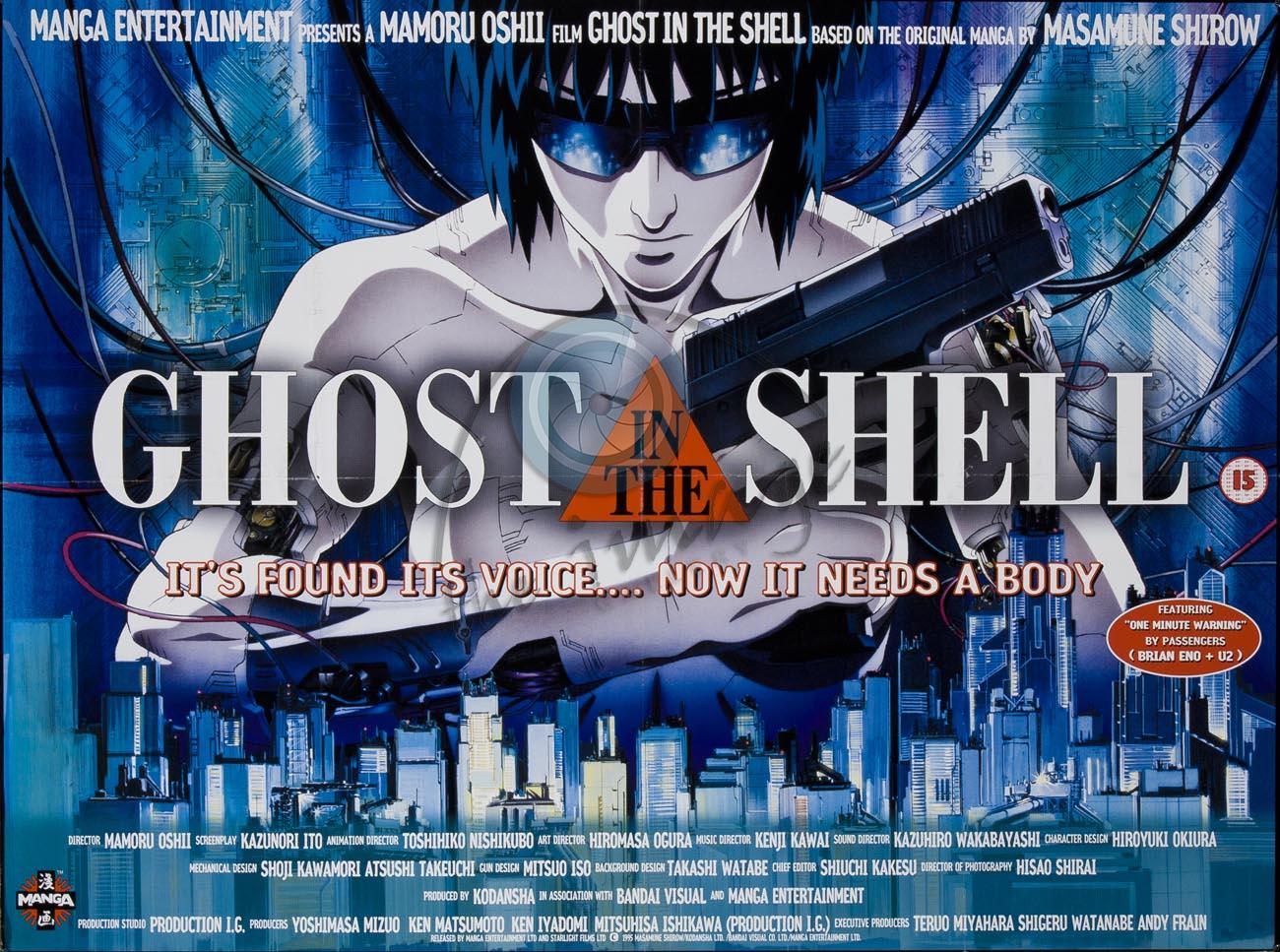
Great Science-Fiction asks questions about what is going on in the time that they are made and gives us a vision of what all that will lead to. Now that it is over twenty years old, Mamoru Oshii’s Ghost in the Shell remains as a pinnacle of great science fiction by still being so relevant because it’s questions are still being asked now.
In the year 2029, the world’s international tensions are still high and the police still do their best to keep the world in as much order as they can. However technology has upped the game, now there is virtual hacking and information deliverance and speed is the name of the game. Just being human won’t cut it anymore so both sides now come with enhancements. They can now trade-in their organic parts and have them replaced with cybernetic upgrades. A brain that can have instant access to the police data logs or act as a radio, more powerful limbs etc. But there are some that are cybernetic from the ground-up. Enter The Major,a woman by appearance but everything from her hair, eyes to her brain has been manufactured. She even comes equipped camouflage capabilities that allows her to disappear.

Probably one of the biggest distinguishing aspects of the movie as well as whats played a part in making it so popular as well as recognizable is the choice to have it main character appear nude for a significant chunk of the movie. On one side, sex sells and there are undoubtedly many that simply come for the exposed breasts. However there are many intellectuals that still find merit in the movie beyond that choice. But lest focus on this part of it. Our opening sequence is the Major being built, the cybernetics, then the fake flesh, then finally the artificial skin. Early on we know that this is not a real woman before us, at least in body , you can observe at her sexualized proportions and say “That was definitely designed by a man” but here it literal on both sides, which adds to it.
Japanese animation operates at a different mentality than what the West will be used to with the Disney movies. First of all they make their movies at a lover frame rate, the West have twenty-four frames a second, while the East have sixteen, this means that they are allowed to have more moments quiet behavior rather than being in constant Ballet mode.They also don’t feel the need to have the characters in constant motion. Sometimes, or even many times they will land on a piece of framing and cinematography and have that be the shot throughout the scene, or for an extended time. It is a method of film-making that is primarily cost effective but can lead to moment of greater poignancy.
Much like Akira and Blade Runner the movie presents us with a city that is like the ones we have now, however elevated through the increase of technology. The building are more higher and technologically designed and advertisements are also everywhere however they are no longer flat projections, they have become three dimensional holograms and move around the building themselves (some even as bug as the buildings). In the slums every inch is used up to accommodate the mass population and is trash heavy and rustic.
We quickly learn that a terrorist is in Japan, one named The Puppet-Master. Who exactly he is nobody knows. They track down an inadvertent accomplice who’s a trash man trying to make money to help-out his daughter, however when they take him in it’s revealed that he has never been married and never had a daughter. This is a world where the enemy can manipulate civilians memories to make them do their tasks. It’s then quickly revealed that The Puppet-Master is actually an artificial intelligence, they simply call it him and he due to typical language conventions. What it really, or at least physically is, is electronic information.
The main theme, or at least the most prominent theme of the movie is what lies beneath. It is about pealing back the layers of what something seemingly is and getting to some sense of truth.
There is a sequence in this movie that consists of images, music and no dialog. It is shots of the city, the major moving through it, while passing she catches a glimpse of someone that resembles her at a restaurant. Nothing really comes of it and it’s not mentioned again but it plants the seeds for so many ideas. Was that a real person that the Major was based on? Is that another cyborg and her face is simply one of many identical ones? Was that even real or was that us getting a view into her imagination? I don’t know. I don’t need to know, because a crystal clear explanation would subtract from the interesting questions that I and/or someone else will come to through the watching and then we can discuss. It is the kind of scene where the robot part of your brain will tell you that it is inconsequential and should be cut, but the emotional, curious side needs it there.
With the heavy science fiction theme and images you would expect the musical score to be some kind of techno/synth style, but no. The score by Kenji Kawai is one of human chanting and traditional instruments. Nothing synthetic. A musical score can be considered the emotional layering on-top a movie, or its spirit.
The main theme, or at least the most prominent theme of the movie is what lies beneath. It is about pealing back the layers of what something seemingly is and getting to some sense of truth. Throughout the movie The Major keeps referring to “Twitch in my Ghost.” In context they are basically instincts, but it is what cannot be programed or truly logically explained in that machine way. They are those abstract feelings that have immense power over our decisions.
The Puppet-Master arranges for his body to be stolen out of the police headquarters. The team peruses and eventually, it’s just the two of them. Finally comes the encounter between The Major and The Puppet-master, taking place in some kind of old dance hall. He has gained control over a tank, which in this day and age is shaped more like a beetle. She dodges and shoots what she can but the armor is too tough, so she distracts it and then gets on-top if it in an attempt to rip off its panel. She pushes her artificial body to the limits and beyond, contorting her body to become incredibly butch in appearance, but even that is not enough, her circuits themselves rip out, leaving her limbless and only a torso.
It looks like the end but one of her colleague arrives to put the tank out of business. What is left is two beings that are no longer capable of psychical movement, only thought. In their time conversing The Puppet-Master proposes a merging to the Major, a merging of their minds.
With The Puppet-Master and The Major merged what we have now is something new. With her adult body destroyed in the fight the only replacement that could be found is a child’s one. Neither entirely him not her, their child? Where will she go now and what lies ahead of her? I don’t know. In the beginning the movie asks the question what makes us human, or what makes something living, at the end resolutions are made like any satisfying narrative but the really big one goes unanswered because it will never be answered.
In order for a ghost to be made something must first be living, right? Something must be there is whatever physical entity harbors it. Japan has a different relationship with technology than other countries. It’s more harmonious, encouraged and celebrated, they don’t fear or distrust the progress that’s been made, they’re quite proud of it. Ghost in the Shell is intricately detailed in many regards but it also operates so much in the blank spaces, leaving the audience to guess and fill in the blanks on their own steam. If you want something to flat out give you all the answered there are many other mediums that can give it to you like that. But a movie should have faith in it’s audience and that they can work things out for themselves. Besides, these questions can never be properly answered.