All posts by admin

Review National Dance Company Wales, One Another, Theatre Severn, Shrewsbury, Pool Hayes Academy Sixth Form Dance Students

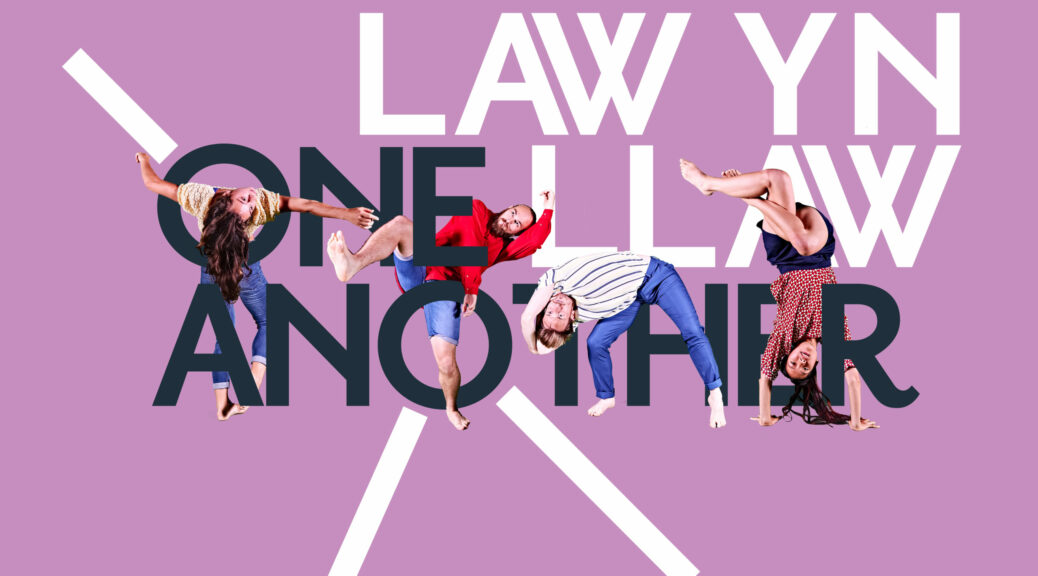
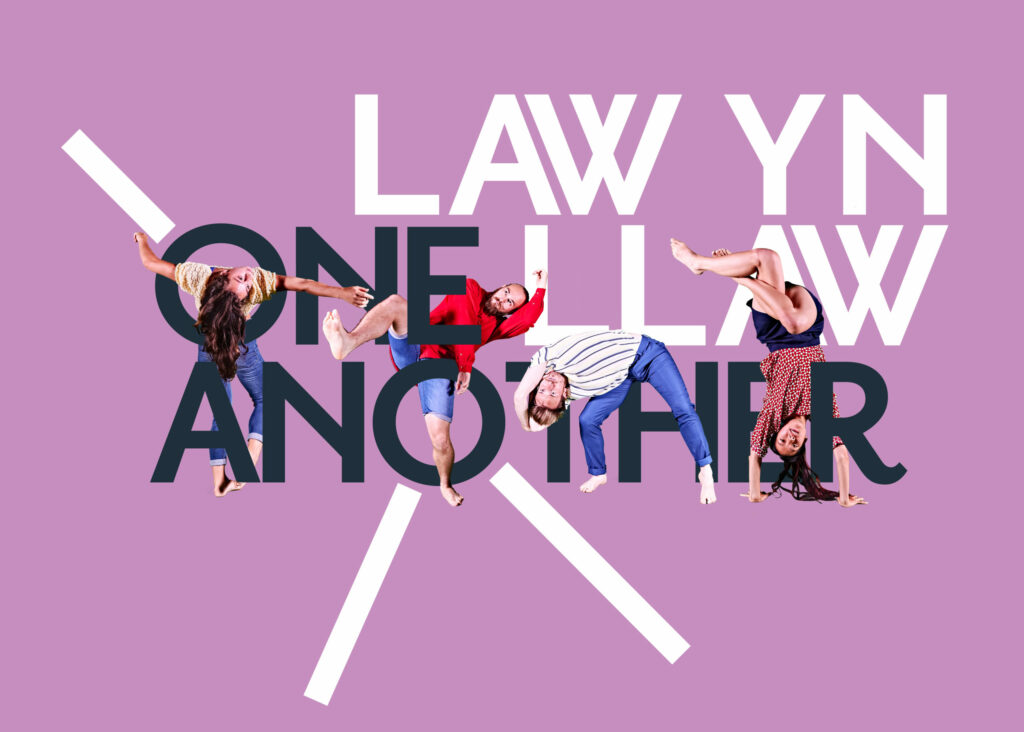
‘One Another’

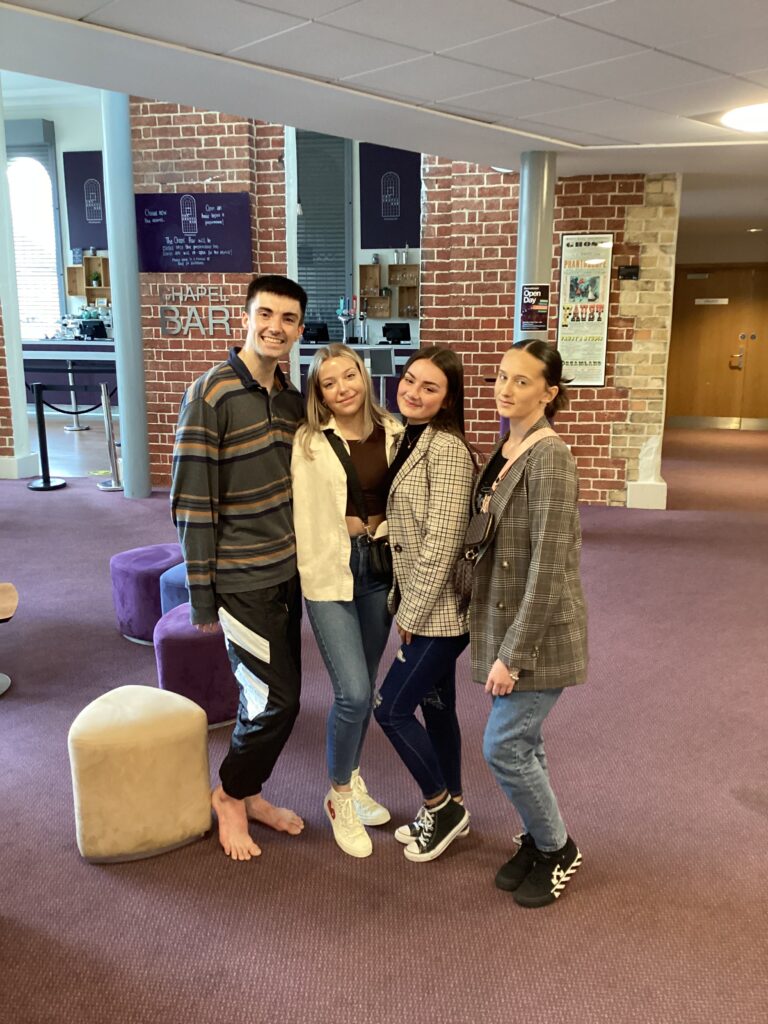
National Dance Company Wales advertised that this piece would be ‘three dances to reconnect us’ and this is exactly what they did when the Pool Hayes Academy Sixth Form dancers travelled to Shrewsbury for their first Dance Aspirations day.

The first part of the day we watched the NDCW open dance class in the auditorium where we observed an independent warm up then a technique class led by Victoria Roberts, the rehearsal director of the company. This insight into a usually private company warm up showed us how a professional company prepare and the importance of ballet even within a contemporary company.
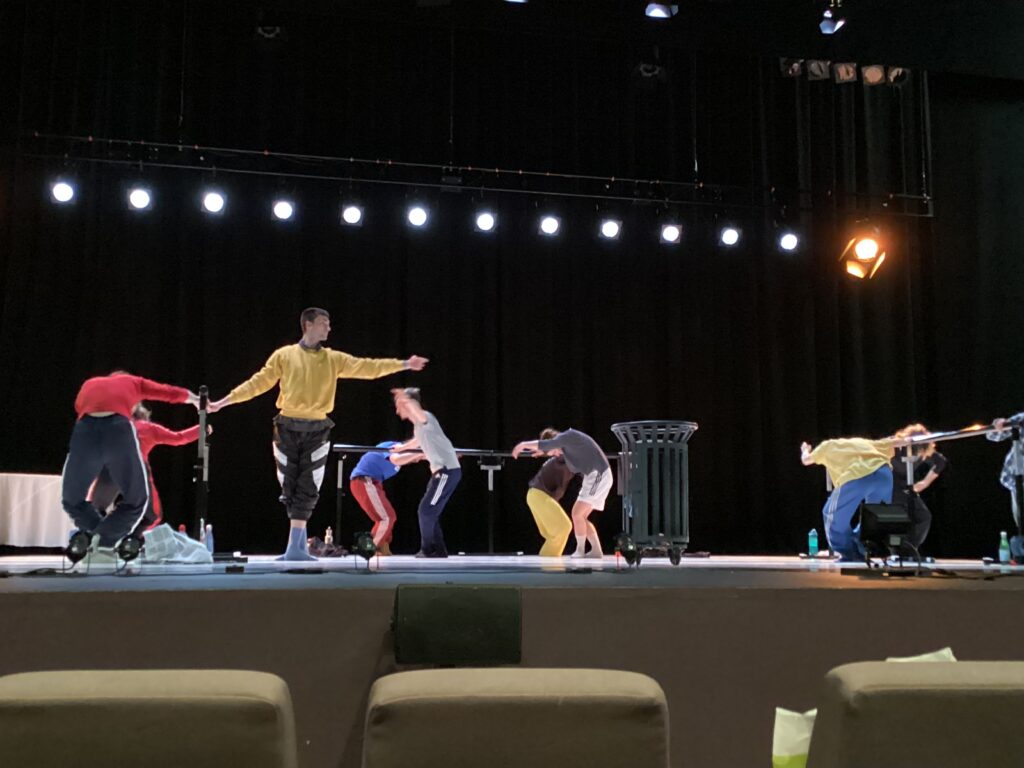
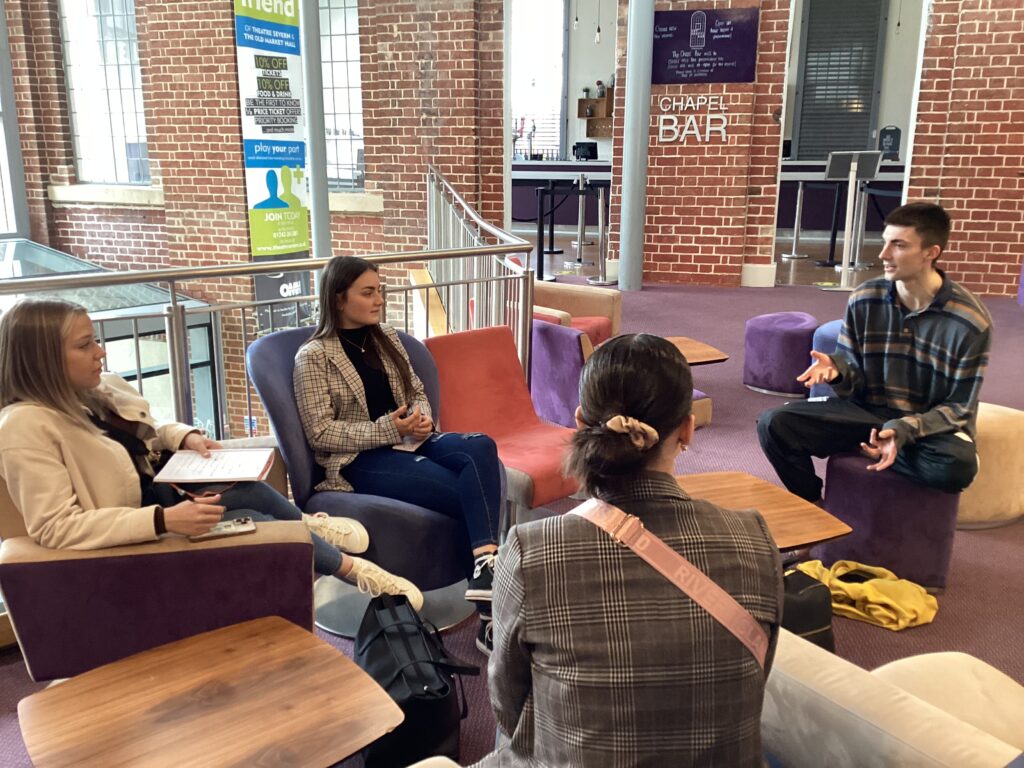
After this we were lucky enough to get the opportunity to interview company member Josh Attwood, who was a previous student of our teacher. He explained what it was like to be a professional dancer and described a day in his life. The opportunity to speak to a professional dancer really helped us to understand how much hard work and dedication it takes to successfully work as a professional dancer and has inspired us to consider our next steps towards this after sixth form very carefully.
A few hours later we returned to the auditorium to watch the performance of ‘One Another’ which is a triple bill.

‘Wild Thoughts’ by Andrea Costanzo Martini

We saw this piece as a celebration of the body because of the way the dancers explored their use of body, in combination with voice and movements. This choreography used animalistic movements with all dancers using contact to explore relationships. The block colour costume worked well for this dance as we felt that this could have been to emphasise the abstract nature of the piece and highlighted a lot of different gestures. The costume was abstract enough to support but not overpower the original theme of the dance. The dancers used a dynamic contrast and projected their voice to the audience with different facial expressions, which was effective to the audience as the combination of voice with movement is something that us students have not seen before and left us excited for what was to follow, having pushed us out of our comfort zones and left a lasting impression.

‘Codi’ by Anthony Matsena

‘Codi’ explores a narrative about the Welsh mining community. In this piece the lighting was key throughout the performance, with the use of headlights giving the audience an insight into working conditions for the miners and setting the scene effectively. This was also supported with the choice of  costumes. The props used gave a sense of drama and highlighted how dangerous conditions in the mine were for the workers. Throughout this piece we could really feel the level of emotion conveyed to the audience, where it goes from being excited and energetic at the beginning to sorrowful at the end. The use of voice effectively conveyed the passion of the community. Overall, this was our favourite piece because it taught us about an important historical event, helped us to empathise with miners and understand their dangerous conditions and inspired us to research more widely for our own choreography stimuli.

‘Ludo’ by Caroline Finn

The final piece in the triple bill was about transitioning into adulthood and revisiting fond memories of childhood experiences. The choreographic use of experimenting with games explored as a child was very entertaining as we tried to spot the various inspirations and witness how these had been turned into movement material. The clever use of props, such as the benches that were originally sat at the side of the stage that turned into a merry-go-round has inspired us to experiment with props in different ways back in lessons. It was interesting to see the clear characterisation within the different dancers, allowing us as the audience to explore these childhood memories through the eyes of each character all the way through. The personalised, multi purpose costumes also allowed each dancer to be playful with their character. This piece was placed perfectly at the end of the triple bill to leave the audience on a high.

After the performance we were lucky enough to be able to sit in a Q&A with members of the cast and learn which piece was their favourite, understand more about the development and rehearsal process for the show and understand how some of the pieces were created over Zoom due to Covid restrictions. Having this opportunity really helped us to develop our appreciation of the pieces and inspire us to try new approaches and push ourselves to explore movement material in different ways in our choreography lessons.

Overall, we loved all three pieces that NDCW performed; particularly how different each of them were and how the use of voice was incorporated. The performance style and characterisation of each piece was so different, which I don’t think we were expecting. We also loved seeing different props used in different ways throughout the three pieces and how the lighting was used effectively, especially in our favourite ‘Codi’.

We would like to congratulate NDCW for a fantastic show but really thank them, Josh especially, for opening up previously unseen elements of the rehearsal and preparation process for audience members to immerse themselves in – the impact the whole day has had on our lessons now we’re back in school is very clear to see and we are all better dancers for the whole experience.
Review School of Rock – The Musical, Wales Millennium Centre by Tracey Robinson

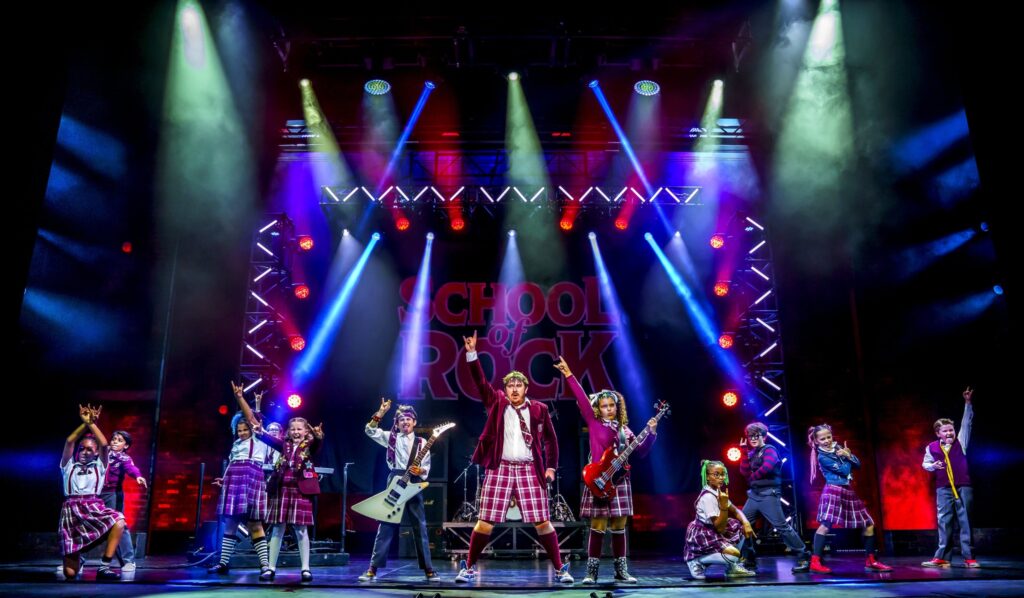
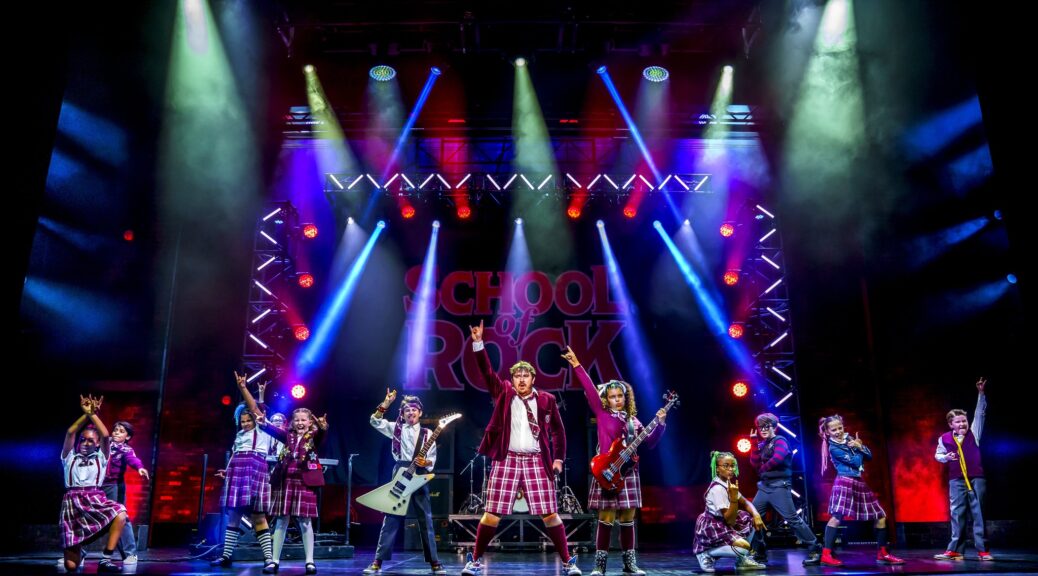
“Stick it to the man” what a ‘rocking’ night we had at the award-winning show School of Rock – The Musical. The performance starts with a message stating that the children in the show do play their own instruments throughout the show and ‘wow’ they are indeed playing live! The young actors seriously have to be witnessed to be believed, they performed a sensational, high energy, hilarious show.


Dewey Finn, played by Jake Sharp, is cast out by his dive-bar bandmates and finds himself in desperate need of cash. He has some questionable habits, such as sniffling, and eating his own belly button gunk, and hasn’t paid the rent on his room in forever. He’s broke, jobless, bandless and soon to be homeless.
He nicks his mate’s teaching credentials to make a few quid at a posh school, and sets about turning his class of straight-A students into a mind-blowing, guitar-shredding, bass-slapping, drum beating, rock band, teaching the pint-sized prodigies what it means to truly rock.

The cast raise the roof and jump around the stage with boundless energy and enthusiasm.


Dewey also falls for the school’s beautiful, uptight headmistress, Miss Mullins, played by Rebecca Lock, she has a secret passion for the music of Stevie Nicks and Dewey helps to bring out the wild child within her. Will they find redemption at the battle of the bands?


I would be singing the praises of the musicians if these were seasoned professional adults but let’s just stop and observe the fact that these are kids! Mini rock legends who smash it, kill it, dice it and slice it and serve you rock n roll raw, live and loving it! The whole cast deserves credit, so take a bow – School Of Rock captures the excitement of live gigs, and how music can shape young lives.


The audience loved it, the cast loved it … and more than a few folk were humming the mantra of ‘stick it to the man’ as they headed off into the night.

Review School of Rock The Musical, Wales Millennium Centre by Gary Pearce

Captivating and exciting from the start as the show opens with No Vacancy on stage, the sound of thrashing electric guitar and screaming vocals that wouldn’t have sounded out of place in any 80s US rock band. With dreams of stardom and a desire to be the best, things soon turn sour as Rock God wannabe Dewey Finn is fired from the band. With no money or prospects and little desire to do anything but play music, Dewey spends most of his time in bed, much to the annoyance of his best pals’ wife who wants him gone from their apartment where he is living ‘rent free’!

One morning when the apartment is empty Dewey takes a call from the principal of Horace Green Preparatory School, a call intended for his supply teacher pal Ned Schneebly, offering temporary paid work. With the prospect of getting paid for hopefully doing very little Dewey poses as Ned and takes the job, and this is where it all begins.

Dewey soon realises that the children at the school have incredible musical talent and he hatches a plan to harness that talent and enter a competition called Battle of the Bands.

In case you are unfamiliar with the rest of the story I will give no more away but have I have two words ABSOLUTELY INCREDIBLE! The young cast were probably one of the most talented and energetic I have ever seen and heard. Not only were they brilliant actors, singers and dancers they played their own instruments! Yes you heard me right! And not only did they play their own instruments proficiently but they played them with what appeared to be a natural ease! Not a beat was missed!

With most of the focus on Dewey and the kids it is easy to overlook the rest of the ‘grown up’ cast but shouldn’t be as every single one of them played their part and played it well.

Overall the show was a rocking success, exciting, exhilarating & emotional!

I’m sure that most people are familiar with the film School of Rock but maybe not the show, so all I can say is get yourself a ticket, get ready to rock and….. STICK IT TO THE MAN!

School of Rock | Wales Millennium Centre (wmc.org.uk)

Review Dreammachine by Hanna Lyn Hughes

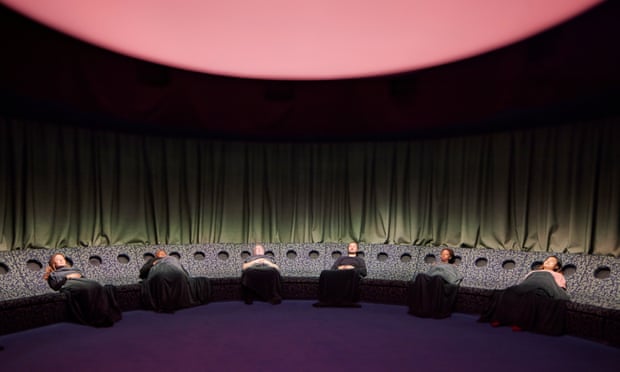
Dreamachine is a free immersive experience showing in London, Cardiff, Edinburgh and Dublin as part of the Unboxed Festival. The idea for Dreamachine was conceived on a bus journey in 1959 when artist and inventor Brion Gysin described himself as experiencing intense hallucinations whilst falling asleep travelling down a tree lined road. It was the bright sunlight flickering in between the trees which induced this trance-like state and inspired Gysin to create the dreamachine in its original form; a light bulb within a cylinder with holes in it attached to a record player designed to be enjoyed at home with eyes closed. Producer and Director, Jennifer Crook and Assemble, an interdisciplinary collective working across architecture, art and design have collaborated alongside
a host of award winning contributors to bring this phenomenon to the masses, creating a unique and transformative experience like no other.

There is a form to fill beforehand and possessions
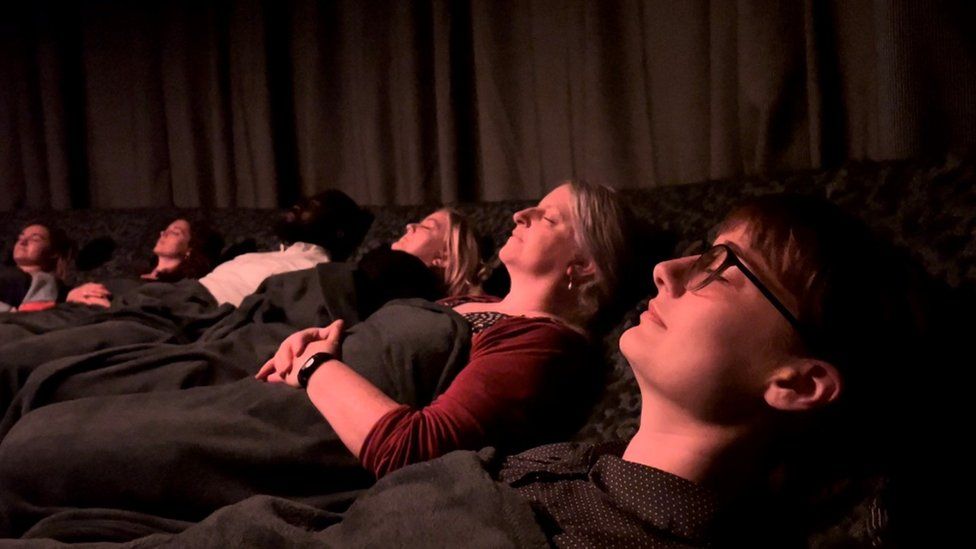
are to be stowed away in lockers. I’d recommend wearing comfortable warm clothing and consider matching socks as you’ll be asked to take your shoes off! We found our seats in the dark round space after a quick safety chat outside and were sensitively guided through a breathing exercise by a member of the dreamachine. The room grew darker as we synchronised our breath and became increasingly heavy eyed. Then, a light glowed overhead and gradually started to flicker as the room filled with atmospheric music, composed by Jon Hopkins. Despite the brightness of the light inducing a little anxiety at first, my curiosity confined me to my chair as I became increasingly transfixed by the kaleidoscopic patterns emerging in front of my eyelids.

As a dancer I often imagine choreography when listening to music, except in the Dreamachine it was overlaid beautifully by the captivating intricate patterns seen through my eyelids.

At this point, the music had built up to an encompassing
quake which vibrated the room and made for the most intense part of the multisensory experience. The vivid bursts of colour seen through the flickering bright light overhead shifted and warped as I drifted in and out of a transcendental state, almost as if what at first I felt I was observing was being moulded by my own imagination. I’ve never experienced anything like it; it was hypnotic, meditative and gripping all at once. As the music lulled and unwound, the light dimmed and we were in the dark again, ready to be led by the Dreamachine team through to a reflection space to discuss. The reflection room was just as enlightening as the experience as we discovered that although each participant had their own distinct experience, we shared no doubt that what we all saw was extraordinarily beautiful and thought provoking. There was a sensorial tool, a drawing table and a live generative visualisation, offering more private, creative and collective ways to reflect on a wholly unique experience based on individual preferences.


I gravitated towards the drawing table and enjoyed discussing the experience with the enthusiastic Dreamachine team whilst attempting to recreate the ornate patterns I saw with chalk on paper.

I left feeling contemplative and curious about
the miracle I’d just witnessed, or produced? Who knows! The Dreamachine is truly a miraculous and unforgettable spectacle that is not to be missed.

Review Dreamachine, Temple of Peace by James Ellis

Photo credit: David Levene/The Guardian
 out of 5 stars (4 / 5)

Something trippy this way comes. Curiously, the Dreamachine from Assemble, is from the jarringly renamed Festival of Brexit in an attempt to blast away British sensibilities and open minds.

Arriving to the Temple of Peace, the staff were warm and welcoming. We popped our shoes off and entered the Greek like temple, now with the enclosure for the experience looking like a building from Mesopotamia. Our host, reassured us and wanted us to know what would occur, if anyone was in discomfort they could leave. I was looked after well, yet found myself nervous for the near ritual.

Artist Brion Gysin created a device which could stimulate the optic nerve, manipulating the brain’s electrical oscillations. This is the Dreamachine. Laying back and getting comfy there was a space age feel to it all. What could only be described as violently hallucinogenic, patterns and constructions formed with my closed eyes. With the lighting at break neck speed to help the trip along, it was an almost unbearable vision. I saw scribbles and prisms within always flowing and hyper coloured yantras. I wondered if this was what it was like to have synesthesia. The score by Jon Hopkins works well, though I think I craved something with a bit more bite from a composer dubbed the next Brian Eno.

Though a shared visitation, what you see is very much wired into your own body and mind. It’s easy to marvel at how the eye takes in light and how the brain processes this information. Some might dub this a religious encounter, others a journey into the psyche. The chance to draw what we saw after with pastels brought me back to childhood and gave us the complete rest bite from an intense journey. A round table was filled with people’s visual testimonies.

What must also be considered is the element of health and what people bring to Dreamachine. Those with mental and some physical health conditions may need to enquire if the show is right for them. I caught a strong headache after the fact, a bout of anxiety did wash over me for the start of the experience as well. It felt as if I was stuck halfway between 2001: A Space Odyssey and a Gaspar Noe film.

The main event it the High Sensory experience (what I saw) along with the more laid back and inclusive Deep Listening encounter. This wont be for everyone, but by golly will it arrest you.

Now on in Cardiff and London, in Belfast and Edinburgh this summer.

Review One Another, National Dance Company Wales – Theatr Clwyd – 10/5/22

So much of what it on offer at the theatre is routine light entertainment or tired re-runs of old chestnuts. A lot of new material, despite the best endeavours of marketing departments, also fails to excite. But, off to one side of mainstream theatre, there is contemporary dance and ‘One Another’ is a show that would appeal to anyone who enjoys performance and who appreciates physical technique, vivid imagination and enthusiastic exploration.

The show consists of three pieces: Ludo, by Caroline Finn, lasting thirty minutes; Codi, by Anthony Matsena, lasting twenty minutes and Wild Thoughts, by Andrea Costanzi Martini. There are nine dancers.

Wild Thoughts is an introduction to the company, with individual dancers appearing, performing similar routines, followed by duos and trios until everyone is on stage and a lot happens simultaneously. It’s extremely energetic (the first performance of the evening?) and very tight. There might have been mistakes but you would have been lucky to spot them. Although it’s fast, athletic and technical, it’s by no means dry. The dancers add to their movements by calling out the names of body parts in a synchronised chant. It had never struck me before that the word ‘thigh’ could achieve dramatic intensity!

I’d seen Codi the last time NDCW performed at Theatr Clwyd. I found it interesting with its clever use of lights and its references to the real life of coal mining and coal mining communities. The second time around, though, as much of it is performed in semi-darkness, to make the most of shadows and the helmet lights, I missed the facial expressions which added so much to the other pieces. And, whilst the soundtrack, mainly consisting of percussive noises is appropriate, it didn’t appeal to me. Nonetheless, this is dance approaching social comment and some of the poses that were struck resonate.

Ludo was fascinating and completely mad. It is a pot-pourri of situations taking place on and around a large table and then a number of park benches, which the dancers can manoeuvre individually or link together. There are moments of surrealism, in which elastic costumes are pulled in all directions, concealing the head or the limbs so that weird shapes can be created – and moved around. Little scenes are played out, teasing the intelligence – you want – in vain! – to work out exactly what is supposed to be going on. Objects, like an old gramophone player and a jam pot, are used as toys. Elements of stage business, like conjuring tricks and trompe l’oeil occur almost randomly. There’s no logic to any of the way the moments segue together, but that’s the fun of the piece. It makes nonsense of the idea of narrative by keeping you guessing throughout. It also makes you wonder if the stream of colourful ideas came from a single choreographer (if so I’d like to have some of what she is on) or if the company contributed their own ideas to make up the mix. The soundtrack to the piece is also charming, including, perhaps inevitably, an accordion at one point. The show ends with a smile.

The only downside is that the evening can’t build as it might with a ballet or a full length play. There are effectively two intervals which are almost as long as the pieces themselves. The audience is left to sit and look at the curtain, talking amongst themselves, or to go outside into the tented reception area which was very draughty (Theatr Clwyd is being substantially rebuilt). There will be technical reasons for these gaps – the dancers need to get their breath back and the set needs to be re-jigged – but ideally, there should be something happening on stage – a talk or question and answer session or even a bit of live music. Performances engross our attention and extend our concentration. If you can find a way to do this cumulatively you achieve more momentum.

That said, NDCW are to be congratulated on putting on a diverse and original show, of the kind which keeps theatre alive. Theatr Clwyd are also to be applauded for keeping their programme varied and making sure their local audience can experience the best in modern contemporary dance.

Simon Kensdale

Review Composition: Wales Concert Hoddinott Hall by James Ellis

 out of 5 stars (3 / 5)

The future of music Welsh lies in events like this. BBC NOW have taken under their wings Wales’ budding composers for years and this reaches its zenith in the Composition: Wales workshops and concerts each year at Hoddinott Hall.

Several pieces were performed on the night and I will try and touch upon each one. Starting off with Haldon Evans and his Y Mynydd Du, we get a vivid depiction of famous Arthurian landscapes. You could feel the breeze, with Vaughn Williams and Britten as friends. The grand, old Welsh composer might just have more music to come. Sam Butler’s Stones Have Memory Here had a focus on time, with Cardiff Castle in mind and the centuries of masonry that lie within. This felt quite nondescript, something I would need to hear again to really drink in. Auburn Dusk from Jonathan Guy was an airy, folk like few minutes which held favour in this concert.

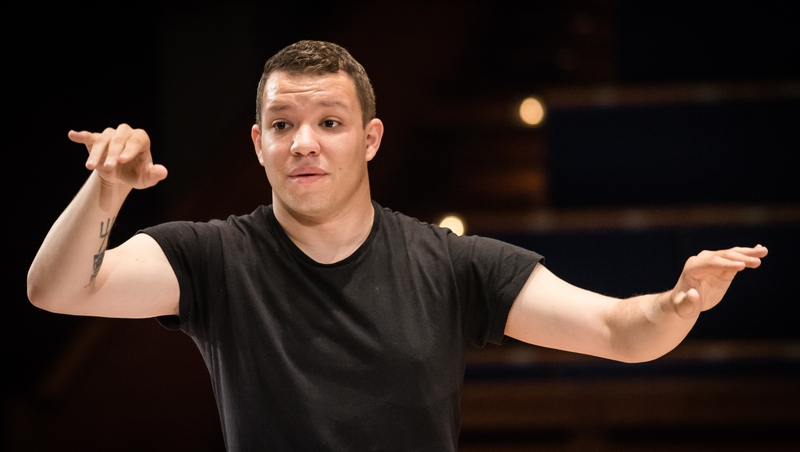
Leading things was the flamboyant Ryan Bancroft, who’s animation is always watchable and exciting. He lives the music in every bar. Tomos Owen Jones and his Daybreak from High House was a charming sign off from the Brecon Beacons, the composer here thinking of his new home and it’s place in the landscape. Nexus by Natalie Roe was an unassuming composition though filled with spice, seemingly venturing into suggestions of other music genres without ever crossing their thresholds. The jazz inspired Ascension by Jake Thorpe had none of the trappings of the genre and crossed over into a harsh encounter. Upper Structures by Jonathan Worsley held up as quite dense and dreamy, the last but one work on the programme. The feel of the theatre lies in BBC NOW’S clarinetist Lenny Sayers’ The Imaginary Carnival, proven by future promises of a staging. This felt like Petrushka hungover, yet the festive imagery was very clear and rowdy.

It is always a joy to hear the musicians play new music. BBC NOW should be proud.

Review Eight Songs for a Mad King, Cardiff University School of Music by James Ellis

 out of 5 stars (4 / 5)

We lost Peter Maxwell Davies a few years ago and his legacy is being greatly considered. Whilst most might shy away from the blunt nature of his music, there is an always theatrical skill to it and he truly remained one of a kind.

Prior to Max’s masterpiece, the Mad Song Ensemble presented contemporary music of an impressive degree. Anna Semple and her Pinter inspired After Torcello starts as a counting game for the players, leading to wispy playing. Strings of the violin and cello are massaged not stressed, the keys of the flute dampened with no breath. The end also remained curious, the conductor leaves the stage, as the musicians pull poses as if to play on. To start, this was an evocative opening and had a real moody feel to it.

Within Richard Causton and Phoenix, the main point of reference is very clearly Messiaen and his Quartet for the End of Time. Inspired by the mythical bird, there is an energy and valour within, though the piece might slightly over stay its welcome. Blue-Green Hill from stalwart Judith Weir seems to have been forgotten about after an overture was hastily needed in a tour of India. Scottish folk melodies are the major factor and the work is the middle ground between dance work and dense, some uncanny doubts lingering in it’s undercurrent. There is an ending of plummy British feel, a vibrant cleansing of the palate.

For the big gun’s Maxwell Davies Eight Songs for a Mad King finally was heard after cancellations. There are no prisoners for this 30 minutes assault, detailing the madness of King George III. We hear quotes from his real life, though we can’t always make out the excellent libretto of Randolph Stow. How the king shrieks, grunts, babbles and blathers. This is purely because of the shattering of the words into pure letters and syllables. The king tries to teach birds to sing and other curiosities. Also, note worthy is the sheet music, with one page a birdcage creation, a symbol of the mental health struggles on stage and the birds in the sound world.

Truly a great work about going into the psyche, you need a committed performer to take it on. Benedict Nelson shines in this ludicrous role, arriving on stage with a shirt barely buttoned and socks tucked into his sweat pants. At one point he appears to inhale a tin of fish like a jackal puppy and a paper crown is adorned upon his head for a brief few bars at the starting line. Being in the front row might have been a mistake as you feel being too near a tiger in its cage. A violin is furiously smashed at one point, a metaphor for one of the king’s birds he is teaching to sing.

The players also shines in an incredibly demanding piece, the fitting harpsichord and flurry of random percussion are just some highlights. We of course expected there to be bird whistles and the like, though it is the brief blast of a didgeridoo that proves the work’s hippy period execution. Maestro Joshua Ballance is a young, bright keeper of proceedings and all through the evening he proved a love of experimental music.

Review Six, Wales Millennium Centre by Lauren Mallin

SIX by Marlow ;

Directed by Moss and Armitage ;
Set designed by Bailey ;
Costumes designed by Slade ;
Lighting designed by Deiling ;
at the Malvern Theatres ;
UK tour ;
2021, Marlowe Theatre
Credit: Johan Persson

 out of 5 stars (5 / 5)

Divorced, Beheaded, Died. Divorced, Beheaded, Survived.

The age-old nursery rhyme, right? History buff or not, most of us know it, have recited it, skipped and handclapped to it, used it to our advantage in a pub quiz…

But how often do we stop to think that these six words that have been periodically used to sum up the legacy and lives of six remarkable women in history? Six individuals flippantly reduced to six words. Words that ultimately reduce these women to the impact their husband had on them.

Henry VIII and his Six Wives have dominated the school curriculum for decades; a period romanticised by Hollywood, become an inspiration for artists, playwrights, authors… but how much do we really know about the women behind the marriages? The women behind the tyrant.

Time for history to be overthrown, thanks to the feminist fuelled ensemble that is SIX.

Prepare to feel empowered, uplifted, and hit by a wave of strength as these powerful Queens finally get their chance to sing their truths and become named, REAL women – not just one word in a stupid rhyme.

SIX perfects the unbelievably difficult task of towing the line between light-hearted, historical romp, while highlighting the major injustices and abuse faced by women in the Tudor Court. What’s more, the show ingeniously shows the hurdles faced by these women through a modern lens – everything from unachievable beauty standards, harassment, gaslighting and predatory behaviour that could easily paint Henry VIII as the Harvey Weinstein of his day. We quickly come to realise modern day women are still fighting the patriarchy in similar ways to that of our sisters 500 years ago.

But this isn’t a show to get you down!

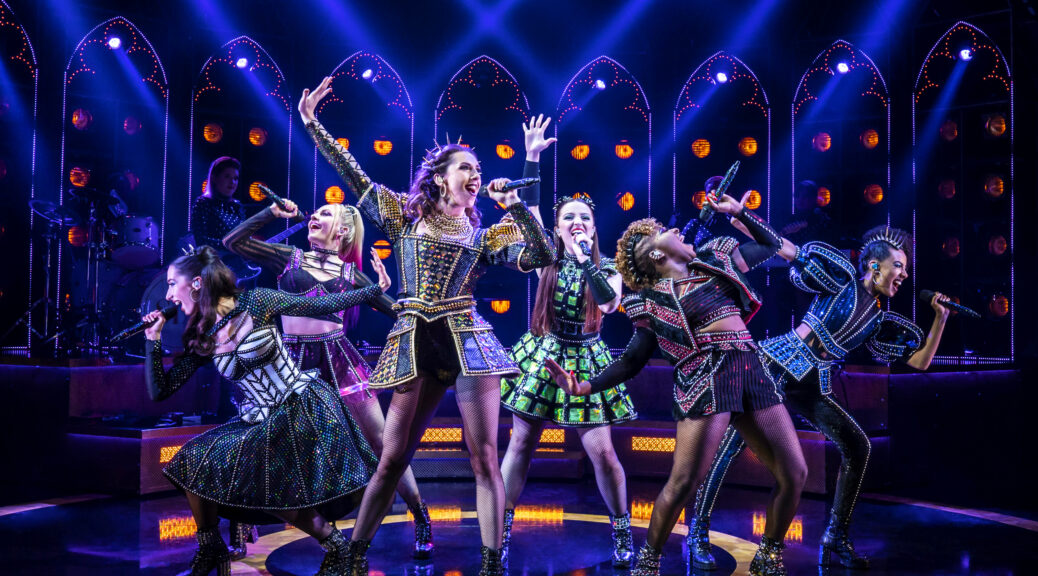
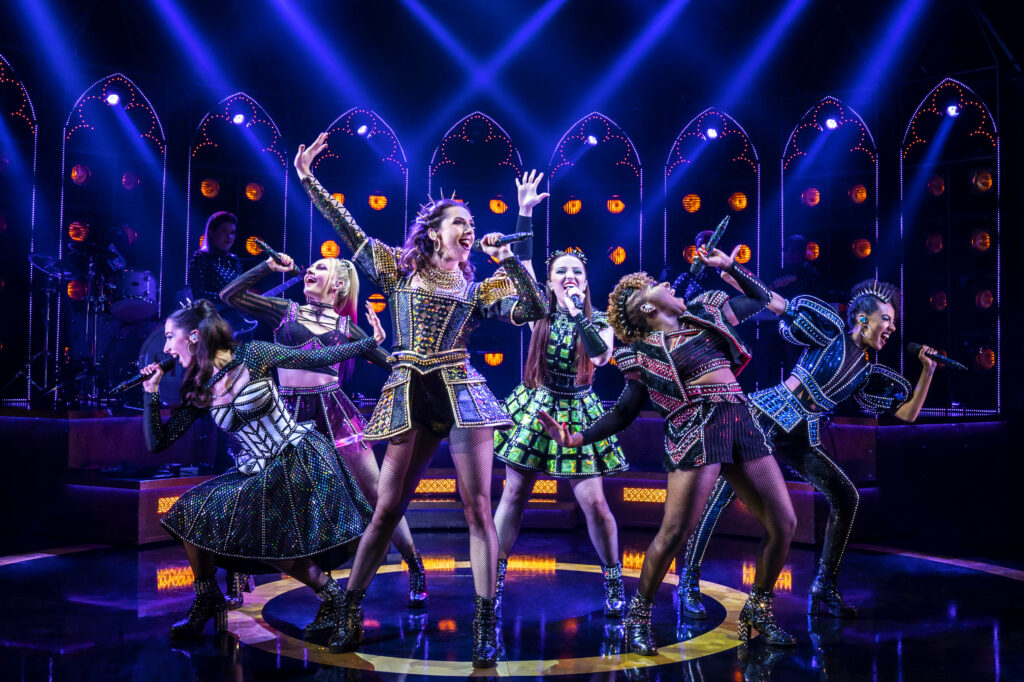
Enough of Henry and his penchant for wedding (and beheading) – SIX shines a literal spotlight on each Queen, allowing the audience to learn more about their individual trials, tribulations and achievements over and above simply being wife. Their stories come to life through a range of girl power-fuelled song and dance numbers that give off a gig-like atmosphere as opposed to that of a traditional musical. The live band on stage, fabulously called The Ladies in Waiting, bring so much vibrance and energy to the show, making it almost impossible to stay still in your seat.

A gloriously diverse and talented cast bring the insanely catchy and clever score to life, with their real strength found when they come together to sing as the ultimate Tudor girl band! You’ll spend long periods of the show taking in the unbelievable detailing of each Queen’s costume, which mix Tudor embellishments with modern day sass – each one is completely different to the other, giving the Queens individual styles and silhouettes on stage. There is lots of funny and heartfelt moments too – the energy is infectious, and it is so obvious the cast are having the time of their lives on stage, which radiates into the audience. Feel good vibes all round!

No longer Divorced, Beheaded Died. Divorced, Beheaded, Survived. They are Catherine of Aragon, Anne Boleyn, Anne of Cleves, Jane Seymour, Katherine Howard, and Catherine Parr: inspirational women in their own right and so much more than who they married.

Too many years lost in history, these six remarkable Queens are finally free to take their crowning glory, so do your royal duty and spend the evening at the most inspiring royal court in HERstory!

SIX is LIVE at the Wales Millennium Centre until 14th of May

Review Little Shop of Horrors, Kent Academy of Musical Theatre by Donna Williams

Many may associate the cult-classic Little Shop of Horrors with its 1986 film adaptation starring Rick Moranis, Ellen Greene, and Steve Martin to name but a few (even Bill Murray makes a guest appearance!) The film was based on the 1982 off-Broadway musical of the same name and was well received by critics and audiences alike. Of course, most forget the original film which started it all. The Little Shop of Horrors (1960) written by Charles B. Griffith and directed by Roger Corman is a horror movie and farce about an inadequate florist’s assistant who cultivates a plant which feeds on human blood!

Fast forward fifty plus years and the musical is still going strong, attracting audiences across the globe. This time it was the turn of Kent Academy of Musical Theatre (KAMT). Founded by Jo Mason in 2020, KAMT is a part-time musical theatre academy for all ages, from toddlers right up to adults of any age! They currently run classes in Maidstone and Cranbrook with ambitions to branch out across the county. Considering the academy was founded during a worldwide pandemic, it has gone from strength to strength during its first two years, Little Shop of Horrors being the first production presented by the academy’s adults. Founder and director Jo Mason had been inspired by professional performances of the show in London, most recently Regent’s Park’s contemporary adaptation.

Often, it is more of a challenge to put on a production with a group of adults than with a group of children. Adults take part in amateur theatre as a hobby, something they’re passionate about and want to continue improving at, but something which comes alongside potential parenting, full time jobs and just ‘life’ in general, so it’s always a thrill to see a group of adults who are clearly dedicated to their craft and who have worked so hard to pull a piece of theatre together. It is almost unfair to label this production ‘amateur.’ Although the definition is actually ‘someone who engages in a pursuit on an unpaid basis,’ it has come to mean that an individual is incompetent at something. For example, you might say Little Shop of Horrors’ hero Seymour is an ‘amateur florist’! But this production certainly pushed amateur boundaries.

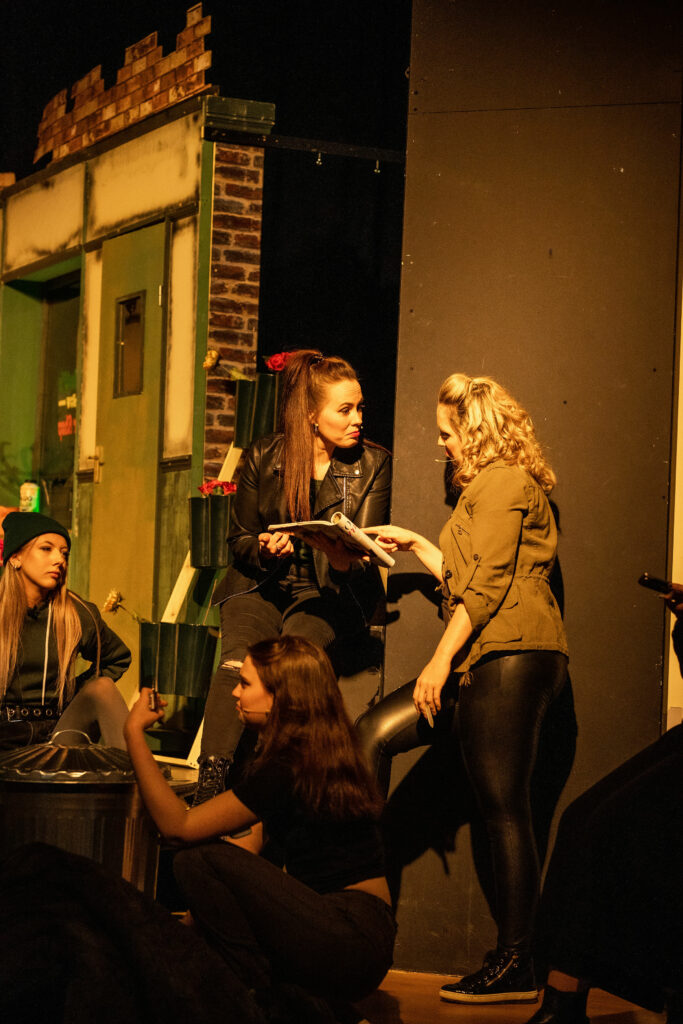
It is great to see an almost full auditorium at the Glassbox Theatre. It is more important now than ever that audiences support local theatre and it is clear that this audience got more than they bargained for, hearing some wonderful comments and fabulous feedback from the crowd in the interval and beyond. It is clear from the get-go, as the piece opens with the well known ‘Little Shop of Horrors’ title song, that the Urchins, the Greek chorus if you will, are extremely strong vocally. Not missing a note, the harmonies work beautifully, and each Urchin performs their ‘sassy’ role to a tee with plenty of attitude! It is clear not all Urchins are completely comfortable with some of the choreography, but this is made up for in style and voice! The Urchins are certainly at their strongest when ‘setting the scene’ vocally, whether it be as a group or scattered around the stage to portray a time or place.

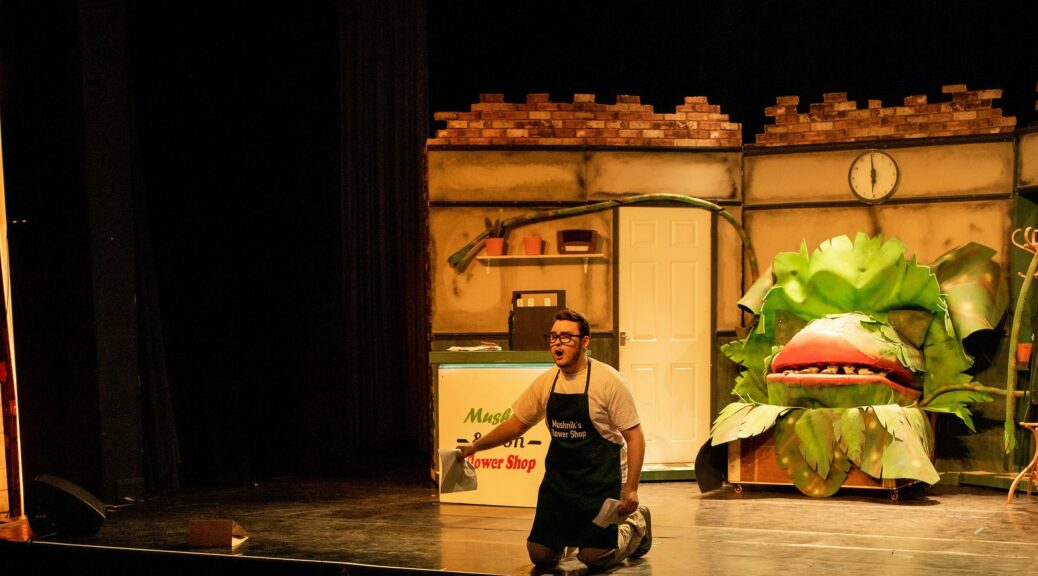
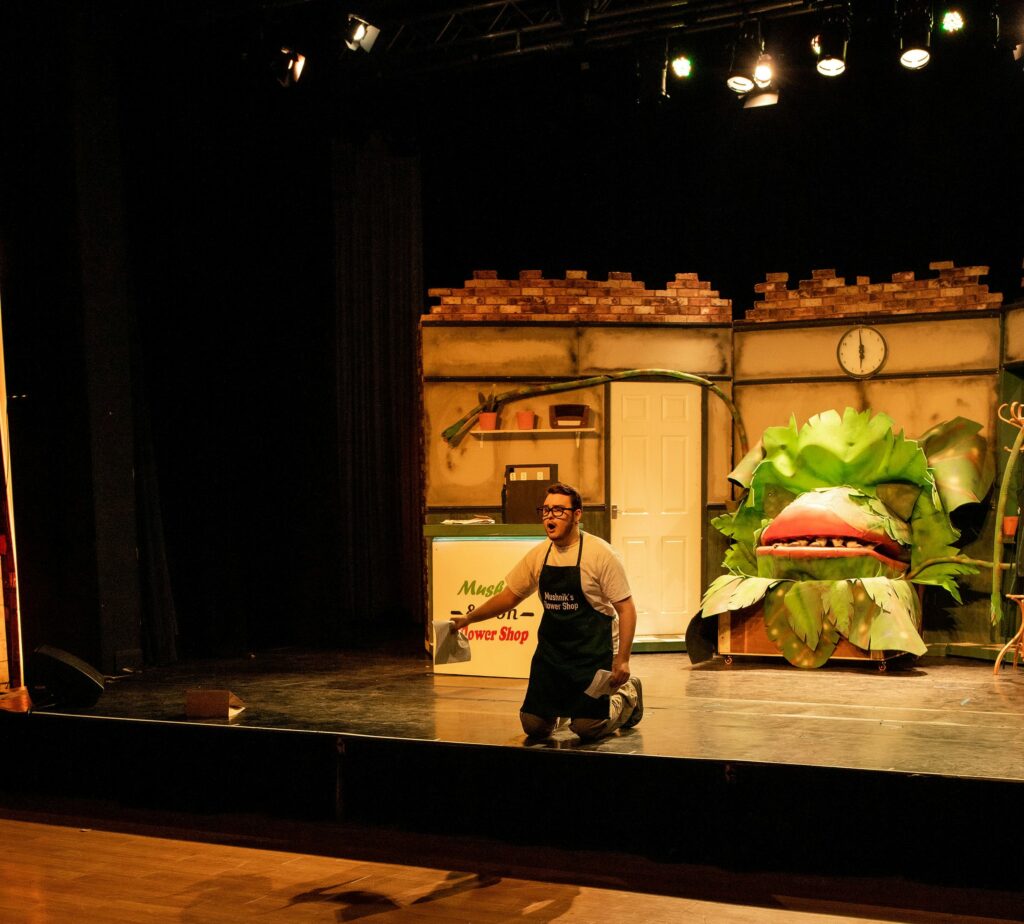
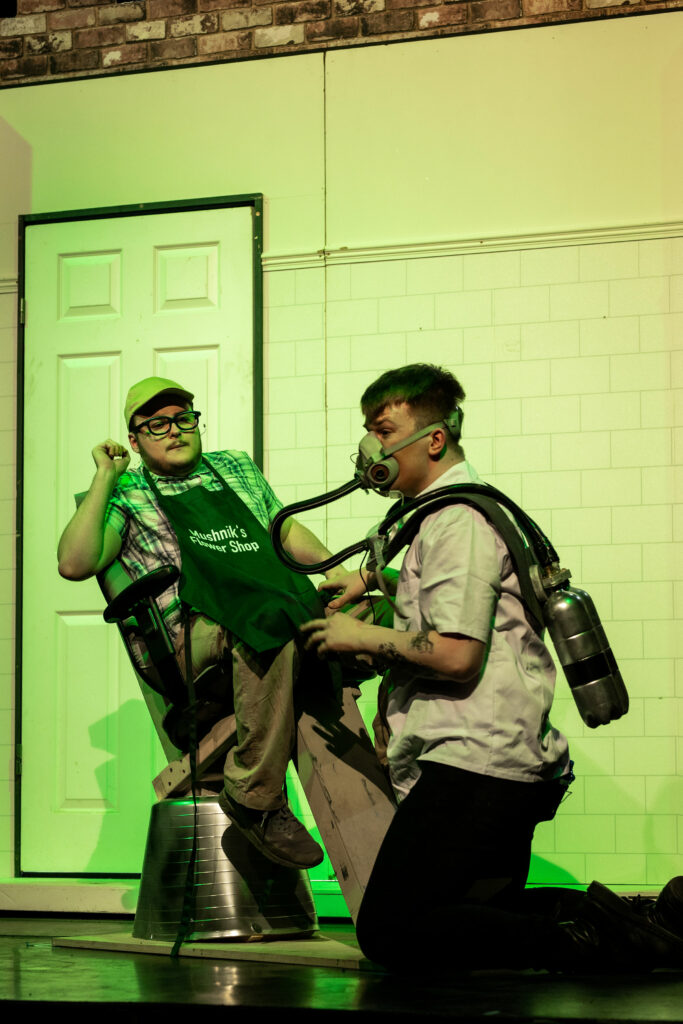
The set is really striking and the scene changes slick with simple but effective changes as the production progresses…a light on here, a dentist’s chair there and of course, the most obvious change being the ever growing, man-eating plant! All puppets are visually outstanding and the shock and laughter from the audience as the plant chomps its first victim is worth the wait! The costumes have been modernised, with the Urchins in khaki green and black, the dentist in ripped jeans and tattoo sleeves and Audrey has a look of Sandra Dee circa 2022!

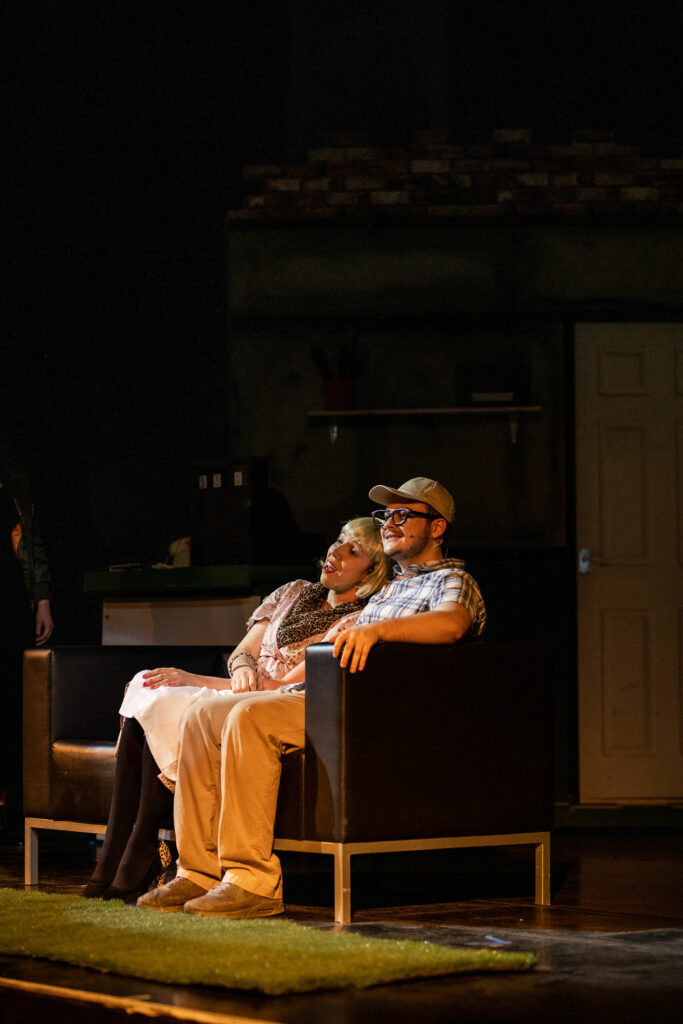
There are a few directorial choices which really hit the nail on the head in this production. The first happens during ‘Somewhere That’s Green,’ beautifully sung by Laura Shannon as Audrey. As she continues into the song, we see her don an apron, as if travelling into her own daydream, particularly poignant as she undoes her cast from an arm broken by her nasty dentist boyfriend, Orin. A piece of artificial grass is then rolled out in front of her, unintentionally I think, causing a few giggles, but we are transported with her, into her ideal future. Another ‘different’ take on a musical number is spotted during ‘Suddenly Seymour,’ usually put across as a simple, lovey-dovey song. Instead, although still romantic in parts, we see Audrey and Seymour clearly getting a little hot under the collar as he pulls her blouse from off her shoulder and pins her (gently!) against the wall! Although not expected, we see the sexual tension between the two and it somehow works despite being placed in the middle of a romantic duet! Most productions have their plant’s voice offstage, so it was a surprise to see the plant ‘brought to life’ as a female diva, entering through the door of the florists and interacting with Seymour! This worked effectively and made the plant seem somehow even more eerie and domineering, no longer just a plant but something even more ‘alive’ and capable!

This production was extremely well cast and, aside from a few sound issues, it could not be faulted. We were in great hands with Laura Shannon (Audrey), Ivan Collis (Seymour) and Paul McLaren (Mushnik) from the outset with Ivan Collis putting on an outstanding performance as Seymour, a very consistent performer with great comedy timing and a strong voice to boot. All other roles, ensemble and dancers were incredibly strong and certainly weren’t missed in the action.

This was a fantastic production which thoroughly deserved the standing ovation it received and I’m already looking forward to KAMT’s next production, Calendar Girls, which will be performed on Saturday February 11th, 2023, at the Glassbox Theatre.

Fore more information about KAMT and how to get involved please head to https://www.kamt.co.uk/ or find them on Facebook (just search for Kent Academy of Musical Theatre).

Glassbox Theatre, Gillingham
Saturday April 9th, 2022
Book & Lyrics: Howard Ashman
Music: Alan Menken
Director & Producer: Jo Mason
Vocal Coach: Fiona Lussier-Foy
Choreographer/Dancer: Millie Judd
Costumes: Jo Mason
Props: Jo Mason
Light & Sound Technician: Jack Gschaider
Set: Set for the Show
Stage Manager: Nick Bower
Stage Crew: Emma Sawyer, Darren Coleman
Cast Includes: Laura Shannon, Ivan Collis, Paul McLaren, Will Coote, Jenny Soto-Briley, Emma Sackett, Natalie Kitts, Maddie Lambley, Molly Dobson, Georgia Page, Suzanna Byles, Lindsey Simpson, Grace Couch, Eden Moody, Emma Bond