Tag Archives: featured

Review, Lil Wenker: Bangtail, Ed Fringe, By Hannah Goslin

 out of 5 stars (4 / 5)

Welcome to the wild, wild west, run by your fearsome and hysterical local cowboy, Bangtail, where no one is safe, no matter where you sit.

Lil Wenker brings the character of Bangtail, the rootingist, tootingist, bad boy around. Unable to be shot, and a riot with the ladies, it all soon crumbles, when his audience-based nemesis manages to injure him. What is his calling now? Why that of accountancy of course! But is either his true calling?

Bangtail can almost be seen as a two parter: we begin being introduced to Bangtail, with his western tropes played on for satire (think spoons instead of boot spurs), where he immediately gets down to business of interaction with us. We are soon barn animals, a select few becoming key characters such as the nemesis or local drunk lady, and his interactions with not only them but us is full of comedy, with smart writing, slapstick and clowning skills. He’s not afraid to prolong the laughter, ignoring the rule of three and pushing the boundaries, leaving us in hysterics.

This continues when changing to the next part, his accountancy era. With clever writing and direction, the comedy and clowning is still there, new and fresh but old ideas are newly presented, almost as a satirical flash back to the past. The audience characters continue but in different guises and so we continue to find hilarity in the basics already set for us. The physical comedy continues, with gusto and high energy and we almost become delirious through giggles. However, the accountancy part felt more into a thought provoking part of the narrative and, while still with moments of comedy, lost a little of the giddiness we felt in the first part.

Bangtail is smart, it is high-level comedy and clowning, with very clever writing and overall concept. Lil Wenker is nothing but a fantastic performer, holding our attention and with instant ability to make us laugh.

Review, SLUGS, Creepy Boys, Ed Fringe, By Hannah Goslin

 out of 5 stars (5 / 5)

If you are looking to have a riotous fever dream of a time, please see SLUGS. With no idea what I was going into, I fell into an absurdist pit of chaos and colour.

SLUGS is a show about nothing. Nothing at all. Or that’s what they want you to believe. In fact its deep commentary on art, artists, the queer community and the quest to bring back the bonkers to the theatre scene. Think clever puppetry projection, bizarre and sometimes grotesque scenes featuring being nude and some beans (separately), high audience interaction and interjections of electronica. Think of a more adult version of The Mighty Boosh, and you will be somewhere near.

The Creepy Boys have no filter, no boundaries and this is what makes this such a hilarious and bizarre show. It is absurdist at its highest and is so unbelievably funny, you struggle hard to breathe. Kruger and Grummett are a fantastic pair, bouncing off one another and following as one mind into the chaos. Two peas in a pod in every sense, one cannot do without the other to propel their high concept and strange art directly into our faces. They equally have little boundary with us, involving us and not being afraid to offend – luckily, their audience is of the same mind. They are highly energetic and the pace of the show is at its top velocity consistently, one can only imagine the weeks of sleep they need after.

They use every inch of space and multimedia available to them – from basic theatrical and performance art skills, to projection on the back wall where they produce skilled and mad puppetry scenes, as well as climbing into the crowd and across seats, not one bit of the room is unexplored.

SLUGS is almost hard to put into words, but in all the best ways. It is utter brilliance and complete insanity and completely what fringe is about.

Review, Aether, TheatreGoose, Ed Fringe, By Hannah Goslin

 out of 5 stars (3 / 5)

Set in Summerhall’s anatomy lecture theatre, we spend an hour speeding through, almost at the speed of light, feminist history of the known and unknown.

Aether, performed by TheatreGoose and written by Emma Howlett explores our human fascination with the scientific. We are propelled from modern day to ancient history to more recent centuries, where discoveries and investigations are made to try to understand the unknown. All with a female at the centre, we see how science is conceived into other ideals such as witchcraft or magic.

TheatreGoose have almost made this play specifically for this space. Arming us with whiteboards and pens, we immediately feel as if we are part of a lecture, engaging with us later in just that fashion. The circular space in front of us features only a blue curtain that is played with throughout, but still managing, with the use of a handy projector (if you’re old enough to remember the ones with the plastic film that you swapped in and out), to utilise the small space by projecting onto the ceiling above – although, blink, and you may miss it!

The performers are all brilliant in their own rights, each with their own unique take, whether this is within the ensemble or in individual characters. With very little props or pieces of costume, they add these subtleties to try and make it clear the change along with their own changes in movement or voice.

While it’s well performed and looks the part, for me the story-line felt slightly disjointed. Whether it’s my own lack of knowledge in the science sphere, I struggled to find what the connections between the stories were and how this related to the modern character. There is maybe one or two moments of her investigating this but it doesn’t cover them all. Each story in their own right was interesting and well presented, but as a whole, they did not feel as if they quite knitted together.

Aether is a really interesting approach to joining science and art, with a great use of the space and wonderful performances. However, the stories themselves seemed separated with no clear conclusion of how they were to come together.

Review, The Fit Prince (who gets switched on the square in the frosty castle the night before (insert public holiday here)), Awkward Productions, Ed Fringe, By Hannah Goslin

 out of 5 stars (4 / 5)

It’s clear after seeing all their productions so far, Awkward Productions have conceived and executed well their own take and blueprint for comedy, queer theatre. Just like Diana: The Untold and Untrue Story and Gwyneth Goes Skiing, The Fit Prince […] approaches the story with gusto, humour and using a range of theatrical techniques.

Pulling upon hallmark Christmas-style movies that have recently blown up amongst the Millennial and Gen Z generations (and often starring stars of Millennial’s youth) Awkward Productions have taken these cheesy and purposefully fanciful tales and approached with a loving satire.

The Fit Prince […] features the story of a Swedonian Prince who must marry in the next two weeks as the heir after the King has suddenly died. In his quest to find someone to marry, a New York baker is enlisted to come and make the wedding cake, soon becoming close to the Prince where they fall in love with one another. In amongst this, there are plots to overthrow the Prince and random but well conceived plot points, providing endless comedy.

Awkward Productions clearly know they are fast becoming a cult following. References to previous shows, such as a Diana look-a-like in the Queen, a prop from Gwyneth goes Skiing making a guest appearance, they are not only creating new comedy but adding references that only the true followers will know. This provides such smart and hilarious moments that you can’t help but guttural laugh at.

The staging, props and multimedia used is so professional and well constructed, they effectively set the scenes but also help to support their unique humour and theatrical approach. At the same time, there isn’t any attempt to be “perfect” or serious; our guest stars appear on a screen with dubious backgrounds such as found in a zoom call, a very well made prop cake is carried around but referred to in a moment as “fake”, showing that they by no means take themselves serious and this is entire satire.

As well known by their comedy, a lot of their “support acts” are members of the audience and this brings its own moments of comedy that our main performers and creators, Linus Karp and Joseph Martin (now an official married couple as took place on stage for real this year!) do fantastically to improv on when it doesn’t go to plan or further add to their comedy performances.

And during this, they have fully lent into their puppetry skills; Diana and Gwyneth both had a bit of this but these have been brought back as subtle nods and as supporting cast, with a newbie amongst the group; the Orphanage’s matron, played by Martin in a cloak and an amazingly constructed head and arms, bringing a almost Roald Dahl-esque figure that is purposefully imposing and so well performed.

The Fit Prince (who gets switched on the square in the frosty castle the night before (insert public holiday here)), is a totally bonkers, highly comedic and ridiculous (in all the best ways) production, continuing Awkward Productions firm stomp of unique theatre on the scene.

Review, Brainsluts, Dan Bishop, Ed Fringe, By Hannah Goslin

 out of 5 stars (3 / 5)

“Brainsluts”, a term apparently used for those taking part in a clinical trial, titles this production of a similar context.

Following five clinical trial participants and a Doctor, we watch as their relationships build and change from strangers to something else over 5 Sunday sessions. Love blossoms and dissipates, vulnerability is shared and friendships are formed.

This production is a very simple set up. We encounter the same room with a set up like a waiting room meets clinical room with furniture and props to support. Times when the fourth wall is broken for the Doctor to speak directly to us is simply set up through freeze frames and a lighting change. It is all effective and works well for this straight forward piece of writing.

It is a humorous narrative, with very different and, at times, stereotyped characters, their interactions provide their own comedy with the help of the well constructed narrative. Their interactions with one another feel genuine and flow easily, with no trips, stumbles or lack of confidence. We utterly believe each character and their relationships with one another. Comedy is also found in awkward moments constructed and feels very “British” in its approach to these. Generally, the story is very well constructed and gives the sense of a sit com on stage.

Brainsluts is an enjoyable and well written production, with moments of well constructed comedy and plot points, all executed very well by the performers.

Review, The Nature of Forgetting, Theatre Re, Ed Fringe, By Hannah Goslin

 out of 5 stars (4 / 5)

In collaboration with the Alzheimer’s Society and Neuroscience Professor Kate Jeffery, Theatre Re bring a heart warming and breaking tale of dementia in physical theatre form.

Based in one of the Pleasance Courtyard’s biggest spaces, the stage is taken up by a skeleton stage, with all the props, costumes, staging for ever changing scenes on bare display. Throughout the production, changes in costume and set happen in front of our eyes, bringing a no-secrets and vulnerable view to the production, perfect for such a touching and vulnerable tale.

The Nature of Forgetting is the story of Tom, 55 years old, living with dementia. As his birthday approaches, he is soon triggered into viewing past memories and reliving his former years. This includes childhood all the way to the present, with relationships with his mother, his budding romance with his school sweetheart and the birth of their daughter and his best friend throughout all this time.

On a square piece of platform is where the majority of the action takes place. Supported by a live band at the back, little speech is heard but perhaps the occasional name or murmur of interaction. This is mostly physical theatre and dance and is very high energy. It is beautiful and fluid and happens so effortlessly. It is playful and highly interactive between the performers. It clearly and artfully tells Tom’s tale, with plenty of room for simple interpretation. As any physical theatre or dance requires, there are feats and movements that are only possible through brilliant skill but somehow are made to look completely easy. They do this and successfully evoke the roller coaster of emotion we feel through the highs and lows of Tom’s life.

While the performance needed a big-ish stage and was highly popular, therefore needing plenty of seating, it felt a little lost in this space. No matter how big the performers movements, it felt a little diminished in such a large space. The beginning began with Tom and his daughter, not mic’ed up (and usually I am actually against mics anyway) but their vocal interaction, no matter how brief, got lost in the vastness.

The Nature of Forgetting is a touching and heart breaking tale of dementia, the ease of confusion and how it can propel one into the past, all elements that people with dementia likely experience. It takes us through the love and loss through a normal life and one affected by dementia and is energetically and effortlessly performed, resulting in a beautiful piece of work.

Review Nye, Wales Millennium Centre by Bethan England

 out of 5 stars (5 / 5)

The noisy member for Ebbw Vale. The stuttering orator. The father of the National Health Service. Growing up as a Valleys girl I was always told that the NHS was created by a Welshman;, but I never truly knew the full story behind the man, Nye Bevan, whose vision for a better, fairer world, was the driving force behind creating the National Health Service. I first encountered Nye at the Wales Millennium Centre in its previous run in 2024. It’s safe to say that my visit to the revival version in 2025 still left me reeling with emotions; high with laughter one moment, face wet with tears the next.

In a time where the NHS is under much scrutiny; undervalued, understaffed, underfunded, Nye takes us back to its infancy, with the opening pages revealing Aneurin Bevan recovering from an operation in one of the very hospitals he built. The staging here is a thing of beauty, the set and ensemble create a budding National Health Service, the hustle and bustle of the ward’s essence captured perfectly. From there we enter Nye Bevan’s dream and his journey from a Miner’s son in Ebbw Vale, through school, endless tribunals and countless committees, to the Houses of Parliament and eventually to his role of Minister for Health (…and Housing) and his ‘vision’ come to life in the creation of the National Health Service.

Nye is, to my mind, a masterclass in writing. The scene in Tredegar Library is a particular favourite of mine, delivered with a deftness of touch but an undeniable Welsh Valleys flavour. Another is the ‘seam’ with Nye’s father, David; a poetic explanation of what it truly meant to be a ‘learned miner’ with the ‘one true blow’ counterbalanced perfectly with the undeniable voice of the Valleys Welshman. The writing throughout truly captures the lives, the spirits, the souls of the people of the coalmining town that Nye Bevan called home and the wider political world he came to inhabit. Tim Price’s pen brings the Valleys to life before my eyes and it is a Valleys that is achingly familiar to me.

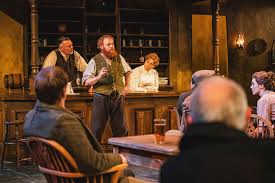
The set is striking and with a swipe of a hospital curtain we are transported throughout the world of Nye. Vicki Mortimer’s striking set with its various levels of green ward curtains move us effortlessly throughout the tableaus, and when they are fully removed, the stage is all the starker and bleaker for it. The emptiness of the stage with the single hospital bed at the end of Act One is stunning in its emptiness and simplicity, and shows the audience, with brutal honesty, that the end of a life is just a son holding his father in his arms and telling him not to fight anymore. The projection design by Jon Driscoll is one of my favourite parts of the production, in particular the scene where Nye first takes up the mantle of Minster for Health and crowds of people in need start walking towards him in desperation. It’s so simple but the execution is flawless. Lighting, sound and music are also excellent, designed by Paule Constable, Donato Wharton and Will Stuart respectively.

Director Rufus Norris is joined by the Revival’s Co-Director Francesca Goodridge, alongside Co-Choreographers, Steven Hoggett and Jess Williams. The way the cast and ensemble move and flow in this production is beautiful; humorous and heartbreaking. The flow and creation of tableaus in Nye, quite frankly, takes my breath away and is an absolute testament to the direction and choreography of the piece.

The cast of Nye is, without exception, phenomenal. There are very few changes from the production in 2024, and you can feel the trust and security that the actors feel in one another. The physicality as they swap and change from various ages in some cases, and roles in others, occurs without fault and without ever jarring the audience’s imagination, morphing from nurse to sister, doctors to politicians (and back again). I would be remiss, of course, not to mention, Michael Sheen in the titular role. He truly embodies Aneurin Bevan; never shying away from his flaws and human condition, with a healthy tot of charm thrown in. The physical wrench of his stutter is painful to watch, juxtaposed with his burgeoning confidence as he first meets Jennie Lee (played with great poise by Sharon Small). I never thought I would get to see Michael Sheen musical performance, full of vigour and swagger; and only a heartbreaking few moments later we see him clutching his dying father in his arms, in a moment which left the audience reeling. What a huge weight to fall on an actor’s shoulders to portray, not only a real person, but one so universally revered and admired, even idolised in his hometown. The respect, poise and gravitas that Michael Sheen brings to this role is nothing short of breathtaking.

Nye truly is a love letter to the National Health Service, in a time where it needs OUR care and attention after years of giving so much of that to us. The play is not so much a ‘call to arms’ as a reminder of all it took to get Nye’s vision to be realised and of the utter travesty it would be to lose that now. But Nye is more than a story of the realisation of the health service; it’s the journey of a man, his life, his triumphs, his flaws, and the people who touched his life along the way. Nye is an absolute triumph and a testament to every single person who has brought Aneurin Bevan back to our minds and our hearts.

Review: Calamity Jane, Venue Cymru, Llandudno, by Richard Evans

Venue Cymru, Llandudno, 26-30th August 2025 and touring

 out of 5 stars (5 / 5)

Jamie Wilson productions, Kevin McCollum, Gavin Kalin productions, evolution productions, Tilted, Willette & Manny Klausner in association with Grace street creative group and David & Hannah Mirvish. A Watermill Production.

Calamity Jane. They’ve turned the legend of a gun totin’, liquor swillin’ girl masquerading as a man into a love story.  The actual events of Calam’s life are based in fact, but have been exaggerated, not least by the woman herself.  However, we should not let our quest for reliable history get in the way of a rattling good story which is what this musical is.

Calamity Jane breezes into a Deadwood saloon having guarded the stagecoach safely into town.  On the coach is Francis Fryer, an entertainer.  Sadly, he does not possess the attributes desired by a hard living audience that has been starved of female company.  He is a man.  When the saloon owner nearly causes a riot trying to fool the waiting crowd that Francis is actually a woman, Calam goes to Chicago to tempt a music hall star, Adelaid Adams to come to Deadwood. As befits her name, she makes a disastrous mistake and brings back her maid, Katie Brown.  However, Katie turns out to be a roaring success and settles with Calam in her run down shack and brings out the more feminine sides to her hosts character.  The two women then become love rivals for an army lieutenant, Danny, before Calam realises that her love for her long time companion and critic, Wild Bill Hickok is mutual and Katie is free to marry her soldier.

Carrie Hope Fletcher is great as Calamity, commanding the stage with her presence.  She is ably supported by Seren Sandham-Davies as Katie, Samuel Holmes as Francis and an understudy for Bill, Thomas Wolstenholme. The company provided plenty of warmth, energy, optimism and banter as the story unfolds into a quick placed drama.  Scene changes were effected by moving props and this required some imagination, not least in the formation of a stage coach by the cast.  The music gave a hoe down feel to the show and there were plenty of catchy numbers to go along with the iconic ‘whip crack away’ Deadwood stage song making this a feel good show.

There is some depth to this story.  Bill Hickok repeatedly wants Calam to be more like a girl, but she is more comfortable wearing buckskin leathers, carrying a six gun and earning the right to be accepted in this hostile culture on her own merit.  However, most of her compatriots drool over the suggestive temptress that is Adelaid Adams.  Herein is a spectrum of femininity and surely there is a place for all along that line.  A woman should be free to be who she wants to be.  Men need not be threatened by a physically strong, aggressive woman and should not expect a woman’s best qualities to lie in her appearance.  Not a bad lesson to come from a good nights entertainment.  

In one sense the story is a throwback to watching Rawhide or the Virginian on TV for those of us with long memories.  We now know that the entertainment industry has sanitised and romanticised stories of the wild west.  The reality was more raw and brutal than we have been led to expect, not least to the surrounding Native American Indian cultures that were often dispossessed quite violently.  However, this is just a story based on the life of a remarkable individual and if a story is a good one, it is worth telling and by the audience reaction, this musical is certainly that.  A raucous, enthusiastic reception was given to a deserving cast after a sparking show.

Review Women Wearing Shoulder Pads, Episode 1 & 2, Channel 4 by James Ellis

 out of 5 stars (3 / 5)

Out of all the strange and wondrous animated work under the Adult Swim banner comes rare jewels and underdogs. From Gonzalo Cordova comes Women Wearing Shoulder Pads, set in 1980s Ecuador. Hailing from Spain, business lady Marionete Negocios (voiced by Pepa Pallarés) is met with scorn and conspiracy as she plans to make guinea pigs pets as opposed to being on the menu. Within this culture clash (the animal in Spanish is called ‘cuy’) lies the main thread of the plot.

This is stop motion and their uncanny appearance is slightly jerky, though that is part of the charm. The only apparent surreal feature is the larger than life cow used as a replacement in bullfighting. Corruption was rife in this era and here is no different. Matador Coquita Buenasurete sleeps with Marionete and hands over breeding contacts. In the second episode, Coquita is in conflict with her new love and her work, the first big pull of the story. Hugely successful Chef Doña Quispe appears as the villain in her attempts to keep cow as a food stuff, blocking the plans to domesticate them. Marionete offers a duck as a piece offering to Doña and things fall apart pretty quickly. Further scheming seems to be afoot from all parties and should emerge as delicious in their execution.

I’d like to say I’m convinced by the whole premise, but at this stage I’m undecided. The hands of the characters in close up appear as real human live action clips, not as disturbing as you’d think. The stop motion figures are subtle and not the most eye catching. Some humour may be lost in translation and some crude jokes seen in past animation might not work well today. The setting of the its era is also convincing, as the name would suggest. The leading lady cast and Spanish/Latin American identity should find an audience away from the bonkers work often seen with Adult Swim. Yet, a mere ten minutes a piece, it leaves you wanting more from this subtle, curious offering.

Watch on Mondays live on Channel 4 & streaming after.

Review, Dear Annie, I Hate You, Wild Geese Productions in association with HFH Productions, Ed Fringe, By Hannah Goslin

 out of 5 stars (3 / 5)

Confronted with different staging, a Dexter-style plastic back drop, old chunky TVs and lots of wires, we have entered Dear Annie, I Hate You – NOT a play about a severe dislike of Annie the musical, but about something much deeper.

Based on Sam Ipema’s true life, Dear Annie […] is the story of Ipema’s diagnosis of a brain aneurysm at 20. We live through her short life up to that moment, her family relationships and then post diagnosis and how she copes with this change. With the high potential of life and personality changing consequences should she have surgery, she begins to question what is more important, life or death, in many different guises.

The production does well to squeeze so much content into such a short space of time. We quickly and easily get a sense of Ipema, her life and her family, with interjections on the TV from her family to make it rounded. These screens are connected to tubes that light up and escape their connection, depending on the points being explored at the time. However, a lot of the narrative accompanying this becomes technical and scientific and, while very interesting and important to explaining her brain and how the impact of the aneurysm, sometimes it just lost me and I felt a little out of the loop of truly understanding.

Ipema is high energy, utilising the space and hopping from podium to podium and up the stairs, banishing the idea of any impediment the aneurysm should have. Unfortunately, sometimes her run up the stairs felt out of place and unnecessary, not really adding much to the story. The energy level continues high when Annie comes in; the physical embodiment of the aneurysm. It is said a lot that some like to put a name or visualise what they are coping with as a person or thing, and this is clearly how Ipema coped with this. Unfortunately, Annie is often the voice of reason, urging for truth, and through her high octane presence in the space being purposefully annoying, she often takes a higher road to Ipema, blurring the lines of good and bad.

The play ends up with Ipema thanking Annie and this feels a little confusing and misplaced. It doesn’t feel like there is a revelation that is needed, with a simply fine life pre-Annie, and it feels as if there was a need for an ending and a story moral that couldn’t quite be found. But, we are dealing with a true story and one critic shouldn’t be the judge of how one copes with something like this and what brings comfort.

Dear Annie, I Hate You is well executed in its production values and an enjoyable retelling of a true experience. However, the narrative and dramatic licences taken felt slightly out of place and unfulfilled.