Category Archives: Theatre

Review, Great Expectations, Tilted Wig & Malvern Theatres at Theatr Clwyd by Gareth Williams

 out of 5 stars (3 / 5)

To be familiar with a narrative can sometimes evoke the desire for a fresh perspective. Yet even as one anticipates the events of a classic literary text such as Great Expectations, another member of the audience might be encountering it for the first time. Therefore, ideally, the adaptation must stay true to the original whilst offering something unique. To this end, I would say that Tilted Wig Productions have done a fine job in breathing new life into one of Charles Dickens’ most famous stories. And they have done this particularly well through the use of music, costume and set design.

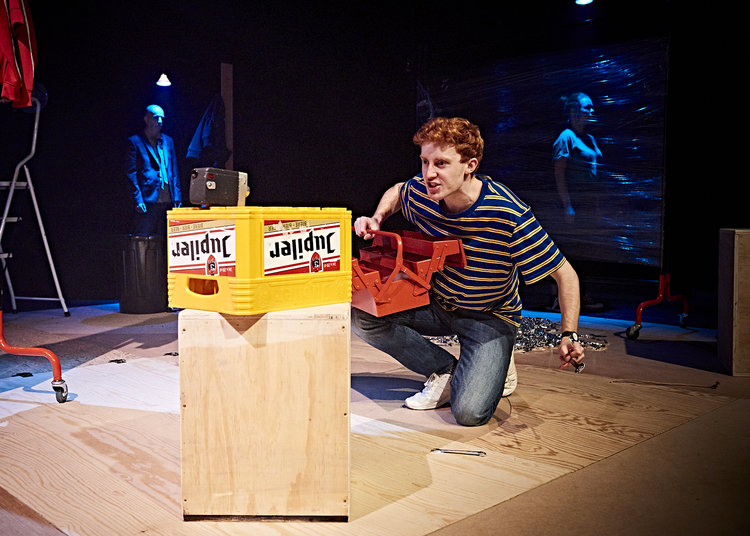
For my companion, this would be his third theatre production of Great Expectations. This, alongside the viewing of many film and TV adaptations from down the years (his particular favourite being the 1989 production, which notably starred Anthony Hopkins as Magwitch), obliged me to ask for his humble opinion after the show. One of the most striking features for him -indeed for me too – was the simplicity of the set. Compromising a three-dimensional, metal-framed box, with a wooden-slatted wall across the back, and two sloping platforms to the front and right, this was a very basic stage. One of the advantages of such a rudimentary set-up was that it enabled the fluid movement of the actors. Another advantage was the ability to transition seamlessly between scenes. It is no mean feat to take on a narrative of such scope, with its broad array of settings, and recreate such different worlds in such a limited space. With the creative use of lighting, director Sophie Boyce Couzens and her team manage to do so, and with seemingly relative ease. We were both mightily impressed by the scale of this production.

One of the shows that this production evoked for me was the National Theatre’s Jane Eyre. In some senses, Great Expectations was essentially a miniature version of this. Both the set and the use of folk music are employed in similar ways, but on a much smaller scale in Great Expectations. Yet the quality is on a similar par. In terms of folk music, there may only be one musician in the cast of Great Expectations, but composer and performer Ollie King manages to evoke such realism with his accordion that no further instrumentation is needed. With a few simple notes, he creates an atmosphere, evokes a setting, and produces an emotion. It is an incredible skill for which he deserves all recognition. Alongside King’s music, there were also some interesting sound effects produced by the other actors, using a plethora of everyday objects shelved on one side of the set. These diegetic additions wonderfully complimented the action on stage, adding to the atmosphere and setting brilliantly. Again, simplicity was a striking feature in the use of sound. And for this production, simplicity becomes a mark of its quality.

Finally, I would like to nod handsomely to the costume makers. With most of the actors playing multiple parts, the choice of a base layer of clothing for each of them, onto which one or two items can be slipped on and off at each turn, allows for maximum flexibility, contributing to the seamless transition between scenes that I have already noted. Moreover, the transformation of Pip (Sean Aydon) from a blacksmith’s apprentice to young gentleman of the city is profoundly simple. It requires only the buttoning up of his jacket, the addition of a coat, top hat and bag, to completely change the character’s social class. I couldn’t believe the effectiveness of such minimal changes. The piece de resistance however, has to be the wedding dress of Miss Havisham (Nichola McAuliffe). It is glorious in its tapestry, magical in its setting, and beautifully faded to reflect the character’s frozenness in time. It perfectly matches the commanding and slightly offbeat performance of McAuliffe. Considering the anticipation that came with this – Miss Havisham is my favourite character in Great Expectations, and one of my favourites in Dickens’ collection – it certainly didn’t disappoint.

Overall, Tilted Wig Productions, in association with Malvern Theatres, have produced an adaptation of Great Expectations that is marked by simplicity. Yet this simplicity is not akin to low quality. The set may be basic, but it allows the actors a freedom to creatively engage in storytelling. The music may be stripped back, but it evokes atmosphere and emotion incredibly well. The costumes may be simple, but the ability to transform characters by the drop of a hat or the fitting of a jacket is extraordinary. They manage to achieve so much by keeping it so simple. It makes for a beautiful adaptation that finds that wealth is not the maker of a show. Instead, with a little bit of ingenuity, it is love that creates something truly special.

Click here for more info and tickets.

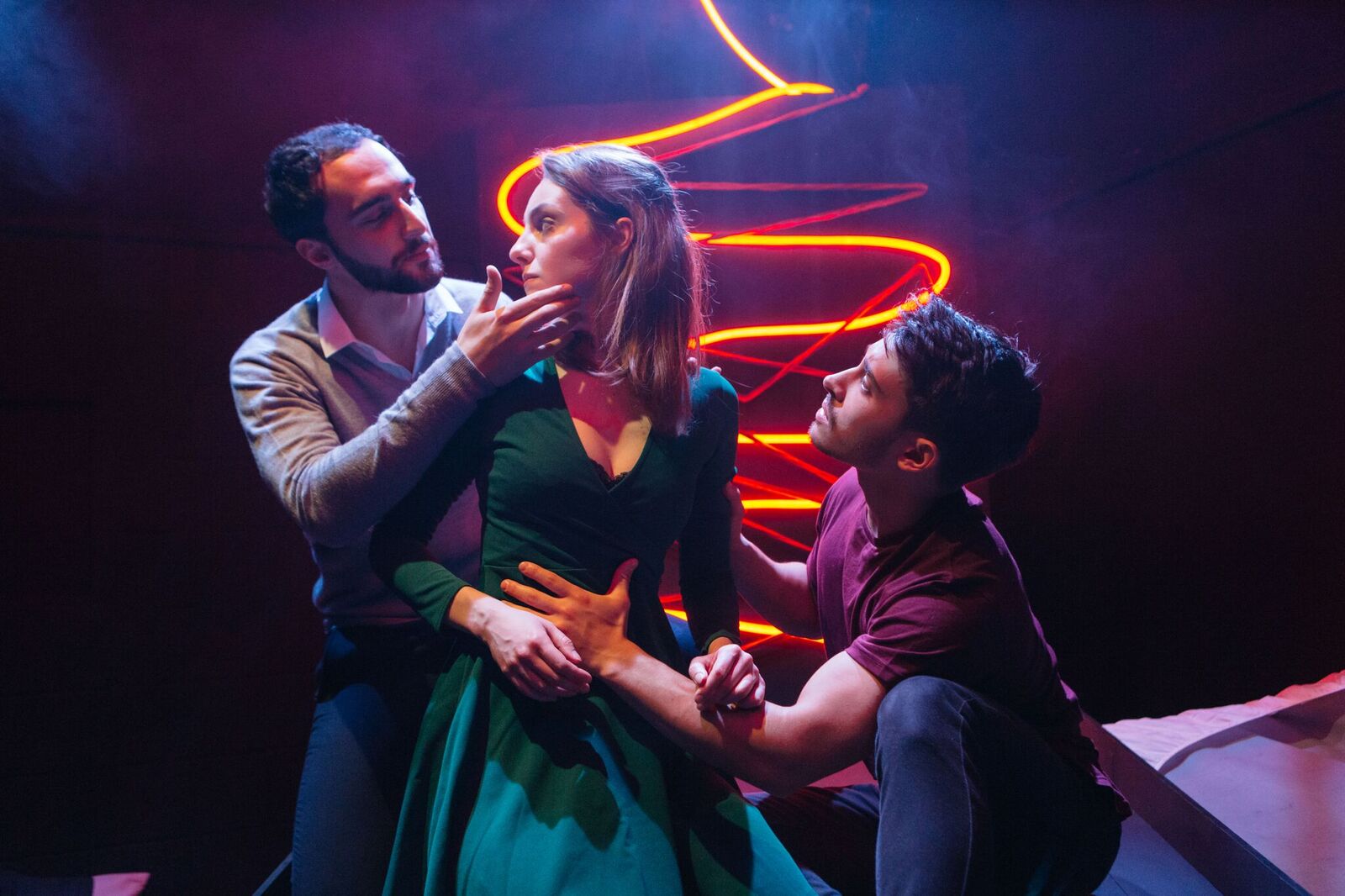
Review Stud, Paloma Oakenfold, Vault Festival by Hannah Goslin

Photo credit Bernadette Baksa

 out of 5 stars (3 / 5)


When someone said to me to watch a play about Football, I did an audible groan.

I like football (not as much as rugby) but what could a play about Football really draw upon (let’s ignore Bend it like Beckham a sec…)

Stud, by Paloma Oakenfold, is not just about Football. Stud sees the current state of the sport and its homophobia in a society and world that is ever increasingly adjusting and accepting of LGBTQ+ communities. We are forever moving forward, yet in 2018, we are still going backwards in sport. Not only with homophobia but racism and sexism.

Stud sees a fantastic player, who has the whole world ahead of him, realise his sexuality, fall in love and yet make a real life changing decision which means either hiding who he really is or losing everything. There is a large essence of family and that union which also preys upon this big decision.

Stud only has two performers – Tom who is a constant. His life is the story and so it is imperative we always see him on stage, his emotions moving and how he continues life. The performer does this well and he plays a boy at a teenage age very well – all the moody, confusion that comes with teen life, with the addition of sexual confusion.

His Dad/Coach/Love/miscellaneous characters chop and change with the other performer, all becoming very hammed up and comical, all apart from his love interest. While he does all of this in a brilliant way, I am not sure this works. Okay, it brings plenty of laughs and maybe we need that but to me it almost turned into a way of laughing at the conundrum Tom is going through and showing his love is all that matters. Which we soon find out is not the case – love, family and being yourself are all important and I feel that with these cartoonish characters, a little of the heartfelt emotion is lost.

I did however love the modernisation of the stage. The floor is astro-turf, the changing room seat is there, and all utilised no matter what the scene is. The music is camp and upbeat, also utilising  the lighting and tech. And it suddenly gives a new dynamic to the duologues.

Stud is good fun, and while it tries its hardest to be everything, it struggles to merge the comedy and the serious.

Hannah Goslin

Review You, Longsight Theatre, Vault Festival by Hannah Goslin


 out of 5 stars (5 / 5)


You. What would YOU do if were young and made to give up your baby? How would you life change or would it? And what would happen if 30 years later, your baby contacts you to met you?

You is a play focusing on all the different parts of adoption- from the beginning, how the mother feels, the father feels, how HER parents feel about their daughter and baby on its way, to how the baby feels once they reach adulthood, and the lives of those who adopt him.

We see plenty of programmes, documentaries, films about adoption and how it feels from the mother’s point of view, but this production brings all the lives and elements together. We see the heart break, the joy, the hard parts and the easy, lovely parts.

This production is really simple – two performers and two chairs, beautiful music in the background and soft lighting that changes throughout. The performers differentiate the characters well – especially seeing as the stories chop and change within each other. We are addressed by the performers with their stories – they are telling us their story and we can’t help but be captivated, staring into their deep eyes and feeling the true emotion that comes from their performances.

I always say that while tech, fancy lights and props can be great, sometimes the real skill and the real emotion is brought through the simplistic. By just engaging with us as an audience, inviting us into the story, and telling it to us, filled with the emotion that comes with the narrative, we are hooked and time speeds by.

You is a beautiful play. It has real emotion and what feels like real stories. And while we may not all know how adoption feels from any party involved, we can definitely relate to the feelings that these performers evoke, coming away feeling personally touched.

Hannah Goslin

Review A Serious Play About World War II, Willis and Vere, Vaults Festival by Hannah Goslin


 out of 5 stars (5 / 5)


!THIS REVIEW MAY CONTAIN SPOILERS!

What do you evoke in your mind when you hear “a serious play about World War II?

1) Would it not be serious anyway?
2) This is going to be full of meaning, of tears, there will be horses… oh wait, that’s War Horse!
3) By no means will you create in you heads what actually happens.

The first 10 minutes is hammed up, not very PC and in this way shocking. We come in believing that we have come to see a War play and some how they are degrading the entirety of it but they are serious about what they are doing. A Jewish man is in the front row, obviously very upset – this is meant to be based on his story of the Holocaust and yet they are making a mockery of it.

And then this very awkward play becomes something different. It’s a play within a play. A farce. Our real play begins when everything goes wrong and the performers must find their way out of the mess they have made. There’s a low budget essence of Mischief Theatre with The Play that Goes Wrong and it’s later counterparts. And to be able to do ‘stunts’ without a large traditional theatre basis and all the theatrical tricks that come with that is brilliant.

It’s full of manic, frenzy and endless comedy. It is ridiculous yet brilliant and a real surprise to what we not only expected to see but also from what we began watching. Awkwardness becomes falling off your seat with laughter. The un PC moments become farcical events going wrong. And we finally breath a sigh of relief that it is not some racist, not very well thought out production but a very clever trick.

A Serious Play About World War II is full of hilarity, surprises and not for the weak stomach (just you wait and see why!).  And they are a pretty swell company to boot.

Hannah Goslin


Review A Number by Caryl Churchill at The Other Room, Cardiff by Roger Barrington

A Number at The Other Room Cardiff

 out of 5 stars (3 / 5)


I have always struggled a little with the plays of Caryl Churchill and the Welsh premiere of A Number at The Other Room, Cardiff continues this trend. I find her admirable in her dramatic innovation but she never seems to engage me emotionally.

However, her reputation as one of Britain’s leading dramatists makes this presentation in Cardiff’s only pub theatre, a noteworthy event.

First performed at that bastion of post WW2 British theatre writing, The Royal Court, in its main auditorium in Chelsea, on 23 September 2002, this two-handed play, directed by Stephen Daldry, (whom many years ago I shared the experience of being locked out of the first act of a play at The Young Vic until the end of the first act – I think we must have been on the same Tube train!), starred Michael Gambon as the father Salter and Daniel Craig playing three of his sons.

The programme notes to production under review, describes the play as, “a fearless and affecting dissection of the relationship between father and son, A Number strikes at the heart of what it is to love unconditionally – and the tragic failure to connect”. Whilst this is true, I understand the play to be more about human identity, brought into moral and ethical questionability  through the instrument of cloning. A fundamental criticism of cloning is that it turns humans into commodities such as in this case, replacing a dead loved son. The cloned have a feeling of a lack of uniqueness inevitably resulting in a lack of identity.

The intellectual premise of the play is largely influenced by the philosophy of Ludwig Wittengenstein, whom the playwright has, in more recent times, returned to in her 2012 play Love and Information. Wittgenstein’s thesis is that a word, taken by itself, could have meaning without the existence of other  elements that determines its character. These entities, he states, may not be the same, but upon closer analysis can reveal a pattern of similarity, “a family resemblance”. Therefore, Wittgenstein allows us to speak in a meaningful way about things and people without reverting to essentialism – a belief that things have a set of characteristics which make them what they are, thereby providing the essence of Churchill’s  statement in A Number on identity.

The play is in five scenes, with the father Salter, a manipulative and deceitful man, and three of his cloned sons, all played by the same actor.

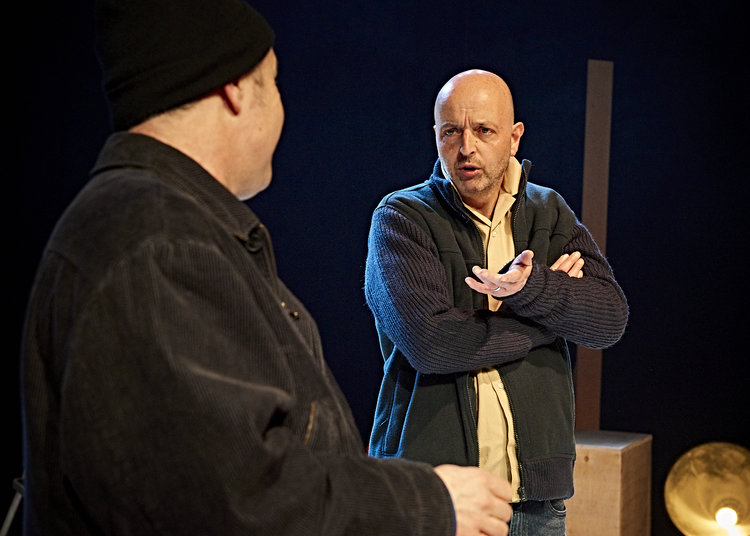
This production of  A Number is directed by  Ed Mannon and is performed by Brendon Charleson as the father Salter, and Stevie Raine as three of his sons.

Brendon Charleson


Stevie Raine

An enduring problem at The Other Room’s small space is set design. In the original production in the Royal Court’s main house, designer Ian MacNeil, (who together with Caryl Churchill won Evening Standard awards for this production), devised a blank set, a rectangular platform above the stage, devoid of decor other than two chairs and an table carrying an ashtray, thereby heightening the lack of context for Salter’s filial visitations.  For this production, designer Carl Davies, has designed a site-specific staging with a kind of thrust stage that runs the entire length of the space, bisecting the audience into two equal halfs facing one another in a semi theatre- in- the round way. This heightens the feeling of intimacy between the actors and the audience and works well. On the one end of the stage there is an easy armchair, with the entrance facing it at the opposite side.

Stage design


Brendon Charleson and Stevie Raines

Brendon Charleson, (who incidentally played in the first ever production at the Sherman Theatre), and comparative newcomer Stevie Raine do well in their roles, and their timing, (which is a very important part of Churchill’s writing style), was largely maintained.

The production is an admirable effort in introducing this important 21st century British dramatic  work to the Welsh public and deserves to play to good audiences, although, like me, you may come away feeling emotionally empty.

A Number runs at The Other Room, Cardiff until 3rd March 2018. For timings and tickets,  https://www.ticketsource.co.uk/otherroomtheatre

Duration: 1 hour without an interval.

Suitability: All (a few instances of persuasive language)

All photo credits Kiernan Cudlip

Roger Barrington


Breaking Out of the Box 4: ‘Wales: a Diverse Nation?’ by Emily Garside

The fourth ‘Breaking out of the Box’ symposium- a series of events to discuss the issue of diversity in Welsh Arts, took place at Theatre Clwyd on 16th February. Subtitled ‘Wales: a Diverse Nation?’ An access symposium’ the focus of the event centered on the question of how diverse are we, and what can we do to change things?

Opening the event was Nick Capaldi, Chief Executive, Arts Council Wales.  He spoke about the history of the Arts Council and Diversity- citing reports from as far back as the 90s into the issue.  He acknowledged the responsibility as  a publicly funded organisation towards diversity:

Capaldi also noted the need to do more to reach communities and the idea of ‘changing hearts and minds’. While this contribution from Arts Council Wales was welcome, and well intended it was let down by a lack of representation from the organisation throughout the day. The focus of the day around galvanising towards action, having an engaged representatives from the Development teams at ACW could really have helped the organisations present to make practical steps in their next projects towards diversity. We all know ACW funding is at the heart of the work made in Wales, and a level of practical support and real engagement on the day from the organisation would have made a huge difference to what could have been achieved. While Capaldi’s support was welcome, and his words supportive, it felt like a missed opportunity from ACW.

Following Capaldi, my own talk. Which focused on turning questions back on the audience to reflect on for the day.

Reflecting on the discussions already taking place, a call to keep talking and keep fighting through these issues

As hoped this provocation moved into an engaged discussion about the many areas that need addressing- from programming to the access needs of audiences.

Following a break we heard from Jamie Beddard, one of the UK’s leading disabled theatre practitioners,  Jamie talked through his experiences as a disabled performer.

Jamie’s experiences, and the video clips he showed of projects in England he’s been a part of showed that the sky literally is the limit for what can be achieved.

Jamie was part of a couple of amazing circus projects where disabled performers worked alongside able bodied performers with no  barriers or prejudice around what they were or weren’t expected to do. That this kind of work is possible can be an example for companies in Wales to aspire to.

Keen for the day to have some practical take-aways there were two workshops on accessibility led by Elise and Beth from Taking Flight Theatre Company. Elise took people through some simple steps to make a rehearsal room more inclusive, while Beth talked through making accessible marketing materials.

These practical elements were a really useful element of the day for the group-providing some tangible next steps that are relatively easy to incorporate and help slowly change the nature of diversity and accessibility.

Finally, the last two provocations of the day. Michele Taylor, Director for Change for Ramps on the Moon and critic Jafar Iqbal. Both proved to be a rousing call to action. Michele punctuated their talk with the repeated phrase ‘Seriously are we still talking about this?’ Sharing her frustration but also experience in creating active solutions through ‘Ramps on the Moon’ this was a non-nonsense call to get things done. And one which also called out well meaning sentiment with again, a call to concrete action.

Challenging all of us on everything from our choice of language to what we believe to be exclusivity Michele provoked passionate discussion about how we really enact change. There was also a clear desire from the room to mimic the ‘Ramps on the Moon’ initiative in Wales.

Finally Jafar Iqbal  talked about the lack of change we’re experiencing in Wales. Criticizing those at the top for a lack of action while others repeatedly shout for change.

Drawing on his own experience as a British Asian, Iqbal has often wondered if he’s in a room to ‘tick a box’ but is also conscious that he’s benefited from that in his career. And despite personally benefiting, being conscious that this approach isn’t good enough any more.

Acknowledging the recent controversies in Wales,  Iqbal talked about the need to change being felt across the sector, but a lack of action being taken. And actually giving us a fairly simple way to start solving these issues:

Further discussion in the room, following this final clear provocation was to that end- the time for talking (and social media debate) has passed and it’s time for action. The very clear notion however, was that this needs leadership. And that is something the movement for diversity in Wales is lacking. Not from those engaged in the arts, but from those organisations with the power and scope to be really influential in making change. And this remains a frustration.

Despite continued frustrations, it was a galvanizing and productive event. Connections between organisations developed during discussion and networking time and there seemed a real commitment to move forward from the event with a new sense of purpose.

Let’s hope that soon an event won’t be asking the question of Diversity in Wales but simply celebrating it instead.

The event was organised by Hynt, Creu Cymru and Taking Flight Theatre with support from Arts Council Wales. 

More information about Ramps on the Moon and the work they have done to date can be found on their website.

Emily Garside

Review The 15:17 To Paris by Kevin Johnson

In 2015 a lone terrorist boarded the train from Paris to Amsterdam carrying an AK-47, a pistol, 300 rounds of ammunition and a knife. Before he could do much damage he was tackled by several passengers, including three American friends on a European tour. This is the film based on that event.

First let me say that the incident itself was an amazing demonstration of the bravery of these passengers in attacking, unarmed, a Jihadist gunman. I am in awe of their courage.

Having said that, this film is incredibly bad.

There are pointers to a bad film: they open in January or early February, they’re usually about 90 mins long due to being edited down, and there are no press reviews before they open.

I knew all that beforehand, but I went in anyway. I’d now add a fourth pointer, if the film is based on a real incident and the characters are played by the ACTUAL people themselves and not actors.

The script is truly terrible, the mother of one of the heroes, upon being told by his teacher he may have ADD, replies ‘My God is bigger than your statistics!’, and that’s not even the worst line.

The narrative is all over the place, the three heroes lives are told in flashbacks that don’t advance the story, and the acting is really bad, apart from Veep’s Tony Hale as a gym teacher who seems to have wandered in from another film. A much better film.

The editing is all over the place, and the direction poor, except in the scenes showing the attack itself. What’s shocking is that the director is Clint Eastwood, who is much better than this.

I have never walked out of a film in my life (except for a Stallone film, but that was just to vomit) but I wanted to walk out of this after 10 minutes.

It’s bad, really bad, worst film not just of this year, but the last decade. I’m posting this review so that you won’t suffer, save yourselves, wait for it to come out on TV or Netflix and then don’t watch it. Trust me. Run away!!!”

Kevin Johnson

Review The Sound of Music, New Theatre, Cardiff by Barbara Michaels


 out of 5 stars (4 / 5)


Everlastingly popular, and guaranteed to play to packed audiences – in the materialistic world in which we live the story of the tempestuous Maria, the young would-be nun who ends up marrying the naval commander Captain Von Trapp with a brood of children, is eternally popular. Not surprisingly, this Bill Kenwright touring production played to a packed house on opening night in Cardiff, despite Sound of Music having been staged here barely three years ago.

It is, course, the music which is largely responsible for making The Sound of Music unfailingly popular with both young and old: Songs such as The Hills Are Alive with the Sound of Music and the tear-jerking ‘Edelweiss’. Welsh soprano Megan Llewellyn’s powerful soprano is well suited to the Mother Abbess of the Abbey, capable of coping with a demanding part central to the story and the action. As for the nuns who form the choir – some wonderful singing although I would have preferred the show’s opening number The Nuns of the Nonnberg Abbey to have begun on a softer note.

Set in Salzburg at the end of the 1930s, with the rumblings of war closing in on Europe, the musical has its dark side, reminding us of the perils that faced those who did not agree with the Nazi regime when their country was overrun by the Germans. This element is projected in the dilemma facing the Captain and the danger he and his family face when he receives a so-called ‘invitation’ (in fact an order) to command a ship in the navy of the Reich.

Not easy for any actress to take on the role of Maria – Julie Andrews’ soaring soprano in the hit 1965 film is a hard act to follow. Lucy O’Byrne, who was runner up in BBC One’s The Voice in 2015 and appeared as Fantine in Les Miserables, was accorded rave reviews in the 2016 tour of Sound of Music. O’Byrne has a great voice and the seemingly boundless energy that the role demands, excelling in the musical numbers with the Von Trapp children.

Playing a central role in the story are those very children – and what a great band they are, from the ‘Sixteen, going on seventeen’ Liesl, played by Katie Shearman, to the smallest, Gretl. Which brings me to what stands out in this production – the choreography. Choreographer Bill Deamer has brought an added dimension to the role of Liesl with a balletic pas de deux danced exquisitely by Liesel and her pro-Nazi admirer Rolf Gruber, an edgy performance by Jordan Oliver.

As the naval Captain Von Trapp, Neil McDermott’s stiff upper-lip appears to preclude much in the way of facial expression, and at times he appears not altogether at ease in the role. It is not until Act II that McDermott’s strong baritone is heard to advantage in Edelweiss – a tear-jerker if ever there was one.

The cameo role of Max Detweiler, is tailor-made for Howard Samuel, who brings a touch of the Noel Coward to the role with a canny but warm-hearted Detweiler, unashamedly backing the winning side.

Gary McCann’s sets are in the most part faithful to the original, in particular the interiors of the Abbey and the Von Trapp mansion, although at times the hills between Austria and Switzerland are perhaps more reminiscent of, say, the Sierra Nevada.

Runs until Saturday February 17 at the New Theatre.

Book: Howard Lindsay and Russell Crouse

Music: Richard Rodgers

Lyrics: Oscar Hammerstein II

Director: Martin Connor

Choreographer: Bill Deamer

Musical Director David Steadman

Barbara Michaels


Review, The Weir, Theatr Clwyd by Gareth Williams

 out of 5 stars (4 / 5)

Whilst on holiday in Ireland a couple of years ago, a visit to the low-lying valley of Glendalough found us walking through the stone ruins of a monastery. On this particular day, the mist had come down. There was rain in the air. For a popular tourist destination, there were few people around. It was still. It was quiet. There was something about the place that gave off a mystical, otherworldly vibe. It is little wonder then that belief in the supernatural is a prominent feature in Irish storytelling. It is certainly a fixture in the stories told by the characters in The Weir. The Mercury Theatre, in a co-production with English Touring Theatre, has decided to revive Conor McPherson’s play to mark its 20th anniversary. It is a decision which should be celebrated, not only because of the exceptional quality of the script but because it speaks some important truths into contemporary society.

The audience is invited into a small town pub in rural Ireland where we are witness to the folkloric tales and ghostly stories of a couple of regulars. They are prompted to delve into the art of storytelling by a newcomer to the village. Beneath such paranormal content however, lies a much deeper and darker level of human thought and emotion. As the stories open up to reveal dark and unsettling truths, it prompts this female stranger to share a secret from her past. She has a story of her own, and its truth will shake them all. So disconcerting are the stories that they tell, several members of the audience (at least around me) clearly felt the need to react in the form of whispered commentary to neighbours or the placement of a hand over a mouth. Such audience reaction was clearly in relation to the stories, yet such impact is as much down to the delivery of these stories as their content. In this respect, much applause must go to the actors on stage. In particular, Sean Murray (Jack) was so captivatingly brilliant that one could have heard a pin-drop inside the auditorium. A large slice of recognition must also go to the production team, particularly Madeleine Girling (Designer) and lighting designers Lee Curran and Dara Hoban. To present a cross-section of the pub, where the lines between the stage and the stalls were blurred, I found, had the effect of assuming the audience as part of the action. We were, in effect, sat inside with these people, the attentive listeners to their gripping narratives. As each story was told, the gradual reduction of light caused an acute focus which made such attentiveness all the more palpable. It also created an atmosphere that became increasingly eerie and unnerving, culminating with the actors speaking under a single spotlight, and accompanied by the occasional single sharp note of a violin. Truly engrossing.

One of the fascinating elements of McPherson’s play, from a contemporary perspective, is the impact of a female presence upon the typically-masculine world of the boozer. It is clear that Brendan, the pub’s owner, has not had to bother accommodating for a female visitor for some time. He has to dash through to his living quarters to source a bottle of wine, then has to promptly serve it in a pint glass, and later must announce that the women’s toilets don’t work. This haphazard, unaccommodating state of events is taken humorously by the audience, yet despite these light-hearted observational moments, much like the character’s stories, there is also a deeper level of social commentary that speaks to the ongoing problem of gender inequality evident in traditionally male-dominated institutions. It is fascinating to see the subtle and gradual shift that takes place in these men once Valerie (Natalie Radmall-Quirke) has entered their midst. Themes of loneliness, fear and loss start to come to the surface in a less-mediated way. Vulnerability and emotional capacity open up. Suddenly, there is a glimpse of raw reality. The masculine ideal begins to crack. It is subtly powerful stuff.

If you want to be entertained, challenged, moved, and inspired then The Weir will certainly tick all of those boxes, and more. It combines pathos and humour exceedingly well. It invites the audience to inhabit its world and become utterly engrossed in its content. The stories told may be unsettling but they are gripping too. The cast excel in creating an intimate atmosphere that draws the listener in and has them hanging on every word, helped by the inspired set design and excellent use of lighting. It reminds you of the simple power of oral storytelling. So step away from your screen. Turn those electronic devices off. And experience the thrill of immediate, live storytelling.

https://www.theatrclwyd.com/en/whats-on/the-weir/

Gareth Williams

Review Red Bastard : The Original Show by Hannah Goslin


 out of 5 stars (5 / 5)


How lucky am I, that less than a week after seeing a theatrical hero for the first time, I was able to see the show that started it all – Red Bastard : The Original Show.

While Lie With Me focuses on love and how we all lie, the original show questions our dreams, our lack of or even fear of the truth and our lack of being interesting. What a perfect audience are the British to tackle these issues!

Red Bastard has a commanding power. Unlike other performances when audience members hesitate and struggle with being interacted with, you expect it with Red Bastard. But part of you wants to be commanded by him, you want him to interact and his clever approach to the performance is to feed off what we give. How amazing is this performer that he is unfazed by this and utalising it for his own theatrical creation.

He is mean. He is loving. He gives 0 sh**s and we love it. We are masochistic in a sense that we crave his abuse, his comedy and his surprises. Because BOY are there surprises. You can never tell when the next one will be.

It is admiring to watch his ability to push boundaries with a sense that the fundamentals are rehearsed but that Red Bastard is the master of improv.

If you ever do anything with your life – see Red Bastard. Join in. And come away with possibly one of the funniest, most enjoyably insulting performances that you will never want to end.