
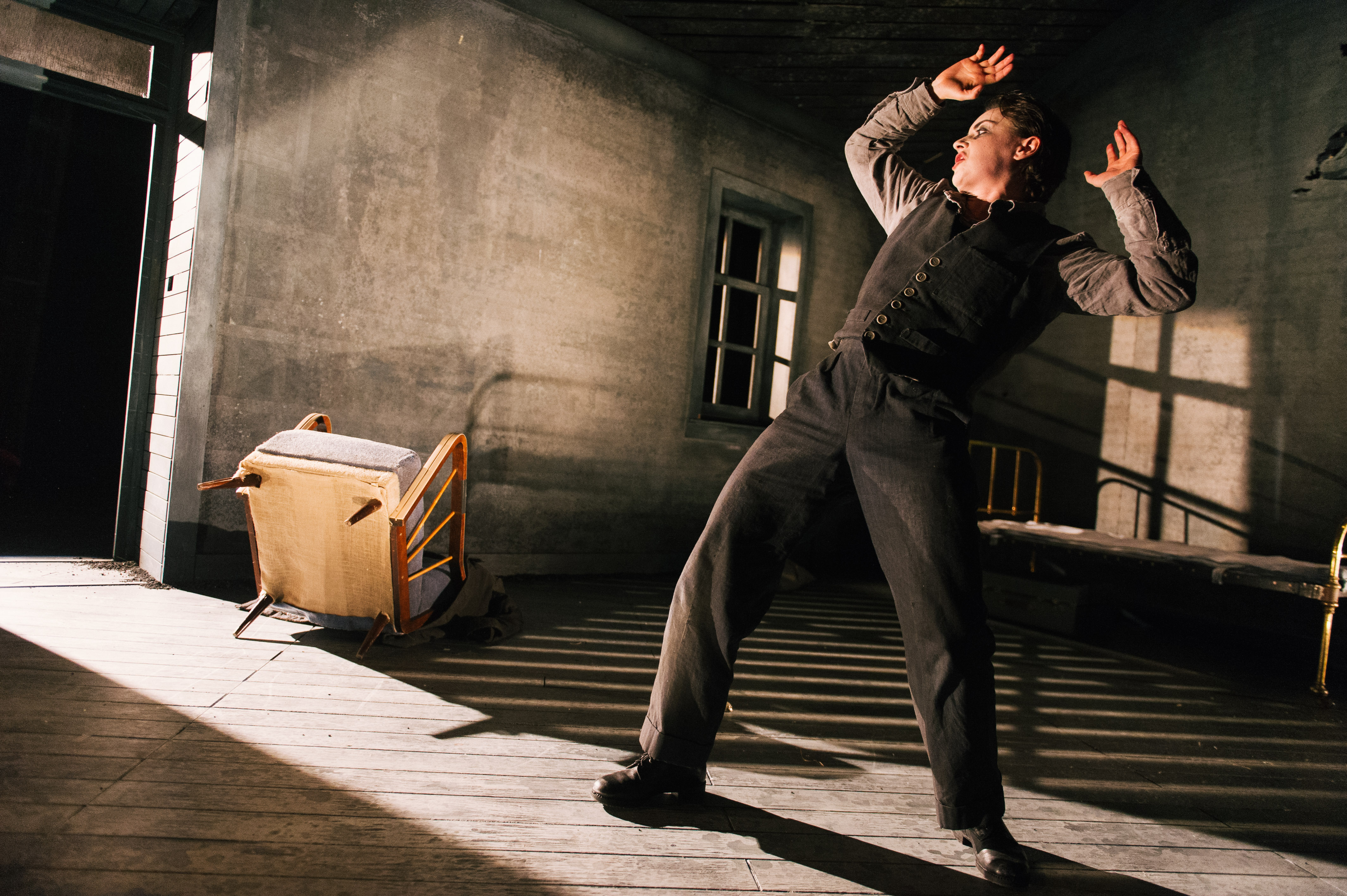
MAN TO MAN Weston Studio, Wales Millennium Centre
Book by Manfred Karge
Translated and adapted for the stage by Alexandra Wood
Co-directors Bruce Guthrie and Scott Graham
Reviewer: Barbara Michaels
Rating: [4.00]
Writer Manfred Karge has brought a new perspective to the horrors of life in Nazi Germany for those hunted down by the regime, with many forced to take extreme measures in order to survive. This is the story of Ella Gericke, a young woman who takes on her dead husband’s job as a crane driver, together with his identity, in order to live. We witness her terror and the lengths she must go to in order not to be found out. Incredibly, she manages to maintain the deception for over forty years. At the core of the piece as the reason for Ella’s decision – Hitler’s persecution of the Jews, brought to the fore when Ella is forced to eat pork (forbidden by Jewish dietary laws) in order to avoid discovery.
This is a brand-new adaptation and production of an extraordinary one-woman play that premiered back in the 1980s when it won considerable acclaim. Offering as it does a searching and searing overview of Germany under the Third Reich, this rare cross-genre piece is not to be missed not only for this reason but for its exploration of identity through episodic scenes in Ella’s life.
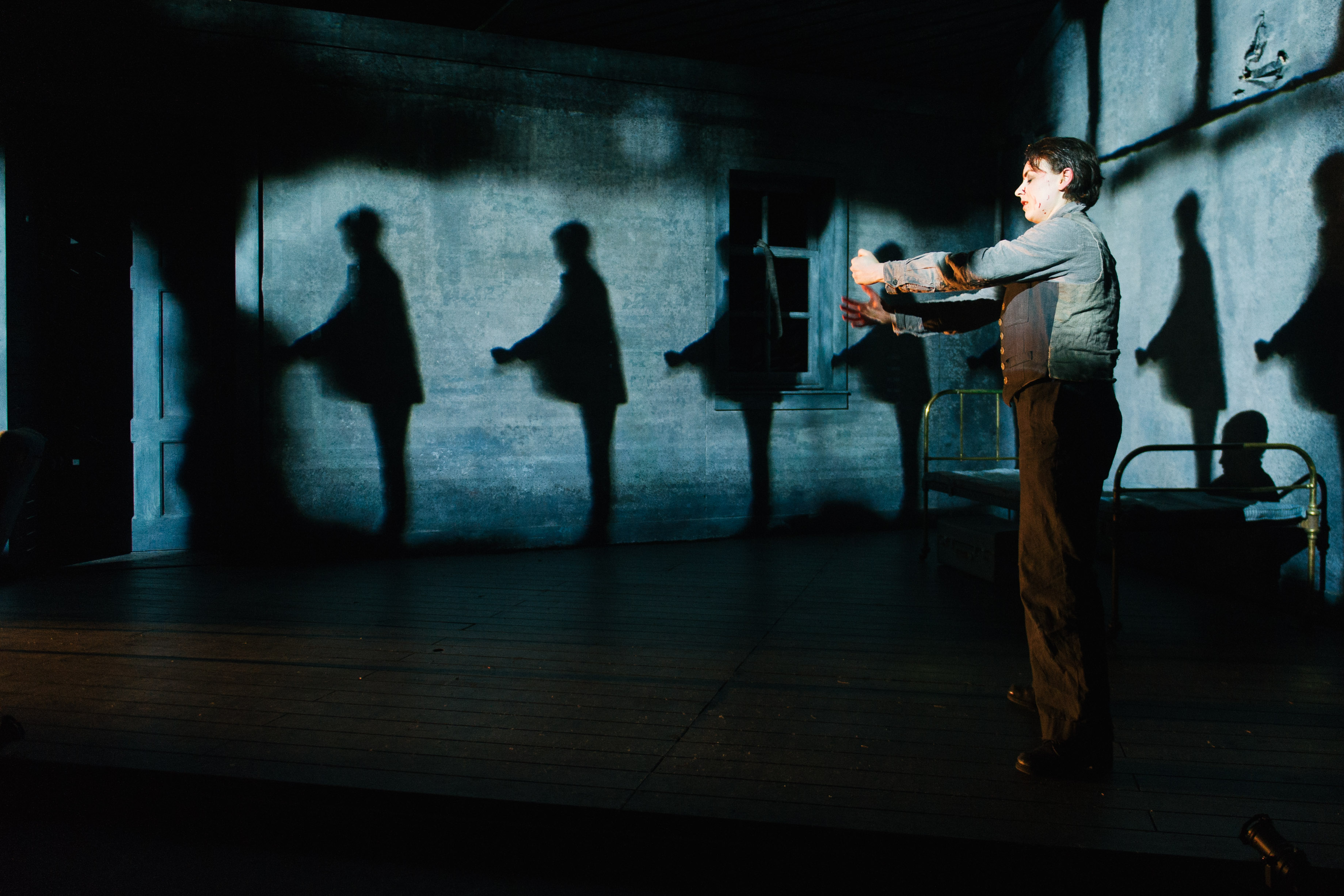
Ella, played by Margaret Ann Bain, struggles to keep afloat in a bewildering male world of beer cellars and crude masculine humour, at the same time leading a false existence with the fear of discovery looming over her. Bain manages to pull off a balancing act, maintaining credibility as a man while retaining an underlying hint of a feminine sexuality at the core of Ella’s being and making the audience aware at all times of the loneliness of a life devoid of close contact with another human being – a life dependant on its memories. No mean feat, this, and coupled with her acrobatic skills – the physicality of the role requires some difficult and hair-raising moves – lifts Bain’s performance beyond the norm, placing her next in line to Tilda Swinton, who received rave reviews for playing the role when the play was premiered at the Segauspeilhaus Bocehum under its original title of Jacke wie Hose. A small caveat, and one that is easily rectified, is that Bain could slow down a tad in the opening sequences in which a strong accent makes for a lack of clarity at times. Nevertheless, an outstanding performance by a young up and coming performer and one well worth seeing.
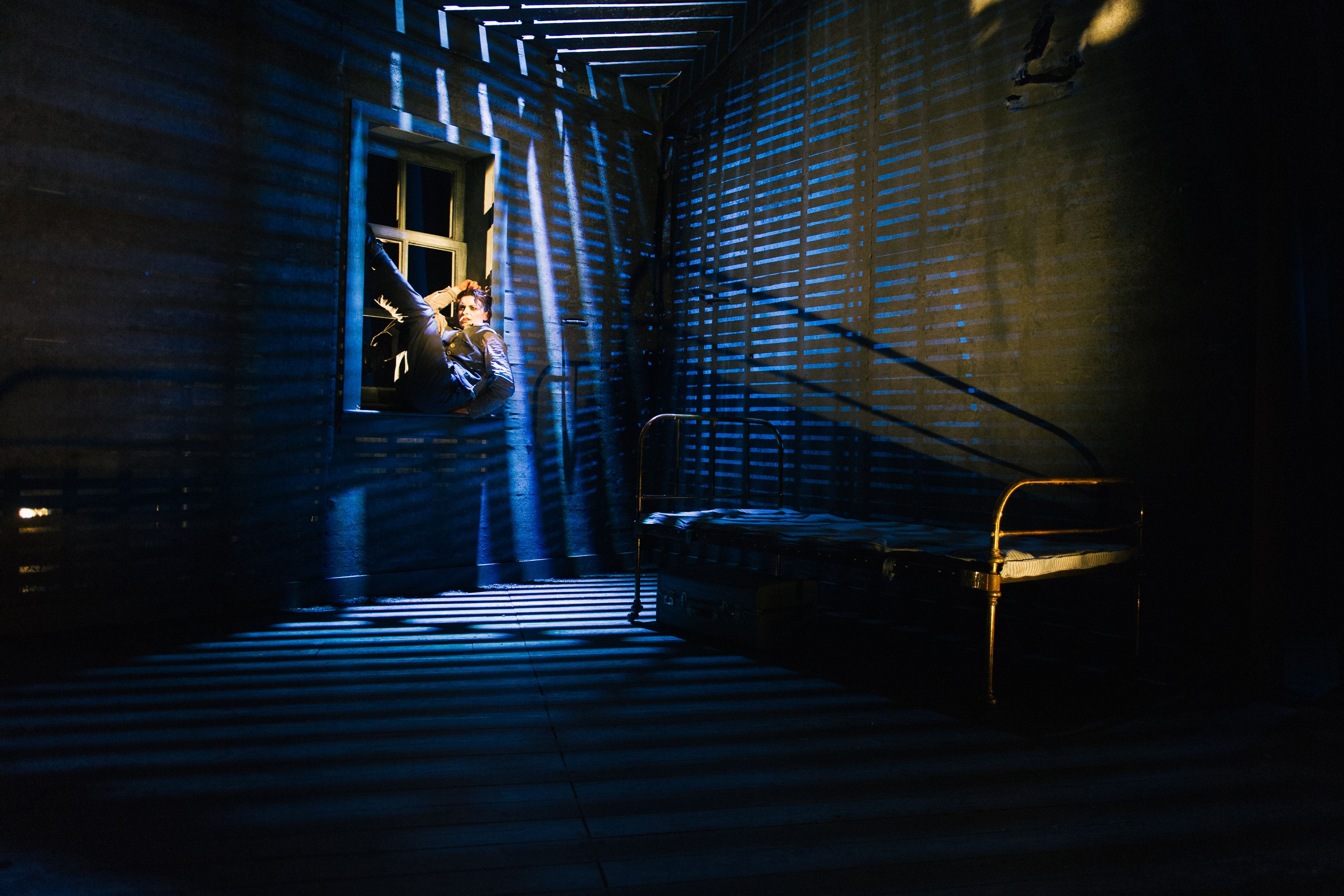
Sparsely furnished it may be, but the set by Richard Kent makes a major contribution in its depiction of scenes such as the fall of the Berlin Wall – great input by video designer Andrzej Goulding -and, poignantly, the mirror image of Ella as a girl, as does Rick Fisher’s clever lighting.
Co-directors Bruce Guthrie and Scott Graham are to be congratulated on bringing to the stage an extraordinary piece whose daring combination of prose and poetry, realism and imagination is in itself a considerable achievement.
Runs until March 27th
Photographic Credit Polly Thomas
All posts by Guy O'Donnell
Review The Blood of Eden by Julia Kagawa
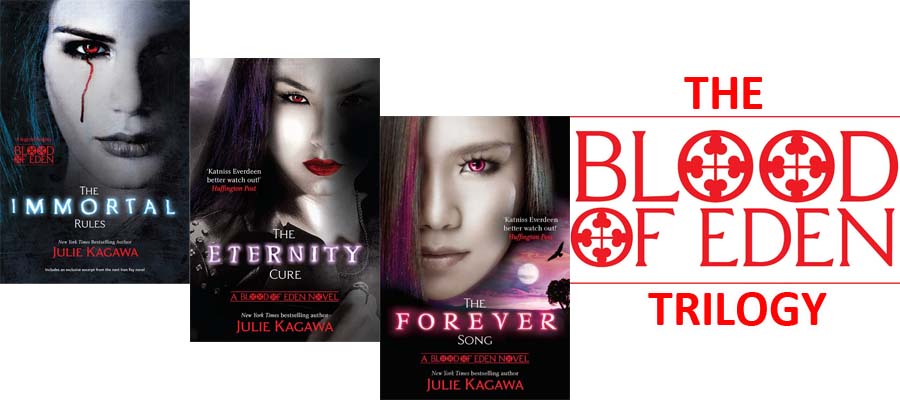
I recently read a trilogy called The Blood of Eden. It’s written by Julia Kagawa, and each of the series of books are equally enticing.
The series is about a girl named Allison Sekemoto and her trials and experiences both before becoming a vampire and then after, with other things weaving their way in and becoming equally important.
While the first book, The Immortals Rules, starts off very slow, you can easily begin to wonder if in fact: Will this book end up like every other vampire story quite possibly ever created? The answer is no, it just takes a while to get there. However following this, you realise that everything you’ve read on the blurb has already happened within the first part of the story, which is only a number of chapters. Your first thought probably races to: There better be something else coming up and fast. And let me tell you, there is!
After my own personal rocky start with the book, once the jagged phase has been passed, the book becomes easily enjoyable and a page-turner that’s so lethal that if anyone tried to grab the book off you, they’d probably get a paper cut. The plot spirals into situations that seem to get even worse as you go, before eventually getting resolved, but usually with another outcome that pushes into the next plot arc, so there’s always something else at the end of one situation.
The second book, The Eternity Cure, starts off neither slow nor fast. The first book leads off with something immediately followed up in the second, however it can be considered slow the way it starts out. Our main character, Allison (Or Allie) is travelling alone in search of someone, with little interactions until the plot finally opens up, and once it does the story immediately starts rolling. One thing I noted about the second book particularly (and later on, the third book) was that at certain times of the story, the next moves of some characters who are meant to be unpredictable, are rather predictable. Maybe I’ve seen too many action/adventure type films or read too many of the books so that I’ve started to notice what the bad guys do and when, but for a character who is our main antagonist, he, on multiple occasions, is described as insane, and often has other tricks up his sleeve, is predictable at a crucial point in the series. (This is towards the very end of the second book and until around a quarter way through the third. I won’t mention what happens in case anyone would want to go into the story without knowing anything to ruin it beforehand.)
The third and last book, The Forever Song, doesn’t actually start off as slow as the others may. It has a clear plot with one main objective, albeit some smaller ones (which gradually grow in importance) fitting their way in. This final book can also become slightly predictable at points, but not at hugely critical times during the plot.
We have a number of consistent characters in the story, starting with our main, Allison Sekemoto, and then we have those immediately close to her. There’s Kanin, the one vampire who made Allison into a vampire herself, he’s the ‘cryptic’ type of character who you suspect to know everything about a situation. There’s Jackal, (Who, albeit, isn’t introduced until the later part of the first book, but is consistent after that.) who was also turned into a vampire by Kanin, making Allison and himself almost “blood relatives”, and runs an army of humans. There’s also Zeke (Or Ezekiel) Crosse, he’s a human who Allison accidentally finds, and inevitably falls for – but it isn’t bland and boring, the whole: “Oh, it was obvious this was going to happen – it happens in EVERY vampire story!” Well. It is at first, but then the ball gets rolling, and you realise you probably didn’t expect to get this far involved.
My own absolute favourite character in this series would have to be Jackal. While at first, he appears to be a huge antagonist, he eventually winds up on the same side as Allison. His speech is full of sarcasm and taunting and his personality is full of: “Act if you belong, and then you will.” Which, I personally took a shine to. Witty comebacks and a confident stride with a mocking smirk thrown in for good measure is the character trope I seem to like best, it seems. Jackal acts to diffuse tension in some situations, can be stubborn and irritating, and can then decide to go to the opposite end of the spectrum and make certain people understand what they need to do to improve their situations – though still with a mocking tone of voice.
The book series as a whole is an enjoyable one. It is neither too short, nor too long. It has amounts of action and adventure to make any fan of that genre happy, and it has comedy and romance to balance out the fighting. Each character is different and leaves a different impression on all, all the while dealing with situations that seem impossible to fix. Vampire stories may not be for everyone, but for those who enjoy them – I’d recommend you this series. It’s not “Just the same thing as all vampire stories”, and can easily leave a positive and optimistic impression for further stories of the same genre.
REVIEW Oh What A Lovely War, Everyman Theatre by Barbara Michaels

Oh What A Lovely War at Chapter Arts Centre, Cardiff
By Joan Littlewood
An Everyman Theatre Production
Director: Jackie Hurley
Musical Director: Lindsey Allen
Choreographer: Richard Thomas
Reviewer: Barbara Michaels
Rating: [4.00]
Portraying the horror of the trenches and the politics behind World War I, Everyman Theatre’s production of Oh What A Lovely War joins the ranks of performances in memory of those who fell that have taken place all over Britain during the past centenary week.
Bringing to the stage once more Joan Littlewood’s iconic 1963 Theatre Workshop production, complete with Pierrot costumes and a backdrop of photographs from the war zones as well as staggering on-screen statements of the numbers lost in what was supposed to be “the conflict to end all conflicts” is an ambitious undertaking. Everyman Theatre rises superbly to the challenge, wisely choosing to present the piece as “A musical play,” rather than musical theatre, although where to draw the line between genres is never clear-cut.
All the more credit, then, to director Jackie Hurley for staging a performance of this profoundly moving piece of theatre, which at times gives rise to an audible intake of breath from the audience as the ever-increasing numbers of the soldiers who died are flashed on the backdrop, yet managing to present in tandem with this an upbeat element which gives a balance to the overall result.
How, indeed, could it be otherwise – despite the grim reality of the core subject matter – when you have a talented young ensemble cast that includes some excellent singers and dancers? Songs that depict to a T both the era and mores of the time – from that of the title to familiar music hall song and dance numbers such as ‘I’ll Make A Man of You, ’ the foot-tapping ‘Row, Row, Row,’ and lump-in-the-throat ones such as ‘Keep the Home Fires Burning’ are memorable. Choreographer and nimble-footed dancer Richard Thomas has done sterling work here, as has Musical Director and on-stage pianist Lindsey Allen (despite grappling with a slightly out-of-tune piano.).
Change of mood is crucial and on the whole handled well, although occasionally erratic, as can happen on a small stage with minimal props. As the fighting escalates, military leaders thrash out the strategies of waging war, putting forward disastrous solutions that only prove them to be blindly oblivious to what is really going on, while the young soldiers who joined up with such youthful enthusiasm slowly come to realise that the “War games” are not at all what they expected.
As a sombre cloud hangs over Europe, the deafening noise of exploding shells brings a powerful sense of the grim reality of war. Amid a number of poignant moments, the one that perhaps more than any tears at the heartstrings is Christmas Day in the trenches. The emotional impact of the sound of the German soldiers singing ‘Stille Nacht’ floating across No Man’s Land, followed by the exchange of gifts and fraternization between the two sides, is huge, giving rise – not surprisingly – to sniffs from some of the audience.
Focus of this production is, quite simply, to honour those who lost their lives while depicting the behind the scenes wheeler-dealing and obstinacy that resulted in such tragically large numbers of young men losing their lives.
In other words: War is a dirty business.
Runs until Saturday, November 15th, at Chapter Arts Centre, Cardiff.
Review Caitlin, Chapter Arts Centre, Cardiff by Barbara Michaels
Credit Warren Orchard
Choreography: Deborah Light, Eddie Ladd and Gwyn Emberton
Director: Deborah Light
Caitlin; Eddie Ladd
Dylan: Gwyn Emberton
Reviewer: Barbara Michaels
Rating: [3.5]
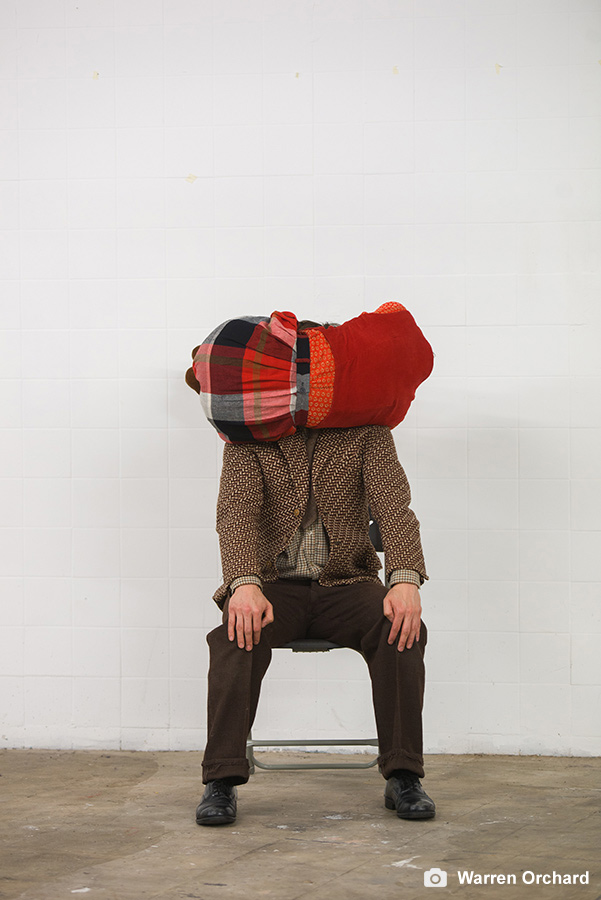
Based on the writing of Caitlin, the wife of Welsh poet Dylan Thomas, this dance production tells of her life with the poet through the medium of a meeting of Alcoholics Anonymous which she started to attend some twenty years after his death. Similar in style that of the one-woman show performed at the Sherman Theatre in 2003, it could equally have been named ‘The Agony and the Ecstasy.’
Caitlin’s recognition of the destruction wrought upon her life is portrayed in a series of dance moves, many of them violent in the extreme. In focussing on the turbulences of the Dylan marriage, director choreographer Deborah Light adheres closely to Caitlin’s own perception of her alcoholism and her life. The athleticism and technical skills of Eddie Ladd as Caitlin are showcased brilliantly, although there is a tendency to over- use of repetition, which can be tedious at times. One thinks of Ladd as a dancer but Light also allows her to speak, albeit briefly. Her speaking voice enthrals as much as her dance technique and makes a considerable contribution to Ladd’s characterisation. Her reiteration at intervals throughout that, while Dylan was a poet, “I could have been a dancer” adds poignancy to the overall projection of chaos, with dancers and furniture crashing around the stage for much of the time.
Ladd’s boundless energy is phenomenal, as is that of Gwyn Emberton, as Dylan. Many of Emberton’s dance moves require him to roll around the floor or balance precariously on a pyramid of stacked tubular and plastic chairs that teeter ominously. The said chairs are an integral part of the production, being used by the dancers use not only to represent actual objects – a baby’s pushchair, for instance – but also mood. There is no set, and these are the only props, barring a paperback book and four glasses of water with sweets in. Seated on some twenty chairs of the same ilk are the remainder of the cast (actually the audience), representing the members of the AA meeting which Caitlin is addressing.
In the year which marks the centenary of Dylan Thomas’s birth and the 60th anniversary of the iconic Under Milk Wood, it was inevitable that all aspects of his life would be explored in theatrical performances both nation and world-wide. His lifelong battle with alcoholism has been well documented; that of his wife Caitlin possibly less well so, In portraying this, and showing that while in some aspects it bound them together, Light’s production shows how eventually it destroyed not only their marriage but both of them.
Runs at Chapter for two more performance: Thursday October 30th at 6.30 and 8.30
Performances on Mon 3 + Tue 4 Nov at Volcano, The Iceland Building, 27-31 High Street, Swansea.
A statement regarding next years Theatre Awards
Theatre Critics of Wales Awards now the Wales Theatre Awards
Dear Friends and Colleagues,
The awards scheme will now be run by an independent, not for profit company and there will continue to be an annual awards ceremony. For 2015 the date and venue have been agreed for January 31st at Sherman Cymru, Cardiff. For work to be eligible for nomination, it must have been created and presented in Wales in the celebrated year. For the 2015 awards, this will be between 1st January and 30th November 2014. In subsequent years the period will change to the start of December to the end of November the following year.
We plan to have individual critics announcing the shortlists and the winners. As we are committed to the awards being increasingly bilingual, we plan to have a Welsh speaking and English speaking presenter alternating during the awards ceremony. We intend both widening the number of critics taking part in the nomination process and also contributing more effectively in the selection of winners.
We will create the longlist by asking more professional reviewers to nominate a winner and Highly Commended shows/individuals for each award and, importantly, give a short written reason for their choices. Unlike previous years, we will stress they DO NOT have to nominate in any category they do not wish to.
Each genre covered will have a panel of jurors, who will be reviewers themselves. They will look at all of the submitted nominations and accompanying comments (to which they will also have contributed) for their genres, and decide on the winners and those that are Highly Commended. For the non-language based awards and overall Director winner, the genre panels will come together and select winners. The panels for each genre and overall panel is then expected to write down WHY the winner has won and a sentence on the Highly Commended, ensuring feedback and openness.
We will apply the National Union of Journalists’ code of conduct and social media guidelines to the way the Awards are conducted. We will ensure the strong link with the Young Critics scheme is maintained as in the past and we will continue to include Young Critics on all of the panels.
The generous sponsorship of the award categories by arts organisations and venues will now also contribute to the establishment of a Development of Critical Writing Fund (DCWF). To emphasise the awards’ independence, they will not be category sponsors. The DCWF will be used to fulfil the following: Enable travel, accommodation etc. for critics to see more performances across Wales – something that is sorely needed – working alongside the Young and Third Age Critics. Act as a network to ensure critics are aware of shows and that reviewing opportunities exist. Work with the venues, individual companies and independent artists on ensuring critics get access to tickets. Work alongside any other organisation that is working to increase capacity and skills across Wales. (We will not directly take the mantle of trainers or pay for reviews etc. as we feel this is the role of professional training organisations, the media itself, and possibly an area for ACW to consider.) Work with venues and organisations to help them build links with their media and with critics.
The awards scheme has enjoyed generous sponsorship from a diverse range of organisations that are not directly arts organisations or venues, such as colleges, agencies, and the media. We are asking those sponsors to continue sponsoring.
Please contact Mike Smith: mike@mediasmith.co.uk or Harriet Hopkins: harriet.g.hopkins@gmail.com with any queries about the awards, how to nominate and sponsorship.
Review Moses in Egypt, WNO at Wales Millennium Centre by Barbara Michaels
MOSES IN EGYPT WNO at Wales Millennium Centre
Music: Gioachino Rossini
Libretto: Andrea Leone Tottola, after ‘L’Osiride’ by Francesco Ringhieri
Director: David Pountney
Reviewer: Barbara Michaels
Rating: [4.00]
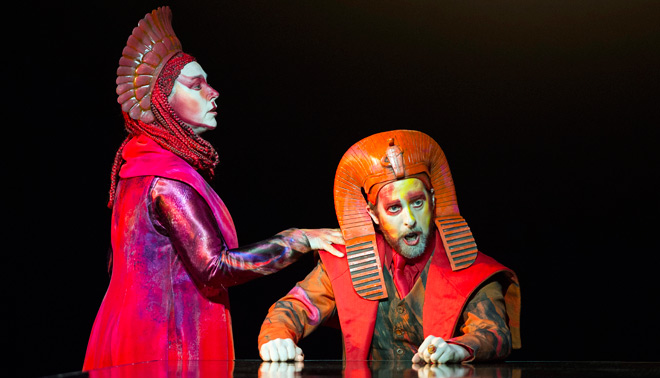
Musically flowing majestically from one theme to another, Moses in Egypt is one of the least often performed of Rossini’s operas. And what a pity that is. From start to finish, this opera – described as ‘tragico-sacra’ and based on the Exodus story of the Israelites flight from slavery in Egypt, is one to appreciate and enjoy on so many different fronts. An added bonus, for this new production by Welsh National Opera, is that it is one to which suits WNO down to the ground. The reason for this is abundantly clear from the start, for the chorus is one of WNO’s many strong points, and the huge scale of the music of this dual-themed opera is a perfect vehicle for their amazing talent.
Act I opens to a darkened stage. Atmospheric and spine-tingling, it heightens the senses as we listen to the off-stage singing. The darkness clears, engendered by the wave of his staff from a be-sandaled and white robed Moses, who raises his hands to God in a paean of thanksgiving and in exhortation to the Egyptians to forsake their wicked ways. Hungarian singer Miklós Sebestéyn gives us a prophet per se, with grey locks curling down to his shoulder and a resonant bass baritone. This is not an easy role to interpret, but the interpretation of it can make or mar a production, and Sebestéyn has most definitely got it right. As, indeed, has Andrew Foster-Williams as the weak and vacillating Pharoh, changing his mind from one moment to the next when exhorted by Moses to ‘Let my people go!’ On the distaff side, Christine Rice is magnificent as Pharoh’s wife Amaltea, particularly in the grand arias of Act II.
In tandem with the Old Testament Biblical theme is the love story of the racially impossible love affair between Pharoh’s son Osirides and the young Hebrew girl Elcia, a sympathetic portrayal as well as superb mastery of difficult and technically demanding arias by British soprano Claire Booth with sympathy. Spanish tenor David Alegret in a yellow-gold trouser has some wonderful duets with Booth and their voices work well together, although, with his flowing dark locks and in a yellow-gold trouser suit Alegret does appear at times more rock star than opera singer..
Immensely important in an opera that includes scenes where God is heard to speak and in which miracles take place is the lighting, and lighting designer Fabrice Kebour proves more than equal to the task with some of the most striking lighting effects seen in opera, dealing superbly with its many difficulties. Not least of these, and one with which many other companies have struggled in the past, is the parting of the Red Sea in Act III; Kebour does his best with the lighting here, but nevertheless what should be a mega-dramatic moment is something of a damp squib.
Despite this, that superb master of the theatre, David Pountney, has once again hit the jackpot with this a colourful and inspired production. It is never easy to mount a little-known opera but this ‘Moses in Egypt’ (or Mosès in Egitto to give the original title) more than justifies his confidence in so doing.
Wonderful music, under the baton of that great conductor Carlo Rizzi, great interpretation, performance and singing, a brilliant Biblical spectacle and a romantic love story – surely enough for any audience.
Moses in Egypt will be performed in Bristol on Friday November 14.
Touring until the end of November.
Review Carmen, Welsh National Opera, Wales Millennium Centre (Performance 2.10.2014) by Barbara Michaels
CARMEN Welsh National Opera, Wales Millennium Stadium (Performance 2.10.2014)
Music: Georges Bizet
Libretto: Henri Melham and Ludovic Haley
Based on the story by Prosper Marilee
Directors: Patrice Caurier and Moshe Leaser
Revival Director: Caroline Chaney
Review: Barbara Michaels
Rating: [4.00]
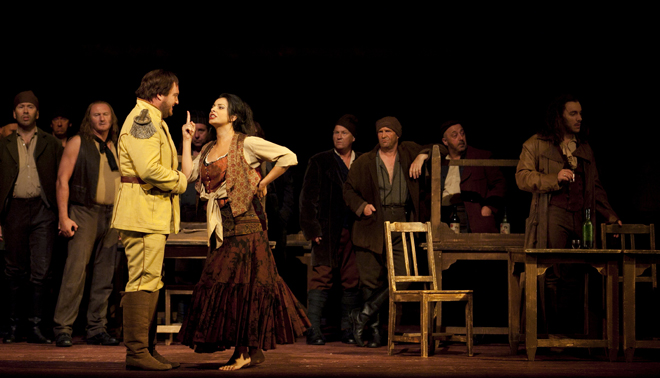
Passion and death are dominant in the story of Carmen – the Spanish gypsy girl and her soldier lover, Corporal Don José, in a torrid relationship that is doomed from the start. This production – a second revival – by the world class WNO, pays homage to both in a blood-red fore drop (as opposed to a backdrop) that is raised and lowered between scenes. However, be not deceived – this is in stark contrast to the minimalist and monotone backdrops throughout. Although doubtless designed in order not to detract from the complexities of this justly famed opera, the sets in this instance fail to enhance it.
In the central role of Carmen, American mezzo-soprano Kirstin Chavey, who has performed the role internationally, gives us a sluttish Carmen, sitting centre stage in Acts I and II with a skirt hitched up provocatively above legs wide apart. In a season entitled overall ‘Liberty or Death’ Carmen’s switch between unthinking abandonment to lust, and the realisation that she is doomed to death whatever road she takes, fits neatly into that slot. Chavez’s singing of the habanera ‘Lamour et un osseous rebelled’, sung in Act I as Carmen enters cannot be faulted, and this high standard is maintained throughout Act III, although her declaration of independence as she chooses death rather than trading her freedom for love in the grand finale to Act IV is not entirely believable. As her besotted and desperate lover Don José, Gwyn Hughes Jones has a pleasing tenor heard to advantage in Acts I and II, gaining strength in Act III when he is pitted against the bullfighter Escamillo, his rival for Carmen’s favours, sung at this performance by Kosmas Smoriginas who cuts a glamorous figure in bullfighting garb but whose performance is somewhat lacking in the necessary charisma.
What is outstanding in this production is the singing of Jessica Muirhead, as Micaëla – the girl from back home whose love for Don José goes unreciprocated. While her role as an episodic messenger is secondary to that of Carmen, her pure soprano, soaring poignantly, in both her solo arias and duets with Don José, gained a deserved and prolonged ovation both during and at the end of the performance.
Singing and dancing the roles of Carmen’s friends Frasquita and Mércedès respectively, Samantha Hay and Emma Carrington give performances which encapsulate the spirit and mores of the piece and its times, while the chorus of the WN0 maintains its high standard throughout, both in its male singers as Don José’s fellow soldiers, and the female singers as Carmen’s co-workers in the cigarette factory, and together in the scene at the tavern run by Lillas Pastia, sung full throttle by Howard Kirk. Worthy of mention too is Huw Llywelyn’s Remendado.
Much to commend here, and an enjoyable performance, but, while in the original as visualised by Bizet the curtain comes down on Don José throwing himself onto the body of his beloved Carmen, who he has killed after her final declaration that she prefers death to giving up her freedom, in this production revival director Caroline Chaney has him walk off stage. Sorry, Caroline, but it doesn’t work.
Carmen is now on tour. For venues, dates and casting see WNO website www.wno.org.uk
Preview Henna Night, 3 Crate Productions at Chapter Arts Centre
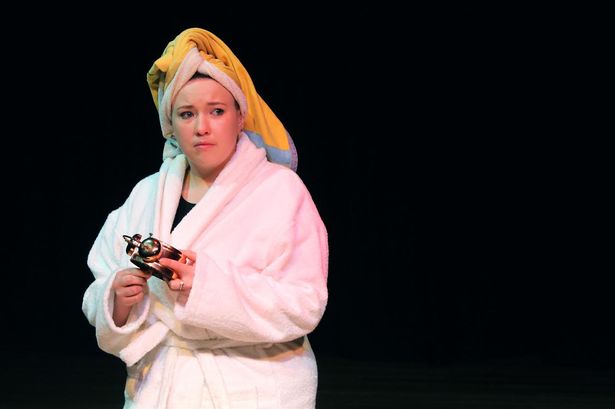
Henna night is arriving into Chapter arts centre for the 21st and 22nd of July, and promises to be a sizzling theatre experience, full to the brim with black comedy. The production tells the tale of two women who by all accounts should loathe each other – the Broken hearted ex, Judith, and his new girlfriend, Ross, when sarcasm and insults give way to reveal parts of the two characters’ lives, the characters carrying the show in an intimate, character driven play.
Henna Night won The Sunday Times Drama Award in 1999, the aim of the Chapter performance by 3 Crate Theatre is to keep it as fresh and relevant as ever, with the leads easy to find in your everyday life.A whole show sitting on the shoulders of two very different women is a refreshing thing to see in a world where even the strongest of them tend to be props in the stories of men, the archetypes of love interests and women scorned hard to see a break from.
As a new play for Cardiff, and part of its comedy festival, the show carries high hopes , and with a talented cast, crew and director should soar to meet them.
Henna Night part of Cardiff Comedy Festival, Chapter Arts Centre Mon/Tue 21/22nd of July
http://www.chapter.org/ccf-henna-night
Wales Dance Platform a short response from 3rd Age Critic Barbara Michaels
Wales Dance Platform –A Valuable Contribution to the Contemporary Dance Scene in Wales.
A week-long programme of contemporary dance in venues across Cardiff which included the Glanfa stage at the Wales Millennium Centre drew audiences from all over the country and nationwide. Independent dance artists presented innovative ideas in choreography, film and photography.
One of the major highlights of a talent-filled week took place on the final Sunday when four independent dance companies performed on stage at the Sherman Theatre. Among these was internationally known Ballet Nimba, from Guinea. Idrissa Camara and Oumar Almamy Camara gave a mesmerising and energised performance, leaping around the stage in what appeared to be manic but was in fact perfectly controlled yet acrobatic dance representing masculine identity and the age-old battle for dominance between father and son while reflecting the uncertainties of the social and political scene. Those old enough to recall the visit to the UK from South Africa in 1974 of the show Ipi Tombi, a pastiche of a variety of South African indigenous musical styles which caused some controversy among critics at that time, will have noted similarities. Ballet Nimba deserves an accolade for the way in which the traditional urban and village roots of the dance is retained alongside modern dance moves and stylistics.
At the conclusion of the Platform a £1,000 award for “The most innovative and eye-catching work” an award was presented to Gwyn Emberton for his ‘The Devil in Eden’, a duet taken from his work My People, based on the book by Caradoc Evans.
Barbara Michaels
Review Nabucco WNO, ‘has audiences jumping to their feet and calling out “Bravo!” by Barbara Michaels
Nabucco Welsh National Opera at the Wales Millennium Centre, Cardiff
Music: Giuseppe Verdi
Libretto Temistocle Solera
Director: Rudolf Frey
Reviewer: Barbara Michaels
Rating: [4.00]
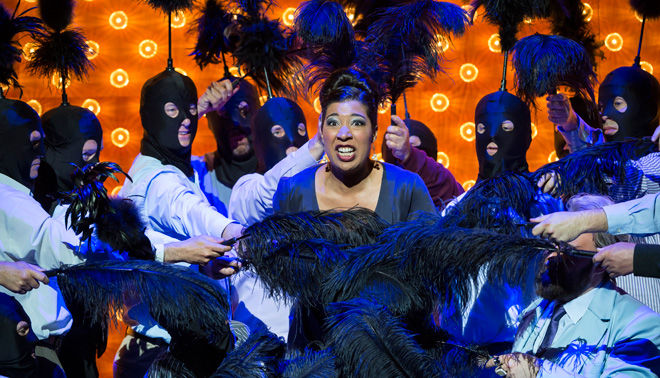
Showcasing the charismatic chorus of the WNO, this seldom performed yet musically familiar opera is presented in a 1950s setting in this new production. Almost ten years since WNO’s last performance (staged at the New Theatre) of the epic Verdi opera best known for its splendid ‘Chorus of the Hebrew Slaves’ (‘Va, pensiero’) director Rudolf Frey and choreographer Beate Vollack have created a production which embraces not only operatic tradition but the mores of modern times. The result is a soaring production that has audiences jumping to their feet and calling out “Bravo!”
The Biblical context of the conflict between the Hebrews and the Egyptians is the background of the story and generates a web of warlike violence and political intrigue. Nabucco (sung by David Kempster) is the King of the Babylonians whose daughter Felena (sung by Justina Gringyte), is held hostage by the Hebrews, under the jurisdiction of their High priest Zaccaria, sung by Kevin Short. Not only does Short bring a powerful and compelling bass-baritone to the role, but shows that he is also an actor of considerable merit. After defeating the Hebrews, Nabucco is convinced that he is God, and becomes insane. Baritone David Kempster – well known to WNO audiences – once again does not disappoint, bringing pathos to the role as Nabucco descends into madness. His projection is of a quasi King Lear – the richness and decadence of Babylon replacing the blasted heath of Shakespeare’s play.
The dominant female role of Abigaille, Nabucco’s other daughter and rival of Felena in succession to the throne, is a key factor and soprano Mary Elizabeth Williams, making her return after singing Tosca with the WNO last autumn, rises to the challenge superbly. A combination of lyricism and dramatic energy projects her relish for the role as well as her expertise and holds the audience spellbound.
Set designer Ben Baur deserves an accolade for opting for such devices as the singular usage of gold lamé drapes to represent the dross of the Babylonian scene and a symbolic wall (the Wailing Wall of Jerusalem, capital of Israel?) that of the Hebrews. Less fortunate, perhaps, is the inclusion of Fifties dance steps and hand-jiving. Costume designers Silke Willrett and Marc Weeger are to be commended, in particular for distinguishing touches such as the yarmulkes (skull caps) – traditional synagogue wear for men of the Jewish faith – worn by the Hebrews.
Highly commended is the dynamic conducting of the diminutive Xian Zhang whose debut with WNO this is. Zhang wields her baton with expertise over Verdi’s diverse score for this production of one of Verdi’s earliest yet most successful operas; an opera which, in the best of operatic tradition, culminates in an intense and gripping finale..
Runs at the Wales Millennium Centre until Saturday, June 15th , then touring.