
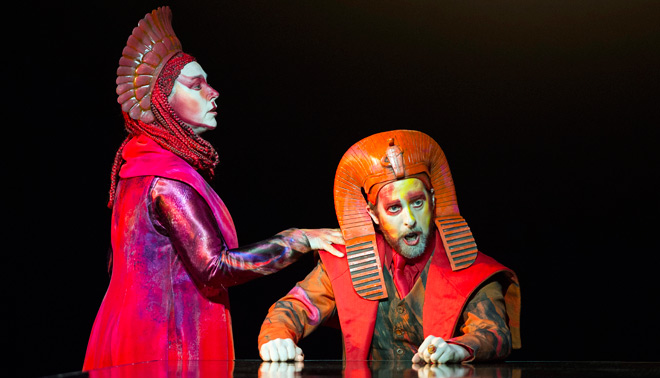
MOSES IN EGYPT WNO at Wales Millennium Centre
Music: Gioachino Rossini
Libretto: Andrea Leone Tottola, after ‘L’Osiride’ by Francesco Ringhieri
Director: David Pountney
Reviewer: Barbara Michaels
Rating: [4.00]
Musically flowing majestically from one theme to another, Moses in Egypt is one of the least often performed of Rossini’s operas. And what a pity that is. From start to finish, this opera – described as ‘tragico-sacra’ and based on the Exodus story of the Israelites flight from slavery in Egypt, is one to appreciate and enjoy on so many different fronts. An added bonus, for this new production by Welsh National Opera, is that it is one to which suits WNO down to the ground. The reason for this is abundantly clear from the start, for the chorus is one of WNO’s many strong points, and the huge scale of the music of this dual-themed opera is a perfect vehicle for their amazing talent.
Act I opens to a darkened stage. Atmospheric and spine-tingling, it heightens the senses as we listen to the off-stage singing. The darkness clears, engendered by the wave of his staff from a be-sandaled and white robed Moses, who raises his hands to God in a paean of thanksgiving and in exhortation to the Egyptians to forsake their wicked ways. Hungarian singer Miklós Sebestéyn gives us a prophet per se, with grey locks curling down to his shoulder and a resonant bass baritone. This is not an easy role to interpret, but the interpretation of it can make or mar a production, and Sebestéyn has most definitely got it right. As, indeed, has Andrew Foster-Williams as the weak and vacillating Pharoh, changing his mind from one moment to the next when exhorted by Moses to ‘Let my people go!’ On the distaff side, Christine Rice is magnificent as Pharoh’s wife Amaltea, particularly in the grand arias of Act II.
In tandem with the Old Testament Biblical theme is the love story of the racially impossible love affair between Pharoh’s son Osirides and the young Hebrew girl Elcia, a sympathetic portrayal as well as superb mastery of difficult and technically demanding arias by British soprano Claire Booth with sympathy. Spanish tenor David Alegret in a yellow-gold trouser has some wonderful duets with Booth and their voices work well together, although, with his flowing dark locks and in a yellow-gold trouser suit Alegret does appear at times more rock star than opera singer..
Immensely important in an opera that includes scenes where God is heard to speak and in which miracles take place is the lighting, and lighting designer Fabrice Kebour proves more than equal to the task with some of the most striking lighting effects seen in opera, dealing superbly with its many difficulties. Not least of these, and one with which many other companies have struggled in the past, is the parting of the Red Sea in Act III; Kebour does his best with the lighting here, but nevertheless what should be a mega-dramatic moment is something of a damp squib.
Despite this, that superb master of the theatre, David Pountney, has once again hit the jackpot with this a colourful and inspired production. It is never easy to mount a little-known opera but this ‘Moses in Egypt’ (or Mosès in Egitto to give the original title) more than justifies his confidence in so doing.
Wonderful music, under the baton of that great conductor Carlo Rizzi, great interpretation, performance and singing, a brilliant Biblical spectacle and a romantic love story – surely enough for any audience.
Moses in Egypt will be performed in Bristol on Friday November 14.
Touring until the end of November.
All posts by Guy O'Donnell
Review Carmen, Welsh National Opera, Wales Millennium Centre (Performance 2.10.2014) by Barbara Michaels
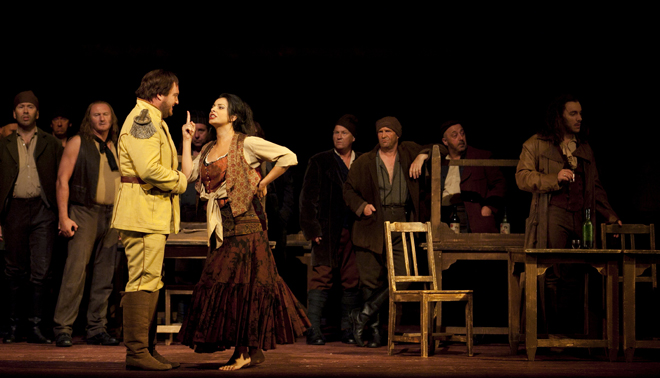
CARMEN Welsh National Opera, Wales Millennium Stadium (Performance 2.10.2014)
Music: Georges Bizet
Libretto: Henri Melham and Ludovic Haley
Based on the story by Prosper Marilee
Directors: Patrice Caurier and Moshe Leaser
Revival Director: Caroline Chaney
Review: Barbara Michaels
Rating: [4.00]
Passion and death are dominant in the story of Carmen – the Spanish gypsy girl and her soldier lover, Corporal Don José, in a torrid relationship that is doomed from the start. This production – a second revival – by the world class WNO, pays homage to both in a blood-red fore drop (as opposed to a backdrop) that is raised and lowered between scenes. However, be not deceived – this is in stark contrast to the minimalist and monotone backdrops throughout. Although doubtless designed in order not to detract from the complexities of this justly famed opera, the sets in this instance fail to enhance it.
In the central role of Carmen, American mezzo-soprano Kirstin Chavey, who has performed the role internationally, gives us a sluttish Carmen, sitting centre stage in Acts I and II with a skirt hitched up provocatively above legs wide apart. In a season entitled overall ‘Liberty or Death’ Carmen’s switch between unthinking abandonment to lust, and the realisation that she is doomed to death whatever road she takes, fits neatly into that slot. Chavez’s singing of the habanera ‘Lamour et un osseous rebelled’, sung in Act I as Carmen enters cannot be faulted, and this high standard is maintained throughout Act III, although her declaration of independence as she chooses death rather than trading her freedom for love in the grand finale to Act IV is not entirely believable. As her besotted and desperate lover Don José, Gwyn Hughes Jones has a pleasing tenor heard to advantage in Acts I and II, gaining strength in Act III when he is pitted against the bullfighter Escamillo, his rival for Carmen’s favours, sung at this performance by Kosmas Smoriginas who cuts a glamorous figure in bullfighting garb but whose performance is somewhat lacking in the necessary charisma.
What is outstanding in this production is the singing of Jessica Muirhead, as Micaëla – the girl from back home whose love for Don José goes unreciprocated. While her role as an episodic messenger is secondary to that of Carmen, her pure soprano, soaring poignantly, in both her solo arias and duets with Don José, gained a deserved and prolonged ovation both during and at the end of the performance.
Singing and dancing the roles of Carmen’s friends Frasquita and Mércedès respectively, Samantha Hay and Emma Carrington give performances which encapsulate the spirit and mores of the piece and its times, while the chorus of the WN0 maintains its high standard throughout, both in its male singers as Don José’s fellow soldiers, and the female singers as Carmen’s co-workers in the cigarette factory, and together in the scene at the tavern run by Lillas Pastia, sung full throttle by Howard Kirk. Worthy of mention too is Huw Llywelyn’s Remendado.
Much to commend here, and an enjoyable performance, but, while in the original as visualised by Bizet the curtain comes down on Don José throwing himself onto the body of his beloved Carmen, who he has killed after her final declaration that she prefers death to giving up her freedom, in this production revival director Caroline Chaney has him walk off stage. Sorry, Caroline, but it doesn’t work.
Carmen is now on tour. For venues, dates and casting see WNO website www.wno.org.uk
Preview Henna Night, 3 Crate Productions at Chapter Arts Centre
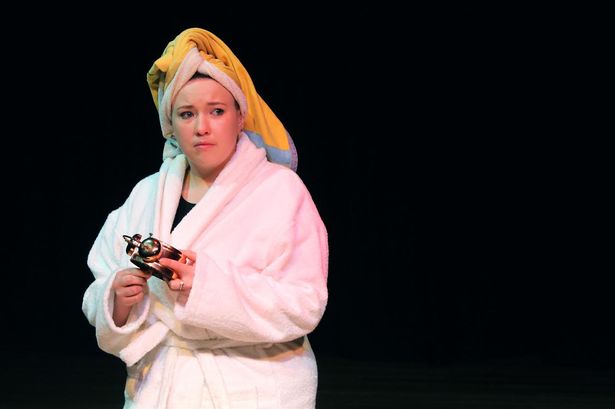
Henna night is arriving into Chapter arts centre for the 21st and 22nd of July, and promises to be a sizzling theatre experience, full to the brim with black comedy. The production tells the tale of two women who by all accounts should loathe each other – the Broken hearted ex, Judith, and his new girlfriend, Ross, when sarcasm and insults give way to reveal parts of the two characters’ lives, the characters carrying the show in an intimate, character driven play.
Henna Night won The Sunday Times Drama Award in 1999, the aim of the Chapter performance by 3 Crate Theatre is to keep it as fresh and relevant as ever, with the leads easy to find in your everyday life.A whole show sitting on the shoulders of two very different women is a refreshing thing to see in a world where even the strongest of them tend to be props in the stories of men, the archetypes of love interests and women scorned hard to see a break from.
As a new play for Cardiff, and part of its comedy festival, the show carries high hopes , and with a talented cast, crew and director should soar to meet them.
Henna Night part of Cardiff Comedy Festival, Chapter Arts Centre Mon/Tue 21/22nd of July
http://www.chapter.org/ccf-henna-night
Wales Dance Platform a short response from 3rd Age Critic Barbara Michaels
Wales Dance Platform –A Valuable Contribution to the Contemporary Dance Scene in Wales.
A week-long programme of contemporary dance in venues across Cardiff which included the Glanfa stage at the Wales Millennium Centre drew audiences from all over the country and nationwide. Independent dance artists presented innovative ideas in choreography, film and photography.
One of the major highlights of a talent-filled week took place on the final Sunday when four independent dance companies performed on stage at the Sherman Theatre. Among these was internationally known Ballet Nimba, from Guinea. Idrissa Camara and Oumar Almamy Camara gave a mesmerising and energised performance, leaping around the stage in what appeared to be manic but was in fact perfectly controlled yet acrobatic dance representing masculine identity and the age-old battle for dominance between father and son while reflecting the uncertainties of the social and political scene. Those old enough to recall the visit to the UK from South Africa in 1974 of the show Ipi Tombi, a pastiche of a variety of South African indigenous musical styles which caused some controversy among critics at that time, will have noted similarities. Ballet Nimba deserves an accolade for the way in which the traditional urban and village roots of the dance is retained alongside modern dance moves and stylistics.
At the conclusion of the Platform a £1,000 award for “The most innovative and eye-catching work” an award was presented to Gwyn Emberton for his ‘The Devil in Eden’, a duet taken from his work My People, based on the book by Caradoc Evans.
Barbara Michaels
Review Nabucco WNO, ‘has audiences jumping to their feet and calling out “Bravo!” by Barbara Michaels
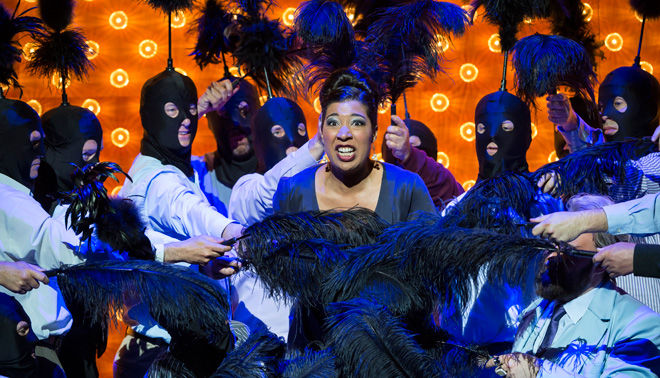
Nabucco Welsh National Opera at the Wales Millennium Centre, Cardiff
Music: Giuseppe Verdi
Libretto Temistocle Solera
Director: Rudolf Frey
Reviewer: Barbara Michaels
Rating: [4.00]
Showcasing the charismatic chorus of the WNO, this seldom performed yet musically familiar opera is presented in a 1950s setting in this new production. Almost ten years since WNO’s last performance (staged at the New Theatre) of the epic Verdi opera best known for its splendid ‘Chorus of the Hebrew Slaves’ (‘Va, pensiero’) director Rudolf Frey and choreographer Beate Vollack have created a production which embraces not only operatic tradition but the mores of modern times. The result is a soaring production that has audiences jumping to their feet and calling out “Bravo!”
The Biblical context of the conflict between the Hebrews and the Egyptians is the background of the story and generates a web of warlike violence and political intrigue. Nabucco (sung by David Kempster) is the King of the Babylonians whose daughter Felena (sung by Justina Gringyte), is held hostage by the Hebrews, under the jurisdiction of their High priest Zaccaria, sung by Kevin Short. Not only does Short bring a powerful and compelling bass-baritone to the role, but shows that he is also an actor of considerable merit. After defeating the Hebrews, Nabucco is convinced that he is God, and becomes insane. Baritone David Kempster – well known to WNO audiences – once again does not disappoint, bringing pathos to the role as Nabucco descends into madness. His projection is of a quasi King Lear – the richness and decadence of Babylon replacing the blasted heath of Shakespeare’s play.
The dominant female role of Abigaille, Nabucco’s other daughter and rival of Felena in succession to the throne, is a key factor and soprano Mary Elizabeth Williams, making her return after singing Tosca with the WNO last autumn, rises to the challenge superbly. A combination of lyricism and dramatic energy projects her relish for the role as well as her expertise and holds the audience spellbound.
Set designer Ben Baur deserves an accolade for opting for such devices as the singular usage of gold lamé drapes to represent the dross of the Babylonian scene and a symbolic wall (the Wailing Wall of Jerusalem, capital of Israel?) that of the Hebrews. Less fortunate, perhaps, is the inclusion of Fifties dance steps and hand-jiving. Costume designers Silke Willrett and Marc Weeger are to be commended, in particular for distinguishing touches such as the yarmulkes (skull caps) – traditional synagogue wear for men of the Jewish faith – worn by the Hebrews.
Highly commended is the dynamic conducting of the diminutive Xian Zhang whose debut with WNO this is. Zhang wields her baton with expertise over Verdi’s diverse score for this production of one of Verdi’s earliest yet most successful operas; an opera which, in the best of operatic tradition, culminates in an intense and gripping finale..
Runs at the Wales Millennium Centre until Saturday, June 15th , then touring.
Review Things We Do For Love New Theatre, Cardiff by 3rd Age Critic Barbara Michaels

Things We Do For Love New Theatre, Cardiff
Writer: Alan Ayckbourn
Director: Laurence Boswell
Reviewer: Barbara Michaels
Rating: [3.8]
A multi-layered romp – in more ways than one – Things We Do For Love was first staged in 1997. The humour, and the dark edge behind it, are still relevant today, as indeed can be said of all of Ayckbourn’s plays. Bedroom farce – yes, and you may choose to take it at its face value. It is, indeed, a bedroom farce par excellence, as one would expect from one of Britain’s master playwrights. But in fact there is much more to it than that – it could in some respects more correctly be classified as a tragic-comedy for that is what it is in the end. For this reason, it is a piece that needs an expert hand on the tiller if it is to succeed. Director Laurence Boswell shows his mettle with this revival by Theatre Royal Bath Productions, a good understanding of Ayckbourn and whence the piece is coming.
On the surface a light, at times raunchy, comedy, and staged on a single set throughout, there is much to laugh at as the characters lurch from one relationship to another in a romantic whirlwind of a plot.. The set, that of a middle floor flat of a converted house owned occupied by the elegant and glacial Barbara, allows the audience to see into both the flat above and the flat below. While Barbara resides in lonely splendour on the middle floor, the upstairs apartment is the perfect bolthole for Nikki, Barbara’s old school friend, and her fiancé Hamish, while the downstairs room is occupied by Gilbert, a part-time postman and amateur plumber man who lusts after his ice maiden of a landlady in a somewhat unconventional way. Feelings change and relationships crumble as the plot develops and the characters reveal their true selves.
As Barbara, Claire Price gives us a believable, no nonsense career girl who has no time for men let alone romance and slides seamlessly into portraying the love-stricken, not to mention energetic in the bedroom and elsewhere, and abandoned female which she becomes. This is all due to her falling, big-time, for Hamish notwithstanding the fact that he is engaged to Nikki, avowedly her best friends since their school days. As Hamish, Edward Bennett looks suitably uncomfortable in the immaculate surroundings of Barbara’s flat while managing to project as a sort of male arm candy for whom women (literally) fall.
Making her stage debut, Natalie Imbruglia looks suitably fragile as Nikki, playing her as the stereotypical helpless-little-woman, irritating at times and yet managing to enlist sympathy and help from everyone including downstairs neighbour Gilbert. Simon Gregor shows his expertise in this role, with evident relish and giving it full throttle. The zany Gilbert has his dark side, and Gregor is adept in showing this beneath the banter.
This is classic Ayckbourn, showing us that what we see is not always what we get. Things We Do For Love will strike a chord in many ways. Ayckbourn’s cynical view is that love knows no boundaries and he is, of course, right.
Runs until Saturday May 17th
Review Ballet Cymru – The Same Flame/Week of Pines, Riverfront Theatre, Newport by 3rd Age Critic Barbara Michaels
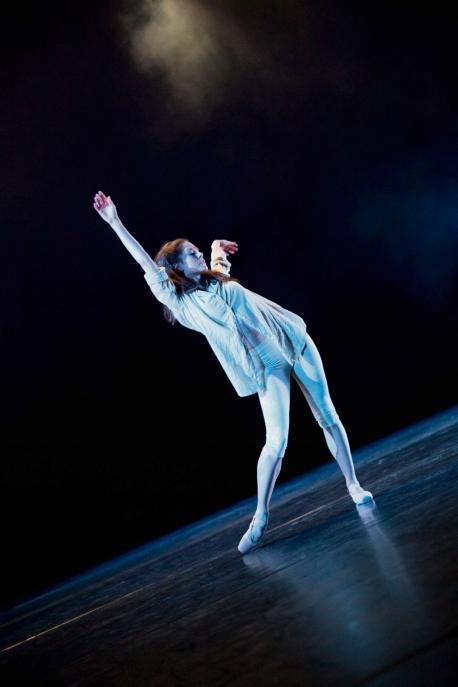
Ballet Cymru has justifiably earned the reputation of going, artistically speaking, where no man – or woman – has previously dared to tread. This double bill proves the point with a combination of contemporary dance and, in the first half, a score by award-winning Welsh composer Thomas Hewitt Jones which incorporates a major choral input, and in the second half the music of folk song.
The Same Flame
Music: Thomas Hewitt Jones
Choreography: Darius James, Amy Doughty & company dancers
The dancers of Ballet Cymru showcase their expertise in this piece, based on a 35-minute choral work portraying Olympic values, with lyrics by Matt Harvey sung by the equally skilled Vivum Singers. The combination, in itself unusual, becomes even more so when guest artist Suzie Birchwood makes her entrance. Birchwood, who won a full scholarship to train at the London Studio Centre when she was 16, but had her training cut short a year later by the onset of generalized dystonia which has left her requiring wheelchair assistance, would emphatically not want this aspect of her life dwelt upon in relation to her dancing. So I shall only say that the determination required to appear on stage as a dancer in a choreographed piece that includes lifts and pointe work is mind-boggling. If that in itself is not deserving of an accolade, then the high standard of Birchwood’s work is even more so.
Darius James is a name well-known to those familiar with the work of Ballet Cymru, and here as is the norm with him he makes huge demands of his team of dancers who rise to the challenge with an evident enthusiasm. This is contemporary dance but James is not afraid to acknowledge, and at times make use of, traditional ballet steps and format, and does so with a seamless expertise which adds much to the success of the performance. The choral input by the Vivum Singers is considerable and of a high standard, but there is a caveat here, in that at times attention is inevitably split between the dancers on stage and the singing.
Week of Pines
Music and vocals: Georgia Ruth
Choreography: Darius James, Amy Doughy and dancers of the company.
A complete change of style, mood and scene for this work by Aberystwyth songwriter, singer and harpist Georgia Ruth, whose debut album is danced to here. Accompanying herself on the harp, and singing in both Welsh and English, backed by guitar, reed organ, bass and drums, Ruth’s is a talent which cannot be denied. Judging by the audience reaction, and conversations in the bar afterwards, many of the audience came specifically for this and, with each of six tracks telling a different story, there was undoubtedly an extra dimension to be gained for those familiar with the album.. However, for those more intent on the structure and performance as applied to the dance interpretation, some explanatory programme notes would have been helpful. Choreographing such a piece is far from easy, and while the dancers did their best to follow the mood swings of the score it did at times take its toll.
Overall, an exciting and innovative double bill danced by a company of nine dancers all of whom display considerable talent. It remains to be seen whether or not Ballet Cymru’s declared objective of bringing in those who are wary of traditional ballet succeeds. Judging by the enthusiastic reception, it may well have done so.
Barbara Michaels
Review Hot Flush New Theatre, Cardiff by Barbara Michaels, Third Age Critic
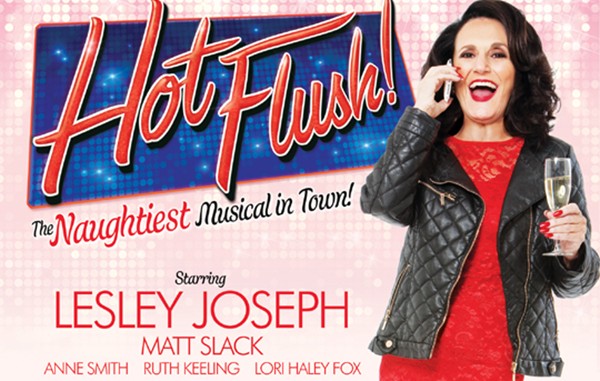
Hot Flush New Theatre, Cardiff
Writer: Julie Benson
Lyrics & music: Olly Ashmore
Director: Alan Cohen
Reviewer: Barbara Michaels, Third Age Critic
Rating: {3.5]
Some twenty years since her one man show at London’s Festival Hall, Lesley Joseph is doing it again – in a manner of speaking, that is. For Hot Flush, billed as “The naughtiest musical in town,” is not actually a one woman show. Lesley’s co-stars – Matt Slack, Anne Smith, Ruth Keeling and Lori Haley Fox – all have important roles to play, but the focus is on Joseph, in the central character of Myra, a barrister, and a successful one to boot, coping with the menopause and a rat of a husband who leaves her for a blonde bimbo. Much hilarity ensues as, with the help of her friends, also dealing with their own mid-life crises, an ever more desperate Myra tries to put back her biological clock.
Ever since she tottered on impossibly high heels onto our TV screens as man-eater Dorien Green in the hit comedy series Birds of a Feather, Joseph has played to packed audiences wherever there are women – or should I say girls – looking for a good night out. In Cardiff, as elsewhere, women dominated the audience. At the age of 69, can she still cut the mustard? The answer is yes, she can. With a sense of comedy timing that is spot on, Joseph gives her all – and That Walk is still unmistakeable.
However, despite a gut feeling that this across-genre piece is basically a vehicle for Joseph to showcase her undoubted talent, and a somewhat clichéd plot line, Hot Flush has some deper themes – errant husbands being only a part of a larger picture. These themes become more evident in the second act which is, to my mind, a great improvement on the first half where strident sound levels drowned out some of the lyrics. The best musical numbers, several of which rely on familiar tunes, are a welcome feature of the second half, which gets off to a flying start as the talented Matt Slack who, as the man in the cast, plays all the male roles, takes centre stage..
He does so with a perceptible relish and expertise that makes his every entrance a joy, and forms a great foil to the women’s antics. Jokes –many of them cruder than those heard on a building site – come thick and fast, although some of the more subtle anecdotes went unnoticed on the first night in Cardiff. Writer Julie Benson’s intention was to extend her original book about the female menopause into a musical about women who were going through a stressful time in their lives, but was funny – and in that she succeeds. If you are looking for a night out with the girls, it’s fine. But don’t take your maiden aunt.
Run: Thursday & Friday, April 24th and 25th
Review Under Milk Wood : An Opera, Sherman Theatre, Cardiff by Third Age Critic Barbara Michaels
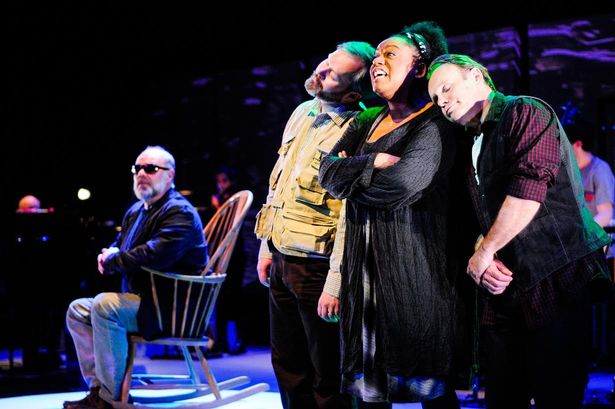
Under Milk Wood Sherman Theatre, Cardiff
An opera
Words: Dylan Thomas
Music: John Metcalf
Co-production by Taliesin Arts Centre, le Chien qui chante (Quebec) and Companion Star (New York), in association with Welsh National Opera.
Reviewer; Barbara Michaels
Ratings: [4.00]
Re-imagined and set to music by Wales’ leading opera composer John Metcalf, the words and imagery of Dylan Thomas’s Under Milk Wood are given a new slant in this presentation by Taliesin Arts Centre, staged as part of the Dylan Thomas 100 festival. Given Metcalf’s sensitive handling of the poet’s ‘Play for Voices,’ and a talented thirteen-strong company of singers and multi-instrumentalists, it can hardly fail. Together with director and producer Keith Turnbull, Metcalf has succeeded in translating Thomas’s mythical village of Llareggub with its gloriously eccentric residents into the format of opera. Not grand opera, to be sure, but rather the melding together of the different genres of poetry and music, requiring in addition considerable acting skills – quite a tall order.
Not surprisingly, in the centenary year, there are many productions of the famous poem, originally written for radio back in 1954, going the rounds. This one is unique, being the only operatic presentation ever – a world premiere, no less. With visuals used as backdrops and a realistic sound track producing the sound of waves crashing onto the beach, it succeeds to a remarkable degree. For those – and at a guess this applies to many of the audience – familiar with the text, it adds a valuable dimension to the whole.
However, there is a caveat. The overture, in the form of a musical introduction before the performance gets going, is overlong when balanced against the overall length of the piece. Also, the music is at times overloud, drowning out the voices and thus inevitably causing some members of the audience to, as it were, lose the plot – not to mention Thomas’s wonderful language, of which every word is to be treasured.
Fortunately, this rights itself and, as the singers settle into their parts – parts plural, for each one takes on the mantle of different persona – one begins to realise what a treat, and a rare one at that, this is. Centre stage, bass/baritone Michael Douglas Jones gives a sympathetic portrayal of the narrator blind old Captain Cat, ably backed by baritone Richard Morris who shines as Mr Waldo as well as in a number of other roles. Soprano Elizabeth Donovan is a wistful tart-with-a-heart Polly Garter who tugs at our heartstrings, while Helen-Jane Howard shows considerable acting ability along with a melodic soprano voice as Goassamer Beynon and other parts. Nice comedic touch from Gweneth-Ann Jeffers in the role of Mrs Ogmore-Pritchard, Mrs Organ-Morgan etc.
Considerable musical ability from harpist Deian Rowlands and some excellent viola playing by Parmela Attariwala.
All in all, a remarkable take on the best known work of the iconic Welsh poet.
Review Rites of Spring/Petrushka, Sherman Theatre, Cardiff by Third Age Critic Barbara Michaels
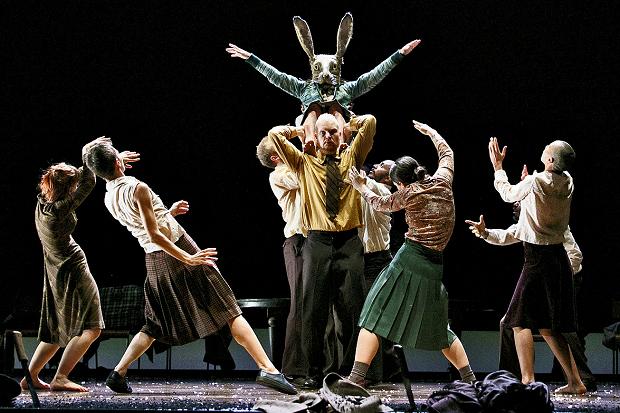
RITES OF SPRING/PETRUSHKA at Sherman Theatre, Cardiff
Director & Choreography: Michael Keegan-Dolan
Music: Igor Stravinsky
Fabulous Beast Dance Theatre
Reviewer: Barbara Michaels
Ratings: [3.5]
With a stark monochrome setting and virtually no scenery, Fabulous Beast Dance Theatre’s double bill, set to the powerful music of Igor Stravinsky, is contemporary dance with a vengeance. There is little or no acknowlegement paid to earlier balletic arrangements in the choreography. That is, perhaps, how it should be. What is lacking, however, in Michael Keegan- Dolan’s version, is clarity of context and relevance to the music. Despite the programme notes, some members of the audience were left floundering.
That is not to say, however, that these two pieces of dance theatre do not have merit. In Rites of Spring, Stravinsky’s vision of a solemn pagan rite with sacrifices to the god of spring, Keegan-Dolan uses the rhythmic elements of the music as a backdrop to violent scenes portraying pagan fertility rites ending in human sacrifice. At one point everyone strips – male dancers down to the buff while female members of the cast are permitted to retain bra and pants. Floral dresses are put on – and taken off again. A man gets murdered (why? Because he’s old, of course.}
Some spectacular dancing here, hard, exciting and physically testing, from both male and female members of the 14-strong International cast. While it is difficult to single out individuals, as the full cast are used throughout, mention must be made of one or two: Louise Mochia manages to remain graceful at all times, with lissom movements even when the pace is frenetic, while Anna Kaszuba displays amazing energy, coping with the considerable effort and expertise that the programme demands,
On the male side, there are striking elements, such as the wide-legged jumps done in unison while balancing cardboard boxes, cartwheels, somersaults, rhythmic stamping et al – some sequences are threatening and violent. This is not for the squeamish.
Petrushka, in the second half provides some light relief after the difficult first half. Petrushka was composed in 1911, and balletomanes will be familiar with the traditional ballet, which tells of a traditional Russian puppet, Petrushka, made of straw and sawdust, who comes to life. Again, Keegan-Dolan’s take brooks no quarter, paying no homage to the original apart from covering the dancers’ faces in dense white make- up like puppets. The cast displays wonderful fluidity of movement in this half, which is altogether more accessible, although there are still some shocks.
Despite the power of the dance, the strength and sheer volume of Stravinsky’s score tends at times to overwhelm the dancers, which is perhaps not surprising, given that it was conceived originally as a concert work. It was that great dancer Diaghilev who, back in 1910, persuaded him otherwise, resulting in the performances that caused much outraged comment back in the early 20th century. Despite the clever concept which it undoubtedly is, the same might be said of Keegan-Dolan’s version.
Run: April 8 & 9