All posts by admin

Review John Waters, False Negative Barbican by James Ellis 

John Waters, filmmaker and writer presents his comic monologue covering his career, movies, fashion and art in the Barbican Hall on Friday, 10 June 2022. Photo by Mark Allan
 out of 5 stars (4 / 5)

Dubbed “The Pope of bad taste”, anyone who has ever seen a John Waters film (I’m talking about the early stuff) will never forget it, try as they might! With this notorious reputation, John aged of 76 finally written his first novel: Liarmouth. I get the feeling he has done his live show just to do a shameless plug, the queue after the performance was a long as the Barbican is a maze. No doubt he would never take offence to any of my words.

His film work is a revelation, a huge point of reference for the LGBT community, even with the tidal wave of problematic themes and subplots. The giddy air at the Barbican greeted John with huge burst of loving applause, arriving in a bold, yet fashionable floral, black and white smock (something I adored). Of course, he had his famous, pencil moustache to boot. It’s the insights, the references, the name dropping and the snarling comebacks that made this live experience an overwhelming gush of camp. The spirt of drag artist Divine, John’s most infamous collaboration was ever present on this night. Divine, who may have been one of the funniest and brilliant people ever to be on film, also proved his chops with more acclaimed work of John’s with Polyester and the original incarnation of Hairspray. 

I knew this would be funny and it was. I found myself scoffing as many times as I was amused, the compulsion of big, hearty laughs caught me off guard. More recent remarks about Covid, vaccines and even Johnny Depp (he worked with John on Cry Baby) stood out as highlights. The amazing thing about this man is he makes you love trash, through a mirror of irony and self confidence. No one really makes me feel like John, his openness and mockery of things he adores are proof that comedy can be funny and not always mean at the same time. You just can’t cancel him, try as they might. A frenzied Q & A proved how much adoring fans can’t get enough of him, John declaring on a few occasions “One at a time!” due to his poor hearing. 

He declared that Liarmouth is the most outrageous piece he has done since Pink Flamingoes of 1972. That is saying a lot, but the book is now top of my list of must read books. Only I don’t think I’m quite ready for it…            

Liarmouth, published by Corsair is now available online and all good retailers. 

Review Violet, Music Theatre Wales/Britten Pears Arts at the Sherman Theatre by Ellie Nichols

 out of 5 stars (3 / 5)

If the objective of art and performance is to encourage the observer to ask questions of both the piece and of themselves, then this production certainly does that. ‘Violet’ the new contemporary opera from Music Theatre Wales with music by composer Tom Coult and libretto by Alice Birch is both thought provoking and arresting.

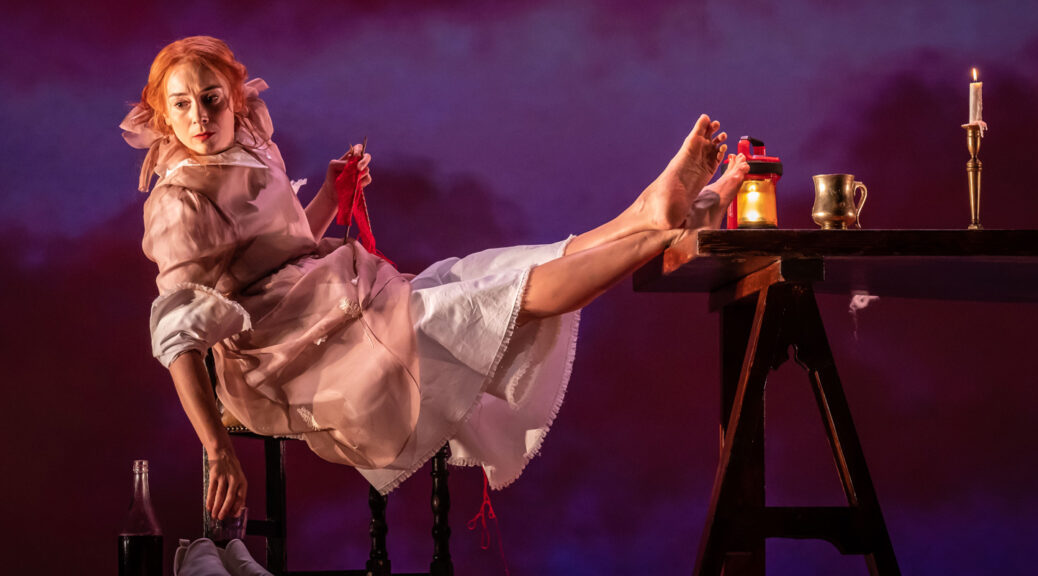
Set largely in one room in a seemingly affluent household within a small village, the opera explores the concept of losing practical time daily and the impact this has on an individual and a society. The undeniable vocal talents of Anna Dennis as the main protagonist, Violet and her, at best fractious at worst toxic, relationship with husband Felix played by Richard Burkhard make for bitter exchanges fuelled by vitriol and spent passion. The libretto uses blunt truths and humour to articulate the harsh realities of a broken marriage, underscored by tones of misogyny and coercive control. The characters are not likeable and the musical score, performed brilliantly by the London Sinfonia orchestra echoes this jarring, uncomfortable feeling for the observer.

The vocal range of all the performers is incredible. Violet’s calm acceptance while those around her crumbled was portrayed by Anna Dennis with a serenity and almost childlike absence of concern that would have been welcomed by me as a viewer. The juxtaposition of Dennis’ piercing soprano and Richard Burkhard’s baritone was palpable and the shift in the balance of their relationship demonstrated to great effect through the peaks and troughs in tone and pace of the accompanying score. Frances Gregory as Laura the maid brings an understated yet powerful presence to the mix and Andrew MacKenzie Wicks as the clockeeper has an ominous presence throughout the performance, and acts as a reminder of the inevitability of time passing whether we want it to or not.  The music takes the audience on a journey through a range of sounds both familiar in the ticking of a clock and at times challenging and uncomfortable. What felt like a cacophony of sound at times, perhaps representing the confusion and uncertainty felt by the characters in their increasingly desperate situation, ultimately left me a little overwhelmed which may have been its intension.

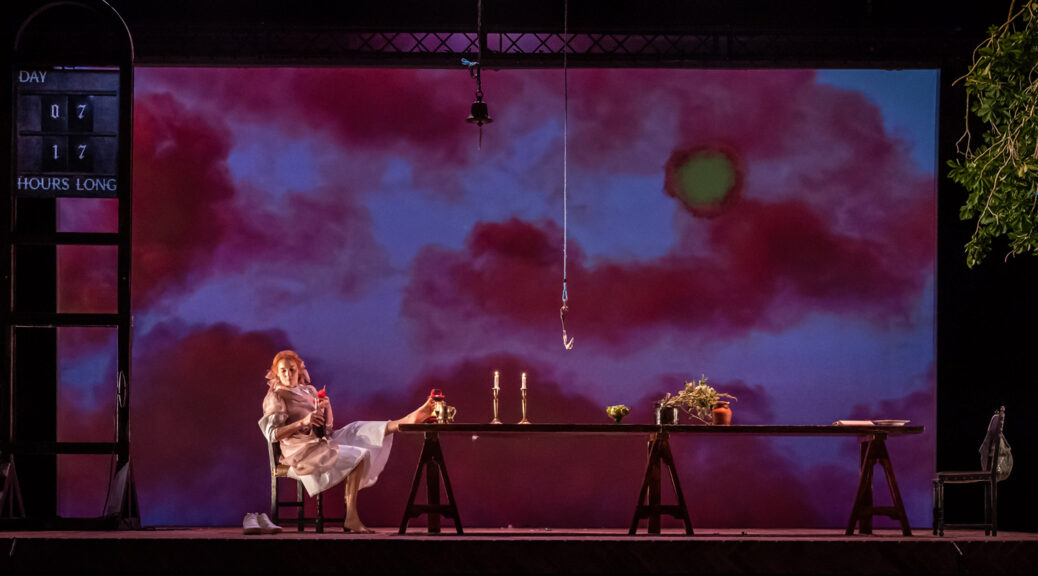
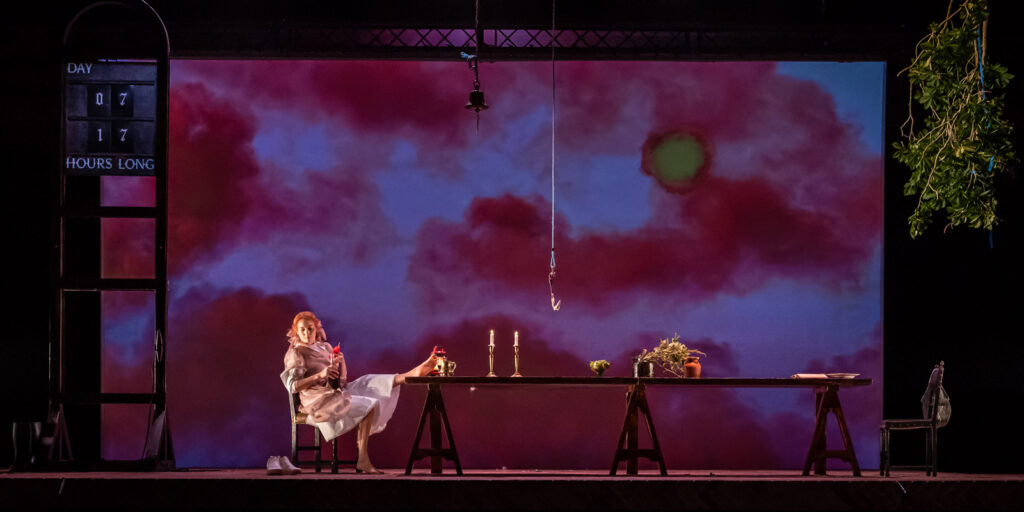
Rose Elnile’s staging was minimal but effective and the mix of old and new meant that the action could have taken place years ago or yesterday, bringing the unnerving concept of the opera closer to home. The animated backdrop representing the outside world transforming from idyllic summer sky to a dystopian nuclear cloud with floating dandelion clocks was an interesting addition that prompts a conversation about climate change and taking notice of what is going on around us. The twist at the end of the performance, no spoilers, didn’t work for me as a viewer but it made for a discussion point that will divide opinion and interpretation.

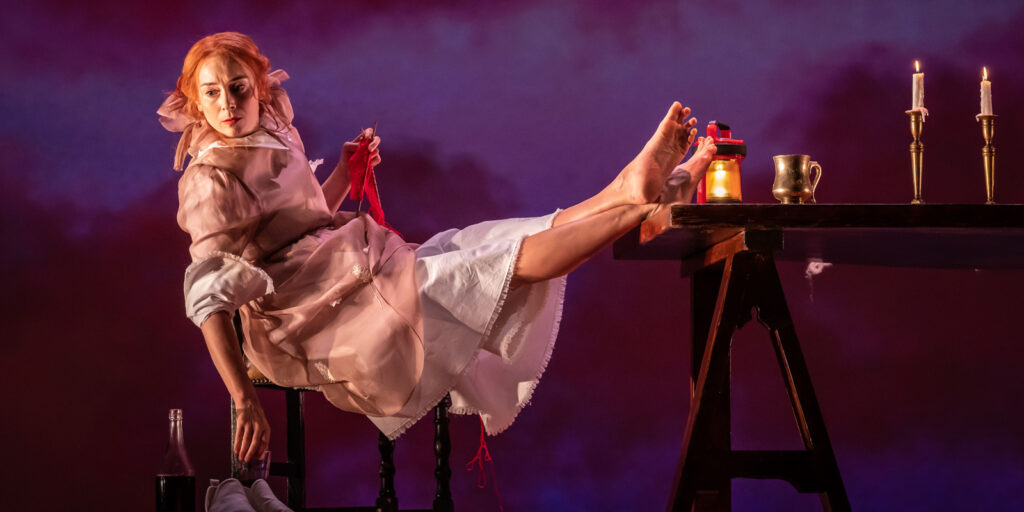
Cécile Trémolières costume design was interestingly simple with Violet morphing from a ‘Baby Jane’ esque image at the beginning to something from the Famous Five at the end reflecting her development in confidence and independence. Violet’s costume was the only one with any real personality or individuality and this served to single her out as a dissenting voice among the masses.

Time as a construct and how we value or use it is subjective and divisive, I suspect this contemporary opera is likely to be the same. If you are new to the genre of opera as I am, this is certainly an interesting baptism. I’m still not sure if I liked it, but I was talking about it when I got home and that has to mean something. 

Review Violet, Music Theatre Wales, Sherman Theatre by Peter Gaskell

 out of 5 stars (3 / 5)

Contemporary opera may be an unfamiliar genre to many, even fans of musical theatre, and this was not in the background of Tom Coult or Alice Birch before they collaborated to compose and write ‘Violet’. Opera traditionally is not sung in English and is set in specific times and places as the protagonists, often lovers, work out their fate, usually tragic, as they struggle against the prevailing social and political conventions. ‘Violet’ is not a story of love seeking to prevail in spite of contrary circumstances, like Tristan and Isolde, La Boheme, Tosca or Madame Butterfly but more Nabucco, of emancipation from constraints to freedom, and lovelessness.

Co-Produced by Music Theatre Wales and Britten Pears, the premise of ‘Violet’ is bold and imaginative in the same way as Nick Payne’s ‘Constellations’ was when it broke new ground at the Royal Court Theatre in 2012, exploring questions about time, free will, choice and death. It is of time disappearing an hour per day over 24, disrupting the balance of nature and the orderly life. Set in an indeterminate historical period and place, the story relates the effect of famine, drought and human misery on the personal lives of the characters, the fourth of whom is the clock-keeper (Andrew MacKenzie-Wicks) whose chief function is to manage the display on the clock-tower stage-right showing the passage of time and the diminishing hours.

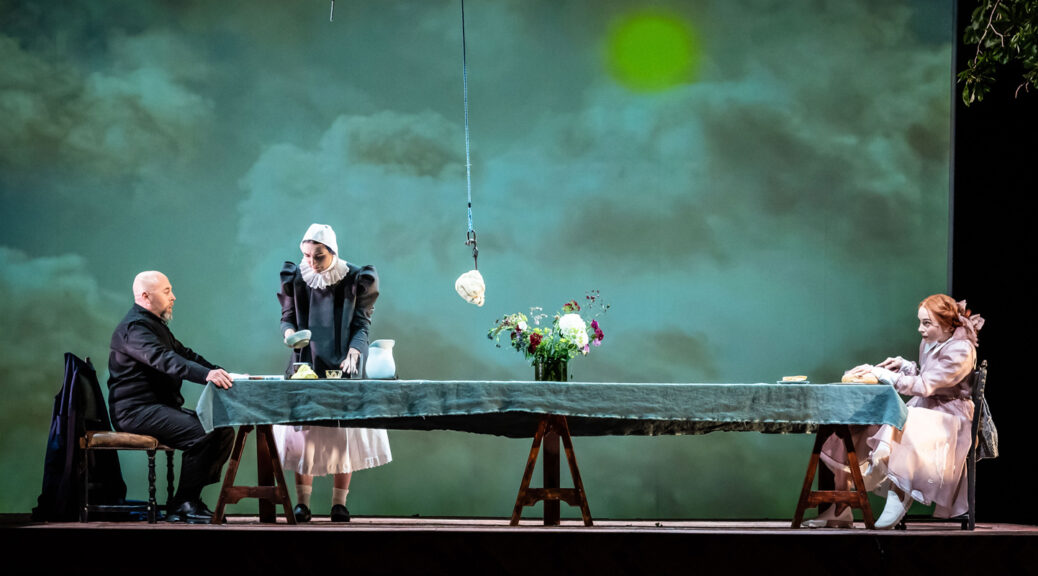
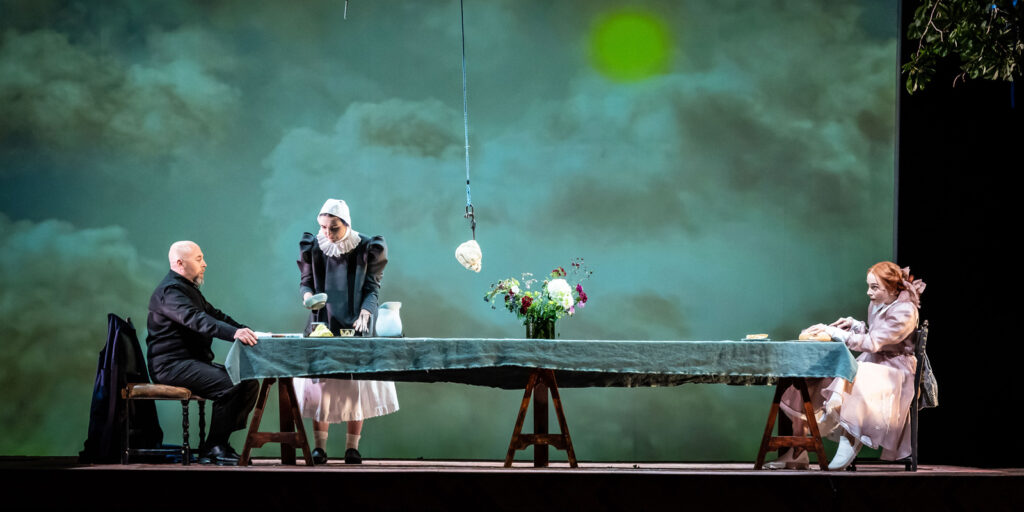
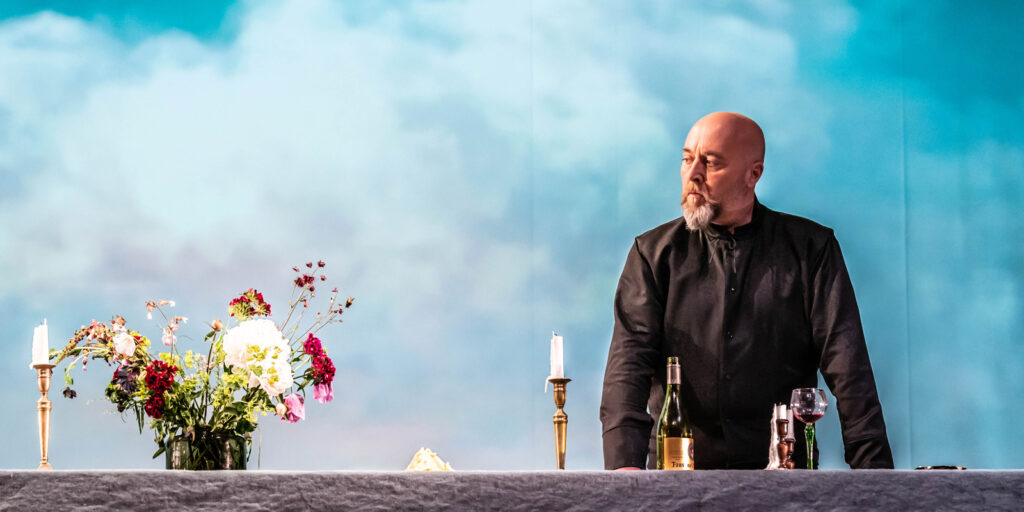
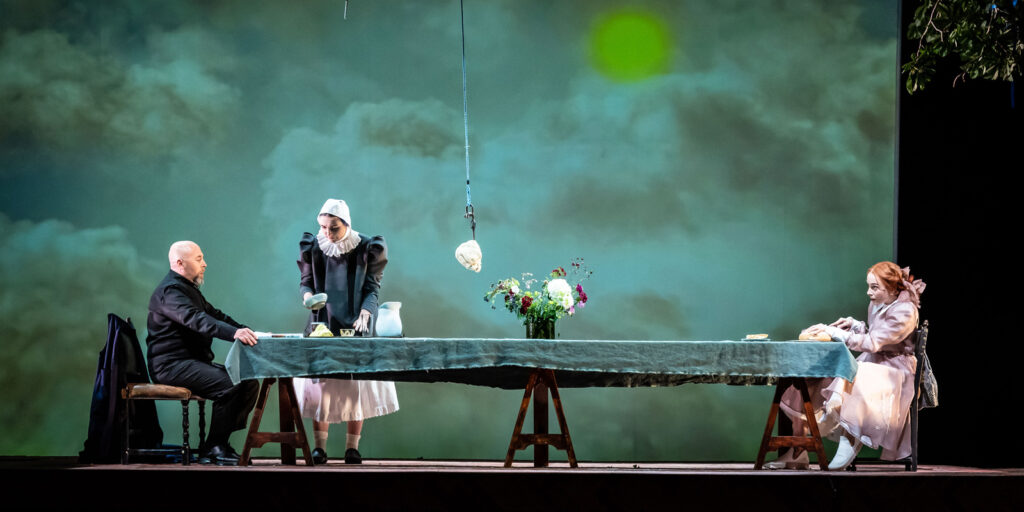
The dramatic narrative is set around the centre-stage dining table of a well-to-do couple, Violet (Anna Dennis) married to the controlling Felix (Richard Burkhard), supported by their maid Laura (Frances Gregory). Violet and Felix sit at opposite ends ( reminiscent of the distance Putin keeps from visiting world leaders) while Felix and the clock-keeper sit adjacent to each other for their conversation about stopping the disappearance of time, indicating Felix is more concerned with worldly affairs than any intimacy with his wife. The costumes designed by Cécile Trémolières support the narrative and character arcs, the static male characters remain in puritanical black while Violet’s attire changes to show more colour and variety as she comes to assert herself more, seeing hope and opportunity with the disappearance of the hours that she hadn’t before. To reinforce the lack of reference to specific time and place, Laura initially wears a maid’s bonnet suggesting this is provincial 17th century era but then the men don Elizabethan ruffs, and Violet kneads bread on the table between plastic milk cartons and supermarket cereal packets.

The backcloth shows a skyscape that changes as the hours disappear, from blue with white clouds to garish orange, purple and black intimating the arrival of catastrophe. As we hear how orderly life is breaking down, so too the props are thrown about, aided by Laura who finally smashes the table after a tree suspended above dropping lower every day is left fallen across the domestic wreckage. The staging by director Jude Christian and designer Rosie Elnile is riveting in its focus to assist the narrative, with visual text beneath the stage in Welsh and English as helpful assistance. A particularly effective piece of staging was the last occasion we saw the clock-keeper, up on his tower lamenting the end of time, lit from behind to show on the backdrop as if he was a hanged man. In view of Felix’ fate, this was a brilliant touch.

Moments in the Alice Birch’s libretto narrative I particularly liked were the conversation between Felix and the clock-keeper, when Felix wants an explanation and insists the clock-keeper should give him one, which he can’t. The clock’s mechanisms are working fine but still an hour gets lost every day. This refers me again the premise of ‘Constellations’ where contradictory happenings can coexist across multiverses. The most magical moment was when Violet pulls a length of flax seemingly from the hidden edge of the long table that was centrepiece just before like everything else it was wrecked by the entropy of time. Suggesting reference to Macbeth, she wraps it around her husband’s neck as she prepares him for a dreamless sleep before he is found hanging from the clock tower, “sleep that knits up the ravelled sleave of care, the death of each day’s life”. Indeed this story resonates strongly with the violation of nature Shakespeare portrays in his Scottish play. Excellent allusion.

There was a hole or two in the plot though e.g. on Day 4, as the town clock jumps 7 hours from midnight, and we learn that the lost time is daylight hours. Then when light is extinguished finally and Violet has her boat ready to escape with Laura who is afraid of drowning, we understand there are no news reports from the wider world about what has happened yet Violet assures Laura that many boats have crossed the sea over the horizon without sinking.

This brings me to the disappointment I felt about the outcome. Seeing no more of Violet whom with Laura we assume has been liberated to find a new life at last, the bizarre denouement is relayed as an animated collage on the backdrop, including the announcement a baby was born in January. Is this to Violet, yet how and by whom? A series of numbers is flashed up which I took to refer to quiz teams as we watch a quiz show where a contestant has to give 10 answers about the side effects of sarin, else calamity will ensue as images of warfare increasingly dominate the screen. The final quiz question is shocking. Why would a man use a gun? Answer – to shoot his children in the face. This is a nihilistic message with no apparent redemption for anyone. Unlike Shostakovich’s tenth symphony, also desperate, terrifying and dark but which is ultimately triumphant in the face of impossible horrors, ‘Violet’ fails to leave us with optimism about surviving catastrophe.

The narrative tension is supported consistently throughout by Tom Coult’s score, uncomfortably atonal, performed by the singers who must be credited for the hours of work they must have done to mesh their voices with the dissonant orchestration of the London Sinfonietta conducted by Andrew Gourlay, woodwind and brass very much at the fore punctuating the vocal exposition of the story, though with chimes and the ticking of clocks providing atmosphere and variety with some electronics. Anna Dennis is especially impressive in the title role as she hits her notes with astonishing precision. But for those who dislike the artificiality of musical theatre where dialogue can seem forced and contrived, they may not be impressed by such torturous delivery. While giving credit to the singers for maintaining their difficult lines over 90 minutes of a story about the disappearance of time, it may seem ironic how slowly the pace of the drama passed. With little obvious harmonic contrast,‘Violet’ seemed dissonant from start to finish, with no let up of the strident tension as an orderly world disintegrates. Comparing dissonance to being pepper, Prokofiev said no one wants to listen to music that’s all pepper. While after 4 hours of dissonance, the groundbreaking score of Wagner’s Tristan and Isolde finally resolves with consonance, ‘Violet’ does not.

In summary then, ‘Violet’ as concept with narrative potential is intriguingly bold even if the denouement is finally disappointing, its staging was marvellous, and its performances commendable. Its shrewd avoidance of specificity as to time or place lends it the opportunity for long-term appearance in the canon of opera.

Review Violet Music Theatre Wales, Sherman Theatre by Gwyneth Stroud.

All credits Marc Brenner

 out of 5 stars (4 / 5)

What happens when time runs out?  Panic, terror, fatalism?  Or resignation and even hope that a new beginning will bring better things?

After two years when many of us have felt the sorrow of lost time due to the Covid-19 pandemic, and ironically why this production has been delayed until now, Violet is both a timely and poignant reflection on the meaning of time and the feelings that it engenders. 

The work centres around three main characters – Violet (Anna Dennis), a depressed wife who hates the predictability of life in their town.  People rise, make bread and open their doors at exactly the same time each day. Nothing even changes, and Violet feels stultified by it.  Her husband, Felix (Richard Burkhard) exerts control over Violet, and is disturbed by the changes that he observes in his wife.  Their anxious housekeeper Laura (Frances Gregory) carries out her daily routine with an increasing sense of dread and terror. 

The action takes place around a table set with incongruous items of food and drink, a still life depicting an unspecified time and place. The characters’ dress does little to ground us either – Felix in modern dress, Laura in period clothing and Violet in an Alice in Wonderland-type outfit, complete with pigtails and bows. Violet is the first to notice that time is – literally – running out. The town loses one hour a day, and this process does not stop until there is no time left.  There are no hours left in the day. Felix and Laura collapse into panic and terror, witnessing the destruction of life around them, but depressed Violet is enlivened by events, sensing that a new beginning might just be possible. And at least something different is happening.

Co-produced by Music Theatre Wales and Britten Pears and directed by Jude Christian, it’s a short piece, running to just 85 minutes,.  As such, every word and note must earn its place, there is no room for any superfluous material.  Alice Birch uses language to great effect here and, coupled with Tom Coult’s haunting and poignant score, the overall effect is of a precarious balancing act between fear and a tiny amount of hope.  The soprano of Anna Dennis perfectly captures single words (“Yes”, “No”, “Time”) with alarming disquiet. Richard Burkhard provides a few moments of levity through his well-placed dialogue and voice. Frances Gregory and Andrew MacKenzie Wicks give assured performances as the housekeeper and the clock keeper.

Mention must be made of the London Sinfonietta, conducted by Andrew Gourlay. The 14 players execute the terse score beautifully, and the dexterity of the percussionist in particular, who handles an array of instruments with great aplomb, moving his score around with him, is to be admired.  Together with additional electronic sound effects, the sense of time running out is always palpable and very real.

What to make of the ending?  Is this a new world, with no humans left?  Whatever is happening in this place, time remains central.  But it is now marked by a digital clock, and the opera ends with the display ticking round to just after midnight.  So is there hope …. after all?

Review Catrin Finch & Seckou Keita St David’s Hall by James Ellis

Photo Credit: Mark Allen

 out of 5 stars (3 / 5)

One of the fond memories of the brief window of live performance in 2020 was Catrin Finch with the Columbian band Cimarrón. Welsh harpist Catrin seems to hold the whole world in her hands, with a versatility in essentially any genre of music. Knowing her from classical circles, her time with Cimmarrón made for a sizzling and dazzling concert, something I haven’t forgotten in a hurry.

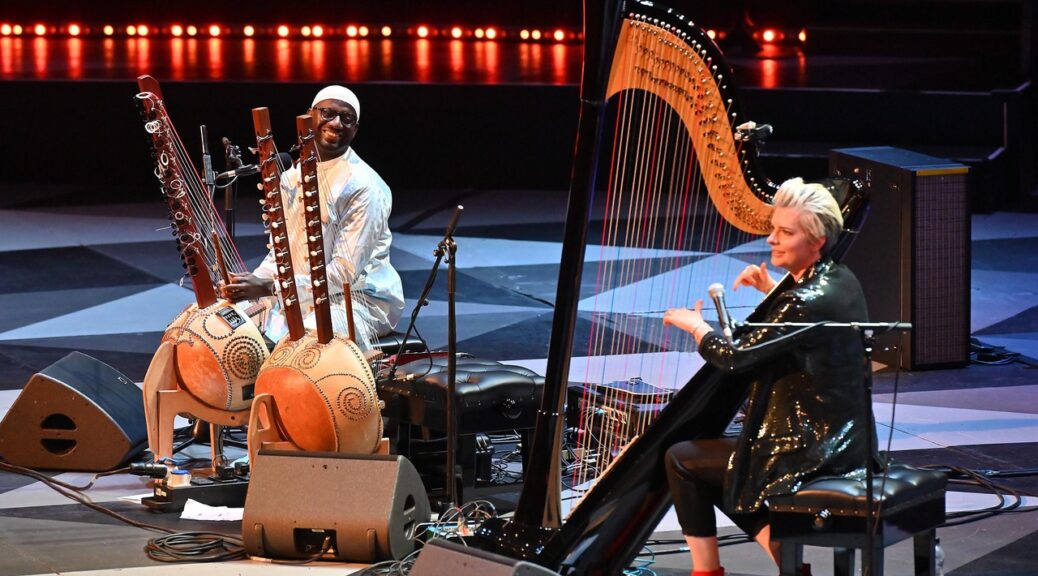
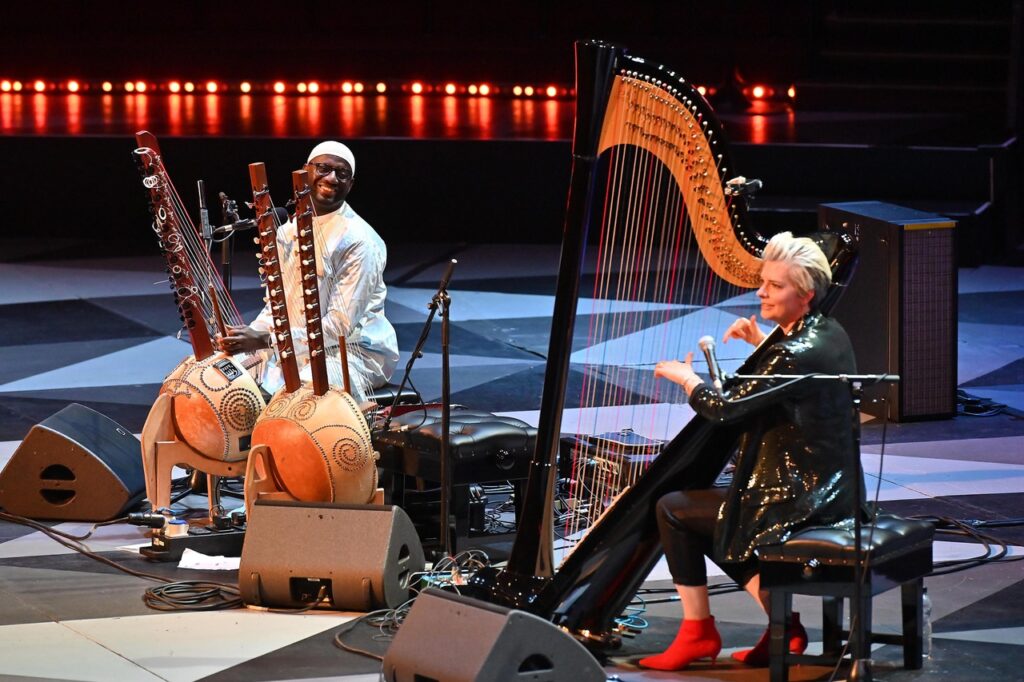
A duet with Seckou Keita from Senegal is another giant leap in taste and mileage. Keita, who plays the kora (a large string instrument made from a giant root vegetable) beams for most of the night, his vibrant energy on full display. Catrin, ever the wry talent, gave humour in speech and simply beautiful playing on her large harp. Together, Wales and Senegal does not seem that far apart, the break down of musical cultures dropping with a huge reverb, its sound a towering influence over the night.

I’ll confess the music here is on a more chilled level, a breezy ambience that never lets up. I found myself craving something with more of a meaty bite, though the eloquence of both players never wained. The kora is a rather subtle instrument, somewhere between a harp, guitar and the strings of a piano. They usually played in harmony, each instrument clear during these moments.

Seckou also shared insights from his country, the idea of the children’s rite of a “standing stick” was amazing. A frustrating moment came later when his mic fell and not a single technician came to assist him. Along with Catrin’s deadpan, they made quite a comedy double, as well as musical bed fellows. The unending, shameless amount of plugs to their new CD started to get absurd as the night went on.

We really should place bets for where Catrin goes globally and who she plays with next. Her journey remains quite the adventure.

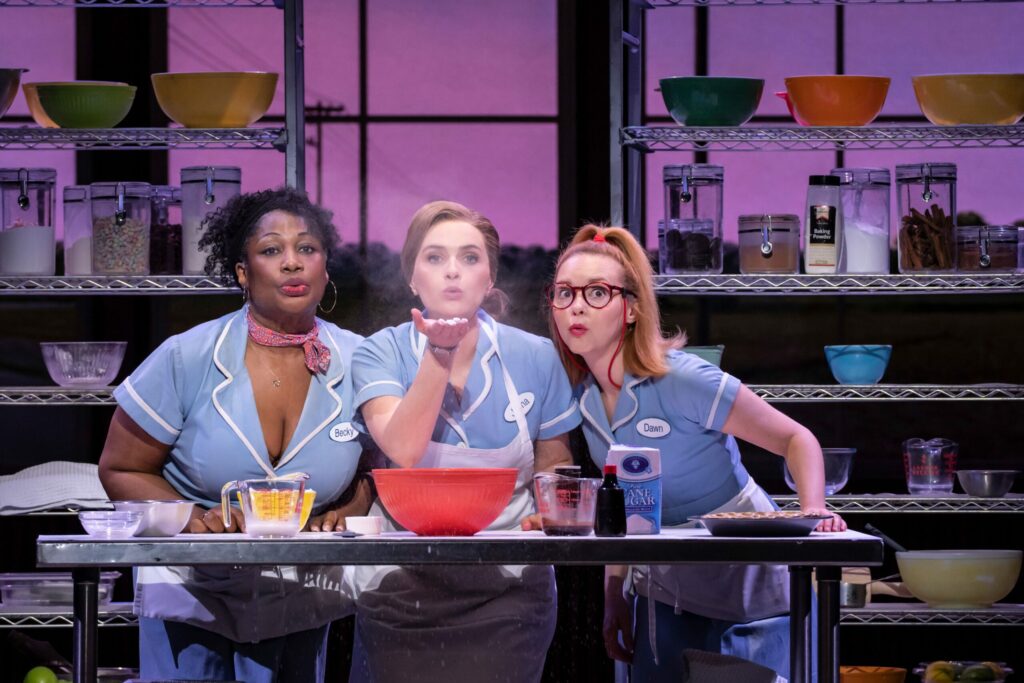
Review Waitress by Bethan Lewis, Wales Millennium Centre, Tuesday 31st May 2022

 out of 5 stars (4 / 5)

Take one charming leading lady, a dollop of catchy songs, a ballad or two to pull on your heartstrings, sprinkle with silliness and mix with loveable characters to create the perfect recipe for a feelgood musical.

The ingredients were expertly balanced at the performance of the Tony Award nominated hit musical Waitress in Cardiff’s Wales Millennium Centre on Tuesday evening.

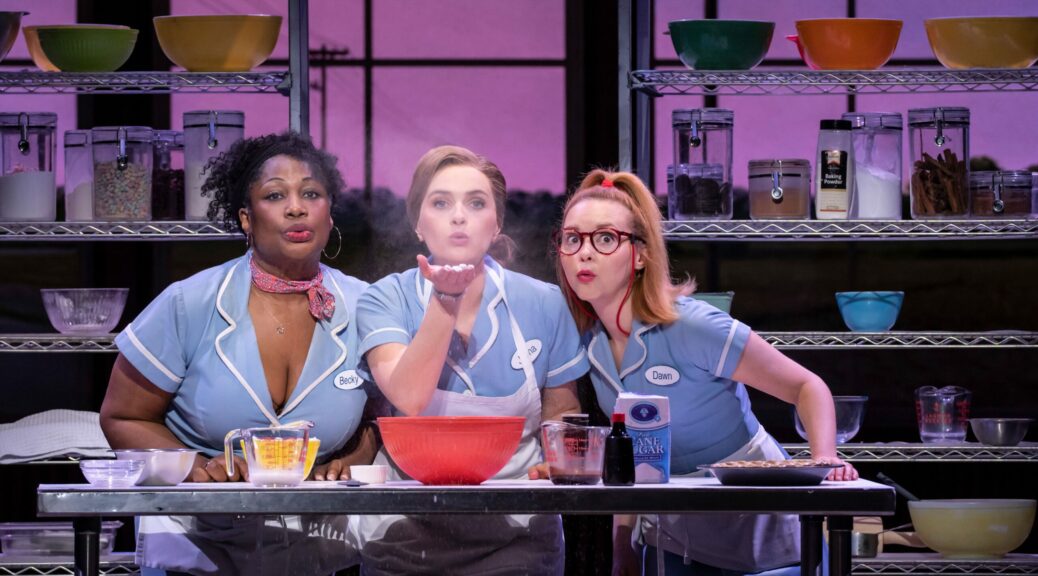
Based on the 2007 Adrienne Shelly film, Waitress tells the story of Jenna who works in Joe’s Pie Diner in the Deep South.  Jenna is unhappy in her marriage to the controlling Earl and feels trapped in her mundane life where every day is a carbon copy of the last.  To make matters worse, as the show opens, Jenna discovers that she is pregnant, expressing her disappointment during “The Negative” where she is consoled by her colleagues Becky and Dawn.   Jenna finds solace in baking and, in particular, in making pies – she makes a different pie for every day of the week and there isn’t an occasion that she can’t think of the perfect recipe, including “my eggs failed me pie” and “in the pursuit of happiness pie”.  Even though she knows it’s a “Bad Idea” Jenna embarks on an affair with her hunky gynaecologist Dr Pomatter.  We follow her journey as she tries to escape her hum drum life.

On the face of it the storyline is fairly predictable but as it develops we realise there is more to the characters than meets the eye.  Jenna is a complicated leading lady, describing herself as being “imperfect but she tries” – she has an affair, she is unmaternal and she lies to her husband.  In fact, in a turn from traditional musical theatre, all the characters are in some way flawed and morally ambiguous, making them more relatable to the audience. 

The cast are impressive in portraying these characters and all give strong performances, approaching their roles with sensitivity.  Chelsea Halfpenny is particularly noteworthy as Jenna, bringing the house down with her vocal ability in the heart wrenching “She Used to Be Mine”.  Evelyn Hoskins and George Crawford pitch their performances of goofy couple Dawn and Ogie just right, providing plenty of laughs while still making the audience believe in their love story.

The production, directed by Diane Paulus is incredibly slick with effortless scene changes supported by the ensemble.  The majority of the action takes place in the diner which has a view of the open highway projected through the windows.  The performance space is reduced in Jenna and Earl’s home, with the ceiling being lowered and the walls drawn in, giving a visual representation of her claustrophobic life. 

The band, which does an excellent job of executing Sarah Bareilles’ Nashville worthy score, is situated on stage and form part of the action as patrons of the diner.  Although this is a nice effect, it is distracting at times.

There are moments when the show touches on darker, more gritty themes; Earl is abusive towards Jenna and it is suggested that she witnessed domestic violence as a child.  Jenna’s attitude towards her pregnancy is controversial and Becky is clearly struggling in her role as a carer for her husband.  The show only mentions these issues on a surface level and shies away from exploring them in any depth.  Instead, it reverts to lighthearted humour, opting for a “life must go on” attitude.

The influence of Waitress’ female-led creative team is clear to see – the show is ultimately a celebration of friendship and femininity.  Jenna’s transformation is inspired by the birth of her daughter and the support of her friends rather than being influenced by the male characters in her life.

Just like a slice of freshly baked homemade pie, watching Waitress the musical leaves you with a warm, comforting feeling.  This sweet story isn’t necessarily ground-breaking but it will leave you with a smile on your face, a song in your heart and a skip in your step. 

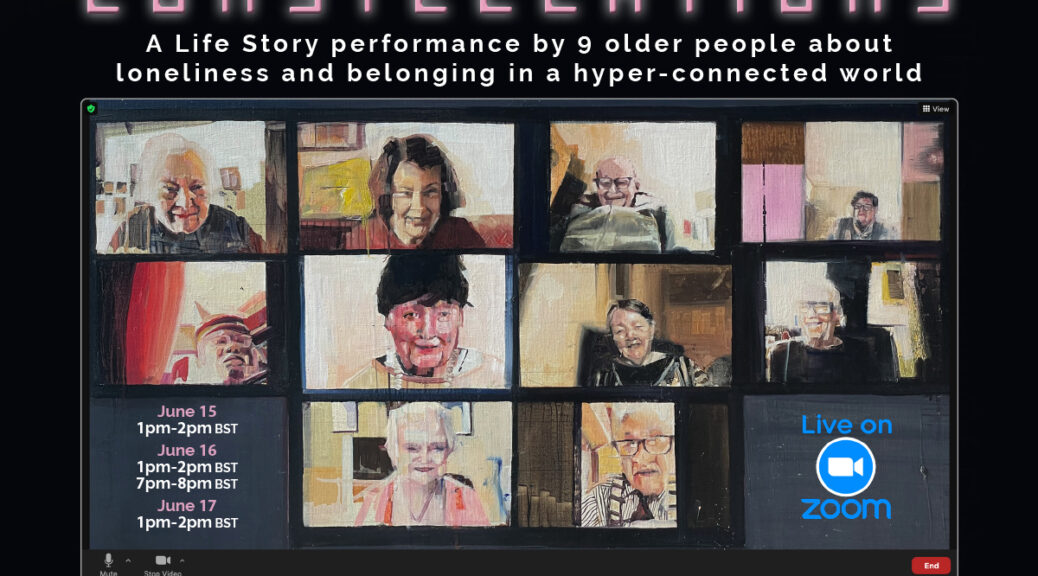
Re-Live to premiere new show about loneliness and belonging, created and performed by a cast aged 72 – 95

Constellations is an honest, moving and at times humorous exploration of the impact of loneliness on our older generation, and the power of community

Devised and performed live over Zoom, Constellations will premiere 15 – 17 June 2022

Welsh Arts in Health charity Re-Live have announced the premiere of their latest creative ageing theatre show – devised and performed by a diverse cast of older people living across Wales, aged between 72 and 95.

Constellations is a candid and urgent exploration of the impact of loneliness and isolation on our elderly community. With playful humour and refreshing honesty the nine members of Re-Live’s Company of Elders explore the stigma of loneliness and how the arts can build resilience to cope and respond to this issue.

In the post-pandemic world, whilst theatre productions are now back ‘in the room’, working with an aging cast presents unique challenges that makes Zoom performances the perfect medium. For some of the cast, ill health means that leaving the house is difficult, for others their geographical isolation keeps them apart. By rehearsing and performing live on Zoom, the pan-Wales cast (from Cardiff to Caernarfon) are able to create together and share their experiences from their homes.

The cast of Constellations includes:

Julian Moyle, an opera singer who at the age of 95 has recently married for the first time making headlines around the world.

Nicky Delgado, 74, who had a stroke during lockdown, is rehabilitating his speech and movement through taking part in the project. His stroke has left him unable to leave the house, but in the digital world he can express his poetic soul from his armchair.

Jill Grey, 82, received a scam phone call and shares its devastating impact on her confidence and desire to connect with others. Jill uses the arts to boost her wellbeing, through summoning memories of Jive nights in 1950s Cardiff.

Nora Jones, 76, is living with Parkinson’s and shares how despite the challenges she faces in her life as an older person, the greatest challenge of her life was combating isolation when living in London. Since she moved back to Wales in later life, she has found a new sense of community and loves nothing more than speaking Welsh again.

The performance is in memory of Company of Elders member Michael/Michelle O’Neil, 84. During their time in the group Michael/Michelle was able to share their transgender identity, and how living with the secret had prevented them from finding real belonging. Michael/Michelle died in April, but they found total acceptance within this group of creative, non-judgemental older people.

“Digital exclusion can have a hugely negative impact on an older person’s life, leading to an increase in loneliness and social isolation.” says Karin Diamond, Artistic Director of Re-Live.

“Since Covid we all understand how vital it is to be connected digitally, but it’s a myth that most older people in Wales are online. Re-Live are delighted to partner with Welsh Government to enable this incredible group of inspirational elders to connect online and get creative together.

“Older people have so much to share, and we all miss out when we don’t hear directly from them. The Company of Elders are paving the way to inspire older people across Wales to get creative online. They are crossing the digital divide, in some style.

“It’s been amazing to discover how much you can do on Zoom with a group of older people who are all in different places around Wales. The level of intimacy and connection in a shared online space is remarkable. It can also be deeply frustrating when someone has logged off accidentally, or their computer is suddenly restarting. But despite the technical hiccups every member of the Company of Elders is a star, and though they live far apart they come together online to form a bright new constellation.”

Constellations will premiere live over Zoom at 1pm on 15, 16 and 17 June 2022, with an evening performance at 7pm on 16 June. Tickets are priced as pay-what-you-can and are available from http://www.re-live.org.uk/constellations

Review Theo Bleckmann & Dan Tepfer Livestream Youtube by James Ellis

 out of 5 stars (4 / 5)

It looks like livestreams have not entirely left us. Though when one is as good as this, I shouldn’t moan. Theo Bleckmann is familiar to me with his extensive collaboration with Meredith Monk, though a Grammy winner, his jazz career should also be recognised.

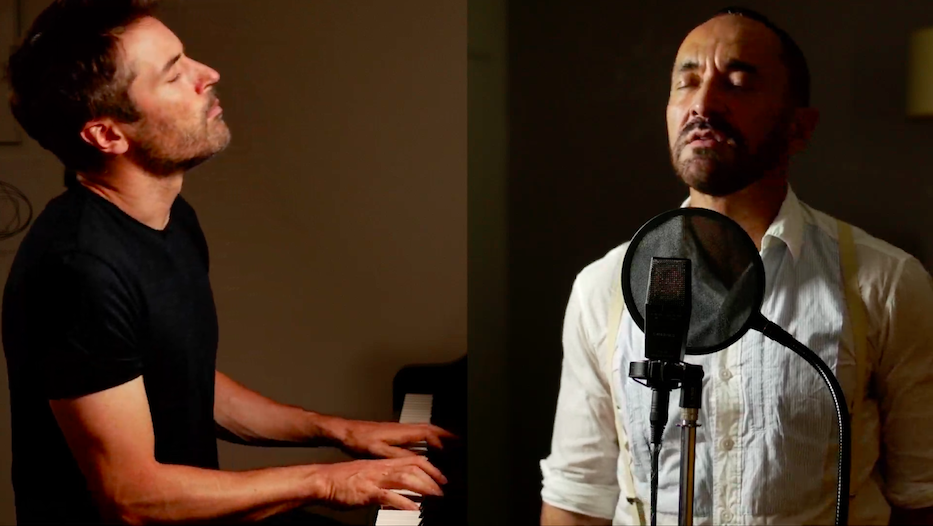
In this midweek livestream, Theo along with Dan Tepfer on piano gave a warm, welcoming recital of Weimar songs, later German work and his own creations. The names of Kurt Weill and Bertolt Brecht need little introduction, their cabaret numbers some of the best in the canon. Theo, with his perfect German, offered up rowdy numbers, tinged with a sharp irony and camp sensuality. As a singer, he is light and bright, though has a rounded lower range, perfect for these songs. The Alabama Song from The Rise and Fall of the City of Mahogany may be best known for The Doors’ cover, yet here it is brought back in a stripped down shot. You can feel the clamour of this drinking song, one that really gets in your head.

As accompanist, Dan Tepfer is everything a singer could want for. An deeply rooted understanding of the music, he displays an easy going, quiet persona, broody and subtle on screen. Unafraid to grapple with the score, his animation makes the experience all the more enjoyable. Dan was more than happy to answer questions from the livestream, pressing some of these onto Theo in an informal way to please this attentive audience at home. The highlight for me came in the middle with Hanns Eisler’s Friedenslied (also written by Brecht), an unashamedly melodic and sincere please for peace written in the composer’s time in East Germany. Well needed in this difficult year. A lovely moment came when they were both making sure they were in the right key before a song (turns out it was E flat), due to the jazz modulation changing that aspect of the song.

Theo’s own songs are a new discovery for me. You could easily compare his to Meredith’s work, though there is a telling sense of the lyric and the musical per se. Singing both Easy and Reason, they both demonstrated his talent in both approachable and experimental bands, one minute crooning, the next grunting and guttural. The amazing, free wheeling quality of Reason ended things with aplomb. Theo promised to do the classic Useless Landscape next time and his own Alphabet of Paints. Tantalising stuff!

Theo Bleckmann & Dan Tepfer perform at the Neue Galerie, New York on Thur 26 May 2022.

Review Moulin Rouge, The Musical, Piccadilly Theatre London by Nathan Scott Howe

Being a huge fan of the jukebox 2001 blockbuster movie Moulin Rouge, I cannot begin to tell you the excitement when I discovered that the musical adaption was making its way to the Piccadilly Theatre London UK after a successful opening in both NYC and Sydney.

Like the movie, the musical’s score weaves together original songs with popular music, including some of the original songs written in the film’s premier 17 years ago, songs such as Sia’s “Chandlier”,  Gaga’s “Bad Romance” and Katy Perry’s “Firework” , just to name a few.

THE PLOT

Moulin Rouge! is set in the Montmartre Quarter of Paris, France, at the turn of the 20th century also referred to as the birthplace of the bohemians that believe in Truth, Beauty, Freedom and Love.

The musical is similar to the movie in plot which tells the story of Christian a young composer, who falls in love with cabaret “Sparkling Diamond” actress Satine (played by the talented and stunning Lissi Lafontaine), who’s paths cross by a fortunate misunderstanding one unforgettable night at the red windmill sparking a secret romance behind the Duke ( Simon Bailey) a jealous and wealthy gentleman who wishes to “own” Satine and the deeds to the Moulin Rouge which is currently run by Harold Ziedler (Clive Carter).

BECAUSE YOU CAN CAN AND MUST MUST

Thankfully I was fortunate enough to purchase the irresistible “Can Can” seats which is a collection of 16 decorative chairs and tables placed right at the front of the action (essentially where the band pit would have originally been), allowing for a fully immersive and interactive view of the show so close to the cast and the extended stage you could see every breath, feel very dance move and spot the intricate details of the set and costumes, this was a theatre experience unlike any I had encountered before. 

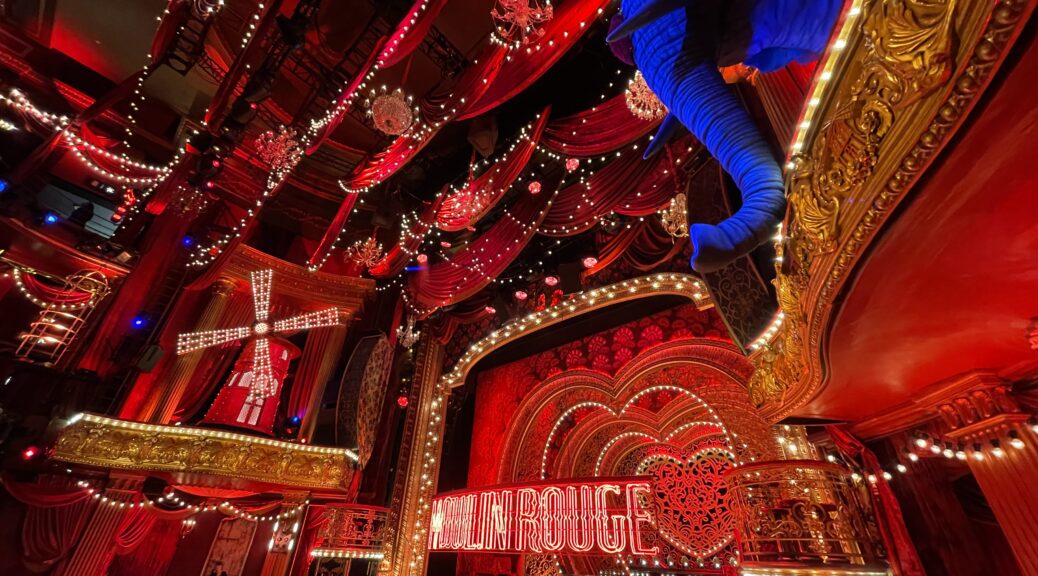
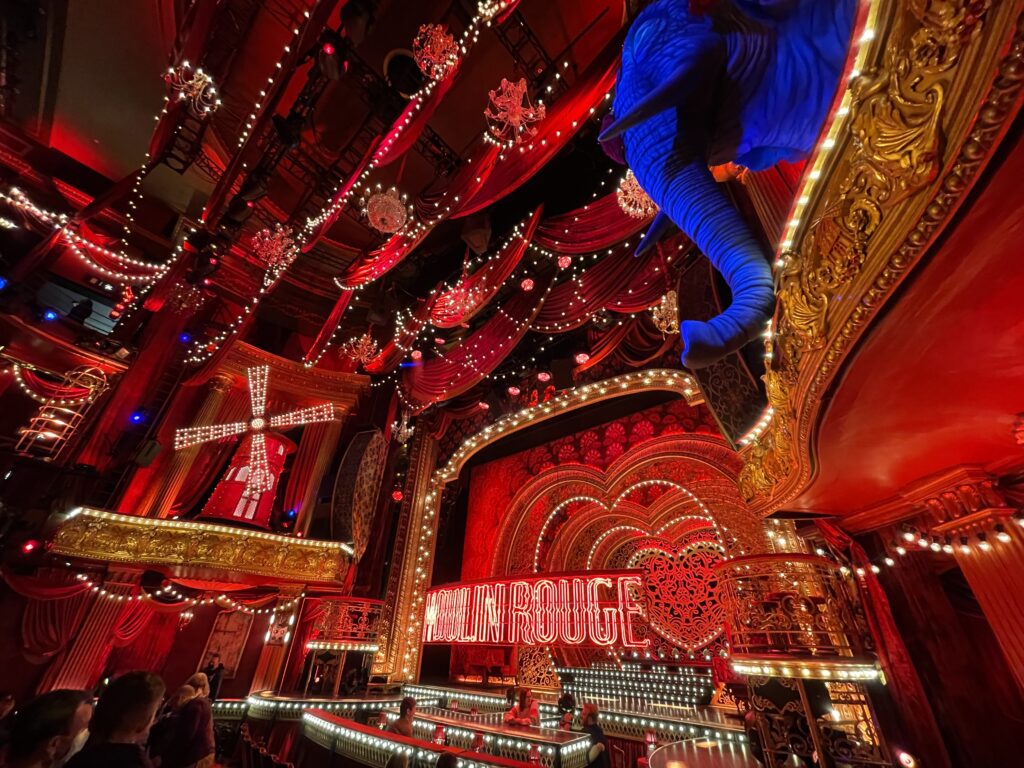
As you descend into the auditorium you are instantly transported to the Moulin Rouge, Paris 1899 with thick red velvet curtains, dim lighting draped throughout the seating areas held by ornate gold cherubs and a subtle murmur of French instrumentals playing in the background.

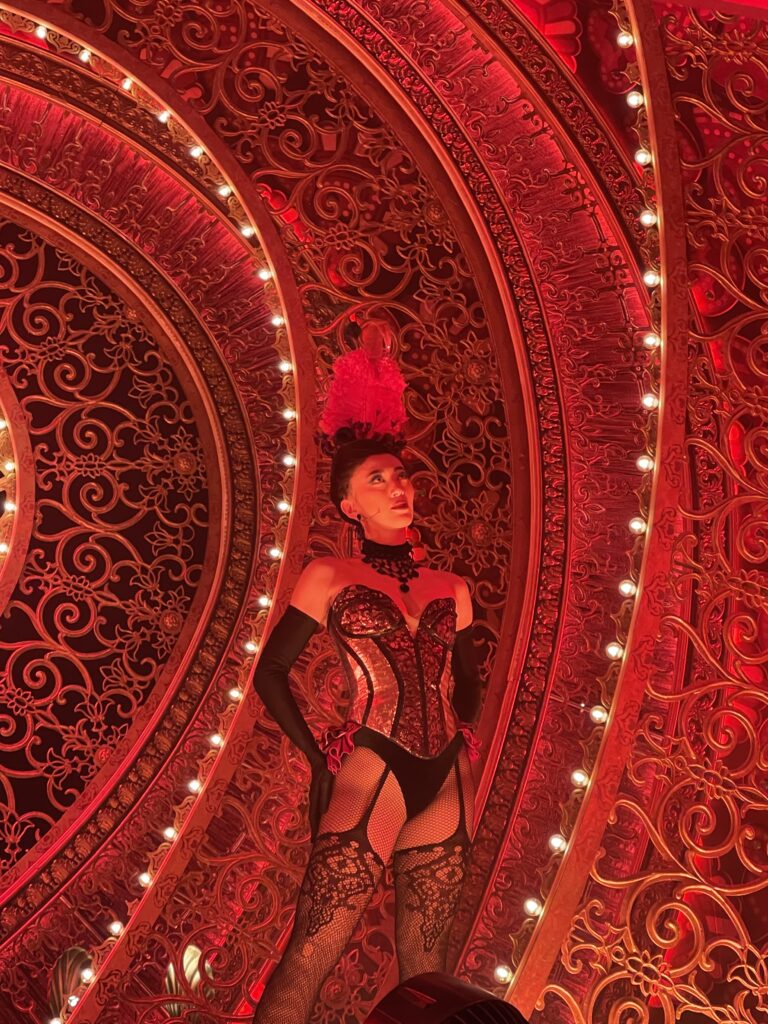
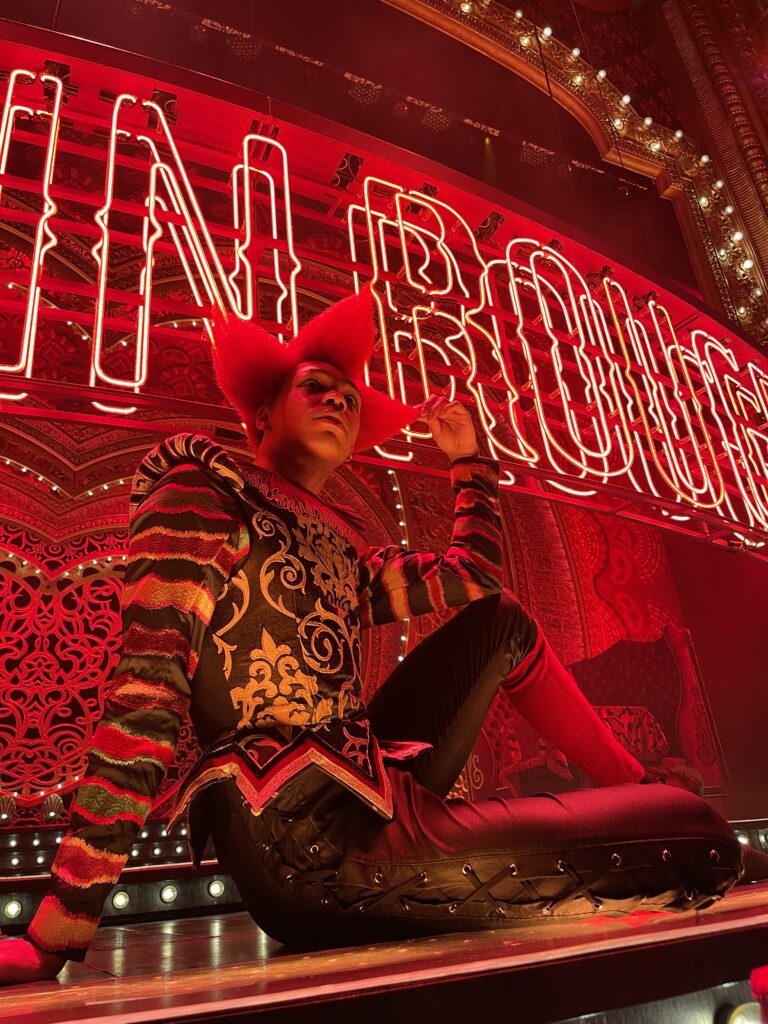
As you find your way to your seat you look up at a collection of glittering chandeliers and an elegant elephant to your right followed by a mechanical red windmill to your left all perfectly lit in the rich colours of the Moulin Rouge. If this wasn’t enough to set the scene then maybe the various characters that emerge slowly from the stage will help, each with a story and costumes from rich men in top hats with smoking cigars to dancer girls seductively looking for attention and interacting with anyone in their path.

ACT ONE – SPECTACULAR SPECTACULAR!

Act one opens with an explosion of energy, high kicks, backflips and can can lines as Harold Zidler (played by the charismatic Clive Carter who you instantly adore) welcomes all from “aristocrats” with “quail eggs and caviar” to “the rats of the latin quarter, The starving artists and thieves of Montmartre” in an electric mash up of classics before he announces his main act, the sparkling Diamond. At this point it then cuts to an introduction to how song writer Christian (American actor with flawless vocals Jamie Bogyo), meets, artist and play write Toulouse-Lautrec ( a lovable key character played by Jason Pennycooke ) and Santiago ( a Latino legend with excellent precise dance moves played by Elis Lo Tauro ) who share a mash up of T.Rex’s “Children of the revolution”, Lorde “Royals” and Satellites  “Tonight We Are Young” explaining their desires to pitch Christians talents as a composer to Satine in the hope that the Moulin Rouge will fund the production.

Scene change back to the moment that Harold announces Satine and ( spoiler alert ) the sparkling diamond descends from above following a trail of glitter as she seductively sings Shirly Bassey’s “ Diamonds are forever” leading to a whole mash up of songs such as Marilyn Monroe’s “Diamonds are a girls best friend” , Madonna’s “Material girl” Beyonce’s “Single ladies” and Rhinanna’s “Diamonds” all brilliantly hyped by backing dancers and excellent vocals.

ACT TWO – MORE MORE MORE!

Act one transports you backstage of the Moulin Rouge set with black brick wall and various levels as the cast prepare for rehearsals for Christians show (which is being funded by the Duke) unlike any other. It opens with Santiago (Played by Elia Lo Tauro who really does do an incredibly good job with this role with his deep voice and cultured presence) he flirts with Nini (the beautiful Sophie Carmen Jones) and begins to seductively dance and entwine with one another in an intense precise and passionate set of choreography to a medley which begins with Lady Gaga’s “Bad Romance” eventually joined by the whole cast, this was spine tinglingly incredible and one of my favourite scenes in the whole show, the precision of each move was perfectly placed and in controlled unison.

PUTTING ON THE RED LIGHT – MY HIGHTLIGHTS

The sparkling Diamond herself, Satine – with an epic entrance that was beautifully executed by Lissi Lafontaine who does such a wonderful job portraying this character. If you do not love her by the end of the show will leave with a full pack of tissues, unlike most of the auditorium.

Bad romance – Nini and Santiago and their seductively electric, heart pounding number.

Chandelier – no spoilers but this is a fantastic mash up and makes you want to go purchase some lights for your cocktails.

So to summarise – Go watch Moulin Rouge the Musical, This truly was an experience I could not recommend more and a new style of theatre which interacts with its audience and enhances their visit leaving them dazzled for weeks after and believing that “the greatest thing you’ll ever learn, is just to love and be loved in return” (sorry, couldn’t resist).

And if you wish to continue your Parisian style experience, head over to Zedels which is literally across the road from the theatre for Moulin Rouge themed cocktails.

CAST

BOOK HERE NOW