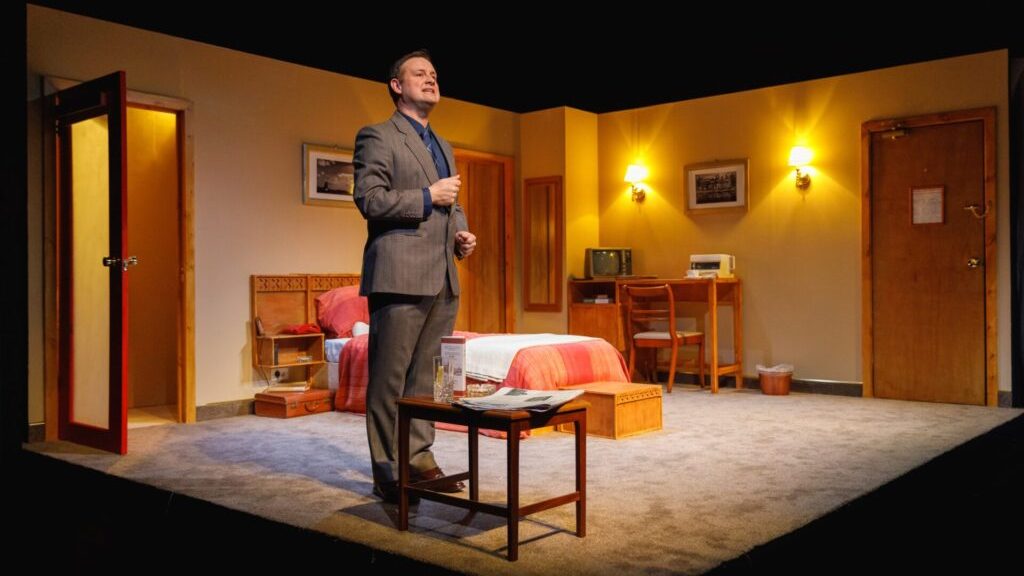
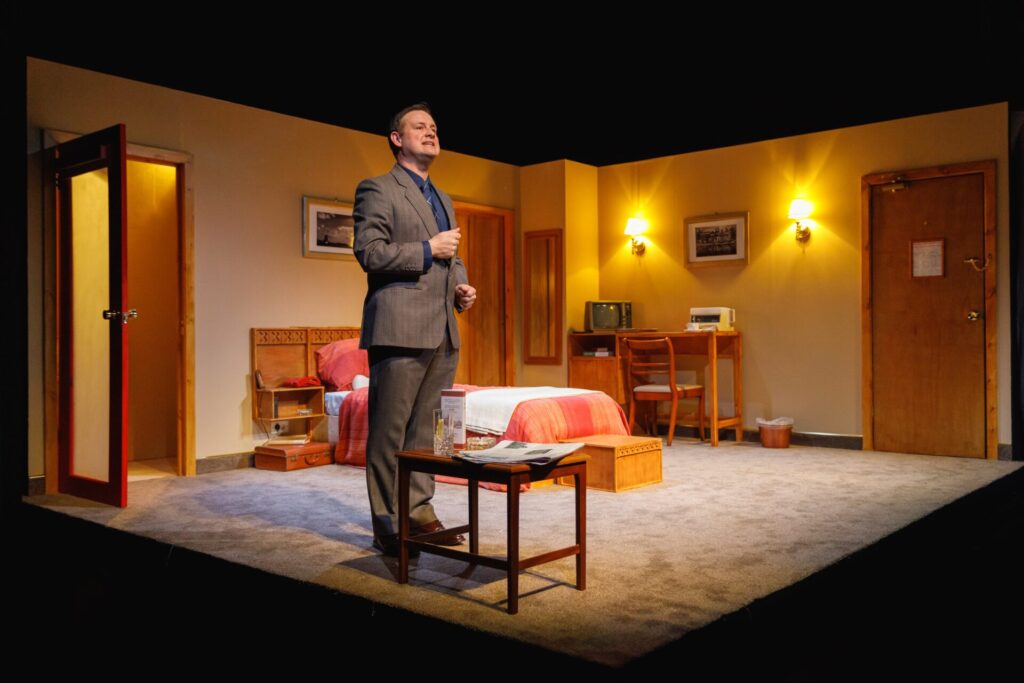
Not many plays start with the actor already onstage, but this production of Carwyn makes you feel immersed from the very start as the audience is taken on a journey of a man that is sadly often forgotten, but he’s one worthy of being celebrated and remembered in Welsh culture.
The play begins and ends with the passing of Carwyn James but throughout the piece, the audience is hooked by the outstanding performance of Simon Nehan . Nehan tells a story of Carwyn reflecting on the good and bad of his life that is well worth knowing. We see two sides of Carwyn, one in which the whole world got to see, the way he felt how he had to be perceived on the outside, and the raw and real side of Carwyn, who spent his life hiding his true self from a brutal society as he was a man, simply living ahead of his time.
Showing both sides of Carwyn through the talented writing of Owen Thomas and the brilliant directing from Gareth John Bale, was something so impactful to watch as his eye-opening story is a story that is heartbreaking, relevant and necessary. I can say without hesitation that Carwyn the play is a production deserving of a standing ovation and if I was to watch it again, I know I would be moved and feel a little more impacted each time.
The Night Woman is directed and unapologetically performed by Julene Robinson. Embodying an electrifying, eloquent vibrancy expressed through dance, singing, live music and themes revolving around self-love, as well as the true essence of blackness navigating through life’s metaphysical journey, essentially as a black phenotype, inevitably encountering difficultly, challenging and disempowering experiences due to nuances, biases, prejudices, discrimination, lack of sovereignty and an identity crises due to a lack representation of dark pigmentation, coarse hair and society’s sensitive triggers to discomfort and negative conscious biases from foreign lands, within your own family and inner community.
Julene’s poetical and metaphorical expression of her exploration of darkness to discover inner beauty, magic, Godliness and purity, is mystical and impactful. Leaving you exploring the depths of the starry, moonlit sky using dazzling twinkling fairy lights and robes to represent tree branches, glowing in the low dim illuminance. This play speaks loud volumes of spirituality, trance and ancestral reconnection to reach places of true acceptance, embrace darkness no matter your linage or background, and to do so both internally and externally in every capacity, to avoid escapism of the fear of the unknown, due to colonial biases around darkness, distributing worldwide ignorances.
Watching Julene Robinson performing without an interval was a phenomenal experience, she’s not only an enchantingly performer who effortlessly takes audiences on a complex phenomena, but her use of characterisation in humorous and unapologetic ways to highlight the day in the life of Caribbean girls, born of a darker hue, living in the West Indies, and the general inadequacies faced by woman within the diaspora is magnifying.
The Night Woman, is an eye-opening fusion of loss, grief, femininity, unlearning to learn sequel; reflective stories told in an educative and playful way; with non-stop metaphors, depth and Jamaican humour all in one to re-live, restore, re-imagine and re-ignite all to come alive in the darkness by closing their eyes, whilst simultaneously appreciating dark skinned beauty by remembering darkness birthed light, and the gentle reminders of how life, including human life grows in the darkness where a God dwelled comfortably and humbly before colonial negative connotations of the word black and society’s conflicting interpretation, hatred and detest for darkness, dark matter and the night woman that birthed light lovingly.
Carwyn the play grants the audience an intimate view into Carwyn James’ private life, revealing a side of himself that he spent his life hiding from a judgmental and unaccepting society. This is a story, often heartbreakingly forgotten, but one that deserves to be celebrated in Welsh culture.
“People shouldn’t fear death, they should fear they didn’t live their best life”- Carwyn.
As he passes, Carwyn’s life flashes before the eyes of the audience. From his triumphs to tragedies, Carwyn’s story is one that must be told. We see Carwyn as who he was to the outside world; who he felt he had to present himself as, because he felt that the time he lived in was not a place for his true self. This play shows us this version of Carwyn, but also, who he was in his solitude. As a result of this, there is something so heart-rending, poetic, and beautiful about this piece. The skillful writing of Owen Thomas, powerful performance from Simon Nehan and the impactful directing from Gareth John Bale put together capture Carwyn’s story in a poignant and moving way; that was undoubtedly deserving of a standing ovation. This is one of the few pieces I have ever seen that I can confidently say that if I watched it many more times, I would be in tears at the end of each and every one.
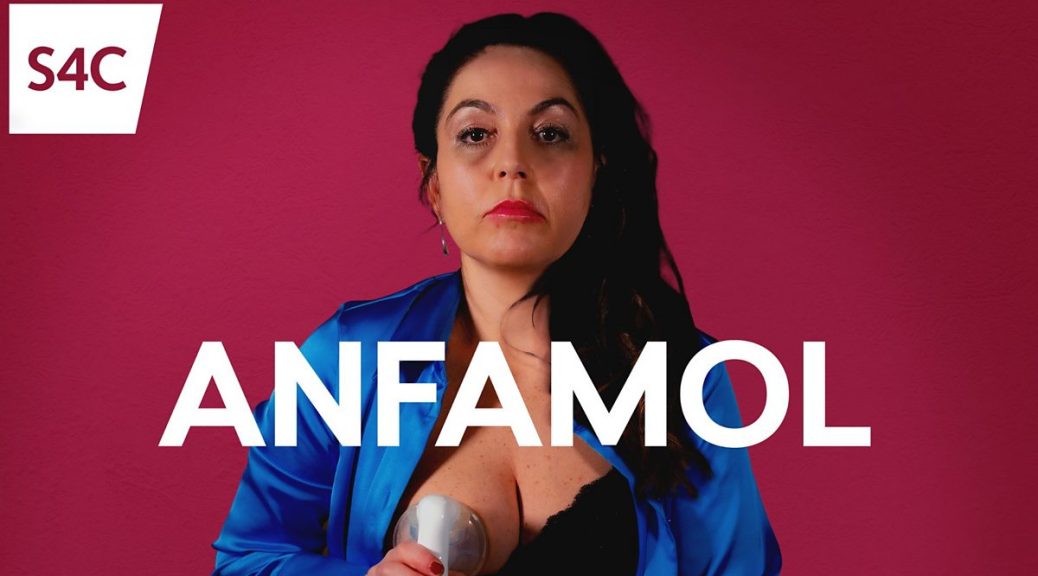
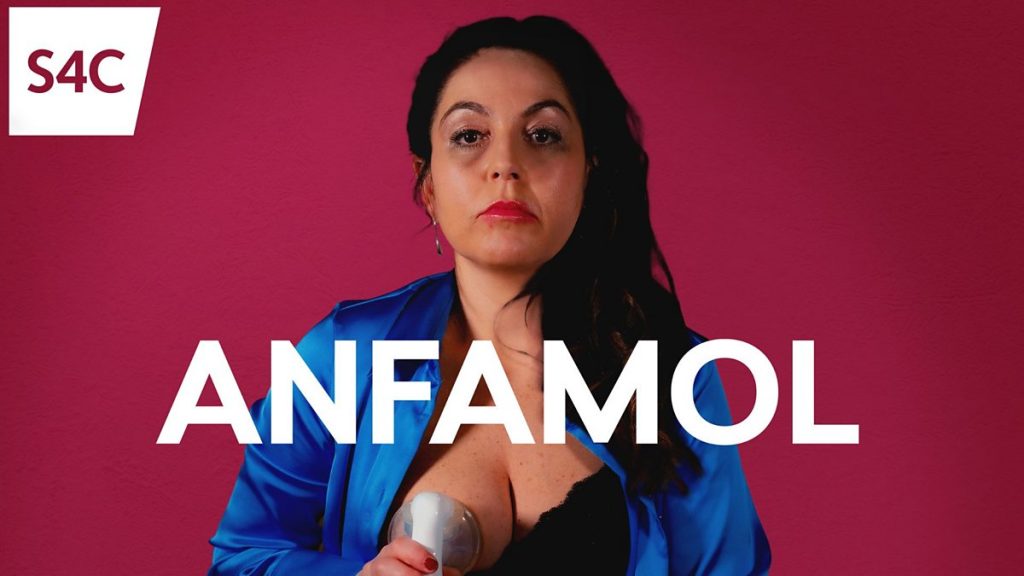
A Welsh adaptation of Fleabag seems quite superfluous in the face of Anfamol’s success. For this is a production that takes the best of Phoebe Waller-Bridge’s comedy and turns it into something original. First conceived as a stage play, the critical acclaim which it received has seen Rhiannon Boyle now adapt it for the screen. She has taken the frank, witty, dark and direct elements of her monologue and traversed them into a script that is punchy and pointed, hilarious and harrowing. The result is a five-part series that injects S4C’s schedule with something that is vivaciously fresh. Boundary-pushing at its best.
Bethan Ellis-Owen reprises her role as Ani, a forty-something single woman looking to become a mother on her own terms. Ellis-Owen brings a subtle sharpness to her emotions; able to portray dogged determination and inner brokenness with apposite aplomb. Her knowing side-looks to camera borrow unashamedly from Waller-Bridge; while the addition of fantasy sequences, particularly with exotic sperm donor Estevez, offer the kind of quirky aside that feels distinctly Welsh. (Think Parch or Enid a Lucy). There is a dark side to such visions however. For alongside the comic that, in part, comes from its overtness to sex and unabashed portrayal of the fertility process is the devastating effects of postnatal depression and the exacting reality of life as a single mum. Ellis-Owen manages to navigate these emotional shifts with ease; and in doing so, presents to us a character that is highly empathetic, and authentic in every way.
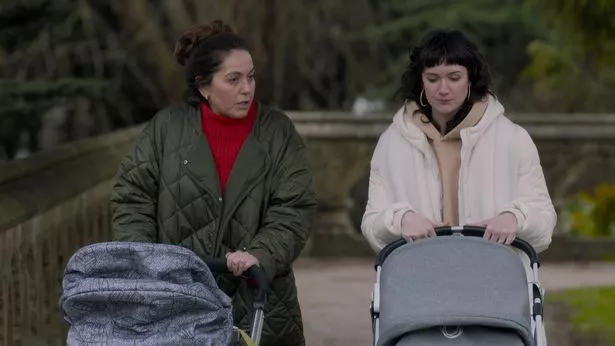
She is joined by a stellar support cast, of which Sara Gregory is the most prevalent. Playing Nia, a kind of nemesis to Ani, Gregory brings a chic strength to her character that cleverly masks a hidden life of sadness and despair. While publicly portraying herself as “Blueprint Mother” online, privately, Nia is struggling. Her birth-plan goes out the window; her marriage is distant, husband absent; and when Ani trolls her online, her success as an online blogger is left in tatters. But along with Ani’s seemingly perfect sister (played by Lowri Gwynne), the drama comes to a point where perfection is extinguished as a myth and vulnerability is celebrated in all its f***ed-up glory. Sticking two fingers up to the chauvinistic, infantile male sex at the same time, it becomes a powerful and thought-provoking piece on feminism, motherhood and mental health in the present age.
Anfamol continues S4C’s excellent batch of female-led dramas whilst offering something very different to what has come before. And though it may feel derivative of Fleabag, it is by no means a copy of it. It has its own distinct subject matter and significant narrative to tell.
Those who watched Ang Lee’s film adaptation of Yann Martel’s 2001 novel will be familiar with the premise of Life of Pi. A young 16-year old boy from Pondicherry in India is launched into an epic adventure as the ship carrying his family and their zoo to a new life in Canada sinks – and he finds himself adrift in the ocean with only a fearsome Bengal tiger for company.
Through the prism of Pi’s recollections later in a hospital ward, we hear how he survives 227 days at sea – and how the narrative which we come to believe – as bizarre and hallucinogenic it seems – is later completely turned on its head.
This is a story exploring themes of religion, the complexities of people, the sanctity and sentience of animals and the sheer will to survive. The degree to which this stage adaptation adds to or takes away from both the book and Ang Lee’s film adaptation is up for debate, however.
Previous reactions to the stage tour all seem to touch on this production being a “visual feast” or “an incredible visual adaptation”, “aesthetically pleasing” or that the puppeteers and animals steal the show. This is most certainly true – the production’s stunning set, magical special effects and masterful puppetry will wow the senses and pack a visual punch.
But some of the book and film’s deeper delves into the philosophies of the human experience and the hypocrisies of religion are lost somewhat in this truncated stage adaptation. Speaking for myself and my father, seeing this stage show for the first time, we found ourselves disliking and feeling upset by some of the depictions of animal suffering. Truth be told, we can’t even stomach David Attenborough’s programmes these days.
This unease mind you, is probably a sign of the incredibly well-executed puppetry and choreography by the team. This did remind me also of the discomfort I felt watching Ang Lee’s film. So absorbed was I by the idea that the animals were suffering, I probably missed some of the intended broader points of the story. The highlight of this production, then becomes focused on the mode of delivery of the story rather than the story itself. Because the plot is pretty harrowing and – to quote a former colleague of mine who I bumped into in the show’s interval: “pretty grim”.
This is not a stage show that will not exactly elevate or lift you as some productions can. It illustrates the difficult line writers and directors tread in that no creative really wants to spoon feed their audience and only serve up neat and today tales in a pretty little bow. But in the quest to make us think and engage us with what’s going on via the mechanisms of the stage production, we lose the potential to get under the skin of the characters and get to know them well. The characters become pawns for pondering the story, rather than characters you truly care about. Life of Pi is also an exploration of the stories we tell and how they come to form part of our “truth” – and as an audience you’ll be confronted with these idiosyncrasies in live time, preferring one version of “truth” over another.
As an audience, we become desperate for those light moments of relief when Pi makes a quip, when the stars come out, when the glowing wiggly fish arrive because we’re reminded of the moments of light relief and beauty in a world that can be truly depressing and awful at times. As Pi tells Ms Okamoto in the hospital ward: “I’ve had a TERRIBLE journey…”
Life of Pi in 2023 hits differently. You’ll think about how some things never change. When Pi’s family flee India due to the dangerous unrest (supposedly echoing Indira Ghandi’s 1976 declaration of “The Emergency”), you’ll ponder the plight of others in the world who now face becoming refugees in hostile territories, as we see playing out when the family are treated poorly by crew and passengers on route to Canada.
Huge congratulations and oceans of praise must go to the energetic and engaging Divesh Subaskaran playing Pi. His physicality and presence in the lead role is stupendous, leaping from one side of the boat / bed to the other and embodying all of the trauma, hope and mania of Pi during his tumultuous journey across the sea. His stamina, his powerful voice, warmth and wit shine through even in the bleakest of times. You are rooting for him from the very beginning and willing for his terrible story to take a turn for the better. The chemistry and rapport between Divesh and Keshini Misha playing Pi’s sister Rani is sweet, offering up a ray of hope ahead of the family’s ill-fated journey.
Finally, the purveyors of the visual magic in this show have to be set and costume designer Tim Hartley, Puppetry and Movement Director Finn Caldwell. The lighting, visual effects and projections in this production are wonderful thanks to Andrzej Goulding and Tim Lutkin.
Life of Pi may not be an easy watch – but it’s certainly a beautiful one.
Suitcase Theatre, a local community theatre company, started out in 2008 with a production of We’ll Keep a Welcome- a play about evacuees from Liverpool and Merseyside who came to live in North Wales in 1939. The use of local stories and topics has been a long-running focus for Suitcase Theatre as well as revivals of classics such as The Birthday Party and Waiting for Godot. The company pride themselves on bringing together a wide range of performers- young and old, experienced, and less so, amateur, and professional and have participants from North Wales, Cheshire, and the Wirral.
The Winter’s Tale is one of Shakespeare’s lesser-known plays and was one of his last, written around 1609-11. The first recorded performance of the play was at The Globe on May 15th, 1611, and later that year it was presented at Whitehall before King James I. It provides us with one of the more challenging stage directions- ‘Exit, pursued by a bear’ (in this instance a member of the company dressed in a questionable costume- if Shakespeare were alive today, perhaps he could have written ‘Exit, SFX of bear in pursuit’!)
It’s difficult to give a brief summary of any of Shakespeare’s plays but more so with his last, lesser-known creations. The Winter’s Tale offers countless themes throughout its tragi-comedic plot – love, jealousy, rage, mistaken identity, reunions, and it really is a play of two halves. The first, clearly tragic- disastrous if you will; one full of bitterness, sadness, and death and if we are going to label this play, we would certainly conjure the word ‘tragedy’ as Act 1 unfolds. It is reminiscent of Othello- the insanely jealous husband, wrongly accusing his wife of an affair, and so catastrophe ensues. However, as Act 2 begins, the audience wouldn’t be judged for believing they had sat down in the wrong auditorium- the piece is uplifted by the appearance of Autolycus, of the Old Shepherd and his son, Clown. We’ve gone from Winter and 16 years have elapsed in minutes as we give way to Spring- with the passing of time as well as with lighter themes of family, forgiveness, and rebirth.
As the play opens, the cast have their backs to the audience, and it is clear we are at a celebration- the guests are dressed to impress and on the screen are fireworks. The use of the screen is effective throughout, particularly to convey the passing of time with the moon in its different phases. The scene transitions are consistent with blackouts in the right places, slick movement of small set pieces and atmospheric music or sound effects to signify the mood or time of day. The performance is mostly done in black box with a few simple additions such as chairs, tables, or dividers and none of this distracts from the action. This is my main take-away from Suitcase Theatre’s production- that due to the simple set and timely costumes it is much easier to concentrate on the language; to really listen to and understand what’s being said. There are a few missed lines, mainly down to projection issues (as well as very heavy rain on the night in question!) or characters aiming their speech at each other rather than out to the audience on occasion, but overall, the speech is clear, and it is wonderful to truly focus in on the wonderful words that Shakespeare provided to actors and audiences alike.
The casting is excellent and there are moments I forget that I’m watching an amateur production. The word ‘amateur’ unfortunately carries such negative connotations but that is exactly what this production is. None of these performers or members of the production team are being paid for their hard work- they’re doing it because they love what they do. And there are some superb performances- most notably from Si Kneale as Leontes who not only has an awful lot of dialogue to learn but portrays the character with just the right amount of madness and regret- as an audience we trust this actor in this role, and he is unwavering throughout the piece. Ruth Huish as Hermione is beautiful and we truly empathise with her plight, no more so than during her speech to illustrate her innocence to Leontes- Huish delivers this with verve and poignancy. Connor Jones as Autolycus lifts the piece in Act 2 and is clearly a natural performer with a talent for accents. His likability factor brings a real charm to the production after a hard-hitting first half.
You’d be hard met to find a local community theatre group willing to give Shakespeare a go, but Suitcase Theatre did it with enthusiasm (lots of it brilliantly displayed via rehearsal photographs etc. on their Facebook page!), professionalism and lots of hard work- having only rehearsed for this piece for around 6 weeks! It was wonderful to see such a variety of performers on stage too- including some very talented youngsters! Huge congratulations to all involved- if you have chance to see this production, I’d highly recommend it!
The Winter’s Tale is playing at Theatr Clwyd until Saturday October 21st. To book your tickets, please head to the website…
The Winter’s Tale | Theatr Clwyd
Cast
Leontes- Si Kneale Hermione- Ruth Huish Mamillius- Isaac Huish Perdita- Zoey Owen Polixenes- Andy Jordan Florizel- Ioan Eldridge Antigonus- John Wylde Paulina- Rowena Owen Cleomenes- Kevin Taws Dion- Peter Thorne Emilia- Lin Blessing Julia- Pauline Marsden Rogero- Stewart Venables Demetrius- John Owen Camillo- Niall Heaton Officer- Richard Thornton Gaoler- Will Wood, Dylan Roberts Benvenuto- James Bennett Mariner- Will Wood Archidamus- Deborah Thomas Autolycus- Connor Jones Old Shepherd- Gwyn Brick Clown- Tom Cutler Cassio- James Bennett Mopsa- Lin Blessing Dorcas- Pauline Marsden Quinto- Dylan Roberts Guiseppe- James Peacock Eufrasio- Peter Thorne Time- Connor Jones Slaves of Time- Dylan Roberts, James Bennett Bear- a member of the company
Production Team
Director- Mike Stevens Production Manager- John Owen Stage Manager- Gordon Peterson ASM (Props)- Richard Thornton ASM- Deborah Thomas Deputy Stage Manager- Graham Sherwood Lighting and Special Effects- John Owen Sound Design- Ellie Wylde Composer/ Music Director- James Peacock Stage Designer- Paul Jones Choreographer- Karen Campbell Wardrobe, Wigs, Hair & Makeup- Rowena Owen Publicity Design- Peter Taylor Chaperone- Nerys Bennett
In 2001, when British Army Major Charles Ingram won the top prize on Who Wants to Be a Millionaire?, he became the third person ever do so – and the first to be denied the winnings. After a lengthy trial he was found to have procured the money by deception, in conspiracy with his wife Diana and fellow contestant Tecwen Whittock. The prosecution’s case rested on the production company’s claim that Charles, who’d played erratically throughout his time in the hot seat, was guided to the correct answers through a series of coughs from Diana, Tecwen, and an underground ring of Britain’s top quizzers, who’d get a cut of the prize money.
Rory Bremner in Quiz. Image credit: Johan Persson
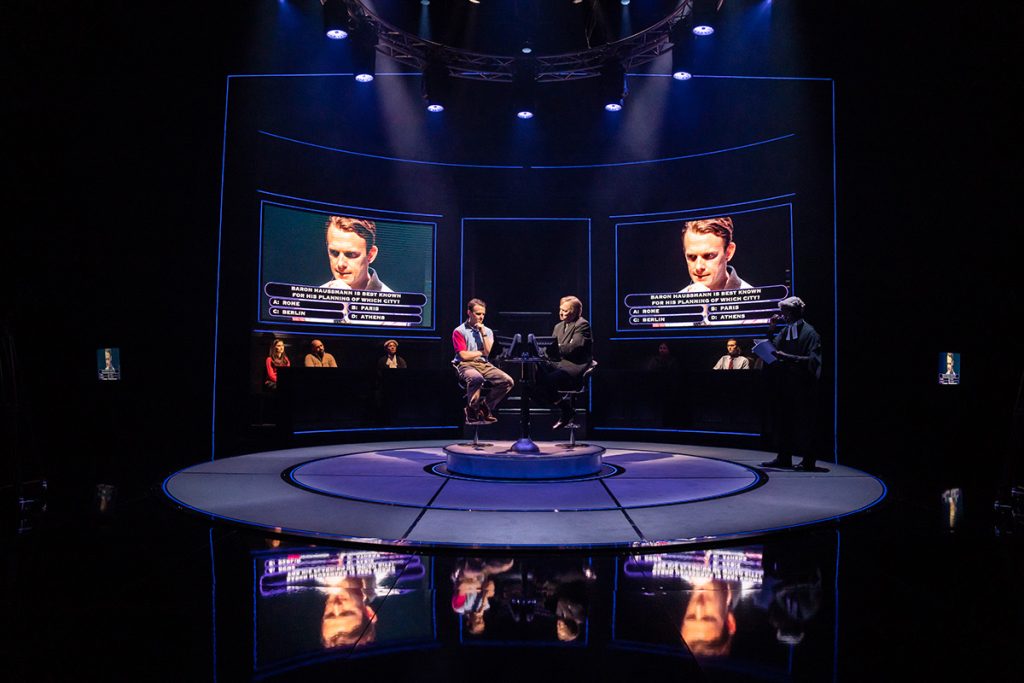
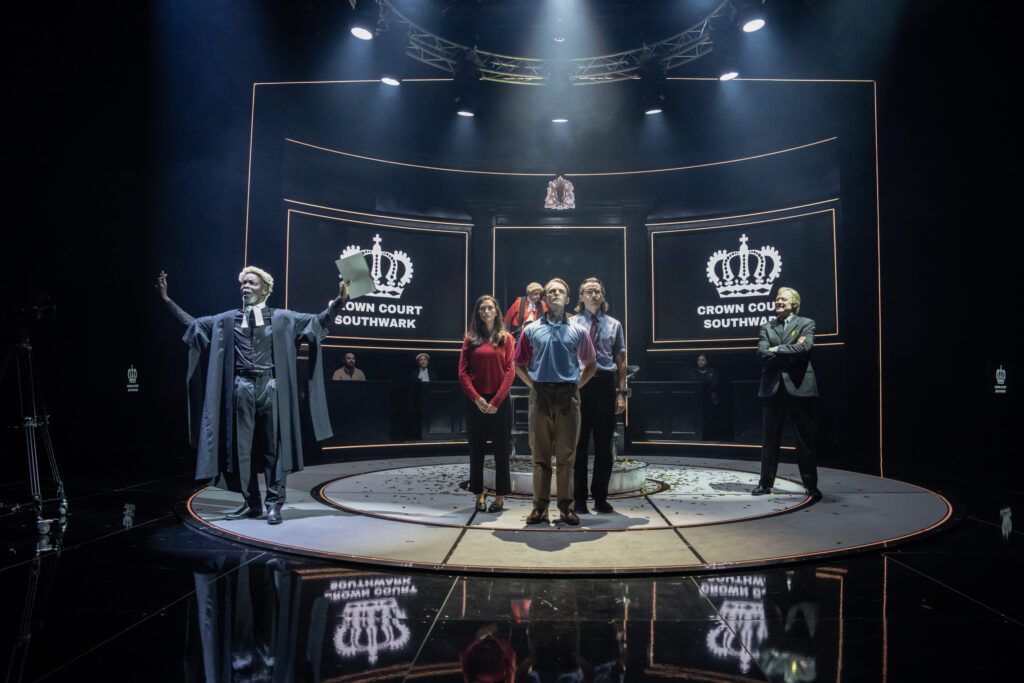
Directed by Daniel Evans and Seán Linnen, and written by James Graham, Quiz takes its audience through the story through the lens of the trial that followed. In Act One, we hear the case for the Prosecution; in Act Two, the case for the Defence – all while using Millionaire’s infamously stress-inducing psychological tactics: the pulsing heartbeat, the gradually dimming lights, and the twisted spectacle of watching someone unravel before your very eyes. No wonder it quickly became the world’s most popular TV quiz show: you quite literally couldn’t look away.
Lewis Reeves and Rory Bremner in Quiz. Image credit: Johan Persson
Comedian and Britain’s top impressionist Rory Bremner stars as Chris Tarrant – and he’s utterly uncanny in the role, capturing every Tarrant-esque tic. His scenes with Lewis Reeves (I May Destroy You, The Midwich Cuckoos) as the unassuming Major Ingram in particular seem lifted exactly from the episode itself. This is in no small part thanks to the spot-on set, designed by Robert Jones and lit by Ryan Day, which brilliantly evokes the original game show and transitions spookily well into an imposing courtroom.
The cast of Quiz. Image credit: Johan Persson
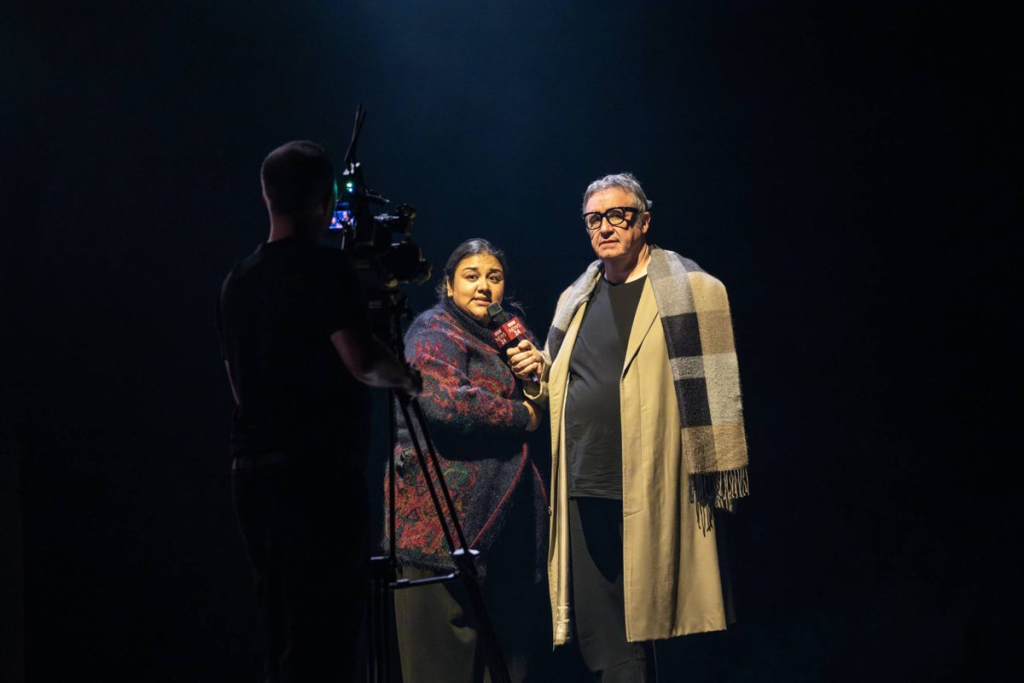
This is far from your typical courtroom drama. It is brimming with energy, poignancy and lots of laughs – not least from Mark Benton (Northern Lights, Shakespeare and Hathaway) as a series of hilarious characters, from the bum bag-toting top dog of ITV to the leather-coated leader of the quizzers’ secret circle. A brilliant ensemble features strong supporting performances from Charley Webb (Emmerdale) as Charles’ quiz-obsessive wife Diana, as well as Danielle Henry, Leo Wringer, Jay Taylor and Stefan Adegbola. And do look out for scene-stealing turns from Sukh Ojla and Marc Antolin.
Sukh Ojla and Mark Benton in Quiz. Image credit: Johan Persson
Nominated for two Olivier Awards including Best New Comedy, the West End smash hit was adapted for TV in 2020, starring Michael Sheen, Matthew Macfadyen and Sian Clifford. But there’s something special about the theatrical production and how it poses the ultimate 50/50 question: Were the Ingrams guilty, or not guilty? You might want to phone a friend, or ask the audience – which Quiz does, by giving them the opportunity to vote, and not just as a contestant’s lifeline. Fresh from a smash-hit run on the West End, Quiz perfectly captures the heart-pumping tension of the world’s most popular TV quiz show. Catch it while you can – and that’s my final answer!
Quiz is performing at the New Theatre Cardiff from 18 – 21 October. More information on the show and how to book tickets can be found here.
Quiz is a fictional imagining based on real events which took place in 2001 following an episode of Who Wants To Be A Millionaire? It is not in any way connected with the makers of the programme or any of the individuals portrayed. The television programme Who Wants To Be A Millionaire? is produced by 2waytraffic.
Based on a true story in Cardiff, a serendipitous encounter between Jim, a Cardiff University student, and Alan, a lifelong resident of Ely Hospital born with Down’s syndrome, sparked a profound shift in the realm of care and support. Alan yearned for a place to call home and had a dream: to join a band. Jim, on the other hand, aspired to change the world, though he wasn’t sure how to make it happen.
Hijinx, a leading inclusive theatre company, partnered with the Sherman Theatre to create an extraordinary gem of a theatrical performance that takes the audience on a rollercoaster ride of emotion and reflection. “Housemates” isn’t just a play; it’s a profound exploration of the human spirit.
Set against the spirited backdrop of the 1970s, “Housemates” introduces us to a robust cast of seven neurodivergent and neurotypical actor-musicians who infuse the narrative with a powerful soundtrack featuring classics from T. Rex and Sweet. Playwright Tim Green dedicated two to three years to bring this story to life. Co-director Ben Pettitt-Wade emphasizes the significance of visibility, inclusivity, and the transformative power of human connections within our society. Co-director Joe Murphy underscores the exceptional nature of this story, one that embodies inspiration while remaining curiously overlooked in Cardiff.
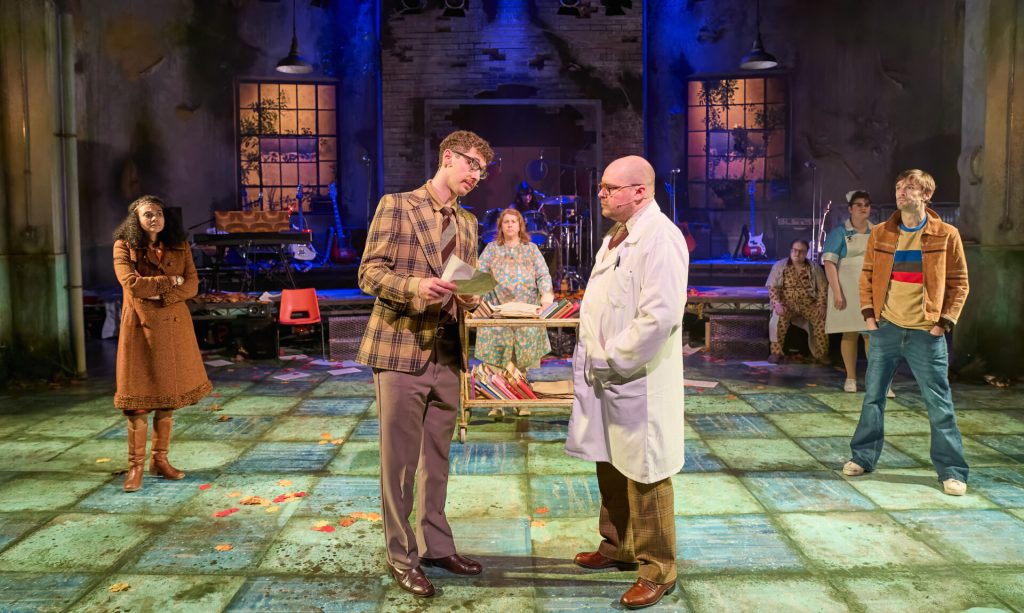
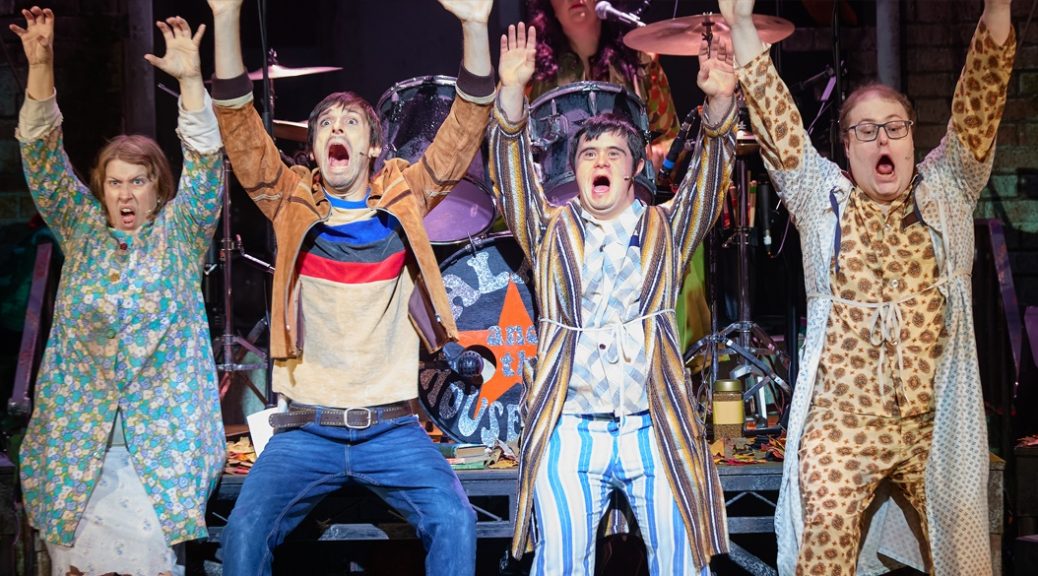
The wonderful ‘70s costumes and the inventive set by Carl Davies transports us to the world of Ely Hospital in 1970s Cardiff. With its green-tiled floor, occasionally scattered with blown orange leaves, and a well-worn wall where the band resides, it visually captivates.
“Housemates” brims with humour and gentle clowning but is unafraid to tackle serious issues. The play courageously sheds light on the derogatory language of the past, such as the dehumanizing term “subnormals” and the terrible legislation of yesteryear like the 1886 Idiot’s Act and the Mental Deficiency Act 1913, which saw over 100,000 people institutionalized.
Actors masterfully navigate delicate subjects with a finesse that is both poignant and humorous. “Are you going to take the ‘angry pill’?” asks the female nurse before the male nurse strong-arms Alan. In another moment, Alan proclaims, “I want sex! In the house… it’ll be like… I am a sex God!” This statement is met with uproarious applause from the audience.
The set is as flexible as it is imaginative, with props ingeniously transforming: a metal frame becomes a bus stop, a trolley of books symbolizes the library, and a hospital bed serves as Alan’s room. Papers tossed in the air symbolize the persistence of the characters as the house application is denied, eventually leading to their triumphant departure from the hospital, each clutching their belongings in bin bags.
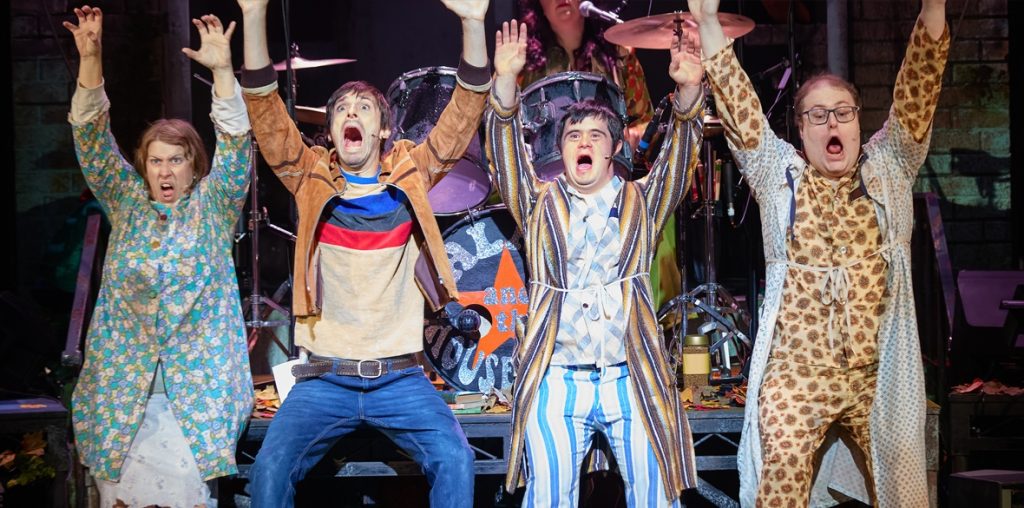
The culmination of this incredible journey occurs as Alan triumphantly declares, “This is my house!” Bedecked in a David Bowie-esque costume, he takes to the drums, igniting the stage with electrifying rock ‘n’ roll energy. Alan’s heartfelt dream becomes a reality, culminating in a grand finale with him shining as a drummer, joined by the entire cast as well as extra actors from the Hijinx Academy. Beneath the societal transformation lies the profoundly personal journey of an individual who, after a lifetime within hospital walls, discovers his own stage as a rock star in his own home in Cardiff.
“Housemates” offers a multifaceted theatrical experience, delivering laughter, tears, and a nostalgic journey. With an anarchic and rebellious flair, the show inspires us to close the absurd ways in which neurodivergent people were treated and motivate us to create change and end injustice.
The show is a tale about being genuinely inclusive; it’s about home, identity, and ultimately about taking action. It’s an extraordinary odyssey through time, friendship, and societal transformation both within and without, captivating audiences at the Sherman Theatre, which coincidentally celebrates its 50th anniversary this year.
Many of my generation will best know the classic story of John ‘Jack’ Worthing and Algernon ‘Algy’ Moncrieff, two bachelors who create alter egos named Ernest to escape their tiresome lives, through the 2002 movie adaptation starring Colin Firth, Dame Judy Dench, and Rupert Everett amongst other big names. The men attempting to win the hearts of two women who, conveniently, claim to only love men called Ernest. The pair struggle to keep up with their own stories and become tangled in a tale of deception, disguise, and misadventure. The elaborate plot ridicules Victorian sensibilities with some of the best loved, and indeed eccentric, characters to be found on the modern stage. First performed in 1895 and published in 1899 it is a satire of Victorian social hypocrisy and considered Wilde’s greatest dramatic achievement.
So then, it is a rather genius idea to take this classic tale turn it into a production where audience members take on the main roles- taking the theme of identity (or rather mistaken identity!) to the next level!
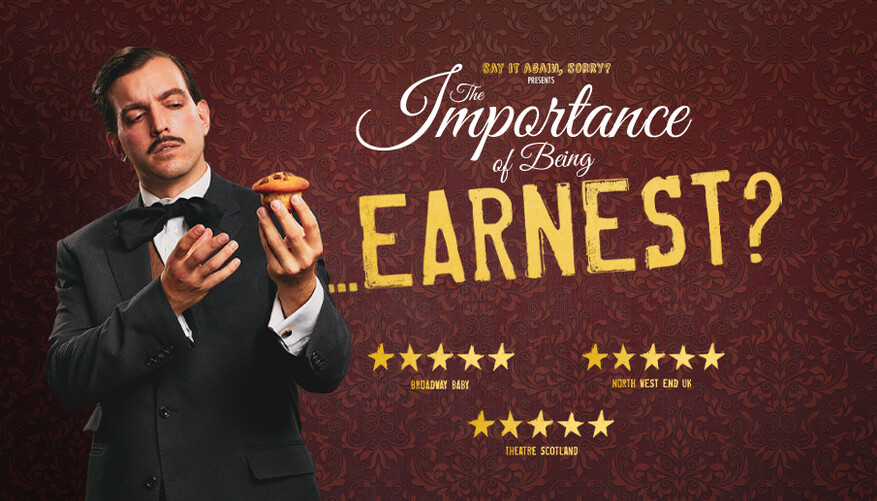
The Importance of Being…Earnest? begins in a Victorian household, complete with your typical English butler. The set is constant throughout aside from the odd addition to imply a change of location. It is simple but effective- particularly the window which, on occasion, doubles as a metaphorical window, into the lives of the actors. This window allows us as the audience to take a peek ‘backstage’ as our characters have heated discussions, enjoy an off-stage smoke, or argue about what’s going to happen next unless the actor playing Ernest decides to turn up!
The play starts as any production of The Importance of Being Earnest might start, but it’s clear that this is the calm before the storm as we experience a long, awkward pause as Algernon and Lane introduce Mr Ernest Worthing. This continues with titters from the audience as stage manager Josh and director Simon break the fourth wall in a panic and ask if there’s a member of the audience who could step into his shoes (literally!) Thus, ensues improvised and organised chaos as members of the audience are plucked out to play various roles- reading from scripts, being shoved around the stage by the pros, shouting out lines from signs held up by other audience members and having lines whispered aside. There are many clever japes including actors pretending to don clothing they’re already wearing due to having to start the play again, solo sword fighting or conversations with the air as the audience member has no idea where they’re meant to be standing and some fantastic, over the top physical theatre!
The casting is perfect but special mention must go to Guido Garcia Lueches as Algernon and Rhys Tees as Lane who are the perfect comedy partnership on stage. They set the scene and really carry the piece throughout. Other noteworthy performances include Lucy Trodd as Lady Bracknell whose take on how to be an ‘ac-TOR’ provides a hilarious comedy skit when she attempts to teach the audience member playing Ernest how to, well, play Ernest! Also, Trynity Silk as Gwendolen is a triumph, particularly as the play unravels and she gets more and more merry- having had one too many glasses of the real wine rather than the prop wine!
My only qualm throughout was that it appeared the audience members taking on the two lead roles were somewhat prepared and/or had been planted. For me, this took away some of the comedy magic that can be provided in using audience members as part of a performance. However, I have since learnt that Say it Again, Sorry? have an open-door policy during rehearsals, so it is possible certain audience members may have already had a glimpse into what would be happening on stage that evening.
Say it Again, Sorry? began back in 2018 when Artistic Director Simon Paris set up The Lab Workshops developing his own craft and supporting actors with their acting technique. The team decided that their mission would be to connect people to their inner artist. The Importance of Being…Earnest emerged in 2019 and previewed at The Pleasance Theatre in Islington and has since grown and developed and become a great success- selling out at EdFringe in 2021 and taking on a UK tour in 2023/24.
The Importance of Being…Earnest? continues its tour at the Belgrade Theatre, Coventry from November 2nd-4th and ends at the Tivoli Theatre, Aberdeen on July 5th, 2024. To book your tickets head to the website-
The Company have requested the note below, which we are happy to facilitate
“The company would like it to be known that there are no plants or prepared audience members that are used during this show, the smoothness of their audience interaction is a testament to their craft and honing.”
Song of Songs, choreographed by Pam Tanowitz collaborates with composer David Lang, The production is inspired by an exploration of Jewish dance history, establishing two worlds of surrealism and transparency to create an equilibrium of openness and realness. Produced by Caleb Hammons and Jason Collins to infuse the notion of life, beauty, magic, compassion and human connectivity within the association of life in a divine interlinked extract of percussion music, poetry and movement that liberates ancient rituals of sincerity, dignity and agape.
Song of Songs as a biblical poem of yearning, magnetically and majestically astral travelling the audience into an invigorating journey diving into tangible elements of experiences within the physical realm, within the real world.
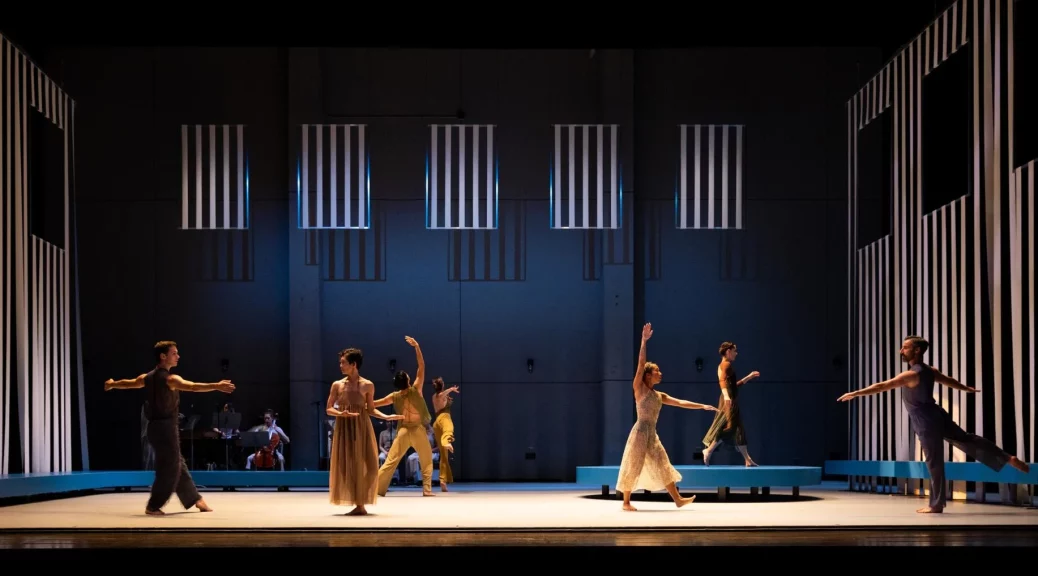
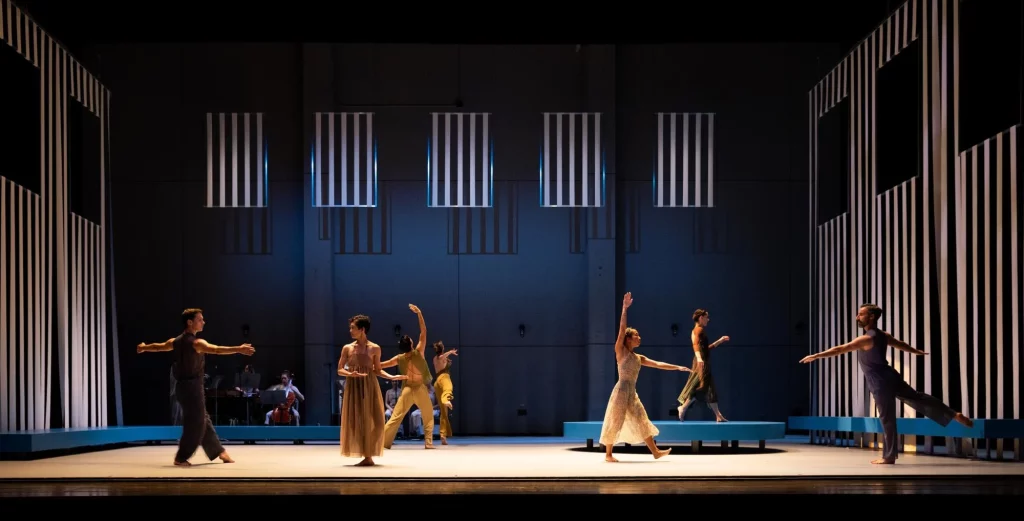
In this production, the instinctive essence of New York-based Tanowitz beautifully expands on classical dance using metaphorical distinctive language to examine chapters of complexity and freedom simultaneously. The empowerment was deeply engrained through delicate lifts, light head turns, soft dim lights overhead spins and captivating gentle touch, eye glances over poetical sounds and sacred tradition.
Creating opportunities for a diverse range of people to experience and respond to sport, arts, culture and live events. / Lleisiau amrywiol o Gymru yn ymateb i'r celfyddydau a digwyddiadau byw




 (4 / 5)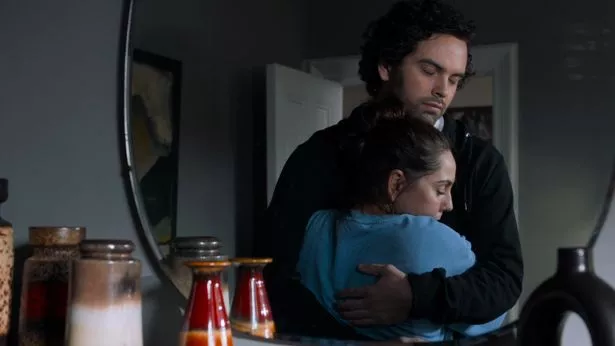


 (3 / 5)



 (5 / 5)