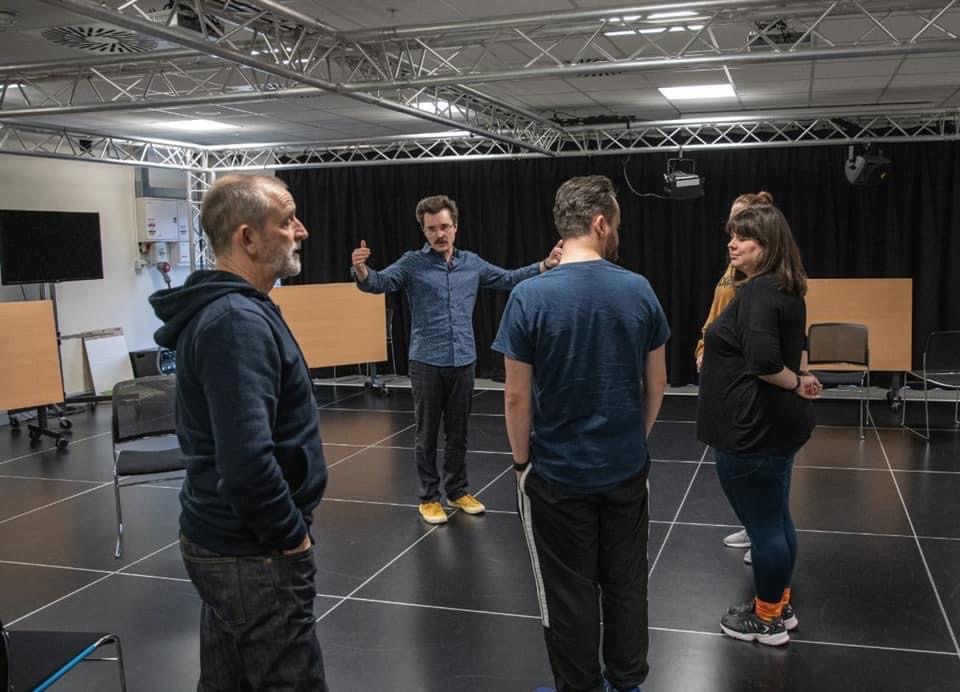
The Sherman Theatre turns 50 this year, and there’s no better way to celebrate than with the golden line-up they have planned for their anniversary: Gary Owen’s much-anticipated Romeo & Julie, Nia Morais’ magical Imrie – and the Sherman Youth Theatre’s Ghost Cities. It’s a new take on Gary Owen’s 2004 drama Ghost City, directed by Justin Teddy Cliffe and incorporating new material by the Sherman’s Introduction to Playwrighting Participants Mared Seeley, Loki Skyrme-Croft, Lauren Hindmarsh and Emma Phelps.
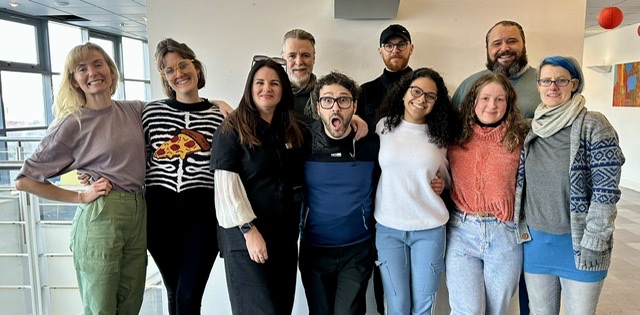
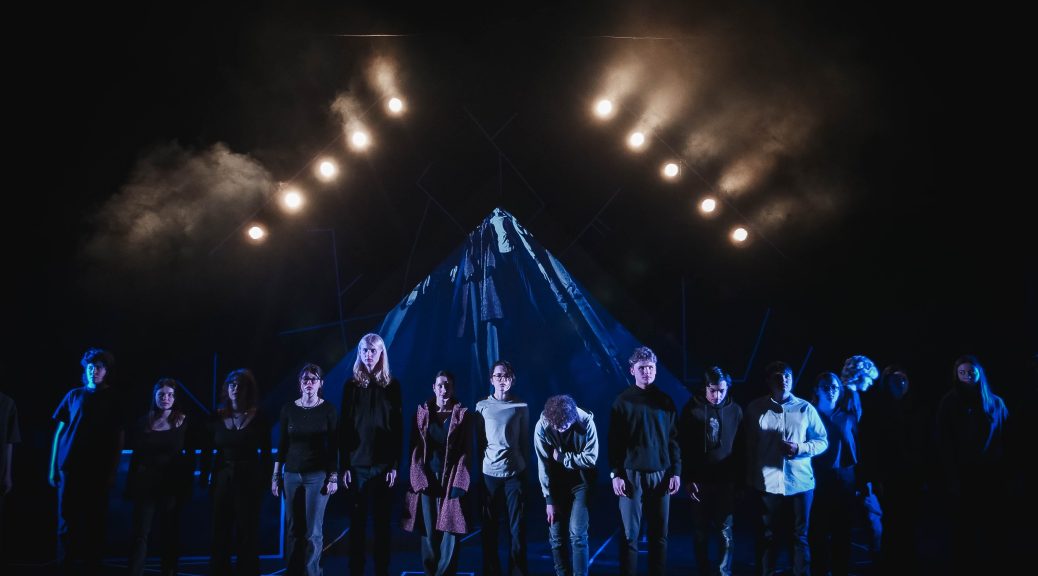
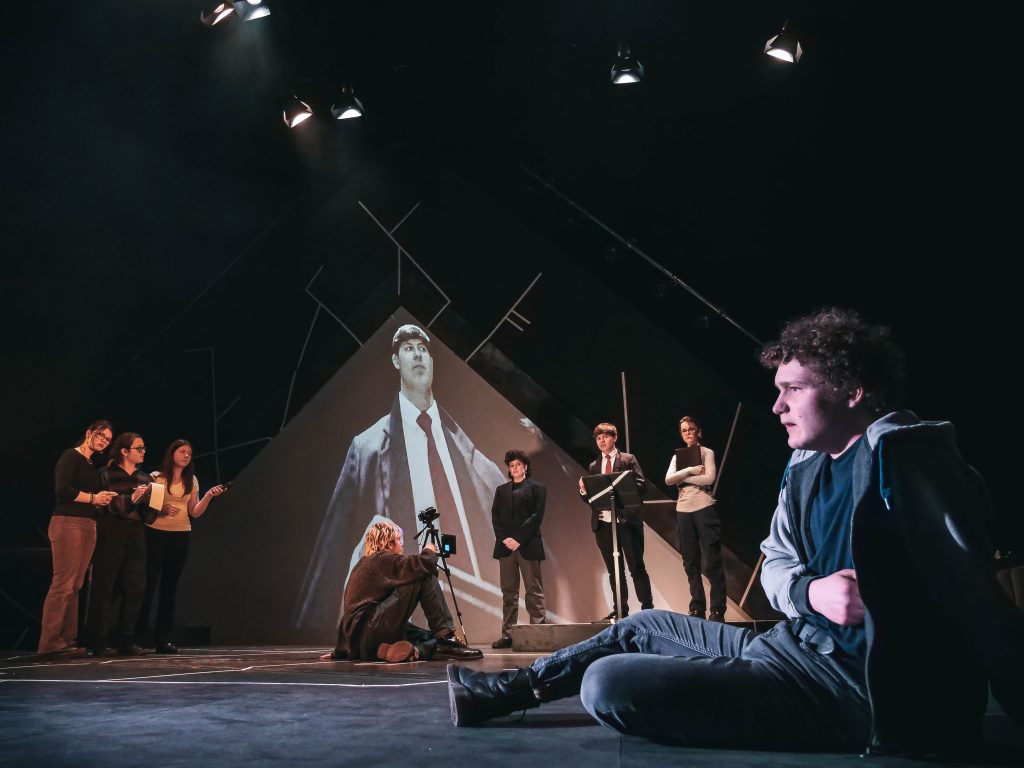
The cast of Ghost Cities. Image credit: Chris Lloyd
Set in Cardiff over a single night, Ghost Cities follows the capital’s lonely souls in a series of interconnected vignettes. There is little to link them directly, save a postcode and a prayer: a universal yearning for connection, understanding, and empathy. I haven’t seen the original play, but there seems to be a nice synergy between the original and its additions. You might be able to spot some of the new material, but it synthesises well with Owen’s text into a cohesive and rewarding whole. And while not every story carries the same sway (some seem as weightless as ghosts), others linger like spectres – largely due to the skill and enthusiasm of its cast and creative team.
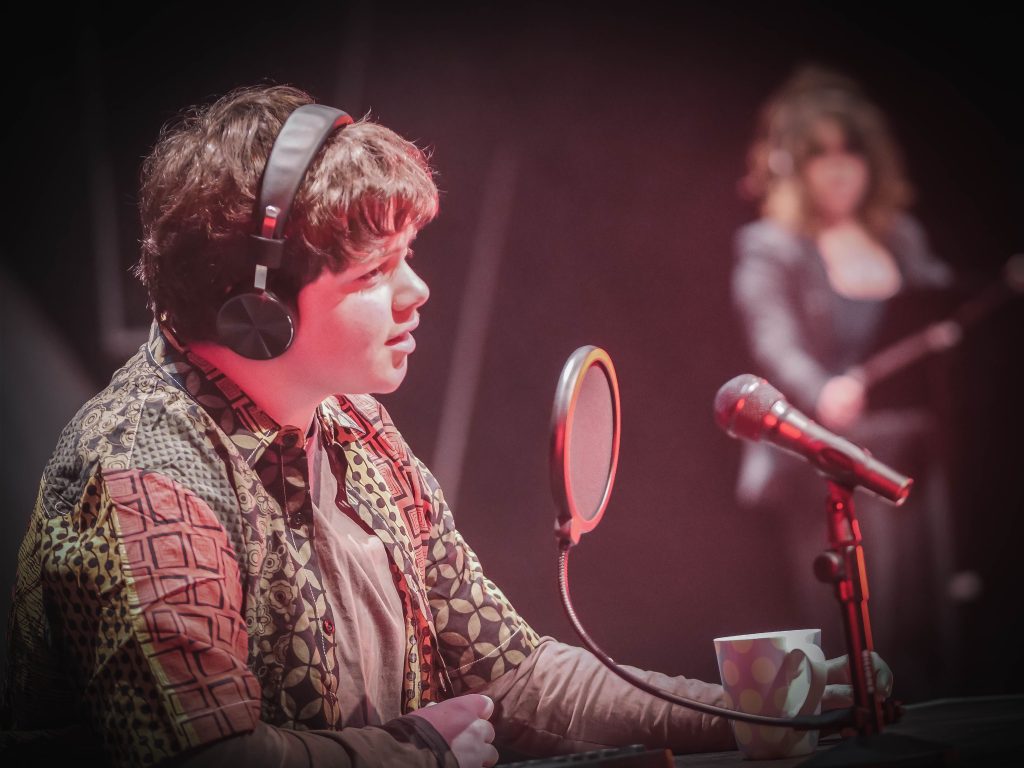
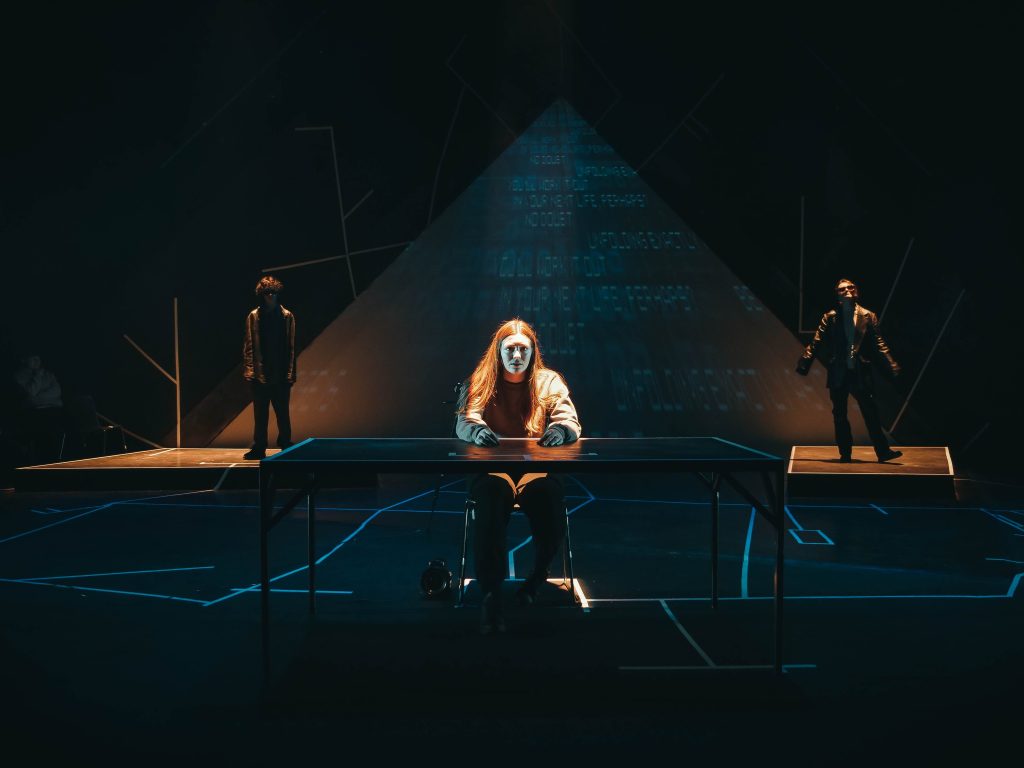
The cast of Ghost Cities. Image credit: Chris Lloyd
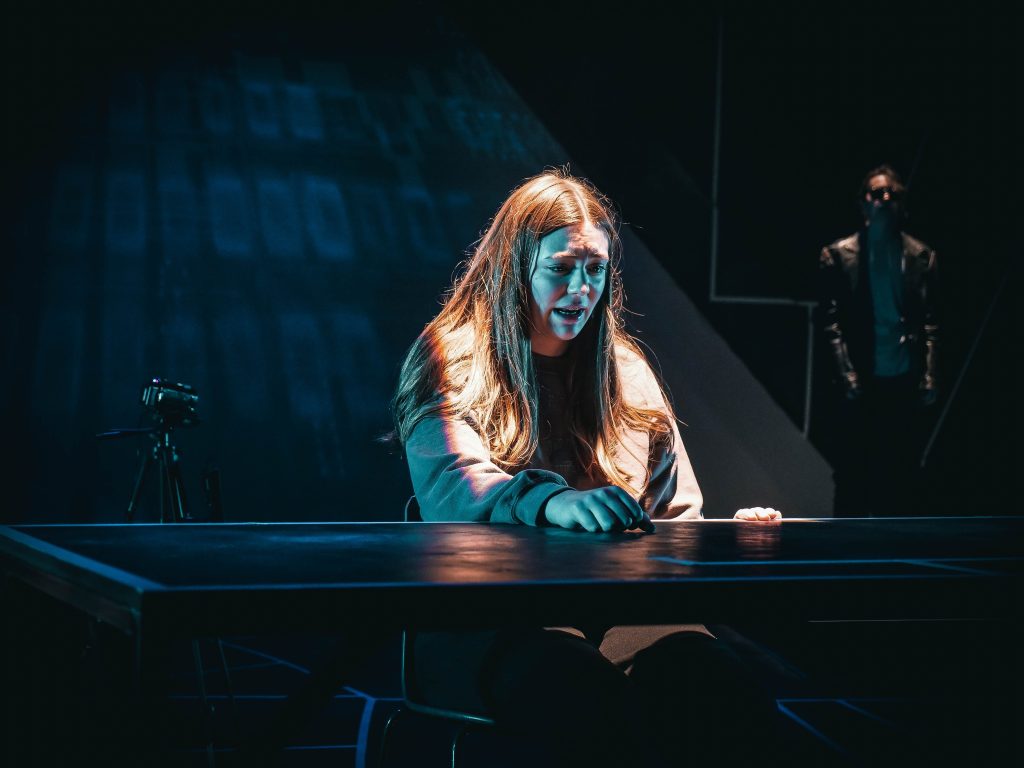
Designer Ruby Brown (supported by The Fenton Arts Trust) and lighting director Rachel Mortimer have worked wonders with the set. Fragments of what’s happening onstage are projected onto an imposing pyramid, distorted and partial; casting doubt on whether what we’re seeing is what’s really happening. At one point, the pyramid becomes the inner core of a Matrix-like computer algorithm; at another, the live feed of an increasingly sinister political broadcast. These are just some of the many striking images that make the play gripping: a hooded stranger leaning against a door, a phone line stretched across the void, a eulogy illumined by a single beam of light as if from heaven.
The cast of Ghost Cities. Image credit: Chris Lloyd
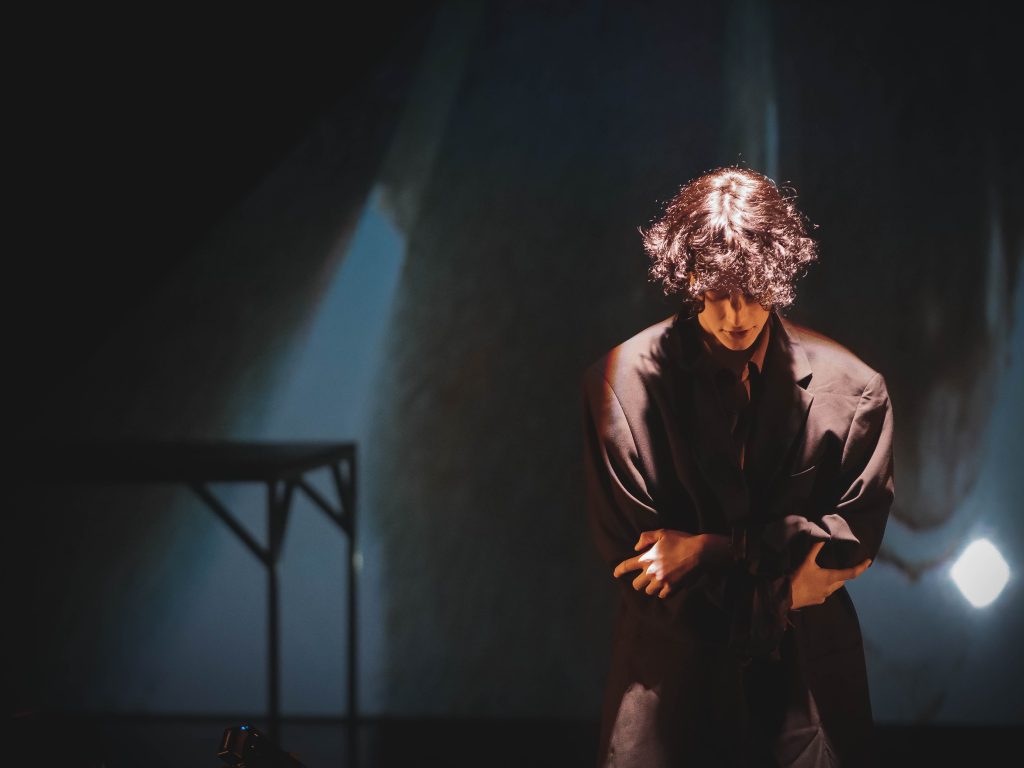
After The It in 2020 and Treasure Island last year, this is the third Sherman Youth Theatre production I’ve had the privilege to attend – and it’s incredible to see such talented young actors continue to grow in their skill and their craft. They navigate brilliantly through drama, comedy, and even tinges of horror, creating a very specific world for the stories to inhabit: the standouts for me were a teacher explaining her gender transition to a previously scornful student, a hilarious night out at Walkabout that ends in both hope and disaster, and a Deliveroo rider philosophising on the meaning of life. All the while, a disenfranchised young man haunts the stage, very much alive and very much at our elbow – we, and the characters, may just overlook him at our own risk.
The cast of Ghost Cities. Image credit: Chris Lloyd
Ghost Cities is a celebration of Cardiff in its hidden corners. It begins with a single voice and ends with many: in doing so, it seems to say that a city is a living thing, and we are its lifeblood: our lives, our stories, the connections we make and the ones we might miss.
Ghost Cities is performed by Rashid Ali, Lily Cole, Rhys Evans, Theo Greenwood, Daisy Griffiths, Twm Llwyd, Edith McCarron, Maya McDarren, Orrin Niziblian, Pringles North, Elian Owen, Jim Pesticcio, Lucia Taher, Brooke Thomas, Nia Thomas, Rory Tune, Indigo Wernick, and Jett Wood.
Ghost Cities is performing between 2 – 4 March at the Sherman Theatre. More information and how to book tickets here. Tonight’s production is a double bill with the Youth Theatre’s ‘Chaos’.
The cast of Ghost Cities. Image credit: Chris Lloyd
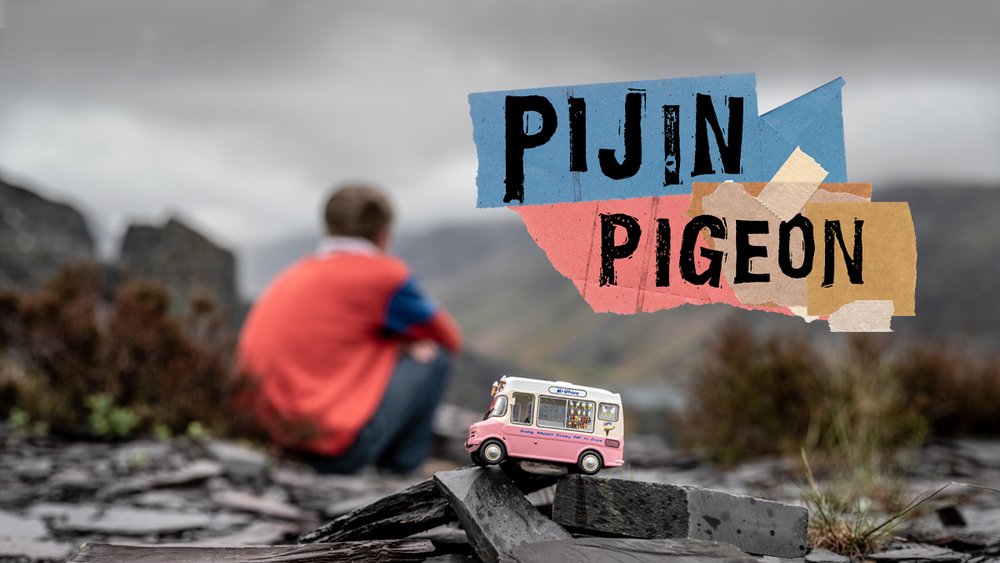
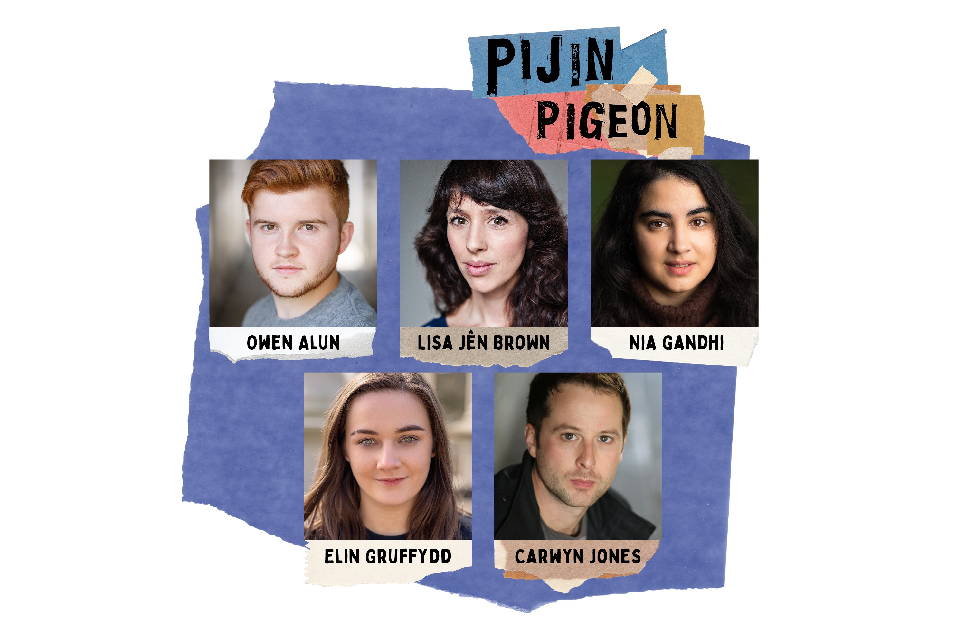
Based on the best-selling novel Pigeon by author Alys Conran, this stage adaptation by Bethan Marlow sees Welsh and English subtly woven together, with every performance using integrated captioning in such a creative way as to lead me to undertake an experimental review in its honour:
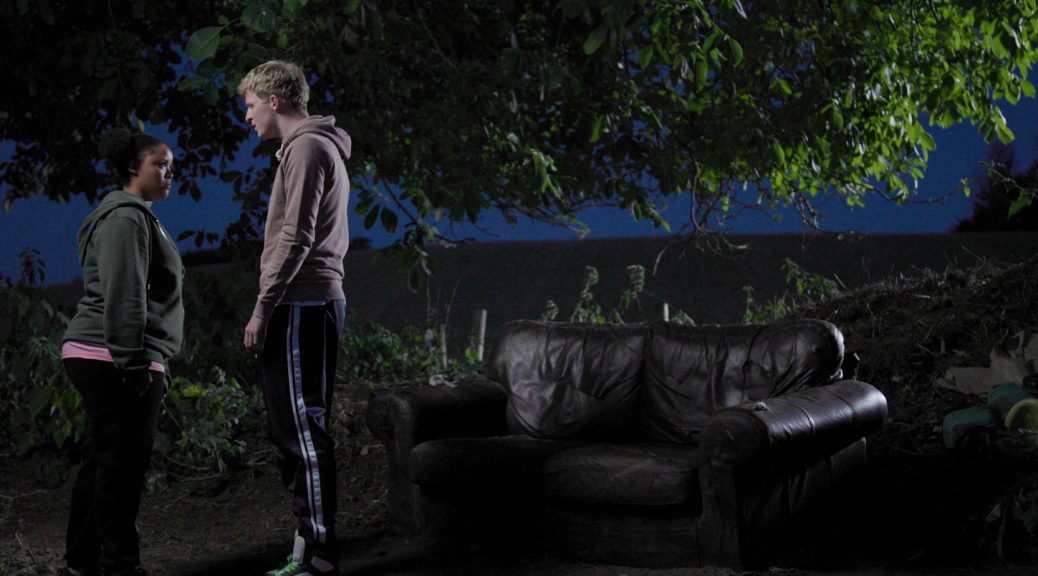
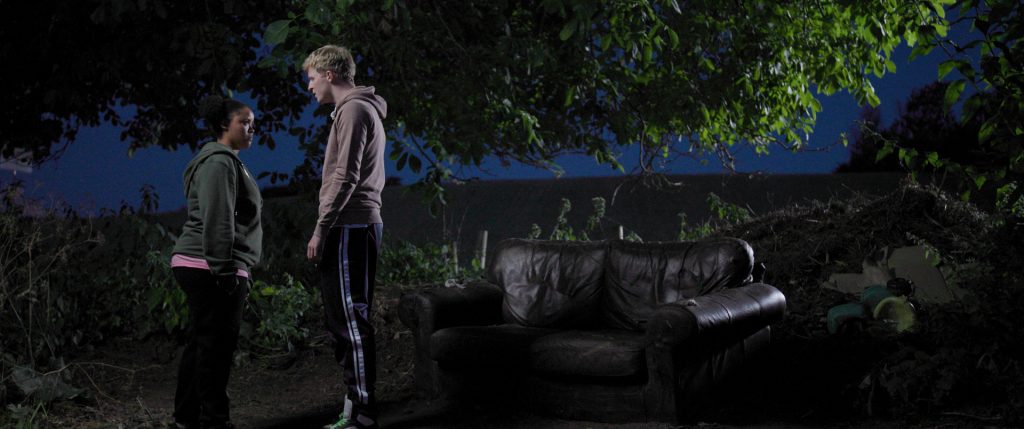
A review of the new digital play, exploring where film and theatre meet, follows two teenagers, one a drug runner and the other the daughter of an addict, as they navigate a dangerous adult world.
Do cats tan? Could you bring me out a blanket?
Tom Powell, The Silence and The Noise, film.
This Be The Verse
BY PHILIP LARKIN
They fuck you up, your mum and dad.
They may not mean to, but they do.
They fill you with the faults they had
And add some extra, just for you.
But they were fucked up in their turn
By fools in old-style hats and coats,
Who half the time were soppy-stern
And half at one another’s throats.
Man hands on misery to man.
It deepens like a coastal shelf.
Get out as early as you can,
And don’t have any kids yourself.
‘’There are 8 reasons why teenagers take drugs: other people, misinformation, popular media, escape and self medication, boredom, rebellion, instant gratification, lack of confidence.’’
Two teenagers ‘both alike in dignity’, acting out the roles they think they should be playing and railing against the tiny crooked worlds they inhabit on instinct and experience unbalanced and afraid.
Daize and Ant , star crossed indeed and lost in an adult place where parenting and drugs are failing them and where hope and stability come from each other.
This Shakespearean duologue creeps under the skin like a needle. It is a slippery painful rush of child and adult feeling its way through the awkward brilliance of its performers. Exceptional and tragic, closed and candid, ‘you’re not a laugh a minute you know’.
I am reminded of being a lay member on the local restorative justice panel and wishing I could magic better lives for the young people we met. These teenagers couldn’t just say No, their worlds were governed differently. Victims of circumstance. I think of them often and wonder what we should do differently as we are the village raising the child and we have a combined responsibility.
Powell forces me to return to the debates in my head – where does responsibility lie and what does it look like? Is Ant so upset by his mother’s infidelity that he looks to make money in the easiest and quickest way (sic), justifying his decisions within a dubious moral framework? How does his complicated and dangerous choice compare to Daize’s addicted and failing mother which leaves her daughter to defend herself with a knife and eat cat food? No one should have to eat cat food. It is an axis on which the play turns.
It is all relative. It is not what happens but how we deal with it. This film schleps through nature and nurture and their consequences on transitional minds.
The story telling is adept – our actors are acting out teenagers acting as adults and breaking into juvenility. It is the most powerful and upsetting screenplay. Like those young people all those years ago in the justice system, I want to take them home and protect them, restore their innocence in some naïve and offensive way. That is how convincing they are.
But Ant takes Daize home and the bravado and the arguments become a search for the relative peace of a family set up, leaving death and chaos behind them. Perhaps this Romeo and Juliet get a happier ending.
Just over a year ago, I attended The Da Vinci Codeat Theatr Clwyd. Although I enjoyed this production, I felt that the book simply didn’t translate well to the stage, mainly due to the amount of detail included in the plot which there just wasn’t time to delve into in two hours. However, the same certainly cannot be said of The Shawshank Redemption.
Based on Stephen King’s 1982 novella Rita Hayworth and the Shawshank Redemption, this production examines topics from injustice to friendship and most notably, hope, in a place where the word ‘hope’ seems impossible: Shawshank Maximum Security Penitentiary. The 1994 movie starred Tim Robbins and Morgan Freeman and was nominated for seven Academy Awards. Among the movie’s fans were stand-up comedians Dave Johns and Owen O’Neill who realised the potential for Shawshank as a theatre production. The Gaiety Theatre in Dublin, where this current tour will end, agreed, and an adaptation of the original novella was first produced there in 2009. It then transferred to London and the adaptation was rewritten and put on in Edinburgh in 2013, with its adapters co-starring alongside Omid Djalili as Red.
For those not familiar with The Shawshank Redemption– it tells the story of Andy Dufresne who, despite claiming to be innocent, is given a double life sentence for the brutal murder of his wife and her lover. Incarcerated at the notorious Shawshank facility, Andy strikes up an unlikely friendship with the prison ‘fixer’, Red, and as their relationship strengthens, things seem to be looking up. However, when Warden Stammas decides to exploit Andy’s talents for accountancy, a desperate plan is hatched.
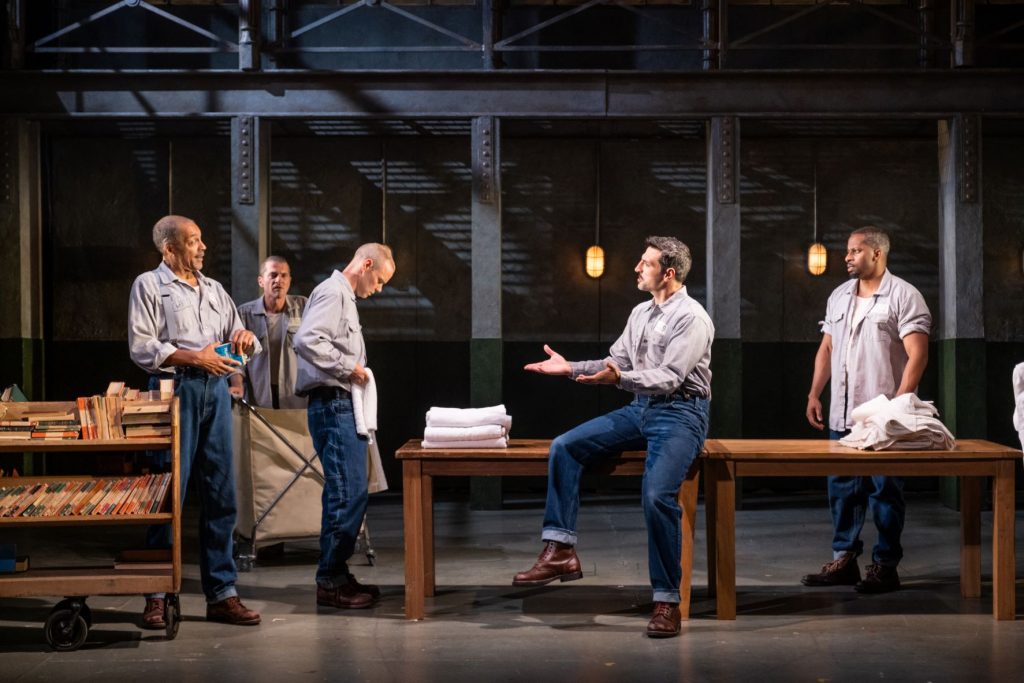
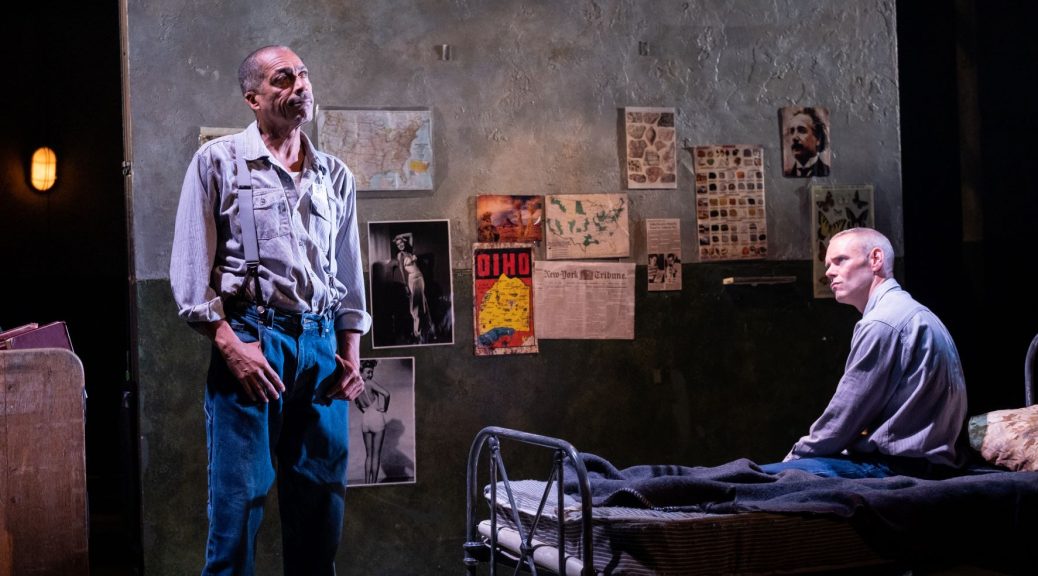
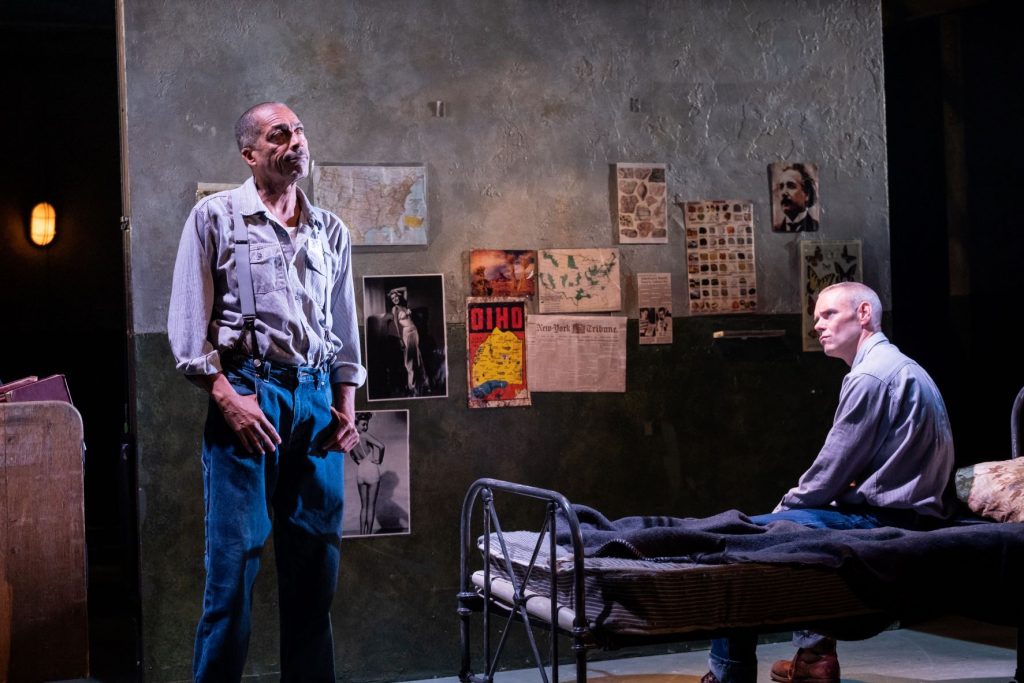
As the play begins, we are transported to the penitentiary. The set is simple but extremely effective with the prison walls surrounding the stage on both sides and upstage, allowing for a feeling of claustrophobia throughout. The main bulk of the set remains, but as the story unfolds, each scene is set within the walls: a postered wall and a bed for Andy’s cell, a desk, chair and wireless for the warden’s office, a long mess table and chairs for meal times. The transition between scenes is flawless, with the actors completing all set and prop movement seamlessly. Most scene transitions are also marked with a prison siren or alarm to signal a new location or place in time. The fluidity of the piece is extremely impressive, the action narrated by the character Red, portrayed perfectly by Ben Onwukwe. Red speaks directly to the audience, often regarding sensitive prison topics such as gambling, rape, corruption and so on, and he draws us in, allowing us to empathise not only with him, but with other inmates at Shawshank so we better understand life within the walls- we are allowed on a journey with each character over the course of the ‘twenty years’ we spend with them. And it’s not without a great sense of humour and plenty of comedic elements. Also noteworthy is
Red’s final monologue which he delivers as he completes a full costume change, reflective of his character’s change from despair to hope. A ‘changed’ man?
Joe Absolom’s Andy is the perfect mix of kind, compassionate, determined, if not a little arrogant in his own self-sufficient way. Absolom provides the character with just enough ‘crazy’ to have you questioning his every move. Consequently, even those familiar with the story begin to question the outcome! Credit must go to the lighting team- providing an appropriate atmosphere throughout. From the spotlights on the new ‘fresh’ inmates at the very beginning, to the effect provided for Andy’s fluttering butterfly at the end. Lighting is also used effectively to depict the men watching a Rita Hayworth movie, giving the impression that a projector is being used, as well as for scene transitions and instances of violence which are cleverly choreographed alongside appropriate light and dark moments.
Dave Johns and Owen O’Neill were certainly spot-on in believing that The Shawshank Redemption could work well in the medium of theatre. The prison setting makes for a fast paced, adjustable, well thought out production, which shifts from scene to scene effortlessly. With the addition of successful sound, lighting, costume and a fantastic cast, this is a must-see production.
The Shawshank Redemption continues its UK Tour on March 6th at the Belgrade Theatre in Coventry and finishes on May 13th at the Gaiety Theatre, Dublin. Head to the website to book your tickets:
We last chatted as part of the series that Get the Chance ran during the height of the Covid Pandemic in April 2020. During this period many Welsh or Wales based arts graduates were hugely impacted by the Pandemic. Their usual opportunities to meet agents, prepare for final year exhibitions or productions took place in later years or sadly not at all. To raise awareness of the diverse talent graduating during the year GTC offered any Welsh or Wales based graduate the opportunity to be showcased on our website.
So, I guess the big question is what impact did Covid have on your career?
Obviously with there not being any work during Covid, it was kind of a chance for me reflect on what I had learned through my education years and decide where I wanted to go when Covid eventually eased off. At the time, one thing that I wanted to take a step back from was theatrical acting and focus on more on acting for camera, as theatre was something I did so much in my education years. I found that taking that break from working and having time to focus on where I wanted to go, helped me come up with a plan. My plan was simple, get an agent and have more experience in acting for camera at a professional standard. I was very fortunate to get both of these achievements just as we were coming out of the last lockdown which worked out perfectly ready for me to get back out there as the industry started to open back up.
One of the biggest lessons I learned through Covid was maintaining a positive mindset, keeping yourself occupied (even if it’s not related to what you want to do) and not letting rejection get you down. A way I do this now is by having a full time job so that I always have a income coming in, so pressuring myself in getting specifically acting jobs doesn’t really concern me as I always have some kind of money available, so the stress of worrying about bills and car insurance isn’t present, but taking priority to the acting jobs as this is where I’m taking my career.
Did any positives come out of this period that has been helpful for your current work?
Definitely my representation. My agent at Vella Wozniak has been the best thing to happen to me in my professional work. They are constantly submitting me for jobs, having update meetings where we talk about future plans and all the positivity that comes with it. All of the clients have a group chat where we all help each other out with supporting each other, sharing information and just industry related help. Having the representation that I have just makes me feel better about my talent and capability in the industry and I’m very thankful for it.
I believe you are in preproduction for a new YouTube fan series based around Dr Who? With Russell T Davies returning to write for the series and a new Doctor and Assistant announced what changes do you think this might bring to the world of Dr Who?
David Tennant as The Doctor is what inspired me to be a actor in the first place. With Russell T Davies back and David Tennant it’s like my dream come true, especially because we’re getting 3 episodes with him and Catherine Tate back for the 60th anniversary! I have very high hopes when Ncuti Gatwa takes over fully next Christmas too. He’s such a talented actor who I’m sure will bring something unique and new to the role. I think the biggest changes we’ll see are going to be in the production values, going off Bad Wolfs previous production of His Dark Materials and the quality of that show. I’m also expecting there to be more spin off shows, obviously this is just my own prediction, but with the success of other projects like the MCU having its own cinematic universe, I think Doctor Who will go down that route which will make it at the forefront of mainstream television again.
What currently inspires you about the arts in the Wales?
I don’t think a lot of people realise how much there is going on in Wales, especially Cardiff in terms of the filmmaking and acting industry. You have the BBC, Bad Wolf Studios, Sex Education, Doctor Who, Casualty, The Millennium Centre, New Theatre, Chapter Arts Centre, extra work, filmmaking apprenticeships… The list goes on. There’s always been this idea that moving to London or studying in London is the way forward in acting but when you take a step back and look at what we have in Wales, You can actually see that everything you need is on your doorstep and it’s only growing bigger.
What was the last really great thing that you experienced that you would like to share with our readers?
It’s so hard to pick one experience. It’s got to be the support I’ve received from friends, family and my representation, Glynis and all of the team at Vella Wozniak. It’s been nothing but positivity all around and I consider myself very lucky to receive the support that I have. The plans that we have in coming this year fills me with nothing but excitement and I can’t wait to share the hard work we’ve put into it with everyone.
Thank you.
You can follow Lewis and find out more about his work at the links below.
Hi Chris, great to meet you, can you give our readers some background information on yourself please?
Shwmae! I am a writer. I was born in Abergavenny, raised in Ebbw Vale, and then Cwmbrân, and now living in Bridgend with my fiancé. I had a Welsh language education in Pontypool (and now I predominately identify as a Welsh language theatre maker). I studied my BA in Drama at Aberystwyth University, and my MA in International Dramaturgy at the University of Amsterdam. I’ve been writing for theatre for about 10 years now, having had many fantastic opportunities to exercise and explore new work. I’ve been fortunate to work with Theatr Bara Caws, Theatr Genedlaethol Cymru, Theatr Iolo, Theatrau Sir Gar, National Theatre Wales, Dutch National Opera, Ensemble Modern, Cwmni Theatr Frân Wen and Cwmni Theatr Arad Goch. I’ve also worked in a pharmacy, as a teaching assistant and a drama club facilitator. It’s all relative!
So, what got you interested in the arts?
I have my parents to thank for that. Neither of them work in the arts, but they regularly took my sister and I to the theatre from a very young age. The stating point was likely seeing ‘Budgie the Little Helicopter’ at the New Theatre, Cardiff. They also took us to Kids Week in London (a brilliant initiative) during the summer, all the way up until we were 16. They always encouraged broad-mindedness in any art form we watched. We went to all sorts of theatre across the country, as well as the cinema, museums, art galleries, as well as the weekly movie nights we would have at home.
Why do you write?
I see the world in a very creative way. Ideas come to me all the time from all corners of life. Human behaviour and experience is theatrical. I have too many ideas. Writing is a method in which to make sense of things. News bulletins and anecdotes and shared-experiences and reading historical documents translate into creative artforms that I visualise. To me, everything has creative potential. I can’t always deal with things ‘just’ as they are, or as matter of fact. I like to imagine and interpret all the time, and ask – ‘why are things like that?’
Can you tell us about your writing process? Where do your ideas come from?
Anywhere. And new ideas usually catch you off-guard! There’s been many a situation where I have had to say: ‘Stop a minute, I have to write this down!’. From there, it’s usually many weeks of toying, thinking, contemplating, researching. If the idea disappears after 6 weeks, then I can’t love it that much to begin immediately. I don’t always start with ‘something to say’. That usually comes later. If I have an idea, and later on it begins to resonate with my own personal opinions, experiences or perspective on things (or challenges them) – and the idea sits with me long enough (I get bored quite easily too) – then I know I may have something. I also thrive on collaboration. I like to work with a director very early on to really uncover a play.
Can you describe your writing day? Do you have a process or a minimum word count?
I personally don’t think there’s such a thing as a writing day because, every time I sit down to ‘write’, I usually scroll on Twitter or stare blankly somewhere. You have to let the ideas come to you. Sometimes they come in chronologically, order sometimes in a random order. The ‘process’ is trusting that it is a process that requires time. I also think it’s healthy to have a different approach and process with each new play. Let the work dictate to you what it needs. I recently completed the first draft of a new play entirely by hand in a notebook because I wanted to try not writing any of it at home and to make the process more mobile. Now I have to find time to type it up . . .
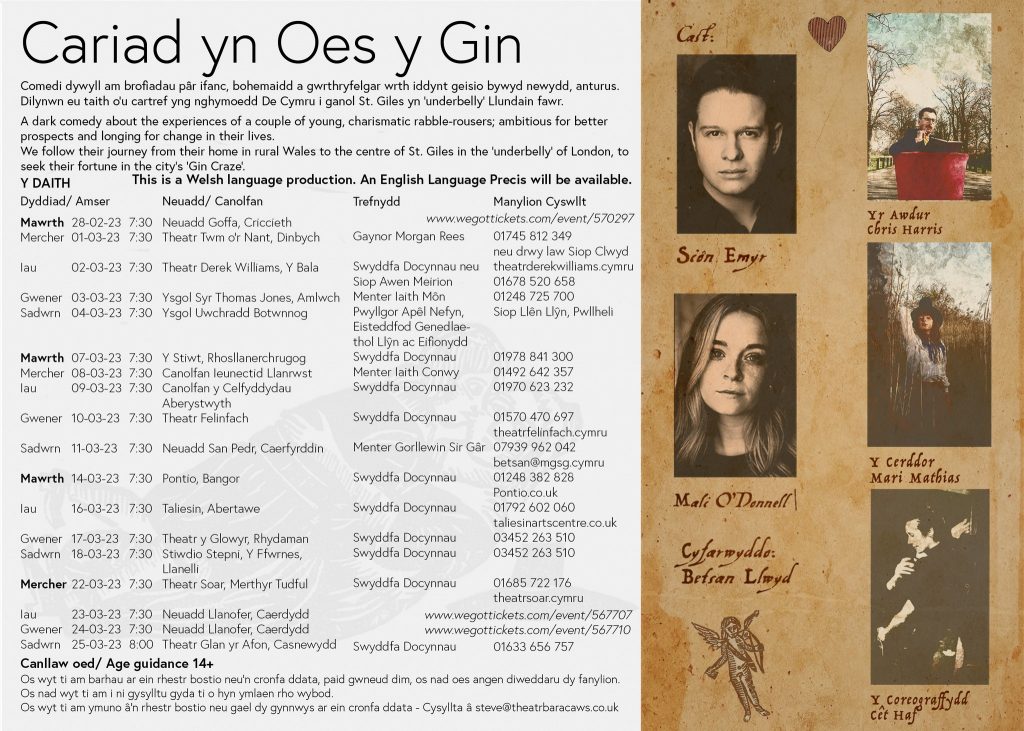
This spring you have two new Welsh Language productions on tour, Cariad yn Oes y Gin produced by Theatr Bara Caws which is described as “A dark comedy about the experiences of a young, bohemian and rebellious couple as they seek a new, adventurous life.” And Golygfeydd o’r Pla Du, a Theatrau Sir Gâr Production, supported by Theatr Genedlaethol Cymru which is described as “A mischievous, black (death) comedy about crisis and corruption, packed with scandal, songs, singing goats and horse sh*t. Welcome to the Black Death – there’s nothing funnier.”
There is clearly a theme of dark comedy in your work! What inspired both productions and what are your ambitions for the tours?
‘Cariad yn Oes y Gin’ was inspired by asking how something so destructive, like gin, was discovered for the first time. I was interested in how, in 1736, it affected people on a societal level, and how a bridge once build between the lower and upper classes was suddenly eradicated because of gentrification. I also wanted to see it through the lens of a young, care-free (and rather naive couple) who get a big slice of reality when paving their own way through life.
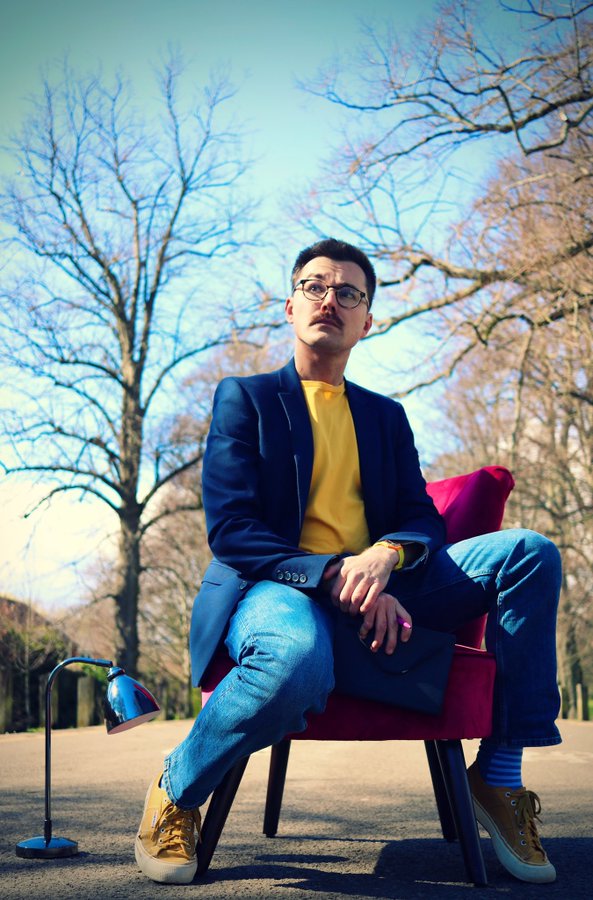
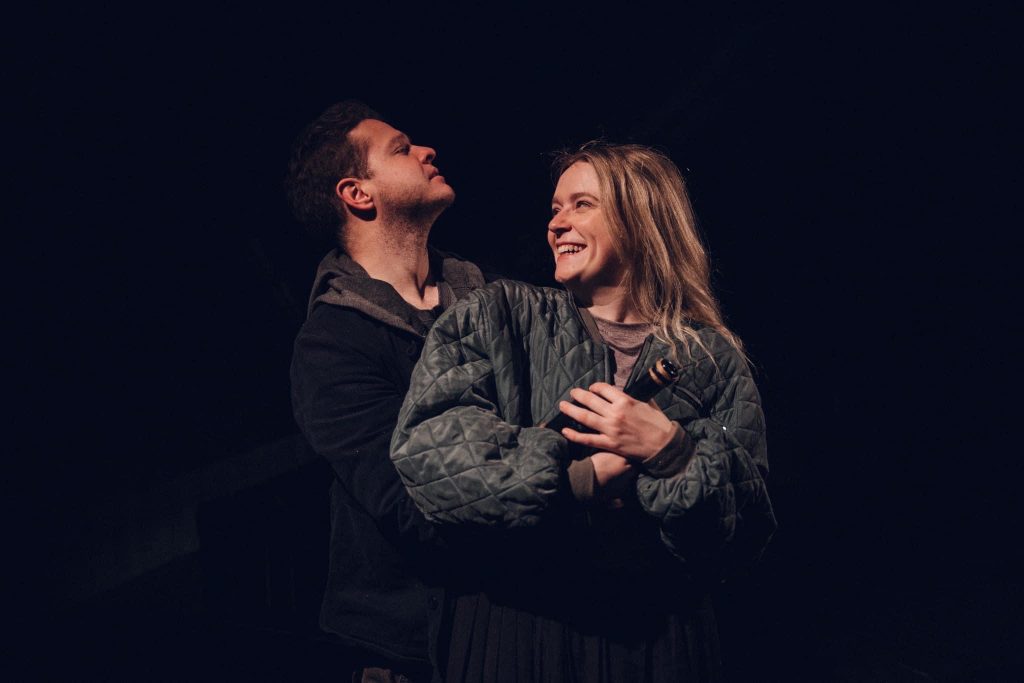
Mali O’Donnell and Sion Emyr in ‘Cariad yn Oes y Gin’ – Kristina Banholzer
I’ve thought a lot about the nature of love and relationships over the past couple of years, and how one must adapt and, sometimes, compromise in a true relationship, whilst also holding on to their very true selves. Gin, a new and destructive drink in society, becomes a symbol of freedom and power for this young, rabble-rousing couple.
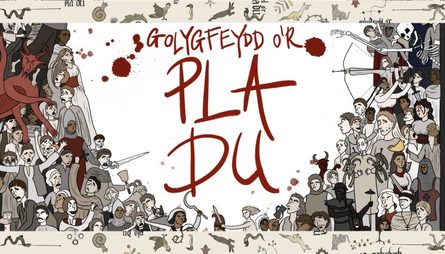
‘Golygfeydd o’r Pla Du’ R&D – Ray’s Photographs
‘Golygfeydd o’r Pla Du’ began life as wanting to be popcorn-theatre for Welsh language audiences in the vain of some of my heroes: Mel Brooks, Monty Python and The League of Gentleman. It’s written for 4 actors sharing around 35 characters. It’s fast, it’s polymathic and outrageous. Of course, like all theatre work, it quickly evolved into something more than just a satirical comedy, and I began to see how crisis, such as a pandemic, brings out the true nature of people. It seems there are many out there who benefited from the COVID-19 pandemic, and the play aims to make an acknowledgment of that through satire.
Both productions take place in an historical context. Do you think the plays period and themes will resonate with contemporary audiences?
I think so. I find it easier to contemplate what is going around us in the present through a historical lens. There’s a sense that enough time has settled for us to learn from history and to see things exactly as they are through the ‘then’. The ‘Gin Craze’ saw many people’s freedoms being curbed, not just on the basis that the drink was doing so much harm to people, but the working classes were entirely to blame for the increase in violence. You’d be surprised at how much corruption and scandal became evident as a result of the Black Death. People began to see the cracks in their leadership and in the feudal system. The ‘Peasant’s Revolt’ came shortly after that. It wasn’t all ‘Partygate’ or how much of public funding was spent on a private jet flight of 30 minutes, but the gesture of abuses of power was very much the same. Through history, we see lessons that have never been learnt.
There are a range of organisations supporting Wales based writers. I wonder if you feel the current support network and career opportunities feel ‘healthy’ to you? Is it possible to sustain a career as a writer in Wales and if not, what would help?
Yes, it certainly feels healthy. I was very fortunate to be invited to a few of those schemes myself (particularly the Sherman Theatre’s schemes in 2016 – 2018 curated by Philip and Christine Carne, Brad Birch, Gethin Evans and David Mercatali). My worry is that there still aren’t schemes to commit to writers long-term – to take risks. Theatr Bara Caws, Theatrau Sir Gar, Theatr Iolo, Blackwood Miners Institute . . . they’ve all taken a risk on me by following through. It takes time, but I don’t know a single aspiring/emerging writer who wouldn’t want to take that time if it meant the end-goal was getting their work seen and discussed by a paying audience.
Is it sustainable being a writer? No, not really. But I recommend training and taking work in other aspects of the arts, if possible: box office, outreach, education, administration, technical . . . whatever. It all feeds into your understanding of the working mechanism that makes up an arts organisation and gives you a greater appreciation of it. However, never work for free.
If you were able to fund an area of the arts what would this be and why?
Access. It’s a financial barrier for many companies, and the costs are increasing for everything. A ‘Dream Scheme’ would be to see core arts organisations given additional resources and funding to ensure that all aspects of access can be addressed: in-house software for captioning, cheaper/free hire of captioning software (Theatr Gen’s access app Sibrwd is super-easy, for example)
https://youtu.be/mc-LV1crMVc
More funding to ensure BSL interpreters/Audio describers are given more performances and more preparation time, access costs being subsidies by larger funding bodies (but not necessarily included in core production budgets) and that wide-spread training is free, accessible and continuous.
What currently inspires you about the arts in Wales?
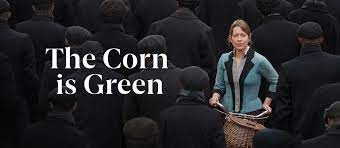
An identity that has shifted from that of coal miners and choirs and drowned villages to telling the real, contemporary stories of the diverse people of Wales. Also, our awakened sense of nationhood sat in the context of the British Empire. I’ve seen a lot of Welsh language work in the past few years that touches on this in an exciting way. To put all that into context, I went to see ‘The Corn is Green’ by Emlyn Williams at the National Theatre last year. Without going on about it, there’s a reason why that play ISN’T being performed in Wales and HASN’T for a very long time.
What was the last really great thing that you experienced that you would like to share with our readers?
Oh, I went to see Damien Chazelle’s new film ‘Babylon’ recently!
https://youtu.be/5muQK7CuFtY
In it, I saw two of my favourite films slammed together in an orgiastic, unapologetic party: ‘Singin’ in the Rain’ meeting ‘The Wolf of Wall Street’. It actually made me think a little about ‘Cariad yn Oes y Gin’ (I love it when that happens – you’re nervous about an idea you’ve thought of, and then see someone else execute it in a different context, making you confident that your idea will work!). For all the drug-fuelled, addicted splendour that ‘Wolf’ and ‘Babylon’ brought, the party has to die down eventually, because people get hurt. That’s what we see in Dylan and Nansi’s journey in ‘Gin’.
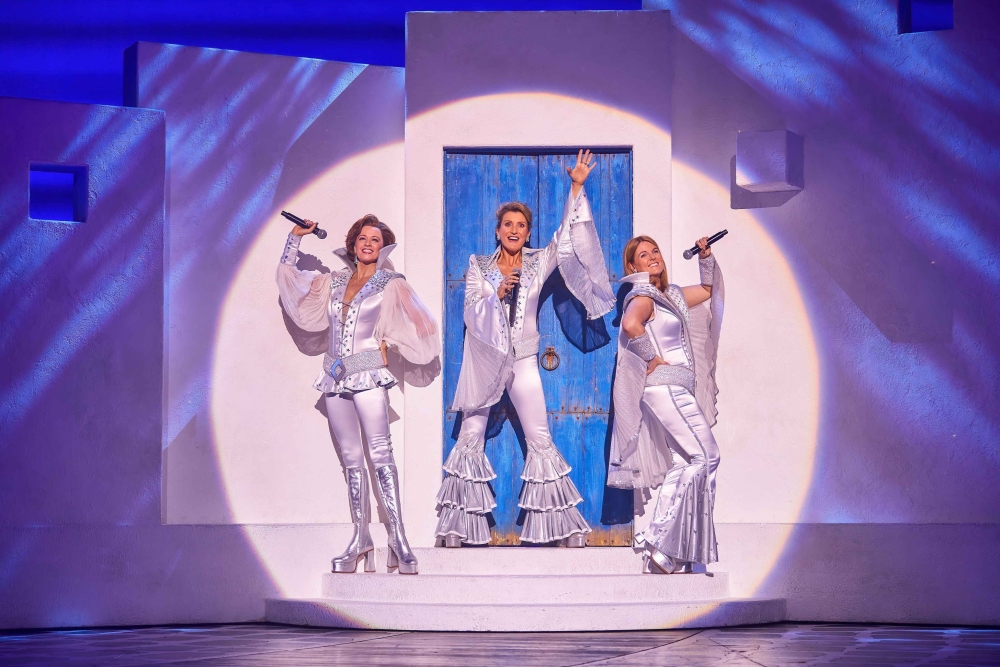
If there’s anyone we should thank for the music, it’s ABBA. One of the best-selling bands of all time, this iconic Swedish quartet made a grand Arrival on the scene in 1974 with the Eurovision-winning Waterloo and went on to dominate pop music for the next decade. Disbanding in ’82 with a smorgasbord of songs (and many millions of dollars) under their belt, their star has never dimmed. (Songwriters Benny Andersson and Björn Ulvaeus even went on to write original musical Chess). Forty years on, they embarked on a new Voyage, with a chart-topping comeback album and a virtual arena residency featuring concerts performed by their holographic ‘ABBAtars’.
So, who better to form the basis of a jukebox musical? Produced by Judy Craymer, Mamma Mia! premiered in London in 1999 and went on to become the sixth longest-running show in West End history. Its movie adaptation, directed by Phyllida Lloyd and starring Meryl Streep, smashed box office records and, for a decade, was the highest grossing film to be directed by a woman. Now, this beloved show is taking off on a massive UK and International Tour to remind us all why we should Take a Chance and Have a Dream.
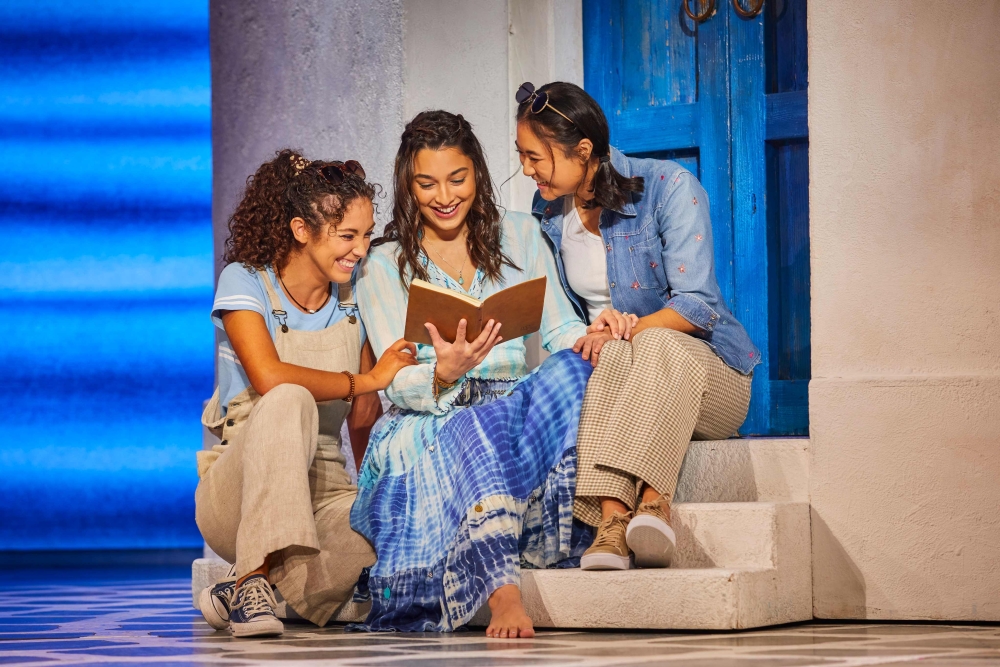
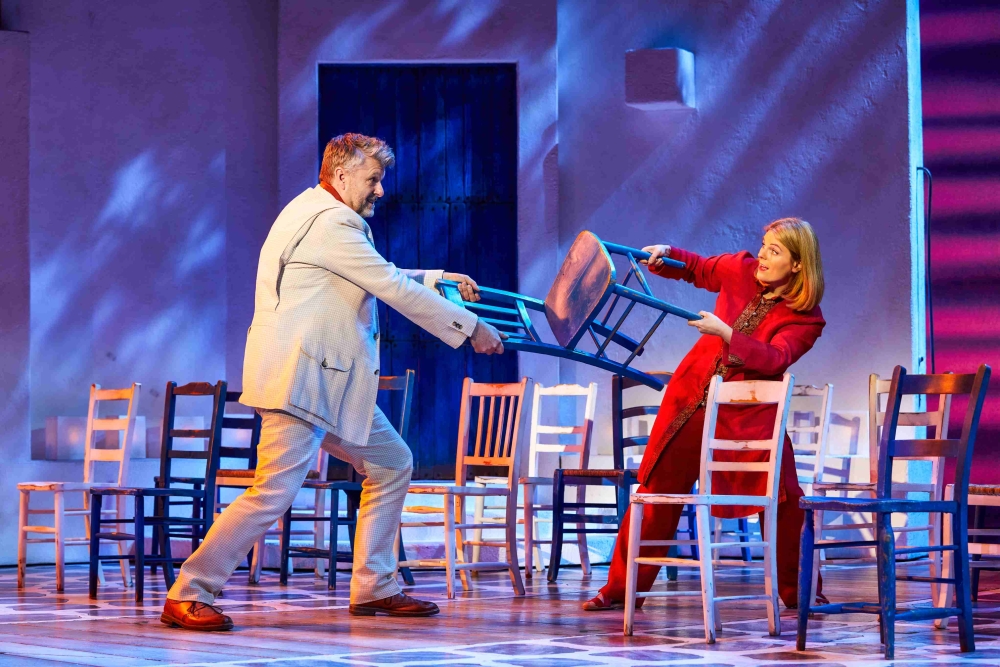
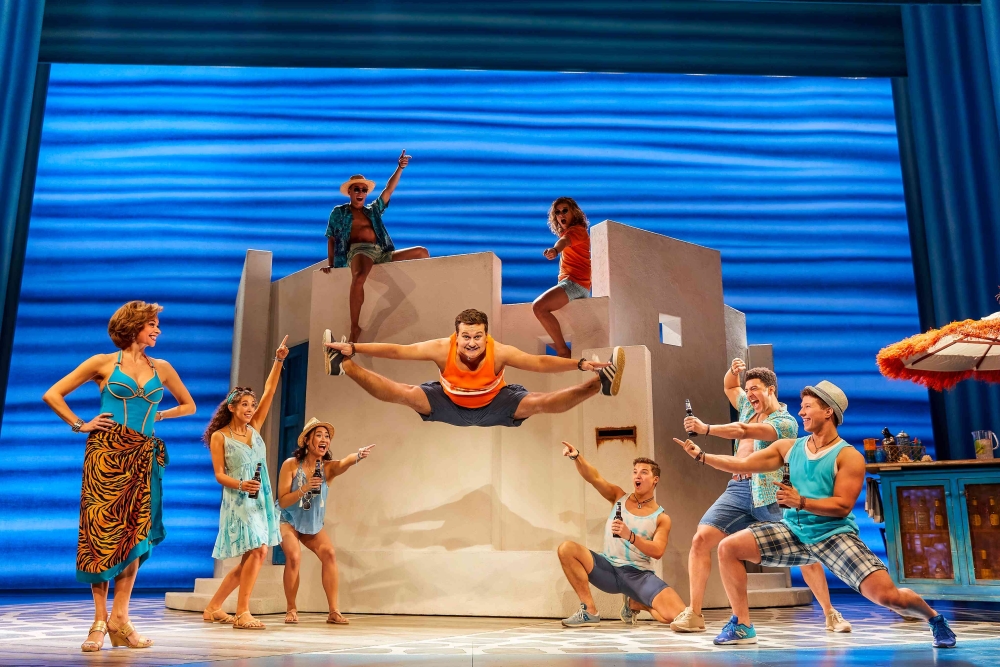
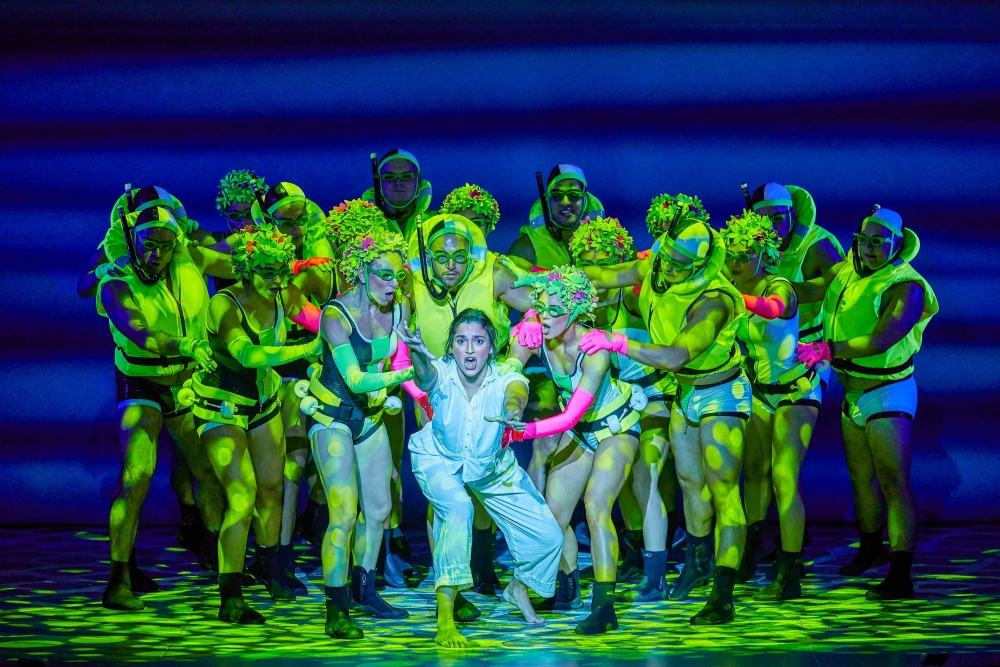
Written by Catherine Johnson, and helmed by Lloyd, Mamma Mia! is set on the fictional Greek island of Kalokairi. 20-year-old Sophie (Jess Michelmore) is soon to marry fiancée Sky (Christopher Foley). She is determined to have her dad walk her down the aisle, but her fiercely independent mother Donna (Sara Poyzer) has never revealed his identity. So Sophie does some snooping, whittles the potential candidates down to three, and invites them to the island in secret. The players in this particular paternity lottery are Harry Bright (Neal Craig), Bill Austin (Phil Corbitt) and Sam Carmichael (Richard Standing), who each captured Donna’s heart one Last Summer many years before.
The plot is as light and frothy as the waves lapping the island shore, and the lead-ins to each ditty tenuous at best – “I’m old enough to be your mother!” Tanya (Sarah Earnshaw) says to lovestruck Pepper (Jaden Osheneye): cue Does Your Mother Know – but who cares? Benny and Björn’s songs are so iconic that they’re ironclad – and all you need to do is sing along. And I defy you not to start doing just that when the title track’s opening marimba kicks in, and the show really kicks off.
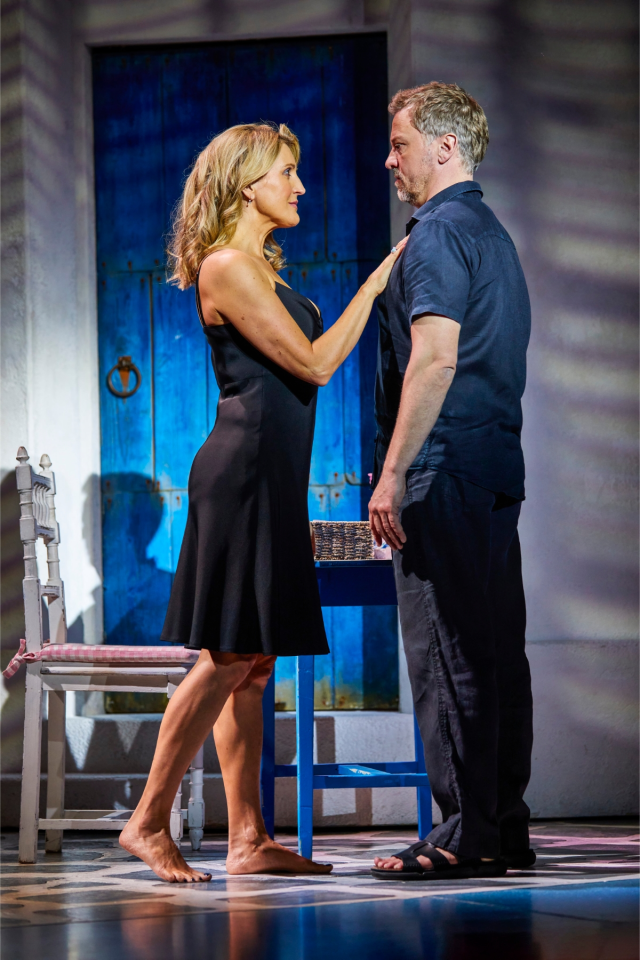
Fun is the Name of the Game here, and there’s more than enough to go round: Rosie (Nicky Swift) and Tanya cheering up bestie Donna with a one-two punch of Chiquitita and Dancing Queen; Sky and his mates’ laddish rendition of Lay All Your Love On Me; a rowdy reception that culminates in a plea to Gimme Gimme Gimme (A Man After Midnight). It also makes time for the smaller moments between characters: Donna singing The Winner Takes It All to Sam, the one that got away (Poyzer and Standing, a couple offstage as well as on, bring a genuine chemistry to their interactions). And rhe way Poyzer performs Slipping Through My Fingers as she tearfully does her daughter’s hair one last time brought a tear to mine.
The show’s celebration of love beyond the heteronormative was progressive for its time – though it would benefit from some updating (it’s 2023, yet Harry’s husband remains resolutely offstage). Even so, the musical is defiantly inclusive and crafts a world for itself that – save for the need to scrape for Money Money Money – is positively utopian. In Mamma Mia!, anything is possible: old flames reignite, new love blooms, and the only obstacles to ever after are just a song away from solving. For all its fluff and fabulousness, its subversive quality is perhaps its most enduring: giving its older women characters focus and agency, and the space to be sexy, messy, and fun.
Mamma Mia – you’ll want to go again! This is a show for every Dancing Queen and Chiquitita who ever had a dream. If you’re thinking ‘Gimme Gimme Gimme a ticket’, you might want to act soon – because they’re selling out faster than you can say Voulez-Vous! It might not be the most polished gem in the West End’s crown – but when it’s good, it’s gold.
Directed by Bill Buckhurst, book by Cheri Steinkellner and Bill Steinkellner, additional book material, Douglas Carter Beane
Produced by Jamie Wilson productions, Kevin McCollum, Gavin Kalin, Robbie Wilson and Curve
Music by Alan Mencken, Lyrics, Glenn Slater
(4 / 5)
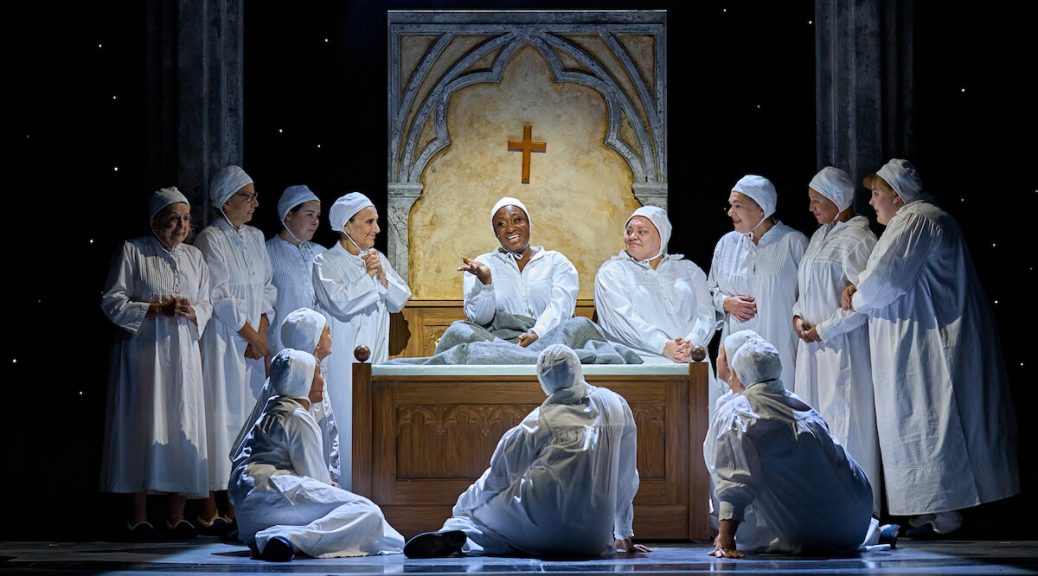
“This is a house of worship” “But this could be bigger than Broadway! Bigger than Vegas!”
The premise behind Sister Act is great: a nightclub singer and gangsters moll on the run after witnessing a murder finds sanctuary in a convent and turns good while transforming their choir from a discordant mess to angelic sweetness. There is plenty of room for farce and slapstick in here and a thrilling ending to go with it.
There are some excellent parts to this production, especially the singing, as you may expect from Sandra Marvin as Deloris, Lizzie Bea as Sister Mary Robert and more surprisingly from Clive Rowe as Steady Eddy who stole the show a couple of times. There is a nice line in humour and some great costuming and choreography. The set is imaginative and the change from nightclub to convent to police station and back again is slick. Leslie Joseph is both assertive as she dictates what she expects of the order yet vulnerable as she sees firstly her church community and then the sacred traditions threatened by modernity and the whirlwind that is Deloris.
As this play is based on the 1992 film of the same name, there are some tough acts to follow. Does this play manage to recapture the appeal of the film? I have heard some people bemoan the fact that the music is totally different, but this underestimates the quality of the songfest here.
However, from memory, one thing the film did well was get a good balance between respect and parody. Like all institutions, the church should be open to being satirised but they are entitled to be represented fairly as well. I am not sure the play does this as successfully as the film. I was not convinced with a lyric from the mother superior that questioned whether God existed. In addition, the lyric where the young novice expressed the desire to choose rather than to obey misses the point which is that the monastic life is one where you chose to obey. In both these examples the musical seems to underestimate the power and depth of personal devotion.
The limited scope of the stage compared to the film set also precluded the emphasis on service to the community which was a major feature in the original and is something that any faith community should seek to do. However, there was a willingness to debate the relative merits of a materialistic and spiritual lifestyle and plenty of respect was paid to those who have taken the vows of a nun. Whenever a play has some gentle moralising, it is important to get these social issues comments correct.
However, such criticism is perhaps unfair on a production that is primarily a musical show with a happy ending. In this light, the play is highly successful. All in all, this was a good nights entertainment and was warmly appreciated by the sell out crowd.
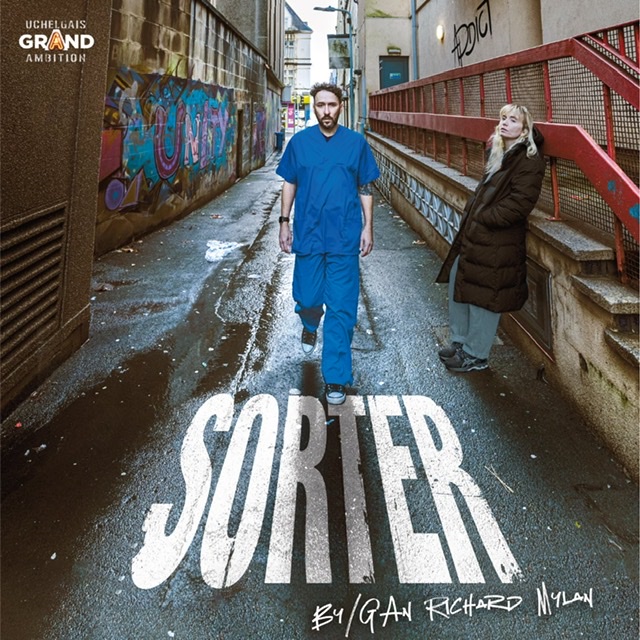
In our latest Playwright interview the Director of Get the Chance, Guy O’Donnell meets Actor and Playwright Richard Mylan, They discuss his career to date, his first play Sorted for Grand Ambition, the companies focus on creativity in Swansea and Richards personal approach to creativity and sharing his life experiences with the wider world.
Hi Richard, great to meet you, many audiences in Wales know you from Theatre or TV, can you tell us how you got started in the arts? I originally trained as a dancer, got into a Lloyd Webber musical where I spent 4 years (which was very much my schooling). Started dipping my toe into acting, loved it- I’ve been an actor over 25 years. Now I co-run the resident theatre production company Grand Ambition at the Grand Theatre, Swansea along with fellow creatives: Michelle McTernan, Steve Balsamo and Christian Patterson.
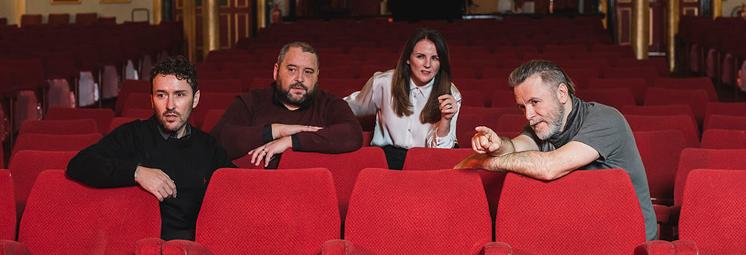
Richard Mylan, Christian Patterson, Michelle McTernan and Steve Balsamo.
We’ve had an incredible first year, we produced a Gala performance to celebrate 125 years of the theatre and ‘A Number’ by Caryl Churchill.
As well as many community outreach projects and the formation of TAG (The ActorsGroup). We’re currently in rehearsals for my debut play Sorter our first original production.
So, what got you interested in the arts?
Rubbish in school- got positive attention for dancing so went with it… It was the gateway really, once I discovered the different forms of dance, choreography- I was hooked. It was my first glimpse of creativity as apposed to learning.
Why do you write?
Sorter is my first attempt at writing. I wrote it to make sense of 20 years of my life as a heroin addict. I was originally going to write it in diary form- just to get it documented & out of my head. But I struggled to write in the first person. Probably because I felt disconnected from it all… or in denial. So I went to a very familiar place as an actor – play form, my lived experience through two characters and when I did that, 20 years flew out of me in three weeks. It was a very cathartic experience.
Can you tell us about your writing process? Where do your ideas come from?
For me it came from real life. Before I began writing I knew the basic structure. I also did A LOT of research. Before I attempted to write real life vicariously, I made sure I was heavily informed. That way, I could deviate from the structure if I wanted to…go with it to a certain extent. Sometimes it was a blind alley, sometimes it was a welcome discovery.
Can you describe your writing day? Do you have a process or a minimum word count?
It’s just structured writing time, but I don’t really have a process as such- or a word count. I’m far more productive if I don’t put pressure on myself.
Do you have a specific place that you work from?
Not really. I can work anywhere as long as it’s an environment where I can focus, but that could be at home with the TV on in the background or a busy cafe. Sometimes life going on around me can put me into a rhythm.
You first play Sorter will premier at Swansea Grand this March. The marketing information for the production states that you wrote Sorter, to “come to terms with your battle with heroin addiction & hope it can lead to a bigger conversation with addictions treated with empathy, dignity & understanding.” has it been difficult for you to share so much of your own personal journey on the page and stage?
I’ve been in recovery for over 10 years so I feel safe enough to explore it all. I’m also incredibly supported by the Grand Ambition team, the staff at the theatre and Swansea Council.
As well as your professional writing debut, Sorter marks the premier production for Grand Ambition a new and exciting creative collective based at Swansea Grand Theatre focusing on a new perspective to capture the arts through the Swansea lens. It’s a collaboration with Swansea Council and Swansea based professional artists – Richard Mylan, Steve Balsamo, Michelle McTernan and Christian Patterson.Why did you and the other creatives involved decide to launch this new company now and what has been the reaction?
We felt that Swansea people should see themselves on stage at the Grand Theatre, their lives and communities reflected in quality work. We also felt very strongly that we could help to create opportunities for those living in/from Swansea. Historically we’ve haemorrhaged creative talent as a city and when you look at our incredible cultural heritage that doesn’t make sense. So we want to add to the brilliant work from theatres & companies like Volcano, Lighthouse, Fluellen etc. We want to bring our collective experience and help to enrich the ecology of venues and output.
What are your future plans for this new company?
To tell Swansea stories, bring new footfall into the theatre, build opportunities for Swansea talent and inspire the next generation of theatre goers and theatre makers.
As well as being a Writer and Actor the public also know you through your documentary Richard and Jaco: Life with Autism. The documentary provided a fascinating insight into your and Jaco’s relationship and the form of autism Jaco lives with known as Pervasive Developmental Disorder (PDD) Both the documentary and Sorter share aspects of your personal life with the wider world, beyond your professional work. Why is it important for you to work in this way and have there ever been times when it’s caused you any doubt?
I’ve always had doubts about sharing my personal life. But its always come from a genuine desire to change the common narrative. It was a joint decision to share Jaco with the world and he’s very glad that we did. But ultimately it was because our experience with Jaco is one of joy, hope and personal learning and growth. I’d not seen any documentaries that reflected that autistic experience.
With my addiction issues it was different because I was carrying it around with me. A huge negative weight that was affecting my mental health. So going public was really about unburdening that weight. But also it was because professional addicts are not generally known about because stigma and the fear surrounding it stops anyone sharing their experiences.
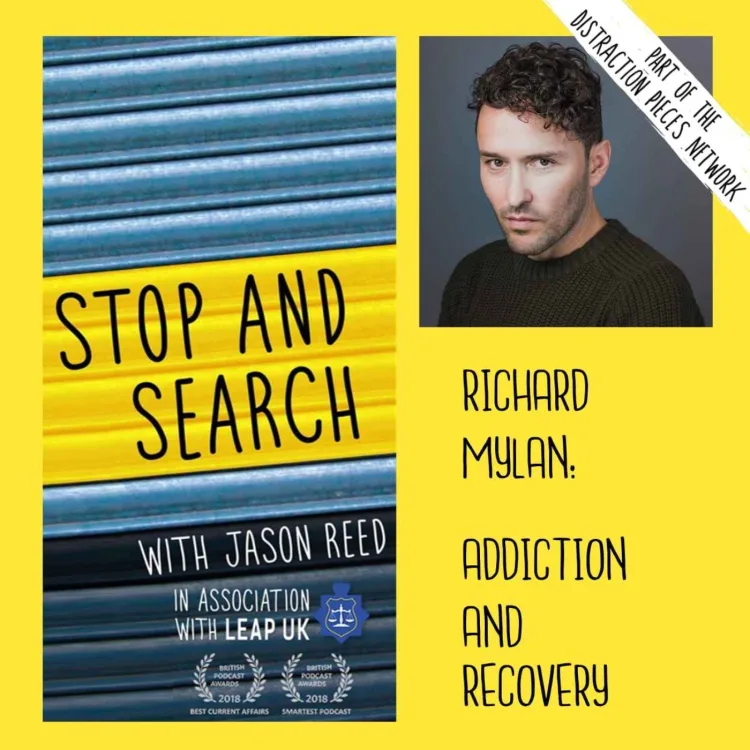
You can listen to Richard sharing his personal journey in the Podcast below from the Stop and Search series. He shares his battle with addiction in hopes that he can raise awareness for other people who may be struggling, and to wipe away the stigma that can often come with addiction. In this special episode we have a very intimate conversation with Richard about his heroin use which lasted twenty years – how and why he got to that place of addiction, and his advocacy for a change of attitudes.
There are a range of organisations supporting Wales based writers. I wonder if you feel the current support network and career opportunities feel ‘healthy’ to you? Is it possible to sustain a career as a writer in Wales and if not, what would help?
It could and should be better. It’s healthy in terms of output but not so healthy in terms of support. Output- because freelance writers are resourceful, determined, used to fighting to support their own ambition by any means. But that’s not sustainable. I think organisations realise this in general terms, but more needs to be done to support our network of writers, from budding to established. I learned a lot from my time with Swansea & District Writers Circle. We can all learn from support networks such as these.
If you were able to fund an area of the arts what would this be and why?
There are many areas of the arts that need funding but In Swansea right now and in Wales, there is a real shortage of technical talent, designers, set builders, stage managers, lighting designers and stage technicians. The infrastructure to nurture talent is there so I would fund grassroots and pathway opportunities.
What currently inspires you about the arts in Wales?
The quality of work currently being made in Wales is a huge inspiration to me. Companies like Theatr na nÓg, Leeway Productions, Sherman, Clywd and then creatives like Hannah McPake, Seiriol Davies, Tracy Harris, Dan Lloyd, Francesca Goodridge, Sophie Melville- the list is long!… they’re all smashing it and inspire me.
What was the last really great thing that you experienced that you would like to share with our readers?
Yesterday during rehearsals. The process of bringing Sorter to the stage is blowing my tiny mind! Every day is a great experience at the moment & I can’t wait to share it with our audiences.
Three theatres removed from Theatres at Risk Register but tough times still ahead, warns Theatres Trust
Theatres Trust, the charity that campaigns to protect the UK’s theatres, has published its annual Theatres at Risk Register, which highlights theatres across the UK under threat of closure, redevelopment or severe decay, but which all have the potential to be revived for their local communities. Theatres Trust has removed three theatres from the list, which are no longer considered at risk due to advocacy, planning and viability advice from Theatres Trust, along with the vital support of their respective local authorities, theatre operators and community groups.
Century Theatre, a unique travelling theatre that toured the country in the post-war years, is now looking more secure in its permanent home in Coalville Leicestershire. It had been threatened by the redevelopment of its site and had been added to the Theatres at Risk Register in 2014, but it is now better integrated into the local area and able to serve the local community with improved facilities.
Walthamstow Granada, a Grade II* listed ciné-variety theatre, had been empty and deteriorating until it was bought by Waltham Forest Council in 2019, with Soho Theatre Company on board as the operator. Having undergone a major refurbishment programme, it will reopen later this year as Soho Theatre Walthamstow, an exciting new London venue offering a mix of comedy, theatre, music and community activities.
The third building to be removed, Swansea Palace Theatre, is a distinctive Victorian music hall that has been on the Theatres at Risk list since it started in 2006. The building will not be reopening as a theatre but as office space, with the ability to accommodate small-scale performances and events. It was evident that there was not the demand in the city to make another theatre viable, so this sensitive scheme by Swansea Council (funded by the European Regional Development Fund and the Welsh Government, via its Transforming Towns programme), protects the building’s historic features and could easily be reversed in the future, making it the best outcome in this situation.
Theatres Trust is advocated for by high profile supporters including Gary Kemp and David Morrissey. Musician, actor and Theatres Trust board member Gary Kemp says, It is fantastic to see three significant theatres being removed from the Theatres at Risk list, as a result of campaigning and advice from Theatres Trust as well as the dedication of councils and local communities. The Theatres at Risk list is about finding the best use for buildings within their communities, so they can be enjoyed for many years to come, and these three theatres are shining examples of that.
Now in its 17th year, the Theatres at Risk Register calls the public’s attention to these important buildings, their challenges, and the significant cultural opportunities they can bring to local communities. Since the list began in 2006, more than 80 theatres have been restored, revived or had a suitable replacement built. This year’s list comprises 38 buildings, which all have strong architectural merit, cultural heritage or value to the local community as a performance venue.
Although they remain on the list, there has been good news for Spilsby’s Sessions House, which is a key project in a successful Levelling Up bid, and for Morecambe Winter Gardens, which will benefit from the same fund in the go-ahead to the neighbouring Eden Project North. Steady progress is also being made at other theatres remaining on the list, including Burnley Empire, Leith Theatre and Theatre Royal Margate, but these theatres face the same challenges as the wider sector, particularly escalating construction work costs and scarcity of funding amidst the fallout of the pandemic, cost-of-living crisis and the energy crisis.
Elsewhere on the list, the situation is looking bleak for Dudley Hippodrome and the Intimate Theatre in Enfield, where redevelopment plans that will lead to their demolition look certain to go ahead despite strong opposition by Theatres Trust and their local communities. Dudley Hippodrome, the only remaining lyric theatre in the town, is on a site approved for a new university centre. The Intimate Theatre, where a number of stars including Richard Attenborough and David Bowie performed early in their careers, will be redeveloped to build a new parish hall and residential accommodation.
No additional theatres were added to the Theatres at Risk Register this year, despite the challenging environment faced by theatres due to the ongoing effects of the pandemic, the cost-of-living crisis and funding cuts and shortfalls. Theatres Trust continues to provide free advice and support with the aim of preventing more theatres from reaching the critical stage of being added to the At Risk list, particularly taking into account the difficult challenges facing theatres this year and the resulting pressures being put on theatre buildings.
Theatres Trust Director Jon Morgan says, As the true impact of rising construction and energy costs, cost-of-living crisis and squeezed council budgets becomes known, the challenge to secure the futures of Theatres at Risk will be more difficult than ever and there is a real fear that more operational theatres may become ‘at risk’. However, despite the difficulties, local support and collaborative working still pays off and the opportunities these buildings offer their communities are immense.
Theatres Trust has recently launched Resilient Theatres: Resilient Communities, a new support and training programme aimed at helping Theatres at Risk and theatres in danger of becoming at risk. This is a three-year project made possible by a grant from The National Lottery Heritage Fund, and funding from the Pilgrim Trust and Swire Charitable Trust. The programme aims to reduce the threat to At Risk theatres and strengthen the sector’s resilience, by supporting communities operating theatre buildings, and communities considering taking over a theatre building.
The theatres appearing on the 2023 register are as follows:
Creating opportunities for a diverse range of people to experience and respond to sport, arts, culture and live events. / Lleisiau amrywiol o Gymru yn ymateb i'r celfyddydau a digwyddiadau byw

 (4 / 5)
 (5 / 5)