What is striking about Welsh play Imrie is its richness. Rich in language. Rich in description. Rich in lighting. Rich in characterisation. This coming-of-age story is like a rainbow bursting into life, pouring its colour out on stage with a vibrancy that reverberates throughout the whole production. Each element resembles a charged particle which, in collision, drives forward a powerful narrative about identity and belonging. It is a tour-de-force in aesthetics, as well as telling of its message.
Credit: Mark Douet
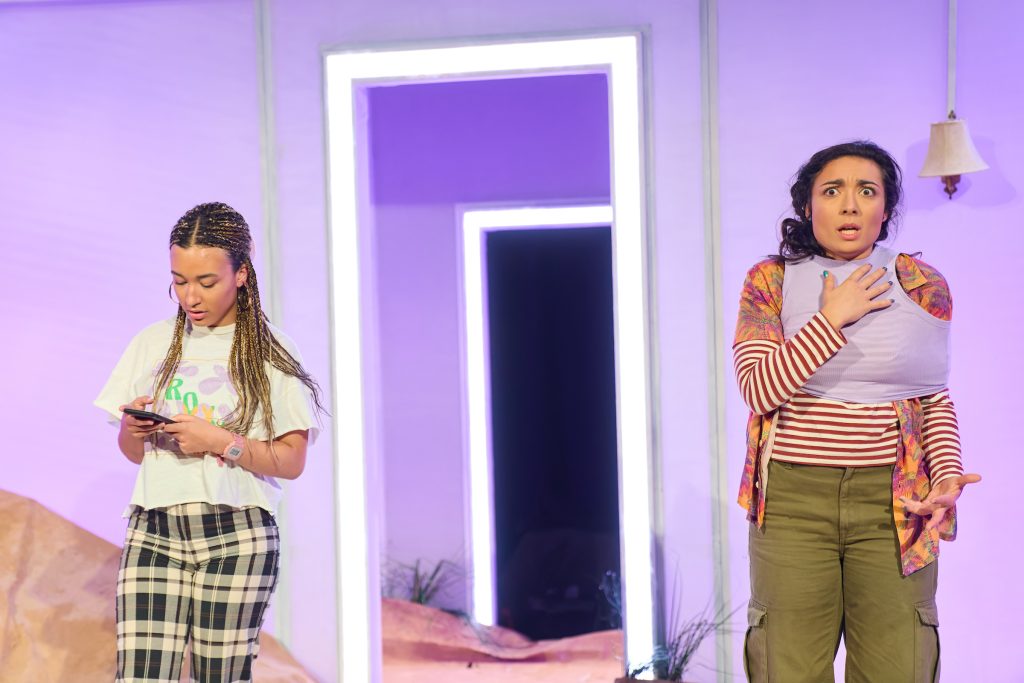
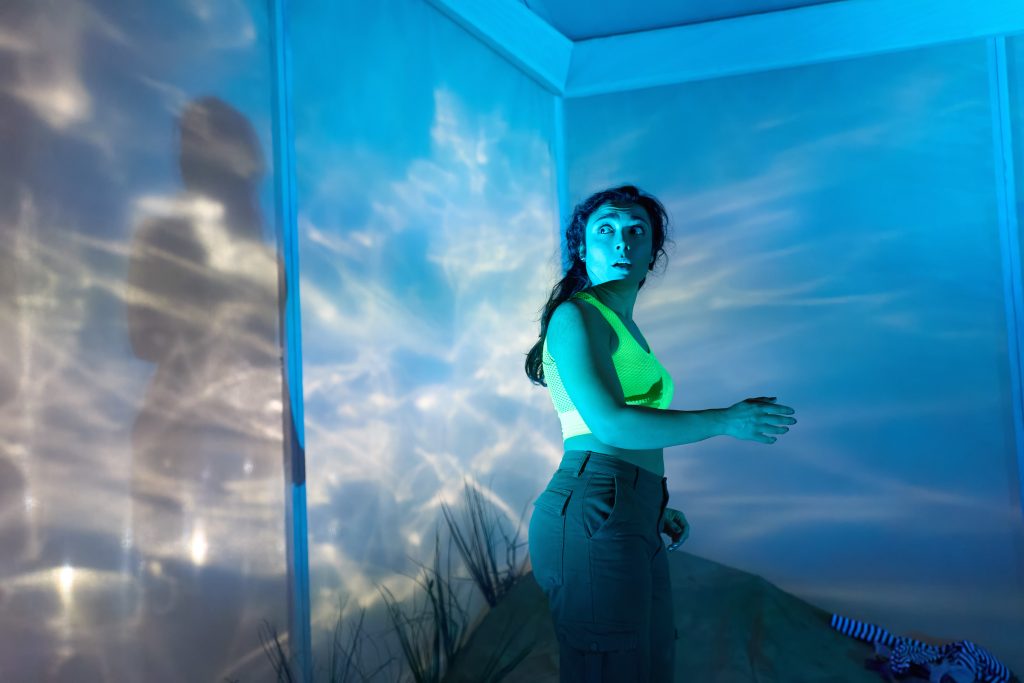
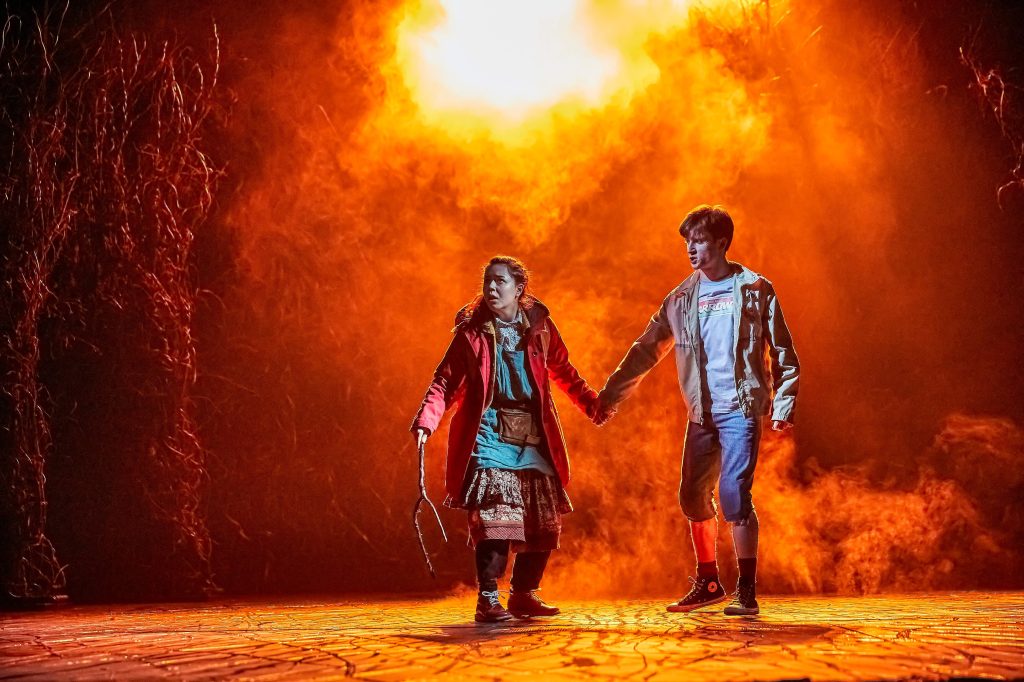
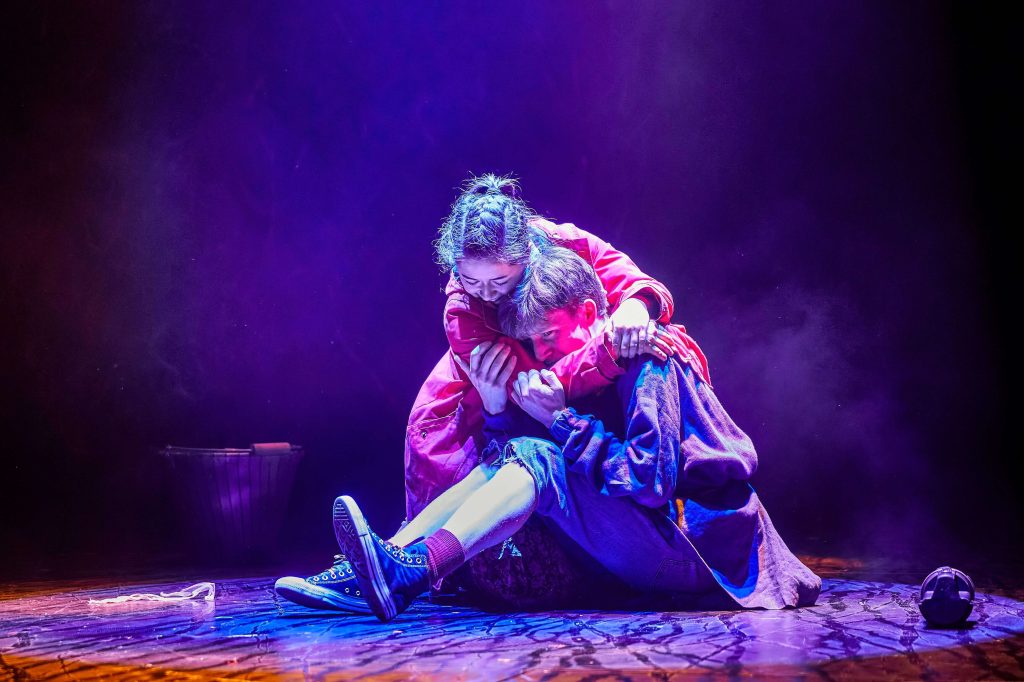
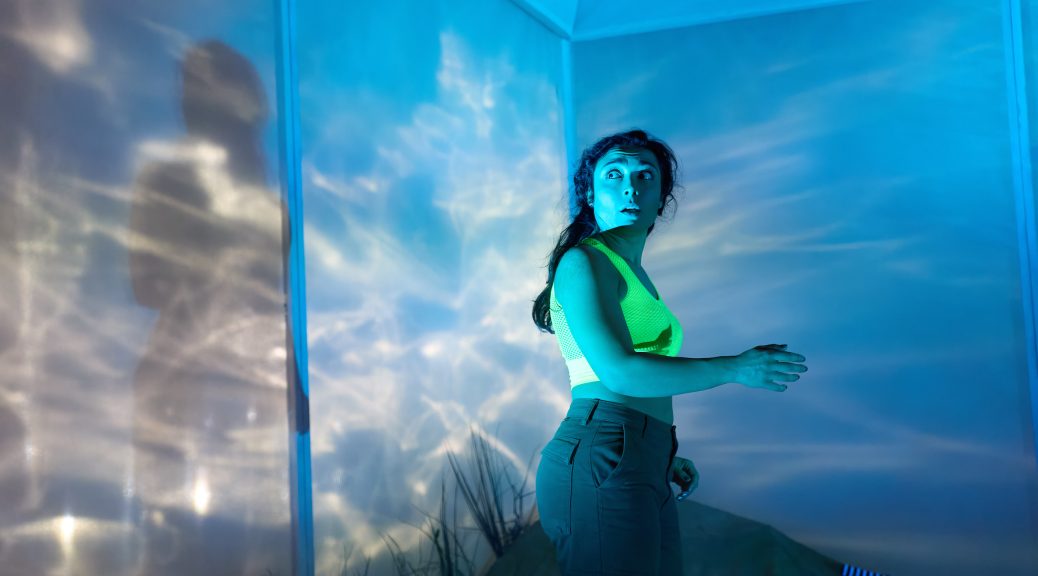
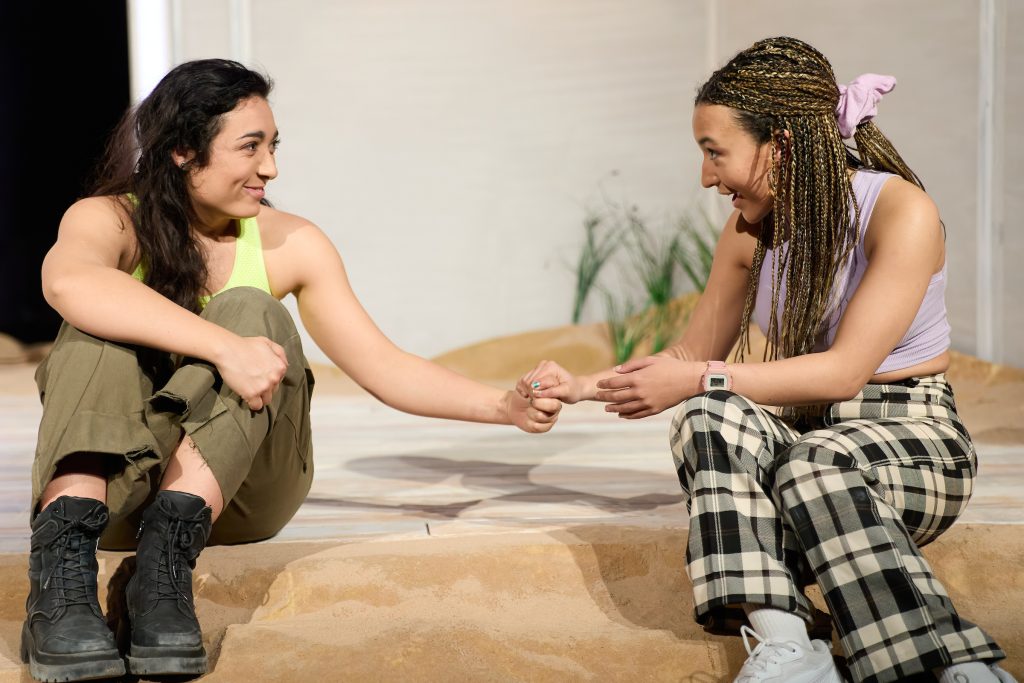
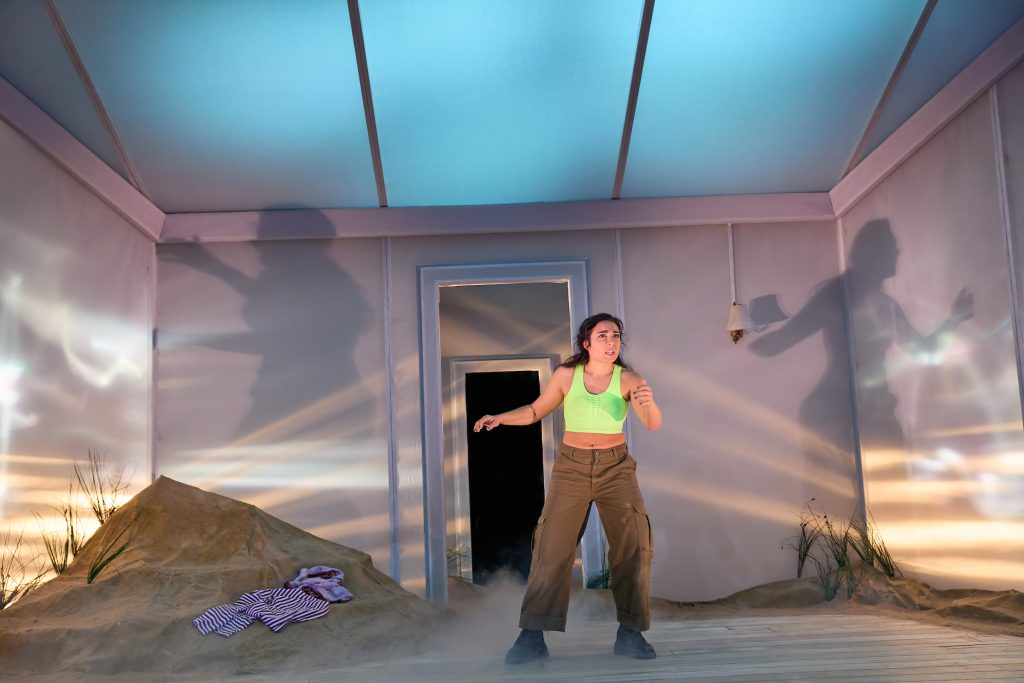
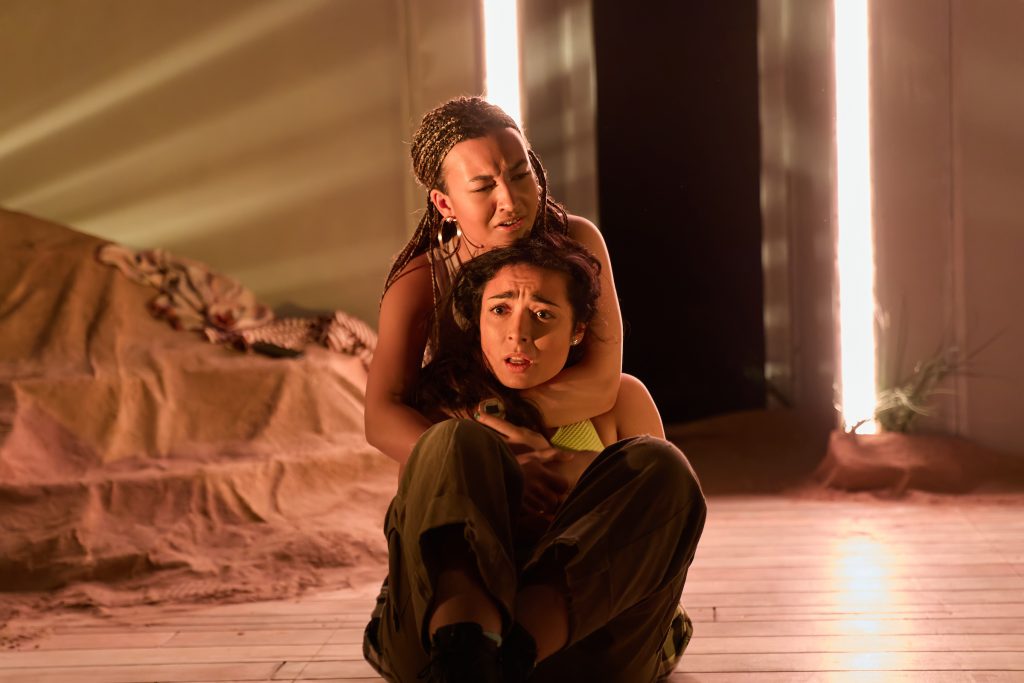
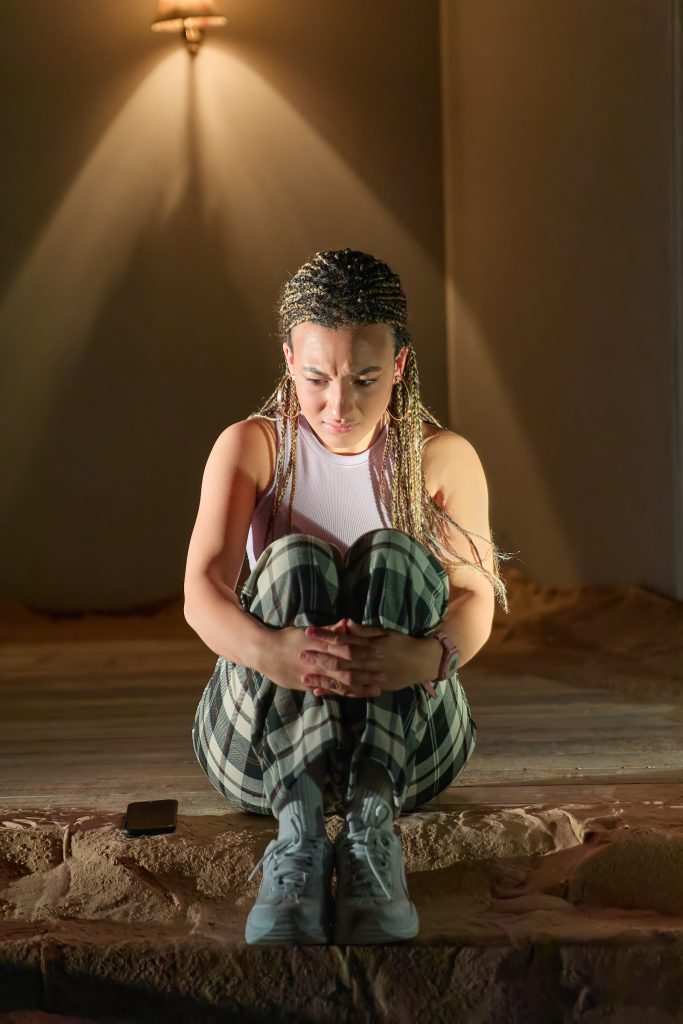
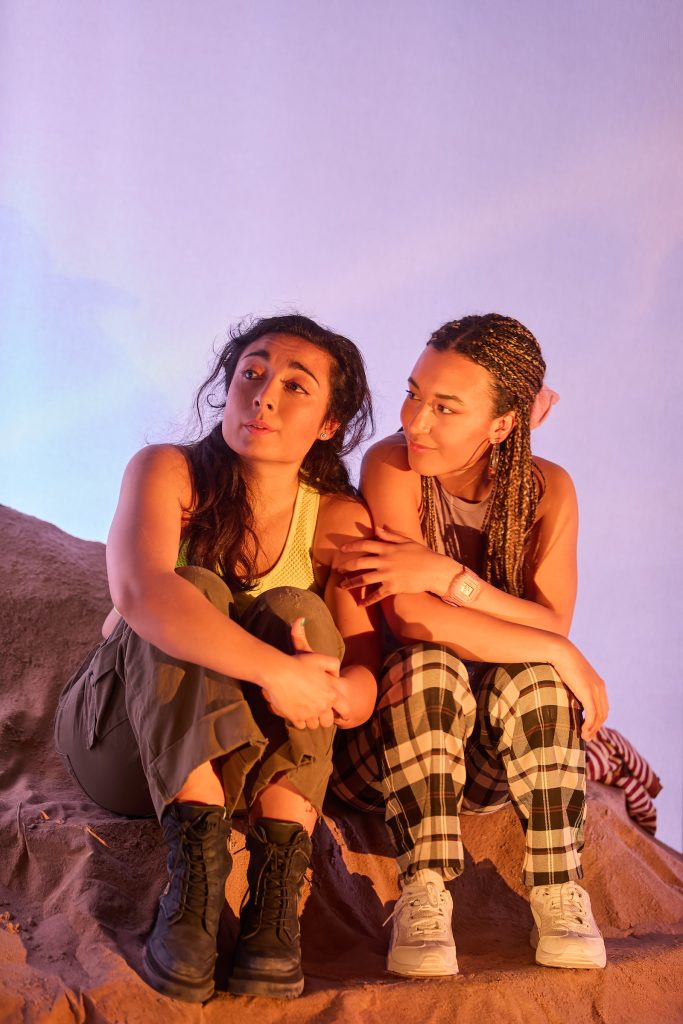
Elan Davies and Rebecca Wilson take on the roles of Josie and Laura in this two-part drama. They are half-sisters seeking to fit in in their own ways. It begins with Laura dragging Josie along to a party on the beach, she wanting to become one of the ‘in’ crowd while her sibling would rather be elsewhere. So while the former attempts to act ‘normal’, the latter runs off, after being made fun of, and finds herself alone with only the sea for company. And when from the water she hears a voice calling, a journey into an otherworldly tale takes place. This ethereal experience is captured brilliantly by the lighting that shimmers and shapeshifts across the three walls of the enclosed set. But it is also the flexibility and freedom of Davies’ physicality that produces beautifully an event which exists between the real and the imaginary.
There are parallels with Caryl Lewis’ recent novel Drift, particularly in relation to the female protagonist. Along with Disney’s Turning Red and The Little Mermaid, it is fair to say that writer Nia Morais has tapped into something bigger with Imrie. Certainly, that desire to break free from the expectations of family and (patriarchal) society burns strong here. To tie it in with the theme and symbol of water gives it a weight that bears down on the scale of contemporary classic. Its relevance is shored up by its exploration of sexual and racial identity. In particular, the conversation between the two characters at the end is thought-provoking, challenging and inspiring in its interaction with intersectionality. This is a further facet to the richness of Imrie, whose immersive soundtrack wraps the audience in its atmospheric tones which, along with the Welsh language, contributes to a mythic quality. Its basis in Cymraeg also adds a poetic lyricism to the dialogue which, though stereotypical, actually strengthens its value as a cultural expression of (self-)acceptance.
Credit: Mark Douet
Most definitely driven by Frân Wen’s passion for young people, when coupled with the Sherman’s support for innovative new Welsh writing, Imrie becomes a bold piece of theatre. Its message may be common but at its heart is an imagination that beats with such originality that it feels fresh. Celebratory of life, even as it depicts its struggles, Imrie reveals something of how identity blossoms, arising out from the depths to become all that we are, rich in colour. A play to be enjoyed whatever age you are.
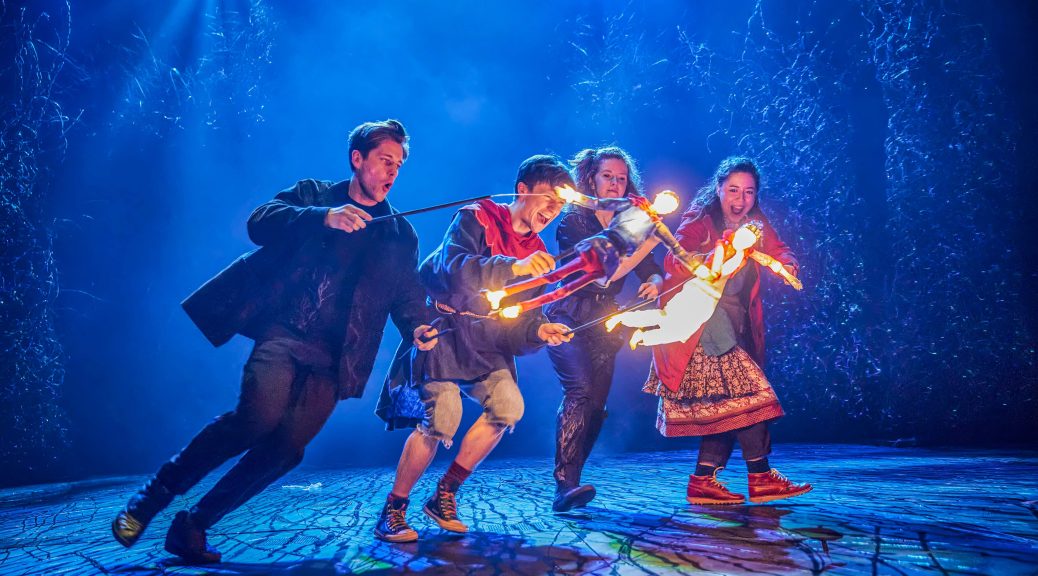
Part of an extensive bibliography, Neil Gaiman’s 2013 novel The Ocean at the End of the Lane escaped adaptation until previews for this play began in December 2019. A successful West End run, and Olivier nominations, followed to culminate in a UK and Ireland tour. In bringing Gaiman’s famous imagination to life, friendship, storytelling, and family are central to an epic, magical tale of a childhood once forgotten and the darkness lurking at its edges.
Following the clearly creepy visuals of Henry Selick’s Coraline (2009) and the excellent chemistry between Michael Sheen’s Aziraphale and David Tennant’s Crowley in Good Omens (2019), The Ocean at the End of the Lane presents unique challenges to theatre makers. Director Katy Rudd, Adaptor Joel Horwood, and cast tackle fantastical and gritty elements with equal sincerity resulting in an evening of spectacle, relatability, and stunning visuals enhancing the original material.
Keir Ogilvy brings a sensitive and well-meaning 12-year-old boy to life. It is a difficult age at which to understand why, in the aftermath of his mother’s death, his Dad (Trevor Fox) burns the toast and brings in a lodger, forcing him to share a room with his energetic little sister (Laurie Ogden). All that before said lodger kills himself in the family car. Ogilvy keeps the boy grounded, but questioning and immovable whilst open-hearted as he discovers his wit and bravery along the way. Ogilby and Fox share many expertly gut-wrenching scenes ensuring the audience cannot look away for a second.
Millie Hikasa (Lettie) and Keir Ogilvy (Boy)
Millie Hikasa is a standout as Lettie Hempstock. This production emphasises Lettie’s mysterious complexities whilst keeping her immediately recognisable to all who know girls like her, want their girls to be like her, or are girls like her. Hikasa packs Lettie with undeniable charm, courage, creativity, and tenderness to provide a comforting presence throughout. Alongside Kemi-Bo Jacobs as Ginnie Hempstock and particularly Finty Williams as Old Mrs Hempstock, their clan sit as both the heart and levity of the show, gently guiding both boy and audience through darker, complex fantastical elements.
Millie Hikasa (Lettie) and Keir Ogilvy (Boy)
Charlie Brooks provides an effortless spine-chilling edge to this production as Ursula, both in her actions and the hard truths she perceives. Brooks and the tight, talented ensemble are at the central to the play’s more theatrical, fantastical elements but to describe them would be a spoiler. This production is perfect for fans of theatre magic and illusion using puppetry, movement, set, prop, and lighting design to truly elevate an already captivating performance.
Keir Ogilvy (Boy), Finty Williams (Old Mrs Hempstock) and Millie Hikasa (Lettie)
It is unfortunately often the case that the soundtracks of straight plays fall under the radar, or are not utilised. However, Jherek Bischoff’s compositions and Ian Dickinson’s sound design ensured the soundtrack sat in equal measure with all other elements of this production. You will leave the theatre wanting to listen to this soundtrack as much as any musical production.
This production features theatrical narrative and design imaginative and beautiful in equal measure. There truly is something in this show for everyone, especially young and old. Particularly, anyone interested in the creation of captivating theatre design should not miss their chance to see this show!
The Ocean at the End of the Lane is playing at the Wales Millennium Centre from 30 May – 3 June 2023. More information on the show and how to book tickets here.
What does it mean for a writer to be great? Is it measured by the amount of work they produce, or its quality? The way they are perceived by others, or how they see themselves? Perhaps ‘greatness’ is just the lie of venerating a ‘chosen’ few; a lie which inch by inch lifts that glass ceiling ever higher.
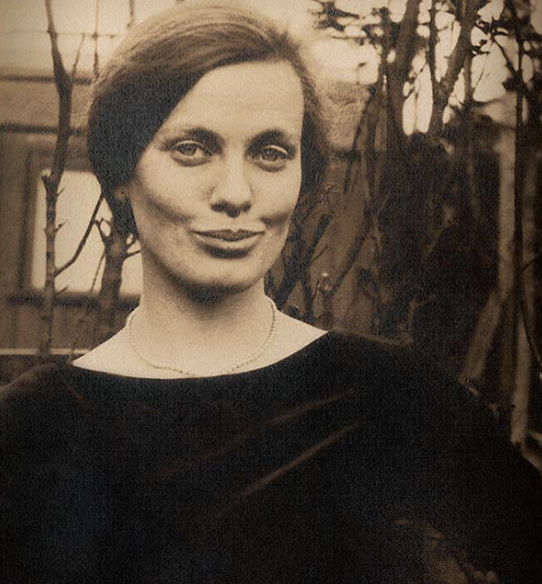
One of the few pictures that survive of Dorothy Edwards
By these metrics, a voice as brilliant as that of Dorothy Edwards (1902-1934) is lost in the maelstrom of literary machismo. The black sheep of the Bloomsbury Set, she was raised by firebrand radicals in South Wales and yet somehow dislocated from her working-class roots (she attended Howell’s private school, if on a scholarship, and later studied Greek and Philosophy at Cardiff University). In the London scene of literary greats like Virginia Woolf and E.M. Forster, she was the ‘Welsh Cinderella’, raised from the pits of the Valleys into dazzling notoriety in her own lifetime – but after her death, her books went out of print and her suicide note became her most cited work.
Angharad Matthews in A Beautiful Rhythm of Life and Death. Image credit: Noel Dacey (@noeley2510)
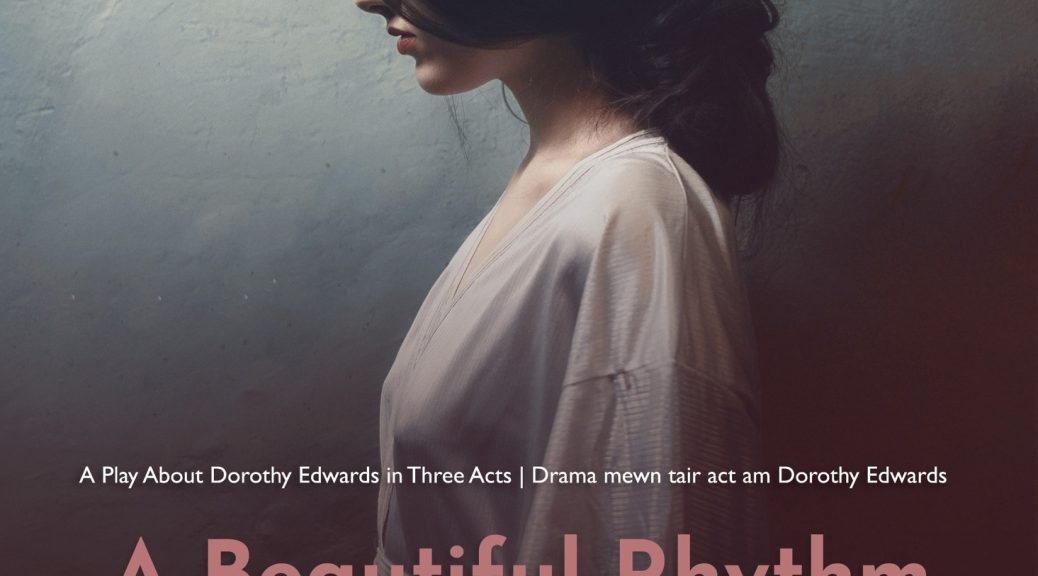
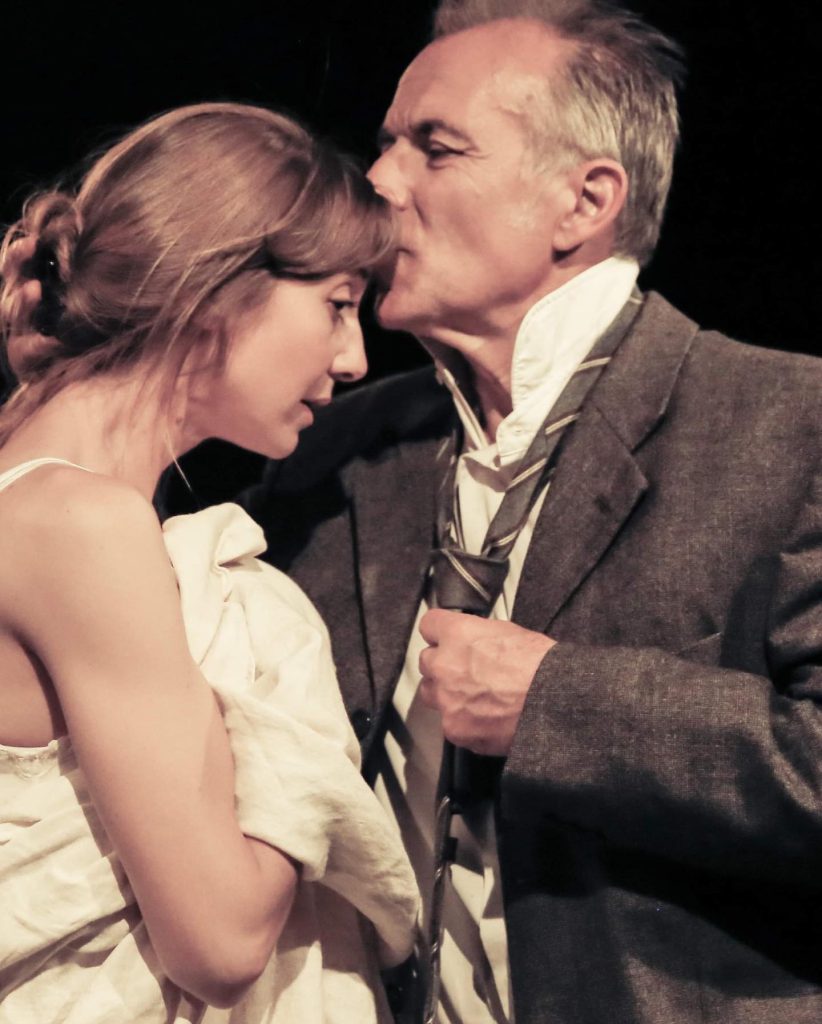
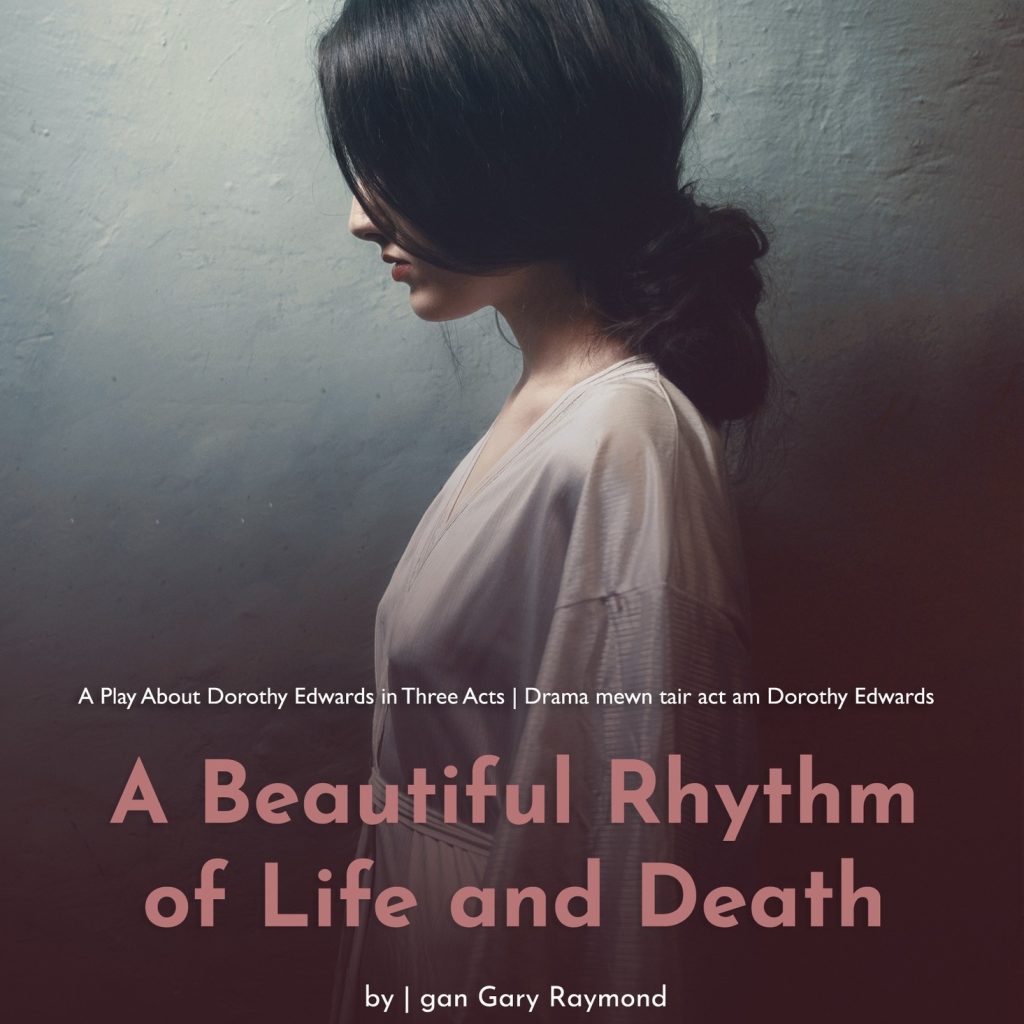
It is this complicated legacy that Gary Raymond’s new play sensitively examines. Directed by Chris Durnall, ‘A Beautiful Rhythm of Life and Death’ starts at the end of Dorothy Edwards’ life and moves backwards through twin storylines: in the past, Dorothy (Angharad Matthews) is inducted into London’s writing elite by David Garnett (Jâms Thomas); in the present, actors Meg and Byron, also played by Matthews and Thomas, debate how best to bring her story to life.
Writer Gary Raymond (left) and director Chris Durnall (right)
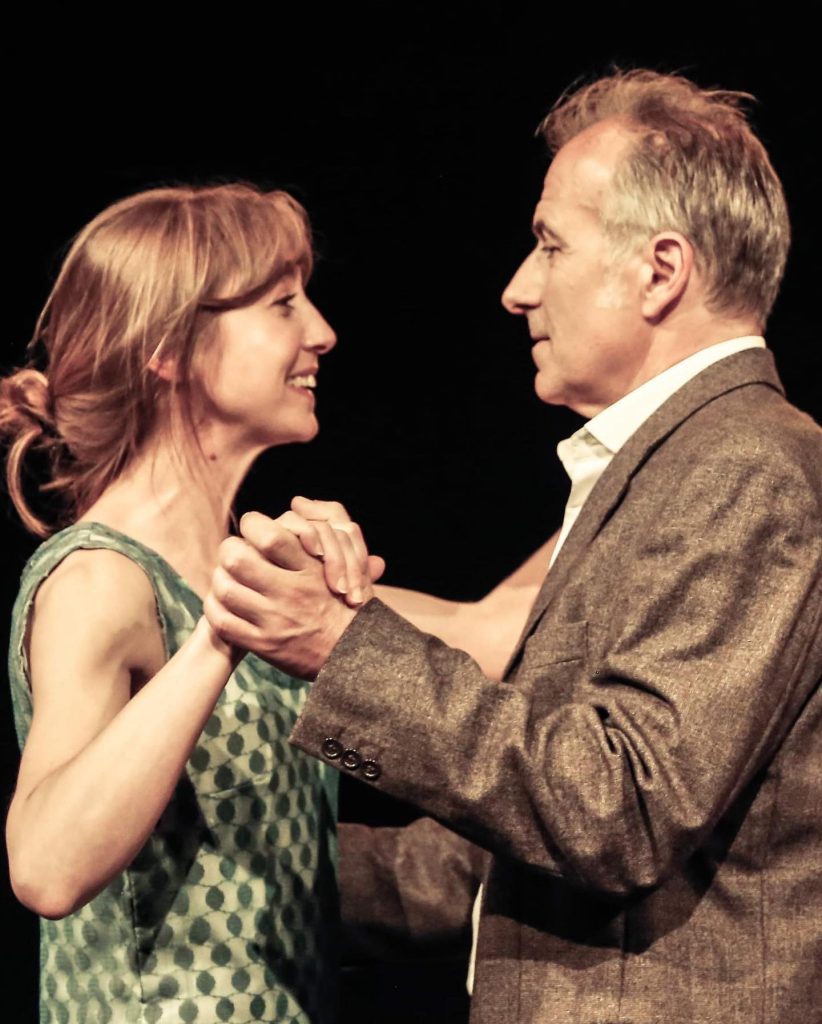
The play’s title – taken from a line in Winter Sonata (1928), her only novel – is an apt description of the drama, which toys with musical and emotional tempos. Matthews and Thomas are captivating, playing a convivial game of cat and mouse in which you are never quite sure who is hunting who. Thomas is equal parts charming and chilling as the Svengali-esque Garnett, who always seems to place himself physically higher in the space than his ‘ingenue’. While he might have benefitted from the same costume flourishes given to Dorothy (e.g., adding braces and a waistcoat for extra texture), Thomas’ performance is nothing short of transformative.
Angharad Matthews and in A Beautiful Rhythm of Life and Death. Image credit: Noel Dacey (@noeley2510)
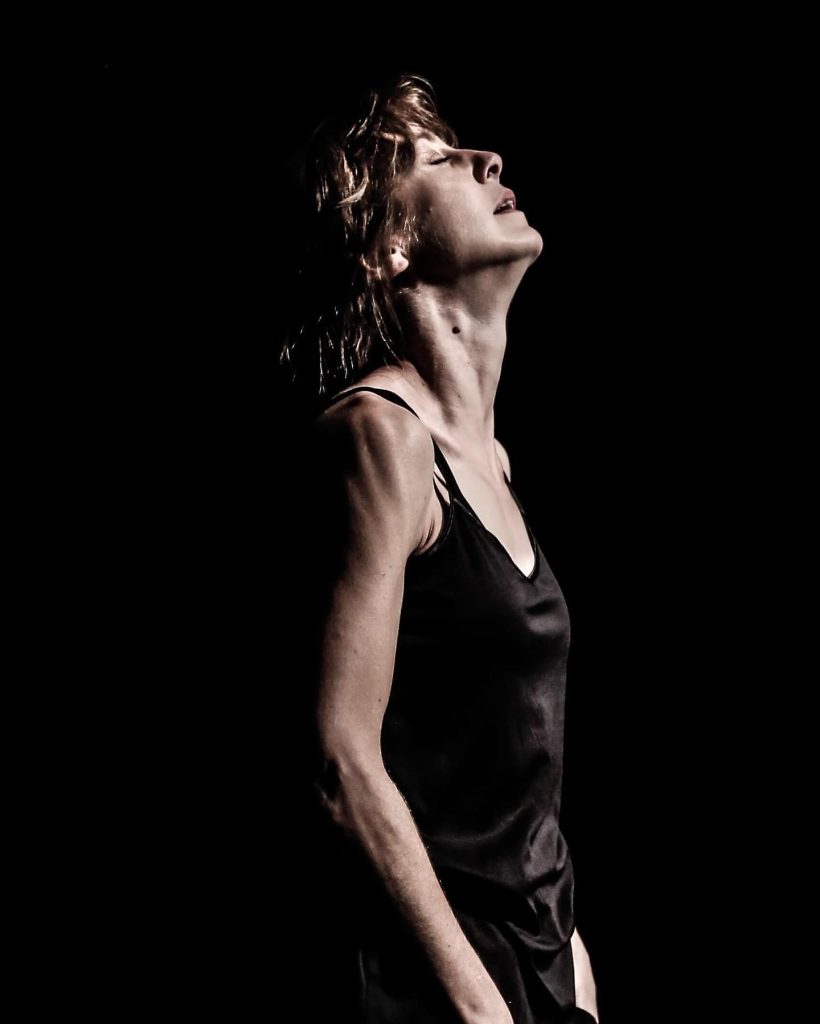
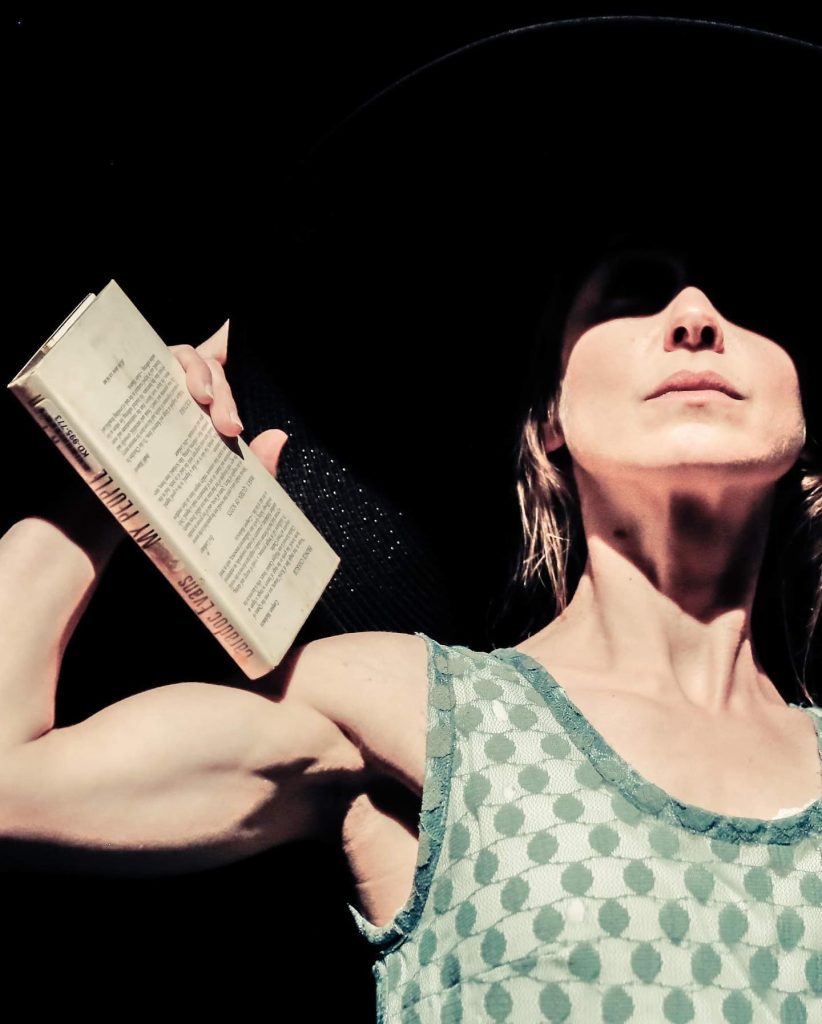
Matthews is radiant as Dorothy, a flame who refused to dim her glow. There is a quiet defiance to her performance that embodies the stoic passion of Edwards’ heroines; women who were pushed to the margins in the interwar period. She was an outsider even among the bohemians of Bloomsbury, whom another famous Dorothy (in this case, Parker) said ‘lived in squares… and loved in triangles’. Dorothy’s affair with a married cellist, her engagement to her Philosophy Professor, working as live-in carer for Garnett’s son: all of these relationships blur boundaries; triangles on triangles, like the sonata form which underscores Dorothy’s work. Even the stage – a square room with its triangle of wooden decking – plays with geometric shapes. The fact that it is designed by Matthews means that we are watching two hidden architects at work.
Angharad Matthews in A Beautiful Rhythm of Life and Death. Image credit: Noel Dacey (@noeley2510)
And she pulls the strings from the very start. The live score by the luminous Stacey Blythe manifests Dorothy’s melodious thought processes: but as Matthews descends the steps for the first time, she slams down on the keys. This is her story, after all – at some points, she strides out in front of the audience and stares us down, as if daring us to forget it. Raymond’s soulful script, and Matthews’ lyrical performance, convey Dorothy’s abiding love for words: their codes and cadences, the way that just 12 notes and 26 letters can capture all the beauty and chaos of the world.
Angharad Matthews in A Beautiful Rhythm of Life and Death. Image credit: Noel Dacey (@noeley2510)
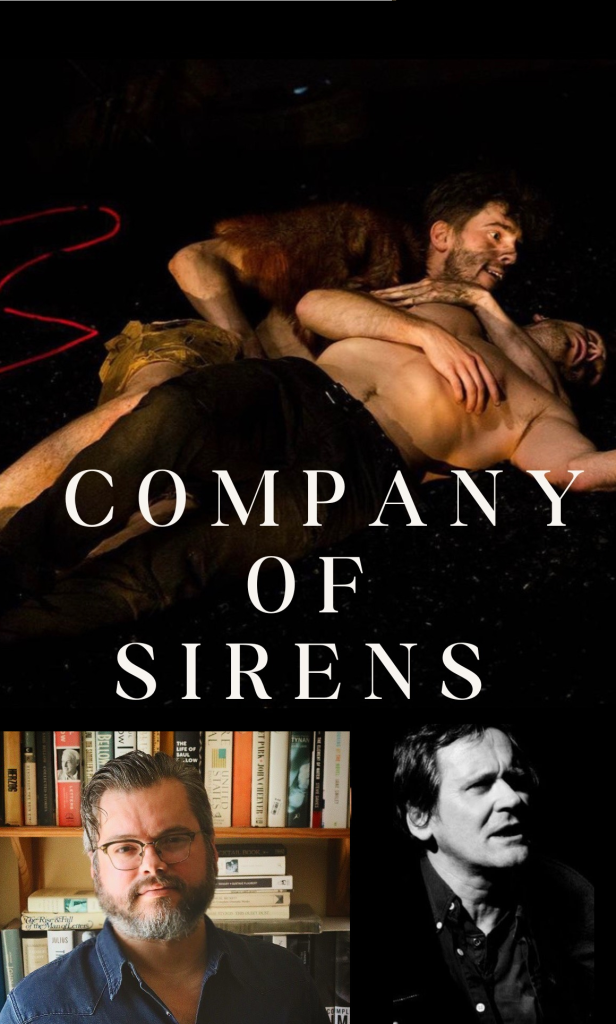
Durnall’s direction is a live if invisible thing: kinetic and coy, like the current that pulls a river. David and Dorothy circle each other, dynamics shifting, power crystallising. The sense that she was always thinking, always writing, with pen in hand or not, is ever-present, especially in the vibrant second act. Writing is her pole star: while people flit in and out of her life, that love never leaves her. Company of Sirens have worked their magic once more, and never is this clearer than in the exquisite closing scene, in which Dorothy finds true synthesis with another Welsh wordsmith (Glyn Thomas, author of The Dragon Has Two Tongues). It is an effortless coda that leaves Dorothy at a moment of pure synthesis. It is a slip of linen on the breeze; a single sustained note, that carries on even when darkness falls.
A Beautiful Rhythm of Life and Death is produced by Company of Sirens in collaboration with Chapter and Arts Council Wales, and performs at Chapter through 3 June. There are BSL-interpreted and audio described performances, and one matinee: more information and how to book tickets here.
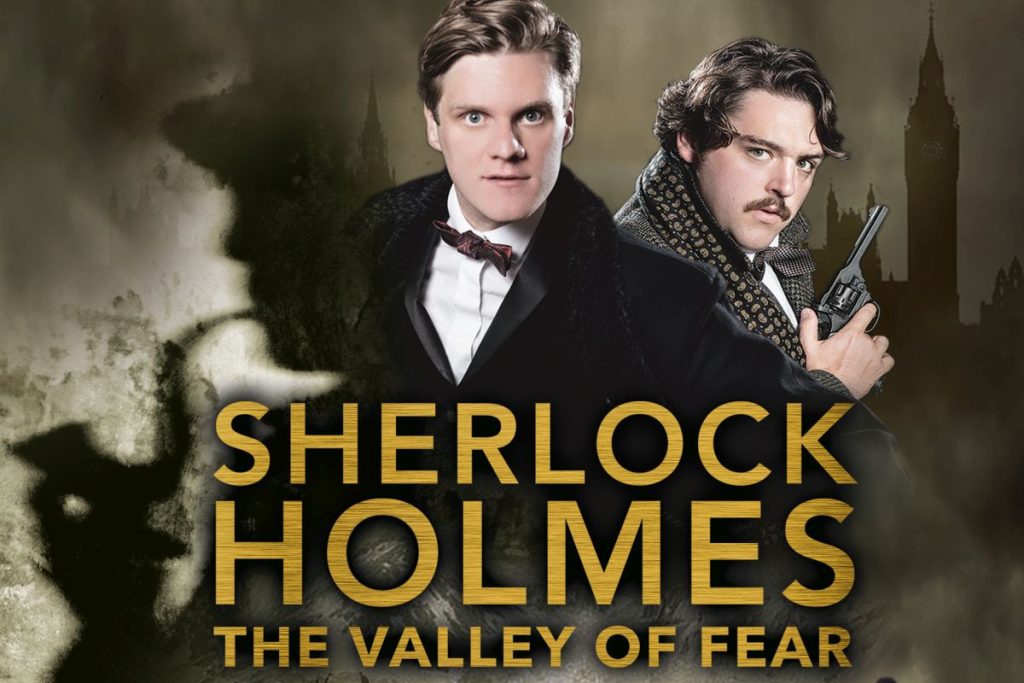
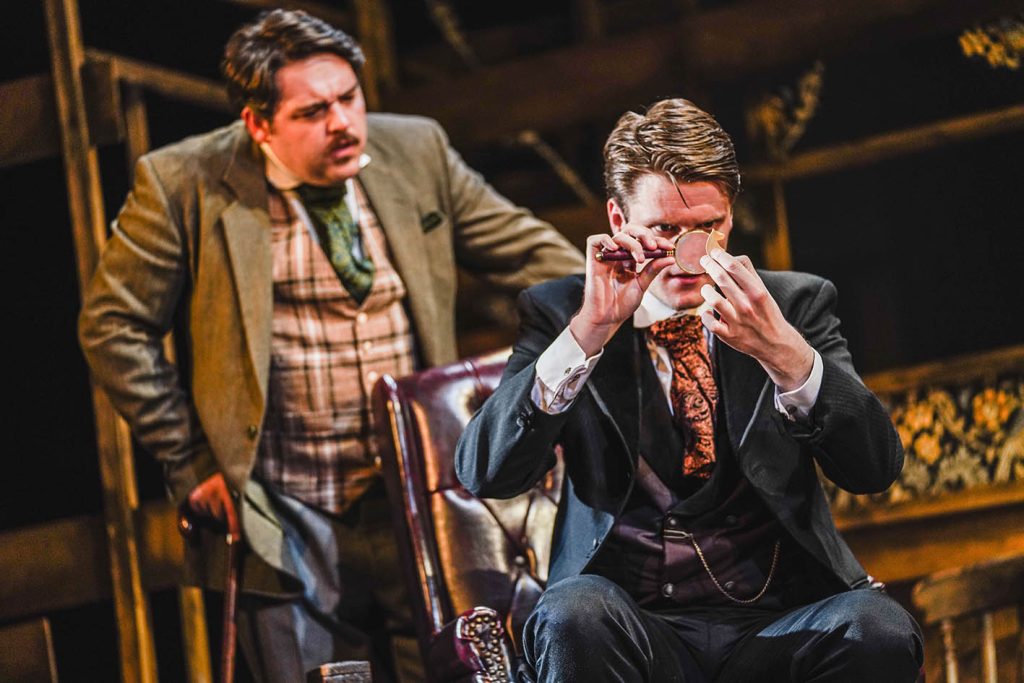
Whether it’s Benedict Cumberbatch and Martin Freeman, Robert Downey Jr. and Jude Law, or even Basil and Dawson from The Great Mouse Detective, everyone has their own definitive ‘Holmes and Watson’. And I can safely say that, after watching Blackeyed Theatre’s interpretation of the dynamic duo, theirs has become mine.
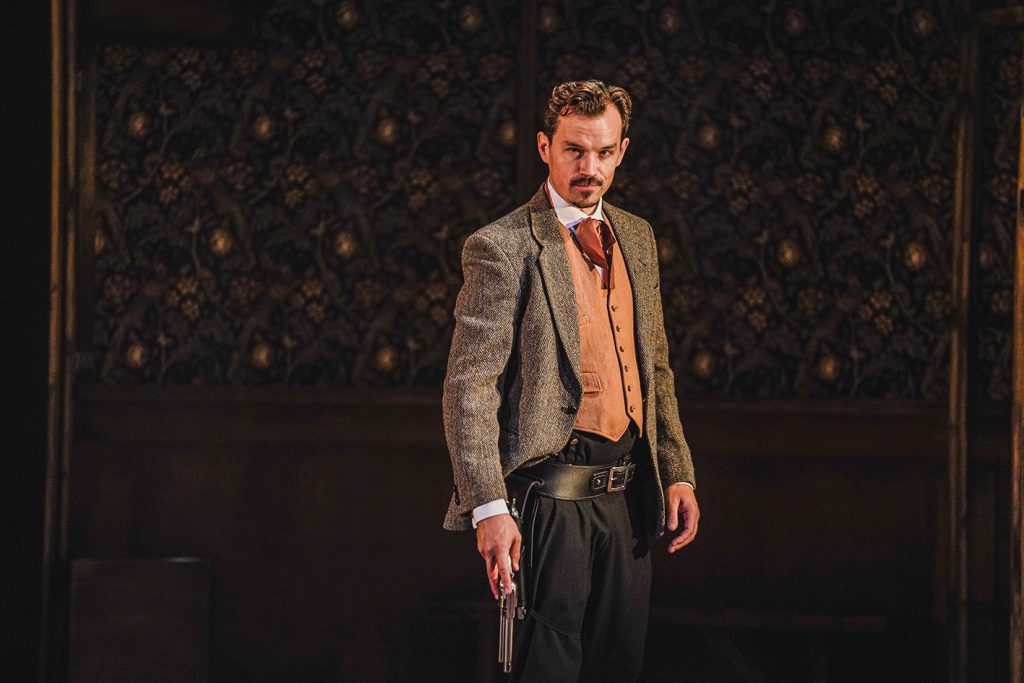
Luke Barton in Sherlock Holmes: The Valley of Fear. Image credit: Alex Harvey-Brown.
After his first appearance in 1886, Holmes quickly became a household name. 56 short stories, four novels and countless film, radio and television adaptations later, Arthur Conan Doyle’s iconic consulting detective has become one of the most successful fictional characters ever – so popular that he was resurrected from the dead by public demand!
Luke Barton and Joseph Derrington in Sherlock Holmes: The Valley of Fear. Image credit: Alex Harvey-Brown.
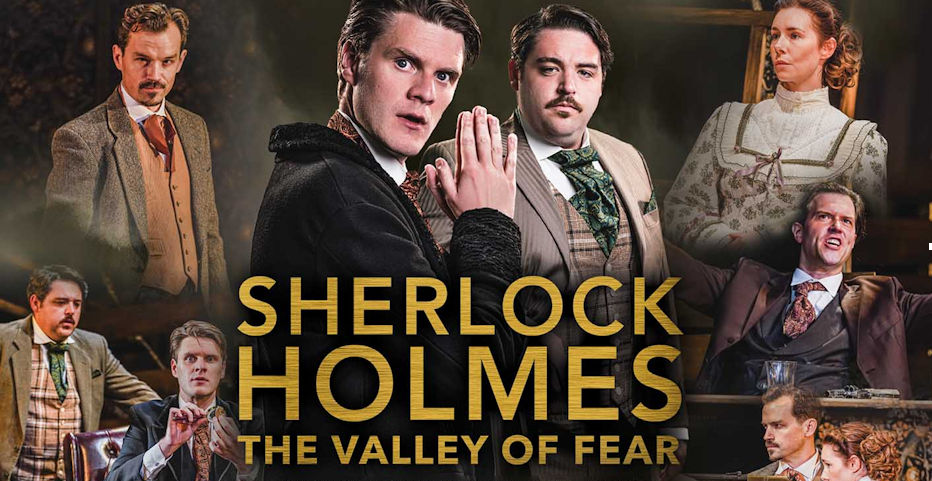
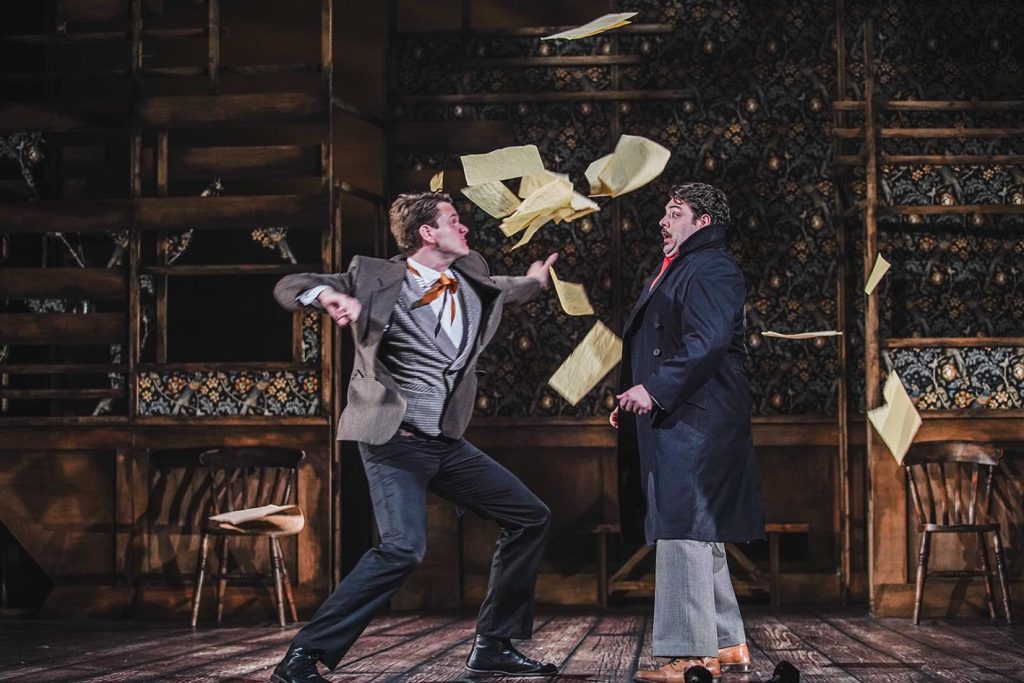
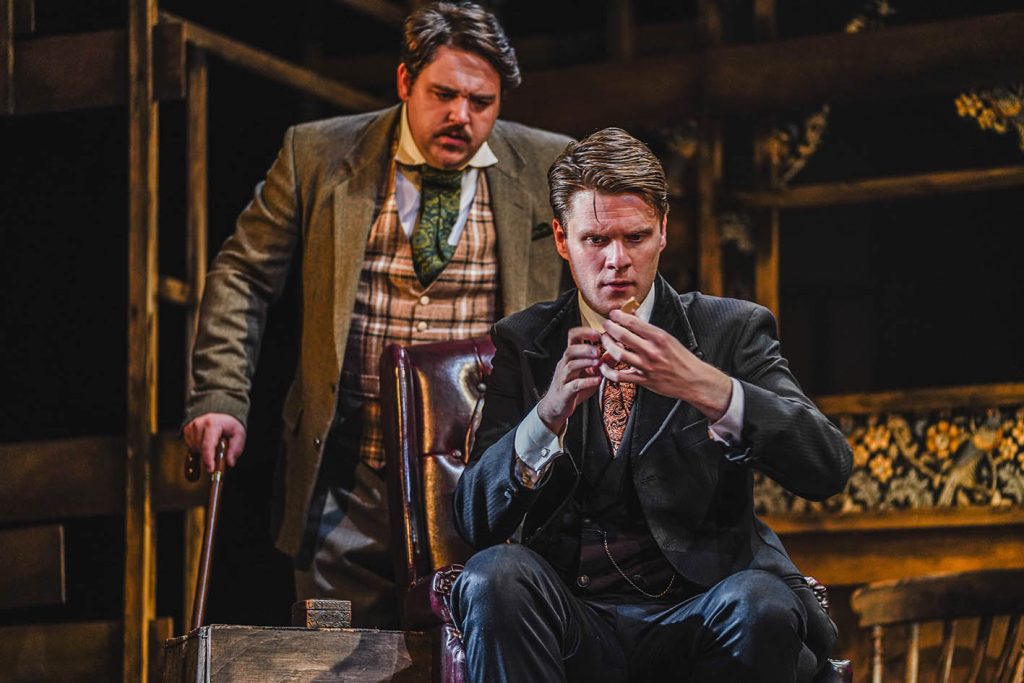
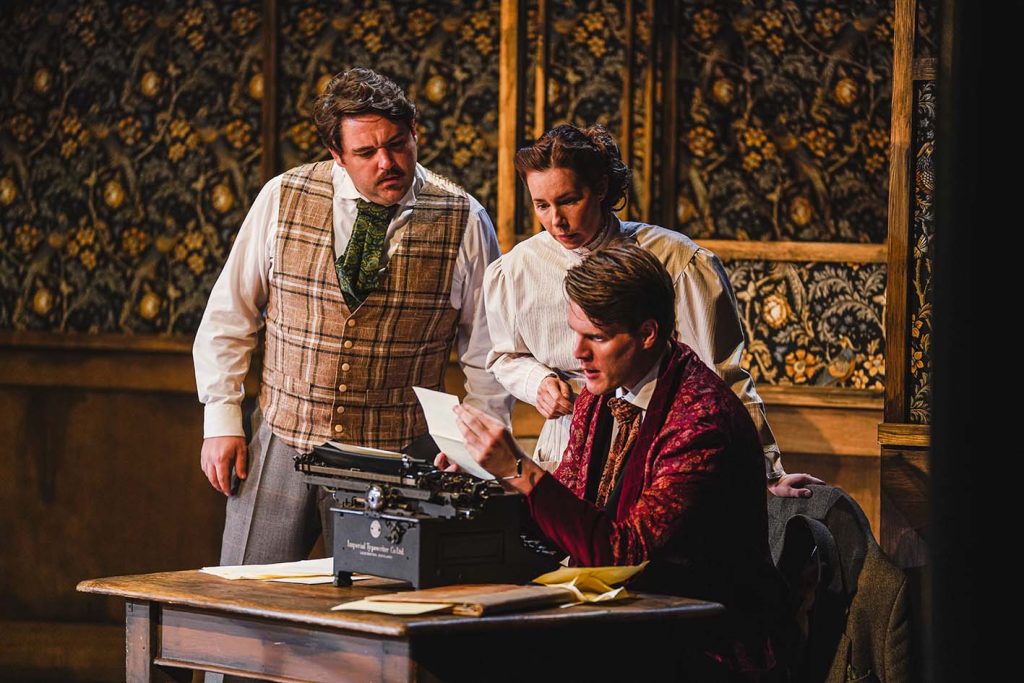
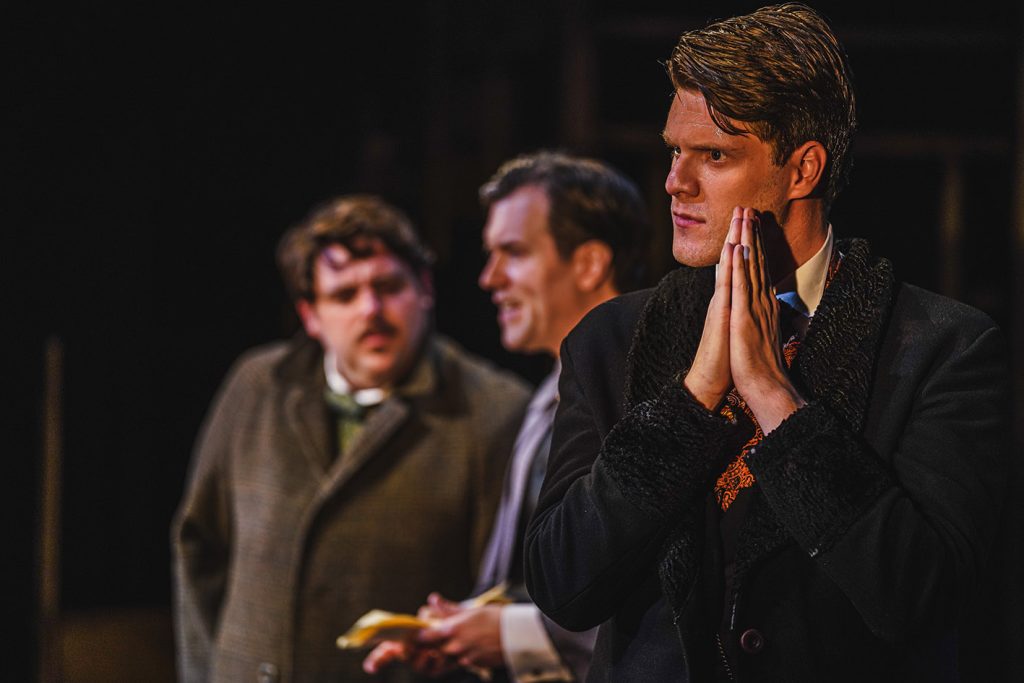
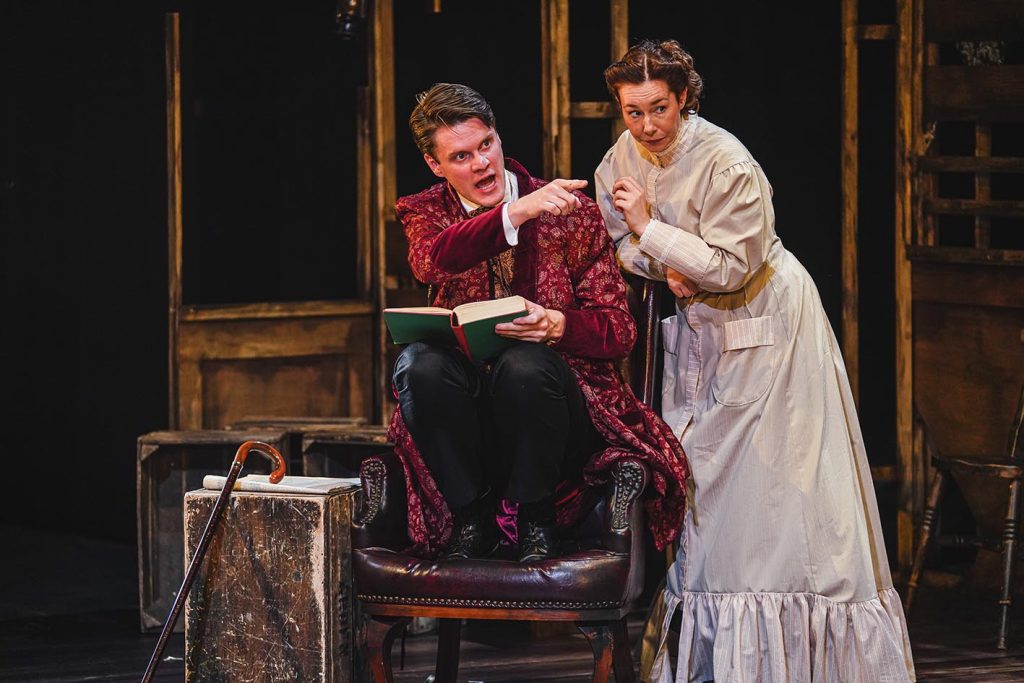
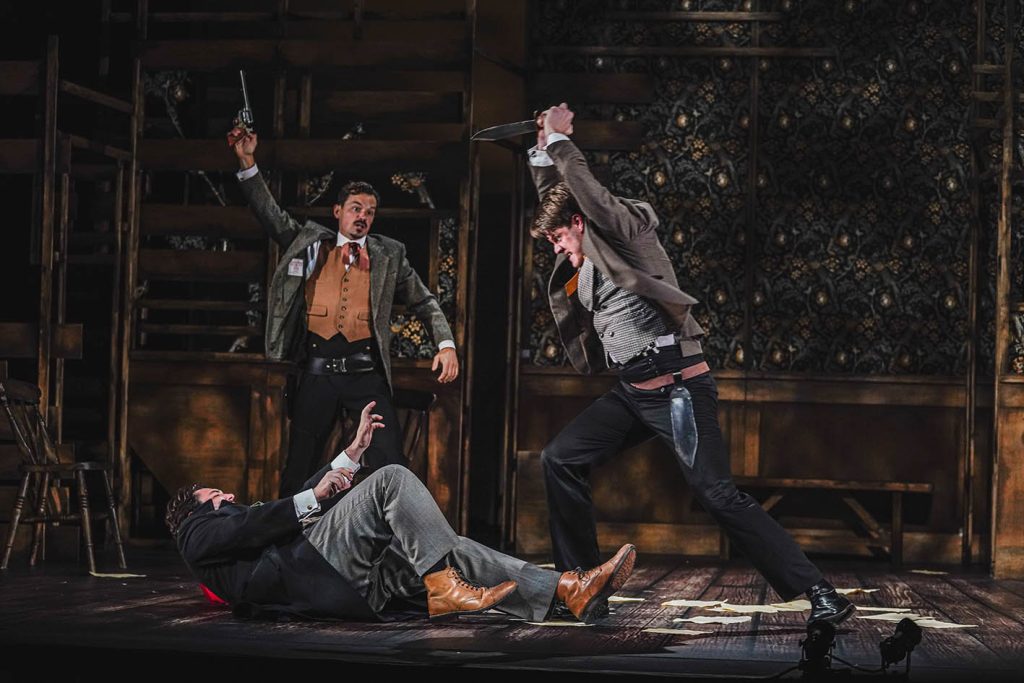
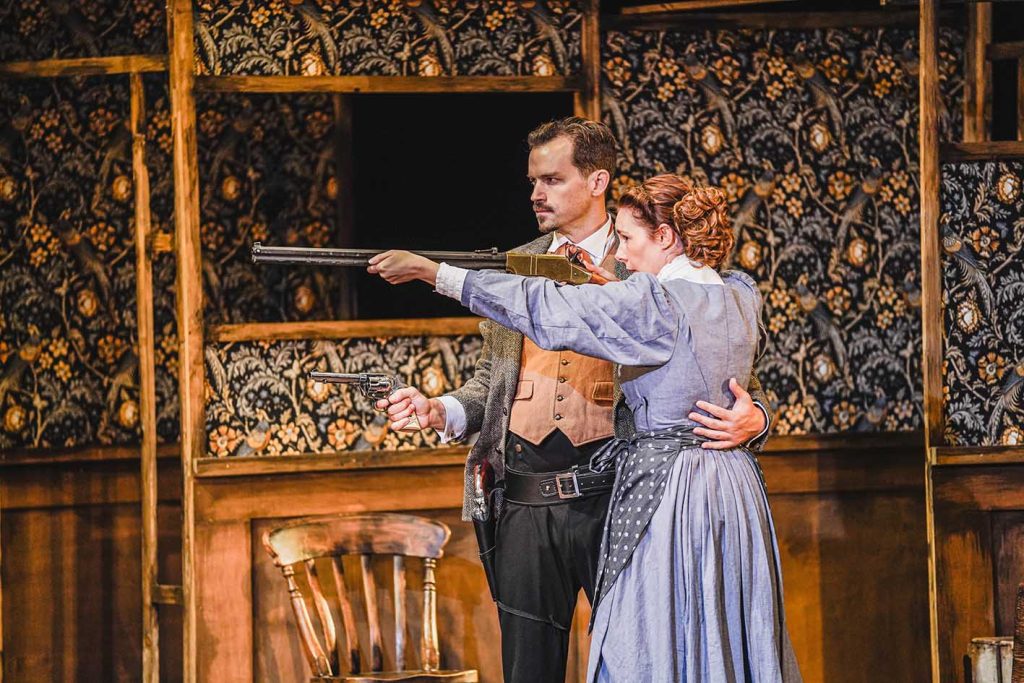
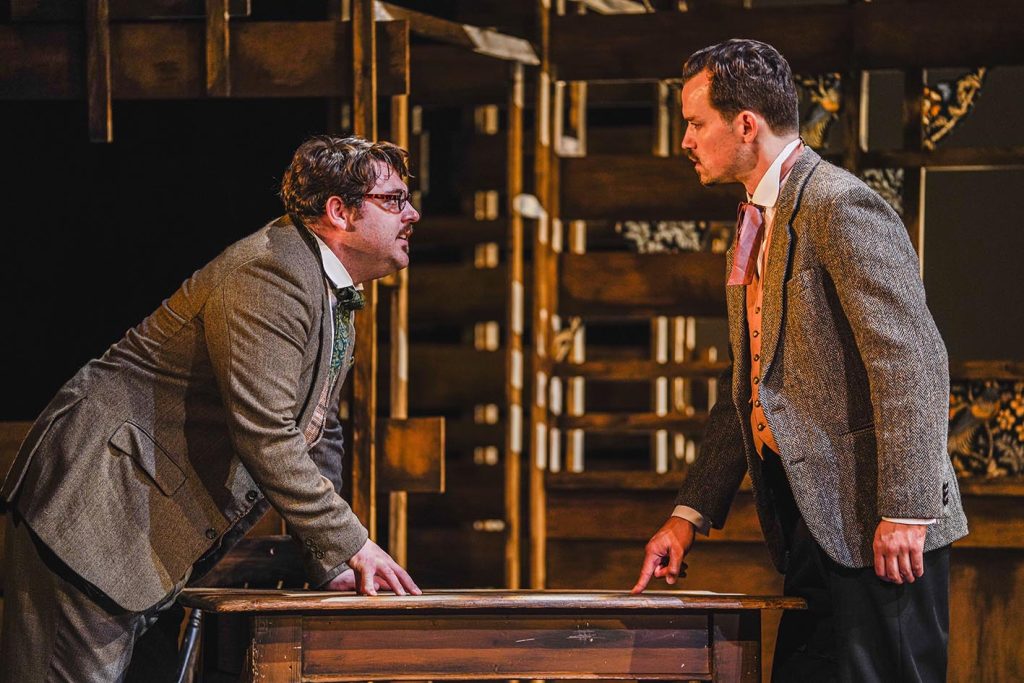
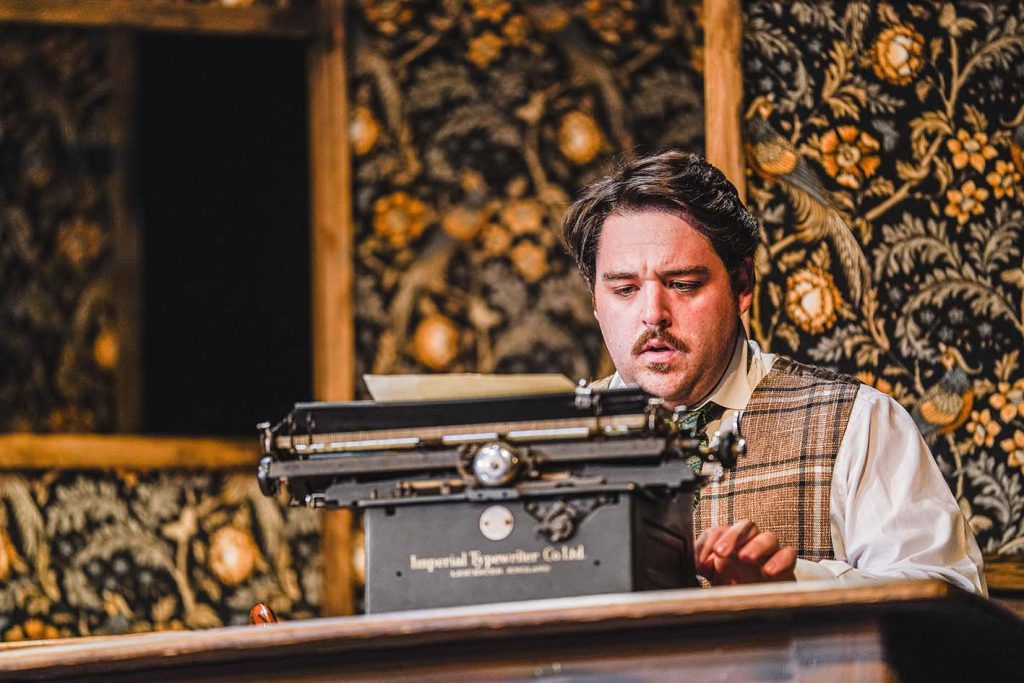
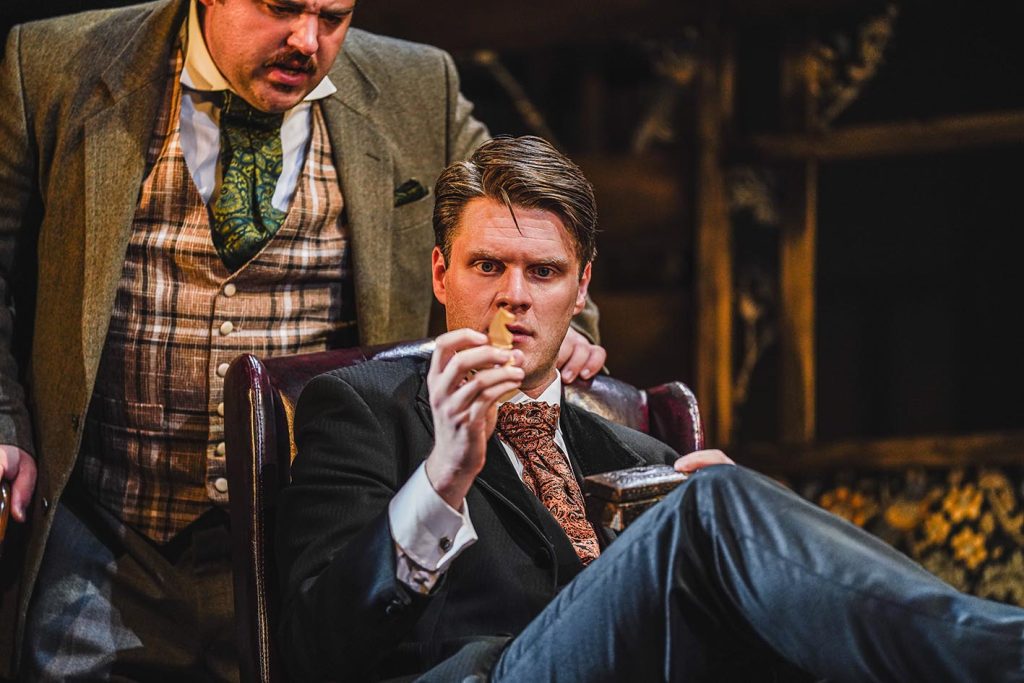
So who better to tackle one of Holmes’ thornier adventures than Blackeyed Theatre, the Berkshire-based company behind innovative reimaginings of Frankenstein and Jekyll and Hyde – not to mention previous Holmes adventures? Writer Nick Lane (who also directs) navigates smoothly through The Valley of Fear – no mean feat, as it spans twenty years, two cases, and both sides of the Atlantic. Vicky Spearing’s set – a fragmenting skeleton of exposed beams and William Morris-wallpaper, cleverly shifts from fin-de-siècle study to dusty saloon with the help of Oliver Welsh’s clever lighting and Naomi Gibbs’ convincing costumes.
Luke Barton and Joseph Derrington in Sherlock Holmes: The Valley of Fear. Image credit: Alex Harvey-Brown.
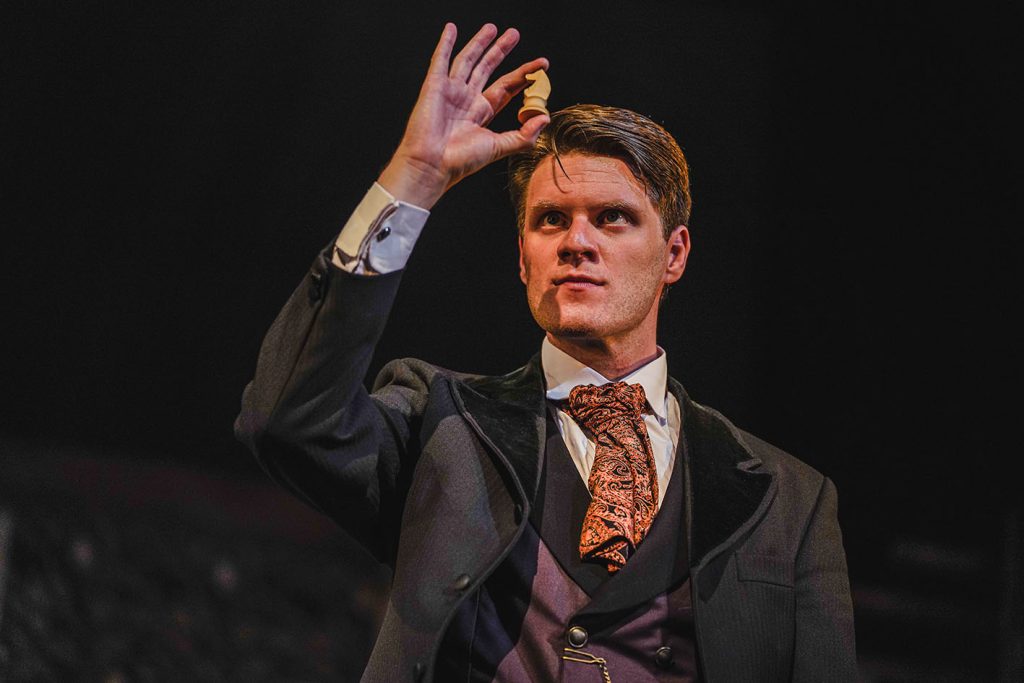
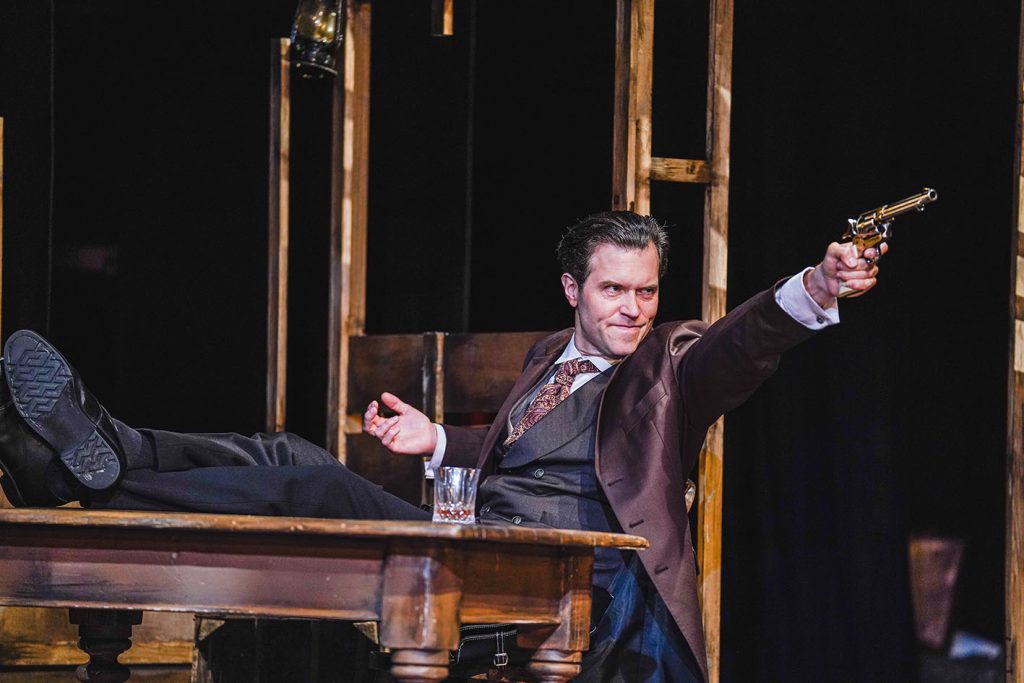
Luke Barton and Joseph Derrington reprise their roles as Holmes and Watson, having first collaborated on Blackeyed’s The Sign of Four in 2018 (For more insight on how Luke and Joseph developed their fantastic rapport, check out our interview here). And what a dynamic duo! Barton is a zesty and mercurial Holmes who positively dances across the stage (at times, quite literally – in one of the show’s most delightful moments, he punctuates his re-enactment of the scuffle by pitching himself across the boards. It’s a ten from me, Luke!) He brings a heroic quality to the role without sanding off Holmes’ rough edges, and his declaration to Watson – “There is no me without you” – is a moment of genuine poignancy.
Joseph Derrington, Alice Osmanski and Luke Barton in Sherlock Holmes: The Valley of Fear. Image credit: Alex Harvey-Brown.
And it rings true, because Joseph Derrington as Watson really is the perfect counter to Holmes: as steadfast and warm as Holmes is volatile and brash. Watson isn’t a slapstick sidekick here: he’s a partner in (almost) every meaning of the term (and Derrington’s own medical background lends a real authenticity to the good Doctor). Derrington is effortlessly affable as Holmes’ chronicler and companion, and their camaraderie feels authentic and lived-in; there’s a cosiness to the cattiness that reveals genuine affection between them. If, as the characters say, this is their final adventure, then they go out on a high – but I do hope we get to see them together one last time. I dare you to find a better Holmes and Watson after seeing this show.
Alice Osmanksi in Sherlock Holmes: The Valley of Fear. Image credit: Alex Harvey-Brown.
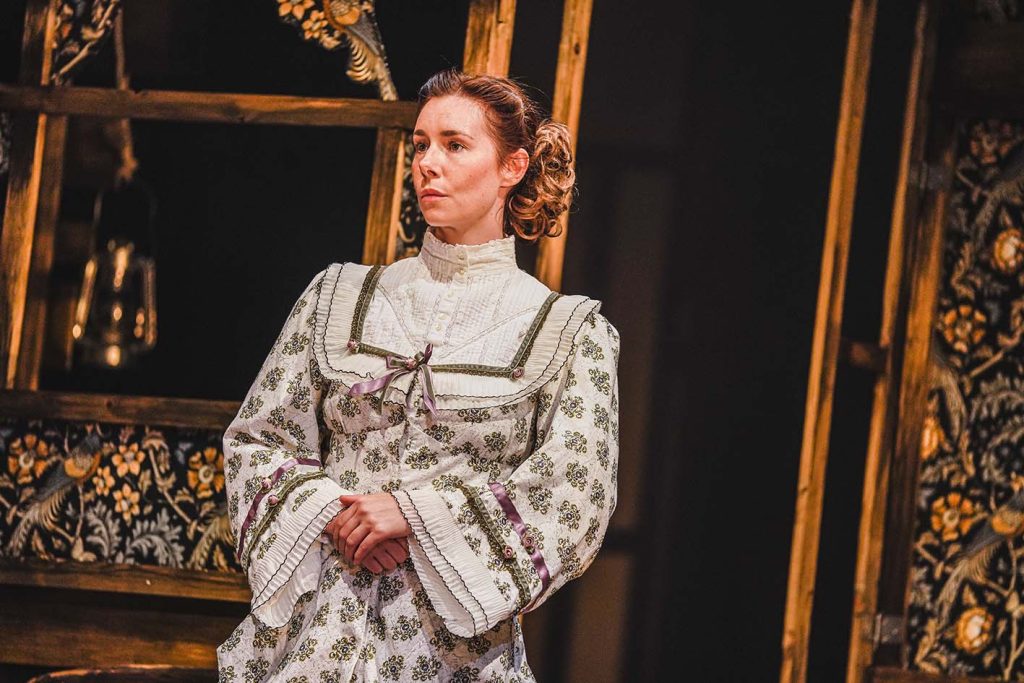
Meanwhile, Alice Osmanski, Blake Kubena and Gavin Molloy, round out this super-skilled ensemble. Their versatility truly knows no bounds, with Osmanski especially impressive as everyone from a hard-of-hearing housekeeper to a sharp-shootin’ Pinkerton.
Blake Kubena in Sherlock Holmes: The Valley of Fear. Image credit: Alex Harvey-Brown.
Kubena, who thrilled and chilled the New Theatre as the titular Jekyll and Hyde last year, continues to be a captivating stage presence, while Gavin Molloy brings genuine menace as coal-field crime boss McGinty and as Holmes’ most formidable foe (if you know, you know): their confrontation in an art gallery, while brief, is one of the most intense moments of theatre I have yet to experience.
Gavin Molloy in Sherlock Holmes: The Valley of Fear. Image credit: Alex Harvey-Brown.
The show has everything you could want from a Sherlock Holmes adventure: packed with twists and turns, it brings the audience in on solving the mystery right along with the characters and keeps you guessing right until the final problem. Whether you’re a die-hard Sherlockian or an amateur sleuth, this is the show for you. Sherlock comes Holmes to roost in Cardiff this week in the last stop of its acclaimed UK Tour, and with only four performances left, it’s an absolute must-see. A whip-smart script and a supremely talented cast make this an adventure for the ages – the game is well and truly afoot!
As Sherlock Holmes: The Valley of Fear comes to Cardiff this week in the last stop of its acclaimed UK Tour, Community Critic Barbara Hughes-Moore spoke with stars Luke Barton and Joseph Derrington (aka Holmes and Watson). Adapted and directed by Nick Lane, The Valley of Fear follows two cases across two sides of the Atlantic and finds Holmes and Watson at a crossroads in their friendship.
This interview has been edited for clarity.
https://www.youtube.com/watch?v=FImpGT8J2aI
So Luke, you and Joseph first played Holmes and Watson in Blackeyed Theatre’s The Sign of Four a few years ago. You’re now reprising your roles in the UK Tour of The Valley of Fear, Arthur Conan Doyle’s final novel. Where do we find Holmes and Watson when the play starts?
Luke Barton (LB): Things have changed for Holmes and Watson, because at the end of The Sign of Four, Watson gets married to Mary Morstan! In the short stories that occur between [this book] and The Valley of Fear, we learn that Watson has moved out of Bakers Street. He’s set up his own doctors’ practice, and lives with Mary – but he does always seem to return to Baker Street. There’s something about the mysteries they go on that just keeps attracting Watson back to Holmes and Baker Street. So we find Holmes and Watson on New Year’s Day 1895: Watson has come home for Christmas –
Joseph Derrington (JD): And he’s not gone back!
LB: He’s chosen to stay with Holmes instead! Then a mysterious coded message arrives in the post warning them of some harm about to happen to a country squire down in Sussex. From there, they embark on this mystery, and very quickly they go back to what they know best: being a crime-fighting, mystery-solving duo.
Joseph Derrington and Luke Barton in Sherlock Holmes: The Valley of Fear. Image credit: Alex Harvey-Brown.
I guess a coded mystery message is the best present you could get Holmes and Watson!
LB: Holmes loves it! I imagine Christmas is very boring and sentimental for him but a mystery is like [a gift].
JD: Better than socks!
Joseph, these are two of the most iconic characters in literature. How do you go about crafting that sort of relationship, especially given that you’ve both played the characters before?
JD: I found it quite an easy process. When we first started rehearsals for The Sign of Four back in 2018, there was a lot of discussion about how the relationship between Holmes and Watson should be. Watson was a lot of the time portrayed as a buffoonish character. He’s obviously not as intelligent as Holmes but he’s still intelligent: he’s a medical man, a doctor. We wanted to try and push this relationship where one person is incredibly intelligent but needs one person to channel it. Watson is that person. And when The Valley of Fear came along, we just slipped back into it. What works quite well is that we still speak to each other when we’re not performing in shows! It helps that we like each other.
Joseph Derrington, Gavin Molloy and Luke Barton in Sherlock Holmes: The Valley of Fear. Image credit: Alex Harvey-Brown.
Do you draw anything from any particular adaptations, or do you leave that behind when focusing on this? How do they play into your process?
JD: I obviously draw off the looks of Jude Law (!) I’d never actually seen a lot of Holmes adaptations, which is probably quite bad! I focused on the discussions I had with Nick [Lane, the writer-director]. I tried to lead in more from the text than from how the character had been played before.
LB: I think for me and a lot of people our age, I was very excited by the BBC adaptation. It was after that version that I went on to read the stories. I think our performance and our production is very much rooted in the original stories and the world of Conan Doyle, and [like] the BBC adaption is done with great reverence to the books. The Victorian world that Conan Doyle creates is quite key to our production, and that was my inspiration as well. There’s something so quintessentially Victorian about Holmes: he is both very much a part of that world but also completely strange within it; he’s very un-Victorian in lots of ways.
Luke Barton and Alice Osmanski in Sherlock Holmes: The Valley of Fear. Image credit: Alex Harvey-Brown.
Is it important to you to you make him ‘sympathetic’?
LB: Holmes doesn’t care what other people think. But in the job he’s doing, I think he finds [that] emotions and feelings just aren’t helpful, and that’s why he’s described as this unemotional machine. But he is a human being: he just has an incredible capacity to filter stuff out, and that’s intriguing because most of us care what other people think. As actors, we spend every night standing in front of people getting judged by them. You’re always under the spotlight. It’s really refreshing to have a character that can switch that off.
Joseph Derrington, Blake Kubena and Luke Barton in Sherlock Holmes: The Valley of Fear. Image credit: Alex Harvey-Brown.
Why is this story so suited to the stage?
LB: There’s something about the larger than life events of these stories, particularly The Valley of Fear, that lend themselves to the theatre. Audiences expect more: we have to go on a bigger imaginative leap. The uniqueness of theatre is that as actors, we sit down with an audience and say: ‘we’re going to pretend we’re these people and you’re going to pretend we are as well’. When you throw in these big characters, like the gangsters and murderers we get in The Valley of Fear, it’s really exciting for an audience. It just allows the imagination to run wild.
JD: I think it also adds to the murder mystery, too: it’s more claustrophobic when you’ve got a mystery and there’s hundreds of people watching you and [anticipating] what’s going to happen in the next hour and a half. Some of the venues we’ve been to in the past, you can see the audience in the front row. We had a floor rolled out and when they’re on the edge of the stage, it does add to the pressure of trying to solve a mystery. No matter how many times we do it, it’s still exciting.
LB: They’re trying to solve it with us: Holmes and Watson are solving the mystery at the same time as the audience. That’s what makes it exciting: you have to figure it out as we do.
Blake Kubena and Alice Osmanski in Sherlock Holmes: The Valley of Fear. Image credit: Alex Harvey-Brown.
Do you find different audiences react in different ways?
LB: That’s the great thing about touring! Like Joe said, we’ve done over 160 shows now, and every night the audience is different: every town, every city, connects and responds to different things. They even root for different characters! And that’s one of the joys of theatre, especially of touring theatre: you go to so many different places, and each one has a different energy.
JD: And while it’s not a comedy, there are funny bits! Nick has tried to keep it very true to the story itself, and it’s nice to see proper Sherlock Holmesians – is there a word for them?
LB: ‘Sherlockians’.
JD: Like Beliebers?
LB: Yeah!
JD: So these Sherlockians are enjoying it even if they know how it ends, because it stays true to the book. It was nerve-wracking to start, [wondering] how Holmes fans would respond. It’s always tricky trying to please everyone – but I think we’ve done it! I’m pleased with it.
Joseph Derrington and Blake Kubena in Sherlock Holmes: The Valley of Fear. Image credit: Alex Harvey-Brown.
The Sherlockians take it really seriously, then?
LB: You’ll not see me in a Deer stalker in this production, but you will see people in the audience wearing one! Plus the full cape, the magnifying glass…
JD: And a lot of moustaches! I’ve seen a fair few – maybe they’re back in…
LB: You know, in the Victorian era, the bushier your beard, the manlier you were.
JD: So I’m semi-masculine, then?
LB: You’ll get there.
Joseph Derrington in Sherlock Holmes: The Valley of Fear. Image credit: Alex Harvey-Brown.
Watson is Insta-ready.
LB: You should see him tending that face.
JD: I can’t wait to try and twiddle it.
Only when you’re solving a mystery or being nefarious.
JD: It’s my thinking moustache…
Do you feel you’ve been able to relax into the roles this time around? Or is there something about bringing it back – the moustache, and everything else – that surprised or challenged you?
LB: I did relax a lot more this time around! Like Joe was saying, that feeling the first time around of stepping into the shoes of such brilliant actors, and bringing to life characters people really love, was overwhelming. This time it wasn’t quite as bad. I think what’s been interesting is that Nick really wanted to explore the limits of their friendship: how tricky it must be for Watson to be friends with [Holmes] and what that must be like. What happens if their friendship is tested? That’s been interesting to explore.
JD: For me, the only thing I found tricky was fitting back into the costume after lockdown!
LB: We all did!
Luke Barton and Joseph Derrington in Sherlock Holmes: The Valley of Fear. Image credit: Alex Harvey-Brown.
I wonder how Holmes and Watson would have coped in lockdown.
JD: They probably would have killed each other!
LB: Holmes would have gone mad. [Luke and Joseph produced a ‘Holmes in Lockdown’ short as a prelude to The Valley of Fear. You can watch the full video here.]
JD: Would Holmes have gone into a Baker Street bubble, or a Mary Morstan bubble?
LB: Definitely Baker Street.
JD: Yeah. That’s awkward!
Joseph Derrington and Luke Barton in Sherlock Holmes: The Valley of Fear. Image credit: Alex Harvey-Brown.
Why do you feel that Holmes and Watson are still so close to our hearts?
LB: They’re basically the first superheroes! You’ve got a dynamic duo with individual ‘powers’ that complement each other, and they use those powers to serve good: they’re superheroes that are also best friends. But there’s just something about their relationship [that] is so interesting. They understand each other even though they’re complete opposites and shouldn’t like each other. We all have that person we can’t be without – and that’s who they are to each other. The intrigue is the cherry on top.
JD: It’s human nature, isn’t it, to build connections with people? To ask for help when you need it; to communicate, and Holmes and Watson do communicate even when it’s one-sided. It’s the humanistic aspect we come back to.
Have you performed in Cardiff before?
LB: We didn’t take the The Sign of Four to Cardiff, though we did perform it in Llandudno – we’re really excited to come to Cardiff! After 8 months, we’re concluding our tour here so Cardiff is getting our last few performances: as of Friday we’re done.
JD: I’ve been brushing up on my Welsh.
Da iawn!
JD: Bless you.
We can’t wait to welcome you to Cardiff. The game is afoot!
Imrie ydy’r sioe ddiweddaraf i’w ddathlu 50 mlynedd o Theatr y Sherman. A chymaint o sioe yw e! Ysgrifennwyd gan Nia Morais (Awdur Preswyl y Sherman) a chyfarwyddwyd gan Gethin Evans, mae Imrie yw cyd-cynhyrchiad gyda Theatr Frân Wen sy’n teithio i fewn i byd arallfydol o dan y mor – a mae’n anhygoel i brofiadu.
Rebecca Wilson a Elan Davies yn Imrie. Lluniau gan Mark Douet
Mae’r stori’n dilyn dwy hanner-chwiorydd: Laura (Elan Davies), sy’n mwyn fitio i fewn gyda’r merched arall yn ysgol; a Josie (Rebecca Wilson), sy’n dawel ac yn difrifol, ac sy’n darganfod ochr arall i’i hun. Nes i’r ddechrau y stori, dysgodd Josie celwydd teuluol a diflannodd hi mewn deyrnas hudolus o dan y donnau. Yna, ffeindiodd hi ferch arall, o’r enw Imrie Sallow, a newidiodd ei bywyd am byth.
Rebecca Wilson yn Imrie. Lluniau gan Mark Douet
Roedd Elan Davies a Rebecca Wilson yn anhygoel. Dalion nhw sylw y cynulleidfa trwy’r stori, a chreuon nhw awyrgylch ddoniol ac emosiynol. Mae’r ddau chwiorydd yn trio darganfod ble mae nhw’n perthyn yn y byd, a phwy ydyn nhw; pwy basen nhw’n hoffi fod. Perthynas y chwiorydd yn prydferth ac yn cymhleth, a roedd yr actorion wedi datblygu cydberthynas cryf gyda’n gilydd.
Rebecca Wilson a Elan Davies yn Imrie. Lluniau gan Mark Douet
Doedd y sioe ddim yn troi i bant o bwnciau bwysig fel hiliaeth a rhywioldeb – ond sgript Nia Morais yn teithio trwy rhain yn haws ac yn hardd. Mae’r ddau cymeriad yn trawsnewid a tyfu fyny o’r ur amser: siwrnai anodd yw e, troi i fewn i berson chi ddim yn adnabod. Mae Laura yn ymrafael i fod ei hun ar y tir, tra mae Josie yn ffeindio ei gwir hunaniaeth yn y mor. Y ffordd mae’n nhw’n dangos deyrnas morol yw trawiadol iawn, yn enwedig gyda miwsig awyrgylchol gan Eädyth Crawford (sy wedi neud y cerddoriaeth i ‘A Midsummer Night’s Dream’ llynedd).
Elan Davies yn Imrie. Lluniau gan Mark Douet
Mae Nia Morais wedi consurio byd sy’n realistig ac yn hud: cydbwysedd annodd, ond mae Imrie yn llwyddiannu. Roedd y tim creadigol wedi neud rhywbeth arbennig yma. Dyma sioe am cynulleidfeydd o bob oedran: a gyda chapsiynau Saesneg ym mhob perfformiad, gall siaradwyr newydd a rhai di-Gymraeg mwynhau’r sioe. Imrie ydy antur hudolus ac emosiynol gan cast a chriw dalentog iawn. Mae o amdan sut deallrwydd, cariad a chysylltiad yw’r pethau mwyaf hudolus o bopeth.
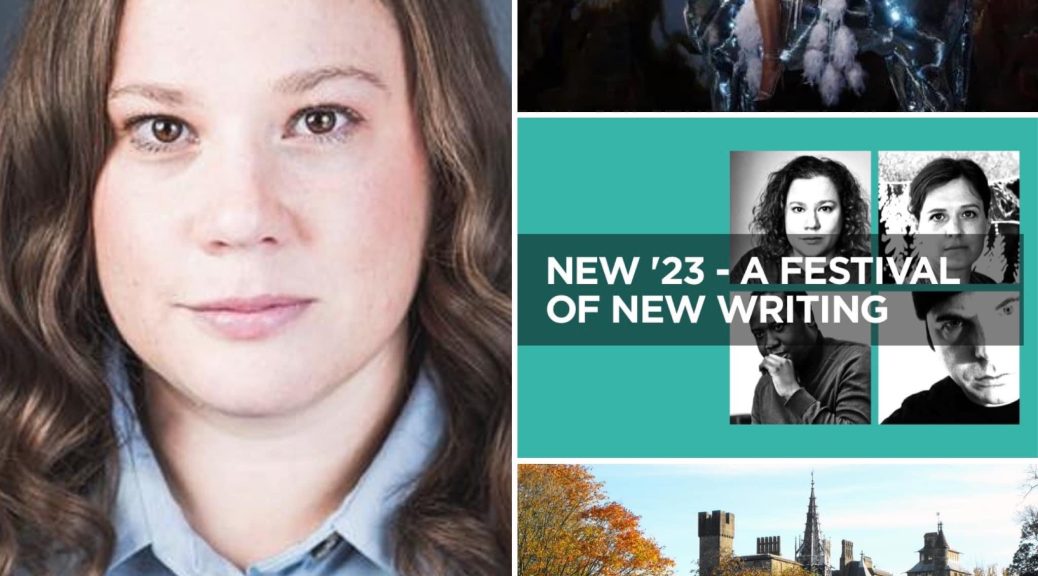
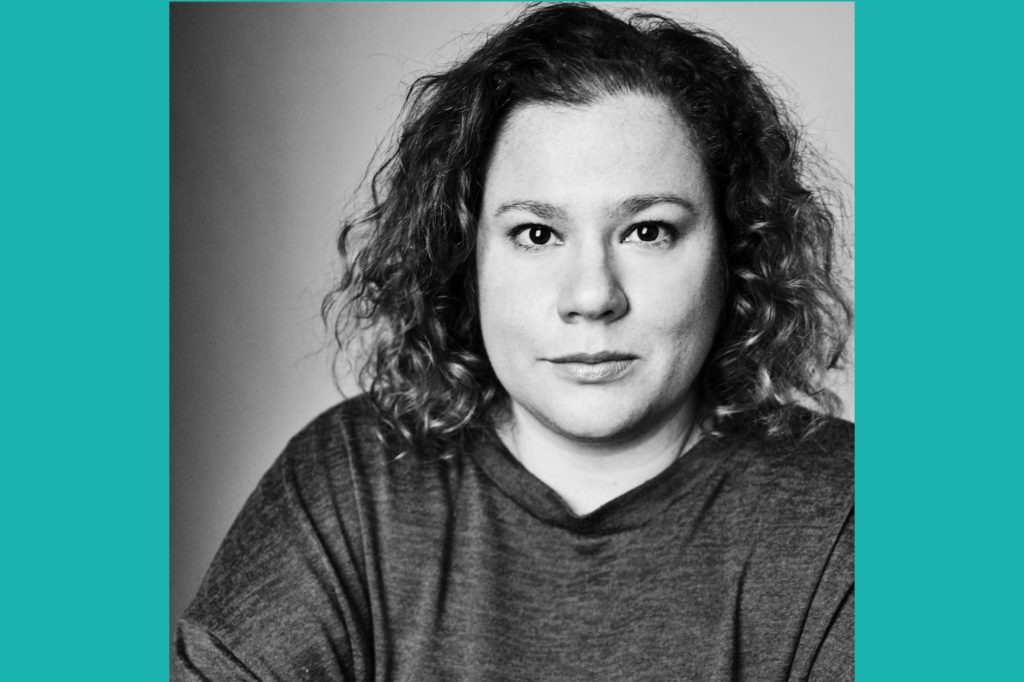
We last interviewed Welsh Playwright and Artistic Director of Chippy Lane Productions Ltd, Rebecca Jade Hammond, in September 2022 just prior to her play Right Where We Left Us being performed at Chapter Arts Centre. We caught up with Rebecca again during rehearsals of Mad Margot which is one of four plays, forming RWCMD New 23 Season.
Hi Rebecca, great to catch up again, it’s been 8 months since we last spoke, with the cultural sector finding a way through the impact of Covid how has your professional career been impacted by this difficult period?
Lovely to speak with you again. To answer your question, I think most writers still feel a sense of ‘world on pause’. It seems that emerging writers making traction pre-pandemic are now picking up the pieces and having to go again at a slower pace. I have always written but it wasn’t until 2019 that I started to take it seriously and since then I have seen steady (if not fast enough) progress. I often feel frustrated that I didn’t take the plunge and start younger, but then I check in with myself and remember that you reap what you sow regardless of age. You have to keep going, apply for everything, have those coffees (with no agenda), meet people, network, write, write, write and get better. At some point something has to happen. I always say: “you have to keep going, you’re too far in to go back now” – I believe this 100%.
Mad Margot is described as a new play that “charts epic events in young bodies, caught between childhood and adulthood in Bute Park, Cardiff.” Can you tell us more about this work?
I originally had this idea in 2020 attending the National Theatre Writers Group. I banked it, knowing that a writer at my point would never be given the opportunity until I was profiled.I let it percolate, wrote bits of it – but kept it for future possibilities. It wasn’t until my play RIGHT WHERE WE LEFT US was on in September 2022 that I was approached by Sherman Theatre and RWCMD with the offer of a commission. The brief was for it to be with ten actors and thread in Welsh translations with the support of Branwen Davies. Of course I accepted and over the last year we have worked hard to bring it to fruition.
MAD MARGOT is a piece about the disintigration of mental health in young women (specifically Margot’s) in the midst of teenage pregnancy. At a time when she should be protected, safe and supported she is alone and trying hard not to drown. Charting the murky world youngsters occupy between childhood and adulthood in Bute Park, MAD MARGOT explores mob-mentality, power-structured relationships and sexuality in relation to the system of patriarchy. Personally it is a nod to my youth growing up as a young Cardiffian in North Cardiff. Always out, not wanting to go home and building an urban family of friends. In fact, several of the characters are based on real people I grew up with including myself.
I have realised as a writer I am obsessed with the rhythm and timbre of dialogue and ensuring it’s as authentic as possible. This piece is incredibly wordy and hard to speak without speaking fast, breathing between punctuation and of course, in a Cardiff accent. It’s exhausting for the actors but rewarding. It’s also incredible to see how they’ve committed to the material. They’ve taken it and run. We are sharing the responsibility to serve this story.
The play is at once epic and historical in its approach yet hyperlocal in its gaze, taking place a stone’s throw from RWCMD in Bute Park. How have you combined these elements in your work?
I have left these ideas and concepts with Llew (Designer) and Jac (Director) both Cardiffians and Welsh speakers. Being deeply aware of the confines of NEW and the play being in Rep the only thing I asked for was it to feel like a vast space with leaf’s. I left everything else up to them to put their stamp and vision on the piece. I am a firm believer in collaboration – it’s the ultimate form of making art. No one can really do it alone and so I have left them to figure out the world in that way. Without giving too much away there are artistic nods to Cardiff, Bute Park and my youth. Also, this piece is a loose reimagining of MEDEA and so, it was important that the words, the performances and the story sing out loud without too much fuss and spectacle. Peter Brook once said “all you need is bodies in space to be engaging” and I like to think we will deliver this in the final production.
The production uses a range of pop culture references and contemporary slang, how did you approach these elements and have you had any feedback from young people? Were you worried about getting any of this wrong?
I mean, I don’t think I’m old yet. I am in my 30’s so I don’t think I had to dig that deep to connect to the material. However, I am a different gen to that of 16+ in 2023 and so I researched a lot about young people in Cardiff. I also worked with the students to ensure the characters sat authentically in their bodies and that the words felt realistic to them. It is amazing how much ‘being young’ is still exactly the same as when I was a teenager. The rules, politics, banter, bullying, dynamics and struggles are all as was. There’s something comforting but also deeply worrying that not much changed.
With regards to other elements, music is always a big part of my writing process and the worlds I build in plays. I have always wanted to integrate rap music into one of my stories and this seemed like the perfect opportunity working on a young persons piece. We actually collaborated with another student Israel J. Fredericks (El Guapo) on creating a rap section for one of the characters who wants to be the next ArrDee / Central Cee. Israel wrote a rap and together we found a beat based on a detailed brief I gave him on the character. This process was enlightening and supportive. Giving our piece another opportunity to utilise the talented skill sets of the students. We are also utilising the ballet experience of one of the actors, singing and Welsh speaking. Continuously having a dialogue and making them part of the conversation. It’s been an organic / openly creative journey for us all getting to this point.
Mad Margot is one of four new plays which will premier at RWCMD at the end of May before transferring to The Yard Theatre, London in early June. The NEW season from RWCMD “showcases its commitment to empowering the next generation of actors, collaborating with the UK’s best writers and directors, and bringing new voices and diverse stories to the stage” Why is this work to support emerging actors and the UK’s best writers and directors important to you?
NEW is an important part of the college’s history and as a writer a gift to be able to explore work that has big casts, epic themes and enables you to experiment with form. It’s a tricky task, but I have seen so many NEW pieces over the years I knew exactly what should be done. Shout-out to Daf James’ FOR ALL I AM in 2016, which in my opinion is the benchmark for when the brief marries up perfectly. From the story, to the characters, to utilising the students and the execution of performance – it is a masterpiece. I am aiming for that… wish me luck.
MAD MARGOT is also significant because it’s the first time NEW has had a bilingual piece in English and Welsh and has several Welsh students in one piece. Platforming RWCMD commitment to Welsh talent and celebrating the Welsh language. For the student/actors, it is the last show they perform before going into the industry. It is an important marker for them leaving education and going into the professional world. I think it’s essential that these pieces are modern, edgy and use all the tools in their box. Make them proud of their work and a piece that they have had a hand in creating. I hope I have given them something they will always remember as a challenge and opportunity to excel but also put THE DIFF on the map.
The play is Directed by Jac Ifan Moore and has Welsh Language Adaptations and Dramaturgy by Branwen Davies. When we discussed this, you said you aimed to reflect contemporary Cardiff in its use of “Wenglish” by young people. How have rehearsals reflected this aim and do you think you have been successful?
What’s wonderful is that we have a mix of fluent-speakers, those learning and those with no Welsh experience at all. Everyone is supportive and encouraging to those who don’t speak the language and the rehearsal room is naturally moving from Welsh to English as it does in the play. Both our SM, DSM and Designer also speak Welsh too so that aids for the language being readily used. I am also learning, so it’s been wonderful to be part of a space where I can brush up on my Welsh.
From a writing perspective Branwen Davies and I have a lovely working relationship where she was very sensitive to my words still translating in Welsh in a Cardiff-style way. I think she’s captured it perfectly and I have been honoured to have her guidance and also my words turned into Cymraeg. Bi-lingual pieces are still rare even in Wales and I am a firm believer that there should be more and that in future work I will work more within that medium. It’s been a thoroughly enjoyable process.
And finally what culture have you been consuming recently that you would recommend our readers to catch up on?
I have favoured listening to music whilst walking and running this year. Also, as a form of mindfulness and to distract me from my forever racing head. It helps me write and figure out story plots, characters and possibilities.
I am listening to a lot of R&B and rap like; Central Cee, RKAYY (Cardiff Rapper), GoGo Morrow, SZA, Doja Cat, Jaish, Drake, El Guapo, Giggs, Jay Z, Little Sims, Mabel, Lauryn Hill, The Carters, Dr Dre, Eminem, Nicki Minaji, ArrDee, Aitch, 9lokknine and my Queen Beyoncé!
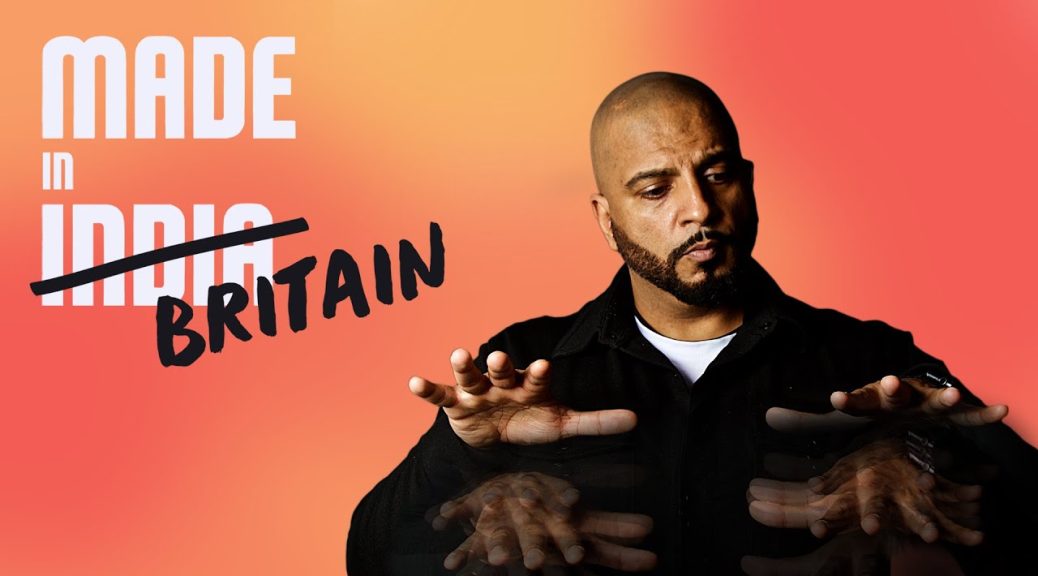
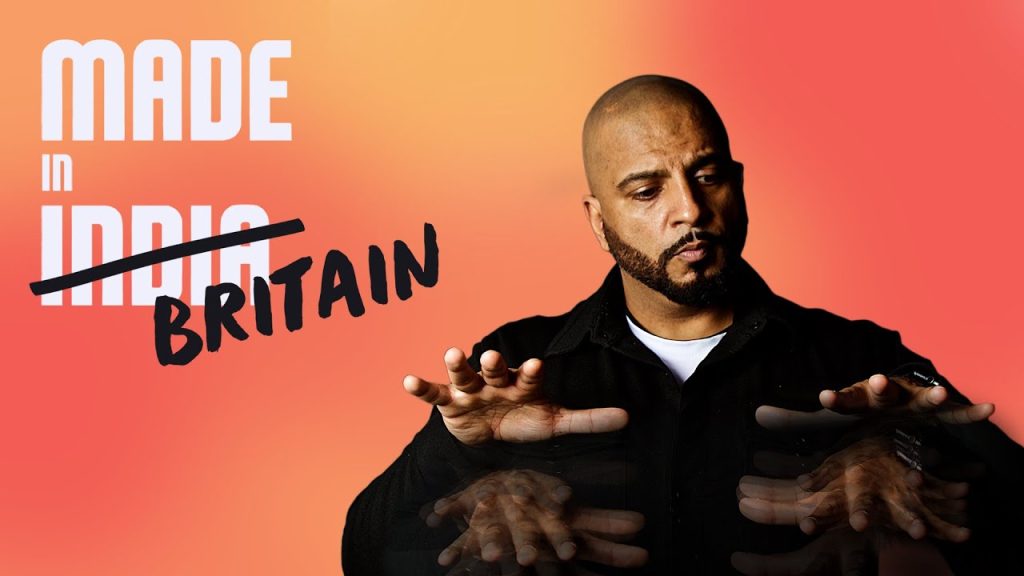
“I was born brown, deaf and outside a prison…thanks Dad!” So begins this one-man show about a British-Indian, or Indian-Briton, or perhaps there’s even a third option.
Rinkoo Barpaga is a Sikh, born in Birmingham to parents from India, who’s been trying to find his ‘people’ all his life. Growing up during the Thatcher years, he experienced unemployment, prejudice and racism, all while observing the many ‘cultures’ he encountered. Learning sign language at a much older age than others left him feeling even more of an outsider, his first word, ‘dog’, was learnt from a friend in a car on the way to a special school.
Bouncing between Birmingham, Newcastle & London, making friends while enduring double prejudice because he was deaf and brown, from hearing and (white) deaf alike, always wanting more than anything to understand and be understood. A career in entertainment was never his intention, falling into it by accident after becoming a translator for TV. Trying stand-up comedy both here and in America, he grew more accomplished, and started creating stage shows based on his life and travels. This being the latest result.
https://youtu.be/1QCMRtUjROk
One of the most intriguing aspects of this play is that, unlike most others, instead of an interpreter for the deaf here we have an interpreter for the hearing. He becomes a sort of narrator in a way, speaking Rinkoo’s words in a voiceover to the acting, which gives us a fascinating insight into his world. Occasionally it misfires, the voice not always being synchronised to the signing, leading to the emotional impact being somewhat diluted. On the whole though, it adds a fresh new dimension to things.
In turns sad, joyous and painful, but always funny, Rinkoo passionately conveys the anger, fear and sheer frustration of his life due to his inability to communicate. The irony is that it seems to be here on the stage that he communicates the best, offering us an insight into his world, a world I was almost completely unaware of. Both an entertaining and enlightening experience then, and one I truly enjoyed.
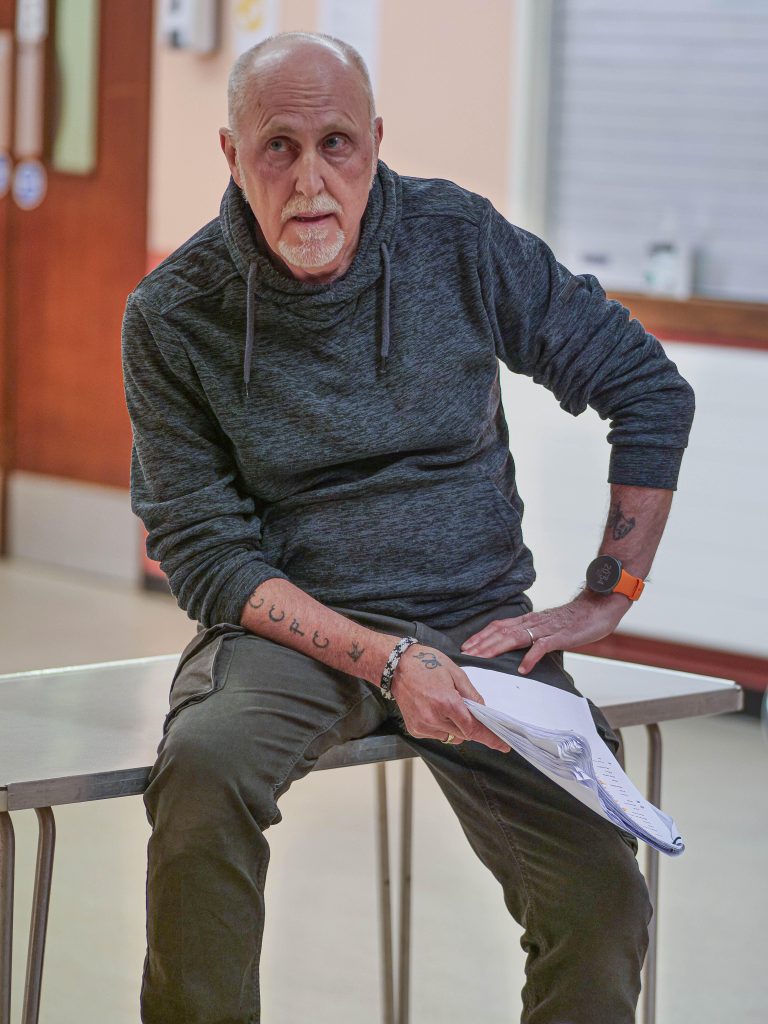
In our latest Playwright interview, the Director of Get the Chance, Guy O’Donnell meets Playwright Vic Mills, they discuss his career to date, his latest play ‘Sanctuary: The Secrets of the Gunter Mansion’ and his thoughts on career support for Playwrights in Wales.
So, what got you interested in the arts?
I came from a non-conformist chapel background, where both of my parents were public speakers, writers, teachers, preachers – so performance of the spoken word was part of what we lived and breathed from infant hood. Music too was central to life. Both my parents were avid readers and we grew up in a home without a television so I read a huge amount – many of the classics before I was eleven.
Why do you write?
That’s probably changed great deal over the years – from poetry as a teenager and young adult to writing for theatre from the time I was about 20. I write because I enjoy the process and each stage of sharing and developing a script is incredibly exciting – the isolation in the first part of the process and then the development of a script with a team is nerve-wracking and exhilarating. Then, right through to the first performance the piece continues to develop and is still changing and hopefully improving until it’s last performance. The chemistry with my director, Neil Maidman, and recently with the Contemporancient Team of poet Dr Kevin Mills, composer Stephen Preston and our actors is hugely exciting.
Can you tell us about your writing process? Where do your ideas come from?
Research around a specific subject – like The Chartists, mental asylums in Wales, Dr Richard Price, ‘The Gunter Mansion’ in Abergavenny – is the starting point – finding where the theatre is in a story, what might be relevant, challenging, inspiring, for contemporary audiences. Then, like most playwrights, I build scenes around conflict. I also search for empathy with every character I develop – they all have to have something of me in them – good, bad and appalling.
I have written theatre with a social and political drive, often linked to an aspect of Welsh history in the last twenty years and that continues to be my focus.
Whilst I usually produce what might be called ‘naturalist dialogue’ as central to a piece, the work itself is not usually naturalistic overall. My great inspiration is Brecht and so music, poetry, ‘chorus’, multiple playing, non-linear structure, are all key tools in creating something meant to evoke intellectual challenge rather than pure entertainment.
Can you describe your writing day? Do you have a process or a minimum word count?
I usually spend a year or so reading around a subject and then write a first draft of a play obsessively and very quickly – maybe within 10 days. I don’t keep any record of how much time I spend at it during those days – but writing comes easily when it comes at all and it usual flies out when it’s ready to. It gets huge amounts of patient re-working for months afterwards, but the arc is there.
Do you have a specific place that you work from?
I have a study and a MacBook Air. I write notes in proper notebooks with a fountain pen. I like fountain pens a lot. I really like fountain pens. Once I start writing the script – its straight on the MacBook though.
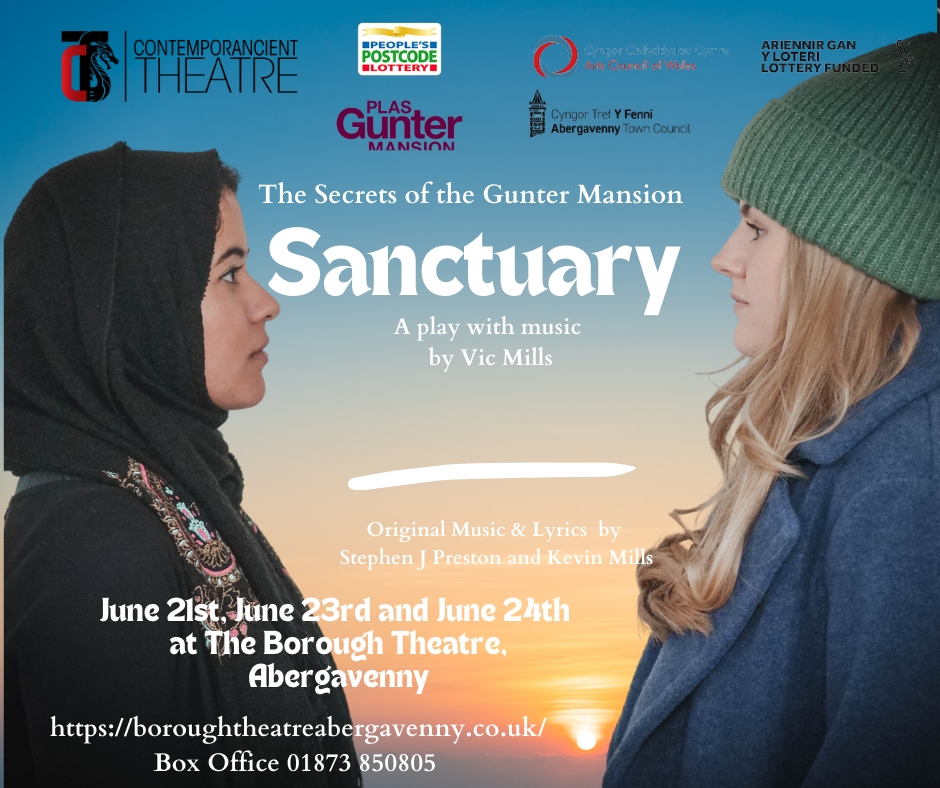
Your latest play ‘Sanctuary: The Secrets of the Gunter Mansion’ plays at The Borough Theatre, Abergavenny at 7.30pm on Wednesday 21st June.
“This new play with music tells how, for more than 400 years, Abergavenny has provided sanctuary for those in danger – here the horrors and joys of their secret stories are told in thrilling theatre and music.”
Can you tell us more about the background to this production and your hopes for its production?
This started with reading an historical text about two leaders of the Jesuits being caught in a priest hole in Worcestershire in 1605 and exploring the idea of people being hunted, tortured and killed for their faith but also willing to do the same things to other people, with only marginally different faith. This seemed incredibly relevant to life for people in many parts of the world today so worth exploring. We have worked with ‘The Plas Gunter Mansion’ in Abergavenny, where these priests probably hid in the months prior to be caught – we have linked that with the story of Syrian refugee woman in Abergavenny today – she is not an historical figure but is based on stories of real Syrian refugees in Wales.
We’ve worked with Syrian musicians and our composer to bring the cultures together in music and explore the idea of sanctuary in Abergavenny and in Wales across the ages. It’s a play about the Welsh nation being made up of people from around the world and about the importance of tolerance. But there’s a lot of difficult stuff in the play about people’s willingness to suffer for their beliefs and to make others suffer who do not share them.
Kevin, my brother, an academic and poet, has produced wonderful verse for the piece and has worked with Stephen Preston, our musician/composer to create stunning songs alongside our Syrian musicians. We’ve worked with our close collaborator, film maker Chris Lloyd to deliver a multi-media piece, where film and visual imagery plays a huge part. Our director and dramaturg, Neil Maidman, is someone I have worked with for more than 25 years so we shape a piece together, understanding each others strengths pretty intuitively by now.
We hope that through exploring our shared history, we will learn more about ourselves and those with whom we share our communal lives and spaces.
This will be performed during National Refugee Week and all performances will be free for refugees.
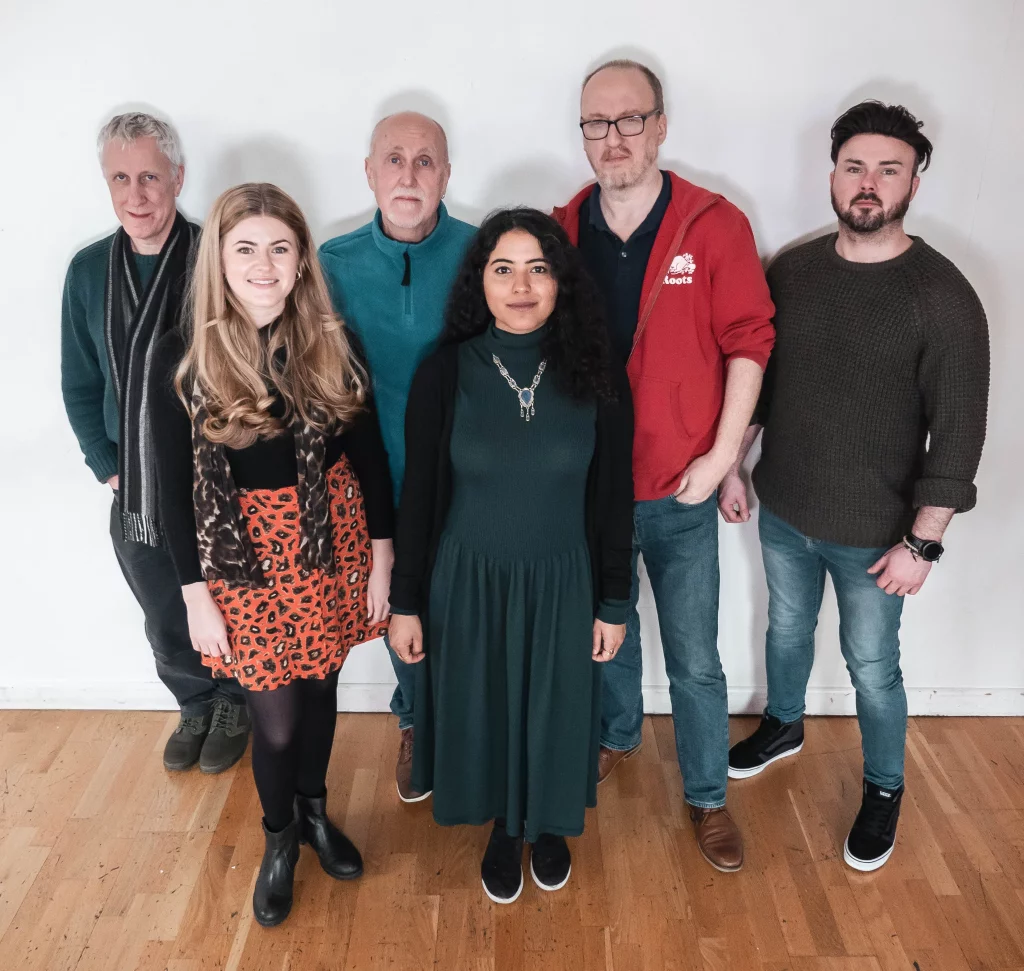
Sanctuary – Cast, Director, Writer, and Lyricist
What role do you think Theatres and Playwrights have in telling the narratives of the citizens of their respective nations?
You can tell from my previous answer that this is a central tenet of all I do as a writer and what this theatre company, Contemporancient Theatre, is all about. Heb Hanes – Heb Hunaniaeth is our motto, and that is at the heart of what we do.
There are a range of organisations supporting Wales based writers. I wonder if you feel the current support network and career opportunities feel ‘healthy’ to you? Is it possible to sustain a career as a writer in Wales and if not, what would help?
I worked as a drama teacher, English teacher and Deputy Headteacher until I was able to retire at 55, and work full time in theatre. I was able to write and get plays produced throughout that time and have had plays of mine produced and performed all around the world. I have never made any money to speak of through that. If a play of mine is performed I get about £50 per performance in royalties.
I spend a huge amount of time applying for funding – far more that I do actually writing or developing scripts. If I had to rely on what I earned from theatre to live, I couldn’t. I ensure that freelance actors, musicians, crew etc are paid union rates and I try to find some money in the budget for writing and script development. I don’t know how anyone writing for theatre could make a living just by writing, unless they were hugely successful.
You are a member of the Get The Chance team yourself and have reviewed a range of productions. Why are you a member of our team of volunteer critics and what value does this opportunity have to you?
I watch as much live theatre as I can, and I usually have very strong opinions about what I experience. Part of the joy of any art is the discussion it evokes – Get The Chance gives people an opportunity to formulate and articulate ideas about performance arts so it’s a vehicle for them and publicity for the event that have attended. What’s not to like about that?
If you were able to fund an area of the arts what would this be and why?
One of my many causes is ‘working class people in arts’ and theatre specifically, of course.
The tradition of great working class actors, playwrights etc that fuelled British theatre has been choked off. I would love to see bursaries or grants for theatre practitioners of working class background to support their work, and organisations like ACW creating funding areas for projects delivered by practitioners from the working class.
What currently inspires you about the arts in the Wales?
The extent to which good work continues to get put on despite the odds.
What was the last really great thing that you experienced that you would like to share with our readers?
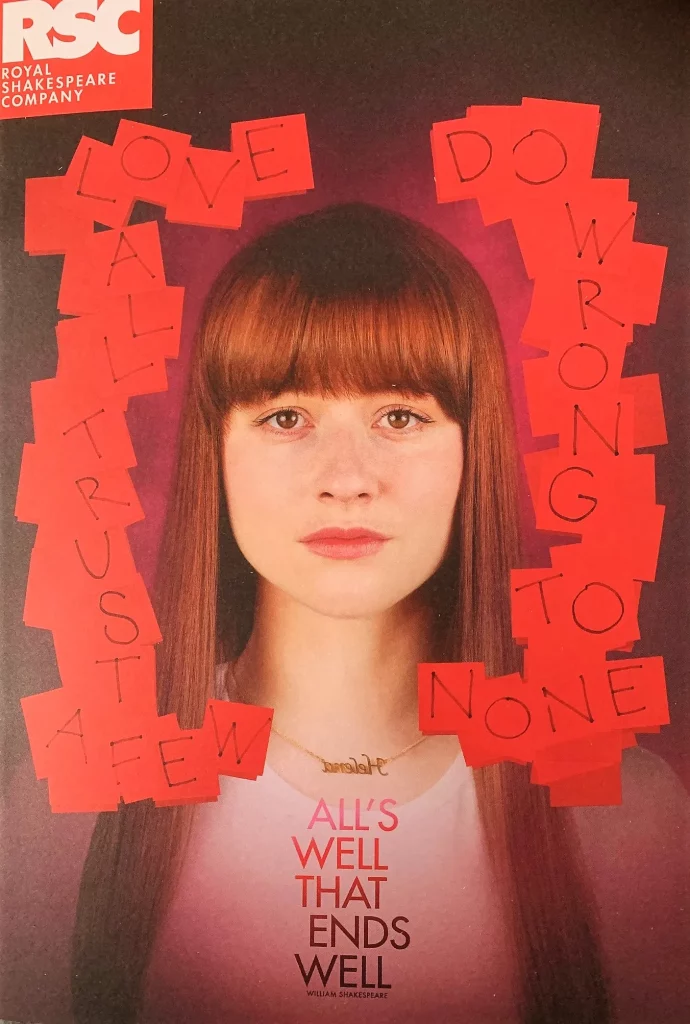
I saw Rosie Sheehy in Alls Well That Ends Well at the RSC Stratford last year. Didn’t know her, or of her, at the time. Stunning, stunning performance – by a kid from down the road. Blistering and inspiring. I love actors who can really speak verse – get verse. Wonderful physical and vocal performance. I love the fact that she was there and blew everyone else off the stage and that she’s a Welsh kid from an ordinary background.
Long before the shock of seeing Tracey Emin’s unmade bed as an exhibit in a gallery, or Martin Creed’s ‘Work No. 227: The Lights Going On And Off’, modern art has evoked strong emotions.
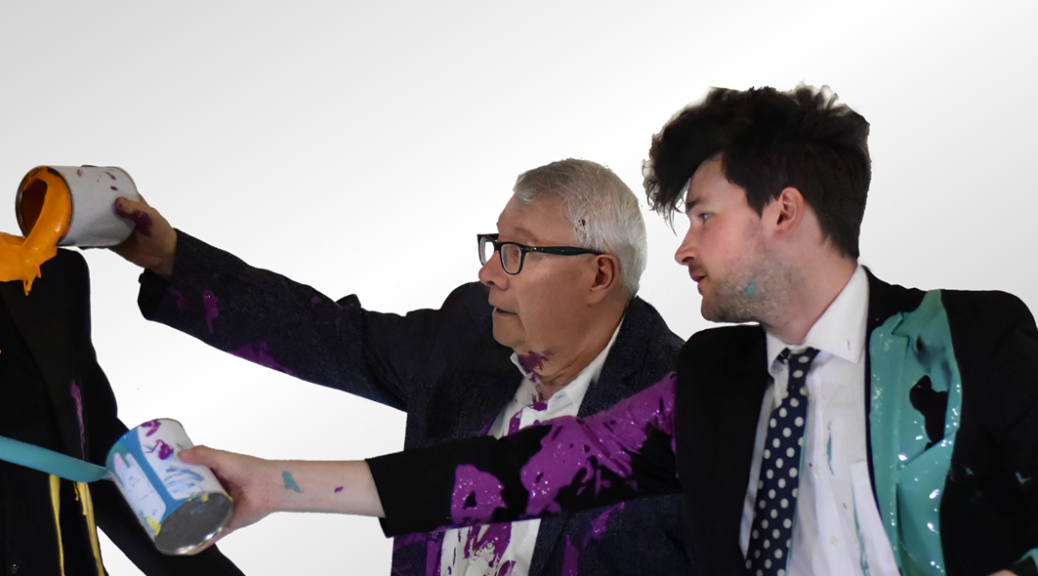
In this single-act play directed by Peter Harding-Roberts for Everyman Theatre at Chapter in Cardiff, the purchase of a blank canvas for a ludicrously high price pits pretentious Serge seeking to impress his friends against classicist Marc who scorns the work as a “piece of white shit”. When he asks “Are you going to have it framed?”, Serge laughingly replies “It’s not supposed to be framed. The artist doesn’t want it to be. It mustn’t be interrupted. It’s already in its setting”, echoing what Mark Rothko said about keeping his paintings frameless to increase their impact on the world, as part of the world rather than separate objects.
Their friend Yvan is drawn into the debate, whose appeasing nature suggests he may provide an opportunity for some resolution to their opposing views about modern art. More than the debate about the merits of the artwork though, ‘Art’ explores the art of friendship as the antagonists realise the fragility of their long-term relationships and question their validity, the painting itself a catalyst for amplifying hidden tensions in a longstanding three-way bromance.
Seasoned Everyman actors Brian Smith and Gregory Owens are joined by Michael Taylor Moran in Yasmina Reza’s 90-minute narrative, structured not in formal scenes but in pithy little episodes, mostly duologues between two of the three protagonists, punctuated by confessional asides that break the fourth wall. The action takes place in Serge’s apartment where two large off-white armchairs are separated by a settle that serves to prop the painting centre-stage as well as a seat when all three characters need to sit. The geometry of the minimalist and monochromatic set allows the three of them to keep their distance from each other which I believe helps accentuate their differences, although I heard someone saying they wished the actors got physically closer as one might expect of true friends. Yet others have criticised the playwright for failing to establish a solid emotional base for her characters’ friendship, that these men are just archetypes, but I disagree. We don’t need to know the origins of their friendship, just the characteristics that account for their differing responses to the artwork in question, and these are well-portrayed.
In the end there is a twist that leads to the suggestion that the canvas represents a man who moves across a space and disappears, a universal metaphor for life itself perhaps, in the same way Creed’s Work No. 227 is interpreted as signifying birth (lights on) and death (lights off). I will resist identifying which character interprets the white canvas in this way as it might spoil the enjoyment of a play I would recommend seeing, for its nonstop cross-fire of crackling language and performances by three actors who capably hold our attention throughout as their levels of exasperation rise and fall according to the strain of their characters’ efforts to keep their friendship alive.
In the programme notes, the director quotes the playwright who considered her play as much a tragedy as a comedy and challenges us to disagree. That ‘Art’’ won the Molière Award for Best Author and the 1998 Tony Award for Best Play suggests the play works, and this performance also, because it is both.
Creating opportunities for a diverse range of people to experience and respond to sport, arts, culture and live events. / Lleisiau amrywiol o Gymru yn ymateb i'r celfyddydau a digwyddiadau byw

 (4 / 5)