The new BBC 1 TV series Talking Heads brings back a personal memory of Dame Thora Hird, DBE, to Barbara Michaels
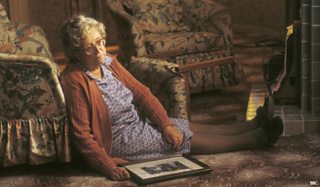
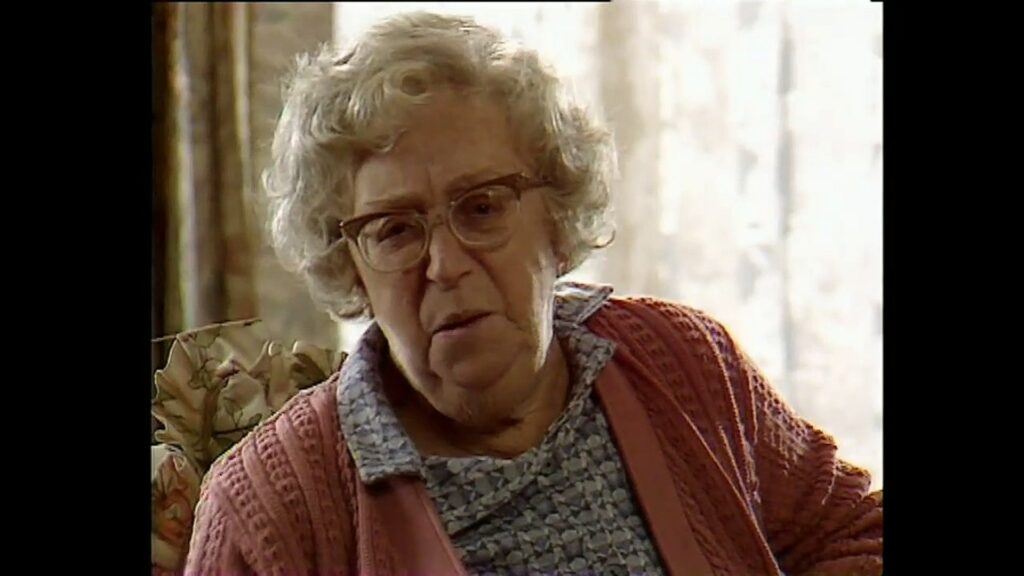
If any of you were fortunate enough to have seen Thora Hird in Cream Cracker Under theSettee, one of Alan Bennet’s witty and often heart-breaking monologues in the series, Talking Heads, premiered back in 1988, you will fully understand why I rank meeting and interviewing Thora Hird as one of the high spots of my career. I interviewed Thora at home in her London flat, with her husband Jimmy Scott pottering around making us coffee in the kitchen.
Forward to 1994. The next time I met her was when I sat next to her at a long prearranged gala performance hosted by Melvyn Bragg, at which she was the guest of honour. Sadly, it was not long after Jimmy, to whom she was married for 57 years, had died. In the darkened auditorium she wept silently, with tears coursing down her cheeks. Widowed myself just over two years previously, I understood only too well what she was feeling.
But wonderful trouper that she was, when the spotlight shone on her (at least she was spared having to walk on stage) she stood up, all traces of the tears gone, and made a speech without a wobble in her voice.
It was her audience who choked back their tears then.
Since that day, there has been a hugely prestigious list of actresses including Dame Eileen Atkins, Stephanie Cole and Dame Penelope Wilton who have performed in the monologues. This time around, the list includes Imelda Staunton (did you see her in Finding Your Feet on Channel 4 recently?) and Dame Harriet Walter.
Great actresses, all of them. But it is Thora I will always remember. Perhaps it is just as well that Cream Cracker Under the Settee has not been included in the remake. The reason why? It calls for an actress over 70 years of age (as Thora was) and, under the lockdown rules, the BBC felt unable to include anyone of that ilk!
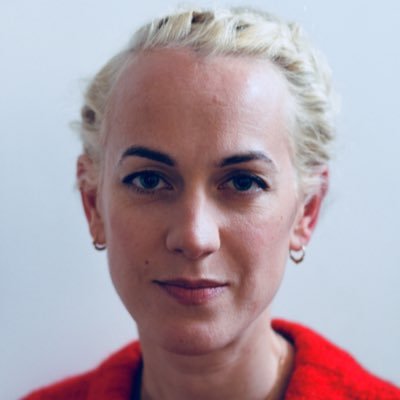
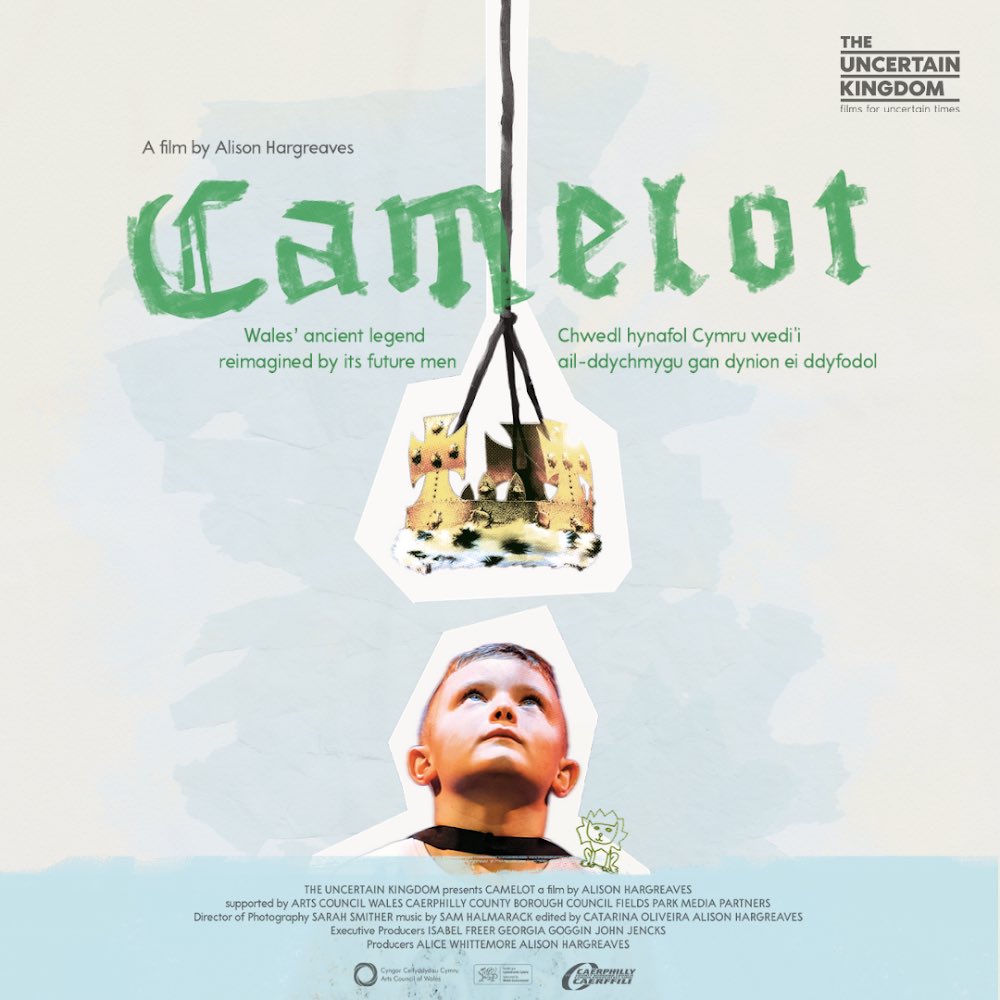
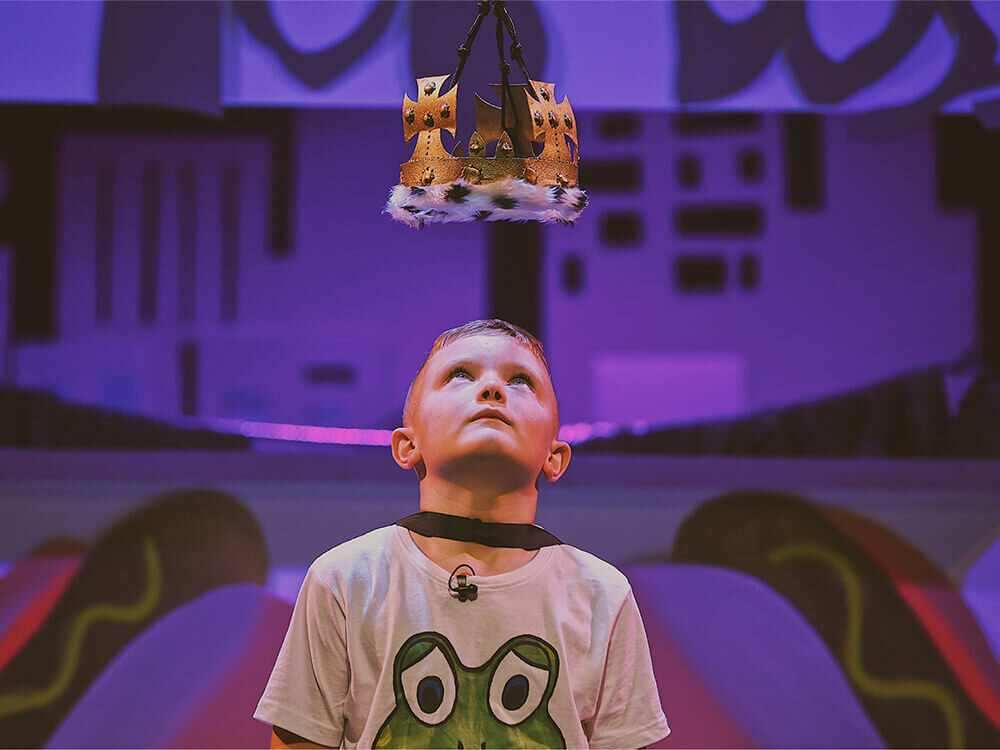
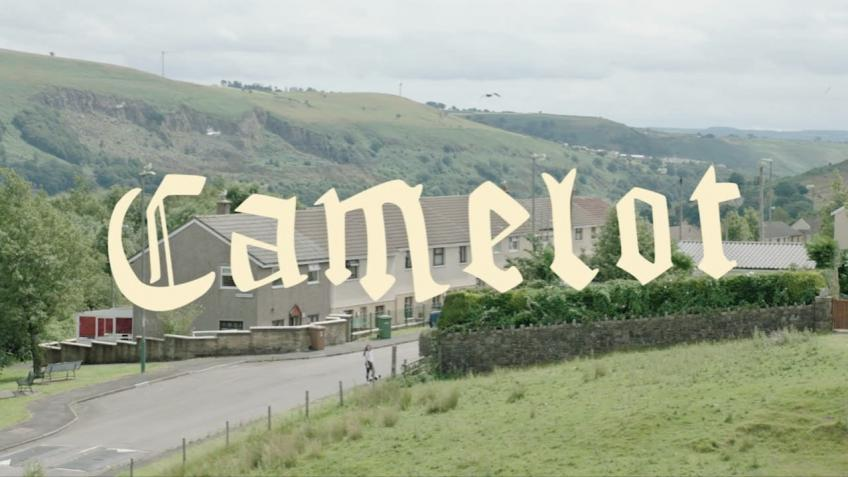
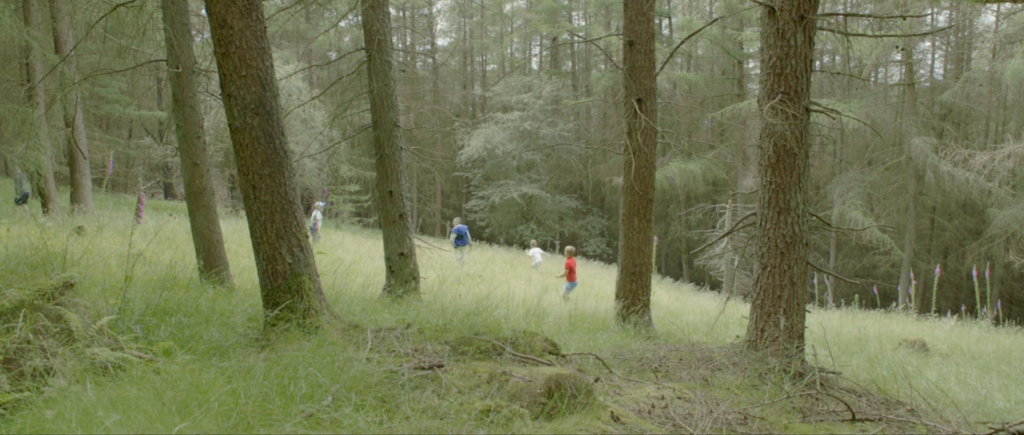
In our latest interview, Get the Chance community critic Barbara Hughes-Moore chats to director Alison Hargreaves, whose latest short film Camelotfeatures in the anthology The Uncertain Kingdom. Produced by John Jencks, Georgia Goggin and Isabel Freer, the anthology assembles twenty visionary filmmakers to paint a portrait of post-Brexit Britain. Alison discusses her career, the urgent need to invest in the arts, and why it’s so important to give children the opportunity and the control to tell their own stories. Camelot was creatively led by a group of pupils at Idris Davies School in the Rhymney Valley in collaboration with professional theatre practitioners from May-July 2019, and is described as ‘Wales’ ancient legend reimagined by its future men’ .
This interview has been for edited for ease of reading.
Hi Alison, thank you for making the time to speak to me this morning. Can you give our readers some background information on yourself please?
I’ve been moving into film in the last 5 years, but my background is mainly in theatre. I’ve worked for organisations like Bristol Old Vic and Clean Break Theatre Company and other companies that have tried to find ways to reach people who didn’t necessarily have access to quality creative engagement and finding ways to democratise resources so that more people can have their voices heard and be represented. I’ve worked in criminal justice settings, in prisons, in different communities, different vulnerable groups, and in schools.
As a theatre fan, it becomes more interesting if going to the theatre teaches us something about our society that we didn’t know, and that means not telling the same stories again and again. Theatre and film should help you understand the society you live in and what you have in common with other people. That’s always been where my creative interest has been because the most impactful and exciting work has been made that way.
How important is it to support the arts?
We live in a country that doesn’t necessarily support the arts properly, and especially in education, so when I started to make films I was interested in documentaries that would give a platform for people who might have been under-/mis-represented. With a film, you can frame something in a new way, you can help people to feel a kind of complicity, and feel a connection to or empathy for people who they might otherwise have never really felt connected to. A film can take you inside someone’s inner life; it can help you understand the way someone thinks, whereas in the course of everyday life we sometimes live in bubbles and don’t always reach out to each other.
I think that the process of theatre-making is that it’s beneficial not only for training children for the creative industries (although it can often spark that interest); theatre-making is about working together, respecting ideas, having your own ideas respected, having a safe space to experiment and imagine new things, to support each other, to be supported, to tell a story, to connect with people and to learn and develop skills like devising and reinventing a story and making it your own. The devising process in particular is brilliant for children because its enables them to understand that they can rewrite a story, meaning they can have an influence not only in the way that a story is told but in the way that their story is told. This means they take some ownership, and have some control, over the story, which I think is huge for children who may not have the opportunities and role models; some people feel they are on a conveyor belt and the only thing they think they’ll end up doing are the things people around them are doing.
Engaging them in constructive creative process gives them an opportunity to really understand that the world is their oyster. What I was really interested in doing for Camelot is using theatre to engage the imaginations of those children so that a film audience could step inside their imaginations and see what was inside their heads, and for those children to be taking ownership of ancient stories, the sorts of stories that underpin our culture. These stories are handed down to us and they repeat ideas about who we are as a country, as people, and I think it’s really important that we don’t treat those stories as set in stone; that they come with their own biases and it’s important that everyone has their own interpretation and has an opportunity to decide for themselves what the story could mean and how its relevant to them. I was really interested to see what the children came up with – they’re at an age where they’re not self-conscious, where they are complete free-thinkers, but not given a huge amount of opportunity to do constructive creative work that doesn’t get graded. We tried to find a way to make sure every set of abilities could find a contribution to make.
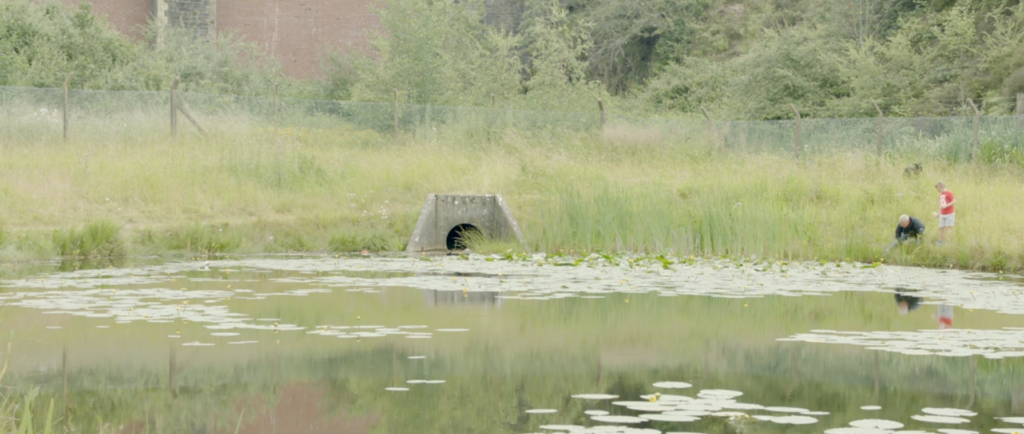
This idea of reclaiming the narrative came across so strongly in the film – do you think it applies to the community as well, because the interconnectedness of people and the place they inhabit seems to be at the core of the film. The Pit Pond seems to be the axis of that. Is that an image that realty stood out to you?
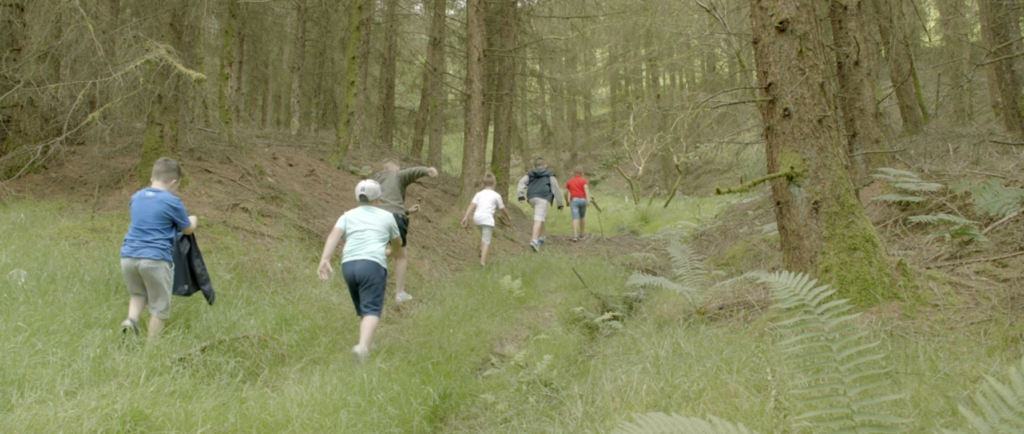
Totally – I’m so pleased you got that! What’s interesting about the Camelot story is that it’s about building a kingdom of your own, creating a space for yourself. A lot of the rhetoric in Wales’ Leave Campaign was about a mythical idea of reclaiming your land – and those kinds of themes must be interrogated. It was time to reinvent the story rather than just repeat the tired tradition way these things are told. Communities are shaped by their landscape; their history has been shaped by their landscape. The landscape itself has been changed by their lives, by their industry; the actions of people in the Valleys have literally shaped the landscape around them, so they’ve got a very interesting connection to the land. It’s a timeless and extraordinarily beautiful landscape, and King Arthur was said to have passed through Gelligaer common, which is located immediately above the school.
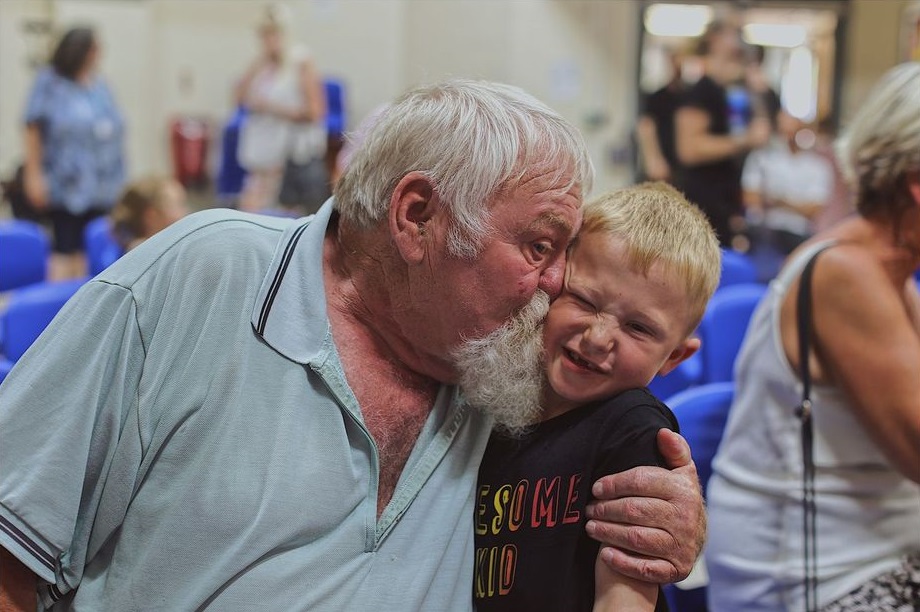
There are many myths in South Wales that connect to the Arthurian legends, and there is a sense of the land holding all these stories, all these histories, but it’s changed so much and now these boys are living in a moment where their fate looks so different from the fate of their grandfathers because of the way their worlds have changed. Bringing in the grandfather I hope gave this sense, because he was able to share his perspective on how things have changed, and how his grandson’s life is different to his was when he was his age. You’ve got this really interesting moment where, because they’re not going to be sent down the pits, these boys have freedoms in some ways that older generations didn’t have, but they’ve lost some of the certainties that those older generations had, so it’s not as simple as saying it’s either good or bad. It’s complex.
King Arthur discovered his destiny and achieved something unexpected, and he did that with the support of Merlin as a role model, and I was interested in role models for the boys and who they look to in their lives, and one of the boys discussed frog hunting with his grancha, and he brought that element to the character of Arthur. Then they took me to the Pit Pond which just happens to be the world’s most beautiful place – lots of young kids go angling there in the summer, and it was such a gift. It felt like the perfect connection between the world of the play and the real world.
Photo credit: Anna Jones
There seem to be two opposing views on destiny in the film: the young ‘Arthur’ believes that ‘destiny wins your future and how you want to live’ whereas his grancha doesn’t believe in destiny and thinks that ‘what you get out of life is what you put into it’. Which side of that debate resonates with you most?
I’d have to side with grancha on that one! I think it is what you make it, and understanding that it’s in your control is really important. It’s positive if you can believe that unexpected things are possible, that change is possible, that there can be these moments in life where even someone with not many prospects or who doesn’t know who he is can learn something surprising about himself. But I also think that you have to understand the influence you can have over your own life. Of course there are circumstances that impact on our lives, but you always have a choice – even if you can’t choose everything, there are always things you can choose and exercise some control over.
Photo credit: Anna Jones
You’ve given these boys a real gift in giving them this opportunity. They seem like directors in the making!
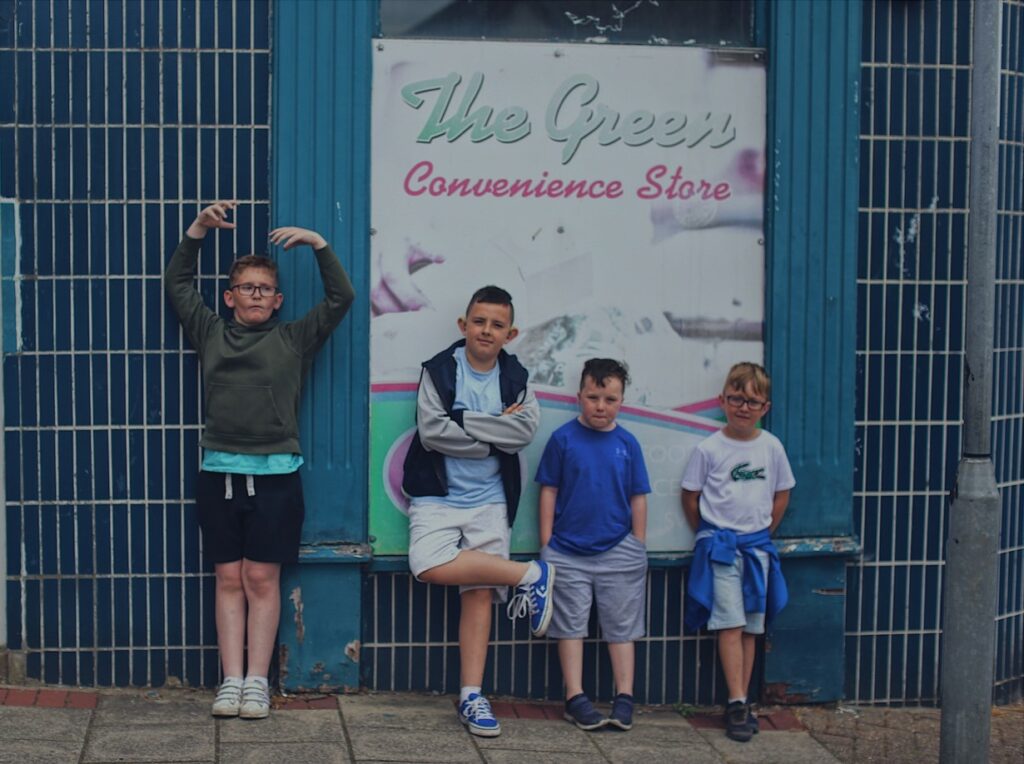
Arts and education have been whittled down to nothing, and these boys have never done anything like devising a stage production in their lives. We had this amazing moment when we’d been developing the story with them, and we came back one day with a script for us to sit down and read together, and the boys took it so seriously. It meant that they cared about it, and they felt like it was theirs, because they’d never have showed it the same amount of respect. They were so keen about finding their lines on the page, they gave their characters personalities, and were really invested in the story. I knew then that the whole concept was going to work because they’d made it their own.
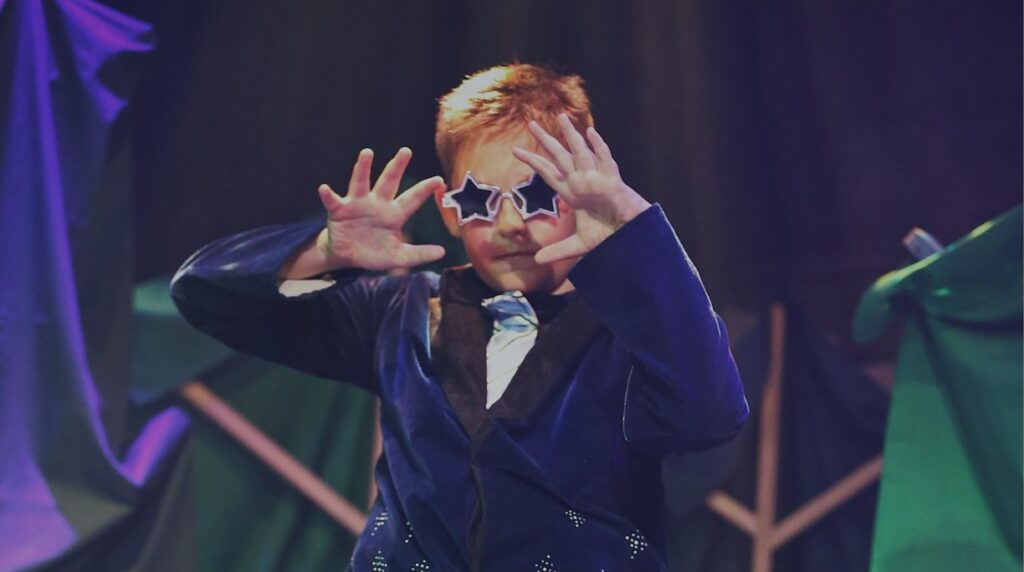
Some of the boys had specific skills, and we needed to channel them into particular roles. One boy was obsessed with drumming and he never expected them to get a beautiful orchestral timpani drum from the RWCMD, but we did – we really invested in where their areas of curiosity were. They were drawing their own costumes and we brought them back made as they’d specified. One boy took a while to come out of his shell. He was one of the shyest boys at the start, and then he turned up on the day before the performance with a remix he’d composed on garage band, specifically for particular moments in the story. Giving them an experience where they’d been taken seriously and their ideas had been made real, hopefully is a really positive memory for them, that they were taken seriously, they contributed, and were celebrated. The show was such a hit with the community and it was such a proud day for them. I hope it’s something they remember for a really long time.
Photo credit: Anna Jones
There’s a real sense of joy and exuberance in the film, which I think comes from this particular way of working. Is this a method you’ve used before?
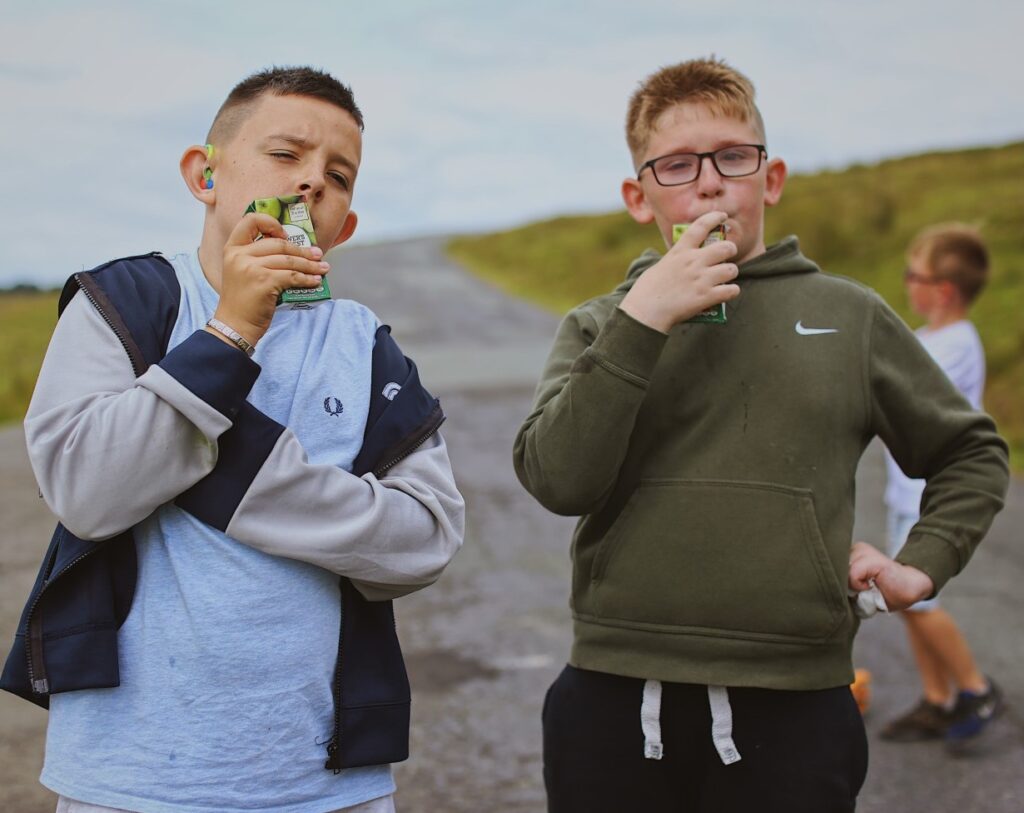
I’d never combined theatre and film in this way before, so I took a chance on a new way of working; something I’d been curious about for a long time but hadn’t done in exactly that way. I knew that it had to be a positive story, as it was genuinely my experience of that community. They’re used to having a lot of lazy journalism that repeats negative stories about the valleys. When they found out we were going to tell something positive and creative with the kids, they were so accommodating and supportive. I’m interested in not repeating tired, narrow judgments of what communities are like. It’s a close community, and those children are adored by their families; they’re living in a little bubble where they are safe and can explore both their landscape and their imaginations. Before life gets a bit more complicated for them, there is joy in their lives, and there is something lovely about where they live and who they are.
Photo credit: Anna Jones
Was the school already putting on an Arthurian play or did you approach them with the idea?
I approached them. I had supported another director on a project a few years ago who had worked with the Head4Arts organisation. So Head4Arts introduced me to Caerphilly Borough Council, who then introduced me to the parents’ network, who introduced me to the school – the parents’ network knew the schools very well and had an idea about which schools would be up for it. After I won the commission for the film, I sat down with the team at Idris Davies [primary school], and then I applied for a specific strand of funding (which no longer exists) for collaborations between schools and artistic practitioners from Arts Council Wales. The Council invested money in the film too, and the Area Regeneration Team in Rhymney made that first step in investment, as it was positive for boys and looks for role modelling which they wanted to prioritise, as well as anything that would bring the community together. So, it started completely from scratch with me saying we want to devise this show with boys in the school, and make a film that tells the story and paints a portrait of the community.
What does Camelot as a concept mean to you?
Camelot is an aspirational place that brings to mind this idea of wealth, health, opportunity, safety, a sense of peace – but also it doesn’t exist. It’s a place that was spontaneously made by someone, and when we think about the idea of Camelot we’re thinking about how we could change the world if we could, and what kind of world we want to live in. Camelot is an idea, a utopia; where we would want to live and what that would look like. It’s a man-made kingdom that was an improvement on what came before. I’m interested in that kind of engagement, productively moving together towards building a better society. An idea like Camelot is a way in to that kind of conversation.
Camelot builds on the idea of the anthology being titled The Uncertain Kingdom – is Camelot that uncertain kingdom?
Yes – and if you’re sat in an uncertain kingdom, it’s where you might be hoping to be. It’s what you might be dreaming of while you’re sat in your uncertain kingdom. I suppose I wanted Camelot to be this moment of unbounded opportunity for these boys, a moment where they are safe, happy, free and unburdened by the world. This sort of perfect moment, when it’s summertime in the Rhymney valley, they’re hunting for frogs and they’re enjoying their childhoods.
How was the anthology put together?
The Uncertain Kingdom was thought up by three producers who were responding to the ways in which the political landscape felt last year. They wanted to empower filmmakers to make a comment on events and they wanted a fast turnaround so that the moment wouldn’t pass. They always intended to make 20 films; they reached out to 10 filmmakers and had an open call process for the other 10 – it was a really open brief, you just needed to pitch for an idea that would provide an insight into life in the UK now and connect with the questions they were asking about uncertainty. We had to write an application, submit a treatment once shortlisted and then pitch it in person. I understand that there were over 1400 applications, so it was really popular.
How do you think the experience will stay with you? How will it impact how you work in the future, the projects you align with?
I’m just thrilled that it worked! It was always going to be quite complex and difficult in some areas, so you have to accept that of all the elements you can expect one or two to be tricky. The only thing you hope for is that the tricky things aren’t in the important areas. I was lucky they weren’t. When it came to relationships with the boys and the community, there were no tricky areas; it felt like everything that really mattered went well, and all the tricky areas were in the boring financial areas. In a way, I feel like I got the problems I wanted.
You can never expect to make perfect work and I’m still learning a lot, but what I’m satisfied with was the tone of the film. The approach was what I wanted it to be, and the heart of the film was where I wanted it to be. It gave me confidence that it’s possible to connect a theatre project with a film project and tell a story that weaves between an imaginary world and a portrait of the real world. I want to make films that are revealing of our society, but our imaginary lives are important and can be revealing in themselves; I’m interested in the kind of documentary that wraps around something that might be imaginary, so I’ve left with some confidence that that sort of project works, and that people understand what I’m trying to do when they’re watching it.
Part of you always thinks is this just in my head, but it’s lovely that what you’ve made has communicated what you wanted it to. I’m hoping to develop it even further and continue to work in that way for sure. It’s also made me really appreciate how important relationships are in any project, that the collaborators you work with are so important, and that you never make anything like that on your own. I’m extremely grateful: I worked with lots of people I hadn’t worked with before, had some fantastic collaborators, took a few risks, and I’m so pleased they paid off.
Photo credit: Anna Jones
The notion of collaboration is so important in an age of lockdown, which can be extremely isolating. Is the arts sector having to change fundamentally in light of this – and is collaboration the answer?
I think it is, you have to be quite inventive now with how you find your support for projects. I’ve always had to resource my projects from a real mixed bag of grants, private help, and volunteer support. You have to think really creatively about how you get things off the ground now. In recent years there’s been a lot of attention on how you make things and who you involve and how you involve them, and it’s not just about what you come out with at the end, it’s about who is represented in that process – it’s crucial that people are trying to think about the methods of working as being as important as the outcome.
People are recognising that you can’t tell certain stories unless you involve certain people – if you’re talking about the experience of certain communities or people of particular identifies, there’s a very specific way you have to go about that. People are creatively understanding how the who is just as important as the what, and just how connected those two things are. You have to think on a case-by-case basis what a project specifically needs, and who would be interested in it. You’re having to work out who your audience is before you get going because you’re having to find support to make it possible. Private funding is going to become more and more important now with creative projects, and filmmakers/theatremakers are needing to become effective fundraisers in order to stay in the game. I think the relationship between business and creative industries needs to be a closer one. I’d love to see more public funding for the arts.
In the same vein as you discussed earlier, it’s not just about humanity coming out the other side of this, it’s about what keeps you going along the way.
And to remind us what we’ve got in common, remind us that it’s what we’re working towards, why it’s worth looking after each other in the first place.
Giving people control of their own stories, as you’ve done here, is one of the most beautiful and important steps so that we can make a better world. The optimism of your film is so necessary.
I really agree. If you can’t imagine it, you can’t make it.
What’s next for you?
I’m lucky to have a side hustle in producing projects that inspire me, so I’m helping Cargo movement right now. They’re a really inspiring company that’s making innovative teaching resources and exhibition design that tells new stories from Black history. Creatively, I’m writing another short film, and I’m working with a production company to develop the Camelot concept into a miniseries for TV, which I’m very excited about. It’s a long road, and it’s very early days, but I’m pleased at least to be having intentional conversations
Wonderful! Thank you so much for your time, Alison – it’s been an absolute delight to talk to you!
I’ve had a lovely time! I can’t tell you how lovely it is to hear you loved the film, and that everything came across in the way I hoped it would. It’s like music to your ears. It’s been a long process – we met the boys in May 2019, but I’d been working on it from January 2019, so it feels now that people are starting to see it. We had to wait a long time for people to see it, and now that they are, it feels like a lovely end to the process, and it’s such a huge reward when someone has taken from it as much as you have. Thank you so much, I really am grateful.
The Uncertain Kingdom is available to watch on demand from Apple TV, Google Play, Amazon Prime, BFI Player, and Curzon Home Cinema.
In the wake of the Black Lives Protests, it has become clear that the majority culture has missed a few episodes so a look at Spike Lee‘s BlacKkKlansman is needed. The film makes subtle points in a non-subtle way. The most important is that white liberal middle-class Christian male identity is the ‘original’ identity politics. Don’t get me wrong. There is nothing wrong with being a white liberal middle-class Christian man, the problem lies in the refusal to see that our society has been shaped in that image and our consciousness reflecting specific prejudices and values.
Society is not a neutral space where individuals interact with other individuals, as libertarians think. Society has structures of power, which create obstacles for the Other (the non-white liberal middle-class Christian man). Culture is the narratives that emerge from social relationships and that legitimise them. The image of a neutral individual colour-blind, gender-blind, etc. is ‘white privilege’, the privilege of not being racialised, gendered, othered. White privilege means never having to ask yourself what it means to be white. BlacKkKlansman explores what it means to be black and what it means to be Jewish, but also how white Christian nationalism has shaped whiteness.
BlacKkKlansman tells the true story of Ron Stallworth (played by John David Washington), an African-American detective in the Colorado Springs Police Department, who infiltrated the Ku Klux Klan in the 1970s. He does so by establishing contact with Klan’s leaders on the phone and through a Jewish colleague, Flip Zimmerman (played by Adam Driver). Spike Lee oscillates between teaching his audience about American history and identity politics and portraying the KKK as fools, between tragic and comic mishandling both. I grew up with Spike’s movies. They shaped my consciousness, so I miss the old Spike.
In BlacKkKlansman, Spike Lee has played it safe giving us a crowd-pleaser, but one that is muddled and weakened by the tension between comedy and melodrama. Gone are Jungle Fever and Do the Right Thing with their uncompromising look into a messy reality told with ironic anger. Yet, buried underneath the self-satisfied humour and self-righteous preaching, BlacKkKlansman offers a few glimpses of the making of racial identity that are worth considering.
In the film, the KKK repertoire of language, symbols, and rituals is contrasted with that of the Black Power Movement. The storytelling of White Supremacists watching DW Griffiths’ A Birth of a Nation, is counterposed with Harry Belafonte’s telling of the lynching of black people. American culture has been shaped by Christian nationalism and capitalist individualism. It has been presented as the default, the universal, while suppressing the experiences of the Other and depicting them through stereotypes and labels, and confining them into social roles (e.g. women as mothers and wives). Above all, it has hidden the systemic violence and oppression black people have suffered and are still suffering.
BlacKkKlansman shows that racism and systemic inequality have been legitimised and reproduced by the cultural process of Othering. Racism is not merely individual prejudice, but a whole set of norms and material obstacles that keep the Other in ‘their place’.
The film highlights that race is embodied but also performed. Ron Stallworth does a ‘white voice’ to fool the Klan, but can only infiltrate it because of the ‘white body’ of his colleague Flip Zimmerman. To persuade his boss to let him go under cover with the Klan, Ron tells him there are those who speak ‘King’s English’ and those who speak ‘Jive’. He’s perfectly fluent in both. Ron needs Flip Zimmerman to play him as a white man with the Klan. In a moment of camaraderie, under instruction from Ron, Flip tries to perform a speech by a black power leader, only to be outperformed by another colleague (on blackness, performance, and politics see Patrick Johnson’s Appropriating Blackness).
The image we have of the body is also highly racialised (voice, hair, skin etc.). White privilege means whites do not normally ask themselves what it means to be white. Yet, there are many shades of white. Foreign-born and Jews are not considered ‘whites’. Zimmerman had never considered himself anything other than white because he had not grown up as part of a Jewish community. It is the Klan’s idea of whiteness that leads him to confront his identity.
Flip tells Ron that he was not raised to be Jewish, it was never part of his life, he had never gone to bar mitzvahs, and never had a bar mitzvah. He never had Jewish friends, he was just another ‘white kid’. Flip’s Jewishness is called out by a colleague mentioning his ‘Jewish necklace.’ Flip replies that ‘it’s not a Jewish necklace, but the Star of David.’ Asked whether he’s Jewish, he says: ‘I don’t know. Am I?’ Zimmerman realises he too is Other as he faces white supremacists.
The most poignant scenes are the real footage of Charlottesville’s ‘Unite the Right Rally,’ where a white supremacist drove his car deliberately into a crowd of anti-fascist protesters and killed Heather Heyer, to whom the film is dedicated. It may seem far away from our British and European sensibilities and yet it is very close, we just have not talked about it much (please read Paul Gilroy’s There Ain’t No Black in the Union Jack). BlaKkKlansman is weighed down by its pedagogical impulse, yet it’s a lesson many have not yet heard.
In response to the lockdown triggered by COVID-19, many arts organisations have taken their work online, sharing content for audiences to view for free. However, creating participatory engagement online is much more challenging and, as a sector used to being face to face with people in their practice, it’s clear that the current restrictions change the nature of participatory arts based activity substantially.
Following a vital conversation on social media led by Guy O’Donnell, Learning and Participation Producer, National Dance Company Wales which opened a discussion on how we can deliver participatory arts effectively, a range of partners are collaborating to lead Zoom discussions for the sector where we can talk about the impact of the lockdown on our work and work creatively together to think beyond the lockdown.
In partnership with ArtWorks Cymru a series of free Zoom meetings have been set up to discuss and share current working practices in participatory delivery.
Capturing the Learning
These Zoom meetings will explore how we capture the learning from organisations and artists who are currently delivering projects. We’ll explore what methods are working well, what are we learning through this experience, and how we are adapting our working practices.
Kelly Barr, Arts and Creativity Programme Manger Age Cymru hosted the first Zoom participation meeting. The meetings are free to attend but numbers are limited. Kelly gives an overview of the work Age Cymru has created to meet the challenges and the companies solutions to support the public and her service users in the current climate.
Hi can you tell me a little about yourself and your organisation?
Hi, I’m Kelly Barr, and I am the Arts and Creativity Programme Manager at Age Cymru, who are the national charity for older people in Wales. I have been working on participatory arts projects with all sorts of organisations for 6 years, including NDCWales, Earthfall and the Sherman.
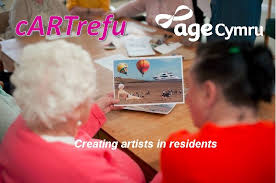
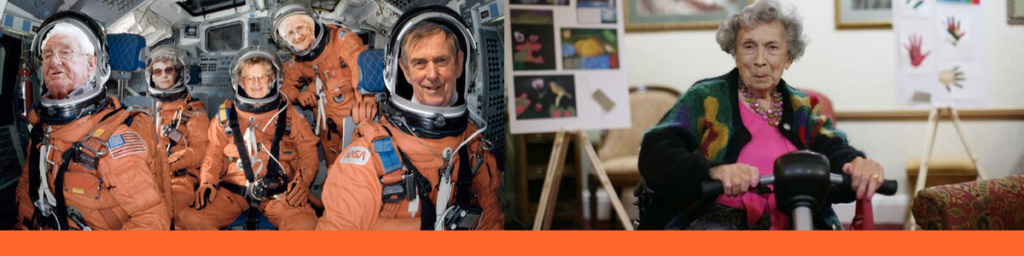
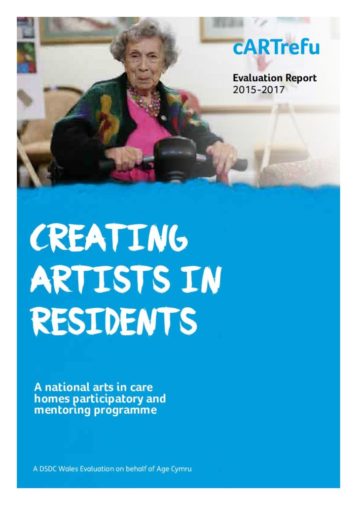
The two main arts projects here at Age Cymru are Gwanwyn Festival, an annual celebration of creative ageing which happens in May each year, and cARTrefu, the largest arts in care homes project in Europe.
We also run other projects throughout the year that might try to tackle isolation and loneliness (like our Gwanwyn Clubs), stereotypes of ageing or representation of older people.
Your organisation is hosting one of the free Participatory Arts – Capturing the Learning / Beyond the Lockdown meetings. Why do you agree to support these events?
I am in a very fortunate position to still be working at this time, and I felt like I had a responsibility to support conversations within the participatory sector. I saw many people reacting wonderfully quickly and adapting their practice, but I also recognised that that isn’t always an option, particularly with the groups of people that I work with. I have always believed that we have much to learn from each other so it was an ideal opportunity to do my bit to support some good practice sharing.
What challenges has lockdown present to the delivery of your service?
Gwanwyn Festival has often been about bringing people together, many of whom are in the high-risk category at the moment, so we made the decision fairly swiftly to postpone the festival.
We had a duty of care to protect the people that might attend the festival events, and those that are running them.The creative ageing sector is very supportive so I have been lucky enough to have regular chats with colleagues across the UK and Ireland (Gwanwyn Festival was inspired by Bealtaine Festival), so that we can support each other to think about how festivals like ours might work moving forwards.
We also knew early on that it was going to be difficult to continue to deliver the cARTrefu project, as care homes were starting to close their doors in early March. We’re lucky to have supportive funders who we will be able to work closely with as things progress. We have multiple scenario plans but are very much being led by what care homes want and need right now.
What issues have your service users/participants faced?
I’m really proud to be part of Age Cymru, as they have been able to adapt really quickly during the pandemic to ensure that older people in Wales are supported. We run an Information and Advice line, which received a 200% increase in calls at the start of the pandemic; people needed advice on whether they should be self-isolating or shielding, where they could get support with food shopping and collecting prescriptions. People have also struggled to access their money, and needed support to find new ways to stay in touch with family members. I’m pleased to say that we have been able to help, in partnership with our local Age Cymru partners, Age Connects and other voluntary services across Wales.
What systems did you put in place to ensure delivery?
Many of us are well-used to working from home, but it’s been really important to find moments to connect with colleagues. Many of us are spending most of our day making calls to older people through our Check In and Chat service, so it’s not always easy to have online ‘meetings’ as often as we used to have physical meetings. So we’ve set up Whatsapp groups, we send voice-notes, have catch-up phone calls, send pet pictures (in my case, plants!) as well as whole team Zoom and Microsoft Teams meetings. It’s ever changing and adapting!
With my specific work, it’s about being available to our partners and being flexible and open about the realities. We’ve been taking time as a team to think further ahead, and problem solve, and take any opportunities we can. We’re also keen to use Gwanwyn and cARTrefu Facebook, Gwanwyn Twitter and cARTrefu Instagram to promote creative opportunities for older people as far as we can.
Did you have any particular challenges or success that you would like to share?
Back in April, I, like many people who are in a position to, wanted to offer out informal chats to anyone interested in running creative ageing projects, or having to adapt current projects. I had no expectations of what would come from this, only that it felt like the right thing to do, but it’s introduced me to new practitioners and individuals, which has helped to build up my understanding of what’s happening in Wales. Many people I might have struggled to physically meet pre-lockdown, due to being based in Cardiff, I have been able to connect with over the phone. I hope to continue to offer this out and to meet more people – digitally!
What are your plans for future delivery?
We’re exploring a range of options at the moment, but we’ll be working closely with our Gwanwyn Festival event organisers to look at how this might be possible. There may be ways to replicate events online, or using social distance rules. I have no doubt that our event organisers are already coming up with innovative and interesting ways to continue to connect to people and I’m looking forward to working together to adapt and learn!
With cARTrefu, we are ensuring that we are listening to care homes, and being led by their needs right now. We have developed a fortnightly e-newsletter that gives care homes low-resource activities to try, and links to lots of online performances and activities from Age Cymru (like Tai Chi classes, now on our website) and other organisations.
I’m aware that we’re now regularly speaking to people that are more isolated, some of whom who aren’t connected to the internet, so a lot of my thinking has been about how to stay connected to them and to provide interactive creative opportunities that are offline.
I’d like to highlight Age Cymru’s Friend in Need service that has launched this week, and direct anyone to it if they’ve been supporting someone who is self-isolating or shielding through lockdown. There’s lots of useful guides and resources, as well as details of our new Befriending scheme – Friend in Need
A range of organisations have worked to continue delivery of their art form during lockdown are there any that you would like to mention that you found either professionally or personally useful?
I’d love to highlight the wonderful speakers from our first Participatory Arts Capturing the Learning Event:
And I’d love to shout out to all of the cARTrefu artists whose work has suddenly come to a grinding halt with us, but have been helping us to provide creative activities for care homes remotely.
Thanks for your time Kelly
The meeting notes from Participatory Arts, Capturing the Learning – Older Peoples Zoom Meeting that Kelly hosted hosted on Thursday 28 May, can be found at the link
In response to the lockdown triggered by COVID-19, many arts organisations have taken their work online, sharing content for audiences to view for free. However, creating participatory engagement online is much more challenging and, as a sector used to being face to face with people in their practice, it’s clear that the current restrictions change the nature of participatory arts based activity substantially.
Following a vital conversation on social media led by Guy O’Donnell, Learning and Participation Producer, National Dance Company Wales which opened a discussion on how we can deliver participatory arts effectively, a range of partners are collaborating to lead Zoom discussions for the sector where we can talk about the impact of the lockdown on our work and work creatively together to think beyond the lockdown.
In partnership with ArtWorks Cymru a series of free Zoom meetings have been set up to discuss and share current working practices in participatory delivery.
Capturing the Learning
These Zoom meetings will explore how we capture the learning from organisations and artists who are currently delivering projects. We’ll explore what methods are working well, what are we learning through this experience, and how we are adapting our working practices.
Megan Pritchard, Marketing Campaigns, National Dance Company Wales is presenting at the first Zoom Dance meeting on Wednesday 3rd June 3-5pm The meetings are free to attend but numbers are limited. Megan gives an overview of the work NDCWales has created to meet the challenges and the companies solutions to support professional and participatory dance delivery in the current climate.
Hi can you tell me a little about yourself and your practice?
Hi I’m the Marketing Campaigns Manager for National Dance Company Wales: under usual circumstances that means I lead on connecting with our audiences and communities with a focus on the national touring work that we do. I work closely with the Participation department who are a fundamental part of how we connect with and stay connected with our audiences.
At the moment that work is much the same – but with a hugely digital focus, and a wealth of new ways to share dance with people. From early on in the lockdown we’ve seen a huge rise in people dancing across media from TicTok to daily community dance parties in the street.
I’ve been with the Company for just under nine years so for me that’s really exciting to see, the heart of my role is sharing this thing that I love with the world- I truly believe that dance is a universal language that is available for everyone from shuffling along to the radio in your kitchen right through to sitting in an Opera House watching a contemporary ballet.
NDCWales has as real ethos that dance is a wide spectrum and we try touch people with dance at all levels. I’m here to reassure those unsure about watching dance or bringing physicality into their bodies – to take away that fear of the unknown.
What challenges did lockdown present to delivery of your participatory practice and what systems did you put in place to ensure delivery?
Our biggest challenge was not unique – how could we digitally re-create work that relies on physicality and connection; how could we do it with reduced resource, and what should the focus be?
We were just two venues into our twelve venue mid-scale touring – our largest annual tour, one that we rely on not just for income but for connecting with people.
As a Company we already had plans to create a digital programme over the next year, but in response to COVID 19 we needed to do this more urgently. We were not in a position to move everything that we usually do online, there wasn’t the money or capacity – but as a Company we value all aspects of our work equally. To help focus our resources, we asked our audiences and looked inwards,
“National Dance Company Wales makes brilliant dance with and for all kinds of people in all kinds of places. With innovation and imagination, we widen the spectrum of what dance can be so that more people can make, watch, participate in and learn about dance in Wales and across the world.”
So we put our energy on repurposing what we already had and building on what we do well- creating spaces to learn about, and participate in dance at a range of levels.
It was important too that content was as accessible as possible – using captions and BSL interpreters wherever we could. This meant that things such as live classes were not a solution for us at the outset because they could not easily be captioned in real time.
To make things as streamlined as possible we used simple ideas and simple programmes, that could be used quickly and taught quickly to people who might be working in new ways.
We used Zoom, YouTube and Facebook live and explored new ways of manipulating these programmes in ways that they may not usually be used. We also used simple editing and captioning programmes – and taught anyone in the Company with a free hour how to use them.
To ensure a polished feel despite content being created in different spaces, on different cameras and in different styles, we created simple branding and guidelines that were easy to follow and carefully spent money on animations to tie the content together.
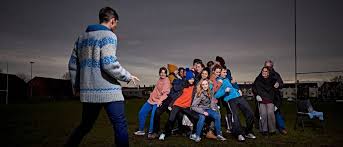
The creation of #KiN:Connected was hard work, but that hard work was met with innovative ideas and rewarding content – and I’m really proud of how quickly all of the team pulled together to create a virtual version of our work – right through from the performance streaming and post-show-talks to the . bilingual classes for children about rugby and dance.
https://youtu.be/aK59n60g-Tw
Did you have any particular challenges or success that you would like to share?
I’m really proud of all of the work that we’ve pulled together to get done during this time – but some stand outs for me are:
https://youtu.be/6m1MfEX-5s0
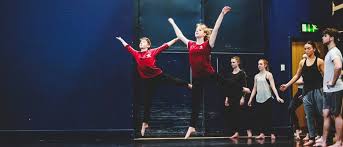
The live performance of 2067: Time and Time and Time (a reimagining of a repertoire piece from our cancelled tour, performance from the dancers home and directed in real time by the choreographer).
https://youtu.be/iYK-l2iLEZ8
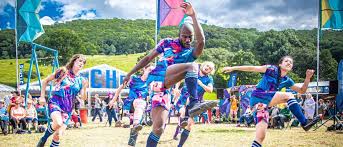
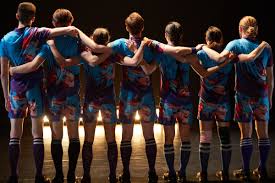
Our Rygbi learning pack and everything that surrounds it (including bilingual classes for parents of welsh speaking children who may not speak welsh themselves, and of course the full length stream of the piece itself).
https://youtu.be/HCKwdpGpUsU
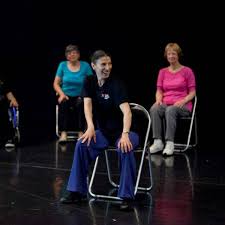
Our dance classes for adults with mobility issues – we’ve had a lot of mums of NDCWales team members use them in their daily routines, which has been really directly rewarding.
https://youtu.be/yYoP_KtGJe0
I think the biggest challenge for us moving forwards is maintaining meaningful relationships with our amazing participants and continuing to imagine new ways to bring dance to them – especially those who may not be digitally proficient.
What are your plans for future delivery?
We are just moving into the second phase of our digital delivery – taking our learning from the first phase and building on it with more real-time live performances and exciting collaborations with other Welsh companies. We’re also launching some things that took a little longer for us to perfect for our participants such as our Dance for Parkinson’s classes.
https://youtu.be/LY9L_RccpTQ
A range of organisations have worked to continue delivery of their art form during lockdown are there any that you would like to mention that you found either professionally or personally useful?
It’s been really inspiring to see how resilient the sector is as a whole and how vitally important the arts are for people’s health and wellbeing at this time (possibly more than ever). Arts companies have been at the forefront of providing accessible and free content for home-schooling, fun classes to keep us fit when we are unable to leave our homes, and beautiful digital distractions in the forms of films, play readings, dance, get togethers, streamed performances and more.
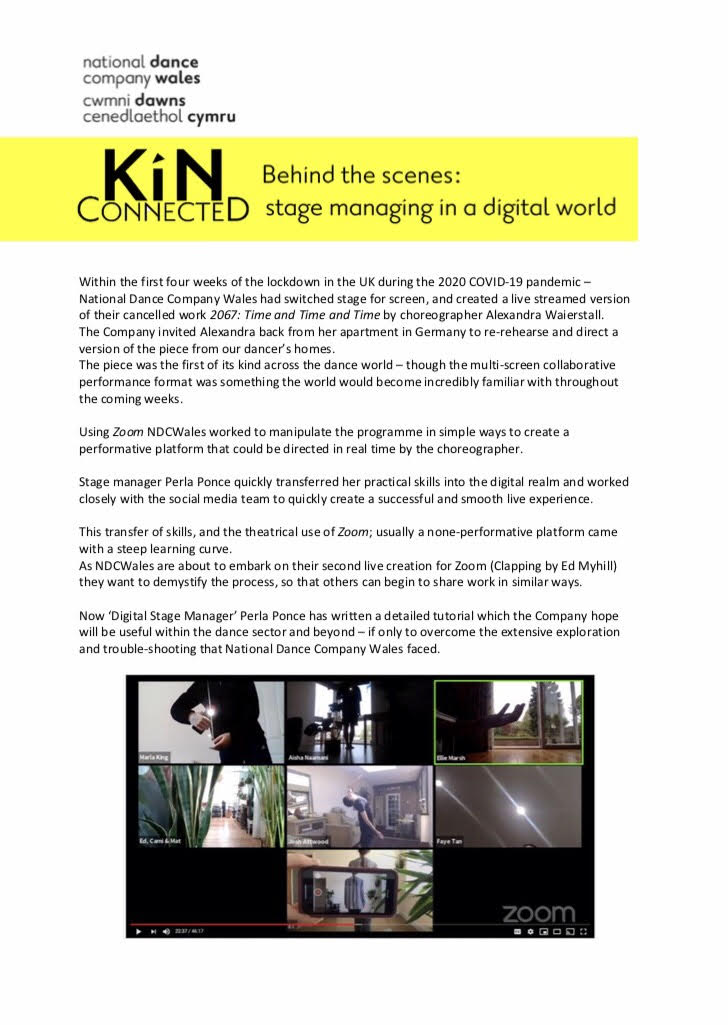
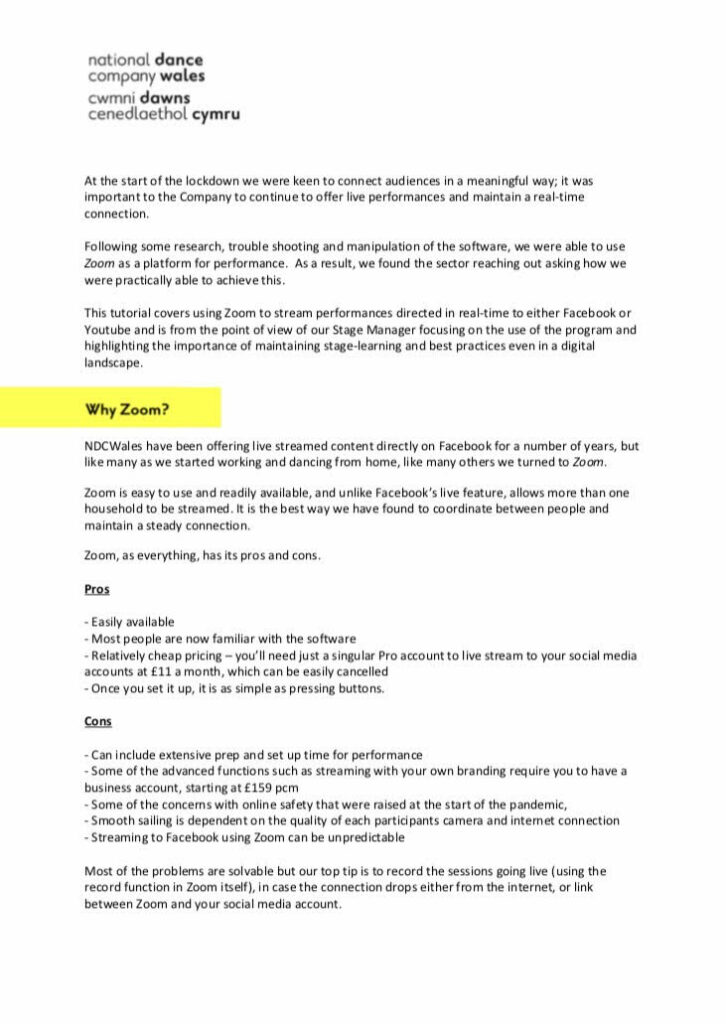
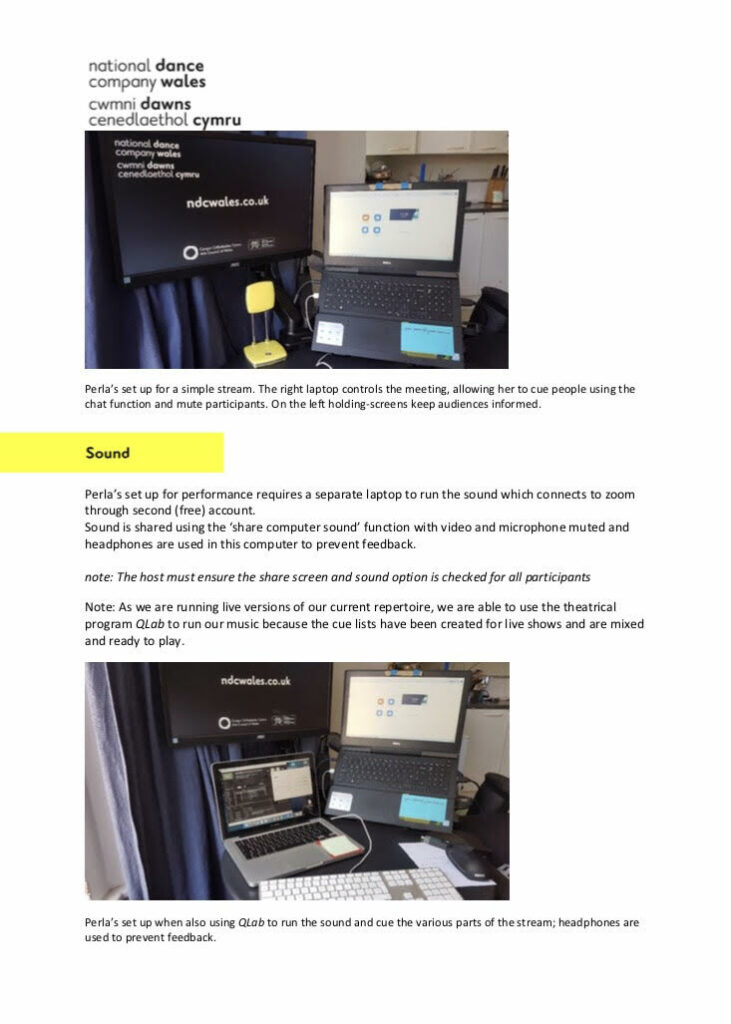
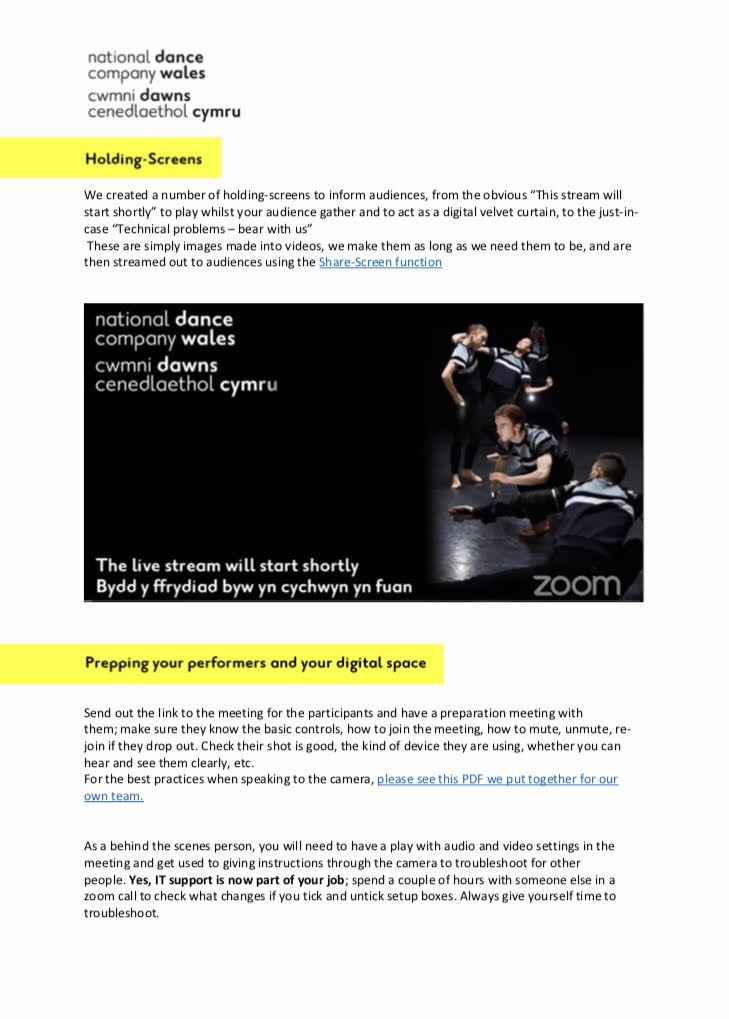
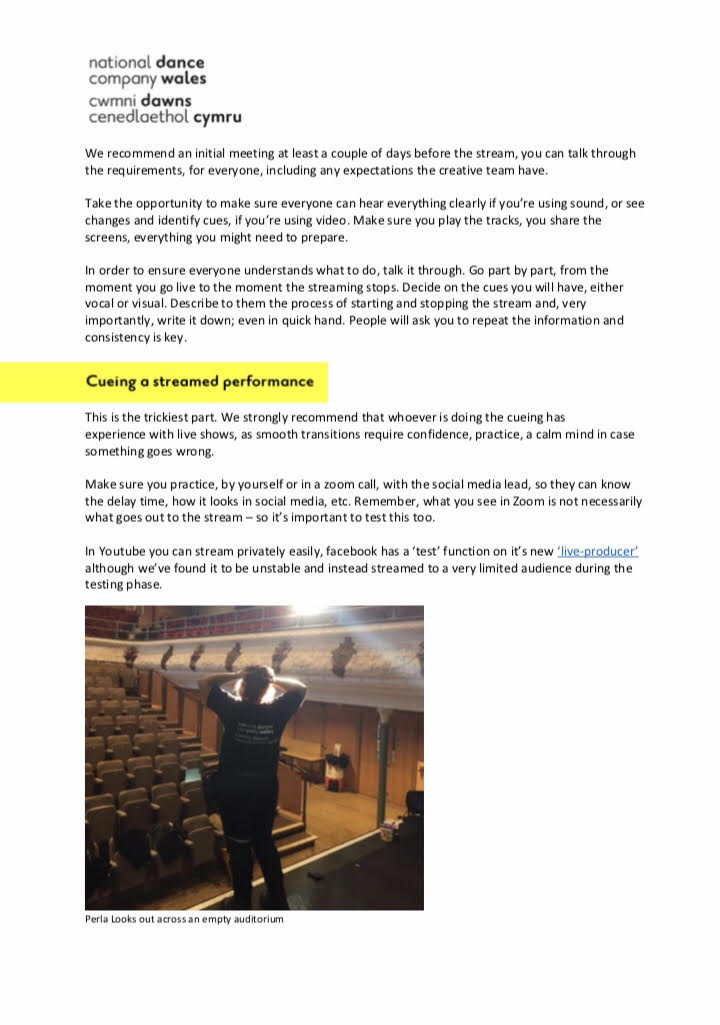
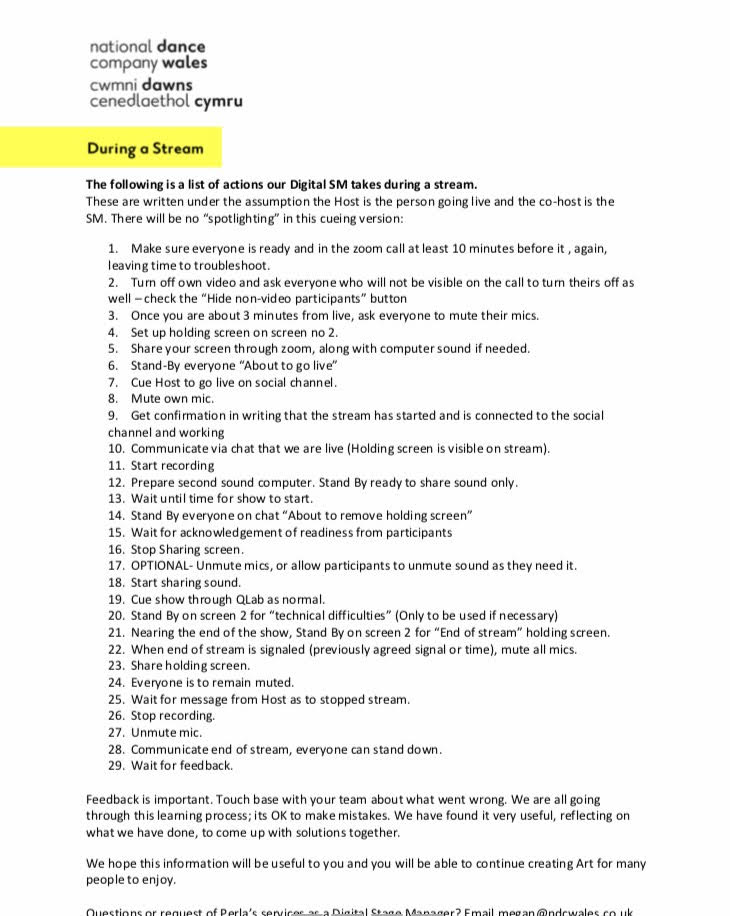
Below is a guide to streaming a live performance from NDCWales, Stage Manager, Perla Ponce. (Please note this information is in a draft format and will be updated.)
Participatory Arts, Capturing the Learning
Meeting Minutes
35 Participants
Julie Hobday – County Youth Dance Swansea
Sister company of West Glamorgan Youth Company
Created when Swansea became a County
To promote dance for 13 – 21 and also run an outreach strand for younger pupils
Collaborate across Swansea with schools, YMCA, Taliesin Arts Centre
Creative educational model – training – exploring professional work – peer support – develop a love for the artform
Follow an academic year
Challenge to be flexible and keep the company relevant
Community element is very important / but also the opportunity to create work in response to stimulus
Challenges of Lockdown
No direct funding – all income from the students
Meeting through Zoom. Had to put robust safe guarding in place
Meeting participants in their homes – some participants don’t have the internet connection or capability to digitally engage.
No shared space – we start with conversation – just so people can chat about how they are feeling and keeping everyone positive
Keeping the dancers engaged is hard – some people are keen regulars – but some people drop off. We deal with this by emailing and prompting them through social media.
We can’t recruit for new members at the moment.
At the moment, we are not charging. But there are questions about how this will develop. It leaves us with a shortfall and this is vulnerable.
Positives of Lockdown
We start by asking participants how they feel at the beginning and the end. They have usually doubled their energy by the end of the session.
We can use artists from anywhere in the country. This has helped us to support artists who might have lost work.
We’ve been able to engage with some of recent graduates who have missed out on their final presentations
Being creative about how we make work – participants are making videos – they have to think differently about how to work in different spaces
Access to resources – suddenly students can access performances and class online from some amazing companies and artists
Trying to stay positive about the future and keep thinking about ways we can keep participants engaged through the autumn
Gwyn Emberton – BA Honours Dance University of Wales Trinity St Davids
University course has moved on line
Degree is based in Carmarthen.
Intensive training in dance focused on contemporary & ballet. Also look at inclusive practice, community work.
We hope our students will stay in Wales.
The shutdown was very sudden – we only had a week to move everything online. We were about to start our last 2 months of big projects for the 3rd years & a final show for the 1st years. It was crucial to be face to face.
First Years
Challenges – Bad wifi – small spaces that students were working in
Gwyn found an online resource that he could focus the 1st years around
They kept class regular at 10am and explored lots of different ideas
They wanted to keep it positive and try to find things they could focus on
Explored musicality, articulating with the upper arms, creating phrases
1st year is about introducing ideas and reaffirming their practice
Ballet class – they did two phrases in one hour – took time to watch Gwyn on speaker view – and then repeat it so that Gwyn could watch them. Then they could reflect and consider.
Used the breakouts for creative making and collaborating. It actually helped some of the less local students to open up. This was a very useful tool and gave them space and time to investigate themselves.
Mental Health was a big thing – everyone was fluctuating. Gwyn and the students were constantly in contact with each other – used Whats App and had regular tutorials. Gwyn introduced a thursday afternoon social – a quiz or coffee and cake.
Creating a dialogue was important – getting feedback through the screen was hard – so Gwyn would call on people and having them named was important.
Resources online were important – students got to watch pieces that they wouldn’t usually see.
THIRD YEAR – Zosia Jo
Worked with students to not focus on looking at her and explore disconnecting and being present in their space.
Visualisation – Deborah Hay’s work of absorbing the space through your body.
They made site-specific work – learnt how to make dance films together
Each day they would make a little film – meet in the morning, work through the day and then meet in the afternoon to reflect.
Meeting more frequently for less time works much better.
You can only do one thing at a time online.
Giving students as much autonomy as possible worked well. Zosia was available for questions.
Sara Sirati – Ardour Academy
New organisation. Ten years of working in the community led to setting up a studio – mind , body and soul
Dancer and psychotherapist – interested in trauma and how to use the body to explore it
The dance studio also have a counselling service online – this is unusual
We work with schools, community and the health board
They also have a coffee shop and bar online where they do events
Students are usually people who haven’t danced much before
Covid struck – my first priority was the make sure all artists we worked with were OK
Considered the options for how we might work carefully. We wanted to offer something that was good quality and really helped our dancers
Jack Philp’s experience
Having a regular online session gave everyone a sense of stability
I was nervous about delivering online sessions – would I be able to communicate?
Trial and error – we navigated it together and found what worked
Pitching the level of complexity was hard as you can’t see what people are managing and not managing
Understanding how you can move big in a small space was a challenge
Grappling with the tech was also difficult but Sara supported this well
Jack found he needed to stop and check in with people regularly to see what was working and what wasn’t
Megan Pritchard – NDC Wales
Participation is tied into touring work – decisions had to made about what needed to be taken online
Blindsided by the sudden lockdown and were 2 venues into the tour
We couldn’t just move everything online – lots of difficulties and barriers including Intellectual Property & rights issues
Kin Connected
Online digital season replacing the tour
Watch Together – some live & some pre recorded – Q&As with artists following them – they wanted to keep connection to the audiences
Create Together – for professional artists to create something
Dance Together – focused on dance classes for young people and for older people
Learn Together – schools and digital work for education –
1. Tundra Learning Pack relating to a piece that was already online – made a you tube playlist
2. Created dance classes for pupils relating to our repertoire online
3. Rugby Learning Pack – relating to work they were already doing around rugby
Kept things simple and accessible – so they were easy for dancers to make – and they wanted to use captions – and for them to be short, simple and available at different levels
Created a simple brand to over arch everything.
They had a team of people who were keen. Megan taught dancers to caption and edit. Created best practice documents to help the dancers and an intro so that the dancers all said the same thing.
They created something for the Wales Arts Review Digithon early on and this got us thinking about how we could make work.
Dancers are performers – we needed to make this possible somehow – so we looked at Zoom. We wanted to make it love somehow.
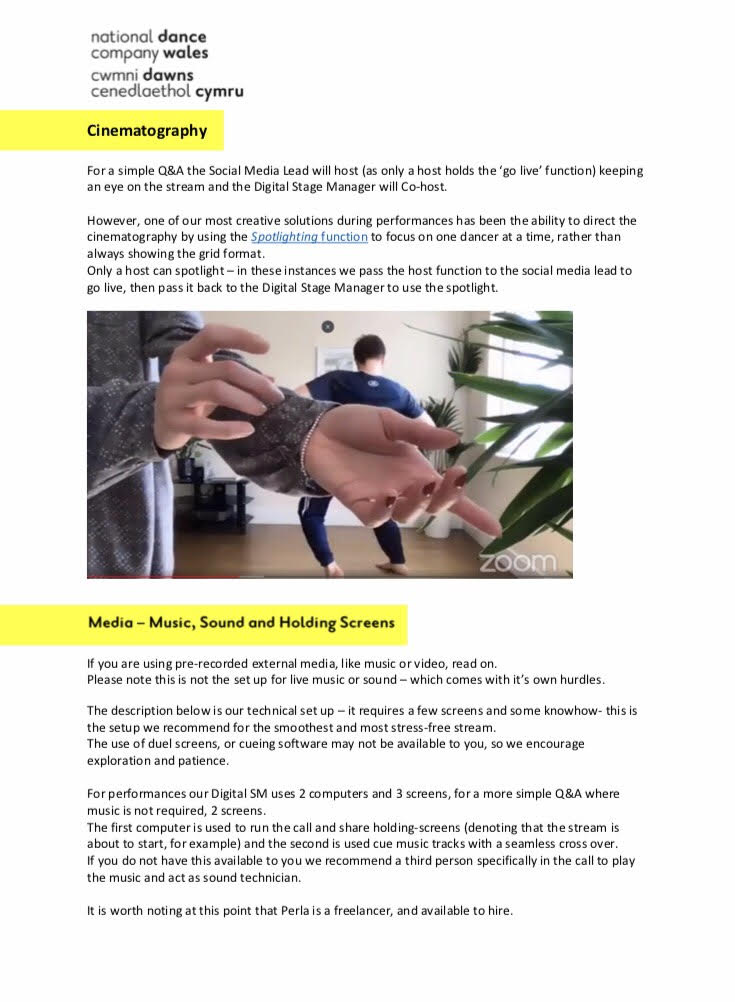
Zoom can go live on You Tube – we hadn’t seen anyone using it. We played with framing and using phones. We used the spotlighting function – this was done live.The choreographer could direct the show live. The stage manager controlled the holding screens, music and spotlighting. They have created a document about how they did this which they will share with the sector.
They have more performances planned and are thinking about how they can develop the Dance for Parkinson’s work.
More people are dancing at home than ever – the opportunities are really exciting.
Discussion
How has online learning challenged people’s teaching skills? What strategies are people using?
Sara – I use a feeling scale to see how people are doing. We keep our Zoom classes to smaller number so they feel more personal. We use people’s names and give people a chance to talk.
Julie – using directive teaching methods is the default online – its harder to get feedback online. But if you know people then that’s helpful – check in moments are important. Asking questions is important so that people engage. Trying to have prolonged moments when they are doing things – but then stopping and talking – and working to get that back again. The pace is more like a rollercoaster.
Mirroring is tricky – the camera flips round on some computers. So either you have to negotiate this or not worry about it.
Explore Stop Gaps access training – they use great language for describing movement and this works really well on zoom
Has anyone considered creating dance exchanges with groups that wouldn’t normally get the meet?
NYDW are involved in UDance – there will be ways to get involved.
We can team up more as a sector. Zoom helps us to do this much better.
Youth Dance night for NDC Wales – they are exploring how to do this online. We can co-create work with young people across the sector.
Music and licensing – questions around how to negotiate this? How have people managed this?
NDC Wales have done lots of work on this. To use music you need written permission from the artist and the publisher. Online streaming is not covered by PRS.
It’s a difficult area – there is music online that has been shared through Creative Commons and they are clear what tracks can be used for
You can also get young people to compose their own music
Or work with existing composers so it’s clear what the contractual arrangement is
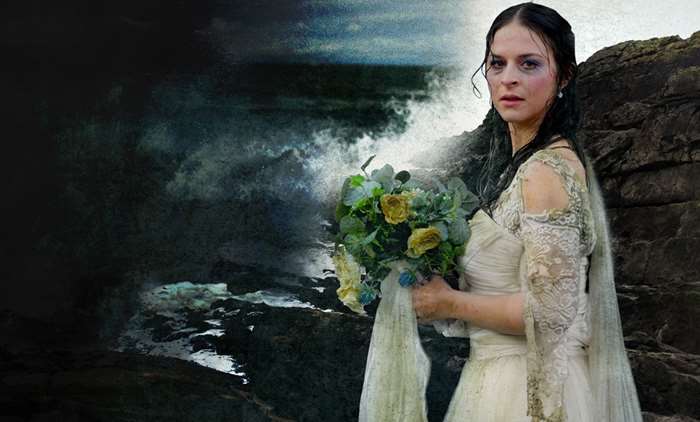
There is nothing like a dining table to expose a series of lies and untold truths. Many would point to Mike Bartlett’s terrific 2015 drama Doctor Foster as the epitome of that. Yet there is a scene in the latest series of 35 Diwrnod that comes close. After four episodes cranking up the tension, this moment represents the point at which the bomb, slowly ticking away since the opening scene, truly starts to go off. It is an extraordinarily gripping scene, full of revelation, as the incalculable web of mystery and intrigue that writer Fflur Dafydd has spun begins to quickly unravel. True to her style however, she leaves enough enigmatic plot points to keep the viewer on tenterhooks to the final moment of the final episode.
What I love most about the writing of Fflur Dafydd is her attention to detail. The series may set up Beth (Gwenllian Higginson) as the main character, whose impending marriage to Dylan (Geraint Todd) provides the focal point, but the interlocking narratives of every single character and the gradual exposure of their secret links to one another means that, in the end, it becomes an ensemble drama. We as viewers become invested in every single person because Dafydd herself has gone to great lengths to make each of them complete and fully rounded characters in their own right. It means that there is no let up; no subplot that exists simply to give the viewer a break from the main focus of the drama. Instead, it is a constant stream of deliberate action, in which every interaction, however mundane on the surface, becomes a point of information that feeds into the wider narrative. The viewer gets drip fed little details, sometimes through dialogue, sometimes via a cleverly crafted camera shot, which act as tantalising threads that keep us hooked. It is a visual guessing game that springs surprises and often plays with our expectations. Dafydd is without doubt one of Britain’s best screenwriters.
This latest series of 35 Diwrnod also features some of Wales’ best acting talent, with Sion Ifan (Efan) and Rhodri Meilir (Bill) starring alongside some inspiring new faces, none more so than Emmy Stonelake (Angharad). Indeed, Meilir and Stonelake are excellent as a married couple whose relationship becomes increasingly fractious due to the former’s controlling behaviour. The calm and calculated persona that Meilir adopts in Bill’s attempts to isolate Angharad from her friends helps achieve a verisimilitude that offers a welcome contrast to some of the more outlandish content in this drama. Stonelake portrays the emotional effects of Bill’s behaviour on Angharad with such obvious subtlety that though it may not grab you by the scruff of the neck like in series two of Bang, this domestic abuse storyline still resonates with a quiet power. Dafydd handles it with great sensitivity, just as she seems to with transgenderism. The inclusion of a character in the process of transitioning may be used as a plot twist, but the emotional impact on them and their family strikes me as sympathetic and considerate in its portrayal. Dafydd balances high-octane scenes with delicate moments really well. 35 Diwrnod: Parti Plu is an emotional rollercoaster for the viewer as much as it is for its characters.
Rhodri Meilir and Emmy Stonelake
I am always fascinated by the exploration of memory and perception that is a feature of all Fflur Dafydd dramas. In this series of 35 Diwrnod we witness the mental traumas that some characters carry, the mental anguish that others feel, as well as the mind games that a few play. Viewers are frequently challenged in their perception of what is happening onscreen, the many surprises and twists throughout providing plenty of mental stimulation that causes us to think twice about our own theories and assumptions as we engage with this incredibly intricate world of Dafydd’s own imagination. I did think that I had her writing figured out. But as my early expectations failed to match with the outcomes onscreen, I realised that it was facetious to even entertain the notion that I could second guess her every move. 35 Diwrnod has deservedly returned for another series with critical acclaim. It further cements Fflur Dafydd’s reputation as a master storyteller.
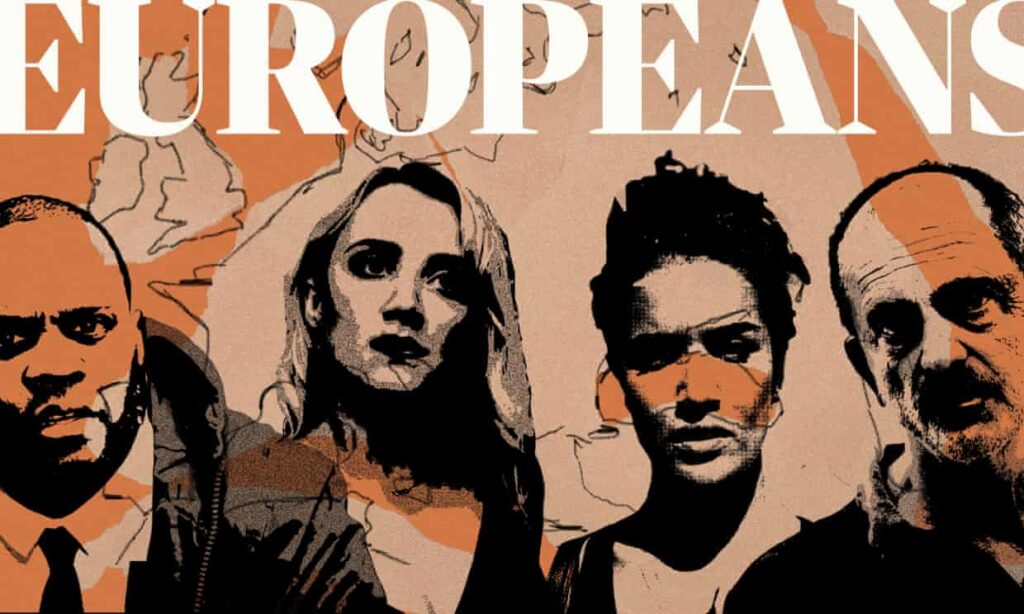
If you, like me, are tired of the formulaic plot-driven writing that saturates our screens, head for The Guardian channel on YouTube. There you will find Europeans, a series of seven short films with seven writers, each from a different European country: Poland, Spain, Germany, France, Sweden, UK, and Ireland. The Guardian shows that it’s ahead of the game in producing documentaries and now drama. The writing of Europeans is fresh and original. The format allows the films to go beyond the demands of TV, where short films have no presence, and crucially the constraints of national cultural traditions.
The films are so different you wonder whether they were responding to different briefs, but that is precisely what’s good about them. They are not made to fit into a category, although all of them have a strong theatrical voice. This is partly because each film is a monologue delivered to camera exploring Europeans relationship with Europe.
The series opens with the French film One Right Answer, the most overtly political episode of the series written by Alice Zeniter and performed by Sabrina Ouazani. A young woman talks of her experience of democracy betrayed. She voted for her first time against the Treaty of Nice in the European referendum of 2005. The referendum was lost and yet the result ignored. She was against the neoliberal Europe dominated by consumerism and the free market, but little transpires as to what she believes in. Sabrina Ouazani gives credibility to the monologue, but it doesn’t go past the disillusionment with the process rather than touch on a generation’s aspirations for Europe.
Borders, the second episode comes from Poland and was written by Jakub Żulczyk and performed by Jacek Koman. It is the story of a lorry driver who has travelled Europe everywhere but has been nowhere because always on the move. Before Schengen, he travelled east and would read books during the long waits at the border. The lorry driver had to sacrifice time with his family to put food on the table. Today, he travels to Germany in a Europe that has no borders. A Europe where his son earns well and can spend time with his family.
In the UK episode, Dim Sum, written by Clint Dyer and performed by Javone Prince, a bailiff acts tough while he empties a house. It is the longest piece, which allows the monologue to be interspersed with short bursts from the people whose house is being emptied. The bailiff, a black man, presents himself as the product of British society, where people only care about themselves and trample on others to be rich. He is British and has nothing to do with Europe, though he is not blind to the deep racism that casts him and his children as outsider in their own country. The bailiff does his job with no compassion, and yet, that one time, when a pregnant woman from a European country opened the door, slightly trembling and then crying, that time left a scar. The captivating writing gives life to a rounded character. Javone Prince’s intensity makes us relive with the bailiff the memory of that encounter.
Equally dramatic is Terra Firma, the Spanish episode, written by Blanca Doménech and performed beautifully by Paula Iwasaki. A woman tells us of when she left her rural village for London only to find herself exploited in demeaning jobs. Now back home, as she walks down the streets of her village, her anger at the dehumanising economy is mixed with a feeling of guilt for betraying her roots. She looks up, to the statue of Mary during a procession, and all is forgiven. She is lifted up, away from the the everyday struggle, from the pain, and feel worthy as a human. Thus she can be true to herself.
For the German episode, Neanderthal, the writer, Marius von Mayenburg, has chosen a Neanderthal man, performed by Robert Beyer, to tell a poetic tale warning of the danger of forgetting the past. It is the story of a tribe that thought themselves stronger than others, which led to war. As he tells the tale, the setting changes from a museum, to the woods, to a theatre, just as a country and a continent change throughout history, and yet repeat the same story, that “Those who don’t want to live together, will die together.” Only in friendship there is life and the future.
Written by Jonas Jonasson, Top of the Class, the Swedish episode makes fun of the Swedish attitude of superiority saying that “We didn’t really join the EU, we rather decided they could join us.” It blames social media for reducing politics to soundbites and creating divisions. The shortest episode, it is performed well by Viktor Åkerblom, but it feels a little too underdeveloped.
The Irish Fake Tan, written by Lisa McInerney, alludes to Brexit by presenting an Irish woman splitting up from her British boyfriend. Lighter in tone, the woman, played delightfully by Evanna Lynch, is the embodiment of an Ireland that no longer needs Britain and can fit anywhere.
I was particularly touched by Dim Sum, Terra Firma, and Neanderthal, which convey complexity through elegant simplicity. They are part of a whole. The films may seem very different dramas, but you get a sense of cohesion, partly achieved by the excellent direction of Amy Hodge, who conveys the emotions in a few careful shots. This cohesion out of difference is just what Europe is, or dreams to be. Europe is not defined by the past but by a dream of the future. Europe looks to what has been to imagine what can be. It is my hope that The Guardian will now commission a series that speaks of our hopes, our dreams, our imagined future.
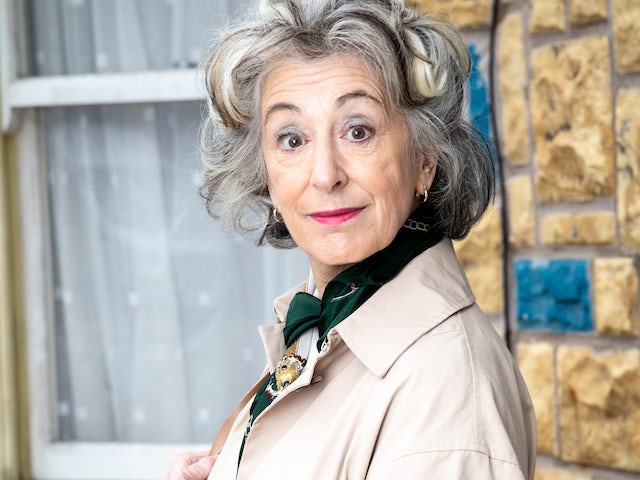
Not surprised to see the indomitable Maureen Lipman, who was 74 this month, taking part recently in an online cookalong project to cook something delicious for a neighbour or friend in need. Maureen, who is due to start filming more episodes of Coronation Street in June, made a nutritious bean and barley soup in the small kitchen of her home in Paddington. The kitchen looked perfectly adequate but it brought back memories of the much larger kitchen of the family home where she lived with her late husband, the playwright Jack Rosenthal, and two children, Amy and Adam. The house had a large garden, at the bottom of which stood a red telephone box, which was presented to Maureen when she was appearing as Beatie in the British Telecom adverts.
Maureen’s kitchen in that house was her pride and joy. I went there to do a big article and photoshoot about said kitchen, which was painted in sunny yellow with blue painted cupboards and the latest in worktops. It was a full-on day. Maureen and Jack were due to go to a wedding later, but like the true pro she is, Maureen didn’t let that faze her.
Jack, and Maureen’s mother Zelma, however, were a different matter. Both kept wandering in; Jack to enquire the whereabout s of different of items of clothing (a shoe lace broke, causing a major problem), while Zelma – a lovely lady whose mission in life seemed to be making sure everyone was fed – appeared at intervals to offer sustenance.
I still remember one particular shot with Maureen perched atop her kitchen counter with a red rose between her teeth! Not your traditional kitchen photo, but that’s Maureen. I have interviewed her several times over the years and she is one of the spunkiest people I have ever met, going on stage many years ago in a demanding play after major spinal surgery, and in 1998 taking on the challenge of learning some fast dance routines as Aunt Eller in the musical Oklahoma!
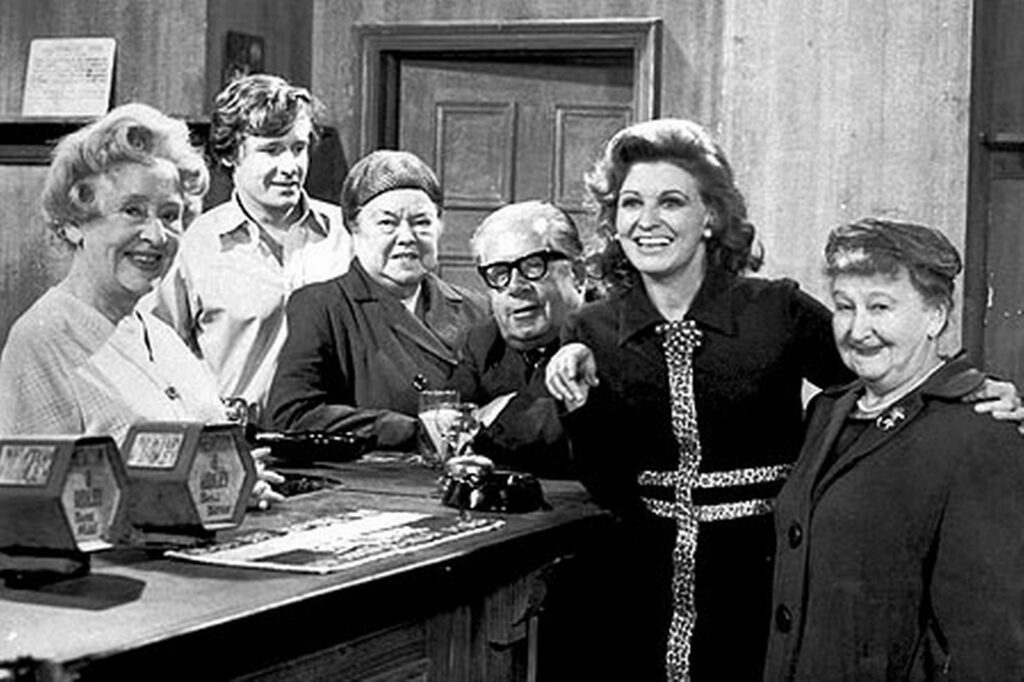
Good old ‘Corrie ‘– veteran of the soaps Coronation Street this month celebrated 60 years on the small screen. The longest running TV soap not only in the UK but in the world, there is even going to be a commemorative set of stamps, on sale from May 28th, to mark the anniversary.
I well remember ‘Corrie’ way back in its early days. Granada TV took a posse of us – some eight or ten showbiz journalists – up to the set in Manchester by train. First class, no less, and a full cooked breakfast with a glass of bubbly in the dining car.
But the TV company got their money’s worth when we arrived at the studios. Interviews with the cast followed, one after the other, each of us being firmly moved on to the next one when your time was up.
I headed straight for the wonderful Violet Carson, complete with hairnet in her role as the miserable old bat Ena Sharples – she of the jutting jaw and woe betide you if you crossed her. Vi was a gem – a true pro knowing exactly what was wanted. Then it was on to the flame-haired Pat Phoenix, bold, brassy and larger than life on TV as Elsie Tanner. A very different kettle of fish – feisty and fun in real life too. As for the men – William Roache (Ken Barlow in the series), who had his 88th birthday last month, was politeness personified.
I must have done at least six interviews that day. Exhausting – but a great day out!
With Gretel and Hansel, Oz Perkins retells the famous Grimms’ tale centreing it on Gretel’s ability to survive in a hostile world and overcome the temptation of evil. One should not be fooled by the title and the focus on Gretel and believe that it is a feminist rendering of the tale. The film hasn’t got an ounce of feminism or women’s empowerment. On the contrary, it is infused with the traditional misogynistic tropes of mad women and witches as women who kill children, including their own. It is not a misogynistic film either, thanks to a pervasive ambiguity, a clever weaving together of the stories of its protagonists, and subtle acting.
Faced with poverty and starvation, the mother of Gretel and Hansel turns mad and kicks them out. There begins Gretel’s journey of growing up and taking responsibility for herself and her little brother. She acts as a mother towards Hansel, protecting him from danger until Hansel’s hunger leads them inside the house of the witch. Gretel is at first wary of the hospitality of the witch. She becomes seduced by the witch’s knowledge and power. The witch teaches her magic, but it is a dark magic that requires sacrifice. The witch tells Gretel that she sacrificed her own children and asks Gretel to sacrifice Hansel to gain power.
Historical scholarship has shown that women victims of witch hunts were often those who did not conform to patriarchal norms and fulfil their roles as dutiful wives and daughters. Louise Jackson’s research on the Suffolk witch trials of 1645 shows that these were unmarried women, widows who lived alone, women suffering from depression, women who were not as submissive as they were meant to be.
The type of crimes of which the women were accused mirrored in reverse the tasks imposed by their social role of mothers and wives. As mother and wives, they were meant to feed, nurture, heal, and give birth. Thus, they were accused of poisoning, infanticide, harming, and of death. The witch is the opposite of the good wife and mother. It was not religious zealotry what motivated the witch-hunt, rather the systematic controlling of women. The pressure was so high that women convinced themselves that they were indeed witches and confessed to being a witch.
The mythical figure of the witch is constructed in opposition to the good wife and mother. She is dangerous and evil because she is not under the control of male authority. In the 1890s, as the figure of the New Woman begins to emerge in fiction and art (think Gustav Klimt), the witch and the female vampire are presented as strong in their sexuality, though largely still for the gaze of men. One of the central features of how women have been portrayed, especially in horror stories, is their dangerous power, which comes from their body, its ability to seduce, to give life, and thus destine us to death. Life is the beginning of death.
The film balances well the allure of the dark power of the witch with Gretel’s attempt at being responsible for life. It is, however, full of allusions and short of clear intent. The cinematography (by Galo Olivares) is slick without indulging in the aestheticism so prevalent in today’s cinema. Sophia Lillis, as Gretel is excellent, though it is Alice Krige, as the haggard-witch, who steals the show. The slow pace makes the film suggestive and subtle for most part. Alas, in the final act the writing (by Rob Hayes) turns artificial and wants to make a point quickly. It assumes a moralistic tone and falls for a simplistic triumph of good over evil. It’s as if the male authors couldn’t help but restoring order.
Creating opportunities for a diverse range of people to experience and respond to sport, arts, culture and live events. / Lleisiau amrywiol o Gymru yn ymateb i'r celfyddydau a digwyddiadau byw



 (3 / 5)

 (5 / 5)

 (3.5 / 5)