Hi I am Guy the project coordinator for Get The Chance. I am a trained secondary teacher of Art and Design and have taught at all Key Stages in England and Wales. I am also an experienced theatre designer and have designed for many of the theatre companies in Wales.
Hello, my name is Cerian and I am a youth engagement facilitator for Amgueddfa Cymru- National Museum Wales. We are about to start a project for LGBTQ+ young people aged 16-25. The project is called Trawsnewid and is going to be focused around the theme of transformations. Throughout this project we will be exploring trans and gender non-conforming figures in Welsh history and lived experiences today.
There will be a bi-weekly meeting with the young people, these sessions will be creative workshops exploring the theme of the project with the opportunity for the participants to run their own sessions. Throughout the project we will be working towards putting on our own events such as a museum takeover at the Waterfront Museum in Swansea and an exhibition of the work created throughout the project. The project will be tailored to the interests of the group, whether that’s history, art, creative writing, performance etc.
The project will begin with an online session on the 24th February at 6pm, we will be introducing the project, getting to know each other and designing our own postcard inspired by the museum’s LGBT+ Collection.
If you would like to get involved in the project, find out any more information about the project or know of any young people who would be interested please email: cerian.wilshere@museumwales.ac.uk
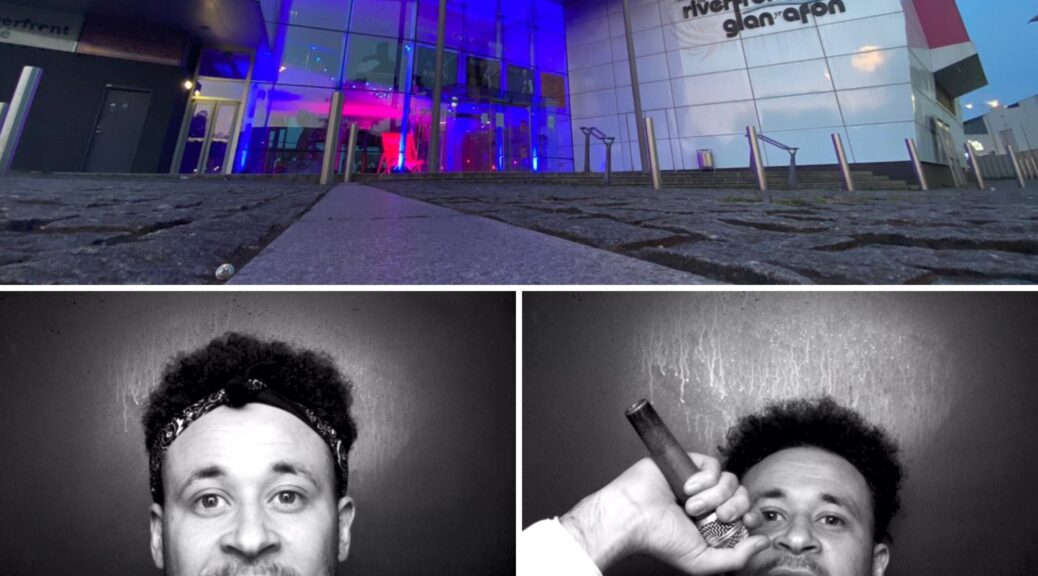
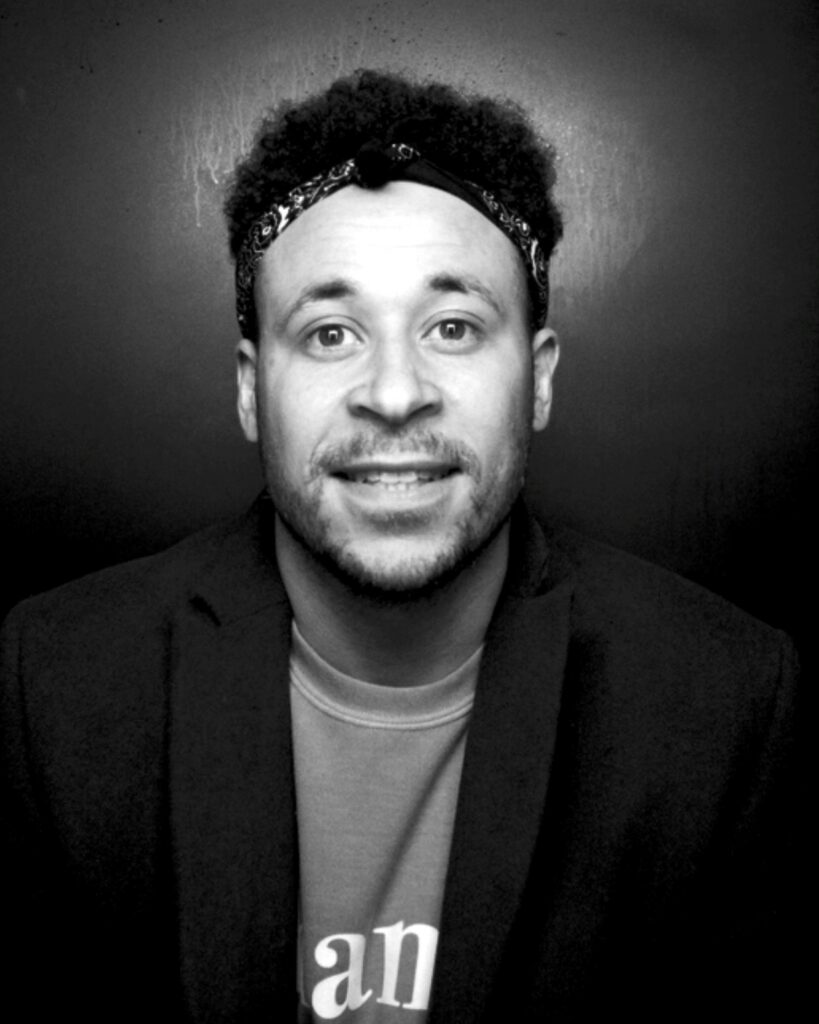
Local artist and The Riverfront Theatre and Arts Centre’s Associate Artist, Connor Allen, has successfully received a £20,000 award from the Live Work Fund from Jerwood Arts.
The fund received over 1,200 applicants and Connor is one of just 33 artists across the UK to have been successful.
Connor will be using the funding to set up a collective of professional black artists working across various artistic disciplines, of all ages and based in Wales. The collective will support the development of artists during the challenges faced due to the current pandemic including mentoring, sharing and supporting each other’s practice as well as providing increased representation and professional opportunities for more black artists to grow and progress. Members will work together to learn and develop as well as to give back to the arts community and inspire the younger generation of black artists in the making.
The Live Work Fund has been created in direct response to the impact the Covid pandemic has had on self-employed artists across the UK and is the result of four major arts funders (Jerwood Arts, Wolfson Foundation, Esmée Fairbairn Foundation and The Linbury Trust) coming together to award a total of over £660,000 to successful applicants.
About the bursary and project Connor said “My growth as an artist and the development of this project and my collective idea wouldn’t have been possible without the Jerwood bursary and the support of many organisations such as The Riverfront who have been instrumental in my success since me becoming Associate Artist.
“I believe that the impact of my collective idea can be exciting and influential on the landscape because it will allow artists of colour in Wales the opportunity to develop themselves and explore their craft alongside my own exploration throughout 2021. This has the potential to nurture the next wave of exciting Welsh artists of colour which in my opinion is awesome and so much needed.”
Since graduating from Trinity Saint David as an Actor, Newport-born Connor Allen has worked with companies such as The Torch Theatre, Sherman Theatre, Tin Shed Theatre and National Theatre Wales. He joined The Riverfront Theatre & Arts Centre as Associate Artist in 2020.
During the past 12 months, despite the difficult circumstance the pandemic has created for artists, Connor has written and performed multiple pieces across South Wales including Dom’s Drug Prayer as part of Sherman Theatre’s Ten and The Making of a Monster at Le Public Space’s Right Now Online Theatre Fest. He was also commissioned by Literature Wales to create an online album of creative mediums, 27, a collection of thoughts from his life, the journey he has been on and the lessons he has learnt.
Olivia Harris, Creative Producer for The Riverfront said “We’ve been working with Connor for some time now and are delighted his talent has been recognised with this bursary. He truly deserves it and we can’t wait to see where it takes him and go on this journey with him.”
In our latest Playwright interview Director of Get the Chance Guy O’Donnell chats to Wales based Playwright Neil Bebber. Neil discusses his career to date, his latest project “Short Stories for Stressed Grown-Ups”and his thoughts on opportunities for Playwrights in Wales.
Hi Neil great to meet you, can you give our readers some background information on yourself please?
Hello! I’m a playwright, screenwriter, copywriter and graphic designer. I enjoy cycling, sea swimming, hiking at night under star-stuffed skies, endlessly scrolling though Netflix trying to find something good to watch, cooking (though my recent attempts at culinary genius have fallen short) and playing online Scrabble with strangers. For the record, I haven’t lost a game. Yet.
So, what got you interested in the arts?
Pantomime. Probably. I remember the feeling I had watching a school panto when I was maybe ten years old. The Seven Dwarves had left for the day to hi-ho off to work and Snow White was left alone in the space. A sequence followed where she just made the most of having the space to herself and I was transfixed.
From an early age, I was curious about the world. Talking to people as soon as I could talk. Asking “why” even more than most other kids. That question can take a child either way. Science allows us to understand how something works. The arts allow us to explore how something makes us feel. I’m a combination of the two. But, having turned down a potentially lucrative career in banking, in favour of a poorly-paid graphic design “apprenticeship” (that’s a whole other story!) I’d chosen my path.
Can you tell us about your writing process? Where do your ideas come from?
I used to fool myself into believing the romantic notion that I could only write when I was wallowing in a pool of self-indulgent pity, but I now realise that’s not true. I don’t know who said it, but writers write. So, the most important part of the process is to start by writing something.
It’s a cliché, but it is a muscle. And the more you do it, the easier it gets. And the more addictive it is. On the many courses I’ve been on, the forensic detail of process has been useful, but I’ve always got more from the automatic writing exercises. It’s a great way to unlock the unconscious mind and discover those seeds lurking in there between the teeth of doubt.
And I make a lot of notes. The romance of a notepad and fountain pen has been superseded by the iphone, but I’m glad that, should I ever hit a pothole on my bike and find myself flattened by an oncoming bus, nobody will ever get to access my notes. There’s a lot of strange musings there. Today I wrote a paragraph about how a crow, battered by the wind, seemed to be perfectly content to walk across the road sideways. And how that might serve as a metaphor. But I don’t know what for yet.
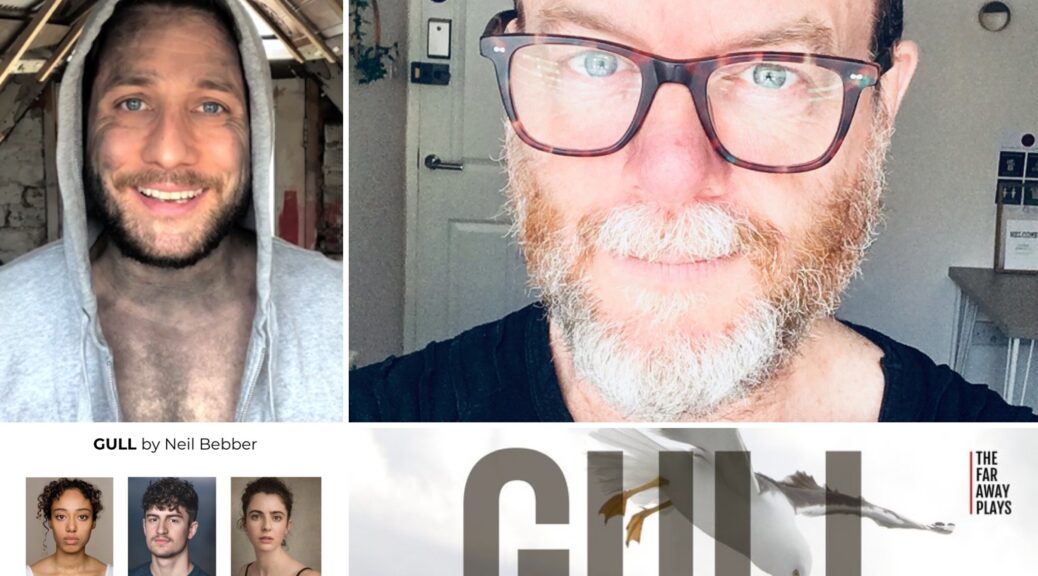
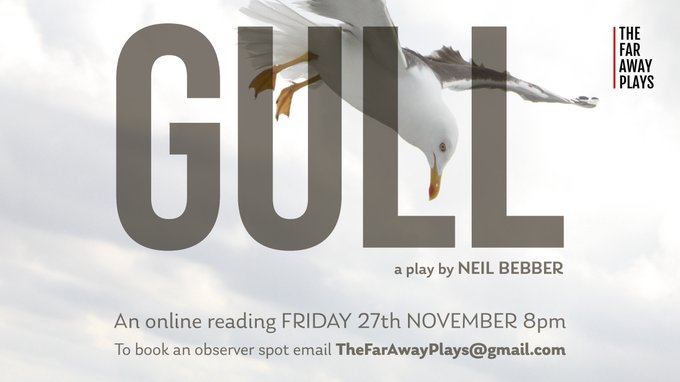
GULL, the play recently read on Zoom by the brilliant The Far Away Plays came about like that. A note about watching gulls rip apart bin bags and hungrily tuck into a pile of used nappies. The revulsion fed the atmosphere of the play.
In terms of dialogue, I believe that writing good dialogue is more about listening than writing. Before our freedoms were curtailed by a microscopic enemy, I used to sit in a lot of coffee shops, just listening to exchanges and watching people’s body language. In recent years, I probably haven’t been the best company, socially, choosing to observe and makes notes, rather than get involved.
Can you describe your writing day? Do you have a process or a minimum word count?
Writing days vary depending on the project. I’m also lucky enough to be able to supplement an artist’s income with commercial copywriting. But, either way, I start early. Check emails, social media between 8 and 8.30 and then make a start on the writing. At the moment I’m in the process of editing an audio play for a competition, writing a new speculative TV drama and also writing, recording and editing my stories for my YouTube channel, “Short Stories for Stressed Grown-Ups”.
Producing my own work has also made me realise the amount of time that’s needed for its design and promotion. The “Short Stories…” project needed to have an eye-catching brand, as well as accompanying visuals for each story. And all of this needs to be shared with the online world. I hope I’m finding the balance between, “oh, that’s interesting, I’m so glad he let me know” and “for God’s sake, not another post about his bloody stories!” If there’s anyone brave enough out there, do let me know!
Why and where do you write?
I write because I have something to say. About something I‘ve seen or something I’ve heard. Or something I feel passionately about.
I write because it’s a compulsion. A bit of an addiction. Especially when I get to see how an audience responds to it, good or bad. Maybe that’s some deep-seated need for validation. But then maybe that’s why any artist creates anything.
I write because it helps me repair. Relax. Forget. Make sense of a world (or of people) I don’t always understand.
I write because it’s satisfying and often surprising to be taken on a journey by imaginary characters, into unfamiliar scenarios and behaviours.
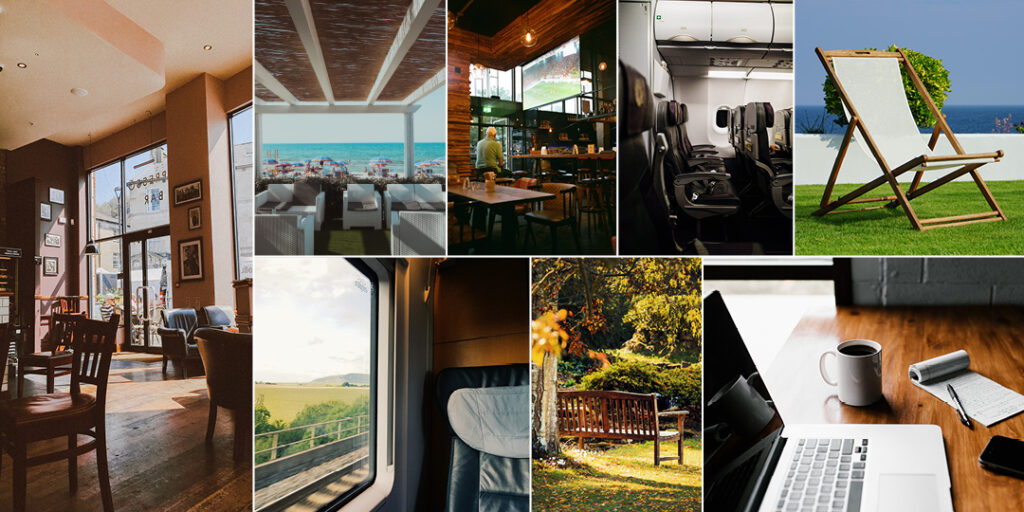
In terms of where I write, I can write anywhere. As long as I have something to balance a laptop on and a reasonably comfortable chair to sit on, I can write. There’s no ritual, no lucky desk or chair of inspiration. So, the photo is of a number of places where I could easily write. And the list is always being added to…
You are a prolific writer working across multiple mediums and forms. How has the Covid-19 Pandemic affected you and your creative process?
It was clear from the beginning that the lockdown, and the continuing response to a global pandemic, was going to fundamentally change a world that relied on the physical gathering of human beings in close proximity, whether audience or performer.
But, pretty early on, I saw an opportunity to get work out to a wider audience. Admittedly, it’s not the same experience as sitting in a studio theatre, tightly-packed with an appreciative audience, breathing the same air and having a collective experience.
When Jordan Bernarde contacted me about re-staging BREATHE (to avoid him climbing the walls during the first lockdown), after a short and successful run at The Bread & Roses the year before, I jumped at the chance. And it’s success has shown that there’s an audience for online theatre.
Theatres talk a lot about diversifying their audience base and this provides the perfect opportunity to do just that. Anyone who might previously have been intimidated by physically visiting a venue, can now watch a performance online and maybe discover that it isn’t the inaccessible, exclusive experience they may have expected. And, from a writer’s perspective, there’s an entire planet’s worth of connected people looking for content. The challenge is standing out amongst the noise!
From my own point of view, there’s been a shift towards demand for more audio drama. I’ve been working on a new play for the Papatango prize, which this year will be awarded to three audio works. And I was commissioned at the end of last year to write a multiple choice audio drama, which would be navigated purely through using Alexa. Exciting stuff!
One of your latest initiatives is the new new YouTube-based spoken word project, ‘Short Stories for Stressed Grown-ups’
You’ve written a number of short stories, which you’ve also narrated yourself. This is how you’ve described the project:
“Remember when you were a kid? And how it felt to be all tucked up and have a story read to you? What a shame that, as adults, we don’t get to enjoy the sheer, indulgent escapism of those moments anymore. Well, now that’s changed. Short Stories for Stressed Grown-ups by Neil Neil is now live! So all you have do is find somewhere quiet, where you won’t be disturbed, and listen to an original short story that will transport you from the troubles of your day.
Whether you use it to help you get off to sleep, or to re-set in the middle of a busy day, every story is written just for you.”
What response have you had to this new area of writing and storytelling?
The short stories were a suggestion by a producer friend of mine, Simon Regan, who I’d worked with on an arts podcast, EVOLUTIONS, shortly before the pandemic kicked off
I was frustrated at the time it took to get work “out there” so he suggested I might do it myself.
I researched the short story market, as well as potential gaps in provision for audio content and I thought a combination of meditative and escapist character-based short stories, narrated in the style of a bedtime story, might work.
The response has been really encouraging. The audience has been very frank about what’s working and what isn’t, the real-time feedback giving me an opportunity to modify the style and content of each new story. I’m also keen to interact with the audience, using names for characters taken from contents pages and maybe asking for suggestions on story ideas and destinations.
It’s great to know, too, that these stories are temporarily distracting people from the stresses of their day and, in some cases, helping them sleep. I’m hoping my voice doesn’t have the same effect during face-to-face conversations, when we return to the “real” world!
In November your latest play GULL was read online by the team at The Far Away Plays. We think the Far Away Plays have been one of the highpoints of creative activity in Wales during the Pandemic. Have you had an opportunity to listen to any of the other Far Away Plays, play readings? And how was it to have your latest play produced on Zoom?
GULL was originally scheduled to be performed at WMC’s Ffwrnes Scratch night in March 2020, but then the world plunged into chaos. So I was thrilled when The Far Away Plays chose it for one of their online performances late last year. Their commitment to getting work out to online audiences, as well as dealing with all the logistical stages in between, has been immense.
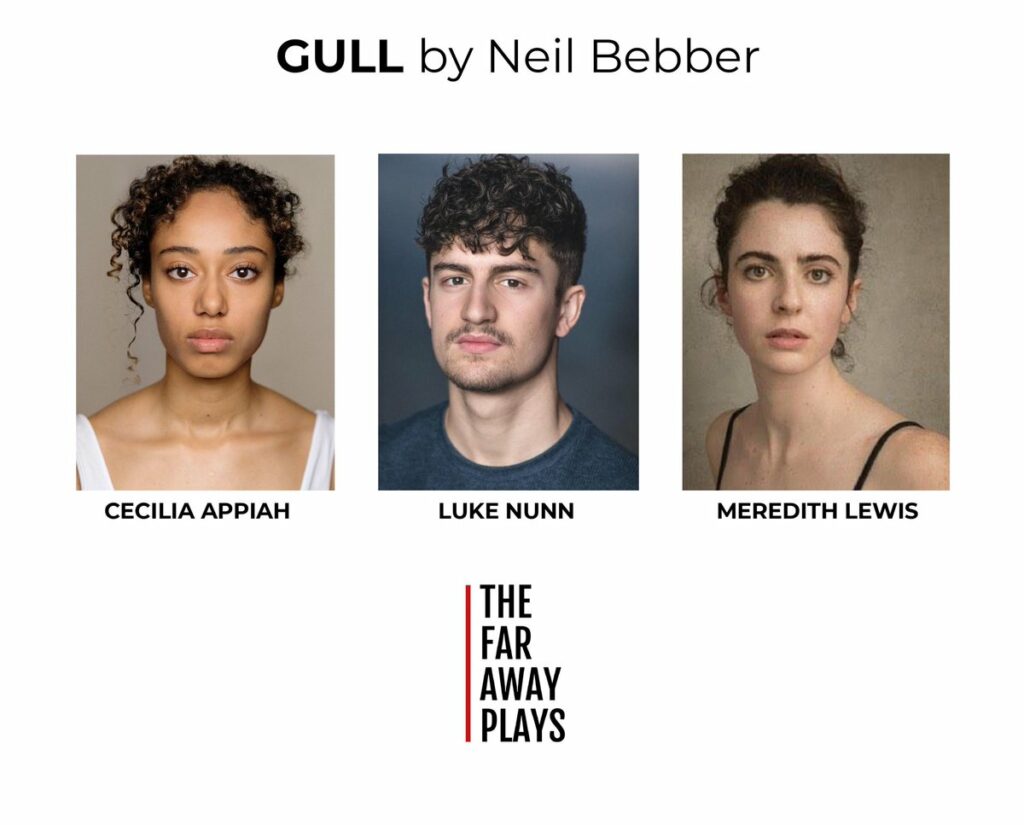
I was also excited to be able to cast three incredible RWCMD alumni. Luke Nunn, Cecilia Appiah and Meredith Lewis were just some of the standout actors from 2020 and it was a real privilege to witness their brilliantly instinctive and nuanced performances, especially given the limited time they had to rehearse.
The director James O’Donnell also deserves a special mention. Having put a callout on social media for a director at late notice, James answered the call. The way he was able to take a potentially static medium and turn it into such a dynamic performance was miraculous. I always get really nervous before any production of my work, but it was clear within minutes that GULL was in safe hands, so I was actually able to sit back and enjoy it!
I’m waiting to hear from FAP if there’s a recording I might be able to share with all of the Artistic Directors who weren’t able to make it, because, as good as it was to see the work performed online, this play would (and this team!) clearly work brilliantly on stage.
There are a range of organisations supporting Welsh and Wales-based writers, I wonder if you feel the current support network and career opportunities feel ‘healthy’ to you? Is it possible to sustain a career as a writer in Wales and if not what would help?
“Healthy” might be a misleading term. The opportunities are available, but I wonder how writers are made aware of them. For opportunities, my go-to is BBC Writer’s Room Opportunities page. Then I check London Playwrights, which is another brilliant resource. I’m not sure if there’s a central database for opportunities in Wales. If not, it would be great to have one, where all aspects of writing were covered, plays, films, TV, etc.
Also, there are a number of theatres offering writer’s courses and residences, but there are rarely the resources available to sustain the momentum, once they’ve happened. I’ve been on three writer’s courses and one residency and none of these led to a tangible, ongoing relationship with the respective theatres.
In terms of sustaining a writing career, I think it’s important to diversify. I’m lucky to also be a freelance copywriter and graphic designer, but, even if I was commissioned to write three plays a year, the income generated wouldn’t be enough to sustain a family, mortgage and other regular day-to-day commitments. From what I can gather, to make any sort of living, TV writing seems to the way forward. Ideally I’d like to be able to do a bit of everything, though, as I’ve been lucky enough to so far.
If you were able to fund an area of the arts in Wales what would this be and why?
I think a TV writing academy would be a valid investment now. As Wales becomes used increasingly as a destination for production, and companies like Bad Wolf continue to thrive, a joined up, sustained TV writing “lab” could help nurture home-grown talent and ensure Wales was increasingly self contained, moving forward. Especially given the increase in demand for content from online providers like Netflix and Prime.
Diversity. The sheer extent of opportunities to make and view art for a country with a reasonable small population. I’m hesitant to use the term, “punching above its weight”. Oh, too late. I have.
And then there’s always the occasional parallel universe curveball of one of Tactile Bosch’s performance art nights. That’s what first made me realise I was living in a capital city. Ah, I miss Kim Fielding. What a lovely man.
Image Credit Emmageliot’s Blog
What was the last really great thing that you experienced that you would like to share with our readers?
There are so many things that have either left me speechless, laugh uncontrollably or made me cry, sometimes all at the same time.
I remember sitting down in my office (in the middle of the first lockdown), with headphones on, to watch Complicite’s “The Encounter”, and feeling within minutes as if I’d been transported to another world, by both the performance and its remarkable aural soundscape. Not sure if it’s still available to view online, but there’s more, here:
Charlie Kaufmann’s “I’m Thinking of Ending Things” (on Netflix), whilst sometimes being incomprehensible, felt like a pure artist’s vision, unimpeded by the demands of people-pleasing. Maybe the best art is selfish. And this felt like that. But in the best possible way.
And no conversation (I say conversation, though this has all been a bit one way) with me goes without a music mention. The Dandy Warhols’ 13 Tales from Urban Bohemia has been my favourite album for years. And at the end of last year, they performed a live stream of it, in its entirety, for the first time. For that hour, I was there, front and centre, dancing like a kid in a sweet shop. The sweets being the songs. But not in jars. Obviously.
Anyway, that’s three. Because there’s never any shortage of great things to share.
Thanks for your time
And thank you for this brilliant opportunity to ramble.
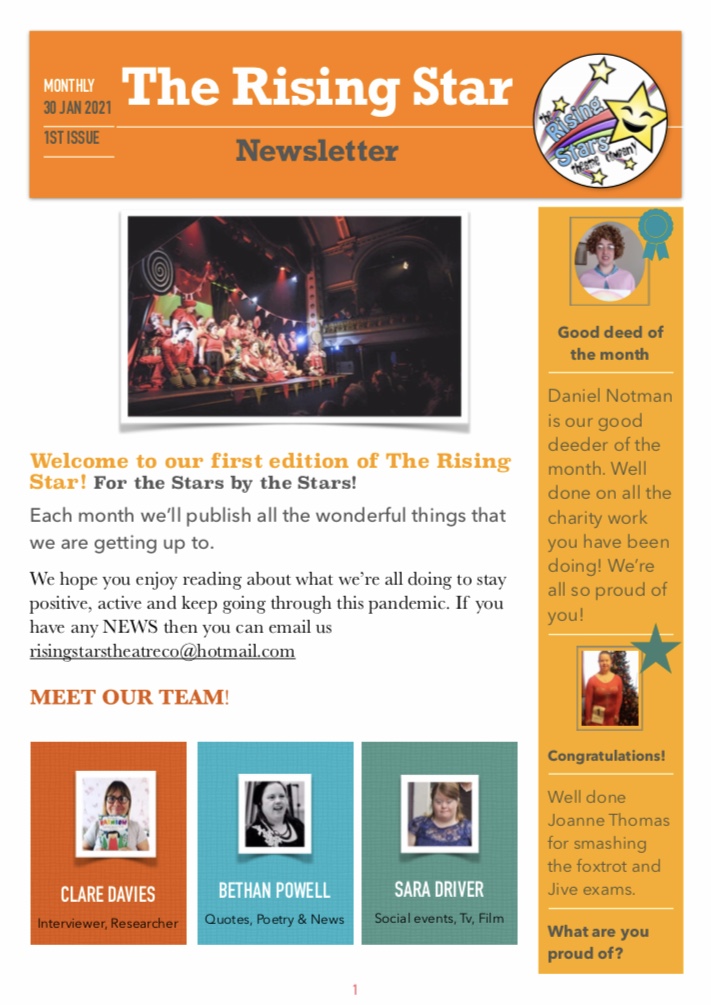
We are happy to share the Newsletter for The Rising Stars.
Please find some information on the group below
The group was originally The Spotlight Theatre Company, which was funded and run by Interplay. When the funding was withdrawn in 2007 we were devastated. All our members have learning or physical disabilities, and there are so few opportunities for them outside of school/ college/ work that we as parents felt we must do something about it. So, we formed a committee and The Rising Stars Theatre Company was born. We rely entirely on charitable contributions and grant applications.
We now meet every Thursday evening from 7-9pm at Friends of the Young Disabled, Cwmbwrla, Swansea under the leadership of Michelle McTernan and Nicola Woodrow. New members are by invitation only and at the moment we are full to capacity! We perform two shows a year, and are available to perform at fundraising events etc
Our mission statement reads as follows.
To promote, maintain, improve and advance the health , well-being, education and citizenship of young people and adults with disabilities, particularly those within the Neath Port Talbot , Swansea and the surrounding areas, as well as for public benefit by the promotion and advancement of the arts; in particular, but not exclusively the arts of drama, music and dance. Also to offer opportunities to perform in integrated stage performances.
You can find out more about the group at their Facebook page here
In the article below members of the Get the Chance team share why the work of Get the Chance is important to them and their lives.
You can make a donation to support the work of Get the Chance here
Guy O’Donnell, Volunteer Director
Hi my name is Guy O’Donnell and I am the director of Get the Chance. In this short article our team share with you how vital Get the Chance is to them and their lives. If you can support our work, please donate at the link above.
Get the Chance is a social enterprise based in South Wales. We are Wales based with an international outlook. We work to create opportunities for a diverse range of people, to experience and respond to sport, art, culture and live events. We use our online magazine website as a platform to showcase our members activities. We provide a fantastic opportunity to develop cultural critical voices and ensure that people from certain groups of society, people that are often forgotten or unheard, are given a platform to share, review and discuss their lives and critique work in a public platform.
Not only have we supported conversations about the arts and culture in Wales, but we’ve also broken-down barriers and asked questions about who actually gets to critique art. It is this democratisation of criticism that is crucial to a healthy and thriving artistic community that listens to everyone. Thank you.
Gemma Treharne-Foose, Volunteer Director and Critic.
Hi, my name is Gemma Treharne-Foose. I’m a board member and volunteer with Get the Chance. We’re a community of volunteers, activists and enthusiasts dedicated to expanding the reach of arts, culture and sports in Wales. At Get the Chance, we exist to create a space and a platform for people to participate, engage in and respond to theatre, arts and culture. In particular, we help people who are perhaps traditionally hard to reach and support them to access and experience these spaces.
Part of the work we do with our community is to encourage and support them to build up their skills, responding to, vlogging about, and writing about their experiences accessing arts, theatre and culture, and also helping them access particular schemes and initiatives with partner organisations.
At the moment the arts and live event industries in Wales are hurting and they’re struggling right now as they try to access support and gain audiences in these uncertain times. I believe this is an arts emergency and I want part of my work with Get the Chance to support the industry to get back on its feet again and to get audiences enjoying live events and theatre again.
If you also want to support and highlight Welsh theatre, arts and culture then I’d encourage you to get involved. Let’s shine a light on the amazing work happening right now in Wales. The show must go on!
Barbara Michaels, Volunteer Critic.
As one of the most senior reviewers who has known Guy O’Donnell for many years, I can’t stress enough how important it is that Get the Chance continues to support the youngsters who want to become involved in the arts, many of them with the aim of a career in the media.
During the time over the years I’ve been reviewing, I’ve been really impressed by the young people who are coming up into the ranks, who have become very knowledgeable and very enthusiastic about their involvement with theatre. Unless we get some financial support, it’s going to be so difficult to continue with an organisation like Get the Chance which does so much good, giving opportunities to young people who wouldn’t have them.
With the cost of seeing the performances of opera and ballet and theatre rising, and inevitably it is going to rise more, it is absolutely vital that we have some support both financially and in all aspects of an organisation like Get the Chance. Thank you.
Kevin B Johnson, Volunteer Critic
Hi my name is Kevin, I work in an office, I like long walks on sunny beaches and I’m Sagittarius. Apart from that, I’m a member of Get the Chance because I like seeing new shows, new films and sharing them with other people, bringing my discoveries to others and getting a chance to view them. I like to highlight what I love about the shows that I’ve seen.
Becky Johnson, Volunteer Critic
Hi my name is Becky Johnson and I’m a member of Get the Chance. I’m actually a freelance dance artist based in Cardiff and I’m a member of Get the Chance alongside that. So with my practice I tend to create work, I tend to perform and I tend to teach, and a big part of me being an artist is making sure that I can see as much work as possible and then also understand the wider perspectives, on not only dance but also the arts in general and the things that are going on in our current climate and our local area.
So with having Get the Chance alongside of it, it allows me to access these different things and to get opportunities to see these, which I wouldn’t necessarily financially be able to do otherwise. Also, it allows me to have that time dedicated to just look at these things analytically and also just to really try and understand what is going on in what I’m watching and what I’m seeing, rather than just watching it and acknowledging what’s happening. Writing with Get the Chance gives me an opportunity to use my voice to promote the things that I really care about and things I’m passionate about, the things I think need to be highlighted, whether that’s something that’s problematic that I see in a show or something that I think’s wonderful that needs to be shown more of and we need to see more of.
Another opportunity that I’ve had recently which has been amazing is the opportunity to interview people that I’m very proud to have had the opportunity to speak to and to be able to give them a voice to speak about their platform and what they’re doing. This is really important to me as a lot of these issues are very important and very close to home and I think it’s something that without this platform I wouldn’t be able to do.
I’ve always loved writing, it’s something that I did always want to pursue but by being a member of Get the Chance I’ve been able to continue my writing in a way that’s still linked with my practice. It means that I can find the balance of both of these feeding each other. I’m really grateful for having this opportunity.
Leslie R Herman, Volunteer Critic
Get the Chance has been one of the ways I’ve been able to maintain a connection to the arts and culture in Wales. I’m writing this message from New York City. It is mid-August 2020. I’ve been unable to get back to Wales due to the Covid pandemic and the global lockdown. Not only am I really missing Wales, I’m missing connection, to people, to places and to the arts and culture that I’ve grown to love and live for – arts and culture that have helped me thrive throughout my life.
At the moment it really feels like we’re all of us spinning in our own orbits and cyberspace is our most vital tool but if that’s all we’ve got, I’m afraid it’s way too nebulous for me. I need to feel more grounded.
Get the Chance really has given me the opportunity to get grounded and to connect to people, to the arts, to culture. It’s given me the opportunity to mentor young people and it’s given me the opportunity to extend and rebuild my own career. What’s marvellous about get the chance is its open and flexible approach to giving people a chance to connect to culture. Why don’t you give Get the Chance a chance?
Beth Armstrong, Volunteer Critic
Hi! My name’s Beth. I’m 24, and I’m from Wrexham, North Wales, and I’m currently training to be a primary school teacher. I’m a member of Get the Chance because it allows me to watch a great range of theatre performances which I wouldn’t normally get to see due to financial reasons, and also allows me to see a really diverse range of different kinds of theatre which I think is great for expanding my knowledge and experience of theatre in general.
Having my work published online is a great opportunity for me because it allows me to have a wide audience for my writing, and it also allows me to engage with other reviewers and read their work as well, so it’s a really fantastic opportunity.
Samuel Longville, Volunteer Critic
When I left university, Get the Chance was a really amazing, creative outlet for me. I was able to see so much theatre for free which would have been really difficult at the time, having left university as a not very well-off student. I was working a quite tedious nine-to-five job at the time so Get the Chance really served as that kind of creative outlet for me, allowing me to see as much theatre as possible, and not only to see it but to think about it critically and write reviews about it. So it really let me utilise the things I’d learned on my drama course at university.
I’m soon to start an MA in Arts Management at Royal Welsh College of Music and Drama and I think, without Get the Chance, my enthusiasm possibly could have wavered over the past year, and I still may be stuck doing the same nine-to-five job that I was previously doing. So I really can’t thank Guy and Get the Chance enough for all the opportunities they gave me over the past year.
Helen Joy, Volunteer Critic
Hi! My name is Helen Joy, and I’m here to talk a little bit about my experiences with Guy O’Donnell and his extraordinary Get the Chance. I joined Get the Chance as a 3rd Act Critic when it started, which is a couple of years ago now, and I was a little less grey(!), and it has given me the most extraordinary opportunities that I would not have had the opportunity to take otherwise. For example, I was able to go to the Opera regularly, something I never thought I’d be able to do or that I would enjoy. I’ve been a keen follower of modern dance – ditto, never thought I’d do that – and it’s also given me the chance to really think about how I evaluate things.
So, for example, much more recently, I was given the chance to interview Marvin Thompson. I think this gave me one of the biggest challenges I’ve had for a long time. He, and the experience of planning and conducting an interview, and recording it visually and hourly on Zoom, made me really think about, not just how I wanted to react to him and to his work, but how I felt about it.
Often, I fall into a particular category: of the classic middle-aged, white, educated woman, where the opportunities are already ours, and we’re very lucky with that, but we’re also quite a silent group. People don’t really want to hear what we’ve got to say, which is why we tend to shout it from the rooftops I think; or why, equally, we disappear into the aisles of supermarket. This has given me and my colleagues tremendous opportunities to re-find our voices and to share them, to listen to what other generations have to say. It’s been a really important experience for me. Long may it continue. Thank you!
Barbara Hughes-Moore, Volunteer Critic.
My name is Barbara Hughes-Moore, and I recently completed my Doctorate in Law and Literature at Cardiff School of Law and Politics on Gothic Fiction and Criminal Law. So by day, I’m a scholar, a reviews editor, and a research assistant; and by night, I write longer retrospective pieces on film and television through a gothic and criminal lens on my personal blog.
I’m a member of Get the Chance because its mission is all about increasing the visibility of, and accessibility to, the arts for everyone. Since becoming a member, I have attended and reviewed numerous theatre productions at the Sherman Theatre, the New Theatre, and Chapter Arts Centre. I’ve been a featured speaker on the Sherman Theatre’s post-show panels. And, more recently, I’ve had the pleasure of interviewing director Alison Hargreaves on her short film Camelot for the Uncertain Kingdom Anthology. Most importantly of all, Get the Chance has not only given me a voice – it has given me the space, the opportunity, and the confidence to use it.
Gareth Williams, Volunteer Critic
Hi! My name is Gareth. I am 29 years old and I live in North East Wales, and I’ve been asked to say why I’m a member of Get the Chance, and I want to answer by slightly rephrasing the question in order to say what Get the Chance means to me. And first of all, it means having the opportunity to respond to the arts in Wales; to contribute to the discussion around arts and culture in Wales; and to engage with various art forms.
To that end, it is an opportunity to support and promote artists and organisations, particularly those that I’m passionate about. So for me, that looks like theatre, particularly the work of Theatr Clwyd in Mold; music – I’m a fan of country music, and it’s great to be able to showcase Welsh country music talent on the Get the Chance website – and TV drama. Welsh TV drama is going through a bit of a golden age at the moment, and it’s great to be able to be a part of that as somebody who critically reviews these shows as a writer.
I’ve always been much better at writing than speaking. I’ve never been very good at expressing an opinion though because of low self-esteem and confidence. But being a member of Get the Chance has given me an opportunity to express an opinion. It’s increased my self-esteem and my confidence to speak about how I feel about the things that I see and watch and listen to and engage with. And I think, for me, that is the most important thing about being a member of Get the Chance: that opportunity to express an opinion which, a couple of years ago, I would not have had the confidence to do.
Sian Thomas, Volunteer Critic
Hi! My name is Sian. The main reason I joined Get the Chance is because I love reading and I’ve always loved reading, and I really like having a definitive place where I can put down my thoughts on any piece of media and see people respond in so many different ways, and even the authors of the books that I’ve reviewed responding in so many different ways as well. It’s really lovely to have that kind of freedom of expression and I really value being a member.
Amina Elmi, Volunteer Critic
I am a member of Get the Chance because it gives me a platform where I can speak my mind . It allows me to give my opinion and being able to do so enables me to explore the media, the news and whatever preferred genre or medium of entertainment I want.
When it was introduced to me I was into writing and that has helped shape what dreams and ideals I have while also keeping my writing skills at a solid, good level. I am fortunate to be a part of Get The Chance because it has given me opportunities that I would not have had otherwise.
Hannah Goslin, Volunteer Critic
I am a member of Get the Chance because theatre and the arts is what I eat, live and breath. To be able to connect with fellow performers, practitioners, critics and journalists is a wonderful chance to learn, be inspired and to network.
Prosiect traws-gelfyddyd Plethu/Weave yn cael ei ymestyn i 2021
Mae Plethu/Weave, cywaith traws-gelfyddyd digidol Cwmni Dawns Cenedlaethol Cymru (CDCCymru) a Llenyddiaeth Cymru, wedi cael ei ymestyn i 2021 ac wedi cael ei gomisiynu i fod yn rhan o lansiad blwyddyn Cymru yn yr Almaen 2021 Llywodraeth Cymru.
Yn dilyn llwyddiant cywaith traws-gelfyddyd CDCCymru a Llenyddiaeth Cymru, bydd Plethu/Weave #2 yn cael ei lansio ym mis Ionawr 2021, gan gynnig rhagor o gyfleoedd i ddawnswyr annibynnol wedi’u lleoli yng Nghymru gael eu paru â rhai o feirdd mwyaf talentog Cymru i greu wyth o ffilmiau digidol, byr, cyfoes a chyffrous ar-lein.
Bydd ffilm gyntaf Plethu/Weave #2, Aber Bach, a grëwyd gan Mererid Hopwood a dawnsiwr CDCCymru, Elena Sgarbi, yn cael ei rhyddhau ar 11 Ionawr, fel y cyntaf o dri chomisiwn CDCCymru a Llenyddiaeth Cymru sydd yn rhan o lansiad blwyddyn Cymru yn yr Almaen Llywodraeth Cymru.
Yn 2020,paroddPlethu/Weave bedwar dawnsiwr o CDCCymru a phedwar artist dawns annibynnol gydag wyth o feirdd gyda’r nod o greu wyth ffilm fer ar gyfer cynulleidfaoedd ar-lein. Creodd y parau hyn weithiau traws-gelfyddyd sydd wedi’u hysbrydoli gan straeon, lleoliad, treftadaeth a chysylltiad yr artistiaid eu hunain â Chymru.
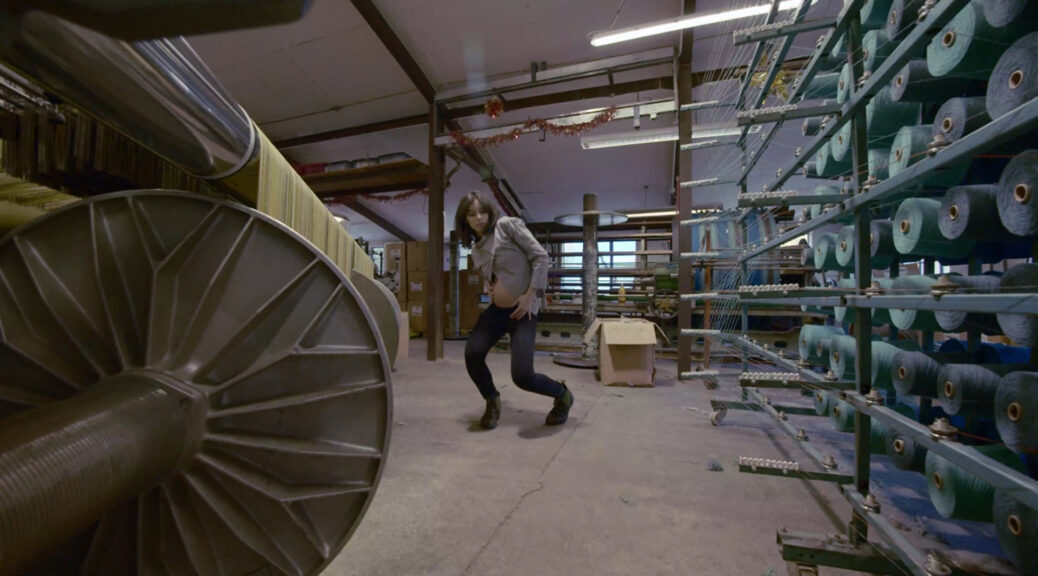
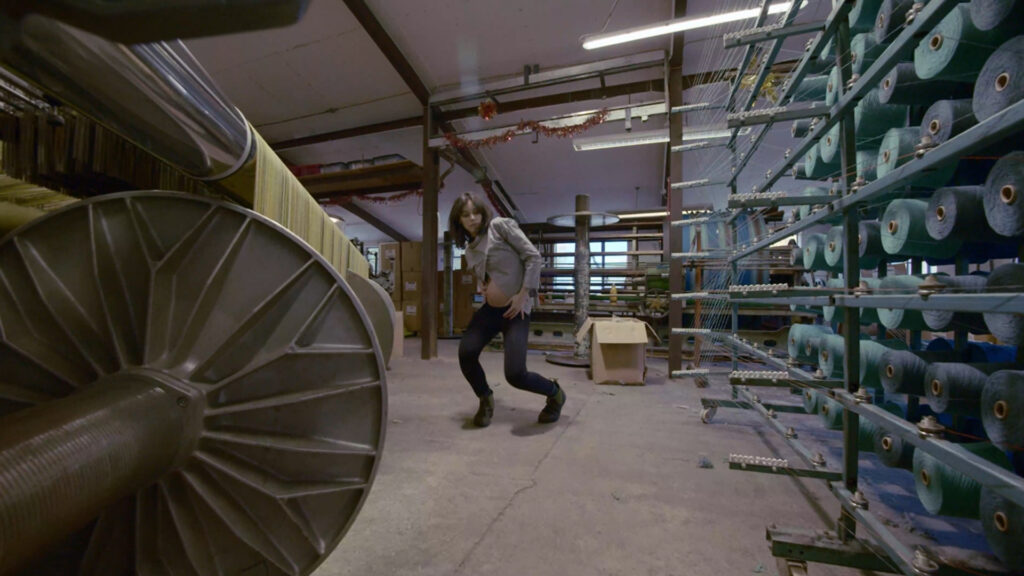
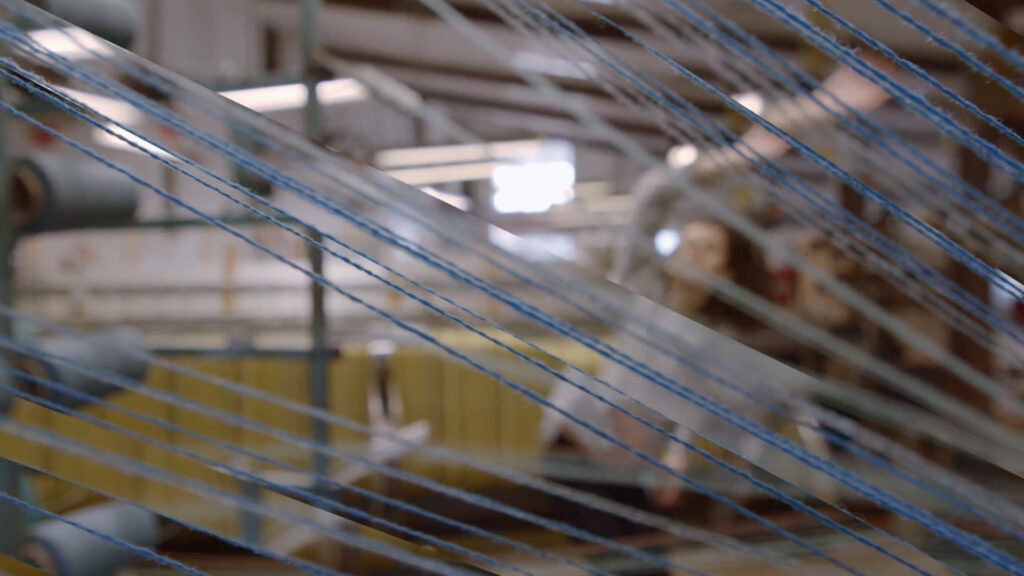
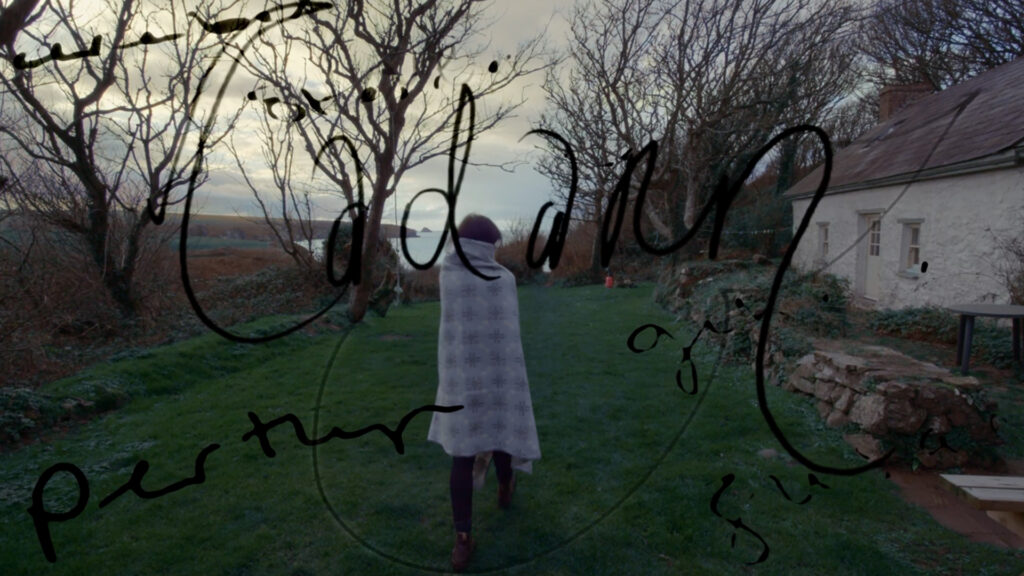
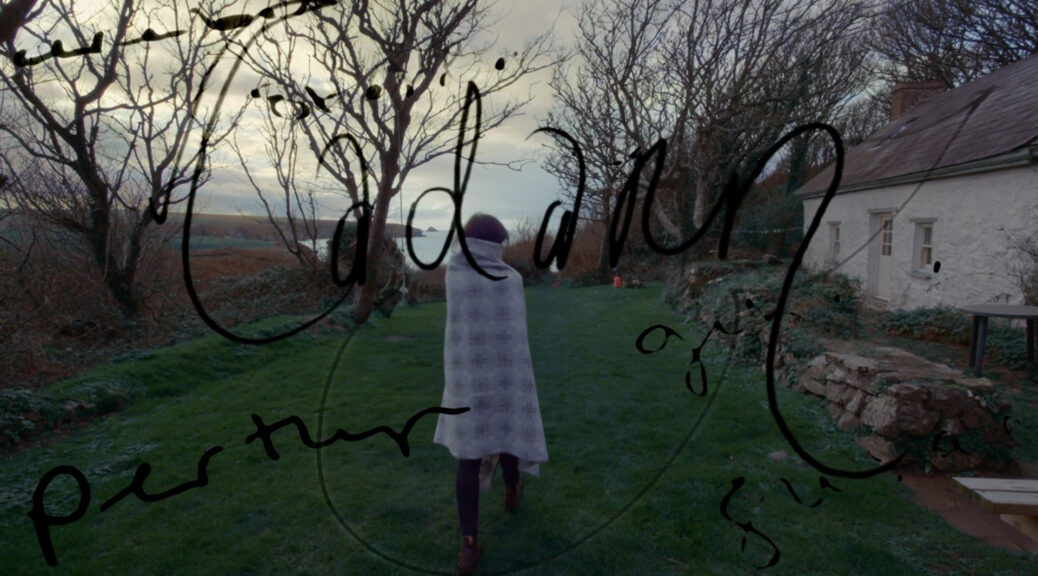
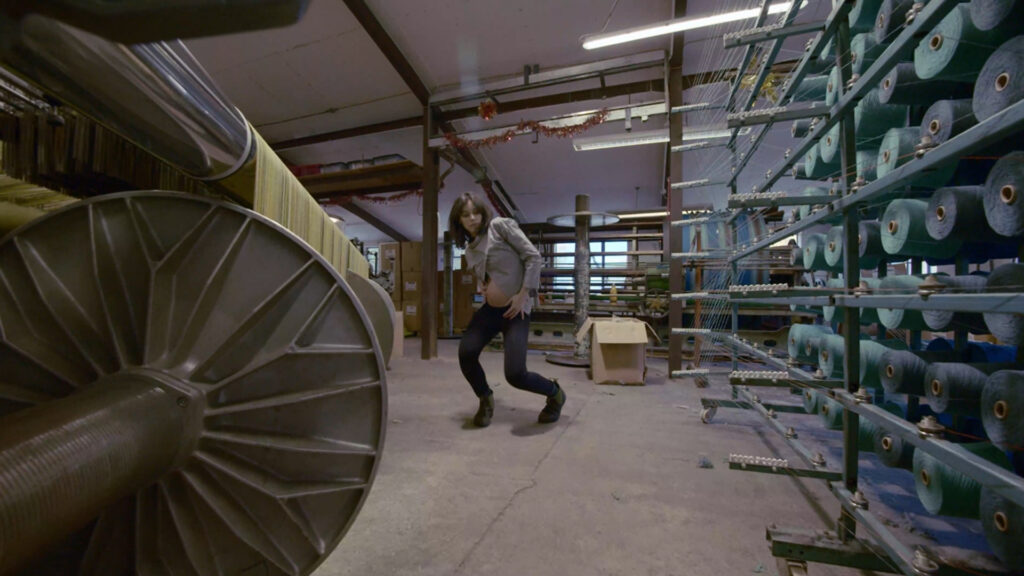
Caiff Aber Bach ei enw ar ôl bae yng ngorllewin Cymru, lle gellir clywed synau melin wlân a’r môr. Ceir ‘Aber’ a ‘Bach yn y Gymraeg a’r Almaeneg, ond gydag ystyron gwahanol. O’r syniad hwn y daw’r ffilm – a gafodd ei ffilmio ym Melin Wlân Melin Tregwynt yn Sir Benfro, a’i chreu ar y cyd â Rufus Mufasa, Hanan Issa a Tim Volleman – ac mae’nn archwilio sut y gallwn blethu geiriau i greu patrymau newydd o berthyn.
Dywedodd dawnsiwr CDCCymru, Elena Sgarbi, “Mae gweithio ar yr ail gynhyrchiad o’r prosiect ffilm Plethu/Weave gyda Mererid Hopwood a Tim Volleman wedi bod yn gyfle gwych i ennill dealltwriaeth well o Gymru a’i diwylliant. Trwy frwdfrydedd Mererid i rannu ei diwylliant a’r prosiect hwn, ces gyfle i ddod i adnabod cornel brydferth o ogledd Sir Benfro drosof fy hun, a’i thraddodiad gwehyddu gwlân pwysig.”
Mae gan CDCCymru hanes o deithio i’r Almaen ers 2017, gan berfformio i gynulleidfaoedd yn bennaf yng Ngogledd Rhein-Westphalia, Bafaria a Baden-Württemberg.
Dywedodd y Prif Weithredwr, Paul Kaynes, “Rydym yn falch iawn y bydd CDCCymru yn cyflwyno dawns fel rhan o lansiad Cymru yn yr Almaen Llywodraeth Cymru. Rydym wedi bod yn datblygu ein henw da a chynulleidfaoedd yn Ewrop, yn enwedig yn yr Almaen a gwledydd cyfagos dros y tair blynedd diwethaf, gan berfformio i leoliadau dan eu sang gyda chryn gymeradwyaeth. Mae’n deimlad cyffrous iawn i ni ein bod wedi cael ein comisiynu i greu y ffilmiau Plethu/Weave hyn, fel bod rhagor o gynulleidfaoedd gartref a thramor yn gallu gweld dau gwmni celfyddydol cenedlaethol o Gymru yn cydweithio.”
Bydd y ddau gomisiwn Plethu/Weave #2 arall sydd yn rhan o raglen Cymru yn yr Almaen yn cael eu darlledu ym mis Mawrth ac ym mis Hydref, gan arddangos gwaith y bardd Alex Wharton a’r artistiaid dawns Krystal S. Lowe ac Osian Meilir.
Dywedodd Jane Hutt, y Dirprwy Weinidog a’r Prif Chwip: “Mae blwyddyn Cymru yn yr Almaen yn ymwneud â chryfhau’r cysylltiadau rhwng y ddwy genedl ac adeiladu rhai newydd, ac mae gan y sector celfyddydol ran bwysig i’w chwarae. Mae ein celfyddydau, diwylliant a chreadigrwydd yn rhoi i Gymru ei phersonoliaeth unigryw ac mae’n gryfder mawr yn nhermau hyrwyddo Cymru ar lwyfan y byd.
“Rydym yn falch iawn o fod yn gweithio â CDCCymru a Llenyddiaeth Cymru ar y prosiect cyffrous hwn ac yn edrych ymlaen at arddangos gwaith rhai o’n beirdd a dawnswyr mwyaf talentog i gynulleidfaoedd yr Almaen yn y flwyddyn i ddod.”
ByddAber Bach, y comisiwnPlethu/Weave #2 cyntaf ar gyfer Cymru yn yr Almaen yn cael ei ddarlledu fel rhan o’r lansiad digidol ar sianeli cyfryngau cymdeithasol Llywodraeth Cymru ar 11 Ionawr. ByddAber Bachar gael ar wefannau a sianeli cyfryngau cymdeithasol CDCCymru a Llenyddiaeth Cymru o 12 Ionawr ymlaen.
EXPERIMENTICA is a live art festival in Cardiff that encourages risk, collaboration and exchange between artists and audiences.
The festival commissions and hosts a dynamic programme of live art, performance and interdisciplinary projects and offers a platform for UK and international artists at all stages in their careers, to present experimental work in an open and supportive environment.
The 2021 festival will explore narratives and alternatives to the status quo; questioning accepted ways of thinking; giving a voice to the underrepresented and challenging existing forms of storytelling – exploring democracy, agency and open authorship.
Chapter will advertise a call-out for proposals for this in March.
In the meantime, Chapter is commissioning three artists to make new work for their interim ‘EXPERIMENTICA Presents’ strand.
They hope that this opportunity will create space for reflection and experimentation during these challenging times.
Chapter is looking for artists based in the UK whose practice, prior to COVID, focused on live art or contemporary performance and who need support to explore ways of adapting their approach to making and sharing their work.
Each commission will receive a £1,000 fee.
If required, Chapter can offer free access to one of their studio spaces in Cardiff for up to one month between March and August 2021.
Chapter especially welcomes applications from those who identify as having currently under-represented characteristics. This includes black and non-black people of colour, disabled people, individuals identifying as LGBTQIA+, those with parental responsibilities and people from lower socio-economic backgrounds.
The decision-making panel will include a varied demographic of lived experiences including Chapter programme staff and independent practitioners/curators.
Artist Jonny Cotsen, who performed at EXPERIMENTICA18 with Louder Is Not Always Clearer, is to join the selection panel. Produced and directed by Mr and Mrs Clark, Louder Is Not Always Clearer has since gone on to tour across the UK and Europe including a hugely successful run at 2019’s Edinburgh Fringe and most recently at Théâtre de la Ville, Paris.
Plethu/Weave cross-artform project extended into 2021
National Dance Company Wales (NDCWales) and Literature Wales’ digital cross-artform collaboration, Plethu/Weave has been extended into 2021 and has been commissioned to be a part of Welsh Government’s launch of Wales in Germany themed year in 2021.
Following the success of NDCWales’ and Literature Wales’ cross-artform collaboration, Plethu/Weave #2 will be launched in January 2021, bringing more opportunities for independent Wales based dancers to be matched with some of Wales’ most talented poets to create eight more exciting contemporary short digital films online.
The first Plethu/Weave #2 film, Aber Bach, created by Mererid Hopwood and NDCWales dancer, Elena Sgarbi, will be released on 11 January, the first of three NDCWales & Literature Wales commissions, as part of the launch of Welsh Government’s Wales in Germany themed year.
Mererid Hopwood and Elena Sgarbi
In 2020, Plethu/Weave brought together four dancers from NDCWales and four independent dance artists paired with eight Wales based poets to create eight short films for audiences online. The pairings created cross-artform creations inspired by the artists own stories, location, heritage and connection with Wales.
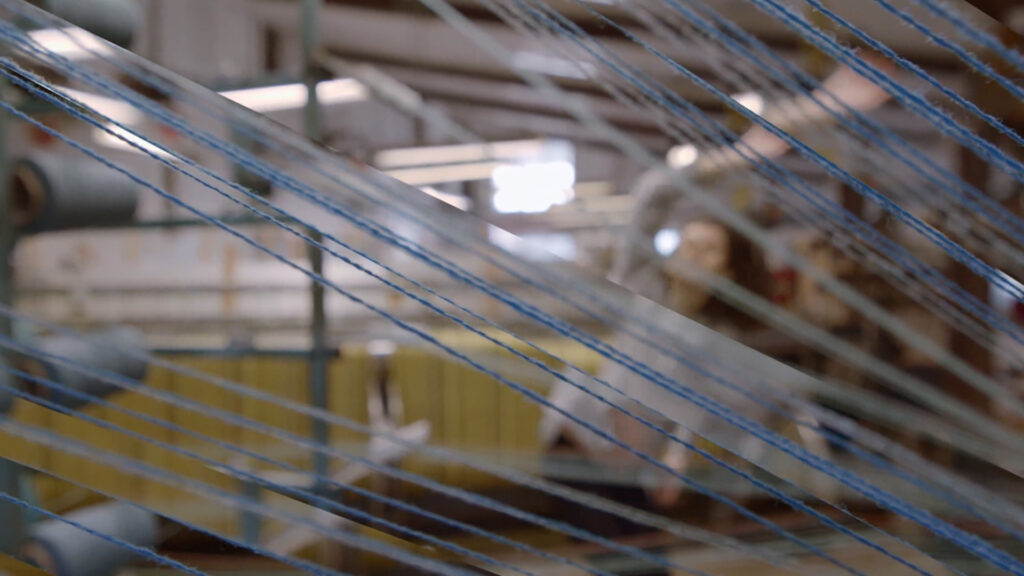
Aber Bach takes its title from the name of a cove in West Wales where the sounds of a Woollen Mill and the sea can be heard. ‘Aber’ and ‘Bach’ are words found in both Welsh and German, though with different meanings. From this notion, the film, which was filmed at the Melin Tregwynt Woollen Mill in Pembrokeshire, and created in collaboration with Rufus Mufasa, Hanan Issa and Tim Volleman, explores how we can weave words to create new patterns of belonging.
NDCWales’ dancer, Elena Sgarbi said, “Working on the second edition of the Plethu/Weave film project with Mererid Hopwood and Tim Volleman has been a great opportunity to gain a deeper insight into Wales and Welsh culture. Through Mererid’s enthusiasm to share her culture and this project, I have been able to get to know first-hand a wonderful corner of North Pembrokeshire and its important wool weaving tradition.”
NDCWales has a history of touring to Germany since 2017, performing to capacity audiences mainly in North Rhine-Westphalia, Bavaria and Baden-Württemberg.
NDCWales’ Chief Executive, Paul Kaynes said, “We are delighted that NDCWales will be presenting dance as part of Welsh Government’s Wales in Germany launch. We have been building our reputation and audiences in Europe, especially in Germany and neighbouring countries in the last three years, performing to packed venues and standing ovations. It’s really exciting for us that we’ve been commissioned to make these Plethu/Weave films, so even more audiences at home and internationally can see two Welsh national arts companies collaborate.”
The other two Plethu/Weave 2 commissions for the Wales in Germany programme will be broadcast in March and October and will feature poet Alex Wharton and dance artists Krystal S. Lowe and Osian Meilir.
Lleucu Siencyn, CEO of Literature Wales, said, “It’s wonderful to be able to partner again with NDCWales on another round of this ground-breaking collaboration, and to celebrate our literary and artistic culture with the world as part of the Wales in Germany programme.”
Jane Hutt MS, Welsh Government Deputy Minister and Chief Whip said,
“The year of Wales in Germany is about strengthening the connections between our two nations and building new ones, and the cultural sector has an important role to play. Our arts, culture and creativity give Wales its unique personality and it is a huge strength in terms of promoting Wales on the world stage.
“We are delighted to be working with NDCWales and Literature Wales on this exciting project and look forward to showcasing the work of some our most talented poets and dancers to German audiences in the year ahead.”
Aber Bach the first Plethu/Weave #2 commission for Wales in Germany will be broadcast as part of the Wales in Germany Digital launch on Welsh Government social media channels on 11 January. Aber Bach will be available on NDCWales and Literature Wales’ website and social media channels from 12 January.
In this interview Catherine Paskell, Artistic Director of new writing company Dirty Protest speaks to Guy O’Donnell about the background of Dirty Protest, Right Now a new online theatre festival and her future plans.
Hi Catherine thanks for taking the time to chat with me. We last spoke as you were about to take Sugar Baby by Alan Harris to the Edinburgh Fringe Festival in 2017.
We are meeting today to discuss a festival closer to home which takes place in Newport this November.
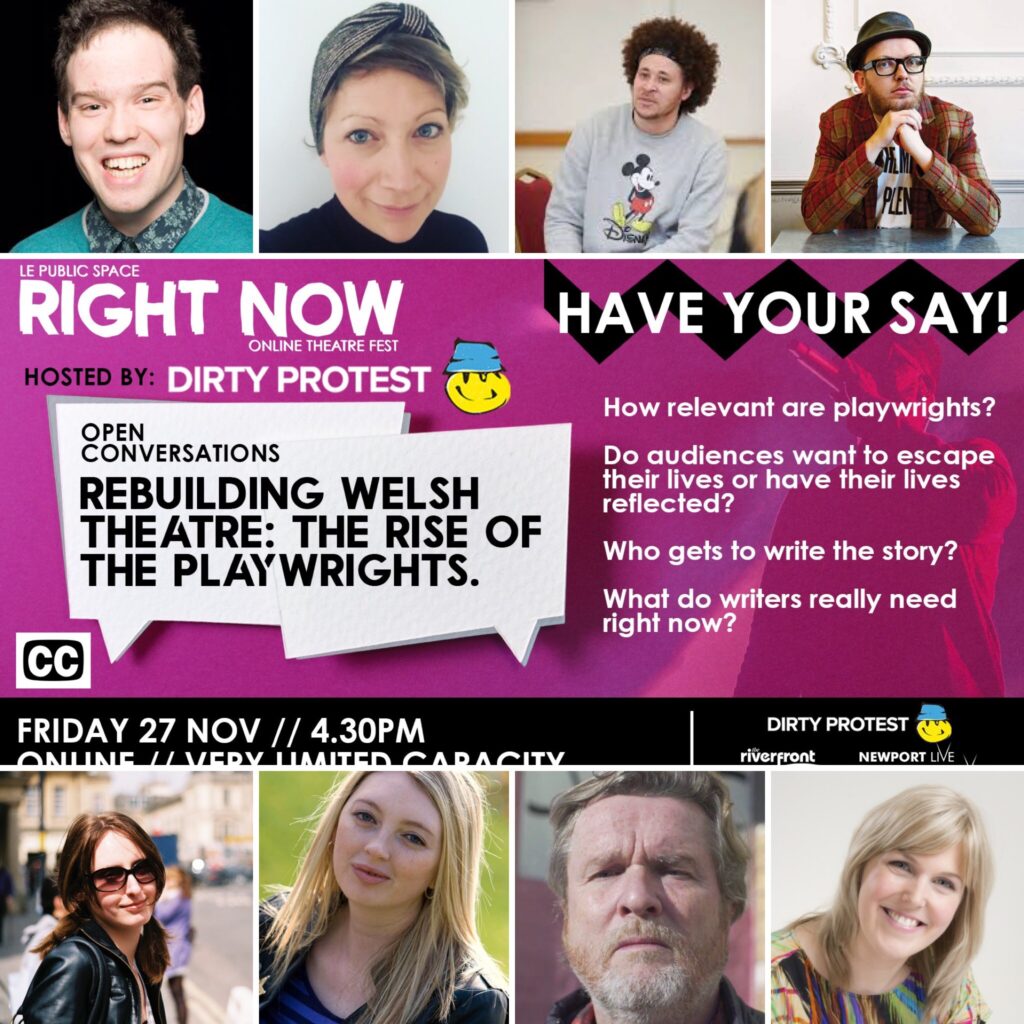
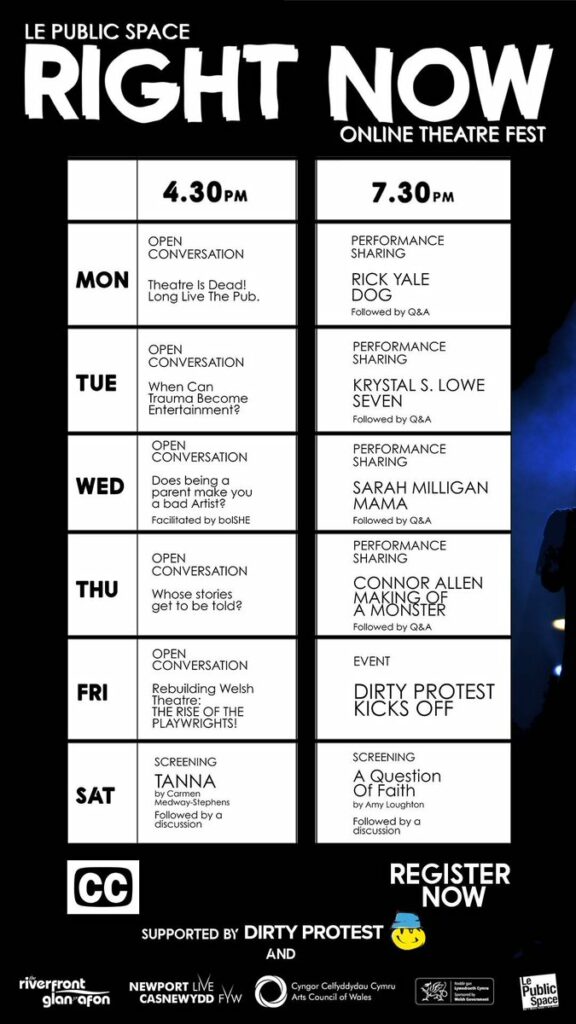
Right Now, Online Theatre Festival. A short online festival of work in progress from some of Wales’ most exciting solo-performance-makers. The event takes place online from the 23 Nov- 28 Nov, 23:00 On the Le Public Space Website.
The event is described as,
“Right Now is an expression of urgency. Because theatre isn’t temporarily paused waiting to happen some where in the near future. It’s alive but physically unable to be experienced. It’s here now.”
This sounds like a vital arts event, how did Dirty Protest come to be involved?
It’s vital that theatre continues to be seen and enjoyed, because theatre and performance has continued throughout the global pandemic. Dirty Protest, like Le Public Space and many inspirational companies didn’t stop making work, engaging artists and talking with audiences and our wider communities as the Coronavirus hit. We found new and different ways to keep going and keep each other going. This is a celebration of that, and an invitation for others to join us in rebuilding and reimagining theatre in Wales.
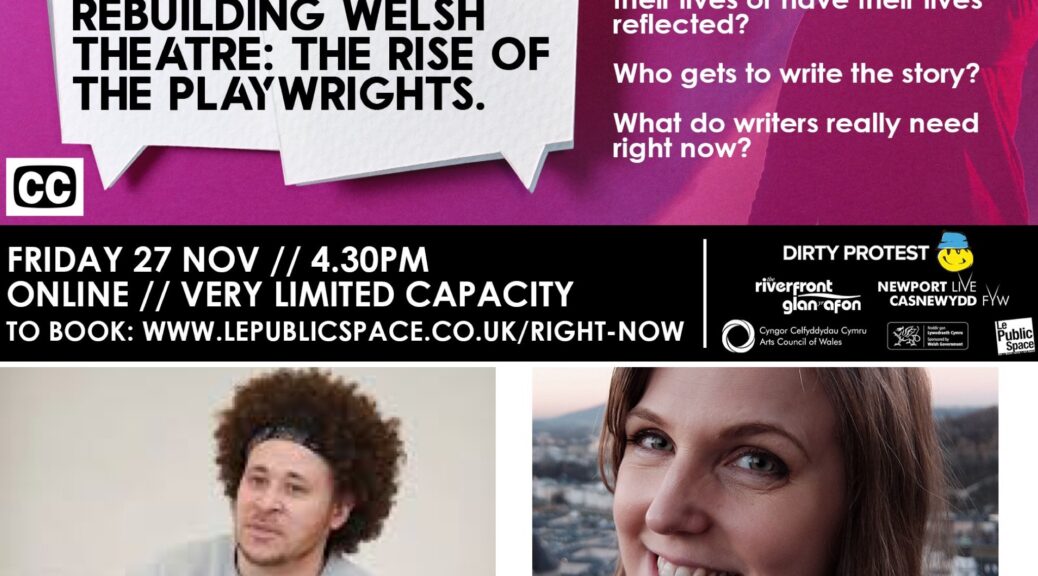
One of the specific events you are supporting is an open conversation titled ‘Rebuilding Welsh Theatre: The Rise of the Playwrights!’ This takes place on Fri 27th Nov at 4.30pm.
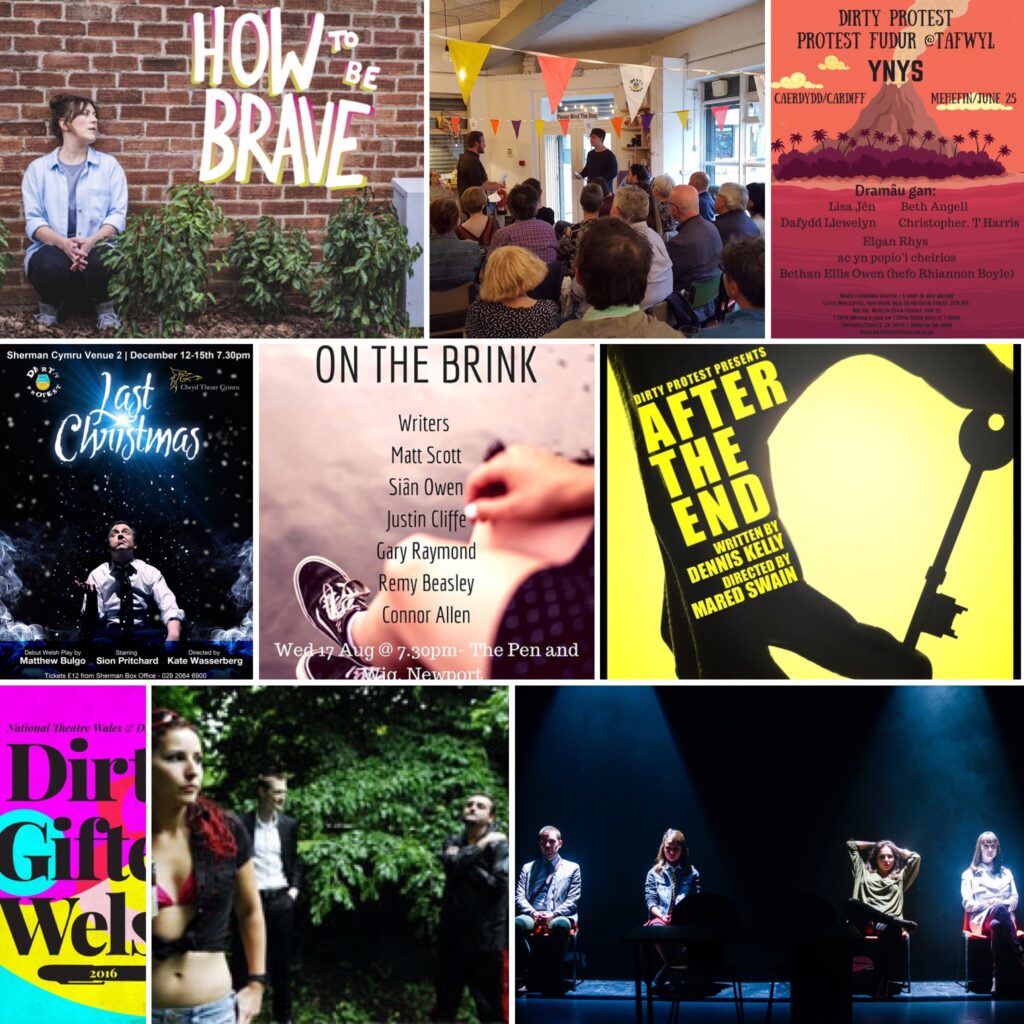
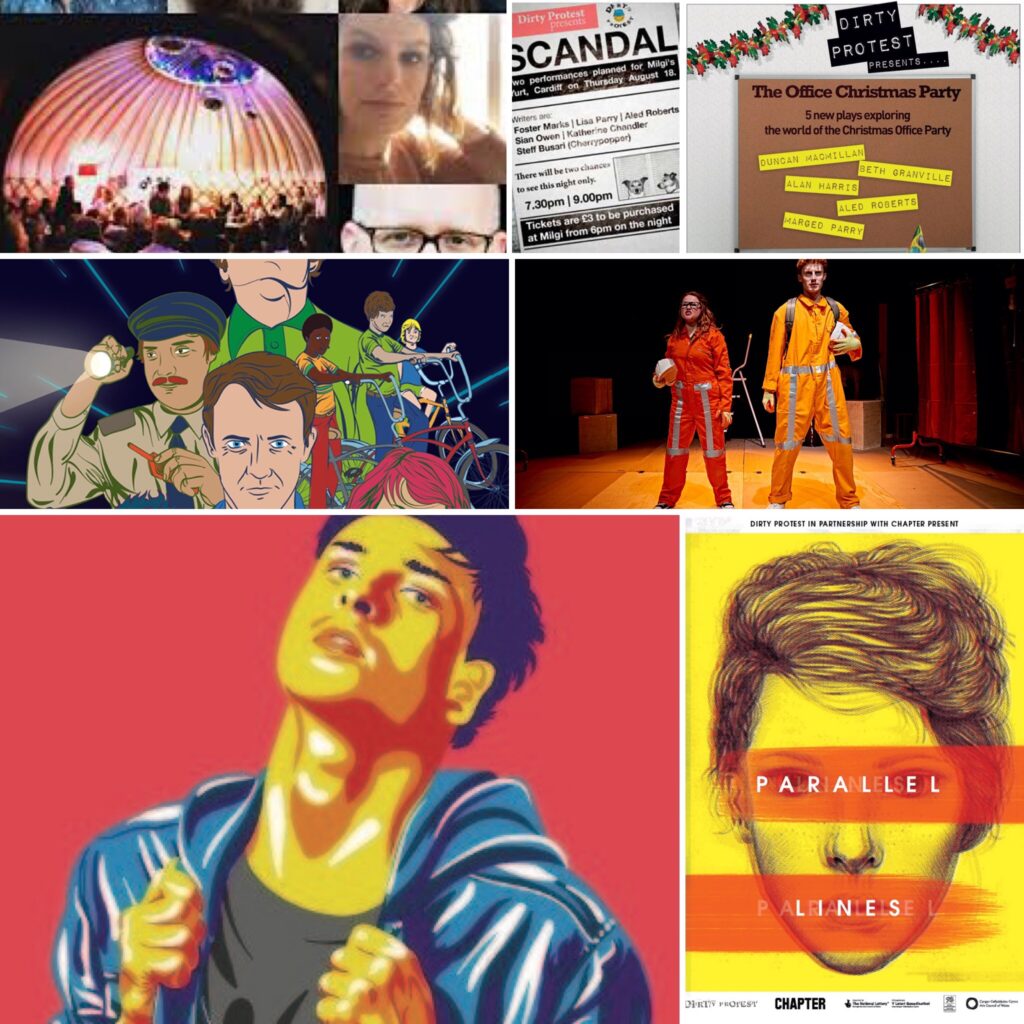
Dirty Protest has a rich history in supporting Welsh Playwrights from script in hand readings in a yurt at Milgis, Cardiff, performances at The Royal Court in London to National tours of award-winning plays. Has the support networks for Welsh Playwrights and the resulting work being produced improved over the lifetime of DP and if so how?
When Dirty Protest first started in 2007, there was no one offering the network and opportunities that we built. It’s why we started in the first place. Over the lifetime of DP so far, many newer companies than us have cited Dirty Protest as their inspiration, including the founders of National Theatre Wales, The Other Room in Cardiff and other numerous Fringe theatre companies who have produced work by Playwrights. In that time, we have seen improvements, as well as the sector still struggling to offer the support that Playwrights really need to sustain their own careers and produce work worthy of our audiences.
In the past 13 years, the networks and opportunities for emerging Welsh Playwrights have become more numerous. The Fringe scene has grown exponentially. Having a big Fringe scene and more Fringe producing companies give more frequent opportunities for early career artists. In recent years, we have seen more Welsh Playwrights produce work that is noticed on stages, television screens and streaming services across Wales and outside our borders. More theatres and companies are offering early career development, and there have been opportunities for writers to get work out there across numerous digital platforms in the global pandemic.
In this time, we have also seen the erosion of openly available spaces for Fringe companies and playwrights to try out their ideas. Spaces that were accessible and free to use in our formative years – pubs and cafes and little shops – now either don’t exist, or those that do now charge hire fees for artists to use the space, or require a share of ticket sales, or guaranteed spend on the bar. The Fringe is bigger, but there are fewer open access spaces and less opportunities to get work made unless you are already connected to the “right” people, or have the money to hire a small space for performance. This squeezes out certain artists and also means we tend to hear similar voices and stories, at a time when we need to hear more under-represented voices and stories.
We also need to see more opportunities open up for our mid-career writers and those Playwrights who are stuck in the space after their first play, when they need a second, third and fourth investment (and maybe more) to kick off their career. We need much more investment for artists beyond the early years, when companies and producers want to find “their” playwright or claim to have “discovered” a new voice. The truth is that Wales is a nation of playwrights who need sustained, long term investment and they are being underserved by the current system.
I believe you will be discussing the questions below for your Open Conversation, why did you decide on them and what do you hope to achieve?The questions are;
How relevant are playwrights?
Do audiences want to escape their lives or have their lives reflected?
Who gets to write the story?
What do writers really need right now?
We decided on these questions because these have come up repeatedly through the global pandemic in meetings with artists and audiences. We want to provide a platform to reimagine what we want theatre in Wales to be, and how we exist in the world during and after a global pandemic.
This conversation at 4:30pm on Friday 27 November needs to be useful for Playwrights and those who work with them, a practical resource as well as space for Playwrights to share, be listened to, and to take action towards changing the sector, to make it more democratic and more accountable. These questions frame real concerns for the sector and our artists and audiences, so it’s a place to start.
Please do come along and join the conversation, to be heard, to listen and to move forward.
Alongside Catherine we asked a range of Welsh/Wales based Playwrights to give their own response to the questions proposed by Dirty Protest.
Connor Allen
How relevant are playwrights?
Playwrights are integral to storytelling. Their relevance is second to none because stories are so important. Ever since the dawn of time stories have been a way of communicating and understanding our places and purpose. Thats where playwrights come in as they write the stories that entertain us, reflect our experiences back at ourselves. Without playwrights we wouldn’t have the broad range of stories to connect with.
Do audiences want to escape their lives or have their lives reflected?
I think both. I always say that theatre is a reflection of life and all lives are different so audiences get to see different reflections of different experiences all the time. BUT also audiences want to be entertained and an escapism of the real world can be achieved through theatre and TV. They can escape for an hour and just get absorbed in the joy and magic of the story being told.
Who gets to write the story?
I believe that anyone can tell and write stories. It depends on the context. Wether that comes from a genuine place is a different story. We all have stories to tell as we are all unique miracles with different perceptions of the world and different experiences that have made us the people that we are. Contained within that are beautiful stories that deserve to be told. I think in todays society we are more aware of the authenticity behind peoples stories and experiences. Where representation and opportunity is rife we can’t have the same people telling the same stories. BUT does that mean that only certain people can tell certain stories specific to them. Its a difficult question. I think there’s a difference between a white playwright writing a play with a black character in it as opposed to a white playwright writing a play about what it means to be black for example and I think a lot of people confuse those two points.
What do writers really need right now?
Time and financial support. Those are the 2 key factors I think that writers need as of now. Time to work on that next idea without the worry of how the rent is going to get paid. Also constructive feedback on drafts where playwrights can have their work in progress read to audiences to help the development. i find it so helpful to hear my words read out loud. Having that option readily available for playwrights is another thing but in a constructive way. There is no point saying “that was shit” because that’s not helpful to a playwright. Thats not helpful to anyone. Give them constructive points on how to make it better and the current playwrights will develop work that is truly exceptional (not that it isn’t already)
Rachel Trezise
How relevant are playwrights?
More than ever before we need playwrights to tackle the issues of class and identity. The UK and beyond is dangerously politically divided. Times are strange and volatile. Out of all the art forms, theatre has the most ability to put audiences into characters shoes and consider other people’s point of view.·
Do audiences want to escape their lives or have their lives reflected?
Both! And a well-told story can do both. For some of the audience it will be escape and for others a reflection of their own experiences. We just need to make sure we have enough stories to speak for everyone.
Who gets to write the story?
Someone who knows it in their heart, their head, their bones.
What do writers really need right now?
To know how relevant they are.
Jon Treganna
How relevant are playwrights?
Theatre is one of the oldest forms of storytelling. Clearly now people get drama from TV, social, books and online content, but a great piece of theatre can move people like nothing else. It’s a shared experience.
Do audiences want to escape their lives or have their lives reflected?
I’m not one for kitchen sink dramas and my heart sinks when I see a sofa and 2 chairs on stage. I think that people go to the theatre for a sense of adventure and to escape their lives, especially after Covid and austerity. Even if a play reflects their lives, it should be heightened and they should be moved or thrilled.
Who gets to write the story?
I like interactive dramas where the audience is part of the show. However, I might be old school but I think the playwright writes the story.
What do writers really need right now?
We need shows back on stages, even with social distancing. We need to create theatre shows that dazzle and entertain after such a dark period. And yes, we need more commissions.
Lisa Parry
How relevant are playwrights?
Playwrights themselves or the work? Plays themselves ebb and flow depending on the times; I think that’s the magic of them. CP Taylor’s Good feels really relevant at the moment but it was commissioned in the early 80s. But if you’re asking whether playwrights in Wales are relevant to the scene here, then I would say 100% yes – you only need to look at the audience numbers for shows like Iphigenia in Splott or Sugar Baby. But I don’t think we’ve been given a chance to prove how relevant we are yet. I think that was only just starting to happen before lockdown with the announcement of a new literary department at the Sherman. During lockdown and the rest of this year, it’s been playwrights making the work that we’ve been able to experience, partly because it’s easy enough to do that over Zoom. And I think the commitment of companies like the Sherman and Clwyd to addressing BLM will help in terms of ensuring that the voices coming through are representational and therefore the work relevant to a whole range of different communities that make up modern Wales.
Do audiences want to escape their lives or have their lives reflected?
Both. It’s hard to enjoy a story – even if you’re after pure escapism – if you can’t relate to it in some way. There’s always a chink or an in. And you never know what that’s going to be for the individual audience member. But getting that balance right after Covid is going to be an interesting challenge and one I think we need to be mindful of.
Who gets to write the story?
I’m not sure it’s a case of who gets to write it so much as who gets to have it put on stage and there’s no escaping the fact that white male work has dominated our stages for generations, for various reasons. I think that’s changing and I think playwriting groups have helped it change but there’s still heaps more to do.
What do writers really need right now?
Support – whether that’s social support (writing’s lonely but Covid has made that a thousand times harder) and also financial support. You need time to write. Time’s tricky when you also need money to buy food and to pay the rent. The Writers’ Guild has been campaigning for theatres to keep commissioning writers so that they don’t get lost to the industry, which I think’s really important. I also think at the moment it’s really important that we keep talking to each other. It’s peculiar writing at the moment – I’ve deadlines for stages that are currently occupied by ghost lights. It’s a weird feeling. It’s also possibly the most optimistic and hopeful thing I can do and I think we need to somehow keep that belief going that we’ll be back as an industry and that the relevance of playwrights here will take a firmer hold.
Tom Wentworth
How relevant are playwrights?
We must try to reflect the times we’re living in as well as providing, as in my own work, some sense of escapism. These two potential outputs mean that playwrights are more relevant than they have ever been for reflecting and taking the temperature of the nation.
Do audiences want to escape their lives or have their lives reflected?
I firmly believe audiences want both. Every play should be a combination of dark and light. You can say a lot about the fractured, difficult and tremulous state of the world in a comedy.
Who gets to write the story?
Whoever is from the community the play is about. I want authentic stories and top class writing. I want to see things I’ve never seen before. Say no to tokenism and cultural appropriation. If you’re from a community with a story to tell – write it .
What do writers really need right now?
Time and money, as ever. We may not have spaces for our work to be performed in but we need commissions so they will be full to the brim when performances are allowed again. Don’t skimp on the money. Pay writers properly and give them the time and dramaturgical support they need. This is not a luxury, it’s the way to ensure financial success at the box office.
Tim Price
How relevant are playwrights?
I think Playwrights have never been more important. Dramatic storytelling is the number one form humanity chooses to consume stories. Of course there are plenty of other forms, and multidisciplinary styles and documentaries, and poetry and all the other rich outputs we achieve but fundamentally – a dramatic story is everyone’s preferred medium to understand the world. Cinema and television come from plays and playwrights. There’s a reason England and the UK generate so much Intellectual Property that sells globally, it’s because of the culture and tradition of dramatic storytelling. To build a theatre culture without dramatic storytelling at its heart is to condemn us to perpetual marginalisation. There’s vehicle to take Wales to the world, and it’s dramatic stories. We shouldn’t be anxious about it.
Do audiences want to escape their lives or have their lives reflected?
Probably both depending on where they’re at. When I was younger I wanted to see myself on stage because I didn’t see myself anywhere else. Now I’m older with responsibilities I think I want escapism.
Who gets to write the story?
Even when I’ve written stories and had them produced I still doubt I was the right person to write it so this is a difficult question to answer. My thoughts shift week to week. I’ve been of the mind that as long writers research and write with respect they should have the freedom to write any story about any community otherwise those marginalised voices will forever be required to write stories about marginalised voices and communities. The problem is right now those with the power to get produced are predominantly from one group, so it looks extractive and exploitative when they write from places beyond their experience. I think maybe my instinct for writers to be free to write whatever they want is an aspiration the industry hasn’t earned yet.
What do writers really need right now?
Opportunities.
Catherine Paskell
Please do come along and join the conversation, to be heard, to listen and to move forward.
We also have an event at 7:30pm on Friday evening called DIRTY PROTEST KICKS OFF. This showcases work in development by ten writer-performers, who responded to our open call out to KICK OFF. These artists are sharing very short excerpts of work in development, to KICK OFF Friday night. Some are performing their work in Le Pub, others will be joining us on Zoom. Some are dramatic monologues, some are interactive, some mix languages of movement and text into a new play. All are the future of theatre. Come and join our Dirty Social! This is a great way to find out more about Dirty Protest, the kind of work we do, and get involved in our upcoming opportunities.
Both the Open Conversation at 16:30 and Dirty Protest KICKS OFF at 19:30 on Friday 27 November are closed captioned.
And finally, what’s next for you and Dirty Protest?
We have some really exciting announcements coming up!
As you already know, over the past 13 years, Dirty Protest has been able to support writers from the very start of early ideas, through short play development, full production and international touring. We are doing more of this, in new and bigger ways, in physical spaces AND digital spaces, with more writers, artists and arts workers. Our audio collaboration in Brazil with six young writers in the Complexo da Maré favela community in Rio will be released in December, and we have new collaborations to announce with more partners. We have been working since March to build opportunities for artists and meet with our communities and audiences – and we can announce the specifics of new Wales-based and international projects, new opportunities, a new writing artists network, and new shows in English and Welsh coming up next very soon! Watch out!
Thanks for your time Catherine
Get the Chance values the role playwrights living and working in Wales bring to the cultural life of our nation. You can read more interviews with the Playwrights above and a range of other Welsh/Wales based Playwrights here
Get the Chance is a voluntary ran organisation, to donate to our work please click here
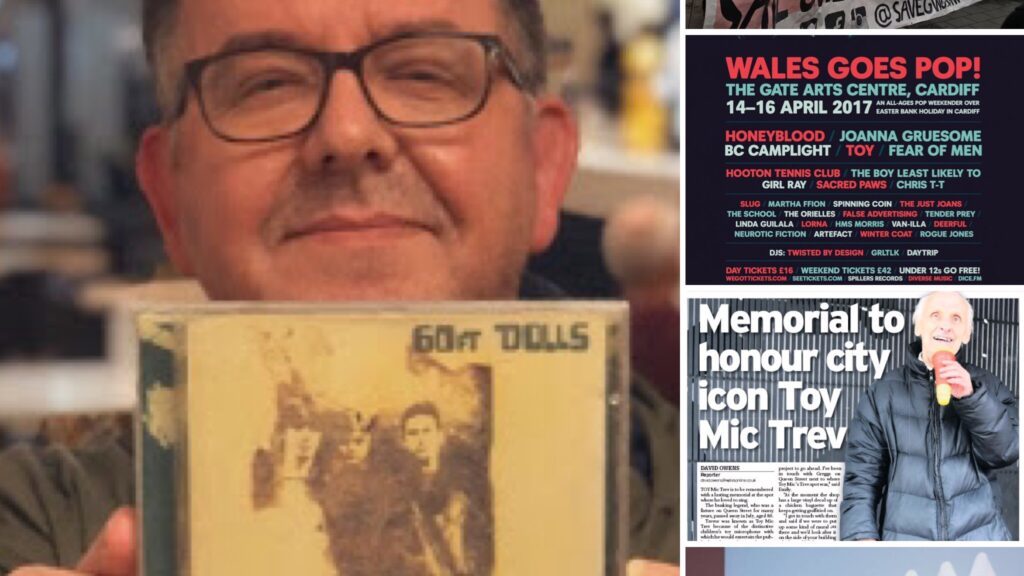
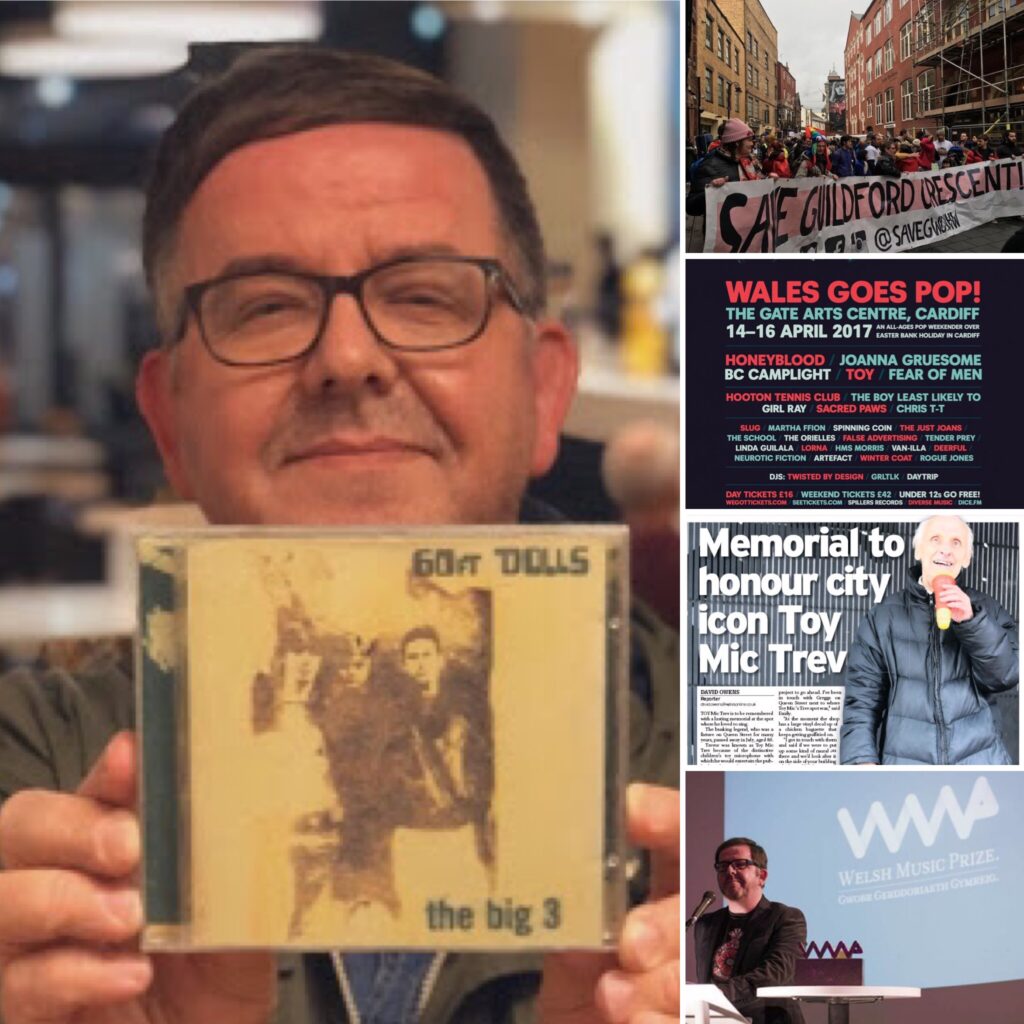
Get the Chance was extremely saddened to learn that journalist David Owens is being made redundant from his role at Media Wales. Dave’s championing of the arts, especially Welsh music has been hugely important for the sector. His unique voice has raised awareness of new music, discussions around class and culture, he has supported music festivals, fought against the destruction of music venues in Cardiff and has created heartfelt articles about Cardiff characters like Toy Mic Trevor!
In the article below fans and colleagues pay tribute to him and his work.
Bethan Elfyn, BBC Radio Wales, Horizons Music Project
Dave Owen’s respect amongst the South Wales music family is well earned and his genuine passion for the music, and the individuals making the music, breathes through all his writing.
I believe I first met him around the time he published the Catatonia story – he might correct me on this – but I have a vague recollection of meeting and possibly interviewing him about the book, released in the year 2000.
Our paths would cross from there at a number of music gigs, events, panels, and anything music related in South Wales.
Dave is more than a journalist to me, more than a talented writer and music fan, he’s also a friend, and I look forward to seeing what the next chapter will hold for him.
John Rostron, Making Music Wales Manager
The people I really connect with in music are those who just cannot turn it off. They devour music – new and old – in all its forms – recorded, written, live – and it’s between bands and bar at a gig that you usually become friends with the people that are particularly special. Dave is one of those people.
Possibly in Dempseys, probably in Clwb Ifor Bach, certainly late in an evening, with ears ringing from whoever we’d both been to see and hear, Dave became, for me, a solid, reliable, passionate part of the fabric of music in Wales. I got used to seeing him bouncing between bands, and I loved to see him. I always do. He’s a good guy. A funny soul. A trustworthy man who wears his heart on his sleeve. He’d give before he got, and he’d never take anything without permission and grace. For a long time his words were my only route into the Echo and The Western Mail where he’d write so enthusiastically about music. He became someone whose opinion I trusted. Through his words I’d go listen to some bands I’d never heard of. But more importantly I’d return to acts I’d skipped or dismissed for some reason that had felt right to me at the time. But If Dave was enthusiastic, then I would doubt my first instinct and give the band a second shot. He would often prove to be right.
When once just music and culture and art were all I cared for I began to get more interested in the politics and policy behind it. I’d share that with Dave, who increasingly became interested in it himself. I love those conversations and those debates we have. He wasn’t just writing about music, he was – and is – part of the push and pull that makes things happen in Wales. He wants there to be more; for it to be better; for it to be fair. He’ll shout about it and write about it between the bands, over the bar, late into the evenings as only he can.
Minty’ s Gig Guide
It’s sad to hear David Owens – Wales Online has been relieved of his duties from Media Wales.
⚡️ There is NO QUESTION that Dave has been a TITAN in Welsh Music Journalism since I can ever remember – his passion for this industry is something I’ve always been enormously enamoured with & he has supported me no end since I started. ❤️
So…whilst some may say…this is a huge loss for Welsh Music Media…
I say it’s a HUGEEEEE gain for independent media…there are much greener pastures ahead for Ser’ David – and I can’t wait to see what comes next.
I Loves The ‘Diff
Many of us have watched with dismay at the decline of decent local journalism in South East Wales at the hands of a non-Welsh plc, yet amid the slide toward online lowest common denominator, catch-all, hit rate, click bate driven drivel was a rare stalwart – Dave. A man whose passion for the place in which we live, its people, and music (Music! Music! Music!) is tangible in his writing, his choice of stories, and the people and bands he celebrated. So thank you for the (words about) music, Dave. Looking forward to hearing about what comes next for you.
Patrick Jones, Poet
I got to know of David’s work through his love of music. His writing was always passionate interesting educational and real. You could tell it was so important to him and this was reflected in his pieces.
He is an important voice in Welsh journalism. You could always hear his authentic voice in his words. Rare in journalism these days. I liked his societal take on bands and music. He knows where it originates. A decent good guy that you could sit down and openly talk with. I shall miss his writings x
Spike Griffiths, Project Leader – Forté Project
I call Dave a ‘mouthpiece’. He has spent endless column inches tirelessly devoted to covering welsh music; be it through reviews, previews, features, or simply highlighting recent concerns to our troubled sector. All of which has helped spread the importance of music. And never has that been more valuable than right now.
His kind words about our youth music development work have always been much appreciated. Whether inked through a feature in his “New Wave” segment or accompanied by a raised glass at one of our gigs, they have all been warmly received.
Illuminating the emerging music talent in Wales is something that we both strongly believe in. The young acts we work with, in particular, treat his music reviews with reverence.
At times like these, Dave’s honesty and passion for music are much needed. I have no doubt he’ll establish a new ‘mouthpiece’ soon and continue the important work he’s well known for.
Creating opportunities for a diverse range of people to experience and respond to sport, arts, culture and live events. / Lleisiau amrywiol o Gymru yn ymateb i'r celfyddydau a digwyddiadau byw