Hi I am Guy the project coordinator for Get The Chance. I am a trained secondary teacher of Art and Design and have taught at all Key Stages in England and Wales. I am also an experienced theatre designer and have designed for many of the theatre companies in Wales.
Hi Hanna, great to meet you, can you give our readers some background information on yourself please?
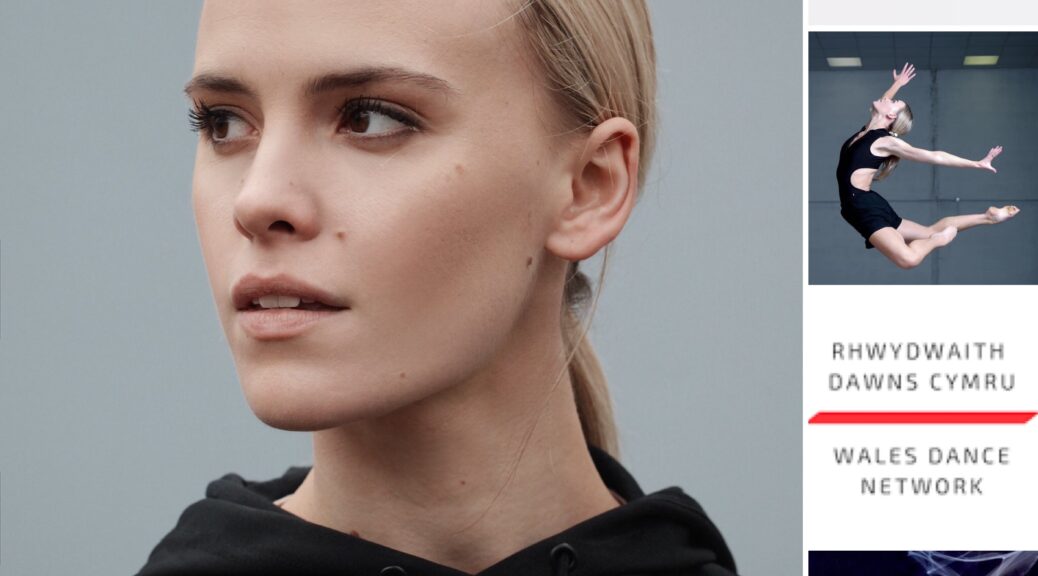
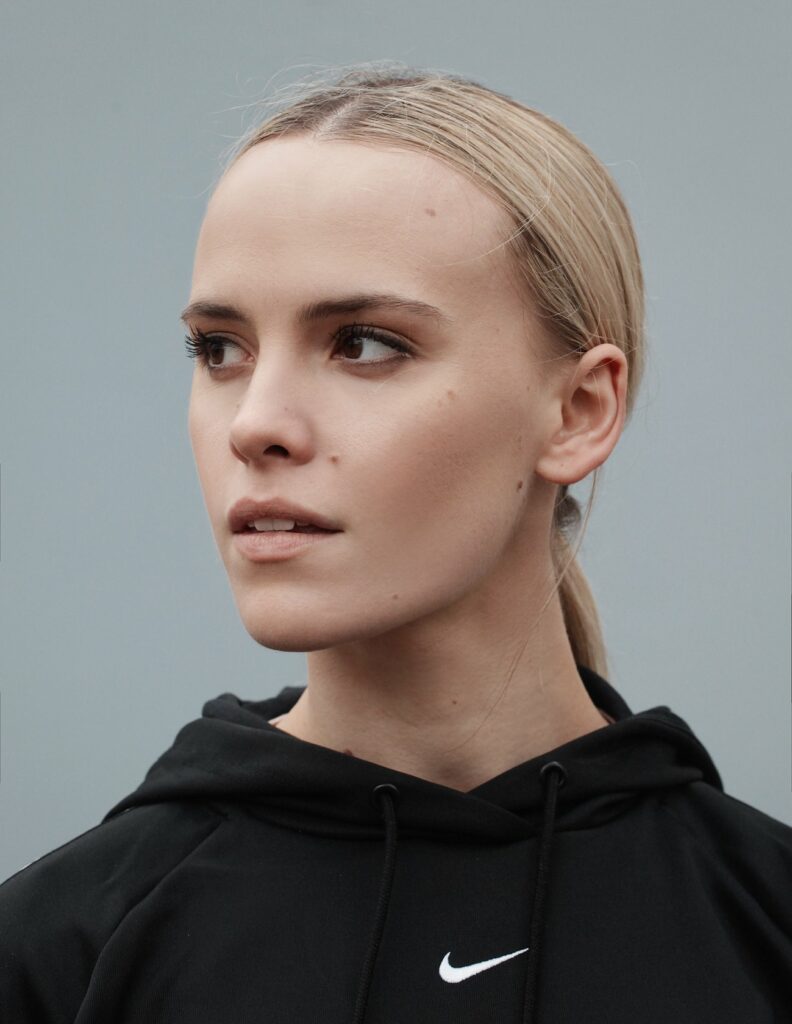
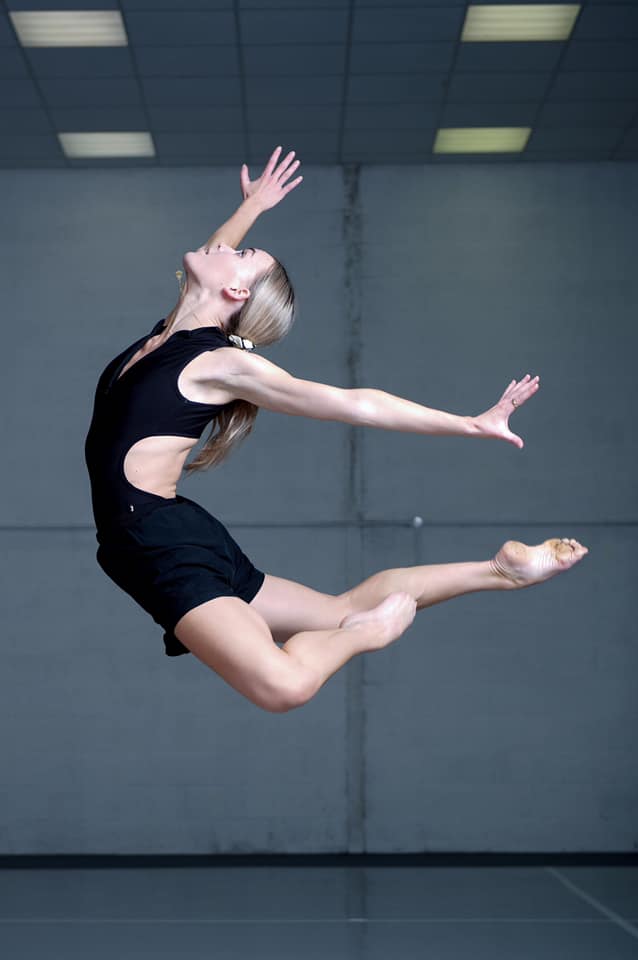
I’m a freelance dancer from Cardiff. I trained as an Associate of The Royal Ballet School and National Dance Company Wales before attending London Contemporary Dance School at 18. I’ve worked with choreographers including Crystal Pite, Caroline Finn and Dane Hurst and have danced with companies such as Danish Dance Theatre, Just Us Dance Theatre and have recently joined Ballet Cymru as a company dancer. You can find out more about me at my website
What got you interested in the arts?
I’ve been creative as long as I can remember. At school, I was more often than not doodling over my Maths homework and choreographing disco dancing routines in the school yard. I also loved studying Textiles and Drama at A Level.
Credit Sian Treberth
You are a company Dancer with Ballet Cymru and are currently working with them to look at ways to support dance delivery in the Welsh Language. What are your hopes and ambitions for this new initiative?
Following a successful trial period, we’re excited to bring the bilingual adult ballet classes back after Easter. I’ve also been teaching Welsh amongst the company members; their confidence in speaking the language has grown and their enthusiasm has been really heartwarming. We’re now looking at more ways to incorporate bilingual practice and it’s solidified my belief that teaching dance bilingually should be the norm in Wales. If you are a dance practitioner in Wales, I implore you to consider how you can include the use of the Welsh language in your practice. With almost 30% of the population able to speak and understand Welsh, it seems worth the effort.
If a dancer wanted to stay and train in Wales and then pursue a career, what support system would you suggest they require in order to be able to do this?
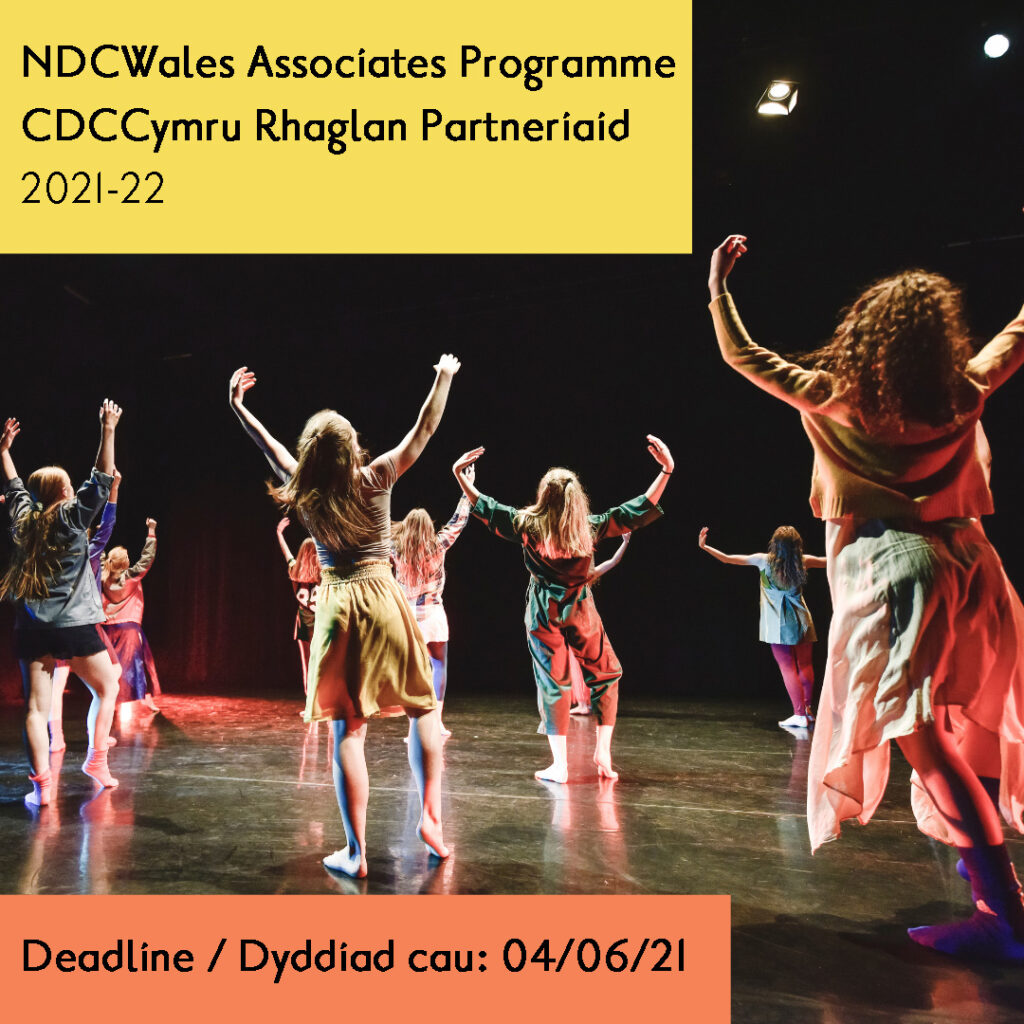
Attending your local dance school is a great place to start and if you’re fortunate enough to be based in South Wales, you may be able to attend the Associate schemes run by NDCWales and Ballet Cymru. But it’s not currently possible to train vocationally in Wales to a professional level which is a huge shame!
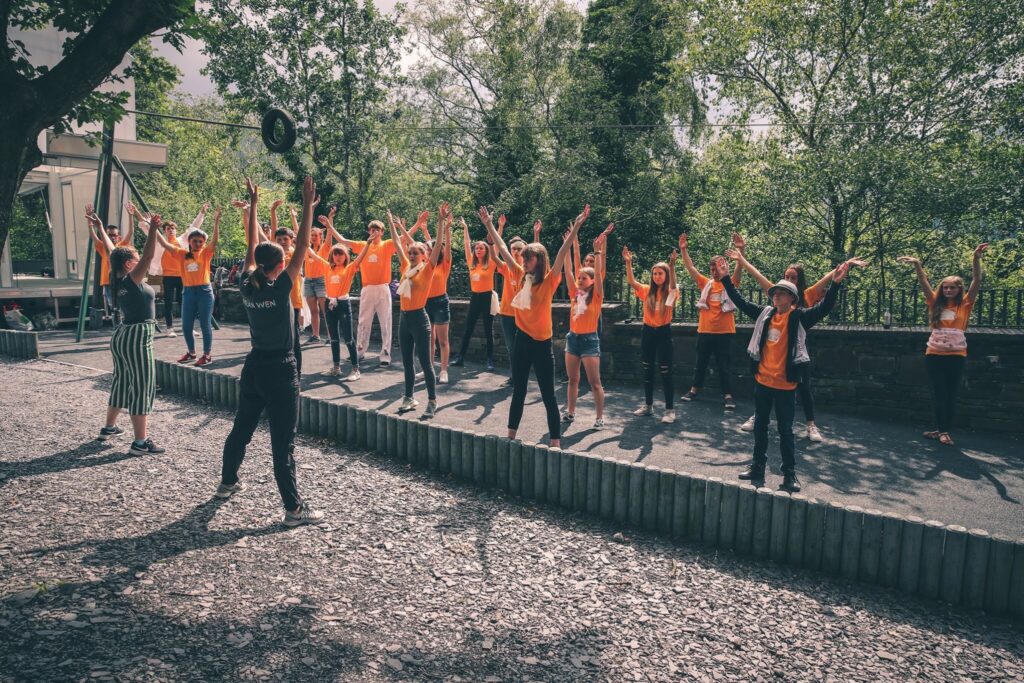
NDCWales Associates.
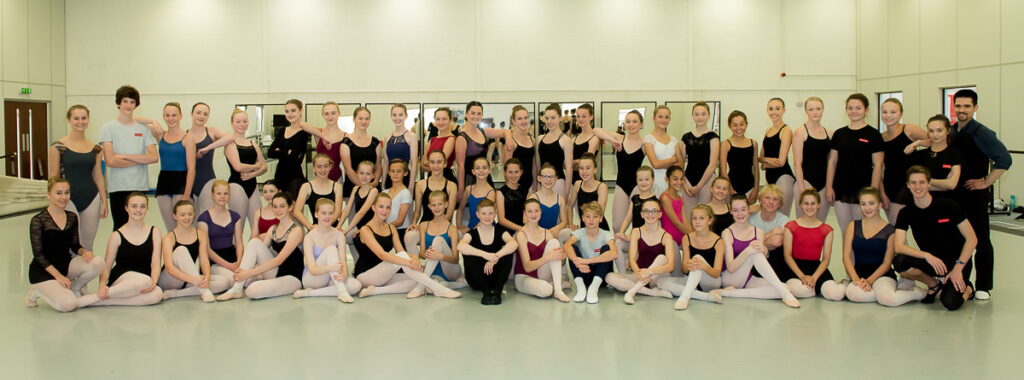
Ballet Cymru Associates, copyright Sian Trenberth Photography
In terms of pursuing a career in dance, in Wales, I’ve found understanding my skills and what I can offer the Welsh Dance sector to be really important. For example, recognising the need for Welsh speaking dance practitioners and providing that service has allowed me to gain choreographic and teaching experience and has at times been a financial lifeline. Having said this, I feel that as a dancer, I’m sometimes valued and held up to a different standard because of my nationality and the fact I speak Welsh. I feel equally lucky to be given opportunities because I’m Welsh but sometimes anxious that my work is valued exclusively on that basis. I’ve come to terms with these feelings by embracing the platforms I’m offered as opportunities to challenge assumptions and in some cases, surpass expectations. I’m passionate about my heritage and culture but it doesn’t define my work or my identity.
You’re an artist who has in the past worked with creatives from a range of art forms to create exciting artistic performances. How would you best describe your creative practice?
I draw upon yoga, flying low and improvisation in my own practice and my movement quality is usually described as fluid and intricate. In terms of choreography, I find myself drawn to both the emotional and physical characteristics of the human experience, in particular themes of mortality and creation. I’m looking forward to developing these ideas in future.
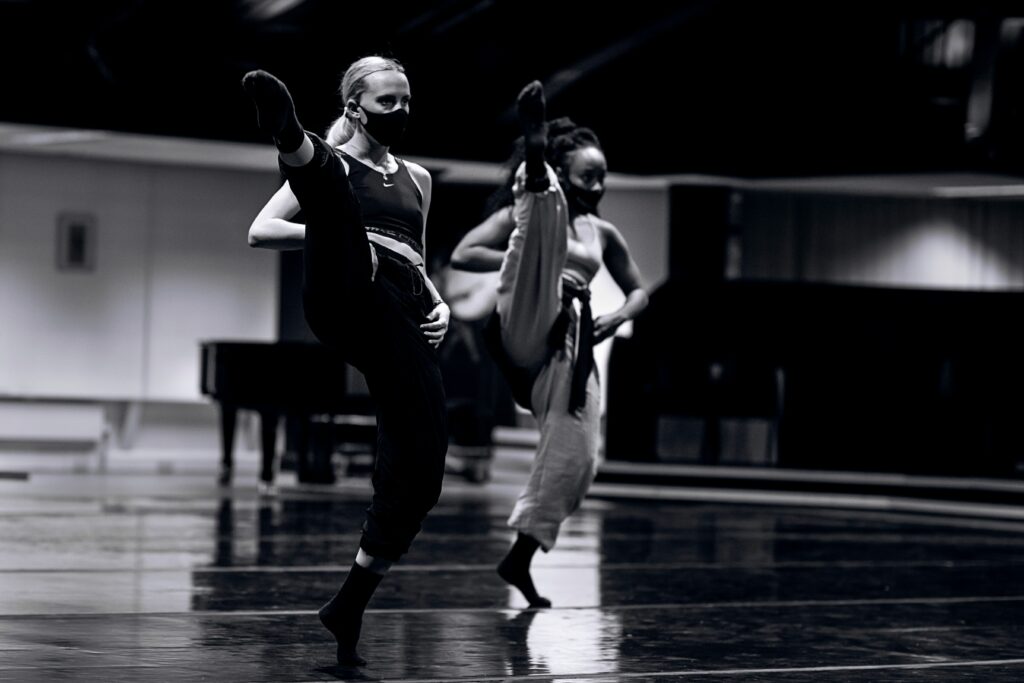
Credit Viktor Erik Emanuel
Are there any examples of training systems or support networks that exist in other nations that Wales could look to utilise?
In terms of training systems, you only have to look across the border to England for some amazing examples. Government initiatives like the CAT scheme would be very beneficial for Wales, to tackle issues like accessibility and consistency in training. There needs to be more pathways made available for young people with passion for movement to engage in creative work and broaden their dance education. This also includes having a vocational training program to study dance at a professional level.
Get the Chance works to support a diverse range of members of the public to access cultural provision. Are you aware of any barriers that creatives in Wales face? If you are, what might be done to remove these barriers?
One of the barriers I’ve been aware of in the past has been the lack of consideration for dance practitioners based in more rural areas of Wales. With organisations having had to adapt to digital means of hosting or streaming their events, these dance practitioners have finally been able to attend events that they wouldn’t otherwise have been able to in the past. I’ve also personally really valued being able to access and watch live streamed performances online and despite the occasional bout of ‘Zoom fatigue’, I still hope organisations continue to offer at least some aspects of working/performing online.
If you were able to fund an area of the arts in Wales what would this be and why?
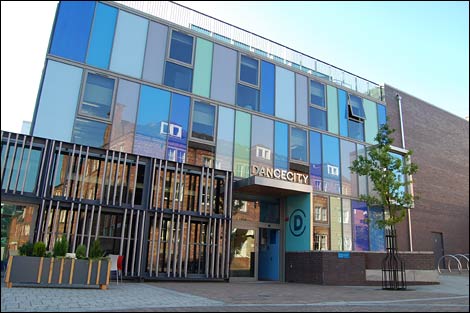
There are lots of areas in desperate need of funding but I would particularly like to see an inclusive professional training program available in Wales as well as a unifying space in which dancers can create, educate and perform together (something like Dance City in Newcastle)
Dance City, Newcastle.
What excites you about the arts in Wales?
It’s been exciting to see the Welsh dance community working together to establish a more connected community of dancers via online networking events and discussions. I look forward to seeing how this connectivity materialises in a progressive, diverse Welsh Dance Sector.
What was the last really great thing that you experienced that you would like to share with our readers?
Watching Crystal Pite’s Revisor and Far From the Norm’s “BLKDOG” as part of Dance Nation. Both extraordinary pieces, available to watch for free on BBC Iplayer.
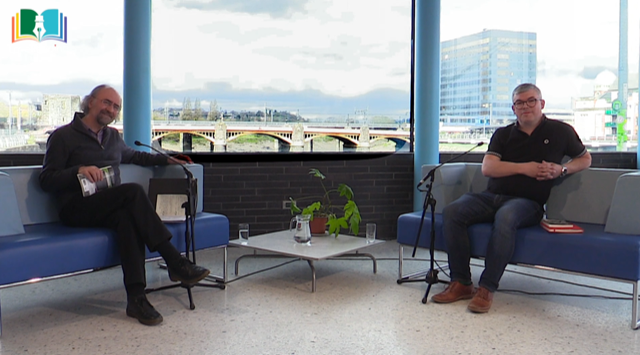
LoveReading LitFest, the recently launched, digitally native, subscription-based books and literature festival, has partnered with Newport Live – a charitable trust providing cultural and sporting activities in Newport, Wales – to support the launch of the critically-acclaimed debut novel Many Rivers To Cross by Dylan Moore at an exclusive event. The talk will be live on LoveReading LitFest tomorrow.
The author, who is the editor of thewelsh agenda, was interviewed about his new book by Sharif Gemie, with the session filmed at The Riverfront Theatre and Arts Centre, right in the heart of the city centre. Sharif Gemie is a former Professor of History. He mainly researched people on the move, whether refugees (Outcast Europe, 2011), Muslims in Europe (French Muslims, 2010) or hippy travellers (A History of the Hippy Trail, 2017). He lives in Newport and is currently writing a novel set among UN aid-workers in Germany, 1945—46.
Written following a period volunteering at the Sanctuary Project in Newport, and partly based on interviews with asylum seekers and refugees, Many Rivers To Cross traces a series of journeys – migrations across time and space – from the streets of Pillgwenlly, Newport to the ‘Jungle’ camp at Calais, and from Ethiopia to the island of Lampedusa. Described by Welsh novelist, poet and translator Siân Melangell Dafydd as “an essential story for an age of migration”, the novel takes the reader to places most of us have never been, and would never wish to go.
The event also featured contributions from two refugees originally from Ethiopia, now settled in Newport. Biniyam Birtukan talked about how his work as a freelance magazine journalist in Ethiopia became impossible due to issues around freedom of speech, his role in establishing the famous St Michael’s Orthodox Church in the ‘Jungle’ camp at Calais, and the satisfaction he has found working as a healthcare assistant since being granted leave to remain in the UK. Yohannes Obsi talked about his mixed heritage background and how his support for the formerly banned opposition group the Oromo Liberation Front landed him in government detention, from which he escaped to make a dangerous journey through Sudan, Libya, Italy and France to reach the UK.
Paul Blezard, Festival Director at the LoveReading LitFest, said: “Dylan’s powerful new novel does something extraordinary. It takes us beyond the screen images that have filled us with horror and compassion for too long and straight into the hearts, minds, hopes and fears of those who are forced, or choose, to undertake life-risking journeys towards safety and sanctuary. We are so honoured and privileged to host Dylan, Biniyam and Yohannes and to support them through this important event.”
Alan Dear, Head of Theatre, Arts, and Culture at The Riverfront Theatre, Newport Live said: “TheRiverfront is delighted to make this new partnership and as we start on the long journey of Covid-recovery we hope that literature will form a core part of our future programme. We now have the capacity to provide content digitally and hope that this will provide pleasure to our new and current audiences until a time when we can reopen our doors again.”
Many Rivers To Cross by Dylan Mooreis published by local publisher Three Impostors at £10
Hi Kate and Jo, great to meet you, can you give our readers some background information on yourself please?
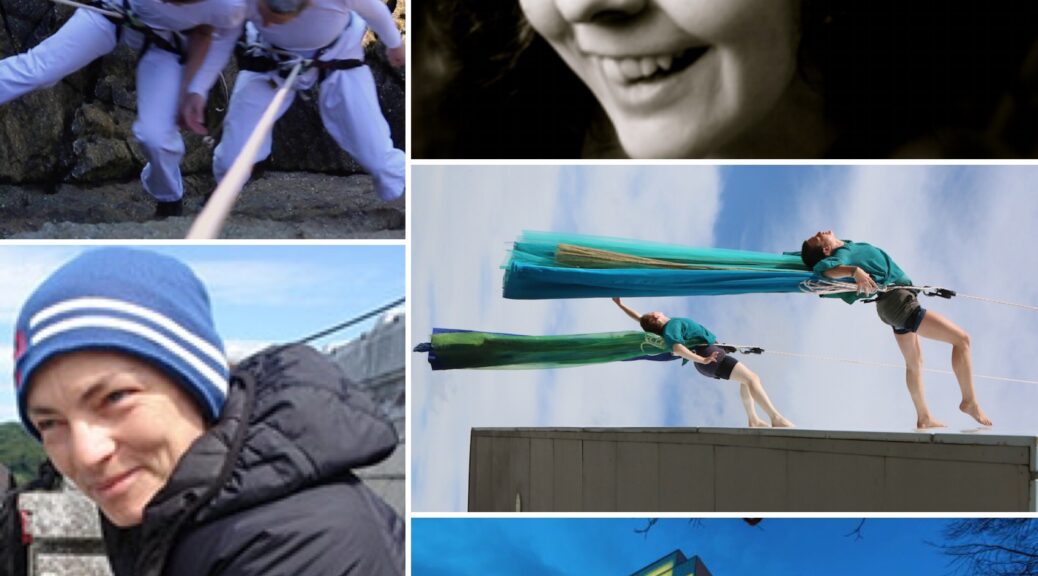
Kate: I was born in London and spent my early years in Tanzania and Mexico before returning to the UK aged 11 to go to a quaker boarding school in North Yorkshire. After school I trained as a dancer at Thamesdown Contemporary Dance Studios in Swindon and then did a BA in Dance Theatre at Laban, in London. Then I started a feminist dance company called Nomads which ran from 1989 – 1995, doing performance and education work. When the company ended I spent a few years doing all sorts of things, car maintenance courses, creative writing courses, stunt training, delivery driving, caretaking. Then I got a job as a dance lecturer at University of Surrey where I spent 10 years. In 2010 I moved to North Wales to be in the mountains and feed my passion for rock climbing. I got a part-time job at Bangor University as a lecturer in performance. During the 10 years I have spent here, I began my own vertical dance company, Vertical Dance Kate Lawrence (VDKL).
Joanna: I’m an artist from North Wales, I grew up on the coast near Conwy. I left Wales when I was a teenager to study art. I ended up living in the USA, working in a really eclectic range of jobs that included furniture maker, running a market stall, selling pizzas, working in a shoe repair shop, photographer for the US government and then working in the art department of film and theatre productions. In 2001, shortly after September 11th, I got a job as a videographer on a sailing boat doing a global circumnavigation, as part of an pioneering interactive, online education project. That was a turning point that eventually bought me back to Wales and took me into working in documentary, in many different forms.
What got you interested in the arts?
Kate: I come from a family of professional musicians on my father’s side (although my father was an amateur) and my mother is a visual artist and potter so I grew up in an arty environment. I did a lot of dancing alone in my bedroom as a child – the pandemic has reminded me of this as I have returned to my bedroom as a dance studio. I think what I love about the arts is that it is really a way of thinking, a way of being in the world that is centred on experience, expression and communication.
Joanna: I grew up with a parent who had a severe mental illness. In the 80’s in North Wales mental health services were poor to non-existent, both for those with mental illness, and their families. In the arts I found a way to express ideas and connect with others that I hadn’t been able to previously. I specifically credit the generosity of the wonderful artist and teacher Dave Pearson who I met as a young art student, he saw some of the weight I was carrying at that time and encouraged me to tell stories with my work and experiences, and also to find playful ways to get it out into the world.
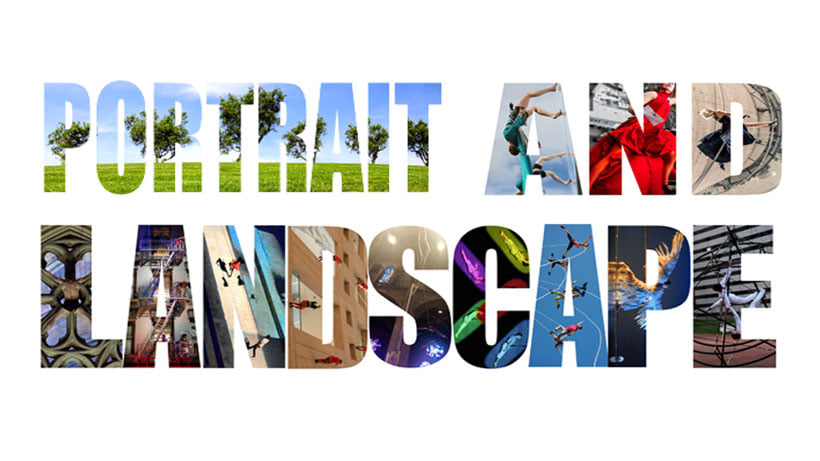
Kate I believe you are working on a new project called ‘Portrait and Landscape’ its described as “a series of online bi-monthly events for the international vertical dance community and beyond. It was conceived by Wanda Moretti incollaboration with Kate Lawrence and Lindsey Butcher. The series runs bi-monthly until the end of October 2021 “.
For those who may be new to the term what is ‘Vertical Dance’ and how did you come to be involved ?
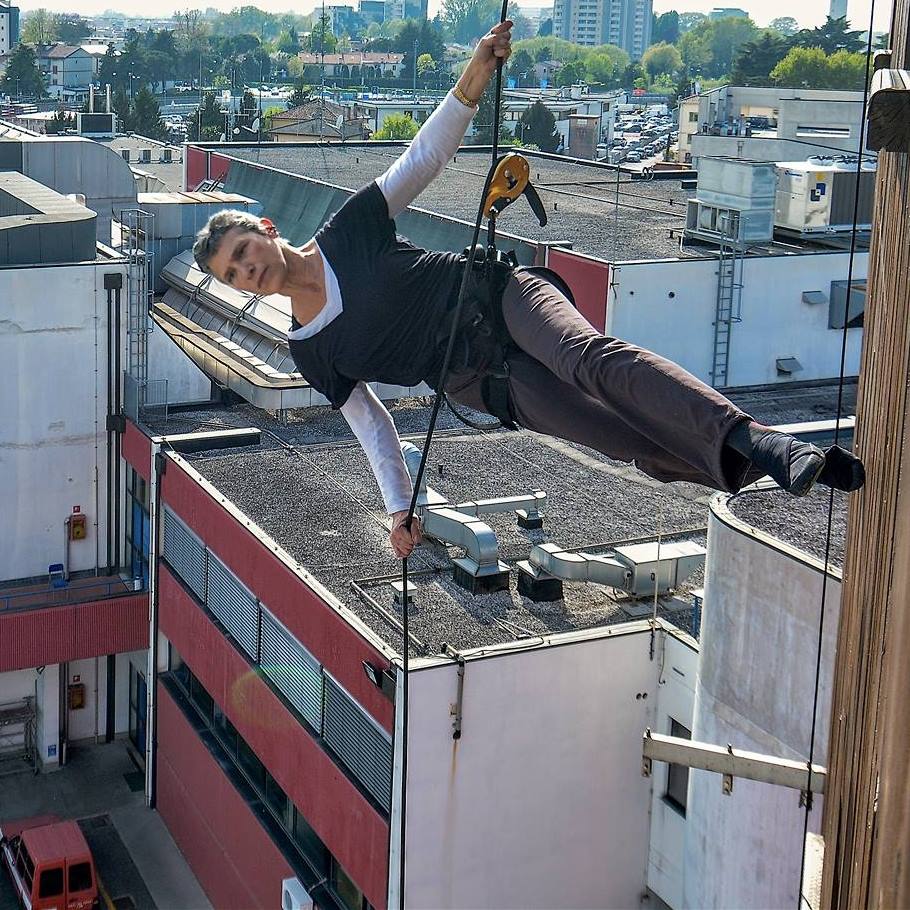
Kate: Vertical dance is a newish term that refers to dancing in suspension – the dancer is suspended using climbing or access equipment, such as harnesses, ropes and abseil devices. Often this is against a vertical wall (hence the term vertical) which becomes the ‘dance floor’. So it often takes place in public space, on the sides of buildings.
I got involved with vertical dance when I started climbing in the late 1990s – as part of training to be a stunt woman (that never happened!). I found the movement of climbing very similar to dance and when I began teaching at the University of Surrey I asked if I could run a module called vertical dance. That began in 2001 and was the beginning of my development of the practice. I began teaching dancers to climb in the climbing wall and getting them to develop choreography from that and then gradually I introduced suspended dancing. In 2005 I embarked on PhD study into vertical dance and that led me to meet other vertical dance artists from around the world. The first two I met were Wanda Moretti from Venice and UK- based Lindsey Butcher, and we are still working together. I finally finished my PhD in 2017 – it took me a long time because I was working and creating at the same time!
Kate, what is your ambition for Portrait and Landscape?
During the pandemic it has been impossible to do vertical dance practice for me and I spent 2020 doing other things – gardening mostly and some writing – this has been quite a healthy break from a very busy time. This series of events was the brainchild of my colleague Wanda Moretti and she invited Lindsey and I to collaborate with her on running it.
Wanda Moretti
The ambition is to bring international vertical dance artists – and anyone else who might be interested – together at a time when we are all isolated and distanced. The current time is an opportunity to connect across borders and learn about how different artists practice the form and also to keep our artistic minds working! My company, VDKL, has received some funding from Wales Arts International to support this project which means we have offered 3 bursaries to Welsh artists. It also enables us to explore making the series more accessible.
You are both working on a project researching into Dance for people who are blind, this sounds fascinating please tell me more!
Kate: Yes, Jo and I are working on a project called Yn y Golau/In-visible Light, which began in 2016 as a collaboration between myself and photonics scientist Ray Davies – a Synthesis project funded by Pontio.
Pontio
Photonics is the science of light – I didn’t know that until I met Ray. The project developed and in 2019 we did a research and development project funded by ACW with a couple of test performances. Our purpose was to make a show that tried to build accessibility for blind and partially sighted people into the creation process, rather than audio describing a finished product. It was a huge challenge and we were assisted by a visually impaired actor and aerialist, Amelia Cavallo.
Amelia Cavallo
We constantly asked ourselves: what would this experience be like if we couldn’t see? And this led to some new ways of working for me as a choreographer. Sometimes I would close my eyes and listen to the dance… It also reminded me that dance is a kinetic art form not a visual one. Sometimes I think we focus more on shapes we see than movements we feel. We invited blind audiences to the test performances and then interviewed them afterwards to get feedback on how successful our approach was. We then received further funding from ACW to develop a touring show, but the pandemic has made us change our plans. We are now working on a film and we also have some seed funding from Clwstwr to do further research into access for blind and visually impaired people to performance.
Joanna: Kate first asked me to work on Yn Y Golau as a documentary filmmaker. In my work in documentary I’m especially interested in how new technologies can be used in storytelling. In Yn Y Golau I felt there was potential to explore how to share the work in an interactive, non linear way, which might better enable us to think about how to move beyond the screen, and think more deeply about how the embodied experience, that was central to Kate’s live work, can be expressed or shared digitally. There are also a lot of documentary elements in the project, and we are exploring how the project audience can choose which aspects they want to engage with.
Prior to this project did you have any knowledge of areas such as audio description for theatre/dance?
Kate: Yes, I first started thinking about audio description back around 2008 when I was asked to do a workshop at an audio description seminar at University of Surrey. The topic then lay dormant for me for several years, and then in 2016 I was asked by Mari Emlyn to make a piece of work for the foyer of Galeri. It was the year of the centenary of Roald Dahl’s birth and so we made a new story built from the drawings of primary school children of their favourite Roald Dahl characters. The piece was called Omnibus and was performed in the foyer of Galeri with the dancers flying in the space overhead.
We created a bilingual (Welsh and English) recorded audio description alongside the soundscore so that everyone in the audience could hear it. From our current research I know that this is sometimes referred to as ‘open audio description’. The traditional method is that an audio describer is in a booth describing events as they unfold, straight into the ears of the visually impaired person, who wears headphones. Headphones can however be distancing, muffling and isolating so I felt it was important to search for ways in which to make the work with accessibility built in.
Joanna: Absolutely none, and that is really motivating me. When I started looking and learning about it, I am not proud to say, I realised how I had never really considered this aspect in any meaningful way. I know I was also, unfortunately, in a majority.
If a dancer wanted to stay and train in Wales and then pursue a career, what support system would you suggest they require in order to be able to do this?
Kate: I can only speak for North Wales, where it is virtually impossible at present for a dancer to train in the conventional, vocational sense – I think there is more capacity in South Wales, but even there options are limited. To make a career entirely in Wales I think it is necessary to take every opportunity available and to be very self-motivated and resourceful. VDKL employs mainly North Wales based dancers, who I have trained in vertical dance techniques. This is because I want to build a community here, however small it is! The dancers I work with have trained in dance outside Wales and returned. I also want to provide employment opportunities for local artists and persuade them to stick around! My company used to run affordable twice weekly training sessions of 3 hours each but we lost our space in 2017, and now with the pandemic training has become impossible. But we are hopeful for the future – the beauty of vertical dance is that we can go outside! In an ideal world a dancer building a career in Wales needs regular affordable access to dance training sessions and also affordable access to space to dance. A vocational/degree programme would also be very helpful.
Are there any examples of training systems or support networks that exist in other nations that Wales could look to utilise?
Kate: France has a great system of support for artists that pays them whilst they are ‘resting’ between jobs. This gives them time and financial support to continue their training and professional development. Many European countries have arts centres that offer space and residencies for artists. Access to affordable space to practice is essential and it would be great if each region of Wales had dedicated spaces or ‘homes’ for dance. I have been doing daily practice sessions during lockdown with Wainsgate Dances in Hebden Bridge, England and this is an excellent example of an artist-led initiative that has built a community of dancers who are now contributing to the provision of residencies for other artists at the centre.
Joanna: I’ve been very inspired by people who have built their own networks where none exist. I’m part of the Arts Territory Exchange project, it facilitates collaborations in remote locations that are cut off from the networks which usually sustain a creative practice. I think as an artist it’s very important to be part of a community of support, to develop and challenge your work and ideas, and to share skills with others. There are some great DIY examples out there, the Artist Residency in Motherhood set up by Lenka Clayton is another inspirational network
What does Wales do well in dance or cultural training and delivery?
Kate: In my experience support for the arts in Wales is a friendlier affair than my previous experience in London and the South of England. I have found local venue managers and programmers to be great collaborators and the Arts Council of Wales officers are approachable. I think cultural training and delivery in Wales is ‘on a shoestring’; the positive side of this is that it is extremely adaptable and mobile – it has to be due to the geographically dispersed activities. But it needs centres too, and not just in Cardiff. The bizarre thing is that it is quicker to get to London than Cardiff for North Wales dance artists looking for training.
Joanna: In my experience Wales supports it’s creatives well and gets a lot out of small budgets. However there are real impacts currently in relation to access to arts education, and the financial barriers for those who want to study. I feel strongly that this will further negatively impact diversity in the cultural sector. About the centres that Kate mentions, I’d say something about the impact of Covid this last year, there has been more cross Wales collaborative working, in my experience, which is great, but the Cardiff region still has a hegemony in terms of cultural projects, and I’d like to see that be distributed more widely across Wales.
Get the Chance works to support a diverse range of members of the public to access cultural provision. Are you aware of any barriers that creatives in Wales face? If you are what might be done to remove these barriers?
Kate: Well we are working on access for blind and partially sighted audiences. Our research so far is showing that provision for these audiences, particularly for dance, is very limited. A perceived barrier is that it costs of a lot of money to provide access and independent artists/small companies with very limited resources can’t afford to spend extra money; this is also true for the larger companies. I would like to challenge artists to see how they might begin to build accessibility into their work so that it can be appreciated by all. A big barrier for many in rural areas is getting to and from performances, so any schemes that provide transport can be really helpful.
Joanna: To build on my comments above, barriers to access can be many, including financial, but there’s also a lot of potential positive learning from the online way of working that’s been adopted because of Covid. Personally, as a carer and parent of a school age child I’ve been able to take part a lot more, due to events being online. It would be a shame for this to be abandoned when things open up physically, because in my opinion it’s cracked open cultural provision MUCH more widely. I’d like to see ways of live-online access being continued for people who can more easily engage in this way, and supporting people where access to stable internet is an issue.
With the roll out of the Covid-19 vacancies, the arts sector is hopeful audiences will return to venues and theatres. If theatres want to attract audiences what do you think they should do?
Kate: I think first and foremost, theatres need to ensure that they are safe spaces and then market that fact very clearly. Perhaps look at small, socially distanced audiences, and commissioning work for this kind of audience. Working outdoors is a great option for providing safer access to arts and this can then be a draw for people to return to the theatre.
If you were able to fund an area of the arts in Wales what would this be and why?
Kate: Dance of course! I think dance is always the Cinderella of the arts and tends to receive less subsidy. We all have bodies – we all move – and our physical and mental well being can be enhanced through dancing. I would love to see the creation of small dance centres around the country so that local artists and the community in general have somewhere to meet and dance. They don’t have to be for dance exclusively, but should provide the space necessary for dance – and rigging points for vertical dance of course.
Joanna: Really good interdisciplinary arts education. The studio based art college system that supported so much groundbreaking creative work across the UK has been decimated. Artists are great problem solvers, and skills in the arts are widely transferable.
What excites you about the arts in Wales?
Kate: I love the maverick nature of the arts in Wales. People are making work in the most surprising places and this gives rise to exciting new techniques and approaches.
Joanna: It’s collaborative & supportive, there’s some great, innovative work happening in cross disciplinary settings. The arts in Wales is embedded into our culture in quite a unique way, the Urdd does amazing work with children and young people. There were 12000 creative works across music, dance, spoken word and visual arts made by children who entered the online Eisteddfod T this year for example- That’s amazing!
What was the last really great thing that you experienced that you would like to share with our readers?
Kate: In our last Portrait and Landscape event San Francisco based choreographer Jo Kreiter shared with us her project called ‘The Decarceration Trilogy’ a long term project looking at the US prison system and its effects on citizens. It was a really moving and inspiring offering to our community and a great example of the power of dance and the arts in general as a tool for examining issues of social justice. Here is a clip of Jo talking about her work in general
and here is a link to a film of The Wait Room that she showed during our event:
Joanna: I am currently a research fellow at the Open Documentary Lab, MIT where I recently saw a presentation of Hatsumi VR It is an amazing project in development that uses virtual reality to allow participants to visually express experiences of pain, emotion and sensory experience in audio visual body maps.
Comisiynu graddedigion celfyddydau diweddar a chyn-aelodau Theatr Mess Up The Mess i gydweithio â phobl ifanc er mwyn creu gwaith gyda Chanolfan Celfyddydau Pontardawe i’w rannu’n ddigidol
Mae Canolfan Celfyddydau Pontardawe wedi comisiynu Mess Up The Mess i gydweithio â thri gweithiwr llawrydd sydd wedi graddio’n ddiweddar ac sy’n artistiaid sy’n prysur wneud enw iddynt eu hunain, er mwyn cefnogi datblygiad eu harfer cyfranogol a’u gwaith creadigol eu hunain. Yr artistiaid sy’n amlygu yw Cerian Wilshere-Davies, Callum Bruce-Phillips a Ciaran Fitzgerald, pob un yn gyn-aelodau o Gwmni Theatr Mess up the Mess.
Bu’r artistiaid yn gweithio gyda grwpiau o bobl ifanc er mis Ionawr 2021 ac maen nhw’n paratoi ar gyfer noson o rannu digidol, lle byddan nhw’n rhannu’r gwaith maen nhw wedi bod yn ei greu. Bydd Cartref / Home ar gael i’w wylio ar-lein ar 25 Mawrth am 7pm.
Mae Mess Up The Mess yn arbennig o gyffrous ynghylch gweithio ochr yn ochr â’r artistiaid ifainc hyn, gan eu bod nhw wedi bod yn aelodau er yn 12-14 oed ac wedi bod ar siwrnai o 10 mlynedd a mwy gyda’r cwmni.
Mae’r Prosiect – Cartref / Home yn archwiliothema ‘cartref’ a defnyddio comedi i gael hwyl gartref. Bu’r artistiaid a’r bobl ifanc yn creu eu mannau ffantasi eu hunain sy’n gwneud iddyn nhw deimlo’n hapus, yn ddwl, yn anturus neu’n ddiogel. Bu’r grwpiau’n archwilio ffantasi, chwedlau a’r mannau a’r bydoedd yr ydym yn eu dewis yn gartref, ac yn paratoi i rannu’r gwaith maen nhw wedi bod yn ei greu ar-lein.
Maen nhw wedi holi cwestiynau fel – pa dirweddau, gwrthrychau a chymeriadau fyddech chi’n hoffi eu rhithio yn eich lle chi? Pa fath o amgylchedd sy’n gwneud i chi deimlo’n gyffrous? Ym mha fath o amgylchedd ydych chi eisiau chwarae neu fod yn ddwl? Efallai mai natur yw’ch amgylchedd chi, lle gyda llawer o greaduriaid a phobl neu efallai man dan do yn arbennig ar eich cyfer chi. Efallai bod y mannau hyn yn heddychlon ac yn dawel neu efallai eu bod yn rhywle sy’n ddoniol iawn i chi.
Mae Callum Bruce-Phillips wedi ennill gradd mewn Astudiaethau Ffilm a Theledu/Llenyddiaeth Saesneg o Brifysgol Aberystwyth ac ar hyn o bryd mae’n gweithio tuag at ei radd MA mewn Cynhyrchu Ffilm. Mae Ciaran Fitzgerald yn awdur ac yn hwylusydd o Bort Talbot. Ysgrifennodd ei ddrama gyntaf yn 2013 i Mess Up The Mess, ac nid ydyw wedi edrych nôl. Yn 2019 graddiodd o Brifysgol De Cymru yng Nghaerdydd gyda BA mewn Sgriptio. Mae Cerian Wilshere-Davies yn hwylusydd, yn wneuthurwr theatr ac yn gomedïwraig, a graddiodd o Brifysgol Salford y ddiweddar.
Mae’r artistiaid yn hwyluso ac yn arwain datblygiad gwaith y bobl ifanc eu hunain, ochr yn ochr â chreu eu gwaith eu hunain. Cyfarwyddwr Artistig Mess up the Mess, Sarah Jones, sydd wedi bod yn mentora’r tîm. Roedd y comisiwn yn cynnwys dosbarthiadau meistr mewn meysydd sy’n gysylltiedig â’r prosiect creadigol; gweithio’n ddwyieithog gyda Bethan Marlow, gwneud ffilmiau mewn ffordd gyfranogol gyda Tom Barrance a dulliau cynhwysol o greu celf ddigidol gyda Taking Flight.
Meddai Ciaran Fitzgerald am y dosbarthiadau meistr;
“Roedd ein gweithdai gyda Tom Barrance bendant wedi cynyddu fy hyder yn gwneud ffilmiau byr. O’n i ddim wedi gwneud llawer o olygu fideos o’r blaen, a gydag arweiniad Tom dwi’n bles iawn gyda beth ‘nes i gynhyrchu, a fyddai bendant yn ei ychwanegu i fy ymarfer yn y dyfodol. Ar ôl ein sesiwn gyda Bethan Marlow, teimlais fod y rhwystrau i weithio’n ddwyieithog wedi cael eu chwalu. Roedd Bethan wedi neud yr holl gyd-destun yn gynhwysol iawn, ac wedi cyflwyno strategaethau defnyddiol iawn bydda i bendant yn eu defnyddio yn fy ymarfer yn y dyfodol. Roedd gweithdy Taking Flight ar sail cynhwysiant yn ddefnyddiol ac yn bleserus iawn. Dwi’n meddwl ‘naeth Elise a Steph atgyfnerthu pethau o’n i eisoes yn gwybod, ond hefyd ‘nes i ddysgu pethau newydd am gynhwysiant yn y celfyddydau, a hefyd falle herio rhai o’n canfyddiadau i. Dwi bendant isho gweithredu BSL a Sain Ddisgrifiad yn fy ngwaith yn y dyfodol.
Meddai Sarah Jones, Cyfarwyddwr Artistig Mess Up The Mess:
“Rydyn ni’n gyffrous iawn ynghylch y prosiect hwn am gymaint o resymau, gan gynnwys y cyfle i gomisiynu artistiaid sydd wedi dod trwy Mess Up The Mess. Dw i’n cofio cwrdd â phob un o’r artistiaid hyn a dw i wedi cael y fraint o ddysgu a chydweithio ochr yn ochr â nhw dros y ddeng mlynedd ddiwethaf. Rydyn ni’n aruthrol o ddiolchgar i Ganolfan Celfyddydau Pontardawe am y cyfle i barhau i gydweithio ar lefel broffesiynol gyda nhw i’w galluogi i fynd ar drywydd eu hymarfer ar adeg mor anodd i’r celfyddydau ac i bobl ifanc. Maen nhw’n bobl greadigol neilltuol sy’n llawn ysbrydoliaeth ac mae ganddynt y pŵer i ysbrydoli ac i ddatblygu lle diogel a lle sy’n meithrin ar gyfer ein cyfranogwyr ifanc er mwyn creu gwaith newydd a gofalu am eu llesiant.”
Mae Cerian yn hwylusydd, yn wneuthurwr theatr ac yn gomedïwraig, ac mae wedi graddio’n ddiweddar o Brifysgol Salford gyda gradd dosbarth 1af mewn Ysgrifennu a Pherfformio Comedi. Mae gan Cerian ddiddordeb mewn creu gwaith sy’n canolbwyntio ar dreftadaeth Cymru a mynegi hunaniaeth.
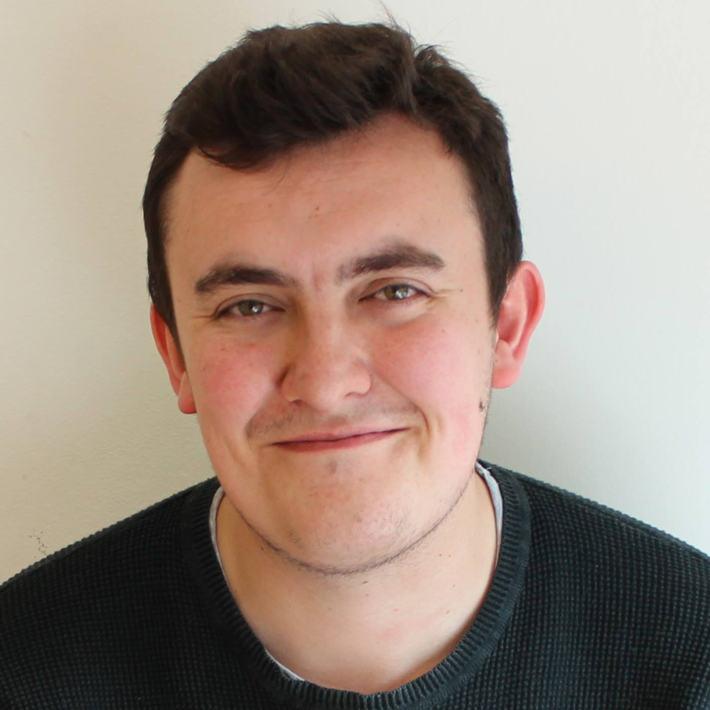
Callum Bruce-Phillips
Mae Callum wedi graddio o Brifysgol Aberystwyth gyda gradd mewn Astudiaethau Ffilm a Theledu/Llenyddiaeth Saesneg, ac ar hyn o bryd mae’n gweithio tuag at ei radd MA mewn Cynhyrchu Ffilm. Yn ystod ei radd israddedig, gweithiodd Callum gyda Chanolfan Ehangu Cyfranogiad, Cydraddoldeb a Chynhwysiant Cymdeithasol y Brifysgol, lle bu’n gweithio gyda phobl ifanc a phobl hyglwyf o gefndiroedd gwahanol sydd wedi eu tangynrychioli. Mae’r profiad hwn wedi ysbrydoli Callum i ddilyn gyrfa fel gwneuthurwr ffilmiau cymunedol sy’n canolbwyntio ar ehangu mynediad yn y diwydiant ffilm i grwpiau sy’n cael eu tangynrychioli ar hyn o bryd.
Ciaran Fitzgerald
Awdur a hwylusydd o Bort Talbot yw Ciaran. Ysgrifennodd ei ddrama gyntaf yn 2013 i Mess Up The Mess, ac nid ydyw wedi edrych nôl. Yn 2019 graddiodd o Brifysgol De Cymru yng Nghaerdydd gyda gradd BA mewn Sgriptio, ac ar hyn o bryd mae’n datblygu’r ddrama gyntaf i gael ei chomisiynu ganddo, sef ‘Chasing Rainbows’ gyda Chanolfan Celfyddydau Pontardawe. Mae gan Ciaran ddiddordeb mewn datblygu gwaith â chymeriadau cryf wrth ei galon, sydd wedi ei anelu’n benodol at bobl ifanc. Ag yntau’n siaradwr Cymraeg rhugl mae hunaniaeth yn agwedd allweddol ar y gwaith y mae’n ei greu, ynghyd ag egwyddorion allweddol mynediad a chynhwysiant.
Recent arts graduates and alumni of Mess Up The Mess Theatre commissioned to collaborate with young people to create digital sharing with Pontardawe Art Centre
Mess Up The Mess have been commissioned by Pontardawe Art Centre to collaborate with three recent graduate freelancers and emerging artists to support the development of both their participatory practice and own creative work. The emerging artists are Cerian Wilshere-Davies, Callum Bruce-Phillips and Ciaran Fitzgerald, all alumni of Mess up the Mess Theatre Company.
The artists have been working with groups of young people since January 2021 and are preparing for an evening of digital sharing of the work they have been creating. Cartref / Home will be available to watch online on 25th March at 7pm.
Mess Up The Mess are particularly excited about working alongside these young artists as they have all been members since they were 12-14 years old and have been on a journey of 10+ years with the company.
The Project – Cartref / Home explores the theme of home and using comedy to have fun at home. The artists and young people have been creating their own fantasy spaces that make them feel happy, silly, adventurous or safe. Exploring fantasy, folklore and the spaces and worlds we choose to make home, the groups have been getting ready to share the work they’ve been creating online.
Asking questions like – what landscapes, objects and characters would you like to imagine up in your space? What kind of environment makes you excited? What kind of environment do you want to play or be silly in? Maybe it’s in nature, in a space with lots of other creatures and people or maybe it’s an indoor space that is just for you. These spaces might be calm and quiet, or they might be somewhere that you find really funny.
Callum Bruce-Phillips is a Film & TV Studies/English Literature graduate from Aberystwyth University and is currently working towards his MA in Film Producing. Ciaran Fitzgerald is a writer and facilitator from Port Talbot. He wrote his first play in 2013 for Mess Up The Mess, and hasn’t looked back. In 2019 he graduated from the BA Scriptwriting degree at the University of South Wales in Cardiff. Cerian Wilshere-Davies is a facilitator, theatre maker and comedian, recently graduated from the University of Salford.
The artists are facilitating and guiding the development of the young people’s own work, alongside creating their own. Mess up the Mess Artistic Director Sarah Jones has been mentoring the team. The commission has included masterclasses in areas linked to the creative project; working bilingually with Bethan Marlow, participatory film makingwith Tom Barrance and inclusive approaches to making digital art with Taking Flight.
Ciaran Fitzgerald said of the masterclasses;
“Our workshops with Tom Barrance definitely increased my confidence in terms of filmmaking. I hadn’t done much video editing previously and with Tom’s guidance I’m really pleased with what I produced, and will definitely add it to my practice in the future. After our session with Bethan Marlow, I felt that the barriers to working bilingually had been broken down. Bethan made the whole concept really inclusive and introduced some really useful strategies that I will definitely be using in my future practice. Taking Flight’s workshop on inclusion was really useful and enjoyable. It was really good to have a refresh on things that I already knew, but also to learn new things about accessibility in the arts, and perhaps challenge some preconceptions I had. I definitely want to implement BSL and Audio Description creatively into my work in the future.”
Sarah Jones, Artistic Director of Mess Up The Mess said:
“We are excited about this project for so many reasons including the opportunity to commission artists who have come through Mess Up The Mess. I remember meeting each of these artists and have been honoured to learn and collaborate alongside them over the last 10 years. We are hugely grateful to Pontardawe Art Centre for the opportunity to continue a professional collaboration with them and enable them to pursue their practice at such a difficult time for the arts and young people. They are exceptional and inspiring creatives who have the power to inspire and develop a safe and nurturing place for our current young participants to make new work and look after their wellbeing.”
Cerian is a facilitator, theatre maker and comedian, recently graduated from the University of Salford with have a 1st class degree in Comedy Writing and Performance. Cerian is interested in creating work that focuses on Welsh heritage and expression of identity.
Callum Bruce-Phillips
Callum is a Film & TV Studies/English Literature graduate from Aberystwyth University and is currently working towards his MA in Film Producing. During his undergraduate degree Callum worked with the University’s Centre for Widening Participation, Equality and Social Inclusion, where he worked with young and vulnerable people from different underrepresented backgrounds. This experience has inspired Callum to pursue a career as a community film maker, whose focus is widening access within the film industry, to groups currently underrepresented.
Ciaran Fitzgerald
Ciaran is a writer and facilitator from Port Talbot. He wrote his first play in 2013 for Mess Up The Mess, and hasn’t looked back. In 2019 he graduated from the BA Scriptwriting degree at the University of South Wales in Cardiff, and is currently developing his first commissioned play ‘Chasing Rainbows’ with Pontardawe Arts Centre. Ciaran is interested in developing work with strong characters at its heart, particularly aimed at young people. Being a fluent Welsh speaker, identity is a key aspect of the work he makes, along with key principles of access and inclusivity.
This year for International Women’s Day (IWD), The Riverfront Theatre & Arts Centre in Newport take their International Women’s Day celebrations online with a programme of events taking place on social media throughout the day on Monday 8th March.
As the theatre is unable to open due to government guidelines, The Riverfront have taken the decision to still celebrate International Women’s Day in these challenging times and showcase a range of wonderful activities that can be joined and enjoyed from home. The theme for IWD 2021 is Choose to Challenge, as a challenged world is an alert world and from challenge comes change.
Community Arts Development Officer and International Women’s Day co-ordinator Sally-Anne Evans comments ‘It’s fantastic to be working on International Women’s Day again this year as it is always a great opportunity to come together and celebrate. This year we want to highlight the amazing creativity in our communities, and we are sharing our event virtually with some amazing activities both on the day and throughout the following week.
We are focussing on our female artists, musicians and makers to share their work, as well as offering links to activities and workshops run by other groups and partners. A lot has happened in a year, but it feels good to be able to provide a platform for people to share and celebrate together. More than ever it feels like we need it.’
Throughout the day there will be a range of activities taking place from fitness to writing, crafts to music, dance to reflection. There will be the opportunity to dance along to the IWD 2020 Zumba routine choreographed by Newport Live instructor Mandy Knight and her Thursday morning FitSteps class, and there will be a live low intensity Functional Flow fitness class hosted by Newport Live instructor Erin.
Performance piece ‘Tripping Through Newport’s Underbelly’ which was devised and performed by Marega Palser will also be showcased. This BOSCH Observation piece is a journey through underpasses, subways and some of Newport’s in between zones that people move through rather than stay in. Spaces that are home for some, dumping grounds for others.
Digital events hosted by IWD partners will be showcased including a Therapeutic writing workshop, an IWD pub quiz and an informative talk and interactive singalong on the hymn ‘The March of the Women.’ The Riverfront also encourages you to take some time and think about what you Choose to Challenge this year, whether that’s calling out gender bias or inequity, celebrate women’s achievements or making a change in your own life to help create an inclusive world. Share how you #ChooseToChallenge on social media.
The Riverfront’s International Women’s Day celebrations will end at 7pm with a pre-recorded bilingual musical set featuring opera director and creative producer Rhian Hutchings performing alongside multi-instrumentalist and singer Stacey Blythe.
On Saturday 13th March The Riverfront is partnering with the Kotatsu Japanese Animation Festival to support the WOW Film Festival Women’s Film Club event Kotatsu Shorts: Women Make Animation. This free event will screen a hand-picked selection of animated shorts made by up-and-coming female animators working in Japan that are suitable for all ages. The ticket for this event will also include access to a live creative workshop on Zoom with Japanese animator and illustrator Chie Arai showing you how to draw a girl in a kimono.
In the weeks following International Women’s Day the Riverfront will also be showcasing inspirational female artists, organisations and groups within our creative communities across social media, including an exclusive performance from Aleighcia Scott. If you would like to be featured contact sally-anne.evans@newportlive.co.uk sharing your work and let us know why IWD is important to you and what you would #ChooseToChallenge.
To keep up to date with The Riverfront’s program of events for International Women’s Day follow them on social media, Facebook.com/ TheRiverfront or visit newportlive.co.uk/IWD.
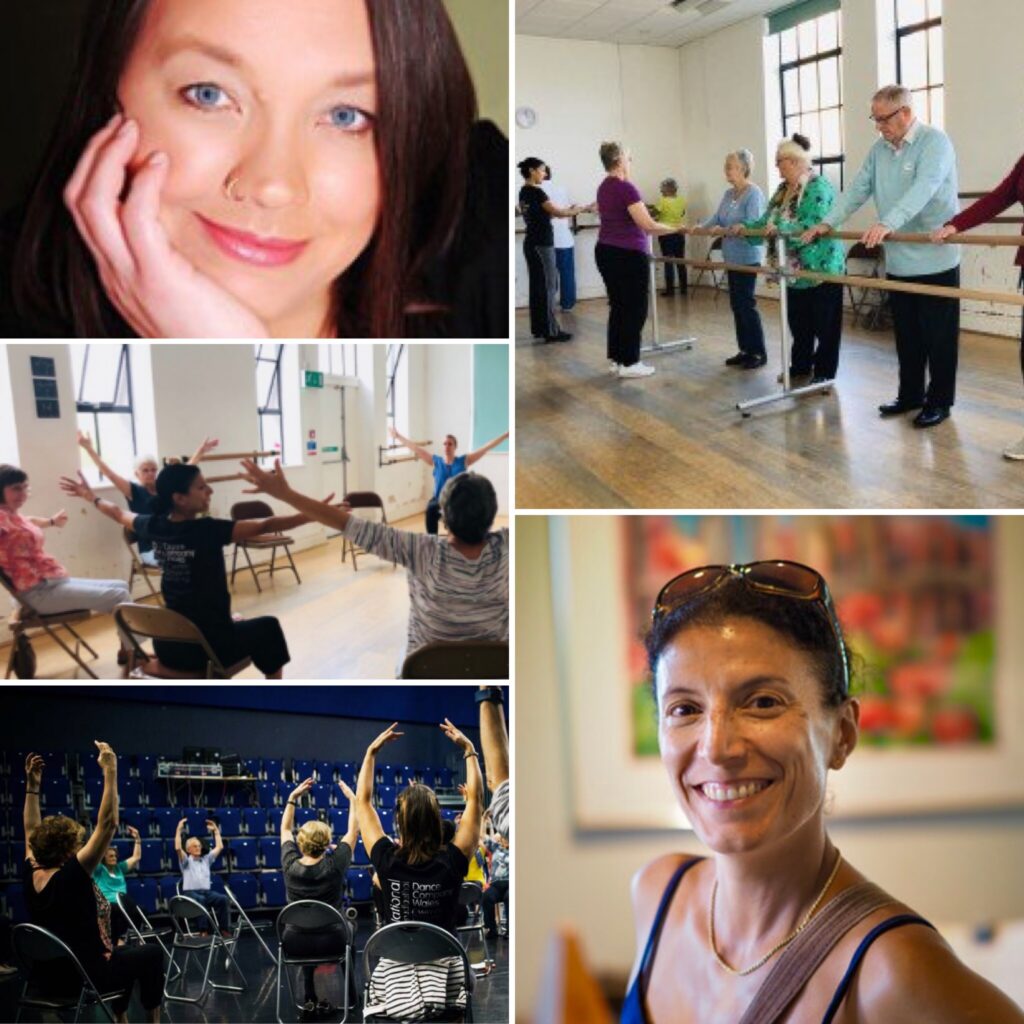
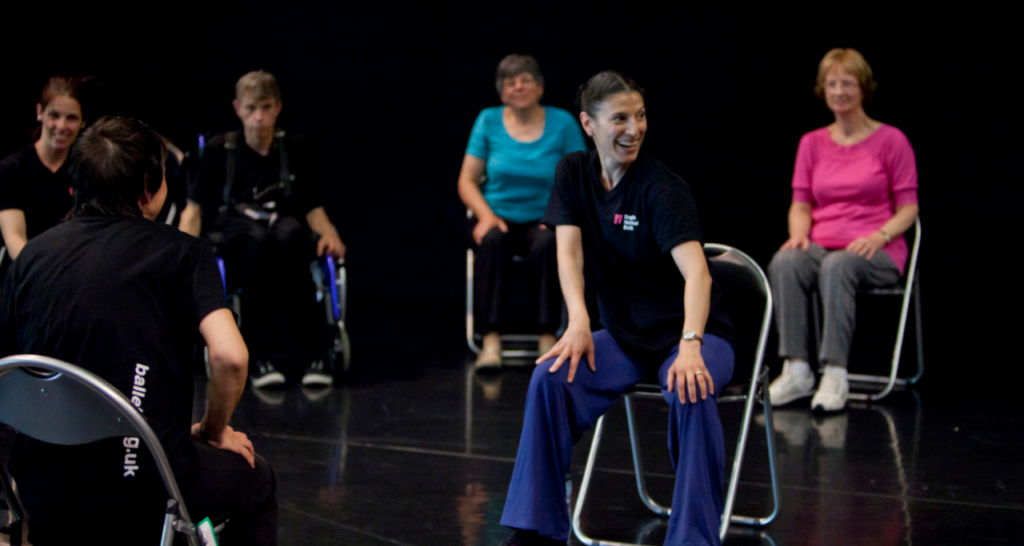
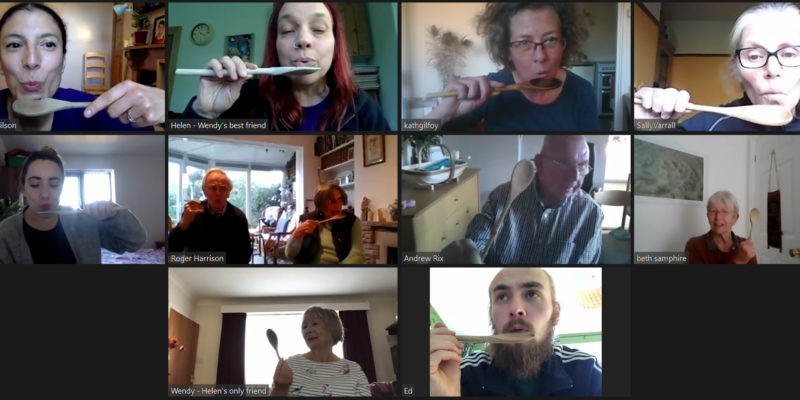
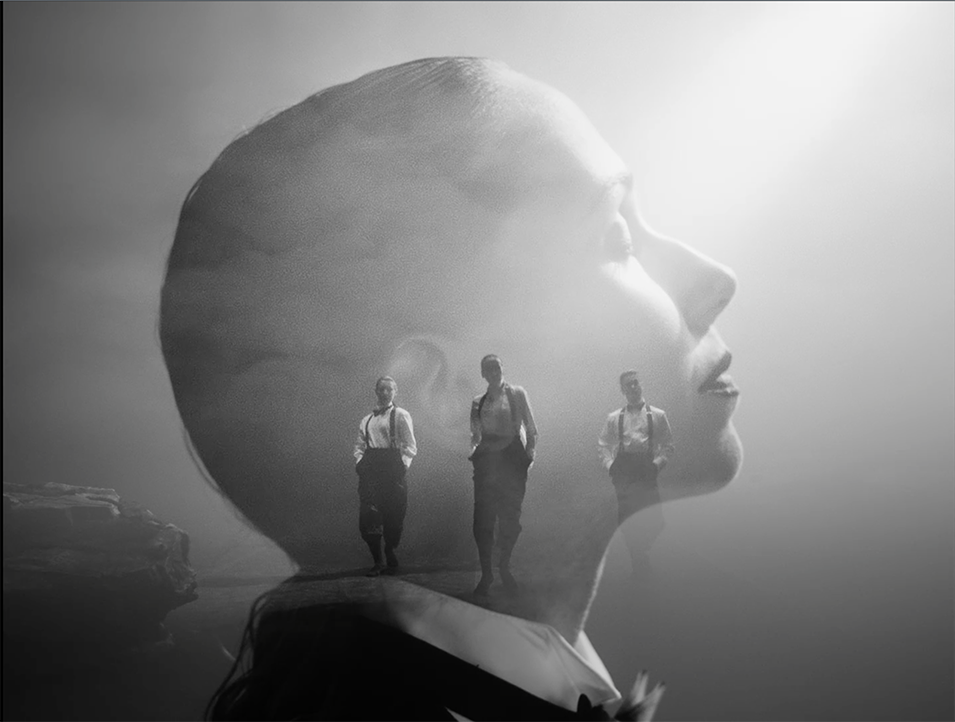
Images Helen Wood, Yvette Halfhide, credit Dave Wilson and Dance for Parkinsons Class.
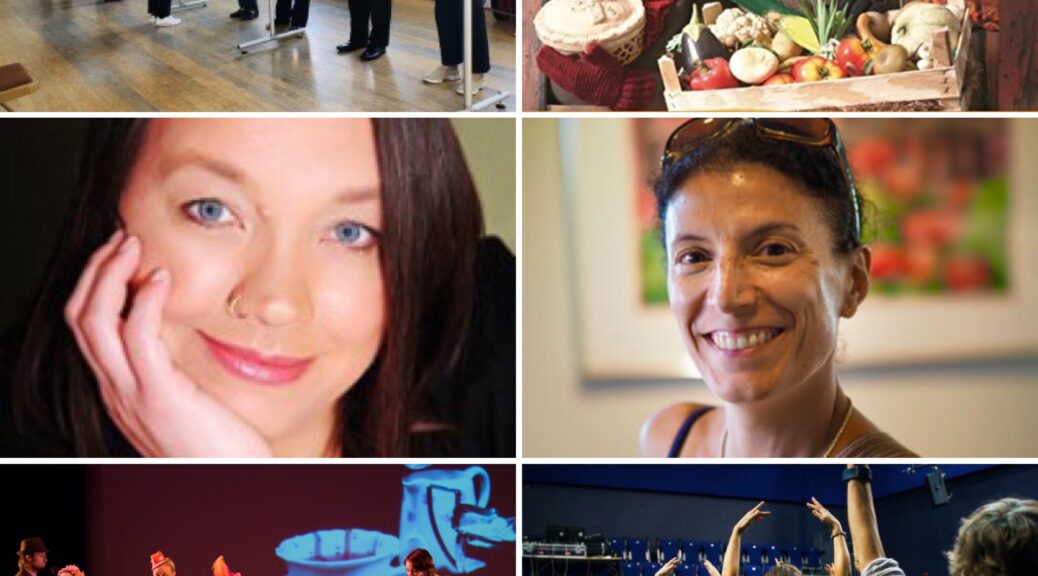
In this interview the Director of Get the Chance, Guy O’Donnell chats to Wales based Dancer Yvette Halfhide and Musician Helen Woods. They jointly deliver the English National Ballet/National Dance Company Wales, Dance for Parkinson’s programme. ENB’s Dance for Parkinson’s programme has been running since 2008. NDCWales is an affiliated hub of ENB’sprogramme.
Hi Yvette and Helen, great to meet you both can you give our readers some background information on yourself please?
Yvette: Hi everyone, My name is Yvette Halfhide and I live with my family near Bridgend in South Wales. I graduated (many years ago now!) from Central School of Ballet and have been a dancer, choreographer, teacher, rehearsal director, creative movement session leader, as well as other jobs connected to dance and the arts. I am currently associate dance artist for the Dance for Parkinson’s Programme initially set up by English National Ballet and run, in partnership with National Dance Company Wales in Cardiff.
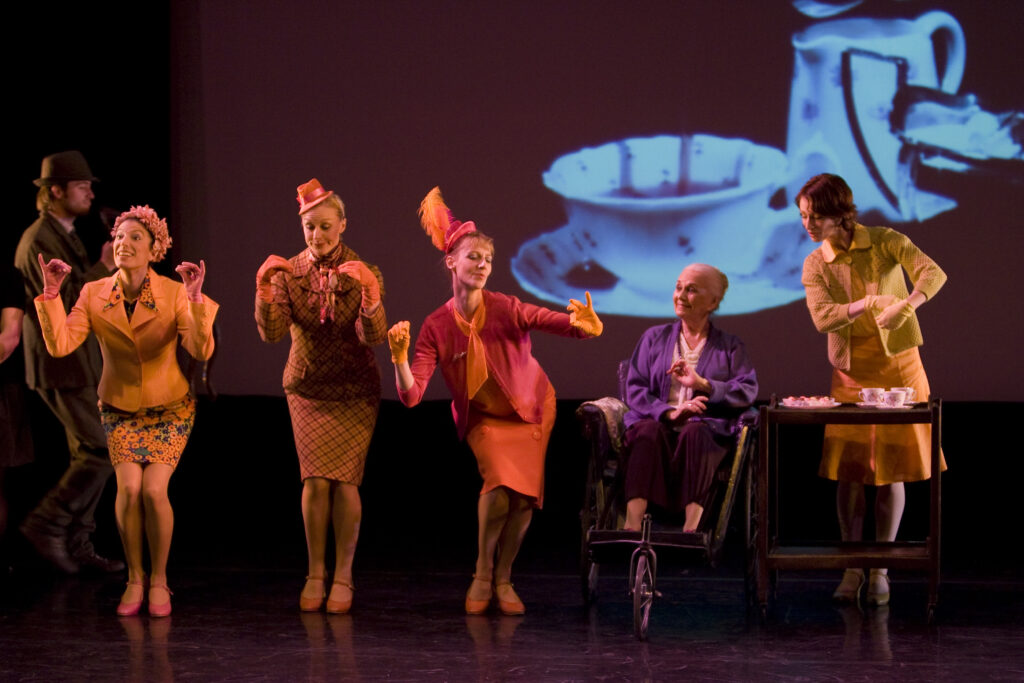
Black Maria, 2007, Green Box Productions, Sadlers Wells.Above: Aunt Maria (Ruth Posner) takes tea with the Mrs Urs (Yvette Halfhide, Justine Berry, Debbie Camp) served by Betty (Katherine Kingston).
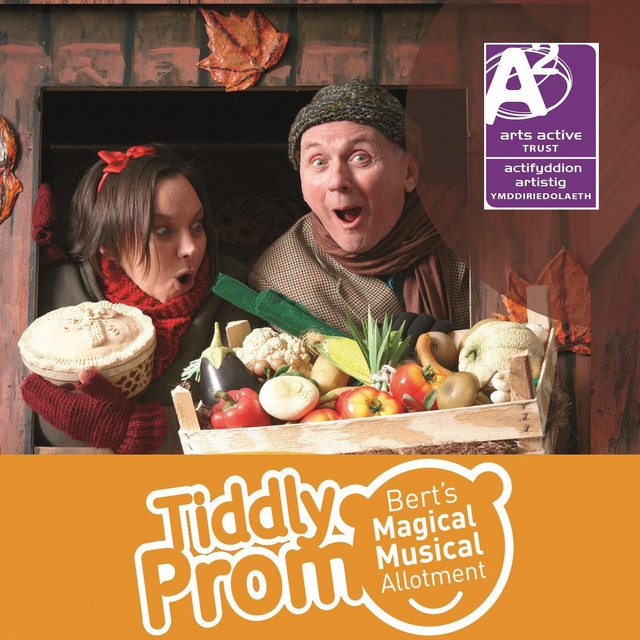
Helen: Hey all, My name is Helen Woods and I moved to Cardiff in 1997 – so I’ve been in Wales for nearly half my life…..nearly. I studied at Dartington College of Arts graduating with a degree in Music and Visual Performance. I work as a freelance composer and musician and have been lucky enough to have worked on a huge variety of projects including Street theatre with a Brazilian dancer, the Tiddly Proms (a show for under 5s that I write the music for and perform as Cherry Pie)
Community musicals, 2 operas for children and in 2013 I received a Creative Wales award to work on my own music writing a flute and piano sonata and a suite of pieces about some of my ancestors. I am currently associate musician for the Dance for Parkinson’s Programme and have the constant pleasure of working with Yvette.
Helen Woods, Richard Berry, Berts Magical Musical Allotment, Tiddly Proms
What got you interested in the arts?
Yvette: Both my parents were keen on the arts in their own way. My mother loves all types of dance, musical theatre and theatre, and my father really enjoyed his opera and classical music, so I was lucky to be introduced at a young age to those forms.
Helen: Like Yvette, my parents gave me every encouragement to explore music and dance as a child. When I was four, my older sister was learning the recorder at school and I wanted to learn so my dad bought us a book and a recorder so that we would learn together. He used to leave for work quite early in the morning so we’d always start before the others were up, I loved that time with my Dad. My mum had always wanted to learn the piano but money had not allowed so she was incredibly supportive.
You have been delivering English National Ballets/National Dance Company Wales, Dance For Parkinson’s class since 2015. Dancing has been shown to support people with Parkinson’s to develop confidence and strength, whilst temporarily relieving some participants of these symptoms in everyday life. You have a dance and musical background; how do you use your artistic skills and background when delivering class?
Yvette: I think that as someone who delivers such an expressive art form, it is important for the participants to see that expression when you deliver, so you could say that you are performing as you teach. If you can convey how much you enjoy dancing (and a particularly wonderful experience when with live music, which is at the heart of the programme) then hopefully that enthusiasm is transferred onto those people in your class.
If someone living with Parkinson’s was interested in attending but didn’t think of him or herself as a dancer or singer would they be able to join?
Yvette: Absolutely. Speaking from a dancer’s perspective I truly believe that if you can move, you can dance. A simple gesture can become an exquisite piece of dance if done with intention.
Helen: From a music perspective – we sing because we love to sing, not to be a choir – we sing for ourselves.
Due to Covid-19 you had to cancel physical class delivery and move onto dancing on the Zoom platform. How did you approach this and how have your members found this change?
It is a very different way of delivering a dance class. The challenges of using new technology can be a barrier to some people wanting to move online, but we have found that those that have, have embraced it enthusiastically. NDCWales also work with Digital Communities Wales to support our members to get online and active.
We have found that when working through exercises, adding verbal instructions or imagery in the form of lyrics onto the music helps participants remember the movements. I would say that most participants would prefer to be in the studio dancing together but a major advantage of moving online is that we are able to reach individuals literally anyywhere in the world. Since starting Zoom sessions, as well as our regular participants from Wales, we have had people from England also join us.
This coming March you are piloting two new Zoom classes in North Wales with Coleg Cambria in Wrexham and Pontio in Bangor. What might these new classes consist of?
The sessions in North Wales will still follow the regular Dance for Parkinson’s format that works through specific exercises focusing on the different symptoms of Parkinson’s. Each term, we focus on a piece of work that is in either English National Ballet or National Dance Company Wales’ current repertoire and for this part of the term we will be exploring – a fun, Cuban-inspired homage to the black and white silent movie era.
What do you personally see as being the key to the delivery of a project such as this?
I think offering a fun, high-quality dance session that motivates those attending to continue to be as mobile as possible whilst developing an appreciation for the arts is key to the delivery of the project.
How would you like the project to develop?
According to the Parkinson’s UK website there are around 145,000 people living with Parkinson’s in the UK and that correlates to about 7,600 of those individuals living in Wales. We are only reaching a very small number. It would be fantastic if we were able to set up more hubs across all of Wales so that people living Parkinson’s have access to a Dance for Parkinson’s Class near to where they live. Admittedly, not every person living with Parkinson’s may want to attend a dance class, but it would be lovely to be able to offer every person living with the condition that option.
If you were able to fund an area of the arts what would this be and why?
There are so many abandoned buildings around the UK that have the potential to be turned into these wonderful creative and artistic centres. Whether that be a site-specific installation, a live performance or a place for artists from all genres to come together to exchange ideas. There is such a wealth of history and beauty in many of these places – it would be wonderful to bring to them a new lease of life.
What excites you about the arts at the moment?
It has been a really challenging period for the arts at the moment, but I would say what inspires me perhaps more than excites me is the resilience of artists. Somehow, in spite of the theatres closing, performances postponed indefinitely, projects on hold, artists from all genres are still finding ways to be creative, to use this time to reflect on their work and find ways to express themselves.
What was the last really great thing that you experienced that you would like to share with our readers?
As part of our training delivering the Dance for Parkinson’s sessions, English National Ballet invited all of the associate dance artists and musicians to come together (online) to explore the repertoire, chat with some of the creative team, exchange ideas and have time to reflect on our practice. It was just before Christmas and after nine months of lockdown I felt tired and drained but after the training, I was re-invigorated and had a renewed sense of purpose. Just coming together with other artists, I was reminded of that support; and it reiterated to me how important it is to be able to have the opportunity to connect and engage with like-minded people.
Hi Jack great to meet you, can you give our readers some background information on yourself please?
Hi, I’m Jack. I graduated in 2019 from Royal Holloway, University of London with a BA in English and Theatre Studies. I’m a dirty Leeds fan, a chaotic book-worm and a prospective East 15 Acting School student.
What got you interested in the arts?
Musicals. I’m a hardcore thespian at heart. The unbridled joy of singing and dancing with a group of people at such a young age instilled within me the transformative qualities of the arts. Singing in particular engendered a keen interest in poetry; something I focused on for my undergraduate thesis. Everyone should sing and dance more.
It’s great to be able to discuss some positive news about a new play being produced and performed during this difficult Lockdown period. You have just directed BEAR by Bridgend based writer Jon Berry and it can be listened to now here…
…I believe the plays production has hadsome ups and downs?
Jon Berry and I were running auditions for BEAR in a comically cupboard sized space in the furthest corner of the Sherman Theatre, early March 2020 – our eyes set firmly on the Scottish capital. We had secured financial help from the Carne Trust and were assembling a company to take BEAR to the Fringe. Needless to say, the rest is history. Throughout the pandemic we met as a creative team and continued to rehearse and discuss the piece virtually, but the length of the pandemic took its toll and the viability of a live production at a venue vanished.
BEAR Playwright Jon Berry
Some months ago I thought to myself ‘enough is enough’ and with a bit of tenacity and good faith I pitched the project to some folk at Awen. I was looking for financial support for my actors as well as some much needed publicity. Awen were very generous and I was able to not only pay the actors involved but also myself, as well as the writer Jon and even get a fabulous motion designer on board to bring an even greater reality to the voices.
And now for the inevitable question, why should we listen to Bear?
Bear is a piece about crisis and community, family and blame; themes that we have all experienced intensely over the past 11 months. All the characters are managing their own crises whilst giving so much of themselves to a seemingly ‘bigger’ cause; a missing daughter. In addition to the arresting textural quality of Jon’s writing the audio drama features beautiful animation by Cardiff based animator Emma Davies. It’s a play about resilience and keeping an eye on hope, something that I believe will resonate profoundly with all who choose to listen.
Cardiff based animator Emma Davies
The production has been supported by Awen Cultural Trust who are they and how did they come to be involved?
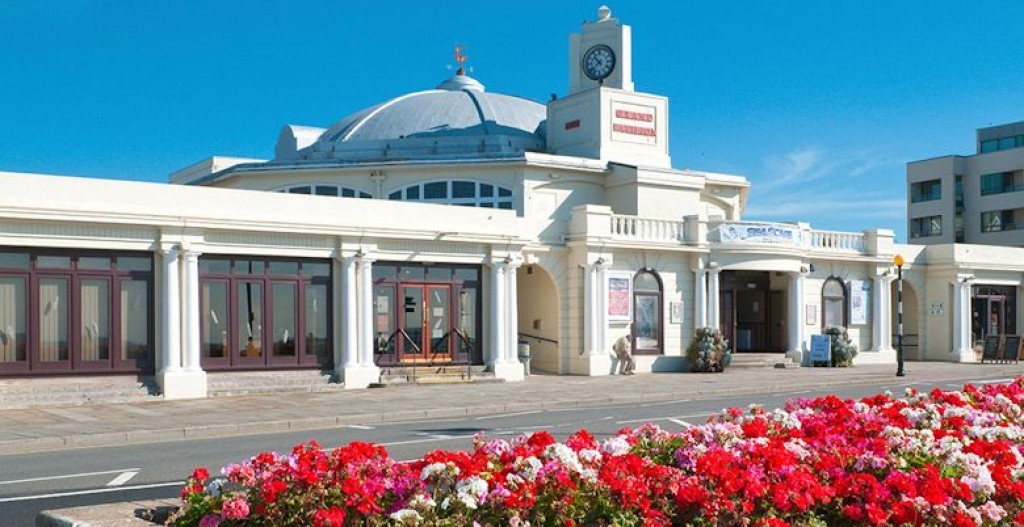
Awen Cultural Trust is a charitable organisation focusing on the enhancement and accessibility of cultural opportunities in the Bridgend area. I first encountered Awen as an employee at one of their beautiful venues. I joined after finishing my degree, as a Front of House assistant before successfully applying for a Duty Manager role at The Grand Pavilion Theatre, Porthcawl.
The Grand Pavilion Theatre, Porthcawl.
It was there that I forged some great relationships and organised ‘WHIP’ (Working Hard in Progress); my first collaboration with Jon Berry.
WHIP was, at its bare bones, a scratch night. We invited writers from around South Wales to send in new writing that they felt needed critical attention. Each writer had a six hour rehearsal process spread over 3 weeks where they could essentially ‘R and D’ their work with some local actors. Jon and I would aid the directors dramaturgically. The process culminated in a sold out event at an Awen venue where each writer celebrated their work as well as receiving the opportunity to ‘Q & A’ with the live audience. Lots of drinks were drunk and brilliant stories were shared – a cracking event we hope to revisit soon.
I believe you are based in Bridgend? Are there many opportunities to pursue a career in the arts where you live in this area of Wales?
Yes, I am based in sunny Porthcawl – a wee seaside resort for the beautiful and the damned. Sadly there aren’t a great deal of opportunities, particularly when you surpass the adulthood milestone. There are loads of Youth orientated events in the area, which is an amazing kickstart for anybody’s creative career, but nothing that really caters to those over the age of 18. Nothing that is readily available at least.
Get the Chance works to support a diverse range of members of the public to access cultural provision. Are you aware of any barriers that creatives in Wales face. If you do what might be done to remove these barriers?
Diversity in the decision rooms of funding. Diversity in the creative teams. Diversity in the Front of House staff. It’s not enough for some of these big buildings and organisations to “discuss diversity” and talk about a community of people, they need to talk to them directly, include them in the discussion. We need to fundamentally change the makeup of who is creating and watching work. Reassessing the arbiter’s of taste in the Arts is a monumental task, but it’s necessary.
There was an important scheme some years ago from ACE called ‘Change Makers’. It was a fund directed at increasing senior leadership in art and culture by helping to develop a cohort of leaders who were POC or disabled by means of targeted senior leadership training.
With the roll out of the Covid-19 vaccines, the arts sector is hopeful audiences will return to venues and theatres. If theatres want to attract new audiences what do you think they should do?
Theatres are proper funny places. They are beautiful, intricate, complex and unlike any other building you will find. But they are buildings. And people make buildings. Theatres need to serve their community like never before and I believe this is vital. They need to be producing and creating theatre that seeks interlocutors, rather than just presenting to an audience; reflect the social geography of a location.
I always think of the panto model. It’s a big day out. It’s an event and not just a performance in a theatrical space with lights and actors and pricey ice cream. How do we generate that excitement and enthusiasm for every show all year round?
What excites you about the arts in Wales?
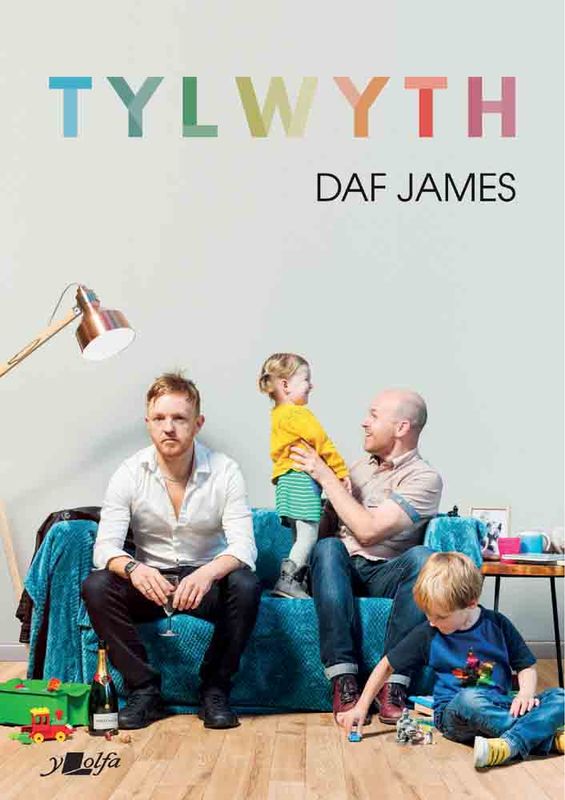
Honestly? The Welsh language. I was born in North Yorkshire and only made the move to Wales at 10 years old. Learning the language was, and remains to be, daunting. Yet with the very recent strong and youthful charge for Welsh independence the language has gained a new found pertinence for my friends and I. We’ve all seriously started learning. I think the Arts has to take hold of this and broadcast it for everyone to hear. Whilst employed at Awen I witnessed some astonishing bilingual theatre for young audiences, and only just before lockdown took hold I watched the tragically hilarious Tylwyth (Kin) by Theatr Genedlaethol Cymru at the Sherman Theatre. Tylwyth, performed entirely in Welsh, was a revelation to me as a director.
Firstly, I found that I understood so much through gesture and scenography, which is a completely separate phenomena. But more impressive was that, as a non-Welsh-speaker, I was still completely immersed in the language, the jokes, the fillers, everything! It opened my eyes (and ears) to the beautiful complexity of working and creating in Welsh and I think we should hold onto that dearly and not as a novelty either.
What was the last really great thing that you experienced that you would like to share with our readers?
There are so many brilliant acts of art I have witnessed over lockdown, not least theatre. However, I have to give my immediate thoughts to France’s ‘Lupin’.
A Netflix mini-series that captures all the slickness of a Bond chase montage at one glance, only to be peppered by the implausibility and wit of Jonny English on steroids, the next. It was a perfect watch from beginning to end. Short, clever and all in another language. Language was no obstacle in this charming espionage thriller that was a much needed binge-worthy bit of fun to kick off (hopefully) a much better year.
Get the Chance supports volunteer critics to access a world of cultural provision. We receive no ongoing, external funding. If you can support our work please donate here, thanks.
Helo, fy enw i yw Cerian a dwi’n hwylusydd ymgysylltu ieuenctid am yr Amgueddfa Cymru. Rydyn ni’n dechrau prosiect newydd am bobl ifanc LHDT+ o oedran 16- 25. Enw’r prosiect yw Trawsnewid, bydd y prosiect yn canolbwyntio ar y thema o drawsnewidiadau. Trwy’r prosiect byddwn ni’n archwilio pobl draws a gwrthiant cydymffurfio rhywedd o hanes Cymraeg a’r profiadau o bobl sy’n byw heddiw.
Bydd cyfarfod bob ail wythnos gyda’r bobl ifanc, bydd y sesiynau yn weithdai creadigol sy’n archwilio’r thema o’r prosiect gyda’r cyfle am y cyfranogwyr i redeg sesiynau eu hunain. Trwy’r prosiect byddwn ni’n gweithio tuag at cynnal ddigwyddiadau fel trosfeddiannu’r Amgueddfa yn yr Amgueddfa genedlaethol y Glannau yn Abertawe ac arddangosfa o’r gwaith sy’n cael ei chreu dros y prosiect. Bydd y prosiect yn cael ei addasu am y diddordebau’r grŵp fel celf, perfformio, ysgrifennu creadigol neu hanes.
Bydd y prosiect yn dechrau gyda sesiwn ar lein am 6yp ar y 24ain o Chwefror, byddwn ni’n cyflwyno’r prosiect, cyfarfod ei’n gilydd a dylunio cerdyn post sy’n cael ei ysbrydoli gan y casgliad LHDT+ yr amgueddfa.
Os ydych chi eisiau cymryd rhan yn y prosiect, cael unrhyw gwestiynau am y brosiect neu yn gwybod unrhyw berson ifanc gyda diddordeb i gymryd rhan anfon e-bost i: cerian.wilshere@museumwales.ac.uk
Creating opportunities for a diverse range of people to experience and respond to sport, arts, culture and live events. / Lleisiau amrywiol o Gymru yn ymateb i'r celfyddydau a digwyddiadau byw