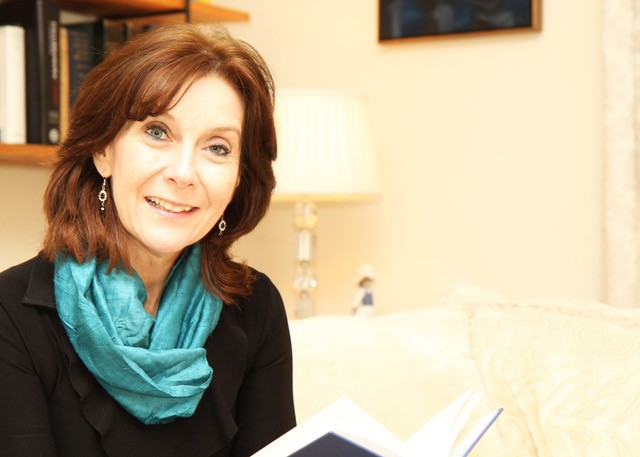
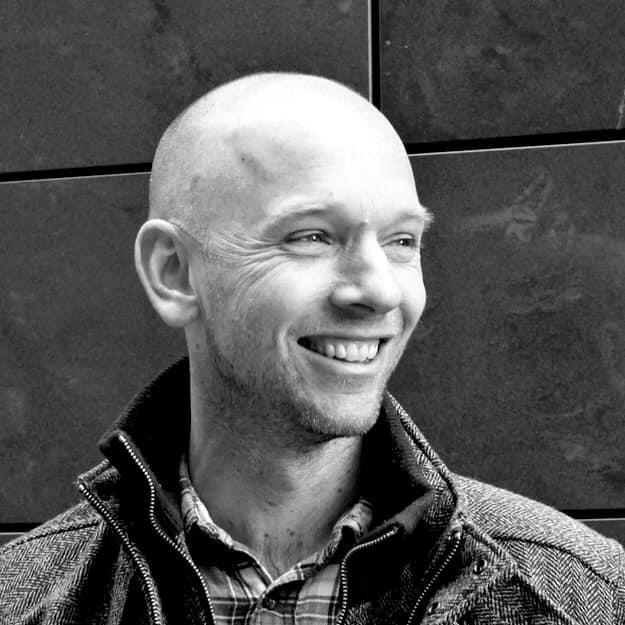
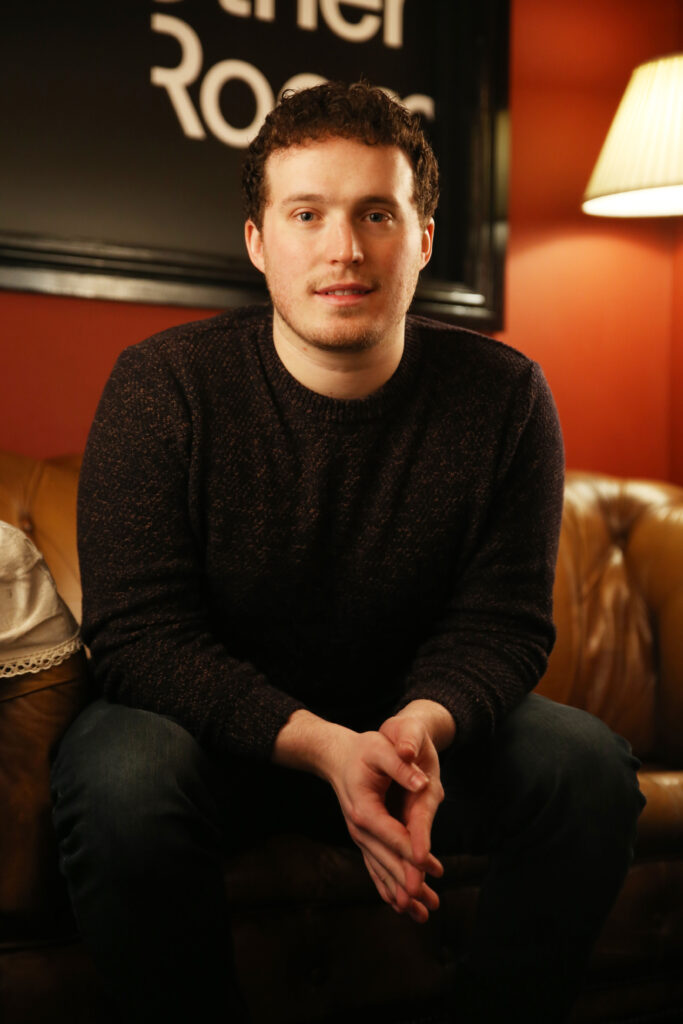
Hi I am Guy the project coordinator for Get The Chance. I am a trained secondary teacher of Art and Design and have taught at all Key Stages in England and Wales. I am also an experienced theatre designer and have designed for many of the theatre companies in Wales.
Prosiect traws-gelfyddyd Plethu/Weave yn cael ei ymestyn i 2021
Mae Plethu/Weave, cywaith traws-gelfyddyd digidol Cwmni Dawns Cenedlaethol Cymru (CDCCymru) a Llenyddiaeth Cymru, wedi cael ei ymestyn i 2021 ac wedi cael ei gomisiynu i fod yn rhan o lansiad blwyddyn Cymru yn yr Almaen 2021 Llywodraeth Cymru.
Yn dilyn llwyddiant cywaith traws-gelfyddyd CDCCymru a Llenyddiaeth Cymru, bydd Plethu/Weave #2 yn cael ei lansio ym mis Ionawr 2021, gan gynnig rhagor o gyfleoedd i ddawnswyr annibynnol wedi’u lleoli yng Nghymru gael eu paru â rhai o feirdd mwyaf talentog Cymru i greu wyth o ffilmiau digidol, byr, cyfoes a chyffrous ar-lein.
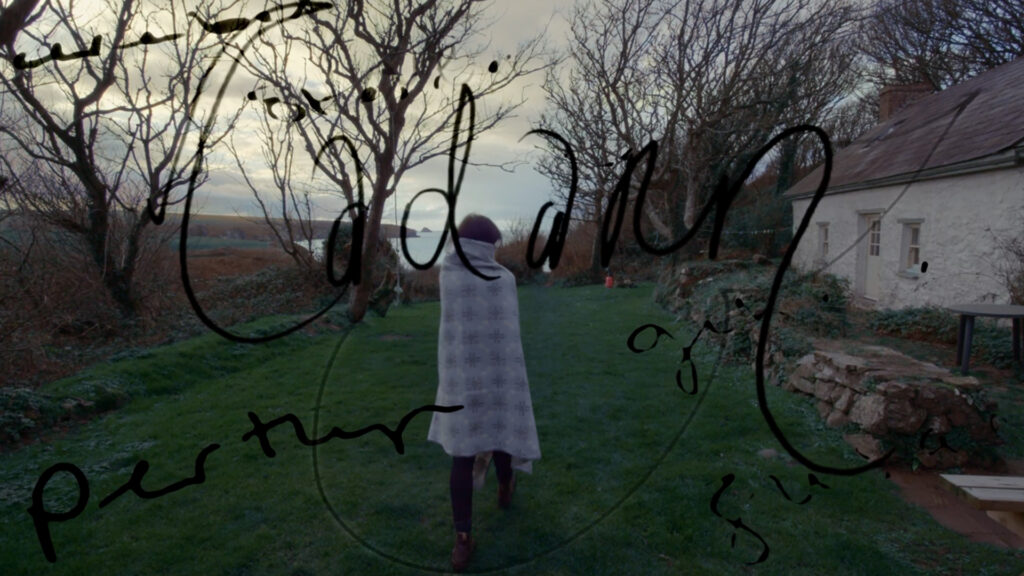
Bydd ffilm gyntaf Plethu/Weave #2, Aber Bach, a grëwyd gan Mererid Hopwood a dawnsiwr CDCCymru, Elena Sgarbi, yn cael ei rhyddhau ar 11 Ionawr, fel y cyntaf o dri chomisiwn CDCCymru a Llenyddiaeth Cymru sydd yn rhan o lansiad blwyddyn Cymru yn yr Almaen Llywodraeth Cymru.
Yn 2020,paroddPlethu/Weave bedwar dawnsiwr o CDCCymru a phedwar artist dawns annibynnol gydag wyth o feirdd gyda’r nod o greu wyth ffilm fer ar gyfer cynulleidfaoedd ar-lein. Creodd y parau hyn weithiau traws-gelfyddyd sydd wedi’u hysbrydoli gan straeon, lleoliad, treftadaeth a chysylltiad yr artistiaid eu hunain â Chymru.
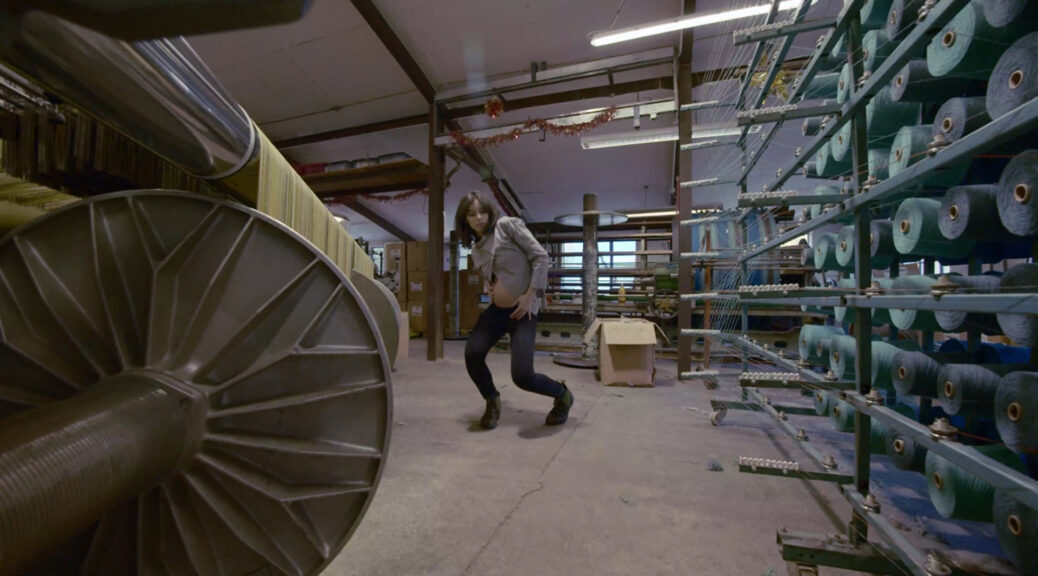
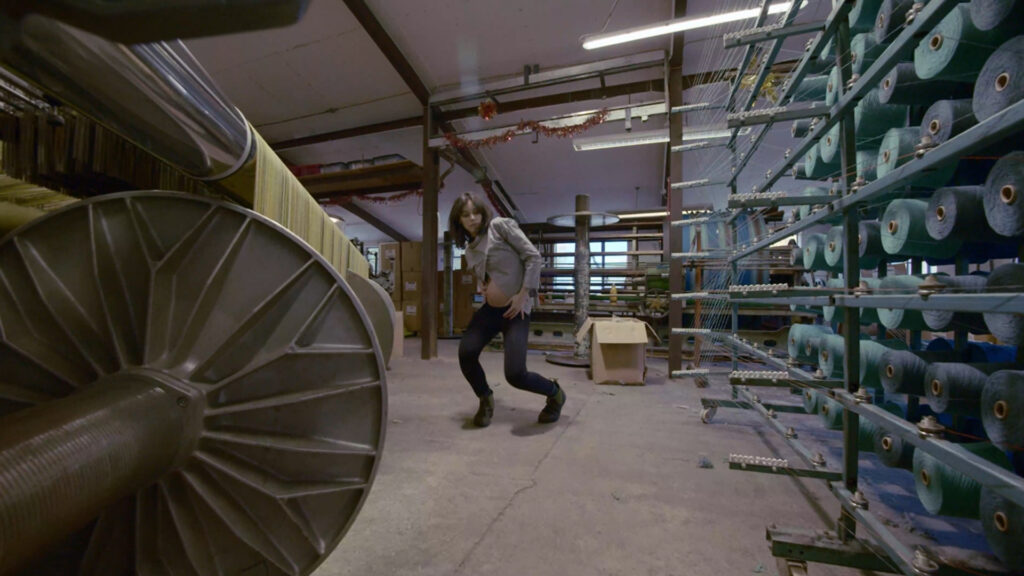
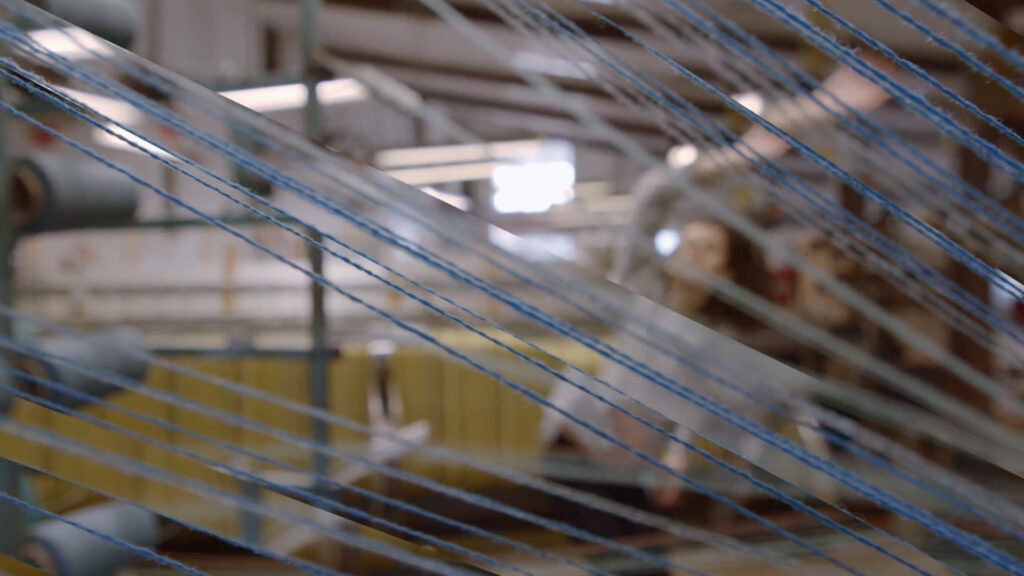
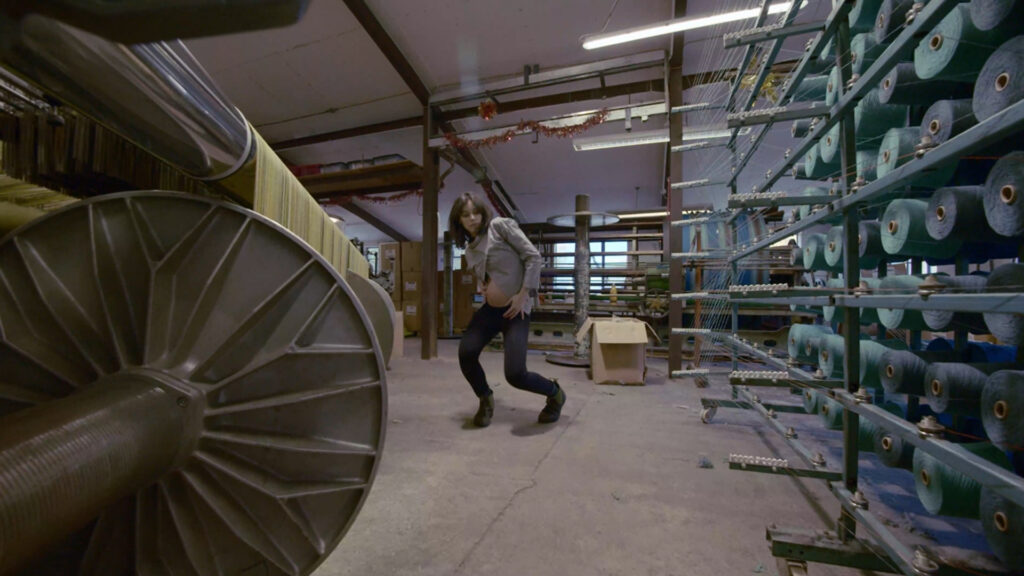
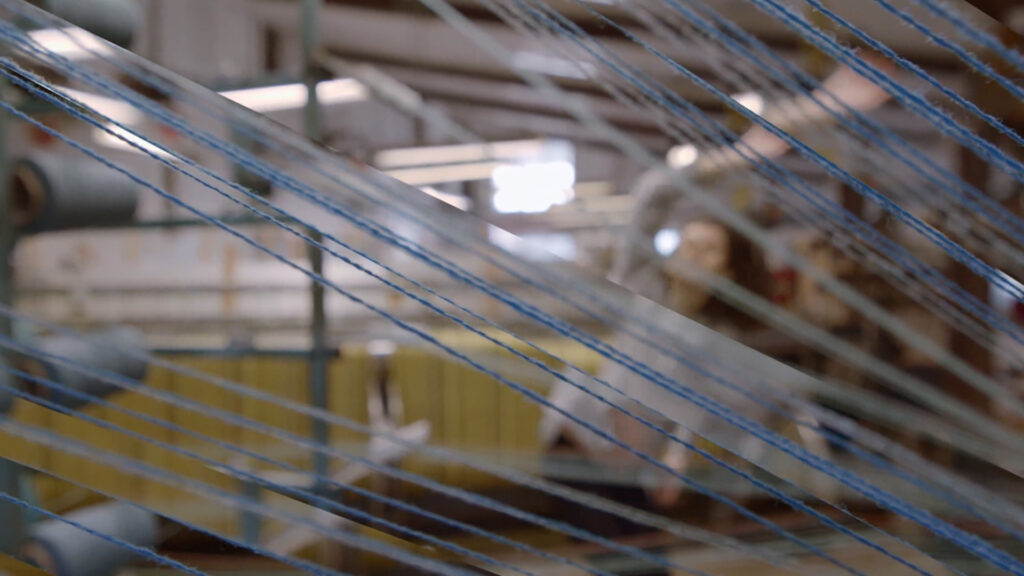
Caiff Aber Bach ei enw ar ôl bae yng ngorllewin Cymru, lle gellir clywed synau melin wlân a’r môr. Ceir ‘Aber’ a ‘Bach yn y Gymraeg a’r Almaeneg, ond gydag ystyron gwahanol. O’r syniad hwn y daw’r ffilm – a gafodd ei ffilmio ym Melin Wlân Melin Tregwynt yn Sir Benfro, a’i chreu ar y cyd â Rufus Mufasa, Hanan Issa a Tim Volleman – ac mae’nn archwilio sut y gallwn blethu geiriau i greu patrymau newydd o berthyn.
Dywedodd dawnsiwr CDCCymru, Elena Sgarbi, “Mae gweithio ar yr ail gynhyrchiad o’r prosiect ffilm Plethu/Weave gyda Mererid Hopwood a Tim Volleman wedi bod yn gyfle gwych i ennill dealltwriaeth well o Gymru a’i diwylliant. Trwy frwdfrydedd Mererid i rannu ei diwylliant a’r prosiect hwn, ces gyfle i ddod i adnabod cornel brydferth o ogledd Sir Benfro drosof fy hun, a’i thraddodiad gwehyddu gwlân pwysig.”
Mae gan CDCCymru hanes o deithio i’r Almaen ers 2017, gan berfformio i gynulleidfaoedd yn bennaf yng Ngogledd Rhein-Westphalia, Bafaria a Baden-Württemberg.
Dywedodd y Prif Weithredwr, Paul Kaynes, “Rydym yn falch iawn y bydd CDCCymru yn cyflwyno dawns fel rhan o lansiad Cymru yn yr Almaen Llywodraeth Cymru. Rydym wedi bod yn datblygu ein henw da a chynulleidfaoedd yn Ewrop, yn enwedig yn yr Almaen a gwledydd cyfagos dros y tair blynedd diwethaf, gan berfformio i leoliadau dan eu sang gyda chryn gymeradwyaeth. Mae’n deimlad cyffrous iawn i ni ein bod wedi cael ein comisiynu i greu y ffilmiau Plethu/Weave hyn, fel bod rhagor o gynulleidfaoedd gartref a thramor yn gallu gweld dau gwmni celfyddydol cenedlaethol o Gymru yn cydweithio.”
Bydd y ddau gomisiwn Plethu/Weave #2 arall sydd yn rhan o raglen Cymru yn yr Almaen yn cael eu darlledu ym mis Mawrth ac ym mis Hydref, gan arddangos gwaith y bardd Alex Wharton a’r artistiaid dawns Krystal S. Lowe ac Osian Meilir.
Dywedodd Jane Hutt, y Dirprwy Weinidog a’r Prif Chwip: “Mae blwyddyn Cymru yn yr Almaen yn ymwneud â chryfhau’r cysylltiadau rhwng y ddwy genedl ac adeiladu rhai newydd, ac mae gan y sector celfyddydol ran bwysig i’w chwarae. Mae ein celfyddydau, diwylliant a chreadigrwydd yn rhoi i Gymru ei phersonoliaeth unigryw ac mae’n gryfder mawr yn nhermau hyrwyddo Cymru ar lwyfan y byd.
“Rydym yn falch iawn o fod yn gweithio â CDCCymru a Llenyddiaeth Cymru ar y prosiect cyffrous hwn ac yn edrych ymlaen at arddangos gwaith rhai o’n beirdd a dawnswyr mwyaf talentog i gynulleidfaoedd yr Almaen yn y flwyddyn i ddod.”
ByddAber Bach, y comisiwnPlethu/Weave #2 cyntaf ar gyfer Cymru yn yr Almaen yn cael ei ddarlledu fel rhan o’r lansiad digidol ar sianeli cyfryngau cymdeithasol Llywodraeth Cymru ar 11 Ionawr. ByddAber Bachar gael ar wefannau a sianeli cyfryngau cymdeithasol CDCCymru a Llenyddiaeth Cymru o 12 Ionawr ymlaen.
EXPERIMENTICA is a live art festival in Cardiff that encourages risk, collaboration and exchange between artists and audiences.
The festival commissions and hosts a dynamic programme of live art, performance and interdisciplinary projects and offers a platform for UK and international artists at all stages in their careers, to present experimental work in an open and supportive environment.
The 2021 festival will explore narratives and alternatives to the status quo; questioning accepted ways of thinking; giving a voice to the underrepresented and challenging existing forms of storytelling – exploring democracy, agency and open authorship.
Chapter will advertise a call-out for proposals for this in March.
In the meantime, Chapter is commissioning three artists to make new work for their interim ‘EXPERIMENTICA Presents’ strand.
They hope that this opportunity will create space for reflection and experimentation during these challenging times.
Chapter is looking for artists based in the UK whose practice, prior to COVID, focused on live art or contemporary performance and who need support to explore ways of adapting their approach to making and sharing their work.
Each commission will receive a £1,000 fee.
If required, Chapter can offer free access to one of their studio spaces in Cardiff for up to one month between March and August 2021.
Chapter especially welcomes applications from those who identify as having currently under-represented characteristics. This includes black and non-black people of colour, disabled people, individuals identifying as LGBTQIA+, those with parental responsibilities and people from lower socio-economic backgrounds.
The decision-making panel will include a varied demographic of lived experiences including Chapter programme staff and independent practitioners/curators.
Artist Jonny Cotsen, who performed at EXPERIMENTICA18 with Louder Is Not Always Clearer, is to join the selection panel. Produced and directed by Mr and Mrs Clark, Louder Is Not Always Clearer has since gone on to tour across the UK and Europe including a hugely successful run at 2019’s Edinburgh Fringe and most recently at Théâtre de la Ville, Paris.
Plethu/Weave cross-artform project extended into 2021
National Dance Company Wales (NDCWales) and Literature Wales’ digital cross-artform collaboration, Plethu/Weave has been extended into 2021 and has been commissioned to be a part of Welsh Government’s launch of Wales in Germany themed year in 2021.
Following the success of NDCWales’ and Literature Wales’ cross-artform collaboration, Plethu/Weave #2 will be launched in January 2021, bringing more opportunities for independent Wales based dancers to be matched with some of Wales’ most talented poets to create eight more exciting contemporary short digital films online.
The first Plethu/Weave #2 film, Aber Bach, created by Mererid Hopwood and NDCWales dancer, Elena Sgarbi, will be released on 11 January, the first of three NDCWales & Literature Wales commissions, as part of the launch of Welsh Government’s Wales in Germany themed year.
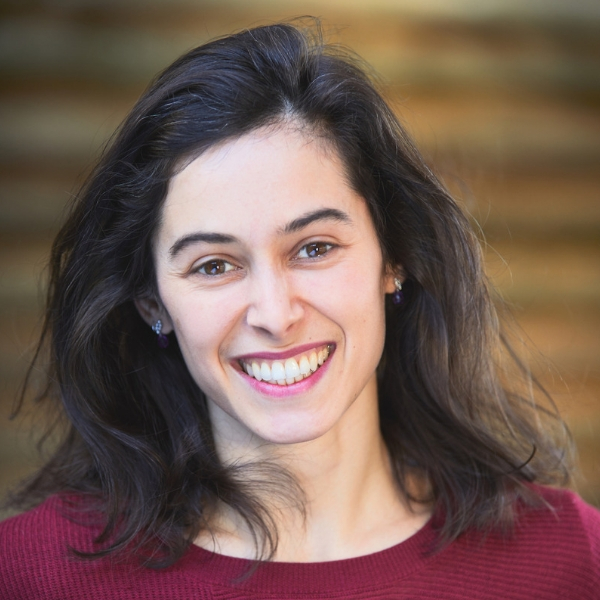
Mererid Hopwood and Elena Sgarbi
In 2020, Plethu/Weave brought together four dancers from NDCWales and four independent dance artists paired with eight Wales based poets to create eight short films for audiences online. The pairings created cross-artform creations inspired by the artists own stories, location, heritage and connection with Wales.
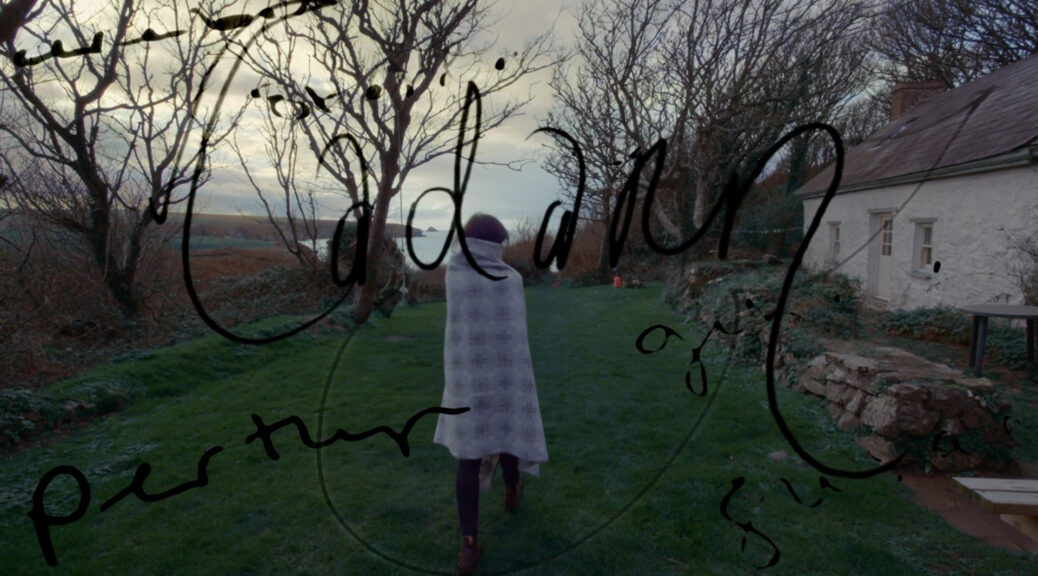
Aber Bach takes its title from the name of a cove in West Wales where the sounds of a Woollen Mill and the sea can be heard. ‘Aber’ and ‘Bach’ are words found in both Welsh and German, though with different meanings. From this notion, the film, which was filmed at the Melin Tregwynt Woollen Mill in Pembrokeshire, and created in collaboration with Rufus Mufasa, Hanan Issa and Tim Volleman, explores how we can weave words to create new patterns of belonging.
NDCWales’ dancer, Elena Sgarbi said, “Working on the second edition of the Plethu/Weave film project with Mererid Hopwood and Tim Volleman has been a great opportunity to gain a deeper insight into Wales and Welsh culture. Through Mererid’s enthusiasm to share her culture and this project, I have been able to get to know first-hand a wonderful corner of North Pembrokeshire and its important wool weaving tradition.”
NDCWales has a history of touring to Germany since 2017, performing to capacity audiences mainly in North Rhine-Westphalia, Bavaria and Baden-Württemberg.
NDCWales’ Chief Executive, Paul Kaynes said, “We are delighted that NDCWales will be presenting dance as part of Welsh Government’s Wales in Germany launch. We have been building our reputation and audiences in Europe, especially in Germany and neighbouring countries in the last three years, performing to packed venues and standing ovations. It’s really exciting for us that we’ve been commissioned to make these Plethu/Weave films, so even more audiences at home and internationally can see two Welsh national arts companies collaborate.”
The other two Plethu/Weave 2 commissions for the Wales in Germany programme will be broadcast in March and October and will feature poet Alex Wharton and dance artists Krystal S. Lowe and Osian Meilir.
Lleucu Siencyn, CEO of Literature Wales, said, “It’s wonderful to be able to partner again with NDCWales on another round of this ground-breaking collaboration, and to celebrate our literary and artistic culture with the world as part of the Wales in Germany programme.”
Jane Hutt MS, Welsh Government Deputy Minister and Chief Whip said,
“The year of Wales in Germany is about strengthening the connections between our two nations and building new ones, and the cultural sector has an important role to play. Our arts, culture and creativity give Wales its unique personality and it is a huge strength in terms of promoting Wales on the world stage.
“We are delighted to be working with NDCWales and Literature Wales on this exciting project and look forward to showcasing the work of some our most talented poets and dancers to German audiences in the year ahead.”
Aber Bach the first Plethu/Weave #2 commission for Wales in Germany will be broadcast as part of the Wales in Germany Digital launch on Welsh Government social media channels on 11 January. Aber Bach will be available on NDCWales and Literature Wales’ website and social media channels from 12 January.
In this interview Catherine Paskell, Artistic Director of new writing company Dirty Protest speaks to Guy O’Donnell about the background of Dirty Protest, Right Now a new online theatre festival and her future plans.
Hi Catherine thanks for taking the time to chat with me. We last spoke as you were about to take Sugar Baby by Alan Harris to the Edinburgh Fringe Festival in 2017.
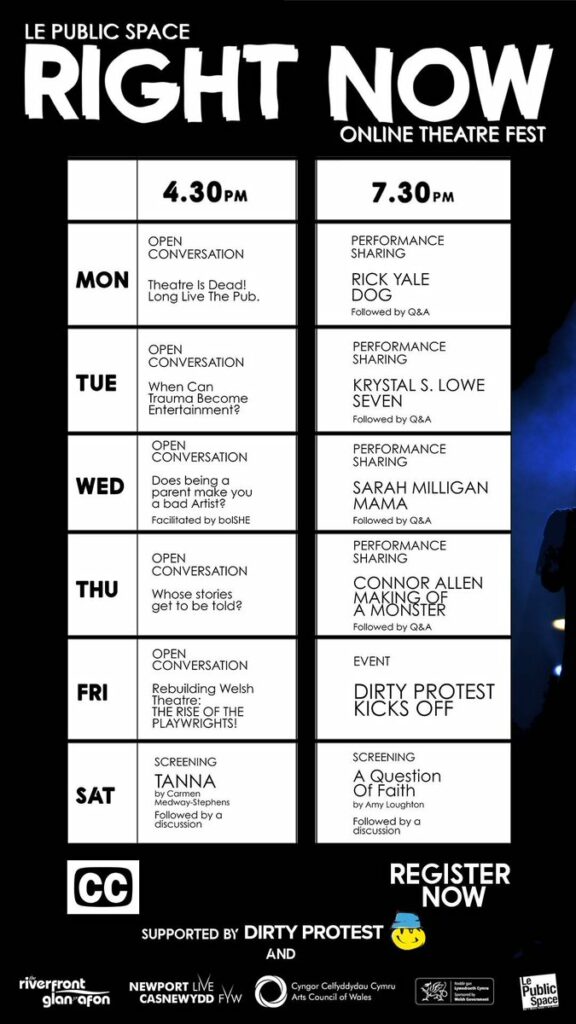
We are meeting today to discuss a festival closer to home which takes place in Newport this November.
Right Now, Online Theatre Festival. A short online festival of work in progress from some of Wales’ most exciting solo-performance-makers. The event takes place online from the 23 Nov- 28 Nov, 23:00 On the Le Public Space Website.
The event is described as,
“Right Now is an expression of urgency. Because theatre isn’t temporarily paused waiting to happen some where in the near future. It’s alive but physically unable to be experienced. It’s here now.”
This sounds like a vital arts event, how did Dirty Protest come to be involved?
It’s vital that theatre continues to be seen and enjoyed, because theatre and performance has continued throughout the global pandemic. Dirty Protest, like Le Public Space and many inspirational companies didn’t stop making work, engaging artists and talking with audiences and our wider communities as the Coronavirus hit. We found new and different ways to keep going and keep each other going. This is a celebration of that, and an invitation for others to join us in rebuilding and reimagining theatre in Wales.
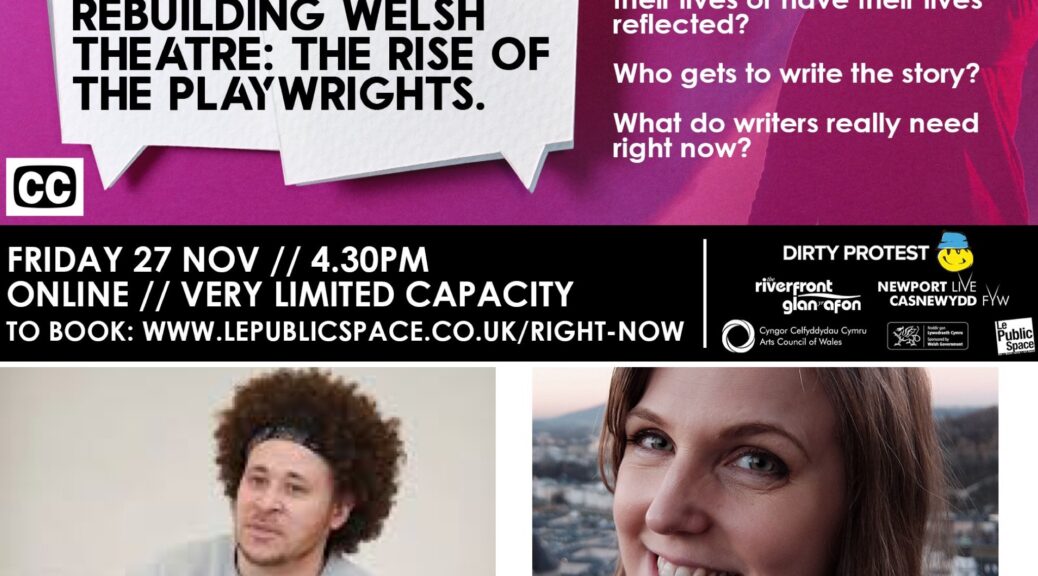
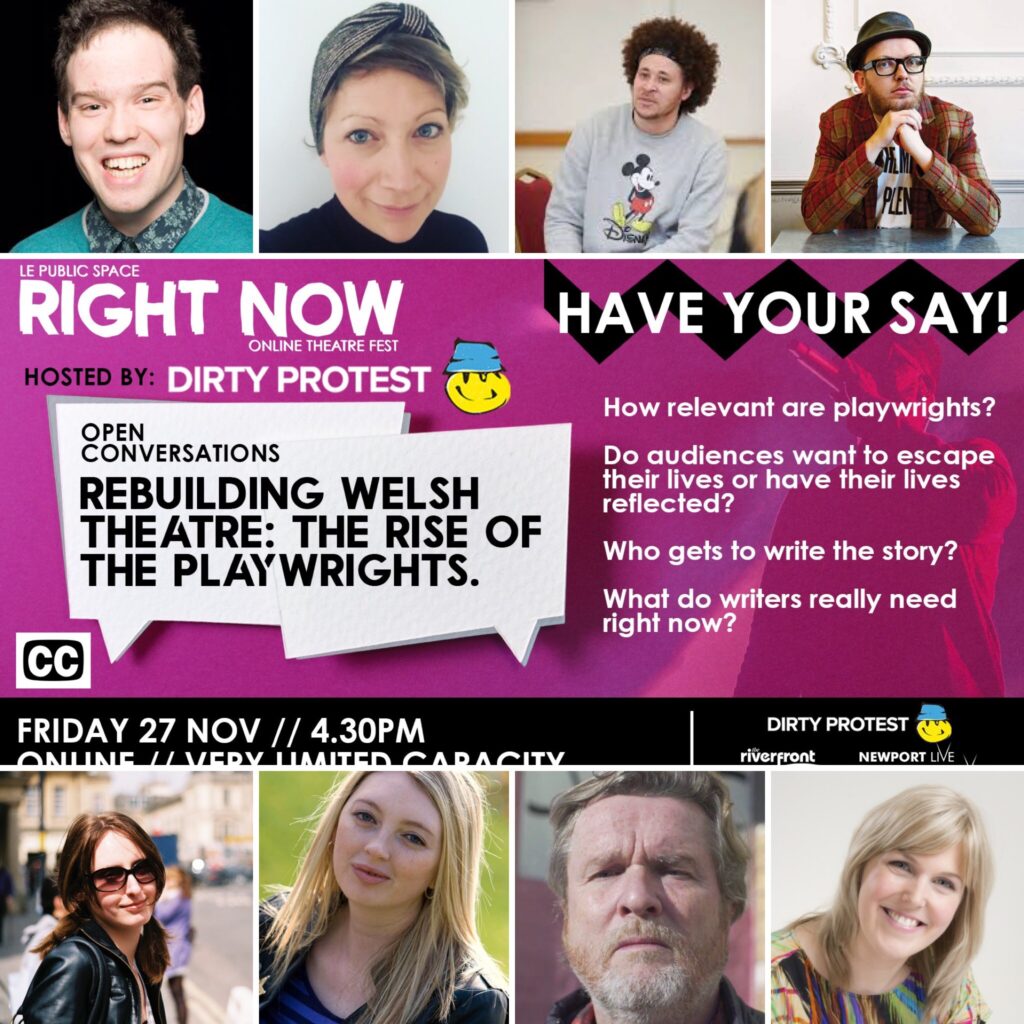
One of the specific events you are supporting is an open conversation titled ‘Rebuilding Welsh Theatre: The Rise of the Playwrights!’ This takes place on Fri 27th Nov at 4.30pm.
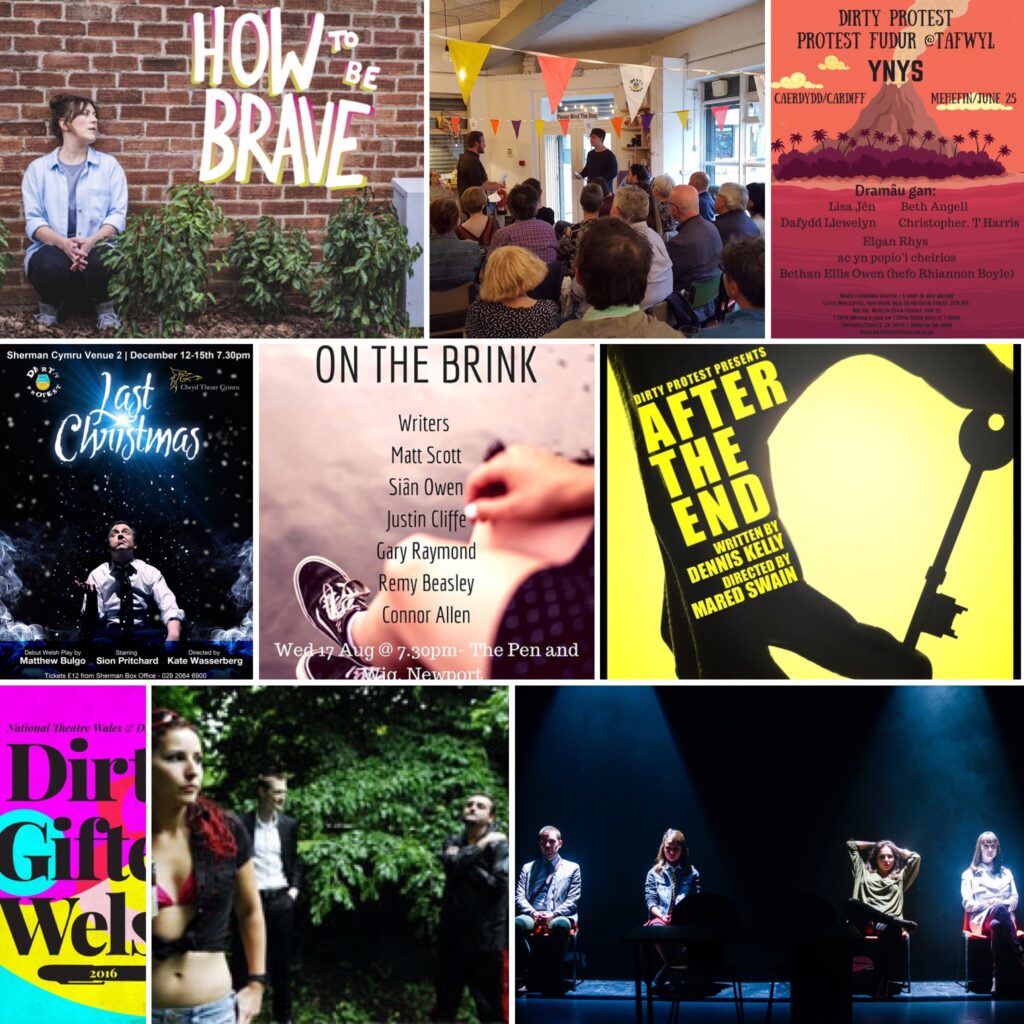
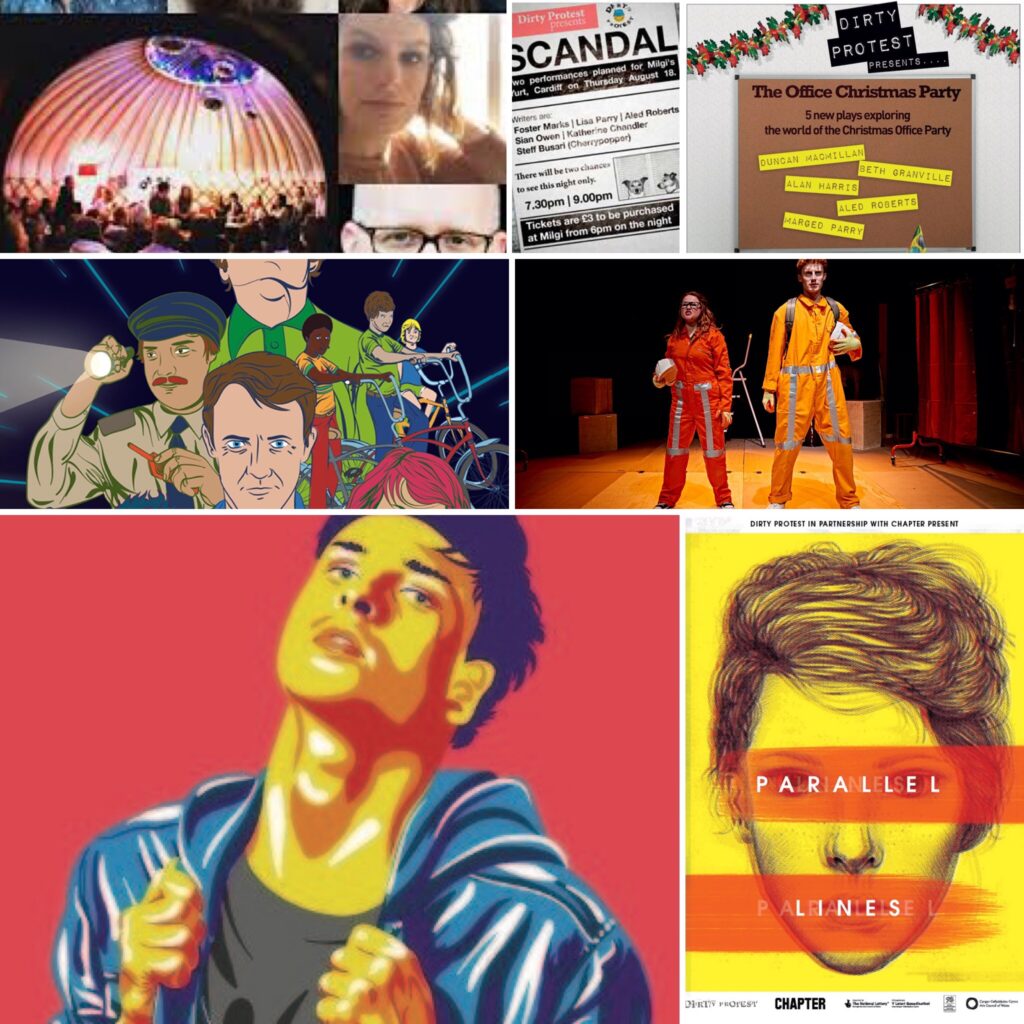
Dirty Protest has a rich history in supporting Welsh Playwrights from script in hand readings in a yurt at Milgis, Cardiff, performances at The Royal Court in London to National tours of award-winning plays. Has the support networks for Welsh Playwrights and the resulting work being produced improved over the lifetime of DP and if so how?
When Dirty Protest first started in 2007, there was no one offering the network and opportunities that we built. It’s why we started in the first place. Over the lifetime of DP so far, many newer companies than us have cited Dirty Protest as their inspiration, including the founders of National Theatre Wales, The Other Room in Cardiff and other numerous Fringe theatre companies who have produced work by Playwrights. In that time, we have seen improvements, as well as the sector still struggling to offer the support that Playwrights really need to sustain their own careers and produce work worthy of our audiences.
In the past 13 years, the networks and opportunities for emerging Welsh Playwrights have become more numerous. The Fringe scene has grown exponentially. Having a big Fringe scene and more Fringe producing companies give more frequent opportunities for early career artists. In recent years, we have seen more Welsh Playwrights produce work that is noticed on stages, television screens and streaming services across Wales and outside our borders. More theatres and companies are offering early career development, and there have been opportunities for writers to get work out there across numerous digital platforms in the global pandemic.
In this time, we have also seen the erosion of openly available spaces for Fringe companies and playwrights to try out their ideas. Spaces that were accessible and free to use in our formative years – pubs and cafes and little shops – now either don’t exist, or those that do now charge hire fees for artists to use the space, or require a share of ticket sales, or guaranteed spend on the bar. The Fringe is bigger, but there are fewer open access spaces and less opportunities to get work made unless you are already connected to the “right” people, or have the money to hire a small space for performance. This squeezes out certain artists and also means we tend to hear similar voices and stories, at a time when we need to hear more under-represented voices and stories.
We also need to see more opportunities open up for our mid-career writers and those Playwrights who are stuck in the space after their first play, when they need a second, third and fourth investment (and maybe more) to kick off their career. We need much more investment for artists beyond the early years, when companies and producers want to find “their” playwright or claim to have “discovered” a new voice. The truth is that Wales is a nation of playwrights who need sustained, long term investment and they are being underserved by the current system.
I believe you will be discussing the questions below for your Open Conversation, why did you decide on them and what do you hope to achieve?The questions are;
How relevant are playwrights?
Do audiences want to escape their lives or have their lives reflected?
Who gets to write the story?
What do writers really need right now?
We decided on these questions because these have come up repeatedly through the global pandemic in meetings with artists and audiences. We want to provide a platform to reimagine what we want theatre in Wales to be, and how we exist in the world during and after a global pandemic.
This conversation at 4:30pm on Friday 27 November needs to be useful for Playwrights and those who work with them, a practical resource as well as space for Playwrights to share, be listened to, and to take action towards changing the sector, to make it more democratic and more accountable. These questions frame real concerns for the sector and our artists and audiences, so it’s a place to start.
Please do come along and join the conversation, to be heard, to listen and to move forward.
Alongside Catherine we asked a range of Welsh/Wales based Playwrights to give their own response to the questions proposed by Dirty Protest.
Connor Allen
How relevant are playwrights?
Playwrights are integral to storytelling. Their relevance is second to none because stories are so important. Ever since the dawn of time stories have been a way of communicating and understanding our places and purpose. Thats where playwrights come in as they write the stories that entertain us, reflect our experiences back at ourselves. Without playwrights we wouldn’t have the broad range of stories to connect with.
Do audiences want to escape their lives or have their lives reflected?
I think both. I always say that theatre is a reflection of life and all lives are different so audiences get to see different reflections of different experiences all the time. BUT also audiences want to be entertained and an escapism of the real world can be achieved through theatre and TV. They can escape for an hour and just get absorbed in the joy and magic of the story being told.
Who gets to write the story?
I believe that anyone can tell and write stories. It depends on the context. Wether that comes from a genuine place is a different story. We all have stories to tell as we are all unique miracles with different perceptions of the world and different experiences that have made us the people that we are. Contained within that are beautiful stories that deserve to be told. I think in todays society we are more aware of the authenticity behind peoples stories and experiences. Where representation and opportunity is rife we can’t have the same people telling the same stories. BUT does that mean that only certain people can tell certain stories specific to them. Its a difficult question. I think there’s a difference between a white playwright writing a play with a black character in it as opposed to a white playwright writing a play about what it means to be black for example and I think a lot of people confuse those two points.
What do writers really need right now?
Time and financial support. Those are the 2 key factors I think that writers need as of now. Time to work on that next idea without the worry of how the rent is going to get paid. Also constructive feedback on drafts where playwrights can have their work in progress read to audiences to help the development. i find it so helpful to hear my words read out loud. Having that option readily available for playwrights is another thing but in a constructive way. There is no point saying “that was shit” because that’s not helpful to a playwright. Thats not helpful to anyone. Give them constructive points on how to make it better and the current playwrights will develop work that is truly exceptional (not that it isn’t already)
Rachel Trezise
How relevant are playwrights?
More than ever before we need playwrights to tackle the issues of class and identity. The UK and beyond is dangerously politically divided. Times are strange and volatile. Out of all the art forms, theatre has the most ability to put audiences into characters shoes and consider other people’s point of view.·
Do audiences want to escape their lives or have their lives reflected?
Both! And a well-told story can do both. For some of the audience it will be escape and for others a reflection of their own experiences. We just need to make sure we have enough stories to speak for everyone.
Who gets to write the story?
Someone who knows it in their heart, their head, their bones.
What do writers really need right now?
To know how relevant they are.
Jon Treganna
How relevant are playwrights?
Theatre is one of the oldest forms of storytelling. Clearly now people get drama from TV, social, books and online content, but a great piece of theatre can move people like nothing else. It’s a shared experience.
Do audiences want to escape their lives or have their lives reflected?
I’m not one for kitchen sink dramas and my heart sinks when I see a sofa and 2 chairs on stage. I think that people go to the theatre for a sense of adventure and to escape their lives, especially after Covid and austerity. Even if a play reflects their lives, it should be heightened and they should be moved or thrilled.
Who gets to write the story?
I like interactive dramas where the audience is part of the show. However, I might be old school but I think the playwright writes the story.
What do writers really need right now?
We need shows back on stages, even with social distancing. We need to create theatre shows that dazzle and entertain after such a dark period. And yes, we need more commissions.
Lisa Parry
How relevant are playwrights?
Playwrights themselves or the work? Plays themselves ebb and flow depending on the times; I think that’s the magic of them. CP Taylor’s Good feels really relevant at the moment but it was commissioned in the early 80s. But if you’re asking whether playwrights in Wales are relevant to the scene here, then I would say 100% yes – you only need to look at the audience numbers for shows like Iphigenia in Splott or Sugar Baby. But I don’t think we’ve been given a chance to prove how relevant we are yet. I think that was only just starting to happen before lockdown with the announcement of a new literary department at the Sherman. During lockdown and the rest of this year, it’s been playwrights making the work that we’ve been able to experience, partly because it’s easy enough to do that over Zoom. And I think the commitment of companies like the Sherman and Clwyd to addressing BLM will help in terms of ensuring that the voices coming through are representational and therefore the work relevant to a whole range of different communities that make up modern Wales.
Do audiences want to escape their lives or have their lives reflected?
Both. It’s hard to enjoy a story – even if you’re after pure escapism – if you can’t relate to it in some way. There’s always a chink or an in. And you never know what that’s going to be for the individual audience member. But getting that balance right after Covid is going to be an interesting challenge and one I think we need to be mindful of.
Who gets to write the story?
I’m not sure it’s a case of who gets to write it so much as who gets to have it put on stage and there’s no escaping the fact that white male work has dominated our stages for generations, for various reasons. I think that’s changing and I think playwriting groups have helped it change but there’s still heaps more to do.
What do writers really need right now?
Support – whether that’s social support (writing’s lonely but Covid has made that a thousand times harder) and also financial support. You need time to write. Time’s tricky when you also need money to buy food and to pay the rent. The Writers’ Guild has been campaigning for theatres to keep commissioning writers so that they don’t get lost to the industry, which I think’s really important. I also think at the moment it’s really important that we keep talking to each other. It’s peculiar writing at the moment – I’ve deadlines for stages that are currently occupied by ghost lights. It’s a weird feeling. It’s also possibly the most optimistic and hopeful thing I can do and I think we need to somehow keep that belief going that we’ll be back as an industry and that the relevance of playwrights here will take a firmer hold.
Tom Wentworth
How relevant are playwrights?
We must try to reflect the times we’re living in as well as providing, as in my own work, some sense of escapism. These two potential outputs mean that playwrights are more relevant than they have ever been for reflecting and taking the temperature of the nation.
Do audiences want to escape their lives or have their lives reflected?
I firmly believe audiences want both. Every play should be a combination of dark and light. You can say a lot about the fractured, difficult and tremulous state of the world in a comedy.
Who gets to write the story?
Whoever is from the community the play is about. I want authentic stories and top class writing. I want to see things I’ve never seen before. Say no to tokenism and cultural appropriation. If you’re from a community with a story to tell – write it .
What do writers really need right now?
Time and money, as ever. We may not have spaces for our work to be performed in but we need commissions so they will be full to the brim when performances are allowed again. Don’t skimp on the money. Pay writers properly and give them the time and dramaturgical support they need. This is not a luxury, it’s the way to ensure financial success at the box office.
Tim Price
How relevant are playwrights?
I think Playwrights have never been more important. Dramatic storytelling is the number one form humanity chooses to consume stories. Of course there are plenty of other forms, and multidisciplinary styles and documentaries, and poetry and all the other rich outputs we achieve but fundamentally – a dramatic story is everyone’s preferred medium to understand the world. Cinema and television come from plays and playwrights. There’s a reason England and the UK generate so much Intellectual Property that sells globally, it’s because of the culture and tradition of dramatic storytelling. To build a theatre culture without dramatic storytelling at its heart is to condemn us to perpetual marginalisation. There’s vehicle to take Wales to the world, and it’s dramatic stories. We shouldn’t be anxious about it.
Do audiences want to escape their lives or have their lives reflected?
Probably both depending on where they’re at. When I was younger I wanted to see myself on stage because I didn’t see myself anywhere else. Now I’m older with responsibilities I think I want escapism.
Who gets to write the story?
Even when I’ve written stories and had them produced I still doubt I was the right person to write it so this is a difficult question to answer. My thoughts shift week to week. I’ve been of the mind that as long writers research and write with respect they should have the freedom to write any story about any community otherwise those marginalised voices will forever be required to write stories about marginalised voices and communities. The problem is right now those with the power to get produced are predominantly from one group, so it looks extractive and exploitative when they write from places beyond their experience. I think maybe my instinct for writers to be free to write whatever they want is an aspiration the industry hasn’t earned yet.
What do writers really need right now?
Opportunities.
Catherine Paskell
Please do come along and join the conversation, to be heard, to listen and to move forward.
We also have an event at 7:30pm on Friday evening called DIRTY PROTEST KICKS OFF. This showcases work in development by ten writer-performers, who responded to our open call out to KICK OFF. These artists are sharing very short excerpts of work in development, to KICK OFF Friday night. Some are performing their work in Le Pub, others will be joining us on Zoom. Some are dramatic monologues, some are interactive, some mix languages of movement and text into a new play. All are the future of theatre. Come and join our Dirty Social! This is a great way to find out more about Dirty Protest, the kind of work we do, and get involved in our upcoming opportunities.
Both the Open Conversation at 16:30 and Dirty Protest KICKS OFF at 19:30 on Friday 27 November are closed captioned.
And finally, what’s next for you and Dirty Protest?
We have some really exciting announcements coming up!
As you already know, over the past 13 years, Dirty Protest has been able to support writers from the very start of early ideas, through short play development, full production and international touring. We are doing more of this, in new and bigger ways, in physical spaces AND digital spaces, with more writers, artists and arts workers. Our audio collaboration in Brazil with six young writers in the Complexo da Maré favela community in Rio will be released in December, and we have new collaborations to announce with more partners. We have been working since March to build opportunities for artists and meet with our communities and audiences – and we can announce the specifics of new Wales-based and international projects, new opportunities, a new writing artists network, and new shows in English and Welsh coming up next very soon! Watch out!
Thanks for your time Catherine
Get the Chance values the role playwrights living and working in Wales bring to the cultural life of our nation. You can read more interviews with the Playwrights above and a range of other Welsh/Wales based Playwrights here
Get the Chance is a voluntary ran organisation, to donate to our work please click here
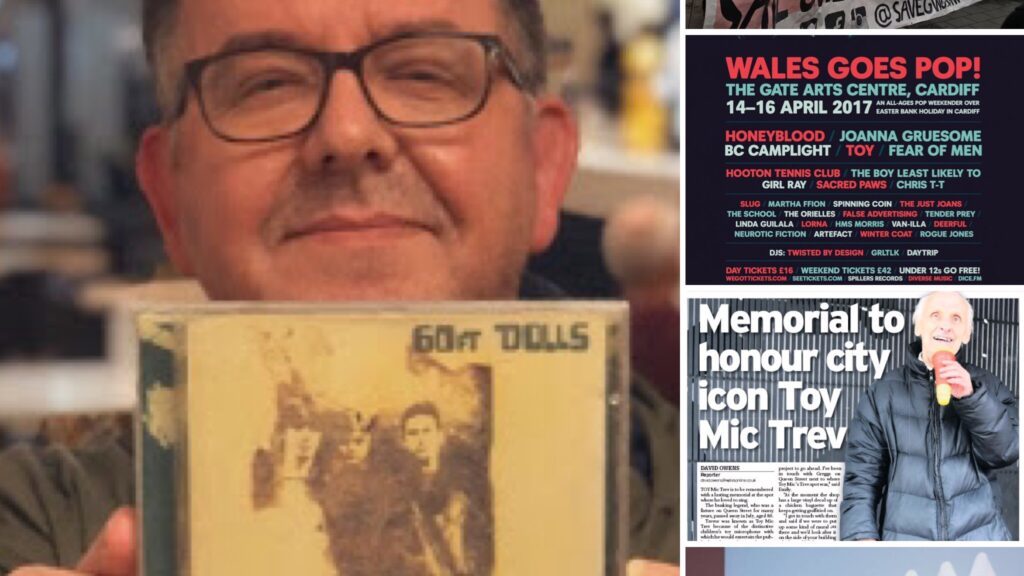
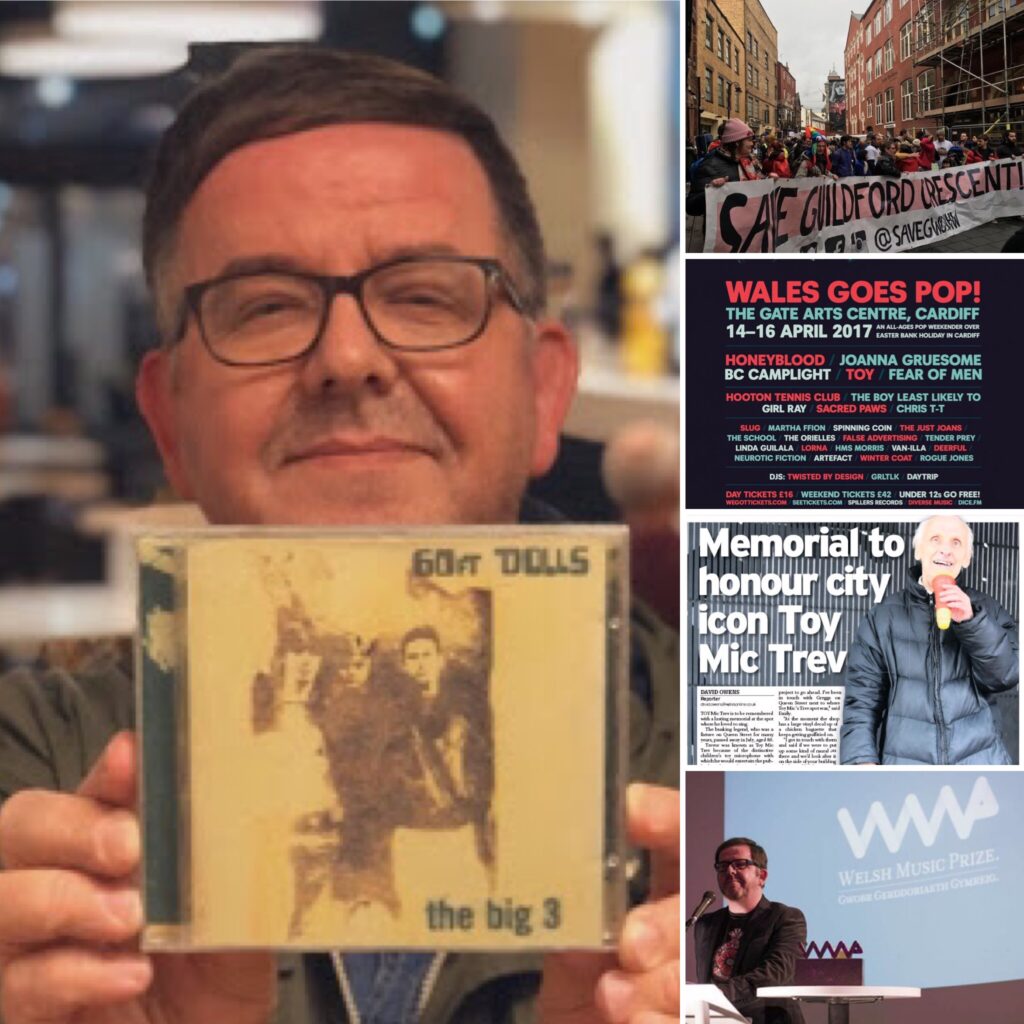
Get the Chance was extremely saddened to learn that journalist David Owens is being made redundant from his role at Media Wales. Dave’s championing of the arts, especially Welsh music has been hugely important for the sector. His unique voice has raised awareness of new music, discussions around class and culture, he has supported music festivals, fought against the destruction of music venues in Cardiff and has created heartfelt articles about Cardiff characters like Toy Mic Trevor!
In the article below fans and colleagues pay tribute to him and his work.
Bethan Elfyn, BBC Radio Wales, Horizons Music Project
Dave Owen’s respect amongst the South Wales music family is well earned and his genuine passion for the music, and the individuals making the music, breathes through all his writing.
I believe I first met him around the time he published the Catatonia story – he might correct me on this – but I have a vague recollection of meeting and possibly interviewing him about the book, released in the year 2000.
Our paths would cross from there at a number of music gigs, events, panels, and anything music related in South Wales.
Dave is more than a journalist to me, more than a talented writer and music fan, he’s also a friend, and I look forward to seeing what the next chapter will hold for him.
John Rostron, Making Music Wales Manager
The people I really connect with in music are those who just cannot turn it off. They devour music – new and old – in all its forms – recorded, written, live – and it’s between bands and bar at a gig that you usually become friends with the people that are particularly special. Dave is one of those people.
Possibly in Dempseys, probably in Clwb Ifor Bach, certainly late in an evening, with ears ringing from whoever we’d both been to see and hear, Dave became, for me, a solid, reliable, passionate part of the fabric of music in Wales. I got used to seeing him bouncing between bands, and I loved to see him. I always do. He’s a good guy. A funny soul. A trustworthy man who wears his heart on his sleeve. He’d give before he got, and he’d never take anything without permission and grace. For a long time his words were my only route into the Echo and The Western Mail where he’d write so enthusiastically about music. He became someone whose opinion I trusted. Through his words I’d go listen to some bands I’d never heard of. But more importantly I’d return to acts I’d skipped or dismissed for some reason that had felt right to me at the time. But If Dave was enthusiastic, then I would doubt my first instinct and give the band a second shot. He would often prove to be right.
When once just music and culture and art were all I cared for I began to get more interested in the politics and policy behind it. I’d share that with Dave, who increasingly became interested in it himself. I love those conversations and those debates we have. He wasn’t just writing about music, he was – and is – part of the push and pull that makes things happen in Wales. He wants there to be more; for it to be better; for it to be fair. He’ll shout about it and write about it between the bands, over the bar, late into the evenings as only he can.
Minty’ s Gig Guide
It’s sad to hear David Owens – Wales Online has been relieved of his duties from Media Wales.
⚡️ There is NO QUESTION that Dave has been a TITAN in Welsh Music Journalism since I can ever remember – his passion for this industry is something I’ve always been enormously enamoured with & he has supported me no end since I started. ❤️
So…whilst some may say…this is a huge loss for Welsh Music Media…
I say it’s a HUGEEEEE gain for independent media…there are much greener pastures ahead for Ser’ David – and I can’t wait to see what comes next.
I Loves The ‘Diff
Many of us have watched with dismay at the decline of decent local journalism in South East Wales at the hands of a non-Welsh plc, yet amid the slide toward online lowest common denominator, catch-all, hit rate, click bate driven drivel was a rare stalwart – Dave. A man whose passion for the place in which we live, its people, and music (Music! Music! Music!) is tangible in his writing, his choice of stories, and the people and bands he celebrated. So thank you for the (words about) music, Dave. Looking forward to hearing about what comes next for you.
Patrick Jones, Poet
I got to know of David’s work through his love of music. His writing was always passionate interesting educational and real. You could tell it was so important to him and this was reflected in his pieces.
He is an important voice in Welsh journalism. You could always hear his authentic voice in his words. Rare in journalism these days. I liked his societal take on bands and music. He knows where it originates. A decent good guy that you could sit down and openly talk with. I shall miss his writings x
Spike Griffiths, Project Leader – Forté Project
I call Dave a ‘mouthpiece’. He has spent endless column inches tirelessly devoted to covering welsh music; be it through reviews, previews, features, or simply highlighting recent concerns to our troubled sector. All of which has helped spread the importance of music. And never has that been more valuable than right now.
His kind words about our youth music development work have always been much appreciated. Whether inked through a feature in his “New Wave” segment or accompanied by a raised glass at one of our gigs, they have all been warmly received.
Illuminating the emerging music talent in Wales is something that we both strongly believe in. The young acts we work with, in particular, treat his music reviews with reverence.
At times like these, Dave’s honesty and passion for music are much needed. I have no doubt he’ll establish a new ‘mouthpiece’ soon and continue the important work he’s well known for.
Hi Daisy, it’s lovely to meet you and to get the opportunity to pick your brains. So just to introduce yourself to our readers, please can you give them some background on yourself and how you define yourself as an artist?
Hey Guy! Yes, so I am a Contemporary Dancer/Director based in Manchester. I trained at the Northern School of Contemporary Dance where I graduated in 2018 with a Masters in Contemporary Performance.
I am Welsh born and proud, so split my time between working in North Wales and across the North of England. My work is a whole mix of things really, from teaching to choreographing, to performing professionally and directing my own company. I like to spin many plates!
At the moment my artistic practice is very much based in collaboration, working heavily with digital creators, movement makers and sound artists. Concerning a definition, I am a person whose artistic world is constantly changing, so I am more of a chameleon than anything else! I like re-developing and re-branding who I am as an artist. I don’t like getting boxed in. So with my practice as a maker, teacher and mover, I feel like I have my own specific interests and style, but also something tangible that is reactive to the situations and people around me.
Your company has a Virtual Performance Party on the 28th of August. You will be premiering your new work, ‘Night People’, which is described as a “visual art, rave inspired, dripping with dance and bass, screen-dance film! Inspired by nightlife adventures and underground club nights, we bring to you an evening of music, movement and misfit mayhem!” This sounds like an exciting event! Can you tell me more?
Of course! This is all very exciting as it is the first time myself and collaborators have made a purely digital work, made for screen. I currently work within a trio, consisting of myself (Director of Brink Dance Company), Animation Powerhouse ‘Howl Creative’ and Composer ‘LSMarley’. Together we make cross-collaborative performance work that focuses on the electric blend of animation, visual art, contemporary dance and sound. We draw upon the themes of Rave Culture and the Dnb scene, bringing to life these underground landscapes of community, escapism and midnight mayhem. We began our collaborations whilst training in Leeds, with our passions to bring contemporary art to a new scene of young people and venues uniting us together. Over the years we have worked in various Club settings and Theatres, alongside showcasing our work in Churches, Bars and Shopping Centres.
www.anniefengphotography.com
Our new work “NIGHT PEOPLE” is our latest ambition, commissioned by Social Conventions London. The whole event aims to bring the night out to your night in, offering an insane mix of dance work, visual creations and DJ sets direct to your screens. We are fiercely attempting an online festival line up, one that follows the storyline of a collection of Pro Ravers on their night out, whilst showcasing a range of DJ and Visual Art sets in between. The whole event is geared towards those missing the party scene and the nightlife culture. However this event is also geared towards those interested in Digital Art, DJ mixes, Animation, Motion Capture, and simply for those who want a fun and energetic Friday Night to enjoy! Tickets can be found on our Facebook Page at Brink Dance Company and cost as little as £1. This is a brand new look at how we can create connection and party via this new lockdown world, so come and join the movement!
Artists features include sets by the incredible DJ and Visual Artist, Izzy Bolt, a completely new soundscape of Dnb/Experimental goodness by LSMarley, Movement & Groove from the phenomenal dancers Iolanda Portogallo and Maya Carrol, Digital Creations and Film from the fantastic Howl Creative and much much more….
Contemporary Dance can be perceived as an elitist art form do you think your practice seeks to break down any perceived barriers?
Completely. Coming from a very traditional dance background, I will always have a love for pure dance on stage, with the theatre audience watching and bows at the end. However as I began figuring out my movement style whilst training, I realised this didn’t always connect with me. My experiences dancing at raves, exploring the club scene and finding connection in these places of music and groove, were the reasons my love for dance and performance grew. I found my feet. I found a place where my body understood how to move. I found a style that expressed who I truly was. And it was amazing. From then on, I wanted dance to move from a place of tradition and bring it to a new scene of people, locations and communities.
www.anniefengphotography.com
My work aims to bring contemporary dance and mix-medium performance to audiences that may never have set foot in a theatre. I wanted to showcase how dance can be used as a tool for communication and dialogue, rather than something people simply observe from afar. I think art is about people and isn’t something that should be contained by old notions of performance and presentation. My work strips this away and offers a raw physicality and emotive landscape of people communicating what they really feel. It is also a reason I have taken dance away from just dance in its pure form. I wanted to work with other creators and other mediums to enhance my process and thankfully through luck and chance I was able to connect with some incredible artists who have helped make this happen. Breaking down notions of art forms being apart or away from each other has been a career changer for me and essential in breaking down limitations of how I view dance and where I see dance going creatively. It is about learning from new sources and being open to the fact you don’t have all the answers. Giving into this and entering various scenes of art, creation and rave enabled my process to blossom and is a huge reason why my work has taken many twists and turns.
It all begins to sound very arty as I describe it but essentially I owe a great deal of my creative ethos to the rave scene. As a maker and particularly as a dancer, this unlikely scene of haze, bass and underground antics moved me in such a way it broke down my perceived barriers of what I thought art was and what it could be. These places of sheer music and escapism shook my creative habits to a point of change and enabled me to see what I truly cared about as an artist. My practice has grown from this place of joy and boundless energy, removing personal and professional barriers so that I can reach audiences beyond the rigidity of traditional performance. Taking my work off stage and opening the doors to all manners of performance, audiences and venues has been an incredible journey and one I hope I can continue in the future.
Rave culture informs a great deal of your practice, how do you curate the music that becomes part of Brink’s artistic vision. What tunes are exciting you now, personally and artistically?
I am blessed to work and be friends with the incredible LSMarley.
We began collaborating on one of my first commissions in partnership with Light Night Leeds and Light Waves Manchester in 2018. We met Luke and it just clicked. Luke has a fantastic ear for sound and composition, alongside being able to produce incredibly unique tracks that gel effortlessly with movement. His music has been a huge influence on the aesthetic and overall movement style of our work. Essentially I think our music and movement is curated through genuine pleasure and joy. We make what feels right and makes us feel good.
I wouldn’t say it is an overly thought out process, it is more about sensation and being honest with each other. It is also through observation and taking interest. I listen to Luke’s music within my everyday ongoings. Luke has watched me perform and dance countless times. We have been in the studio playing and jamming together for the last three years. I think through simple experience and listening to each other we have naturally come to an understanding. I think it is all a little unspoken and I think this is what makes it so magical.
Apart from Luke’s sound, my music style for work takes inspiration from various pools of EDM artists and DNB creators. Some of my favourite ‘going out/research’ tracks are by Lenzmen, Calibre, Nicolas Jaar, Caribou, Thundercat, Marcelus, Chimpo Halcyonic and G Roots and Children of Zeus.
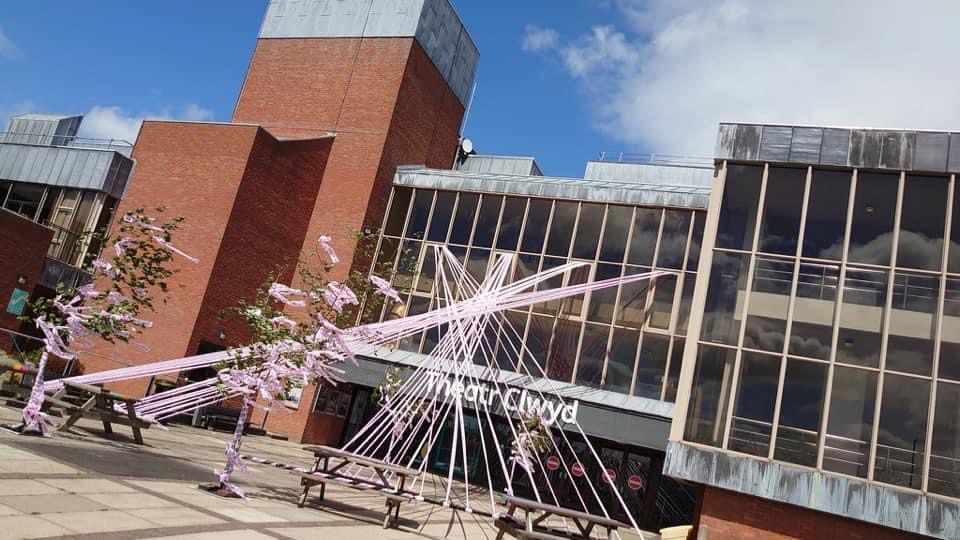
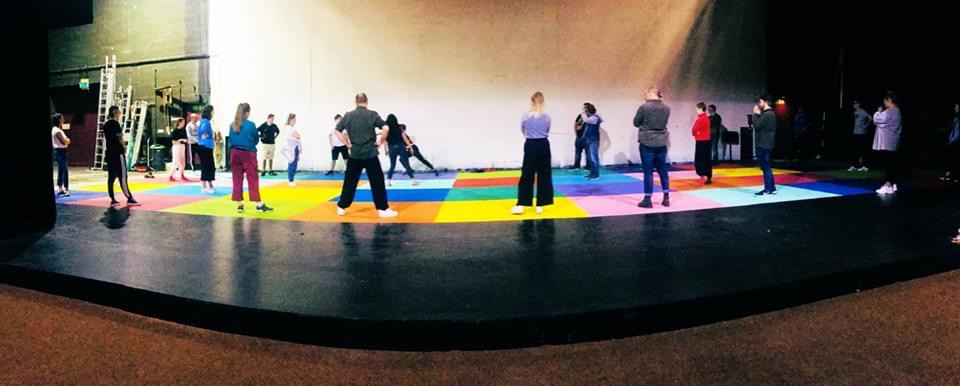
You were recently working for Theatr Clwyd providing arts based activities to key worker children. How did you approach delivery given the limitations of Covid 19 and do you have any hints for colleagues as regards delivery of participatory activity?
Ah this was such an incredible part of lockdown! One of my biggest passions is teaching and working with young people. It was such an honour working back in North Wales and helping these children experience art and dance after such a tough lockdown!
Delivery was all focused on protection for both teachers and students, alongside creating a super safe and welcoming atmosphere. We were lucky enough to work in a huge theatre, so that really helped keeping the 2m distance rule. We had colourful 2m squares painted on the floor for the children to work in and have as their own which was really lovely. The main actions we took were developing games and activities that would involve a whole group whilst keeping distance, so there was lots of re-inventing the classic games and making them Covid safe! We wore masks around the building at all times, apart from in sessions and washed our hands religiously! Having hand sanitiser on you was key and we made sure the kids we routined in regular hand washing within all sessions.
It was a crazy experience diving into this work environment and I know for many dance teachers re-entering the scene feels risky and under-researched. I guess the main factor when it came to delivery was prioritising your safety as a teacher and making sure the space was set up in a way so that you could keep distance, whilst being able to lead. Little things I got into the habit of doing was taking spare clothes to change into throughout the day so I wasn’t taking ‘unclean’ clothes into my car/living spaces, disinfecting materials and surfaces I used regularly (my phone/speakers/trainers) and being very clear and open with the students about when they should wash their hands and the importance of keeping distance. It is totally possible to make a teaching space fun, enjoyable and feel relatively normal, you just have to be super on it with hygiene and be creative with your practice!
How has lockdown affected you as an artist? What long term effects do you see Covid-19, having on your artistic practise?
Big question. And I feel one where the negatives could naturally be the main answer here. Obviously the financial impact is huge, especially on freelance artists. Alongside loosing months of passion projects, contacts, performances and creative support, there was also a huge loss of momentum for freelancers self generating their own work and putting endless hours into making their ideas come to life. Through a loss of income and creative development, I still feel a sadness for all the things that were cancelled and taken away once lockdown hit. These impacts have been truly devastating for many artists and I cannot deny the damaging affect this loss of time, money and security has had on many.
However I think it is also incredibly valuable to look at the long term positive effects. Covid-19 was a huge blow for my freelance practice. I lost all my work over night and I had to basically start again. BUT (and this is a big but) when there is a will there is a way and damn I was going to find a way! Due to lockdown I switched up my aims, practice and pretty much my overall artistic outlook and set out to learn a bunch of new things. During this time I have been lucky enough to develop my skills in film and digital media, take lectures in screendance and movement capture. I was able to be part of online R&D’s and several digital creations, alongside delving into my writing practice and developing my online classes. I’ve managed to reconnect with old artistic ambitions and have the space to come up with new ones. I’ve become more efficient and savvy with finding work and directing my passions. I’ve had chance to think long term and not rush from one project to the next. There have been so many things I would have never done and I feel beyond grateful to have had these experiences come my way. I think there has to be a big shout out to all ALL artists and organisations taking Covid-19 on with re-invention and innovation and I feel very proud to be part of an artist community that is pushing new boundaries and re-shaping the path forward.
The Get the Chance team are big fans of the ‘Reasons to be Cheerful’ podcast and something they do on each episode is ask their guest “If they were in government as an advisor for their specialist field, what would be the first change that they would make?” So I’d like to ask you, if you were an advisor/ representative for the Arts sector, what would be the first change that you would make?
Diversity and accessibility. I think a great deal of work is still needed in these areas, to help make art that is a true representation of the communities we live in and offers diversity in voice, experience and narrative. I think more has to be done to create an arts sector that offers fair opportunity and reflects the social changes that are part of our current 2020 lives. I think the arts sector can be seen as a liberal place but it is also stuck in tradition, old schools of thought and certain infrastructures that limit artistic creation from a truly diverse pool of artists. I believe art is for everyone and what we generate, create or shape can make a real impact to those who engage with it. It can be a kick starter for social change, dialogue and awareness and I would love to see the scene develop further in audience outreach, art inclusion and diversity in engagement and opportunity. I think a great deal of this comes from employers and art funders being aware of their positions of power and the change they can implement through re-shaping old ideas concerning art creation and its outlook. I see innovation happening across the sector, from dance and music, to visual and digital media, to how we showcase art and offer accessibility through viewing and participation. However I know a great deal more is to be done and that these conversations need to move from discussion and board meeting chats, to quicker modes of change and action.
To conclude, is there anything that you’re currently working on or anything that you’d like to highlight/ share with our readers?
I wanted to share the Instagram links of the fantastic artists I am lucky enough work with for our NIGHT PEOPLE project. Their talents, artistry and love for their craft has made this event what it is and I am so proud to have collaborated with this team of wonderful humans! Check out their work below at…
Instagram Names:
@mayarosecarroll
@lsmarley
@howl_creative
@boltizzy
@_.iole._
Follow @brinkdancecompany for further info, ticket links and exciting updates about the work, and yes…go buy a ticket! You won’t regret it!
Words by Poet Marvin Thompson / Movement by dancer Ed Myhill
On Sunday 23 August, in respect of International Day for the Remembrance of the Slave Trade and its Abolition, National Dance Company Wales (NDCWales) and Literature Wales announced its next short film release from their poet and dancer project, Plethu/Weave, which focuses on Wales’ involvement in the Trans-Atlantic slave trade.
The International Day for the Remembrance of the Slave Trade and its Abolition, started by UNESCO, is now held annually across the world on Sunday 23 August, which offers an opportunity for collective consideration of the historical consequences of slavery.
Wales based Black Poet Marvin Thompson, and NDCWales dancer, Ed Myhill who is of White British heritage – as part of NDCWales & Literature Wales’ new innovative cross-art form digital collaboration project, Plethu/Weave – will look at Wales’ involvement in the trans-Atlantic slave trade. Triptych which will be released on Thursday 3 September uses Marvin’s words together with a new sound scape and movement by dancer Ed Myhill to convey the injustice, the communities and the people affected in a powerful poetic letter.
Poet Marvin Thompson said, “Ed Myhill and myself have created a film inspired by my poem ‘Triptych.’ This poem is a response to a plaque in Brecon that commemorated a slave trader. Ed Myhill took the first section of ‘Triptych,’ an open message to Brecon Town Council, and remixed it over a soundscape that he composed. The film incorporates images of cornfields, the sea and the movement of our bodies to amplify themes of ecological destruction and enslavement.”
Triptych is the third video of eight from the Plethu/Weave project by NDCWales and Literature Wales. The new digital film project, Plethu/Weave sees dancers from NDCWales and the independent sector, partnered with some of Literature Wales’ commissioned poets to create eight short solo film performances during lockdown.
The first two films, Hirddyddby Mererid Hopwood and Tim Volleman and Ust by Ifor Ap Glyn and Faye premiered as part of the National Eisteddfod’s Online Digital Festival at the beginning of August and are now available to view on NDCWales / Literature Wales’ websites and social media channels.
Lleucu Siencyn, CEO of Literature Wales, said, “Literature and the arts can guide us towards a better understanding of difficult and important issues. Through poetry and dance, Marvin Thompson and Ed Myhill openly and honestly examine Wales’ involvement in the trans-Atlantic slave trade, and Literature Wales is very proud to support this work in partnership with NDCWales. The Day for the Remembrance of the Slave Trade and its Abolition is an occasion where everyone around the world – including the citizens of Wales – should pause to reflect the atrocities of the past.”
Chief Executive Paul Kaynes said, “Dance is an artform which relies on deep collaborations – with choreographers, composers, designers and often with writers. Two Wales-based artists – a poet and a dancer – are collaborating to make a work for and about Wales, reminding us of our past in the trans-Atlantic slave trade and challenging us to reflect on how Black Lives Matter, then and now. The power of the work they have made is a testament to them as artists, and the relevance of their subject”
Triptychwill be broadcast on NDCWales/ Literature Wales’ social media channels from Thursday 3 September and will be available to watch for up to 12 months. The next five new short films from Plethu/Weave will be broadcast every fortnightonline as part of KiN:Connected, NDCWales’ digital programme. NDCWales has been showing many of its productions online for the first time for audiences to watch for free as part of its online programme KiN:Connected, including Dream (Christopher Bruce CBE),Rygbi: Annwyl i mi/ Dear To Me (Fearghus Ó Conchúir) as well as a live streamed Zoom version of Ed Myhill’s Clapping.
Full details of KiN:Connected can be found at ndcwales.co.uk and on social media channels over the next week @NDCWales
In the article below a range of The Privilege Café members share how they first heard about The Café, why they attend, its importance in their lives and to wider society.
Hi Leena, can you give our readers some background information on yourself, please?
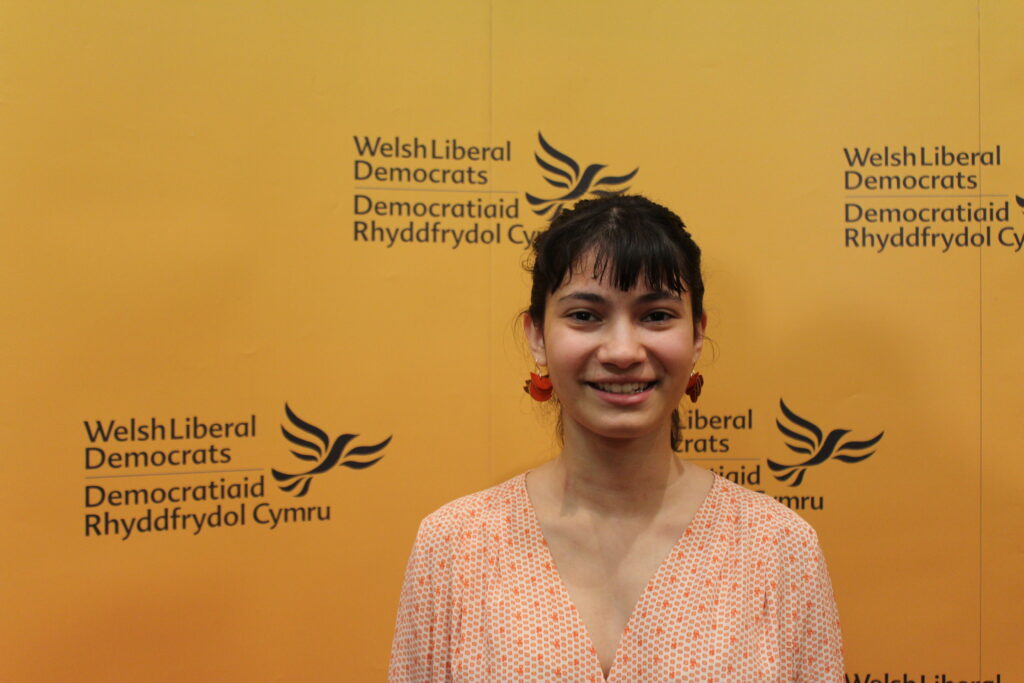
Of course, my name is Leena Sarah Farhat and I am the Diversity Officer for the Welsh Liberal Democrats as well as a candidate for the Senedd. I am 22 and have just finished a degree in Computer Science at Aberystwyth University. I am hoping to be a change-maker in Wales and beyond.
You have previously spoken at or attended The Privilege Café, The Café is advertised as a place to discuss all things privilege. For those who have not yet attended how would you best describe The Café and its work?
Privilege is a loaded word and is becoming superfluous. I would say that the Café is a space for people to try and unpack privilege through thematic lenses. Each week is a new topic and these topics are vehicles to come to conclusions on privilege. I would urge everyone to join the chat because there will be a topic for you.
How did you first learn about The Café and why do you attend?
I saw it on Twitter! I followed Mymuna Soleman (The Director of The Privilege Café) already and I had watched her and many others get frustrated with ethnic minority discourse in Wales as well as people not understanding privilege. I related to that as a young woman who is a minority ethnic and in fields where people like me are hard to find. You can feel really isolated and like you are screaming into the void. I also recognized my privilege, being lucky to be educated as well as sit on Boards. I wanted to play my part to use my privilege to elevate others and see them succeed and so I went to the first-ever one and was hooked!
Is there a specific Café that stays with you and why?
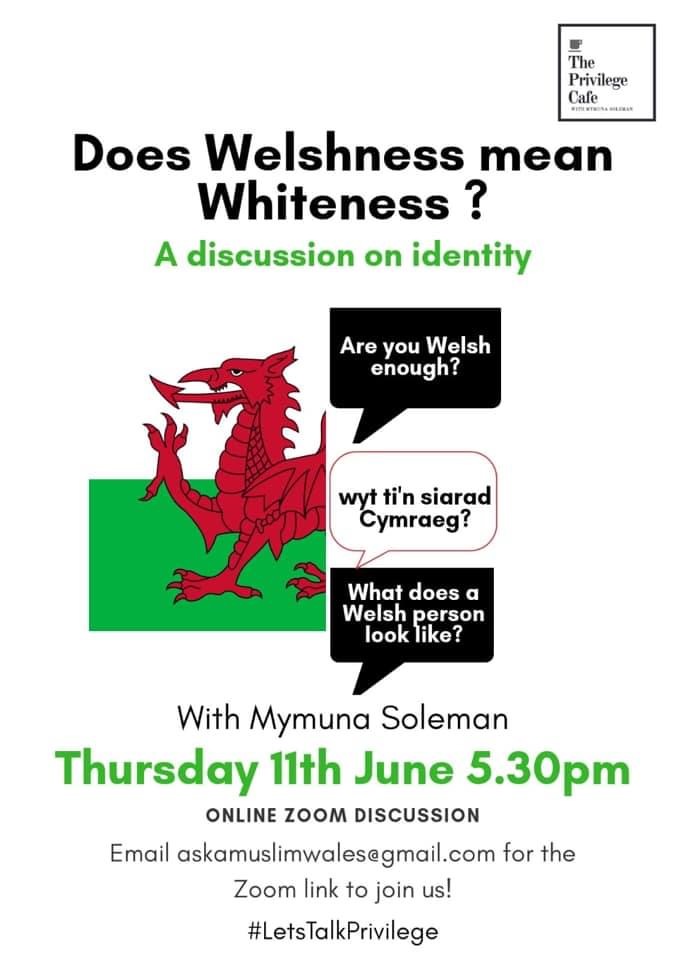
I think the one that I was lucky enough to speak on. We tackled the topic of Whiteness and Welshness. I was so used to being the only person in a room who would think about this topic so it was surreal having a range of other people who shared my experiences. For a second, I felt a bit less alone in Welsh public life. I learned a lot for the other speakers and have implemented it into the work I do.
It’s evident that the work of The Café is hugely important, how would you like the work of The Café to develop?
I would love to hold the Café both in physical locations and online events. I would love to see Mymuna host discussions far and wide, she is an absolute powerhouse and she has brought us together to make change. We have to do that together and everywhere.
Hi Henry, great to meet you, can you give our readers some background information on yourself please?
Sure, my name is Henry Field, I’m a recruitment manager and have been in the sector just shy of 7 years.
You have previously spoken at and attended The Privilege Café, The Café is advertised as a place to discuss all things privilege. For those who have not yet attended how would you best describe The Café and its work?
The Privilege Café is the education around issues faced by, and a platform and voice for Black, Asian and Majority Ethnic people that has been needed for a very long time. It’s a place where BAME community members can feel safe in sharing their experiences, where speakers from different sectors can share knowledge and where we can start to break down barriers and build new foundations for relationships moving forward.
How did you first learn about The Café and why do you attend?
I was a speaker at my first Café, I saw they were asking for recruiters in Cardiff to get involved and speak about bias and how to stand out as an applicant. I attended because I thought I was aware of the issues faced by black professionals getting jobs. I was wrong. Although I was aware of unconscious bias, and able to provide a recruitment service that was inclusive – I had no idea about how big the issue is in Cardiff alone, especially for people living in Butetown and Grangetown.
I was one of 3-4 panel members, with differing views on how we can ensure opportunities are being given where possible. It was Wasim Said from TigerBayABC that asked the question that has stuck with me. “Recruiters and companies will come to these things regularly, especially our recruitment events held in community hubs. You come in, you speak to a few people, you get your pictures for LinkedIn and your website – Then we hear nothing else, Few end up with interviews and less end up with jobs – How are you going to be any different?”
That question had an effect on me I don’t think Wasim realises. He was absolutely right of course, I thought I was just going to be a speaker, share my knowledge and be on my way. It was on that call I made the conscious decision to attend all sessions that I could, including those that as a recruiter, I didn’t think were ‘Relevant’ to my role. After a couple of sessions learning more about the lack of education around history involving black communities in Wales and the issues still faced with racism in the police force in the UK,I realised just how little I knew, and how different my life experience and opportunities have been to people living so close to me. I really understood what privilege felt like.
A bit of a long answer, but I attend because of that. I want to learn, and be a positive ally.
Is there a specific Café that stays with you and why?
Other than the one I spoke at, for the reasons above, the café that sticks with me most was the one around policing within the UK. Hearing how black children need to be warned to always leave the shop with a receipt, always turn out their own pockets when being searched, always make sure they smile at police officers as they walk by – This is information I have never needed to be given. As a white man, If I have the choice not to print a receipt at self-service, I don’t because I feel I’m saving paper, I’ve never been stopped – I never considered such a small action could cause trouble for someone with darker skin. I’ve only ever been searched once in an airport, and that was because me and my partner were at the back of the queue and I think they had to just pick someone. Again, this café made me realise what a privileged life I have.
It’s evident that the work of The Café is hugely important, how would you like the work of The Café to develop?
It probably comes as no surprise that my response here will be recruitment related. I would like to see enough HR professionals, and enough business involved to be able to put on a careers fair different to previous. I would like to see a careers fair attended by decision makers and hiring managers that, as long as the skillset is there, interviews can take place on the spot in another room and real action can be taken to improve the opportunities available to BAME communities.
Thanks for your time
Thank you for the opportunity to share.
Naila Missous
You have previously spoken at or attended The Privilege Café, The Café is advertised as a place to discuss all things privilege. For those who have not yet attended how would you best describe The Café and its work?
I would describe the space as a hub of learning, relearning and application. The discussions had are not empty discussions; but rather, calls to action. Many things have come out of The Café, including courses that members are offering, Patreon support and for myself personally; making connections with other attendees so that we can work together on anti-racism and global citizenship workshops in education. It is also very Wales based, which is great as someone who lives in England as it has been an extra step in my learning.
How did you first learn about The Café and why do you attend?
I first learned about The Café on Twitter, when there was a call out for a speaker with a Linguistics background for one of the earlier sessions. I tweeted by interest, and have been attending ever since as both a speaker, and also listener.
Is there a specific Café that stays with you and why?
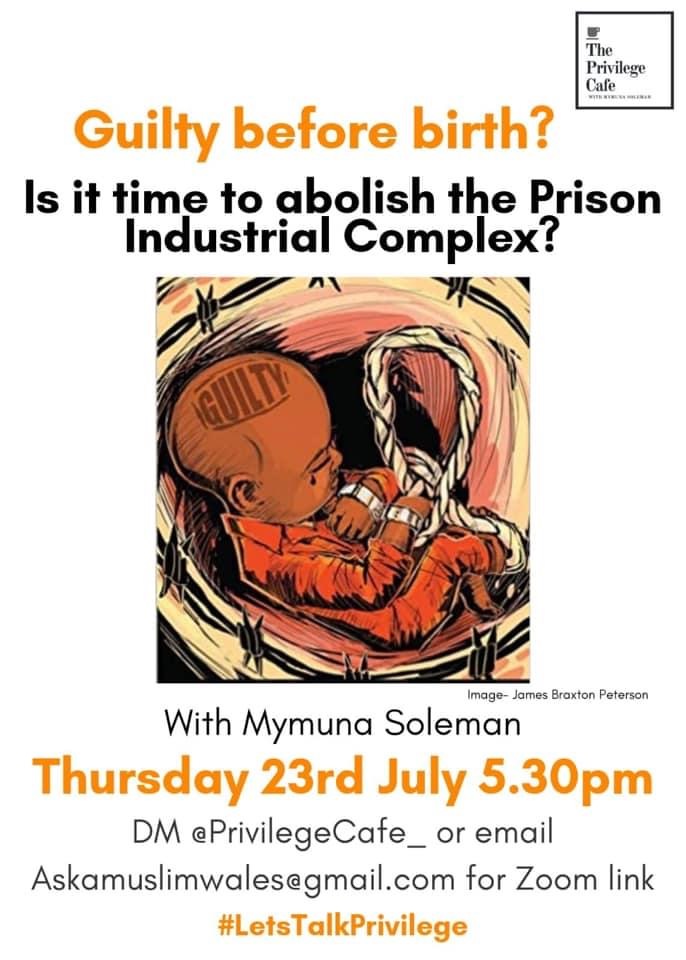
I have enjoyed all sessions, as mentioned above, each session is a learning journey. I in particular enjoyed the session entitled, “Guilty before Birth” about those in the prison system; as it was a topic I was not well versed on yet learned so much.
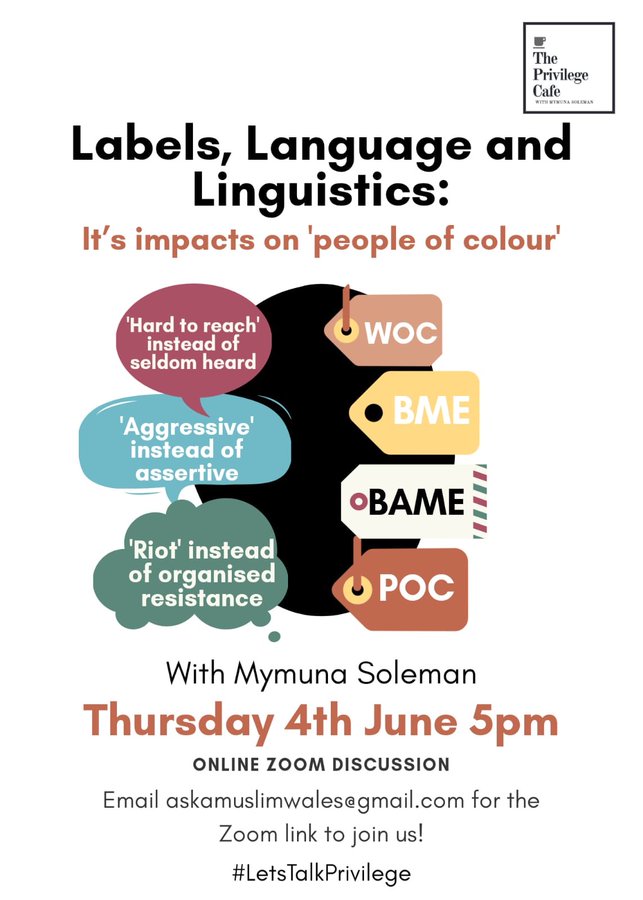
I also enjoyed the “Labels, Language and Linguistics” as this was the first session I ever attended, as well as my first attendance as a speaker. I was unsure as to what to expect as a speaker, given that I am passionate about this subject. The feedback has and still is amazing, and I am forever grateful to the members of the cafe who are supportive, open and always willing to better themselves.
It’s evident that the work of The Café is hugely important, how would you like the work of The Café to develop?
It would be great to create connections and sub cafes across the UK.
Hi Claire great to meet you, can you give our readers some background information on yourself please?
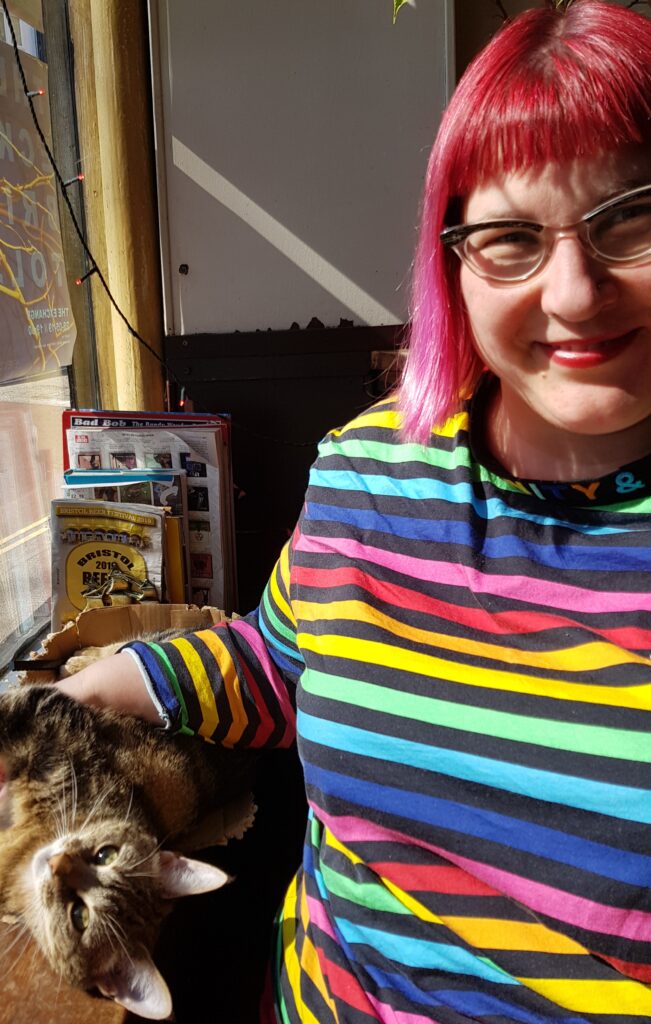
My name is Claire Vaughan, I’m originally from Tintagel in Cornwall and spent time living in the USA, but have lived in Wales for many years. I moved to Cardiff nearly 20yrs ago and worked in various jobs (including call centres, accountancy and a youth hostel) before joining Chapter Arts Centre in 2005. In 2012 I joined the Cinema department doing talks and organising events and became the Programme Manager for Cinema in 2018. In 2018 I began the Shift Cardiff Research and Development Art Space in the Capitol Centre with Jon Ruddick and Pria Borg-Marks which gives space for artists time to work and develop their practice with us. I am a White, cis, Queer woman who lives in Grangetown with my partner and my cat and I have three nieces – two who live in Wales, one living in Germany. I don’t come from a rich background – my mum was a cleaner, my Dad was a carpenter and they really struggled financially at times, but I was incredibly lucky to live at a time when education and travel was easier and so in many ways I am incredibly privileged.
You have previously spoken at or attended The Privilege Café, The Café is advertised as a place to discuss all things privilege. For those who have not yet attended how would you best describe The Café and its work?
Attending The Privilege Café is like being at a big, welcoming community centre where you come to listen to discussions about the world we live in where the conversation is being directed by Black and Non-Black women of Colour. The topics are timely but also cover all kinds of aspects of life – from Mental and Physical Health, national identity, History and Culture. Everyone is expected to come with an open mind and an open heart so we can learn from each other and try and make our world somewhere everyone can thrive no matter what their background or colour of their skin. As a White person entering this space you might get to consider perspectives that you’re not used to hearing, so it can be challenging but really educational and illuminating. The people who are invited to speak at The Café feel safe enough to be really honest, so you may hear stories that shock you and make you question your own behaviour – have you considered these experiences in this detail before? As White people the level of racism in our society can be difficult to grasp, as we don’t deal with the relentless experience of being judged by society every time we step out of our door. Similarly, hearing from White people is useful – how do we feel about these discussions and how do we find it difficult to help? The people speaking at The Café are offering up their real lived experiences and research to help us come to terms with how our society works so it’s important to respect and feel gratitude that they are giving up their time so we can all work on this together. Even those of us who have experienced really difficult times have some things to be grateful for, some level of privilege. Attending the Café and hearing from all kinds of people makes us more mindful of that.
How did you first learn about The Café and why do you attend?
Theatre practitioner Catherine Paskell set up a wonderful discussion early in Lockdown to discuss inequality in the Arts in Wales and I met Mymuna through that. She heard people talking about the issues and thought it would be good to have a follow up discussion on White Privilege since it seemed to be not very well understood. Mymuna doesn’t have an Arts background so I probably wouldn’t have come across her work otherwise as the majority of people I meet are through the Arts these days. I found my thinking being challenged really useful. It reminded me of the discussions we had in the Imagination Symposium with Gentle / Radical and the warmth of the BME Woman’s Club. In the past couple of years I’ve met the fantastic Keith Murrell (Cardiff Bay Carnival); Yvonne Connicke (Cinema Golau), Kyle Legall through Cardiff Animation Festival; Yasmin Begum (whose encyclopedic knowledge always blows me away) – I’m kind of taken aback that I’ve only become aware of the work of some of these wonderful people in the past few years, it demonstrates how segregated the Arts is here in Wales.
Keith Murrell
Kyle Legall
Yasmin Begum
It isn’t enough to say that groups of people are ‘hard to reach’, there is a whole load of exciting work going on getting almost no exposure or funding. We need to work on addressing that. But I don’t attend because of work, I think everyone, no matter what your background or interest has something to learn. It’s up to all of us to make this world better, it’s something I really believe in.
Is there a specific Café that stays with you and why?
I think the story is that effected me most deeply was in one of the first sessions. One of the speakers, a Black Science academic was talking about her first day at University and how she was sat in the lecture hall and no-one came and sat with her, no one tried to befriend her. It stopped me in my tracks because I remember those days so well and how nervous you feel in that situation and I don’t know if at 18 I’d have behaved any differently. I think you seek out people who look like you when you’re new to something and nervous, which was easy enough for me at that age because there were plenty of White women in my lecture room. That simple moment of sharing something painful helped her talk to others about similar experiences and I got a chance to reflect on this and be more mindful of how I am in social situations. It stung, it made me ashamed because it made me consider my unconscious bias but also spurred me on to make sure that I attended as many of the sessions as possible because everyone had a story that made me think differently.
It’s evident that the work of The Café is hugely important, how would you like the work of The Café to develop?
The knowledge passed on by Abu-Bakr Madden Al-Shabazz every week when he talks about the history of Black and Non-Black People of Colour around the world is essential, I’m really glad that he’s started a Patreon (https://www.patreon.com/user?u=39306141) so we can have a history lesson that covers something other than the World Wars, which is all I remember being taught.
I am also glad that Mymuna has started a Patreon (https://www.patreon.com/PrivilegeCafe) because I would like to see her and her speakers invested in by the community. We need to tackle the crisis in funding for public good in the UK (including the Arts and Education) but progress can be slow and people need money to help plan and create now, not in 5 years, so alternative funding is important to donate to. I would like to see publicly funded organisations and councils around Wales to support these initiatives, so it’s not just spread by word-of-mouth in the capital because these aren’t just issues in Cardiff. As a country we are becoming more confident and we need to press on with progressive ideas to help create a better, more inclusive country. More forums where people can talk about their experiences and ideas in every part of the country from all kinds of backgrounds, from rural areas, towns and cities, is needed so we can build up a better future. Wales has welcomed me and I wasn’t born here, it is upsetting to see Black and Non Black Welsh People of Colour not given similar opportunities. Mymuna has made a huge investment in all of us, an investment in hope, by starting The Privilege Cafe. I want Wales to live up to her belief in us.
Hi Dafydd great to meet you, can you give our readers some background information on yourself please?
My name is Dafydd Trystan. I work in Higher Education in Wales for the Coleg Cymraeg Cenedlaethol. I live in Grangetown and I’m active in my local community. I chair governors at Ysgol Hamadryad the local Welsh medium school for Grangetown and Butetown, the most multi-lingual multi-ethnic Welsh school ever!
You have previously spoken at or attended The Privilege Café, The Café is advertised as a place to discuss all things privilege. For those who have not yet attended how would you best describe The Café and its work?
A real opportunity to listen and learn about some of the issues facing society today – in a supportive space.
How did you first learn about The Café and why do you attend?
I think I saw it first on Mymuna’s Twitter feed. I’ve seen some of Mymuna’s work before and its very impressive so I thought I’d go along. There were some topics that were / are of particular interest e.g. Do You Have to be White to be Welsh?
Is there a specific Café that stays with you and why?
Probably the one I mentioned on Welshness and Whiteness. It made me 100% convinced that we needed to do far more to ensure that Welsh speaking spaces are genuinely welcoming and open to all – and we’re not there yet. Following on from The Café, a group of us who spoke got together at Tafwyl and have subsequently presented to a Welsh Government strategy group.
It’s evident that the work of The Café is hugely important, how would you like the work of The Café to develop?
Carry on as it is – but probably needs some more organisational structure to ensure that the excellent conversations can build into action
Thanks for your time
Rhiannon Barrar
Hi Rhiannon great to meet you, can you give our readers some background information on yourself please?
I have attended The Privilege Café many times. I have never spoken but sometimes have contributed to the chat.
You have previously spoken at or attended The Privilege Café, The Café is advertised as a place to discuss all things privilege. For those who have not yet attended how would you best describe The Café and its work?
I would describe The Privilege Café as a place where minoritized groups can safely talk about what it is like living in a world of white privilege and what changes in society must take place to eradicate racism. It has been a place to learn about Black history (and not just slavery). It is a place where white people can listen and learn and investigate their own sub conscious racism and how our system accepts being white as the norm and how they can use their white privilege to support minoritized groups achieve the eradication of racism.
How did you first learn about The Café and why do you attend?
I first learned about The Privilege Café on Twitter when I saw the very provocative title ‘ Does Welshness mean Whiteness. Ydych chi’n gallu siarad Cymraeg’. In the context of the murder of George Floyd, I found this title provocative and it made me question my own attitudes. It never occurred to me that being Welsh and Welsh speaking could be equated with whiteness. I had just never thought about the experience of being Welsh and Black for example. This session was very hard hitting and very challenging to me personally. It was like a road to Damascus.
Is there a specific Café that stays with you and why?
I am eternally grateful to Mymuna for setting up this forum. It is a revelation and an education. Everyone should attend. It challenges you to find a way to do something about racism. Although each session is very well attended and a wide range of ethnicities, I think the challenge is to reach out to socially deprived areas of the country. Many of the speakers are successful professionals. What about reaching out to the unemployed and homeless for example?
It’s evident that the work of The Café is hugely important, how would you like the work of The Café to develop?
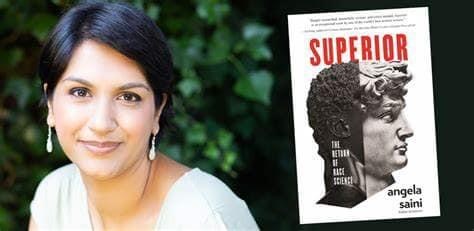
It would be good to explore the origins of racism from a scientific point of view. Where has this idea of race come from? I am reading ‘Superior – The Return of Race Science’ by Angela Saini which explores this question.
Heddiw, mae’r theatr dafarn Caerdydd The Other Room, enillydd Gwobr Theatr Fringe Y Flwyddyn gan The Stage, sydd wedi’i leoli ym mar Porter’s, yn cyhoeddi ei phrosiect Haf 2020, sef New Page. Dengys y rhaglen hon, am y tro cyntaf, gyfle i gynnal Galwad Sgript Agored ar gyfer ysgrifenwyr. Byddant yn derbyn hyd at 100 o sgriptiau llawn, gyda phob un yn derbyn adborth cynhwysfawr gan dîm o ddarllenwyr sgript proffesiynol.
Bydd modd cyflwyno ceisiadau rhwng y 5ed o Awst tan Hydref y 4ydd, ac anelir yn benodol at ysgrifenwyr sydd naill ai yn Gymraeg, wedi’i hyfforddi yng Nghymru neu wedi’i lleoli yng Nghymru. Gobaith y theatr yw i greu partneriaethau creadigol newydd yn ogystal â datblygu’n bellach sgiliau dramodwyr Cymru. Bydd y theatr yn annog ceisiadau gan ysgrifenwyr sydd erioed wedi ysgrifennu i’r llwyfan; gan dderbyn barddoniaeth, straeon byr a dyfyniadau deialog yn ogystal â sgriptiau llawn.
Bydd Yasmin Begum, sydd newydd ei phenodi yn Swyddog Cysylltu Cymunedol, yn ymdrechu i olrhain 30% o’r holl geisiadau drwy waith cyfranogol wedi’i dargedu gyda’r cymunedau hynny o Gaerdydd sydd ar gyrion cymdeithas a gyda phobl efo nodweddion gwarchodedig. Ar ôl y cyfnod derbyn ceisiadau, anfonir rhestr fer at dîm gweithredol y theatr ar gyfer ystyriaeth ymhellach. Caiff ysgrifenwyr y rhestr fer gyfle i dderbyn sesiynau adborth gan Dîm Weithredol TOR, gyda’r gobaith o feithrin perthynas hir-dymor ystyrlon gyda’r theatr.
Dywed Dan Jones, Cyfarwyddwr Artistig The Other Room:
“Prin iawn y bydd sefydliad fel The Other Room yn segur, ond fel y gwyddom i gyd, rydym yn boenus o dawel ar hyn o bryd. Mae hi wedi bod yn gyfnod o fyfyrio dwfn, pryder ac adfyd. Ond yn y drychineb du yma, daw cyfle. Cyfle i droi tudalen. Gan ystyried popeth sy’n digwydd yn ein byd, dyma’r cyfnod i aros, i wrando ac i gysylltu.
Gyda chefnogaeth anhygoel gan Gyngor Celfyddydau Cymru a’r Sefydliad Esmee Fairbairn rydym yn falch i gyflwyno “New Page”, ein platfform ceisiadau agored. Dyma gyfle gwych i artistiaid Cymraeg neu sydd wedi’i lleoli yng Nghymru i gyflwyno eu hunain a’u straeon. Rydym yn ymwybodol nad ydym wedi gwneud digon i gyrraedd ac atgyfnerthu lleisiau sydd heb eu clywed yma yng Nghymru. Dyma ein cam cyntaf bwysig tuag at newid ystyrlon ac ni allwn aros i glywed ganddoch.”
Dywed Yasmin Begum, Swyddog Cysylltu Cymunedol:
“Mae New Page yn fenter sy’n torri tir newydd yng Nghaerdydd i gefnogi ysgrifenwyr ac i greu gwaith newydd. Rydyn wrth ein bodd i gael gweithio gyda gwahanol gymunedau ac aelodau’r gymuned i alluogi ysgrifenwyr i ddylanwadu ar sector y celfyddydau mewn ffordd bositif ac i hybu cydraddoldeb, cynhwysiant ac amrywiaeth.
Byddwn yn gweithio mewn modd arloesol a chroestoriadol i ddarganfod gwaith ysgrifenedig o Gymru a thu hwnt yn y Gymraeg a’r Saesneg. Rydyn yn hynod o gyffrous i weithio gydag ystod eang o ddarllenwyr gan obeithio ddechrau perthynas o gysylltiadau broffesiynol newydd gydag ysgrifenwyr tra yn rhoi cefnogaeth ac arweiniad.”
Cefnogir New page gyda chymorth Cyngor Celfyddydau Cymru, Sefydliad Esmee Fairbairn a chefnogwyr SupportTOR.
Ar gyfer mwy o wybodaeth ynglyn â New Page gan The Other Room, ewch i
Today, Cardiff’s pub theatre The Other Room, located in Porter’s and winner of The Stage’s Fringe Theatre of the Year Award, announces its Summer 2020 project, entitled New Page. The programme will see, for the first time in the theatres existence, an Open Script Submission for writers. They will accept up to 100 full-length pieces of writing, with each receiving comprehensive feedback from a team of professional script readers.
Submissions will be open from 5th August through to 4th October, and is aimed specifically at Welsh, Wales-trained or Wales-based writers. The theatre hopes to forge new creative partnerships and further develop the skills of Wales’ writers. The theatre will be encouraging submissions from writers who have never written for stage before; accepting poems, short stories and dialogue extracts as well as full-length scripts.
Newly appointed Community Engagement Officer, Yasmin Begum, will endeavour to source a minimum of 30% of the total submissions through targeted outreach work with marginalised communities of Cardiff and people with protected characteristics. After the submission period, a shortlist will be sent to the theatre’s executive team for further consideration. Shortlisted writers will receive feedback sessions with TOR’s Executive Team, marking the beginning of what we hope will be a long-lasting, meaningful relationship with the theatre.
The Other Room’s Artistic Director, Dan Jones, comments:
“It is rare for an organisation such as The Other Room to sit still, but as we all know, right now, we are painfully still. It has been a period of serious reflection, anxiety, and adversity. But buried deep in this catastrophe there is opportunity. An opportunity to turn the page. With all that is going on in the world, now is the time to stop, to listen and to connect.
With the incredible support of Arts Council Wales and the Esmee Fairbairn Foundation we are pleased to present “New Page”, our open submission platform. This is a fantastic opportunity for Welsh and Wales-based artists to introduce themselves and their stories. We know we have not been doing enough to reach and empower unheard voices here in Wales. This is our first important step towards meaningful change, and we cannot wait to hear from you.”
Community Engagement Officer, Yasmin Begum, comments:
“New Page is a groundbreaking initiative based in Cardiff to support writers and the creation of new work. We are thrilled to work with different communities and community members to engage writers to positively impact the arts sector and promote equality, inclusion and diversity.
We will be taking an innovative and intersectional approach to source written work from across Wales and beyond in the medium of English and Welsh. We’re really excited to be working with such a broad range of readers and hopefully start the beginning of new working relationships with writers as we offer support and guidance.”
New Page is made possible with the support of Arts Council Wales, Esmee Fairbairn Foundation, and our SupporTOR donors.
Creating opportunities for a diverse range of people to experience and respond to sport, arts, culture and live events. / Lleisiau amrywiol o Gymru yn ymateb i'r celfyddydau a digwyddiadau byw