Trigger warnings for the show: strong language, violence, and homophobic and transphobic slurs.
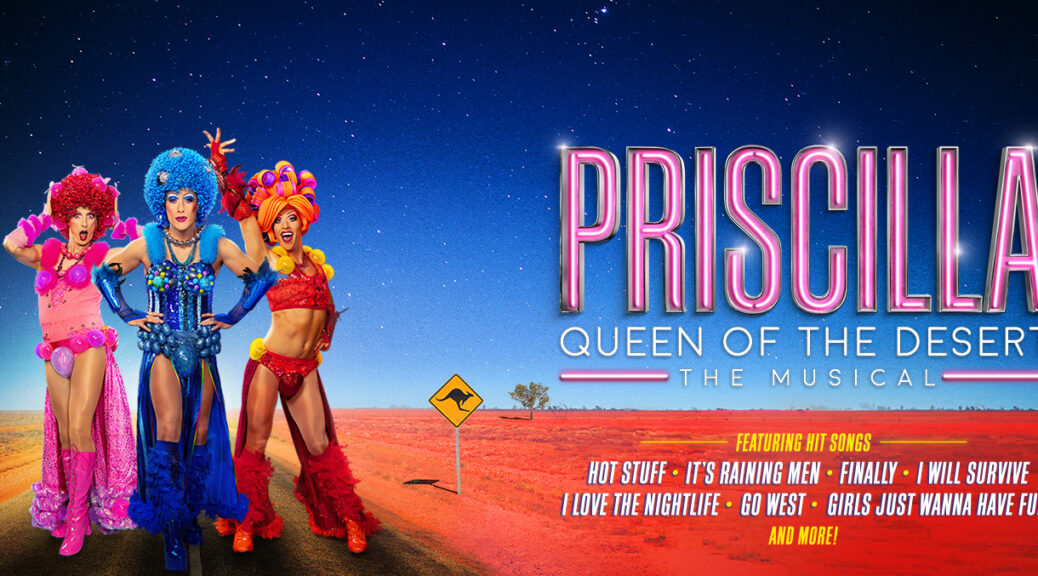
Before there was RuPaul, there was Priscilla – who, like Divine and Crystal LaBeija before her, brought drag to mainstream attention. The 1994 movie, starring Hugo Weaving, Guy Pearce and Terence Stamp, won an Oscar for its spectacular costume design and introduced a new generation to a thrilling world of glitz and glamour, a world to which the stage musical eagerly wants us to return after being left so long in the COVID wilderness. Racy, rowdy and rambunctious, Priscilla Queen of the Desert is a riotously fun time that reminds you exactly why live theatre is irreplaceable and invaluable.
It’s thrilling to be back in the New Theatre after so much time away, and the Priscilla UK Tour is the perfect show to welcome us back through its doors. The show centres on three drag queens, two cis men and a trans woman, who journey across the Australian Outback on the titular tour bus. Tick/Mitzi Mitosis (Edwin Ray) persuades two close friends – egocentric ingénue Adam/Felicia Jollygoodfellow (Nick Hayes) and drag doyenne Bernadette (Michael Western) – to perform their act at a casino in remote Alice Springs, where Tick will have the opportunity to reconcile with his estranged wife and son. Along the way there are sequins, setbacks, and singalong disco classics that will have you dancing (COVID-safe) in the aisles. Fun, filthy and fabulous – Priscilla puts the ‘extra’ in ‘extraordinary’!
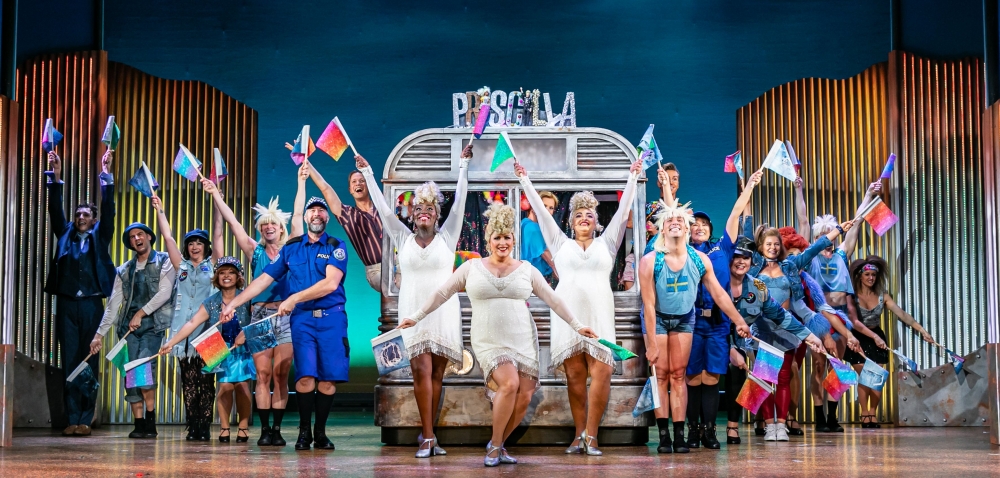
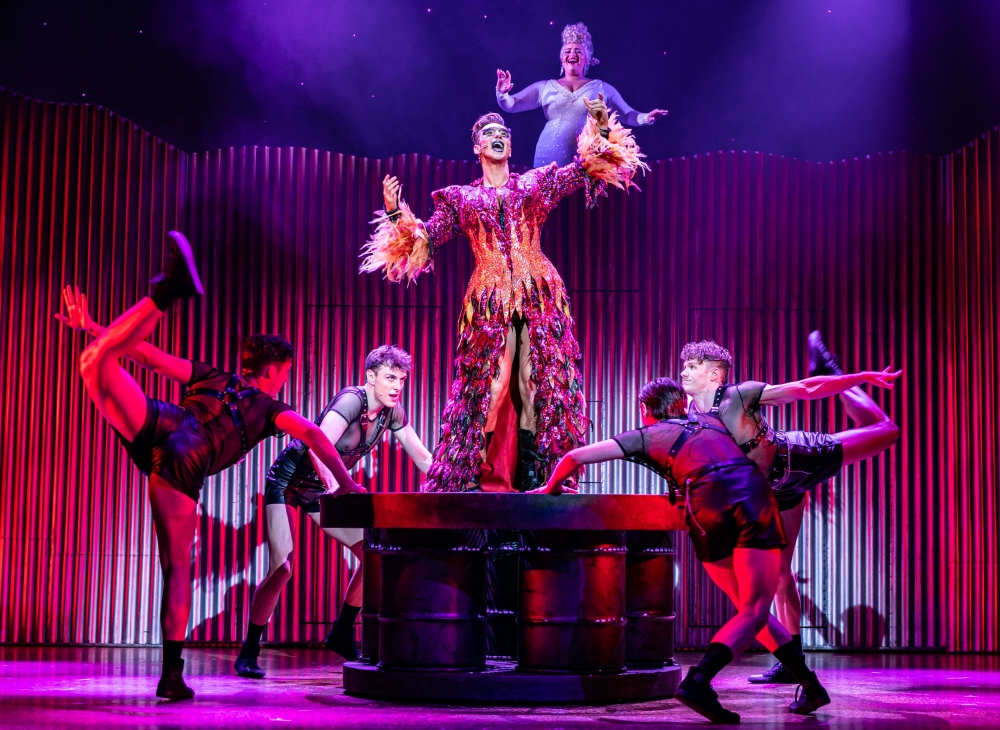
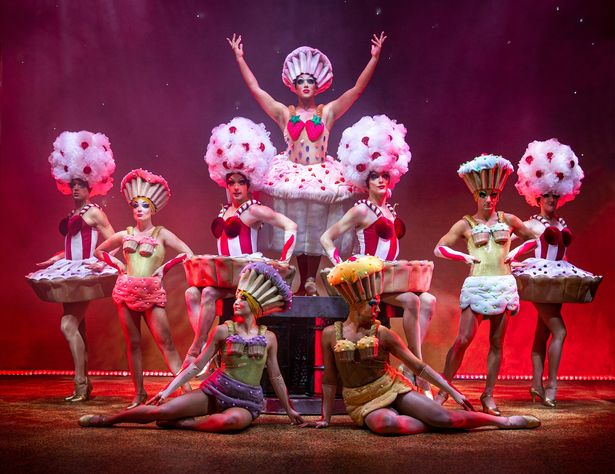
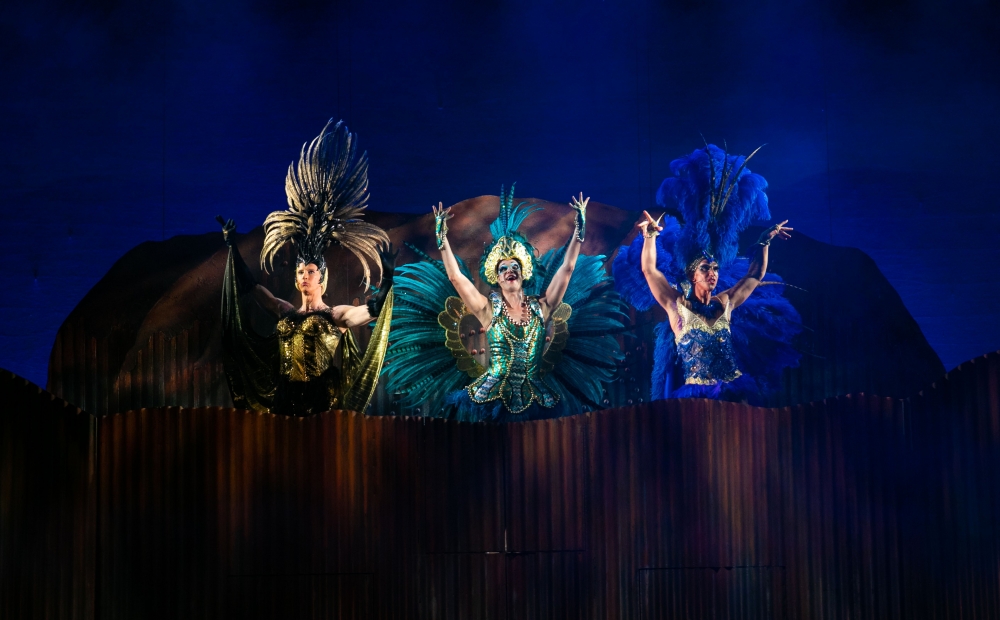
Directed by Ian Talbot and produced by Mark Houcher and Jason Donovan (who originated the role of Tick on the West End), the show is a jukebox musical brimming with camp classics from ‘Boogie Wonderland’ to ‘Go West’ to ‘Hot Stuff’. Every musical number is joyous and unique, and songs are beautifully woven throughout (like Dionne Warwick’s ‘I Say a Little Prayer’, which recurs in its most poignant moments). While the humour might feel dated at times, the songs never do. Charles Cusick-Smith’s sublime costumes do justice to the Oscar-winning originals while bringing a new flair and Tom Jackson-Greaves’ excellent choreography lights a kinetic spark that burns throughout the show – they, along with the exceptional live band (directed by Richard Atkinson), ensure that the production is a feast for the eyes and ears.
The level of talent on display is staggering. Edwin Ray brilliantly anchors the ensemble as a man trying to marshal all the facets of his identity, while Western’s Bernadette exudes Old Hollywood grace and glamour and Hayes’ Felicia bags all the best songs, including a truly show-stopping entrance number – you’ll know it when you see it. I have never seen a happier ensemble: from the main trio to the Three Divas (Claudia Kariuki, Aiesha Pease and Rosie Glossop) to the performers dressed variously as giant cupcakes, dancing paintbrushes and plaid-clad delinquents, the cast’s unadulterated joy at being back in action was palpable.
While the zingers sizzle and the sequins glitter, Priscilla doesn’t gloss over the real-life hatred and violence inflicted on the LGBTQ+ community. Bernadette not only faces transphobic bullying from bigoted straight people but from Adam, who repeatedly deadnames and misgenders her. Adam himself is the victim of an attempted assault, and even apparent allies can turn out to be fair-weather friends when the sun rises. Though the central trio often bicker and Priscilla often breaks down, they stick together and they neither give up nor turn back, proving that true allies are there even after the music stops and the engine fails.
Priscilla concludes that, no matter how long and winding the road, your family will always be waiting to welcome you home at the end of it – and that true family are the ones who stay by your side no matter how bumpy the ride. Family are the people who climb mountains with you, both literal and figurative; they are the people who help you follow your dreams. When the audience rose, as one, for a much-deserved standing ovation, it felt like the best kind of dream: the one that comes true.
After endless months of lockdowns, Zoom hangouts and laughable attempts to bake banana bread, we’re all dusting off our boots and getting our sequins out of storage as we take a step back into ‘ordinary’ life following an extraordinary year and a half. But Priscilla Queen of the Desert is here to put the ‘extra’ in ‘extraordinary’!
The UK Tour is the inaugural event of the New Theatre’s much-anticipated reopening, and there truly couldn’t be a better show to welcome us back. Based on the Oscar-winning 1994 filmwhich starred Hugo Weaving, Guy Pearce and Terence Stamp, Priscilla Queen of the Desert centres on three friends as they journey through the Australian outback in the titular tour bus. Produced by Mark Goucher and West End icon Jason Donovan (in his producing debut), the show stars Miles Western as Bernadette, Nick Hayes as Adam/Felicia, Edwin Ray as Tick/Mitzi, who lead an amazing ensemble through such classic tunes as ‘It’s Raining Men’, ‘Hot Stuff’, and ‘I Will Survive’ and many more.
After so much uncertainty for so long, it’s amazing to be seeing a show which proclaims to be ‘pure joy guaranteed’ – and I for one can’t wait to hitch a ride.
Get the Chance supports volunteer critics like Barbara to access a world of cultural provision. We receive no ongoing, external funding. If you can support our work please donate here thanks.
Living in lockdown after lockdown has facilitated more binge-watching than ever before, and a lot of us have taken the chance to catch up on shows we missed the first time round. I’ve finally caught up on Fringe, Red Dwarf, and Life on Mars/Ashes to Ashes. I’ve rewatched more of the Stargate franchise than is healthy and puzzled my way through Neon GenesisEvangelion. But two of my personal lockdown favourites, Spirited and Starlings, happen to have something (or, rather, someone) in common: and that’s Matt King.
King is known to many as Peep Show’s lovable crack addict Super Hans, but I first knew him as charming grifter Cookie in Guy Ritchie’s RocknRolla, in which he effortlessly stole scenes from the likes of Gerard Butler, Idris Elba, and Tom Hardy. While he’s perhaps best known for playing wide boys and weirdos onscreen (to great effect!), he’s also a dab hand behind the camera, having co-written and produced series like sketch comedy Dogface, acerbic sitcom Whites, and the subject of this review, Sky 1’s family dramedy Starlings.
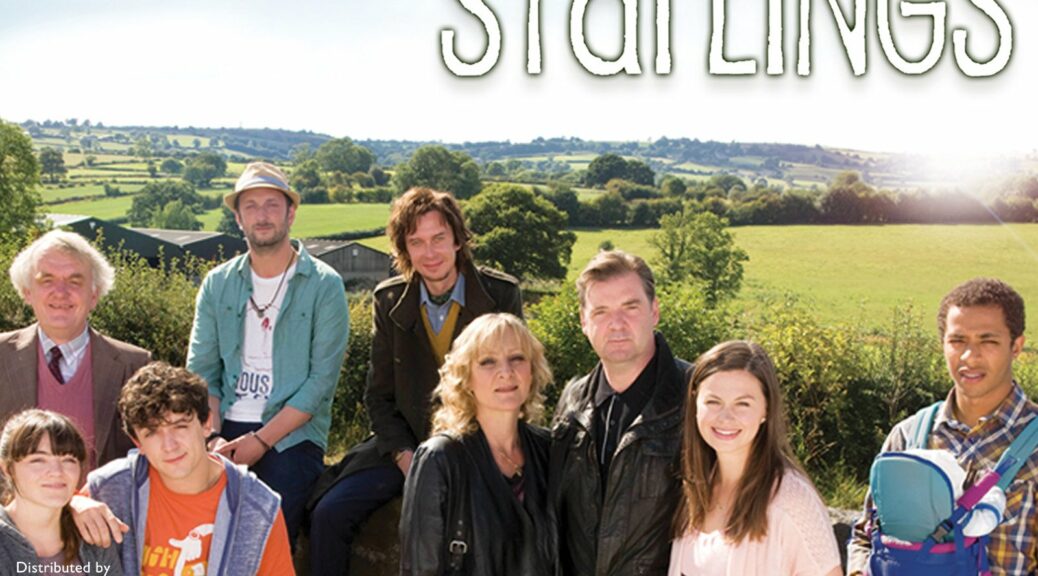
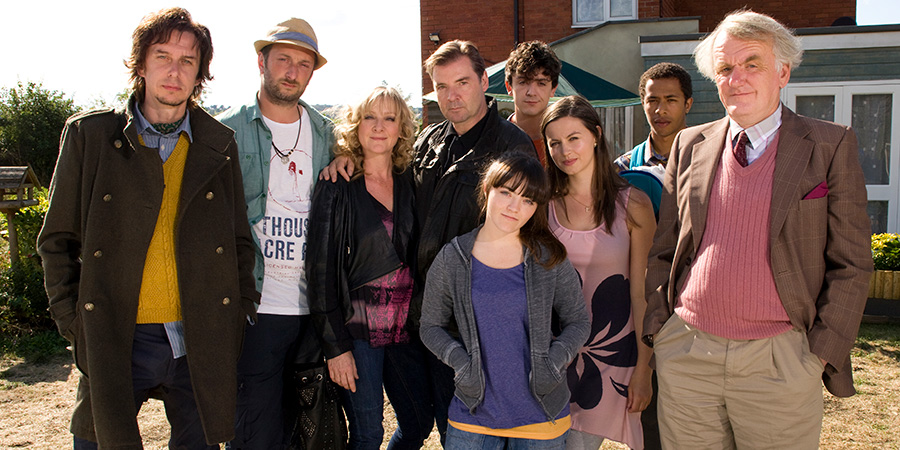
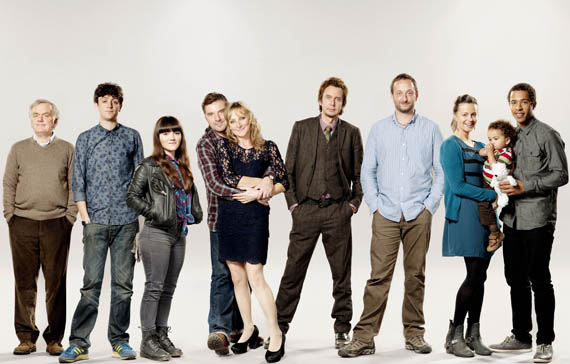
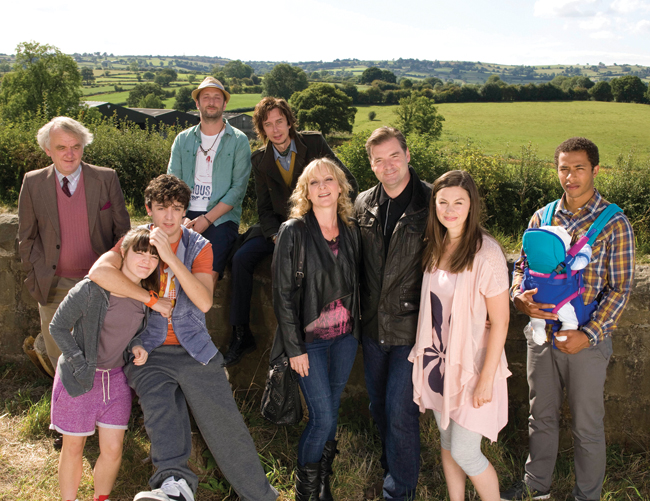
Written by King and Steve Edge (who also star) and produced by Steve Coogan, the series follows four generations of the lovable and slightly chaotic Starlings, an everyday working-class family who all live under one roof. At its heart is happily married couple Terry (Brendan Coyle) and Jan (Lesley Sharp), and their three children: eldest daughter Bell (Rebecca Night), separated from her boyfriend Reuben (Ukweli Roach) on the eve of giving birth to their son; Gravy (John Dagleish), the layabout son with a penchant for reptiles; and Charlie (Finn Atkins), teenage football hopeful and seemingly the only person in the family who’s got it together. Add in Jan’s jack-of-all-trades nephew Fergie (Edge), eccentric Granddad Billy (Alan Williams), and Billy’s long-lost son, Loz (King), and the Starlings’ detached red-brick house is getting rather cramped by the end of the pilot.
Set in Matlock, Derbyshire under perpetually blue skies, the world of Starlings is beautiful to look at and to live in. King and Edge set out to make a comedy drama without the caricatures you’d find in your common garden soap opera, and they succeeded: while its contemporaries wring laughs from families falling over, falling out, or downright falling apart, Starlings is about people who both love and genuinely like each other – even when they get on each other’s nerves. There’s not a weak link in the cast, and their rapport feels natural and lived-in. Honest, gentle, and understated, Starlings delights in the everyday. It doesn’t just give you a window into family life – it makes you feel part of that family.
In doing so, it manages a deceptively tricky balance: it’s warm and genuine without being twee, funny without being farcical, snarky without being mean-spirited. It has an eye for detail and the small, quietly meaningful moments of life that other series tend to trample on or overlook entirely. It thoughtfully subverts toxic masculinity and crafts characters you relish spending time with. It’s also very refreshing to have a series where people are not just happy, but profoundly relieved, to be able to go home to their loved ones at the end of the day. In the Starlings’ world, family is sanctuary.
On an aesthetic level, Starlings is ideal summertime viewing. In many ways a modern pastoral, the series immerses you in a bucolic fever dream of British rural/town life that is still rarely seen on screen. Watch it in the winter, and you can feel the balmy breeze rustling through the trees of the Starling homestead; see it in the summer, and you can sense its warmth spilling over the edges of the screen. It was clearly a joy to make, and that affection is apparent in every frame – no wonder it attracted the likes of Dolly Wells, Cherie Lunghi, Vincent Regan, and Una Stubbs to guest star.
As I wrote about the dearly departed Spirited, discovering a gem of a show years after it’s ended is something of a double-edged sword. On the one hand, there’s the injustice of it being taken before its time, the realisation that there is a finite amount of the thing you love; a story unresolved. On the other, it’s like happening upon buried treasure; a rare jewel you never even knew existed and now couldn’t bear to be without. The appeal of unthreatening mediocrity means that countless copy-paste procedurals run ad infinitum and gems like Starlings get struck down in their prime. I wish it could have gone for longer. I wish it would come back. But whatever its fate, I’m grateful it exists in the world. It takes a little time to worm its way into your heart, but once it does, the Starlings come home to roost – for good.
Starlings is streaming on iTunes, Apple TV, Google Play and Amazon Prime Video.
Review by Barbara Hughes-Moore
Get the Chance supports volunteer critics like Barbara to access a world of cultural provision. We receive no ongoing, external funding. If you can support our work please donate here thanks.
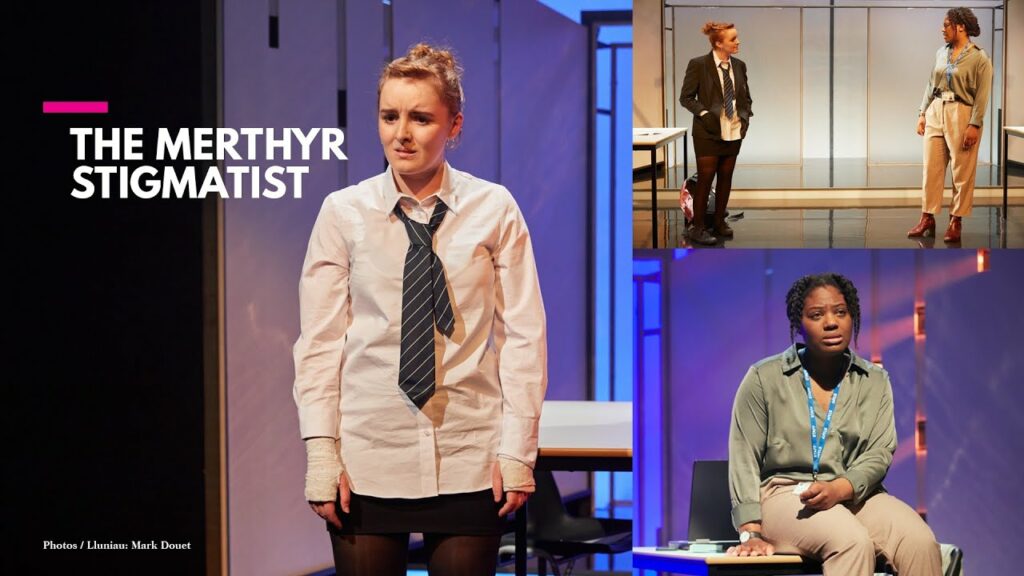
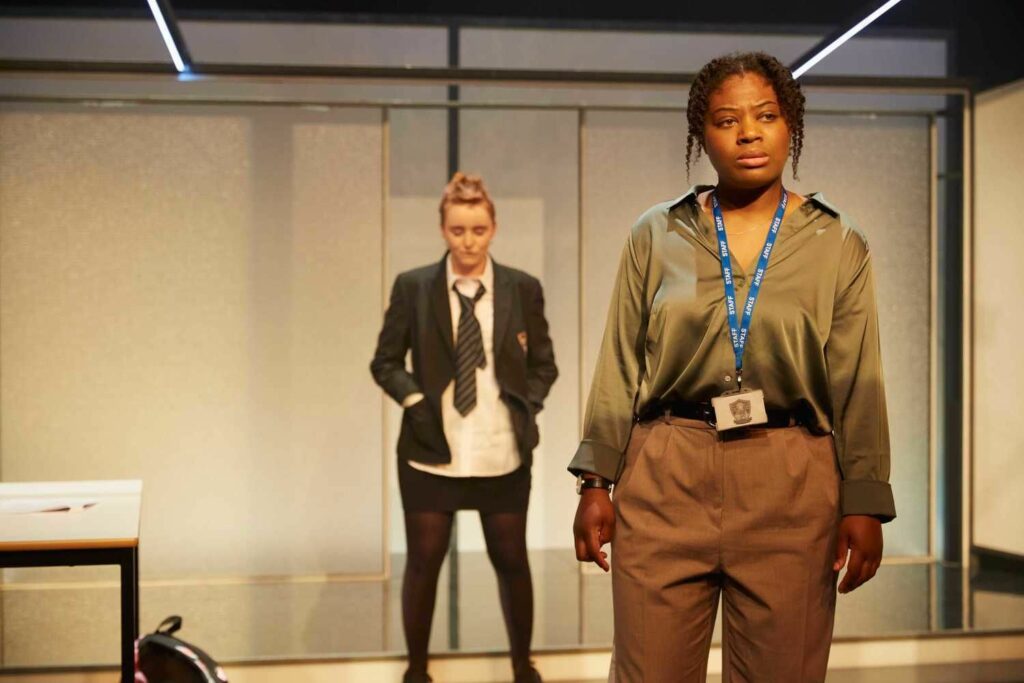
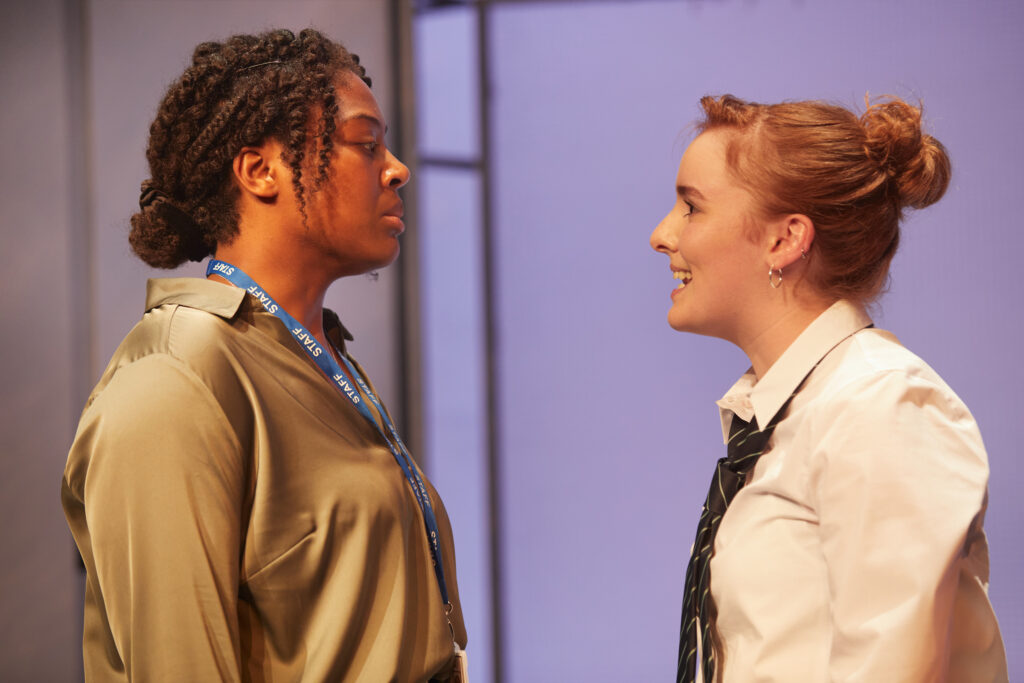
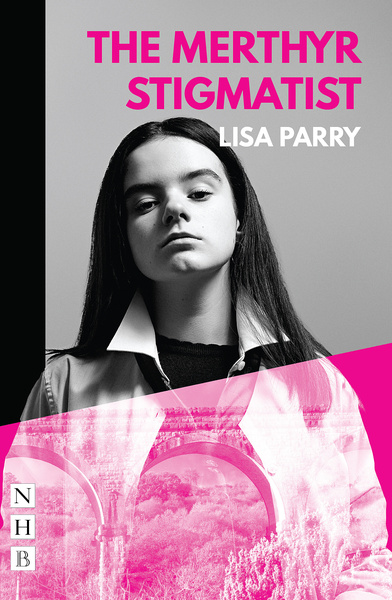
“Do I literally have to bleed in front of you to get you to listen?” This is the question that haunts Lisa Parry’s visceral new play. Co-produced by the Sherman Theatre and Theatre Uncut, The Merthyr Stigmatist is a lean, lacerating two-hander that tells the story of sixteen-year-old Carys (Bethan McLean, in her professional debut) who claims to have received the wounds of Christ. Meanwhile, her sceptical teacher, Siân (Bethan Mary-James), struggles to believe that the hand of divinity has alighted, of all places, on Merthyr Tydfil.
It’s hard to express just how incredible it is to have the Sherman Theatre back. They’ve kept the artistic flame burning through unprecedented circumstances, and their latest production is a blazing triumph of personal and epic proportions. Parry’s play nimbly traverses the rocky terrain of politics, culture, and faith, and director Emma Callander, marking the tenth anniversary of Theatre Uncut’s founding, brilliantly balances tension and emotional tautness as the play moves pacily through beat after enthralling beat.
The Merthyr Stigmatist at the Sherman Theatre
Writer Lisa Parry
Director Emma Callander
Designer Elin Steele
Composer Eädyth Crawford
Sound Designer Ian Barnard
Lighting Designer Andy Pike
Assistant Director Carli De’La Hughes (Supported by Ashley Family Foundation)
Fight Director Kev McCurdy
Carys Bethan McLean
Siân Bethan Mary-James
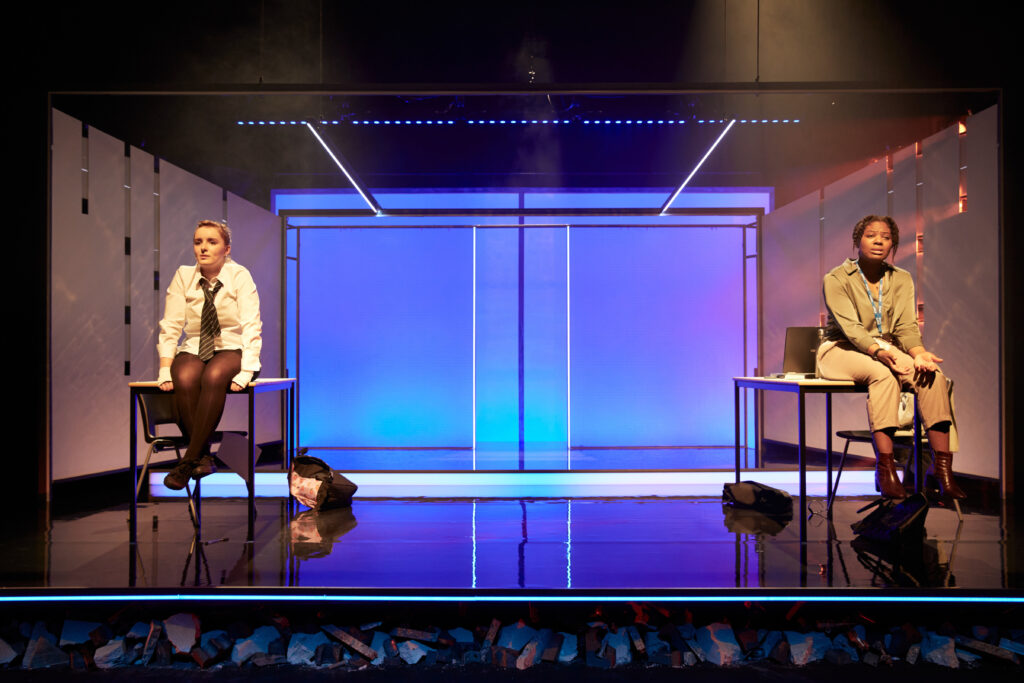
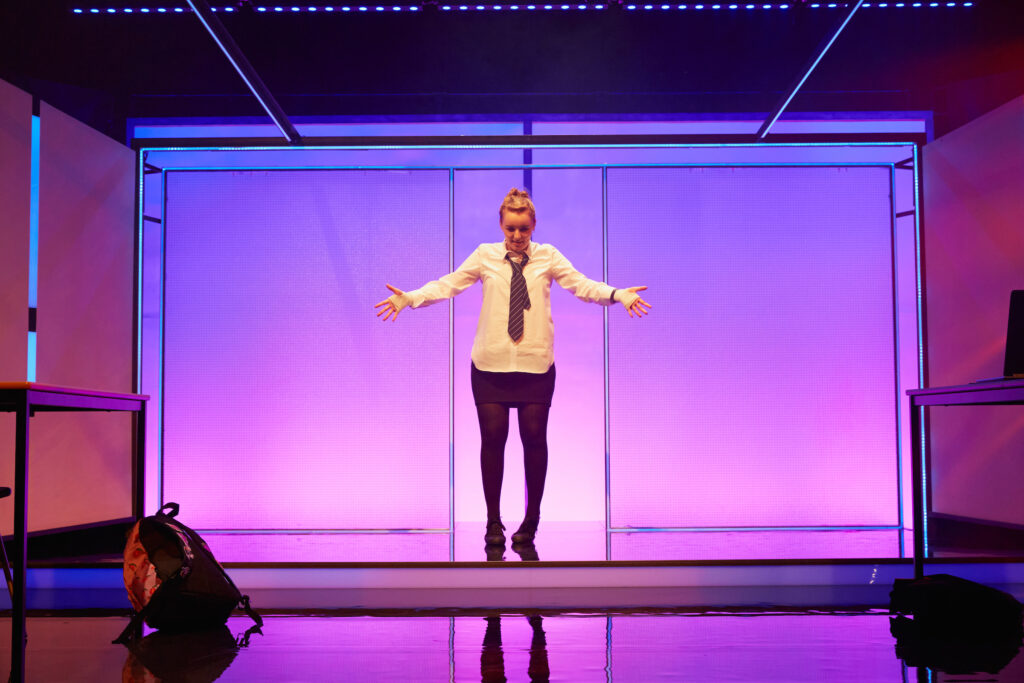
McLean and Mary-James are not merely mirrors, personalities bleeding in between the cracks; they are each other’s prism. To bring more characters to the stage would have refracted the light these two blistering performers throw on each other. (Aptly, the patriarchal (God)head Mr Williams remains unseen and offstage). As the power dynamics shift they prowl around Elin Steele’s sinisterly symmetrical set, which variously evokes a classroom, a cage, and a confessional. Bordered by liminal space, and brought to pulsing life by Andy Pike’s vivifying lighting, the only signifiers of the outside world are the choruses of Carys’ disciples and a line of what looks like rocks, perhaps Welsh slate, lining the front of the stage. At first glance, it looked like kindling for a martyr’s pyre – but on further reflection, I detected littered scraps of the Valleys’ industrial past, and it called to mind the Welsh towns that were flooded to provide English regions with water: Tryweryn and Elan, Llanwyddyn and Claerwen. Each one an Atlantis. The ruins of these stolen cities can sometimes be seen on warm days.
Intergenerational Welsh trauma is a wound that runs deep in the show. The spectre of Aberfan is invoked more than once, and Carys chastises her teacher for leaving her hometown (and accent) behind for pastures new in Cardiff, which might as well be ‘a different world’. In comparison to the vibrant, distinct Valleys community ‘where we look after each other’, Cardiff is ‘somewhere that could be anywhere’, a metropolis in the mould of many before it. While potrayals of the Valleys have historically honed in on negative stereotypes, Parry’s play is a moving paean to Merthyr and its individuality, its beauty and its love, its humour and its character, and above all its sense of community.
Merthyr Tydfil, or ‘Tydfil the Martyr’, is named after the daughter of an ancient Welsh King, who was known for her compassion and healing skill. Her sister formed a religious community in what is now Aberfan – a vivid reminder that we are never far away from our saints. Tydfil did not run when Picts invaded her land: she knelt calmly and prayed. Parry’s play is very much in the spirit of its martyred namesake. You cannot heal a wound, or a town, by running from it. Ivan Illich described the stigmata as an ‘individual embodiment of… contemplated pain’, and Carys, like her peers and the generations to come, will have to bear the marks of damage wrought by their forebears. But, like the diamonds in Carys’ mock science exam, like the gems of the coalfields and of the pits, something special and beautiful can be formed under immense heat and pressure. You just have to know where to look.
Recorded live during the pandemic and available to stream online through to 12th June, The Merthyr Stigmatist is just under an hour of utterly transcendent theatre. It unflinchingly addresses mental health, rape culture, and self-harm, and makes space for women’s rage. The show itself is an open wound, presented to us, palms up, asking for supplication, or succour, or simply to be seen. Are the holes in Carys’ hands and feet the marks of divinity, or of delusion? That is a question for you to answer, but in doing so, you might risk missing the miracle entirely.
Get the Chance supports volunteer critics like Barbara to access a world of cultural provision. We receive no ongoing, external funding. If you can support our work please donate here thanks.
To exist, socially, at this moment in time, we have to live online, disembodied and digitized, encased within the four corners of a Zoom call. Siloed away, with nowhere to go and no-one to see, it’s unsurprising that we’ve looked to social media as a sanctuary; a digital lifeboat in a shared storm. But while it might give the illusion of solidarity, it can also make you feel the most alone you’ve ever felt in your life, and the gulf between the digital self and the ‘real’ grows wider with every like, comment, and subscribe.
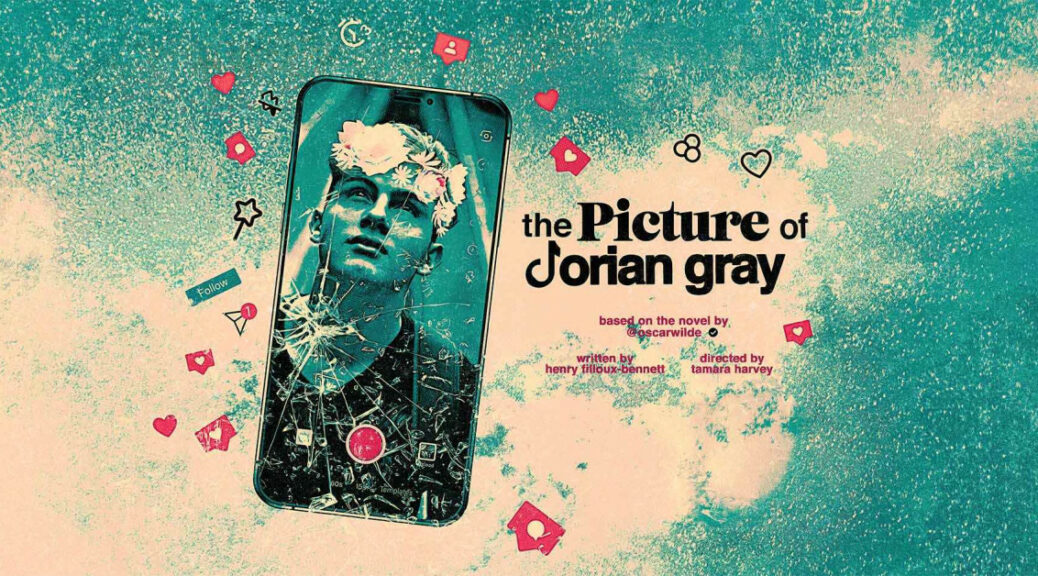
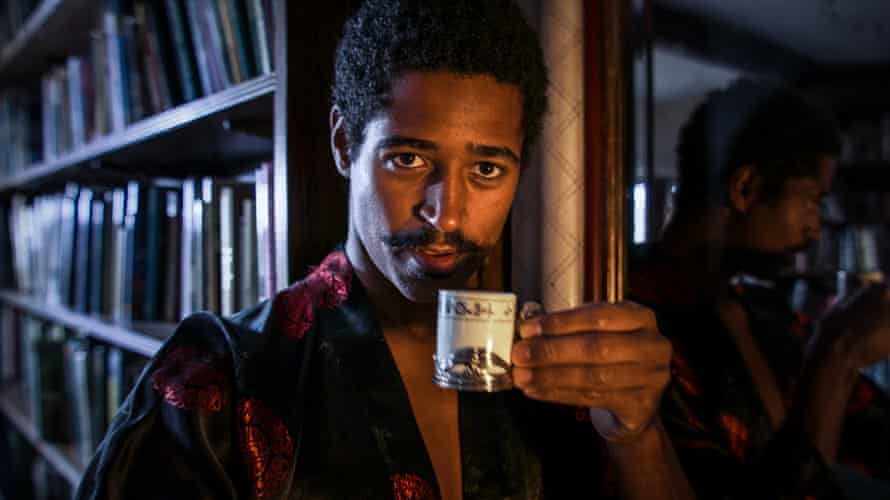
It’s a duality that Theatr Clwyd’s clever and inventive adaptation of Oscar Wilde’s The Picture of Dorian Gray revels in. Directed by Tamara Harvey and written by Henry Filloux-Bennett, this online play is an ambitious co-production between Theatr Clwyd, Barn Theatre, Lawrence Batley Theatre, New Wolsey Theatre and Oxford Playhouse, and features a star-studded cast including Russell Tovey, Alfred Enoch, Joanna Lumley and Stephen Fry (whose very appearance is something of an easter egg).
Not only does this version update Dorian Gray for the Instagram age, it sets most of the action in 2020 when its characters (and cast), like the rest of us, were in self-isolation. Sleekly made and brilliantly performed, it plays out in a series of FaceTimes, YouTube videos, Insta Stories, and interviews with the surviving characters. It’s an incredibly involving piece in the same vein as other internet-set mysteries like Catfish, Searching, and Unfriended, but with the kind of quality that you only find in a truly excellent piece of theatre.
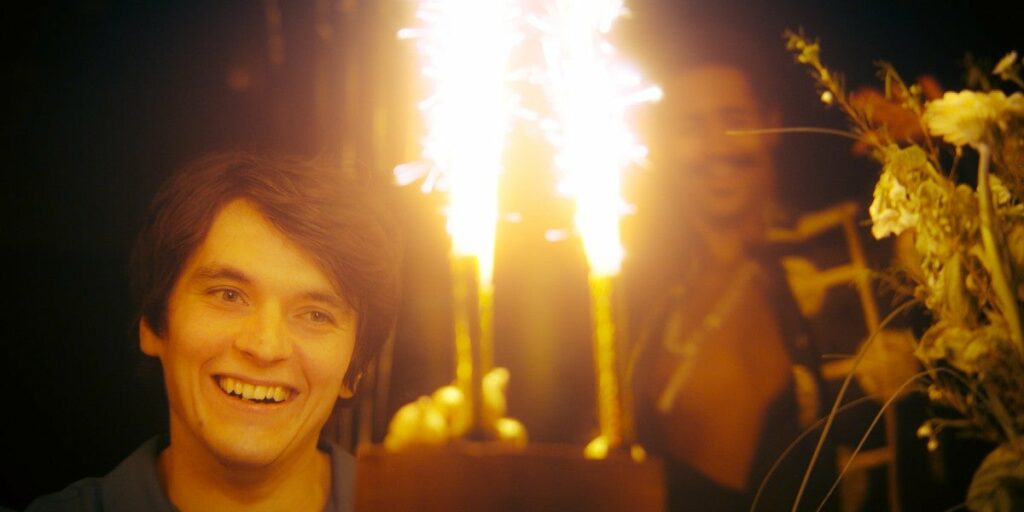
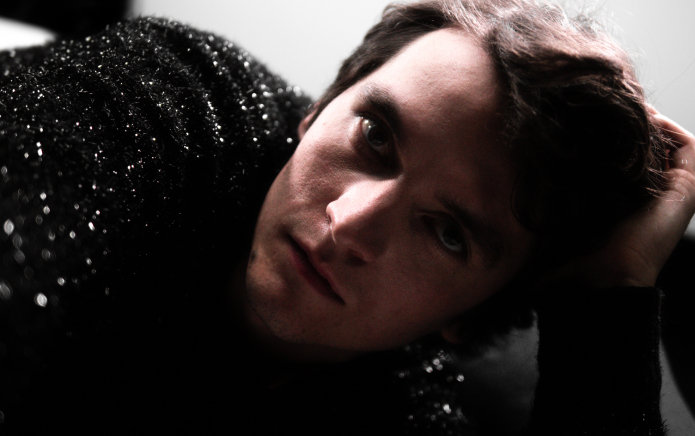
This Dorian (Fionn Whitehead) starts out as a sweetly naïve English lit undergrad trying to make it big on YouTube, aided by his rakish BFF Harry Wotton (Enoch), family friend Lady Narborough (Lumley), and besotted benefactor Basil Hallward (Tovey). Basil, a closeted programmer who’s made little effort to conceal his feelings for Dorian, plies him with gifts – clothes, mobile data, a smart phone – and offers him a very special filter that will ensure his pictures will remain ever flawless and ageless: “a perfect digital Dorian”. There’s no catch, because the price is something that carries little currency in the digital age: your soul.
Filters give the illusion of perfection. They are insidious because they are invisible, and they make you feel as if being beautiful and happy and successful is natural for everyone in the world but you. Uploading a selfie to the digital panopticon takes deliberation, intent, and often deceit: the background, the lighting, the clothes, the hair and makeup, the filter – even the most spontaneous looking snap is a meticulously oiled machine. As Basil says, we spend our lives comparing ourselves to everyone else’s highlights. The greatest trick the influencers ever pulled was convincing the world that they woke up like this.
In many ways, the amorphous, abstract identity of social media is embodied by Basil himself, who becomes both the painter and the canvas. Basil, who we rarely see ‘in the flesh’, is simultaneously omniscient and insidious. Tovey, one of the finest actors working today, is characteristically magnificent here – but I’m not sure how I feel about Basil, rather than Harry, being Dorian’s tempter. In the novel, Basil didn’t want Dorian’s soul, he wanted his heart. But, perhaps, in order to translate the essence of the story, it’s necessary to share some of Harry’s original menace with Basil, turning the sombre, soulful painter of Wilde’s original into a low-key Svengali.
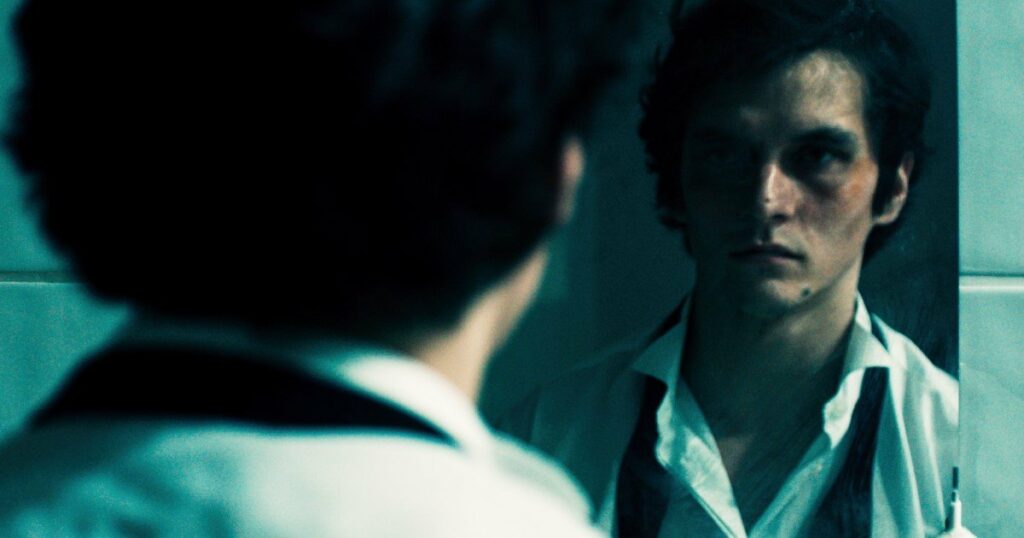
The mechanism of the Faustian bargain is reversed here too – the painting in the novel preserved Dorian at his peak, and grew more decrepit as his sins accrued, but here the filter enhances Dorian’s onscreen beauty while his flesh rots in the real world. The visual effects marking Dorian’s physical decline are brilliant and subtle – I truly couldn’t tell whether it was makeup or CGI – and Whitehead’s transformation into a Sargon of Akkad or Onision-esque shock jock is genuinely unsettling (the moment where he starts glitching between his two faces was particularly eerie). What’s less convincing however is his success as a social media influencer.
‘What if Joe Sugg became Jake Paul?’ That’s seemingly the question posed by the play, and we’re told from the outset that wherever Dorian goes, he charms the world – but that’s simply not the impression we get from the sweet, sensitive, introvert presented here. And his rapid rise to fame never fully convinces, because while his clothes get progressively fancier, his manner, home studio set-up, and even the editing style never rings true (the fairy lights on his shelf were a nice touch, though). Emma McDonald’s Sibyl Vane is far more authentic: McDonald captures Sibyl’s kindness and her fragility, and she really nails the Insta aesthetic right down to the dreamy line delivery and the flower crowns.
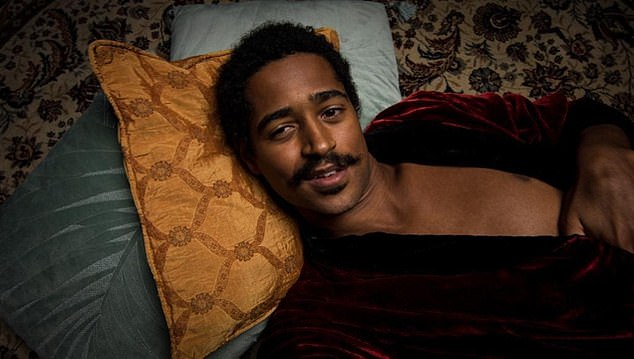
Sibyl tragically falls prey to the toxic celebrity culture normalized by Harry (Enoch), rebranded here as a louche Made in Chelsea-esque socialite who lives the decadent lifestyle of a reality star. Enoch gives easily the most entertaining performance in the play, not to mention the most authentic interpretation of his literary counterpart, sprawled across a velvet chaise-lounge and elegantly sassing the ‘incessant’ barrage of theatre livestreams in #Lockdown1 like a latter-day Contrapoints.
His scenes with Whitehead and Tovey are mesmeric; Filloux-Bennett transforms the subtextual queer yearning underscoring the novel into text, and even separated by a screen, a Wi-Fi connection, and who knows how many miles, the chemistry between the central trio is off the charts. Wilde once confessed that he could ‘resist everything except temptation’. Social media is a creature of temptation, luring you in with a clickbait headline or an exclusive tell-all. It promises everything and gives nothing. It can facilitate cruelty without conscience or consequence and lives have been ruined, lost and taken. And none of us can say it’s not our fault: responsibility is fragmented between everyone who takes part in and enables this vicious culture of competition.
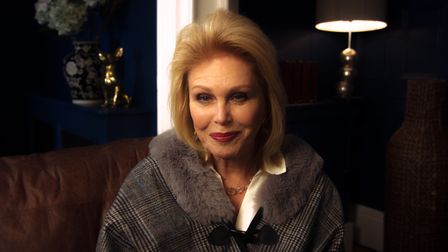
Lumley, sublime as always, delivers a monologue on how social media is ‘viral’ in every sense of the word: a poisonous contagion that’s infected the whole world. But just as The Picture of Dorian Gray showcases the internet’s ugliness, it also illustrates its beauty: its ability to connect people from across the globe in the shared experience of storytelling. Far from the isolating spiral of the doom scroll, this production illustrates the joy of collaboration, of creativity, and of art persevering in the darkest of times.
The Picture Of Dorian Gray | Theatr Clwyd is streaming online until Wed 31 March. Tickets are £12 each (one per household) including a digital programme and 48 hour access that allows for flexible viewing.
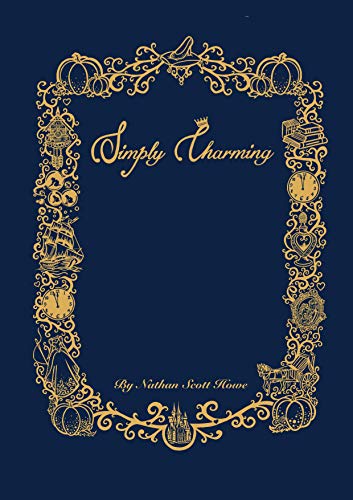
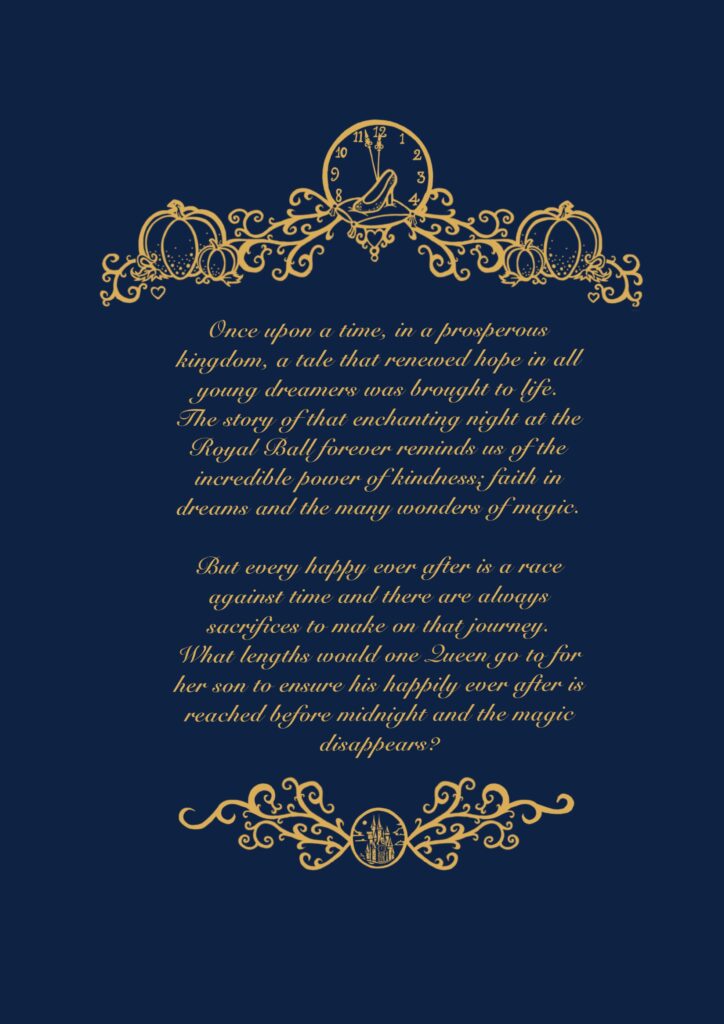
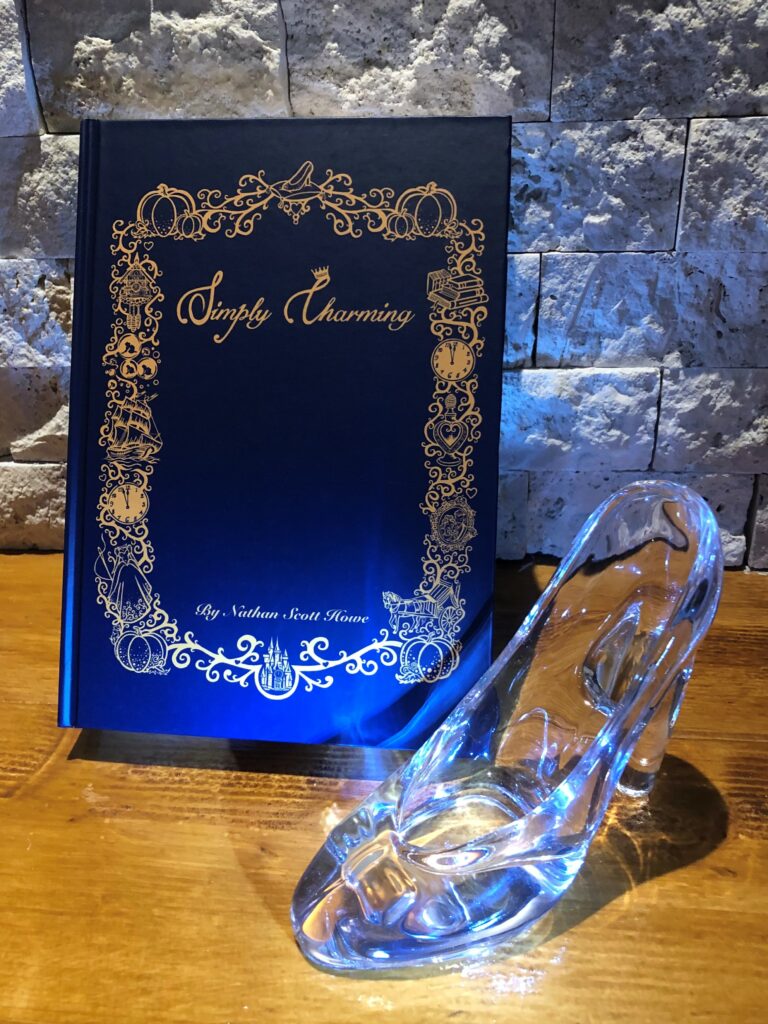
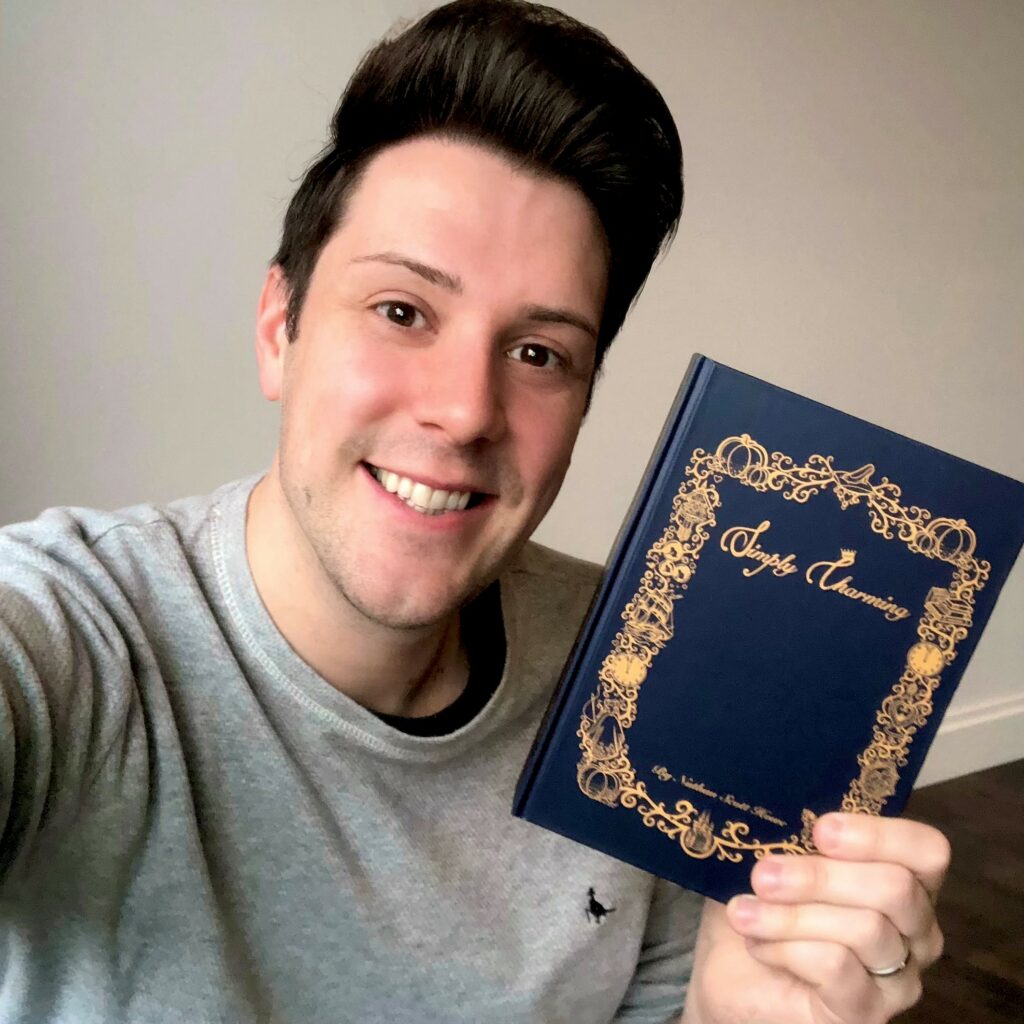
Having spent a year trapped in our towers and unable to let our hair down, it’s only natural we would long for the escapism of fantasy. Even before the world stood still, a rise in fairy tale retellings spoke to our collective yearning to break free from everyday existence; to conjure up a pumpkin carriage and finally go to the ball. Fairy tales have a unique power to transport you into a world where anything is possible. This is a realm in which good people get everything they’ve dreamed and deserved, where cynicism and cruelty go unrewarded, and where a happily ever after is only one wish away. If you want your wish granted, look no further than Simply Charming, a reimagining of Cinderella from her prince’s perspective, written and illustrated by Nathan Scott Howe.
Image credit: Nathan Scott Howe
Cinderella is one of our most culturally beloved stories, retold countless times in myriad ways – but the focus, as you might expect, has (almost) always been on its pure-hearted heroine. Simply Charming flips the script by centring on Prince Charming himself, a character so historically generic he’s become a byword for one-dimensional hunky niceness and very little else. In the original tale, he’s more a prize than he is a prince – simultaneously the person everyone’s searching for and the person whom nobody truly knows. Howe’s book not only gives Prince Charming a personality and a proper character arc, it shows how his parents shaped the man he would become; a man who would search an entire kingdom to find his true love.
Image credit: Nathan Scott Howe
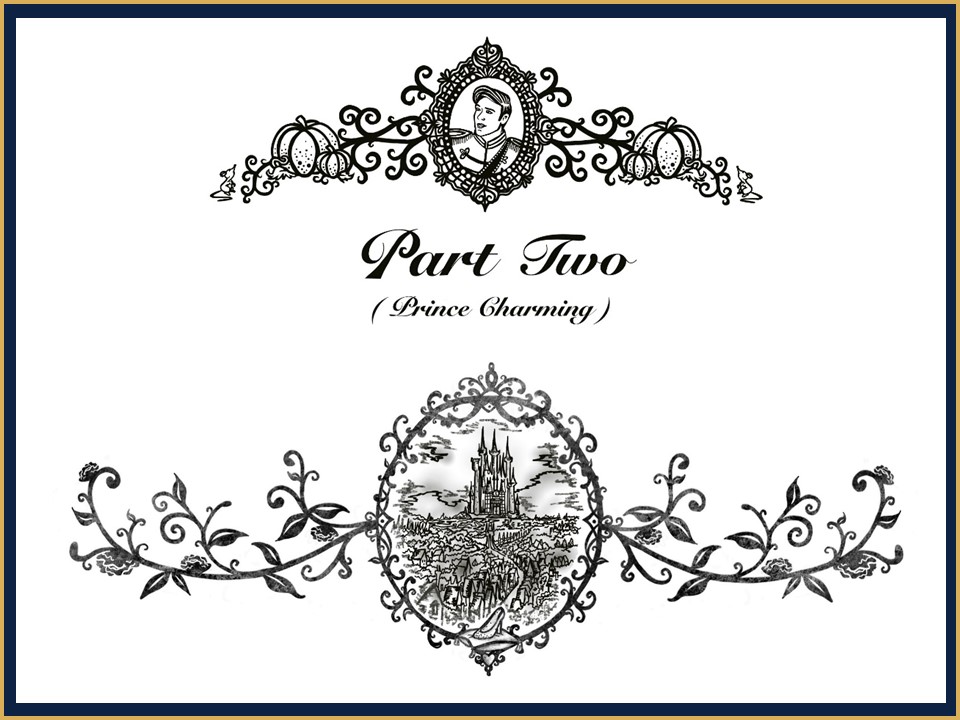
Just as Maleficent fleshed out Sleeping Beauty’s ‘villainess’ into a complicated anti-heroine, Simply Charming takes a character formerly reduced to one-note chivalry and explores exactly why he deserves that much-prophesied happily ever after. Part one focuses on Florence, Charming’s mother, and part two on Charming himself. Howe takes time and care to craft sympathetic characters whose company it is a pleasure to share, and you can sense his genuine affection for the characters in every word. It’s a real labour of love, having taken eight years from inception to completion. This self-published book has both the grounded, loving feel of Ever After and the sumptuous palette of the Disney classic. Howe has an eye for tone, texture, and visuals in his writing, and his brilliant use of descriptive imagery often made me feel like I was stepping into a painting – an immersive experience enhanced by his gorgeously illustrated chapter headings (which eagle-eyed readers might spot changing as the story progresses). The stunning cover image alone, which combines illustrations from key moments throughout the book, is a work both of art and heart.
Image credit: Nathan Scott Howe
I was constantly thrilled by Howe’s inventive incorporation of the Cinderella mythos – right down to the pumpkin carriage and the vengeful housecat! – in ways which wonderfully expand on and enhance the original tale. Learning the origins of these elements, and especially the motif of time which underscores the tale, has made the story even more resonant than it was before. It’s a rare treat to watch an author hone their craft in real time, and you can witness Howe’s confidence and skill blossom chapter-by-chapter. Although it may at times seem a little uneven, I feel this can be forgiven as the first half is setting up the pieces which pay off brilliantly in the second. Though I would have loved for some intriguing story points and interesting characters to have gotten more of the spotlight (a Poppi/Samuel spinoff, anyone?), I greatly appreciated the book’s focus on character and theme over plot. It reminded me of Becky Chambers’ Wayfarers series, which is more concerned with making you feel like part of a kooky and loving family than bamboozling you with twists. Simply Charming is a story for everyone: pure escapism into a kind and gentle world.
That the story concludes just before the happy ending we know so well is incredibly poignant. We know that Cinderella will marry her prince – it’s part of our collective consciousness, after all – but Simply Charming is about the journey to happily ever after. It’s like life: sometimes it all falls into place, and sometimes it doesn’t. Living happily ever after is never a certainty, and even if it does happen, we’ll never know where the fairy tale really ends. We’re left on the precipice of hope and promise; a precarity that a year in lockdown has only served to magnify.
Image credit: Nathan Scott Howe
Immersive, innovative, and involving, Simply Charming had me completely under its spell. Howe crafted a world I simply didn’t want to leave, and reading it was genuinely joyous from the first to the last word. During a time in which the bad news more often seems to weigh out the good, Simply Charming reminded me that people can be brave and kind, that wishes do come true, and that a love that is secure and unfettered and fought for is a magic all of its own. Last Christmas, Howe and his colleagues designed and produced Christmas cards to raise funds for the New Theatre (they sold out in less than a week). Profits from the sales of Simply Charming will be donated to Macmillan Cancer Trust and Great Ormond Street Hospital, and it’s a beautifully generous act which underscores the heart of the fairy tale: that time is fleeting and therefore precious, that kindness and goodness always triumphs, and that a happy ending lies ahead of us all, if we fight for it. In Howe’s words, “Have faith in your dreams, they have more power than you think”.
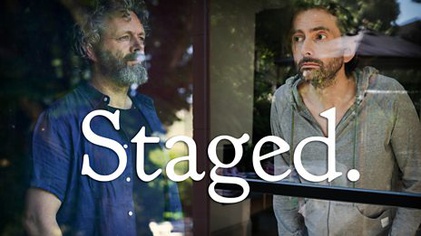
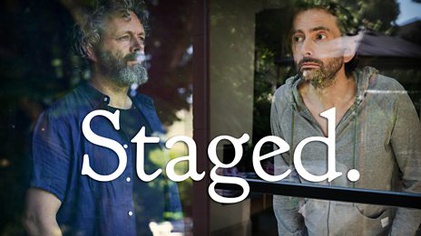
2020: the year when hair was long and tempers were short. With everyone squirrelled away in their homes for months on end due to a pandemic unparalleled in our lifetime, we turned to the arts for comfort and distraction – and yet, as a medium in which social distancing is almost impracticable for artists and audiences alike, they are now in a battle for survival. COVID-19 has compelled writers and performers to innovate as never before, and BBC’s Staged is proof of what can be achieved with a little Wi-Fi and a whole lot of heart.
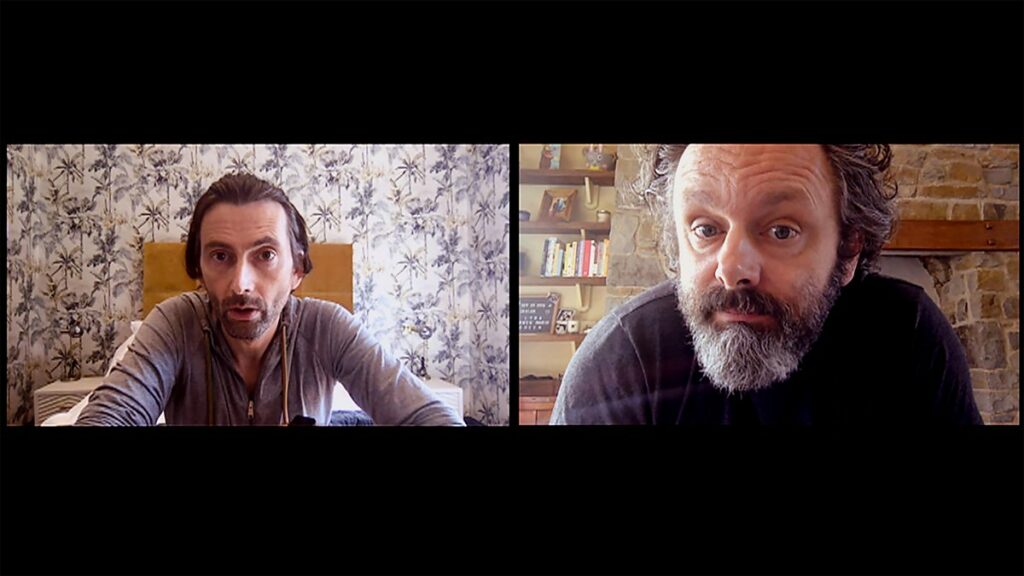
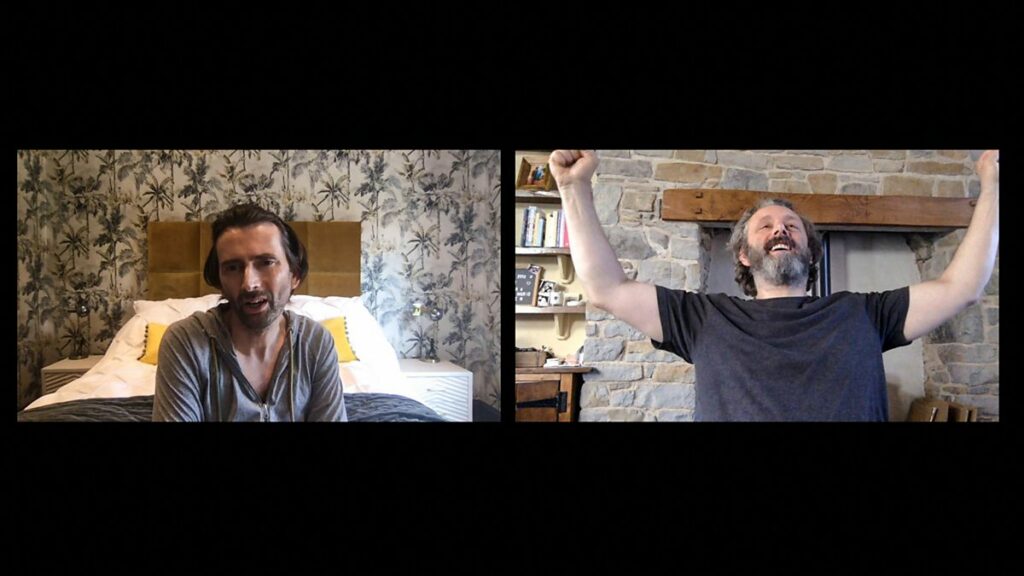
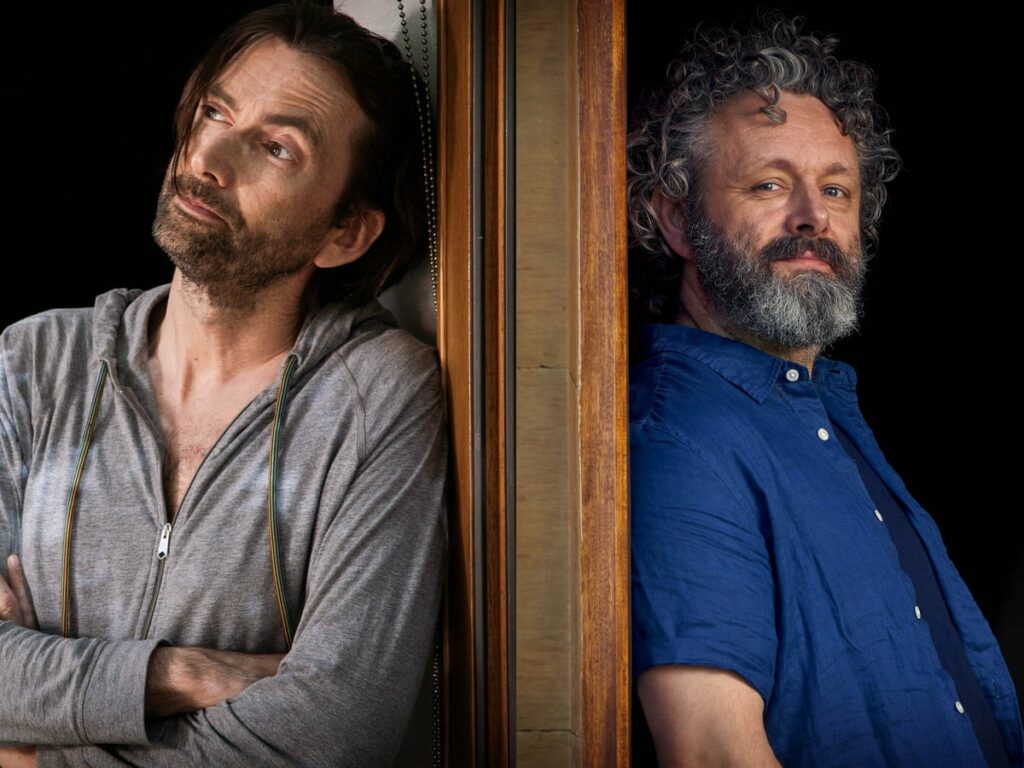
Easily the best entry in the rapidly-emerging lockdown genre, Staged is a note-perfect ode to the quarantine blues. Here’s the pitch: Simon Evans (who plays a fictionalised version of himself, and also directs and co-writes the series with Phin Glynn) was due to stage a starry West End production of Luigi Pirandello’s absurdist classic Six Characters in Search of an Author – until COVID-19 closed the theatres. Determined to get a head start on the new season, he decides to conduct rehearsals with the cast over Zoom – but corralling the duelling egos of co-stars Michael Sheen and David Tennant (also playing exaggerated versions of themselves) proves the most difficult task of all.
Anyone who has sampled the (un)earthly delights of Good Omens, Amazon and the Beeb’s glorious adaptation of Terry Pratchett and Neil Gaiman’s Python-esque apocalypse yarn, will be keenly aware of the heavenly rapport between Michael Sheen and David Tennant. There, Sheen was the angelic Aziraphale to Tennant’s demonic Crowley, but in Staged the roles are reversed, with Sheen playing wicked, wolfish devil to Tennant’s sweet, beleaguered pacifist. (They’d said in the past that were they to take Good Omens to the stage, they’d swap roles every night – Staged works both an audition for the role-swapping shtick and a testament to its success). Their chemistry transcends miles, screens and technical difficulties – released on June 10th in six fifteen-minute episodes (20-minutes if you check out Netflix UK’s extended editions), Sheen and Tennant charmingly bicker over increasingly petty minutiae, like the contentious issue of whose name comes first on the poster, which ends up being one of the series’ best running gags – and that’s really saying something for a show so cleverly scripted as this). It’s an utter delight to see them reunite again so soon, and I hope this proves just the second in a slew of future Sheen-Tennant (ad)ventures.
Featuring delightful cameos by Hollywood royalty from both sides of the pond (I won’t spoil them here), and turns by Adrian Lester as a superficially zen version of himself and Nina Sosanya as the only outright fictional character (Jo, an acidic theatrical agent), Staged is a fantastically produced show, more professional than most other Lockdown TV, from Dan Gage’s superb editing to Alex Baranowski’s whimsically jazzy score, and the writing by Evans and Phin Glyn, which is so clever and performed so naturalistically you often wonder whether its scripted at all, giving it the feel of a postmodern play. Evans and Glyn marvellously drop themes and dialogue early on that pay off by the end of each episode and/or the whole series, and even seemingly throwaway gags like a David Tennant mug and a daft theatre warm-up song are resolved in hilarious and often meaningful ways. Co-starring Sheen and Tennant’s real-life partners (Anna Lundberg and Georgia Tennant respectively, the latter of whom also produces) as well as Evans’ real-life sister Lucy Eaton, Staged is a family affair in the truest sense – complete with the quarantine-specific cocktail of passive aggression, pettiness and the pangs of affection true of loved ones living together in lockdown.
You feel in a decade’s time you could look back on Staged as a time capsule of this bizarre year –it captures the essence of what lockdown was really like, not just because the cast are plagued by the mundane scourges of lockdown life – home-schooling, monotony, general malaise of the soul – but also by intercutting with footage of deserted London thoroughfares, vacant supermarket shelves, teddies in windows and tributes to the NHS. Even production lines of loo rolls and the goats who took over the empty Llandudno! Sheen, Tennant and co often start their Zoom calls by staring melancholically off-camera, and Staged captures the awkward silences, the uncanny valley, the timing that’s just a bit off, about the medium of video conferencing. ‘We just need a focus for it,’ Tennant says at one point; he’s referring to their chaotic Zoom rehearsals but that’s a 2020 sentiment if I ever heard one. Focus is one of the many things in dwindling supply during this singular year, especially in the infamously fluid temporality of lockdown living, which renders the experience of time inconsistent and patchy (days feel like years, months fly by) which the show also captures.
For all it’s comedic brilliance, Staged doesn’t shy away from sorrow. There’s a subplot between Sheen and his next-door neighbour which goes from hilariously petty to genuinely moving, and encompasses the cloud of uncertainty that hangs over us all at this time. While Tennant claims he brings ‘charm’ and Sheen claims he brings ‘gravitas’, they each excel at both – as well as capturing that sense of defenceless inertia that is common to us all right now. And Tennant gets to sum up the collective malaise of the era in a wonderfully poignant monologue: “You just stop feeling useful, don’t you? The theatres close, audiences go away, roles dry up, you’ve got nothing to offer. You’re just hoping it’ll all be alright”. The series – and the year – has walked the surprisingly fine line between rage and hope. Sheen quotes Dylan Thomas’ famous lines, ‘Do not go gentle into that good night… Rage, rage against the dying of the light’, and David worries whether things will ever go back to normal.
One of the more subtle ideas in the show arises when Sheen comments in passing that, of all the things in the real world, he misses elephants most of all. A minute or so before this, Georgia explains that elephants in David’s play symbolise memory – so, for me, this was their way of suggesting that making memories is the thing we all miss most of all. “You’ve survived this long without elephants. You’ll manage,” Georgia tells him, and the audience. We’ll manage. We’ll get through. We’ll endure. The response of certain governments could indeed be described as a ‘cachu hwch’ (I’ll leave you to look that one up), but there are more good people in this world than bad, and in a time where fighting for our rights has become more essential (and more visible) than ever before, Staged is there to remind us that we will get through this – and that we can only do so together.
Staged is currently streaming on BBC iPlayer and Netflix UK.
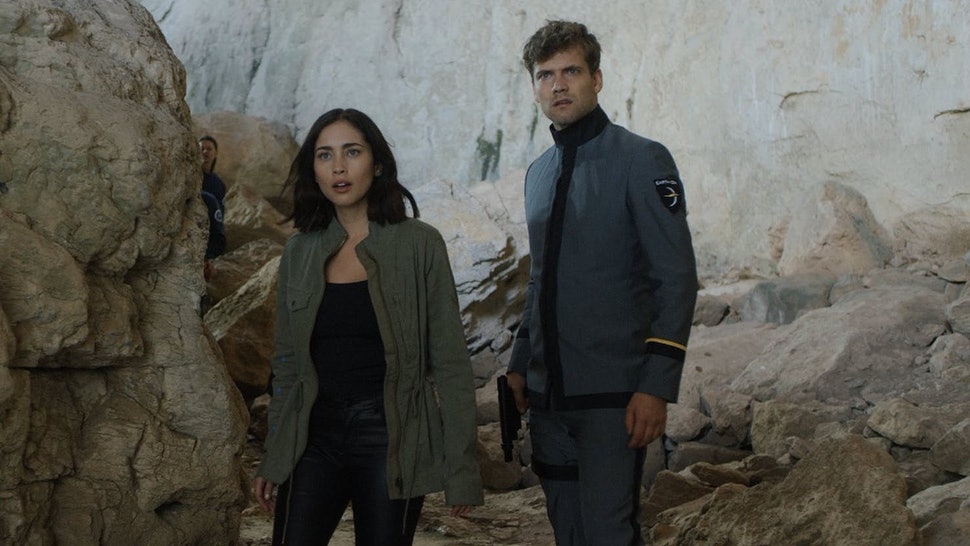
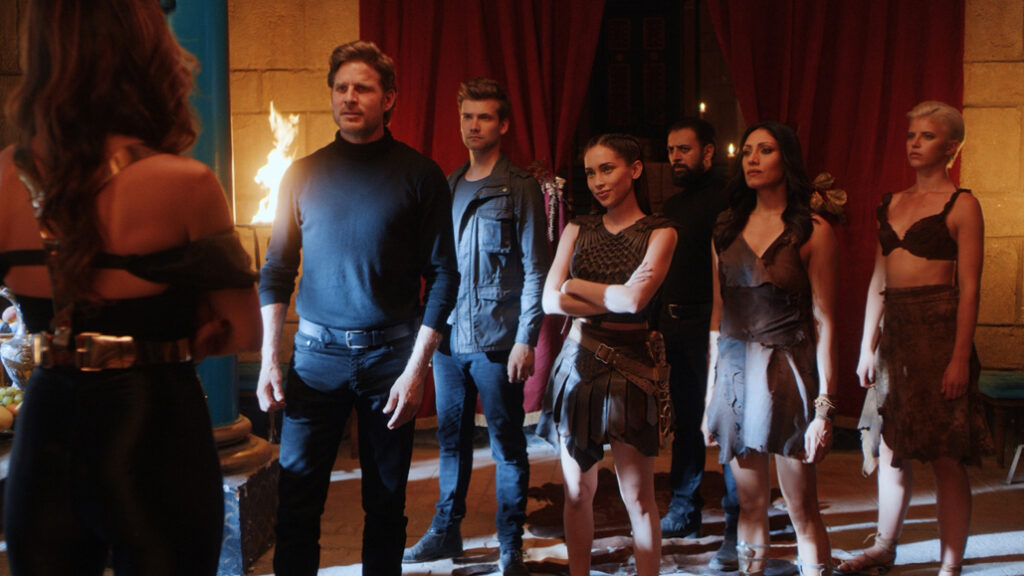
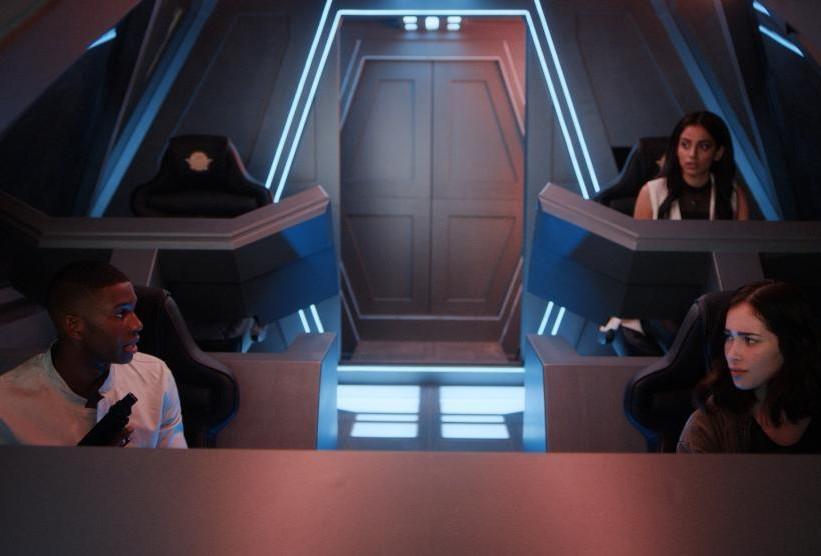
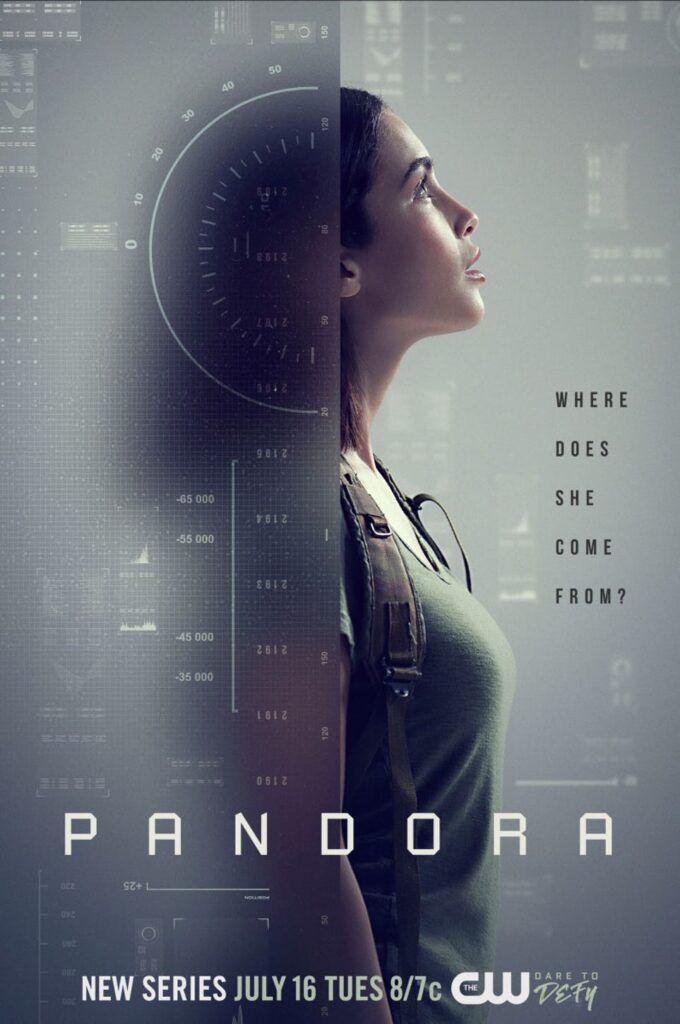
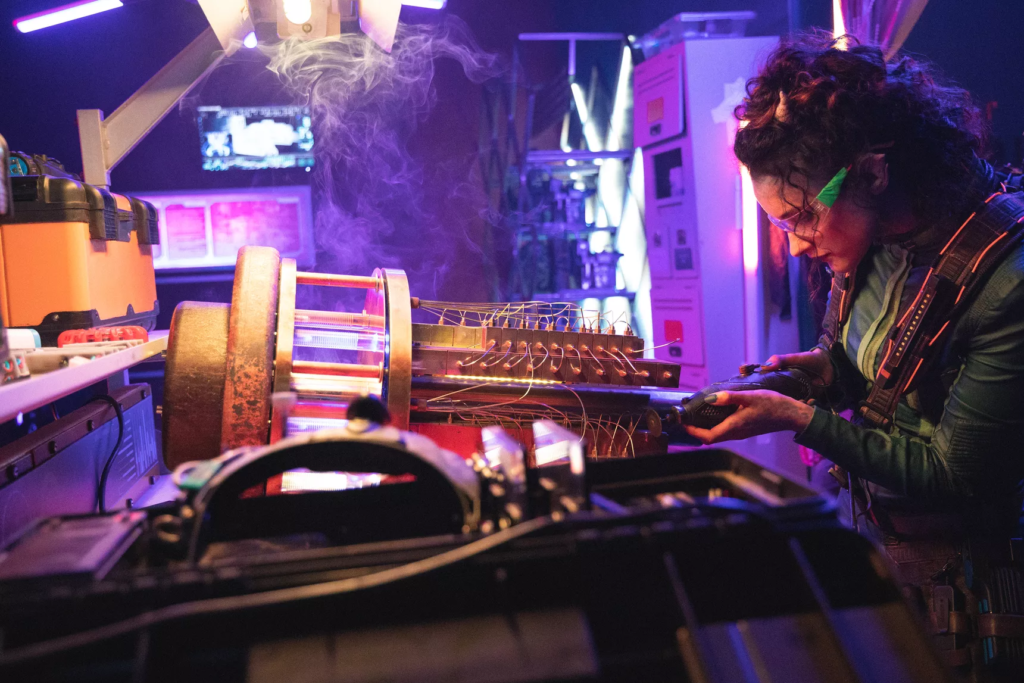
Created by Mark A. Altman, a producer on The Librarians and Castle, CW’s summer sci-fi series Pandora follows Jacqueline ‘Jax’ Zhou (Priscilla Quintana), a young woman who enrols in Earth’s Space Training Academy after her home is destroyed and her parents killed under suspicious circumstances. It’s 2199, and humanity is recovering from a decade of war with their extra-terrestrial neighbours, the Zatarians (who are essentially just Romulans with better hairdos). Jax must navigate new alliances, friendships and romances while training to defend the planet in an era of fragile peace and ultimately unravelling her own mysterious origins.
It’s easy to write off any fantastical school as a Hogwarts rip-off, but Pandora’s alma mater is more akin to a sexed-up Starfleet Academy (already a high bar, given Trek’s sexy track record) or even Starship Troopers: The College Years. Now, it’s nowhere near as bitingly satirical as Paul Verhoeven’s stylistically cynical space-soldier romp – and Pandora does name its space academy in the blandest way possible – but there’s a layer of interesting social commentary under the preternaturally pretty sheen of your typical CW cast. It can, at times, lapse into a kind of thematic genericity – but when it hits gold, it glitters.
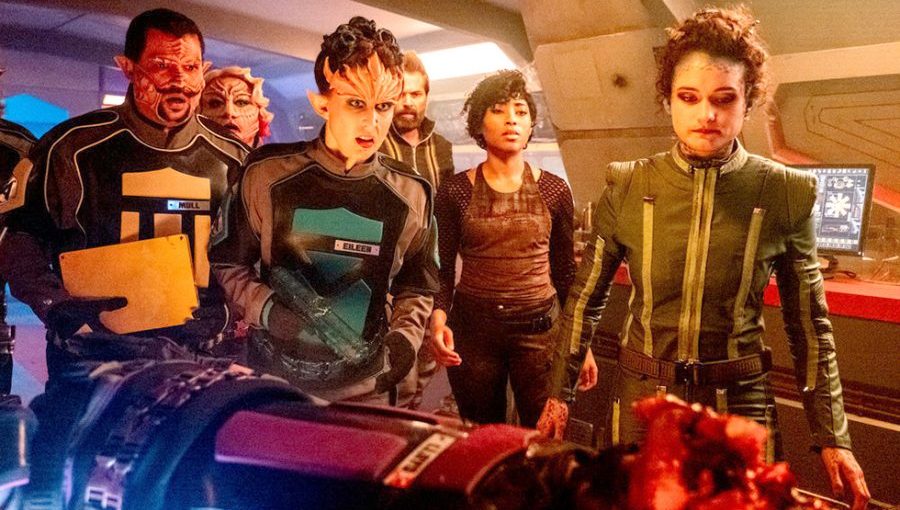
Nine episodes in to its thirteen-episode first season, and I’m hooked. There’s an indefinable magic to the series that has me eagerly anticipating each weekly instalment. The hardest element of the show, according to its producers, was assembling the right actors for the roles – and in this area they have excelled. The cast really commits to the characters and the story, and the chemistry between the central ‘Scooby gang’ feels natural and genuine, in spite of the rapidity at which it developed. I was invested in the team by episode two and as the show goes on, it shifts the spotlight onto different characters to flesh them out.
The natural leader of our merry band is, of course, Priscilla Quintana as Jax, a character who feels like the descendant of Talon (Jessica Green) from TheOutpost, another CW show which has a small budget and a big heart (aka my kryptonite). Quintana is a charming lead and makes Jax feel like a fully realised, even relatable, character when she could so easily have slipped into stereotype. I love that she genuinely cares about people and risks her own safety to do what she believes is right – whilst also being sarcastic as hell. The central mystery as to who – or what – Jax truly is, or could become, drives much of the series’ intrigue; the question of whether Jax – ostensibly the titular Pandora – possesses the calamitous powers of her mythological namesake has become its most relentlessly interesting aspect.
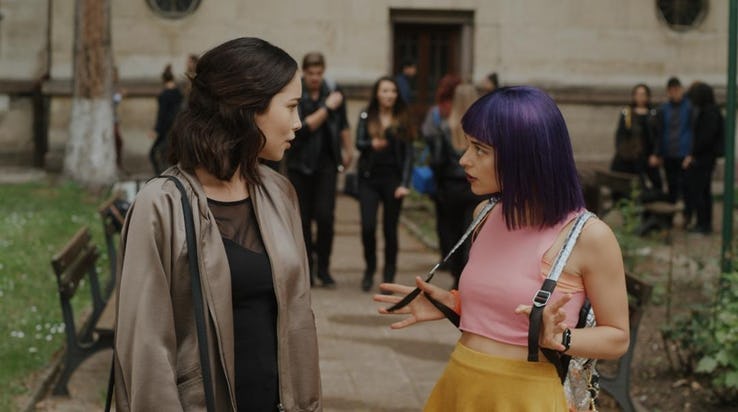
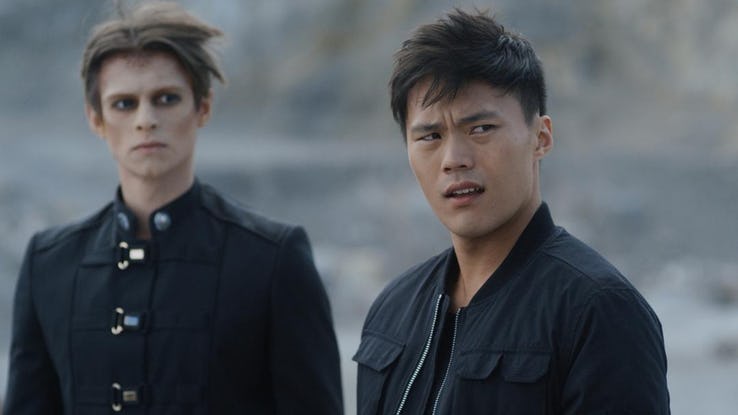
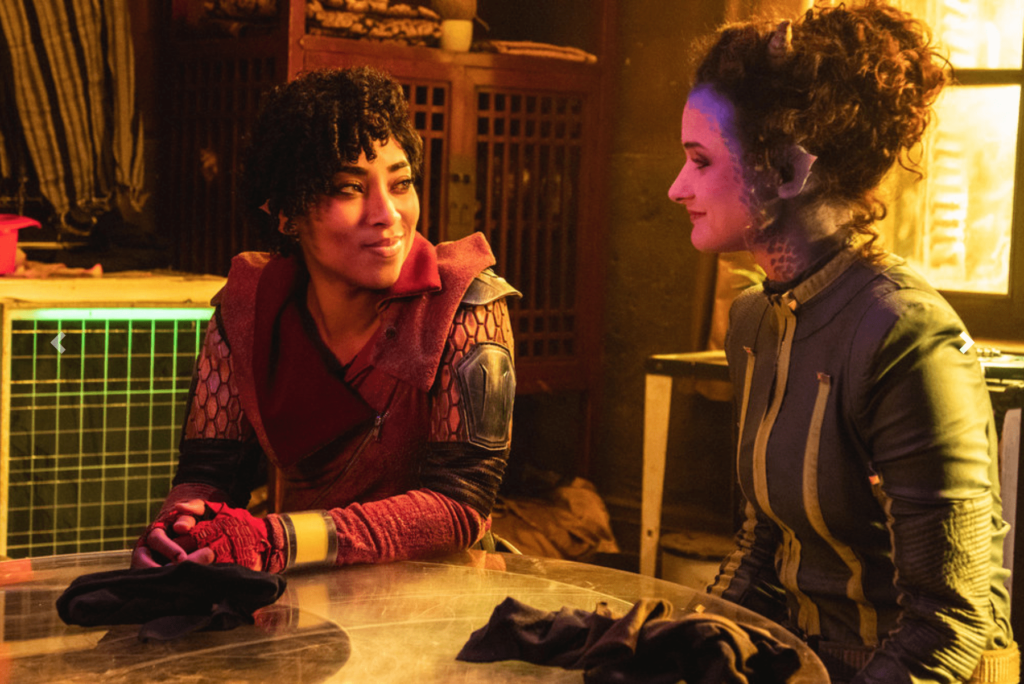
I think the major reason her friendships with her college buddies works so well is that the cast get along and they’re all having a riot. Much of the levity stems from two characters in particular: Atria Nine (Raechelle Banno) and Greg Li (John Harlan Kim). Atria is a clone who escaped her abusive creators to join the academy. Whilst almost everyone else is kitted out in the generic grey-green garb of most science fiction, Atria looks like she’s been pulled straight out of an anime – with her purple hair and technicolour outfits, she could easily come off as parodical, but Banno’s effervescent performance and her character’s internal quest for a soul promise more interesting character beats for her to come. Pandora is also refreshingly clear and upfront about its characters’ queerness, with Atria and Jax openly attracted to people of all genders, and Jax’s relationship with ex-girlfriend Cordelia Fried (Isabelle Bonfrer) taking centre stage in episode eight.
Greg, meanwhile, is a medical student so charming you almost overlook the fact that he is given next to nothing to work with story-wise. Kim played the roguish Ezekiel Jones on TNT’s The Librarians, televisual comfort food at its fluffiest and finest, who started off as a cardboard cut-out and ended the show’s four-season run as its best and most beautifully developed character. Here, he’s a college-era Han Solo with shades of ER’s Dr Ross. It’s refreshing to see a romantic lead who is a genuinely good guy, and not a tormented bad boy with a dangerous streak. Even though ‘Greg’ may not be the most swoon-worthy name in the book, Kim’s charisma and leading man charm is a real boon to Pandora – which is why it’s a shame that he’s side-lined so early on. After a strong start which positioned him as one of the main leads alongside Jax, and a serious contender for her affections, Kim simply doesn’t appear for a good portion of season one for reasons unknown and unjustified.
Greg has two major rivals for Jax’s heart, at least in the main cast: Xander Duvall (Oliver Dench), a teaching assistant at the academy, and Ralen Maht (Ben Radcliffe), son of the Zatarian ambassador, and whose enrolment at the Academy is something of an olive branch after years of warfare between his species and humanity. I’m fairly certain that Xander is being set up as Jax’s endgame love interest, which is a shame because of her four suitors he’s the least compelling thus far. Despite being some kind of super-badass TA with a secret mission and murky past, there’s no real emotional hook to his character, and he’s written to be so buttoned-up and officious that he can’t even rely on charm, as John Harlan Kim does, to plaster over the gaps – the writers seem to have decided he’s The One and that’s the end of it. I would be pleasantly surprised if they’ve planned a more interesting trajectory for him (à la Agents of S.H.I.E.L.D.) but I’m not optimistic.
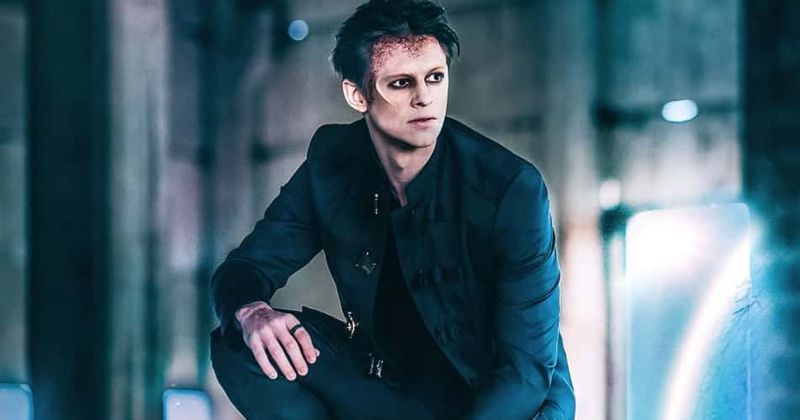
Ralen, on the other hand, is much more intriguing. Although he’s initially sketched in the broad strokes of Star Trek’s Lt. Comm. Data – driven by logic and intellect over outward emotion, often to humorous effect – Radcliffe rises above archetype and crafts Ralen as a sweet, sensitive and soulful person torn between loyalty to his people and his newfound human friends. His striking performance is embellished by subtly effective makeup and a great wardrobe – he looks like if Tom Holland was possessed by a demon and subsequently raised by David Bowie and Spock. Ralen’s already great on the page and on the screen but Radcliffe is the reason he’s so compelling – not only does he get to shine in fight scenes thanks to Radcliffe’s gymnastics know-how, his physicality in dialogue-driven scenes gives the character a genuine alien feel that enhances the sense of otherness between him and his Academy friends.
Rounding out the fellowship are Thomas James Ross (Martin Bobb-Semple) and Delaney Pilar (Banita Sandhu), arguably the characters with the most potential going forward. Pilar is a nannite-enhanced human whose cybernetic implants allow her to access the Datastream (basically the internet but turned up to eleven). She’s given centre stage in episode six, where she is bullied and attacked by other students jealous of her beauty and academic prowess, in a way which interestingly investigates campus culture. As Jax’s roommate, Pilar shares the most screen-time with her so far, but I’m hoping she and Atria will grow closer because of their shared territory in bio/tech fusion.
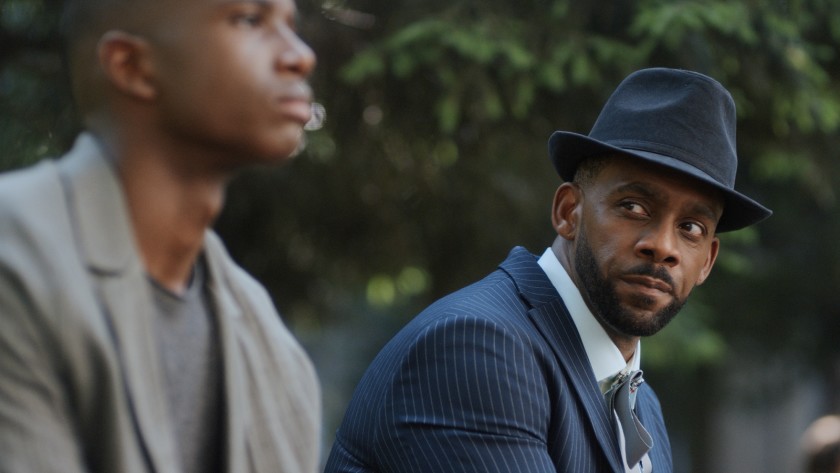
As well as being the best-dressed on the show by a mile (I think half the budget went on his jackets, and I call that money well spent), Thomas also has the strongest arc so far, thanks to a wonderfully anchored performance from Bobb-Semple and some brilliant developments in episode five, where he is reunited with his fair-weather father, Billy D. (Richard Blackwood). Billy can read minds, Thomas can read emotions – and while Billy initially comes off as a suave psychic conman, the episode explores the complexity of their relationship and the dark origins of Billy’s powers and their connection to Earth’s wartime strategy against the Zatarians. Their complex father/son is a definite highlight of the series so far, and their story was genuinely emotional.
The episode, and Thomas in general, also brings some much-needed conflict into the main gang in a show in which everyone seems to have buddied up instantaneously, when he falls out with Jax for very legitimate and understandable reasons and causes a rift amongst the ‘Super Friends’. There’s a general wariness of Ralen, as the sole Zatarian student, but this brings conflict of a passive kind. The conflict involving Thomas occurs because he is a more active character, narratively speaking – and the show would do well to write more of its characters in this way. Conflict drives the story and reveals who the characters truly are because it forces them to make challenging and difficult choices – our cast of young heroes is diverse, charming and brimming with potential, but there’s simply not enough friction between them just yet.
The gang’s most obvious Earthbound antagonists, for now, are their professors. Profs Ellison Pevney (Tommie Earl Jenkins) and Martin Schral (Vikash Bhai) are basically Lupin and Snape in all but name – Bhai’s supercilious Schral even reprimands Jax for being late in an almost beat-for-beat recreation of Alan Rickman’s introductory scene in Harry Potter and the Philosopher’s Stone – but the most pivotal is Jax’s shady uncle Professor Donovan Osborn (a nefarious moniker if ever I’ve heard one).
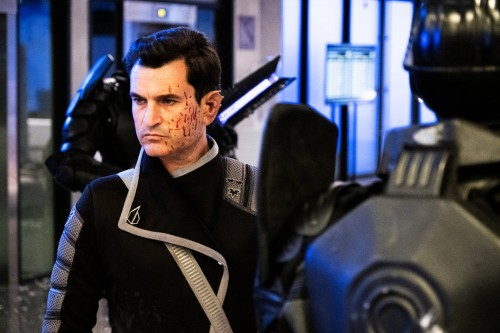
Played by Noah Huntley and looking like the bewaistcoated lovechild of Peter Facinelli and Eric Bana, Osborn may be largely confined to his (rather swish) office as yet, but he’s an intimidating and perplexing presence – is he a cog in the machine or the puppet master? The existence of Osborn alone raises several points of interest, not least the seemingly non-existent separation of powers in late 22nd century Earth – Osborn is not only a professor in wartime politics and battle strategy at the Academy, he’s also a high-level operative in the Earth Intelligence Service, which is (by Huntley’s own admission), a ‘futuristic CIA’. On a more superficial note, the man should really have his own fashion line in sci-fi couture, because his outfits are to die for. If you’re a fan of how the genre tweaks familiar clothing in ways that make them more science fiction-y, Pandora is the show for you.
Although its world-building can sometimes feel derivative, and the inner lives of its characters are still being formulated, Pandora is an intriguing and compulsively enjoyable show that has much to recommend it and heaps of potential for its future. It’s another entry in the ‘small on budget, big on heart’ genre I love so dearly, and it does a lot with what it’s got, incorporating exciting fight scenes, cool missions and constructing its plots around thematic analyses of xenophobia, intolerance, climate change, and colonialism. I hope the bizarre choice to call the alliance of planets a ‘Confederacy’ is critiqued in-universe and that we see more sympathetic Zatarians than just Ralen. A second season has already been ordered, and though the first has so far been a shaken martini of potential, I’m interested to see which box Pandora opens next.
Pandora airs on Syfy Channel in the UK on Thursdays at 9pm.
[This review contains spoilers for Star Wars Episode IX: The Rise of Skywalker]
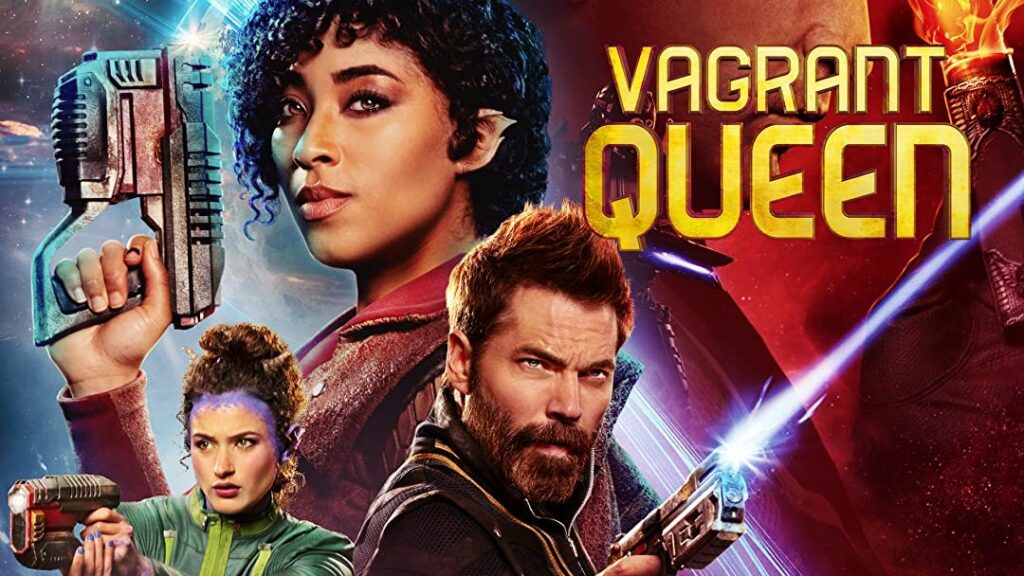
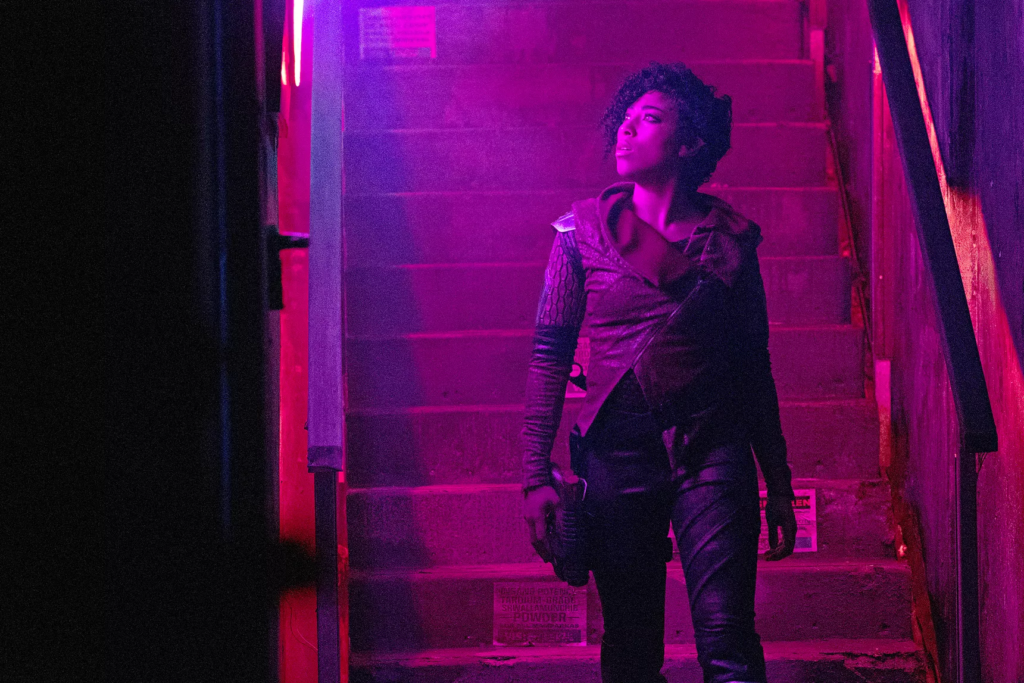
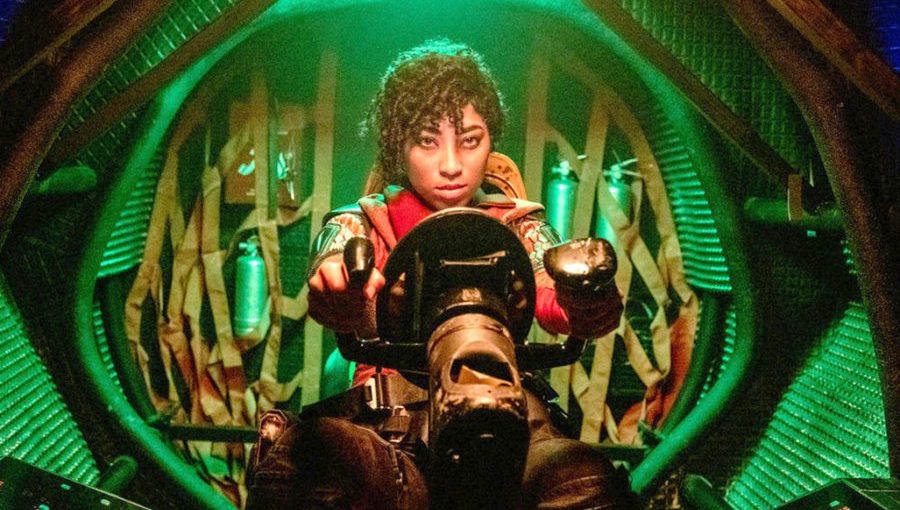
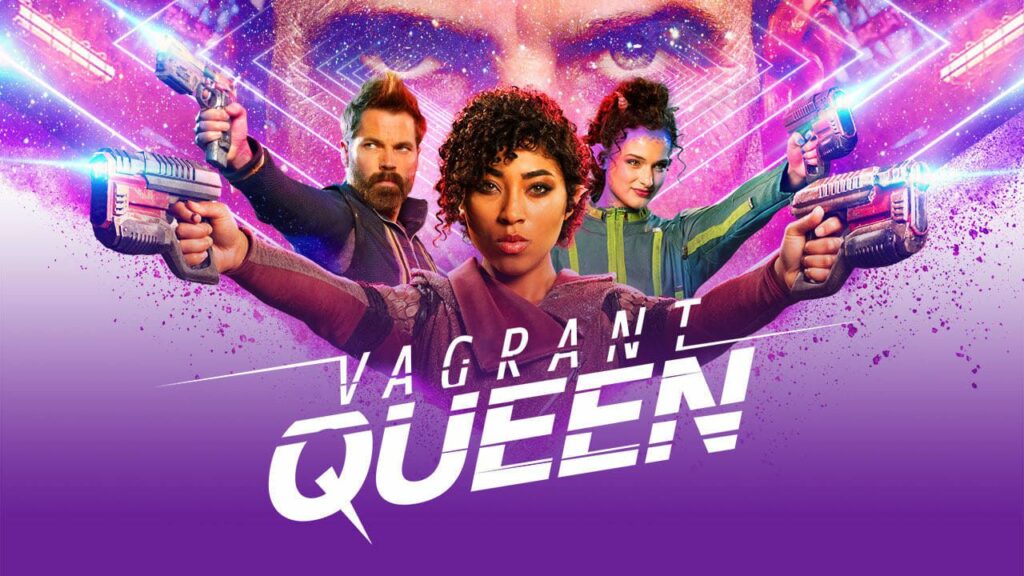
Imagine, if you will, that the ‘Scavenger Rey has royal lineage’ twist had been the plan from the beginning of the Star Wars sequel trilogy, and not just The Rise of Skywalker’s tacked-on cynical move to appease sexist fanboys? If you want to know how to do that plot properly, look no further than Vagrant Queen, Syfy’s latest swashbuckling series set in a galaxy far, far away.
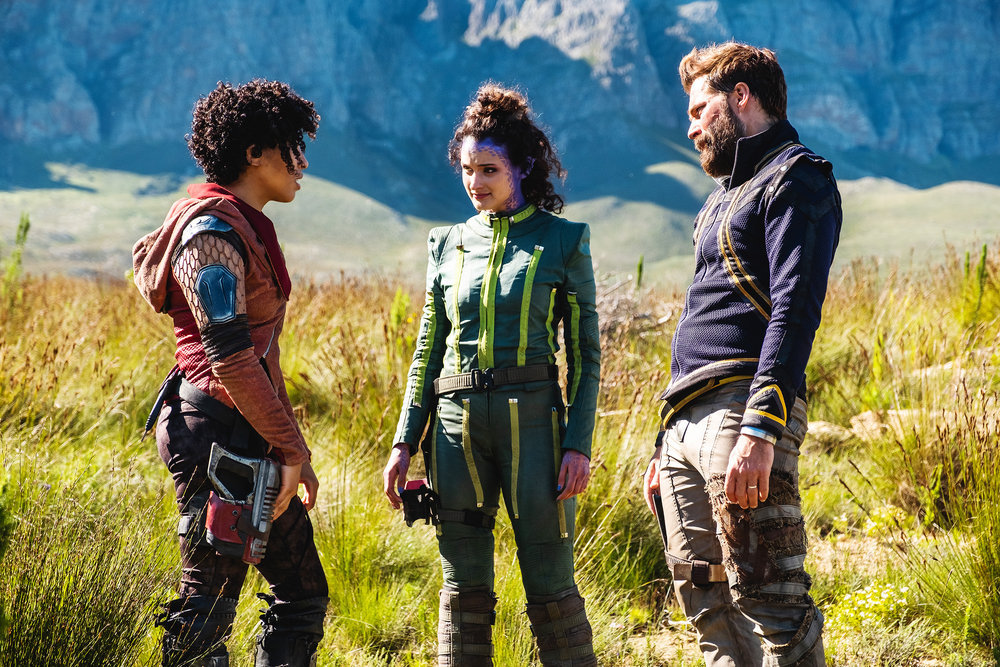
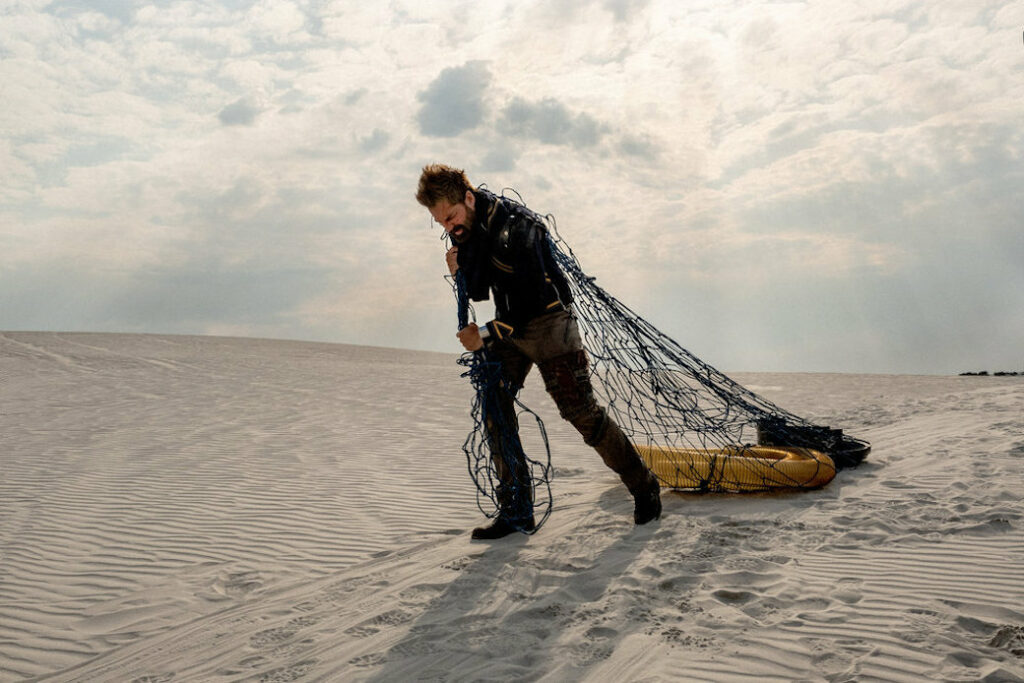
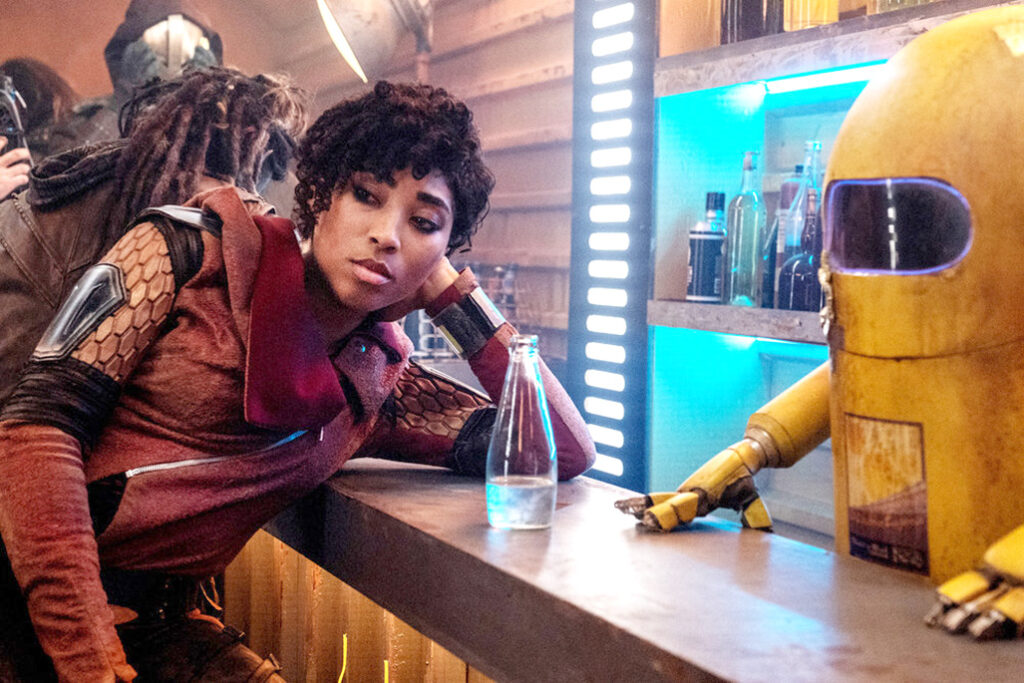
Co-produced with Blue Ice Pictures, Vagrant Queen is that rarest of gems: an under-the-radar show that truly deserves the spotlight. Created by Jem Garrard and based on the Vault comic book series of the same name by Magdalene Visaggio and Jason Smith, the series stars Adriyan Rae as Elida, a scavenger on a desert planet who has long been running from her secret past. Elida, aka Eldaya El-Fayer, was once the child-queen of Arriopa, a sprawling celestial empire in another galaxy (not ours), until she was deposed by a band of revolutionaries led by Commander Lazaro (Paul du Toit) who shot Elida’s mother (Bonnie Mbuli) in front of her. Over a decade after she went into hiding, news that her mother may be alive after all leads Elida to team up with the roguish Isaac (Tim Rozon) and the effervescent Amae (Alex McGregor) on a hazardous quest to learn the truth and overthrow the corrupt government that stole everything from her.
VAGRANT QUEEN — “Sunshine Express Yourself” Episode 107 — Pictured: (l-r) Adriyan Rae as Elida, Alex McGregor as Amae, TIm Rozon as Isaac — (Photo by: Riyaaz Dalvie/Vagrant Productions/SYFY)
Space train! Karaoke death battle! Spaceship murder mystery! What more could you possibly want from a show? In its DNA is the antipodean oddness of Farscape, Mad Max, and Thor: Ragnarok, coupled with a Mystery Men-style wackiness that ticked every one of my boxes. Colourful, campy and cool, it’s a delightfully zany mishmash of all your sci-fi faves – Star Wars, Killjoys, Firefly, Guardians of the Galaxy – but with a tone and style that’s completely its own. Whilst a lot of low budget sci-fi restricts its setting to a single spaceship and a handful of samey locales, Vagrant Queen is filmed in Cape Town, South Africa, and takes its audience to a smorgasbord of smorgasbord of distinct, memorable and diverse locations, making it a genuine delight to see where the characters will go next. The series isn’t afraid to end a fight scene with a cheesy pun or a pop culture reference, but it’s all done with a winking self-awareness that is so refreshing in our recent glut of grimdark genre fiction. In a landscape of po-faced programming, Vagrant Queen was bright, breezy breath of fresh air that didn’t take itself too seriously. My kingdom for a bit of light entertainment!
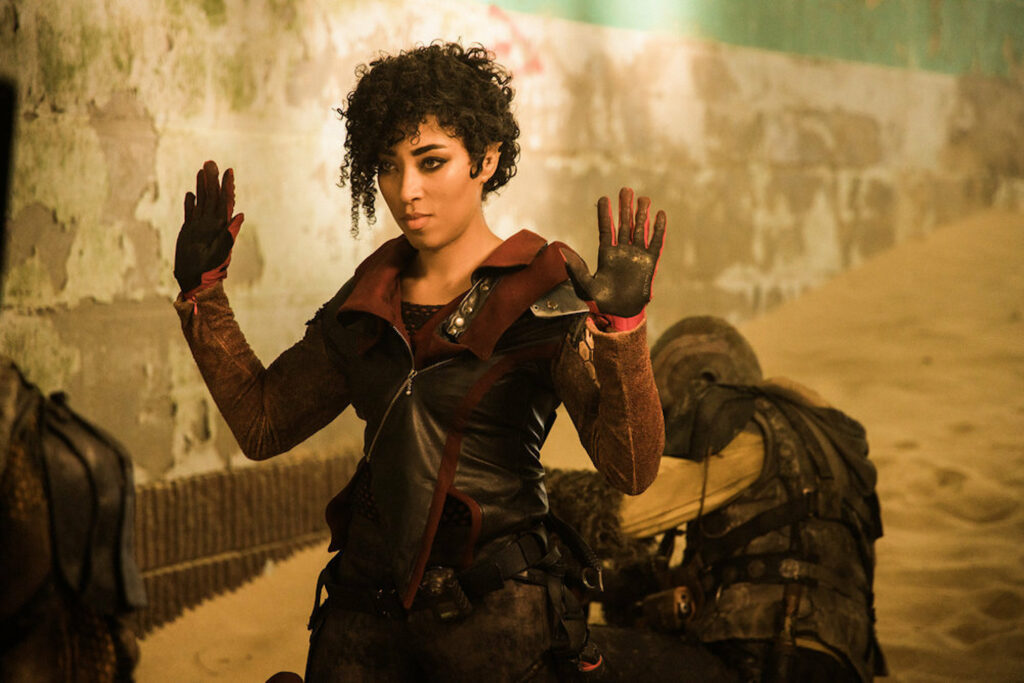
VAGRANT QUEEN — “Pilot” Episode 101 — Pictured: Adriyan Rae as Elida — (Photo by: Marcos Cruz/Vagrant Productions/SYFY)
Showrunner Jem Garrard has assembled a multi-talented team of brilliant women both in front of and behind the camera – not only is every episode written and directed by women, Vagrant Queen’s lead character Elida is a Black queer woman who is wonderfully complex and multi-faceted: impulsive, kind, cynical, loyal, occasionally cavalier, and delightfully unafraid of punctuating a punch with a dorky pun, Elida is reluctantly heroic and compulsively likable. Adriyan Rae is utterly magnetic in the role, moving effortlessly between comedy, drama and action – by the end of the show you’ll want to go for a drink with her and take down a totalitarian government with her! Rae, a multi-talented Renaissance woman (she was a scientist before becoming an actor, singer and model) with recent credits in Atlanta and Burning Sands, is definitely one to watch.
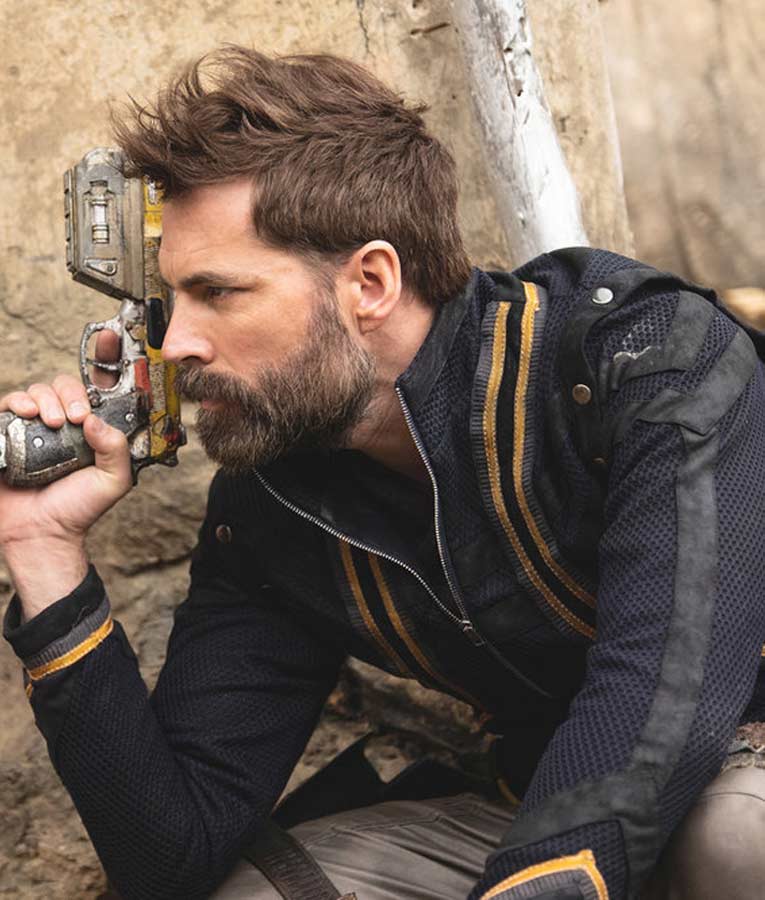
Although Elida starts out as something of a lone wolf, she quickly assembles a motley crew in her quest comprising of Isaac Stelling (Tim Rozon) and Amae Rali (Alex McGregor). Isaac is more Jack Sparrow than Han Solo, haplessly selfish and frustratingly self-centred, but Rozon (of Wynonna Earp and Schitt’s Creek fame) manages to make the character relentlessly endearing in spite of his many transgressions. Amae is a whip-smart, endlessly kind and joyously optimistic engineer who is probably the only reason Elida and Isaac haven’t killed each other yet. I wish we’d seen more of Amae’s bartender brother Chaz (Steven John Ward), but their bond was excellently sketched even in the brief time they shared the screen. McGregor is utterly charming in the role, and it’s easy to see why she and Elida fall for each other.
To see a healthy, loving and well-written queer romance in any show is something to celebrate, especially in an era in which showrunners are more than happy to bury its gays (*cough* The 100 *cough*) or string its audience along with the promise of an LGBTQ+ love story while never intending to make it canon (looking at you, Teen Wolf). Representation in Vagrant Queen is straightforward and unfettered right out of the gate: we first meet Amae in bed with another woman, and often see her flirting with other women throughout the show. The sweet, sparkling chemistry between Rae and McGregor is right there in their first interaction, and the bond they strike up through various (mis)adventures makes for both a breathlessly swoony and emotionally healthy romance – they support each other, trust each other, listen to each other, protect each other, and truly care about each other as friends first and (potential) lovers second. Not only is this a particularly brilliant queer romance, it’s just a gorgeously written romance full stop, one which doesn’t function solely on angst for angst’s sake (*ahem* Vampire Diaries).
The show’s fun, feminist and cheekily badass vibe has shades of Lost Girl and Wynona Earp, but sometimes it goes full-on Saw – and the character responsible for most of the bloodshed is the meticulously unhinged Commander Ori Lazaro (Paul du Toit). If you were to mash together Joaquin Phoenix’s roles as Emperor Commodus and Johnny Cash with a pot of hair gel and a pair of elf ears, you’d get Commander Lazaro. Du Toit may be having the most fun of the entire cast, which is really saying something – and it’s easy to see why. Lazaro is a completely looney tune; a preening sadist with both a raging superiority streak and an inferiority complex (a dangerous combination). This is a galaxy which feels genuinely dangerous, especially for our three ramshackle heroes, and it’s largely down to du Toit’s unnervingly psychotic performance.
My only real point of contention is that I think the show is often too gory for its own good. Don’t get me wrong, I love a bit of gore – but it has to fit the tone of its story. The campy ultraviolence of Punisher: War Zone matched its hyperbolically brutal tone; the casual carnage in Deadpool is an essential part of its cynical metatextuality. Vagrant Queen’s not afraid to Go There™ – and that’s commendable, but its gore often feels disturbing for the sake of it – there are things that Lazaro compels lackeys and prisoners to do to themselves that will haunt me for a long time, and while it reinforced his credentials as a worthy villain, it often feels gratuitous and unnecessary given the otherwise tongue in cheek tone. At the same time, it’s commendable of the show to have the courage of its convictions and go to some truly dark places…
…Because this is a show which is 100% itself. It’s refreshingly proud of its strangeness, and its scrappy, unpolished charm is a real draw in an age of by-the-numbers blockbusters. This is a show that cares. It cares so deeply – about its characters, its story, its world, and its audience. It knows when to be goofy, when to be cool, and when to be emotional. Everyone on this show is giving it their all, from the hapless loyalists to the Republic guards (essentially Goth Stormtroopers) who all have distinct, quirky personalities. One particular standout is Thembalethu Ntuli who plays Nim, a canine-faced humanoid who steals any scene he’s in and is in too few of them. Ntuli’s performance is so good he makes you forget that the CGI on his face is little more a marginally enhanced Snapchat filter.
There is a genuine warmth and sincerity infused in every frame – and shows with a low budget and a big heart are my kryptonite. It’s clearly having a ball and wants you to join in with the fun. It’s a terrible shame that Syfy thoughtlessly cut the party short when it was only just beginning – and also a huge mistake for a channel with the least inspiring line-up of shows that don’t come close to filling the void left behind by Vagrant Queen. It could have been their new Killjoys – but instead, with Van Helsing ending and Wynonna Earp as their sole remaining draw, most of their remaining content is composed of rookie shows in their first seasons – like Vagrant Queen, which had so much potential that I can only hope another network has the guts to put their faith in.
With very few exceptions, it is unwise to judge a series on its first season alone. They need time to breathe, to experiment, to play, until they’ve settled into a tone. Cancelling a series after one season is like throwing a first draft in the bin – and Vagrant Queen, like many shows cut down before their time, got better and better with every episode. There’s a common misconception that a pilot has to hook you for a show to be worth investing in. I’ve been guilty of switching off a show mid-premiere, only to give it another try and become involved. Killjoys’ first season was shaky but promising. The Expanse’s first episode was almost unwatchable, but a mid-season turn got viewers hooked. Dark Matter had an intriguing pitch but its slow burn approach to character and plot rewarded viewers by the end of its first season. Season one is where you work out your tone; season two is where the story you want to tell truly begins. You need to give a series the time and space to find its footing and build its audience.
VAGRANT QUEEN — “Requiem For The Republic” Episode 106 — Pictured: Tim Rozon as Isaac — (Photo by: Marcos Cruz/Vagrant Productions/SYFY)
For my part, I feel that every series should be automatically locked in for a first and second season when a network green lights them – a single season is just a graveyard of missed opportunities otherwise. There seems to be an increasing aversion to investing in shows which aren’t an immediate worldwide sensation. Networks are giving hope and opportunity to creators without actually giving them a chance to build new worlds with long-lasting mileage. It seems that if a series isn’t an instant hit, it’s binned – and there’s a trend of co-productions not lasting long at Syfy (I’ve never got over them cancelling Dark Matter three seasons into a five-season plan). Haven’t networks learned from Firefly that cutting down a promising show before it’s even hit its stride is a mistake in the long run?
VAGRANT QUEEN — “Sunshine Express Yourself” Episode 107 — Pictured: Adriyan Rae as Elida — (Photo by: Marcos Cruz/Vagrant Productions/SYFY)
After The Rise of Skywalker crushed my love for Star Wars into a fine pulp, Vagrant Queen was like the fix-it fic I desperately needed. Knowingly campy, pulpy fun with fantastic costumes, striking makeup design, a goofily psychedelic tone and technicolour palette that makes it one of the most distinctive and innovative shows on TV right now, Vagrant Queen is a neon-splashed, gung-ho space adventure that has an enormous amount of fun and wants you to bring you along for the ride.
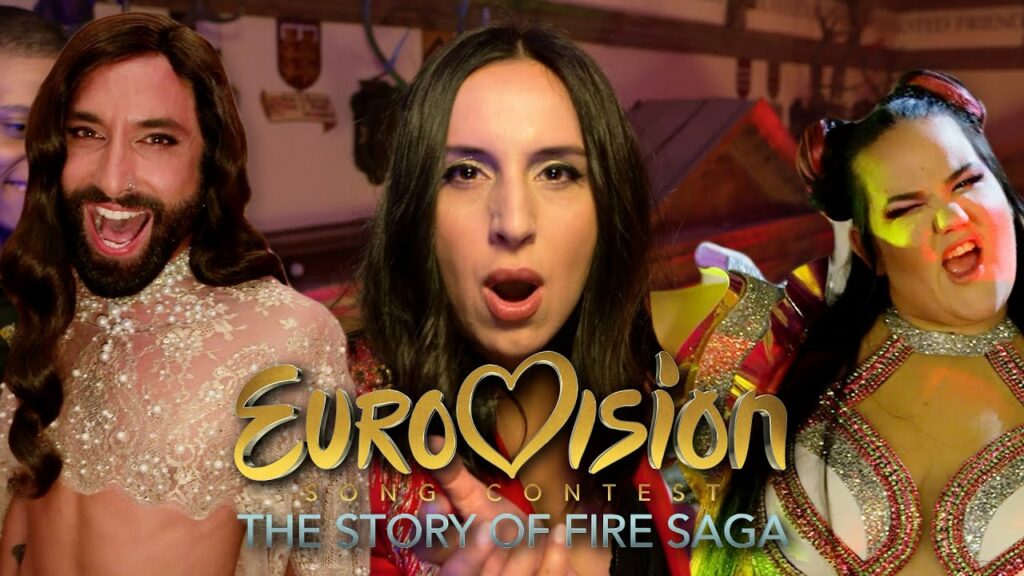
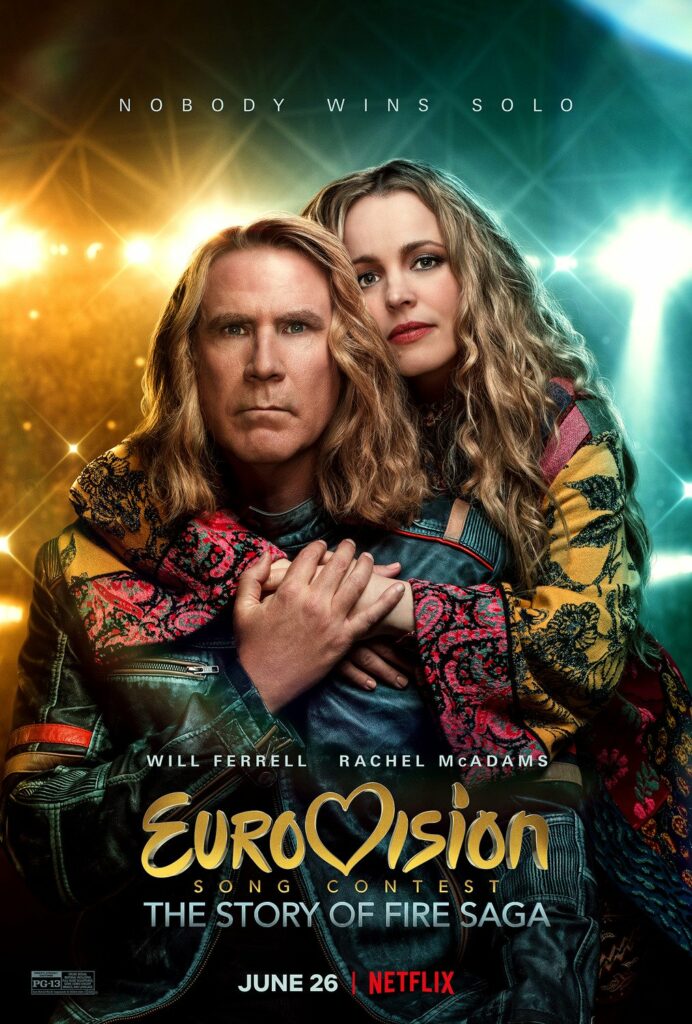
Will Ferrell and Rachel McAdams star as a quirky Icelandic musical duo who fail their way to the top in representing their nation at the Eurovision Song Contest.
Eurovision is, at its heart, a celebration of togetherness; it’s essentially a festival of campy delights that annually gathers the wondrous and the weird together on a single stage. It’s so singularly, spectacularly strange that I’m not surprised to hear that Will Ferrell of all people is a fan. The man loves to sing! He sings in practically all of his movies, like this one, this one, this genuine belter from Casa de Mi Padre and of course this classic. He even sang at the Oscars – twice!
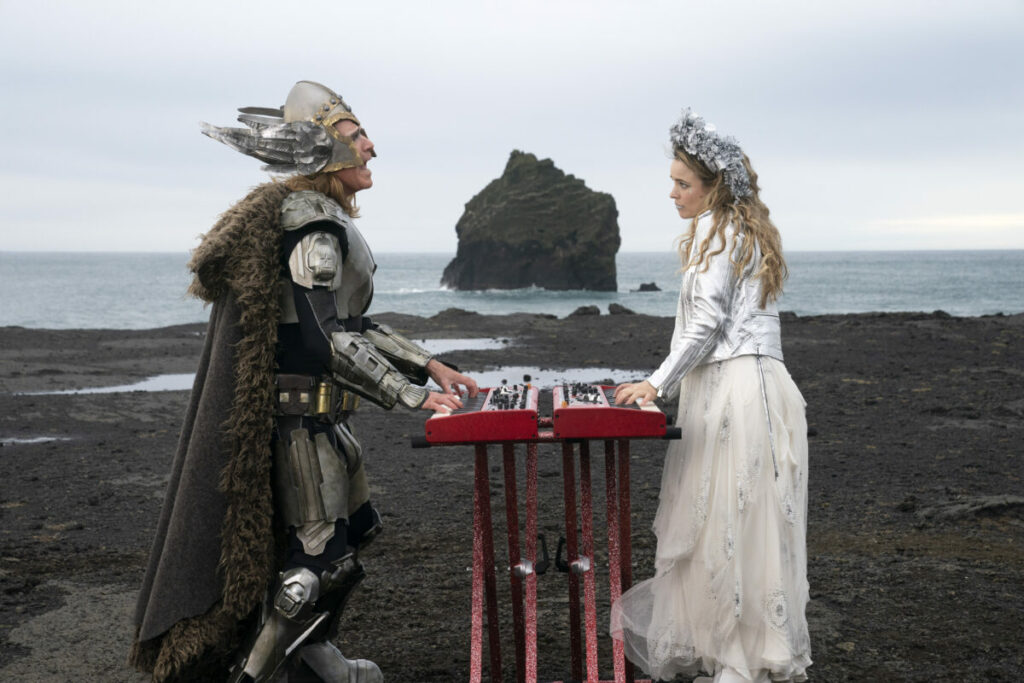
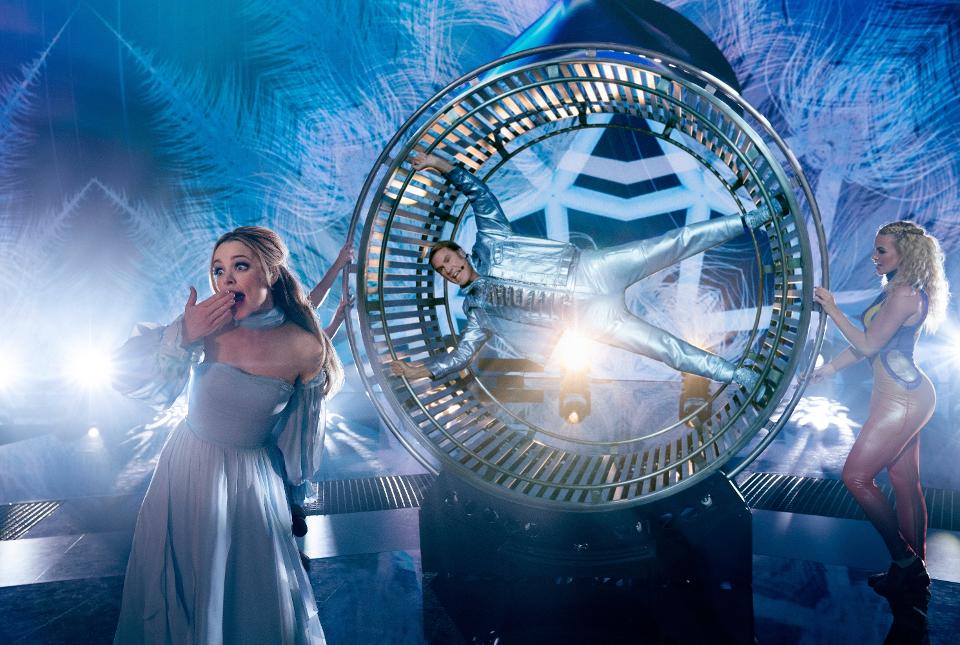
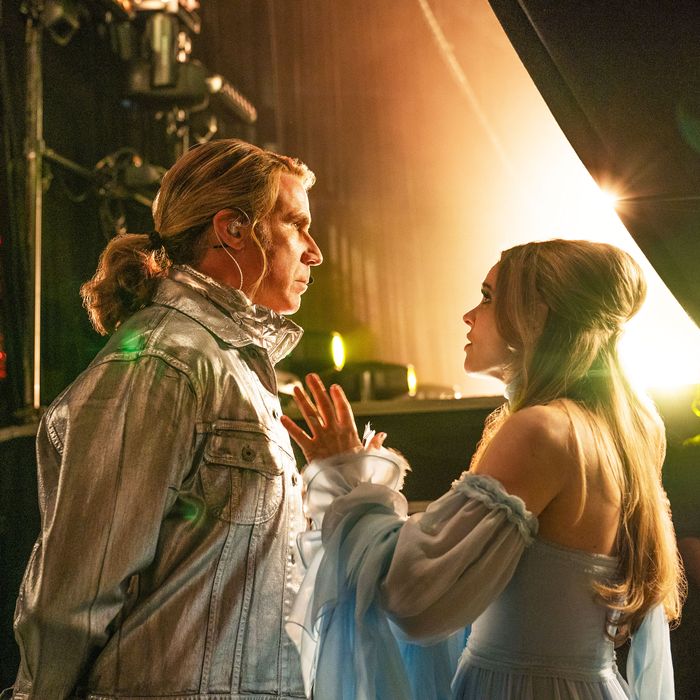
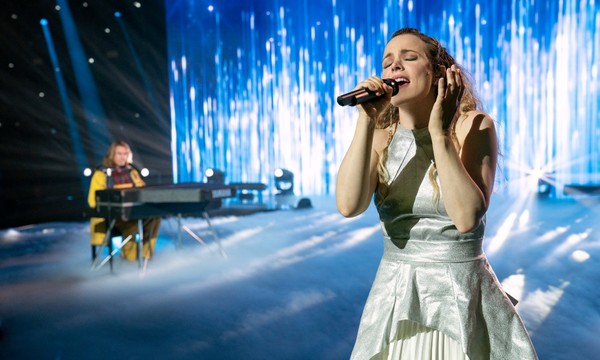
Eurovision Song Contest: The Story of Fire Saga brings two of these loves together in a joyous ode to being completely and defiantly true to yourself. Directed by David Dobkin, the film follows Lars Erickssong (Will Ferrell), a lovably unlucky wannabe-musician who dreams of nothing but winning the Eurovision Song Contest. The only support from his small-town home of Húsavík comes in the form of his long-suffering bestie and Fire Saga bandmate Sigrit Ericksdottir (Rachel McAdams), who has been in love with the oblivious Lars since they were children. Through a series of loopholes, freak accidents and government wrangling, the unlikely duo finds themselves representing their nation in the contest.
Ferrell could play the lovable man-child archetype in his sleep, and in his last few films he seems to have done just that – Daddy’s Home 2, Get Hard and Holmes & Watson all missed the mark in so many ways – but here he’s on top form (aided in no small part by an absolutely fantastic wig). Rachel McAdams shines once again in a comedic role after her hilarious turn in Game Night, and they have real chemistry – even if the film veers into fantasy by suggesting that McAdams and Ferrell could have grown up together or that she would be the one pining for him and not the other way around. Fire Saga is not quite a musical, not quite a pastiche, but its songs are enjoyable across the board. I liked that neither Lars nor Sigrit are inept musicians – the lavish music video for the extremely catchy ‘Volcano Man’ may exist only in their dreams (for now), but their songs are genuinely excellent, from the foot-tapping ‘Double Trouble’ to the sweeping ballad ‘Húsavík’.
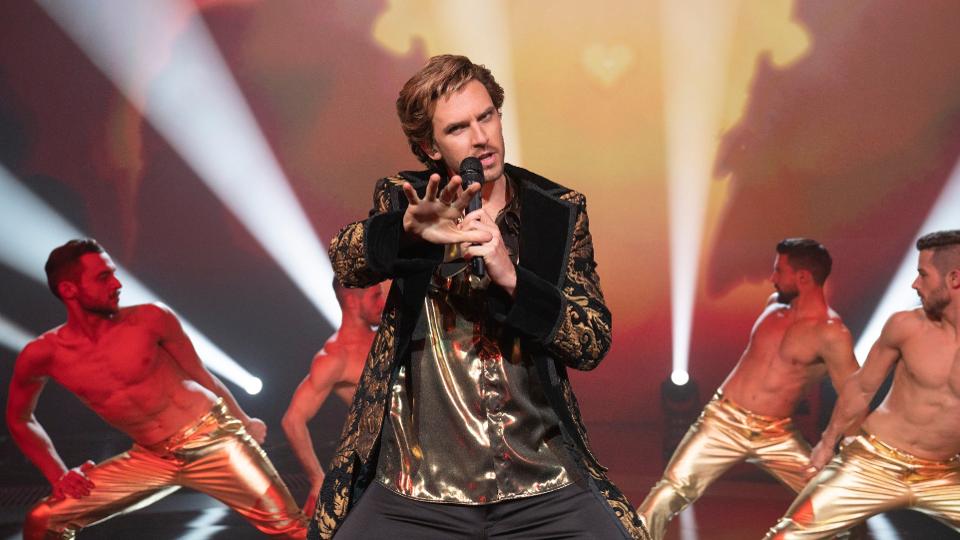
The highlight of the whole thing is Dan Stevens having the time of his life as Alexander Lemtov, an ostentatious singer representing Russia in the contest. Not to spoil the film, but you should absolutely know in advance that there is a scene in which Stevens, wearing a gold-brocade suit and a Careless Whisper-era George Michael wig, sings a song called ‘Lion of Love’ while flanked by a group of scantily-clad hunks. You owe it to yourself to watch that in HD.
A starry medley featuring a multitude of Eurovision winners (I spotted Conchita Wurst and Alexander Rybak) is the cherry on top of a loving homage to the hilarity and exuberance of the contest. It compelled me to revisit my Eurovision favourites of yore – Only Teardrops, Running Scared, Hard Rock Hallelujah and Fairytale – and though nothing could ever beat Ukraine’s entry from 2007, Ferrell has distilled the magic of what makes a classic Eurovision act, capturing the campy charm in a way that only a superfan could.
Sometimes Ferrell’s comedies veer into the mean-spirited (Get Hard, Anchorman, Daddy’s Home) – that’s not the case here. Instead, the film affectionately teases a show which is already acutely self-aware, and gloriously proud, of its quirks. In terms of Ferrell’s filmography, it’s his most successful blend of good comedy and genuine emotional warmth since 2003’s Elf (although I have a place in my heart for both The Other Guys and Talladega Nights: The Ballad of Ricky Bobby, you would be hard-pressed to call either film particularly warm-hearted).
Although it’s a shame we won’t get to witness Daði Freyr win the top spot with the immeasurably catchy ‘Think About Things’ due to the COVID-19 pandemic cancelling this year’s contest, Netflix’s endearing, fun tribute is a loving send-up of the things which make Eurovision bizarre and brilliant in equal measure. It may not be for everyone, but for me it’s the best film released in lockdown so far, and a welcome slice of escapist fun.
Eurovision Song Contest: The Story of Fire Saga is currently streaming on Netflix.
Creating opportunities for a diverse range of people to experience and respond to sport, arts, culture and live events. / Lleisiau amrywiol o Gymru yn ymateb i'r celfyddydau a digwyddiadau byw