
All posts by Barbara Hughes-Moore

Review Northern Ballet’s Jane Eyre, New Theatre Cardiff By Barbara Hughes-Moore

It’s always a treat when the Northern Ballet comes to Cardiff, and it’s been a privilege to indulge in the artistry of their past productions that include the lovely likes of  CleopatraBeauty and the Beast, and Casanova. But their production of Jane Eyre, currently on its UK tour, is an utterly breath-taking feast for the eyes, ears and emotions that simply must be seen.

Based on the classic novel by Charlotte Brontë, the ballet follows the traumatic, and eventually triumphant tale, of our titular heroine as she navigates a wearying world of romance, mystery, drama and deceit. The story has been retold time and time again across a myriad of mediums, so what could possibly set this version apart?

My question was answered as soon as curtain rose. Cathy Marston has choreographed and conceptualised this show to perfection, delicately maintaining an admirable faithfulness to the source material whilst developing a distinct, innovative edge to the newest telling of this transcendent tale, from imaginative staging to exciting choreography. (The most striking scene for me was when a row of headstones glided into view, from which ghostly figures emerged to taunt a young Jane as she visited her parents’ grave – such Gothic touches had me giddy with glee). Every single dancer – principal, soloist and ensemble alike – brought their A game, from the joyously carefree Adela to the sternly solemn St John and the sadistic Mrs Reed, but I have to shout out to the particular performers who carried the singular burden of portraying their exceptionally complex, flawed and iconic characters with seeming ease and natural elegance.

Our titular heroine is always tricky to adapt from the page to the visual medium due to the fact that she is largely introspective;  though wildly passionate within, Jane’s emotions are often compressed and concealed behind a calm, collected facade. Ayami Miyata is completely heartbreaking as a young Jane, expressing both her overwhelming despair and her iron will in the face of seemingly insurmountable odds and corrupt authority figures. Because of this we understand how Jane became the person she is in adulthood, with each emotional scar and every sorrow-honed trait being beautifully portrayed by Abigail Prudames. As Jane forges her own identity through torment and toil, Prudames encapsulates the character’s growing sense of self, strength and independence with every expressive movement.

Jane’s love, Edward Rochester, is also troublesome to translate because he is, in technical terms, what we literary folk like to refer to as a ‘hot mess’. But Mlindi Kulashe was more than equal to the task, inhabiting both of these elements of Rochester’s personality with effortless grace, and completely embodying the character from the moment he strode onto the stage. Thorny and thoughtful, alluring and angsty, Kulashe’s painstakingly detailed performance conveyed every gamut of Rochester’s being from his swaggering imperiousness to his surprising tenderness, and his chemistry with Prudames is palpable. Every stage of their relationship feels simultaneously real and magical, from tentative interest and aching frustration, to its beautiful fulfilment and the inevitable fallout. Their intricate, instinctive and incredible performances anchor the entire show, and their dances were the standout moments in a production positively brimming with gorgeous choreography.

As ballet is a dialogue-free medium, it’s down a heady mix of the dancers’ expressive movements and the skill of the orchestra to convey the high, complex emotions of the story being told. Live music has no equal in this regard, and Philip Feeney’s sumptuous, near-supernatural score, performed live by the incredible Northern Ballet Sinfonia supplanted the need for dialogue and beautifully complemented the action taking place onstage. Similarly, lighting is largely a thankless task, because it’s only generally noticed if it’s very good or very bad. Thankfully this ballet boasts the former, with the wonderfully expressive lighting enhancing the nuance of emotions at play and complementing the dancing and music in lieu of words.

And because a doubles PhD researcher gotta double, allow me to enthuse about how deftly themes of duality, also inherent in the text, were woven into this production. After the prologue, in which a traumatised, wandering Jane is found and cared for by St John Rivers and his sisters, Jane looks melancholically into the middle distance as her younger self appears on stage; we know it is her because the adult Jane mimics her past self’s movements as if in a mirror, or a memory. Later, when Jane finds herself in the direst of straits, she sees her young self again, a memory that mocks and offers no comfort, merely a reminder of her misfortunes. The scariest, most unsettling moment occurs when Bertha, Jane’s foil and spectral double, duplicates Jane’s movements as if she is indeed her shadow, demonically illuminated behind a curtain as the fire she started burns behind them.

Mariana Rodrigues gives a cunning, characterful performance as the first Mrs Rochester, and she and Mlindi Kulashe wonderfully convey the characters’ strange, spiky history. Happily, then, that Bertha has a more active, present role than her book counterpart, literally haunting the characters as a living spectre, a revenant in a red dress. In a daring, active change from the book, this version of Bertha breaks out of the attic to crash the wedding, giving her more agency and expression than her novel counterpart. At one point, Rochester and Bertha resemble Gone with the Wind’s Rhett and Scarlett down to the clothes and the burning background, though their interpersonal connection is even more tangled and twisted than Margaret Mitchell’s selfish star-crossed lovers.

Themes of mental health, present in the original text, are also deeply entrenched in this version, perhaps most notably through Bertha, who’s often crudely and cruelly referred to as ‘the madwoman in the attic’. Bertha acts as a lens through which to analyse the period’s struggle to understand issues of mental health issues  (something which, along with the postcolonial context, is explored further by Jean Rhys’ ‘Wide Sargasso Sea’). Jane is periodically plagued by physical manifestations of her inner maladies, in the form of grey-clad dancers who pull and poke and prod at her. Are they spectres of Jane’s past, an externalisation of her depression? Perhaps they insidious angels, or vindictive demons? At first I wondered if they personified the windswept moors, the Gothic landscapes that so inspired the Brontë sisters. But above all I viewed them as the cruel hands of fate, dragging Jane inexorably from one unfortunate event to the next in her sorrow-saturated life.

At the end, Jane extricates herself from Rochester’s loving arms, but she isn’t leaving him; her ending the play standing alone and apart embodies the notion that this is Jane’s story. She has found a purposeful, fulfilling life as well as a partner and an equal – possessing both the independence and companionship she has long craved, and proving without doubt that those things are not mutually exclusive. I did miss some iconic scenes from the book, such as Jane and Rochester’s dramatic anti-meet cute in the forest, and the burning of the wedding dress; though both would be tricky to recreate, and also proved unnecessary in an already packed production that fully captured the soul of the story.

Haunting, harrowing yet hopeful, Jane Eyre’s story remains as relevant to us now as it ever did. Northern Ballet’s adaptation weds faithfulness with innovation in an enchanting adaptation of a timeless story that will linger long after the final curtain.

Review: This Is Elvis, New Theatre by Barbara Hughes Moore

It may have been a rainy Monday night in 2018 Cardiff, but for everyone watching This Is Elvis at the New Theatre, it felt as though we had been transported back in time to watch the King shake, rattle and roll in the flesh. This new musical, presented by Bill Kenwright and Laurie Mansfield, adapts, and celebrates, Elvis’ 1968 comeback special and his 1970 Las Vegas show, and five decades later the songs remain indestructible, incredible, and utterly unforgettable.

The first thing we’re greeted with is a striking red screen onto which is emblazoned an image of the King himself; his features are only hinted at, half his face obscured in shadow, but he’s still strikingly recognisable. It’s so bold that when you close your eyes the face remains like a camera flash after-image, like a Rorschach test, like the holy face imprinted on Veronica’s veil. Instantly, the image and its lasting effect on the eyes wordlessly articulates Elvis’ legendary status; that we only get impressions of the man he was, shaped by our own perception, experience and memory.

Having been bombarded with that stunning visual, when the curtain lifts it’s not Elvis we see, but rather other people – his manager, his band mates – talking about him. The spectral presence of Elvis’ image lingers, so that when he does finally arrive on stage he hauls along with him the baggage of everyone’s individual and collective ideas of who Elvis was. But from the moment Steve Michaels swaggered onto the stage in that legendary black leather ensemble, he was Elvis Presley.

We’ve all of us probably risked a ‘thank you very much’ Elvis impression at some point in our lives. But Steve Michaels’ performance was not an evocation, or even an impersonation – it was a complete inhabiting of character from the first moment to the last. His every vocal intonation, every gesture, every step and every sound was Elvis – even his hair, from root to tip, was every bit the King’s! Each and every song was varied and vibrant, capturing the essence of Elvis like lightning in a bottle. It was so spot on it veered into the uncanny valley at times, as if this was some living hologram of the man himself, here to bring a little joy into the lives of us Cardiffians on that rainy night. From his first line – ‘if you’re looking for trouble, you came to the right place’ – to his last – ‘Goodnight everyone, I’ve been Tom Jones’ – Steve Michaels lived every second on stage like a man possessed, and when they announced at the end that Elvis had left the building, it felt as if we truly had lost the King all over again.

The first act portrays Elvis’ ’68 NBC comeback special, the emotional and professional aftermath of Elvis’ revived spirits and career, and his first (reluctant) foray into performing a Vegas show. Most tantalising of all, it humanises the King in a way I’d never seen before – who’d ever have though such an extraordinary man as Elvis Presley would feel anything as ordinary as nerves? Fear? Insecurity? Yet we get to see the legend shaking with anxiety at the thought of getting back on the stage after twelve years away from it. At the start, he seems as monumental as that striking image of him emblazoned on the red screen; but by the end of act 1, we realise that this was but one side of the man, magnified, writ large on history. Despite all the accoutrements of his iconic character, beneath it all he’s just a man; a gifted one, but one plagued with the same emotional turmoil that we mere mortals know only too well.

Though earnest and interesting, the first act felt a tad messy in parts, interspersing Elvis’ onstage performances with his offstage personal drama in a way which felt clumsy at times. But act 1 was rendered both necessary and fulfilling by the absolute beast of its second act, which solely, singularly recreates Elvis’ 1970 Vegas show (feat. the iconic white jumpsuit) from start to finish with nothing else in between. It roars along as both a riotous, self-contained concert experience, and as a personal and professional victory, a success of epic proportions that completes Elvis’ road to reviving his confidence and career.

The audience was responsive, raucous and often rowdy, dancing and singing and affectionately shouting out their love and appreciation for the tireless efforts of the performers. And who could blame us, with such iconic, incredible songs to soak up like ‘That’s All Right Mama’, ‘Viva Las Vegas’, ‘Suspicious Minds’ and ‘It’s Now or Never’ – to name but a very few. One of the highlights of act 1 wasn’t even an Elvis track but a stunning rendition of Simon and Garfunkel’s ‘Bridge Over Troubled Water’. ‘Love Me Tender’ was the only song which I felt fell a little flat, but it was sandwiched by such corkers as ‘All Shook Up’ and ‘Don’t Be Cruel’. As an avid, enthusiastic (if amateur) dancer myself, I was particularly enraptured by the more upbeat songs of the night, jiving away to the riotous tones of ‘Blue Suede Shoes’, ‘Hound Dog’ and ‘King Creole’. But even when they slowed it down for ballads like ‘In The Ghetto’,  ‘Always On My Mind’ and ‘Are You Lonesome Tonight’, everyone in that theatre was utterly transfixed. ‘Burning Love’ seemed to be a more fitting final song than ‘Jailhouse Rock’, and the crowd reacted to it as such; the latter is a classic, don’t get me wrong, it just felt unsuitable for the finale. Having said that, using it as the climactic piece makes for a moment of pure circularity where the Elvis at the end of his life calls back to the Elvis who was just starting out. Narratively, it makes sense; musically, less so.

I was amazed – and vicariously exhausted – to watch every performer maintain such high levels of energy and quality throughout what looked to be an exhilarating but exhausting set. You can’t beat live music, but I have to commend these performers in particular for being amongst the best I’ve had the privilege of seeing live. I want to shout out especially to Misha Malcolm, Melissa Brown-Taylor, Katrina May and Chevone Stewart who added stunningly beautiful harmonies throughout the show, and enhanced every song by adding a simultaneously contemporary and ethereal quality. Everyone was incredible, from the guitars to the drums, the brass section to the singers, but I have to shout out to two standouts in particular: Niall Kerrigan on the lead guitar, of whom Chuck Berry would have been proud; and Steve Geere, who performed the dual roles of conductor (not an unclear upbeat in sight) and keyboardist – he was shredding them keys something fierce.

Transcendent, resplendent, incandescent. Whether you love Elvis or have never heard of him, this show is a must-see.

Review The Motherf**ker with the Hat, Sherman Theatre by Barbara Hughes-Moore


 out of 5 stars (5 / 5)


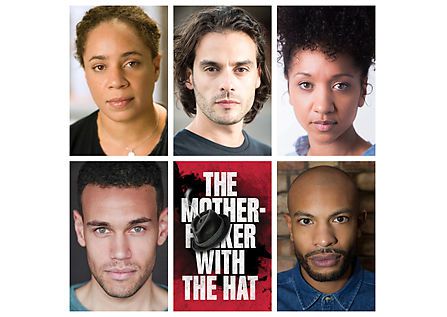
Having been a fan of Stephen Adly Guirgis’ The Last Days of Judas Iscariot (hereafter Last Days), I was eager to check out his similarly incendiary-of-title follow-up ‘The Motherf**ker with the Hat’ (hereafter That Mo-Fo Show). Directed by Andy Arnold, this collaboration between Sherman Theatre and Tron Theatre, Glasgow is ninety minutes of electric drama, with no interval to slow down the break-neck pace of this magnificent masterpiece unfolding on the stage.

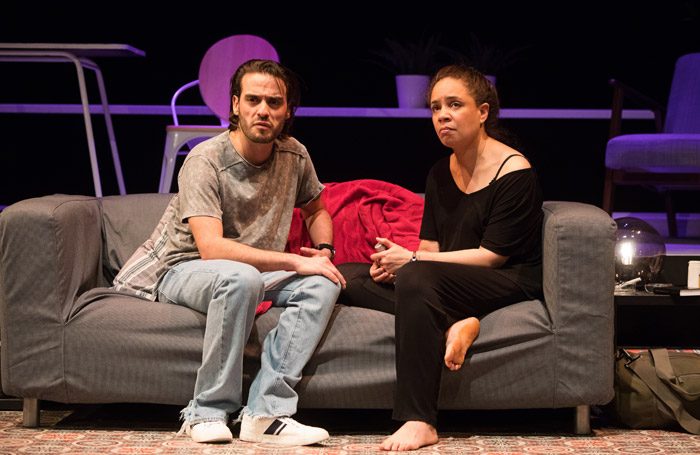
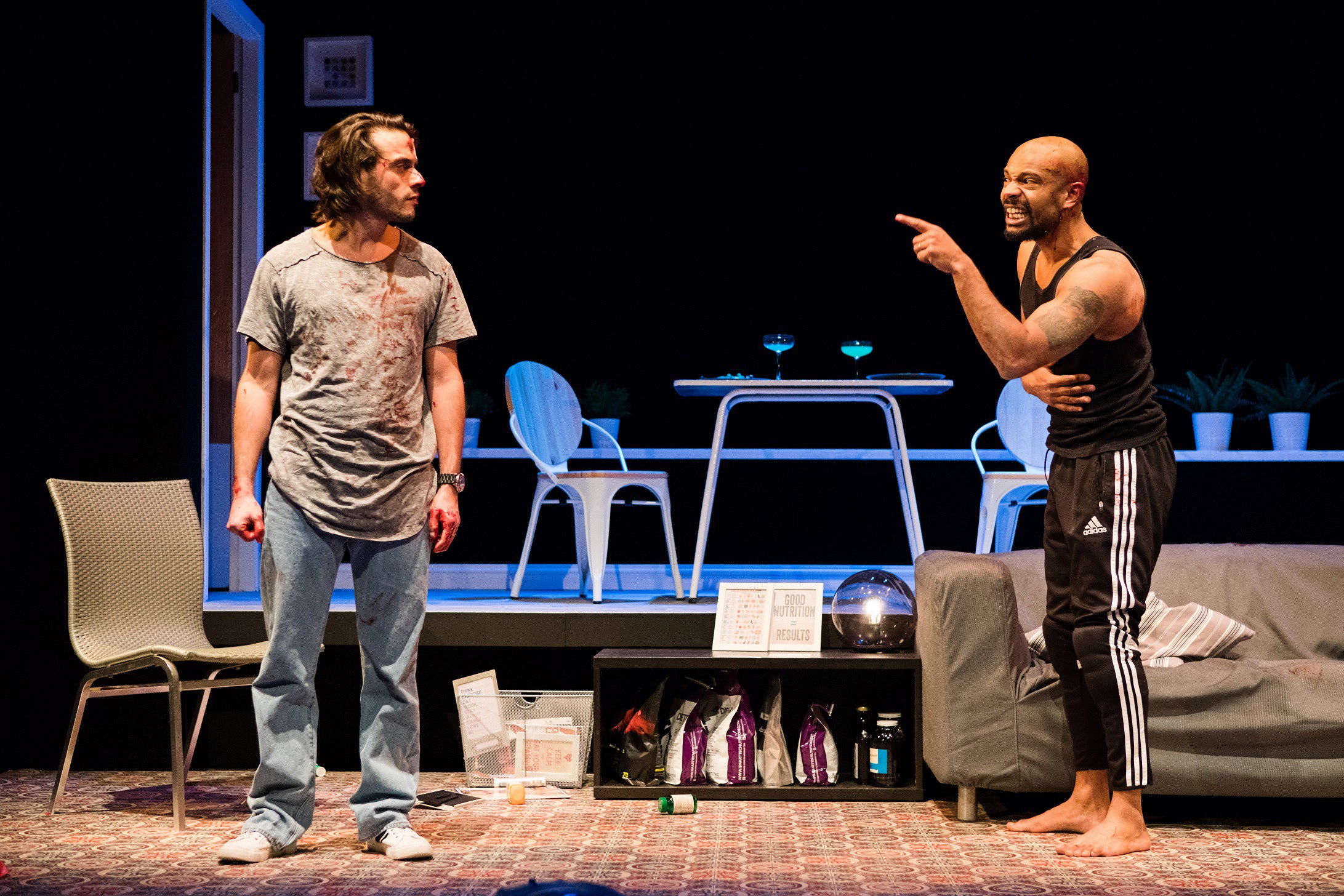
Set in the grimy grit of Hell’s Kitchen NYC, The Mo-Fo Show follows a young man named Jackie, a newly-released ex-con recently home from prison, as he tries to stay clean and out of trouble despite personal revelations that threaten to turn his world upside down. Francois Pandolfo plays Jackie with such roguish, ramshackle appeal that you understand why Veronica, Ralph and Julio still care about him despite his transgressions. He’s a lovable loser; a user in all senses of the word. As Satan tells the lawyer El-Fayoumy in Last Days, ‘you’ll never be loved, because you’re incapable of it’, which sums up one of Jackie’s myriad issues to a tee. Unendingly selfish and mercurial, Jackie cares little about the thoughts and feelings of others as long as they serve his purpose. But by the final curtain, there’s hope – if ambiguously framed – that Jackie may finally have a toe on the path to recovery; though he leaves threats in his wake, a revenant of his presence that lingers uneasily after the curtain falls.

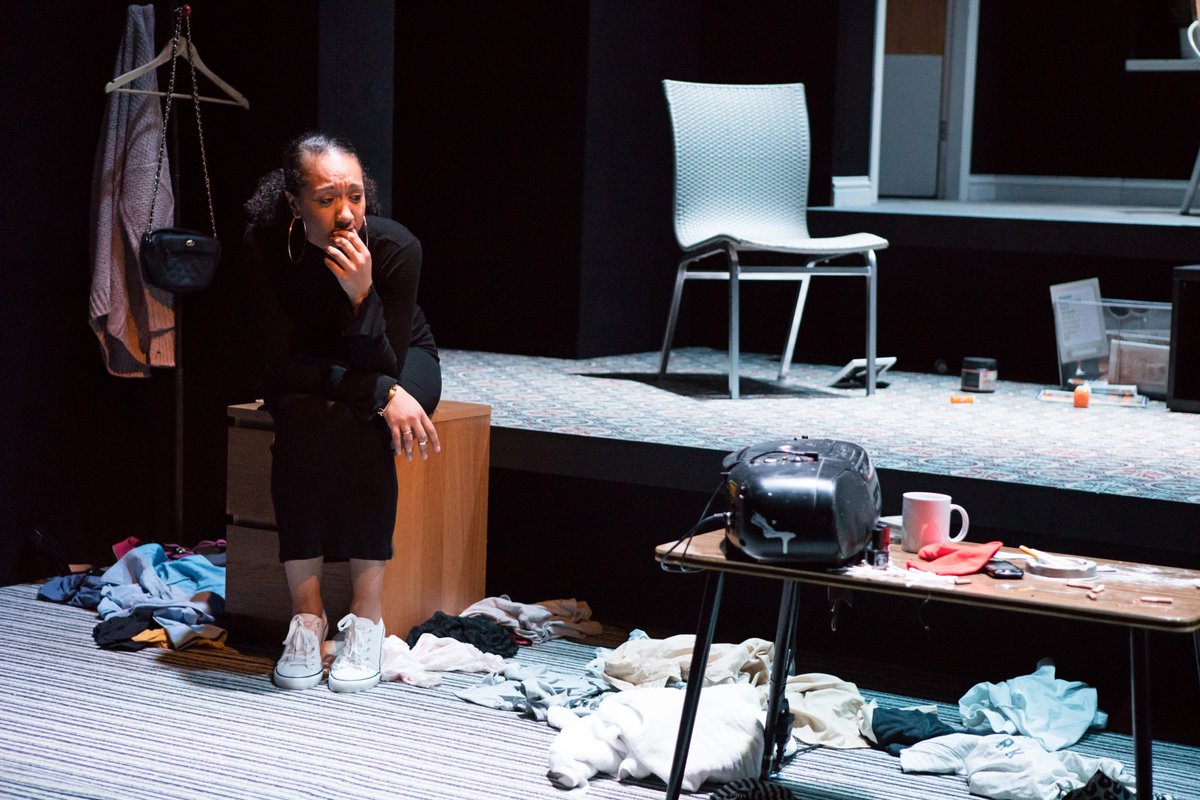
Despite this being ostensibly Jackie’s story, we start and end the play with Veronica, masterfully played by Alexandria Riley, who is fast proving herself as one of the most dynamic actors currently treading the boards. To me, Veronica is the most tragic character of them all, because she learns nothing, and is doomed to re-enter the vicious cycle in which she has imprisoned herself. When the play starts, Veronica is chastising her mother on the phone for dating a deadbeat and taking drugs; and yet she casually snorts coke during the conversation, and then praises her own deadbeat boyfriend for finally getting a job. Veronica is her mother’s double, repeating the same harmful mistakes of the past again and again. We leave her at the end alone in the dark, with little hope for the future.

Veronica projects an image of brutal honesty, but it conceals secrets and lies – though she is far from being the only hypocrite in the play. Jackie protests that he is a good man, but it masks the fact that he is not. Ralph presents an image of being the ideal man, but in reality he is far from perfection. Played with mesmerising charm by Jermaine Dominique, Ralph’s shocking switch from wise everyman to shrewd manipulator is subtly portrayed and all the more sinister for it. Having said that, none of the characters are moustache-twirling villains, although they say and do bad things, making each character’s own personal Dark Passenger frighteningly realistic.

Each character leaves the play with their own long list of regrets – for the life they could have led, for the people they could have been, for the choices they’d have made differently if they had the chance. Regret makes a double of you, leaving an imprint of who you might have been if not for one choice, one moment, one mistake. The character of Victoria – wonderfully, woundedly portrayed by Renee Williams – exemplifies this duality most keenly of all. Her choice to follow love over career has left her hollow and achingly lonely, so much so that she wants to ‘disappear’, if only for a while. She is the least hypocritical character, except perhaps for Jackie’s Cousin Julio.

Julio may just be the most well-adjusted character of the bunch, a guy who both enthusiastically enjoys the minutiae of cooking and also occasionally puts people in the hospital. He even names his violent alter ego, referring to it as Jean-Claude Van Damme. Though perhaps the most dichotomous character of the cast, Julio is engaging precisely because he accepts that he is a bad man – a clear foil for Jackie, who proclaims to be a good man but is, in truth, the oppsite. Kyle Lima frequently treads a fine line between pastiche and plausibility in the role, but wonderfully crafts a performance which feels both fantastical and naturalistic, and the kind of person you would legitimately enjoy hanging out with in real life. Julio is a potent mixture of Pulp Fiction’s Jules Winnfield, The Birdcage’s Agador Spartacus, and Yoda from Star Wars; and if that sentence alone doesn’t convince you to see the play for yourself, I don’t know what will.

In addition to being a rapt audience member, I also had the pleasure of being a speaker on the post-show panel, led by Tim Howe, the Sherman’s Communities and Engagement Coordinator, and my fellow panellists Luke Hereford (the play’s assistant director), and Nick Shepley (addictions therapist at The Living Room). The discussion was lively and engaging as always, with some great insights from the panel and the audience alike.

Every character in the play was, or had been, an addict – to drugs, alcohol, sex, sometimes a combination of those things. But they’re also (quoting Last Days) ‘addicted to tragedy and punishment’, doomed to wallow in a hell of their own making; a vicious circle of self-imprisonment. Secrets and lies have stretched taut to breaking point between the characters; revelations take time to crack open, but once the lid is lifted on that particular Pandora’s Box, a whole swathe of sorrows and deceits come pouring out, with little sign of stopping. Some of the revelations were so shocking that I gasped audibly when reading them for the first time, and still felt the aftershocks of that surprise whilst watching the play live. Each character fails to stave off the throes of their own addiction – often, as Nick observed, just swapping one addiction for another.

The play is so rich and rewarding that there were so many observations, thoughts and ideas that there simply wasn’t time to discuss on the panel. On reading the play for the first time, the appearance of the hat, sans owner, seemed almost to be mystical, even mythic, in nature. It appears without warning, like an omen, and is the MacGuffin which ignites the dramatic spark which burns throughout the rest of the play. And when Jackie goes downstairs to confront who he thinks is its owner, it seemed almost as if he was descending into the pits of hell for an audience with the devil. Much like Godot, the eponymous hatted individual is absent from the proceedings, and yet his spectral presence haunts every scene. Or, rather, the mo-fo with the hat does appear, though not in the guise Jackie first expected. Whether its magical or mundane, the hat acts as a manifestation of mistrust and misdemeanours – Jackie initially likens it to the mark of Zorro, sign of the titular mo-fo marking his territory. He closes the play, and the narrative loop, by leaving his own mark behind – a Commodores CD, a relic of his long-held love for Veronica, now a monument of a bygone era.

This is not a courtroom drama, despite a number of legal elements splintered through the story. I lost count of how many times assault and battery occurred, both with and without a deadly weapon, not to mention the copious references to drug use, convicted and otherwise. Jackie has a very particularly twisted moral code – when he first suspects Veronica of having an affair, with scant evidence to go on, he argues that murder would be ‘f**ked up but understandable’ in the circumstances. Jackie is every person’s judge but his own. The play reinforces Guirgis’ own words from Last Days, in which the lawyer Fabiana Aziza Cunningham proclaims that ‘those who need forgiveness are the ones who don’t deserve it’. But, as Last Days attests to, ‘you have to participate in your own salvation’. Jackie ends up serving time, not for his various assaults, batteries and criminal threats, but for breaking parole. The law is a distant, vaguely drawn entity in the play; but it is an interesting consideration of how a person’s internal self differs from their external persona, and how, as Jackie observes, ‘people can be more than one thing’.

Vibrant, vulgar and viciously insightful, The Motherf**ker with the Hat is an unrelenting, rewarding play that lingers in the mind long after the final curtain. Incendiary, inventive and intoxicating, the play showcases the second-to-none cast and brings the wildly exhilarating worlds of Stephen Adly Guirgis to sharp, relatable relief. Utterly unmissable. And following on from that, I would also highly recommend Guirgis’ The Last Days of Judas Iscariot, as a companion piece to this play, as its predecessor, or as a stand-alone study of the prisons we make for ourselves.

Barbara Hughes-Moore

Review Tango Moderno, New Theatre by Barbara Hughes-Moore

You know when you’ve been Tango’d*

Of all the countless dance shows produced by Strictly pros over the years, Vincent Simone and Flavia Cacace’s are by far the finest I’ve seen (and I’ve seen quite a few). I even reviewed Natalie Lowe, Jay McGuinness and Louis Smith’s superb 50s spectacular Rip it Up for Get the Chance last year (which you can find here). However, what little the latter show lacked, Tango Moderno possessed in spades.

Vincent and Flavia’s dancefloor magic has captivated Strictly audiences for years, but where they truly shine is incorporating stories through which the dancing is rendered not only enjoyable, but also emotionally rewarding. Ultimately, it’s the evolving and varied stories of the shows – interwoven with the incomparable dancing – which make them stand out, and they never tell the same story twice. This time around, the dance spectacular is framed as a sort of Greek drama, with Tom Parsons’ charismatic narrator acting as Chorus and chanteur as he doles out gems of romantic wisdom like a Shakespearean slam poet. The Shakespearean elements don’t end there – Vincent and Flavia portray ethereal love gurus; supernatural muses who play cupid to the lonely hearts of the modern era, much as Puck meddles with the hearts of Shakespeare’s star-crossed lovers in A Midsummer Night’s Dream.

As the title suggests, the tango in its literal and abstract form is brought into the modern era, juxtaposing the classic with the contemporary, the magic with the mundane. In that way, it makes dance feel accessible even to us mere mortals, even as Vincent, Flavia and co. transcend the bounds of your traditional dance show with bold staging, relatable concepts and beautifully innovative ways of conveying emotional truths through music and movement.

The modern setting started out as intriguing and grew more effective and affecting as the drama and dancing played out; not only is it  beautifully choreographed and lovingly crafted, it also has a lot to say about modern life and specifically modern love, even featuring a sequence entitled the Blah Blah Blah Cha Cha Cha in which modern lovers embrace whilst still being attached to their iPhones (other brands are available), as well as an incredibly amusing online dating number in which the crazy people you swipe left on Tinder were hilariously recreated by the dancers posing inside a massive phone screen prop.

Vincent and Flavia’s unparalleled talents have been better expressed by more eloquent and informed people than me over the years, so what can I add that hasn’t already been said? Only that I’m deeply grateful that Vincent and Flavia continue to grace us with their time, skill and generosity year after year. I was surprised to see them take somewhat of a backseat in their own show, but found it to be an innovative and welcome choice in showcasing the talents of their wonderful co-stars, as much as demonstrating their own transcendent talents.

Every single dancer was sublime, and every number was a winner, but I have to shout out specifically to George Hodson and Mary Lynn Tiep whose dancing – both individually and as a partnership – was by far my favourite in the show; their dance ability, comedic timing and chemistry shone even among an already superb cast. They led one of the outstanding numbers of the night in which Vincent and Flavia’s cupids inspired their bickering couple to get back together and reconcile in let’s say a rather energetic way. Other standouts in the ensemble include Simon Campbell as a lovelorn millennial mourning his lonely nights to the tune of Luther Vandross’ ‘A House is Not a Home’, and Bryony Whitfield and Tom Woollaston who made for a sweet couple as well as sensational solo artists.

I was consistently impressed by the fluidity and ease in which each dance number flowed into the next. Adding to this was the idea of recurring characters – the eight ensemble dancers, despite playing multiple roles, each formed four distinct recurring would-be couples in matching outfits of distinctive shades who appeared regularly in between the group numbers. The presence of a narrative through-line, and recurring characters, really helps to elevate the dancing and give it an emotional impact as well as a visual spectacle.

There are too many incredible sequences to describe, but here are a few highlights. One of the most beautiful segments of the night was an affecting number set to Lukas Graham’s ‘7 Years’, in which the male dancers really captured the melancholy journey from youth to maturity. One of the funniest group dances was a combative Spring Cleaning-off, in which the dancers fought mundane battles in the domestic setting with lawnmowers and wheelbarrows for chariots and kitchen implements for weapons; a laddish soft-shoe to Bruno Mars’ ‘Lazy Song’, and a haunting, spiky Argentine to Rag ‘n’ Bone Man’s ‘Human’. There was also a spotlight for violinist extraordinaire Oliver Lewis whose rendition of Flight of the Bumblebee was so exciting and energetic a rendition that it left the audience simultaneously exhausted and exhilarated. The live band were utterly amazing and gave a vibrant backdrop to the onstage antics.

However I have to note one of the rare troubling aspects I have with mainstream dancing culture, and that’s that it remains deeply heteronormative. Vincent and Flavia’s classy cupids kept matchmaking a veritable conveyor belt of straight couple after straight couple; however, there was an admittedly brief, but very welcome openly queer moment near the end of the show in which two women shared a romantic kiss and decided to start a relationship with each other, much to the surprise and chagrin of their respective male exes. It’s a pretty big leap for the dance community, framed as it was as a celebratory, romantic moment for the two women in question (though it was played as comedic for their shocked exes). But as the only openly queer moment in the show, and a brief one at that, I found it to be comparable to Lefou’s much-discussed ‘explicitly gay moment’ in Disney’s 2017 live-action Beauty and the Beast; a moment which ended up as all-too brief, and though it might have been a huge step for the historically conservative Disney, was not the representation the LGBT community was promised, or the much-needed representation it deserved. However, I was grateful for its inclusion, and hope that it paves the way for more queer representation in the dance community.

Tango Moderno proves once again – if proof was needed – that Vincent and Flavia are unmissable, unbeatable and unforgettable even while affording every member of their tireless yet effortless cast and crew a moment to shine. And of course, the world champions graced us with their incomparable Argentine Tango skill with a truly breath-taking, heart-stopping finale the likes of which I’d never seen. This is truly a show that everyone can enjoy, and if you can make it, I promise you’ll be tango’ing all the way home.


*Sorry I couldn’t resist. Dance puns, I’ve got ‘em.

Review Young Frankenstein: The Musical, Garrick Theatre London by Barbara Hughes-Moore

Abby-normally good

I’m a huge fan of Gene Wilder & Mel Brooks’ Young Frankenstein. Released in 1974, it’s the paragon of horror-comedies for me and the most lovingly crafted homage to the Gothic monster movies of the 1930s I’ve ever seen. Not only is it funny, but it does what all the best sequels/ reboots should: it does justice to the original, whilst also creating new characters to love and root for.

So, naturally, I was both excited and anxious when I heard that it would be turned into a musical, because how can you improve on perfection? And who could ever do justice to the roles originated by Gene Wilder and co? But, then again, the last time a Mel Brooks classic was Broadway-ified was The Producers, and for me its musical adaptation is far superior to the original.

With that hope in mind, I took my seat in the Garrick Theatre and waited to be impressed. It didn’t take long for that to happen. Far and away the best thing about this production is Hadley Fraser as the eponymous scientist burdened with a monstrous legacy. Fraser has always had a wonderful presence on the stage – his performance as Raoul in the 25th Anniversary adaptation of The Phantom of the Opera is the only time I have ever liked that particular character – but he’s incandescent as Frederick Frankenstein, grandson of Victor, who is initially resolved to shirk his infamous heritage. He impressively handles his introductory song ‘The Brain’ in which he elegantly and eloquently rattles off a wordy self-treatise that rivalled the Major General’s song for speed and complexity. From that moment on, he had the audience in the palm of his hand. Gene Wilder is a singularly hard act to follow, but Fraser owns the role and makes it his own, mixing arrogance and charm with vulnerability and compassion, and crafting a wonderfully fulfilling character arc whilst singing, dancing and acting with brio from the first note to the last.

Ross Noble is charged with the responsibility of inhabiting the inimitable Marty Feldman in the role of Igor, Frederick Frankenstein’s eccentric accomplice. Happily, he too decides on evocation over imitation, and delivers a knowingly offbeat performance that nicely complements Fraser’s more prudish counterpart; their amusing dynamic is nicely showcased in the ‘Together Again’ duet, complete with physical comedy and the iconic ‘walk this way’ joke. Lesley Joseph approaches the role of Frau Blucher (*frenzied neighing*) with admirable gusto, belting out the standout Ursula-esque number ‘He Vas My Boyfriend!’ with joyful abandon. However, the speaking segments of the song were a bit unnecessary, clumsily and crudely spelling out what the song has thus far aptly alluded to – though the blame for this lies with the writers. But though Cloris Leachman set a high bar, Joseph is hilarious in the role and it was great to see her less as an antagonist (as she was for most of the film) and more as a core member of the main team throughout.

However, something that irked me about this musical was the way in which the female leads were framed. It’s shocking that a production in 2018 manages to sexualise its female characters even more than a film from the 70s does. But with Summer Strallen’s Inga, they do just that – something which seems especially egregious when the male characters don’t receive the same framing or treatment. The character of Inga, originated by Teri Garr, was always progressively, defiantly in control of her sexuality – though it was often utilised more in the enterprise of producing innuendo than in asserting her strength as a character and her admirable sexual agency. Strallen’s two major musical numbers – ‘Roll in The Hay’ and ‘Listen to Your Heart’ – are both laden with sexual innuendo and mostly involve her draping herself seductively over Frederick. It would seem progressive but for the framing, which is planted firmly in Male Gaze territory. However, the lyrical content of those songs are perhaps more layered than they may seem on the surface: the former is, at its core, a Hakuna Matata-style treatise on letting go of your worries; and the latter is an interesting gender reversal of the usual dynamics between heterosexual couples in musicals – this time, it’s the woman who seduces the man through song. Strallen is a sparkling stage presence, and it’s a credit to her skill and charm that she renders the role as more than a bland stereotype.

Even the character of Elizabeth, whose disgust at the thought of touching her fiancée Frederick is the butt of many jokes, is sexualised (along with Inga) where the male characters are not. Her solo ‘Please Don’t Touch Me’ has an extended section in which she repeats a vulgar term for a part of her anatomy over and over again – much to Frederick’s sexually-frustrated chagrin – that proved ultimately more embarrassing than entertaining. Again, there are some interesting, even admirable, elements of the song – it’s arguably an example of a female character asserting her own sexual agency and establishing boundaries in a relationship. However, it’s framed as if Elizabeth is cruelly leading Frederick on, and her lack of romantic attraction to him is starkly confirmed when she later engages in a whirlwind romance with the Creature.

A lot of these problematic aspects admittedly have their roots in the source material; as with all Mel Brooks properties, there are as many potentially offensive jokes as there are progressive ones, to be found in the 1974 original as well as here. Madeline Kahn is damn near irreplaceable in the role, but Dianne Pilkington’s amazing voice and great comedic chops are both allowed to shine in spades. Her interactions with the Creature are a particular highlight – and Nic Greenshields portrays the hulking outcast with just the right balance of monstrosity and vulnerability. He had to hit all the right comedic beats both in physical and verbal performance, and managed to achieve the balance that his predecessor Peter Boyle achieved all those years ago.

I have to commend the production design for its creativity; all of the settings were atmospherically invoked, the Gothic laboratory in particular, as well as the horse-drawn hay cart being pulled by guys in War Horse-esque equine puppet heads (it looked better than I’m describing it). However, I’m in two minds about the Transylvania Mania sequence, which was a conceit of the production rather than the movie. In it, Frederick, Inga and Igor have to distract Inspector Kemp and the townspeople from investigating the reanimated Creature’s howling, so they fabricate this tacky dance crazy on the fly. It was nicely staged, and objectively amusing, but it just felt a little pointless.

I have to say, the townsfolk storyline overall never involved me even in the original movie, and it continues to fall a little flat here, despite enthusiasm from the chorus and some fantastic costuming. Every scene with them feels a little dull, except when Patrick Clancy moodily storms around as the animatronically-armed Inspector Kemp. He also plays the lonely Hermit, the better role of the two, and the one which earned the most laughs in the shortest time period. His dry delivery and aged prosthetics called to mind Billy Crystal’s Miracle Max in The Princess Bride, and his melancholy, musical plea to ‘Please Send Me Someone’ was a standout number of the whole show. His performances as Kemp and the hermit were so dissimilar that I genuinely didn’t know they were played by the same guy until he ripped off his hermit beard during the final bow – serious kudos to Clancy for that.

However, the number which stood head and shoulders above the rest was, of course, ‘Puttin’ On the Ritz’, and how could it not be? The show takes the original’s delightful novelty of Frankenstein dancing with his monster, and turns it up to 11. They absolutely make the most of their theatrical setting, transforming what was once a duet into a chorus-line of joy and strangeness and 30s charm. I particularly like how every cast member is part of the number this time around, and in fact the group/ friendship dynamic is (happily) front and centre in this version.

I also like the expansion of the romantic aspects of the story. Frederick and Inga’s blossoming relationship was enjoyable, mainly due to the chemistry between Fraser and Strallen, who made even the hokiest romantic/ innuendo-laden dialogue charming through their line readings alone. But the other characters get a little love too: from the unexpected union of Frau Blucher (*frenzied neighing*) and the blind hermit, to the expansion of Elizabeth’s liaison with the Creature.

One of the happy surprises was the inclusion of the original film’s main musical theme, a hauntingly angsty violin solo that is also beautifully integral to the plot because of the humanising effect it has on the Creature. I’ll try to avoid spoilers, but there is a moment at the climax of this musical where Frederick sings a song to this iconic melody (‘Frederick’s Soliloquy’) and it was without a doubt one of the best moments of theatre I’ve ever seen. It beautifully completes Frederick’s character arc – as a scientist, as a Frankenstein, as his own person – and also heals the past wrongs with which his legacy had burdened him. It is an emotional, poignant and utterly transcendent moment in a Mel Brooks comedy musical – and if that’s not one hell of an achievement, I don’t know what is.

The lines don’t have quite the mix of bombast and subtlety that the original pioneered, but some of that comedic nuance needs to be abandoned when translating into the theatrical medium. I was pleasantly surprised at how much of the original this musical adaptation maintained, particularly its core message of lonely outcasts finding acceptance and affection with each other. Just as Victor Frankenstein stitched together his Creature, so does his grandson Frederick weave a family for himself, and in so doing, heal the wounds of the past. If you have even the slightest Gothic tendencies, or if you enjoy a bit of comedy/ horror with your laughs, I highly recommend Young Frankenstein: The Musical for an abby-normally good night out!

Review The Cherry Orchard, Sherman Theatre by Barbara Hughes-Moore


The third part in the holy trinity of dynamic duo Rachel O’Riordan & Gary Owen’s co-productions, and the jewel in their collaborative crown, is their adaptation of Anton Chekhov’s The Cherry Orchard, seamlessly updated from pre-Revolution Russia to Thatcherian Pembrokeshire.
Centring on a family of wealthy landowners just as their luck and lucre begin to dwindle, the updated Cherry Orchard follows the return of boozy, bombastic matriarch Rainey to her childhood home mere days before it’s to be sold at auction. Her reappearance heralds an era of chaos, confusion and uncertainty, not just in her personal relationships but in creating a complex and combustible legal situation that threatens the stability of her nearest and dearest. Over all hangs the spectre of Mrs Thatcher, promising the working-class freedom with one hand, and mass unemployment with the other.
Rachel O’Riordan deftly directs the excellent ensemble, expertly exhuming the characters’ inner demons in a way that is interesting and realistic, but not clumsy or banal – a tricky line to navigate. Gary Owen adds heart and humour in his adaptation of Chekhov’s play; Owen’s version is not just more accessible than its source, but often improves on the original through its use of language, and its inclusion of Gothic undertones (spectral trains and ghostly children appear infrequently). O’Riordan and Owen work in tandem to ensure that we not only know these characters as well as our own families by the close of play, but that there are still myriad mysteries to uncover about the complex cast left after the curtain (metaphorically) falls.
The cast itself capably carries a modern audience through the dual layers of antiquity: first, to the 1980s, which have evolved into a sort of nostalgic Eden in pop culture thanks to the influence of Stranger Things, Stephen King’s It, and Guardians of the Galaxy to name but a few; and secondly, to the chequered past of Chekhov’s turn of the (20th) century Russia.

The linchpin of the piece is Denise Black’s winning, wine-soaked wonder Rainey, sauntering through life with a perpetual cigarette/ alcohol combination in hand. Her brash bravado and devil-may-care allure masterfully conceals the pain of her young son’s death, and the guilt she feels at her (careless, not calculated) part in his passing. A role that could easily slide into caricature is rendered relatable, realistic, and raw courtesy of Black’s amazing acting.

Matthew Bulgo excels as Lewis, a relatable downtrodden everyman who slowly sheds his skin to reveal a treacherous snake beneath. His cheerful ordinariness in the first act becomes tainted by the insidiousness of his ultimate decision, and the moment in which he strides around Rainey’s house proclaiming ‘these are my floors’ is particularly haunting.

A star-making turn by Alexandria Riley as Dottie gives the production a bold, beating heart. She is snarky, sarcastic, self-assured and frequently takes her wealthy employers down a peg with her biting insight about their whiny, work-shy ways. Although Riley injects a grounded grumpiness to the family’s affluent antics, she revels in revealing the hidden, hurt soul behind the bolshy brashness. Her relationship with Rainey is truly touching, and anchors the action with emotion – more than Rainey ever shows her other daughters.

Speaking of which, Hedydd Dylan and Morfydd Clark cleverly act as clear counterparts to one another – Dylan is Valerie, treading a delicate line as the exasperated, underrated eldest (adopted) daughter of Rainey. Although she often seems the coldest and most clinical of the bunch, chinks in her armour gradually appear, revealing a deep need to be loved by Rainey that the object of her desire – tragically – cannot fulfil. Clark is Anya, Rainey’s youngest (and only) biological daughter. Anya is the complete opposite of the uptight Valerie – free-spirited, defiant and romantically adventurous (whereas Valerie pins her romantic future on a friend of the family who’s been there all her life). Clark does a lot of heavy lifting with lyrical ease; as her character has the most monologues, she often has to wax poetic about the heady nostalgia of the past – she is the chronicler of the piece, the notary of nostalgia who ensures no-one forgets how precious the eponymous orchard is to the family: as a symbol, a cipher, and, ultimately, a swan song.

Richard Mylan plays Ceri, Anya’s former A-Level tutor with whom she reunites and (impulsively) romances, despite the fact that Anya has a stable, loving (and ostensibly rich) girlfriend back in Uni. Mylan plays Ceri with a potent combination of socialist vigour and musical snobbery that would make millennial hipsters blush. He probably has ‘Disaffected Youth’ tattooed in his soul, and he’s clearly relishing every second of acting like Sid Vicious and Michael Sheen’s lovechild. From the second he struts onto the stage clad in black from his boots to his leather-jacket and era-appropriate mop-top, you know exactly the kind of guy he is. Except you don’t, because halfway through the play, after denouncing once-beloved bands for signing to a label and selling out to ‘The Man’™, he abruptly announces his long-held desire to start his own record label, cheerfully (and obliviously) selling out in the exactly the way he just condemned.

My only disappointment in the adaptation of characters was that of Gabriel. Despite being thoughtfully and subtly portrayed by Simon Armstrong, his translation from Chekhov to this play was the only one which fell flat for me. In both he represents the laziness of the wealthy who don’t need to work to live – and Gabriel’s news of a (potentially fraudulent) career choice is poorly received by his relatives, and his failure seems inevitable However, the tragedy of Chekhov’s Gabriel was that he spoke a lot of sense, despite the fact that his relatives often shushed him mid-maxim. They find him annoying, we find him insightful. In this adaptation, Gabriel is demoted to doddery window dressing, and denied the musings his original counterpart was given in spades.

I had the pleasure of being on the post-show discussion panel on 24th October; led by Timothy Howe, the Sherman Theatre’s resident Communities and Engagement Coordinator, the panel consisted of Gary Owen himself, Dr Tristan Hughes (a senior lecturer in Literature at Cardiff University), and myself. I was there to represent Law and Literature, a field of study which boasts two complementary strands of thought: firstly, Law in Literature, which looks at how law is portrayed in literary texts; and secondly Law as Literature, in which legal texts are analysed using literary tools of interpretation. The Law and Literature module at Cardiff School of Law and Politics, led by Professors John Harrington and Ambreena Manji, have been linked up with the Sherman Theatre since 2016, incorporating their productions of Love Lies and Taxidermy, and now the Cherry Orchard, into the module over the last two years, offering a fantastic opportunity for students to not only study the texts, but see them performed live – and starting off discussions as to the parallels between performing law and performing theatre.
The post-show panel discussion was a hoot! Gothic sensibilities were touched on, Chekhov’s ghost was invoked, and new terms were coined – ‘melancomedy’, i.e. melancholy comedy, rather than a comedy about melons. One of the topics discussed was the evocative use of sound and imagery in the play; for me, the most striking image was the doorway from the house – dual monoliths illuminated from within by an afterlife-inspired white light. It was as if the living room from Roseanne led out into the stairway to heaven in A Matter of Life and Death. Juxtaposing the homely with the heavenly was an inspired piece of stage production, and gave the play an almost supernatural quality that was only enhanced by the occasional appearance of the spiritual presences mentioned above. Tristan and I exchanged Gothic interpretations of the play, and he felt that the most striking moment of the play was the haunting sound of the siren that heralded war with Argentina. A similarly chilling noise was the sound of the cherry orchard being chopped down offstage, the axe cutting into wood with a visceral thud akin to the sound of breaking bones and severed flesh, as if being murdered – very Gothic indeed.
Looking at the play using the lens of Law and Literature allows the legal aspects to shine under literary interpretation and vice versa. It was fascinating to watch how the play represents lots of different aspects of law: land law, family law (particularly adoption law), and contracts. I can assure you from experience that land law is one of the driest, dullest and yet most important and practical facets of the entire legal system. Memories of studying it at undergrad bring flashbacks of long, lethargic legal spiel, volumes upon volumes; it certainly felt like I was reading them in perpetuity. But the Cherry Orchard, in bringing complex legal issues like land law into the context of characters you care for and empathise with, was a paragon of Law in Literature – it represented the legal (and political) issues of the day, making them relatable and understandable, as well as informing us of the legal consequences through characters whose futures we grew to worry about.
There were doubles a go-go in this show (of particular interest to my Doppelganger-centric PhD). For a start, Dottie, Ceri and Lewis acted as the lower-class literary foils to the upper-class Rainey and co. Whereas Rainey and Anya want to keep the orchard for themselves, Lewis plots to buy the land and transform it into council houses thanks to Maggie Thatcher’s new scheme. Rainey and Anya want to linger in the home of their charmed childhoods, Dottie thinks they just don’t want lower-class people like her living next door; the response couldn’t be more insulting when Rainey effectively claims Dottie’s ‘one of the good ones’, a racist, classist sentiment that Dottie rightfully rails against. It only reinforces the fact that Dottie was spot on about their reasoning. Whereas Dottie works within the system to provide for herself and her family, Ceri fights against it, proclaiming the power of the proletariat – whilst dating a rich girl. I mean, the two aren’t mutually exclusive, but it does somewhat foreshadow his forsaking his principles later on, just as he thinks going late to the dole office is a middle finger to authority. Gabriel is the most passive character of the play, and has no active involvement in the action – well-meaning but weightless. Not to mention the obvious doubles running through the play – ‘I’m a ghost. I’m not here’, Rainey whispers, feeling that she died in spirit when her son did’. The ghostly segments often feel like an afterthought, and I would have liked to explore them more – though, as they are now, they act as spectres of the past, relics and afterthoughts – and as such, they’re in good company with Rainey and her ghosts of love and luxury.
I can’t rave about this show enough. It is a triumph for those involved in making it, and a treat for those lucky enough to see it.

Barbara Hughes-Moore

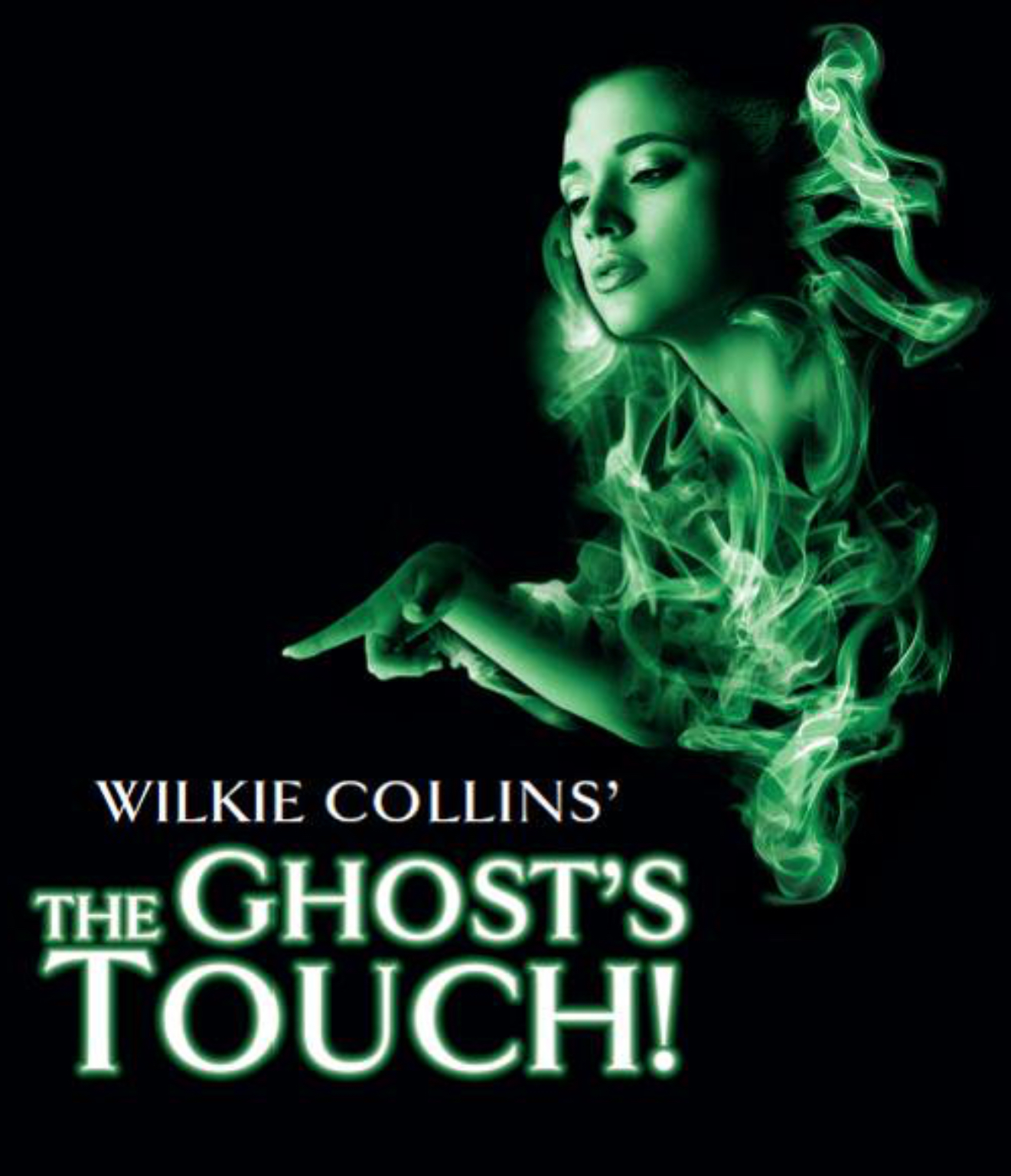
Review Wilkie Collins’ The Ghost’s Touch, New Theatre Cardiff by Barbara Hughes-Moore


Mr Cholmondley-Warner Does the Twilight Zone
I’m preternaturally inclined to appreciate – even in just a lexical way – any kind of theatrical, literary or musical group or production that has an exclamation point in the name. Examples include Wham!, Panic! At The Disco, Oliver!, Moulin Rouge!, and now Wilkie Collins’ TheGhost’s Touch !, the latest production by Rumpus Theatre Company, who are no strangers to the Gothic given their past theatrical dalliances with the stories of HP Lovecraft, HG Wells, and Edgar Allan Poe to name but a few.
The Ghost’s Touch! was based on Mrs Zant and the Ghost, an early work by Wilkie Collins, a writer who would later be heralded as the pioneer of the literary detective in his seminal 1859 novel The Woman in White. The Ghost’s Touch! centres on a similar mystery and subsequent investigation; it begins as Stephen Rayburn (Mark Homer), a widower in Victorian England, goes for a stroll in Kensington Gardens with his young daughter, Lucy. However, a sunny summer’s day grows scary indeed when Lucy spots a ghostly figure in the woods talking to someone who remains invisible to characters and audience alike. The figure turns out to be Mrs Zant (Terri Dwyer), a (not the) woman in black caught in a daily loop of grief for her husband’s loss; a scene that she word-perfectly re- enacts seemingly to thin air every morning as though experiencing it for the first time. As Rayburn grows progressively attached to, and entangled in, the enigma of this other-worldly woman, he begins to question the very foundations of his beliefs, principles, and even his sanity.
This production was a pleasant surprise for me, a long-time theatre-goer but first-time horror show attendee. Possibly this is because I didn’t find the show quite as spine chilling as advertised – except for the very first instant when, before the curtain rose, the lights went out and a child’s voice whispered ‘Daddy’ over and over again, to disturbing effect. It was reminiscent of The Empty Child , that most disquieting of Doctor Who episodes, in which a creepy kid clad in a gas mask eerily enquires ‘Are you my mummy?’ However, that frightening first minute was the scariest part of the show by far. It was rather grating to move from that alarming audio experience to a scene where Rayburn calmly and amiably relates his trip to the park that day.
Although it wasn’t exactly chilling, The Ghost’s Touch! proved to be quite atmospheric at times. Mrs Zant is introduced illuminated with light in a dark stage, disappearing only to coalesce a little closer to Rayburn (and the audience) each time (although occasionally you could hear the footsteps of the actor shuffling from place to place, which downplayed the horror just a tad). An effective theremin- esque score nicely accentuates the more unsettling moments of the piece. However, the upbeat jolly hockey sticks fourth-wall-breaking delivery of the narrator was jarring at times when juxtaposed with the spooky set and spectral sightings. At times it was less Wilkie Collins’ The Ghost’s Touch ! and more Mr Cholmondley-Warner does the Twilight Zone.
One of the more unusual features of this production is that it takes minimalism to its limit, a totally understandable approach for a small theatre company to take, especially on tour. Luckily, the actors’ skill and the story’s intrigue maintained tension and interest from start to finish. The set was simple in the extreme – swathed in midnight-black material and featuring a sole park bench as the only prop in sight. The rest is left to lighting, sound effects and acting. The latter two were well done – the sound effects in particular were the unsung (and unseen) heroes of the piece – but the former was rather lacking overall; the lighting could have been used to more consistently convey a creeping sense of dread, and left a lot to the imagination, which was already working pretty hard to cope with the stripped-down cast and spartan set. Despite this, the staging and direction was at times​ extremely effective, in particular during some scene transitions towards the end of the play (to elaborate further would involve spoilers) where the lighting finally reared its creative head.
A two-hander through and through, the dynamic duo of Mark Homer and Terri Dwyer were the only physical presences onstage, with the other characters (including Lucy, Mrs Zant’s brother-in-law John, and various housekeepers, landladies and officers of the law) appearing in audio form only. The voice acting was very well done, with Lucy and John Zant (the latter voiced by John Goodrum, who doubled – tripled? – as the show’s writer and director) being the stand-outs. The scarcity of actors on stage, as well as a practical necessity on tour, actually plays well into the plot, keeping you healthily suspicious of whatever you see, hear and believe. Magical elements clash with the mundane, leaving the audience in the dark (both literally and metaphorically) as to the truth of our increasingly perplexed protagonist; much like Rayburn, the audience too is swept into uncertainty and indecision.
Rayburn is not only our protagonist, but our fourth-wall-breaking narrator, and an unreliable one at that. Mark Homer thrives in a deceptively tricky role, providing a genial, grounded counterpoint to the ghostly goings-on. John Goodrum did a good job in remaining  faithful to the soul of the source material whilst reconstructing it into a theatrical narrative – and, in my opinion, vastly improving it by exploiting the original’s more ambiguous supernatural subtext into something more explicitly eerie. For example, Mrs Zant’s written account of her eerie experiences – letters and diary entries often featuring in Gothic novels of the era – is thankfully removed from this adaptation, remoulded instead into dialogue and inference, which works much better in a theatrical context. Terri Dwyer portrays a complex, haunting portrait of a woman who feels both realistic and mysterious, and her chemistry with Mark Homer is palpable, believable and carries the story right through to the final curtain. This adaptation also elegantly restores a sense of agency in her character that the novel lacks – her literary counterpart asks the only (living) man in her life to judge her sanity, whereas her theatrical self has complete faith in her beliefs and experiences (much to the surprise of the sceptical Rayburn).
However, the narration frequently conflicted with the air of mystery the play was going for, and none of Rayburn’s exposition was effective enough to justify its existence. The actors were very capably displaying the evolving emotions of the piece, and the rest of the information could have been outlined in the synopsis, or inferred from the action. But the themes – loss, grief, and the road to recovery – are beautifully expressed through the actors’ heart-breaking performances.
Doubles, metaphorical and manifest, permeate the plot; grief splits a person in two – who they were before the loss, and who they are now. Grief is a thing which duplicates as it grows, and each act of mourning is doubled, replicated, and reflected back at the mourner. This production doesn’t shy away from these concepts, and in its own way demonstrates that the only truly terrifying thing isn’t the thought of being confronted by a ghost, but by what the ghost represents – a loved one gone forever. To delve deeper into double-dom would take us into spoiler territory, and this is the kind of story you should experience with as little information as possible.
Stripped and unusual but interesting and enjoyable, Wilkie Collins’ The Ghost’s Touch! was a rather unique theatre experience that was ultimately anchored by Terri Dwyer and Mark Homer’s great performances. It embodies the stand-out quote from 2015’s Crimson Peak , Guillermo del Toro’s gory Gothic elegy: ‘it’s not a ghost story, it’s a story with ghosts in it’. If you like your dread creeping and your horror introspective, this is the show for you.

Barbara Hughes-Moore

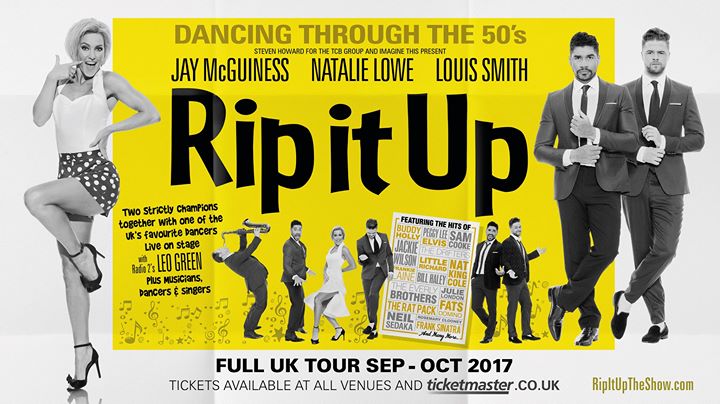
Review Rip it Up, St David’s Hall by Barbara Hughes Moore


Dreamboats and Petticoats: Strictly stars tear up the dancefloor in Rip It Up
Having attended a fair few live shows featuring the Strictly cast, I can safely say that Rip it Up ranks among the best of them. Inventive, energetic and invigorating, Rip it Up was created, crafted and choreographed by fan favourite Strictly pro Natalie Lowe. Having recently left BBC’s flagship dance show after seven years (to the distress of many SCD fans, myself included), Natalie has shifted her considerable skill towards the theatre, being both the brains and brawn behind this 1950s-set dance spectacular. Joining her on tour are Strictly champions Jay McGuiness and Louis Smith, who lifted the glitterball with Aliona Vilani in 2015 and Flavia Cacace in 2012 respectively.
Directed by Gareth Walker, Rip it Up (named for one of the 50s songs it incorporates) follows the three principals and a slew of equally brilliant backing dancers as they shake, rattle and roll their way through some of the decade’s greatest songs – moving with ease from Elvis to Little Richard to Sam Cooke and Ritchie Valens. I’d forgotten how good these songs were, and how fabulous they are to dance to – but the considerable, combined talents of the Rip it Up ensemble brought it all back to me.
The show was split into different segments, each encapsulating a different type or trend of 50s music: rock ‘n’ roll, vocal harmony, blues, ballads, and Latin, as well as specific tributes to Buddy Holly, Elvis Presley, Little Richard and the Rat Pack. It was exhausting enough reading through the setlist, let alone watching the dancers perform to them! Natalie described the ensemble as the hardest working out there, and I certainly agree. Nothing was spared or suppressed – hearts and souls were bared on the dancefloor that night, and the audience was loving every second.
It was particularly gratifying to be a part of an audience that was as responsive to the show as I was – so often in modern theatre audience reaction is muted and formal, but just as the performers were giving every drop of energy and enthusiasm they had, so too were the people watching from their seats. Jay kindly acknowledged the audience response, thanking us for ‘making Monday night feel like Saturday night’. Well, Jay and the rest of the cast certainly made a rainy night in 2017 Cardiff feel like a summer’s day in 1955 NYC.
To enhance the feel of the time period, there was a brief TV montage interlude between each dance segment, showcasing some of the 50s’ cringiest commercials – including a toy advert for a truly bizarre sort of hula-hoop worn on the head called a ‘Swing Wing’, which was no doubt responsible for causing widespread whiplash during the decade. These were intercut with the ensemble’s pre-filmed cutesy interpretations of the era, as well as entertaining asides from the master of ceremonies, Leo Green, who also doubled as band leader and saxophonist.
Speaking of the music, the classic 50s hits were played with emotion and aplomb by a five-piece band, and what a joyful noise they made with so few. Along with Leo’s superb sax, we were treated to Ed Richardson on drums, Ian Jennings on bass, Jonny Dyke on keyboards and Matt White on guitars. I can’t stress how excellent the musicians were, including the two primary singers of the piece: Oliver Darling (who sported Buddy Holly glasses during his tribute) and Jill Marie Cooper, an exclusive treat for Cardiff audiences. They not only captured the spirit of the songs, but of the generation – although at times, they did tend to belt ballads that could have done with a softer touch. A small price to pay for the marvellous music overall – I would happily have paid to see the musicians and singers alone, but here they enhanced and accentuated the equally wonderful work of the dynamic dancers.
Natalie Lowe embodied the charm and elegance of the era, seamlessly slipping from Grace Kelly-esque screen siren to Elvis-like leather-clad rock ‘n’ roller, and countless other characters in between. She utterly evoked the ingenue of her introductory song, Jackie Wilson’s Reet Petite (‘the finest girl you ever want to meet’). Her standout number was a beautiful ballroom show-dance to the Righteous Brothers’ Unchained Melody, as well as a cheeky jive to a medley of 50s jitterbug. Not to mention she was responsible for overseeing and choreographing everyone else, and ensuring that every part had a unique and different feel, facet and flair. Her exit is a loss to Strictly, but a magnificent gain for the stage, and I can’t wait to see what she has waiting in store for us next.
Supporting our superb leading lady were two highly capable, and yet incredibly different, leading men: Jay McGuinness, whose unique brand of cool, chivalrous charm embodied the era’s sweetness simmering beneath the surface; and Louis Smith, whose fiercely flirtatious brand of fun complemented Jay extremely well. They couldn’t be less alike, except in their attempts to vie for Natalie’s affections, alternately foxtrotting and jiving their way into her heart. For two Strictly champions who had both been unfairly criticised by the judges for their supposed lack of personality during their tenure, it was particularly satisfying to see Jay and Louis not only having improved since their deserved wins, but infusing their routines with so much character, confidence and flair. They fit in perfectly alongside the pros, and skilfully held their own alongside them.
Jay’s entrance was the most impressive by far. Clad in black from head to toe, he spun around in the shadows and de-hatted himself, giving the impression that he had appeared out of thin air. He certainly encapsulated the gung-ho gusto of his intro song, Jerry Lee Lewis’ Great Balls of Fire. He also demonstrated a wide range of theme, technique and emotion (as he had done on Strictly), performing with passion and panache in every style of dance from waltz to cha cha and an artsy modern number to Nat King Cole’s Unforgettable that evoked his winning show-dance. And, of course, his jive prowess were second to none, as it has been ever since he and Aliona’s Pulp Fiction tribute broke the internet. Jay didn’t just shine whilst dancing; he also graced us with lovely renditions of some of the staple songs of the 50s, including the incomparably classy Beyond the Sea and a sultry rendition of Sway. Out of all the Strictly champions, Jay has the greatest potential to take the West End by storm – singing, dancing, acting, what can’t he do? I hope his recent stint as the lead in Big! The Musical is the first of many in a long line of stage shows in Jay’s future.
Louis, last but certainly not least, leapt onto the stage to Little Richard’s Tutti Frutti; from start to finish he looked like he was having the most fun by far – and that’s really saying something in an altogether joyous production. Although Louis performed in Strictly alum Robin Windsor’s Keep Dancing tour at Cardiff’s New Theatre last year, and has improved even since through joining Rip it Up, he confessed he hadn’t been sure if he could or should carry on dancing in live productions. But after a great experience with Natalie, Jay and the gang (and some vehement audience encouragement), it (thankfully) looks as though Louis isn’t going to hang up his dancing shoes any time soon. He looked as though he lived every moment of every dance, and possessed the most vibrant personality and stage presence of the entire ensemble. His gymnastics skills always shone during his Strictly stint, but here he has honed his dance technique and performance into sophisticated and stylish perfection. He excelled in solo, partner and group dances, really capturing the mischievous, rebellious feel of the era and starring in some of the strongest set-pieces: a sulky, sultry number to Peggy Lee’s Fever was a particular highlight, as well as a geeky romance against the backdrop of Sam Cooke’s Wonderful World. Louis’ Strictly journey keeps evolving, and long may it continue – Cardiff will certainly be there to welcome him back to the stage in the future.
If ever a stage show was an ensemble success, that show is Rip it Up. Every single backing dancer performed to the same superb standard as the principals and musicians, and were given ample time to shine both alongside and separate from the three leads, yet another testament to the team spirit of the entire production. Though the set itself was sparse, the performers and costumes made up for the minimal production values (totally understandable on a tour budget). However, despite how impressive the three leads’ solo numbers were, I would have loved to have seen the three of them sharing the stage more often. Natalie, Louis and Jay appeared together to bookend each segment, but then split up to perform numbers in which they individually featured (accompanied by partners or backing dancers), but rarely with one another. Because of the rarity of their onstage collaboration, one of the standout numbers for me was Jay and Louis engaging in what I can only refer to as a ‘James Dean-Off’ in which the two Strictly champs did their damned-est to out-Brando each other in rolled-up jeans and white Ts. In a similar vein, I think there should have been a story running through the show (just as Vincent and Flavia often have in their live shows); in doing so, they could build on the natural flirtation between Natalie, Jay and Louis, and incorporate their love triangle into a more structured through-line. It would have added a narrative cohesion to the excellent dance numbers, rendering them not only exciting but necessary in advancing the plot and our leads’ love lives.
Overall, Rip it Up is a truly wonderful theatrical experience that I urge anyone with even the vaguest interest in dance, music, theatre, The Wanted or gymnastics to go to if humanly possible. It’s great to see familiar faces again, as well as discovering new ones, and I can’t wait to see where Natalie, Jay, Louis and company go from here – I only hope that they keeeep dancing
http://www.stdavidshallcardiff.co.uk/whats-on/dance/rip-it-up/
 

Review Burning Lantern Fayre by Barbara Hughes-Moore


On Saturday 12th August, St Fagan’s embarked on their first foray into launching an annual Glasto-esque fest of family friendly fun in the heart of the Welsh countryside. An impressive musical smorgasbord headlined the Orchard-organised inaugural event, from Tom Odell to Martha and the Vandellas, Jack Savoretti to the Shires. In addition, there was also a variety of non-musical entertainment to be had throughout the day, from arts and crafts to artisan-quality food and a funfair/ circus for good measure.

Welsh acoustic duo Into the Ark, local boys from Blackwood turned The Voice UK 2017 finalists, started the show with soulful, spirited charm. They performed as if they were headliners – and to us, they were.

Martha and the Vandellas followed with an energetic set, infusing the festivities with a party atmosphere and setting off the sing-a-long spirit with classic hits like ‘Jimmy Mack’ and the timelessly terrific ‘Dancing in the Street’.

Third to take to the stage were Brit country duo the Shires, who held the distinction of being the first act whose very presence raised the crowd to their feet. And what a joyful noise they made on that sunny Saturday afternoon, belting out fan-favourite hits like ‘State Lines’ and ‘All Over Again’ as well as making time for more melancholic melodies such as ‘Daddy’s Little Girl’. They promised to be back soon, and here’s hoping it won’t be their last time in Cardiff – judging by the cheers that permeated their performance, there are many (including myself!) who are looking forward to welcoming them back to Wales in the not too distant future.

Tom Odell provided a suitably bombastic closing set, tearing through tunes with a spellbinding falsetto Matthew Bellamy would have been proud of. My personal favourites of the night were the achingly haunting ‘Can’t Pretend’ and his career-launching debut ‘Another Love’, both of which – along with his remaining repertoire – were elevated by a dazzling light show that punctuated every syllable of Odell’s crooning choruses.

Hover, it was the penultimate performance of the festival, provided by the incomparable Jack Savoretti, that stole the show with a haunting, husky voice that would make the likes of Paolo Nutini and Tom Waits blush. There is simply no-one else in the world who sounds like Jack Savoretti, and he suffuses his songs with the raw, rugged sound that has become his trademark. Hearing him live was a special treat, though I have to compliment almost everyone on the day who performed live for sounding just as good as, and often better than, the record. There were too many favourite Savoretti songs to mention, from the rebel-rousing ‘We Are Bound’ to the sorrowfully sincere ‘When We Were Lovers’, and the True Blood-tinged ‘Knock Knock’. It was a real treat to have an artist of Jack Savoretti’s calibre in this event, as it was with so many of the marvellous musicians that graced St Fagan’s that day.

The sheer variety of food on offer – from gourmet burgers to posh pizzas – was a feast for the eyes and nose, but sadly not for the stomach. Reportedly 8,000 festival-goers walked the fields of St Fagan’s that day, but far fewer managed to purchase even a single crumb due to the bloated queues that stretched out for hours on end.
‘Queue-Gate’ was such a widespread issue that the ensuing tweet-storm urged the organisers to issue an apology, which, though appreciated, still failed to understand the backlog (many spent up to 2 hours queuing at a single stall), or the duration (it was an issue throughout the entire day, not just the evening). Worse still, the organisers banned any food being brought onto the premises, meaning that the supposedly family friendly event left many families with the choice of queuing for hours or going hungry.
I only braved a queue at around 9pm, by which time all that seemed to be left in the entire venue was a single Danish pastry (at that point, it was any port in a storm). Even if picnics had been allowed in, it would have been impossible to resist the delicious scent that wafted across the fields throughout the event. The ratio of people to food vendors was severely misjudged; in future, either lower the maximum number of tickets sold, or increase the amount of food stalls on offer.
In addition, the site itself was tricky to navigate. I didn’t even know there was a second stage for supporting acts, and spent the first three hours eagerly awaiting the arrival of Kizzy Crawford, an enchanting bilingual singer, on the main (at that time I thought the only) stage. It was only after my increasing hunger necessitated exploring the venue that I stumbled across a beautiful bandstand hung with twinkling fairy lights. The dulcet tones of Gareth Bonello (aka the Gentle Good) drifted across the evening air, after which he mentioned fellow Welsh-speaking singer Kizzy Crawford’s earlier set, and my heart dropped. If only there had been a programme, or schedule of some kind, listing the various locations and who was doing what when, it would have greatly enhanced the accessibility and exploration potential of the festival experience.
I had a wonderful time at my very first festival experience. However, there are things at a fundamental level that must be addressed for a follow-up fest to be a success, from better management and organisation to a programme of events and acts. However, it remains a very special event to have been a part of, and it was a real privilege to see so many incredible musicians pour their hearts, and their songs, in that picturesque place. I would love to see the Burning Lantern festival return next year, especially if its maiden voyage was able to attract such a breadth of talent from all spheres of the musical world – but it has to take these concerns on board for it to rebuild trust and maintain interest in its future.
http://www.burninglantern.com/en/