When booking to see a National Theatre Wales production, there is an expectation for something thought provoking, intense and different.
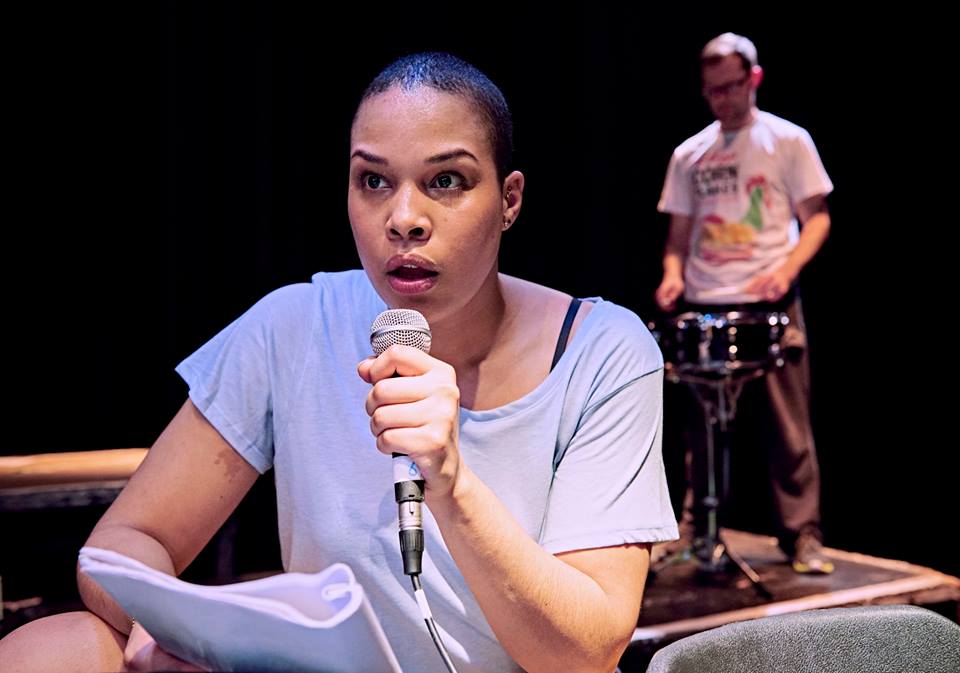
The STORM cycle is a series of multimedia works that aims to explore the themes of truth and testimony, it includes original texts, specially created sounds and novel physical-acts TOGETHER AND ALONE succeeded in including specially created sounds – the composition was eery and worked to punctuate the piece. It also drew on Simone de Beauvoir’s Pour une moral de l’ambiguite, a work that explores the varying ethical attitudes of people and how they relate to the idea of “freedom”.
TOGETHER AND ALONE presents, through 8 different people, a different view of freedom and what their freedom means to them.
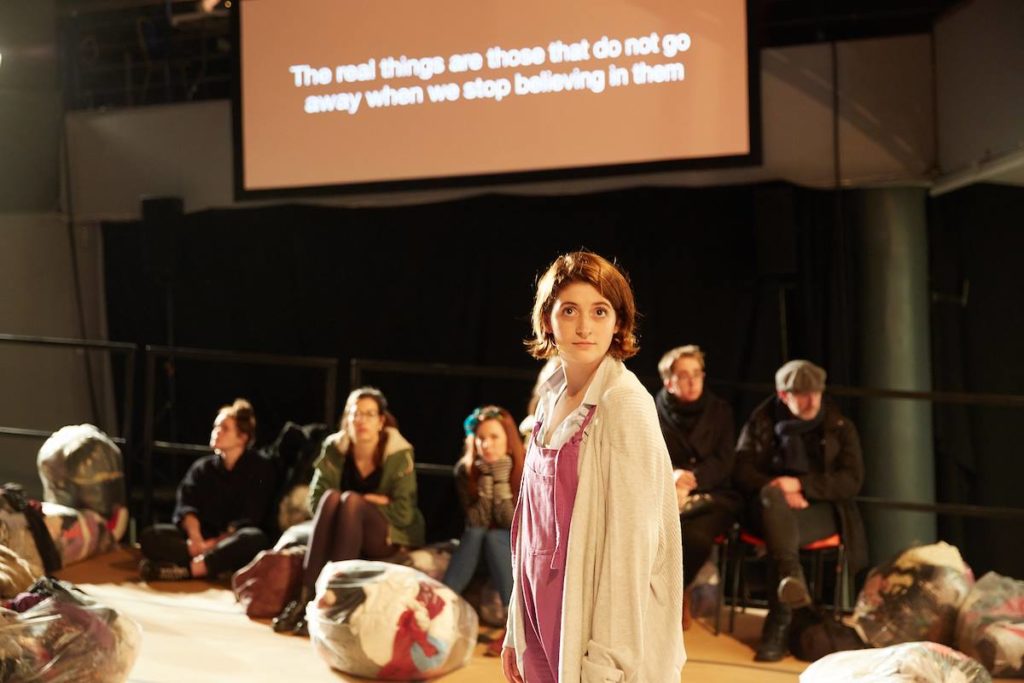
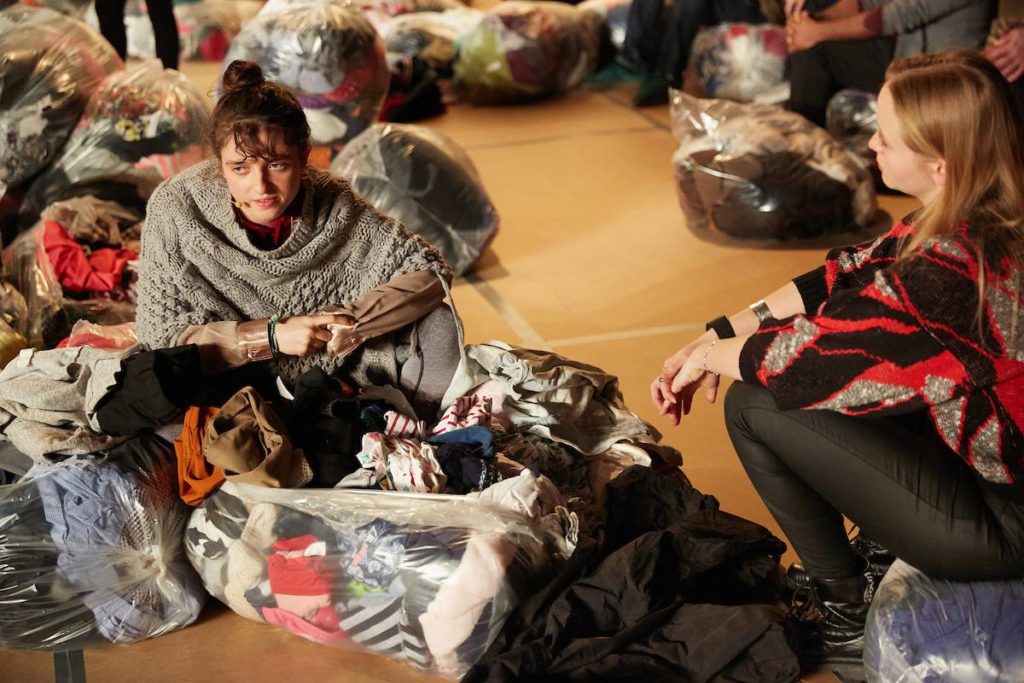
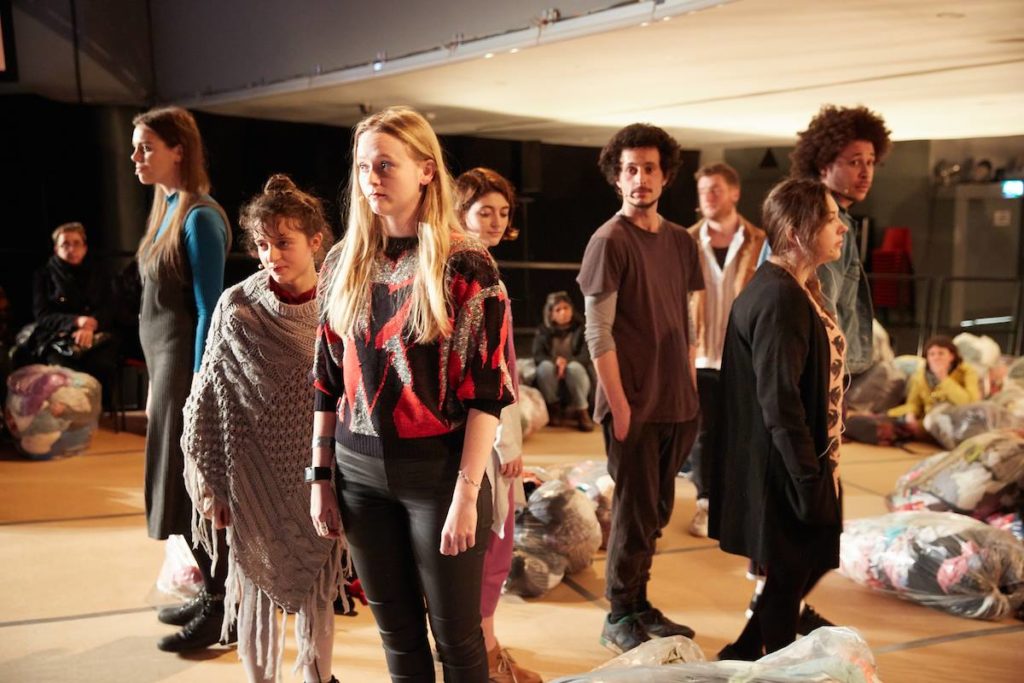
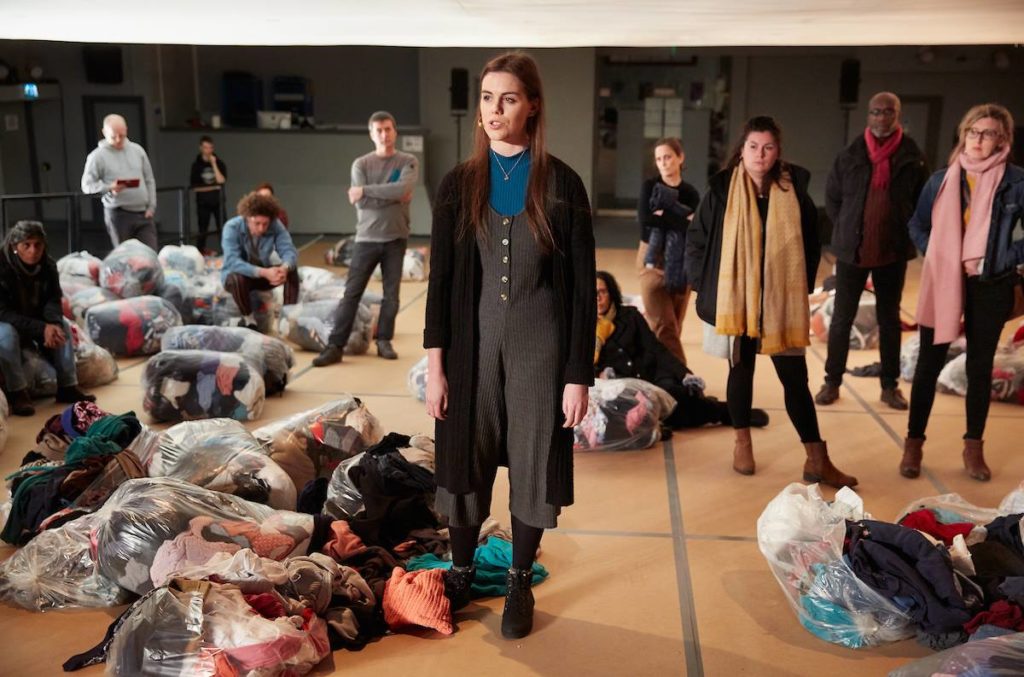
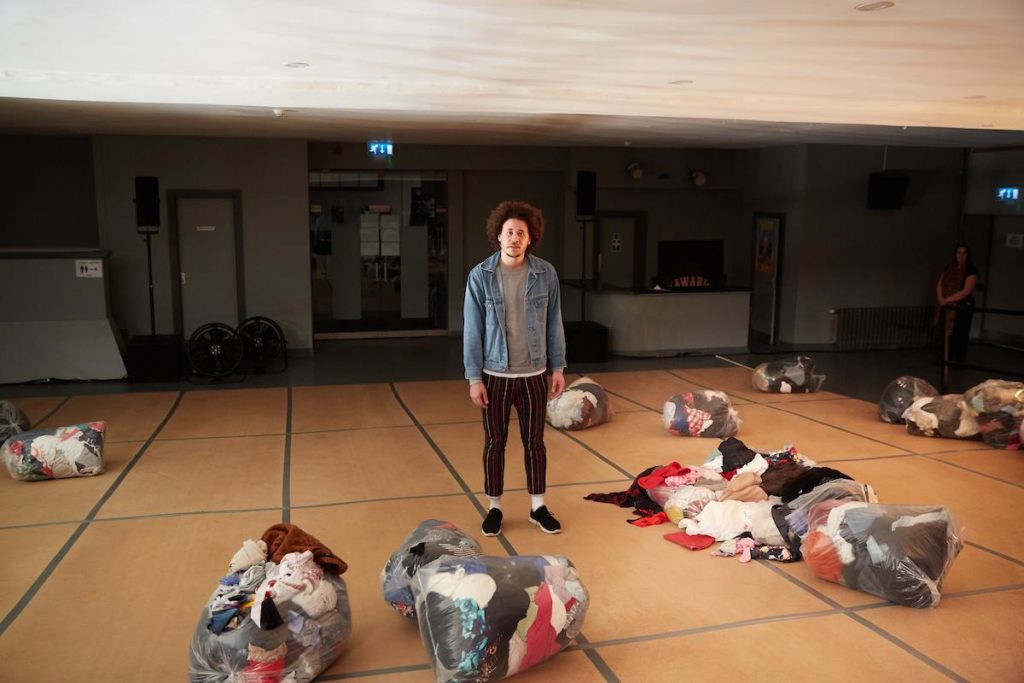
It is an interesting concept showcased against a high-impact backdrop; the cast and audience all stranded together on a stage that could be the prow of a ship, or the floor of a warehouse, or a holding area for refugees. Strewn around are clear plastic bin bags rammed and bursting forth with clothes, as if people have packed to leave, or have donated to charity, or have left somewhere in a hurry. Two large screens display statements that seem like negative rewrites of inspirational quotes.
The spectacle of this, when entering and waiting for the action to start, boded well. But the reality, when things “got going” was that there would be no action. As tremendous as each actor may have been, it was impossible to enjoy their hard work – the words delivered were a series of self-reflective testimonies and as much character as the actors tried to put in it was stripped away by the overwhelming monotony of it all. Perhaps this was the point – we live in a world where we talk about, think about, tweet/insta/facebook/snapchat about ourselves; we are so preoccupied with ourselves and how we see ourselves within the world, and how we think and want others to see us, that we do nothing of real importance. (I understand this is a generalisation, just to make everyone clear…in case you think ill of me, because that’s not something I want…now should I put a winky face emoji here to make it clear I’m making a joke? Hmmm…)
Whether this was the point or not, it simply felt tedious. I was working so hard to take in the words, but the movement and interaction that was there (and, be assured, the actors did as much as they could), just wasn’t enough to fill the gaps of character and story; the total absence of energy meant that I missed all the substance, the nuances, the political leanings, because I was too busy worrying about how long it would take for my knee to start hurting from all the standing, and thinking about how it could be made more dynamic and engaging. Convincing myself that my lack of engagement must be a mental fog which, surely, must indicate the early onset of the menopause!
The monologues/statements the characters were making were extremely well written, but the voices (no matter what accent they were in) still sounded the same. Yet as standalone tracks they could have been truly engaging; in podcast form, for example, the audience could listen and explore at their own pace, if they had something to watch too, or something to do (fold clothes and bag them, perhaps). I appreciate this is easier said than done though and, as usual, NTW has staged something different and risky – unfortunately, the biggest risk for me is how alienating a piece of theatre like this can be.
National Theatre Wales presented STORM.3 TOGETHER AND ALONE at The Neon in Newport from 21st-23rd March so you can’t go and see it now but, to be honest, if you’re anything like me you’d have spent more time thinking about whether there’d be time for a glass of wine at Le Pub than being moved by the work, anyway.
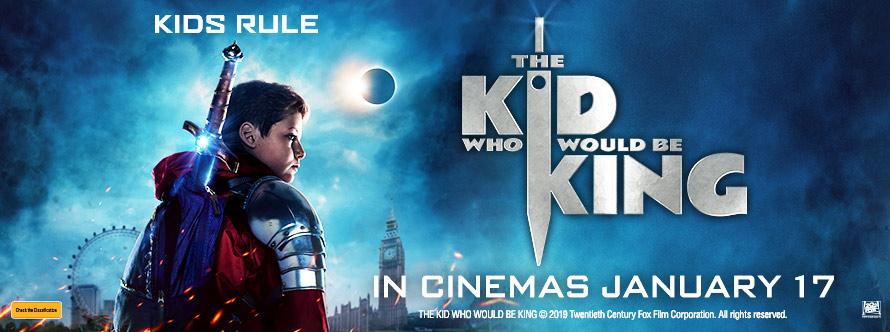
Myths and fables are the cornerstones of great narratives. For, if no other reason, they are the oldest stories to survive the test of time. They are journeys and battles of good and evil and are basic but deep so you can throw almost any coat of paint on them you want and they still ring the same emotional core. Not all though have to be set in ancient times. An essence of a story can be picked up and put in almost any aesthetic or time period. Take Star Wars, for example, dark lords, a princess in peril, it takes place a long time ago in a place far, far away, its a fairytale with a science-fiction setting. The Kid Who Would Be King knows this and takes one of the oldest (as well as British) myths and puts it into our modern era with a few new twists and turns.
The
tale begins by telling the tale. Literally, the movie opens with a
storybook opening and seeing illustrations and narration telling the
tale of King Arthur, how it was a time of chaos and dark forces were on
the rise and the people needed leadership, so came a young boy named
Arthur that pulled the sword from the stone and became king of the land.
But his stepsister Morgana was warped by greed and jealousy and sought
to take the throne for herself, so Arthur, along with his wizard Merlin
battled her and then banished her deep within the earth, but she vowed
to return when the land is sick and the people are divided. Then we pull
out of the book and are now in modern times.
We see a
young boy named Alex Elliot (Louis Ashbourne Serkis) who is late for
school (as it seems all leading children must be when they are the
protagonist in movies). When he gets there his friend Bedders (Dean
Chaumoo) is being bullied by Lance (Tom Taylor) and Kaye (Rhianna
Doris), he refuses to let his friend be the victim and bushes back,
resulting in all of them getting detention.
You will
notice that each character is given their own color and has a unique
silhouette. Such detail is important to notice and give credit to
because it helps make the character instantly visually recognizable.
Which, in a movie where the characters are simple and there’s a lot of
running about, is very important.
While running away
from the bullies after detention Alex runs through a construction site.
While there he sees a sword sticking out of the pillar of a building, he
pulls it out and takes it home. While there he and his friend translate
(through the aid of Google) the engravings on it. It read that it will
be pulled out by the king of the land, they say that this must be the
sword in the stone, which they laugh at the thought of. But when a
strange boy suddenly enrolls in their school and one night a flaming
skeleton soldier enters Alex’s room, almost killing him, he starts to
think that there is merit to some of this.
This strange
boy is in-fact Merlin (Angus Imrie), the great wizard himself. In the
actual lore, Merlin would age backward so this decision has some logic
and credibility by staying true to the original mythology. Though at
times he does revert into his adult form and is then played by Sir
Patrick Stewart, who both seems to naturally take to playing a mighty,
booming wizard and is clearly having quite a bit of fun with the role.
While he is in this state he brings great gravity and seriousness to the
moments, as well as comedy, though what would you expect from Stewart. So
begins the quest to train, assemble knights of the round table (that is
foldable in one of their dining rooms) and defend the land against
evil. It’s a classic tale that has been told again and again and holds
up. What matters is if it brings something new to the table and how well
it executes its concepts. As has already been made clear taking the
myth and setting it in modern day is something but there are other
examples of this, adding all the modern pop culture references is
something though I feel these are more of a deterrent to the movie. They
are just there for kids to hear and think “Hey they said that thing I
like, yay!” It is something that adds no real substance to the material
and will most likely date it terribly, though this is a movie for
children and it never forgets that so maybe I’m being too hard on it.
Writer-Director Joe Cornish seems to have found his niche in modernizing fables. His first movie Attack the Block,
which I greatly enjoyed, was essentially a fable, just told in modern
London with Aliens thrown into the mix. He writes fast-talking,
personality-infused characters, with plenty of humor sprinkled about and
always stays true to the emotional core of the whole project. If you
enjoy the work of Edgar Wright (who Cornish has been writing partner to
for many projects), particularly his Cornetto Trilogy, then this is the
type of humor, style, and a journey that will appeal to you.
If
there’s a definite weak element to the movie it is the acting. These
are not great child actors, they are the overreacting type you often get
from child actors. When they are shocked or surprised their mouths hang
open and eyebrows raise, when they are upset the eyebrows go down and
they pout their lips. Though I must give credit to Serkis, who is able
to convey pain just through an expression
and without dialog. The best actor within the movie is Sir Patrick
Stewart but that seems unfair to compare these children to this
well-experienced master of his craft.
I
appreciate the incorporation of real problems with these characters.
Some are insecure, or have to face truths about the world is harder than
they’d like it to be. This grounds it and adds weight to the story, it
makes the characters real in a way that goes beyond simply having them
say what their favorite drink or color is.
This is one of the oldest stories ever told. About a land in need of a hero and a sword chooses the said hero, about dark forces and a group that unites to slay it. it stays true to that core and wraps it in modern day with the lingo and names so that the youth will find it easy to connect with. It does it’s job well and distinguishes itself while doing it.
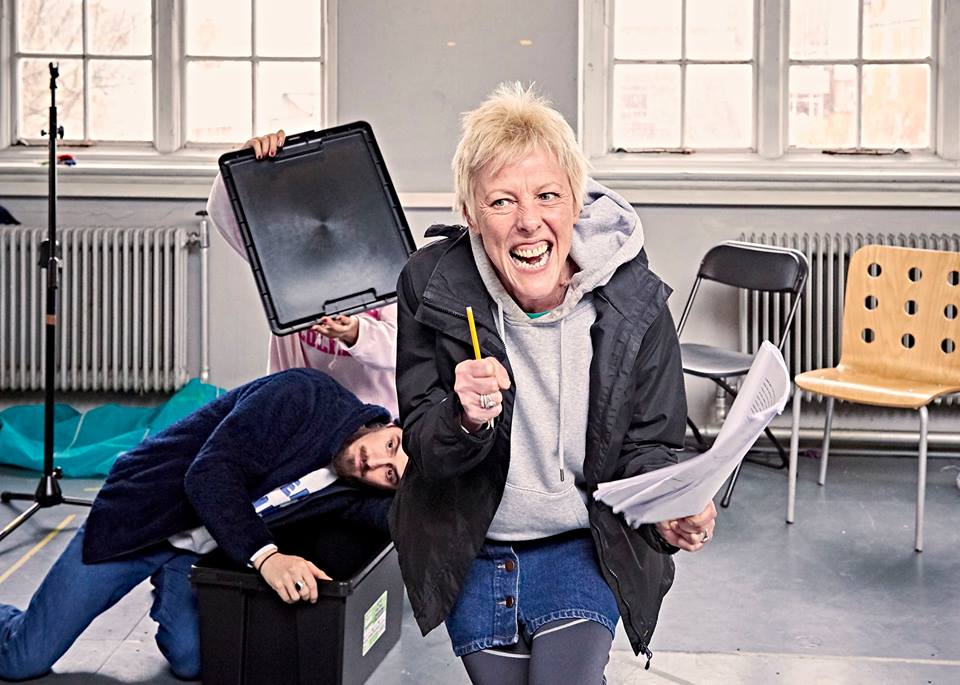
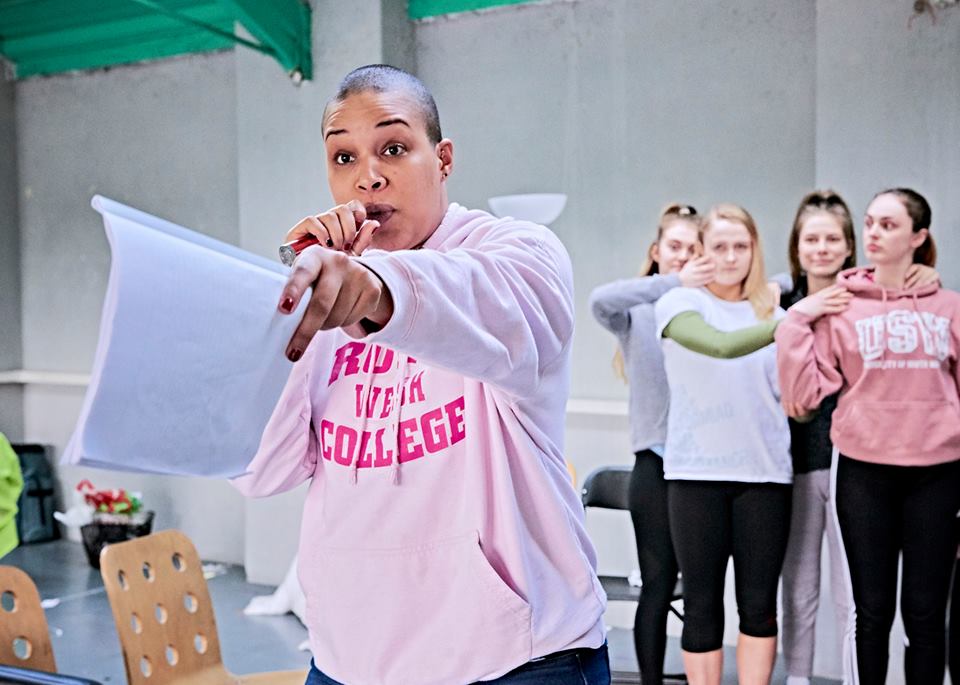
Please note this is a review of an open rehearsal which took place at Chapter Arts Centre, Cardiff.
All images credit Jorge Lizalde
This fun and moving adaptation of Victor Hugo’s Les Misérables by Cardiff-based theatre company August012 juxtaposes the battle of Waterloo and the Brexit Referendum. The intention behind the historical and literary parallel is to insert our daily lives into a wider perspective, to juggle the big and the small, the significant and insignificant, the past and the present. Les Mis, not the musical (thank God not the musical!), is a whirlpool of sound, words, and movement, from which emerge a sense of loss and futility, an awareness of something different beginning in a Britain still hangovered from the Referendum, and compassion.
The scene begins with an account of the battle of Waterloo, cut by the recollections of Brits on holiday in Greece before the Referendum, and by the disbelief and shock at the result on the night. Away from formulaic narrative structure, Les Mis embraces a multilayered performance where music, words, and movement intersect and converge all around us. The music is spell-binding and plays a prominent role in guiding the audience into this tragi-comedy. It is a seductive and immersive experience that stirs the senses and brings awareness of wider significance.
The smell of grass, the thumping on the ground of the soldiers’ feet, broken by holiday-makers’ easy-going chatter and banter to the tune of Brazilian music in the sun-kissed beaches of Greece make the play at once seductive and moving. The charged atmosphere evoked by the battle is countered by the fun and ordinariness of the Referendum night. The parallel is sustained by local references to Cardiff’s roads and neighbourhoods. Napoleon is in Grangetown. Brussels is Ponty. Yet, the playfulness of Les Mis accentuates the brutality of Waterloo conveying a sense of awe, of something bigger than ourselves.
This heartfelt, engaging, ironic and exciting production articulates the current confusion, exhaustion, and ridiculousness of the aftermath of the Referendum. We don’t know what is going on. There is no neat comforting thesis, no tidy narrative, no solution, but a deliberate intention to throw off course. Les Mis plays with our confusion and our Brexit fatigue.
At a time when over a million people have marched for a referendum on the deal, over five million have signed a petition to revoke Article 50, and when Parliament keeps voting down May’s deal, Les Mis captures the never-ending saga, the incomprehensible going around in circles, and the complexity of the present situation. Brexit has severe repercussions for peace in Northern Ireland, for EU citizens in Britain and British citizens in the EU, for Europe, and for Britain; yet its significance is drowned out in the daily drama deprived of substance. In all this, Les Mis wants its audience to wake up to the historical significance of our daily lives.
The play includes Nicola Sturgeon’s address to
European nationals living in Scotland. In the endless noise produced by
politicians on Brexit, European nationals in Britain are often forgotten and,
at times, dismissed as ‘bargaining chips.’ Director Mathilde Lopez is a
French-Spanish North African, who has lived and worked in Britain for 20 years
and has a family with British composer John Norton. Matteo Marfoglia, who
choreographs the dancers, is an Italian national who has worked in the
Netherlands and has been living in Wales for the past six years. For both
Mathilde and Matteo the result of the Referendum brought the pain of exclusion.
All of a sudden, their identity,
status, and very presence in Britain were questioned.
Les Mis gives a voice to that sense of
disorienting loss Europeans felt. There is no anger, no preaching, no pedantic
history lecture. The political and philosophical rhetoric at the end is perhaps
not as punchy and inspirational as it could have been, but it is genuine and
moving. There is an acceptance of defeat without despair, a search for strength
in love, not distance. Les Mis appeals to faith, hope, and
love. In opposition to the outside political message of exercising control and
erecting borders, Les Mis, fruit of artists with diverse
cultural backgrounds and political stances, celebrates friendship across
divides. It calls on all of us to show compassion to one
another.
What would Hugo make of this take on his work and, perhaps more crucially, what would he make of his own dream of a United States of Europe? He might be confused and excited to see that a Union of European countries has taken shape. He might feel inspired and hopeful that it is not just a philosophical, political, or religious idea, but a reality, clumsy and complex, but one that is increasingly in people’s hearts. This production of Les Mis, with its exuberant rhythms, poignant words, and passionate movements, lets us hear the heart of Europe beating.
Up the ramps of steep metal stairs, in a room in the Loft, outside of the main building of Chaptert Arts Centre, the theatrical company August012 are rehearsing for their unique take on Les Misérables by Victor Hugo. The music begins. It’s a military tune. It’s 1815, the battle of Waterloo. The fighting, the casualties, the hollow victory. Then, at a stroke, it’s 2016, in Cardiff, the night of the EU Referendum. The battle of Waterloo and the battle of Brexit come together through a meeting and clashing of sounds, words, music, and dance making for an immersive sensory experience.
Rehearsal images credit Jorge Lizalde
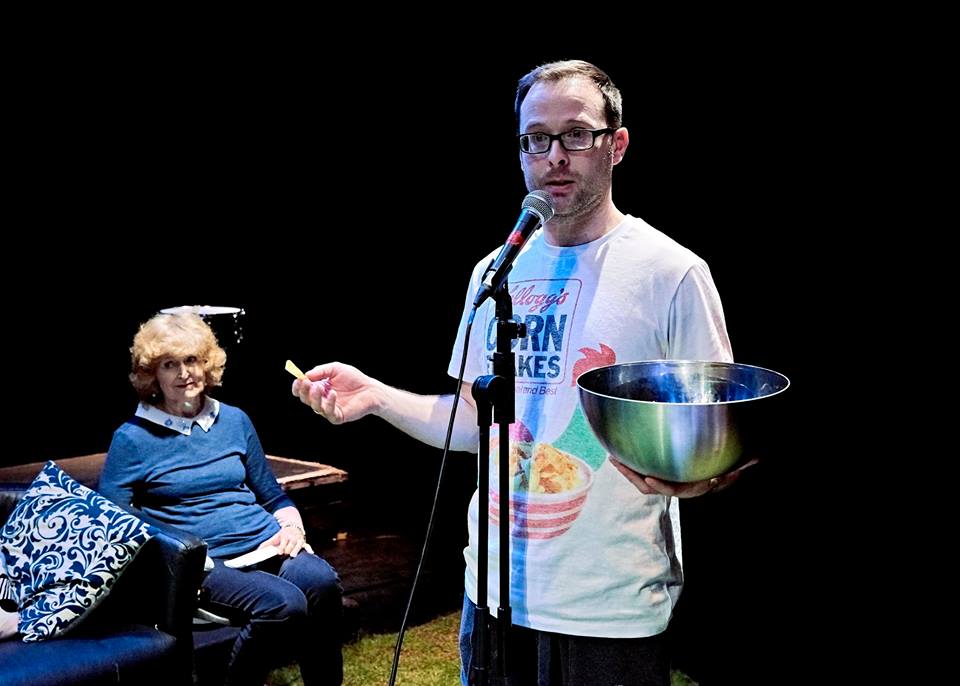
The tragedy and horror of Waterloo is juxtaposed with the carefree and indulgent pleasure of holiday-makers in 2016 ahead of the Referendum and the comic coming to terms with the result. It is a kind of estrangement that seeks to bring awareness of the historical implications of Brexit through rhythm and fun. All the pieces, the description of the battle, the drums, the music, a man chocking on a Dorito, Farage, and soldier-dancers, come together with perfect timing. The creativity fuelling Les Mis comes from the collaboration of Director Mathilde Lopez, Choreographer Matteo Marfoglia, and Composers John Norton and Branwen Munn, the latter working from West Wales.
Mathilde Lopez
Matteo Marfoglia
John Norton
Branwen Munn
The coming together of French-Spanish, Italian, and Welsh talent with diverse national and cultural backgrounds makes gives an extra dimension to the careful multi-layered assembling of sound, words, and movement. It is the collaborative and supportive nature of these relationships that stands out as I watch the rehearsals. There is no hierarchy, no instructions, no neat division of labour, but a coming together to harness the talents and creativity of one another. Mathilde says, ‘We can do that,’ not ‘Can you do that?’ She is not imparting instructions, she listens to others and makes suggestions. The work emerges from this shared effort and fun. They’re working hard but they’re also having fun.
The atmosphere is so relaxed and friendly that I wonder how a comment from me might be received. I comment and I’m struck by Carwyn, one of the actors, turning to me and nodding. It is a listening environment, where each member of the company can make suggestions and is listened to. John Norton, the composer/DJ, is surprised I’m surprised. ‘This is theatre,’ he tells me, ‘If you want control, don’t do it.’ Unpredictable, brittle, never finished, theatre is always in the making. Precision is impossible, flexibility is key.
Mathilde likes the challenge that music and movement present to her as a theatrical director. She needs to limit herself to give space to John and Matteo. Her listening and collaborative frame of mind includes listening to actors and non-actors who participate in the production. When auditioning for the play, Mathilde asked them what they were doing on the night of the Referendum. The piecing together of different perspectives and experiences reinforces the nature of this production of Les Mis where different worlds coexist.
Choreographer Matteo Marfoglia tells me that the idea is to have two
worlds side by side in the same space: the world of the actors and the world of
the dancers. The two worlds do not interact. The dancers and the actors are on
different journeys. The dancers, as soldiers, evoke with their movements and
sounds the tragic sense of the historical dimension of both Waterloo and
Brexit. Actors and dancers come in and out of the space interweaving the
present with the past, connecting and disconnecting history with our daily
lives.
Les Mis speaks to our own
reality. It is this sense of the real and dance as a way to communicate real
life that brought Matteo to Wales. Classically
trained, Matteo first moved to Amsterdam and Rotterdam to become a contemporary
dancer and, six years ago, he came to Wales to be part of the National Company
Wales. He left classical ballet because it did not meet his thirst for
something more authentic to human experience. He believes that contemporary dance
allows the individual expression of emotions to come to the fore.
Matteo is training to become a ‘Gaga’ dance teacher.
Gaga dance has been developed by Israeli dancer and choreographer Ohad Naharin.
At its core, Gaga dance is about embodying the inward emotions of the dancer
and how they connect with other dancers. The individuality of the dancer is
expressed outward flowing into the shared consciousness of the group. ‘We feel the same
emotions but we do so differently,’ Matteo explains, ‘We’re all connected
through an emotion but this emotion is expressed in one’s unique and individual
way.’
The emotional dimension of Les Mis is a pervasive sense of loss and futility contrasted with seductive pleasure and a hangovered awakening to the aftermath of the Referendum. As European nationals, Matteo and Mathilde experienced a deep sense of loss after the Referendum. They felt ‘under attack,’ as Matteo puts it. All of a sudden, they became foreigners, their presence questioned. Mathilde, who has been living in Britain for 20 years, is married to John and has British children who speak Welsh, felt the pain of exclusion, of being told to ‘go back home.’ She never needed to be formally British, she was part of British society, then Brexit struck.
Brexit has shown that being foreign is an identity that stays with you
no matter how long you live in your ‘adoptive’ country, no matter of many
changes you make, no matter how much you absorb of the local culture. The
‘in-betweeness’ that has characterised Mathilde’s life became problematic with
Brexit. Europe allowed overlapping identities that don’t stop at national
borders. Europe, for Mathilde, is the wider project of togetherness. It is
complicated and Europe often does not live up to the dream. The way the EU
functions right now doesn’t work for many countries, she tells me, but they
don’t question being part of it. ‘It’s like moaning at your parents,’ Mathilde
says, ‘you moan, you don’t kill them.’
The vote brought sadness to Mathilde and also anger. She found that
anger was more ‘socially acceptable’ than sadness because it makes one look
strong, but she found it tiring. She needed compassion. She plunged into
reading classics, such as Steinbeck, Camus, and Hugo. Classics were her way to
get her head around what had just happened and avoid a reductive perspective.
‘When you’re angry at the Americans, you read Steinbeck, when you’re angry at
Italians, you read Dante,’ Mathilde explains. Literary classics allow her to go
beyond the narrow contingencies of today’s events, put things in perspective,
and nourish compassion.
For Mathilde, Les Mis is a personal journey from sadness and
anger to compassion. Compassion is in the ability to listen to one another,
work together, and produce a work that is accessible to all.‘Will my grandmother get it?’
Mathilde asks herself when writing. She wants something accessible, not limited
to regular theatre-goers. She wants to be open to others, wherever they come
from culturally, socially, and, of course, politically. Some members of the
production voted Leave.
‘It is our duty to be compassionate,’ says Mathilde, ‘to find strength in accepting defeat, not despair.’ It is compassion that allows to overcome division, to appreciate human complexity, and find strength in togetherness. Mathilde finds compassion in being supported by Chapter Arts Centre, in working together with actors, non-actors, and dance students, getting inspiration from all.
Mathilde, Matteo, and John tell me working together requires humility, respect, and trust. As John tells me, ‘you need to sense the time when to follow someone else’s lead, when to defend one’s position, and when to let go of it.’ You need to abandon the need to take control. This deeply collaborative and inclusive production of Les Mis is fruit of mutual trust and compassion. It is what the UK needs now.
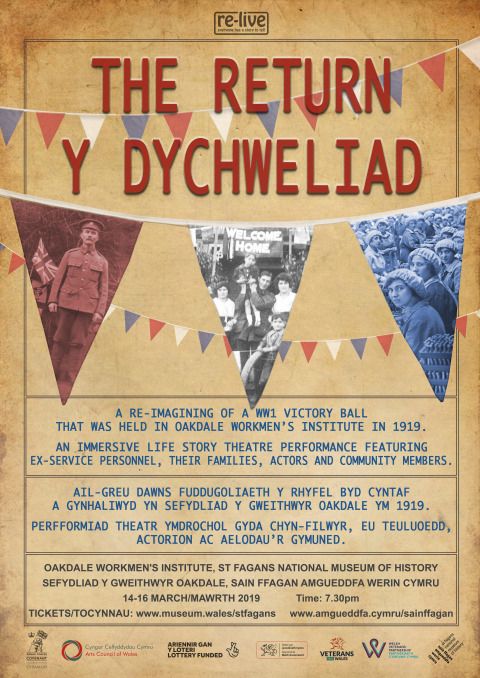
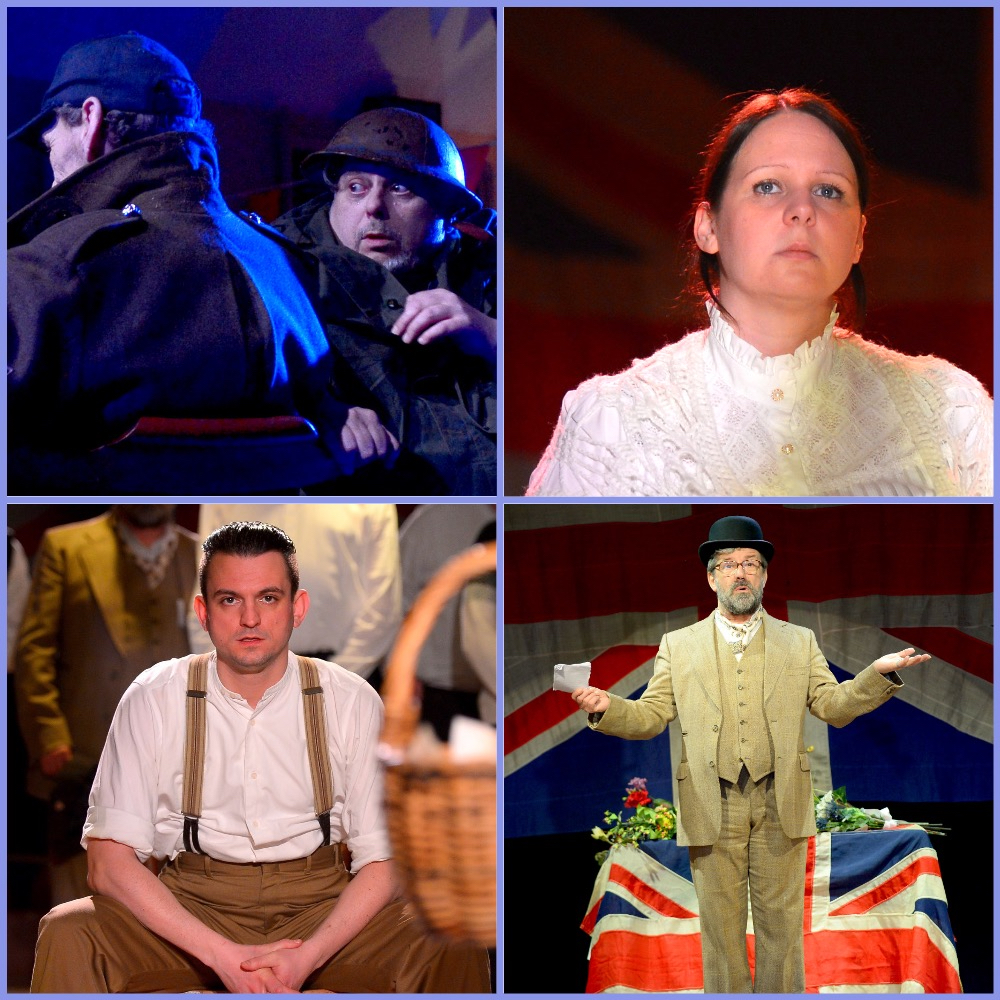
Re- Live’s new theatre show ‘The Return/Y Dychweliad’ is a moving, courageous composition of sadness, truth, celebration and sacrifice.
It begins at St Fagan’s Museum entrance where we are taken on a welcoming walk to Oakdale Workmen’s Institute, listening to various accounts of the thoughts and memories of the people connected to Oakdale. They tell us of the beauty of ‘devouring books’ from the library which was a rarity then, the joy of choc-ice treats and how Oakdale invited a ‘thirst for knowledge’ in the Institute.
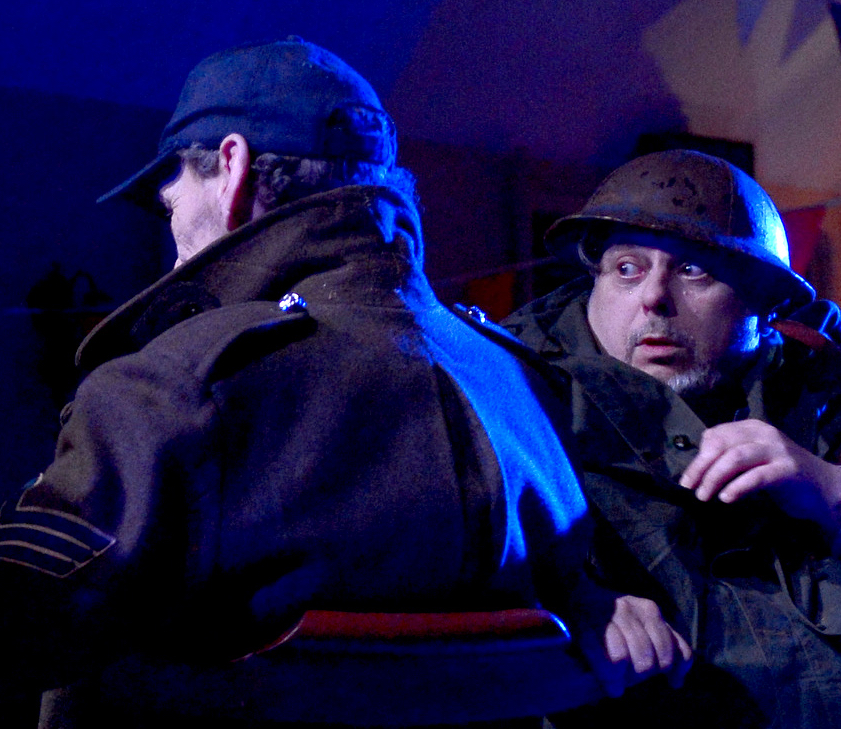
We then reach the Oakdale’s Workmen’s Institute where (after a lovely cuppa tea) we are thrown into a World War I Victory Ball in 1919. The bunting is up, the tea is flowing, the Bara Brith is out and we are entertained with song, story and striking truths of what it was to be a soldier, a friend, a woman and a mother during The First World War. We are shown the thrill of the beginning of war, and the heartache it created during a time when so much was unknown medically about the after affects of battle and sacrifice.
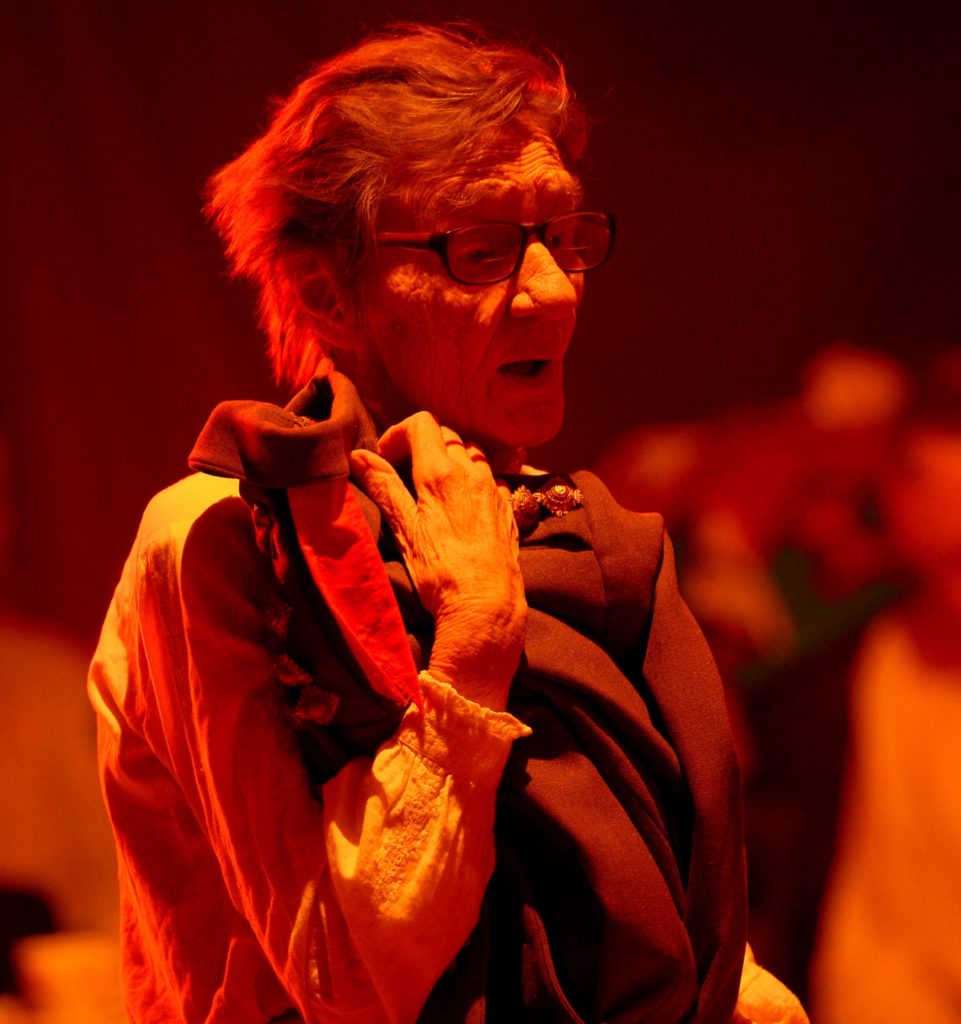
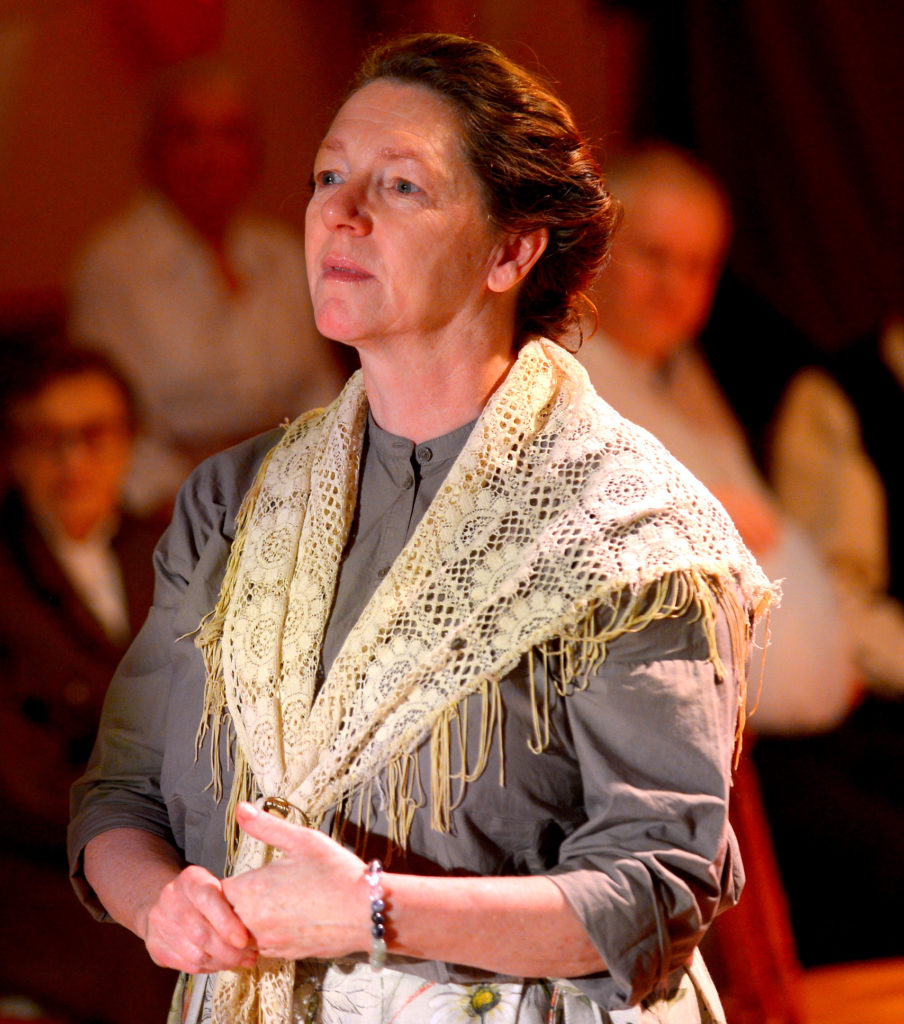
The piece moves through dialogue, solo performance, touching physical imagery and choral singing with a nod for the audience to join in on a few wartime tunes. And there’s the beauty of Re-Live right there. Yes, it’s a show, a performance, but it’s a cwtch too. A really important, poignant, ‘so glad to be home’ kind of cwtch. The cast open their arms to you, smile at you, pour their hearts out to you and allow you to feel something about how they feel and have felt. Re- Live’s mission is to work with communities and to tell stories and truths from their lives and ‘Y Dychweliad’ is a beautiful shower of these things. These stories, this history, the effect war has on people around us and still has to this day are subjects that we must talk about. If we don’t talk about these things, if we don’t remember the history of our times, and the affects it has on us still- will they be lost? Will we learn? Will future generations know these wonderful, war time songs, even?
Karin Diamond and the team have created a gorgeous concoction of story, song, music and poetry and a beautiful memory for all that see the show. The production ends as fuelled as it begins, with a personal poem ‘Mother Wales’ written by one of the cast- which makes your heart beam. The thankful, heartfelt, emotional response at the post show discussion is unforgettable. Talks from the cast about their own experiences, and how much support we must continue to provide for our Veterans is integral.
One of the cast said ‘ Once you leave for war, and go over there, coming back is.. alien. You’re petrified. You come home. But you’re never the same.’ Reading through the Oakdale information book, one Veteran writes (of working with Re-Live) ‘The project has saved me because it’s given me something to look forward to, it’s given me a purpose again. It helps me control my anxiety too. This is the one place I can come where I know I won’t be judged.’
And that’s Re-Live. Sharing words and feelings from people, to people and for people. With the utmost care, gratitude and heart. ‘Keep the Homes Fires Burning’, indeed.
‘The Return/Y Dychweliad’ runs from 14-16 March/Mawrth,
Oakdale Workmen’s Institute, St Fagan’s National Museum of History/ Sefydliad Y Gweithwyr Oakdale, Sain Ffagan Amgueddfa Werin Cymru
Hi Adele, great to meet you, can you give our readers some background information on yourself please?
I am a theatre and opera director. I am from Port Talbot originally and live in Cardiff now. I’m about to make my Royal Opera House debut with Handel’s Berenice.
This chat is specifically about music and the role it has played in your personal and professional life. Firstly to start off what are you currently listening to?
I am obsessively listening to Berenice as I’m about to direct it! So my iPod is pretty much given over to that and to some of Handel’s other operas. It’s good to get a sense of where this piece fits into his wider body of work.
But the latest thing that I saw and was blown away by was a gig by Hen Ogledd. Their album, Mogic, has just come out and it’s just sensational. I’m a vinyl lover, so I’ll be listening to it on the record player!
We are interviewing a range of people about their own musical inspiration, can you list 5 records/albums which have a personal resonance to you and why? 1
Magical Mystery Tour – The Beatles
I’m going to immediately preface this by saying that this is by no means The Beatles’ best album (for me, that’s Revolver) but it is the one that changed my life. I was struggling to fit in in my teens in a world of grey concrete and everyone in head to toe adidas block colour tracksuit and gangster rap. After one very late night of underage drinking, a friend took me back to his house and said “check this out”. He put the film of Magical Mystery Tour on and immediately my entire world opened up. The colour, the surreality, the clothes and, of course, the music! I became obsessed with the backwards tapeloops, the kaleidoscope camera, the technicolour kaftans. I binned the tracksuit and immediately became a 60s throwback. That one encounter opened up everything to me: art, counter culture, the music scene, a whole world of new friends. And I can still quote that film word for word.
His ‘N’ Hers – Pulp
When my school mates did all start listening to Oasis and Blur I was firmly in the 3rd camp: I was a massive Pulp fan. Different Class is the album that cemented them as working class hero for the wierdo amongst us, and This is Hardcore saw them reach the pinnacle of their orchestral ambition, but His ‘N’ Hers is my favourite. It captures something very real about being an outsider in the 90s: when charity shops were packed full of incredible 60s clothing for pennies, the seedy glamour of the beachside dirty weekend B n Bs along Mumbles road, sticky indie clubs and lager and lime. It’s an album that celebrates the trashy, sexy, the working class. Jarvis Cocker is still my hero and nothing makes me dance and cry at the same time like “Do you Remember the First time”.
Work and Non-Work – Broadcast
I wrestled between this and Dots and Loops by Stereolab (which is a masterpiece) but Broadcast just pips them for me. Warp records seemed to be the coolest thing on the planet, and Broadcast’s music touched a nostalgic nerve for a period I didn’t even know. Their music seemed to be the subconscious by product of an alternative past: the mulch creepiness of Dario Argento’s fits, the sun saturated photography, the trippy wierdness of Public Information films. This album is incredibly beautiful and cinematic: every song on it lends itself to a film that has never been made. And perhaps the thing that pushes Broadcast’s work up the list for me is the tragic death of their singer and heart of the group Trish Keenan. She was a fashion icon and a poetic mind who went too soon.
The Hissing of Summer Lawns – Joni Mitchell
One night my boyfriend and I were driving very late down a pitch Black Country lane and we were listening to a radio show of Prince’s favourite songs. Suddenly this piece came on and it was so overwhelmingly beautiful, so totally perfect that we had to stop the car and just sit there in the dark listening. That song was Edith and the Kingpin from this strange and haunting album by the one and only Joni Mitchell. Poetically, every listen glistens with new meaning and her use of language is so incredible. “The helicopter lands on the Pan Am roof/ Like a dragonfly on a tomb”. Exquisite. Especially coming at you through that pure voice.
Wozzeck – Berg
I discovered that I wanted to direct for stage when I sat down and watched Richard Jones’s production of Berg’s complex and terrifyingly hard opera based on the Buchner play. That production tore away any concepts I had of what theatre could be. The world on stage was so strange, so complete, and the performers were incredible musicians and amazing actors (Christopher Purves’ performance in that was one of immense human detail. All while singing some of the hardest music you’ve every heard over a full orchestra). Now I’m finally directing opera, this production is still the benchmark for me of what can be achieved. It’s really worth listening to: yes the music’s complex, but the tragedy of the story is brilliantly served here. Please note the version Adele describes is not available online. Instead we present The Hamburg Philharmonic State Orchestra, The Chorus of the Hamburg State Opera, Conducted by Bruno Maderna, Directed for television by Joachim Hess. Set design: Herbert Kirchhoff Costumes: Helmut Jürgens Recorded 1970, Hamburg State Opera.
Just to put you on the spot could you choose one track from the five listed above and tell us why you have chosen this?
I’m going to chose Babies from His N’ Hers because I think it shows how complex pop music can be. Melancholic, strangely profound: it captures the sense of teenage boredom on a rainy Tuesday evening between school and… But it also never fails to get everyone on the dance floor, and it builds into a euphoric, semi-spiritual exorcism of raw sexuality and kitchen sink drama. I can’t listen to this without dancing!
It is a cold and snowy night in St Hilary. I drive up to the village hall. All is quiet. I tap on the door. It creaks open…to expose a whole community packed into a warm space – already chatting and laughing and drinking tea. A blast of hot air and frivolity. An absolute treat to be amongst such a friendly bunch all ready to enjoy themselves. And enjoy ourselves we do.
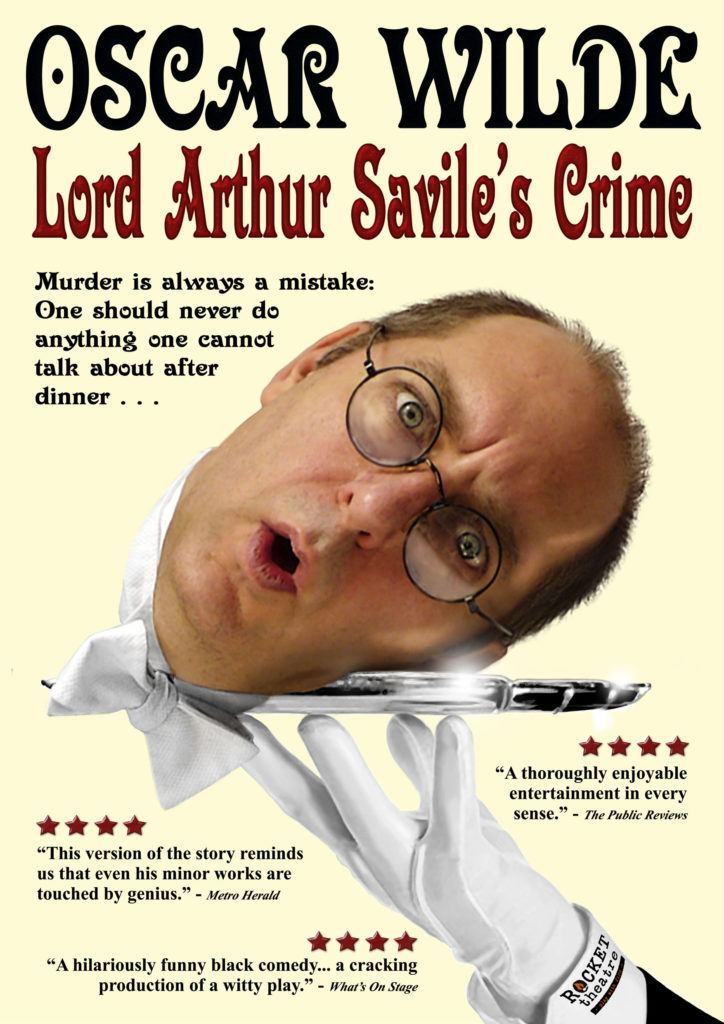
You always think you know Oscar Wilde = that you are au fait with every quip and quiver but no, we all know so little of this clever writer, this scribe of human quirks.
Lord Arthur performed by Martin Harris is positively steaming with aristocratic lunacy – a Bateman come to life, facing out his audience and batting down his batman. Ah, Middlewick performed by Chris Bridgman. Valet, butler, gentleman’s gentleman,player of many parts. Subtle, farcical, multi-talented, the perfect foil.
They do not falter.
We are laughing from the off. We are relishing the peculiar gratification of recognising a line, a title, a character. And then it starts to take a tricky turn. We are being included. Not just eyeballed but persuaded onto the stage. Stage? A chair, a fireplace, a table and a stool just within the curve of our seating. A painting of Lady Savile, young Sybil in fine Edwardian garb, overseeing all of us. And we are suddenly nervous.
Cries of, Oooh I’m glad to be at the back, go out. We egg on our comrades to join in with that curious mixture of jealousy and relief. It is expertly handled. Hilarious! Properly one of the funniest theatrical experiences to be had. The temperature starts to climb. The macabre nature of the tale unfolds and we accept not only the dark side of our humour but the apparent ease with which the upper class is seen to accept its position outside of the law. Lord Arthur and Middlewick start to play with our sensibilities and we are sucked in. We are all in the clutches of the palmist.
D’you think authenticity is what they’re after in St. Hilary?Clearly not! We want more Lady Clem.
A slightly clunky trip to Venice requires us to take a break and enjoy wine and ice cream while the snow falls outside and the temperature rises inside.
In our cups, we rise to the panto atmosphere and settle into the second act with enthusiasm. Lord Arthur, driven to a carefully controlled distraction by his failure to commit murder, pushes on with Middlewick riding shotgun to the story telling. We are roaring with laughter and starting to wonder how it all will end.
And end it does. A sorry damp little ending, perhaps a bit like life itself.
And we are released into the cold, a lot warmer and a little wiser to the power of suggestibility to the gentler mind. It’s all been such nonsense…
There was an Old Person of Ems Who casually fell in the Thames; And when he was found, they said he was drowned, That unlucky Old Person of Ems.
I recently finished Disconnected – a collaborative and clever endeavour of alternating short stories and poems (with a handful of extra poems as well). I didn’t know how many to expect, nor how to expect it to look or be delivered, but what greeted me from inside the cover was pleasant and enjoyable. Alternating piece by each author was a nice succession, gave room for clarity and enjoyment, and was nice to see it neatly presented. Seeing their words and pieces in the put-together way of the whole book was fab, and even better was the feeling of consistency throughout all the pieces. The emboldened and repeating lines, such as, “Here is how it works: you take your finger and write the most secret words you can think of on my skin…” in Amanda Lovelace’s short story “Small Yellow Cottage on the Shore”, even though that line is the majority of Iain Thomas’ poem, “The Way It Works”. These bits, scattered throughout each of the pieces gave the book a lasting impression of the book itself being made from togetherness and teamwork. As things related back and fore to each other, there was a gentle feeling of camaraderie between all the authors and also myself, as I can catching the dotted-around references to and from. Both of my favourite short stories and poem came from Iain Thomas. The story, “Driving with Strangers” and the poem, “The Way It Works” were both lovely. The idea of driving with Death and also the idea of “owing” something to him/the world was definitely and interesting one. It inspired me, in its own little way. Plus, it had some really striking lines, such as, “another dark spark shines in the voice inside us and the night grows one iota blacker”, and, “bees come and bees go, and the bees die and are reborn as little boys and girls”. They were just so catching – easily hooking me in. After all, I love lines that snatch my attention like that. And I adored the poem. Short and sweet. Lovingly crafted, concerning love. Gentle and kind. I’m not entirely surprised that these turned out to be my favourite of the collection. I bought the book as I knew he was a part of it. The rest of the experience was a nicely added surprise. There were, also, some authors I’d never come across at all before, and similarly, some works and styles I’d never encountered before, either, like Liam Ryan’s “The Train”, and “Ultra” by Yena Sharma Purmasir. Both of these stories had a uniqueness to them, a gentleness and a tenderness to one that hooked me in, and a ferocity almost – a maternal flame and bright, bright instinct in the other, that made me feel a lot at once. I really like love stories, and they’re both one, if you try. Love for a child to come, and love lost and found (almost. Kind of). On the flip side, there were some authors I recognised. Iain Thomas, of course, but also Trista Mateer, and Amanda Lovelace. I’ve read almost all of Iain Thomas’ other work, Trista Mateer’s “Honeybee”, and Amanda Lovelace’s “The Princess Saves Herself In This One” and, “The Witch Doesn’t Burn In This One”. I could see through those pieces to how each of those authors come through, staying true to their styles and interests, and it impressed me each time over. The familiarity of it was nice. Overall, Disconnected was an incredible read, especially for poetry lovers and short story lovers, too, and I’m glad I read it.
I feel as if I started reading Neverwhere by Neil Gaiman years ago, fell in an out with it as time went on, until I finally stumbled and stayed in its clutch. I remember hearing about it and thinking of it as interesting. Intriguing. I’m pretty sure it was described to me as light and easy, and I’m pretty sure the suggestion had come just after I finished A Little Life by Hanya Yanagihara. Light as easy must have been what I needed, because at the very least, Neverwhere was something that stayed in the back of my mind as a quiet desire to get into – and that’s where it all starts, really. I’ve read Neil Gaiman before, both The Graveyard Book and Good Omens, and I can say with a complete certainty that the way fantasy is presented through his writing is done strongly, and in a way that’s wholly fascinating. The story I have different opinions on, but the way it was crafted and elegantly delivered to me I really enjoyed. Richard, the main character, was one I grew to be quite fond of. Especially considering that how he was written was the begrudging type in a fantasy novel – the one who is just trying their best to get home. I liked the way he was happy when his bank card worked again at the end of the novel – something so simple and joy-inducing considering everything else he’d seen throughout the novel. The story itself was alright. Most of my reason for reading was that 1) I like the writing and, 2) I really liked the characters. It’s an easy story in a huge book – man dragged into a big fantastical fantasy-world journey of “London Below”, going on a mismatched-twisted-and-turned adventure until he can go home (and then immediately realising he didn’t really want to go home). Kind of predictable, but still enjoyable. The main characters – Richard, Door, and the Marquis (later adding a woman named Hunter) – each had a specific feeling to them that – though recognisable in fantasy – still had their own little spins which was nice to see. They were all likeable in their owns ways – as were the villains, for people who tend to enjoy bad guys more. I do quite like Neil Gaiman’s characterisation – something about it is always very clear and well-liked. The characters had their traits, and their goals, and their rises and falls – and none of it was made too complicated for unnecessary reasons. I really did like this book! I’m glad I read it.
Hi Megan, this chat is specifically about music and the role it has played in your personal and professional life. Firstly to start off what are you currently listening to?
At the moment I’m listening to the Lazarus soundtrack, it’s the current CD in my car and I haven’t changed it for about 6 months, so I often listen to it on short journeys around Cardiff – for me it’s the perfect mid-point between three things I really enjoy: story-telling, musicals and David Bowie. I was lucky enough to see Lazarus at it’s run in London in 2015 – it was brilliantly written by Enda Walsh, and the staging was a great balance between rock concert, performance-art and play. I especially enjoy Michael C Hall’s version of Lazarus as I still find the David Bowie recording quite painful to listen to.
https://youtu.be/B8aEi1oJK9w
We are interviewing a range of people about their own musical inspiration, can you list 5 records/albums which have a personal resonance to you and why?
David Bowie – Underground
I had to think for a long time about which Bowie track to include in this list. To say his work has been an influence on my life would be an understatement. Like lots of people my age, Labyrinth introduced me to Bowie, and as a fantasy-obsessed 9 year old, you can only imagine appeal of the mysterious Goblin King. My mum was happy to cultivate the interest and began to introduce me to his other albums; she even bunked me off school to see his Reality Tour at the NEC when I was 14 and the Lazarus a few years ago (I burst into tears at the end, it was all very embarrassing for her).
Bowie’s influence has woven itself through me in fashion, philosophy and art as well as music. He is the poster-boy of reassurance for strange young minds that it’s cool to be weird; and whilst I have other favourite Bowie songs and albums, Underground was the catalyst.
https://youtu.be/Qga12-bAS4A
Dick Dale – Pumpkin and Honey Bunny, Misirlou
I could have picked any track from the Pulp Fiction soundtrack to remind me fondly of my university years. As a young scenography student Simon Banham (who I’ve been lucky enough to cross path’s with again in a Professional capacity at NDCWales) decided we would study and create studio work based on Tarantino’s cult film.
I fell in love with the movie and learned loads during the project. For me, the driving pace of this track takes me back to the craziness of deadlines. As soon as I hear Yolanda say the iconic opening words I’m always grinning, reminded of some of the best friends and best work I made at that time.
https://youtu.be/A_6ajei_isE
Nick Hennessey – A Rare Hunger
I’ve always loved songs that tell a story, I’d enjoyed musicals from a young age but not really considered a mixture of spoken word and song before going to a Story-Telling event at my local arts centre. Nick Hennessey (a singer, songwriter, storyteller and harp-player) quickly became a firm favourite in my playlists, and the more he toured, the more CD’s I was able to get my hands on. I’ve been able to see him live a few times now and he has a unique way of weaving vivid tales whilst also possessing the most wonderful voice. A Rare Hunger is my favourite album he’s produced so far, the perfect relaxation for the active mind prone to imagination.
I occasionally moonlight as a burlesque dancer, and whilst its certainly more of a hobby than a career; Alchemy is the track to one of my most requested acts, it’s carried me to some exciting shows both in the UK and further afield and allowed me to meet some incredibly inspiring women as well as life changing friends. I was introduced to Johnny Hollow whilst part of a devising society at university. They have an affinity for creating emotive and atmospheric tracks that easily stir the imagination.
https://youtu.be/dtq72jbfQ-o
Adam Hurst – Midnight Waltz
This is track that fills me with pride every time I listen to it. It features as part of Caroline Finn’s Folk a contemporary dance piece that has become well known as part of National Dance Company Wales’ repertoire over the last few years.
https://youtu.be/ZTlFuSsR6Qk
I’ve been working for NDCWales for 7 years now and have heard lots of music, there was plenty to choose from; but I can’t hear this without picturing Folk with joy. For me, it’s a reminder of some of the highlights of my career so far (and arguably highlights for the Company too) Like a few of my other fav tracks, it’s quite fantastical and evocative.
https://youtu.be/p2FYBUjLcqs
Just to put you on the spot could you choose one track from the five listed above and tell us why you have chosen this?
Oh Gosh! To pick a favourite from the list above would be like saying one part of my life has been a more important part of growing up than another – but without question if you ask me my favourite musician, I’ll tell you Bowie; so lets go with that.
https://youtu.be/EOlowNcrBO8
Creating opportunities for a diverse range of people to experience and respond to sport, arts, culture and live events. / Lleisiau amrywiol o Gymru yn ymateb i'r celfyddydau a digwyddiadau byw


 (2 / 5)
 (3 / 5)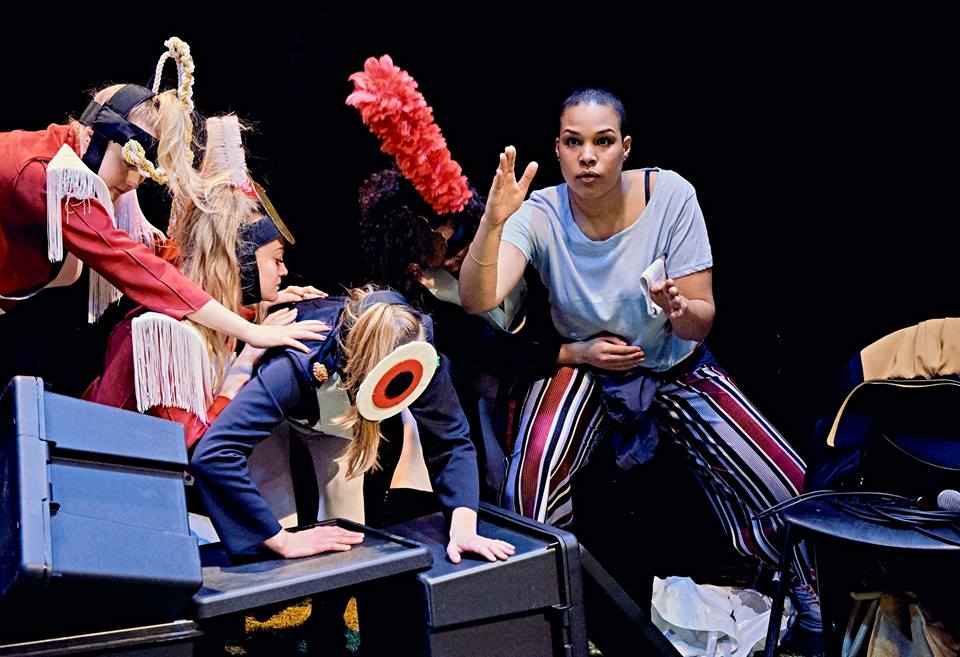



 (5 / 5)