
Tag Archives: Puccini

Tosca – reviewed by Eva Marloes

 out of 5 stars (3 / 5)

Politics, sex, torture, love, and of course plenty of death, Tosca is an opera that always delivers. It’s a pacey political thriller where painter Mario Cavaradossi (Andrés Presno) gives refuge to his fugitive friend Cesare Angelotti (James Cleverton), who has escaped prison and is now searched by baddie-in-chief Baron Scarpia (Dario Solari). Add a jealous lover, Floria Tosca (Fiona Harrison-Wolfe), and the drama keeps you at the edge of your seat. Scarpia uses Tosca’s jealously and love for Cavaradossi to find out where Angelotti is hiding, then gets Cavaradossi tortured in front of his beloved Tosca.

Puccini’s orchestration ensures every element is woven together perfectly, every element serves the drama. It’s a compact drama brimming with a whole gamut of emotions. Alas, the Welsh National Opera’s Tosca pleases the public, but does not quite bring out the tension and drama.
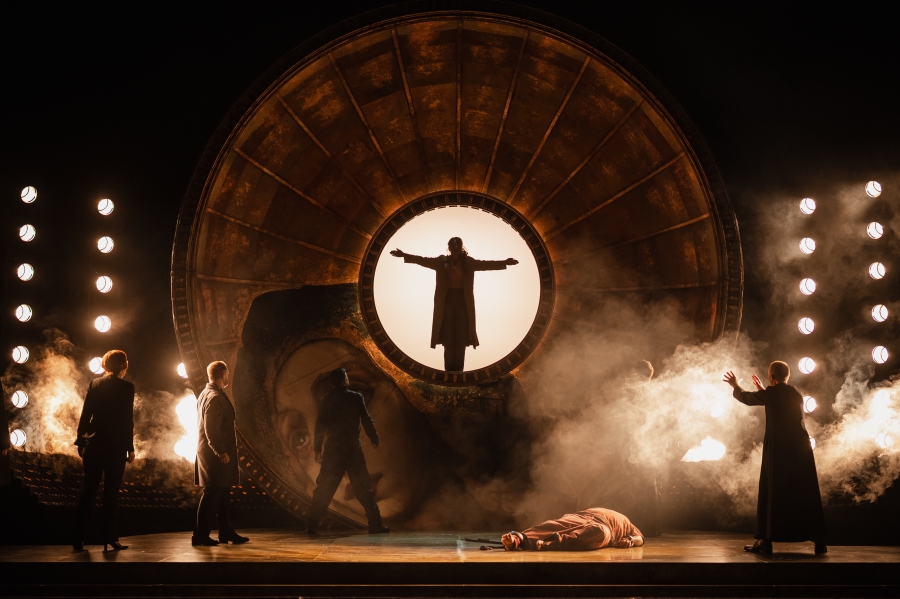
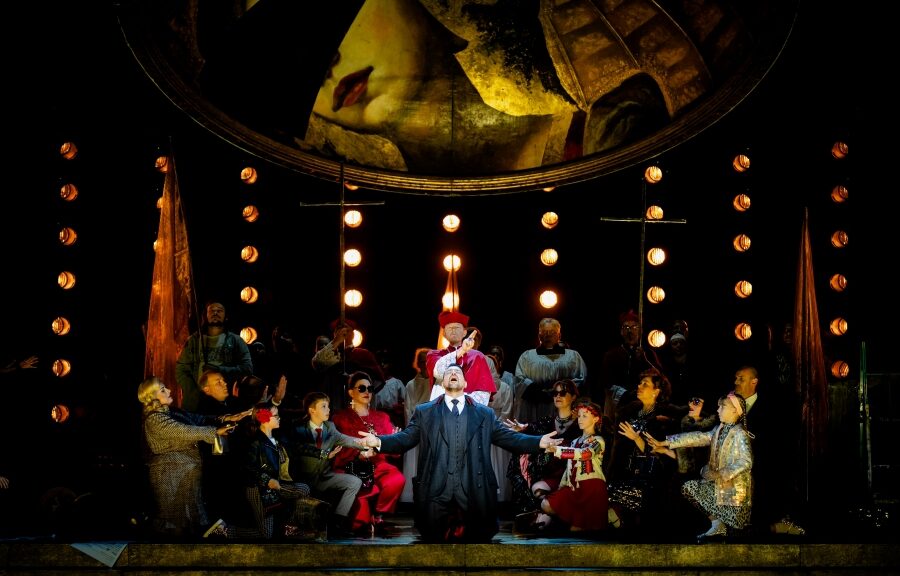
Cast of Tosca – Photo by Dafydd Owen

On the night of the 24th of September, Floria Tosca was performed by Fiona Harrison-Wolfe, whose voice is strong but lacks modulation therefore pathos. Both Harrison-Wolfe, as Tosca, and Presno, as Cavaradossi, seemed to fail to modulate and deliver a more natural progression to higher notes. This was particularly noticeable in the first act when it was like being hit by a sudden increase in volume.   

The interpretations were powerful but the lack of modulation compromised the emotion. Tosca’s Vissi d’arte and Cavaradossi’s E lucevan le stelle failed to move. The artists were not aided by an orchestra that did not shine. Such a compact opera felt a little drawn out at times. Dario Solari gives a solid and impressive performance as Scarpia.

The contemporary setting was used effectively. A large painting of Mary Magdalene on the ceiling of a cupola dominates the scenes emphasising the clash of sacred with profane. Scarpia uses religion for power. Lights, costumes, and staging produce a very striking image where the chorus in colourful costumes surrounds Scarpia who is illuminated as a star. It is not so distant from the quasi-theocratic images we get from the United States today.

The WNO’s Tosca provides good entertainment to a public very keen to applaud at the earliest opportunity. 
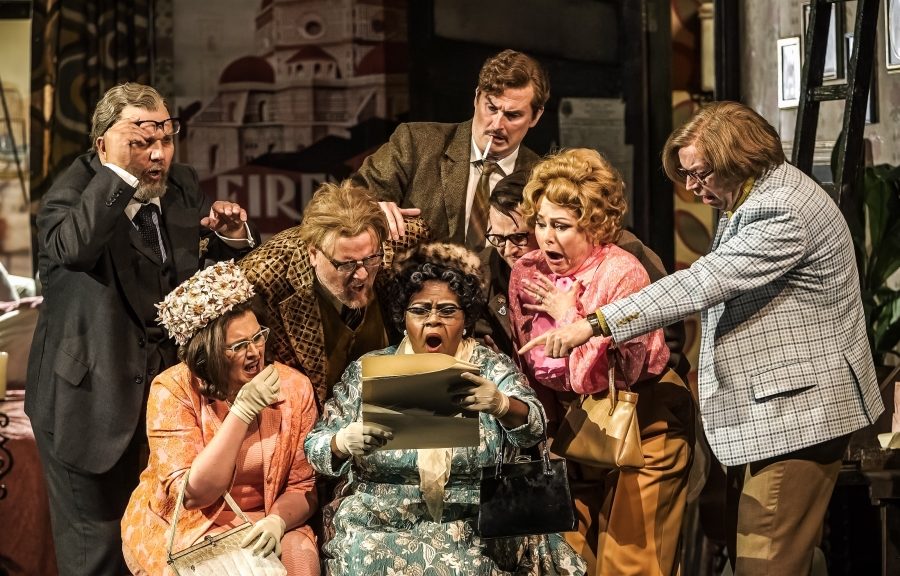
Puccini’s Il Trittico, WNO, a review by Eva Marloes

 out of 5 stars (5 / 5)

The Welsh National Opera delivers an excellent production of Il Trittico by Giacomo Puccini, where singers, chorus, and orchestra perform beautifully with skill and pathos. This is no small feat for a sophisticated and yet underrated work, consisting of three one-act pieces of starkly different registers. One only hopes that management will rethink the misguided cuts to the wonderful chorus and orchestra.

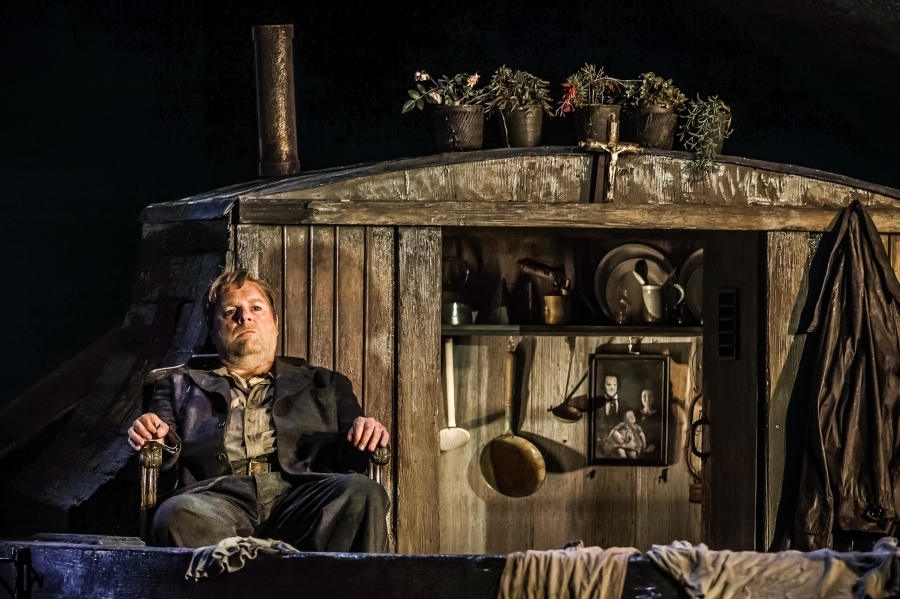
The night begins with Il Tabarro (the cloak), dark and intense, is perhaps the most refined musically of the three pieces. It tells the story of Giorgetta (Alexia Voulgaridou), dissatisfied with her life with Michele (Roland Wood) travelling from place to place on a barge. She falls for kindred spirit Luigi (Leonardo Caimi). Michele realises Luigi is Giorgetta’s lover, kills him, and forces her to look at her dead lover.

Roland Wood as Michele in Il Tabarro (photo credit Craig Fuller )

Contrary to Toscanini’s dismissal of the opera as grand guignol, Il Tabarro never indulges in sensationalism. Puccini’s mature music combines passion and restraint. Voulgaridou, Wood, and Caimi all deliver the haunting drama with great emotional depth.

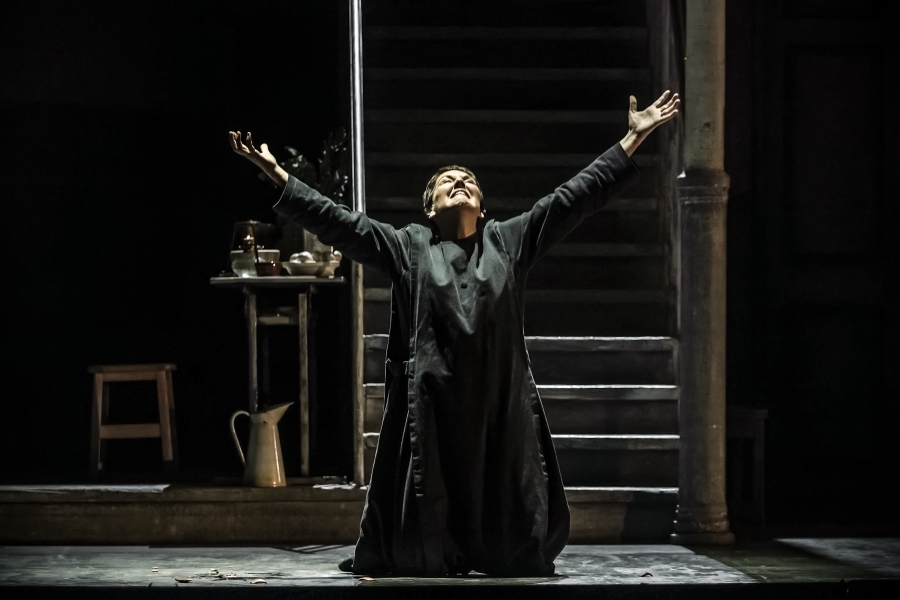
A splendid Alexia Voulgaridou gives voice to the pain of Suor Angelica, the second piece. The story of a woman forced to become a nun after giving birth to a child. Her Princess aunt visits to tell her that her son is dead. Angelica kills herself in the hope of being reunited with him, then she despairs as she realises that her suicide condemns her to hell. In in her final moments of anguish, she experiences hallucinatory or mystical transcendence, and embraces her child. 

The subdue and soft music lets the tension between Angelica’s suffering and her hope unfold. Voulgaridou delivers Angelica’s irrational demise or transfiguration with striking pathos, doing justice to a much misunderstood Suor Angelica

Alexia Voulgaridou as Suor Angelica in Suor Angelica (photo credit Craig Fuller)

The night ends with the unadulterated fun of Gianni Schicchi, where a family is left penniless as the patriarch dies and leaves his fortune to a monastery. They engage the wits of peasant Gianni Schicchi (Roland Wood), who pretends to be the deceased and dictates a new will to the notary. As he does so, he makes sure the largest part of the family fortune goes to him. 

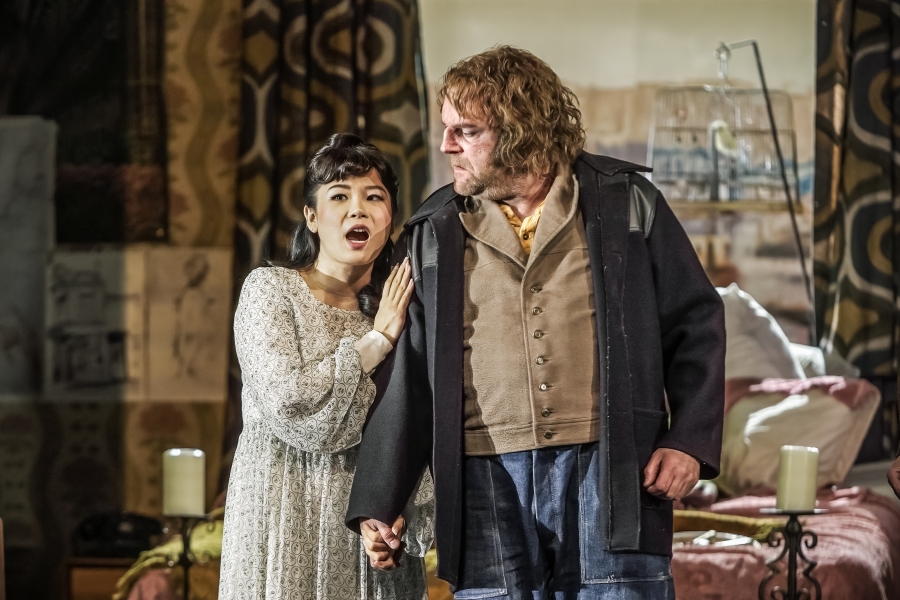
Haegee Lee as Lauretta and Roland Wood as Gianni in Gianni Schicchi (Photo Credit Craig Fuller) 

Roland Wood performs with humour and sagacity, Haegee Lee, as Lauretta, sings Mio Babbino Caro beautifully. The three pieces have an excellent cast all around, including Tichina Vaughn (The Princess in Suor Angelica and Zita in Gianni Schicchi), Wojtek Gierlach (Il Talpa in Il Tabarro and Simone in Gianni Schicchi), and Oleksiv Palchykov (Young lover in Il Tabarro and Rinuccio in Gianni Schicchi), who entertain and enchant the audience.

In the expert hands of Carlo Rizzi, the WNO orchestra brings together the three pieces giving them a sense of continuity. They excel at balancing the restrained with the emotional thus delivering the intensity of Puccini’s music and drama. As Puccini would have wanted.