
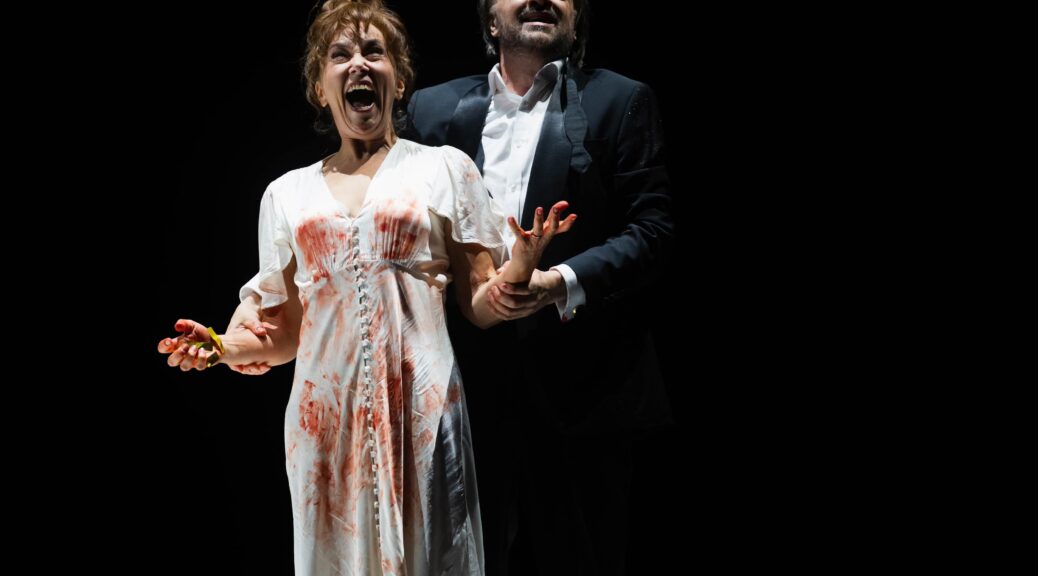
 (4 / 5)
A strong double-bill of Bartók’s Bluebeard’s Castle and Stravinsky’s Oedipus Rex opens the new season of the Welsh National Orchestra.
The WNO’s Bluebeard’s Castle is impeccable with excellent performances and a superb orchestra. Christina Rice stands out as Judith, Bluebeard’s new wife who asks incessantly to open every door, reveal all secrets, and bring light to the dark castle. Nathan Berg, as Bluebeard, counters Judith’s insistence with his dark tones. The orchestra, conducted by Lidiya Yankovskaya, is in perfect balance with the performances.
The production borrows from the ENO’s production of Bluebeard’s Castle with minimal staging. Mundane objects take on symbolic significance. Thus, the wine becomes blood, sparkling confetti shine like gold in the light. Nevertheless, the light design was disapointing as it did not convey the circular move from darkness to light and then again to darkness of the opera. The addition of music from Hildegard Von Bingen at the opening of the piece, whilst beautifully executed, stood in contrast with Bartók’s music.
Stravinsky’s piece, often and perhaps more appropriately performed as an oratorio, is not on a par with Bartók’s Bluebeard. The performances were strong. Tenor Peter Hoare is a fearful Oedipus who is overwhelmed by fate. The power of fate comes through in the powerful voice of Stephen Richardson as Messenger and Creon. Christine Rice is a self-assured Jocasta who realises that the oracle was right and she married her own son. Nathan Berg is the prophet Tiresias, at first mocked but later proven right. There is no escape from fate.
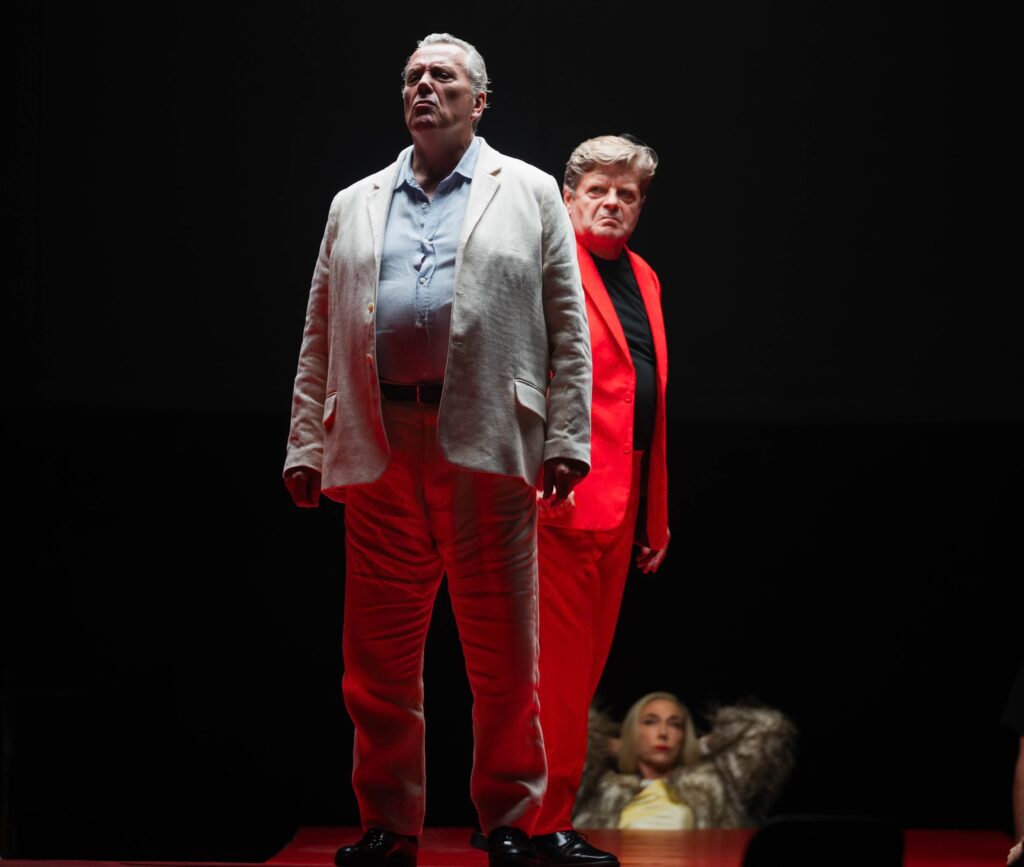
Stephen Richardson (Creon & Messenger) and Peter Hoare (Oedipus) in Oedipus Rex. Photograph: Dafydd Owen.
On a superficial level, both one-act operas share themes of male sexuality, death, and self-destruction. According to the director Joe Hills-Gibbins, ‘it’s a sort of psychosexual nightmare double bill.’ However, this seems to read Stravinsky’s Oedipus through Freud’s influence in late 20th century Western culture. The psychological interpretation provides a tenuous link between the two operas.
Musically, Bartók’s Bluebeard’s Castle and Stravinsky’s Oedipus Rex are worlds apart. Bartók’s emotional charge and polytonal motifs build an internal world of trauma, which contrasts with Stravinsky’s neoclassicism and irony. The staging of Oedipus Rex departs from Stravinsky’s conception that saw it as detached and static. It stresses the caricatural nature of the characters of Oedipus, Jocasta, and Creon by having them strut on the stage. It is less effective than Bluebeard, yet the WNO offers a good opening of the new slimmed down season.