
Category Archives: Theatre

Review A Christmas Carol, The Sherman Theatre by Kate Richards

Image Credit Richard Hubert Smith

 out of 5 stars (5 / 5)

Taking two children (11 and 12) to see a production of the Dickens classic ‘A Christmas Carol’ and knowing nothing about the production was a risk.  I’d heard it was quite long, I was worried it might be very dour and maybe the language would be inaccessible for youngsters.  I’ve also experienced other Christmas productions which were quite ‘arty’ interpretations of classic tales (e.g. The Lion, The Witch and The Wardrobe – when during the interval I heard a child ask their parent ‘Mummy what’s an Aslan’?) and clearly went way above their heads.  So, I was fairly surprised to see a variety of instruments on and before the stage as we came into the comfortable auditorium.  I was also reassured to see a detailed set of a traditional snowy, Victorian street scene, as I’d feared a minimalist, abstract set that might not convey the oppressive Dickensian atmosphere.  The opening seconds of the performance also did not disappoint – a dramatic musical flourish and a burst of coloured light revealed the silhouette of our ‘protagonist’ complete with tilted top hat and heavy winter coat.  And that readers, was the end of all the traditionalism……

‘He’ was not a he at all – this Cardiff dwelling, Ebenezer Scrooge (or Ebbie) is a cello-playing, powerhouse of a woman with the stature and stage presence to intimidate all but the bravest of souls.  Hannah McPake strides around the stage, glaring and hollering at anyone who tries to drag her into the spirit of Christmas and merely laughs at the impending threat of her three night-time visitors. 

It’s difficult to know where to start reviewing the rest of the cast – each of them taking on at least two but most often four or five other characters through-out the show – but undoubtedly what they all have in common is an abundance of talent!  It is honestly breathtaking the quality of the acting, singing and musical skills we were treated to by this accomplished cast.  We had a harp, an accordion, a saxophone, we had puppets, we had slapstick comedy, tears and anguish, romance and West-End quality voices from a cast of only 8 and there wasn’t one amongst them that didn’t add to the richness of the experience we had in the Sherman Theatre that evening.

The subtle beauty of the ghost of Christmas past (Catrin Mai Edwards) – beautiful Welsh vocals and evocative storytelling had me transported to Victorian Cardiff and entranced.  Then, listed only as ‘Apprentice Actor’ in the programme, our hearts were all broken by the perfect tones of Madalena Juma as Ebbie’s Mum forced to give him up as she was sent to the Workhouse.  ‘Apprentice’ she may be, but she is definitely mastering her craft most ably as she held her own amongst this accomplished company.

After the emotion and the drama of the past, and still laughing in the face of her past crimes and misdemeanours, Ebbie and the audience are confronted with (or maybe ‘assaulted by’) the Ghost of Christmas Present…..what can I say about Owen Alun as the Ghost of Christmas Present?  There are no words – suffice to say that EVERYONE needs a ‘Ginger North Walian’ in their lives at Christmas (and frankly all year around!).  No spoilers here – you have to experience it!

In a very modern backstory, we got insight into the reasons behind Ebbie’s notorious miserliness and the drama was built as we thought the Ghost of Christmas Present had finally cracked through her hard shell and Ebbie would be saved from the torment and chains endured by her former business partner Marley, but alas she soon slipped back into her old ways.  Bring on the mighty Ghost of Christmas Future! 

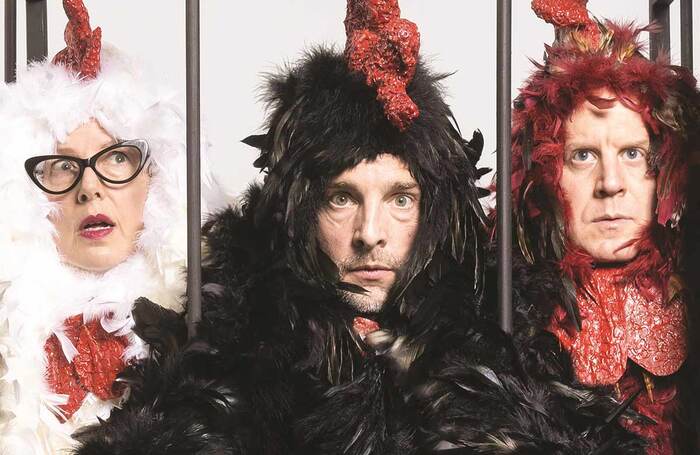
The creativity of this production is wonderful – the four ghosts (including Marley of course) could not be more different – they are humorous, enchanting, ridiculous and terrifying and take the audience on a rollercoaster of emotion through-out the nearly two-hour production.  There is so much attention to detail in the set, the costumes, the vulnerable delicacy of the puppet children, the music and the songs – it combines to make a perfect evening.  Last Christmas I had the pleasure of seeing Disney’s Aladdin at another venue in Cardiff – the big budget spectacular was incredible and left me feeling joyous and uplifted, but I can honestly say that the exuberant feeling as I jumped to my feet to explode into applause with the rest of the audience after this production, was absolutely no less life-affirming and the first thing I did when I got home was have a look to see if there are still tickets available to go again!  This is pretty much a first for me – I don’t think I’ve seen any production twice in my life!  It was heartening to hear that my 11-year-old son and his friend loved it to, and he’d also be willing to spend another evening in the company of this incredible cast!  Oh, and if you’re wondering who his favourite character was?…….That well-known Dickens character – the business bauble!  You’ll just have to go and find out for yourself!

Review Mary Rose – York Theatre Royal by Simon Kensdale

This is a play – by JM Barrie, the author of ‘Peter Pan’ – that shouldn’t work today. First produced in 1920, it puts stereotypical characters into conventional settings and develops conversations between them in dated, middle class English. There is no direct conflict and the use of clichéd idiom and vocabulary is stifling. On top of this, the plot splits between two very different places and then takes fifty years to completely unravel.

Yet it does work. Barrie prompts you into reconsidering some time-honoured and appropriate literary themes. This may be because in ‘Mary Rose’ he deploys a crude form of surrealism, using it to open up another dimension behind the mind-numbing realism.

A little girl goes missing on a small island during a family holiday. After a month she reappears, unharmed and unconscious any time has passed. Since her parents are overjoyed to have her back, this mystery is accepted. Because it is never explained, though, sitting in the audience you try to rationalise it. Is it a reference to the number of children who died in childhood before the advent of modern medicine and hospital treatment – and of how a century ago parents simply had to cope?

Because of their daughter’s brush with death, the parents in the play are overly protective of her. They worry about her getting married. She does, however, and at first everything goes well – she has a baby boy – but when she persuades her husband to take her back to the island where she once disappeared – she disappears again, this time apparently for good.

You puzzle over Barrie’s intention. You think perhaps now he is referring to how often women died in childbirth before antibiotics were discovered. But huge numbers of young people had died in the flu epidemic that followed the First World War. A lot of households had to deal with losing their daughters as well as losing their sons. The mystery in the play echoes a social environment where a generation grew up with its members not having known one or both of their parents.

‘Mary Rose’ doesn’t wallow in sorrow. Mary’s parents and husband get on with their lives. The family maid becomes a surrogate daughter and is promoted to being a paid companion for Mary’s mother. But, in yet another twist irreconcilable with everyday reality, Mary returns after a quarter of a century. She is unchanged and, again, doesn’t know what has happened. Of course, everyone close to her has aged to the point at which she cannot recognise them – even though they all recognise her. Trying to grasp the situation, you consider the issue of mental stability. Mary is like someone who has gone mad, still believing herself to be young when she is middle-aged. The unhappy atmosphere in the family re-union thus becomes realistic and credible, even though the route the story has taken to set it up has been fantastic.

To round the play off, the story fast forwards in a movement reminiscent of ‘The Winter’s Tale’ –
‘Impute it not a crime
To me or my swift passage that I slide
O’er sixteen years, and leave the growth untried
Of that wide gap, since it is in my power
To o’erthrow law and in one self-born hour
To plant and o’erwhelm custom.’

Only Barrie’s story skips another twenty-five years, to the return of Mary’s son, Harry, to the house of his grandparents. There he encounters his mother, now a ghost.

A play which reminds you of the quote you learned for your A level English exam can’t be all bad. ‘Mary Rose’ is not on the scale of a Shakespearean play, but it gets away with what might just be a device – the use of unreal passages of time – to force consideration of family life – at this point, a kind of climax – reconciliation. The long-lost son is allowed a (brief) meeting with the mother he never knew, while she discovers her son has led a full life, a discovery that allows her to disappear forever – happy at last. Barrie succeeds in infusing his story with some poetry – as he had earlier with ‘Peter Pan’.

You could leave the theatre thinking about how surrealism never really got going in England, perhaps because of our insular attitude towards Europe, perhaps because our intelligentsia didn’t speak any foreign languages. You might also want to wonder why Barrie, who was very well connected with the other literary figures of his day, is no rival for Chekov, who was born in the same year. He’s hardly an English Ibsen, either. But whether you’re interested in its background or not, the York Actors Collective deserves congratulations for reviving a play that is so little known. (They won’t have earned much for their work, either, as it only resulted in a short run in a studio space.)

The Collective managed to wring the few laughs there are from the script. They made the stuffed shirt characters more or less sympathetic. The scenes didn’t drag as they might have done and the conversations, although clunky and predictable, rattled along without the need for overacting. The addition of a slight Australian accent for Harry, and a Hebridan brogue for Cameron, the gillie who accompanies Mary and her family to the little island, added colour. I didn’t find the portrayal of Mary’s husband, Simon, convincing but it is nightmare role to play, as he – a naval officer – is completely devoid of personality. The set was minimal but adequate for a studio production. The period atmosphere was caught by a few items of furniture and the appropriate clothing.

Theatres shouldn’t run too many revivals at the expense of new work, but there are a number of plays out there which are unfamiliar to the general public. Given the right kind of treatment, venues will benefit from putting them on. We saw this with the National’s ‘An Inspector Calls’ a few years ago and also with Theatr Clwyd’s production of ‘Rope’ in July this year. More, please.

Review Yes, We’re Related, Lace-Evans Productions, Purple Door Productions, The Other Palace, By Hannah Goslin

 out of 5 stars (3 / 5)

I must say, it is a daily thought and worry of mine about the (hopefully, very far in the future) moment of losing my parents *touches wood*. I’m not sure my reaction, how I will cope, and whether there will be moments of insanity or even comedy. Yes, We’re Related has already helped my knowledge that this could be possible.

Yes, We’re Related, is the story of two very different sisters, dealing with the passing of their mother, a party to celebrate 1 year on, the memories and angst and… a squirrel. Yes that’s right, a squirrel. Gerald is believed to be their mother reincarnated but what ensues is a stark look at the sister’s relationship, with one another, their mother and one of their partners and how to cope within loss.

A mixture of themes, this production certainly has moments of highs and lows. I wouldn’t say that it touches deeply in terms of sentiment or bringing a tear to your eye, but it brings out sympathies and certainly makes you think about your own relationships with family and friends. The highs are very high, with quick witted humour and a contrasting characterisation between sisters; one is prim and proper, organised and seemingly with her life together, the other, short of a breakdown within grief, is buoyant and erratic and extroverted. The two bounce off each other, with little break for pause, and this works really well. It feels truly natural as a sisterhood and as if we are peaking through that fourth wall.

The partner who is the third wheel of this relationship, is more like his partner’s sister than her; wild and melodramatic but also love-able. However, we know him as Mark, and twice does he accidentally get referred to as Mike. We can only assume this is an ex that the sister is fixated on, but we never reach that revelation and so it doesn’t quite add to the story as it maybe was meant to.

The squirrel, Gerald, is never seen. I’ll admit, I thought would there be some hand puppet or wildly, someone dressed as a squirrel. But no, he is presented in sound and light only, using our figment of imagination when he escapes and this works really well. He is meant to be the mother in animal form and the symbiotic relationship between him and the sister living there is concerning but also heartwarming. Her way of coping. A story, heard many a time in different guises. So when he leaves the story, and she succumbs to her grief, it is heartwarming and tearing all at the same time.

Yes, We’re Related is a roller coaster of comedy, meaningful conversation and a warm hug in what we will all experience, in one way or another. The performances and relationships are impeccable and it tells an age old story in a unique and new way.

NINE SIXTEENTHS Performed at The Pleasance Theatre by Tanica Psalmist

Written & performed by Paula Varjack, devised and performed by featured casts members; Julienne Doko, Endy Mckay & Pauline Meyers.

NINE SIXTEENTHS retells the most searched incident over the internet. On the 1st February 2004, where we witness during the play the extent of ongoing warranted investigations, meetings, interviews, congressional hearings and biased coverage distorting the narrative of the feminine, an unprotected Black woman within patriarchal society, simultaneously tackling unethical white supremacy within show business causing infliction at every angle, complexing narratives through choice of language, encouraging further scrutiny, working against the woman.

NINE SIXTEENTHS well depicts from start to finish the challenges & turmoil Janet truly experienced. In the opening scenes we evidently see how the finale of the SuperBowl during Half time released the wildfire, with two of the most Iconic artists Janet Jackson & Justin Timberlake’s duet on Justin’s popular song ‘Rock your body with the final line’… “Have you naked by the end of this song” taking the world by surprise as he unapologetically revealed Janet Jackson’s breast in slow motion.

Each talented cast member perfectly highlighted the necessity for the world to have & share their opinion in their great multi-character takes, displaying the deepness of Janet’s never-ending humiliation, rage & hate speech for Janet Jackson daily shameful accusations, one being it was all a publicity stunt!

The obsession for more air time on this topic brought the attraction to the founding of YouTube! With the Founder of YouTube keen on erasing & destroying Janet’s career as profit & gains.

The influx of searches per day after the Super Bowl, helped stir debates around Janet’s sexually explicit content, where we see how even the White House launched an investigation on whether the CBS was in on it. With noone believing Janet’s verbal statement! FCC fined CBS, allowing the CEO of CBS to hate on Janet for eternity, fixating on getting her blacklisted on major music stations; MTV & CBS radio stations where music was majorly promoted! Janet was cut off & shadow banned, triggering scrutiny, pain and vulnerability! Paula has done an incredible job on touching on the depths of this forgotten but never truly forgotten infliction.

In this play we are left critically thinking & reflecting on the ‘why’, why was Justin not mentioned once, acknowledged nor considered in the articles/headline news, with the frame solely on Janets indecency, deliberate tendencies, turning Justin Timberlake into the victim, the innocent bystander whilst Janet remained the perpetuator, blocked for 8years, undermined on live TV shows & criticised for the entire world to continue watching legally even till this day.

Overall, NINE SIXTEENTHS highlighted how our attention is our main currency so be careful how we choose to use it. The importance of acknowledging the why & what threatens Black woman’s safety net expressed universal vulnerability. However, unlike Janet, can we trust the personal spectrum is being heard, respected and considered this time around, moving forward.

Playing until 16th November 3pm & 7.30pm. November 14th performance will be BSL signed by Jacqui Beckford.

Review Pontypool, Wales Millennium Centre by Bethan England.

 out of 5 stars (4.5 / 5)

‘Don’t. Breathe. A. Word,’ is the advice given to all those who may enter the Western Studio at the Wales Millennium Centre to watch ‘Pontypool;’ a brand new stage adaptation by Hefin Robinson, directed by Dan Phillips and based on the cult horror story by Tony Burgess.

The original novel took place in Pontypool but in Ontario, Canada, whereas this production definitely is a lot more local!

Washed up radio DJ, Grant Mazzy is trying to ‘take no prisoners’ and whip up the local community into action through his radio slot. There’s only one problem; he’s used to the listeners of Islington and now he’s ended up in a basement in Pontypool delivering his ‘Mazzy’s musings’ on Beacon Radio. Producer Rhiannon has certainly got her hands full with him and Megan, the assistant, is just trying to keep the show on track. Mazzy wants to deliver hard hitting radio, which isn’t easy when you must interview the cast of the local, gender blind production of Lawrence of Arabia…

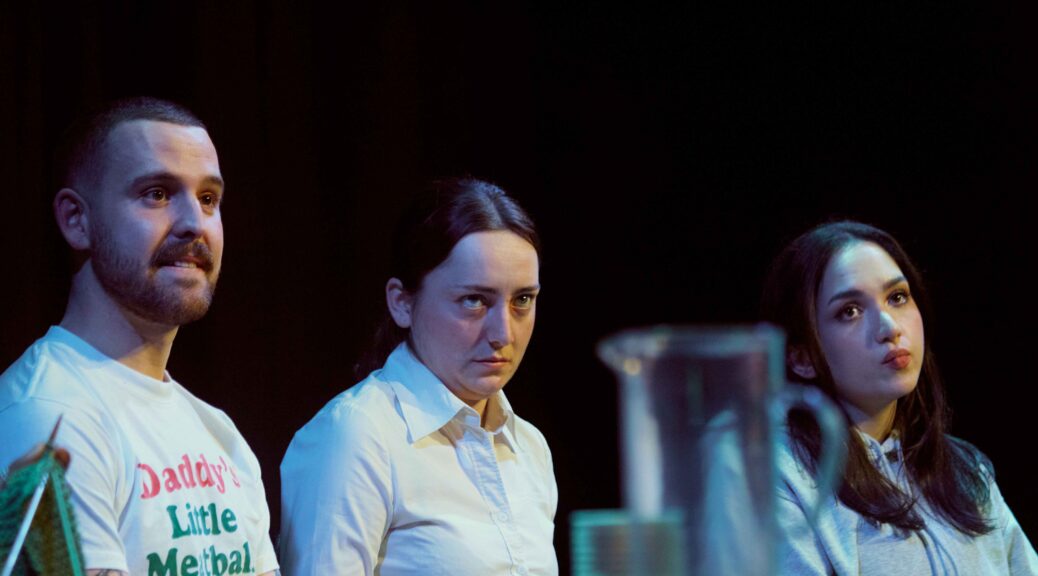
Production Images Credit Kirsten McTernan

The action, all delivered in the basement radio station, really amps up as they start to receive news of a local ‘riot’ at the doctor’s surgery, which turns out to be a lot more than it first seems. Not being familiar with the cult horror novel means that every twist and turn of this production was a complete surprise to me but even those familiar with the story will be met with a fresh, local but universal story that is brought bang up to the 21st century with Rhiannon demanding Mazzy STOP using the word ‘woke’ and references to the last time we got locked down. The writing is fantastic, and I highly commend Hefin’s adaptation; the humour is fast paced and relentless, the language is witty and smart and the relationships between the characters are totally believable. Even when the action starts to ramp up, the direction by Dan Phillips has clearly been worked to toe the line between drama and comedy, its expertly walked and even in the horrific moments, the comedy still flows!

The casting is spot on; Carwyn Jones is the voice of Ken Loney, ‘the eye in the sky’ reporting on the weather in Pontypool from his ‘sun helicopter…’ Although we never see him, the voiceover is excellent, the comedy ably aided by the clever sound effects. His later phone calls to the station are perfectly counterbalanced to the earlier humour, with voice alone sending shivers down the spines of the audience. Ioan Hefin is ‘dodgy’ Dr Harry Phillips, again balancing comic chops with great acting ability in the more serious moments. He is the lynchpin to the play, providing us with in turns hilarious and in turns dramatic moments of explanation.

Rhiannon Briar is brought to life by Victoria John; she captures the frustration of the producer stuck with the radio ‘star’ with big ambitions of ‘shaking things up.’ The clashes with Mazzy are delivered with panache and Victoria gives us brilliant angry chemistry with Mazzy. They are the quintessential odd couple of the play. Without giving too much away, Mail O’Donnell’s portrayal of Megan Davies, the radio assistant, is a role of two parts! Her physicality is exceptional, and she ably delivers the vision of Movement and Intimacy Director, Lucy Glassbrook. Her realisation of the character and her twists and turns is delivered expertly right up to its explosive conclusion…

Finally, the radio DJ himself, the voice of Pontypool, Grant Mazzy is brought to life by Lloyd Hutchinson. Lloyd owns the stage and his radio booth, prowling across the stage with his agenda ready and waiting to be delivered to the willing (or unwilling) listeners of Beacon Radio. He sends the audience into fits of laughter with facial expressions and movements alone; he also sends a shiver down our spines with those expressions and silences too. I was so impressed by his ability to have me giggling one moment and with my heart in the mouth the next.

A special mention must go to the make up and special effects, which totally blew me away. The make up is brilliant; huge congratulations to the Marcus Whitney and assistant, Kristie Stanway. I honestly had no idea how the team would bring this horror classic to life onstage, but I was in awe. I can’t say too much, but the make up and effects are visceral and drew gasps (and sounds of disgust!) from the captivated audience.

https://youtu.be/cW93tKGMoJM

A huge congratulations to all involved with this expert adaptation; what a phenomenal version, with a distinct national flavour but universal appeal. Don’t miss this and do not let Pontypool fall silent. ‘Don’t. Breathe. A. Word…’ or should I say… ‘Dim. Gair. Wrth Neb…’

You can find out more and book tickets here

Review Mumfighter, A Grand Ambition Production, written by Tracy Harris, review by Abigail Thomas

Mumfighter is a new play written by Tracy Harris, based on her own personal experiences of having a child with a disability and fighting to get them the help they need. The emotional one-woman show follows the life of Amber, from her life before her child was born to trying to process having a child with Cerebral Palsy, to fighting systems, like the NHS, to get her daughter the medical therapies and assistance she needs. The play was able to connect with its audience and is raising awareness of the struggles of living with a disability and supporting someone with a disability.

Katie Payne’s performance as Amber was breath-taking both emotionally and physically. The way she confidently moved around the arena staging, engaging with the audience and the set was remarkable and, the symbolic fight sequences were effortlessly done. Despite the difficulty and the pressure of performing solo, Katie Payne appeared undaunted, allowing her to deliver the emotionally striking performance, perfectly portraying a mother who feels lost and unable to help her daughter.

The play resonates with many people, including myself, and is showcasing Welsh talent from Katie Payne and Tracy Harris. In interviews Tracy Harris said that she thinks there are problems in the support system for people and children with disabilities and that people who are not part of that world are still unaware of the problems. The play has definitely succeeded at raising awareness of the issues that carers can face every day and the fight that is still ongoing for support. I think the play will be remembered for the exceptional representation of disabilities, from an entirely unique perspective that I haven’t seen explored before.

Review Mumfighter, A Grand Ambition Production, written by Tracy Harris, review by Megan Barrett

A boxing ring, boxing gloves and a bottle of wine.

Mum Fighter by Tracy Harris is a raw, moving piece of theatre that explores the complexities and resilience of motherhood. As I sat in the theatre, captivated by Katie Payne’s performance, I saw the look on the audience’s faces. Some with jaws slack, others sat on the edge of their seats entirely absorbed in the world Tracy has created – that is so similar to her own.

The show follows a mother, Amber, fighting in a boxing ring to win the support that her daughter, Bea, needs to fight cerebral palsy. The boxing ring at the centre of the room and the symbolic act of using the boxing gloves to represent Bea highlights the dominant themes of this play, that Amber and her daughter are fighters.

Amber goes through a rollercoaster of emotions, is knocked down, refused, broken up with, torn apart and put back together again but not at any point does she give up on fighting for her daughter. She is challenging the system and will not settle for the scraps that
they are giving her.

As the show reached its end, the entire theatre stood to applaud. All of us in awe at the performance we just watched, I even had a tear in my eye. Mum Fighter portrays the strength found in vulnerability, challenges the system

Review, Frontiers, National Dance Company Wales, The Place, By Hannah Goslin

 out of 5 stars (4 / 5)

Plunged into darkness, our eyes becoming accustomed, we start to see the outline of bodies, moving as one. As the lights come up, we are confronted with a team of mismatched and almost fearsome creatures, with mixtures of jagged and smooth movements.

A double bill, National Dance Company Wales bring questioning and critical performances, Skinners by Melanie Lane and AUGUST by Matthew William Robinson. Neither aim to give answers to our changing world but aim for us to reflect on our existence and the change around us.

Skinners particularly looks at the digital age, where physicality is distorted beyond recognition and where we live in a virtual world as opposed to reality. This first piece is what we are confronted with from the dark; creatures with recognisable assets yet distorted some what, move as one and then in separate spheres. The movements themselves move from recognisable, to abrupt, repetitive and unusual. With their costuming and contortion of their bodies, we want to understand but we are quickly pulled away, watching something unearthly, at times robotic, at times… no one knows.

It is a piece that you cannot take your eyes off. Even the repetitive movement hooks you, and there is something always catching your eye. Once the performers peel away their outer layer, they become more humanised, but there is still this sense of something lost underneath, as they continue to move unusually and almost unnaturally. It is a high octaned piece, full of dance moves that seem simple and easy, but clearly requires immense talent and skill to perform.

AUGUST, while noted in the programme as inspired by sunsets and sunrises and the liminal space between, to me, it continued this concept of other-worldly, of a digital age. A horizontal light, that throughout counts down and follows the dancers across the stage, gave this sci-fi effect; of a barrier that could not be crossed. Within this, the movement, compared to Skinners is more graceful and fluid – dancers appear from the dark and as the horizontal light moves up, down, forward and back in movement with them, they are highlighted by the shadows created.

Again, unable to take your eyes off, there is something always appearing or disappearing, with moments of increased energy, within the fluidity of their movements. It is sensual and intense, with the performers working more with one another and their bodies than previously, melding into one and separating into something different.

Frontiers showcases the immense talent of the NDCW – from the unusual and avant guard to the fluid and contemporary, Skinners and AUGUST beautifully compete in excellence.

Review: Swan Lake, Imperial Classic Ballet, Venue Cymru, Llandudno by Richard Evans

Venue Cymru, Llandudno, October 18th 2024 and touring

 out of 5 stars (4.5 / 5)

An Imperial Classic Ballet production. Ballet Artistic Director – Katsiaryna Fadzeyeva, Conductor – Nikita Suhik, Concertmaster – Polina Chaika.

Swan Lake, a timeless story that became the standard for classical ballet and redefined the genre.  Would this production continue to entrance the audience as much as the ballet has since its first presentation?

The libretto is well known and at its heart is a love story.  Prince Siegfried is disappointed at his birthday celebration that no suitable bride is presented to him.  After, while hunting he sees some swans by the lake.  He is entranced by the white swan, Odette who insists that she and the other swans are human and have been put under a spell by the evil magician, Rothbart that can only be broken by everlasting love.  In Act 2, the Prince has to choose his bride and eventually sees Odile, Rothbarts daughter and sees an uncanny resemblance to Odette.  In the heat of celebration he confesses his love for Odile, breaking his vow to Odette who watches on from the window.  Once he realises, the Prince returns to the lake to see the grief stricken swans.  He begs forgiveness of Odette and declares his love.  Rothbart challenges him, but love prevails.  

The ballet tugs at the heartstrings throughout taking you through a range of emotions from joy to grief.  This is enabled by Pyotr Tchaikovsky’s moving score.  He pioneered the use of leitmotifs, snatches of music that are assigned to a character and repeated when they appear on stage.  Musically it is challenging.  On speaking to the first violinist she commented that Tchaikovsky composed on a piano, having five fingers available while the violinist has only got four, the thumb being used as a grip.  The orchestra proved the point that dance and music are natural extensions of each other and portrayed the emotions in the ballet really well.  

To perform Swan Lake is difficult, comparable to Sleeping Beauty in its complexity, yet the lead roles are compelling for any aspiring dancer.  There were a series of tableaux illustrating the skills of the dancers which provided ample evidence that ballet makes extremely difficult manoeuvres look effortless.  The part of Odile/Odette is particularly challenging both technically and emotionally yet illustrated that the movement of the human body can be beautiful as it combines grace, poise and strength.  This performance did not disappoint, yet again this dance proved to be compelling viewing  

The ballet troupe and orchestra, in the midst of a gruelling schedule for their national tour were enthusiastic and committed tonight, although my impression is that the emphasis in this production is on demonstrating prowess rather than storytelling. However, this did not spoil what was an excellent and thoroughly recommended evenings entertainment.  

Review Grav Torch Theatre by Seren Lewis

An hour-long monologue is no easy task, but Gareth J Bale smashed his performance once again in the lead up to the 200th performance of ‘Grav’ the commemorative re-telling of Raymond Gravells life, the Welsh rugby icon turned actor who embodied all that it meant to be Welsh. Set in a decrepit rugby locker-room, Bale reenacts some of Grav’s most memorable moments; from beating the All Blacks in small-town Llanelli, to acting alongside some of tv’s finest.  

The play begins by introducing Grav’s notoriety, establishing the biographical nature of the play, spanning from his tryouts for the under 15’s local rugby team, to his battle with diabetes which resulted in losing his leg. Writer Owen Thomas focuses on the positive moments of Grav’s life, while also not shying away from the tough and intense moments, including his father’s suicide. We, the audience, experience a full range of emotions, heightened by the skilled directing and lighting changes, along with the tone and atmosphere created.  

Despite being a monologue, Thomas has Grav tell his story as if he were talking to his mother about it, giving a natural and comforting feel to his story, allowing us to empathize with the character and his journey. The play ends with Grav preparing for a rugby match, getting into his kit and leaving through the same door he arrived.