
All posts by Barbara Hughes-Moore

REVIEW Watermill Theatre’s A Midsummer Night’s Dream, New Theatre Cardiff by Barbara Hughes-Moore

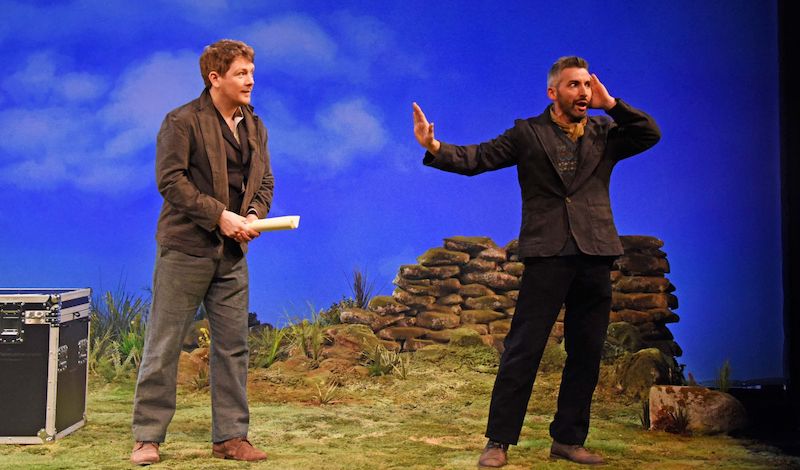
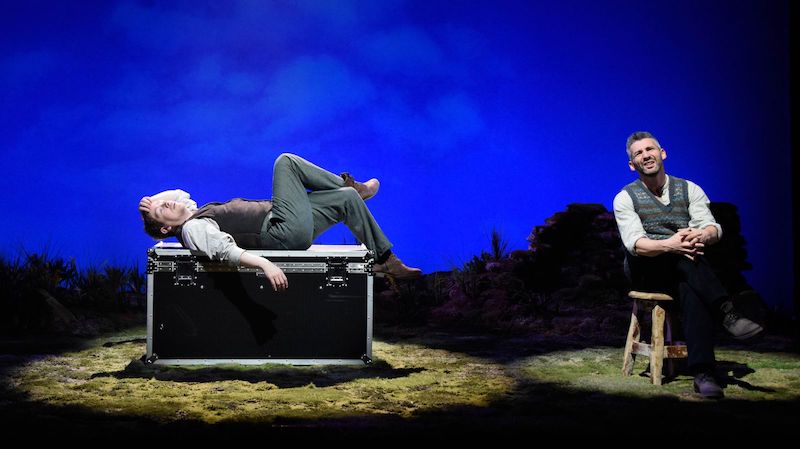
The Watermill Theatre’s tour stops in Cardiff this week with a double bill of polar-opposite Shakespeare plays on alternate nights: Macbeth, which will be playing on Wednesday, Thursday (matinee) and Saturday, and its tonal opposite, A Midsummer Night’s Dream which will be playing on Thursday, Friday and Saturday (matinee). I was delighted to see the performance of the latter, and to experience how Watermill – whose past triumphs include The Wipers Times, Crazy for You andMurder for Two – reconceptualised one of Shakespeare’s most beloved comedies, A Midsummer Night’s Dream.

The creative team is brilliant across the board, and even though the pacing can be a bit uneven at times, the infectious energy of the cast, Paul Hart’s direction and the excellent second act more than makes up for it, with the ten actor-musicians gamely switching roles, instruments and costumes. Relocating the drama to Edwardian times maintains the original’s frenetic sense of fun, even if the period doesn’t add a huge amount to the original Athenian setting. (I wonder if it would have worked even better if set in the modern day, as with their staging of Macbeth).
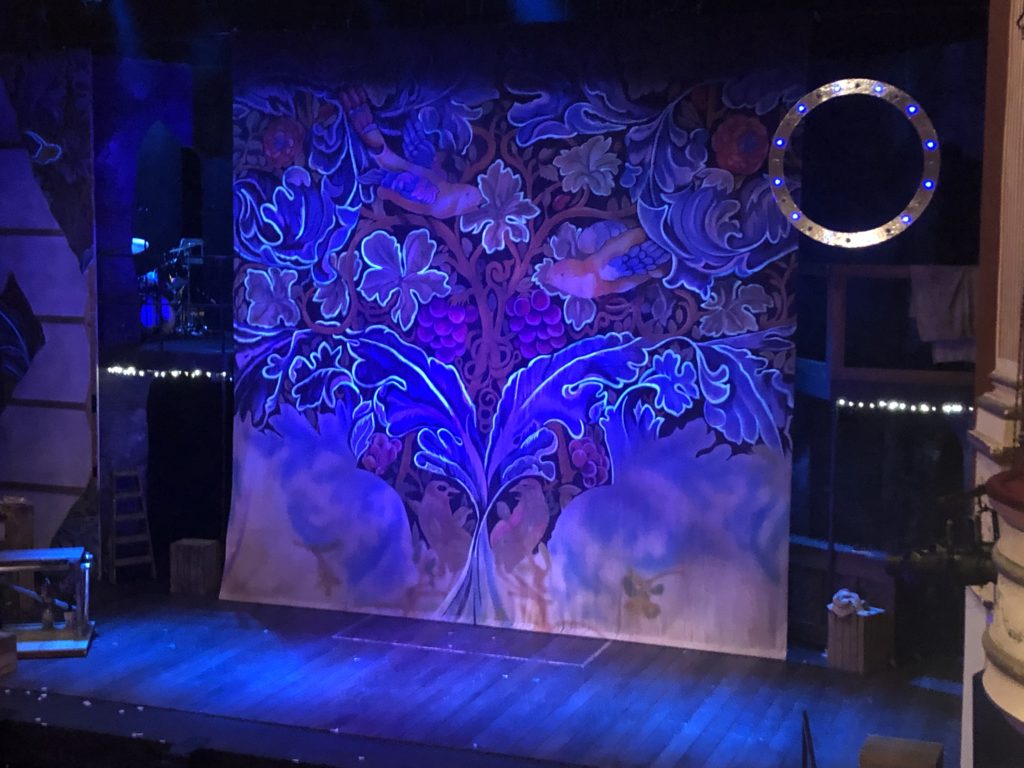
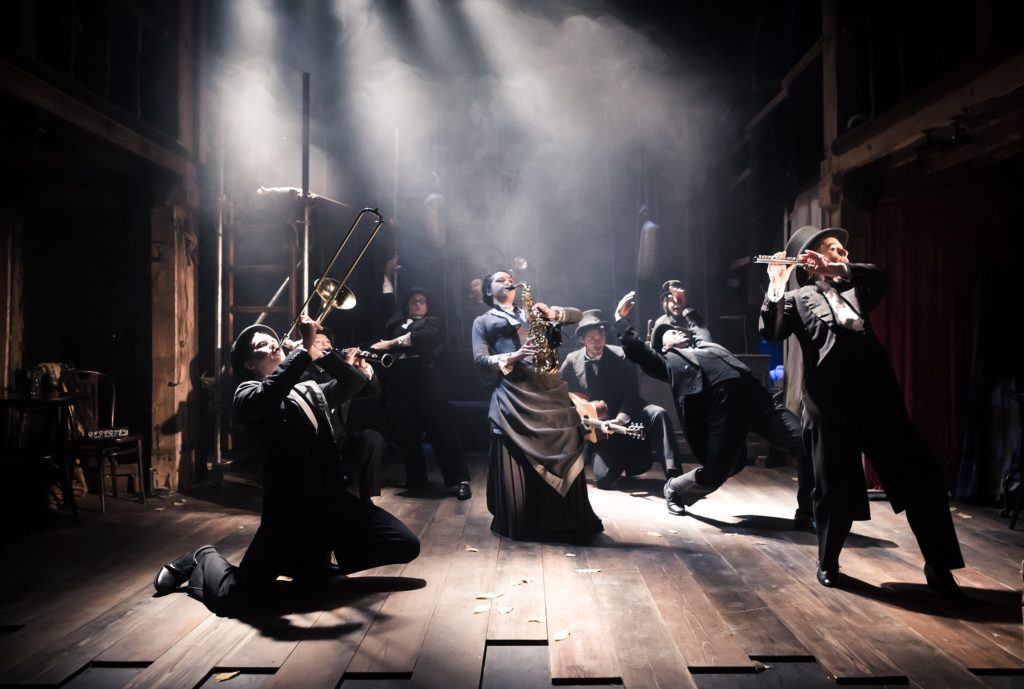
Katie Lias’ production design beautifully shifts from dilapidated Edwardian theatre to the neon-lit faerie realm, aided by Tom White’s ethereal lighting. The music is worth the price of admission alone, with the cast performing gorgeous renditions of classic songs like ‘Cupid, Draw Back Your Bow’, ‘Blue Moon’, and ‘My Baby Just Cares for Me’. (Yes, the song choice can be a bit on the nose, but it works – trust me). The harmonies are delicious, especially in the haunting performance of Laura Mvula’s ‘Sing to the Moon’, the culmination of this ensemble’s considerable skill – and the show’s major moment of pure magic.
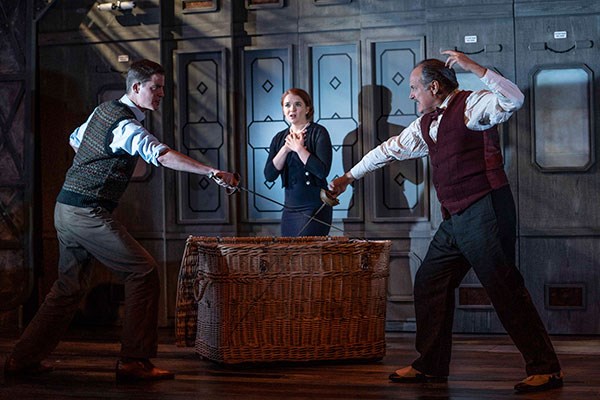
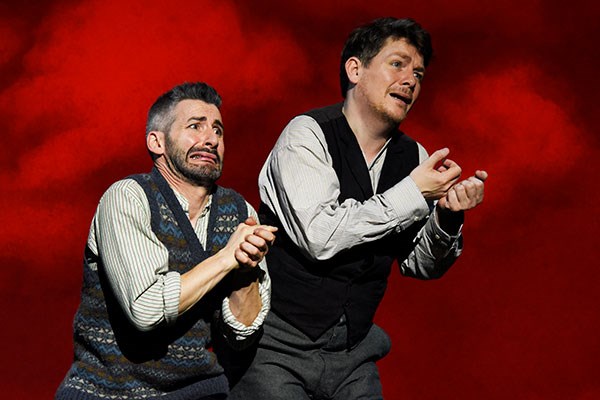
Our central lovestruck quartet – Lysander (Billy Postlethwaite), Hermia (Lucy Keirl), Helena (Robyn Sinclair) and Demetrius (Mike Slader) – are fairly thinly-drawn on the page, so your investment in their plight relies almost entirely on the actors’ charisma. Luckily, the four are more than up to the task, especially when Puck’s meddling turns their romantic squabbling up to eleven – coming to a crescendo with Hermia/Helena’s quippy sparring and the hysterical ‘macho-off’ between Lysander and Demetrius (the way they treat a bit of playground-style shoving as the most violently masculine mode of attack is maybe my favourite moment in the whole play – think ‘Agony’ from Into the Woods).

Postlethwaite gives easily the best performance in a brilliant ensemble. Effortlessly charming and captivating from the moment he saunters onstage, his Lysander is dynamic and compelling; his physicality pitched (at least from where I was sitting) somewhere between Kylo Ren and Kevin Kline in his prime. He makes the archaic dialogue sound natural and contemporary, and there’s a spark to his delivery that isn’t present elsewhere in the show. On the basis of his work here, his turn as Macbeth is sure to be mesmerising.
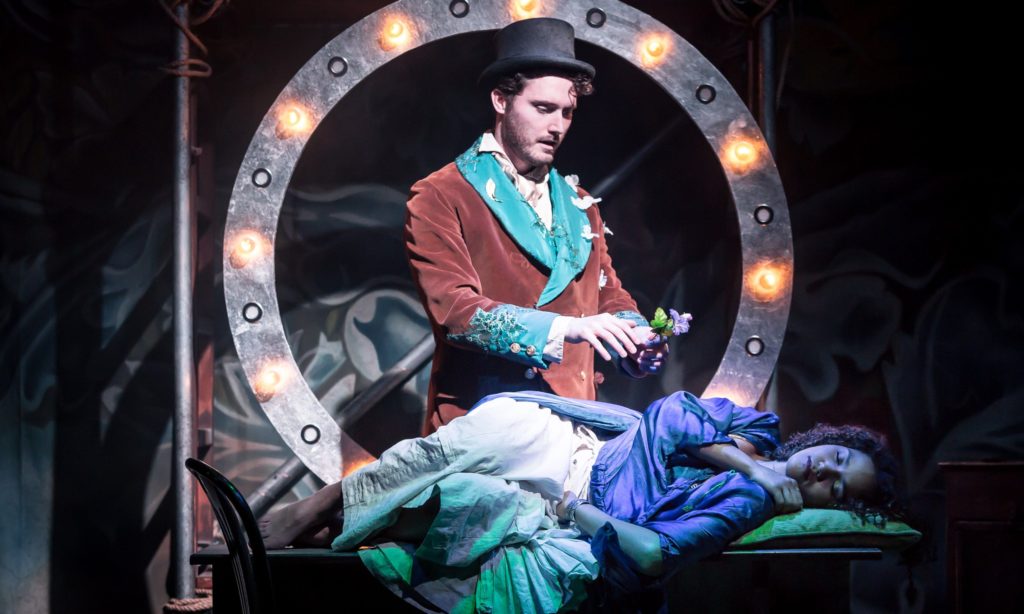
The lively chemistry between the main quartet carries them through wave after wave of romantic contrivances. Robyn Sinclair is a standout in every musical number, but her excellent artistry is undercut slightly by poor costume choices and overwrought affection for the rather insipid Demetrius. While Hermia and Helena are perpetually thankless roles, Sinclair and Keirl approach their perennially-perplexed paramours with panache. (Hermia for example insults Helena’s ‘beanpole’ frame despite the fact that the actresses are the same height. It’s a small but conspicuous issue which demonstrates that performing the play as writ doesn’t always work).
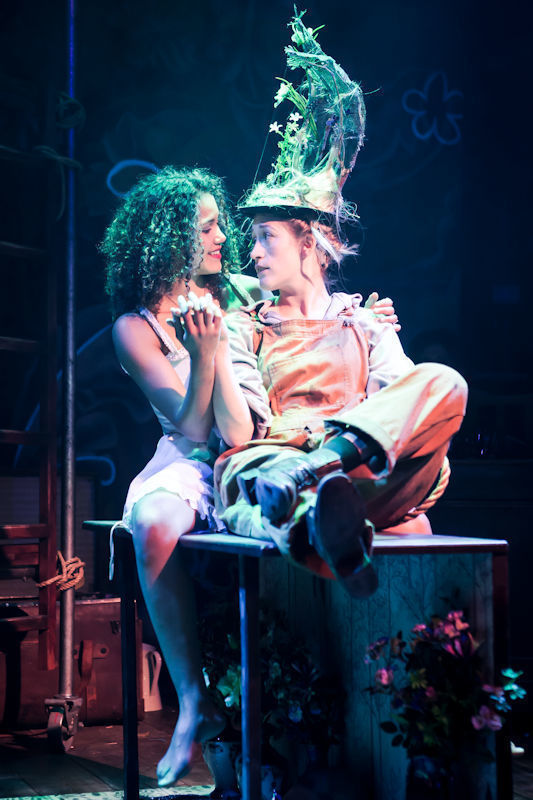
The closest the play comes to exploring the contentious gender politics at its core is to genderswap a few characters – notably Puck (Molly Chesworth) and Bottom (Emma Barclay), both of which had potential but were undercut either by performance/direction or connotation. As to the first, Molly Chesworth isn’t quite as mercurial or mischievous as the Puck character needs to be (although her ‘stroppy toddler’ scene is a high point). And although Emma Barclay shines as an entertainingly imperious Bottom (the puns are inevitable when discussing this character), her casting means that we are invited to laugh at the prospect of a romance between the only same-sex couple in the show – and when the spells are broken, the heteronormative status quo is reset across the board. I do think the show’s heart is in the right place, but I think it would have been more subversive to gender-swap one of the main quartet of lovers instead.
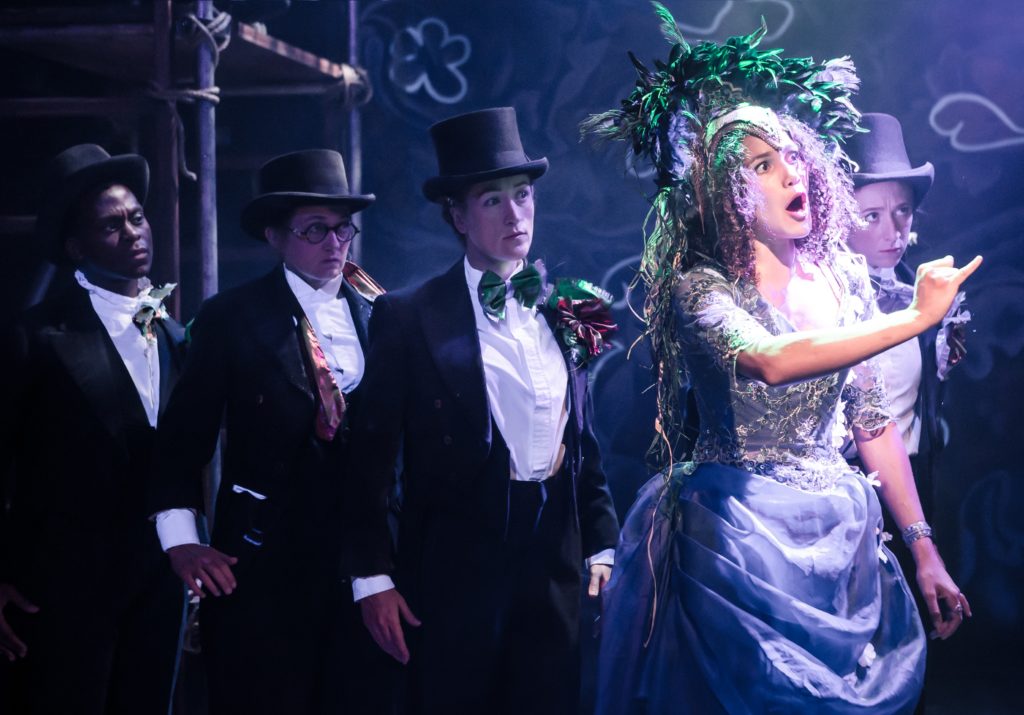
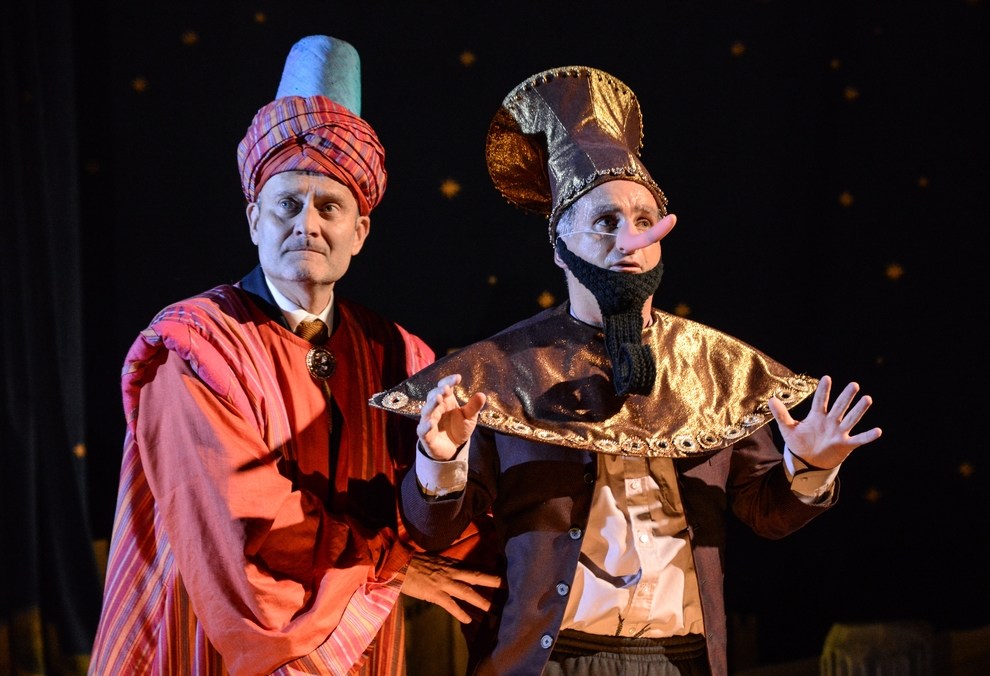
In other casting quirks, the actors playing Theseus and Hippolyta traditionally double up as Oberon and Titania – but while Emma McDonald impressively plays both Queens, the roles of Theseus and Oberon are played by different actors here, which doesn’t entirely work. Offue Okegbe’s Theseus is a wonderfully commanding presence, although they added a subtle bit of pre-marital strife between him and Hippolyta that goes nowhere (and reverses their loved-up vibe from the original play); but Jamie Satterthwaite’s Oberon is less convincing. Satterthwaite doesn’t quite bring the same regal elegance as Emma McDonald’s enchanting Titania, and his subpar outfit looks like a Halloween costume next to her elfin haute couture.
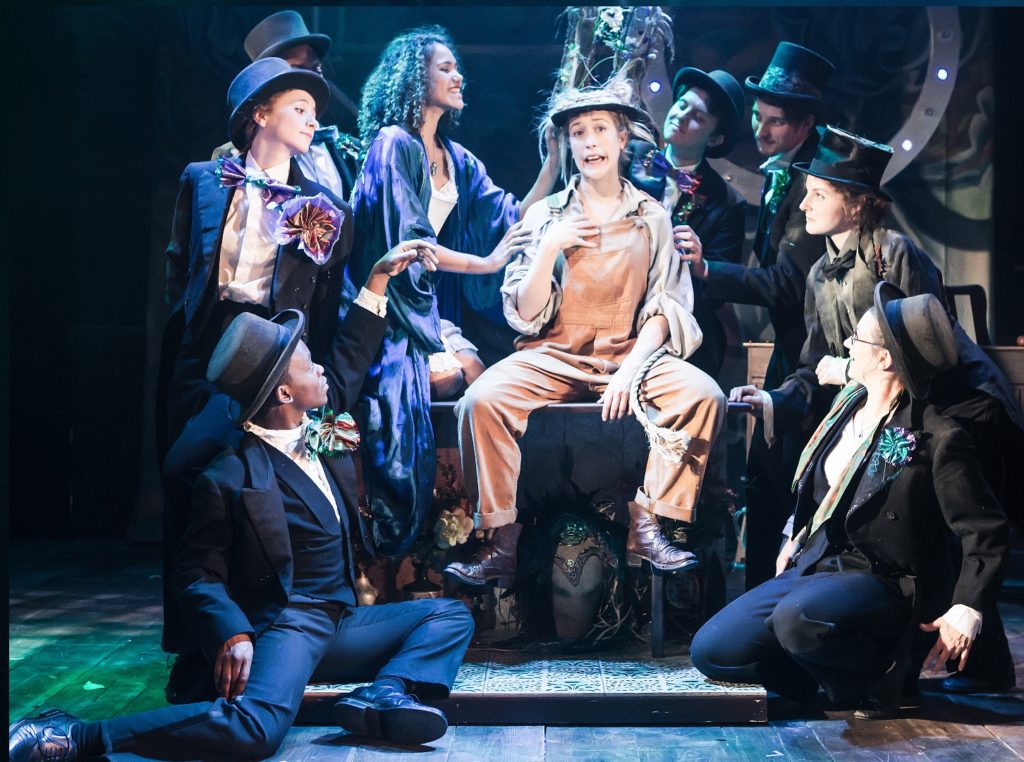
Although a tad drawn-out, the show ends on a perfect note thanks to the ramshackle players’ (un)intentionally inept version of Pyramus and Thisbe, and the hilariously but earnestly incompetent luvvies wouldn’t seem out of place in Waiting for Guffman or Barry. The machinations of the fey court might be frequently more interesting than the bickering beaus (you can’t really beat top hat and tails-wearing faerie courtiers singing Nina Simone) – but if what we have witnessed here is, as Puck warns, just a dream, then it’s a very good one indeed.

Review ‘The Creature’, Company of Sirens, Chapter Arts Centre, by Barbara Hughes-Moore

The Creature, Company of Sirens’ bold reinvention of Mary Shelley’s Frankenstein, is not only a magnificent modernisation of the classic tale but a potent and poignant examination of what it means for society to deem someone a monster. The play, vibrantly written by Lucy Gough and dynamically directed by Chris Durnall, functions as a spiritual sequel to their previous collaboration The Wolf Tattoo, which explored knife crime and gang violence. The Creature picks up these thematic threads and shifts the action from a futuristic dystopia to the dystopian prison system of our own world; to a single cell in which a young man confronts his erstwhile father for his part in the son’s terrible crime.

The production is thematically rich and harrowingly rendered. Are monsters born or created? What makes us monsters? And who is responsible? These questions form the spine of the story, and Gough has a knack for exploring the universal in the specific. The central mystery of Son’s ‘monstrous’ act is elegantly unwrapped, with breadcrumbs – bird, heart, tree – keeping the audience guessing until the final reveal, which (as in a criminal trial) still only forms a partial glimpse as to the act itself. Thematically and tonally, it called to mind Carol Ann Duffy’s Education for Leisure (empathetically exploring the psyche of a person who commits violent acts), the Taviani Brothers’ documentary Caesar Must Die (humanising/liberating prisoners through theatre), and Charles Williams’ Descent into Hell (in which the central image of hell – descending a rope into a bottomless pit – strikes a chord with the metaphors of this piece).
The original soundscape is effectively squelchy and unsettling, with Angharad Matthew’s design impressively recalling the psychological minimalism of the Sherman Theatre’s Tremor, and Dan Young’s spectral lighting eerily recalls Frankenstein’s early foray into the visual medium. The performances are powerful and evocative, even if they can be a little overwrought at times, but Durnall’s direction imbues a fantastic sense of motion and movement, and the melodrama complements the story’s high emotions and Gothic origins. Sometimes the characters’ declarations can feel a little on the nose, and a few elements don’t read as powerfully in execution as they might have on the page (the “autopsy”, Father’s revelatory monologue), but the creative team’s skill and good intentions keep the drama grounded and thrilling.

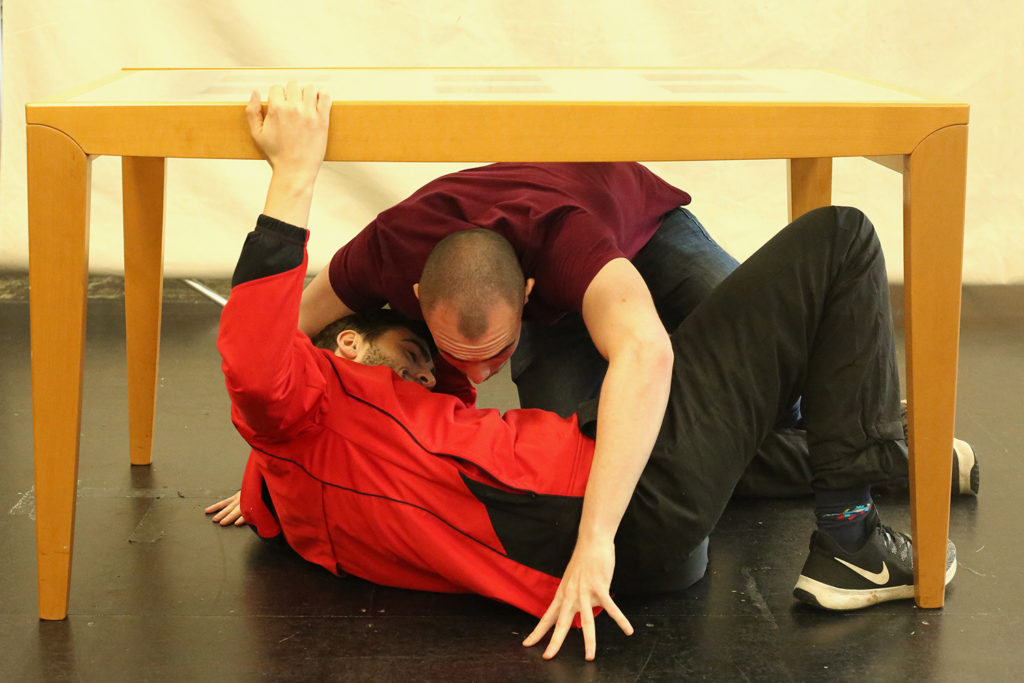
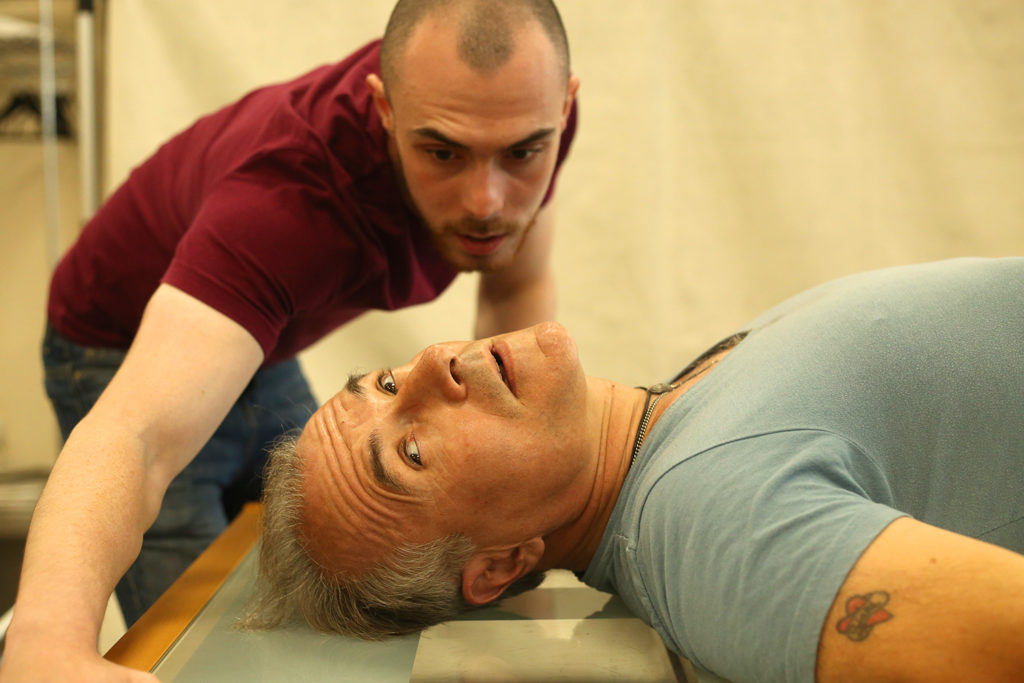
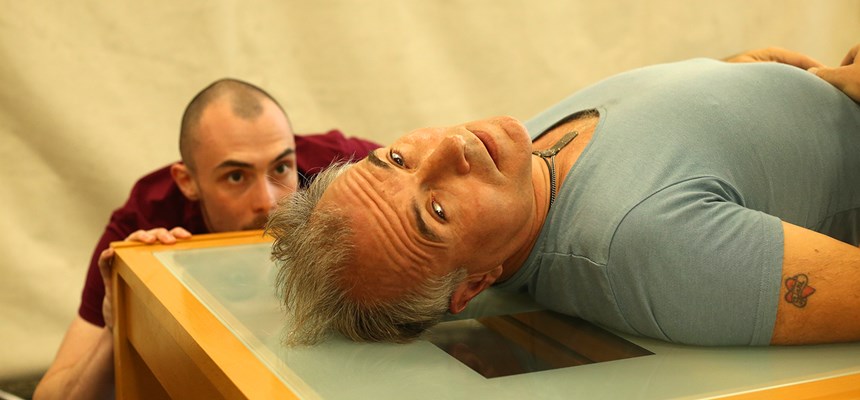
Intriguingly, the character of Son is portrayed by three actors – primarily by Matt Reed, who brings a brilliant Toby Kebbell-like intensity to proceedings, but also by Jared Ellis Thomas and Angharad Matthews, who embody the various facets of Son’s character, occupying the roles of his heart and mind respectively. The trio’s sinewy, surreal entrance starts the play: the three, a tangle of limbs under a sterile table, emerge as if from the primordial ooze in a visually thrilling sequence that you simply have to see to believe.

The doubles’ aspect of the Son character is especially interesting because duality is a key theme in his beloved Frankenstein, in which the son (the creature) can be read as a dark double of the father (Victor). Father (Jams Thomas) enters as an imposing figure jangling a set of keys. At first, then, he seems like a Warden, until his aloof disdain makes him more akin to some remote deity who materialises to pass judgment. When he enters the cell, he identifies himself as Father – not just the Frankenstinian sire of this seemingly-monstrous Son, but also the manifestation of patriarchal enmity; a symbol of the society which has shaped, condemned and discarded people like Son.

It was a pleasure to stay for the excellent post-show panel, in which the creative team explained that, in developing The Creature, they collaborated with young offenders from Parc Prison in Bridgend – the vivid authenticity of their collective and individual voices lends the drama a tangible, believable quality even as the weirdness escalates. Much of what we witness is ambiguous, largely psychological, and steered by an unreliable narrator who leaves us in doubt as to whether what we have seen actually takes place in reality.

The play is not realistic in a literal sense, then, but in an emotional one. The feelings are raw and jagged; tension simmers and rises to boiling point, but there is no relief or release – because this is a snapshot into the mind of someone like Son, whose traumas are absorbed so deeply into his psyche that he relives them on an endless loop. Son’s nightmare – ‘I’m in a labyrinth being chased by a monster, but the monster is me’ – demonstrates a remorse that he never clearly vocalises, and it’s interesting that his quest for a clean slate and father figure doesn’t turn him towards religion (despite wearing a rosary, something which is never overtly mentioned by the characters). The play also has some fascinating meditations on gender/gendered violence which similarly harken back to its Shelleyan source.

The dialogue is frequently interspersed with songs by cult music icon Daniel Johnston, a loner and underground revolutionary of whom Nirvana’s Kurt Cobain was a vocal admirer. The most striking of these is ‘Casper the Friendly Ghost’, which hauntingly sketches Son’s predicament through the recurring lyric, ‘he was smiling through his own personal hell’. The penal system is its own specific type of hell on earth, imprisoning people in a monotonous cycle that is supposed to squeeze the criminal impulses out of them and depositing them back into society a changed person – or, otherwise, hole them up for the rest of their natural-born lives for committing a crime that society deems unforgivable. But it is almost impossible to imagine how the four walls of a barren cell can facilitate a moral and spiritual metamorphosis, especially because a criminal record can operate as an indelible mark on one’s character which jeopardises the prospect of ever finding a stable job, home, and life.

‘Am I to be thought the only criminal, when all human kind sinned against me?’ Though never spoken in this version, the original creature’s plaintive repine appears to encapsulate Son’s rationale. Myriad social factors and personal traumas formed the disparate limbs of his identity that the root of his criminal actions is fragmented in neglect, abandonment, isolation, and (implicitly) issues of poverty, class and mental health. Monstrosity is a social phenomenon; it’s a word we use to label people whose actions are so repugnant that we as a society cannot condone. But monsters are the children of society – and, as Son urges Father, the responsibility for these monstrous acts are shared by us all. If society does not provide an opportunity for people to change, the vicious cycle repeats. The fact that re-offending is on the rise and people of colour (and especially black men) are disproportionately incarcerated accords with the notion that prison is a microcosm for the world: its injustices are the world’s injustices. The system punishes the offender rather than the social structures which contributed to that person’s crime, and as such can arguably never truly offer justice or closure.

The least we can do, as Son implores, is listen. The play wonderfully demonstrates how literature (and theatre) can help you make sense of the world – Frankenstein’s creature gives Son the words he wouldn’t otherwise have to describe the chaos in his soul. Likewise, this production gives us the chance to hear Son’s story and empathise with him just as we did with Shelley’s creature.

This is a four-star show with a five-star heart that resonates long after the striking final image.  It’s not only a taut exercise in maintaining mystery and suspense, but a viscerally timely and harrowingly relevant work of art that urges us to take responsibility for what we create and, crucially, for each other. The Creature is playing at Seligman Theatre, Chapter Arts Centre from 1-5, 8-10 October (BSL-interpreted performance on 4 October): https://www.chapter.org/whats-on/performance/the-creature-company-of-sirens/4595/.

REVIEW The Lady Vanishes UK TOUR, New Theatre Cardiff by Barbara Hughes-Moore

Alfred Hitchcock’s 1938 thriller The Lady Vanishes remains one of the hallmarks of the genre, and the Classic Thriller Theatre Company (presented by Bill Kenwright) has brought the story to vivid life on its excellent UK tour. Despite its distinctly Agatha Christie-esque trappings, the original film, scripted by Sidney Gilliat and Frank Launder, was actually based on the novel ‘The Wheel Spins’ by Ethel Lina White, although the mystery is a top-quality Christie-style affair.

The story: on brink of World War II, pampered socialite Iris (Lorna Fitzgerald) is anxious to reunite with her Lordly fiancée on her way back to England. On the train ride home she strikes up a friendship with Miss Froy (Juliet Mills), a former governess who takes care of Iris after a bump on the head, and whose subsequent disappearance Iris is determined to solve – despite the other passengers denying they ever saw Miss Froy at all.
Although I was vaguely familiar with the synopsis (and wrongly convinced that it was an Agatha Christie joint), the rest of the story was new to me, and kept me guessing as to the compelling mystery at the heart of it. Is the conspiracy over Miss Froy’s disappearance (indeed, Miss Froy’s very existence) just a product of the injury to Iris’ head? Or is she being gaslit by unknown assailants for some nefarious purpose? The exact nature of events isn’t revealed until the end, but the setting and time period might provide some clues along the way.

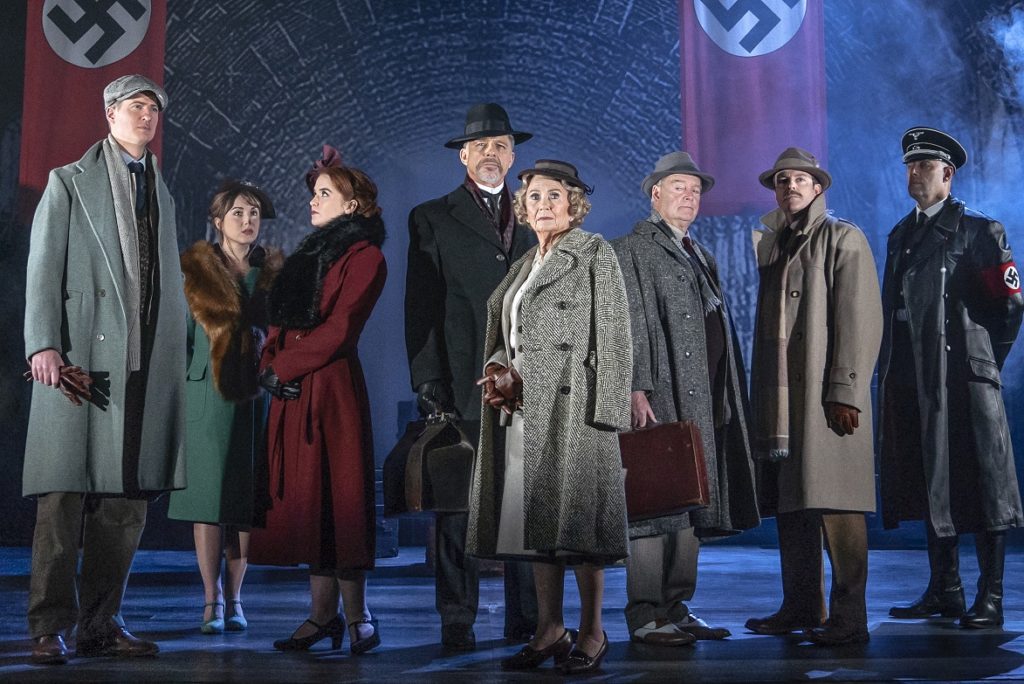
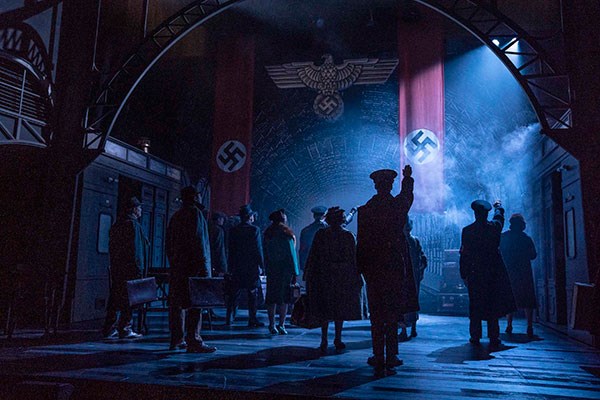
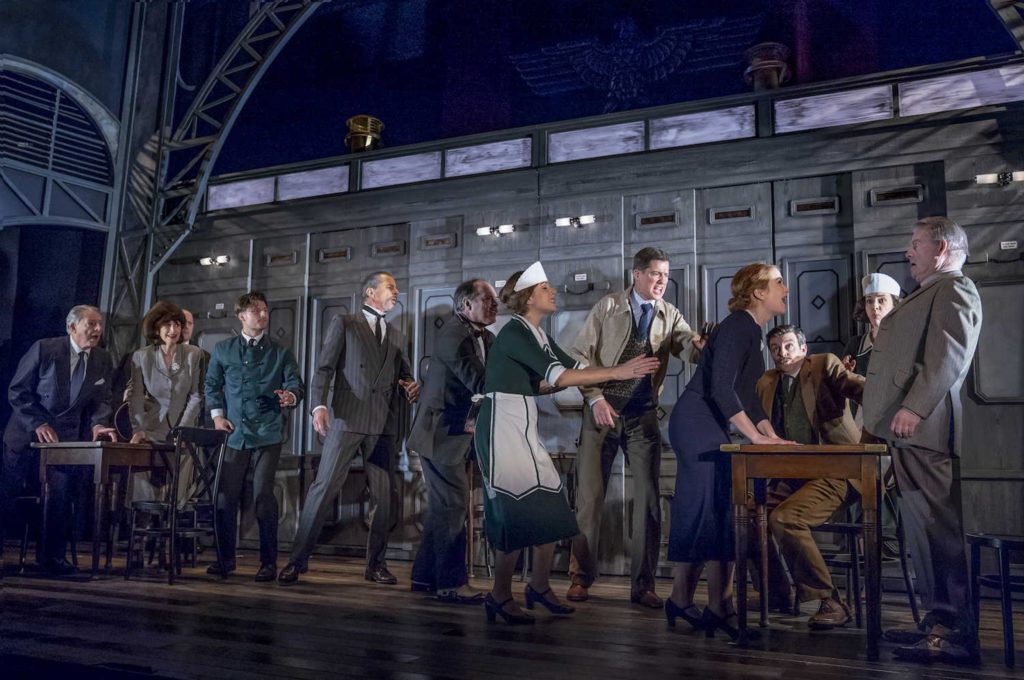
The striking first image sets the scene in malevolently epic fashion: the curtain rises on a train station swathed in swastikas, in which Nazi officers mingle with ordinary citizens in a shockingly routine manner. It is an especially haunting visual because of how accustomed the characters are to this occurrence, and how this chillingly reflects the way in which Fascism is becoming insidiously normalised in the current political climate. It renders the story – over eighty years old at this point – powerfully relevant in our day and age.

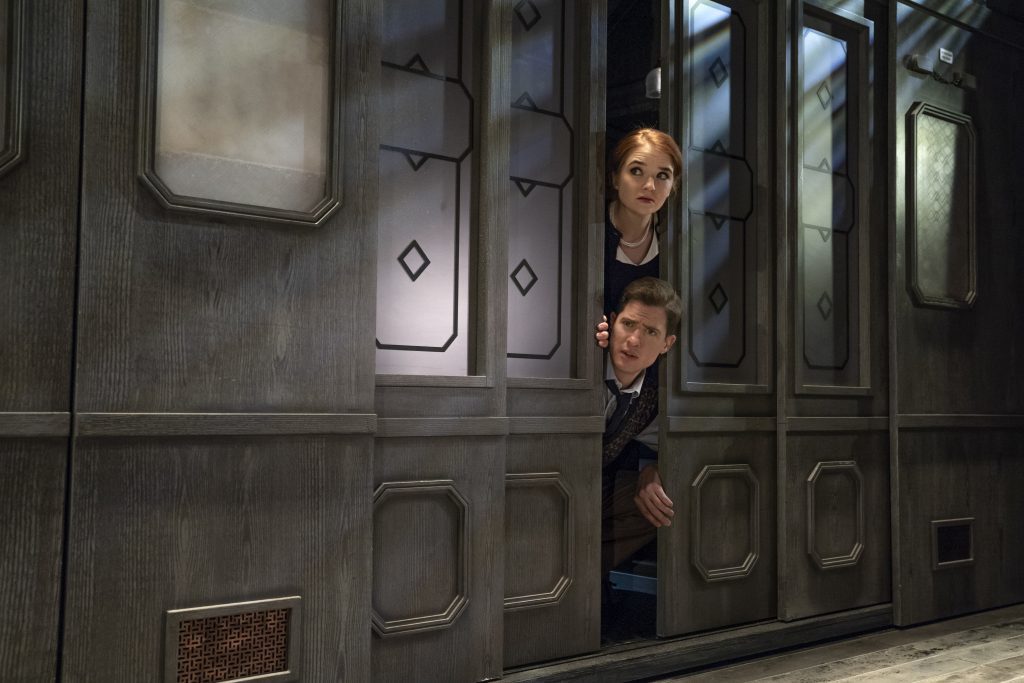
Roy Marsden’s marvellous direction and Antony Lampard’s agile script have produced a tight, nimble thriller in which the puzzle pieces are a joy to assemble and the story whips along at the same breakneck pace with which the train dashes through the Austrian Alps. As Iris, Fitzgerald wonderfully grounds the piece, crafting an affecting transformation from superficial to superstitious, and remaining endlessly sympathetic throughout. Her chemistry with Matt Barber’s elegantly affable Max is sublime; Barber brings a terrific Benedict Cumberbatch-esque flair to proceedings, and his good-natured bemusement provides an effective counterpoint to Fiztgerald’s harried resolve. The way in which the mutually antagonistic relationship between these unwitting detectives mutates into one of trust and esteem is one of the play’s loveliest lynchpins.

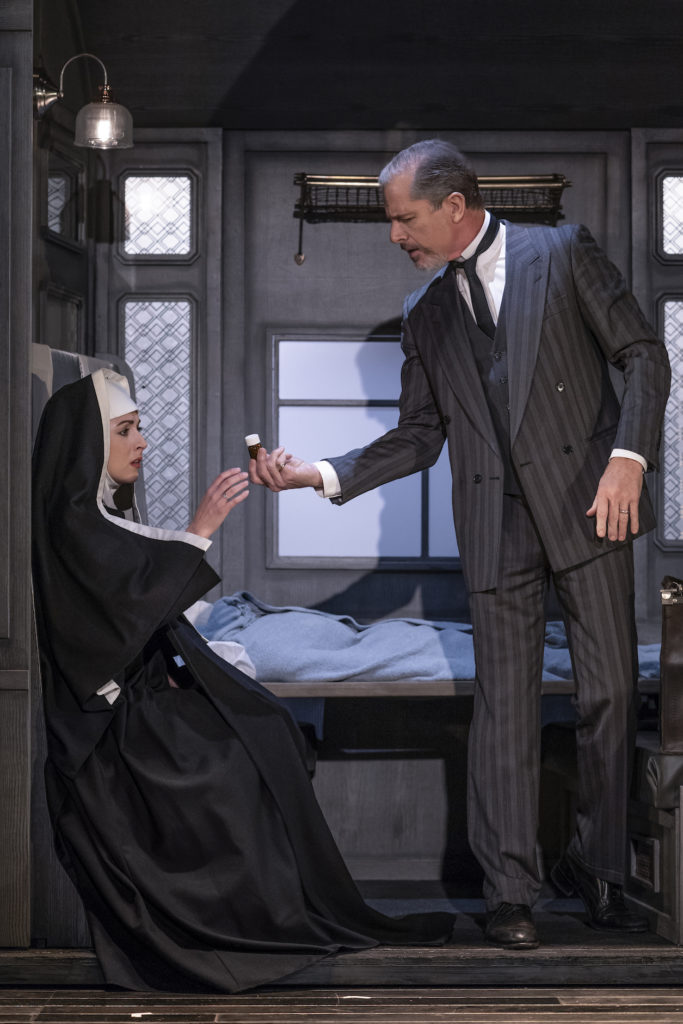
The play is helmed by acting icons Juliet Mills (as the vanished lady herself) and Maxwell Caulfield (as the genially dubious neurologist Dr Hartz). Although they aren’t in as much of the play as I presumed, they both make a tremendous impression with their superb performances that are a credit to the calibre of their acting credentials. The production excels in both in its mystery and (delightfully) in its comedy, with the latter largely owing to the often-oblivious antics of country-hopping cricket fanatics Charters and Caldicott (Robert Duncan and Ben Nealon), but the play deftly weaves comedy into the mystery and is thoroughly entertaining throughout.

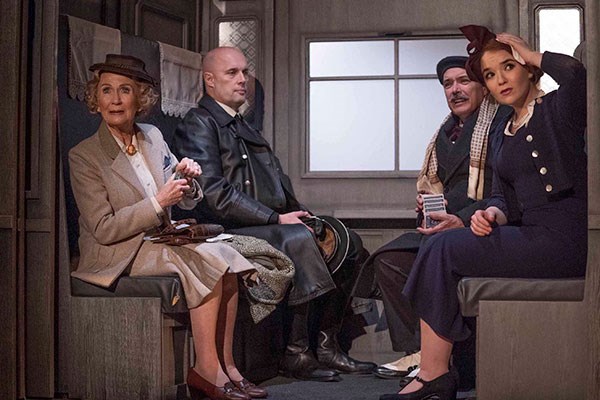
Designed by Morgan Large, the set is both gorgeously authentic and splendidly theatrical, an artistic marvel that is worth seeing the play for alone. Sumptuously realised and innovatively adaptable, the train in which most of the action takes place is animated by Charlie Morgan Jones’ inventive lighting, the collaboration of which crafts a magical visual experience that gives the sensation that you – the audience – are on the train with the characters.

Star-studded, sumptuously crafted and swiftly paced, this UK tour of The Lady Vanishes is a wonderful theatrical mystery that you owe yourself the joy of unravelling. (I would also direct you to Donna Poynton’s excellent review of the show, especially as Donna is more familiar with Classic Thriller Theatre Company’s repertoire ). It will be playing at the New Theatre through Saturday 20th July, after which it will conclude its tour in Leeds until 27th July.

Avenue Q, New Theatre Cardiff by Barbara Hughes-Moore

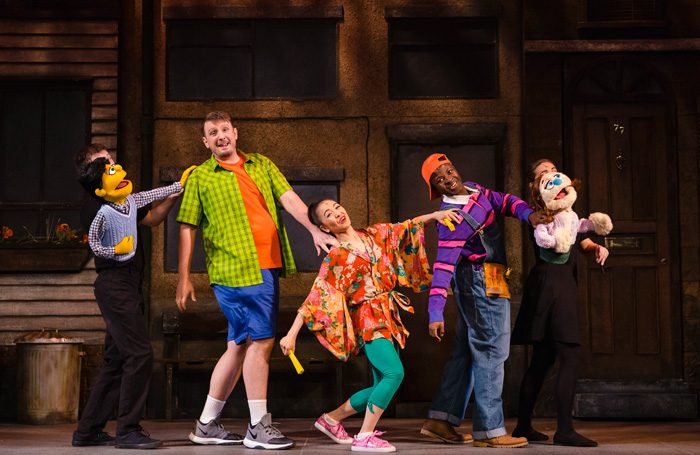
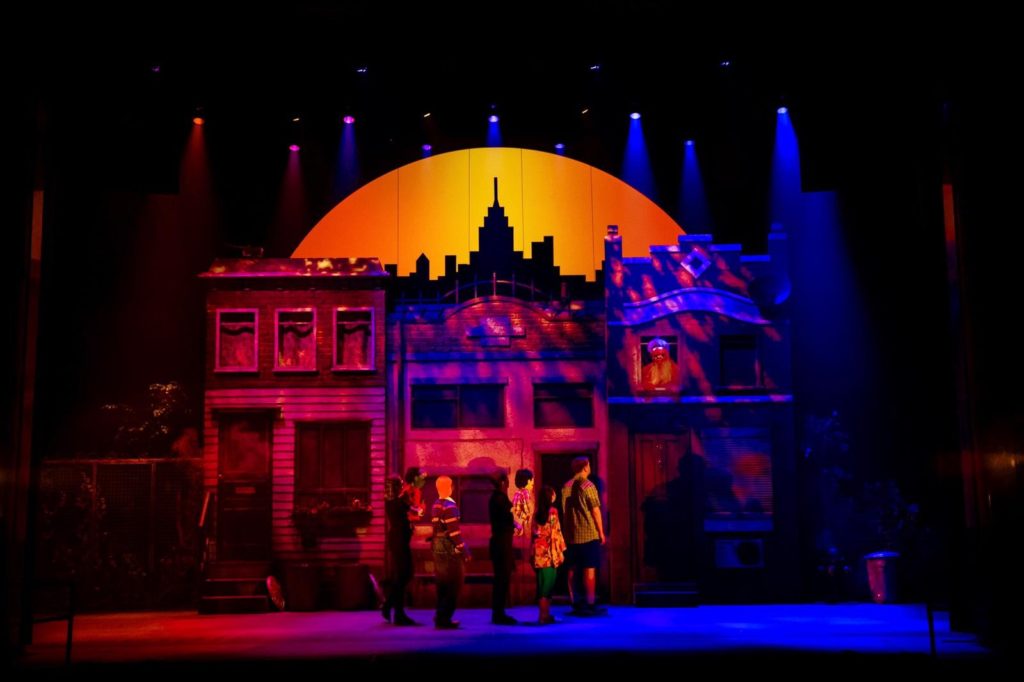
The multi-award-winning mature muppet musical makes a glorious return to the New Theatre after their much-lauded 2012 and 2016 runs, not to mention their monumental success across the pond. The premise: in a world populated by humans and puppets, the musical follows the ragtag residents of the eponymous street in New York City, an area so decrepit that the locals view Hell’s Kitchen as a step-up. Directed and choreographed by Cressida Carré, its an entertaining blend of the nostalgic and the now, with the melodies recalling those iconic Muppet Show tunes while the lyrics bemoan the ‘warts and all’ anxieties of modern existence.

Avenue Q’s colourfully crass approach to social commentary via meta musical parody pitches it somewhere between Sesame Street and South Park, with its closest contemporary being the tunefully tragicomic Crazy Ex-Girlfriend. Thematically, the show is emotionally ambitious and surprisingly nuanced in its portrait of modern life, demonstrated by the depressingly relatable What Do You Do with a B.A. in English?/ It Sucks to Be Me, the hilariously realised The More You Love Someone (The More You Want to Kill Them) and utterly hysterical highlight The Internet is for Porn.

Even though its references are rather dated (it did premiere in 2003, after all), the show’s tales of millennial angst are still relevant sixteen years later, with characters unsuccessfully searching for direction in life (Purpose) or lamenting the endless cycle of love gone wrong (It’s a Fine, Fine Line). These fantastic numbers hit home in unexpected ways, and pepper in moments of poignancy amid the calamitous crudity on display most of the time – case in point, an extended instance of puppet-related rumpy-pumpy that evokes the infamous scene from Team America: World Police, only turned up to eleven.

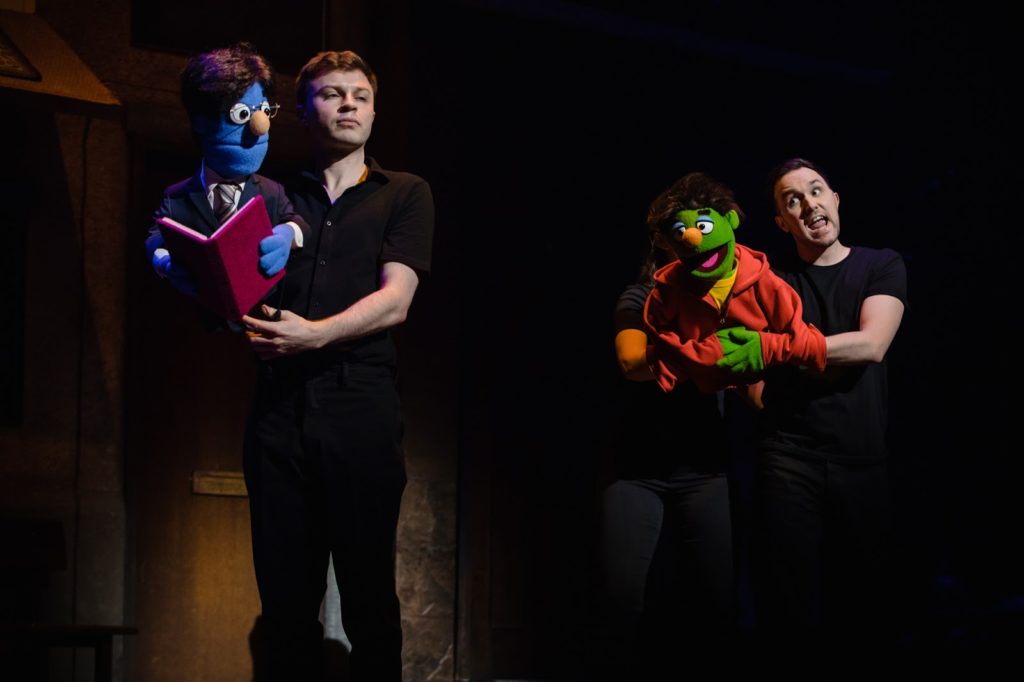
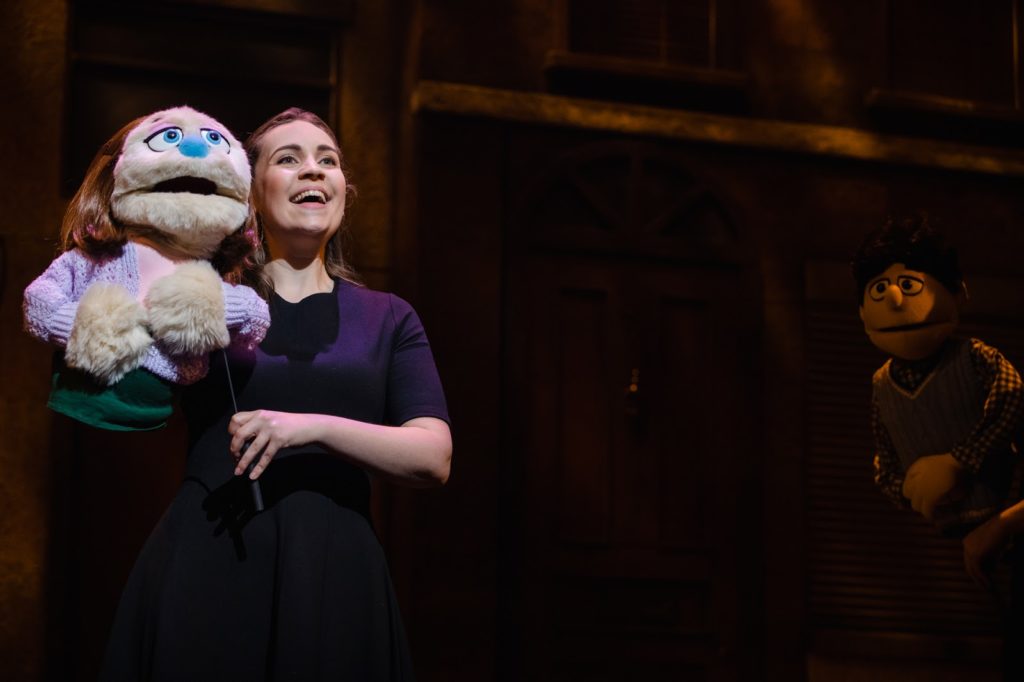
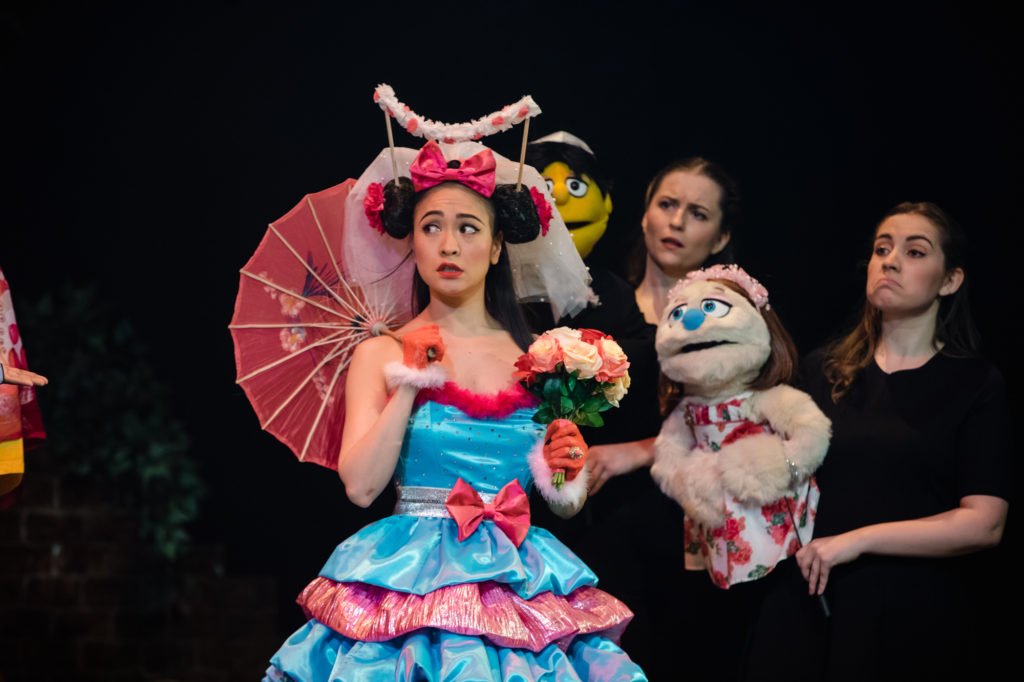
The production’s raucous energy is thanks largely to its superb cast, with standout performances by Lawrence Smith (Princeton/Rod), Cecily Redman (Kate/Lucy) and especially Tom Steedon (Trekkie Monster/Nicky/Bad Idea Bear). (The Bad Ideas Bears, played by Steedon and Megan Armstrong, are particularly entertaining – manifestations of the worst impulses that goad you to misbehave with the power of their Care Bear-like innocence). Everyone in the ensemble emotes wonderfully through their puppet alter egos (which I imagine was no mean feat, especially as they play multiple distinct roles with ease), and their Herculean efforts mean that the puppet characters feel just as real and complex as the human characters (often moreso). The gorgeously ramshackle set, designed by Richard Evans, grounds the action in a truly transportive way, and the live orchestra is sensational.

However, there are a few potholes dotted about Avenue Q’s sidewalk: much as it wants to skewer stereotypes, it often ends up indulging them: the brilliant Saori Oda is a dazzling stage presence but her character (Christmas Eve) is uncomfortably caricatured; and Rod’s coming out story is mired in stereotypes which plays his sexuality for laughs. Even though the show is commendably unafraid of engaging directly with more weighty themes, its handling of them comes off a little clumsy in If You Were Gay and Everyone’s A Little Bit Racist. Some characters simply do not work (Gary Coleman, Brian), some numbers fall flat (Schadenfreude, I’m Not Wearing Underwear Today), and some of the humour feels more mean-spirited than cheekily self-aware.

Avenue Q is a hugely entertaining musical that feels slightly out of date in some elements and viscerally prescient in others. Amidst the raunchiness and rowdiness there’s a real beating heart at the centre of the story that no amount of flippancy can hide. However, other than a brief mention of Brexit and Theresa May in the last number, it stubbornly plants itself in the pre-social media age of 2003 and refuses to move with the times. With a little updating, its already-relatable themes could be refreshed and renewed by acknowledging how the internet has become even more ingrained in our personal lives, especially the way in which it has effectively become the de facto matchmaker of our times. That potential to both enhance and complicate our already-fraught lives and relationships seems like the natural progression for such a savvy show – but as it stands, it’s an excellent, irreverent, exercise in accepting (as its beautiful final song attests) that ‘everything in life is only for now’. For now at least, that’s enough.

Stones in His Pockets: UK Tour New Theatre Cardiff

Reviewed by Barbara Hughes-Moore

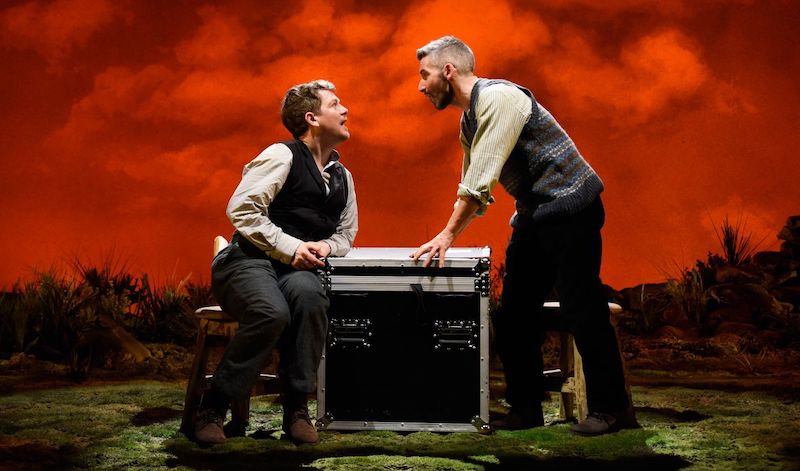
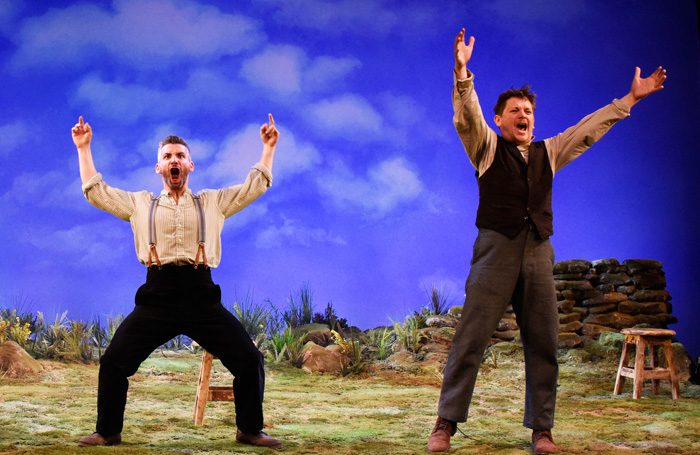
The latest UK tour of this critically-acclaimed tragicomic two-hander is written by Marie Jones and directed by Lindsay Posner, and centres on the culture clash between the locals of a small Irish village and a snooty Hollywood studio during the making of a blockbuster period piece. Kevin Trainor and Owen Sharpe star as Charlie Conlon and Jake Quinn respectively, employed as extras in the film, as well as a host of other characters, who grow to question their romanticised notions of Hollywood when a tragedy hits too close to home.

In making ‘the stars the extras, and the extras the stars’, Stones in His Pockets feels like a mixture of Rosencrantz and Guildenstern are Dead and Bowfinger by way of Ballykissangel. The Hollywood studio in Stones in His Pockets is making a film just as (in)sensitive to (and stereotypical of) Irish culture as Leap Year or Darby O’Gill and the Little People – or, indeed, the infamously-accented Cruise/Kidman vehicle Far and Away, which seems to be the thinly-veiled target of this play’s scorn. The play thus dispels notions of a ‘Romanticised Ireland’ as neatly as it displays Hollywood’s cynical penchant for appropriating cultures for profit.

Two-handers live and die on the strength of their actors, and Sharpe and Trainor prove to be an excellent comedic pair indeed – the scenes of their slightly hapless extras attempting to emote, and even dance, are standout moments; I only wish there were more of them. Sharpe copes well with a multitude of accents and characters (including a lively old timer whose sole claim to fame is being the last surviving extra from The Quiet Man), but it’s Trainor who steals every scene he’s in (which is all of them).

He’s been a favourite of mine since he played a young version of John Hurt in Hellboy (2004), but this is the first time I’ve had the pleasure of seeing him on the stage. Trainor elegantly transitions between the myriad characters he inhabits, making each one distinct and memorable – including Hollywood ingénue Caroline Giovanni, posh toff producer Simon and Southern Gentleman Nick (the gregariously calculating director of the movie). He masterly evokes his talented predecessor (Game of Thrones’ Conleth Hill) in mannerisms and intonation whilst also making the role his own. It’s perhaps the most captivating stage performance I’ve seen since Rory Kinnear in National Theatre’s Hamlet – I can give no higher praise.

As for the play itself, it’s often funny, occasionally thoughtful, but rarely as poignant as its title might imply. The title itself refers to the tragic element within the play’s otherwise mostly comedic shenanigans: shunned by the stars and callously rejected by the producers, local teen Sean Harkin drowns himself by wading into the river with the eponymous stones in his pockets. His suicide casts a pall on the proceedings and seems to set up a clash not only of cultures but of values – and yet the tragedy of this traumatic event sits awkwardly alongside the quickfire comedy of its first act, largely because it is never given any kind of dramatic or meaningful weight. We never get to know Sean, either first hand or through the other characters, and even though news of his death is what closes act one and what should have driven the momentum in act two, when the curtain rises again the play seems more directionless than ever. We are never given the chance to mourn him, rendering his death a footnote when it should have been the focus.

A funny, endearing, if rather weightless story, Stones in His Pockets amusingly skewers Hollywood culture whilst gleefully revelling in its theatrical authenticity. Although it never lives up to the poignant promise of its striking title, it provides a wonderfully entertaining night out thanks to a manic sense of fun and a spectacular five-star turn by Kevin Trainor that’s worth the price of admission alone.

Produced by Rose Theatre Productions and Theatre Royal Bath Productions, Stones in His Pockets is playing at the New Theatre Cardiff through Saturday 15th June.

Rebus: Long Shadows, New Theatre Cardiff by Barbara Hughes-Moore

Rebus: Long Shadows is a new story written by critically-acclaimed author Ian Rankin and adapted exclusively for the stage by award-winning playwright Rona Munro. Starring Ron Donachie, Cathy Tyson and John Stahl, the story follows the titular DI, one of Scotland’s most famous fictional detectives, now retired, as he exhumes the faux pas of the past to find justice in the present.

Though I don’t claim to be a Rebus aficionado by any stretch of the imagination, I’ve enjoyed the various incarnations of the character, though for different reasons. DI John Rebus, played onscreen by John Hannah and Ken Stott, is the archetypal hard man, a gruff detective and former SAS soldier with PTSD and a serious drinking habit. Hannah’s Rebus was a youthful yet world-weary DI with a whole host of personal demons despite his fresh-faced looks. Stott’s Rebus, replacing Hannah in season 2, was a more convincing cynic given his age and natural gruffness. Both versions boast a bleak brutality, but Hannah’s inner monologue denoted a more internal, psychological approach, whereas Stott’s Rebus was more external and thus retained a greater sense of mystery and ambiguity.

Long Shadows’ Rebus seems to be pitched somewhere between the two, played here by Ron Donachie who portrays the character in the BBC radio dramatizations of Rankin’s novels. Donachie is a very genial stage presence, a lovable curmudgeon who is plagued by the ghosts of past. Rebus is not so much an analogue detective in a digital age as a displaced Diogenes trying to make it in millennial Edinburgh.

It was disappointing not to see Cathy Tyson as Rebus’ procedure-driven protégé DS Siobhan Clarke (played by Gayanne Potter/Claire Price in the series), but understudy Dani Heron does a great job as the jaded DS even if she doesn’t look old enough to have been working a case for a quarter of a century. Her banter with Donachie is one of the show’s highlights, as both actors ably conjure that catty camaraderie of a long-lived friendship. She also gets one of the show’s best lines when Rebus frets about ‘the way lassies dress these days’, by responding that ‘young women can’t be prisoners of their fathers’ fears’.

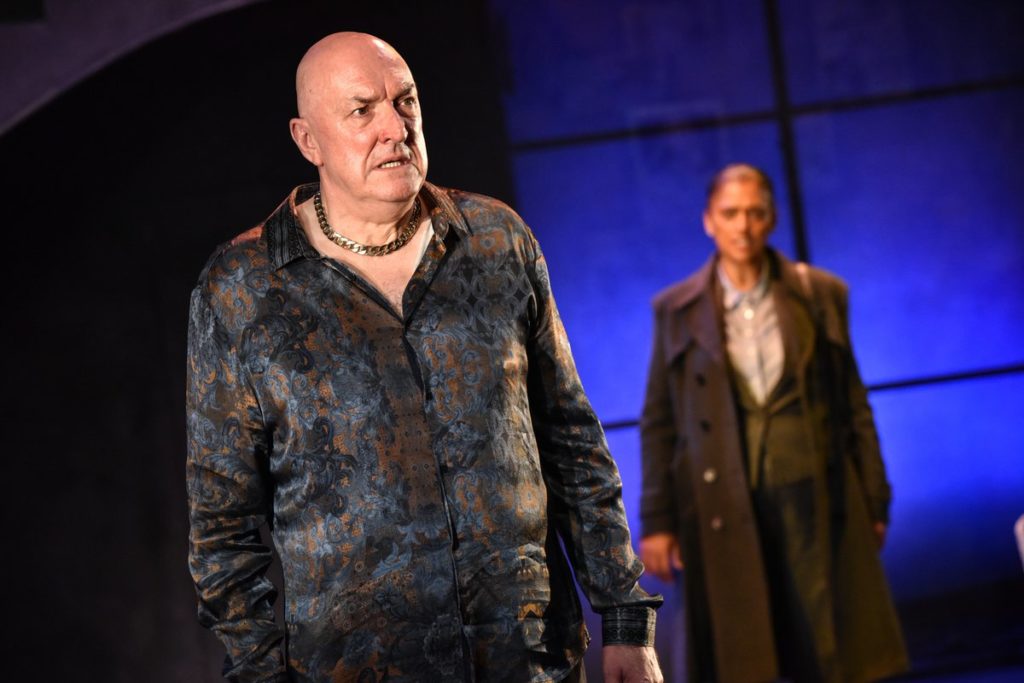
The cast is brilliant across the board, from Eleanor House and Ellen Bannerman as the ghosts of the victims Rebus failed to save – the former of whom also plays the dual role of (murdered) mother Maggie and (surviving) daughter Heather – and Neil McKinven masters multiple roles with charm and skill whilst making each one distinctive and memorable. However, the standout of this production is John Stahl as ‘Big Ger’ Cafferty, Rebus’ amiable nemesis. There’s a layer of artifice to every actor in the show except Stahl, who imbues an earthy authenticity into the vibrant, larger-than-life (in name and nature) character. Stahl’s deliciously imperious performance captivates from the second he steps onstage, slipping seamlessly from debonair to devilish in a way that could have be cartoonish in the hands of a less capable actor. His performance is worth the price of admission alone.

Rona Munro’s script is interesting and engaging, and
Robin Lefevre’s skilful direction guides the audience through the murky mystery. The surname Rebus originates from the phrase ‘Non verbis, sed rebus’ (‘not by words, by things’), a phrase which describes a form of heraldic expression used in medieval times that used symbols, pictograms and illustrations to represent new words/phrases. This was taken up by Sigmund Freud, who believed dreams could be (re)interpreted in a similar way. It’s a fitting name for a gritty detective who has to sift through reams of fakeries and facades to find the villainy behind the civil veneer.

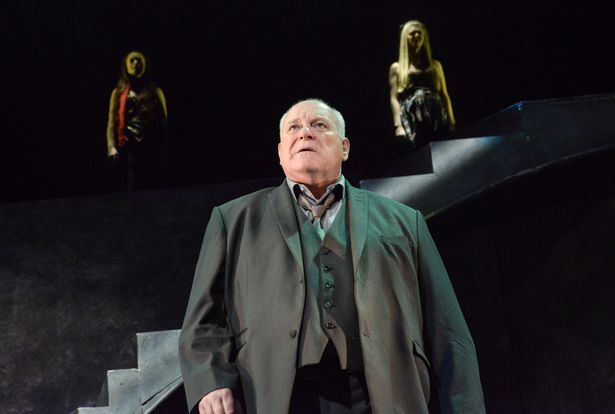
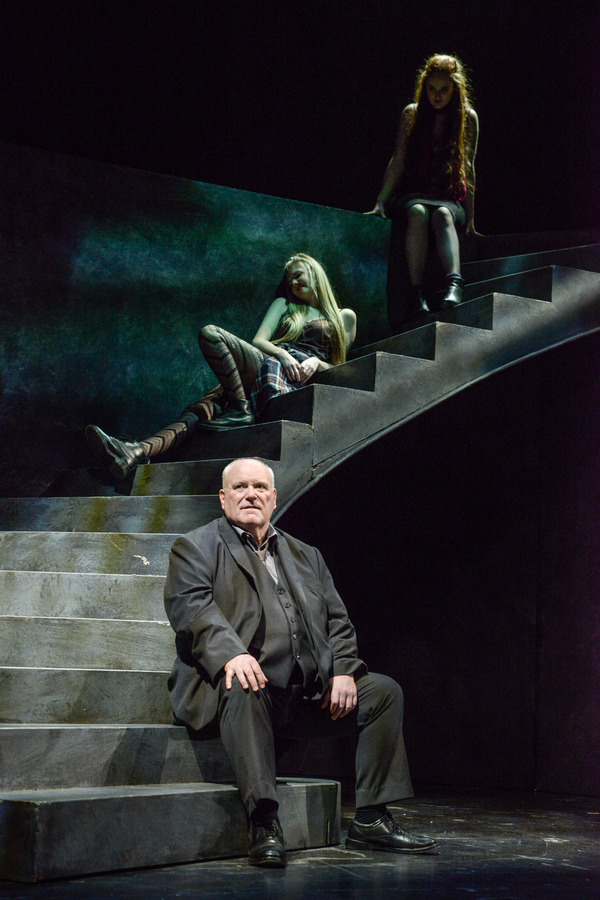
The production has a number of discretely creative touches, predominantly Ti Green’s evocative set featuring a central curving staircase that takes us down into the lair of Rebus’ mind, and a set which functions interchangeably as a poky flat, a nightclub, a pub, and a swish penthouse suite. The Gothic touches of the ghostly apparitions (aided by Chahine Yavroyan and Simon Bond’s lighting) are effective as they berate and motivate Rebus, but their near-constant presence reduces their potency. This element might have been more effective if Rebus had been the lead investigator of the cases in question, which would have given a sense of urgency and regret, and a more compelling motivation beyond just a general obligation to justice.

As such, the mystery of who the true antagonist is falls a little flat, because it’s fairly obvious from the moment they appear. Relocating the crime drama to the stage already reduces the nuance of a book or film/tv show, which can include breadcrumbs in the background – a throwaway glance, a name on a file, a news report – whereas onstage everything is rather unambiguously right there in front of you. The scene at Cafferty’s swish apartment, while engrossing, goes on for far too long, and despite the talented female-driven creative team, DS Clarke is frustratingly side-lined by the narrative, and Eleanor House’s Heather (though intriguingly layered) is stopped mid-potential by the arbitrary ending. I would certainly be interested to see how her character develops, especially in conjunction with Stahl’s Cafferty, if we ever get a sequel.

Interesting and enjoyable, Rebus: Long Shadows is a compelling addition to the longstanding, multi-media mythos of its eponymous investigator. Playing at the New Theatre until Saturday 9th February, it’s well worth a watch, especially if you’re already a fan of Rankin’s crotchety copper.

Review American Idiot (UK Tour), New Theatre Cardiff

Aka Disaffected Youth: The Musical

When Green Day, the minstrels of jaded adolescence, released their rabble-rousing, game-changing manifesto American Idiot in September 2004, the world stood to attention. A brash rebuff to the powers that be, the bombastic battle cry was a defiant call to arms that enraged and enraptured many an angsty teenager, myself being one of them. Because of this nostalgic tether, I was nervous to see how they would relocate those beloved songs into a sensical story without damaging their integrity.

Directed and choreographed by Racky Plews, the musical/(punk-)rock opera centres on best friends Johnny, Will and Tunny, self-styled as the Jesuses of Suburbia, as they embark on a narcotic-fuelled voyage of discovery in post-9/11 America. Johnny and Tunny decide to move to the Big City while Will opts to stay home with his pregnant girlfriend Heather. Tunny quickly becomes disillusioned in their new urban surroundings and joins the army, while Johnny falls in love with the ambiguously-monikered Whatersname and develops a nasty drug habit, and Will becomes disillusioned with fatherhood.

One of these things is not like the other: Will’s storyline is hardly comparable to the poignant physical/mental trauma experienced by Johnny and Tunny, and his character arc is far less persuasive than theirs despite a great performance from Samuel Pope. His baby mama Heather gets similarly short-changed in the narrative department, but Siobhan O’Driscoll stands out regardless with a truly impressive voice and a very sympathetic performance, especially in the lovely Last Night on Earth.

Joshua Dowen as Tunny gets perhaps the best character arc, starting out as just another brash upstart before the war leaves its mark on him physically and mentally. His beautiful performances of Are We the Waiting? and later Before the Lobotomy are utterly haunting, if undercut by the scene (Extraordinary Girl) that follows it. And Johnny, the self-proclaimed ‘son of rage and love’ who laments being ‘in a land of make believe that don’t believe in [him]’, is a vulgar hybrid of Joseph Gilgun and Iggy Pop. Swaggeringly played by Tom Milner, Johnny is a boldly dislikeable, grotesque portrait of 21st century adolescence who goes through a lot but seems to learn little by the end.

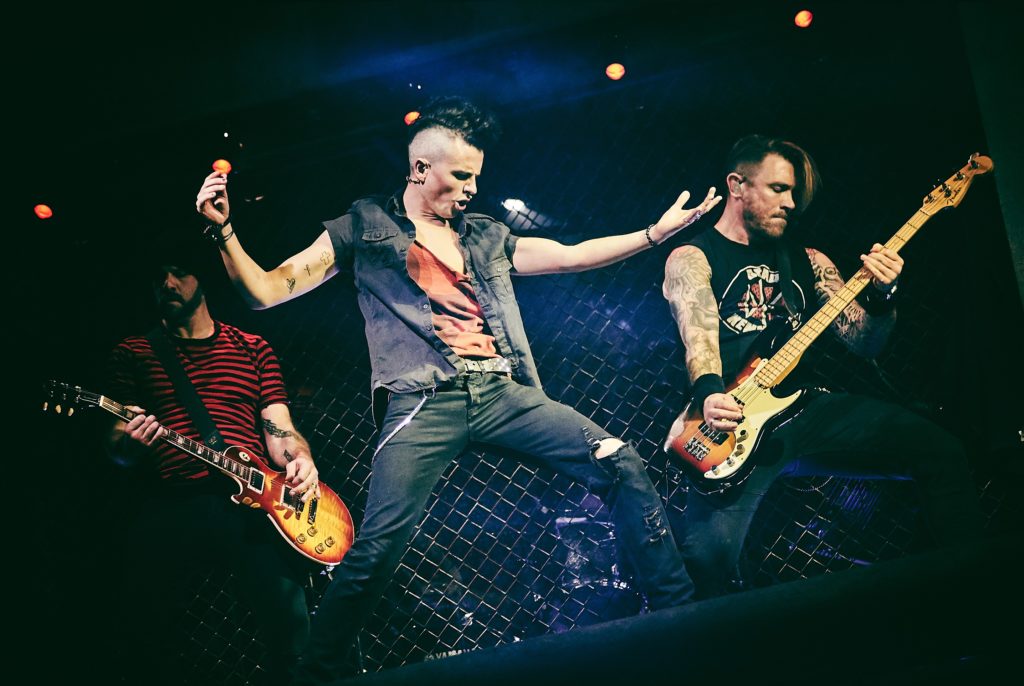
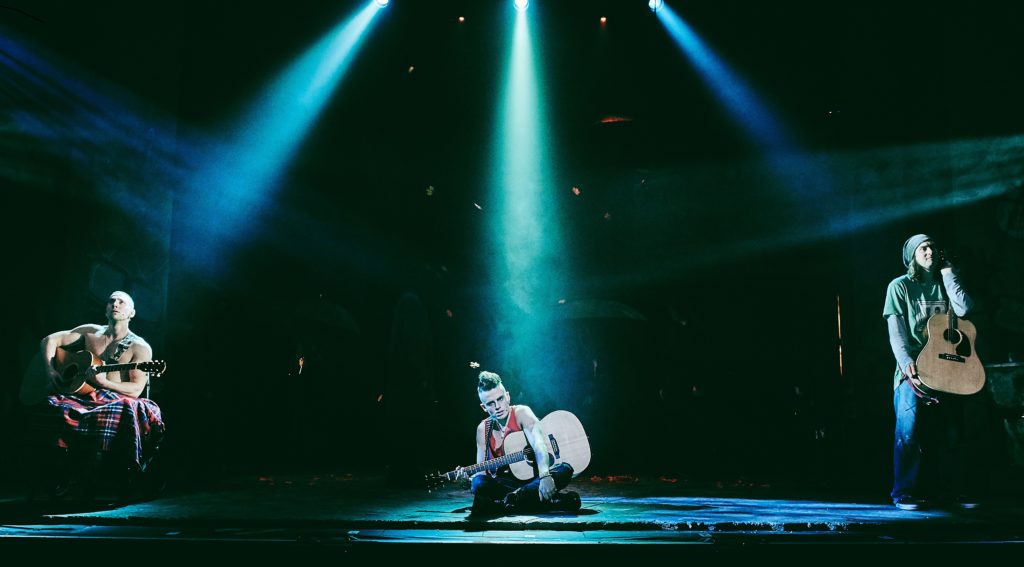
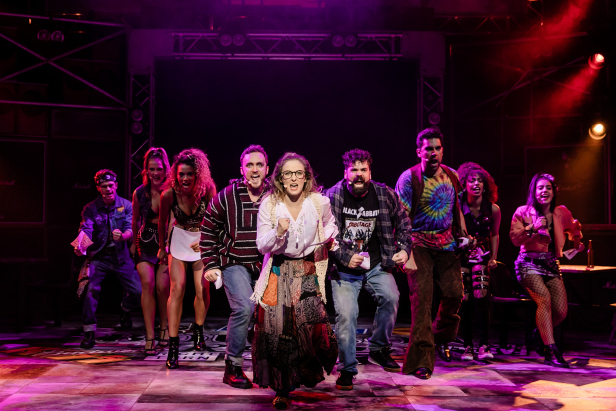
For its raucous anthems of youthful rebellion, American Idiot can be viewed as a modern-day Les Miserables or a twentieth century Hair (Hair Gel, if you will) that replaces barricade flag-waving with air guitar, grinding and a potent grunge aesthetic. Like Rock of Ages, it takes a little while for your mind to calibrate to its crassness, not to mention a set so purposefully grungy it makes you long to bathe in Clorox afterwards. Tosca, this ain’t. But once you wade into the mire, you’re in the zone and ready to stick it to the man. Combining songs from 2004’s American Idiot (as you might assume), 2009’s 21st Century Breakdown and a few tunes written for what is essentially a jukebox musical, the songs segue surprisingly well into a theatre setting, which maintains the raucous power of their anthems whilst enhancing their slower tunes with careful orchestration and stunning harmonies. However, it’s the nature of the jukebox musical that trips this up from the get-go, stemming from a cliché-ridden script that crowbars in a few emotional storylines which ultimately feel rather hollow.

The show is more about sensations than story; if you’re looking for narrative coherence, you’ve come to the wrong place. The news footage from the bygone Bush presidency is perhaps the only overtly political thing about the musical which (surprisingly for such an otherwise literal show) opts instead to show the social decay caused by such a system, and specifically how this societal dysfunction affects the working classes more than most. But the frequent tonal whiplash between scenes is jarring, and some of the songs are perfunctorily placed – American Idiot and Boulevard of Broken Dreams came way too early, Too Much Too Soon (ironically) came too late – but the strength and skill of the ensemble results in songs so brilliantly performed they transcend the material in which they are caged. And the band is utterly exceptional, performing with record-level quality and all-round excellence, even if they did drown out the singing at points. The show perhaps fares better when viewed as a pseudo-live concert experience in the same vein as This is Elvis.

And the songs really are the standouts, coupled with fiercely energetic performances and gorgeous harmonies. Holiday is a deliciously rowdy anthem to ‘the dawning of the rest of our lives’, and Boulevard of Broken Dreams is intriguingly staged, with a stream of cloaked unknowns swarming around Johnny as he makes his way through the city. The ensemble imbues particular power to lyrics like ‘your faith walks on broken glass’ (21 Guns) and ‘kiss the demons out of my dreams’ (Give Me Novocaine); the ballad of lost love Whatsername gloriously crescendoes into a bittersweet climax, and Wake Me Up When September Ends, a magnificently melancholic ode to grief, is wondrously realised.

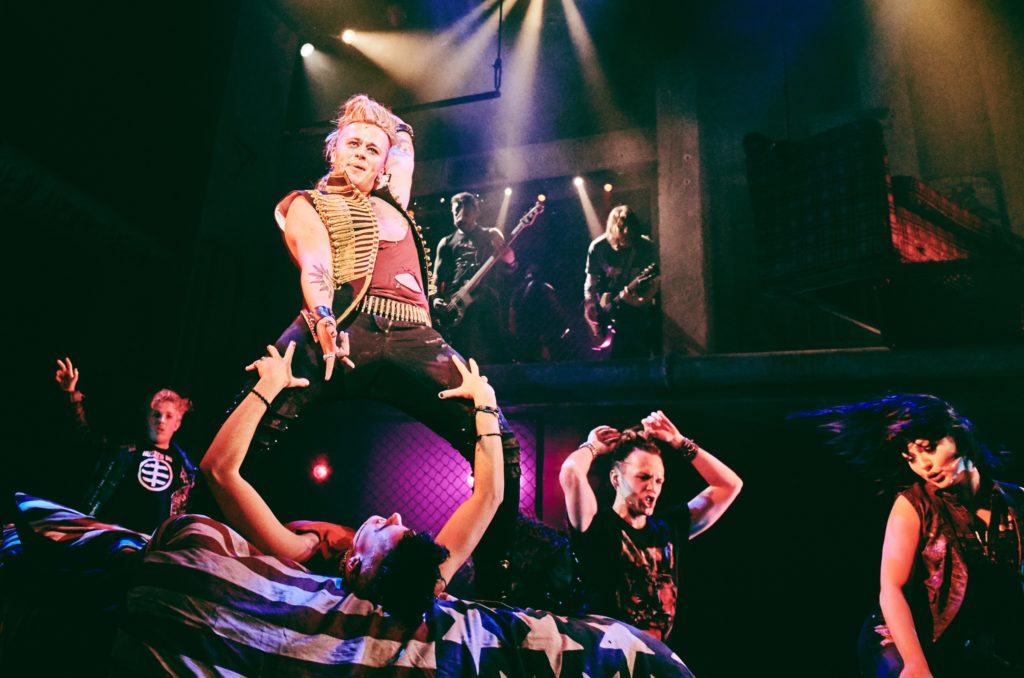
The characters are intentionally archetypical, to the point where all of womanhood is represented by a person quite literally called Whatsername. The Jesuses of Suburbia are screw-ups, St Jimmy is far from angelic and the characters exist on a sliding scale of unlikable to downright hateful. And despite its rebellious ambitions, the show’s anarchic nature is more trite than tough, in the same way that adding a chain to your belt makes you a punk-rock rebel. But when it rocks, it rocks hard – and that’s mainly down to St Jimmy, the manically charismatic Luke Friend, who acts as a personification of Johnny’s dark side, the seductive Satan to his Jesus of Suburbia. As ‘the patron saint of the denial’ and ‘the resident leader of the lost and found’, Jimmy brings a sense of lawless joy whenever he springs onstage, like Beetlejuice by way of Billy Idol.  

Despite the gaudy grunge trappings, from Sara Perks’ scrungy set to Tim Deiling’s Hadean lighting and the appealingly pop-punk wardrobe, the show has a lot of heart buried beneath the band tees. It’s a mephitic snapshot of post-9/11 America and the malevolence of bourgeois apathy to the rest of society, celebrating the riotous angst of those who rail against compliance to ‘The Man’. Ten years later and the songs, bemoaning the dangerous presence of a corrupt right-wing looney toon running the nation into the ground, are scathingly pertinent to our own fraught political climate.

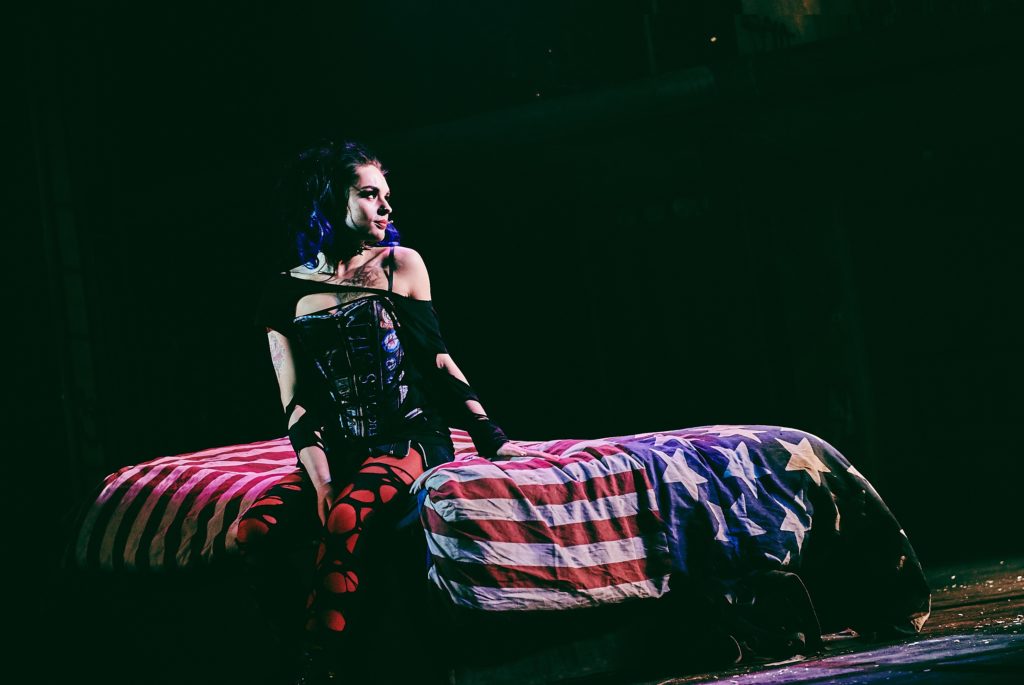
Sadly, the show has a less than right on view of women, who are confined in the ‘well, actually…’ prison of the male gaze for most of the runtime, functioning interchangeably as nags and lovers until Sam Lavery’s compellingly enigmatic Whatsername (who, like Frankenstein’s creature, is denied the dignity of a title to call her own) is finally allowed to express herself (in an explosive version of Letterbomb) well past the halfway point. And when the women of Green Day’s America do get a moment to shine – during a sublime rendition of 21 Guns – it’s framed as a moment of emotional labour in which they must cater to the traumas of their man-child partners, without ever being given the space to deal with their own pain.

Visually interesting and politically engaging, American Idiot is an ambitious, defiant treatise to the restlessness of youthful discontent that is well worth seeing at least once in your lifetime, and a must-see for Green Day devotees like myself. Some of the characters may go to that great mosh-pit in the sky, leaving little closure for ‘the kids of war and peace’ who are left behind. But, as everyone on stage sings us out with the iconic Good Riddance (Time of Your Life), there’s hope. Chaotic, frenetic and miasmic, American Idiot isn’t quite the welcome to paradise you’ve been waiting for. But if you hitch a ride on this walking contradiction of a show, you might just have the time of your life.

Frankenstein, Cascade Dance Theatre at Chapter Arts Cardiff

2018 has been quite the Franken-tastic year. With conferences a-go-go and a veritable funfair of Frankenreads events, the bicentennial of Mary Shelley’s game-changing masterpiece has been quite fully, and rightfully, celebrated en masse. Having studied the book in-depth for thesis-y reasons over the past four years, I’ve consumed the story in myriad mediums from the filmic, to the televisual, to the orchestral, including a gender-swapped web series and that icky Sean Bean show loosely ‘inspired by’ Victor’s dodgy dealings with the (un)dead.

So I was thrilled at the prospect of Cascade Dance Theatre* translating the tale in their latest much-lauded production. I’d seen the Royal Opera House’s lavish stab at a Franken-centric ballet on TV a couple of years ago – but found their faithfulness to the source material resulted in a less powerful whole that, while visually spectacular, was ultimately undermined by the rushed, soap opera-esque ending. How, then, would Cascade fare with six performers, two musicians, and a single simple set?

Beautifully, as it turns out. Artistic Director Phil Williams (winner of Wales’ Best Male Dance Artist Award at the Wales Theatre Awards 2017) has carefully assembled an excellent adaptation that is small in scale but large in style and ambition, fulfilling the heart of Shelley’s tale in creative new ways. The ensemble is excellent across the board, with Stuart Waters as a suitably haughty, believably tormented Victor, and Jordi Calpe Serrats in an endlessly vibrant and deeply sympathetic turn as the creature. Their connection is compellingly ambiguous: there is no directly analogous relationship to theirs, meaning that Victor is in turns the creature’s God, father, masculine ideal, romantic interest and romantic rival. Their bond could have set a positive precedent for humanity; but their mutual violence to one another and people close to them renders them variously perpetrator and victim to the other until their battle concludes in bloodily Biblical fashion.

Although Frankenstein was written by a woman, and especially one with such a famous feminist mother, there is a curious dearth of female characters in the text that are afforded the same active roles and complexity as their male counterparts, being mostly passive recipients of male violence. It’s a lovely reversal, then, that the women of Cascade’s Frankenstein are the absolute highlight of an already-stellar production. Caldonia Walton shines particularly brightly as Elizabeth Lavenza, Victor’s far-superior fiancée; Walton imbues kindness, strength and a genuine warmth of character to what is often a thankless role, and lights up the stage whenever she graces it. And the tremendous trio of Anna Cabré-Verdiell, Desi Bonato and Luca Dora Bakos steal the show entirely – case in point…

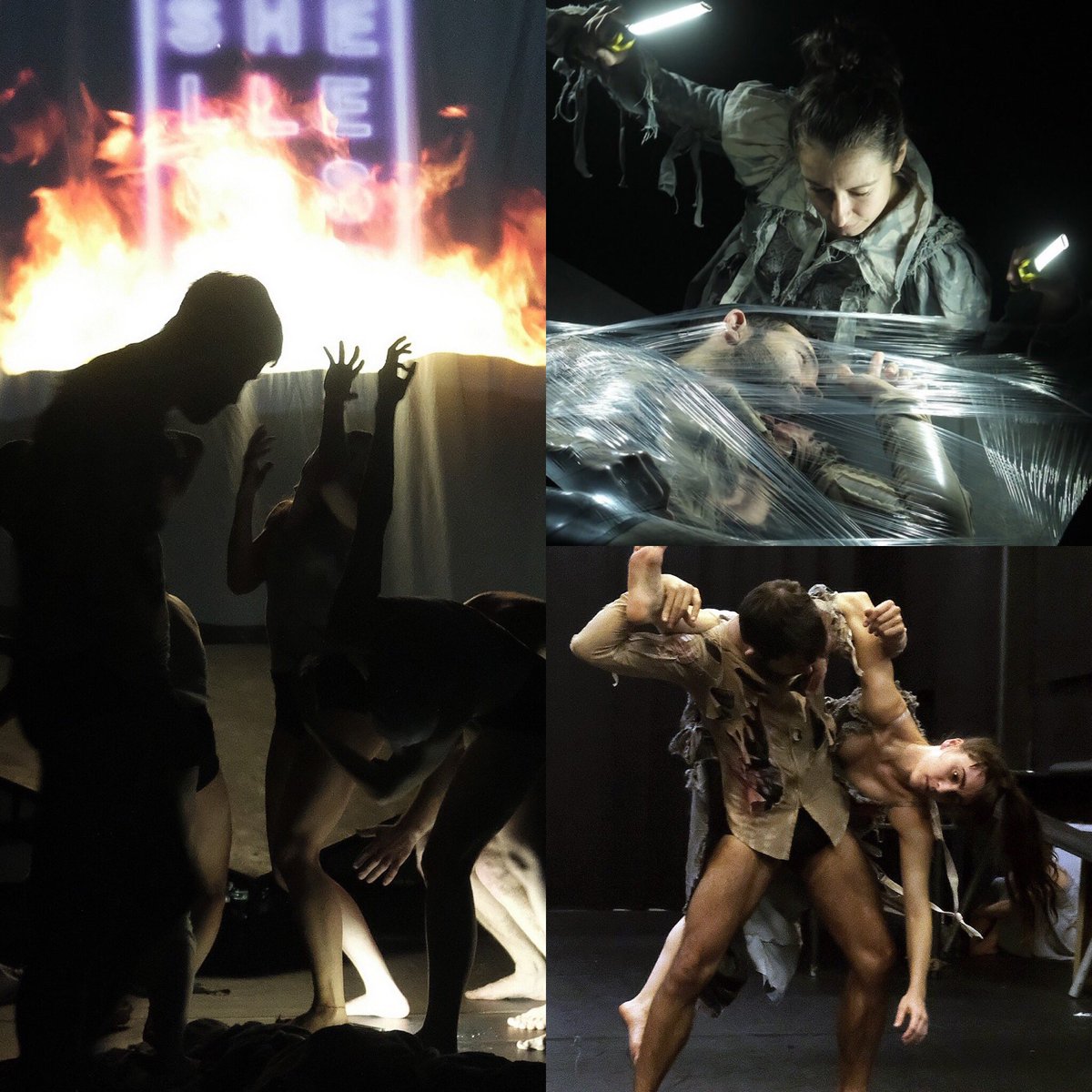
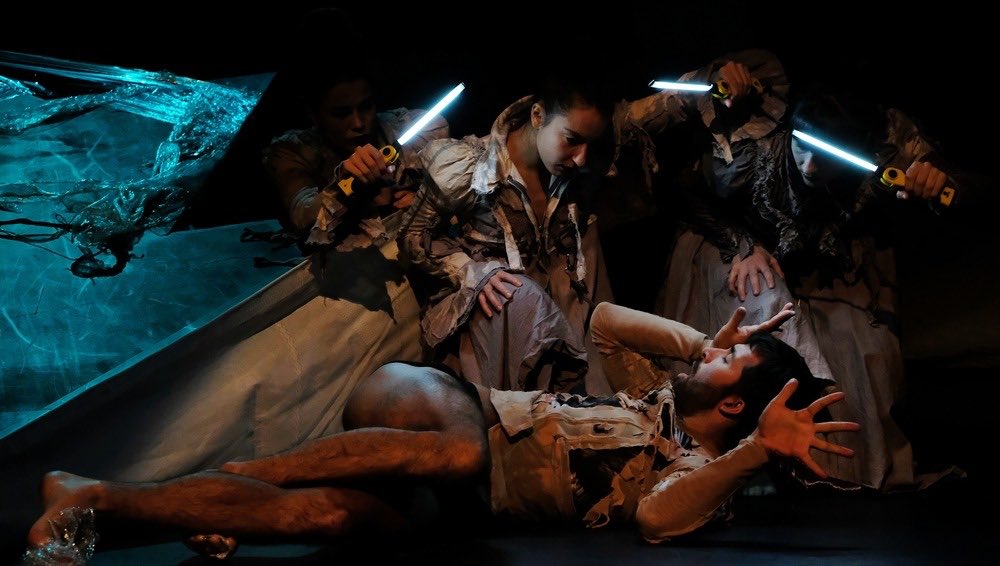
…We open on a truly haunting image: the creature, encased in chrysalis-like bindings, being meticulously inspected by a trio of women whose white strobes cast the only light in a sea of darkness. At first, they seem like explorers; archaeologists hungrily inspecting the excavated remains of an ancient burial site. But as the drama unfolds, the trio’s more otherworldly nature is revealed; they seem at times to be angelic guardians, at others mischevious sprites, even mythological beings like the Graeae, the three sisters of Fate from Greek mythology, and their spiritual descendants in Shakespeare’s Macbeth. Bonato, Bakos and Cabré-Verdiell (who doubles as the female creature) not only dance superbly, but inhabit multiple roles with ease and panache, and I felt at times that they acted as Mary Shelley’s muses, helping her to tell her story two hundred years later on that appropriately dreary night of November 2018.

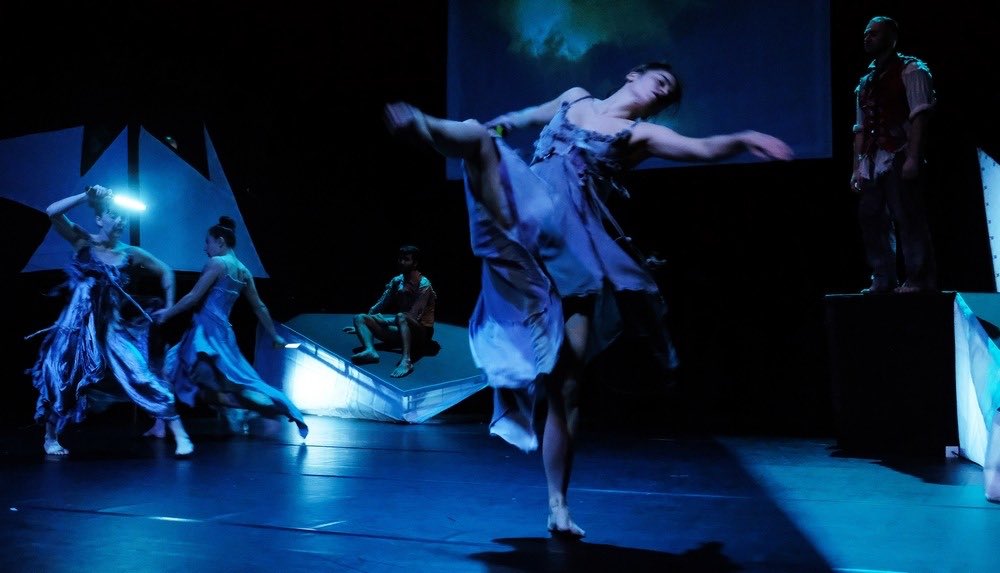
The sumptuous performances are complemented and enhanced by the rest of the production’s creative endeavours, not least Hristo Takov’s atmospheric lighting, and Paul Shriek’s spectacular set and wardrobe design. The set is evocatively uneven, making the most out of jagged inclines and the morgue-like slab on which the creature is brought to life, and on which Victor ends as his creature started; the costumes are artfully-tattered and ethereally expressive with shades of Vivienne Westwood. All of which is tied up in a gorgeously Gothic bow by Jak Poore and Ben Parsons’ eerily emotive score, composed and performed live by the two on stage like Romanticism’s answer to Daft Punk.

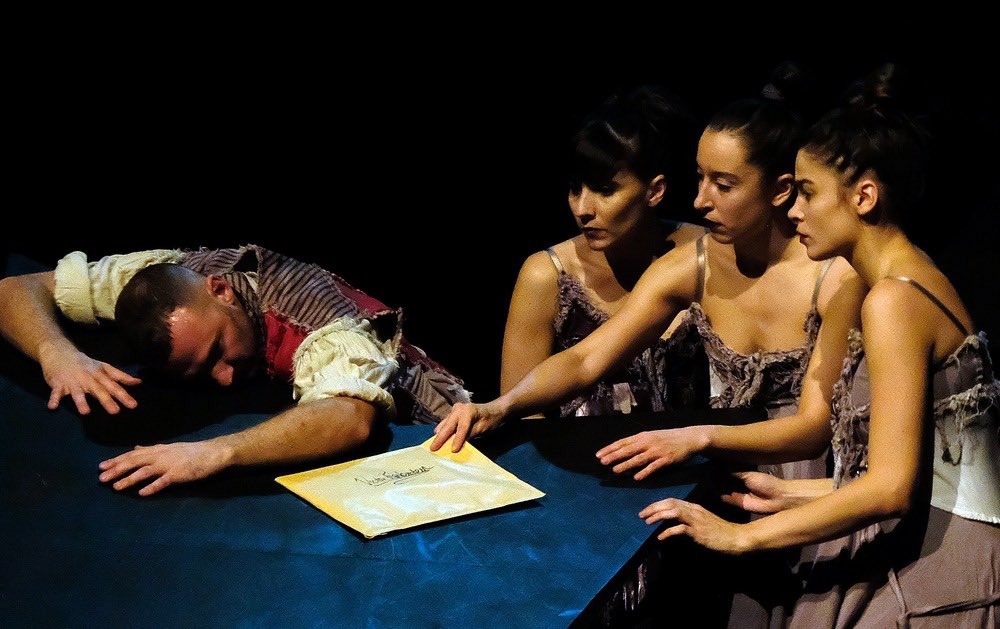
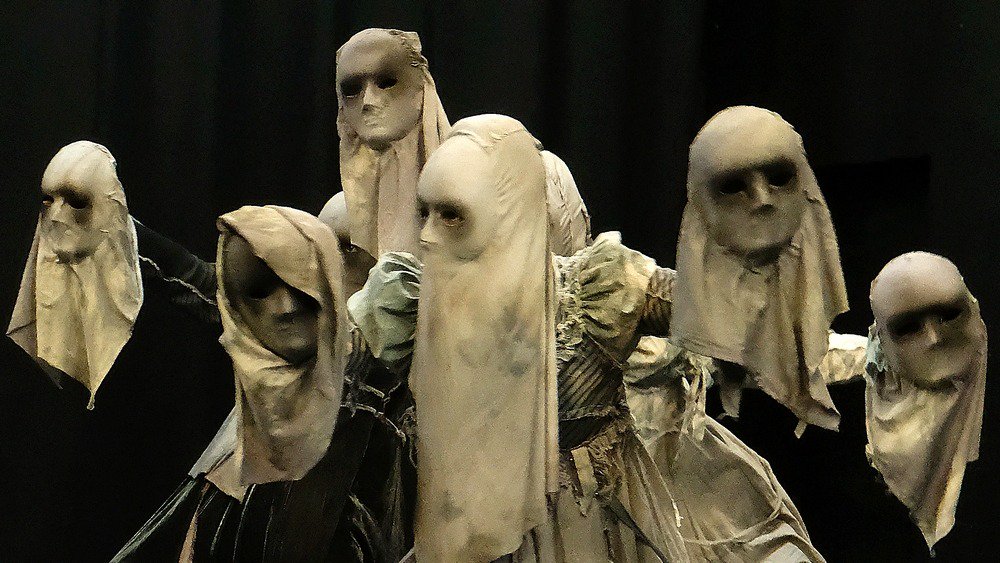
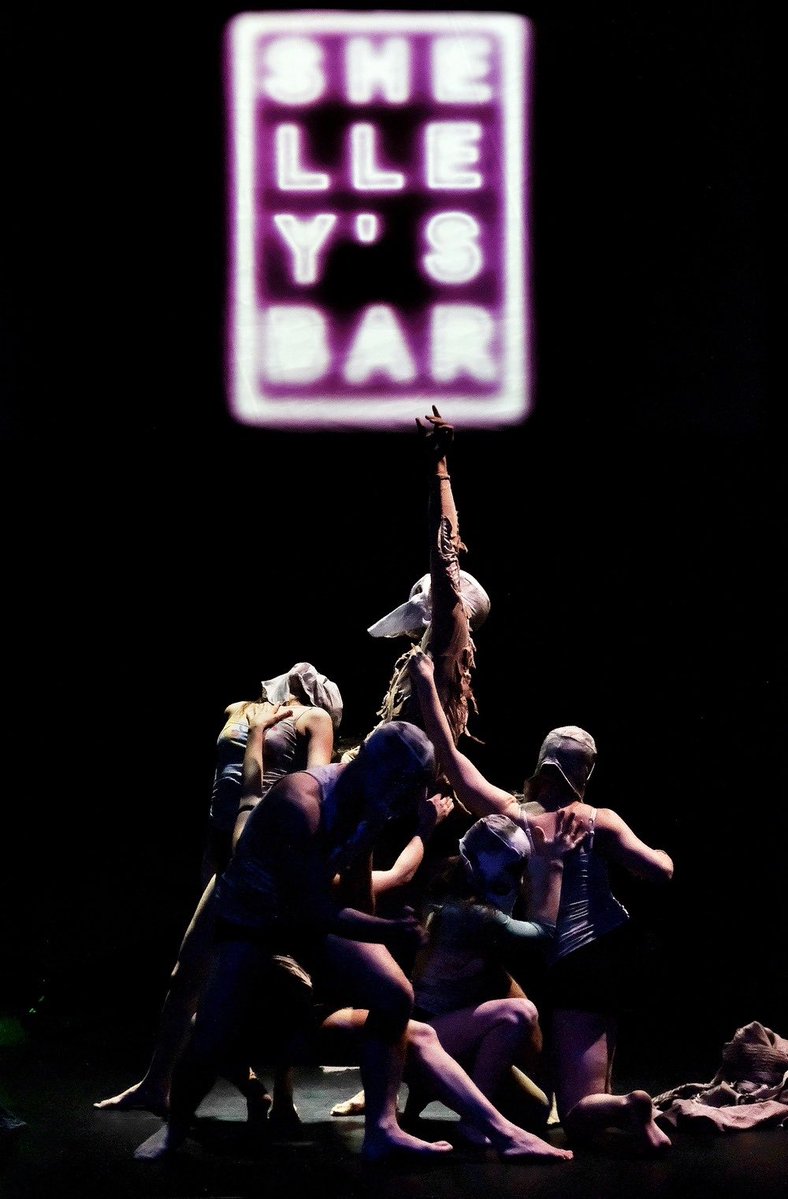
There are scenes in this production so haunting and beautiful that I will never forget them, and are well worth the price of admission alone – you won’t believe how they perform the sending of a letter, but it’s an unexpected delight. The programme promised a more creature-centric narrative, and they definitely delivered – one scene follows his flight from a macabrely-masked mob who taunt and beat him. You totally feel the creature’s pain and the endless cycle of fear, frustration and rejection from which there seems to be no way out. And I’m not sure Mary Shelley would have envisioned her creature bumping & grinding at an Eyes Wide Shut-inspired rave, but Cascade makes it work (plus I think the rebellious Mary would have approved): a masked group writhe and worship at the monolithic neon altar of SHELLEY’S BAR, escalating in impressively incendiary fashion. And the dance between the two creatures, one living and one lifeless, was utterly breath-taking: Serrats and Cabré-Verdiell transform what could have been a deeply awkward encounter into the show’s emotional apex.

Not everything lands; having affectingly conveyed the creature’s birth, rejection, and loneliness without the need for words, it was jarring for Victor to suddenly start monologuing the ‘dreary night of November’ speech when we had literally just seen it happen before our eyes. The creative team should have had more faith in its superbly talented cast to convey the story through performance alone. If there had to be words at all, it would have been infinitely more effective if they were more sparingly used – though the creature’s first word being ‘father’ was an effective moment, Victor’s sporadic speechifying was not. And though Elizabeth’s letters were nicely presented, I still find the exposition a little clunky in an otherwise elegant retelling.

It was on a dreary night of November that the creature beheld the accomplishment of his toils; standing before the same slab on which he was birthed, on which now rests the bodies of his victims. He wraps them in the bindings that once imprisoned him, and retreats across the stage into darkness once more, all the while unfurling that umbilical cord-like tether, his last tie to humanity. It’s a fittingly melancholic end to a stunning production that I cannot recommend highly enough. Whether you’re a Frankenstein fanatic like myself, or if you have the most passing familiarity with the text, you’re sure to find Cascade’s adaptation wonderfully rewarding. It’s been touring around Wales since 1st November, but you should definitely catch one of the last two performances of this remarkable show either tonight or tomorrow (30th Nov/ 1st Dec) at Chapter Arts: https://www.chapter.org/frankenstein, http://www.cascadedancetheatre.co.uk/


*In co-production with Taliesin Arts Centre; supported by the Arts Council of Wales, Welsh Government and the National Lottery, with additional support from Aberystwyth Arts Centre, Ty Cerdd and Creu Cymru.

Rock of Ages, New Theatre Cardiff by Barbara Hughes-Moore

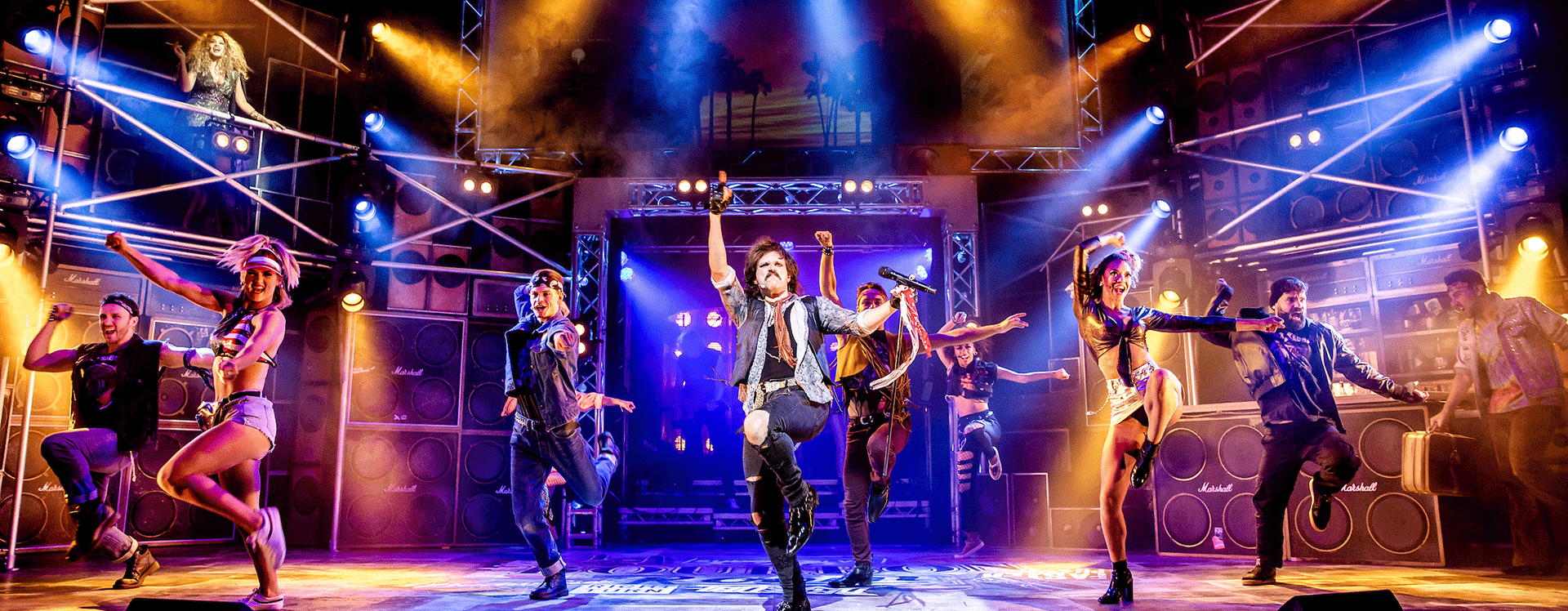
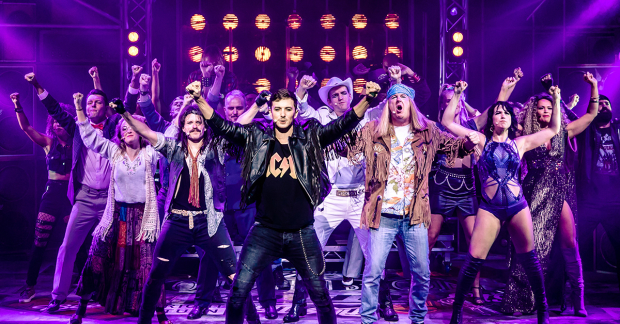
Direct from the West End, this Broadway smash-hit jukebox musical, featuring 80s’ glam rock classics from Whitesnake to Journey, transformed a rainy evening in Cardiff into a hot summer night on the Sunset Strip – and had everyone on their feet and singing their hearts out by the final curtain.

A quick proviso: I came to this production as a fan of the show; this will have been the third time I’ve seen it (fourth if you count the movie adaptation), and it holds a special place in my heart, being the first show I saw with one of my best friends in our undergrad days. Suffice to say I went to this production with my rose-tinted glasses firmly in place – though it also made me slightly predisposed to be critical of a musical I hold so dear.

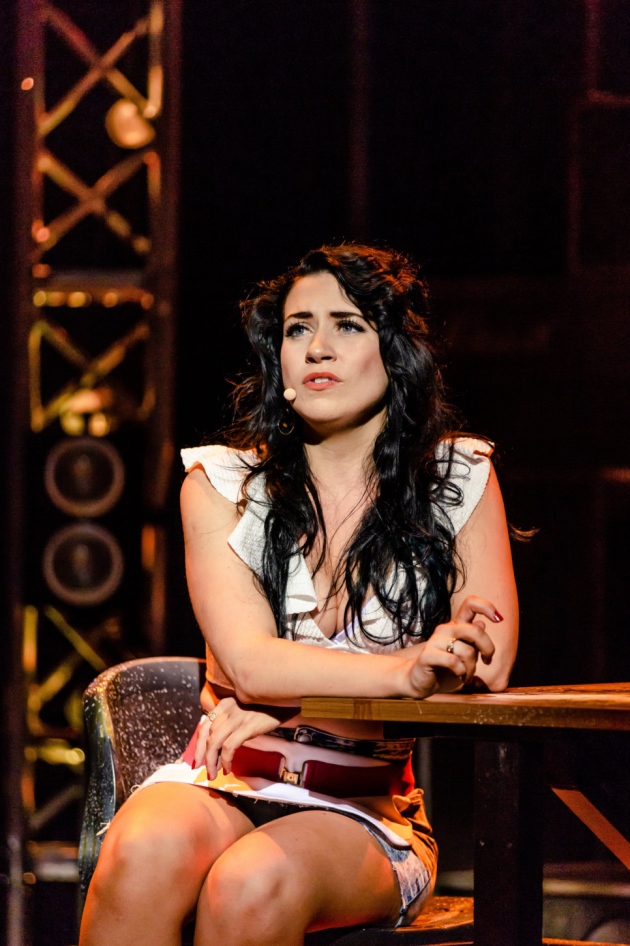
So I’m happy to report that I adored this production! I forgot everything that was troubling me in the real world and just basked in its frenetic charm for two and a bit hours. Joyfully directed and choreographed by Nick Winston, the show is a funny, sexy nostalgia-fest featuring the rampantly rowdy riffs of The Final Countdown, Hit Me With Your Best Shot, and Cum On Feel the Noize to name but a few. I’m not always a fan of jukebox musicals, but Rock of Ages employs the right songs in the right places to tell an intentionally conventional story in a new, entertaining and outlandish way – and with a soundtrack that good, you can’t help singing along.

The ensemble is excellent across the board, with high quality singing and dancing and a real sense of fun from start to finish. Small-town girl Sherrie (Danielle Hope) and city boy Drew (Luke Walsh) make for a lovely central duo with great chemistry and amazing voices, who have their moments both as a couple (the epically melancholic High Enough) and individually – Hope performs an excellent, edgy rendition of Harden My Heart, and Walsh brings bravado and lovable naivete to a cracking version of I Wanna Rock. And Adam Strong, Sinead Kenny and Bobby Windebank turn what could have been throwaway characters into standout supporting roles.

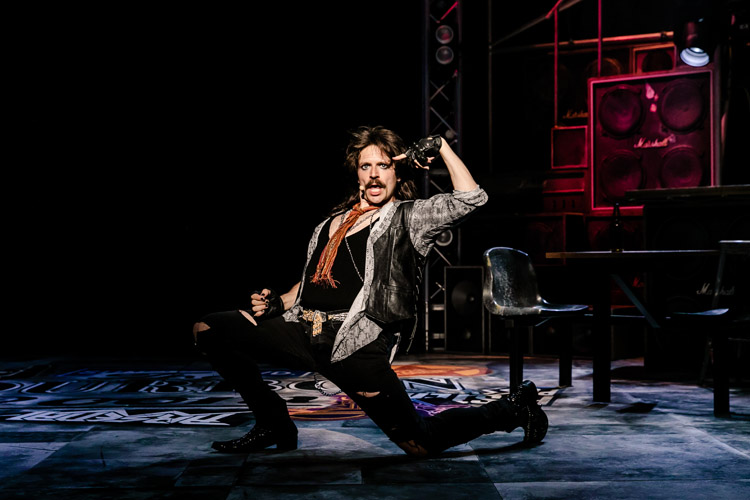
But Lonny is the lynchpin of the show, the naughty narrator who guides us gleefully through the increasingly raucous debauchery. If Lonny doesn’t work, neither does the show – and the character’s passivity in the 2012 film version was one of the many reasons that adaptation failed. Luckily, Lucas Rush is the absolute highlight of this tour: a hilarious punk-rock Puck who runs away with every scene he’s in – the second act suffers primarily because he’s not in it much. Channelling Sam Rockwell and Starkid’s Brian Holden – complete with John Oates hair – Rush brings Prince-like pizzazz to the proceedings and steals laughs, applause and our hearts as the show’s mischievously metatextual master of ceremonies.

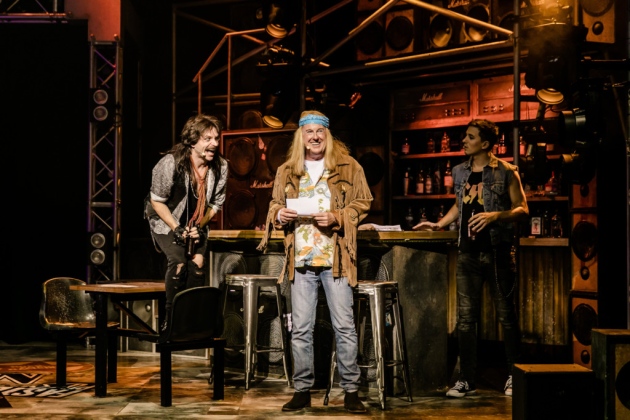
His common-law business partner Dennis Dupree is gamely played by Kevin Kennedy, suitably shambolic as the avuncular guardian of rock who runs the paradisiacal Bourbon Room. Vas Constanti pitches his delightfully OTT German businessman Hertz Kunemann somewhere between Young Frankenstein’s Inspector Kemp and Chitty Chitty Bang Bang’s Baron Bomburst, and Andrew Carthy portrays his son Franz as a kind of Bavarian Pee-Wee Herman.

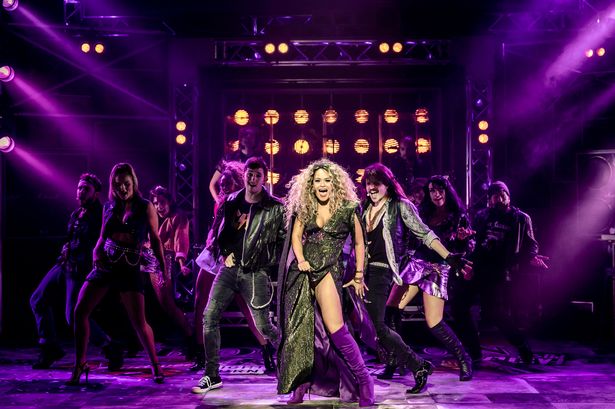
Glamorous and gregarious, Zoe Birkett keenly plays the sharp, more sinister edges of Justice Charlier while also making her a sympathetic, entertaining and simply sublime stage presence. She owns the stage with every note she sings, bringing epic gravitas and impressive pipes to Shadows of the Night and Any Way You Want It.

Easily the most knowingly grotesque version of the character, Sam Ferriday’s Stacee Jaxx is the Nosferatu of the Sunset Strip: creepy, predatory and unsympathetic, he makes for an effective antagonist and a compelling caricature of 80s narcissistic stardom, giving entertainingly offbeat renditions of Wanted Dead or Alive and I Want To Know What Love Is. This is ain’t Tom Cruise’s Stacee Jaxx, redeemed rocker and eventual family man – Ferriday’s Stacee might just make out with you and off with your soul.

This is a gloriously inclusive show, where everyone is celebrated and teased in equal measure – but sadly they shy away from giving the only queer couple their deserved romantic dues. Yes, Lonny and Dennis still manage to bring the house down with Can’t Fight This Feeling (complete with a spritely, balletic body double for Dennis), but the number didn’t quite reach the (comedic or romantic) heights of other productions for me personally.

The 80s are a comforting time, near-mythic in their modern-day romanticisation. It’s comforting to look back at that era of hyperbole with a knowing grin, giggling at the outlandish outfits and big hair and the songs with choruses that can never die. Rock of Ages isn’t afraid to stoop too low for a joke, and not all of them land – it’s an 80s-set show, so hardly a bastion of wokeness – but it ribs itself in this regard with a knowing comment, wink or nudge to the audience. That said, the German caricatures are a bit uncomfortable at times, and sometimes the show basks in the stereotypes of its era a little too indulgently – and it wouldn’t hurt to have a more diverse cast.

Given that the last Rock of Ages-related property I saw was the disastrous movie adaptation, it felt like coming home to see it reign onstage once again. The film totally missed the point of the show: as musical!Lonny says towards the coda, ‘the dreams you come in with might not be the ones you leave with – but they still rock’. In the movie, everyone got a happy Hollywood ending with recording contracts and stadium tours a-go-go; but the message of the stage show is that the truly fulfilling dream is not to pursue the superficial adoration of celebrity, but to find someone who gets you, accepts you, and loves you for you. Justice Charlier’s dreams had to be snuffed out so she could survive in a cutthroat world, and Stacee Jaxx may well have started out as a wide-eyed innocent like Drew before notoriety corrupted him absolutely. Fame is hollow – your friends and family are the best fans you could ever wish for.

The full power of the assembled ensemble is left in no doubts after a powerful performance of act one-closer and show calling card Here I Go Again, and an affecting version of Every Rose Has Its Thorn. And If you aren’t energised and inspired by the incredible, deservedly iconic Don’t Stop Believin’ finale, then you’ve either never had a dream or you ain’t got a pulse. Raucously raunchy and joyfully uncompromising, Rock of Ages is energetic escapism of the highest calibre that you should absolutely see at the New Theatre this week – just maybe don’t watch it with your mum…

The Messiah, New Theatre Cardiff by Barbara Hughes-Moore

It’s nigh-impossible to read the title of the newest play by The 39 Steps scribe Patrick Barlow without calling to mind that most iconic of Monty Python one liners – and Life of Brian is definitely an influence on this comedy about a hapless theatre troupe putting on a shambolic production of the greatest story ever told. Whilst it doesn’t reach the comedic heights of Cleese & co. arguing about what the Romans ever did for us, it manages to be a triffic trip through theatre tropes nonetheless.

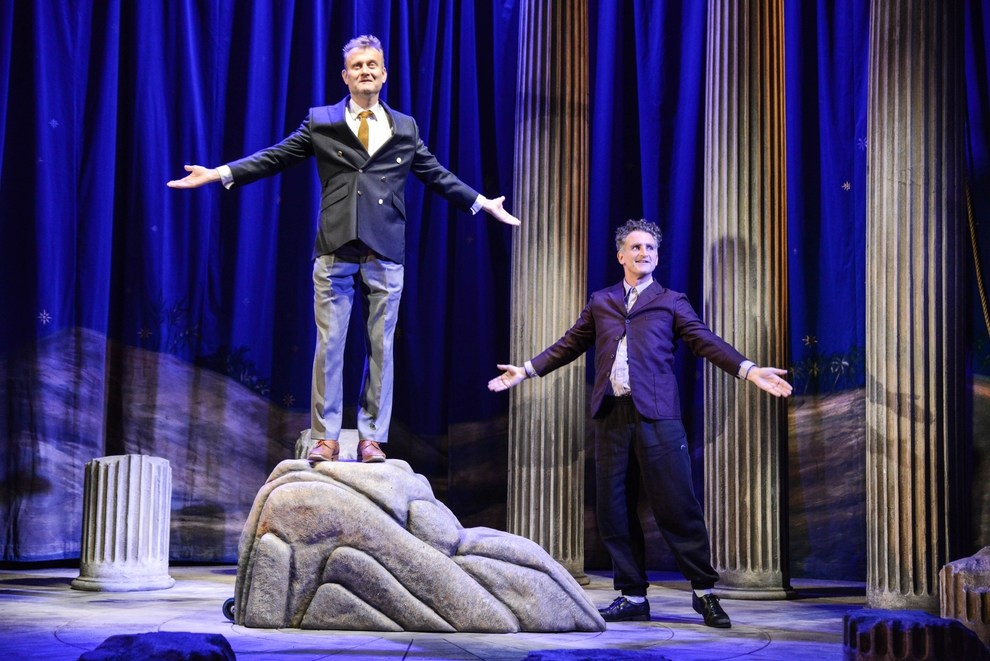
Hugh Dennis is entertainingly harried and haranguing as Maurice Rose, an actor admirably fighting to stage his dream production despite diminishing resources and will to live. Although the play constrains Dennis’ natural flair for improvisation by trapping him in a rather fruitless ‘straight man’ role, he gamely leads the increasingly (and intentionally) chaotic performance of the Nativity story with deadpan wit and a sort of hangdog brio that grounds the action even as the humour gets curiouser and curiouser.

John Marquez as Ronald Bream is a revelation; he gives a 5-star performance in a play that desperately needs but doesn’t quite deserve him. Part Charlie Chaplin, part Michael Crawford, with a bit of ‘Allo ‘Allo’s Officer Crabtree thrown in for good measure, Marquez owns the stage in every word, gesture and intonation. His delivery alone makes a so-so line sensational, and there was very little he did which didn’t result in hysterics from the audience – his lovably oblivious mispronunciation of words in particular had us all in stitches. But the crowning glory of his performance is a Terry Jones-esque rendition of Mary, and his bickering with Dennis’ somewhat browbeaten Joseph is worth the price of admission alone.

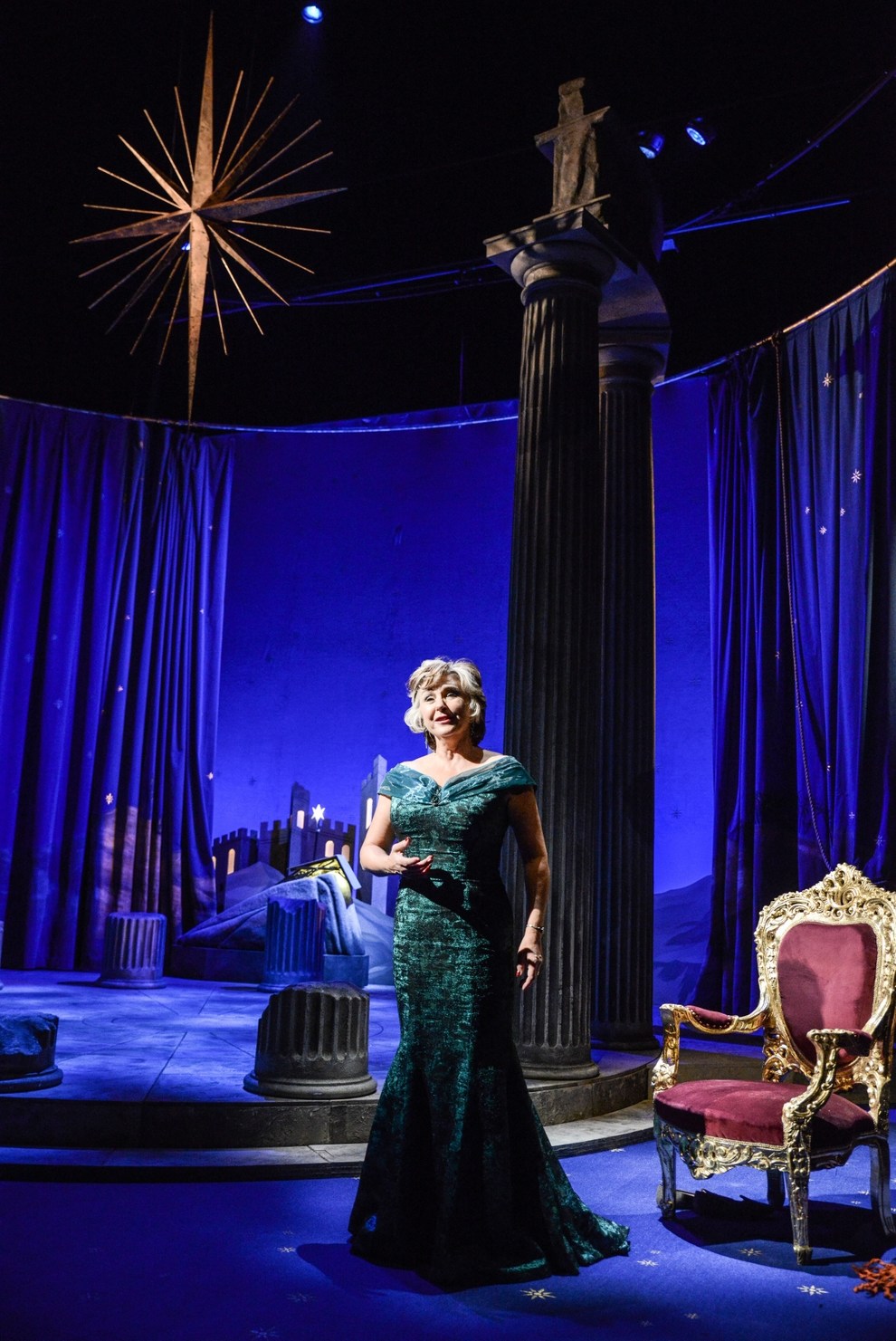
Lesley Garrett rounds out the trio as diva Leonora Fflyte aka Mrs F, bringing glitz, glamour and a truly beautiful voice – but is ultimately wasted in a thankless, tangential role. Although she performs stunning renditions of Silent Night and In the Bleak Midwinter, her character adds nothing to the plot in a play which could have easily been a two-hander. Given the purposefully scrappy nature of the comedy, it would have worked better with the theme if Lesley Garrett played an opera singer who couldn’t sing (after all, it takes an excellent musician to portray a bad one – as Les Dawson proved some years ago). And it would have been more interesting if Mrs F was Maurice’s much-discussed ex, making their professional dynamic fraught with interpersonal tension.

The play is consistently entertaining – when it’s funny, it’s hilarious; but when it’s not, it really shows – and there are a few standout scenes which elevated the action: an atmospheric recreation of the Three Wise Men following the star had an otherworldly magic to it, and their subsequent flight from Herod had a sense of genuine urgency and thrill to it. This was especially noticeable in a play which had little drive throughout, and a perceptible lull in the second act – though they made up for it with a hilarious re-enactment of Jesus’ birth involving a lengthy Call the Midwife homage.

And the set is absolutely gorgeous: a dilapidated circle of Ancient Roman columns rotates dramatically when the drama requires, framed by a luxurious lapis lazuli curtain decorated to look like the starry night sky.  The title ‘THE MESSIAH’, picked out in gold on a blood red cloth, is held aloft by two medieval angels that look as if they’d been airlifted straight out of The Book of Hours. And the ambience is aided by some neat lighting and smoke effects, plus a cool little light-up Bethlehem (complete with stable) and a rather grand heavenly star (the celestial kind) that swings in imperiously when needed. I’m not usually a fan of piped music in theatre productions, but this is one of the few exceptions: they chose absolutely brilliant scores that underlined and enhanced the emotions in any scene, from the Ben Hur/ The Ten Commandments-style epic orchestral numbers, to the excellent use of Wojciech Kilar’s sumptuous score from Bram Stoker’s Dracula).

Although the play sells itself on its comedically haphazard tone, there were some odd things about the production that made me question its intentions. The doors didn’t even open until about 5 minutes before the curtain was due to rise, and even when everyone was settled in the auditorium, the play still started late. Instead of making up time after Act 1, the interval also ran over, making us wait to see a second act which ultimately felt overlong in execution. The fair bit of audience participation (which I object to on principle) is all in good fun as long as you’re not in an aisle seat – though attempts to recreate an ‘I do believe in fairies’ moment and pass the farce off as a ‘spiritual discovery’ feel forced.

And finally… there’s a truly great play hiding within this; cut the interval and the superfluous stuff and make it one single act played straight through (which was a great move in Mischief Movie Night), make it a two-hander or develop Lesley’s character and give her more to do. As presented, it’s a production with a bit of an identity crisis, with little clarity as to what it wanted to be or say. Murder for Two and The 39 Steps deconstructed theatre in clever, inventive ways, but in this it feels as if the theatre symbolically (and occasionally literally) is falling down around them. It’s not the Messiah, it’s a very messy play.