A morning spent trying to get to Manchester would be met by awful train journeys and the finding of hosts. Having always wanted to go to The Lowry, I stood up to the challenge and checked out some local theatre maker’s work.
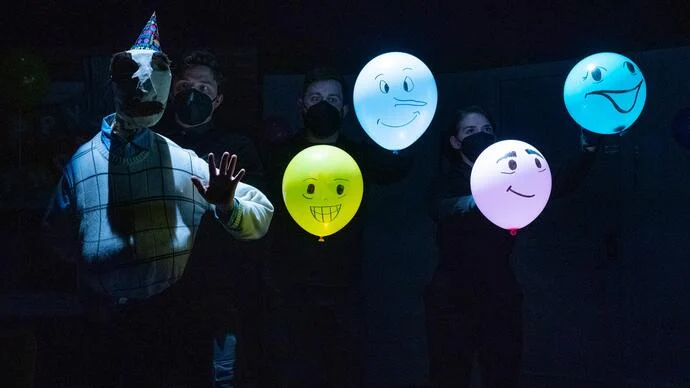
Wayne Steven Jackson’s piece And Here I Find Myself is a highly personal affair, where the abstract meets the honest, the queer meets the quest for parenthood. Wayne’s journey in seeking a child through adoption or artificial insemination has proven to be a remarkably difficult venture. His show attempts to unravel this along with life goals, disappointment along with the battle with heteronormativity.
Long strips of blank scrolls are hung from the rafters, as Wayne pops more paper on washing lines, where projected actions are given and he must follow. He jumps, climbs ladders and speaks openly about all these things that have defined his life. I could easily relate to a great deal of his truth, though I can honestly say I would not want a child in the state of the world at this present time. Speaking how holding a baby made him feel, that overwhelming love for the child proves his legitimate desire to be a parent. The law for single, gay men to adopt a child is also a very recent action and should have been done much sooner.
Though the show is mostly there, I think some extra touches could really finish it off well. Wayne needs a head microphone when above the ladders and in other parts. Even with myself in the front row I was sure people in the back would have struggled hearing. He has a mic for the moody sequences in the back, spotlight bound on him going off on more insights and memories. The score by Jack Fleming is pretty and dark when need be, a sweet song by Katherine Myles is seasoned well in a scene after much discord. The video work by Studio 91 Media adds atmosphere, projected onto the scrolls and a metaphorical magpie (Wayne in a sort of Black Swan glow up) haunts the space for most of the show.
Maybe I craved a bit more humour or less of an experimental veneer (though I usually live for this). I could feel I was sat with friends of Wayne, so there was also that. There is some interesting ideas here and more queer voices are truly want I want to hear now. We hope the journey’s end of this story is a child to call one’s own.
Finding all the right words to talk about this superb show is an undertaking. The recovery period for it as well, can be daunting.
In what is one of the finest post-pandemic shows in London, a new version of Kander and Ebb’s iconic musical waves in the ether. From the moment you step into the Playhouse Theatre (or the Kit Kat Club as in the show) you are met with a bombardment to the senses. Cognac is offered at the door, the prologue dancers muck about in the foyer and a real sense of joy washes over you. This is a special show with some lovely padding before the main event. Very much a sense of “Welcome back!”
With a complete restoring of the theatre, the revolving stage is small and packs a lot of punch. The dancers make great use of the space, with thrilling moves and an all round sex appeal thanks to the choreography of Julia Cheng. The direction of Rebecca Frecknall should not be underestimated, the animation of this production reaches a fever pitch I’ve rarely seen on the stage. Amazing work from Jennifer White as music supervisor and director leading this immaculate bravado band. Sets and costumes by Tom Scutt are fitting of the Weimar era and have a real slick style to them. Not faired to show off some legs, thighs amongst other regions. Tis a very autumnal coloured show, cloaked in black.
What the musical is perhaps most noteworthy for is the colossal tonal shifts, with Hitler’s rise to power and the unwavering chaos this caused. The cabaret space becomes the place to express oneself though some songs also bleed I to the real life of the characters. There is little it takes to be moved by these proceedings as queer and Jewish characters become the focus of hatred and violence. These mood swings in the show are what makes it perfect, the threat of the Nazi is omnipresent as apposed to literal on the stage. Moments of panic lead to a absolutely belting dance number and vice vera.
The cast shine eternal. Fra Fee as the Emcee is the master of ceremonies and our guide for the show. Ever the charmer, Fra has taken over from the big boots of Eddie Redmayne, talking the dream role with aplomb.
Amy Lennox is a powerhouse Sally Bowles. I loved her little bit of screaming she did in the title song, her wry English wit ever cutting and blunt. An amazing voice never far away and her costumes, perhaps the best in show.
Omar Baroud as Clifford Bradshaw is charming and quick witted, the plucky American writer who is taken Berlin and all it has to offer. It’s a lovely role with a big effect on the story.
Vivien Parry is quite touching yet also plays the spurious role of Fraulein Schneider. Her entanglement with Richard Katz Herr Schultz has some funny and lovely moments, a song about a pineapple remains a highlight. Ernst Ludwig is a challenging role due to his change in allegiances, here given up Stewart Clarke in a dashing, pristine take. The marvellous Anna-Jane Casey is both Fraulein Kost/Fritzie who was not in it enough and I was craving more. I’ve already spoken of the stupendous ensemble and band, yet I find myself mentioning them again. Their talents are other worldly.
The Kit Kat Club is calling and you simply must accept the call.
The new cast for Cabaret from October 2022 includes RWCMD Graduate Callum Scott Howells & Madeline Brewer.
One of the great London discoveries for myself pre-pandemic was the work of Lazarus Theatre Company. With a sensational take on Oscar Wilde’s Salome and later Macbeth, one ponders what might be next…
Doctor Faustus by Christopher Marlowe made for great theatrical flair from this company. I expected a lot of wackiness and panache was delivered it in bucket loads. Impassioned lead actor Jamie O’Neil, works very well as the titular anti-hero, easily wooed by the devil’s messenger Mephistopheles. In a series of ever increasing mania, Faust abuses his newly acquired powers, a strange array of Pope visitations, globe trotting and an outrageous number featuring the seven deadly sins. The colourful, whiplash speed is alive throughout and the curtains used get a keen workout.
As Mephistopheles, David Angland is wickedly good, his evil glares really selling it, along with other funny moments. An amazing troupe of supporting talent have the reigns in a conveyor belt of locations and situations. A dance number after Faustus signs the deal features tight movement and the all round glowing energy that they bring throughout are more highlight. Director and adapter Ricky Dukes must be praised for this fine thing. The exceptional use of such a small space enhanced the experience making for an intimate endeavour.
Some beautiful moments saw a hark back to their Salome, figures slowly traversing through a smokey tableaux. There is a lot of this here, though it remains a pretty sight, none more so when the apparent Helen of Troy joins Faustus in relations. Money, blood and ectoplasm stain the stage and the famous plastic sheeting another nod to previous work. Sell your soul to book this.
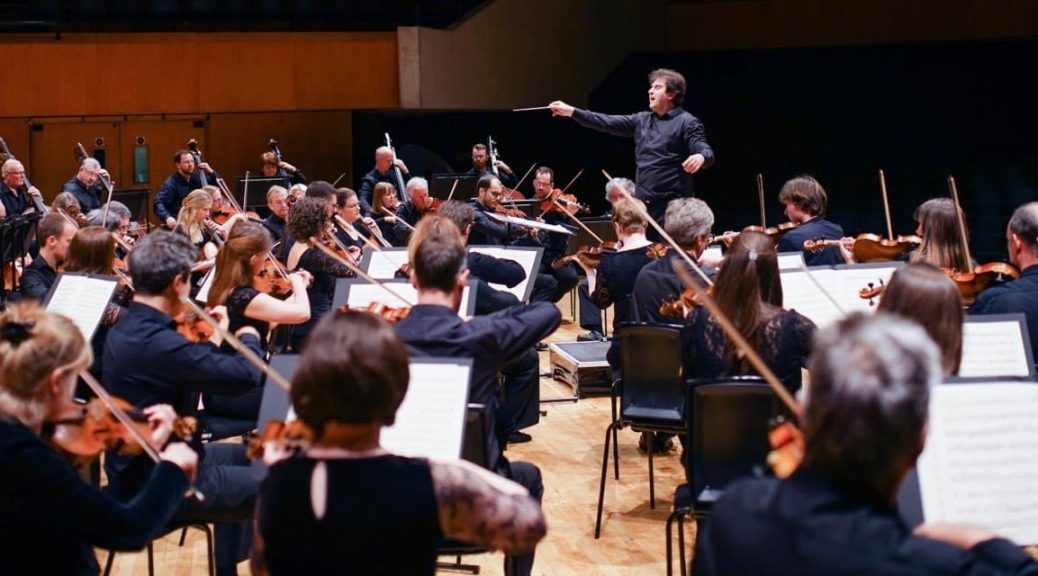
For my finale Prom this season, an appearance from the BBC Symphony was offered for the last Monday concert. Mighty Conductor Karina Canellakis excited with an array of varied delights in a concert that had a lot going for it.
Beethoven’s The Creatures of Prometheus overture thrills in its few minutes, a tantalising taste of the full ballet score. This makes a great concert opener with it’s charm on it’s sleeve, Karina getting off to a fabulous start here. Of note was the world premiere and BBC commission from Besty Jolas of bTunes. Here in the Albert Hall with us at the age of 96, this added a special weight to proceedings. Her odd piece used theatrical elements that could have been utilised more. We saw the lead violinist conduct for the first few bars, as the pianist and conductor arrive late flustered.
This funny little moment lead into a harsh and insightful sound world, Betsy creating some intriguing compositions. Pianist Nicolas Hodges got busy with lid slamming, string plucking and smashing tone clusters, also notated into the score for him. The whole things was barmy, trying to pass off as a playlist of music, it seems to have gone down well and with her presence on the night proved a success.
The 1st Symphony makes for gateway Mahler and here it was executed with a fiery focus. All the hallmarks Arte here in what would be heard later in his music. This graduation piece shows a vast array of musical brilliance, the meshing of popular songs, the waltzes, Alpine bliss and mirky underwater stand out as check points. With a pristine beauty, this held up as a highlight of my Proms live this year. There is a promise in this first symphony, perhaps one of the finest firsts ever written. The panache of it’s delivery, the mighty mood swings and the composer himself having conducted this more than any other of his works proves its importance. Highlight include the Frère Jacques variation, a evocative double bass solo and all round impassioned occupation that sells it and more. Would to hear Karina conduct the following on two symphonies by Mahler now.
A second wind from the Berlin Phil after the rowdy Mahler 7, would proved mixed. The Violin concert from Alfred Schnittke proved a rare discovery and a really strange piece with a lot going for it. Soloist Tabea Zimmermann proved a jaw-dropping display in pretty harsh passages along more fund bits. Some of her cadenza might not have been as stimulating as the rest, though the orchestra alas proved quite brilliant in the whole endeavour. Razor sharp pastiche mingles with serious experimentation in all its brow raising brilliance. The touch of a harp, piano, celeste and harpsichord could only be Schnittke, in this most memorable of violin concertos. Should do a good job in haunting me over the next few days.
Daniel Harding replaced Kirill Petrenko from the night prior, therefore replacing the Shostakovich 10th Symphony with Bruckner’s 4th Symphony. Whilst I’ll admit the performance was a grand affair, the definition of professional…I have to say this was one of the dullest symphonies I’ve ever heard. Bruckner seems to loiter is past German romanticism that leaves little room for new horizons nor any real depth to the style. A lot of this just felt like a load of frivolity with no real sense of it’s influences. I still can’t make out if it’s “German sounding’ either. The finale almost won me over with broad, bold outburst where things started to take off, quieter moments having some genuine appeal. Though I’ve heard the Shostakovich originally planned many times, I dare say I would have much gathered heard that again.
Sir András Schiff relaxed a Sunday morning Proms audience in a intimate affair in the grandeur of the Albert Hall. You see another side to Beethoven in his late piano sonatas. Still filled with innovations, their refections and anguish still pound through and the electricity still lies within them.
Schiff is extremely no thrills, at least the view of his back and part of the keys would prove this where I was sitting. Playing all this from memory proves his chops, his previous Bach whistle stop concerts also proof of his sheer talent. His writing out of the pieces makes it look so easy when it might be a nightmare to play. The dexterity and energy require cant be underestimated, Schiff tackling all these, though his reserved manner might shut fool people.
A debate about having small, more intimate Proms prevails. All I know is the sounds ring out from the piano, though I was in the stalls and may very much be a different story in the high up gallery. This massive audience all came to hear him play and that is enough to justify the recital in the space. Whilst the first two buttery sonatas performed are firsts for the Proms, it was the Sonata No. 32 in C minor which stood out, as if a big beast on the war path. The violence and the weird imagery made it stick out, a fine choice to wrap things up.
Itching for more Proms, the Berlin Philharmonic began a two ninth fest featuring the huge 7th Symphony from Gustave Mahler. It’s been a while for me where I’ve seen a instrumental blend this fine and musicianship this stellar. One can never picture taken on his big works on a whim, the lesser favoured piece is finally getting the love it deserves. It’s funnier than usual as well, with merry tunes and drinking songs which as ever, are met with black doubts and lingering uncertainties. Here the woodwind shines, the brass enthral and the percussion (when used) add that extra bite to proceedings.
The large set of strings delivers jabs, swoons and haunts us all. This feat of musicianship was made crystalline by conductor Kirill Petrenko, who’s flamboyant flair and care for the orchestra is very telling of his persona. These five movements remain quite strange in their form, moments for guitar and mandolin or the cowbells evoking the Austrian Alps are another quirky touch. I found the near 90 minutes whizzed by, some Mahler can drag and this being so fresh and alive it was never a test. The composer wouldn’t have believed a performance like this could be done of this work, so tight and polished. Great work indeed.
BBC Proms continues till 10 September 2022. Listen live to all concert on BBC Radio 3 or listen back to all concerts on BBC Sounds.
The National Youth Theatre of Wales isn’t a company like other theatre companies, so its work can’t be lined up against standard productions. It’s more akin to a BTEC Performing Arts course in which the end-of-year show is designed to give all students an equal opportunity to participate. Because of this, there aren’t individual stars whose performances can be picked out. In The In-Between, the main plotline features a heroine but she is played by different performers at different times.
Reviewing is not course moderating. Reviewers can’t comment on the process that lies behind the end product, even though the workshopping will have been a key part of an educational process and will be very valuable to the student. The performance is only the tip of an iceberg, however exciting it may be.
Equally, you can’t say much about the script, which is specially worked up for this production and which may never be used again. So, there are difficulties reviewing The In-Between.
To stick to facts, the production features twenty-three performers, backed by a creative team of twenty-five. It’s no small undertaking. The combined work of these people (assisted by staff at Theatr Clwd) is compressed into a fifty-five minute, single act showcase. The linking theme is the story of Fay, a student on a performing arts course who is considering dropping out. The show starts with Fay’s failure to hand in her homework, or perform ‘her’ song for her lecturer. It ends with her predictably deciding to stay on and at the end, supported by the entire cast, she sings what is quite an effective pop song, celebrating the state of being in between training and working.
As Fay’s story unfolds, group activity is choreographed around a series of small sketches. There is a constant supply of business, much of which centres on a stolen letter. This handwritten letter, in which Fay tells her lecturer she is dropping out, is recognised as being an anachronism and a bit of a joke. Dialogue throughout is in English but it’s peppered with Welsh in an evocative way. Overhead screens carry the script, like subtitles, and a signer works at the side of the stage for deaf members of the audience. There were a couple of fluffed lines and the screens seemed to get stuck at one point but generally everything was done enthusiastically and well.
– Only I did want a bit more. I wanted more character acting, allowing a dramatic penetration of Fay’s crisis of confidence. The self-conscious conversations about the problems of working in the industry didn’t achieve this in any depth, since students really know little about what awaits them down the line. There might have been a second person, a friend, who does leave the course, recognising that there are other things in life beside the performing arts. (Sacrilege!) The snatches of character acting there were – like the cameo of a grandmother and the emergency call handler who breaks out into ‘Staying Alive’ to demonstrate the kiss of life (!) – were delivered properly, making you think the cast members could easily have done more of the same.
Perhaps I wanted more conventional acting because I don’t greatly like musicals, even though I recognise their popularity and their economic importance for theatres and for television. Unless there is an exceptional score, as in West Side Story or Mac The Knife, personally I never feel musicals rise above the level of light entertainment. I prefer shows that make a demand on my intelligence rather than ones that aim to make me tap my feet. I like plays where verbal control and projection goes into lines rather than songs and when physical agility is present in movements and gestures and not just in dances.
I am also intrigued by work where the two genres overlap. However, in The In-Between there is no question but that music theatre is the be-all and end-all. It comes with the fairy tale suggestion that fame and fortune do wait around the corner for the girl who is determined to make it come what may. I didn’t engage with this idea. I wasn’t bothered about whether Fay delivered her course work or not. I started thinking instead about the cast and the fact that there were more than four times as many young women as young men performing. A BTEC computer course would probably reverse this statistic. (In contrast, the production team is almost evenly split and the script was written by a woman and a man.) Maybe this production could have referenced the social conditioning behind gender imbalances.
I would have enjoyed an exploration of late adolescence in which anxiety really came centre stage. Anxiety is hardly the sole preserve of those on performing arts courses: it is wide-spread and not just in the student community. Watching one character overcome anxiety in a convincing way would have been interesting. Watching another fall victim to it might have been moving. Could there have been a second half?
You could say my taste means I am not the target audience but another feature of this particular type of work is that it has no target. It was pleasing to see the large audience in the temporary auditorium at Theatr Clwd (where the buildings are being redeveloped) was an unusual mixture of young and old and the show did have something for everyone – we laughed and applauded – but it didn’t have quite enough of anything in particular to mark it out.
Maybe the title – and the subject of Fay’s delayed solo – says it all. The show itself is in-between genres. It left me in between admiring it for what it contained and for what it allowed its young performers to do but fussing about what it left out. For a student show, it was very entertaining. As a piece of contemporary theatre, it fell a bit short.
In a return to the BBC Proms in London, a new venue for the festival would call. Whilst I’ll confess the Printworks in Canada Water is a bit out of the way for this travelling reviewer, it was a fleeting chance to see another side of London. In a more laid-back, approachable look on classical music, the venue itself on first appearance looked cluttered, very busy.
As things went on, I found the whole thing to be truly wonderful, the direction of James Bonas with a metaphorical butterfly net keeping everything grounded, yet delightful.
The head turning array of soloist, orchestra, dance, art, beat-boxing and sound design filled the venue with the ambition of a classic happening. The star of the show was very much American counter-tenor Anthony Roth Costanzo who has dazzled audiences across the pond and over the world. It is his clear sex appeal and queer ideals that dust the show with beautiful goings on. In both the bejewelled Handel and Phillip Glass repertoire (extracts from both their operas, some never heard at the Proms along with a world premier from Glass) he proves his broad taste and mighty passions, his voice sharp and touching.
All the other goings on segway well into each aria, the dancers never quite getting the limelight (with emotive choreography by Justin Peck). The live painting of Glenn Brown was only truly visible to one side of the vast elongated factory. Players from English National Opera and conductor Karen Kamensek never wained is this apparent gamble that paid off all round. Costumes by Raf Simons are billowy, colourfull fun creations, slight and web like for the dancers, exaggerated for Costanzo.
Jason Singh would beatbox and add whispy vocal tricks to make space between the notes of the arias. What almost attempted to steal the show was the finely crafted surreal video work which graced the brick walls. The likes of James Ivory with Pix Talarico, Tilda Swinton and Daniel Askill and more had unsettling, vivid and witty films that got away with a lot of it’s demands.
A surreal trip to Bristol would herald a gig of epic proportions. Having discovered Dareshack in my last visit to Brizzle, I marvelled at the cafe establishment which is also a hairdressers, along with other goings on. The other Dareshack on Wine Street would host this fine gig and has a more bar like feel.
The warm up act for the evening was The Pleasure Dome, though the name is deceptive. Whilst I went along with their intense, cutting rock, I found the sound levels to be exceptionally loud. It appeared I was the “old man” for this set and it almost bordered on a feat of endurance. Lead singer Bobby Spender arrived on stage, bare chested and chugging a beer. There is a slight feel of Ozzy to him, even if I wasn’t able to make out a single word in any of the songs. On bass, Loz Fancourt provided additional support in the makeup within the wall of noise. Drummer Bert Elvin had the energy of a horse who I was drawn to for most of their time on stage. I noted Bobby getting extremely liberal usage of feedback pedals, I assume the source of the screeching in my ears throughout. I’ll stay on the case and be down to see more of The Pleasure Dome in the future.
With the breakup of the band Prince Rama, front-woman Taraka has been establishing her own strident solo act, though is still very much an all round artist. A technical glitch made a brief predicament for the start of her show, though things would set off pretty quickly. With a mattress and bed sheets on stage, Taraka made for joyful viewing and listening. It is her dreamy, post-punk vibes that holds everything together. The trippy mix of binary numbers, Shepard tones and spam voice-messages that make for quirky patter in her songs. It’s all very charming and her stage presence shines. Even an impromptu pillow fight with the audience was a liberating few moments.
As if were weren’t treated enough, her encores would prove her versatility with an intimate guitar show, the audience invited to join her on stage. She even shared with us a brand new song not performed before, another thrill just for this Bristol crowd. This giddy audience seemed to lap up what she offered and her funny, wry talk also made for a great time.
Taraka would prove a great success in Cardiff, we could easily see her at the Festival of Voice or down Womaby Street very soon. This is one singer to keep a keen eye on!
Taraka continues on tour to End of the Road Festival, Salisbury, Paradiso in Amsterdam and Endless Summer in Marseille.
The Pleasure Dome are again in Bristol at Exchange on 24 September and back at Dareshack on 7 October. They also continue on tour around England & Wales.
Creating opportunities for a diverse range of people to experience and respond to sport, arts, culture and live events. / Lleisiau amrywiol o Gymru yn ymateb i'r celfyddydau a digwyddiadau byw