Category Archives: Theatre

INTERVIEW Luke Barton and Joseph Derrington for Sherlock Holmes: The Valley of Fear

As Sherlock Holmes: The Valley of Fear comes to Cardiff this week in the last stop of its acclaimed UK Tour, Community Critic Barbara Hughes-Moore spoke with stars Luke Barton and Joseph Derrington (aka Holmes and Watson). Adapted and directed by Nick Lane, The Valley of Fear follows two cases across two sides of the Atlantic and finds Holmes and Watson at a crossroads in their friendship.

This interview has been edited for clarity.

So Luke, you and Joseph first played Holmes and Watson in Blackeyed Theatre’s The Sign of Four a few years ago. You’re now reprising your roles in the UK Tour of The Valley of Fear, Arthur Conan Doyle’s final novel. Where do we find Holmes and Watson when the play starts?

Luke Barton (LB): Things have changed for Holmes and Watson, because at the end of The Sign of Four, Watson gets married to Mary Morstan! In the short stories that occur between [this book] and The Valley of Fear, we learn that Watson has moved out of Bakers Street. He’s set up his own doctors’ practice, and lives with Mary – but he does always seem to return to Baker Street. There’s something about the mysteries they go on that just keeps attracting Watson back to Holmes and Baker Street. So we find Holmes and Watson on New Year’s Day 1895: Watson has come home for Christmas –

Joseph Derrington (JD): And he’s not gone back!

LB: He’s chosen to stay with Holmes instead! Then a mysterious coded message arrives in the post warning them of some harm about to happen to a country squire down in Sussex. From there, they embark on this mystery, and very quickly they go back to what they know best: being a crime-fighting, mystery-solving duo.

Joseph Derrington and Luke Barton in Sherlock Holmes: The Valley of Fear. Image credit: Alex Harvey-Brown.

I guess a coded mystery message is the best present you could get Holmes and Watson!

LB: Holmes loves it! I imagine Christmas is very boring and sentimental for him but a mystery is like [a gift].

JD: Better than socks!

Joseph, these are two of the most iconic characters in literature. How do you go about crafting that sort of relationship, especially given that you’ve both played the characters before?

JD: I found it quite an easy process. When we first started rehearsals for The Sign of Four back in 2018, there was a lot of discussion about how the relationship between Holmes and Watson should be. Watson was a lot of the time portrayed as a buffoonish character. He’s obviously not as intelligent as Holmes but he’s still intelligent: he’s a medical man, a doctor. We wanted to try and push this relationship where one person is incredibly intelligent but needs one person to channel it. Watson is that person. And when The Valley of Fear came along, we just slipped back into it. What works quite well is that we still speak to each other when we’re not performing in shows! It helps that we like each other.

Joseph Derrington, Gavin Molloy and Luke Barton in Sherlock Holmes: The Valley of Fear. Image credit: Alex Harvey-Brown.

Do you draw anything from any particular adaptations, or do you leave that behind when focusing on this? How do they play into your process?

JD: I obviously draw off the looks of Jude Law (!) I’d never actually seen a lot of Holmes adaptations, which is probably quite bad! I focused on the discussions I had with Nick [Lane, the writer-director]. I tried to lead in more from the text than from how the character had been played before.

LB: I think for me and a lot of people our age, I was very excited by the BBC adaptation. It was after that version that I went on to read the stories. I think our performance and our production is very much rooted in the original stories and the world of Conan Doyle, and [like] the BBC adaption is done with great reverence to the books. The Victorian world that Conan Doyle creates is quite key to our production, and that was my inspiration as well. There’s something so quintessentially Victorian about Holmes: he is both very much a part of that world but also completely strange within it; he’s very un-Victorian in lots of ways.

Luke Barton and Alice Osmanski in Sherlock Holmes: The Valley of Fear. Image credit: Alex Harvey-Brown.

Is it important to you to you make him ‘sympathetic’?

LB: Holmes doesn’t care what other people think. But in the job he’s doing, I think he finds [that] emotions and feelings just aren’t helpful, and that’s why he’s described as this unemotional machine. But he is a human being: he just has an incredible capacity to filter stuff out, and that’s intriguing because most of us care what other people think. As actors, we spend every night standing in front of people getting judged by them. You’re always under the spotlight. It’s really refreshing to have a character that can switch that off.

Joseph Derrington, Blake Kubena and Luke Barton in Sherlock Holmes: The Valley of Fear. Image credit: Alex Harvey-Brown.

Why is this story so suited to the stage?

LB: There’s something about the larger than life events of these stories, particularly The Valley of Fear, that lend themselves to the theatre. Audiences expect more: we have to go on a bigger imaginative leap. The uniqueness of theatre is that as actors, we sit down with an audience and say: ‘we’re going to pretend we’re these people and you’re going to pretend we are as well’. When you throw in these big characters, like the gangsters and murderers we get in The Valley of Fear, it’s really exciting for an audience. It just allows the imagination to run wild.

JD: I think it also adds to the murder mystery, too: it’s more claustrophobic when you’ve got a mystery and there’s hundreds of people watching you and [anticipating] what’s going to happen in the next hour and a half. Some of the venues we’ve been to in the past, you can see the audience in the front row. We had a floor rolled out and when they’re on the edge of the stage, it does add to the pressure of trying to solve a mystery. No matter how many times we do it, it’s still exciting.

LB: They’re trying to solve it with us: Holmes and Watson are solving the mystery at the same time as the audience. That’s what makes it exciting: you have to figure it out as we do.

Blake Kubena and Alice Osmanski in Sherlock Holmes: The Valley of Fear. Image credit: Alex Harvey-Brown.

Do you find different audiences react in different ways?

LB: That’s the great thing about touring! Like Joe said, we’ve done over 160 shows now, and every night the audience is different: every town, every city, connects and responds to different things. They even root for different characters! And that’s one of the joys of theatre, especially of touring theatre: you go to so many different places, and each one has a different energy.

JD: And while it’s not a comedy, there are funny bits! Nick has tried to keep it very true to the story itself, and it’s nice to see proper Sherlock Holmesians – is there a word for them?

LB: ‘Sherlockians’.

JD: Like Beliebers?

LB: Yeah!

JD: So these Sherlockians are enjoying it even if they know how it ends, because it stays true to the book. It was nerve-wracking to start, [wondering] how Holmes fans would respond. It’s always tricky trying to please everyone – but I think we’ve done it! I’m pleased with it.

Joseph Derrington and Blake Kubena in Sherlock Holmes: The Valley of Fear. Image credit: Alex Harvey-Brown.

The Sherlockians take it really seriously, then?

LB: You’ll not see me in a Deer stalker in this production, but you will see people in the audience wearing one! Plus the full cape, the magnifying glass…

JD: And a lot of moustaches! I’ve seen a fair few – maybe they’re back in…

LB: You know, in the Victorian era, the bushier your beard, the manlier you were.

JD: So I’m semi-masculine, then?

LB: You’ll get there.

Joseph Derrington in Sherlock Holmes: The Valley of Fear. Image credit: Alex Harvey-Brown.

Watson is Insta-ready.

LB: You should see him tending that face.

JD: I can’t wait to try and twiddle it.

Only when you’re solving a mystery or being nefarious.

JD: It’s my thinking moustache…

Do you feel you’ve been able to relax into the roles this time around? Or is there something about bringing it back – the moustache, and everything else – that surprised or challenged you?

LB: I did relax a lot more this time around! Like Joe was saying, that feeling the first time around of stepping into the shoes of such brilliant actors, and bringing to life characters people really love, was overwhelming. This time it wasn’t quite as bad. I think what’s been interesting is that Nick really wanted to explore the limits of their friendship: how tricky it must be for Watson to be friends with [Holmes] and what that must be like. What happens if their friendship is tested? That’s been interesting to explore.

JD: For me, the only thing I found tricky was fitting back into the costume after lockdown!

LB: We all did!

Luke Barton and Joseph Derrington in Sherlock Holmes: The Valley of Fear. Image credit: Alex Harvey-Brown.

I wonder how Holmes and Watson would have coped in lockdown.

JD: They probably would have killed each other!

LB: Holmes would have gone mad. [Luke and Joseph produced a ‘Holmes in Lockdown’ short as a prelude to The Valley of Fear. You can watch the full video here.]

JD: Would Holmes have gone into a Baker Street bubble, or a Mary Morstan bubble?

LB: Definitely Baker Street.

JD: Yeah. That’s awkward!

Joseph Derrington and Luke Barton in Sherlock Holmes: The Valley of Fear. Image credit: Alex Harvey-Brown.

Why do you feel that Holmes and Watson are still so close to our hearts?

LB: They’re basically the first superheroes! You’ve got a dynamic duo with individual ‘powers’ that complement each other, and they use those powers to serve good: they’re superheroes that are also best friends. But there’s just something about their relationship [that] is so interesting. They understand each other even though they’re complete opposites and shouldn’t like each other. We all have that person we can’t be without – and that’s who they are to each other. The intrigue is the cherry on top.

JD: It’s human nature, isn’t it, to build connections with people? To ask for help when you need it; to communicate, and Holmes and Watson do communicate even when it’s one-sided. It’s the humanistic aspect we come back to.

Have you performed in Cardiff before?

LB: We didn’t take the The Sign of Four to Cardiff, though we did perform it in Llandudno – we’re really excited to come to Cardiff! After 8 months, we’re concluding our tour here so Cardiff is getting our last few performances: as of Friday we’re done.

JD: I’ve been brushing up on my Welsh.

Da iawn!

JD: Bless you.

We can’t wait to welcome you to Cardiff. The game is afoot!

Sherlock Holmes: The Valley of Fear is performing in Cardiff from Wednesday 24 – Friday 26 May 2023. There are only four performances so make sure to reserve your spot: you can find more information and how to book tickets here.

ADOLYGIAD Imrie, Theatr y Sherman gan Barbara Hughes-Moore

Imrie ydy’r sioe ddiweddaraf i’w ddathlu 50 mlynedd o Theatr y Sherman. A chymaint o sioe yw e! Ysgrifennwyd gan Nia Morais (Awdur Preswyl y Sherman) a chyfarwyddwyd gan Gethin Evans, mae Imrie yw cyd-cynhyrchiad gyda Theatr Frân Wen sy’n teithio i fewn i byd arallfydol o dan y mor – a mae’n anhygoel i brofiadu.

Rebecca Wilson a Elan Davies yn Imrie. Lluniau gan Mark Douet

Mae’r stori’n dilyn dwy hanner-chwiorydd: Laura (Elan Davies), sy’n mwyn fitio i fewn gyda’r merched arall yn ysgol; a Josie (Rebecca Wilson), sy’n dawel ac yn difrifol, ac sy’n darganfod ochr arall i’i hun. Nes i’r ddechrau y stori, dysgodd Josie celwydd teuluol a diflannodd hi mewn deyrnas hudolus o dan y donnau. Yna, ffeindiodd hi ferch arall, o’r enw Imrie Sallow, a newidiodd ei bywyd am byth.

Rebecca Wilson yn Imrie. Lluniau gan Mark Douet

Roedd Elan Davies a Rebecca Wilson yn anhygoel. Dalion nhw sylw y cynulleidfa trwy’r stori, a chreuon nhw awyrgylch ddoniol ac emosiynol. Mae’r ddau chwiorydd yn trio darganfod ble mae nhw’n perthyn yn y byd, a phwy ydyn nhw; pwy basen nhw’n hoffi fod. Perthynas y chwiorydd yn prydferth ac yn cymhleth, a roedd yr actorion wedi datblygu cydberthynas cryf gyda’n gilydd.

Rebecca Wilson a Elan Davies yn Imrie. Lluniau gan Mark Douet

Doedd y sioe ddim yn troi i bant o bwnciau bwysig fel hiliaeth a rhywioldeb – ond sgript Nia Morais yn teithio trwy rhain yn haws ac yn hardd. Mae’r ddau cymeriad yn trawsnewid a tyfu fyny o’r ur amser: siwrnai anodd yw e, troi i fewn i berson chi ddim yn adnabod. Mae Laura yn ymrafael i fod ei hun ar y tir, tra mae Josie yn ffeindio ei gwir hunaniaeth yn y mor. Y ffordd mae’n nhw’n dangos deyrnas morol yw trawiadol iawn, yn enwedig gyda miwsig awyrgylchol gan Eädyth Crawford (sy wedi neud y cerddoriaeth i ‘A Midsummer Night’s Dream’ llynedd).

Elan Davies yn Imrie. Lluniau gan Mark Douet

Mae Nia Morais wedi consurio byd sy’n realistig ac yn hud: cydbwysedd annodd, ond mae Imrie yn llwyddiannu. Roedd y tim creadigol wedi neud rhywbeth arbennig yma. Dyma sioe am cynulleidfeydd o bob oedran: a gyda chapsiynau Saesneg ym mhob perfformiad, gall siaradwyr newydd a rhai di-Gymraeg mwynhau’r sioe. Imrie ydy antur hudolus ac emosiynol gan cast a chriw dalentog iawn. Mae o amdan sut deallrwydd, cariad a chysylltiad yw’r pethau mwyaf hudolus o bopeth.

Mae Imrie yn perfformio yn Theatr y Sherman tan 20 Mai. Ar ol hyn, mae’n perfformio dros Cymru trwy Mai a Mehefin

Rebecca Wilson a Elan Davies yn Imrie. Lluniau gan Mark Douet

“I am a firm believer in collaboration – it’s the ultimate form of making art.” An Interview with Playwright Rebecca Jade Hammond.

We last interviewed Welsh Playwright and Artistic Director of Chippy Lane Productions Ltd, Rebecca Jade Hammond, in September 2022 just prior to her play Right Where We Left Us being performed at Chapter Arts Centre. We caught up with Rebecca again during rehearsals of Mad Margot which is one of four plays, forming RWCMD New 23 Season.

Hi Rebecca, great to catch up again, it’s been 8 months since we last spoke, with the cultural sector finding a way through the impact of Covid how has your professional career been impacted by this difficult period?

Lovely to speak with you again. To answer your question, I think most writers still feel a sense of ‘world on pause’. It seems that emerging writers making traction pre-pandemic are now picking up the pieces and having to go again at a slower pace. I have always written but it wasn’t until 2019 that I started to take it seriously and since then I have seen steady (if not fast enough) progress. I often feel frustrated that I didn’t take the plunge and start younger, but then I check in with myself and remember that you reap what you sow regardless of age. You have to keep going, apply for everything, have those coffees (with no agenda), meet people, network, write, write, write and get better. At some point something has to happen. I always say: “you have to keep going, you’re too far in to go back now” – I believe this 100%.

Mad Margot is described as a new play that “charts epic events in young bodies, caught between childhood and adulthood in Bute Park, Cardiff.” Can you tell us more about this work?

I originally had this idea in 2020 attending the National Theatre Writers Group. I banked it, knowing that a writer at my point would never be given the opportunity until I was profiled.I let it percolate, wrote bits of it – but kept it for future possibilities. It wasn’t until my play RIGHT WHERE WE LEFT US was on in September 2022 that I was approached by Sherman Theatre and RWCMD with the offer of a commission. The brief was for it to be with ten actors and thread in Welsh translations with the support of Branwen Davies. Of course I accepted and over the last year we have worked hard to bring it to fruition. 

MAD MARGOT is a piece about the disintigration of mental health in young women (specifically Margot’s) in the midst of teenage pregnancy. At a time when she should be protected, safe and supported she is alone and trying hard not to drown. Charting the murky world youngsters occupy between childhood and adulthood in Bute Park, MAD MARGOT explores mob-mentality, power-structured relationships and sexuality in relation to the system of patriarchy. Personally it is a nod to my youth growing up as a young Cardiffian in North Cardiff. Always out, not wanting to go home and building an urban family of friends. In fact, several of the characters are based on real people I grew up with including myself.

I have realised as a writer I am obsessed with the rhythm and timbre of dialogue and ensuring it’s as authentic as possible. This piece is incredibly wordy and hard to speak without speaking fast, breathing between punctuation and of course, in a Cardiff accent. It’s exhausting for the actors but rewarding. It’s also incredible to see how they’ve committed to the material. They’ve taken it and run. We are sharing the responsibility to serve this story.

The play is at once epic and historical in its approach yet hyperlocal in its gaze, taking place a stone’s throw from RWCMD in Bute Park. How have you combined these elements in your work?

I have left these ideas and concepts with Llew (Designer) and Jac (Director) both Cardiffians and Welsh speakers. Being deeply aware of the confines of NEW and the play being in Rep the only thing I asked for was it to feel like a vast space with leaf’s. I left everything else up to them to put their stamp and vision on the piece. I am a firm believer in collaboration – it’s the ultimate form of making art. No one can really do it alone and so I have left them to figure out the world in that way. Without giving too much away there are artistic nods to Cardiff, Bute Park and my youth. Also, this piece is a loose reimagining of MEDEA and so, it was important that the words, the performances and the story sing out loud without too much fuss and spectacle. Peter Brook once said “all you need is bodies in space to be engaging” and I like to think we will deliver this in the final production.

The production uses a range of pop culture references and contemporary slang, how did you approach these elements and have you had any feedback from young people? Were you worried about getting any of this wrong?

I mean, I don’t think I’m old yet. I am in my 30’s so I don’t think I had to dig that deep to connect to the material. However, I am a different gen to that of 16+ in 2023 and so I researched a lot about young people in Cardiff. I also worked with the students to ensure the characters sat authentically in their bodies and that the words felt realistic to them. It is amazing how much ‘being young’ is still exactly the same as when I was a teenager. The rules, politics, banter, bullying, dynamics and struggles are all as was. There’s something comforting but also deeply worrying that not much changed.

With regards to other elements, music is always a big part of my writing process and the worlds I build in plays. I have always wanted to integrate rap music into one of my stories and this seemed like the perfect opportunity working on a young persons piece. We actually collaborated with another student Israel J. Fredericks (El Guapo) on creating a rap section for one of the characters who wants to be the next ArrDee / Central Cee. Israel wrote a rap and together we found a beat based on a detailed brief I gave him on the character. This process was enlightening and supportive. Giving our piece another opportunity to utilise the talented skill sets of the students. We are also utilising the ballet experience of one of the actors, singing and Welsh speaking. Continuously having a dialogue and making them part of the conversation. It’s been an organic / openly creative journey for us all getting to this point. 

Mad Margot is one of four new plays which will premier at RWCMD at the end of May before transferring to The Yard Theatre, London in early June. The NEW season from RWCMD “showcases its commitment to empowering the next generation of actors, collaborating with the UK’s best writers and directors, and bringing new voices and diverse stories to the stage” Why is this work to support emerging actors and the UK’s best writers and directors important to you?

NEW is an important part of the college’s history and as a writer a gift to be able to explore work that has big casts, epic themes and enables you to experiment with form. It’s a tricky task, but I have seen so many NEW pieces over the years I knew exactly what should be done. Shout-out to Daf James’ FOR ALL I AM in 2016, which in my opinion is the benchmark for when the brief marries up perfectly. From the story, to the characters, to utilising the students and the execution of performance – it is a masterpiece. I am aiming for that… wish me luck.

MAD MARGOT is also significant because it’s the first time NEW has had a bilingual piece in English and Welsh and has several Welsh students in one piece. Platforming RWCMD commitment to Welsh talent and celebrating the Welsh language. For the student/actors, it is the last show they perform before going into the industry. It is an important marker for them leaving education and going into the professional world. I think it’s essential that these pieces are modern, edgy and use all the tools in their box. Make them proud of their work and a piece that they have had a hand in creating. I hope I have given them something they will always remember as a challenge and opportunity to excel but also put THE DIFF on the map.

The play is Directed by Jac Ifan Moore and has Welsh Language Adaptations and Dramaturgy by Branwen Davies. When we discussed this, you said you aimed to reflect contemporary Cardiff in its use of “Wenglish” by young people. How have rehearsals reflected this aim and do you think you have been successful?

What’s wonderful is that we have a mix of fluent-speakers, those learning and those with no Welsh experience at all. Everyone is supportive and encouraging to those who don’t speak the language and the rehearsal room is naturally moving from Welsh to English as it does in the play. Both our SM, DSM and Designer also speak Welsh too so that aids for the language being readily used. I am also learning, so it’s been wonderful to be part of a space where I can brush up on my Welsh.

From a writing perspective Branwen Davies and I have a lovely working relationship where she was very sensitive to my words still translating in Welsh in a Cardiff-style way. I think she’s captured it perfectly and I have been honoured to have her guidance and also my words turned into Cymraeg. Bi-lingual pieces are still rare even in Wales and I am a firm believer that there should be more and that in future work I will work more within that medium. It’s been a thoroughly enjoyable process.

And finally what culture have you been consuming recently that you would recommend our readers to catch up on?

I have favoured listening to music whilst walking and running this year. Also, as a form of mindfulness and to distract me from my forever racing head. It helps me write and figure out story plots, characters and possibilities.

I am listening to a lot of R&B and rap like; Central Cee, RKAYY (Cardiff Rapper), GoGo Morrow, SZA, Doja Cat, Jaish, Drake, El Guapo, Giggs, Jay Z, Little Sims, Mabel, Lauryn Hill, The Carters, Dr Dre, Eminem, Nicki Minaji, ArrDee, Aitch, 9lokknine and my Queen Beyoncé!

Review Made In (India) Britain, Rinkoo Barpaga by Kevin Johnson

 out of 5 stars (4 / 5)

“I was born brown, deaf and outside a prison…thanks Dad!” So begins this one-man show about a British-Indian, or Indian-Briton, or perhaps there’s even a third option.

Rinkoo Barpaga is a Sikh, born in Birmingham to parents from India, who’s been trying to find his ‘people’ all his life. Growing up during the Thatcher years, he experienced unemployment, prejudice and racism, all while observing the many ‘cultures’ he encountered. Learning sign language at a much older age than others left him feeling even more of an outsider, his first word, ‘dog’, was learnt from a friend in a car on the way to a special school. 

Bouncing between Birmingham, Newcastle & London, making friends while enduring double prejudice because he was deaf and brown, from hearing and (white) deaf alike, always wanting more than anything to understand and be understood. A career in entertainment was never his intention, falling into it by accident after becoming a translator for TV. Trying stand-up comedy both here and in America, he grew more accomplished, and started creating stage shows based on his life and travels. This being the latest result.

One of the most intriguing aspects of this play is that, unlike most others, instead of an interpreter for the deaf here we have an interpreter for the hearing. He becomes a sort of narrator in a way, speaking Rinkoo’s words in a voiceover to the acting, which gives us a fascinating insight into his world. Occasionally it misfires, the voice not always being synchronised to the signing, leading to the emotional impact being somewhat diluted. On the whole though, it adds a fresh new dimension to things.

In turns sad, joyous and painful, but always funny, Rinkoo passionately conveys the anger, fear and sheer frustration of his life due to his inability to communicate. The  irony is that it seems to be here on the stage that he communicates the best, offering us an insight into his world, a world I was almost completely unaware of. Both an entertaining and enlightening experience then, and one I truly enjoyed.

“Finding where the theatre is” An interview with Playwright  Vic Mills

In our latest Playwright interview, the Director of Get the Chance, Guy O’Donnell meets Playwright Vic Mills, they discuss his career to date, his latest play ‘Sanctuary: The Secrets of the Gunter Mansion’ and his thoughts on career support for Playwrights in Wales.

So, what got you interested in the arts?

I came from a non-conformist chapel background, where both of my parents were public speakers, writers, teachers, preachers – so performance of the spoken word was part of what we lived and breathed from infant hood. Music too was central to life.  Both my parents were avid readers and we grew up in a home without a television so I read a huge amount – many of the classics before I was eleven.

Why do you write?

That’s probably changed  great deal over the years – from poetry as a teenager and young adult to writing for theatre from the time I was about 20.  I write because I enjoy the process and each stage of sharing and developing a script is incredibly exciting – the isolation in the first part of the process and then the development of a script with a team is nerve-wracking and exhilarating.  Then, right through to the first performance the piece continues to develop and is still changing and hopefully improving until it’s last performance.  The chemistry with my director, Neil Maidman, and recently with the Contemporancient Team of poet Dr Kevin Mills, composer Stephen Preston and our actors is hugely exciting.

Can you tell us about your writing process? Where do your ideas come from?

Research around a specific subject – like The Chartists, mental asylums in Wales, Dr Richard Price, ‘The Gunter Mansion’ in Abergavenny  – is the starting point – finding where the theatre is in a story, what might be relevant, challenging, inspiring, for contemporary audiences.  Then, like most playwrights, I build scenes around conflict.  I also search for empathy with every character I develop – they all have to have something of me in them – good, bad and appalling.

I have written theatre with a social and political drive, often linked to an aspect of Welsh history in the last twenty years and that continues to be my focus.

Whilst I usually produce what might be called ‘naturalist dialogue’ as central to a piece, the work itself is not usually naturalistic overall.  My great inspiration is Brecht and so music, poetry, ‘chorus’, multiple playing, non-linear structure, are all key tools in creating something meant to evoke intellectual challenge rather than pure entertainment.

Can you describe your writing day? Do you have a process or a minimum word count?

I usually spend a year or so reading around a subject and then write a first draft of a play obsessively and very quickly – maybe within 10 days.  I don’t keep any record of how much time I spend at it during those days – but writing comes easily when it comes at all and it usual flies out when it’s ready to.  It gets huge amounts of patient re-working for months afterwards, but the arc is there.

Do you have a specific place that you work from?

I have a study and a MacBook Air.  I write notes in proper notebooks with a fountain pen.  I like fountain pens a lot.  I really like fountain pens.  Once I start writing the script – its straight on the MacBook though.

Your latest play ‘Sanctuary: The Secrets of the Gunter Mansion’ plays at The Borough Theatre, Abergavenny at 7.30pm on Wednesday 21st June.

“This new play with music tells how, for more than 400 years, Abergavenny has provided sanctuary for those in danger – here the horrors and joys of their secret stories are told in thrilling theatre and music.”

Can you tell us more about the background to this production and your hopes for its production?

This started with reading an historical text about two leaders of the Jesuits being caught in a priest hole in Worcestershire in 1605 and exploring the idea of people being hunted, tortured and killed for their faith but also willing to do the same things to other people, with only marginally different faith.  This seemed incredibly relevant to life for people in many parts of the world today so worth exploring.  We have worked with ‘The Plas Gunter Mansion’ in Abergavenny, where these priests probably hid in the months prior to be caught – we have linked that with the story of Syrian refugee woman in Abergavenny today – she is not an historical figure but is based on stories of real Syrian refugees in Wales.

We’ve worked with Syrian musicians and our composer to bring the cultures together in music and explore the idea of sanctuary in Abergavenny and in Wales across the ages.  It’s a play about the Welsh nation being made up of people from around the world and about the importance of tolerance.  But there’s a lot of difficult stuff in the play about people’s willingness to suffer for their beliefs and to make others suffer who do not share them.

Kevin, my brother, an academic and poet, has produced wonderful verse for the piece and has worked with Stephen Preston, our musician/composer to create stunning songs alongside our Syrian musicians.  We’ve worked with our close collaborator, film maker Chris Lloyd to deliver a multi-media piece, where film and visual imagery plays a huge part.  Our director and dramaturg, Neil Maidman, is someone I have worked with for more than 25 years so we shape a piece together, understanding each others strengths pretty intuitively by now.

We hope that through exploring our shared history, we will learn more about ourselves and those with whom we share our communal lives and spaces.

This will be performed during National Refugee Week and all performances will be free for refugees.

Sanctuary – Cast, Director, Writer, and Lyricist

What role do you think Theatres and Playwrights have in telling the narratives of the citizens of their respective nations?

You can tell from my previous answer that this is a central tenet of all I do as a writer and what this theatre company, Contemporancient Theatre, is all about.  Heb Hanes – Heb Hunaniaeth is our motto, and that is at the heart of what we do.

There are a range of organisations supporting Wales based writers. I wonder if you feel the current support network and career opportunities feel ‘healthy’ to you? Is it possible to sustain a career as a writer in Wales and if not, what would help?

I worked as a drama teacher, English teacher and Deputy Headteacher until I was able to retire at 55, and work full time in theatre.  I was able to write and get plays produced throughout that time and have had plays of mine produced and performed all around the world.  I have never made any money to speak of through that.  If a play of mine is performed I get about £50 per performance in royalties.

I spend a huge amount of time applying for funding – far more that I do actually writing or developing scripts.  If I had to rely on what I earned from theatre to live, I couldn’t.  I ensure that freelance actors, musicians, crew etc are paid union rates and I try to find some money in the budget for writing and script development.  I don’t know how anyone writing for theatre could make a living just by writing, unless they were hugely successful.

You are a member of the Get The Chance team yourself and have reviewed a range of productions. Why are you a member of our team of volunteer critics and what value does this opportunity have to you?

I watch as much live theatre as I can, and I usually have very strong opinions about what I experience.  Part of the joy of any art is the discussion it evokes – Get The Chance gives people an opportunity to formulate and articulate ideas about performance arts so it’s a vehicle for them and publicity for the event that have attended.  What’s not to like about that?

If you were able to fund an area of the arts what would this be and why?

One of my many causes is ‘working class people in arts’ and theatre specifically, of course. 

The tradition of great working class actors, playwrights etc that fuelled British theatre has been choked off.  I would love to see bursaries or grants for theatre practitioners of working class background to support their work, and organisations like ACW creating funding areas for projects delivered by practitioners from the working class. 

What currently inspires you about the arts in the Wales?

The extent to which good work continues to get put on despite the odds. 

What was the last really great thing that you experienced that you would like to share with our readers?

I saw Rosie Sheehy in Alls Well That Ends Well at the RSC Stratford last year.  Didn’t know her, or of her, at the time.  Stunning, stunning performance – by a kid from down the road.  Blistering and inspiring.  I love actors who can really speak verse – get verse.  Wonderful physical and vocal performance.  I love the fact that she was there and blew everyone else off the stage and that she’s a Welsh kid from an ordinary background.

Review Art, Chapter Arts Centre by Peter Gaskell

Long before the shock of seeing Tracey Emin’s unmade bed as an exhibit in a gallery, or Martin Creed’s ‘Work No. 227: The Lights Going On And Off’, modern art has evoked strong emotions.

In this single-act play directed by Peter Harding-Roberts for Everyman Theatre at Chapter in Cardiff, the purchase of a blank canvas for a ludicrously high price pits pretentious Serge seeking to impress his friends against classicist Marc who scorns the work as a “piece of white shit”. When he asks “Are you going to have it framed?”, Serge laughingly replies “It’s not supposed to be framed. The artist doesn’t want it to be. It mustn’t be interrupted. It’s already in its setting”, echoing what Mark Rothko said about keeping his paintings frameless to increase their impact on the world, as part of the world rather than separate objects.

Their friend Yvan is drawn into the debate, whose appeasing nature suggests he may provide an opportunity for some resolution to their opposing views about modern art. More than the debate about the merits of the artwork though, ‘Art’ explores the art of friendship as the antagonists realise the fragility of their long-term relationships and question their validity, the painting itself a catalyst for amplifying hidden tensions in a longstanding three-way bromance.

Seasoned Everyman actors Brian Smith and Gregory Owens are joined by Michael Taylor Moran in Yasmina Reza’s 90-minute narrative, structured not in formal scenes but in pithy little episodes, mostly duologues between two of the three protagonists, punctuated by confessional asides that break the fourth wall. The action takes place in Serge’s apartment where two large off-white armchairs are separated by a settle that serves to prop the painting centre-stage as well as a seat when all three characters need to sit. The geometry of the minimalist and monochromatic set allows the three of them to keep their distance from each other which I believe helps accentuate their differences, although I heard someone saying they wished the actors got physically closer as one might expect of true friends. Yet others have criticised the playwright for failing to establish a solid emotional base for her characters’ friendship, that these men are just archetypes, but I disagree. We don’t need to know the origins of their friendship, just the characteristics that account for their differing responses to the artwork in question, and these are well-portrayed.

In the end there is a twist that leads to the suggestion that the canvas represents a man who moves across a space and disappears, a universal metaphor for life itself perhaps, in the same way Creed’s Work No. 227 is interpreted as signifying birth (lights on) and death (lights off). I will resist identifying which character interprets the white canvas in this way as it might spoil the enjoyment of a play I would recommend seeing, for its nonstop cross-fire of crackling language and performances by three actors who capably hold our attention throughout as their levels of exasperation rise and fall according to the strain of their characters’ efforts to keep their friendship alive.

In the programme notes, the director quotes the playwright who considered her play as much a tragedy as a comedy and challenges us to disagree. That ‘Art’’ won the Molière Award for Best Author and the 1998 Tony Award for Best Play suggests the play works, and this performance also, because it is both.

Art runs at Chapter until Saturday May 13th

TRUTH or DARE, Theatr Clwyd, Thursday 4th May 2023 by Simon Kensdale

There will be no new theatrical professionals in the future without development programmes. These programmes are problematic because the work that comes out through them is bound to be variable. Yet, just as investment clubs throw money at funds supporting collections of start-up businesses, in the hope that the one that comes good will offset the losses incurred on the duds, a theatre initiating a development programme hopes to be able to mine a new vein of artistic talent.

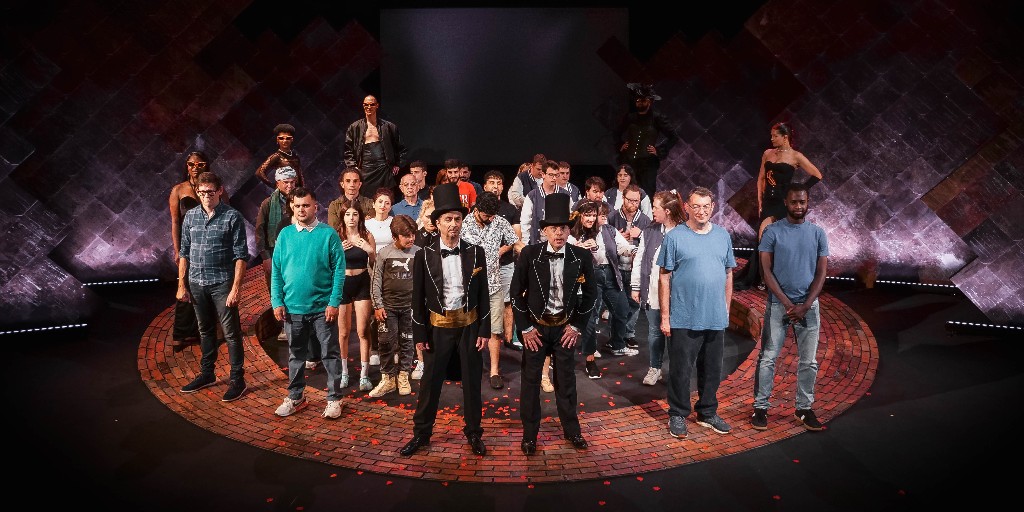
‘Truth’ or ‘Dare’ are representative of Theatr Clwyd’s investment in its local community. Each consists of five short plays, written by freelancers, performed by two teams of ten actors. The plays are given the full treatment, with two directors and two associate directors, two stage managers and two deputies and a good-sized creative team. No expense is spared.

You might think this would be high risk. Will anyone travel to see new work by unknown writers being staged on a Thursday night in a small town in north west Wales? Isn’t there a danger of having more people on stage than in the auditorium? This can happen but fortunately it doesn’t happen in Mold. Because of Theatr Clwyd’s reputation and its well established relationship with its audience, they turn out to see what is going on (including people who are still the right side of forty). Thus, on the Press Night for ‘Truth’ and ‘Dare’ there were well over a hundred people in attendance. The makeshift space, The Mix, Theatr Clwyd is using while its main house is being refurbished, was over three quarters full. The Mayor was there in person, too, wearing the chain of office.

The audience enjoyed the double bill. They laughed long and loud. They clapped vigorously. They cheered and gave the casts of both groups of plays a standing ovation. It was quite a night and refreshing to experience so much open enthusiasm and support. It wasn’t unlike being at a football match when the home team wins.

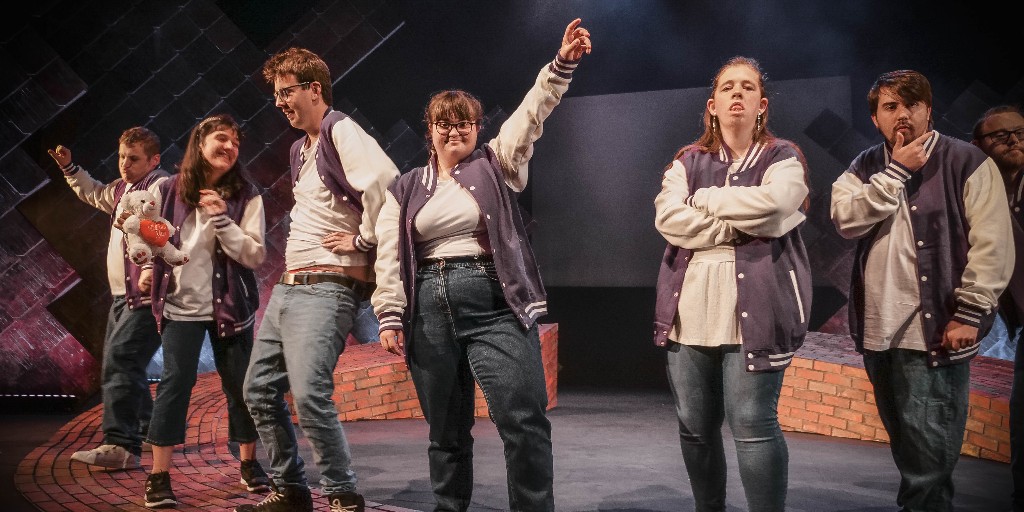
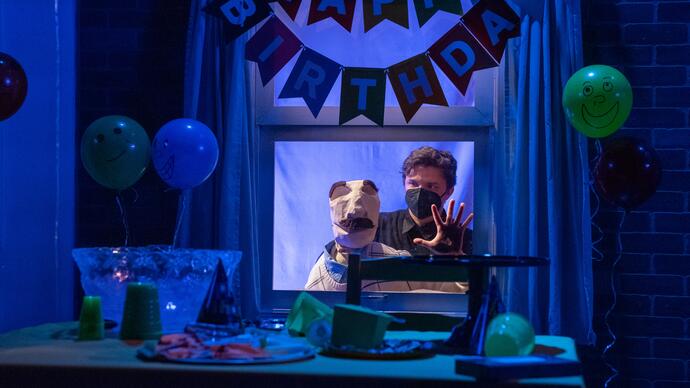
That said, I think what appealed most to the audience were the performers. The evening became a show case for the actors and the creative team behind them, i.e. they fully repaid the investment. I felt, however, that the performers were better than the material they were working with. I couldn’t understand the connections between the plays and Truth or Dare, for example, and I couldn’t find the comic centre or the joke in most of them. I missed the point of One Stop Short and didn’t see why a stuffed teddy duck had replaced a dog in This Time Next Week. I felt there was an absence of plot And The Crowd Goes Boom.

This could have been down to my lack of perception but what the actors were doing, on the other hand, I could relate to completely. They managed to extract every last drop of potential from what they had been given. Every traditional theatrical gag was included, up to and including ‘Take a Chair’ – (Exit with chair) (groan).

What the audience got was a high-octane display of the art of coarse acting which, in some cases, took farce to a new level. One feature of this was the incorporation of objects provided by the audience for the cast to use as key props. These objects had not been seen before the night, so the actors were required to improvise to incorporate them quickly into the scripts. Cue much mirth as a doorknob became a murder weapon and a toilet roll became a prized personal possession.

Perhaps it’s unfair to pick out individual performances, because the evening favoured the comics over their straight supporters, but Seren Vickers was astonishingly daft as James Bond in drag; Laura Dalgleish managed to do things with a dowsing stick that I can’t describe and Geraint Edwards managed to completely reinvent the whole business of sales and marketing. These three weren’t just over the top. They were somewhere else entirely. Leilah Hughes as an all singing, all dancing Barbie was not far behind them.

Whilst the plays themselves were a mixed bag of different styles and approaches, there were two – The Wake and Bwgan (The Ghoul) – which stood out by being more or less naturalistic. The former was a set piece in which two sisters argue over what they will each inherit from their (toilet roll fixated) mother. The latter was a kind of ghost story in Welsh, which provided Betson Llwyd with the opportunity to be suitably ghoulish and to perform a bravura solo monologue. The fluent Welsh she spoke added atmosphere and musicality to the story, as I don’t speak I inevitably had to look away from what was being done on stage to read the subtitles on the overhead screen. Lisa Jen Brown contributed a lot to the success of both these pieces.

The language of Bwgan and the approach adopted in the other plays, up to and including the audience participation, has its limits, however. I’m not convinced this programme could transfer or tour and enjoy the same level of success as it had at Theatr Clwyd. In the end, although it was enjoyable, it wasn’t very original. What I would like to see personally is the same level of talent and commitment invested in plays that capture the imagination. There are short comic plays by Chekov and O’Casey that would really come to life with this cast’s energy. The treatment could also be applied to work by Ionesco and more recent comic dramatists like Dario Fo. This creative team could easily tackle longer classic plays by Moliere or Goldoni.

Finally, it would also be good to see serious work – drama that is disturbing and intellectually challenging – replacing the preoccupation with going for laughs, which is something of an easy way out.

Of course, it’s not fair to compare the programme with material by the greatest European playwrights and it’s beside the point. What one would hope, though, is that Theatr Clwyd’s development programme does succeed in unearthing writers and scripts which will allow them to get beyond providing their audience with light entertainment and just tickling their fancies. On the basis of the good things that were in this double bill, that should be well within the theatre’s capabilities.

REVIEW Titanic The Musical, New Theatre Cardiff by Barbara Hughes-Moore

When the RMS Titanic sunk on its maiden voyage from Southampton to New York in 1912, it became instantly one of the deadliest peacetime disasters in history. Over 1,500 passengers were lost, and more than a century later, the fate of the ‘unsinkable’ Titanic continues to captivate the world, not least in James Cameron’s multi-Academy Award winning blockbuster that swept the Oscars in 1998. So epic was the film’s success that it (almost) eclipsed an adaptation that premiered on Broadway mere months before: Titanic The Musical, which docks at Cardiff for its 10th anniversary.

With music and lyrics by Tony Award-winning Maury Yeston (Nine, Phantom) and book by Emmy- and Oscar-winner Peter Stone (1776, Woman of the Year), Titanic The Musical follows the passengers of the White Star Line’s fateful ship. Unlike its big-budget younger brother, most of the musical’s characters are based on the real-life people who experienced the tragedy first-hand, from the three working-class Irish ‘Kates’ dreaming of a better life in the new world to the old-money couple who founded Macy’s department store.

It’s an unusual premise for a musical: how could any theatrical show convey the scale of such a disaster on the stage? Titanic achieves it and then some. The original Broadway production won five Tony Awards including Best Musical, Best Score and Best Book – and its easy to see why. David Woodhead’s set is a mechanical marvel while Yeston’s songs are sprawling and lush – when performed by the 25-strong ensemble, the music positively soars. The ship might be the star, but these actors are titans.

Their skill is showcased in the epic opening number, ‘Godspeed Titanic’, in which the passengers board the grand ocean liner for the first time. In doing so, it begins with the same exhilaration with which most shows end – more impressive still, it maintains that momentum. There are exuberant moments like the song ‘Lady’s Maid’, in which the third class passengers dream of new horizons, led by the luminous Lucie-Mae Summer. There are moments of connection, as between Alastair Hill as cheery wireless officer Harold Bride and Adam Filipe as crewman Barrett, where they marvel at how technology can bridge hearts a thousand miles apart. Valda Aviks and David Delve are funny, warm and affecting as the stately older couple who refuse to part. And Barnaby Hughes is fabulous as the haughty head butler while Joseph Peacock adds a cheeky charm as the spirited bellboy.

You might not expect a show about the Titanic to have much happiness, but Director Thom Southerland brings a lovely breeziness to moments of whimsy, like when busybody Alice Beane (a charming Bree Smith) gossips about the blue bloods on board to her loving, beleaguered husband (James Darch, on fine form). Southerland moves elegantly between these moments of delight and the encroaching drama: when the iceberg looms, it does so to the eerie melody of ‘No Moon’ – it’s as unsettling a moment as approach of the shark in Jaws. All credit to musical director Ben Papworth and the fantastic orchestra.

What the show does exceptionally well is prepare you for the coming tragedy without sliding either into maudlin doom and gloom or into ‘nudge nudge wink wink’ clue-dropping. The characters’ moments of joy, love and hope are given real poignancy, especially when you realise that they are based on real-life people and their stories. So when class-defying couple Charles and Lady Caroline (Mathew McDonald and Emma Harrold) sing of getting married as soon as they reach New York, we ache for them. And when Captain Edward Smith (Graham Bickley, masterful in the role) speaks of this being his last voyage before he retires – it gains a greater resonance. So, too, does the Ozymandian epic of ‘Mr Andrews’ Vision’ in which the Titanic’s architect (Ian McLarnon, breathtaking) watches his dreams – quite literally – sink before his eyes.

It also brings new insights into a story you might think you already know. Here, the relentless greed of White Star Chairman J. Bruce Ismay (a delectably pompous Martin Allanson), who scrimped on lifeboats to make room for more higher-paying passengers, may sound horribly familiar to us in our own time. Those who have the most – money, wealth, privilege – will always be the first on the lifeboats. Titanic The Musical gives voice to those left behind.

An unsinkable cast, an unbeatable score, and an unforgettable experience, Titanic the Musical is an emotional triumph of epic proportions – and, like the fabled ship, it must be seen to be believed.

Titanic The Musical is playing at New Theatre Cardiff from 9 – 13 May

REVIEW Roald Dahl’s Charlie and the Chocolate Factory: The Musical, Wales Millennium Centre

Sweets are miraculous inventions. With a little sugar and a dash of imagination, you can make something magical. It’s the sort of magic that suffuses Charlie and the Chocolate Factory, Roald Dahl’s classic tale of a young boy whose life changes when he wins a Golden Ticket to meet the Candy Man himself: eccentric and elusive chocolatier Willy Wonka.

https://www.youtube.com/watch?v=hX3lvcr8HQU

Originally made into the classic 1971 movie-musical starring Gene Wilder, the Leeds Playhouse Production now embarks on a grand UK Tour after successful stints on Broadway and the West End. Directed by James Brining and adapted by David Greig, Charlie and the Chocolate Factory is a feast for all the senses! Classic tunes ‘Pure Imagination’ and ‘The Candy Man Can’ sit along sumptuous new songs by Marc Shaiman and Scott Wittman, the duo behind the musical Hairspray, with orchestrations by David Shrubsole. It now comes to Cardiff’s Millennium Centre, which seems fitting given that it’s the hometown of author Roald Dahl.

The cast of Charlie and the Chocolate Factory: The Musical. Image Credit: Johan Persson.

The role of Charlie is shared by four actors (two boys and two girls) and was played on the press night by Isaac Sugden. He brings a real warmth to the role, caring and compassionate, and it’s a great choice to turn Charlie into an inventor-type who repurposes lost and broken things. His scenes with the wonderful Michael D’Cruze as Grandpa Joe are some of the show’s best, as are the scenes in the Bucket household. Christopher Howell, Kate Milner Evans, Emily Winter and Leonie Spilsbury beautifully portray the rest of the loving Bucket clan, and also double up as the beleaguered parents of the other four Golden Ticket holders, who are just as delectably loathsome as their sprogs.

Marisha Morgan and the cast of Charlie and the Chocolate Factory: The Musical. Image Credit: Johan Persson.

And boy do they get their just desserts! Marisha Morgan is on top form as Violet Beauregard a gum-popping poseur rebranded as a sort of obnoxious TikTok star. Robin Simões da Silva as Augustus Gloop, Teddy Hinde as Mike Teavee, and Emma Robotham Hunt as Veruca Salt (stepping in for Kazmin Borrer) bring real panache to their roles, while Ewan Gillies and Lucy Hutchison are delicious as dynamic TV duo Jerry and Cherry Sundae. Whenever each ‘bad egg’ is hoisted by their own petard, you know the Oompa Loompas are on their way for a musical ‘I told you so’ – here, they are reimagined as dancing automatons, lending a steampunk quality to Wonka’s factory that gives it a Metropolisesque edginess (and nimbly sidesteps the characters’ problematic origins). It’s their scenes that best showcase Emily Jane Boyle’s zesty choreo and Simon Higlett’s costumes, especially in the standout set piece ‘You Got Whatcha Want’.

Gareth Snook and the cast of Charlie and the Chocolate Factory: The Musical. Image Credit: Johan Persson.

And you’ll really get what you want with this show’s portrayal of Willy Wonka, played by the sublime Gareth Snook, who really makes the character his own. He’s got more layers than a Wonka Whipple Scrumptious Fudgemallow Delight: at turns sinister, sarcastic, and sweeter than an Everlasting Gobstopper. Plus, his rendition of ‘Pure Imagination’ was truly scrumptious!

Charlie and the Chocolate Factory: The Musical. Image Credit: Johan Persson.

The show is a candy-coated fantasy, featuring eye-popping visual effects and illusions courtesy of Simon Wainwright and Chris Fisher. The way they convey the factory’s myriad rooms, from the chocolate river to the fear tunnel, brings real spectacle to the stage. Choc-a-block with gorgeous sets, toe-tapping songs, and more sweetie puns than you can shake a (candy) stick at, Charlie and the Chocolate Factory is pure confection perfection!

Roald Dahl’s Charlie and the Chocolate Factory: The Musical is playing at the Wales Millennium Centre from 3 – 20 May 2023. More information on the show and how to book tickets here.

Review by
Barbara Hughes-Moore

Get the Chance supports volunteer critics like Barbara to access a world of cultural provision. We receive no ongoing, external funding. If you can support our work please donate here thanks.

Review Truth or Dare, Theatr Clwyd, Mold, April 27th-May 13th 2023 by Donna Williams

 out of 5 stars (5 / 5)

It’s only fair to take the time to look at these pieces as separate entities as, although as with the popular game we may have all played as teenagers, ‘Truth’ and ‘Dare’ go together hand in hand, these performances also offer the audience two different casts, a variety of plays and writers and a change in creative teams, all which must be applauded in their own right.

This concept has been built on Curtain Up, which was performed in September 2021, in response to the Covid pandemic. This production embraced many freelance artists and this time around, Theatr Clwyd has commissioned ten freelance writers to create ten brand new plays on the theme of ‘Truth’ or ‘Dare.’

Each of these brand-new plays is captioned in Welsh and English with the scripts being a mixture of English language, bi-lingual and Welsh language. It is so refreshing to consistently hear our native tongue throughout, yet it is easy to follow even for a non-Welsh speaker- and would be well suited to those learning Welsh.

We’ll begin with ‘Dare’ (mainly due to this being the first treat for audiences on this particular occasion). ‘Dare’ opens with ‘Barbie Butt’ written by Greg Glover and we go on to witness four other plays- ‘Show Us’ by Kallum Weyman, ‘This Time Next Week’ by Natasha Kaeda, ‘Annwn (Mold Gold)’ by Hannah Daniel and ‘And The Crowd Goes Boom’ by Bethan Marlow. It would be easy to give a summary of each play and choose the best bits but I encourage those reading this to go and experience ‘Truth or Dare’ for themselves as it’s clear that no one performance will be exactly the same each evening- not only dependent on the audience and their reactions but also down to the fact that audiences are encouraged to bring props for the actors to use in each play- changing up the delivery and the outcome of each piece every time! This provides a lot of laughter, not only for the audience but often for those on stage! Props during this evening’s ‘Dare’ range from a tin of Heinz baked beans to a fake, rubber poop! All of the performers must be praised, not only for their character work and scripted sections but also for their improvisation skills whilst dealing with an unknown item being inserted into the play with no prior warning!

‘Dare’ offered up so many laugh out loud moments- highlights being Geraint Rhys Edwards’ as ‘salesperson’ (absolutely hilarious and fantastic comic timing!) and Sara Harris-Davies’ poignant speech at the end of ‘This Time Next Week’- perfectly balanced reflection betwixt the brilliant comedy of the the rest of the piece.

After a slightly longer than usual break (which is a welcome change and chance for the audience to discuss what they have already seen as well as an opportunity to spin the ‘Truth or Dare’ wheel and pick the relevant card- my ‘Truth’ card asks ‘what is your guilty pleasure?!’ What a fun way to introduce some conversation starters to the interval!)

‘Truth’ commences with ‘One Stop Short’ by Alexandria Riley, ‘The Wake’ by Ceri Ashe, ‘Maternity Leave’ by Lucie Lovatt, ‘Bwygan’ by Melangell Dolma and ‘Two Parts Madness, One Part Mayhem’ by Christian Patterson. Where ‘Dare’ provides more laugh out loud moments, ‘Truth’ is more of a balance between sadness, darkness and ridiculousness! We move between themes of loss, bereavement, love and loneliness to the grand finale which certainly lives up to its name and is the icing on the cake! Again, there are lots of stand out moments and performances during ‘Truth’- Mirain Roberts and Lisa Jen Brown as feuding sisters who end up having to recapture a childhood performance from their days in the Eisteddfods at their mother’s wake to Francois Pandolfo as the over-the-top (but not TOO over-the-top!) grieving widow alongside Seren Vickers who just screams Rik Mayall! Again, audience props brought a unique flavour to each play- this time a window squeegee and a toilet roll amongst others!

‘Truth or Dare’ is a wonderfully entertaining evening at the theatre. A unique concept, an extremely talented cast and creative team and filled with moments of contemplation and plenty of giggles!

You can find out more information about the productions and book tickets here

‘Dare’

Cast
Ashley Mejri
Laura Dalgleish
Jake Sawyers
Victoria John
Kieran Bailey
Caitlin Drake
Leilah Hughes
Hefin Wyn
Sara Harris-Davies
Geraint Rhys Edwards

Creative Team
Director – Francesca Goodridge
Associate Director – Daniel Lloyd
Company Stage Manager – Cassey Driver
Deputy Stage Manager – Martha Davies
Prologue Writer – Matthew Bulgo
Set & Costume Designer – Millie Lamkin
Lighting Designer – David Powell
Sound Designer – Ben Morgan
Casting Director – Polly Jerrold
Producer – Jenny Pearce
Production Manager – Jim Davis

‘Truth’

Cast
Francois Pandolfo
Mirain Roberts
Gabin Kongolo
Lisa Jen Brown
Betsan Llwyd
Londiwe Mthembu
Elinor Larsson
Catherine Morris
Oliver Morgan Thomas
Seren Vickers

Creative Team
Director – Hannah Noone
Associate Director – Juliette Manon
Company Stage Manager – Alec Reece
Deputy Stage Manager – Amy Wildgoose
Prologue Writer Matthew Bulgo
Set & Costume Designer – Millie Lamkin
Lighting Designer – David Powell
Sound Designer – Ben Morgan
Casting Director – Polly Jerrold
Producer – Jenny Pearce
Production Manager – Jim Davis