
All posts by Hannah Goslin

[...]

Review, The Death of a Black Man, Hampstead Theatre, By Hannah Goslin

 out of 5 stars (3 / 5)

The title of this play, in itself should give you an inclining to its concept and writing. Blunt, dark, surely to take you by the lapels and shake you.

The Death of a Black Man, written by Alfred Fagon in the 70’s is a raw and laid bare story about black culture in the UK and the development of generations from the Windrush movement and London itself. There is no beating around the bush with this play and it takes a lot to sit and watch with its darkness seeping in slowly.

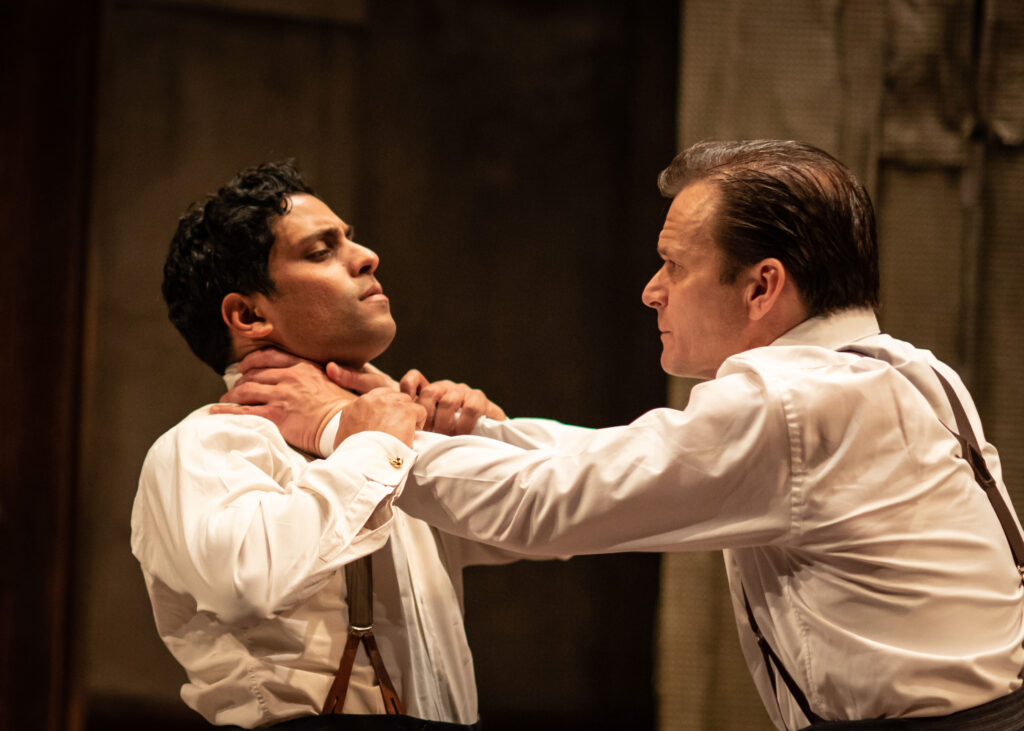
The Death of a Black Man tells the story of Shackie, his career development as a wheeler dealer in London, his battle with his own heritage and how far he will go to make it as a black man in a still very difficult and competitive society with race. Soon, his equally minded best friend comes along, selling his ideas and the two concoct ideas of exploitation of the white man, to make money but also to support black power. Starkly contrasted, Shackie’s older ex girlfriend appears, a black woman but from a middle class background, lacking an interest in her heritage and support of the movement. It is soon evident that these two will stop at nothing to make it in this world, even if it means betraying those in their own community.

Fagon limits nothing in this play. The language is of its time, with words and phrases perhaps not said today, making it shocking and at times awkward – but as this play grows darker and darker, this feeling is clever and well executed and only adds to the tension and the final crescendo. What is brilliant is there is nothing held back about Caribbean and London Black community culture, highlighting the development of these 2nd Windrush generations with their joint use of London and Caribbean phrasing and accents as they intertwine. As someone from neither community, this takes a little time to feel yourself in the swing of the writing and how it is produced but feeling the energy of those in the audience from these communities, it feels as if it is on point and reflective of those communities. It also gives a great insight into the culture of the time and how those communities were feeling, contrasting views between Shackie, who is happy to just create a career and utilise his heritage to get there; Stumpy who is a developing activist for Black Power with a underlying hatred for white people and the country he is in and Jackie, whose middle class background has washed away any interest in her heritage but who is as dark and cynical as the other two about life.

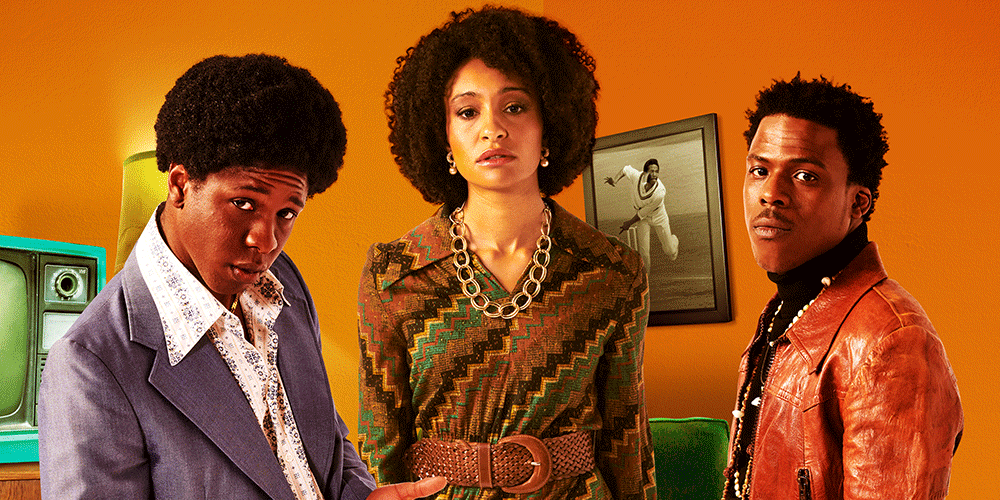
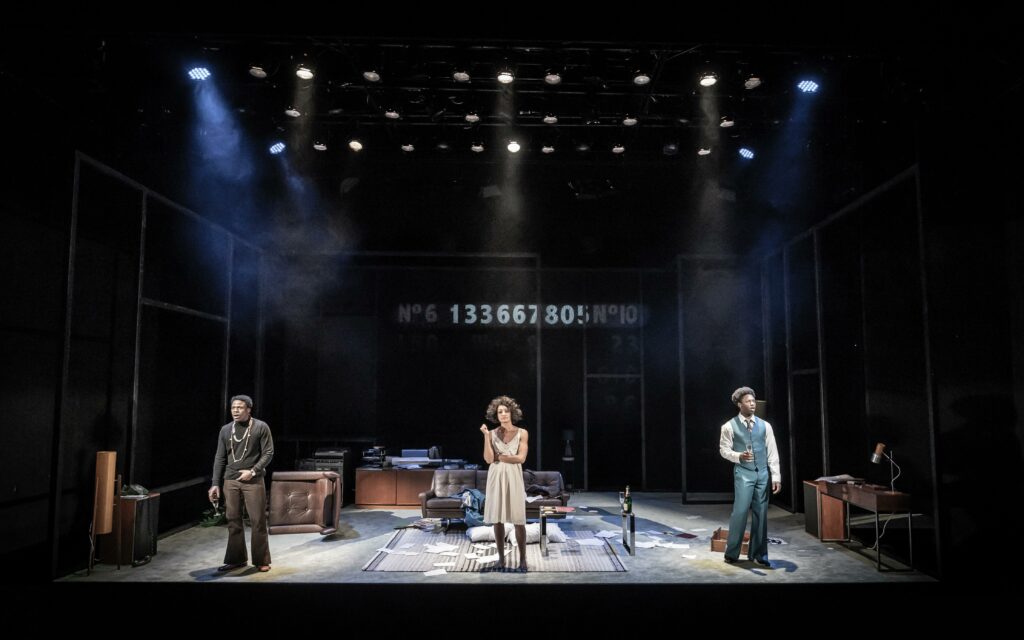
With only three performers, it felt as if we had cut away into this living room and was easily watching a normal conversation. Their acting was effortless and easy, with the added 70’s aesthetic making this feel like a piece of history. It felt very reflective of what you usually see at The Royal Court which is always very well done – something simple and naturalistic, with elements of theatricality bursting through. In this case, the conversation acts out naturally and a change of scene brings in the contrasting theatricality with music, lighting; the stage and scene changes before our eyes as the characters almost fasten up time, moving props and staging which would have happened naturally throughout several hours as they drink champagne into the night. The final part felt particularly theatrical, with naturalism taken away and symbolism and theatricality added to enhance the darkness of the writing.

My only critique is that it felt as if these natural, spoken scenes took too long and didn’t add or emphasise much by doing so. Fagon, sadly, writes about Shackie’s fathers death which unfortunately mirrored the writers own, little did he know. And while a brilliantly written play, it felt as if much of this production was trying to keep to its legacy, with a fear of maybe changing too much, cutting too much out or bringing it to the modern stage. Perhaps the fear of changing it and therefore it no longer being a homage to Fagon held it back in what it could have become. Points and elements, which as previously said were very much of the time, felt a little like it went over my head but I can definitely appreciate that this may be because I wasn’t alive in the 70’s to understand the references or culture, as well as the Carribbean/London Black Community not being my community. I would be really interested to hear from a reviewer of this community to know how reflective this really is and how it relates to the modern community.

The Death of a Black Man is interesting, it is dark, it is cleverly executed but something felt lacking and as if it really held back what is really possible with this production.
Review, Look Who’s All Grown Up, Abigail Chandler, The Space, By Hannah Goslin

 out of 5 stars (4 / 5)

In our industry, there is often questions, perhaps never elaborated on fully when it comes to what actors go through. This is even more troublesome and often taboo when it comes to young performers.

Look Who’s All Grown Up by Abigail Chandler lays the taboo and secrets bare, without letting you ignore or look away. A coming out story of sorts, we meet two young performers who have reached the point of changing in their personal lives from children to adults but also in their performance careers. Highlighting issues with puberty in both the personal and professional but also what this means for their development in both areas and how quickly things can change.

We see three viewpoints – from a male, from a female and from an LGBTQA+ person. All similar yet staggeringly different, the three character’s stories are compared and contrasted, in experience, in opportunities and also in the unspoken – the Me Too movement and its application to child stars of any gender, but what this also means when you yourself transition from being the child to the adult in awkward situations.

Look Who’s All Grown up is carefully constructed to ease you into this headspace, and so when things become heated or awkward, you feel it in your gut, yet cannot look away. The character of Felix particularly lays everything bare, with a sense of humour and it isn’t until later that you can really understand the trauma it has caused. You fall in love with him yourself, not only with Chandler’s writing but Daniel Bravo’s effortless acting, adding a level of whether this is okay in relation to the topic, seriously highlighting the issues between the transition of child actors to adult actors.

Caitlin, played by Kalifa Taylor also shows a very good contrasting character and her personal growth, from an anxious girl with mental health issues to someone confident, knowing her worth but perhaps escaping the stories we hear of sexual misconduct with women and young ones at that. It was refreshing to have a strong woman character, helping the male character when these stories are often over looked.

Look Who’s All Grown Up is quirky, it is humorous but also highlights important points that are rarely laid bare and hits you in the gut with these facts.

Review, Godot Is A Woman, Silent Faces, Pleasance Theatre By Hannah Goslin

 out of 5 stars (5 / 5)

Who would have ever thought that Samuel Beckett and Madonna would ever be thrown together in a play?

No one, till now.

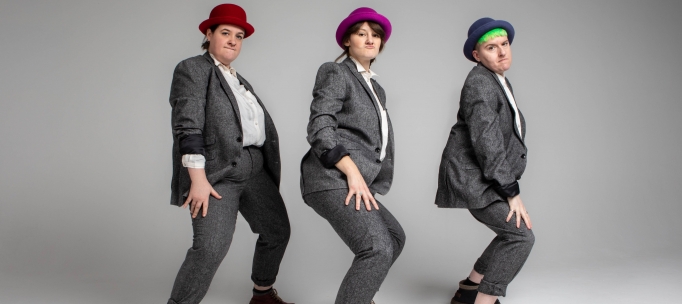
Godot is a Woman, by Silent Faces, is nothing short of a masterpiece. If, like me (and Silent Faces), you are a huge fan of Samuel Beckett, particularly his play “Waiting For Godot”, and a liberal feminist, then the title alone is enough to tickle your fancy.

I try not to read too much about a production or a company before I see a show. I like to be thrown in the deep end and figure it out for myself. No presumptions or expectations. And am I glad I did for this one.

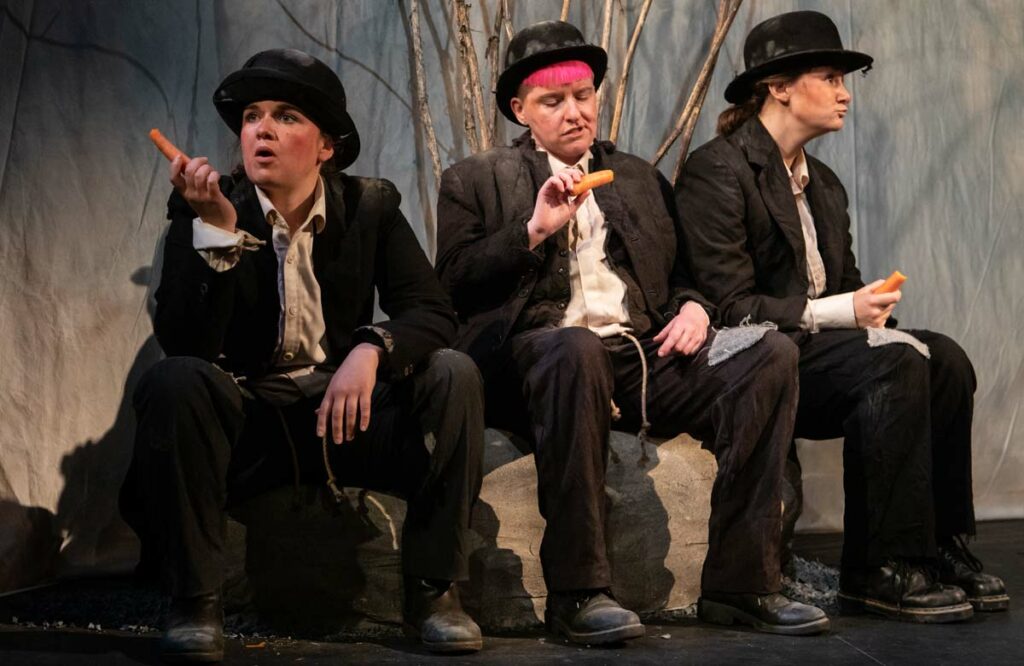
We meet 3 performers who want to put on Waiting For Godot. They reflect the original play by waiting for the Beckett Foundation to answer their call for the rights. As time goes by, the 3 battle with the reasonings on why they would be refused, a lot stemming from past beliefs in society, and hugely and predominantly focused on gender politics.

There’s an element of people who have a love/hate relationship with someone. Beckett, while a brilliant writer, specified that Waiting For Godot could not be played by females or anyone other than male, to loosely include non-binary people; I say loosely as this was never specified, in the terms of “Only a male can play these roles” way. This is thrown out in the open and discussed through performance – and it makes you feel something not necessarily easy about your own love for the play and playwright but in a good way, because it is important to address.

Silent Faces evoke the pauses, the silence, the staccato word play of Beckett when working through these thoughts. They bring in hilarious and highly hammed up characters in a pretend court room to highlight different facts and fables from both sides of the argument which in itself highlights the ridiculous nature of even having to argue gender for a play about self discovery.

They bring in elements that bring the whole play into the 21st century – instead of waiting for a person, they wait by a telephone that has a recorded message while they wait alerting them to the website. They bring in almost Brechtian elements, surprising us with dancing and music, such as Madonna, that would never have been seen in the style of Beckett. They give us a brief history of feminism and gender equality through music, dance and summaries of important elements from selected years e.g. Harvey Weinstein and the Me Too movement, androgynous celebrities and so on. And most importantly, highlights are brought onto Non-Binary persons. A exploration of the Beckett foundation’s elimination of anyone not male playing these faithful parts, including those who do not identify as either male or female and whether this is a sign of the times or something more. Again, we are thrown into history, learning something new about gender politics and how non-binary has been in lots of different cultures for thousands of years and that changing in times is not an excuse.

Godot is a Woman is hilarious, insightful, polished, educational and a brilliant production. While you feel a little uneasy as a Beckett fan, the fact it makes you question society and whether his approach would have changed makes it all the more interesting, making you further question the world we are in and the arts sector.

Review, The Producers (No, Not That One), Pleasance Theatre

 out of 5 stars (5 / 5)

After 1 year of ups and downs in our industry, I cannot tell you how excited I was about tonight.

The brief period that we returned to Theatre near the end of last year felt like part of me returned but to be shut down again was hard for everyone. Suddenly, we are working our ways back and gosh, doesn’t it feel good.

What better way to celebrate our return than with The Producers (No, Not That One) at the Pleasance Theatre. With all proceeds going to the #TheatreArtistsFund, we were entertained with a cabaret style show full of talent, of fun and of joy while supporting those who have had a really difficult year.

While many, bar a couple of the performers, were new to me, we all laughed, we all felt comfortable and in tune with one another and it felt like a family enjoying a common love. To be back in a fringe venue felt like a homecoming amongst friends.

The Producers was as it says on the tin: A culmination of some of London’s finest Theatre Producers showcasing what else they can do. Often, we are all known in this industry as jack of all trades: giving our hand to a number of different elements (myself included) and often this is from starting with our love of the Theatre, perhaps to be performers and finding that our passion and talent in also in many other elements.

We were treated to wall shaking singing, some hilarious comedy, a circus routine, wonderful piano and a Host full of love and laughter. Every single person was full of talent and showcased that everyone from in the background to the forefront are full of talent and skills.

I could not imagine more of a perfect show to come back to, with our World returning somewhat back to how it was , than to bring some of the backbone of our industry and celebrate their talent as Producers but as performers.

Review, Faina and The Snow Beast, Scratchworks Theatre Company and Jack Dean, By Hannah Goslin

 out of 5 stars (4 / 5)

This year has been the year of the audio. Scratchworks Theatre Company have brought their original stage play, written by Jack Dean to an audio tale with accompanied Science experiments for children.

Combined in a couple of audio sections, Faina and The Snow Beast features the tale of an Orphan, Faina, who dreams of becoming a scientists. Raised by the owl who found her abandoned, Maud, who believes in the magical and extraordinary, the two, with the help of Faina’s mother’s journal, undertake the most exciting adventure full of trials and tribulations to find The Snow Beast.

The story is very easy to get into. Able to download, you can dip and dive into the story whenever you want to. With the talented voices of Scratchworks, a range of different character’s are animated within our consciousness with the use of accents and skillful voice acting, evoking images and fueling our imaginations of the character’s and their adventure.

Known for their brilliant voices and musical styling, Scratchworks bring in magical yet homely and folk like music to accompany the story, making the atmosphere and the story feel sensational, with a Disney-like quality to the story in drumming up visions of the adventure.

Punctuated with their science pack, children are able to listen to the story and are encouraged and inspired to follow Scratchworks and make their own scientific experiments. The story highlights that science and the extraordinary are not necessarily different to one another. Maud states something along the lines of why should you only have the choice of belief in science or of the magical and unusual. By bringing the two together in a theatrical story telling and with science to attempt, children and adults alike can enjoy the magic of science and stories.

Faina and The Snow Beast aims itself at children, but adults are also fully taken away to far away lands, flying in hot air balloons and feeling the blizzardy atmosphere The Snow Beast creates. A joyous and sensational story.

Review, The Dumb Waiter, Harold Pinter, Hampstead Theatre, By Hannah Goslin

 out of 5 stars (4 / 5)

In a Covid world, when we thought that Theatre was losing its life, out comes Hampstead Theatre with their revival of The Dumb Waiter.

A long time fan of Harold Pinter from my study days, I am always intrigued with how his plays are performed and how the director has interpreted the piece.

Well known for his unusual yet naturalistic narratives and inclusion of his infamous pause, Pinter creates tension and atmosphere merely with his writing. Something so specific is always difficult to direct as your own and to bring something new. But Alice Hamilton achieves this while still keeping the Pinter essence.

The Dumb Waiter is the story of two men contained in one room, where their quite peaceful lives waiting for their boss to action their job is interrupted by a dumb waiter with unusual requests.

Hamilton, along with the actors Alec Newman (playing the character of Ben) and Shane Zaza (Gus) take on this funny, awkward and fantastically written play and run away with it. The purposeful silence never feels rushed, nor does the action; the pauses adds an atmosphere, a tension, and even at times, comedy.

Newman and Zaza in themselves are brilliant. Not only keeping to Pinter’s techniques, they embody their characters, to a point where we feel as if we really are intruding into this singular room and the unusual activities. Newman is content, calm, pristine – his newspaper is folded carefully and collected, his bed is tidy, even putting his clothing out is done slowly and precisely. Zaza in comparison is a little more energetic, messy, wired and this informs the action later on when the orders from an unknown entity come it; Zaza is heightened in his emotions and soon the unknown rocks the cool and collected Newman.

A short play, The Dumb Waiter felt as if no time had passed yet all the the time in the World had as it was so enjoyable to watch. In a time of uncertainty, something full of simplistic comedy, of simple yet effective design and so well acted and directed is what we clearly need.

Review: too pretty to punch, edalia day, vault festival by hannah goslin

 out of 5 stars (4 / 5)

Edalia Day has brought a very unique and very interesting
production to the forefront at this year’s Vaults.

Beginning slow and slightly awkward, Day seems nervous and
uneasy in this plain white room. Soon we are to realise, this is very much a
clever theatrical technique to their story and very much the beginning of
something special.

Too Pretty To Punch brings Day’s autobiography to the stage.
Identifying as trans, Day transforms the stage into their life story, the
trials and tribulations and turmoil in accepting who they are and seeking
acceptance in society. It then continues into a widen view of the issues trans
people face and eventually brings in verbatim videos to others facing the daily
obstacles.

It would be easily and still powerful to have used these
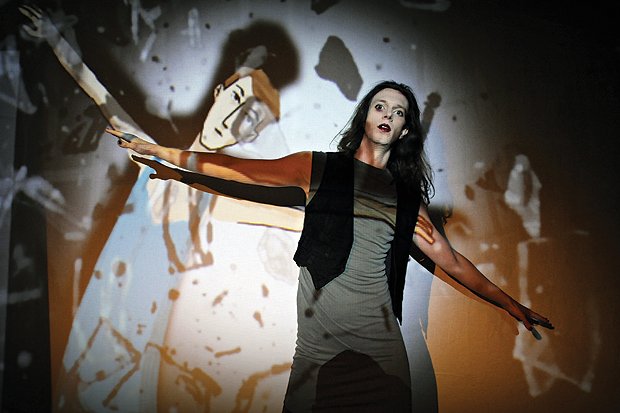
videos to support Day’s points, but they go the step further – animation is
projected onto screens, one an ordinary square screen, another slightly
misshapen and another as a moveable canvas. These are used to flick between
images and animations as they move across the stage, along with physical
theatre by Day, making the action come to real life in our eyes.

Some of the performance feels like we are getting to know a
new friend – Day addresses us and talks to us like a new friend being made, but
then some poignant moments being transferred into visual elements adds a unique
and clever nature to this production and hits the points home.

Supported at times with kitsch music that reminds me of
Golem by 1925, this makes the production feel a little special and like nothing
on the theatre scene right now.

Too Pretty To Punch is not only a really important production to see but is also one of the most unique and fascinating pieces of theatre I have seen in a long time.

Review: Animals, Conscious/Unconscious, Vault Festival By Hannah Goslin

 out of 5 stars (3 / 5)

What can I say that drew me to this production? Ultimately
that the show image is of two men in the nude hiding their gentlemans and
looking like they are loving life.

Animals is the story of two cousins, a long way from home,
trying to make a life in London. They enjoy drugs, music and cheese. They enter
moments of absurd hallucinations, finding the meaning to life but ultimately
gaining a new love for their friendship.

Animals is an interesting production; mainly consisting of a
duo doubling up on characters, there’s an element of The Inbetweeners, with
rude jokes, silly humour and really unique moments of comedy.

It took me some time to get into the rhythm of the
production and understand its niche concept, but equally there were moments of
comical genius and once I understood the approach, it became more enjoyable.

The two performers play very good parts; similar yet very
different, there was a naturalism to their performances, even as hallucinated
characters, and the chemistry between them was relaxed, bouncing off one
another with ease.

I am not sure where this production can and should go, but
it felt much as if there needed a bit of development and perhaps a moral
direction to the narrative.

Animals is comical, enjoyable and unique. While I wouldn’t say that this is a must see production at the moment, I would say that it is however a good laugh and an easy production when you’re not in the mood for anything too heavy.

Review: LIFE: The Gameshow, Dave Bibby, Vault Festival By Hannah Goslin

 out of 5 stars (4 / 5)

Take audience participation, the hilarious parts of life and
throw in two comedians and you get a whole hour of a great night out.

Dave Bibby, in his new show, takes his usual love of getting
the audience involved and on stage and transports us through elements of life,
competing to be the better sex.

Games range from releasing blown up balloons, representing
our first poo as babies, to scooting along our bums in our first car, to losing
our virginities with slinkies. The inventiveness and creativity of the games
and their representation is unique and clever, leaving us laughing firstly at
the intelligent creations but also gearing us up for how the ordinary human
completes such a task.

Bibby is totally honest with us, finding elements hilarious,
turning any “mistakes” (as this is a show in progress) into a hilarious
addition, and picking up or moving along the action with ease and confidence.
We feel safe and well within his hands but happy to make fools of ourselves and
join together to cheer on strangers.

Life: The Gameshow is exactly what we need in these uncertain times; a moment to relax, have fun, be pleasantly surprised but also to join together for common enjoyment.

Review: Message In A Bottle, Peacock Theatre, By Hannah Goslin

 out of 5 stars (5 / 5)

I am going to be honest with you dear readers, I was rather dubious about Message In A Bottle.

I’ve never been a huge fan of Sting or The Police, but the fact this was another dance production by the wonderful Katie Prince of Zoonation fame (of which I am a fan) I was really intrigued with how the two could combine.

A really poignant story, Message In A Bottle focuses on a family torn apart from war and disaster, facing a life of a refugee and starting life again. A story that has often hit our newspaper headlines and breaking news articles on TV.

Zoonation has been known for its comedy – taking existing stories and giving them a comical yet urban feel to them. This production from Prince is something so different and dare I say it, my favourite to date from this choreographer and director.

Somehow the music from Sting fits every scene so well, without much change to the music, the world this family exist in feels almost alien and somehow the electronics of his songs, and the earthly beats of others just fit so well to the story and the characters.

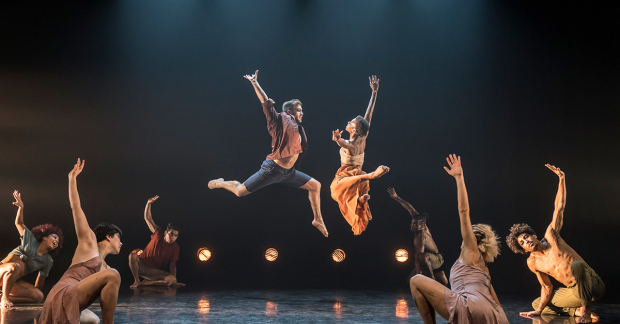
The dancing, of course, is flawless and awe inspiring as Prince’s work always is. It is great to see her branch out even more with choreography – previous work lending to the fact it is urban, a hip hop version of a story; this production has these moments, but there are also beautiful contemporary moments, really showing the skills and versatility of each dancer.

And a review cannot be written without mentioning the set – a combination of multimedia usage with projections, a cubed stage where the background is ever changing, costumes that just fit effortlessly with the colour schemes and the lighting effects that are those I haven’t seen before in a show but also manage to include us the audience – an absolute triumph.

Message In A Bottle is an absolute masterpiece. It is everything from a dance show and more, and somehow, if you weren’t a fan of Sting or The Police before, you will now have them on repeat.

Complete perfection.