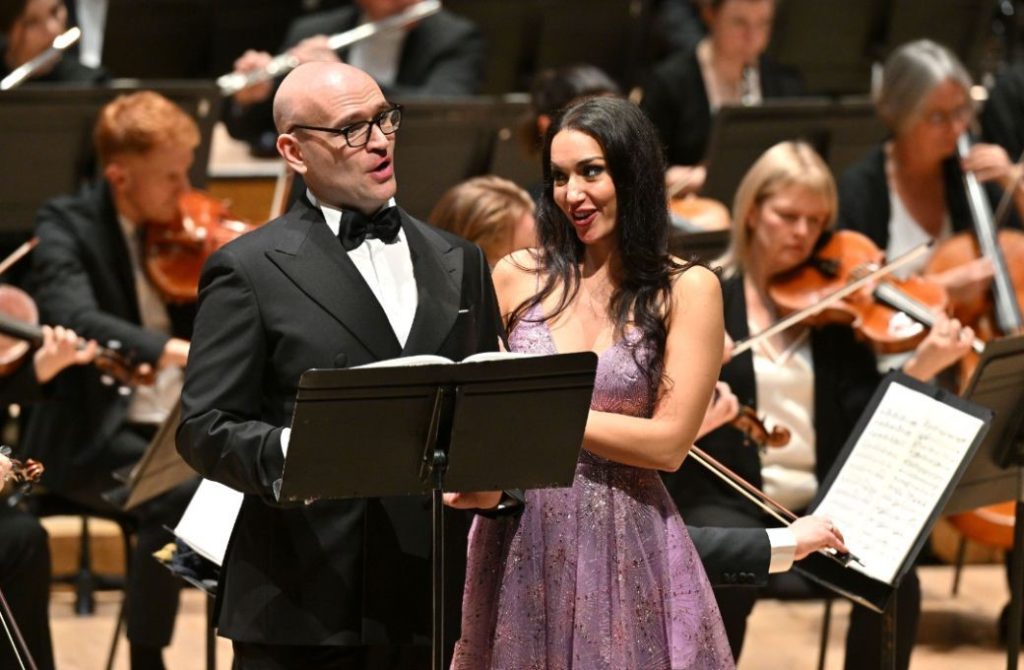
An all female driven programme is appealing with the build up to International Women’s Day around the corner. Cecilia Damström had a UK premiere with ICE. A fine little opener, the lone vibraphone and dense orchestral textures had a decent amount of unease. Blood curdling strings would offer severity to the pot, Damström clearly likes both worlds of music making: experimentation and more conventional forms. The addition of a bike bell is certainly unique!
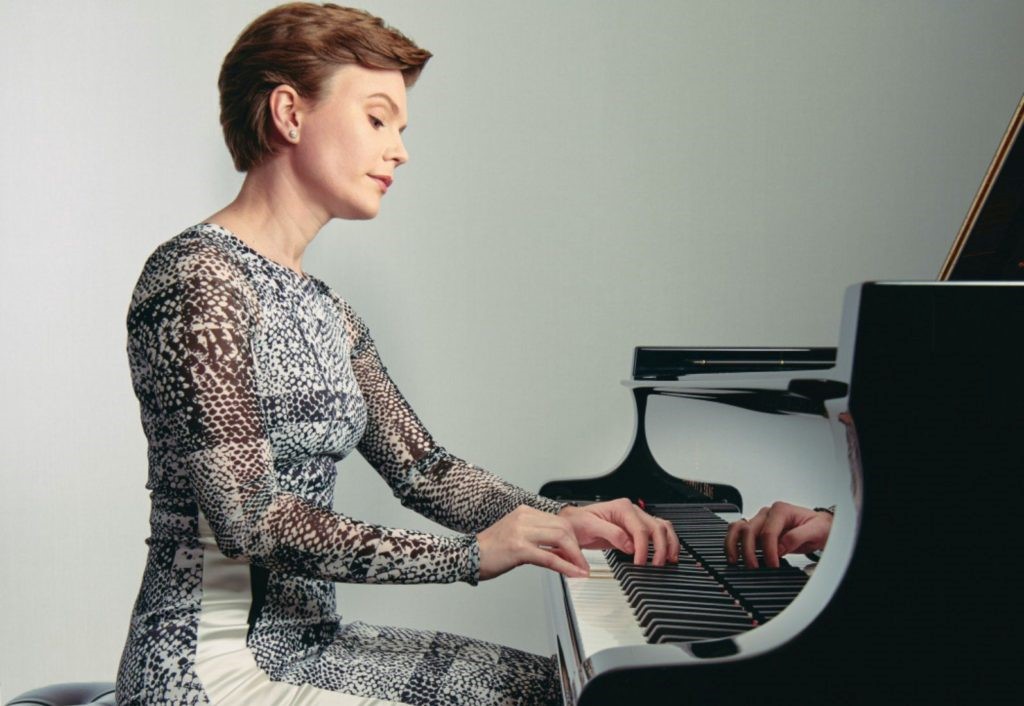
It’s always a pleasure to see Clare Hammond back in Cardiff. A pianist of great renown, the chance to hear a world premiere should have been blockbuster. The Piano Concerto from Ninfea Cruttwell-Reade had smatterings of Ravel and Thomas Newman. Strangely, as the orchestra geared up to present the opening cadenza for Hammond, she played tutti with the orchestra. It was underwhelming, you could barely find her playing audible in the fray. These issues would continue throughout and as it went on, there was not a lot that stood out. A slow movement which went on too long, a fairly passable finale and an all round uncertainty over this being an actual concerto were the concerns.
Maestro Emilia Hoving offered up elbow flexing conducting. She is very watchable in charge, her endorsing of Grace William’s and her 1st Sympony had more allure. ‘Grace’ (as this concert has been titled) proved to be one of the finest composers from Wales in the last century. Also known as the Symphonic Impressions, this has promise (she would go on to write another symphony and plenty more orchestral work). Though…this is not really to my taste. A trumpet solo is extensive, the sense of alarm and clinging to Romantic sensibility are it features. It is very busy with its focus, never clear in mood nor pacing. A great amount of ‘searching’ seems to have gone into this, to create a symphony which for a first effort is fine, but needed more balance.
Mae Gwobrau Effaith Ddiwylliannol Get The Chance 2025 yn dathlu gweithgarwch diwylliannol o safon uchel sy’n cyrraedd ystod eang o’r cyhoedd a’i effaith gadarnhaol ar ansawdd eu bywyd.
Bydd y seremoni wobrwyo yn cael ei chynnal yn Porter’s Cardiff, Caerdydd ddydd Sadwrn, 22 Mawrth (5-7pm). Bydd gwahoddiad i gynrychiolydd o bob sefydliad/unigolyn enwebedig fod yn bresennol.
Bydd yr enillwyr ym mhob categori yn cael y cyfle i greu ffilm broffesiynol fer sy’n amlygu eu gwaith. (yn amodol ar gadarnhad)
Mae’r Gwobrau’n cael eu cefnogi gan Tempo Time Credits a Porter’s Cardiff. Dywedodd Rachel Gegeshidze, Prif Weithredwr Tempo Time Credits:
“Yn Tempo, rydyn ni’n credu y dylai diwylliant, y celfyddydau, a threftadaeth fod yn hygyrch i bawb, ac rydyn ni’n hynod falch o fod yn cefnogi Gwobrau Effaith Ddiwylliannol Get The Chance 2025. Gwirfoddolwyr yw asgwrn cefn ein cymunedau, a thrwy Time Credits, rydyn ni’n cydnabod ac yn gwerthfawrogi eu hamser, gan agor drysau i brofiadau newydd. Mae’r gwobrau hyn yn taflu goleuni ar y mentrau diwylliannol anhygoel a’r gwirfoddolwyr sy’n rhoi o’u hamser i wneud gwahaniaeth go iawn i gymunedau a bywydau pobl. Mae’n fraint, felly, i ni ddathlu’r unigolion a’r sefydliadau sy’n arwain y gwaith hwn.”
Rachel Gegeshidze, Prif Weithredwr Tempo Time Credits
Dywedodd Dan Porter, Cyfarwyddwr Porter’s Cardiff:
“Fel lleoliad, rydyn ni am barhau i fod yn ymrwymedig i artistiaid newydd, y rhai sy’n dod i’r amlwg, a’r rhai sydd ddim yn cael eu cefnogi.Rydyn ni’n falch o gefnogi Gwobrau Effaith Get The Chance a’r hyn y gallwn helpu eraill i’w gyflawni yn Porter’s Cardiff.”
Dan Porter, Alice Rush a Frankie-Rose Taylor
(Llun: Moreton Brothers)
Mae’r gwobrau’n gyfle gwych i ddathlu effaith y ddarpariaeth ddiwylliannol yng Nghymru yn ystod 2024. Mae llawer o’r categorïau unigol yn cael eu noddi gan amrywiaeth o gefnogwyr prosiect.
*Cysylltwch os oes gennych ddiddordeb mewn cefnogi’r digwyddiad hwn
Ceir rhagor o wybodaeth am y Categorïau a’r broses enwebu isod:
Meini prawf
Nod y gwobrau hyn yw amlygu ac arddangos natur fywiog ac amrywiol diwylliant, treftadaeth a’r celfyddydau yn ein cenedl bob blwyddyn
At ddibenion y gwobrau hyn, mae gennym ddiffiniad eang o ddarpariaeth ddiwylliannol sy’n cynnwys gwirfoddoli cymunedol gyda’r celfyddydau, addysg a threftadaeth. Bydd enwebiadau yn adlewyrchu amrywiaeth o feysydd ym mywyd diwylliannol Cymru. Gall unigolion neu sefydliadau enwebedig fod yn wirfoddol neu’n broffesiynol. Rhaid i bob parti a enwebir ddod o Gymru neu wedi’i leoli yng Nghymru ar gyfer y rhan fwyaf o’i weithgarwch creadigol a’i faes enwebedig. Y cyfnod sy’n berthnasol ar gyfer enwebiad yw 1 Ionawr–31 Rhagfyr 2024.
Pwrpas y gwobrau hyn yw codi ymwybyddiaeth o weithgaredd diwylliannol o ansawdd uchel sy’n cyrraedd ystod eang o’r cyhoedd, yn ogystal â’i effaith. Rhoddir ystyriaeth ddyledus i adnoddau’r gweithgaredd creadigol a’i effaith ar y cyhoedd.
Rhaid i bob gwaith fod â chysylltiad Cymreig cryf, a bydd hyn yn rhan o’r broses sgorio.
Mae’r ffurflen enwebu yn y ddolen isod.
https://forms.office.com/e/MFiTvHPSXy
Categorïau
Digwyddiad Cyhoeddus
Disgrifiad: Dyfernir i gynhyrchiad, arddangosfa neu ddigwyddiad diwylliannol cyhoeddus sy’n dangos uchelgais a safon artistig uchel sy’n cysylltu â’r cyhoedd. Dylai’r gweithgaredd fod wedi cael ei gynnal a’i gynhyrchu gan bobl greadigol o Gymru.
Ystyriaethau
Pa effaith gafodd y Digwyddiad Cyhoeddus hwn ar y cyhoedd?
Sut mae gan y digwyddiad safon artistig uchel amlwg; a gafodd adolygiadau, sylw yn y wasg neu wobrau diwydiant?
Cyrraedd cynulleidfa – tua faint o bobl a welodd y digwyddiad ac a gyrhaeddwyd unrhyw grwpiau penodol megis plant a phobl ifanc ac ati?
Cyrraedd cynulleidfa – o ble ddaeth cynulleidfaoedd? A aeth ar daith neu a oedd yn ddigon mawr i ddenu pobl o’r tu allan i’r ardal lle cafodd ei pherfformio?
2. Person Creadigol y Flwyddyn
Disgrifiad: Dyfernir i Berson Creadigol sy’n dangos y safon artistig uchaf mewn gwaith sy’n cael ei greu a/neu ei arddangos, ei berfformio neu ei arddangos yn gyhoeddus yng Nghymru.
Ystyriaethau
Pa effaith gafodd gwaith y Person Creadigol hwn ar y cyhoedd?
Sut mae’r Person Creadigol wedi dangos safon artistig uchel; a gafodd ei waith adolygiadau, sylw yn y wasg neu wobrau diwydiant?
3. Prosiect Cymunedol ac Addysgol
Disgrifiad: Dyfernir i brosiect cymunedol, cyfranogol neu addysgol e.e. côr, dawns, theatr, celfyddydau gweledol neu grŵp treftadaeth sy’n cynnig mynediad rheolaidd, cynhwysol at ddiwylliant i bobl leol.
Ystyriaethau
Pa effaith gafodd y prosiect cymunedol, cyfranogol neu addysgol ar y cyhoedd?
A gafodd y prosiect adborth cadarnhaol a boddhad gan gyfranogwyr?
Faint o bobl gymerodd ran?
Oedd y prosiect yn gynhwysol? Er enghraifft, a oedd yn cefnogi pobl o gefndiroedd amrywiol neu’r rhai ag anableddau neu na fyddai, am resymau eraill, yn cael y cyfle i gymryd rhan fel arall?
A gafodd y prosiect unrhyw sylw cadarnhaol yn y wasg, adolygiadau, gwobrau eraill neu gydnabyddiaeth?
A wnaeth y prosiect gydweithio â sefydliadau eraill?
4. Hwylusydd y Flwyddyn
Disgrifiad: Dyfernir i hwylusydd diwylliannol, athro neu ymarferydd sy’n arwain prosiectau cymunedol, cyfranogol neu addysgol cynhwysol yng Nghymru.
Ystyriaethau
Pa effaith gafodd gwaith yr unigolyn ar y grŵp neu unigolion?
Unrhyw adolygiadau, sylw yn y wasg, gwobrau eraill neu gydnabyddiaeth?
Unrhyw adborth gan bartneriaid neu gyllidwyr?
5. Diwylliant a Iechyd
(Noddwyd gan Christine O’Donnell)
Disgrifiad: Dyfernir i brosiect, digwyddiad neu gyfres o weithdai diwylliannol sy’n cefnogi pobl sy’n byw yng Nghymru i wella eu hiechyd a’u lles.
Ystyriaethau
Pa effaith gafodd y prosiect ar ei gyfranogwyr
Faint o bobl gymerodd ran?
Sut cafodd y prosiect/digwyddiad effaith gadarnhaol ar iechyd pobl?
Unrhyw adborth/tysteb gan gyfranogwyr?
A oes unrhyw ffyrdd y mae’r gweithgaredd wedi lleihau dibyniaeth ar wasanaethau eraill fel y GIG?
Sut defnyddiodd y prosiect ddiwylliant a chyfranogiad?
Unrhyw adolygiadau, sylw yn y wasg, gwobrau/cydnabyddiaethau eraill?
Unrhyw adborth gan bartner?
6. Hyrwyddwr Diwylliannol
(Noddwyd gan Tempo Time Credits)
Disgrifiad: Dyfernir i unigolyn o’r gymuned greadigol, e.e. gwirfoddolwr, gweinyddwr, technegydd, curadur neu aelod bwrdd y mae ei waith yn gwneud cyfraniad cadarnhaol mawr at fywyd diwylliannol y genedl
Ystyriaethau
Y prosiect/digwyddiad/gweithgaredd/arddangosfa fawr y mae’r unigolyn wedi chwarae rhan arwyddocaol ynddo neu ynddi a beth fu effaith ei rôl?
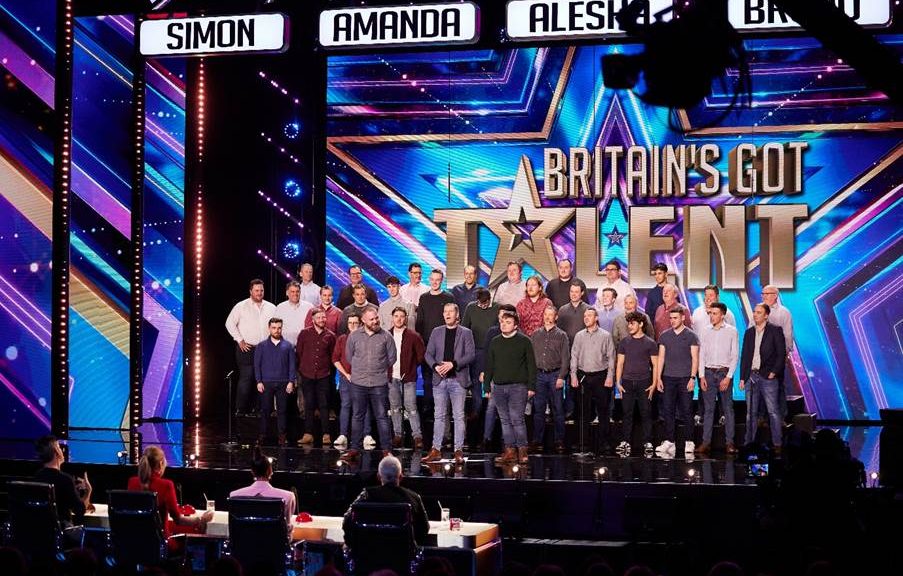
Last week I had the immense honour of interviewing Aled Phillips, founder and director of the award – winning (and BGT semi-finalists!) Welsh male voice choir – Johns’ Boys, in the midst of a UK Tour.
How did the choir start?
The choir came together in 2016 to perform choral arrangements by two local composers in our village—both of whom were named John! As I walked onto the stage to conduct the concert, I suddenly realized I hadn’t thought of a name… and that’s how Johns’ Boys was born. I still get so many emails starting with ‘Hi John’!
What was the experience of being on BGT (auditions and live semi-finals) like for you?
BGT was an incredible experience—truly surreal. You never know how the audience will react, so to see everyone on their feet and receive such amazing feedback from the judges was unforgettable. Then, being invited onto national TV and even getting a personal message of congratulations from Calum Scott was unbelievable. The impact was immediate—travelling to London the next day, we saw the numbers rising from Wrexham to Euston at every stop -another million people had watched our audition. It was a moment we’ll never forget!
Aside from BGT, have there been any other highlights for the choir?
In 2019, we became the first British male choir to be crowned Choir of the World at the Llangollen International Eisteddfod—undoubtedly the choir’s biggest achievement. Winning such a prestigious competition was an incredible honour. Other standout moments include performing at the Last Night of the Proms and the Royal Variety Performance at the Royal Albert Hall—both unforgettable experiences that showcased the choir on some of the world’s most iconic stages
Have there been any major challenges/setbacks?
The shift in running the choir has been incredibly challenging. I was a music teacher for over 15 years, but the sheer amount of work needed to manage the choir meant I had to step away from teaching. Now, my days are filled with organising concert venues, responding to emails from all over the world, booking hotels and transport, and arranging music for new shows and another EP. It’s a huge task, but seeing what the choir has achieved makes it all worthwhile. For the lads, I’d say the biggest challenge is balancing choir with work and family commitments—it’s tricky, but their dedication and passion make it possible-
What’s your favourite song/piece to perform as a choir?
That’s a tricky one for me to answer because when I listen to the choir in concert, I have three caps on—the conductor, giving direction to the performance; the arranger, who has written the songs; and the manager, watching the audience’s reactions. As a conductor, the best piece to lead is Surge Illuminare—it’s a full workout! As an arranger, I’d have to say our BGT audition arrangement of Biblical, which has had over 20 million views worldwide. And in terms of audience reaction, it’s a close call between Bread of Heaven and Myfanwy, with Angels thrown in too!
https://youtu.be/RKYiTw-dRUU?si=Wcqq5N7-_nVWYpRI
What’s next for Johns’ Boys post – tour?
The choir is currently in the middle of recording our second EP and preparing for our first foreign tour to Canada. Next, I’d love to extend the tour even further! But beyond that, a dream of mine is to create a musical set in a Welsh pub, with a piano in the corner and a jukebox. Picture all the lads sitting on stools, chatting about life in Johns’ Boys! I’ve got it all planned out… now I just need someone to write it—and pay for it! We’re also starting up a Junior Johns’ Boys Choir to give young people in the area a chance to be part of this wonderful story. It’s not just about inspiring the next generation but also ensuring a strong future for the choir. We want to pass on the passion, talent, and camaraderie that make Johns’ Boys so special.
https://youtu.be/Ef_20UzZJ_s?si=crOwyTZopthcf0__
The Choir will be performing in Wales this year on,
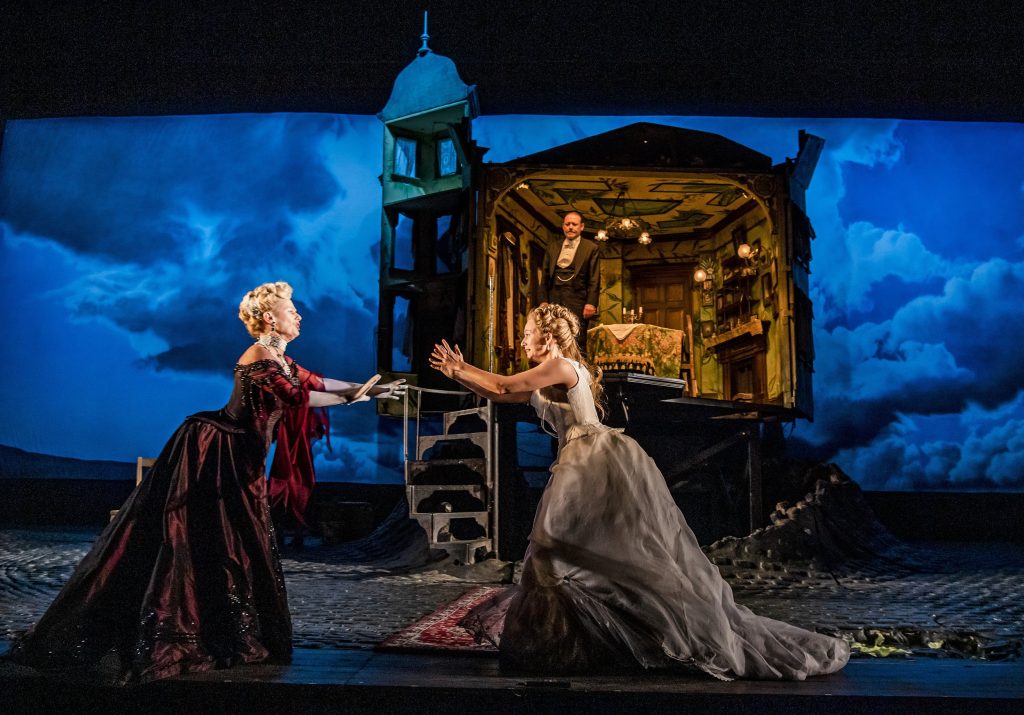
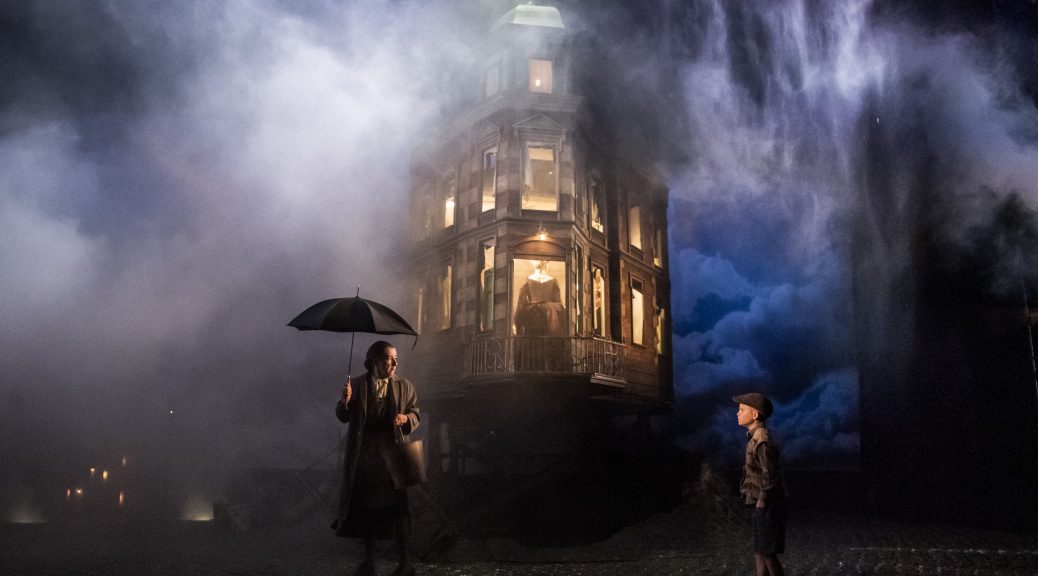
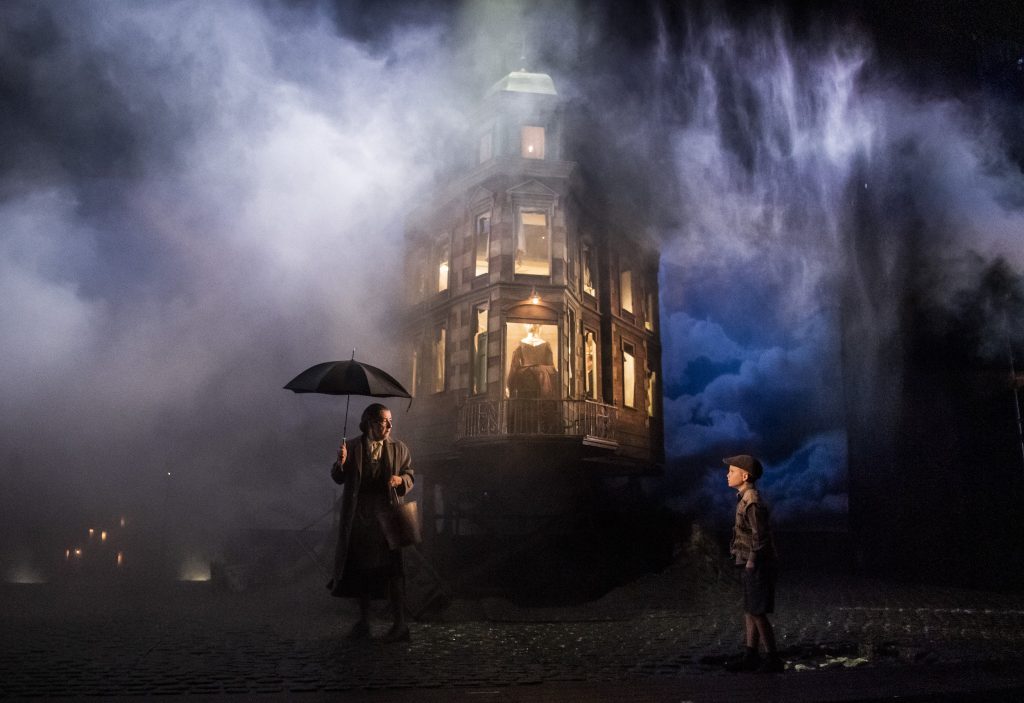
An Inspector Calls is a staple of English Literature GCSE; we’ve all grown up knowing the twists and turns of J.B Priestley’s classic play. I remember vividly studying it and even playing Shiela Birling in an amateur production, so I know the play well. This is a production that rips up the basic setting of the upper-class drawing room and engagement party that Inspector Goole intrudes upon, with unwelcome news. This is a moody, smoky, gritty production that really emphasises the themes of society, class, gender and generational divide.
The set is extremely impressive. I loved the ‘doll’s house’ Birling household, with them being closeted away inside away from the audience’s view as the curtain lifts. It stands on stilts above the street below, keeping the Birlings and their perfect world away from the gutter, out of the view of the lower end of society. The front of the house opens up to begin their descent, swinging open to reveal their garish opulence, which stands starkly against the grey drabness of the street below. The Inspector arrives and bridges the gap, slamming steps against their home to be able to force them to descend to the streets below. The house plays an important part later on too, which I won’t spoil, but this further visceral vision of the collapse of this affluent family is excellent and drew gasps from the audience.
I also loved the costuming, with each character revealing their own unravelling. Sheila becomes more and more undressed as the show progresses, with her beautiful white gown having less and less fabric as action unfolds. Gloves are removed, shoulders taken off, leaving bare shoulders and arms. The other cast are disrobed in similar ways. Eric especially is dishevelled and unkempt upon his return; Mrs Birling’s perfect hair cascades messily down her face.
https://youtu.be/UhXDvm86_e8
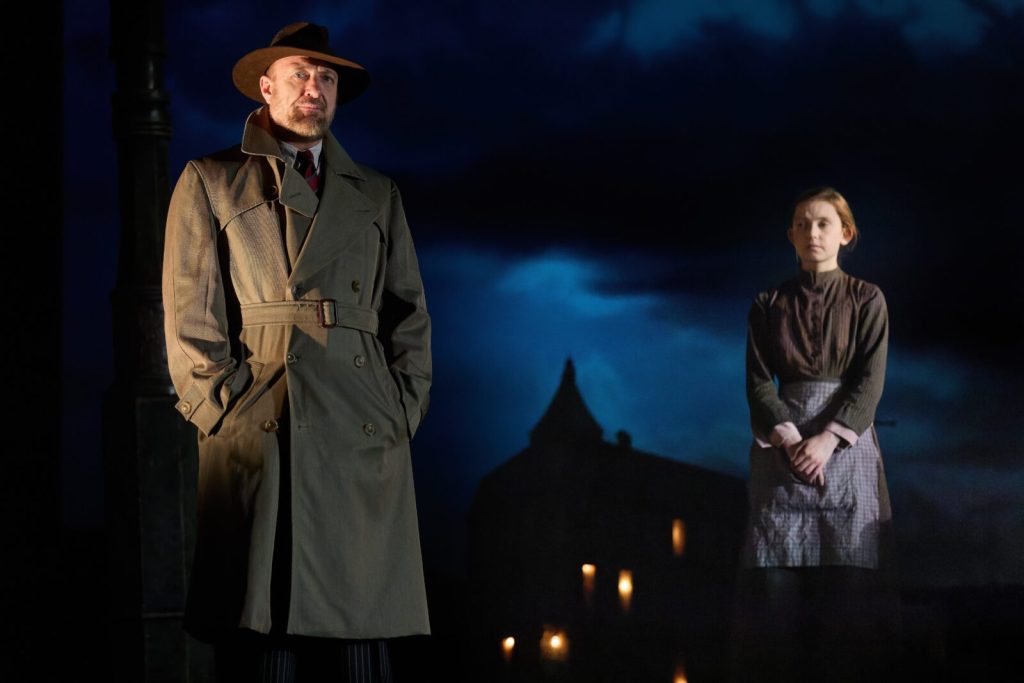
Tim Treloar as Inspector Goole walks through the darkness of the auditorium to the stage, his figure standing tall and forlorn in the single ray of the streetlamp. We have a Welsh Inspector here, a fact made altogether more impressive by the fact that this is a change specifically for the Wales Millennium Centre residency. The accent adds an extra element to the performance; ensuring that Goole stands apart from the Birlings, not quite fitting in anywhere to the fictional industrial town of Brumley, England. His performance was not what I was expecting at all; this Inspector is sometimes funny, passionate, clearly passionately involved in the tale of Eva Smith and her untimely demise. It makes him more human than previous iterations I have seen; his humour breaking the sometimes almost unbearable tension of the scenes and, of course, immediately gains him the empathy and support of this Cardiff crowd!
An Inspector Calls 2024. Tim Treloar (Inspector Goole) and Alice Darling (Edna). Photo by Mark Douet
He is joined by an excellent cast; Jackie Morrison owning every inch of the stage in her opulent gown as Mrs Birling; Philip Stewart is our understudy Mr Birling and brings the upper-class bluster and self-importance of Birling in spades. The younger side of the family are played to great effect by Leona Allen as Sheila Birling and George Rowlands as Eric Birling. Tom Chapman completes this ensemble as Gerald Croft, bridging that gap between the older and younger generations with ease. I also thoroughly enjoyed the ever-present Edna played by Alice Darling, her fair skin and quiet demeanour constantly reminding us of the lost Eva Smith and being an unending reminder of the effects that this family have had on a girl just like her.
This is a production which is unafraid of silences, poignant pauses and tableaus which really drive home every piece of symbolism and theme of the script. The image of the Birlings brought low by the Inspector, wrapped in blankets on the cobblestones beneath the very house they presided from is one that will stay with me for a long time. I enjoyed the use of the young actors throughout the piece and the ensemble serves to remind us that we are one society and those who forget that do so at their peril. This is ably directed by Stephen Daldry (with assistance from Charlotte Peters) and ensures that the audience sees this very well-known script with a whole new set of eyes. My only tiny complaint was that we lose some of the dialogue full of foreshadowing and dramatic irony at the beginning, with the house remaining closed slightly longer than I would have liked. But this is a very small grumble in an otherwise well executed, smart production.
Moody, atmospheric, with spades of tension to boot; I love the original, but I’m pleased to report that this adaptation maintains that whilst adding many more layers and creating a version that will stay with the studiers of this GCSE piece. Ultimately, I think that is what is important; maintaining the integrity and message of the original whilst compounding its importance for the future generations that are, and will be, reading it in class. The audience, both young and old, leave with ‘fire and blood’ in their minds, left with the message of ‘one society’ that is more important now than ever, almost 80 years after it was first produced in the West End.
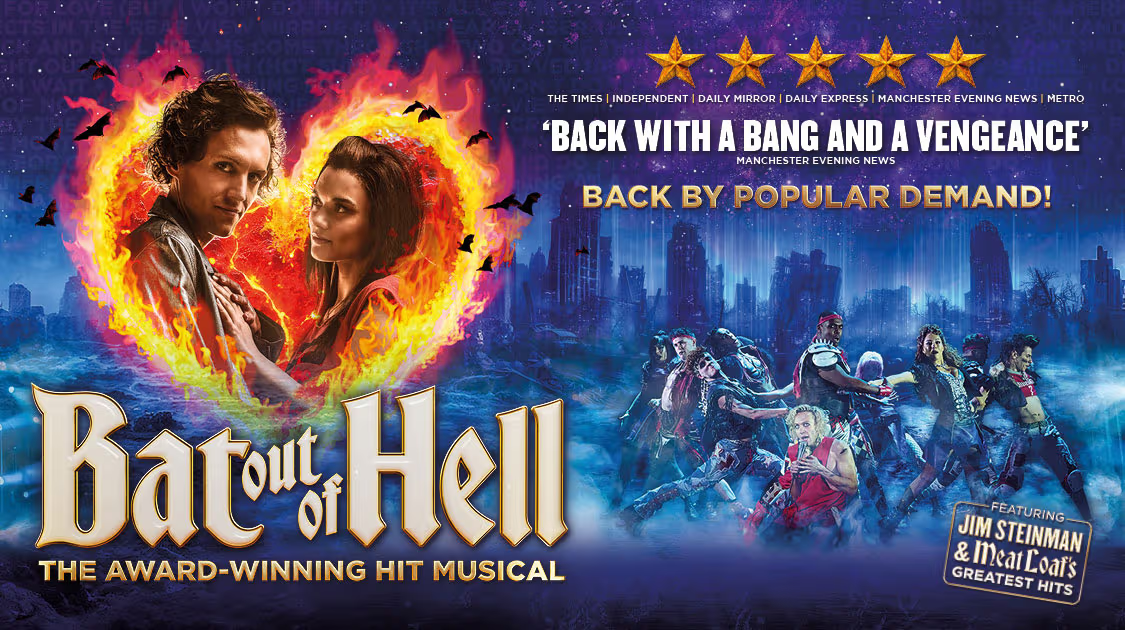
Bat Out of Hell unapologetically storms onto the New Theatre stage, bursting with the greatest hits of Jim Steinman and Meatloaf, a set straight out of a dystopian cityscape, punchy, stylish dance routines and vocals to die for.
There’s a lot to take in, from the tunnels of Obsidian, the incredible band pouring their hearts and souls into the beloved songs, the performers who look like they’re having an absolute blast and the lights and sounds which fill the theatre to even further capacity. The storyline follows a rag tag bunch of unageing friends; The Lost, who live beneath the city in the tunnel system. With echoes of JM Barrie’s Peter Pan, (indeed where the piece has its origins as Jim Steinman originally intended to pen an updated version of the play called Neverland), The Lost are bombastic, free spirited and unashamedly living their ‘forever 18’ lives. Above ground, the ‘Hook’ of the piece, Falco, threatens all that they stand for, trying to bring enforced order to their bohemian lifestyles of rock and roll. His free-spirited daughter, Raven, however, has fallen in love with the forever young Strat and is determined to run away, find The Lost and live her life her own way and be free.
Although the themes of Peter Pan are still evident in some ways, the piece now stands apart and carves out its own space in the Musical Theatre genre. To draw parallels with other jukebox musicals would be unfair; it does have similarities, but it is certainly unlike anything I have ever seen on stage before in shows such as We Will Rock You, for example. The show is pure theatre. It is unashamedly over the top, loud, proud and explosive. From the first number to the curtain call, the audience is grabbed by the frilly white shirt and pulled into their world. The dance numbers are electric; the leads and ensemble leap across the stage using the tunnel set to its full potential, disappearing and reappearing through its maw. The pure energy of the routines really impressed me; the ensemble earning their cheers in the finale just as much as the lead performers.
And what a cast of leads it is. Our four main characters clearly have Bat in their blood; Rob Fowler as Falco and Sharon Sexton as Sloane both originated their roles in the 2017 production. They clearly know these songs and these roles like the back of their hands; their musical numbers are truly spectacular with vocals that are described in no other way than brilliant. Paradise By The Dashboard Light is spectacular and hilarious in equal measure, but their voices reach even further heights in What Part of My Body Hurts the Most and It’s All Coming Back To Me Now. They clearly adore this piece of theatre; it oozes out of them whenever they step on stage.
Katie Tonkinson as Raven also returns to the role having played Valkyrie and cover Raven in the UK and International Tour and Peacock Theatre. She brings a perfect naivety to the role but then owns the stage with confidence and poise in her musical numbers. Heaven Can Wait was beautifully sung showing her softer more emotional vocals, but the counterpart to this was her heartfelt, raw rendition of It’s All Coming Back To Me Now. Glenn Adamson as Strat owns the stage and proves why this is a role this he is critically acclaimed for. He clearly channels the performances of Meat Loaf and his performance leaves the audience breathless; he bounds across the stage with restless energy and pours every energy into every single song. The ‘greatest hits’ are truly made his own with an obvious standout being his performance of Bat Out of Hell, truly raising hell at the end of act one. Georgia Bradshaw as Zahara and Ryan Carter as Jagwire also deserve mention, for their rendition of Two Out of Three Ain’t Bad alone; their vocal acrobatics had me on the edge of my seat.
The tour tries new things too, with the current in vogue method of bringing onstage videography to the production. I enjoyed this element as it did allow an extra layer to the performances and enabled lots of close ups and different angles of the musical numbers. I did, sometimes feel a little overwhelmed as I wanted to look everywhere at once; at the screens, the action on stage, the dancers and the lead vocalist. The cast also uses handheld mics throughout, even throughout dialogue. This does give the show a distinct concert feeling but it can sometimes feel slightly distracting.
Overall, the show is pure energy, dragging the audience along with its joy and vigour and certainly pulled people to their feet by the end to sing and dance along. For fans of Jim Steinman and Meat Loaf this is an absolute must, but there’s something here for everyone so catch it at the New Theatre before it roars off to the next stop of its tour!
The new year in the Welsh capital saw concerns over the disarming of history, nursing and music studies at Cardiff University. The arts are becoming a deeply rooted concern, as well as further rug pulls, National Theatre Wales bows out as well. Still, St. David’s Hall the concert hall for Wales remains closed. This major hub for the BBC National Orchestra of Wales may not be in use for at least another year or two.
We’ve settled into Hoddinott Hall down the Bay, as have the orchestra for all Cardiff based concerts. Some of these events can boast sell outs, thanks to thrilling programmes and guest artists. Issues expressed before in reviews would prevail and need attention. I’m talking about the lack of physical programmes and tonight, a lack of a libretto for the French sung operatic outing (the equipped venue would fare well with a surtitle screen). No one really wants to read on their phone with a digital programme.
Jamie Martín is a natural conductor, who would herald the start of a fine concert thanks to Ravel’s ‘Mother Goose’. This being the full ballet version, as with the composer it is often light and mostly charming in execution. Typical tales of Beauty and the Beast, Sleeping Beauty and lesser-known stories are within these bars. The eloquence of the orchestration would go onto influence music inspired by fantasy and fairy tales in media, such as a standout it remains. Putting personal taste aside with Ravel, the whole work has hurrying, shimmering moments. I could see this being a nice intro to classical music for children, yet it doesn’t seem to be the first choice. The orchestra captured the fine bristle of all the movements, its grandeur mounting up to a sweet closing.
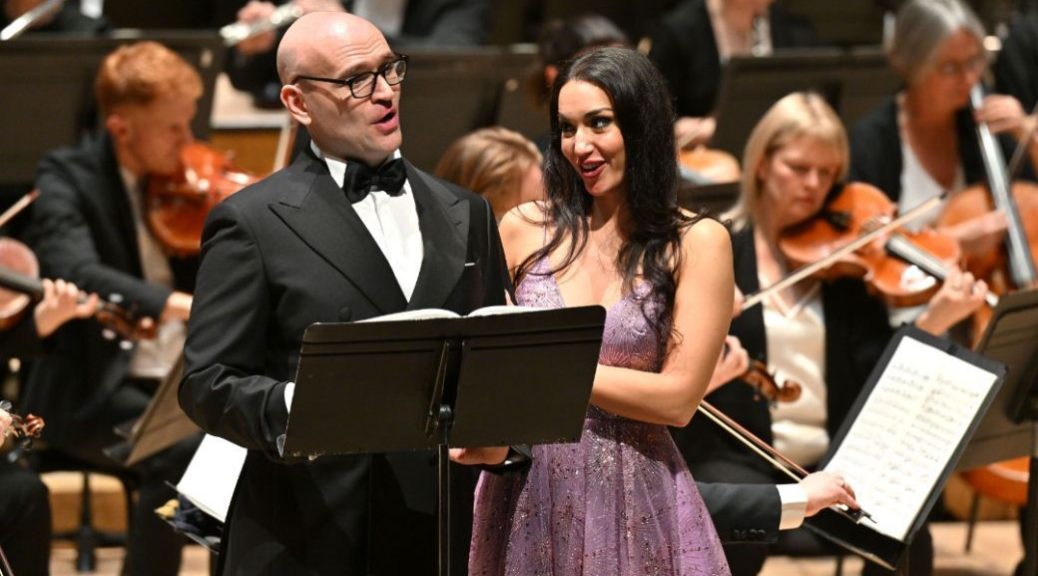
A rare opera arrival for Hoddinott, with that of soprano Danielle de Niese and Poulenc’s ‘La voix humaine’ or ‘The Human Voice’. One of the finest one-act operas from the 20th Century, this taking of Cocteau’s play sees an intimate scope. The only character is a lady who in a desperate flux, speaks to her lover on the phone, the conspiracy of a breakup the dramatic punch of the plot. With a sad send off, Poulenc and his full use of orchestra throughout is mighty. The pounding and plucking of the alert score become more engrossing as this woeful tableau goes on. The xylophone is the clever ringing of the dreaded telephone (who has a landline anymore?), as each call faces connection issues, wrongs numbers and flashes of this vanishing lover.
Ubiquitous to Glyndebourne audiences, this is de Niese’s first time with BBC NOW. I’d dare say it was a success, the French sounded perfect, the acting flustered, yet paced. Her voice holds truth and a graceful, unwavering flight, never a half measure in anything she does. It’s time we see her back again with Welsh National Opera. It must happen.
In 1895, the star attractions at the Mold Carnival were Leino, the Flying Trapezist; Signor Rovollo, the Gymnastic Wonder and Professor Crannio,’The Marvellous Conjurer.
In 1904, Carnival music was supplied by the Royal Buckley Town Prize Band. There was the Best Decorated Bicycle competition, Riders on Horseback and The Procession of Gigantic Proportions, which paraded through Mold’s principal streets, its salient features being six brass bands. At the close of The Procession, the public congregated at the Black Lion Hotel where dancing took place to music supplied by the Brymbo Steel Works Prize Band. Takings for the Carnival in 1904 were about £68, and after putting aside an amount for the following years’ show, £25 was handed over to the Mold Cottage Hospital Fund. (Note – this information is from the Mold Carnival website and was provided by local Historian David Rowe.)
Mold Carnival has form. It’s representative of a genre of activity that is widespread and perhaps an example of best practice, not too small to be meaningless but not too large to be commercially exploited. It’s still organised by volunteers and in 2024 it attracted over 6,000 people to its events. This is what grassroots cultural activity looks like (in terms of grass, the organisers get a lot of help from local people cutting the grass on the two fields where the Carnival is held).
The Eisteddfod Mold Carnival is not but there is an almost infinite variety of strata in this type of cultural activity. The Eisteddfod is not Glastonbury and Glastonbury is not Edinburgh, which is not Bayreuth. Carnivals, like festivals, have a role to play, otherwise they would disappear.
This year I thought I might participate in the ‘Time 2 Shine’ Mold Carnival talent show, not because I am talented but because I like a challenge and it looked like a good way to see the event from the inside.
I am a (very) amateur piano accordion player. I thought I’d play a simple version of the famous Czardas, composed in 1904 by Monti (go to https://youtu.be/_Zjz6oLuaxw if you want to hear it played properly).
A Czardas is a traditional Hungarian folk dance, getting its name from the old Hungarian term for roadside tavern. Its origin was a death dance, in which a soldier fights with an opponent, looks for his weak points, then kills him and dances in joy. It starts slowly, speeds up, slows down and then finishes quickly. I thought it might be suitable for the Carnival…
Lined up against me in the talent competition were a young man playing Chopin on a keyboard, a teenager impersonating Chuck Berry, a vocalist with an Adele song, a girl reciting her poem about what she would do if she were Queen for a day and some very young singers performing their favourite pop songs to backing tracks (they were all word perfect).
You can’t judge the talent in a line-up like that. I don’t say this because I didn’t win (!) but because more than the difference between apples and pears is involved. The only original performer was the poet. It’s not easy to either write or recite your own funny poem. The most technically accomplished performer was the Chopin player, who would have put in a lot of practice on his Grade 8 exam piece. The most entertaining performer by far was the Chuck Berry impersonator. But then the vocalist was employment-ready standard, and the very young performers’ singing was as accurate as their recall of their lyrics. Then there was me – but you always attract an eccentric when you have an open-door policy.
I was perfectly happy to have performed the Czardas satisfactorily, if at two-thirds speed. A couple of people had asked me what my accordion was, so I think I reminded the Carnival-goers of what is now a vanishing instrument in the UK. Children danced as I played and I got enough applause to go home quite pleased with myself.
I think the Adele singer and Chuck Berry won the senior and junior categories because they conformed most closely to what talent show judges are looking for, but that’s beside the point. The point is that creative performance activity can and does take place in a variety of styles, irrespective of economics. It makes a significant contribution to social celebration – the Mold Carnival feeling like a gigantic garden party, with its mountain bike acrobatics, its fire-eater and the alien robot wandering around in front of the Territorial Army. The only question is – Is It Art?
The short answer to that is No. There was not enough originality, technical ability or depth of feeling on show for anything to be discussed in artistic terms (especially not if you want to compare what was on offer with what gets performed in the street at major festivals). However, art does not appear out of thin air and artists have journey to make. It’s possible that at some point in the future the author of ‘What I would do If I was Queen for a day’ will one day release a first collection. It’s possible that the Chopin player will become a modern composer. It’s possible that the young Chuck Berry impersonator will develop his own persona and become the next Mick Jagger.
It’s that possibility which counts, alongside the opportunity events like Mold Carnival give young people the chance to experiment and gain experience. There is nothing quite like appearing on stage in front of a substantial live audience, especially if you are only nine years old. The theatre in the UK depends heavily on both musicals and pantomimes for its survival and carnivals help to feed future cast members into the system. So it’s not exactly what you see taking place, so much as what it all represents that matters.
I’m already wondering what I might brush up to perform this year.
The csárdás is characterized by a variation in tempo: it starts out slowly (lassú) and ends in a very fast tempo (friss, literally “fresh”).
The dancers are both male and female, with the women dressed in traditional wide skirts, which form a distinctive shape when they whirl.
With the tenure of Antonio Pappano with the London Symphony Orchestra now under way, London will be treated to both concert and operatic offerings. The idea of these concert operas are mouth-watering, the first outing was Puccini’s La rondine.
One of the Italian masters lesser known works, it owes a lot to La traviata and the glamour yesteryear of Paris. Though the story has a focus on comedy for the first two acts, the love story flutters about in the third act, not necessarily fulfilling the narrative structure. Musically, this is a sparkly affair: lots of fun and mirth from all involved. The sweeping melodies are met with Puccini’s modern harmonies, clever in many ways. There is the famous aria and absurdly soaring high notes, ensemble moments that hark back to Verdi, who’s shoulders Puccini rests on.
Pappano and the orchestra were pristine, this was their second performance of La rondine this week. Everything was acute and perfect. Strangely out of all the instruments aside the strings, it was the marvellous glockenspiel and harp that stood out. The piano also featured, though is used less effectively in the pot. The chorus were also a triumph playing rowdy students and party goes, all that was missing was the champagne bottles in hand. The time was brief though they shone in the middle act, you couldn’t resist their impeccable charms.
The cast were also great. Carolina López Moreno as Magda de Civry was the stand out, our beloved diva with a voice working extremely well here. Her control and drive for these luxurious moments never waned, a real star. Michael Fabiano as Ruggero Lastouc is here love interest and is just as fine. His hefty role for tenor has a lot in it, vocally very intense and Fabiano pulls many things off to acclaim. The maid Lisette, Serena Gamberoni has her nose in the air, with a genuine dislike for Magda, a second soprano role that is not always noteworthy. She seemed to enjoy the fussy role anyway and sang well. Paul Appleby as Prunier who is in love with Lisette, gets curious, funny bars his tenor working really well in Puccini. He gets the most laughs and is not a bad actor either. There were several party going supporting roles that also shone, too many to mention, but some up and coming and established singers were in the fold.
It’s a short affair under two hours and musically is rather pleasing. The story may not grip like other Puccini, yet for its size and colour it’s a lovely thing to admire.
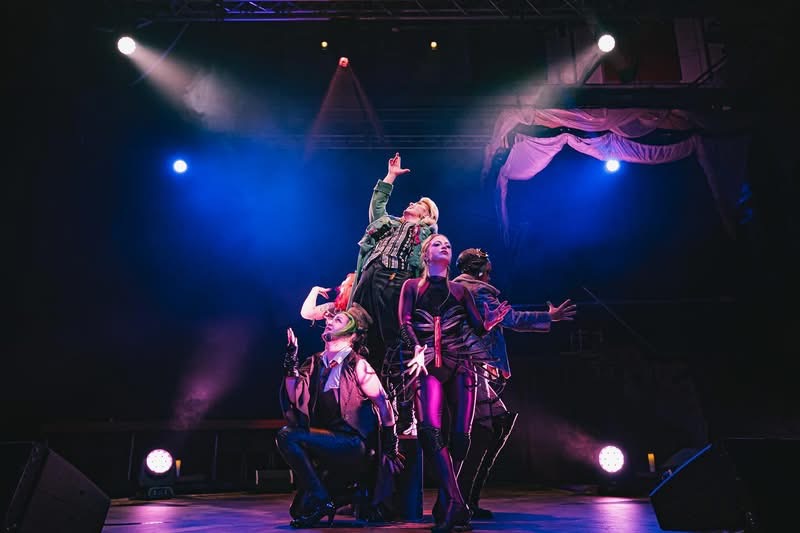
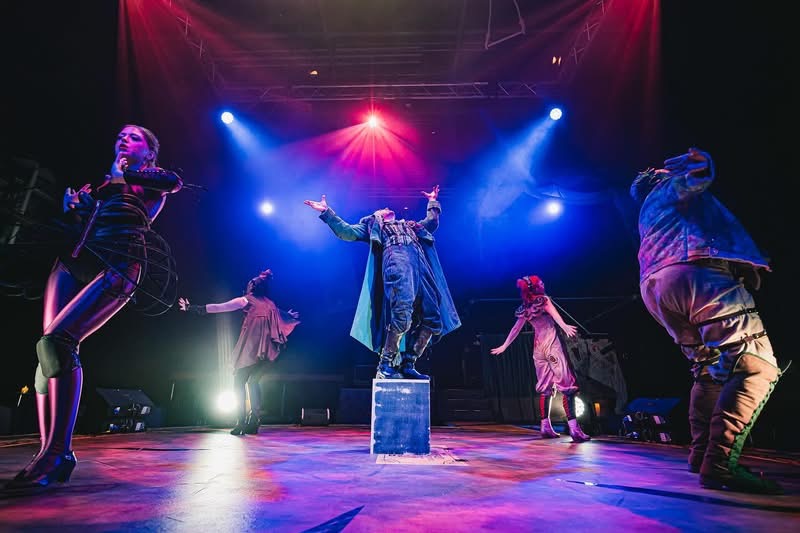
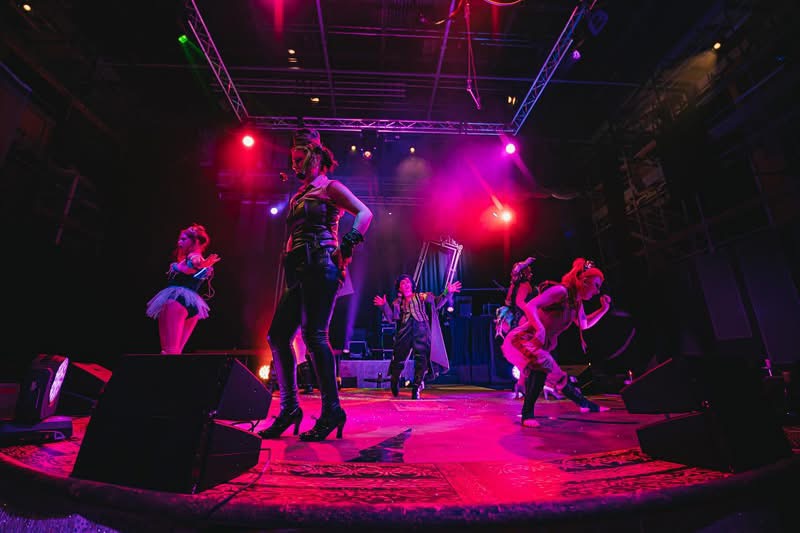
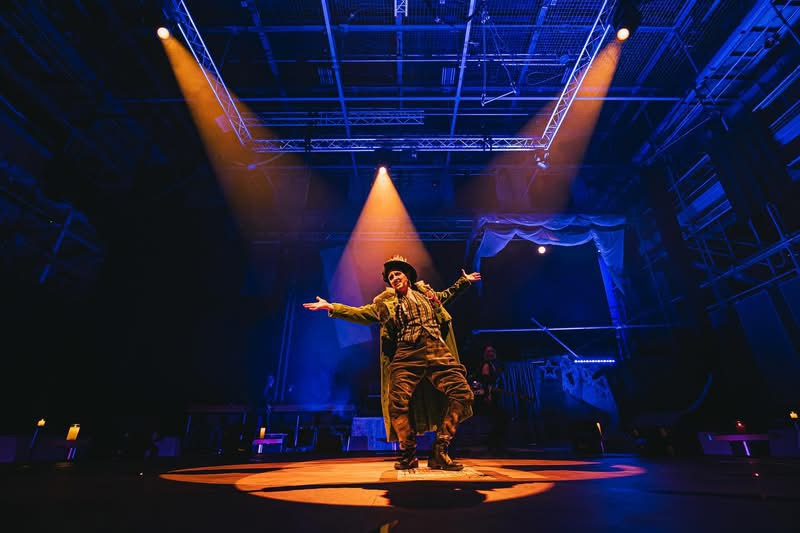
Over the past couple of years, it has become somewhat of an annual tradition for me to take the short journey to the Weston Studio and the Wales Millennium Centre to watch a queer-infused re-telling of some of the most iconic Christmas classics to ever exist. The last three Christmases saw Polly Amorous and the team take over the venue with their unique version of festive stories (the most recent of which is the first xxxmas which you can read about at https://getthechance.wales/2023/12/23/review-the-first-xxxmas-by-rhys-payne/) but the team working on this year’s project took a much more classically theatrical twist! As the name would suggest this iteration of The Nutcracker players homage to the iconic two-act ballet of the same name and I have to admit this is not a show I am particularly familiar with and so it did take me a little longer to pick on some of the nods and reference to the original show.
Production Images Kirsten McTernan
The story explores the underground world of misunderstood creatures as they highlight their skills in the wonderfully eccentric “Le Crack” through a series of cabaret-style performances. I thought that it was particularly clever that the opening moments of the show showed the group of outcasts actually putting on the aforementioned cabaret performance for the audience as this beautifully blended the lines between the story and reality that totally made sense!
My favourite performance in this version of The Nutcracker however was the captivating Cadbury Parfait who took on the wonderfully iconic role of the Sugar Plum Fairy. From the very moment this performer stepped onto the stage, they instantly stole both the spotlight and the audience’s attention as they showcased an incredible burlesque-infused performance. The performer used every inch of the stage as they began peeling off layers of their gorgeous insanely regal, gorgeously pink outfit which the audience went absolutely wild for. The second half of this production, however, saw the sugar plum fairy fully embrace a more villainous perspective as she began to spout a series of homophobic/transphobic abuse at the budding couple of the Nutcracker and the Rat King. This transformation began with the character being shrouded by towering curtains (which later magically cascaded down to the floor to reveal her new outfit) above the stage as she donned her Margret Thatcher-inspired suit/hair as she began spouting transphobic/homophobic abuse at the new coupling of the Nutcracker and the Rat King which was clearly a reference to the section 28 laws passed during Thatcher’s leadership. This then transformed into a performance of a performance of “Just Don’t be Gay” which was a comedic, cabaret-centric number that exposed the character’s bigoted views and also contained buckets loads of audience participation as the sugar plum fairy had key audience members reciting the straight creed of loving fixing cars, top gear and cigars. Despite being the character which the audience was encouraged to hate and boo, but I could not help myself being totally transfixed every time this character took to the stage!
Just over a year ago, we were introduced to the incredible Diomede at the first every Hell Haus event (which you can read about athttps://rhysreviews.com/2023/10/23/hell-haus-production-review/) where we were totally transfixed by their incredible lip-synch talents but I was not aware how much of an all-round musical performer they are! Diomede was announced as the titular role in this queer-adaptation of the classic Nutcracker, and they were instrumental in helping invite immense amounts of sympathy from the audience. As an innocent character brought into this underground world of cabaret, The Nutcracker is not aware of all the things that go on at Le Crack or the lives of the creatures underground and so seeing this character go from being totally unaware to becoming a victim of the oppression was very powerful! There was a hilarious sequence later in the show where Diomede was forced into a physical box after confessing their attraction towards The Rat King (captured wonderfully by Len Blanco) to her master the Sugar Plum Fairy which led to a series of hilarious events where this performer trying to encourage a romantic moment while being stuck inside the box and also reciting the “straight man” mantra introduced by the sugar plumb fairy which had the audience in hysterics throughout!
In terms of individual performances, however, there was one member of the cast who clearly used this production to showcase their immense array of talents. Before ‘the cast of Le Crack’ could take to the stage the audience was greeted by Heledd Watkins as the world’s first dominatrix cockroach who helped to introduce “Le Crack” and the rules of the evening (which was obviously very important at any event) with a series of Nessa-inspired interactions with the audience. Throughout this compare-style introduction, ‘Roach’ showcased their bilingual talents by sharing some of the information through the medium of Welsh which is obviously a fantastic inclusion. Later in the production Roach also showcased their musical talents but not only providing backing vocals for all the performers but also busting out a series of electric guitar solos which was insanely impressive!
Overall, Nutcracker: the alternative cabaret is a contemporary and entertaining twist on one of the most iconic ballets with a much-welcomed queer/cabaret style twist which allowed space for a series of mesmerising performances. As previously discussed, this is my first experience with The Nutcracker so I do believe that I may have missed some of the references to the original story, but the narrative itself was easy enough to understand. Despite being an extremely outlandish tale, the love story between the invading toy soldier and the king of the rats is particularly captivating and the added layer of queerness to the story makes it even more heartwarming. The audience was clearly immensely involved with the story as they appeared to erupt in thunderous applause or booming boos at key points in the story. I would rate this story 4 out of 5 stars!
It’s been on the bucket list for a while to see the emerging superstar pianist Khatia Buniatishvili. With her season at the Barbican, she is playing in an array of varied repertoire. This is all very exciting and the time to see her live was upon me. Before this, Academy of St Martin in the Fields set of with Mozart’s Don Giovanni Overture. Director Benjamin Marquise Gilmore lead as first violin, taking over conducting duties without ever needing to conduct. The energy between him and the players is magnetic, Mozart’s spiralling themes and punches hit the audience as they have done for centuries.
Khatia had planned to rather ambitiously perform the solo for two Mozart concerti, though this would fall through. Though her time spent with his Piano Concerto No. 23. This was in many ways perfection, Khatia arrived to the stage in a golden dress, one statement of many. Her playing is effortless (so glad I could see the keys and her hands) graceful yet also violent. Her little moments of conducting, clutching of fists in the air after dramatic passages and her swaying are poetry. This famous concerto has wide appeal and with Khatia playing, each of the three movements were a joy. Her playing of the stupendous Adagio was creamy and oh so right. It’s empowering seeing a musician on this scale. The encore was the very well known Debussy that delighted the audience and left us keen to see her in the new year.
The cancelled other Mozart concerto was replaced respectfully with Mendelssohn’s The Hebrides Overture. The German composer vividly recounted his trip to Scotland with watery cleverness and a sweeping orchestration. Again, the players were were a resounding success, the balance calibrated to a fine set. Fittingly, Haydn’s Symphony No. 104 was the finale. Dubbed the ‘London’, this master of the craft gave thrills and laughs abound. Eccentric in nature, its four movements are curious and noteworthy for their almost ironic tone.
We were then gifted an encore of Sibelius’ Nocturne, the serene flute from Michael Cox the definition of pianissimo. I could not have found a better wrap up.
Creating opportunities for a diverse range of people to experience and respond to sport, arts, culture and live events. / Lleisiau amrywiol o Gymru yn ymateb i'r celfyddydau a digwyddiadau byw

 (3 / 5)





 (4 / 5)