
All posts by admin

Review Chamber Domaine, Bach’s Brandenburg Concertos, Wigmore Hall, London by James Ellis


1st concert:
 out of 5 stars (3 / 5)

2nd concert:
 out of 5 stars (4 / 5)

3rd concert

 out of 5 stars (4 / 5)

To experience Bach Brandenburg Concertos in one day is formidable. Only once before have I heard it live, Florilegium in Cardiff back in 2018, notably we heard them in in descending order. You are easily won over by its pristine harmony, the playful sport within its players, the cleverness of the whole thing. Few would deny Bach’s genius, this is a fine example of it. Yet would the allure be kept spread out over a day?

Chamber Domaine has done just that with three concerts at Wigmore Hall. We are also treated to living composers who have reacted to these concertos and their impact on composition. Luke Styles and his ‘A Brandenburg’ is essentially just an arrangement of Bach’s eternal Toccata and Fugue. It’s all there and the frilly addition of ornament question if this can be regarded as a whole new composition.

We then lead into the Brandenburg Concerto No 1, our first of six on this day. I wouldn’t say this is the best out of the set, there are charming passages and the players feel like they are warming into the whole venture. Conductor Thomas Kemp leads with a lucid control, that  much is known. This short opener ended with ‘Sequel’ by Brian Elias. Written in 2020, to Taylor this was a world away from what we had just heard, its instrumentation remained the same as the concertos. Irregular rhythms and an all round sense of unease permeated the work, Sarah Burnett got intense bassoon solos and the harpsichord worked particularly well in the concoction. Amazing how different a sound can be.

A two and a half hour rest saw a return of the 2nd Brandenburg Concerto. Trumpeter Alison Alty gets many delights in a soaring solo, high and mighty. I imagine this is not easy to play, there may have been some scratches, but was mainly delightful. Purist would scoff at the inclusion of new work interspersed through some of the concertos. Aaron Holloway-Nahum added more atmosphere with ‘as the soul recedes in what the years bring’. The harpsichord strings got stroked in this solemn piece.

Michael Price and The Malling Diamond gave Alty got more special, sweet writing, following with the glowing notes Deborah Pritchard’s sacred offering of her Illumination. Zoë Martlew had the most evocative selection with Bacharolle. With humming and whistling, steamy pizzicato and the ghost of Bach haunting the space. I was impressed with this most. With the Third Brandenburg Concerto, entirely stings with harpsichord, this is more famous and endearing than the past two. Perhaps the most condensed, its clarity unwavering, the mood chirpy and heartfelt.

An even bigger break, would then see a final evening concert to conclude both the old and new together. Fatigue had kicked in by the night and I’m having a hard time trying to recollect Daniel Kidane and his Concerto Grosso. I’m recalling flair and fun, some audience members seemed irked by its nature. The fourth Brandenburg Concerto had alluring recorders thanks to the celestial efforts of Louise Bradbury and Annabel Knight. They really are a fine addition, adding to the pot harmonies of great respelandance.

Florence Anna Maunders really got the memo in writing for these specific instruments. The earthy sinew of her Big Koncher’ah was very telling, Paul Edmund-Davies on flute was a fiery performance, many attacks and trills for the eternal woodwind. The fifth concerto might be the most famous, on harpsichord Sophia Rahman had brows held high for her glorious solo (I’ve always marvelled at Karl Richter’s take). For me, this is the defining moment of the set.

Joseph Phibbs and Bach Shadows went both ways in music making, traditional and experimental. I think I saw Kepm blow a partly whistle. Fun all round. We hear bird song in tape before going into Gold and Precious Silver by Stevie Wishart. Not quite as attentive as I’d have thought, this would be last newer work in a telling selection of today’s composers reacting to Bach. The sixth Brandenburg Concerto is maybe the most refined, just for stings. Lead violin Tom Pigott-Simith held great swavs of momentum in tiny solos, quivering tremeloes and a ringing vitality throughout the day. It was quite an achievement hearing all this music in a day. The adjustments to the stage were also considerable as Thomas Kemp, the musicians and stage hands all frequently altered the changing space.

A pleasure to have spent a day with these musicians.


Review New Palace Opera, Peter Grimes, St John’s Church, Waterloo by James Ellis

 out of 5 stars (3 / 5)

Benjamin Britten’s Peter Grimes is getting lots of play at the moment. We had the alluring production from Welsh National Opera, Nicky Spence’s first outing as the lead. A concert version at Cadogan Hall is days away. I caught New Palace Opera last year for a Wagner night, a newly discovered passage by the composer as well as a moving Walküre last act.

A first wrestle with Grimes should not taken lightly. I admire them for doing this. I had the same feeling when Kennsington Symphony did it a few years back. Everyone should try it. In one of my favourite operas and a well regarded 20th century masterpiece, lies Britten at his best. Never easy for singer nor musician, the complexity and cleverness of the whole score, sees the characters of George Crabbe come alive with nuance and flair.

The orchestra were up to the challenge, okay a few slips from the brass and some uneven tempos I’m patient with. The devastating force and beauty are what seal the deal. Whether it’s the magic of moonlight, oompa bands, terrifying storms and gleaming sea visions, the orchestration is simply astounding. I know it well now, proudly saying this is the fifth time I’ve heard it live, the Aldeburgh beach and English National Opera outing were my gateway. Some people on the night said they couldn’t hear the words, the stellar libretto by poet Montagu Slater is another benchmark for English opera libertti. There are so many lines I could now sing and quote by the dozen now…..

A fine effort from conductor Michael Throne, who reigns in this watery beast with defiance. The singers left a variable in casting choice. As Grimes, Jonathan Finney has the fitting acting chops, a wild, almost unhinged persona, but the singing was not always there. Flashes of Peter Pears (who created the role back jn 1945) are evident, but some fiery moment left the voice to vulnerable and compromised. Though, I did still love the ‘Now, the Great Bear and Pleiades’ aria in the pub, those outstanding harmonics from the strings are the first marker (the first sea interlude as well) of what a great work this would become.

Too many to mention in the cast, Phillippa Boyle as Ellen Orford paired well in the role. The hearty vocals and sympathetic air to the role is what made Boyle shine. Captain Balstrode from baritone Paul Putnins faired well. I recall his Wagner Dutchman a few hears ago (also with Boyle) and he is better suited in this secondary role. Bo Wang as Reverand Horace Adams is the gossipy father of the The Borough, vocally strong in one many silly roles. Mrs Sedley, the nosey busy body gets a fantastic mini aria, dark and murky in the last act, when Grimes has proven his bad faith in the safety of his fishing apprentices. Gráinne captured the ludicrous nature of the part with aplomb, the vocal shrieks and constant clutching of Pearl’s are often highlights. Even a magnifying glass to boot!

Zoe South might not have always given Aunty, the owner of the Boar pub, the full potential of the role. There is humour and moments of snarky jabs, as she puts up with a lot with a pub compromised by the sea, rowdy patrons and more. Her two Nieces: Elizabeth Stock and Elizabeth Moreland get odd, stroppy vocal pairings, the whining and teasing feature heavily. Swallow the lawyer, was Edwin Kaye, not every word was clear but he felt right in the role. The rest of the cast followed suit with potency and a strong will to try out these bizarre Crabbe creations.

I’ve said it before that Britten would be proud of these performances of Grimes. This also applies here.

Review Martha, Taking Flight Theatre by Alis Waters

Sherman Theatre Stiwdio – 17/06/25

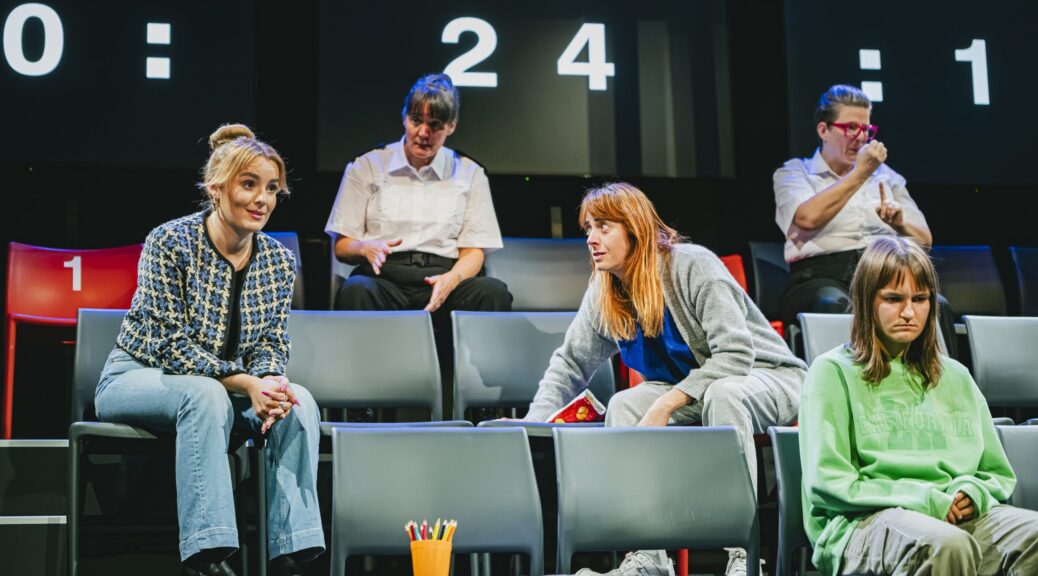
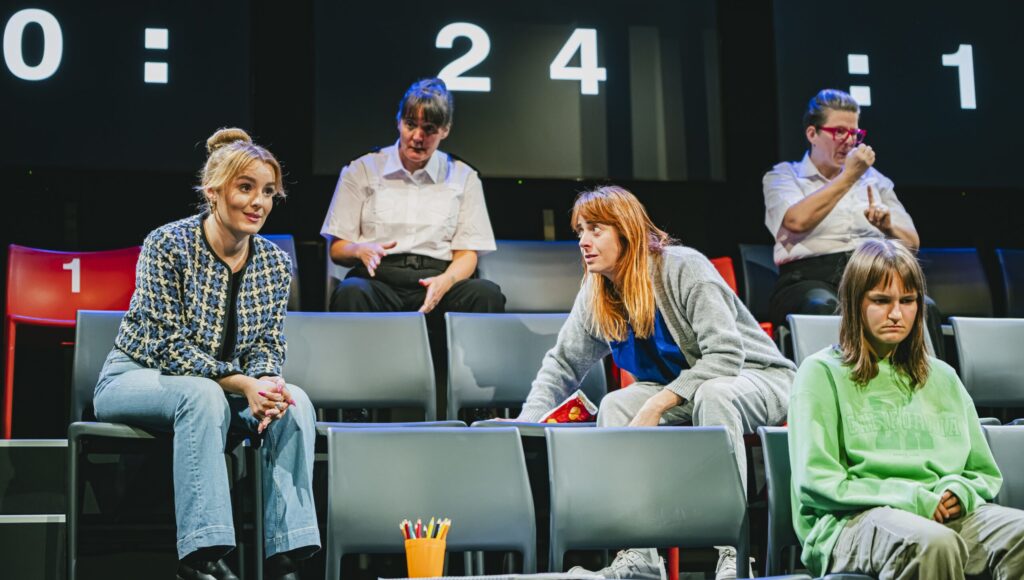
Elise Davison’s Martha is a glamorous, playful and fiercely political production that manages to be both joyful and deeply uncomfortable. Staged in the Sherman Theatre Stiwdio, it throws us into a dystopian 2055 where deafness is pathologised and BSL is criminalised – a chillingly plausible warning of unchecked authoritarianism.

The set and costume design were particularly striking — glamorous, bold, and effective. While the futuristic style occasionally felt a little on-the-nose, overall Carl Davies’ work was impressive. The world-building was visually immersive and immediate. From the moment I entered the space, I was asked for a “secret passcode” — a sign in BSL I would later be taught. A tattoo was stamped on my hand, and an actor enthusiastically welcomed me into the world of Martha. The layout and setting were clearly well thought through. Intimidating? Yes — but also exciting.

Before diving into the dystopian future, Davison allowed a moment to reflect on a quieter history: an island once home only to deaf people, where everyone used sign language. After this unconventional prologue, the audience was asked directly, “Are you hearing?” — followed by a patronising, “Oh, you poor thing.” A small but loaded exchange that immediately set the tone. Thoughtful, and unsettling in exactly the right way.

The use of clowning, physical theatre and exaggerated, flamboyant characters brought energy and was articulated particularly well by Granville (played by Duffy), whose performance was a standout. At times, though, the tone bordered on being silly. Some scenes – especially the musical or more panto-like ones – veered away from the serious subject matter, which could be jarring. Still, these playful elements made the heavier themes feel more accessible for a wide audience. They also injected a sense of humanity into a world where that very humanity is being stripped away.

There was a notable split between naturalistic scenes and surreal, exaggerated ones. This contrast wasn’t always smooth. I often found myself struggling to stay engaged – the lack of live sound and reliance on subtitles meant I was constantly shifting focus, scanning for words instead of watching performances. This disconnect felt particularly frustrating in emotionally charged moments – looking at subtitles instead of faces, reading instead of feeling. It’s something hearing audiences aren’t used to – but maybe that discomfort is exactly what the production wanted us to sit with.

Davison’s integration of BSL throughout the show was powerful – not as an add-on but woven into the form itself. In that sense, Martha wasn’t just inclusive – it challenged what inclusivity in theatre looks like. A show not about deafness, but made for deaf people, by people who care about that representation. The message landed clearly: difference is not illness, and the fight for rights is far from over.

However, while the themes – medical control, state propaganda, forced erasure – were undeniably timely and important, I felt the production didn’t always trust them to carry weight. Torture scenes, disappearances and threats were sometimes overshadowed by a tone that felt too “soft”. The cutesy, cabaret-like atmosphere occasionally took away from the emotional punch those ideas deserved.

The ending, though, was the strongest moment. A rousing, urgent call to action: “I’m still here!” A final plea for resistance, for visibility, for community.

Martha isn’t perfect – and maybe it shouldn’t be. It’s messy, experimental, bold, eclectic and emotionally complicated. For all its structural flaws, it sparks conversation. It’s not just a show about the future – it’s a challenge to audiences now.

Review & Juliet the Musical, Wales Millennium Centre by Bethan England

& Juliet is a delightful, riotous show that takes the ending of Romeo and Juliet and asks, ‘what if Juliet didn’t kill herself? What if she lived on..?’ The show is full of class hits penned by Maz Martin, Swedish record producer and songwriter, and what a backlist of hits he has!

One of those hits is Katy Perry’s Roar and I was lucky to be invited to take part in a dance class to learn (just a smidgen) of that dance. The class was brilliant; led by Andilé Mabhena (who plays Augustine, swing, is a member of the dance team and 1st cover Francois) and Michael Nelson (who plays Henry, 1st cover Shakespeare and Lance). Their patience and sheer dance ability was so impressive, and it really gave us an insight into the show and how incredibly difficult the choreography must be to learn. We only learned a few bars and I was exhausted! At the end of the class, they showed us how it should be done, and it was a delight to then see that replicated in the show.

I am a bit of a stickler for Shakespeare, I adore his plays and the impact that they still have to this day, so I had slight trepidation about & Juliet. I must say though, from the opening bars of Larger than Life, I was absolutely hooked. We are met with a stage preparing for a performance of the just finished, Romeo and Juliet, with the players still painting the set and adding pieces of set. Shakespeare reveals the ending of the show, the death of the star-crossed lovers, but Anne Hathaway intervenes and takes us, instead, on an altogether different path, one where Juliet decides to live and finds her own destiny in Paris. I adored the ‘play within a play’ aspect of this, very reminiscent of Shakespeare’s other productions. The constant asides and breaking of the fourth wall are immersive and shows us Anne and Will shaping the show in real time. Their arguments and plot changes are shown to us in real time, and the consequences of two very different opinions on how the show should play out, in turn affect and move the characters on stage.

It would be easy for this to be a complete pastiche of Romeo and Juliet and to disrespect the original source, but it manages to perfectly balance the modern day whilst being entirely respectful to Shakespeare and his incredible genius. It was also nice to see an interpretation of Anne’s story and her feelings on him never being there with her and their two daughters. There’s a momentary reference to loss of son, Hamnet, and the ‘second best bed’ is mentioned a few times! All in all, there’s enough nods to the originator to be respectful but to also bring the plot straight into the 21st century.

Cast and ensemble are phenomenal; the sheer energy and skill of the chorus is mind blowing! Non-stop, high octane and just full of joy, it’s definitely a sight to behold. The cast does have its star casting in Jay McGuiness from The Wanted and Dr. Ranj Singh as Lance. Jay McGuiness was a cheeky, delightful Shakespeare and obviously has the pipes for the pop soundtrack! Dr. Ranj was an hilarious Lance; he more than held his own amongst the cast despite this being his debut in a musical theatre production. I was impressed with his singing and his involvement in Strictly Come Dancing clearly paid off too!

Recent graduate, Geradine Sacdalan leads the cast as Juliet, her dancing and singing prowess would suggest years of being the leading lady, her performance is assured and confident. I also adored Lara Denning as Anne, her rendition of That’s the Way It Is was breathtaking, her portrayal of Anne in turns hilarious and heartbreaking. Sandra Marvin as Angelique, Juliet’s nurse, manages to capture the essence of the Nurse in the original play whilst making her a fully fledged character with her own identity and voice (and what a powerhouse voice it is!). Her scenes with Lance were brilliant, especially their fabulous rendition of Teenage Dream/Break Free.

Jordan Broatch is a wonderful May, Juliet’s friend and confidante. May is the perfect character to be in a show based on an original Shakespeare play when you consider how often his plays contained characters who subverted gender norms. The quote from Anne perfectly sums this up, “Really? This from a man who’s built a career on men dressing as women, women dressing as men; the man whose name is synonymous with gender-bending. Do you really think it’s up to you to question May’s gender or sexual preference, or do you think maybe it’s May’s personal choice and really none of our business?” Jordan’s performance is so endearing, and they portray May’s struggle perfectly. Their scenes with Kyle Cox as François are beautiful, both performers truly capture the essence of the burgeoning romance with ease. Kyle is a suitably awkward François, blossoming from shy youngest son of Lance to claiming his place beside May.  Finally, Benjamin Jackson Walker as Romeo is comedy gold; his return from death is iconic with him descending on his own name and although this show is all about Juliet, I would have loved a bit more stage time from this hilarious performer with a great voice to boot!

Don’t ‘get thee to a nunnery,’ get yourselves to the Wales Millennium Centre and make sure you catch & Juliet’s final tour stop. It’s joyous energy, phenomenal vocals and brilliant cast really deserve to go out with a bang at their final location of their tour. Matched with themes of empowerment, no matter what or who you are, this is a must-see production, so don’t miss out, grab yourself a ticket to & Juliet today.

Review Royal College of Music Song Recital, Secrets & Desire: The life & Songs of Mel Bonis, Wigmore Hall by James Ellis

 out of 5 stars (4 / 5)

Further discoveries in music of past has led to some wonderful discoveries. It would appear many have not got a look in with recognition until recently.

This concert at Wigmore was one of these discoveries. Mel Bonis (1858-1937) was a French composer regarded as a talent in the golden era of song writing in her century. Scandal, children out of wed lock, sexism, artistic yearning and this the fairly sad story that makes up her life. We heard all this delivered with grace and frankness from speaker Audrey Hyland. It’s easily another story of a female composer that should  have a film made about her.

These songs are accessible, they are honest and a fine handling of the written word is evident. This concert which was light and open, began with Songe, La mer and Le chat sur le toit, all proof of her talents. With two sopranos: Susanna Davis and Bella Marslen, they worked hard on these songs, accented and vocally alluring. They might want to check on airier high notes which did not quite land well. Mezzo Cecilia Yufan Zhang might have been the most interesting singer, the voice blended well with the allure of these eloquent, restrained offerings.

Countertenor Will Prioir will age into the singing group, not quite there just yet. Though his few selections had charm and romance. Sam Hird, baritone, was used little though had command in the odd song he was in. We had two sharp pianists with Louis-Victor Bak and Firoze Madon, talents who held these frank pieces as concentrated support for the singers. It’s important to see young people share with us lesser heard composers.

Chanson catalane was a flavour of Spain, Un soir a gentle flutter and the three ladies singing the wrap up Ave Maria, was sweet, if not the most compelling take. There seems to be much more of Bonis we have yet to hear, no doubt more is planned for the future. This is rather interesting to keen ears. 

Review Sandrine Piau & Les Paladins, Wigmore Hall, London by James Ellis

 out of 5 stars (3 / 5)

An all Handel programme is what I’m needing right about now from Les Paladins and soprano Sandrine Piau. The Overture and a March from Ariodante would herald this one part concert. Les Paladins bring authenticity and pride to these period pieces, their tuning before the start was also considerable. Violinist Catherine Plattner had meaty moments throughout, though conductor and on harpsichord Jérôme Correas is the needle focus of the night. Together these two and the players evoke this era, the concert dubbed as ‘Enchantresses’ is rather fitting.

I dont think I’ve heard Sandrine Piau since 2008, with the BBC National Orchestra of Wales on the Messiaen centenary, doing Debussy. This was my introduction and I’ve gently followed ever since. An aria from Lotario was her opening gambit and it might not as enticed as much as expected. Piau voice is interesting, passages of deep focus and a restrained colour are evident. I wasnt so sure about the take on Piangerò la sorte mai from Giulio Cesare in Egitto, the embellishments give the singer the right to experiment in this wonderfully emotive piece. Piau left and the Concerto grosso in A, proved further the durability of the ensemble, its tricky and piffy dynamics are a highpoint.

Piau really came into her own with two arias from Alcina, next and at the end. This opera was proven more popular with Royal Opera and Opera North staging it. I’ve yet to see it fully, though if these arias stand on their own (and they do), this should be a potent experience. Piau’s acting also shone, this is a role I imagine she’s taken before. The psychological intensity is permeating from the stage, the beauty of this Handel never doubted in this opera, almost 300 years old. Il bistro maggio from Rinaldo also dazzled, though a more famous aria from this opera would follow on as a surprize.

The audience found it amusing that the Trio Sonata would have half of it not be performed. The announcer at the start declared this and I assume, the peace offering of the Ariodante march. Because of this, I cant judge it as a full composition, though what we did hear was bouncy and kenetic to the rest of the offering, if just cut short. They seemed unsure if they were doing encores, another flutter from Alcina and a standard Lascia ch’io pianga sent us away, adding to an almost slight evening. 

Review, London Voices, Stockhausen’s Stimmung, St Martin in the Fields Crypt by James Ellis

 out of 5 stars (5 / 5)

In the crypt of St Martin in the Fields lies a place in London to escape. A descend from the streets to a historical scope where the names of the past lie on the floor and the bricks above have seen ages.

What better way to have a concert, a cult experience at that. Karlheinz Stockhausen is notorious for several things, his remark on 9/11 the most misguided. Back in 1968 his Stimmung was one of several, infamous compositions gaining notoriety. In what is perhaps his most accessible work, Stimmung is a gentle encounter. The six singers of the London Voices are dressed in white (Stockhausen loved theatrics), for this feverish hour. This sharing circle is a crash course in overtones, over enunciated German, occasional English words, whistling and hushed harmonics.

Those who can get over the absurd nature of the piece (it’s arguably his most minimalist work), shall be rewarded with the glowing aura that the piece radiates. Each singer takes turns, whilst sharing rounds as well, little flutters and bursts bop in and out. Days of the week are mentioned, which would prelude his extensive operatic outings. These drones almost feel like mantras for meditation, their repetition wafts around the space and into our ears. I’d be interested to hear how exactly this is recorded as well.

Moments of humour easily fade, as the growls, moans, chrips, shrieks and chattering all becomes contextless. The approach and accessible way this Stimming has been placed is fantastic, I’d struggle to think of a more intimate venue then the Crypt of St Martin’s. A genuine sense of calm came over me, I felt little urge to vacate the space after it was over. I wanted to savour. Though, I dare say a minute or two of silence after would have really sealed the deal, the goal of transendance haunts us even after. Curiously, a mouse or two in the crypt were so moved as to come out and experience with us. 

Review, Khatia Buniatishvili & Friends, Barbican Centre, London by James Ellis

 out of 5 stars (3 / 5)

As Khatia Buniatishvili bids farewell to her time at the Barbican Centre, I’m already savouring her take on a Mozart Concerto. With that, the only time then I saw here live, this send off was a must attend event in London.

A blockbuster cast of artists aside a massive programme, this was set to be a excitable evening. Khatia, excels in her smooth playing, a gentle finesse that I’ve rarely seen. At this send of, she openly put herself in the background and let musical friends be the guide. Amira Casar opened with a reading of Robert Browing, later famous verse from Elizabeth Barrett Browning. Spoken with pride and nuance, I rather enjoyed them. But I did wonder why just this only? Its further relation to a night of music? 

It’s very easy to be jealous of Jakub Józef Orliński. This Polish countertenor, is a true triple threat of singer, athlete and model. His takes on Vivaldi, then Handel here were tremendous, real highlights. Tonaly everything a countertenor should be, acting with his eyes considerably. The audience adored him, he couldn’t resist showing off some break dancing at the ending Piazzolla, the well known Libertango. Nicola Benedetti is a fine violinist, her Massenet Méditation hits the sweet spot, movements from Frank’s Violin Sonata rich in melodious mirroring between the soloist and the piano. Axelle Saint-Cirel, the mezzo-soprano was seen in a slight moment just two short songs from Poulenc & Barber. We didn’t see enough, her, stage presence and mystery to the offering was impressive.

My issues with the concert were the unrelenting programme offered no intermission and ended twenty minutes later than advertised. This was a lot to truly take in and a break for everyone would have been welcome. All this music, a fair amount was solem, the lights dimmed for an atmosphere not befitting a celebration. The gaggle of other pianists were noteworthy: Sodi Braide, Hélène Mercier and Khatia’s sister Gvantsa Buniatishvili. A wonderous sense of friendship and love of music was evident when they played together, a rather creaky Gallop from William Tell had all four playing in this iconic romp. Arrangements of The Four Seasons for two pianos were fine, but having Benedetti there seemed like a waste opportunity, a violinist well known for this Vivaldi. 

These musical choices spanned centuries, they had little through line (I’ve said it before I just like using it in reviews) and were tonally very broad. Arvo Pärt’s Pari intervallo was the quieter side, a formidable silence from Khatia and Sodi, in a highlight for me. It might work best for organ, but in double piano it was extremely touching. The recently past Sofia Gubaidulina had a brief stint: Song of the Fisherman from Musical Toys. Folksy and shy, it had unashamed pianissimo and was another evocation. Choices of Brahms and Dvořák I was less stirred by, a cheery Nutcracker overture couldn’t be further from Christmas in peoples minds, another eight hander. Worries seemed to evaporate if only for mere minutes.

This meaty leaving do was considerably large, maybe a slight pruning might have faired better? 

Review Tick, Tick…BOOM!, Theatr Clwyd by Donna Williams

It was a privilege to be among some of the first visitors to attend a production at the newly refurbished Theatr Clwyd. Having been lucky enough to attend a tour during its reconstruction it is wonderful to see the (almost) completed work in all its glory. With substantial backing from the Welsh Government, Arts Council of Wales and Flintshire County Council and under the leadership of Executive Director Liam Evans-Ford and newly appointed Artistic Director Kate Wasserberg, the theatre is working with acclaimed architects Haworth Tompkins to complete the redevelopment.

The largest ever private gift to an arts institution in Wales came from The Moondance Foundation with a gift of £1.5m, hence the newly refurbished auditorium (formerly the Anthony Hopkins Theatre) being named the Moondance Theatre. And so, is it purely coincidence that the first production to grace the stage following the theatre’s reopening is Tick, Tick…BOOM!? A semi-autobiographical piece written by RENT writer Jonathan Larson and featuring the diner he worked at whilst attempting to carve out a living as a composer in 1990s New York. The name of that diner? The Moondance!

Tick, Tick…BOOM! follows Jon, a struggling composer in New York City, approaching his 30th birthday. He’s anxiously waiting for his ‘big break’ while wrestling with doubts about his career in musical theatre. As the clock ticks, Jon navigates pressure from his girlfriend Susan, who wants to move out of the city and start a family, and his best friend Michael, who’s abandoned acting for a lucrative corporate job in marketing. The story explores many themes which are also recurrent throughout Larson’s groundbreaking musical RENT– mortality (including the AIDS crisis prominent in New York in the 90s), artistic expression, love and relationships. We are also consistently reminded of RENT throughout Tick, Tick…BOOM!’s music- weaved into harmonies, recognisable chords and comparable melodies, all these a poignant reflection on Larson’s own life and aspirations. Tragically, Larson passed away from an aortic aneurysm on January 25, 1996, at the age of 35, just hours before the first public preview performance of RENT.

The UK premiere of Tick, Tick…BOOM! took place at the Menier Chocolate Factory in London in 2005, featuring Neil Patrick Harris as Jon, and has since only been performed a handful of times in this country. However, the musical was brought to the public’s attention again in 2021 in a film directed by Lin-Manuel Miranda and starring Andrew Garfield as Jon.

This production is placed in the hands of three performers, who not only play the main roles but also a plethora of minor roles throughout the show. Ryan Owen, Christina Modestou and Tarik Frimpong do this with equal amounts of talent, professionalism and ease that we feel completely relaxed in their presence for the duration. We hear three voices, but it sounds like thirty, we know Modestou is not only Susan but also Jon’s agent, Rosa (whom Friends fans cannot fail to compare to Joey’s hilariously memorable agent Estelle!), and yet we see two completely different people.

Having seen Owen in the comedy role of Glennie the Goose in Theatr Clwyd’s rock ‘n’ roll panto Mother Goose at Christmas, it is hard to believe this is the same guy! The role is worlds away from the amusing antics of a farmyard animal and demands guts, passion, incredibly strong vocals and the command to carry the piece. Owen did this with great aplomb, particularly during the almost five-minute long Why, a composition which journeys through all seasons of emotions! Christina Modestou shines as Susan. We empathise with her plight for a more peaceful, stable life and although willing her relationship with Jon to work out, we can’t help but understand the decisions she makes. Ironically, Modestou’s stand-out moment comes, not as Susan, but as Karessa, a performer taking part in Jon’s workshops for a musical he’s been working on called Superbia. During a public performance of these workshops, we hear Come to your Senses, a stunning ballad performed beautifully by Modestou, demanding an audience ovation! Similarly, the role of Michael is wonderfully portrayed by Tarik Frimpong with just the right amount of strength and fragility. There are so many wonderful moments between these characters- most notably Jon and Michael’s rocky duet No More in which they dream of the life with ‘no more faulty wiring, no more leaky ceilings and no more taking a shower in the kitchen’! and the ‘phone call fight’ (Therapy), a humorous take on a nonsensical argument between Jon and Sue (beginning with the lyrics ‘I feel bad, that you feel bad, about me feeling bad, about you feeling bad, about what I said, about what you said’…we can all relate!) The choreography for this is inspired- utilising telephone wires as props which eventually end up tangled as the argument escalates- a perfect reflection on the tangles we often find ourselves in at various stages in our relationships!

There are several clever set and design elements which stand out- the brilliant use of the revolving stage, symbolising the ‘treadmill of life’ which these characters find themselves on, as well as its practical use, for example to show physical journeys and to remove stage props and set. I love the use of the umbrellas during Sunday, during which Jon satirises brunch at the diner taking inspiration from one of his favourite musicals Sunday in the Park with George written by his idol Stephen Sondheim. And the way in which this scene transitions into a scene set in a car is pure genius (I won’t give the secret away!)

The costumes are perfect for the era, even the diner uniforms are wonderfully replicated, and the show is not afraid to be ‘a show’, using the crew in their Tick, Tick…BOOM! polos to move set and props when necessary. And I always enjoy being able to see the band- this time positioned above the action and even taking part in various scenes with blasts of dialogue!

Tick, Tick…BOOM! is the perfect piece to christen the reopening of this wonderful theatre. With a small yet stellar cast, themes of creation, performance and new beginnings and plenty of passion and emotion, I could not fault this production and am thrilled to have been privy to its beginnings as well as that of this new chapter for Theatr Clwyd.

Theatr Clwyd, Mold

Tuesday 10th– Saturday 28th June, 2025

Cast

  • Jon – Ryan Owen
  • Susan – Christina Modestou
  • Michael – Tarik Frimpong

Creative Team

  • Writer – Jonathan Larson (Book, Music & Lyrics)
  • Director – Kate Wasserberg
  • Musical Supervisor and Musical Director – Bob Broad
  • Assistant Director– Dena Davies
  • Casting Director– Polly Jerrold
  • Voice and Dialect Coach– Aundrea Fudge
  • Lighting Designer – Katy Morison
  • Costume and Set Designer – Amy Jane Cook
  • Choreographer – Lucy Cullingford
  • Sound Designer – Andrew Johnson
  • Wellbeing Facilitator– Hester Evans
  • Producer– Wes Bennett-Pearce
  • Company Stage Manager– Elizabeth O’Sullivan
  • Deputy Stage Manager– Edward Salt
  • Assistant Stage Manager– Emma Hardwick
  • Drums– Richard Burden
  • Guitar– Maria Rocha
  • Bass– Olly Buxton

Running time: Approximately 1 hour and 30 minutes (no interval)

Review Steel, The New Plaza, Neath Port Talbot by Charlotte Hall

 out of 5 stars (4.5 / 5)

On the face of it, Steel is about a 17-year-old boy called James (played by Jordan Tweddle) in West Cumbria, who discovers that he is heir to a small stretch of British rail, and if he can claim it, he will get half a million pounds. Him and his friend Kamran (played by Suraj Shah) are thrust into a treasure hunt around town, talking to various family members to find the contract in time. There is a lot more to the show than just this though. There is a lot more to unpack.

My pre-conceived notions about this play were a little off the mark, because when I saw the offer to review this show and the location as Port Talbot, with the timing of Port Talbot’s Tata Steel factory closing down, I thought it was about two late teenagers growing up there and the impact of the factory restructuring on the industrial town and its people. I brought my dad (who worked in Tata Steel in Trostre) to see the show with me on the basis of this. I wasn’t all wrong: it was about a steel town and its people, but the location and surface-level story were different.

The New Plaza (the show’s venue) is a community building, not a big theatre venue, and hosts a wide range of activities like films, gym classes, arts and craft events, and more. Walking into a small community hall room, with two small rows of audience on either side of the stage and minimal set, I immediately got the impression of an intimate performance. The floor was cartoon-like black and white drawings of a factory with chimneys and smoke, a town hall, a tearoom, and steel train tracks. A bench decorated in the same cartoon pattern sat above where the tracks crossed over, and there was a small stage and microphone on the other end of the space, and a structure made of steel behind it, which displayed the time like a digital alarm clock throughout the show. This experimental and budget-looking set contrasted with expensive and professional lighting, and computers and tech boards, who manned the speakers and lights. This wasn’t meant to be a big-scale production, and the locations on their tour were village halls and the like, so the set and atmosphere even pre-show definitely reflected this.

The show opens with James standing in front of the microphone, telling us how it started. The writing of the show makes it clear that they know they are describing and showing us an event, it’s aware of itself as a piece of theatre, Brechtian style, and it suits all aspects of the production, including the set, delivery of the lines, and physicality of the actors.

The lighting and sound throughout this production was so atmospheric and aided the acting in conveying the story and subtext. An example of that was at the start when they played the sound of an angry and impatient crowd with red lighting until James steps onto the microphone, when it changes to a cool temperature and the sound becomes more subdued. It also had beats which got faster at more serious parts of the script, until it got to its highest point before breaking off.

The acting was excellent. With only two actors, quite a fast-paced script, and lots of movement, they had to be completely present in the space and aware of the dynamic between each other, and you could tell they were completely in the performance. I thought it would follow each character equally, but it was mostly about James and his relationship to Kamran, not Kamran as a whole. I was initially a little disappointed with that, but Shah was tasked with taking on the vocal and physical mannerisms of many other characters in the retelling of the story to the audience, and because of his incredible talent in that respect, it made up for it. The only aspect I found challenging was understanding their lines at times, which I think was a mixture of the Cumbrian accent, not hearing them when they directed their lines to the audience on the other side of the stage, and the fast-paced nature of the piece. Because of the space, the sound doesn’t reverberate back, so at times, audiences on both sides are going to miss the odd line. Because of this, it was difficult at times to follow exactly what was happening, which isn’t ideal, but you can follow the gist of the story anyway.

The writing of the script was also fabulous, with an almost poetry-like rhythm to it, and other aspects of the piece complimented it. It handled serious topics well, but had moments of comedy to break it up, with many jokes and sarcastic comments that fit British humour as a whole, so any audience it goes to can understand it.

The ending mirrored the start and reflected the themes of the story, whilst also letting it apply to the wider world. There was significant character development, and James talked about finding someone who lights you up and about the fact that it’s not about the steel itself that makes the steel town, but the people. The play isn’t really about the end, but the journey James goes on.

I think every aspect of this production complemented each other really well, and it was a very high-quality show. The setting, lighting, sound, writing, actors, and the story had huge depth, with a story on the surface but a wider and deeper theme in the journey, the process of getting to the end. I would urge anyone who enjoys intimate performances, where the show encourages you to reflect on your own beliefs and views on humanity and the world around you, to see this show. If you can’t catch this show on its last stop in London, I’m sure it will be commissioned for another tour, so you’ll just have to catch it then!