

 (3 / 5)
After a week of travels in both Austria and Germany, I would find my journey’s end with Parsifal in Bayreuth. For me this is one of Wagner’s best bit of music. A personal and often enticing affair dripping in Christian imagery and themes. Having heard this live twice only in concert form (Marinksy & Opera North), a chance to finally see it staged was vastly enticing.
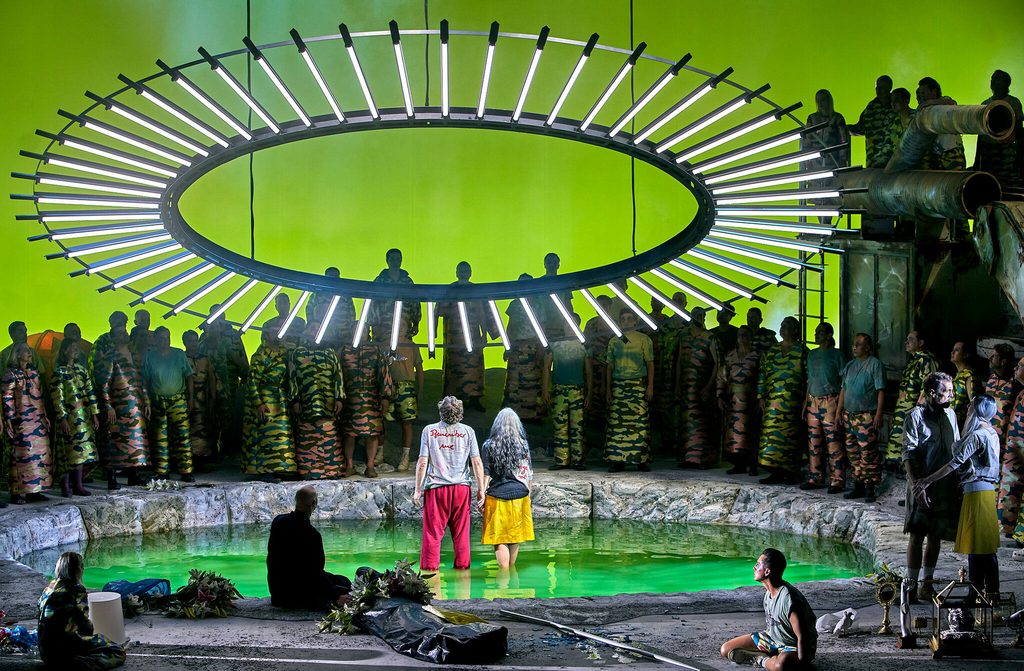
After two days of The Flying Dutchman and Rienzi in Bayreuth, I was impressed with most things about both productions. This Parsifal broke the cycle in an odd, fruity production which left me wanting more. Jay Scheib has a bold vision for these four hours, heavy in faith and ceremony. The set design by Mimi Lien would evoke a red light district, Fallout, saint’s relics and florescent tube lighting. Video work by Joshua Higgason would see vast IMAX screens the back of the stage pulling focus on this large stage to the characters in question, live streamed for great effect. An extensive scene of the filmed dressing of a wound, is bloody and has left some viewers nauseated.
Costumes are a variable: army camouflage, Summer of Love, gowns, t-shirts and more. ‘Remember Me’ is seen on the back of Parsifal for the third act, a nod to memorials in the R’n’b world. This story of the Welsh knight Perceval (the story is here set in Spain), sees him go from boy to man, via the quest for The Holy Lance, which pierced Christ’s side. Amfortas is given the same wound as he also got struck but it, via Klingsor the wicked knight who went off the rails. Kundry, a sorceress at times aids and in other moments torments these knights, via the hand of Klingsor. The Holy Grails also plays a part in the story, the redemptive qualities of Parsifal through his trail by fire to adulthood involve the sacred artefact as well as the Lance.
I did not find everything to glue together here very well. Actors and the chorus did not always have a lot to do, even in the elongated Transformation Music and the finale. The live video might have been one of the more strong accepts of this staging. Klingsor’s lair looks more like a slither of a Soho nightclub, with flashing harsh colours and a huge crack in the wall. The Flower Maidens sent to woe Parsifal are hippy chic, rich in reds, pinks and greens. The first act sees a towering beacon, illuminated for dramatic moments not really suggesting more than a lighthouse. It just feels like there were ideas for the sets and costumes without any real connecting tissue to it all.
As the singing went there was little to be upset about. As Parsifal, Andreas Schager proved valiant and rich in the role. Heavy going by any standard, the metamorphosis between these acts sees more vocal drama, leaps and sweeping proclamations for the part. Amfortas, the wounded elder knight, was Michael Volle, who in this take appears to have a severe case of hernia of a wound. A lot of suffering comes out of this role, as he is in pain for 95 per cent of his time on stage, this goes into the vocal line and Volle seeks great depths and finds jewels. Gurnemanz from Georg Zeppenfeld is always a lovely part, here no different in the inclusion of the young Parsifal to their rituals, singing the Good Friday Music with elegance and vigour.
Titurel, Amfortas’ father is the offstage Vitalij Kowaljow, burring during the arriving ceremonies, as his son writhes in agony. Klingsor is the fabulous Jordon Shanahan and is owning every moment of this. Clad in heels, a salmon suit and foil helmet the ludicrous nature of this version is not a divergence and is fun. Also nicely delivered thanks to the de Sade like take on part by Shanahan, a shame we only see him at the start and end of fact two. Miina-Liisa Värelä had a little iffy start as Kundry, another ocean like character. She really gets into her alluring goth girl outside Blue Banana in act two, with the dress sense. Act three sees her sing very little (two lines), so the second act gives Värelä daring drama in the seduction of Parsifal to betray him. Impressed by her efforts, the audience found her also very effective. The Flower Maidens and Celestial Choirs are choral highlights in an opera hard to stage, here in Bayreuth who could do these passages better? I doubt anyone.
Said choirs moved me near to tears, the orchestra bounded through this bulk of an opera with reverence and power. Conductor Pablo Heras-Casado did not rush this work and it may have felt a little long in parts, but often the momentum was there and it glistened.
So, I head home with a broken back due to the famously stiff seats (they make you sit bolt upright) and some of a militant and highly unfriendly audience (some were lovely, honest). I may not return again to the Bayreuth Festival for these reasons, yet the stellar musicianship and artistic displays are always worth the journey.
Bayreuth Festival will continue in 2027.