
★★★
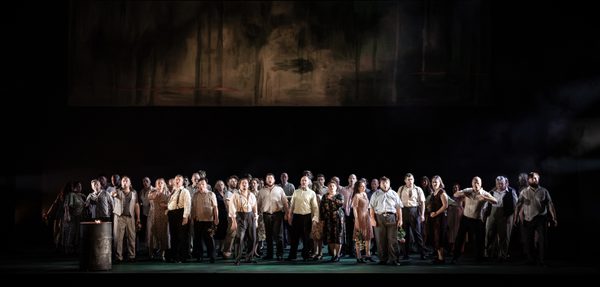
The Welsh National Opera marks its 80th anniversary with Wagner’s The Flying Dutchman. Tomáš Hanus conducts in what is the final opera of his tenure as WNO’s Music Director and directed by Jack Furness in his WNO debut. Overall, the production has solid performances from the cast and orchestra, and a superb chorus.
The Flying Dutchman is the story of the Dutchman (Simon Bailey), an immortal sailor who has been condemned to sail the oceans eternally and whose destiny and soul can only be redeemed by the faithful love of a woman. The sea-merchant Daland (James Creswell) finds his ship has gone off course, due to the distraction of his young steersman, and is now next to a mysterious ghostly ship, whose captain introduces himself as a Dutchman. After learning that the Dutchman is wealthy, Daland offers him hospitality and his daughter’s hand in marriage.
Back at the village, Senta (Rachel Nicholls), Daland’s daughter is infatuated with the tragic story of the Dutchman. Her former lover Erik (Leonardo Caimi) tries to pull her away from the Dutchman and tells her his premonitory dream of her union with the Dutchman. The Dutchman sees the former lovers together and thinks himself damned for eternity, yet Senta follows the Dutchman unto her death.
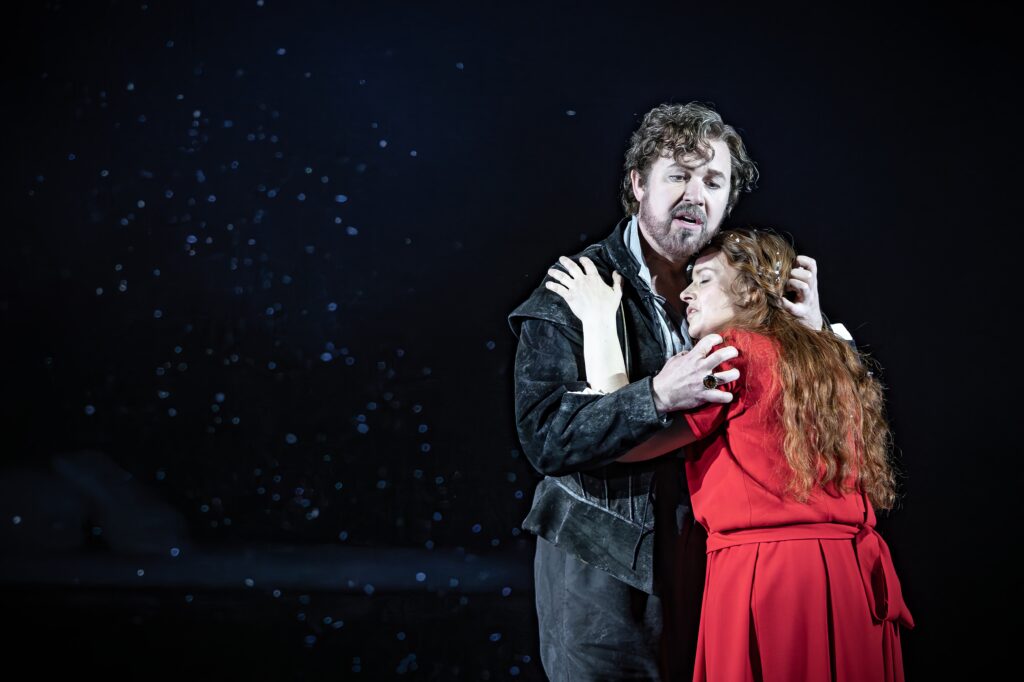
photo credit: Craig Fuller
The Flying Dutchman marks the first opera in Wagner’s artistic development. The overture introduces the underlying themes, though not quite leitmotifs as Wagner would later develop, these musical themes structure the opera. The striking feature of the opera lies in the musical contrast between the harmonies of the earthly characters and the dissonant non-traditional harmonies of the ghostly sailors. The magnificent chorus does it justice.
The singing opens well with Trystan Llŷr Griffiths as the young steersman and with a solid performance by James Creswell as Daland. Simon Bailey’s voice has all the dark intensity of the Dutchman seemingly without strain. Rachel Nicholls, although lacking full control of her voice, she performs well, especially in the duets with the Dutchman and with Erik. Leonardo Caimi conveys effectively his longing and fear. Monika Sawa’s voice is warm and versatile. It is the chorus, however, that stands out in bringing to life this eerie drama.
Director Jack Furness chooses to give some sort of psychological reasoning behind Senta’s obsession with the Dutchman by opening the scene with a woman in labour, followed by a young child in a red dress running around the stage and then becoming a running around Senta. Alas, this choice distracts from the overture’s themes and ends up being utterly puzzling when, at the end of the opera, instead of Senta ascending to heaven with the Dutchman, who is redeemed by her sacrifice, we see Senta running around again and ending up in her mother’s bed.
The staging is minimal and on the whole effective, although seemingly devoid of any hints of the sea, letting Wagner’s music doing the heavy lifting. As in previous WNO productions, there is a tendency to fall for crass semi-erotic displays that are irksome and fail to convey the social and cultural setting of the opera. Seafaring communities are not vulgar simply because they lack the graces of the higher classes.
Notwithstanding some weaknesses, the WNO continues to deliver under very difficult circumstances. This Flying Dutchman has substance and gets a very warm reception by the public.
As I had been very fortunate in seeing the 1958 Sadlers Wells production (still touring in 1978 or so) I had no great hopes for this one, but I had not expected a reputable National Opera Company to do it with absolutely no sets or props, no ships and no nautical references aboard ship and no spinning wheels in the spinning chorus (rather like having a drinking song with no drinks!) The music is majestic and noble and it’s a pity the director didn’t seem to have listened to it before giving us this empty stage and rather lacklustre production. Unfortunately the ladies’ costumes looked as though they came from a charity shop and the sailors’ as if they had come from a skip. Musically it was excellent, and the chorus of about 50 almost too many voices though they filled the otherwise empty stage while not even miming anything like sailing their non-existent ship. Senta, Daland, and the Dutchment gave powerful and moving performances, helped by good surtitles (which did not exist 50 years ago), and the steersman very adequate, though it was odd to see Fritz dressed as a double glazing salesman. I hope WNO will ask their future producers and set (or empty stage) designers to at least listen to the music before putting such contradictory business or sets (if any) on the stage. Visually the production I saw 50 years ago remains fresher in my mind than that of two days ago, though the music is enduring “in ewigkeit”