
Tag Archives: Tosca

Tosca – reviewed by Eva Marloes

 out of 5 stars (3 / 5)

Politics, sex, torture, love, and of course plenty of death, Tosca is an opera that always delivers. It’s a pacey political thriller where painter Mario Cavaradossi (Andrés Presno) gives refuge to his fugitive friend Cesare Angelotti (James Cleverton), who has escaped prison and is now searched by baddie-in-chief Baron Scarpia (Dario Solari). Add a jealous lover, Floria Tosca (Fiona Harrison-Wolfe), and the drama keeps you at the edge of your seat. Scarpia uses Tosca’s jealously and love for Cavaradossi to find out where Angelotti is hiding, then gets Cavaradossi tortured in front of his beloved Tosca.

Puccini’s orchestration ensures every element is woven together perfectly, every element serves the drama. It’s a compact drama brimming with a whole gamut of emotions. Alas, the Welsh National Opera’s Tosca pleases the public, but does not quite bring out the tension and drama.
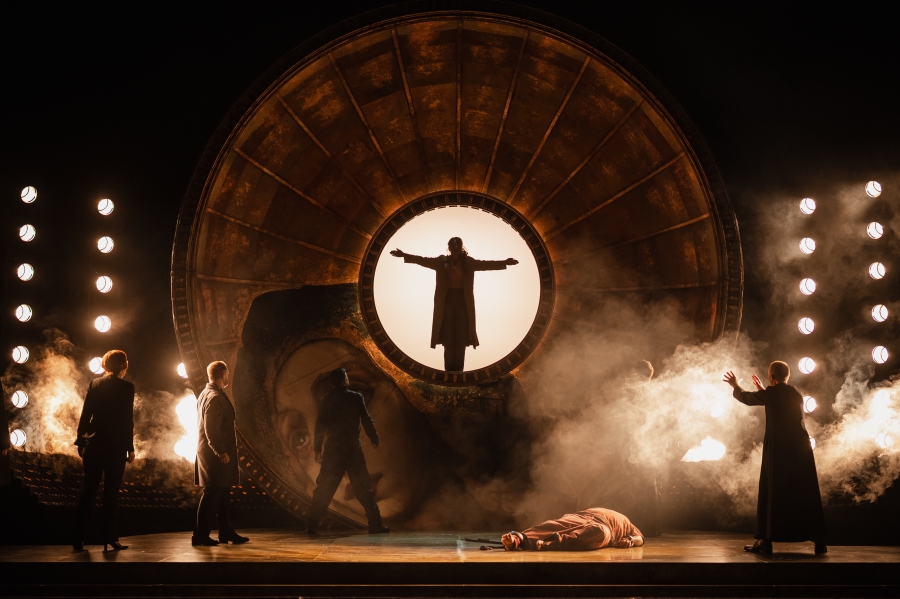
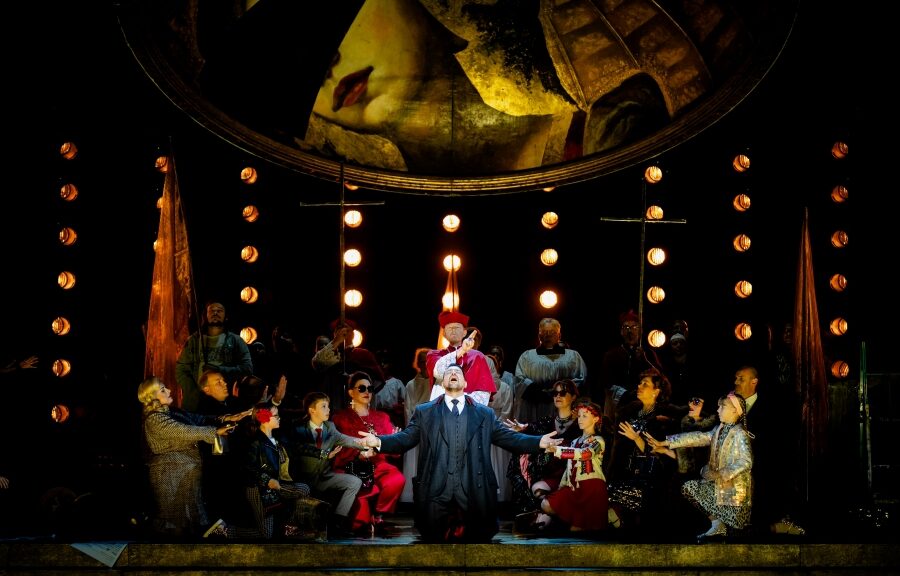
Cast of Tosca – Photo by Dafydd Owen

On the night of the 24th of September, Floria Tosca was performed by Fiona Harrison-Wolfe, whose voice is strong but lacks modulation therefore pathos. Both Harrison-Wolfe, as Tosca, and Presno, as Cavaradossi, seemed to fail to modulate and deliver a more natural progression to higher notes. This was particularly noticeable in the first act when it was like being hit by a sudden increase in volume.   

The interpretations were powerful but the lack of modulation compromised the emotion. Tosca’s Vissi d’arte and Cavaradossi’s E lucevan le stelle failed to move. The artists were not aided by an orchestra that did not shine. Such a compact opera felt a little drawn out at times. Dario Solari gives a solid and impressive performance as Scarpia.

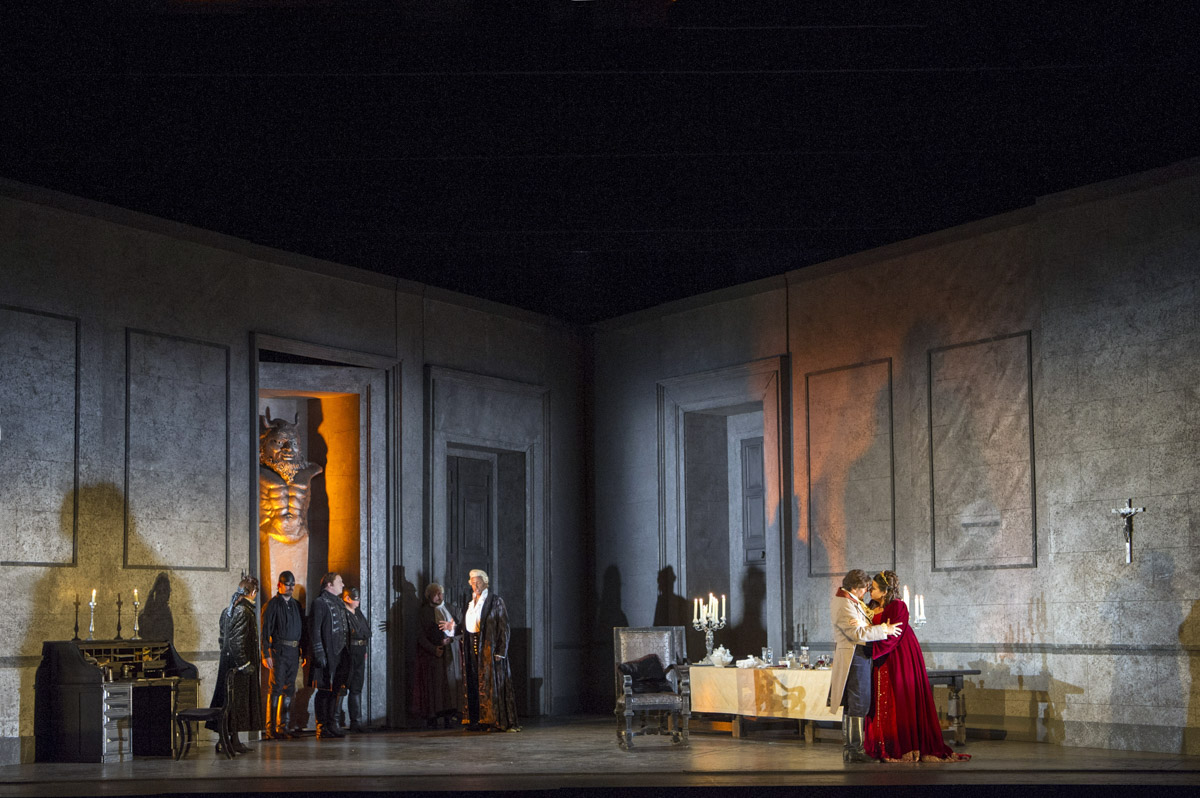
The contemporary setting was used effectively. A large painting of Mary Magdalene on the ceiling of a cupola dominates the scenes emphasising the clash of sacred with profane. Scarpia uses religion for power. Lights, costumes, and staging produce a very striking image where the chorus in colourful costumes surrounds Scarpia who is illuminated as a star. It is not so distant from the quasi-theocratic images we get from the United States today.

The WNO’s Tosca provides good entertainment to a public very keen to applaud at the earliest opportunity. 
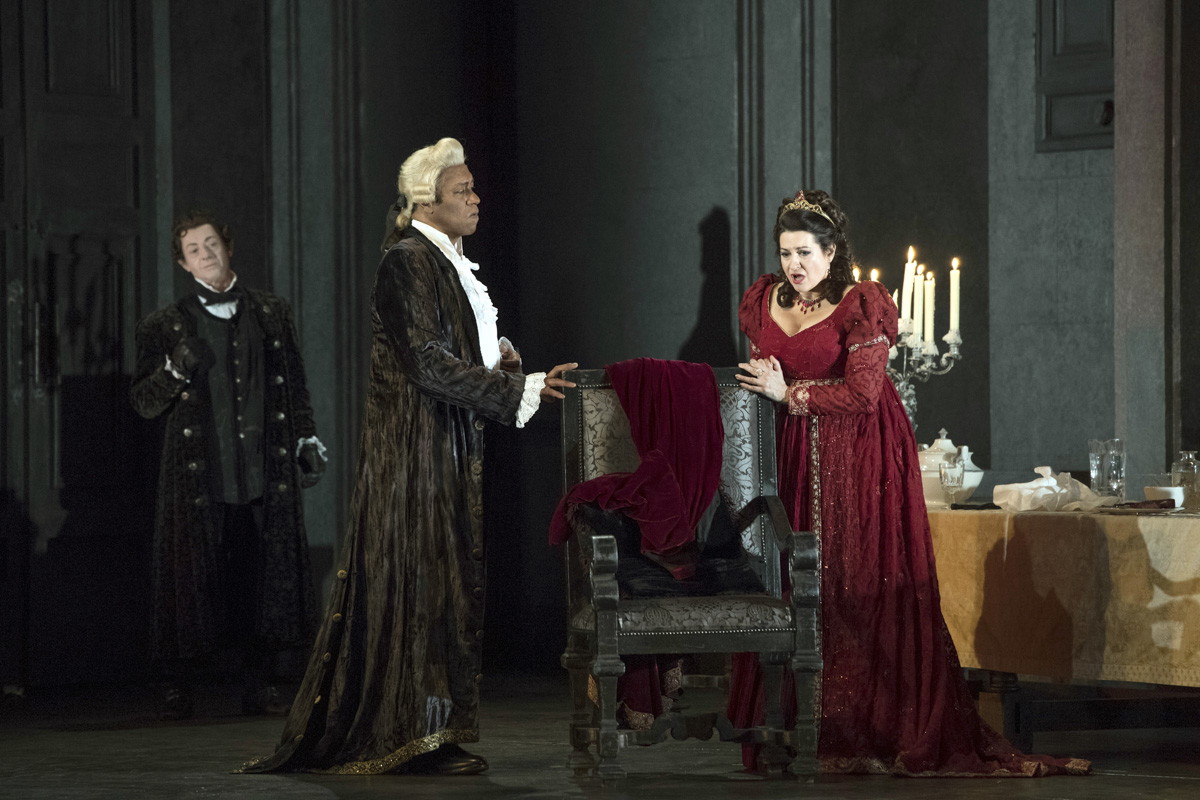
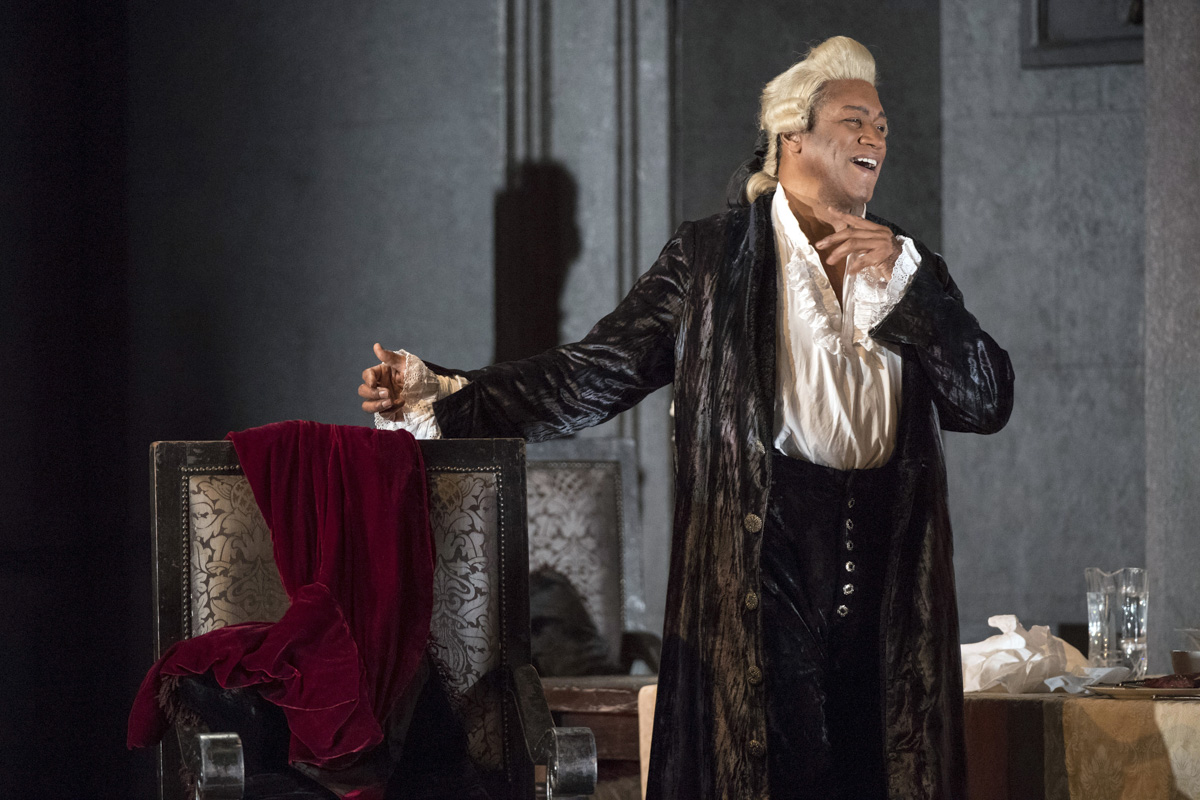
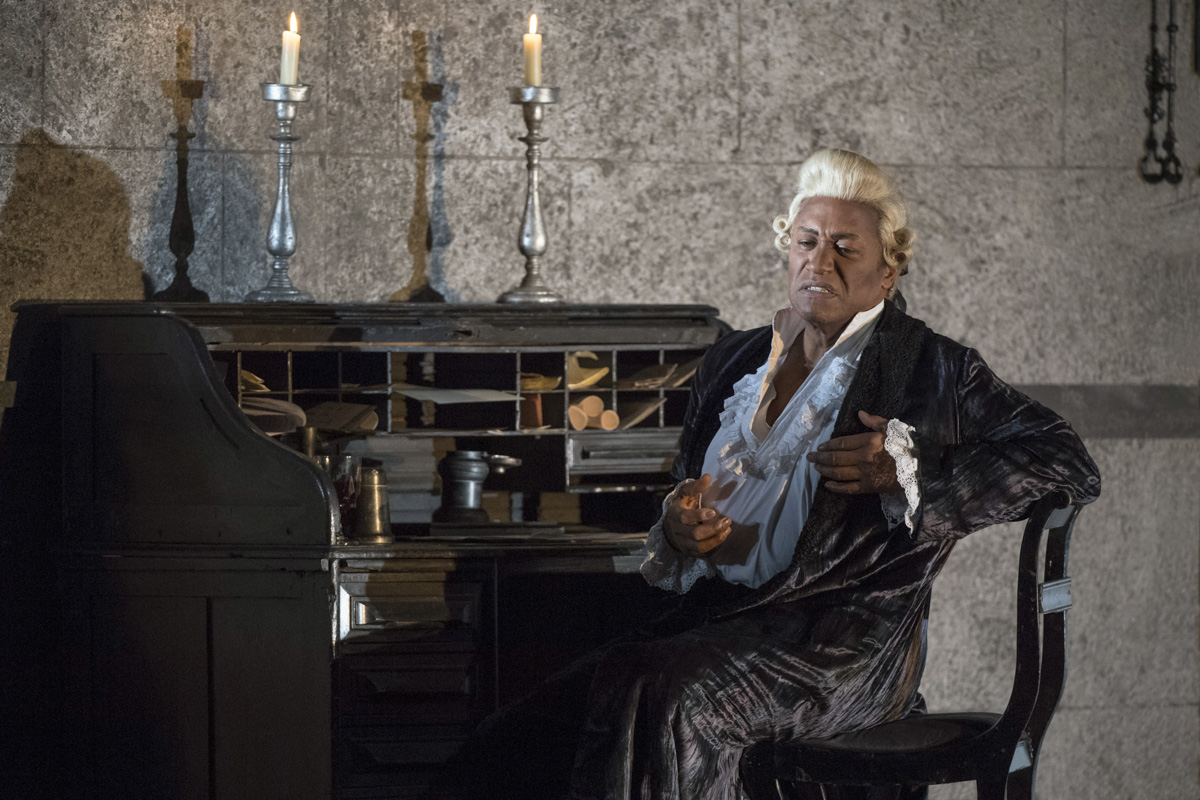
Review Tosca, Welsh National Opera by Roger Barrington

photo credit Richard Hubert Smith


 out of 5 stars (4 / 5)


An opera in three acts by  Giacomo Puccini

Libretto by Luigi Illica and Giuseppe Giacosa after the play by Victorien Sardou

Cast:

Floria Tosca – Claire Rutter (Soprano)
Mario Cavaradossi – Hector Sandoval (Tenor)
Baron Scarpia – Mark S. Doss (Bass-baritone)
Cesare Angelotti – Daniel Grice
Sacristan – Donald Maxwell
Spoletta – Michael Clifton-Thompson
Sciarrone – George Newton-Fitzgerald
Gaoler – Jack O’Kelly

WNO Orchestra conducted by Carlo Rizzi

Production:

Original director – Michael Blakemore
Revival director – Benjamin Davis
Designer – Ashley Martin-Davis

Michael Blakemore’s 1992 WNO’s Tosca is revived in a scintillating production currently at the Wales Millennium Centre in Cardiff.

Tosca is probably the first example of verismo, the operatic movement that followed literature in its change from romanticism to realism, and in its more extreme form. naturalism.  The tale set in set in Rome in June 1800, with the Kingdom of Naples’s control of Rome threatened by Napoleon’s invasion of Italy. It depicts jealousy, abuse of power, murder and suicide.

The three principal characters are Tosca, a celebrated soprano opera singer, Cavaradossi a painter and her lover, and Scarpia, the chief of police  who lusts after the Diva. The story is fast paced and exciting with its inevitable tragic conclusion.

British soprano Claire Rutter manages to convey the prima donna character of Tosca to excellent effect. Sudden mood swings, demanding and flamboyant behaviour  comically shown when her lover Cavaradossi’s portrait of the Magdalene resembles an imaginated rival. Her rendition of Tosca’s aria “Vissi d’arte”, a lament to God for having repaid her cruelly for her good deeds, demanded your sympathy and compassion.

Mexican Hector Sandaval, (not to be confused with his compatriot, the martial arts exponent), possesses a highly cultivated tenor voice and this was shown to good effect during the climatic final act with Cavardossi’s famous aria, ”  E lucevan le stelle”.

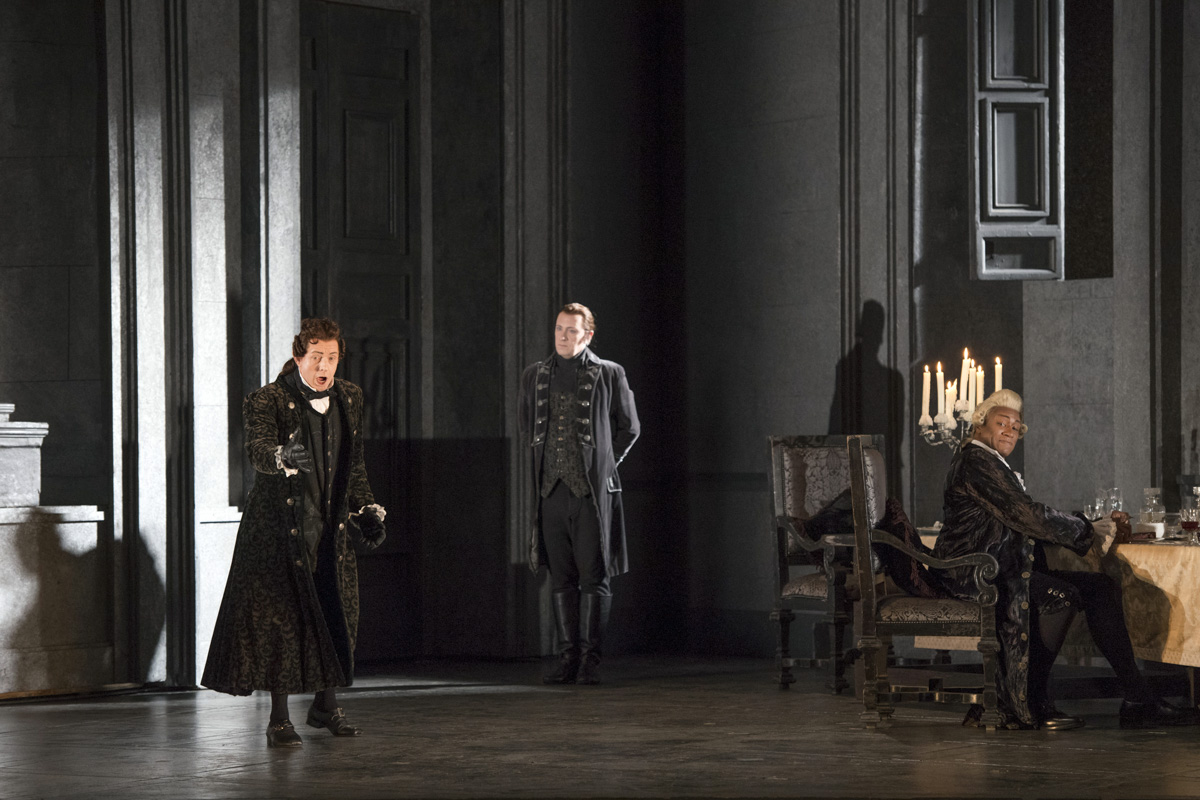
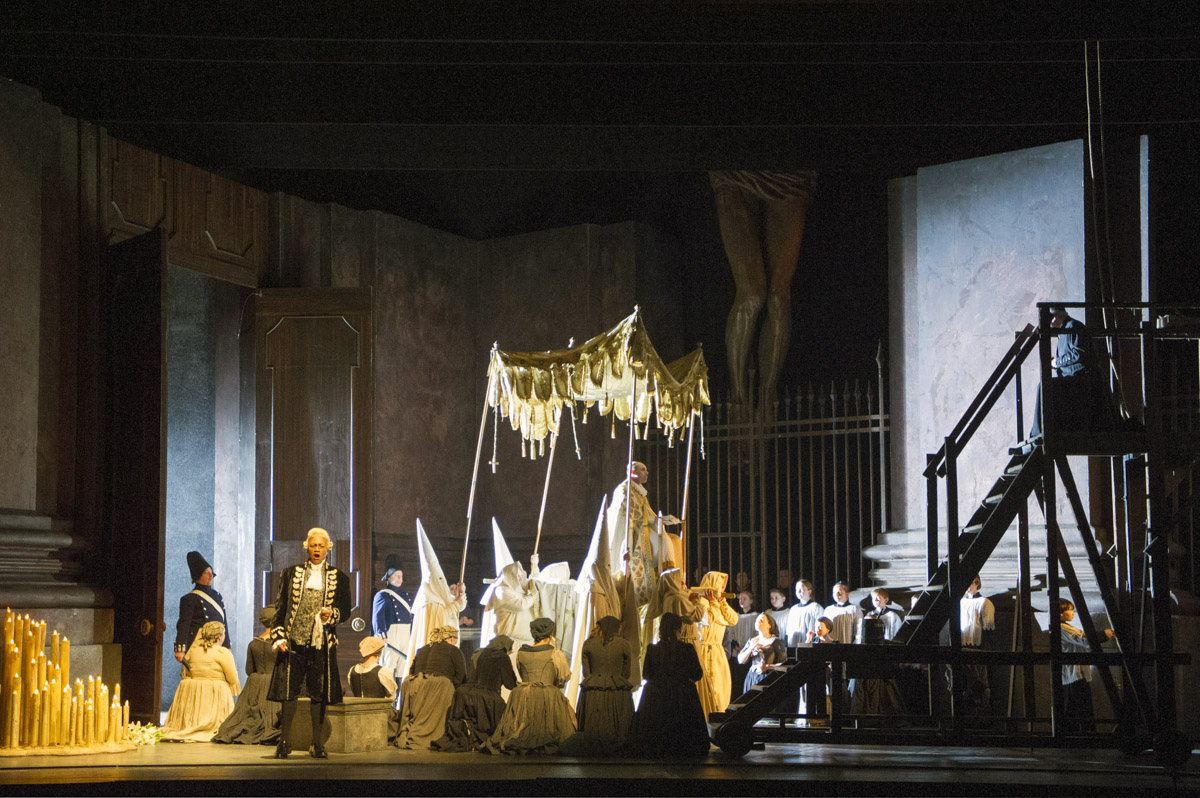
American Mark S Doss amply displayed the sadistic nature of  Scarpia, although at the conclusion of Act 1 with the sublime Te Deum, he lacks the power of Bryn Terfel or the late Dmitri Hvorostovsky in the same role. Having said that, this is the highlight of the production with Doss backed up by the chorus largely made up of local schoolchildren.

The orchestra of the Welsh National Opera under the baton of Carlo Rizzi played beautifully throughout and added to the high quality of the singing significantly.

I would like to see the WNO  the next time they perform Tosca, having a new production as Blakemore’s twenty-six year old production, is getting a little long in the tooth.

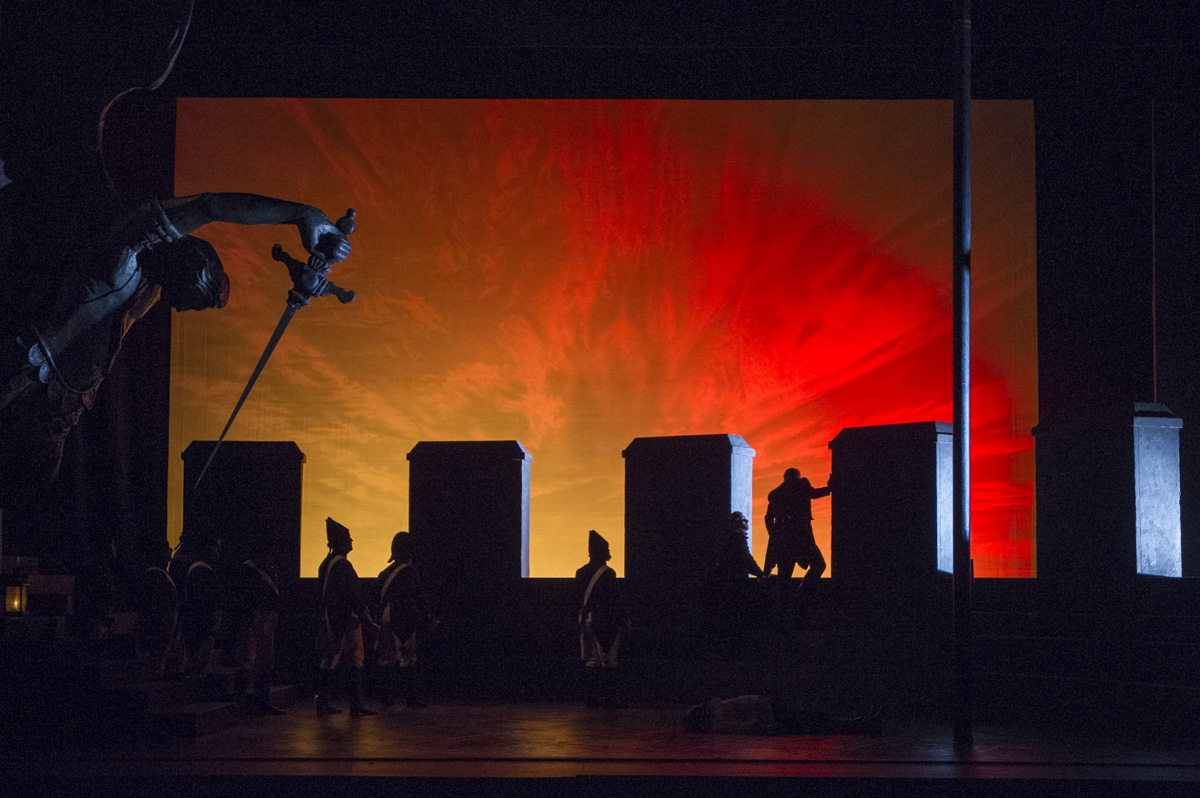
Another small blemish was in the final scene where Tosca dramatically jumps to her death from the parapet of the Castel Sant’Angelo, her head momentarily reappears thereby defying the laws of gravity.

Should you be looking for an introduction to Grand Opera, then Tosca with its riveting story-line and fast pace provide the basis of an experience that can open a new world of high art.

Duration: 2 hours 40 minutes with 2 intervals.

It plays at the Wales Millennium Centre in Cardiff Bay until 20 February 2018 and tickets can be purchased here

End

Roger Barrington

Photos

 photo credit Richard Hubert Smith


 photo credit Richard Hubert Smith photo credit Richard Hubert Smith photo credit Richard Hubert Smith photo credit Richard Hubert Smith photo credit Richard Hubert Smith photo credit Richard Hubert Smith

Roger Barrington