Tag Archives: featured

Review Monster’s Paradise, Staatsoper Hamburg by James Ellis

Photo credit: Tanja Dorendorf 

 out of 5 stars (5 / 5)

I would take the plunge and travel overseas for the first time in a decade. In a frozen city, the Staatsoper Hamburg made a piece which got people talking, yet even more attention should have been brought its way. 

Monster’s Paradise is an astounding thing. The collaboration between Olga Neuwirth and Elfriede Jelinek goes back to the mid 90’s, including a surprise version of an opera based on David Lynch’s Lost Highway being noteworthy. I am new to their work and Monster’s Paradise is my chance to see what they do. Neuwirth’s score is so overwhelming in its references and utter violence. In the spirit of Ligeti, there is much humour and I was taken with the unrelenting use of percussion, with Lucas Niggli on drums as a soloist of brilliance. Seth Josel on electric guitar was another highlight in the pit. The orchestra with Titus Engel at the helm remained potent, going up to the pit as everyone was leaving, I was stunned with just how small the amount of players were, even out of tune pianos were included into the fold. 

With director Tobias Kratzer and co-director Matthias Piro, they embraced the deeply silly story and notched it up tenfold. With sets and costumes by Rainer Sellmzier, the total embrace of pop culture references held up as a universal truth. Disney Princesses, The Muppets and Godzilla are clear in their imagery here, no cause for concern with parody as a justified right. Naturally, the main head turn is the character of the Trump like persona Der König-Präsident, with many additional Oval Office trappings. 

With a libretto by Elfriede Jelinek (and additions from Neuwirth), it is razor sharp in its satirical and political cometary. Many acidic nods to both of Trumps terms and the infamous, in-between period are brought up and questioned severely. There are puns and even some I would have missed in the German, yet the near mythical and pop transformation of events are what really stand out. 

This all works immensely well, not taking itself too seriously and also questioning profound issues we have today. Two vampires Vampi and Bampi go across the world, trying to find ways to help and this is when they discover this manic President. Through the aid of the keiju, Gorgonzilla (one of the many puns!), a battle commences between good and evil, clever and stupid, nature vs destruction. The video work from Jonas Dahl and Janic Bebi, aside clever stage craft, is also a delight. There are Trump supporters depicted as Zombies, who also haunt the foyer during intermission. You wouldn’t get this done in the U.K. This much I know. 

The cast are total talent and everyone was perfect for their roll. Vampi and Bampi from Sarah Defrise and Kristina Stanek are our leading ladies of the whole opera. Many funny and touching moments with these two are the backbone. They even have doubles from Sylvie Rohrer and Ruth Rosenfeld who are used in showy was when the two are front and centre. As this twisted President, Georg Nigl stole the show any time he’s on. This is an immensely silly role and he took it with aplomb, singing with shrieks, shouting, attacks and whines. Inflation baby suits, a washboard tie and his golf buggy are some of the many hilarious props to the role. It was an immensely funny thing to see. 

Photo credit: Tanja Dorendorf 

Gorgonzola also got his double: Anna Clementi and in physical form from an amazingly committed Vanessa Konzok. The vast array of modulated sprechgesang through the entire role was shocking, Clementi really doing vocal fireworks. Mickey and Tuckey from countertenor Andrew Watts (I believe the only singer I’ve seen before here) and Eric Jurenas as both acidic wretched Disney icons, servants to their president. A surprising singer Ruben Drole who was not on stage enough, was Ein Bär, a bear in a physical manifestation of the America, often ravaged by his leader. A surprise turn from actress Charlotte Rampling seen on video, framing the stage in double, glistening form as The Goddess. The only extensive English language moments were here, with concerning verse over events on stage, not dissimilar to a Greek Chorus. 

I’m aware there is much more that could be said. I’m also savouring the amusing boxing match between The President and Gorgonzilla, the latter’s rattle used to great effect throughout the night, Melania as a lampshade and the Vampire dolls to show how tiny they are when they see the immense Gorgonzilla. The lucid electronics from Markus Roistering also season the pot, a children’s chorus is also briefly sweet towards the wrap up. The devastating end with Nancarrow like piano MIDI flurries couldn’t have been better. A little bit of trimming in length (two hours, forty five minutes with the break) might have faired better, though there are little quips from this impassioned critic. 

This should have been filmed or at the very least, live streamed for much more to see. It’s popularity both near and also far, has proven potent. 

Monster’s Paradise is staged at Opernhaus, Zurich from 8th March till 12 April, with Graz Opera, Austria dates to be confirmed.

Listen to Monster’s Paradise on the Opera Hamburg website.

Review: Glitch, The True Story of the Post Office Scandal, Theatr Clwyd, Mold, by Richard Evans

A Rabble Theatre production, Theatr Weston (Theatr Clwyd)

 out of 5 stars (4.5 / 5)

On tour nationwide until April

Glitch.  It took a television series to ignite public anger about a scandal that had been brewing for over 20 years.  Those with an eye to the news knew something about what was happening but most remained blindly indifferent to the scale of injustice that was being perpetrated.  This drama relates some personal stories from those whose lives were often ruined by the actions of the Post Office and the computer company, Fujitsu.  It focuses in particular on the story of Pam Stubbs from Barkham, a small village 15 minutes away from the Fujitsu headquarters in Basingstoke. 

Rabble theatre takes stories of national significance and develops drama from them.  They are passionate about supporting women such that when they heard the story of Pam in 2021, they felt compelled to tell her story. As they devised the show, it became apparent that this was a huge scandal, not a one off event.  Glitch was first produced in 2024, before the broadcast of the now famous ITV drama featuring Alan Bates who was knighted recently for investigating this scandal and managing the campaign for justice.  

What happened to over 900 sub-post office masters is quite simple.  A new computer system called Horizon made by Fujitsu to record transactions was installed in sub-post offices.  A selection of these Horizon machines developed a bug which altered the totals of a days takings leaving a short fall of perhaps £200 a day unaccounted for.  Over a period of time, a sub-post office could run up a debt of up to £50,000 by which time, the Post Office auditors would have been called in to inspect what was happening and concluded that the sub-post office master was swindling the system.  The Post Office would then prosecute the shop owner to recoup the money.   

Pam’s particular story is both distressing and admirable.  She kept meticulous written records of every Post Office transaction and could detail every loss that was unjustly incurred within the accounts.  Despite countless attempts to call in help from the Post Office and Fujitsu she was not believed, had her counter closed down and she had to sell her shop.  She became a social pariah in a close knit village, yet despite this when called on to testify in court, stood up and told her story despite intimidating and manipulative tactics from the defence lawyers.  She emerges as a strong minded, fair person who acted with integrity.  

This show needed a strong lead and Joanna Howarth as Pam provides this.  At times friendly and gentle, at others someone you would not mess with.  However this was a team effort with a small cast of four.  Laura Penneycard, Naveed Khan and Sabine Netherclift all played multiple roles and together they portrayed a compelling drama that illustrated the distress caused by the scandal well.  

The play notes that 300 people died before seeing this injustice exposed and their name cleared.  Thirteen of those committed suicide.  Many law abiding citizens were imprisoned or faced bankruptcy because the Post Office believed a computer system from a faceless multinational company rather than honest working people.  This really is a story of the common person fighting against the impersonal cruelty of big business and the desire to put profit before people.  Full marks to Rabble Theatre for being bold enough to tell this story.  It deserves widespread viewing.

Review Tanztheatre Wuppertal, Pina Bausch’s ‘Sweet Mambo’, Sadler’s Wells, London by James Ellis

Photo credits: Karl-Heinz Krauskopf

 out of 5 stars (4 / 5)

The late choreographer Pina Bausch was one of the greats of her generation, past shows at Sadler’s Wells have dazzled with what dance can become in London.

Her Sweet Mambo was her penultimate work, after a life made in dance. This is a cocktail of moments, at times more of a happening as opposed to pure dance. I’ve never heard dancers speak so much: their introductions, recollections, narratives, demands and instances are heard throughout the night. These can be highly meta, or idiosyncratic as there is screaming, mic feedbacks and vocal frys, uttley absurd in the best of spirits. It’s clear that the few male dancers on stage are limited to Lynchian aggressors or lecherous fiends who prey on these leading ladies.

As a dance work, the movement is fluid and elegant, contemporary without to much pressure. Long silk sails are often used on stage for effect, the only other addition of note. The ladies costumes also evoke this breeze with soft, billowy frocks, aside ballroom fashion by Marion Cito. As things went on, it become compelling to watch the dancers evoke old Hollywood, The Red Shoes, Latin dances, story time and performance art. The show embraces its messy relationship with men as both abusers and lovers, even with this one note portraying. There is much joy either way.

Effecting use of the film Der Blaufuchs is the back drop for extended passages, another ode to yesteryear. Eclectic musical choices sees Portishead, Richard Wagner, Ryuichi Sakamoto and the song Cry Me A River feature, all working very well. An international feel to the whole thing with dancers from all over, talk, move and move us dearly. Many moments conventionally depict sexism and rights taking, as others indulge with lust and playfulness. I’d honestly say the second part after the break was not necessarily needed, as it returned to dances seen in the first part and didn’t quite capture the same kinetic energy, nor giddy heights.

Also, the prospect of seeing another Bausch classic: Kontakthof – Echoes of ’78 at Sadler’s Wells in the spring, is very much exciting.

It runs till the 21st February 2026

Review ENO, Rise and Fall of the City of Mahogany, London Coliseum by James Ellis

Photo credit: Tristram Kenton

 out of 5 stars (2 / 5)

My support for English National Opera goes back nearly two decades. I’ve loved the passion, the commitment to the art of opera and music making. With recent setbacks and issues, I still need to support the company, yet I have some doubts…

This is an odd choice, Kurt Weill and Bertold Brecht’s Rise and Fall of the City of Mahogany would be the latest premiere from the company. With Weill’s love of all thing’s cabaret and Brecht lectures for the audiences…it’s an often-heady mix. Directed by Jamie Manton, this is a stripped back show, with Brechtian sensibilities, one which typically vexes.

I found there to be several issues, I think the English translation let’s it down, it should be in German for that acidic pout of clever-told-you-so storytelling. ENO’s commitment to opera in English has always been the gold standard, yet not everything works. The humungous Coliseum may have proven to be two large for the opera intimacy, within many moments of the first two acts.

The City of Mahogany comes about as dessert delivery workers can go no further with their toil. They choose to set up in the wasteland, creating a utopian idyll where everyone is equal, at a price. A strange band of characters including Jimmy MacIntyre and his lover Jenny Smith make the city their home, though flaws fixate and unpaid debts cause fatal flaws in the city’s ideals. This is where Brecht gets to shine with his annoying storytelling parables. There are no prisoners for this lucid narrative, less about sharp character development and more social and political, issues of the day, now seen with fresh eyes – today.

Weill’s score is highly eccentric. With the addition of banjo, acoustic guitar, an under used saxophone, (I think I heard pianola at one point) and other fun additions, I do stand by this being an opera if highly unconventional in its vocal delivery and orchestra fibres. Many merry Oompa moments and toe tapping bars should appease, yet this is not always the case. The first part of the night with act one and two conjoined, felt like a slog and the intermission after the first act would have been graceful respite. The third act remains the most ‘operatic’ as the story finally gets some heightened momentum with Jimmy MacIntyre’s execution for unpaid whiskey bills and other heinous acts. Story wise, that’s pretty much it!

The chorus and orchestra of ENO are always a thrill and under the baton of new music director André de Ridder, I think there is little to be worried about. The concerns lie with an arts council who have openly chosen to comprise the company base of over ninety years in London, with Manchester flutters for their own Brech-like agendas. You can see this in the sets of Milla Clarke, though ‘alienation’ as a proven point, the set back on this funding would slash many ideals. There is good singing from Danielle de Niese, Simon O’Neill, Elgan Llýr Thomas, Mark Le Brocq and more. Some eccentric dancers would add to the fray in often bizarre and comical ways. My only regret is that I just wish I’d enjoyed this screwball rarity much more.

Side note: I should be off to Hamburg later this week for Monsters Paradise, another German twist on the American dream, where Trump will fight Godzilla. Now that. Is. Entertainment….

It runs till 20th Feb 2026

Review, Ensemble Près de votre oreille, Wigmore Hall by James Ellis

 out of 5 stars (4 / 5)

It would be further new discoveries in music that would present Ensemble Près de votre oreille and their concert of William Lawes. He would write for Charles I and his involvement in the English Civil War would see his fate sealed. Yet, why do we not know of him better?

With dimmed lighting and a solemn air, this hour was quite evocative. Lawes pushed boundaries in an era which he found himself in. Baroque would be the time, yet everything is sharp, the ensemble brim with a youthful punch. With singers Marion Tassou, Anaïs Bertrand and Olivier Gourdy, their series of Choice Psalms held such intimate secrets, a journey back to the past and one of great impact. Extracts from Lawes Harp Consorts were other thrills, it’s the simplicity, really. The ease with everything was held together tight but was just so soft and alluring.

Director Robin Pharo, who was playing viola da gamba throughout, spoke halfway through declaring it was the ensembles first time in the UK performing. This broke the spell for me a little, I think the whole hour could have easily sailed on peacefully. Perhaps Robin could have spoken before the first piece? What followed was still sweet and profound in many ways, as more Harp Consorts and Choice Psalms wafted around us. We must strongly encourage Ensemble Près de votre oreille to come back and do more stellar work such as this.

Review 2:22 A Ghost Story, New Theatre, Cardiff by Bethan England

 out of 5 stars (4 / 5)

There is no doubt about it, 2:22 A Ghost Story is a global phenomenon. Since its debut in the West End in 2021, the production has had seven seasons in London, a record-breaking UK and Ireland tour and has inspired over thirty productions across the globe. It’s safe to say that the play penned by Danny Robins has enjoyed huge success and is still as popular as ever.

Judging by the gasps at the climatic twist in the tale, there are still people who are brand new to experiencing the plot of 2:22 for the first time. Even for someone like me, who has seen it before, the play still carries huge weight and the twist in the story still hits hard. The action sees a couple hosting their friends at their new home, with renovations still in full flow. What the play does so well is bring together four people who are clearly from such different places in their lives, careers, social backgrounds and more, and throws them together in an evening which tears their nerves to threads. The premise is simple; having just recently moved in with their newborn daughter, Jenny has started hearing noises through the baby monitor, whilst her husband, Sam has been travelling. The key point is that these footsteps always happen at the same time, 2:22am.

What follows is the pursuit of the truth and what is really going on in the baby’s room. The dynamic of the two couples is well played and scripted here, with each character’s beliefs and backgrounds bouncing off or colliding with another character. Sam is a scientist and therefore, complete disbeliever of his wife, chasing away her theories with flawless logic. Lauren seems more inclined to believe Jenny but is still sceptical, whereas her partner Ben is a firm believer. The clash of personalities here is excellent and very believable. These people come from all walks of life, and this is clearly executed throughout the script.

Sound and scenery add to the tensions of the piece. The stage remains fairly unchanged throughout, but the passage of time is marked by sound, blackouts and the stage proscenium being lit in stark red lights. This is highly effective, along with the dramatic sound effects, in ramping up the tension exponentially and the crowd often descended into nervous, anxious giggles in each of these passages of time. The effects on stage are also very good; not overdone, but when they are delivered, they’re very believable. It’s the lack of ghostly happenings rather than them being overwhelming and constant which makes the tale palatable and draws the audience in even more.

A small cast, but one that delivers in spades. Grant Kilburn is excellent as Ben, delivering much needed comedic relief which helps ease both the ghostly and social tensions. He is partnered with Natalie Casey’s Lauren, an eccentric, zealous peer of Sam. Casey owns the stage with gusto and swerves between comedy and drama with ease. Shvorne Marks is hugely capable in the role of Jenny. Her fear is palpable, and we are instantly on side with her and want to believe her story. She is the perfect counterbalance to Sam, portrayed by James Bye. Their relationship is very well delivered by the pair; their love is evident, but the marriage is scarred by their differences and inability to agree on this divisive topic.

I was very impressed with the play’s rewatch factor, as I have seen this before and obviously knew the twist in the story. It still had massive impact for me though; I had huge enjoyment spotting the clues cleverly interlaced throughout the script! If you’re up for a night of jumping out of your theatre seat, this is definitely the one for you! But it’s not just played for scares; it’s a well-constructed play full of great comedy, social commentary, fractured relationships and, of course, the devastating climatic ending which will leave you open mouthed. If you do manage to grab a ticket, just remember, ‘Shh! Please don’t tell!’

Tempo Time Credits and an Unforgettable Cardiff City Match Day!

By Guy O’Donnell, Director, Get The Chance

If you’re wondering how Tempo Time Credits can offer you Pitch Perfect moments beyond volunteering, let me share my recent footy adventure at the amazing Cardiff City Stadium.

🎟️ What Are Tempo Time Credits?

Tempo Time Credits are a brilliant way to get rewarded for the time you spend volunteering. For every hour you give back in your community with a Tempo partner, you earn 1 Time Credit. And guess what? You can spend those credits on all sorts of cool experiences — gigs, theatre trips, museum days … and yes, even football tickets!

It’s dead simple: volunteers, earn credits, and then browse the Tempo network for available activities. ! For the match I booked and confirmed using my Tempo Credits, via email with the support of the team at Cardiff City FC Community Foundation — no money exchanged, just a great way to get something back for my volunteering with Get the Chance.

⚽️ Matchday Buzz

The Cardiff City Stadium sits right in the heart of the city, I parked in the Cardiff International Sports Campus, I easily booked a ticket on Eventbrite, costing £10.00. Parking runs from 12-5.30 giving you ample time to arrive and suck up the pre-match atmosphere!

Parking at Cardiff International Sports Campus

I showed my electronic ticket at the turnstiles (super quick and easy with a QR scan), and then it was straight into the ground

🟦 Cardiff City 3 – 1 Luton Town

And what a game it was! Cardiff were on fire from the off. Here’s how it went down:

🔵 David Turnbull opened the scoring early, firing in a great goal to get the home fans roaring.

🔵 Joel Colwill added a second before half-time, slotting home with confidence.

🔵 Perry Ng made it three before the break with a thunderous strike that sent the stadium into overdrive.

⚫️ Luton did grab one back from the penalty spot through Jordan Clark, but Cardiff held firm to secure a 3-1 victory.

The crowd was singing, the players were buzzing, and to be there live watching that turnaround — honestly, nothing beats it.

🍿 Half-Time & Highlights

Half-time was a treat in itself — great food stalls, friendly fans, and loads of chat about who’d step up in the second half.

💙 Why Tempo Time Credits Are Amazing

Using Tempo Time Credits to experience a match like this felt unreal. It’s one thing watching football on TV, but being in the thick of it — hearing the chants, feeling the tension, celebrating goals with fellow supporters — is a total game changer.

Whether you’re into sport, theatre, gigs, museums or something new altogether, Tempo opens doors to experiences that make volunteering feel even more rewarding!

Backstage at a conference: dreams, ideas and visions in action

Eleonora Savvidou-Missouri currently studying at the Royal Welsh College of Music & Drama, Cardiff talks to us about her experience of curating the conference ‘Chamber music: synergies through time, places and spaces’.

Hi Eleonora, How did this initiative begin?

I’m not quite sure myself how it all began, one day, about a year ago… is it possible to suddenly, out of the blue, set your heart to running a conference?

Perhaps unconventionally, it wasn’t just advocacy for a particular research area that led me on the journey of leading a conference only a couple of months after starting my master’s degree. Like many in their early twenties who are trying to navigate their desired career path, I was shaken by the realisation that finding a means for my enthusiasm to be embraced seemed fraught with difficulties. At the same time, going from a university to a conservatoire setting made me realise that what I envisioned as musicology – something that can ignite fireworks! – was not a common consensus. More often than not, it felt to be conceived as something foreign and scary.

I’d say that the emergence of the conference is attributed to my desire to spark change. I wanted to make music research feel like a space brimming with excitement and possibility – a place where people from all career stages can work together and become friends over shared passions. In hindsight, choosing chamber music as the conference theme was ideal: beyond the thrill of the field’s multifaceted nature, it closely reflects values which I hope will resonate through the event. Friends coming together to talk, perform and celebrate is where it all started, both in the eighteenth-century and now!

How did you choose the guest speakers for the conference? 

It was only a couple of hours after I’d first conceived the possibility of hosting a celebratory chamber music conference that I contacted Laura Tunbridge (Heather Professor of Music at Oxford University) to ask if she was up for joining me on the journey. Her course on String Quartets was my favourite part of my undergraduate degree, so it felt like there was no better person to be the keynote lecturer for the conference! From the very start, her support for the event has been unwavering; I can’t imagine the conference without her being a part of it.

I’m delighted that Julia Plaut (Royal Welsh College of Music and Drama tutor and founder of ‘Little Live Projects’ charity), Lucy Green (Emerita Professor of Music Education at University College London), Susan Young (formerly Principal Lecturer in Music Education and Childhood Studies at Exeter University) and Clíona Ní Choileáin (cellist of ‘Hold the Drama’ chamber collective) will also be joining us for a panel discussion on ‘Education & Engagement through Chamber Music’.

Attending one of Julia Plaut’s ‘Little Concerts’ inspired my idea to include a panel discussion on education and engagement as part of the conference. Founded in 2021, Julia’s ‘Little Live Projects’ charity offers interactive live chamber music events to families and children across South Wales; imagine stories set to music, shimmering lights, laughter…

I hadn’t been in contact with Lucy Green prior to the conference, but I feel as if I’ve known her for years through her work. My high school curriculum was based on her teaching philosophy, and I vividly remember my excitement when my music teachers handed me a copy of one of her books to read around 8 years ago. I never thought I’d have the honour of meeting the person that the whole world seemed to know of and talk about.

My choice of inviting Susan Young came through high recommendation; she has been a driving force behind the education programmes at Wigmore Hall and the London Symphony Orchestra, among many others. I had recently come across Wigmore Hall’s ‘Chamber Tots’ scheme and found it particularly compelling – only to realise that it was Susan that had written the programme’s research report!

Keen for the panel discussion to reflect the perspectives of educators, researchers, and performers, Clíona Ní Choileáin will be joining us to represent ‘Hold the Drama’. ‘Hold the Drama’ is a chamber collective of 6 classically trained musicians who curate and deliver live music shows that ‘tell stories to explore mental health’.

I’ve been really struck by the generosity, willingness and enthusiasm of all the guest speakers to be part of the event. I know I’m biased, but we seem to have the most amazing line up!

If you were to offer advice to others your age, based on your experiences with the conference, what would it be?

I feel that many students and graduates often encounter barriers: there always seems to be someone or something to remind us of how competitive everything is or the difficulties we will face. What often goes forgotten, though, is how much every discipline needs more people that genuinely care for what they do. If I’d give one piece of advice to anyone my age it would be to think of something that combines everything you’re passionate about and do it – no matter what. It will make the world feel a better place, it will give back like nothing else can. But the magic will only work if you set your heart to it…

Join us on the 13th of March at the Norwegian Church Arts Centre in Cardiff for a one-day conference celebrating the place of chamber music in past and present communities and advocating for its continued livelihood as we look into the future. The event will feature a panel discussion on Education & Engagement with Prof. Lucy Green, Dr Susan Young, Julia Plaut and Clíona Ní Choileáin, a performance of Mendelssohn’s Octet by the Carducci and Vita Quartets, and a keynote lecture by Prof. Laura Tunbridge.

For more details on the programme of the day, and to register your attendance, visit: https://www.eventbrite.co.uk/e/chamber-music-synergies-through-time-places-and-spaces-tickets-1980266845442?aff=oddtdtcreator

Review Our Town, Welsh National Theatre, Theatr Clwyd by Donna Williams

 out of 5 stars (4 / 5)

“Our Town is a play about life, love, and community. That’s what matters to us in Wales; that’s what matters to me. It’s a play that compels us to celebrate the everyday, to hold the ones we cherish. I can’t think of a better play to welcome audiences around Wales”
– Michael Sheen

Thornton Wilder’s three-act play Our Town was written in 1938- yet its themes certainly stand the test of time as is proven in this ground-breaking revival by the Welsh National Theatre, a new company founded by Welsh actor Michael Sheen.

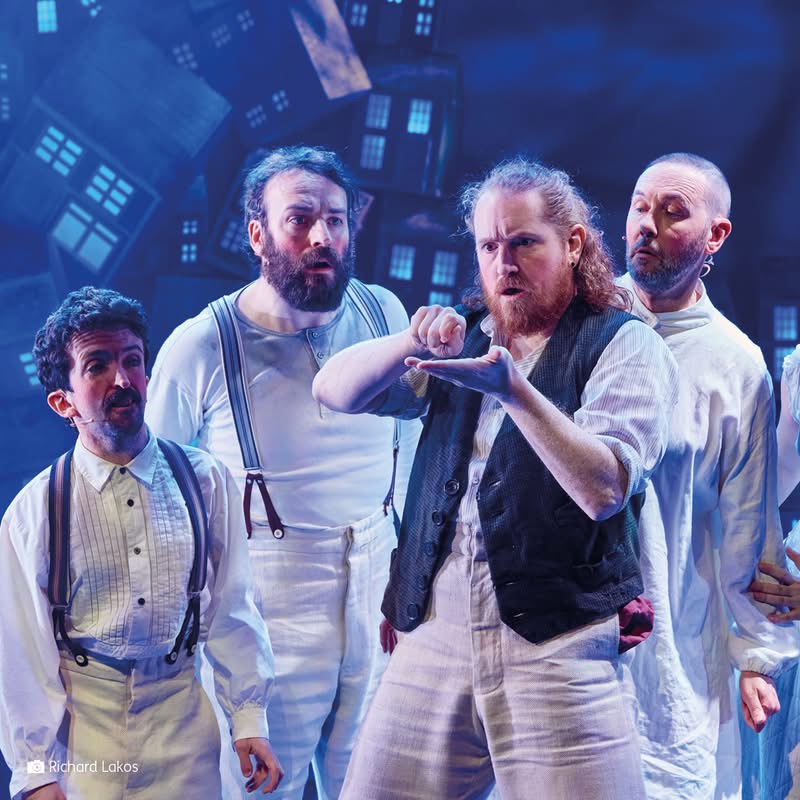
The original play introduces the fictional American town of Grover’s Corners and the everyday lives of its citizens between the years 1901 and 1913. First performed in 1938, it went on to have enormous success on Broadway and received the Pulitzer Prize for Drama. Wilder made great use of metatheatrical devices throughout the original production- setting the play in the actual theatre where it was being performed, writing his main character as ‘Stage Manager’ (a narrator who frequently addresses the audience, breaking the ‘fourth wall’) and presenting a bare stage, with actors miming rather than using multiple props. These theatrical tools are also present throughout this new production and yet the piece has been elevated beautifully through use of physical theatre, the addition of economical objects to represent various items, buildings and so on and lighting design to end all lighting design- from blood orange sunsets to starry skies…it’s simply magical!

It was widely known that the decision had been made to move Grover’s Corners to Wales for this reimagining- the Welsh accents and the period costume creating a real Welsh spirit and aesthetic. However, a lot of Wilder’s original references to American placenames, historical events, and certain other Americanisms (dollars, high school etc.) remain, which makes for a rather confusing edit. There is a certain disconnect between the new setting in Wales and the old text which hasn’t been amended- a creative choice which feels a bit odd and left me wondering why. If you’re going to bring the story to Wales, surely you’d want to fully immerse your audience by making the change a complete one?

Then again, when a piece of theatre is as clever in its accomplishments as this one, perhaps this tale could be set anywhere in the world- for its actual relevance is in its themes. Themes which seem more important today than ever. In a world of chaos, war, terrorism, technological advancement, we are transported to simpler times here; where teenage lovers communicate through opened windows at night, mothers tend to their gardens and are members of the church choir, where meals are eaten together with family at the table rather than on laps in front of the television. And yet these people still loved, lost, had passions and dislikes, hoped and grieved…as we do today. We follow parents attempting to bring up their children, young people falling in love then building a family, an alcoholic hiding his sexuality…a community simply trying to navigate through life. A superbly strong cast play an array of wonderful characters- each providing us with something we can relate to. It’s impossible to single out any one performer for neither would work without the other…a fantastic nod to the overriding theme of community.

The triumph of this production is in its staging. It is seamless, flowing, almost militant in its execution. We hear music and see dance throughout, but the whole piece is comparable to one epic, flawless piece of choreography. Credit to Francesca Goodridge, Director and Jess Williams , Movement Director. Moved by the cast, wooden planks become houses, tables and shelves, chairs transform into lawn mowers, boxes, soda pumps, and ladders of varying heights are used for levels. Even the cast take on a few transformative challenges- including becoming the farmer’s milk cow…physical theatre at its absolute best!

The first, and much longer, of the acts is filled with sentimentality, love, hope and joy, yet we begin act two with a much more sombre mood and a plotline reminiscent of Dickens’ A Christmas Carol- with ghostly figures, time travel and feelings of regret- a message to the audience to celebrate life, hold your loved ones close and enjoy yourselves, as much as you can. So, despite Our Town having been written almost one hundred years ago- the moral of the story will forever be relevant.

What an extremely strong start for this new company and at the helm, a leader who has used his celebrity status to do good- to bring this play to life again, to create theatre in Wales at a time where Welsh arts and culture continues to go through a challenging period, often due to financial restraints, and to offer opportunities for emerging artists and future generations of theatre goers, makers and creators. I very much look forward to following their work, hopefully for a long time to come.

Our Town completes its run at Theatr Clwyd on February 21st.

Cast:

Michael Sheen — Stage Manager
Rithvik Andugula — Howie Newsome
Peter Devlin — George Gibbs
Aisha-May Hunte — Wally Webb
Rebecca Killick — Rebecca Gibbs
Alfie Llewellyn — Joe & Si Crowell
Rhodri Meilir — Mr Webb
Christina Modestou — Mrs Soames
Yasemin Özdemir — Emily Webb
Sian Reese-Williams — Mrs Gibbs
Nia Roberts — Mrs Webb
Kingdom Sibanda — Sam Craig
Gareth Snook — Professor Willard & Joe Stoddard
Matthew Trevannion — Dr Gibbs
Rhys Warrington — Simon Stimson
Kimberley Noble — Ensemble
Gareth Tempest — Ensemble
Jâms Thomas — Constable Warren

Creative Team:

Thornton Wilder — Writer
Francesca Goodridge — Director
Russell T Davies — Creative Associate
Hayley Grindle — Designer (Set & Costume)
Jess Williams — Movement Director
Ryan Joseph Stafford — Lighting Designer
Dyfan Jones — Composer, Musical Director & Sound Designer
Sam Jones — Casting Director
Dena Davies — Assistant Director / Theatr Clwyd
Dewi Hughes — Voice & Dialect Coach
Haruka Kuroda — Intimacy Director
Pádraig Cusack — Executive Producer (Welsh National Theatre)
David Sloan — Executive Producer (Rose Theatre)

Launching the Get the Chance, Cultural Impact Awards, 2026

The second, Get the Chance, Cultural Impact Awards, 2026 sponsored by Ffilm Cymru, Tanio, Tempo Time Credits, Theatr Clwyd, and Porters Cardiff, are now live!

The Get the Chance, Cultural Impact Awards, 2026 celebrate high quality, cultural activity that reaches a broad range of the public and its positive impact on their quality of life.

The Award event will take place at Porters , Cardiff on Sat March 28nd, 5-7 pm a representative of all nominated organisations/individuals will be invited to attend.

The Awards are sponsored by Ffilm Cymru, Tanio, Tempo Time Credits, Theatr Clwyd, and Porters Cardiff. Individual Category sponsors include, Common/Wealth, Christine O’Donnell, National Dance Company Wales and Theatr Iolo.

Caroline Lane, Partnership Manager, Ffilm Cymru Wales said,

The Get the Chance Awards bring people together to celebrate the people and organisations that are delivering exceptional and engaging work through arts and culture. We are delighted to be part of the celebration of cultural activity that enriches people’s lives through participation, connection and storytelling.

Lisa Davies, Chief Executive, Tanio said,

Tanio are delighted to be supporting the Get The Chance Awards again this year.  We need more opportunities to come together and celebrate the exceptional work happening across Wales, from grassroots community arts to large scale events!  All Important for the culture and wellbeing of the people of  Wales.

Rachel Gegeshidze, Chief Executive, Tempo Time Credits said,

“At Tempo, we believe that culture, the arts, and heritage should be accessible to all, and we are incredibly proud to support the Get The Chance, Cultural Impact Awards 2026. Volunteers are the backbone of our communities, and through Time Credits, we recognise and value their time, opening doors to new experiences. These awards shine a light on the incredible cultural initiatives and volunteers that give their time to make a real difference to communities and people’s lives, and we are privileged to celebrate the individuals and organisations leading this work.”

Liam Evans Ford, Executive Director and CEO at Theatr Clwyd, said,

Get the Chance shines a light on arts and culture in Wales, offering a positive and supportive critical eye on what is happening across the country within the cultural sector. We know the impact made by our sector is varied and wide ranging, and what a brilliant thing to have an awards highlighting some of the wonderful work undertaken. We don’t have enough of this in Wales, and so this is wholeheartedly supported by Theatr Clwyd.  

Dan Porter, Director of Porter’s Cardiff said,

‘As a venue we want to remain committed to new, emerging and unsupported artists. We are happy to support the Get The Chance, Impact Awards and what we can help others to achieve at Porters Cardiff”

Dan Porter, Alice Rush and Frankie-Rose Taylor

(Photograph: Moreton Brothers)

The awards are a great opportunity to celebrate the impact cultural provision in Wales during 2025, many of the individual categories are sponsored by a range of project supporters.

*Please get in touch of you are interested in supporting this event

Further information on the Categories and nomination process can be found below

These awards aim to highlight and showcase the vibrant and diverse nature of culture, heritage and the arts within our Nation each year

Criteria

For the purposes of these awards, we have a broad definition of cultural provision which includes community arts volunteering, education and heritage. Nominations will reflect a range of areas in the cultural life of Wales, nominated individuals or organisations can be either voluntary or professional. All nominated parties must be from or based in Wales for the majority of their creative activity and nominated area. The nomination period is Jan 01-Dec 31 2025.

The purpose of these awards is to raise awareness of high quality, cultural activity that reaches a broad range of the public and its impact. Due consideration shall be made on the resources of the creative activity and its impact on the public.

All work must have a strong Welsh connection, and this will form part of the scoring process.

The nomination form can be found at the link below.

The final deadline to submit your entry is Friday 13 March 5pm.

Get The Chance, Cultural Impact Awards, 2026: Entry Form  – Fill out form

https://forms.office.com/e/MFiTvHPSXy

Categories

  1. Public Event

(Sponsored by Creu Cymru)

Description: Awarded to a public production, exhibition or cultural event that demonstrates high artistic ambition and quality which connects with the public. The activity should take place in and be produced by Welsh and Wales based creatives

Considerations

  • What impact did this Public Event have on the general public?
  • How the event has demonstrable high artistic quality, did it receive reviews, press coverage or industry awards?
  • Audience reach – roughly how many people saw it and were any specific groups reached such as children and young people etc?
  • Audience reach – where did audiences come from? Did it tour or was it large enough to attract people from outside the direct performance area?

2. Creative of the Year

(Sponsored by Porters Cardiff)

Description: Awarded to a Creative who demonstrates the highest artistic quality in work which is created and/or publicly exhibited, performed or displayed in Wales.

Considerations

  • What Impact did the work of this Creative have on the general public?
  • How has the Creative demonstrated high artistic quality, did their work receive reviews, press coverage or industry awards?

3. Community and Education Project

(Sponsored by National Dance Company Wales)

Description: Awarded to a community, participatory or education project e.g. choir, dance, theatre, visual arts or heritage group which provides regular, inclusive access to culture for local people.

Considerations

  • What Impact does the community, participatory or education project have on the general public?
  • Did the project receive positive feedback and satisfaction from participants?
  • How many people took part?
  • Was the project inclusive? For example, supporting people from diverse backgrounds or those with disabilities or who, for other reasons, might otherwise not have the opportunity to take part?
  • Did the project receive any positive press coverage, reviews, other awards or recognition
  • Did the project work in partnership with other organisations?

4. Facilitator of the Year

Description: Awarded to a cultural facilitator, teacher or practitioner who leads inclusive community, participatory or education projects in Wales

Considerations

  • The impact the individuals work has on the group or individuals
  • Any reviews, press coverage, other awards or recognition
  • Any feedback from partners or funders

5. Culture and Health

(Sponsored by Christine O’Donnell)

Description: Awarded to a cultural project, event or series of workshops which support people living in Wales to improve their health and wellbeing.

Considerations

  • The impact the project has had on its participants
  • How many people took part?
  • How the project/event positively impacted people’s health?
  • Any participant feedback/testimonial?
  • Are there any ways the activity has reduced reliance on other services such as the NHS?
  • How the project used culture and participation?
  • Any reviews, press coverage, other awards/recognition?
  • Any partner feedback?

6. Cultural Champion

(Sponsored by Tempo Time Credits)

Description: Awarded to an individual from the creative community, e.g. a volunteer, administrator, technician, curator or board member whose work makes a significant positive contribution to the cultural life of the Nation

Considerations

  • The major project/event/activity/display in which the individual has played a significant role and what the impact of their role has been?
  • How the individual positively contributes, beyond their own participation (for example supporting others, volunteering etc)?
  • Any support or feedback from project/organisation leaders or facilitators?
  • Any reviews, press coverage, other awards/recognition for either the individual or the project they are involved with?
  • About any feedback from colleagues, participants and other relevant parties?

7. Commitment to Education in Arts, Heritage & Culture

(Sponsored by Theatr Iolo)

Description: Awarded to a teacher or lecturer who demonstrates significant commitment to and celebration of the arts in the broadest sense

Considerations

  • The impact the project has had on its participants?
  • What cultural activities does the school offer?
  • How many students are involved?
  • How is this offer different from traditionally provided education activity?

8. Disabled Creativity

(Sponsored by Common/Wealth)

An award recognising the achievements of an organisation or individual creating awareness of Disabled led work.

Considerations

  • What impact has the organisation or individual made to Disabled led work?
  • What cultural activities does the organisation or individual offer?
  • How many people are involved?