
It is a truth universally acknowledged that a theatre has to put bums on seats if it is to survive. What better source of material to use to achieve this goal than a book which has sold more than 20 million copies (Wikipedia) and which has been revived on TV? The only drawback is that Pride and Prejudice is a novel not a play. Adapting it means a six-hour reading experience has to be pruned back to provide two hours traffic on the stage. The difficulties have been confronted by an interesting (and presumably economic) collaboration between five regional theatres: Mold’s Theatr Clwyd, the Bolton Octagon, Keswick’s Theatre By The Lake, and the Stephen Joseph and Hull Truck Theatres. Their production has attracted good reviews and on a Wednesday press night at Theatr Clwyd the house was more than three quarters full and the best seats looked to be sold.
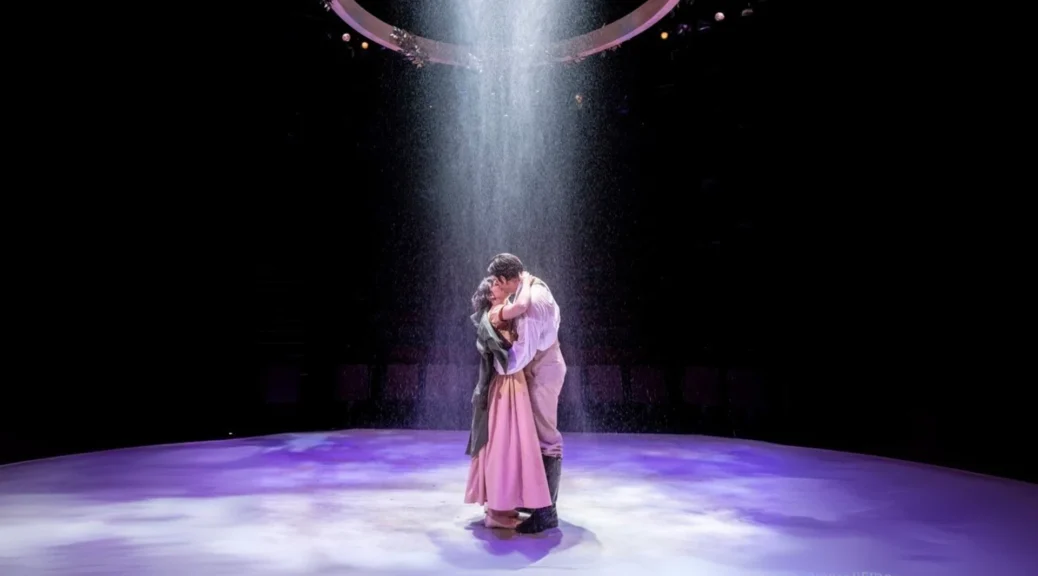
The audience enjoyed the show. They applauded loudly when Elizabeth Bennet kissed Darcy (did that happen in the book?) and they cheered when the couple were sprayed with water so that Darcy’s shirt could be dampened in reference to a scene in the TV series (not, I think, in the book). A number stood to applaud at the end, as if we were still in the party conference season.
I think the audience and the critics were right to applaud. The show is very funny. The cast, with their spot on timing and faultless attention to detail, perform like a dance band, making the absolute most of the material they have been given. They fill the stage even when only two characters are present, and they easily suggest both the crowded rooms at a ball and the palatial grounds of Darcy’s estate. There is a lot of physical theatre with Ben Fensome’s inspired interpretation of Mr Collins and Joanna Holden’s manic clowning as Mrs Bennet. Set against these two are secure performances from James Sheldon as Darcy – his feet remain stolidly rooted to the stage throughout the excitement – and Eve Pereira’s Mary, a study in straight-face absurdity. We also get a riff on Lady Bracknell in Jessica Ellis’ Lady Catherine de Bourgh (she avoids mentioning the handbag). Other members of the cast, like Rosa Hesmondhalgh as Elizabeth and Dyfrig Morris as Mr Bennet (and one suspects also as the permanently veiled Anne de Bourgh) hold everything together confidently. They maintain the realism of the story. Background music is provided on the harpsichord by Mary, and by other period instrument versions of ‘Will You Still Love Me Tomorrow?’ and ‘You’re So Vain’.
Nobody put a foot wrong. The only (small) detail that didn’t work dramatically was doubling Eve Pereira up as Mr Bingley, presumably to save employing another actor (one of the Bennet daughters was also cut). But, given that Bingley has the least interesting role in the production, the gender switch didn’t matter much.
Nonetheless, despite what the show achieved, it was entertainment rather than art. Quality, ingenious entertainment, requiring a high level of professionalism- it can’t have been easy for writer Kate Hamil to fashion a fast-moving play from a slow-burning novel and director Lotte Wakeham deserves her plaudits for getting the most out of her actors – but this show is fundamentally tongue-in-cheek. It stops short of sending the novel up but it misrepresents it. It draws on Oscar Wilde and Alan Aykbourne and it comes across as more Gilbert and Sullivan than Mozart. Brecht it is not. The humour in it is good-natured and well-meant but the laughter it generates is in the service of what is apparently not a serious story. This because the real facts which Jane Austen was so careful to include, have had to be skipped over. (Those reviewers who claim the show is faithful to the original should go back and reread it.)
Pride and Prejudice is a fairy story. Austen’s artistry consisted of connecting a popular genre to a contemporary reality so both our intelligence and our feelings can be engaged. Economics and the laws of inheritance feature in her novel as they represent the restrictions the Bennet sisters have to break free from – in a world where women had virtually no role to play in society if they didn’t become wives and mothers. The Bennet family lives comfortably, with servants and a carriage, on Mr Bennet’s unearned income (equivalent to £170,000 a year today) but Mrs Bennet is not mad to be obsessed about what will happen to her five daughters if and when her husband dies. Those of the girls who remain unmarried will become homeless and be reduced to the level of the labouring class. Their abilities on the harpsichord and their knowledge of foreign languages won’t help them. They are effectively good for nothing.
Austen’s sharp detailing picks out for us the misery faced by Elizabeth’s friend Charlotte Lucas, who is too insecure to resist Mr Collins’ blandishments and who faces a life with an egotistic eccentric dependent in turn on the whimsical patronage of an almighty snob. She also gives us Lydia Bennet’s elopement with Lieutenant Wickham. Lydia is only fifteen. The age of consent in 1800 was twelve but even two hundred years ago a relationship between a man and a young teenager would have raised eyebrows – as we see from Darcy’s treatment of Wickham. Wickham has already tried it on with his sister.
Any mention of paedophilia or any close consideration of economics or of a legal system preventing women from inheriting property, would unbalance a light-hearted piece of entertainment, so the production skirts these issues. It understates, for example, the social disaster the Bennet family face when Bingley appears to have jilted Jane and Lydia’s elopement has disgraced them.
But you can’t have everything. Like Mary Bennet, ‘I profess myself one of those who consider intervals of recreation and amusement as desirable for everybody.’ Until someone manages to turn work by Sally Rooney or Annie Ernaux into relevant modern comedy, we can go along with productions like that offered by this regional collaboration. Escapism is sometimes OK, and it puts bums on seats.