
Category Archives: Theatre

Review, Friday Night Love Poem, Crossline Theatre, By Hannah Goslin

 out of 5 stars (4 / 5)

Not many productions, books, shows, advice columns talk openly and frankly about sex, love and what it is like for different women.

Friday Night Love Poem is a coming of age story about three different women: a group of women in America, all part of a Christian support group, a Canadian teenager in the early noughties and a British teenager in current times. We see the juxtaposition of not only how sex and love has change through ages, but also what it is like in different communities and also different ages.

The first third of the Production is interesting and does well to steer away from the quintessential and stereotypical Bible bashing American evangelists. There are elements of their extremism but it isn’t what we see often portrayed. It isn’t satirical and therefore makes it more real. There is a sense of recognition; we can relate to elements but some we cannot, as per part of this community. Sex before marriage and LGBTQ+ are questioned and the woman, who is experiencing this confusing time, is conflicting by two parts of this community – the liberal and the stubborn and traditional. The only issue being that they are cycling through a time period of meetings. At first this isn’t clear that their movements to a different position of the stage is the signal for a scene change, and until we get the hang of this, it convolutes the storyline somewhat. When we change to a completely different story, there is music and lighting change, and this works well. Even if it was a change of lights or a change of outfit item, a prop, then it may have been a little clearer.

Our second coming of age story is something recognisable from my own teenage years. The rebellion, the rock music, the interest of older boys, of sex. We go through the moments losing her virginity and realising later that the one you lose your virginity to is not always the love of you life. A huge difference mirroring earlier discussion of sex after marriage. To avoid the x-rated, we are shown her experience through the use of Barbie and Ken. And somehow this is a really interesting and a subtle way to show it but also highlights the youngness of the character, that the idea of sex is in minds of those much younger than we think, and the unmentioned events and non events of sex. The unspoken. In fact, this, in addition to factual sex ed, would be honest and helpful to anyone.

Our last story is more up to date. This is more poetic and fast paced, and is somehow beautiful in this aspect. The elements of porn pressure, of the pressure on young girls and lack of respect of boys, the consequences of this and more. It is heartbreaking but also realistic, shown in a very theatrical way. The poetic monologue expressing her thoughts and feelings, clearly taken from media and what she thinks she should be and do. And then the issue of revenge porn. Something so grotesque is eloquently expressed.

Friday Night Love Poem is a raw and unbridled look at what sex and love means for all kinds of women; ignoring any boundary, ignoring any stigma and in this way, becoming an important piece of theatre on consent and the unspoken realities of women and sex.

Friday Night Love Poem will be on stage at The Space January 18th – 22nd 2022.

Review Back in Play, Sherman Theatre by Beth Clark

Being back at the Sherman Theatre

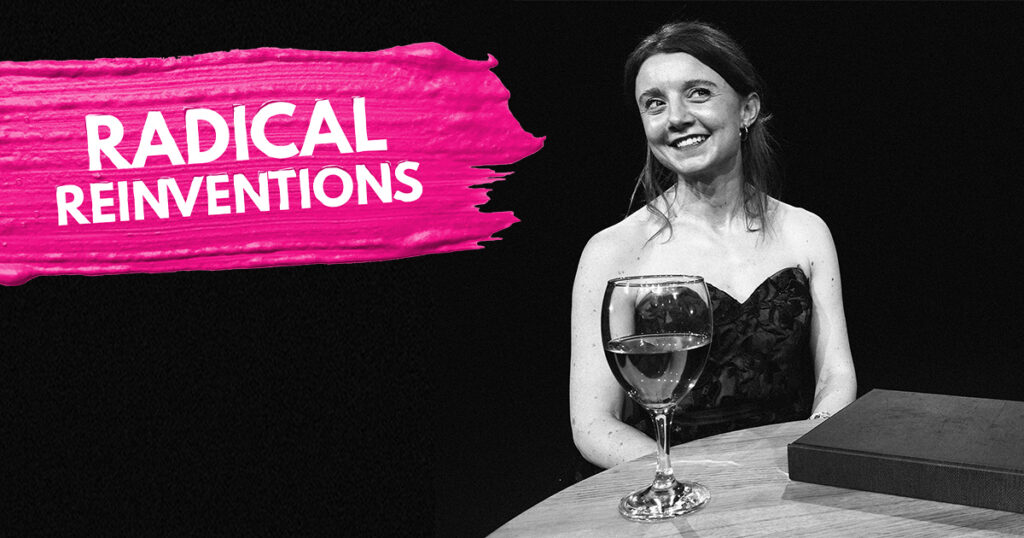
When I had an email through: would you like to volunteer via the Sherman 5 project, for the “Radical Reinventions” short plays, part of the Back in Play Festival at the Sherman theatre this week, I was immediately excited again.

Radical Reinventions have taken classic stories and cleverly reinvented them to tackle issues of today. Each play is set in the studio space with cabaret style seating, a warm cosy space, dressed with table lamps and dazzling chandeliers, you instantly feel relaxed upon entry.

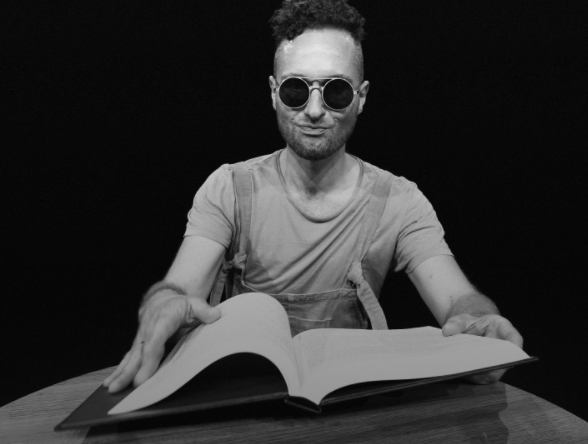
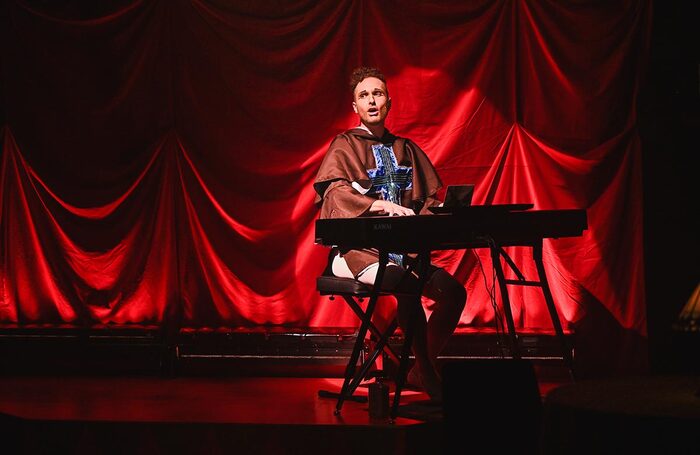
The first of the two plays I attended was “The Love Thief”, directed by Nerida Bradley. To my surprise, this play was written and also performed by Rahim El Habachi in monologue style. Rahim excelled at the opportunity to shine as a multi-talented creative, being one to watch going forward. ‘The Love Thief’, takes the Greek mythology tale of Prometheus and remakes it that Prometheus steals love from the gods. Every time there is to be pain caused in the story via love, (or lack of), Prometheus would break into belly dance. Dressed head to toe in belly dancing attire, Prometheus would dance whole heartily to fantastic eastern music and with moves that shook the studio. With the play tackling dark social injustices, the break out in dance and music was the distraction needed before Rahim continues to indulge us in more emotion. The play left you thinking about subjects that are often overlooked but made you look at them from an inside view, which was for me, in hindsight, was the most interesting part of the play.

The second play “Tilting at Windmills”, directed and written by the extremely talented Hannah McPake and performed by Mared Jarman is inspired by the very long classic Don Quixote by Miguel De Cervantes. To the viewers delight, the play was extremely light hearted and fun in the story telling although as the story progresses the realisation of loss and barriers were to emerge, with the story telling and the personal life of the character playing the same. The smiles of the audience and audience interaction happened instantaneously on entry whereby audience members were asked to take on characters within the play. As well as audience members to take on characters in the play so did a plant, a mop head, a monkey and a narrator through the bellowing speakers of the studio, making a monologue projection interesting at every moment.

The young actress Mared Jarman was an exceptional professional who put every ounce of energy into her performance and whom I would actively follow for any future performances. With lots of people experiencing loss and having to overcome more than usual in today’s climate, I believe this play has a beautiful message to portray but in a not so heavy on the heart way which for me had a very healing effect.

Would I recommend the Back in Play Festival at Sherman Theatre to others? Absolutely! If you like myself, have found getting back into your old self before lockdown restrictions, a bit of hurdle then do not delay in booking on. The plays, lasting only 30 minutes gives the viewer a short, sharp shock of creativity which will get you motivated and wanting more.

Review, Invasion, Bad Clowns Comedy, By Hannah Goslin

 out of 5 stars (4 / 5)

Take Men in Black. Set it in England. Add some bumbling comedy buffoons and what do you get? Invasion by Bad Clowns Comedy.

Filmed exclusively for reviewers, Bad Clowns Comedy have nicely given us a good quality recording of their show at the Rose Theatre, Kingston. Filmed with different angles and great sound recording, it is one of the best recordings over the past year of Covid that I have seen.

If you were to imagine Men in Black set and written by the British, this would be it. The character’s fumble around, they’re not sure what they are doing, to some degree it could be seen as a spoof. It reminds me much of Simon Pegg and Nick Frost if they brought their films or even their show, Spaced, to the stage. It reminds me also of when Ant and Dec ventured on the film Alien Autopsy, when the narrative is meant to be spooky and serious, but in true British Comedy style, is a comedy of itself. If Ade Edmondson and Rik Mayall decided to make a Sci-Fi theatre show for Bottom, this is what it would be.

Each character has its own flaws – Sam’s character is stars truck by his commanding officer, but lacks common sense and this leads to hilarious errors. Christian is the smarter of the two but exasperated by Sam and still, finds ways to be inadequate as a Special Agent himself. John is the commanding officer, who encompasses both Sam and Christian’s traits, and for sure, should not be a captain – hilariously finding ridiculous ways to stop a bomb, to engage with the set, the characters, the narrative. If this was true life, it would be one hilarious worry.

The three performers bounce off one another and the audience well. When there is the odd mistake or a heckle, they are quick to react and incorporate it into the performance. It only adds to the hilarity. They engage with the audience, using their responses and heckles to incorporate and help the narrative. They address them the entire time and so there is no escape, but makes you feel part of an exclusive club.

Adding multi-media in the form of a large presentation screen, recorded voices with Sci-Fi style orders, they effortlessly pick up on the quintessential elements of known Sci-Fi, from films, tv shows, games as well as British Culture. Some being well known dances that we all followed at school discos, the presentation of pop ups on a computer screen from way back when, with the correct noises and the use of brain control with helmets often seen in Sci-Fi films. It allows us to spot and identify with these parts and shows their intricate research and well written production.

A wonderful part of this production is that they clearly enjoy what they do and are very skilled in improv and going with the flow of the performance. Times where they could corpse or it’s on the verge of this, is still so professionally done and fits… like it was always meant to happen.

Invasion by Bad Clowns, is a hilarious and very British Sci-Fi Comedy production which anyone, whether into this genre or not, would find themselves laughing out loud at.

Review Death Drop, New Theatre Cardiff by Barbara Hughes-Moore

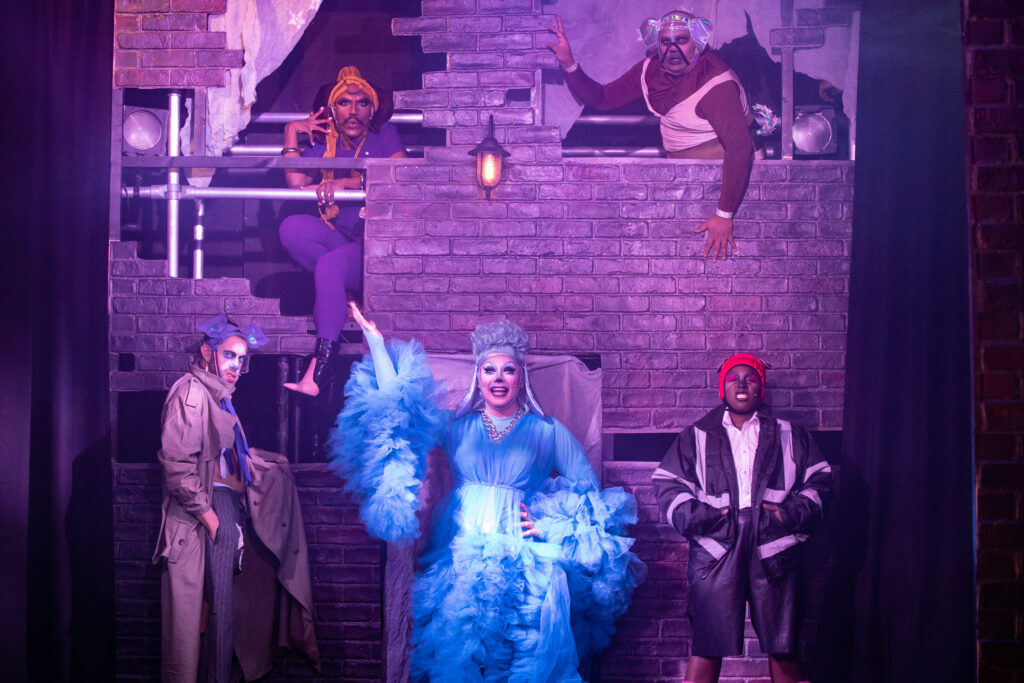
Death Drop is the ultimate triple threat: it’s a Drag Comedy, a murder mystery, and a musical extravaganza – and it’s here to slay. Premiering on the West End in December, the star-studded UK Tour is making a brief pit-stop in Cardiff for only a few days – so sashay your way to the New Theatre and catch it while you can!

It’s 1991, and Lady von Fistenberg (Drag Race UK star Vinegar Strokes) has gathered a gaggle of celebrity frenemies to her mansion on Tuck Island to celebrate Charles and Diana’s anniversary – only for the guests to start dropping dead. This isn’t your grandmother’s murder mystery – and when it comes to the jokes, there’s no such thing as ‘too far’. Produced by TuckShop and Trafalgar Theatre Productions and written by Holly Stars (who also plays all three Bottomley Sisters), the show is essentially Murder on the Starlight Express: a campy, chaotic riff on the whodunnit where the one-liners fly so thick and fast, they make panto look slow.

Karen From Finance, Ra’Jah O’Hara, Willam, and Vinegar Strokes

Drag legends Willam and Ra’Jah O’Hara lead an all-star cast including Vinegar Strokes (reprising her role from the original West End lineup), Drag Race Down Under’s Karen From Finance, and drag kings like Richard Energy and George Orell who deliver some of the show’s best and most bonkers lines. The cast are incredibly game and bring a fun, raucous energy to the stage – I truly can’t remember the last time I laughed as much as I did in Death Drop.

Directed by Jesse Jones and with original songs by Flo and Joan (Oopsie Whoopsie is a real earworm), the show is a boozy, bolshy bit of escapist fun. Justin Williams’ set looks as if Dr Seuss designed Liberace’s living room, and Isobel Pellow’s costumes are a feast for the eyes: case in point, an outfit of Willam’s made entirely of bandanas (even the boots! I seriously want a pair). It leaves no 90s reference unturned and no innuendo unmilked – it’s daft, it’s dirty, and it’s an absolute delight.

Funny, filthy and fabulous, Death Drop is anything but a drag. If you’re averse to a bit of blue (cheese or comedy), you might want to give this one a miss – but if you’re up for a night of glitz, glamour and giggles, you can’t get better than this.

Death Drop is sashaying its way through to Saturday 23 October at the New Theatre.

Review, Immersive Gatsby, Immersive LDN, By Hannah Goslin

 out of 5 stars (4 / 5)

Greeted at the door by a man with an excellent hospitable nature and his 1920’s attire on, in the heart of London, we enter into what feels like some form of speakeasy at the top of this lovely building, where the doors open and you are (nicely) bashed in the face with jazz music and dancing.

Immersive Gatsby is based upon the well known American Novel, The Great Gatsby by F.Scott Fitzgerald, which you likely know from recent film adaptations, or were subjected to at school. I admit, that I have a love/hate relationship with the novel, mainly with school ruining it. But as adaptions in film and theatre continue, I appreciate it more in older age.

The story is about old lovers who meet in later life. Both changed dramatically, their love is reignited but is doomed by circumstance, by gossip and cheating, by lies and love. And so we see them fall in love but also fight for one another, amongst the many love triangles.

The story of Gatsby is well known for the fact the character of Jay Gatsby throws lavish parties where anyone who is anyone will be. Full of booze, of colours, dancing and care free lifestyles, and this is what we initially get a taste of. The performers do quintessential moves from the 1920’s, in their beautiful and stylish outfits, encouraging us to dance, and at one point, putting us through a dance class. Certainly a good way to have a great night out and feel pleasantly out of your comfort zone.

The joy of Immersive theatre, especially in large venues, is that there are pockets of events happening in different rooms, in little groups, in corners of the room. Depending where you are placed, you may get to chat with Daisy about her love for Jay, or Muriel about her love affair. Not everyone gets to go in another room, or be spoken to and that’s what makes each experience different to the last. This is what makes you want to go again; to fill your FOMO needs.

However, with this, it can also feel a little frustrating. The placements of the rooms are almost in each corner and until you realise this, it’s entirely possible you won’t be lucky enough to be whisked away in the group. It’s impossible to be sure everyone out of potentially 150 people in a room has had their turn to see the new spaces. And so we unfortunately left with only seeing the main area and 1 extra room. I wouldn’t say we felt cheated but it certainly wetted our curiosity appetite and left us a little deflated with the knowledge there were scenes and rooms we never saw.

I was lucky enough to be taken away on my own with the character Muriel. My social awkwardness did not help here but it was really interesting to go into this quiet room and talk with the character as if we were old friends. A very special part of the evening indeed.

Knowing the story well, it confused me that character’s seemed to be doubling up and being put in parts of the story that they were not in the novel. It is clearly for logistical reasons, and they do well to keep in character and to continue the momentum, so we enjoy this as it is but it conflicts what we know about about the story and somehow undermines some of Fitzgerald’s intentions. Some characters also didn’t come across as they were intended in the novel and again, this is a juxtaposition on the initial story. I couldn’t help but be critical, thinking that that was not how a character was meant to be or how the story goes.

I cannot leave a review without mentioning Gatsby himself: there are moments of the above to help inform the transition of the space and the story but Oliver Towse is the right brooding, distant but hopelessly in love character that Gatsby should be… and clearly his attractive nature, in his well known pink 3 piece, makes us all swoon. As if we are in the room of a Rockstar.

Immersive Gatsby is for sure a brilliant night out; filled with dancing, elation, champagne and a 1920’s Eastenders style vibe with conflict. But for those who know the story well, the need to utilise the space unfortunately sees changes to the novel which makes a stickler a little anxious.

Review Our War,  Imole Theatre Company by Tanica Psalmist

Remember me more than a fighting man and the choice I made for the greater plan”

‘Our War’ is directed by Andrew Ashaye & produced by Imole Theatre Company (Lola Oteh). Our War is an emotionally compelling story from the lens of the fellow Nigerians Ola, Tommy and Christian, as they travel from their native land Nigeria. Encouraged to partake in World War II as Nigeria at the time was a British colony; which left young men & women feeling as if they had no other choice or say in the matter, just wanting to make their mothers proud. Nigerian men & woman were not only having to leave sunny Nigeria, their families & parents; but the feeling of hope, unknowing whether they’d ever get reunited with their loved ones again. A flight with no guarantee of return, but of the sounds of explosive nuclear bombs, the height of World War II became their history.

After the play, I was keen to speak with Lola Oteh to hear what sparked her interest in the concept of ‘Our War’. Lola mentioned it was when she’d realised the vast absence of African & West Indian soldiers who were not widely acknowledged or recognised in being Britain’s key players fighting for the country.

Once Ola (the nurse), Tommy & Christian arrived to Britain, they experienced the national terror of war on the battlefield and the harsh realities of being Black in the army and in the local community. This entailed not only segregation for the coloured but their uniform differences to.

In conversation with Lola Oteh & Andrew Ashaye after the play, it became clear that Our War came together after an abundance of research from various sources from black cultural archives, etc. was carried out. Where autobiographies, real names, times & untold stories were incorporated into the play to ensure they portrayed life as realistically as possible during that era. Perfectly depicting the characteristics, mindsets & attitude of those in authority as well as the veteran desperately missing their motherland. ‘Our War’ perfectly dramatises the bravery of forgotten heroes, Black African and Caribbean men and women who contributed and made sacrifices for the war effort in Britain.

This production was majestically infused with elements of Nigerian culture through compelling dialogue & sweet singing in Yoruba; penetrating the audience hearts. Lola Oteh’s cultural influence was deeply embedded to create a platform in which original and innovative stories could be told. Drama and performance was greatly used in ‘Our War’ to magnify history bringing the past back to life and giving us a voice to stories that might not always be heard.

Review Cat On a Hot Tin Roof, Theatr Clwyd by Richard Evans

Tennessee Williams

Co-production by Liverpool Everyman & Playhouse, Curve Leicester and English Touring Theatre

Directed by Anthony Almeida

 out of 5 stars (4 / 5)

What is it like to be living a lie and then to be confronted by the truth?  This is the theme that runs through Cat on a Hot Tin Roof.  We know this is a classic text so it is hard for a new production to live up to that legacy.  The spectre of Paul Newman and Elizabeth Taylor from the film adaptation looms large in the memory and that medium can introduce more phase and change into the setting than is possible on the stage.

This is a difficult play to get right.  It’s reputation demands vital theatre, yet the script is carried by dialogue much more than action such that it is the communication of character that will hold the attention.  Does this production succeed?  Indeed it does.  The three strongest characters, Maggie, played by Siena Kelly, Brick, by Oliver Johnstone and Big Daddy, by Peter Forbes were superb and were ably supported by the cast.  Maggie in particular was beguiling, passionate and determined while Brick suitably downtrodden before being awoken by confrontation from his stupor.  Big Daddy was the epitome of a controlling, self-made man from the Deep South with all the patriarchal values you would expect. 

Sienna Kelly as Maggie

The action takes place in a bedroom in a household that is straining to cope with the tensions that lie within.  Key to this is how people respond to the fact that Big Daddy is dying and what will become of his legacy.  Of course there are machinations behind the scenes, but the problem is the alcoholism demonstrated by the favoured son, Brick.  Why does he drink?  It is clear he is a spoiled, indulged child who has had his sports career wrecked through injury and suffered the loss of a profound childhood friend through suicide.  Now he is now running from himself out of a sense of disgust but senses that a tissue of lies pervades all his relationships.  Something has to change. The play becomes an exercise in how to uncover truth after a whole panoply of lies has been built.  The question arises, just how much truth can we take without it breaking the family apart? 

Oliver Johnstone as Brick

The set was simple and effective.  I found the curtain a distraction while it was drawn, but it was used to excellent effect when Brick was wrapped in it to symbolize being suffocated by the expectations of people around him.  The movement of the cast in and out of scene while dialogue was taking place alluded to the fact that ‘walls have ears’, again, nicely done. 

Peter Forbes as Big Daddy, Oliver Johnstone as Brick

The cast did an excellent job of portraying a suffocating, stifling atmosphere.  All that was missing were a few crickets, mosquitos and the oppressive heat from the Deep South.  The play gripped the attention and held the audience in thrall.  The characters were well developed, complex personas who all had their flaws and thus mirrored the human condition.  No easy answers were given here, people had to make the best from what they had. This may sound uncomfortable, rather it made for riveting theatre.  This was an intense, yet thoroughly enjoyable evening. 

Rhys Payne Interviews Hamed Amiri on The Boy With Two Hearts.

In this interview Rhys Payne interviews Hamed Amiri writer of The Boy With Two Hearts, adapted by Phil Porter now showing at Wales Millennium Centre, Cardiff.

You can find out more about the production and book tickets here.

Get the Chance supports volunteer critics like Rhys to access a world of cultural provision. We receive no ongoing, external funding. If you can support our work please donate here thanks.

REVIEW Radical Reinventions – The Love Thief & Tilting at Windmills, Sherman Theatre by Barbara Hughes-Moore

The Sherman Theatre is well and truly Back in Play! The festival, which has everything from stand up to monologues to young writers showcases (all done in short form to allow you to safely see as much or as little on offer as you like), is headlined by ‘Radical Reinventions’, four short plays which put a new spin on a classic work of literature. (Hamlet is a F&£$boi and The Messenger, which both reinvent works by Shakespeare, premiered earlier this week).

The Sherman always has a knack for getting at the sinew and bones of a story, and this series is no exception. Performed in a socially distanced and visually striking cabaret setting (imagine that the Phantom of the Opera designed a circus tent and you’re halfway there), The Love Thief and Tilting at Windmills are two joyously irreverent and transcendent plays which argue that, while love may seem futile and dreams impossible, the adventure makes them worth the risk.

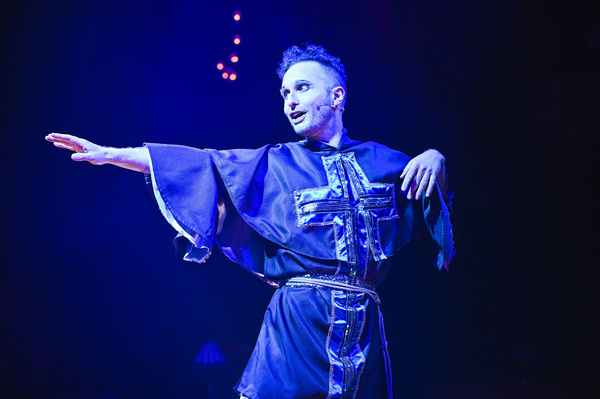
Rahim El Habachi

The Love Thief is written and performed by Rahim El Habachi and directed by Nerida Bradley, and is based on Aeschylus’ Prometheus Bound. Dressed in flames, Prometheus steals love instead of fire and gives it to humanity so they can love whomever they love regardless of gender. El Habachi, an actor and belly dancer, commands the stage from the second he appears – sensual, ethereal and lyrical, he relays his story like the Emcee via Elvira, all mischief and mysticism. The play gives a god’s eye view of modern Britain, its imperial ghosts and their ungodly scions who make it their life’s work to make life difficult for anyone they deem to be ‘different’. It also highlights the personal toll of activism, and how important it is to fight the tide of hatred and bigotry even when it threatens to consume you.

Mared Jarman

Tilting at Windmills is written and directed by Hannah McPake and performed by Mared Jarman, and is based on Miguel de Cervantes’ The Ingenious Gentleman Don Quixote of La Mancha. Jarman is chaotic, heroic and mesmeric, gallantly sprinting around like Lancelot on a sugar rush. Using basic props and a whole lot of chutzpah (not to mention a rollicking Knights of Cydonia needle drop), Don Quixote and Sancho Plant-za attempt to squeeze a near-one-thousand-page book into a breathless (and hilariously meta-textual) thirty minutes. Cervantes makes an appearance as a Zardoz-like disembodied voice that boasts of his own greatness – opening up interesting avenues of the dialogue between authors and those adapting and performing their work, and how radically reinventing a text is what keeps it fresh, alive and relevant.

Ultimately, Prometheus has to decide whether hope is worth all the pain and the not knowing whether things will ever get better, and Quixote/Mared has to decide whether to stay in the fantasy or live in the real world. And yet, neither choice is a binary between staying or going, fantasy or reality. There will always be pain, and uncertainty – but there will always be hope, fun, and magic, hidden between the margins.

The Sherman is most definitely Back in Play and back to stay!

Back in Play season at the Sherman Theatre: 8 – 30 October

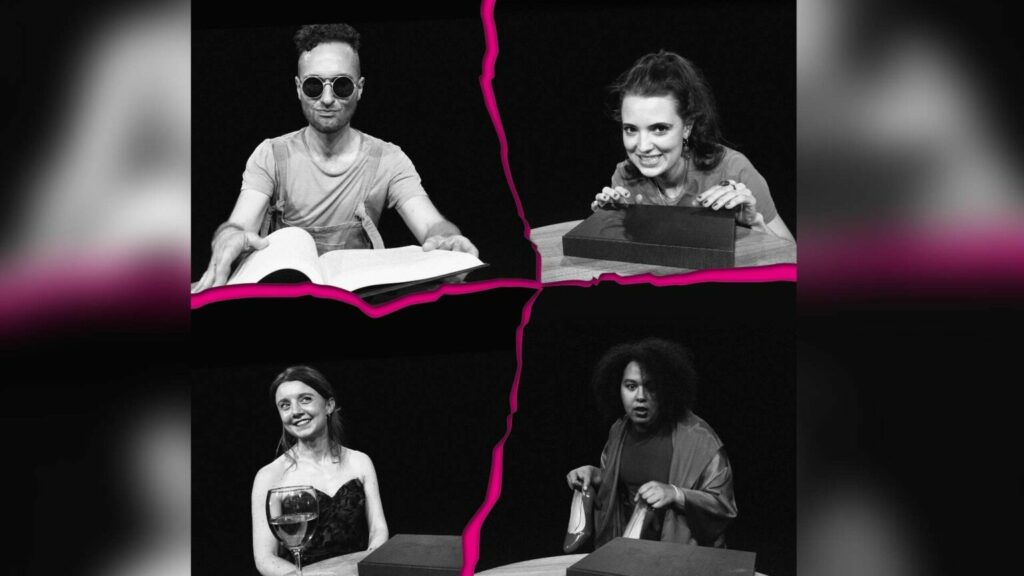
Top, left to right: Seiriol Davies, Mared Jarman; Bottom, left to right: Lowri Jenkins, Rahim El Habachi
Barbara

Review by
Barbara Hughes-Moore

Get the Chance supports volunteer critics like Barbara to access a world of cultural provision. We receive no ongoing, external funding. If you can support our work please donate here thanks.

REVIEW Company of Sirens: Hitchcock Redux, Chapter by Barbara Hughes-Moore

Company of Sirens make a dynamic return to Chapter with Hitchcock Redux, two short plays that explore the elusive power of real (and reel) memories. Written and directed by Chris Durnall and funded by Arts Council of Wales/National Lottery, Hitchcock Redux dramatises and meditates on two traumatic events in Durnall’s life and the Hitchcock films with which are intertwined.

In the first play, Twelve Cabins Twelve Vacancies, Durnall recounts the time when, while watching the first television broadcast of Hitchcock’s Psycho in 1968, he learned that his father had died. The two are forever connected in his consciousness, and memories of both are shaped and distorted by each other. The second play, Souvenirs of a Killing, explores the tragic abduction and murder of a friend in 1973, the trauma of which is embodied and underscored by the film Vertigo. Both plays are performed by Durnall and Angharad Matthews (who also designed the set and costumes), and feature original music composed and performed live by Eren.

Twelve Cabins premiered onstage in 2019, and was performed along with Souvenirs online in March of this year. The lyrical writing and pensive performances resonated even through the screen – but onstage they are brought to vivid, visceral life. The sense of place, space and movement is powerful: Durnall moves as though monumentalised in grief, shifting between joyous reminiscence and solemn contemplation; Matthews moves ethereally, as light dances on the surface of rippling water; and the immersive music, composed and performed live by Eren, moves between original compositions and evocations of Hermann that cage the characters in a spiralling static state.

The women in Psycho and Vertigo are portrayed with more empathy in those films (and in these plays) than Hitchcock showed the actresses portraying them. Women encased in amber, both celluloid and corporeal, are objectified through movies and memories, their losses mourned through the membrane of grief and fiction. Durnall speaks not for them, but through them, their voices reanimated but recounted, living only through scribbled words on cigarette boxes (a subtly gorgeous image).

The set is plaintively sparse, evoking the ways in which the backgrounds of memories are often shadowed, blurred, or absent altogether; sometimes a face, a dress, a glance, is all we remember. Examining a memory can tarnish it, like buffing a broken mirror – it just makes the cracks cut deeper. In a piece for the Wales Art Review, Durnall argues that the (fictional) films and the (real life) losses ‘have become so inextricably linked with those moments that they have become artistic metaphors for the events themselves’. Whether watching scenes play out on a television set, or re-enacting Hitchcock’s dialogue, Psycho and Vertigo become a prism through which grief is reflected and refracted, and provide a kind of closure which is not always found in life.

The search for closure is a sentence which Hitchcock Redux leaves incomplete – purposefully so, because closure is by nature perpetually unfinished. But it also leaves you with the drive not only to explore your own connections between art and grief and memory, but the tools you’ll need along the way. Striking, pensive and poignant, it does not ask you to take the first step – it merely opens the door.

Hitchcock Redux is playing at Chapter through 16 October