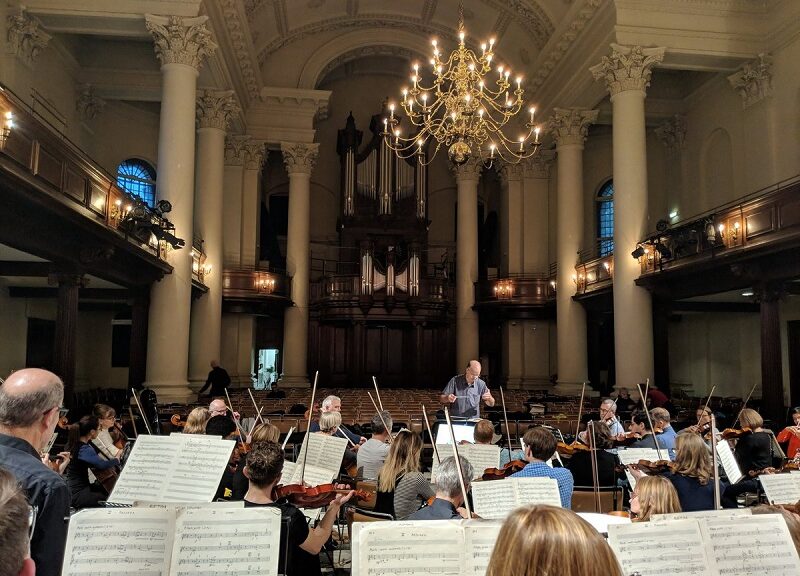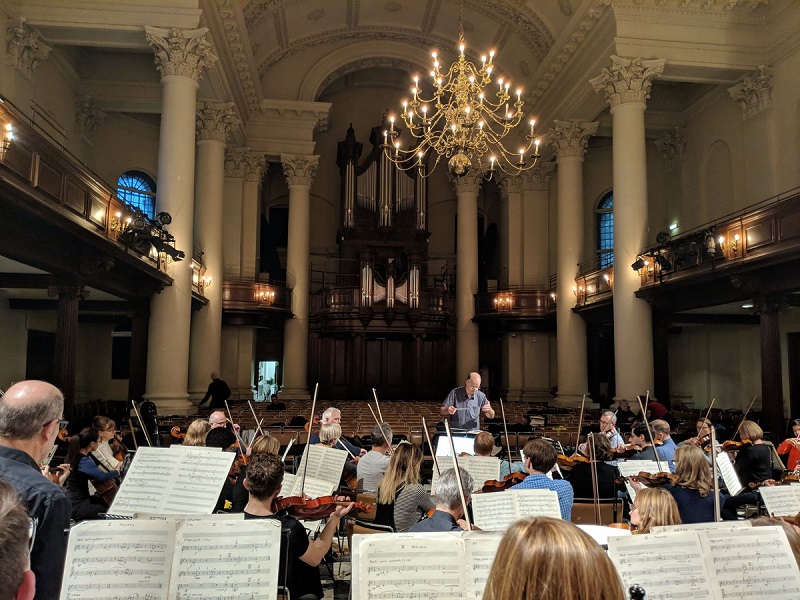

Philharmonia are breaking out the party hats and having many slices of cake as they party their 80th year. With one of London’s leading orchestras, I would be hard stuck to think just how many of their gigs I’ve attended in the capitol and on tour. It was billed that Evgeny Kissin would be the soloist for this latest concert at the Southbank, in what would prove to be a blockbuster night of two pianos concertos and ballsy orchestra music all from Russia.
A Night on the Bare Mountain (as named in the programme) is one of Mussorgsky’s finest and most well known orchestral pieces. Yet this arrangement by Rimsky-Korsakov is the only way I could ever listen to the work. Mussorgskys gradual decline into alcohol would leave much work in reduced piano form or incomplete at his death. Most famous for devilish outing in Disney’s Fantasia, this is highly regarded as a great Russian work, one that is is instantly recognisable. It’s thrill and total menace lie in its varying backstories and it often makes a fine concert opener.
With. No Kissin to be had, Boris Giltburg is another Russian offering which is pleasing to audiences and critics. I recall his Rachmaninov in Cardiff which went down a storm pre-pandemic. His jump off would be Prokofiev’s 3rd Piano Concerto as the first of two of the night. Whilst not a furious or experimental as the previous concerto, the third is still fun. The composer’s often harsh, stunning tone is here, Giltburg gets to play often sweeping melodies, as the orchestra was bouts of intrigue and delusion. I saw not the keys of the piano in the hall, yet seeing Giltburg often has the wow factor, the tenacity and tenderness are key elements to his craft.
An all Rachmaninov second half saw The Rock as another orchestral spotlight. Not to be confused with his Isle of the Dead, this was standard fare, I would not say it gripped nor moved me in much of a way. This is early student days from him and it shows, the grandiose romantic adoration would come later in often deeply impactful ways. His 2nd Piano Concerto is known to British ears thanks to David Lean’s Brief Encounter, a classic that spans eras. With it’s heightened rhapsodic nature, mastery of pace, melody and emotional touch, its never boring. Giltburg really gets Rachmaninov, proven with many totalling, past performance. An unwavering presence on the piano, I doubt too many were irked Kissin was not playing tonight.
Luciano Berio remains an intriguing composer. Inventions and experimental forms were his game, often creating outrageous, yet very human pieces.
With a concert from Ensemble 360, Claire Booth would join them for songs in a third occupied hall at the Royal Welsh. His Quattro canzoni popolari is much more traditional in nature, yet still alluring. The last flutter tongued song ‘Ballo’ get later recycled into his iconic Folk Songs, whilst the rest of the set is lovely for its charms. Rebecca Clarke and her Prelude, Allergro and Pastorale was new to me and a great find. Subtle discovers and a understated scope was the pallet for the three players and was impressive all round.
Ravel: I can take or leave, but his Chansons Madécasses is a fine work, one I’d wished to have heard sooner. Madacasgan lore is the basis, extreme romantics mingles with anti-colonial sentiments in a set of three powerful songs. Booth plumed with her French, got the sinews just right, for me this was a high note. Kokopeli by Hoover was an exquisite solo for Juliette Bausor on flute. An evocation of a mischievous spirit (not dissimilar to Pan), I was taken with these uncluttered few minutes, awesome in its intamacy and unfurling aura.
Suite Populaire Espagnole by de Falla saw a focused Tim Hortom on piano and a unbridled cello solo from Gemma Rosefield, saw colour and light from Spain. I recognised some of the patterning dance delights, the Avant-Garde mingles with the traditional spirit of Iberia. Never played enough, de Falla is often a joy. On viola, Rachel Roberts opened Berio’s Folk Songs with the exquiste American song ‘Black is the Colour’.
Booth glided across the globe with many nations as tribute from France, Italy, Azerbaijan (this song has made up words) and more. Clarinetist Robert Plane, very well known to Cardiff crowds get brief moments of cheer here. Seeing him play again after many times is touching. These songs never wain in their complete delight, a gateway for those keen to discover Berio for themselves.
I recall being highly impressed with the Kensington Symphony Orchestra, doing Peter Grimes a few years back at the Southbank. Speaking with people involved with the players, they spoke they were most, if not all amateur.
Heading to this Smith Square Hall gig, the sea-faring views would not settle. Doreen Carwithen is new to me, her Bishop Rock was note worthy. Vivid in its sight-specific vista, you felt the sea foam as well as calmer moments too. This along with the finale piece of the afternoon would be discoveries of women composers who might not have always gotten their due. Sir James MacMillion followed with a work which put him on the musical map: The Confrssion of Isobel Gowdie.
Conductor Russell Keable introduced it and gave insight to the Scotland’s awful history of witch hunting. Isobel Gowdie was one of many people convicted of witchcraft, she was tried, tortured, made to confess to nonsense accusations and then executed. This wreathed scenario would be the basis for MacMillion’s intense pallet.
Pounding, Stravinsky like chords, relentless dancing rhythms and an over all turbulent violence are what you discover. The orchestra had clearly rehearsed intently and they shone. Not shying away from such a subject rewards the listener with a very powerful composition, rightly giving him the reputation he has as a composer of great talent and innovation.
The end would come with Ruth Gipps and her 4th Symphony. Dedicated to Arthur Bliss, this symphony from 1972 would take years to get recognition. Like Bliss, there was a faithfulness to tonality, just some of the reasons both were shunned, as more experimental forms had become the status quo. Hearing it live, you get a feel for a serious love of the convention. I won’t say I was wowed by it, yet its formal feel still had drama, beauty and thrills. Again, the players gave it their all, in what is music from yet another female composer who needs more recognition.
I’ve followed New Palace Opera for around a year. I was very taken with their Walküre chunks last year and a Peter Grimes both proved great efforts made put into challenging work.
In a wintery London, a concert in Waterloo would see agony and tragedy in equal measure. George Templeton Strong and his At Sunset got its UK premiere on this night. Heavily owing a lot to Mahler, its unease and pain was the vein of the whole thing. Effective, if it felt a little ropey to start with. Then Mahler would arrive properly with his Totenfeier, or Funeral-Rites. No one does the dreary and existential like old Gustav. The mood never shifted from the negative, I guess its name would suggest the tone. Stirring in nature, the players and a Jonathan Finney as maestro, held the drama of this fleeting passage.
The stand out would end with Stravinsky and his cantata Oedipus Rex. A first hearing for me and one I’ve wanted to hear for decades, this was evocative and a natural drama from the Greek source material. It being sing in Latin doesn’t take away either. We had a solem Sophie Duval as narrator guide us through what would be a difficult following even with the story well known. The entire work excudes a faithful Greek musical palette for its hour length.
James Schouten was cast very well as the titular character who’s downfall is his own doing through pride, ignorance and a general stupidity. Vocally, as a piercing tenor he melded well into the role, it was a pleasure to hear him live. In the strong male support, this Greek chorus saw figures come and go singing solos to strange effect. I saw few blips throughout this Oedpius. I also found Mae Heydorn as Jocasta, wife of Oedipus, to be a another highlight. A mezzo which had a grounding, yet was still compelling to the ear.
Well done to all involved in hearing this rare Stravinsky classic.
‘Where the dreamers still belong’: ‘Carducci Caravan’
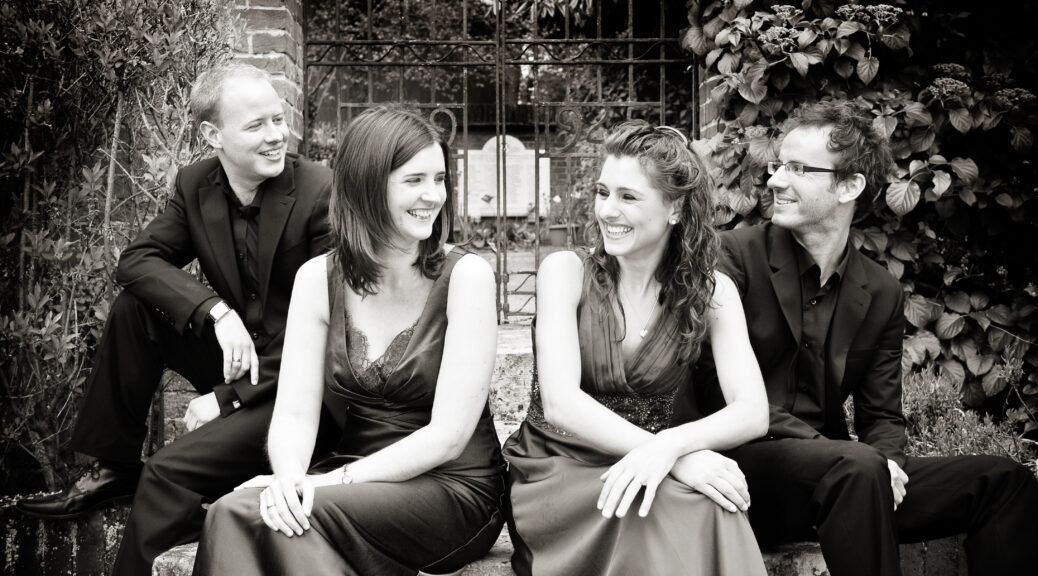
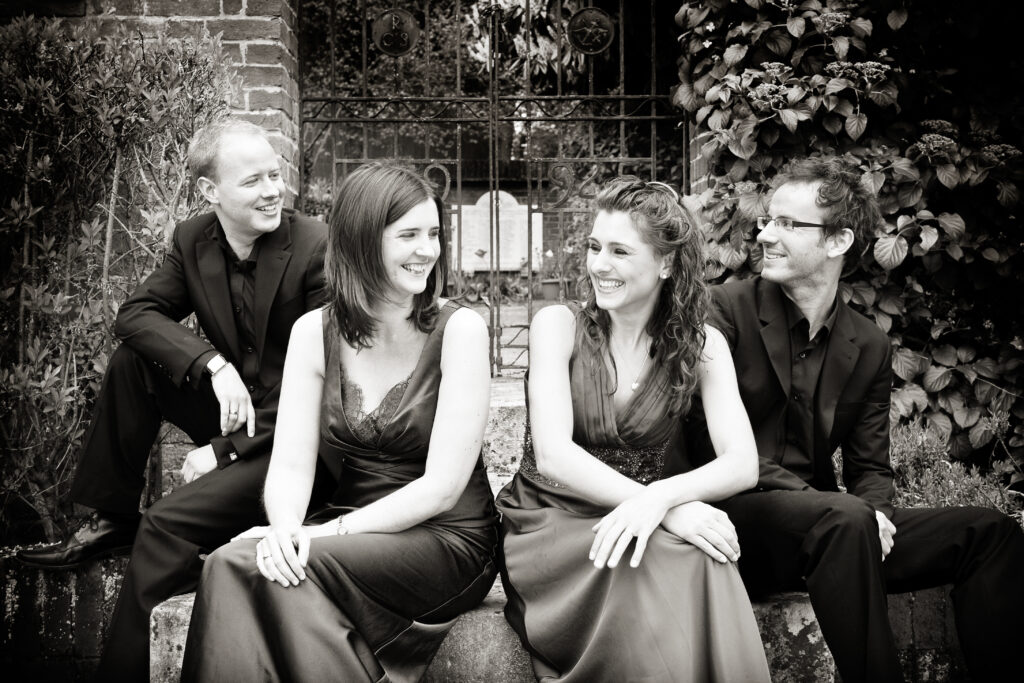
Matt Denton – violin, Michelle Fleming – violin, Eoin Schmidt-Martin – viola, Emma Denton – cello
‘They are expecting you,’ I overheard Andrea Jones, the head of undergraduate studies at the Royal Welsh College of Music & Drama (RWCMD), say to a visitor ahead of the much anticipated ‘Carducci Caravan’ concert. An unexpected phrase to hear before a concert, one could say, considering that ticketed entry has been a hallmark of public performances since their emergence in the eighteenth century. Laughter, and enthused quiet chatting followed, as I turned to see groups of primary school children, orderly lined up, walking towards the stage doors. Many had never attended a world-class concert venue before, and this may have been their first time hearing a string quartet live. While the students would have been introduced to the fame of the Carducci Quartet by their teachers, the novelty of the experience itself, combined with their dream-centred view of the world, may have overshadowed the factual biographical details they had been told. To college students as much as to older visitors, the ‘internationally acclaimed’ and ‘award-winning’ Carducci Quartet needed no introduction. The young special guests were to be the sincerest critics of the night.
It was not long after the Carducci Quartet took the stage that the audience, who had been expecting a normative concert format with a series of pieces played in turn, realised they were in for a treat. ‘No borders bound, no paths confined, a world of music we will find… so come abroad – no need to pack – the Carducci Caravan won’t look back’, Bella Cerely, one of the four RWCMD actors who joined the quartet for the evening, announced to begin the concert. The reassurance offered by the opening poem, titled ‘Wanderer’s Melody’, was soon to be subverted by the Carducci’s innate theatricality. Playfully misguiding the audience through the fourth movement of Haydn’s Joke quartet, they repeatedly encouraged the belief that the movement had ended ahead of time, although the young guests were particularly good at not being tricked from the second time round!
Following the distinct, gypsy-influenced tone pallets of Bartók’s Six Romanian Folk Dances, Clarissa Mondeh read a translated poem by Tao Yuanming. Portraying how that which makes a place feel like home is not determined by environmental features, but is guided by the heart, the soaring lines of Puccini’s Crisantemi continued the narrative of the poem. Matt Denton’s poignant solo alluded to the intangibility of seeking for the out of reach, while the quartet’s remorseful ends of phrases reflected the narrator’s dissolving, ‘fleeting truths’.
The next piece in the programme – Huang Ruo’s The Flag Project: String Quartet No. 2 – introduced a soundscape so close yet so far away from the unanimous timbral quality which has long been attributed to the string quartet genre. As the Carducci’s took turns to welcome Tibetan finger-cymbals to the ensemble, the pure, sonorous and resonant timbre of the percussion instrument complemented both the penetrative high registers of the violins and the depth of Emma Denton’s rich harmonies. A sound world shaped by Ruo’s vivid imagination and the artistry of the quartet unfolded to captivate the audience.
With the ‘Carducci Caravan’ symbolising one’s journey through life, the invincible upheavals that toy against humanity were depicted through an account titled ‘Chaos instead of Music’ (Pravda, 1936). Condemning and denouncing Shostakovich for the nature of his music, Alex Johnson read how it was conceived as ‘a wilderness of musical chaos… that may end very badly’. Paradoxically, the Carducci’s sinister tone evoked through the preceding Four for tango by Piazzolla was alleviated for the beginning of Shostakovich’s Wrong Note Polka. Their shimmering fast vibrato infused buoyancy to the theme which was first stated plucked before its bowed reprise at the end the movement. With the closing of the piece delayed by an interspersion of dissonant chords, the programme continued with a shift in mood from anger to desolation as Rory Stroud narrated ‘The Dark Hills’ by Edwin Arlington Robinson.
‘Dark hills at evening in the west… fade – as if the last days were fading, and all wars were done’ was remarked before the opening harmonies of Elgar’s Nimrod filled the room with an apologetic depth of feeling. The quartet’s carefully crafted phrasing and frequent returns to stillness rendered the optimism of the rising passages short-lasting, mirroring the narrator’s enduring difficulty in comprehending man-made destruction. A final utterance of the thematic material, which was inspired by one of Elgar’s close friends, seamlessly led onto a recent partnership formed between the Carducci Quartet and 18-year-old composer Sam Snook. Winner of the 2025 Carducci Young Composers Competition, Sam’s Bloom furthered the emotional landscape of Elgar’s Nimrod as frequent tremolo passages united members of the quartet and strength was born from the movement’s sorrowful melodies. In the time span of a few minutes, musical, metaphorical, and literal synergies had been ignited between the past and the present.
Having experienced feelings of reassurance, unease, heart ache, wonder, devastation and unity, ‘we end with fire, and full of light’ was exclaimed ahead of the quartet’s final piece. Composed by the Danish String Quartet, Shine you no more is inspired by John Dowland’s Flow my tears. Yet, it goes on to tell a story beyond that which the narrator of the song is capable of seeing. Contrasting to Dowland’s lament of intense sadness and misfortune, Shine you no more alludes to a detachment from the world’s unfathomable nature. Music guided the narrator to find brilliance and joy as the quartet’s palpable enthusiasm drew the concert to a close.
During the interval, audience members from all walks of life had gathered in the bustling RWCMD foyer, as champagne glasses adorned the circular tables and heads of departments hurried around to greet the many visitors from afar. While the young special guests were nowhere to be seen, it was assumed that the quartet were backstage preparing for the second half of their performance, as is customary at classical-music concerts. Little did many know that the Carducci Quartet had other plans for the interval. Moments after leaving the stage to place their instruments backstage, the quartet returned to the hall – this time off-stage – to meet, greet and thank their smiley, bright-eyed unexpected visitors. As the primary school children cheered and congratulated the quartet with a standing ovation at the end of the concert, it was clear that the Carducci Quartet had succeeded in inviting everyone present into their world. A world, as ‘The Lark’s Song’ by William Allingham noted during their performance, ‘where the dreamers still belong’.
It would be a surreal Halloween in 2025. I chose to dress up as Marioneta Negocios from Adult Swim, most curious recent offering Women Wearing Shoulder Pads. My plus one was Lady Dimitrescu from Resident Evil Village. Some concerns over dressing up and also political views in a church, would be quickly brushed aside, the Tabernacle have often been friendly and welcoming. It’s why I go back.
Seeing Connor Fogel back last year in the same venue, the through line is naturally Lizst. Connor should not be accused of micro-obsessions, as his devotion to Liszt and known ways in which the composer played, are part of this pianist branding. In this programme entirely made up from the Hungarian composer, it would be mostly arrangements of other’s work. Rossini’s Overture to William Tell is a standard, most famous for the gallop. I noted the lack of dampened pedals for extended passages, the wonderful cello solo rings out, the famous parts puffy and handled with aplomb.
Reminiscences of Lucia di Lammermoor from Donizetti is more well regarded material. I’ve personally never been wowed by this Italian composer, though Liszt takes chunks from the opera and swirls it into a marvellous patter for piano. Mozart and his Don Giovanni (though here dubbed Don Juan) got the Liszt treatment, with Connor noting Scriabin never recovered form playing this take on the opera, with a profound hand injury emerging from rehearsal. It was more dark drama, though a whisper of Zerlina’s aria would really seal the deal.
Lovely Schubert came next and Liszt usage of Ave Maria is by far the most perfumed, wispy right hand ornaments, aside your eternal melody. ‘Le roe des aulnes’ or Erlkönig was a nice touch for All Hallow’s Eve, the story gothic, the composition a highlight of Schubert’s lieder. With the singer playing four varying roles, Connor on piano braced this command with focus and lucidity. The wrap up (with no encore) was Liszt’s very own Grand gallop chromatique. Feverishly absurd in nature, the composer knew how to send audiences dazed and dazzled, Connor seems to relish playing this. It’s finality leave smiles, though I dare say a touch of Wagner next time would really seal the deal form me. It was a family affair, after all.
In an all piano concert at Wigmore, Scottish pianist Steven Osborne gave an evening of two half in tone, theme and depth. A first part fired up with Schumann’s Papillons. Breezy and clever in nature, they have a lot going for them from the tortured composer. A slight change in mood With thanks Satie’s Gymnopédie No. 3. Whilst not as iconic as the first, this is almost as evocative, the graceful cloud-like pacing and effortless melody charms. This was followed straight on with Lili Boulanger’s D’un jardiniere Clair from 3 Moreaux. Another sensual offering, this from the tragically short life of a female composer who had innovation to spare. The utter charms of Musical Snuffbox from Anatoly Lyadov are in keeping with Satie’s love of novelty, whilst still being delightful and kitsch (the good kind at least).
Fritz Kreisler’s Liebesleid in the arrangement by Rachmaninov, might have been the most forgettable item of the evening, yet its romantic allure shined, if only briefly. Ravel’s Vales nobles et sentimentales might have not really made the mark in this varied first half. It’s hallmark sound for the composer was there, Osborne played with an openness and exuberant quality Ravel demands from players. Fairly loud and impassioned moments seem shocking from the French composer, I have to remind myself he did push the boundaries somewhat.
A second part would be entirely made up of Beethoven’s 33 Variations in C on a waltz by Diabelli. I didn’t know this piece, the source material comes from Austrian composer Anton Diabelli. For me, this was the stand out of the night and a fantastic discovery. There are so many frantic, clomping moments for Osborne, it was pretty shocking. The unravelling sense of motion, driven by a dramatic flair caught me off guard. Why this is not better known Beethoven?. Granted, an apparent codas seemed murky and some quieter passages didn’t quite live up to the outburst surrounding them. Still, with Osborne’s intense and mastered playing, this was quite the feat. An extremely impressed audience gave much him love, though an encore appeared to far this time.
Politics, sex, torture, love, and of course plenty of death, Tosca is an opera that always delivers. It’s a pacey political thriller where painter Mario Cavaradossi (Andrés Presno) gives refuge to his fugitive friend Cesare Angelotti (James Cleverton), who has escaped prison and is now searched by baddie-in-chief Baron Scarpia (Dario Solari). Add a jealous lover, Floria Tosca (Fiona Harrison-Wolfe), and the drama keeps you at the edge of your seat. Scarpia uses Tosca’s jealously and love for Cavaradossi to find out where Angelotti is hiding, then gets Cavaradossi tortured in front of his beloved Tosca.
Puccini’s orchestration ensures every element is woven together perfectly, every element serves the drama. It’s a compact drama brimming with a whole gamut of emotions. Alas, the Welsh National Opera’s Tosca pleases the public, but does not quite bring out the tension and drama.
Cast of Tosca – Photo by Dafydd Owen
On the night of the 24th of September, Floria Tosca was performed by Fiona Harrison-Wolfe, whose voice is strong but lacks modulation therefore pathos. Both Harrison-Wolfe, as Tosca, and Presno, as Cavaradossi, seemed to fail to modulate and deliver a more natural progression to higher notes. This was particularly noticeable in the first act when it was like being hit by a sudden increase in volume.
The interpretations were powerful but the lack of modulation compromised the emotion. Tosca’s Vissi d’arte and Cavaradossi’s E lucevan le stelle failed to move. The artists were not aided by an orchestra that did not shine. Such a compact opera felt a little drawn out at times. Dario Solari gives a solid and impressive performance as Scarpia.
The contemporary setting was used effectively. A large painting of Mary Magdalene on the ceiling of a cupola dominates the scenes emphasising the clash of sacred with profane. Scarpia uses religion for power. Lights, costumes, and staging produce a very striking image where the chorus in colourful costumes surrounds Scarpia who is illuminated as a star. It is not so distant from the quasi-theocratic images we get from the United States today.
The WNO’s Tosca provides good entertainment to a public very keen to applaud at the earliest opportunity.
The Welsh National Opera know how to put on a show. On opening night, Cardiff’s public enjoyed Candide by Leonard Bernstein. It’s a light musical, more than an operetta, done in a cheeky tone. The WNO enthralls the public with colour, wit, and excellent performances from all the cast. Of note are also the choreography by Ewan Jones, the imaginative use of light by Rob Casey, to create animations and guide the story, and Nathalie Pallandre’s costumes, where the eighteenth century meets and crashes with the late twentieth century.
The singing by all members of the cast is excellent. Soraya Mafi stands out with a powerful voice and delightful timbre. Excellent is also Amy Payne as The Old Woman, delivering a funny and skillful performance, and Ed Lyon is an impeccable Candide.
WNO Candide Ed Lyon Candide Amy J Payne The Old Woman Soraya Mafi Cunégonde photo credit Craig Fuller
Alas, Bernstein’s Candide lacks the satire and depth of Voltaire’s original novella. It’s a picaresque pastiche with no subtleties. The good mise en scène, creative costumes, and excellent performances cannot compensate for the lack of substance of this musical. There is no variation in tone in the music or the story. There is no emotional arch, and the cheeky jokes become irksome after a short while.
The two-dimensional cartoon created by the light animation emphasises unwittingly the lack of depth of the show. Although effective in conveying the comedy in the beginning, the two-dimensional drawings keep the scene flat. As a result, there is little variety in the perspective on stage, just as there is no change in tone in the music.
There is no escape from a mediocre score and shallow libretto, light years away from the subtle and biting satire of Voltaire, but also from Bernstein’s West Side Story. Yet, people loved it. It’s a bit of fun on a rainy night in what feels like an abrupt autumn.
At a time when culture is under attack, when theft of artistic work has effectively been legalised to make AI viable, one can’t help longing for the amazing productions of Janáček that the WNO gave us in the past. One can’t help yearn for the WNO doing operas to convey the truth of the human condition.
WNO Candide cast of Candide photo credit Craig Fuller
Communities Engagement Partner at Royal Welsh College of Music and Drama, Guy O’Donnell was one of the speakers at the annual Arts Marketing Association Conference, Amplify in Edinburgh in July.
In the role of Communities Engagement Partner, Guy works on delivering a wide range of engagement activity, working across every aspect of the College with potential students, community groups, schools, colleges, audience members, partner organisations, decision makers and the wider public.
Guys presentation is shared below to give an overview of the work of the Department.
The Royal Welsh College of Music and Drama (RWCMD) is in a position to make a significant impact on the cultural accessibility and inclusion of people who may be facing barriers to engaging with live performances.
By actively supporting these audiences to work with their students, and share the creative outcomes on their stages and exhibitions, RWCMD has fostered a more inclusive, diverse, and collaborative environment that benefits both the participants and our students.
In this overview you can learn more about the work RWCMD has supported to develop;
Demonstratable techniques to increase the diversity of audiences
New ways to curate a cultural programme
Ways to work with volunteers to increase attendance and income
After many audience development initiatives, audiences are still mainly white, well-educated, middle-class, and middle-aged. This lack of diversity makes it difficult to demonstrate the value of publicly funded cultural activity. It also raises doubts about how creative and lively the arts sector is and its genuine connection to the broader general public.
In this article I will outline the work of the Communities Engagement Department at RWCMD, to co-create, empower, and support active audiences who face barriers, offering them opportunities to work directly with our students. Our goal is to not only enhance the cultural engagement of these communities but to provide them with a meaningful platform to share their creativity, exchange ideas, and contribute to the training of our students.
The Royal Welsh College of Music & Drama in Cardiff, attracts the best creative talent from across the globe. As Wales’s national conservatoire, we fire imagination and drive innovation, offering training to more than eight hundred actors, musicians, designers, technicians, and arts managers from more than forty countries.
The College’s events calendar encompasses over five hundred public performances every year including orchestral concerts, recitals, drama, opera, and musical theatre. The creative diversity of the College ensures a stimulating environment and broad experience for students of all disciplines.
RWCMD is a space for everyone, through proactive measures, we seek to address barriers, promote diversity in all its forms, and cultivate a culture of belonging where everyone, has the opportunity to reach their full potential.
The mission of college is to be a space for everyone; the role of the Communities Engagement Partner works to support a greater range of students and the public to be aware of college and our work. In order to deliver on this mission When I first came into the role in Sep 22, I spent time learning about our live performance programme and meet with lots of staff and students and members of the public to get their views. What came across most strongly was the potential of our live cultural offer to open up conversations about access to the arts and it is a natural strength as the national conservatoire of Wales.
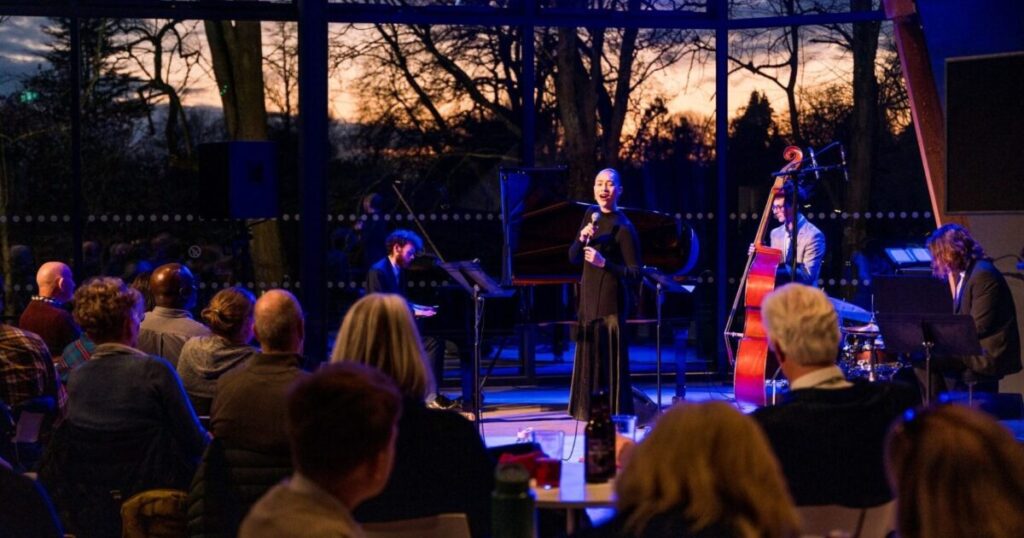
Using this information one of the first projects we developed was Calypso Jazz with The Windrush Cymru Elders
The Windrush Cymru Elders, led by Race Council Cymru, come from different areas across South Wales. They’re a proactive group of Elders who promote understanding of ethnic minority elders’ concerns and needs while celebrating key milestones and marking the contributions of people of African descent.
The group meets weekly, usually in the College, to enjoy each other’s company and take part in creative activities in and around Wales. The College and Race Council Cymru colleagues, provide support and meeting facilities for the group who use College as a community hub.
They collaborate with us on feedback and input to the What’s On performance programme. A range of colleagues and students from college have presented to the group to foster an understanding of the College’s work and develop links with The Windrush Community. Public performance is central to student learning, as is understanding a diverse range of audiences and their needs.
At the start of the new academic year, we have a large-scale concert led by jazz musician Dennis Rollins, supported by our students. Prior to the performance Dennis and staff, met members of The Windrush Elders to discuss their musical heritage, the conversations led to a co-created concert performance where our students and the Elders shared a stage, to a paying public, to celebrate Calypso Jazz.
The Elders have also been supported by college to join The Tempo Time Credit Network. Tempo Time Credits are an external UK wide organisation. They build local and national networks of organisations, bringing people together in their local communities to conduct valued and important voluntary work. Volunteers earn Tempo Time Credits as part of a reward and recognition scheme for the invaluable work they do within their communities. These Credits can be exchanged for a range of services and activities provided by their local and national Recognition Partners of which College is one.
The Elders earn two Tempo Time Credits volunteering their time as part of their weekly meetings, supporting their community. Most of the group have used their credits to see a college performance. As some of the Elders would find the physical cost of tickets a barrier, this collaboration benefits everyone involved.
Using their Time Credits the Windrush Elders have seen opera, drama and classical music. They have also brought their grandchildren to see Wearable Art, the costume showcase created and performed by Design for Performance students. This introduces tomorrow’s talent from a range of communities to the College and inspires them for future career possibilities in the creative industries.
Karen and Linda two of the Elders have used their Tempo Time Credits to see performances by South African musician Abel Selaocoe
They said of their Time Credit membership
‘Since coming to college, we have had the wonderful ability to earn Tempo Time Credits through volunteering our time to support our group, The Windrush Elders. This has opened up the possibility to use credits as reward payments for different things such as theatre shows or going to leisure centres.
At College, we’ve seen Abel Selaocoe, the jazz cello player twice, last December as part of a quartet and then again as part of an orchestra of violinists & cello players. We thought both performances were astounding and loved every minute.
Being able to attend these performances and be included with Abel’s audience participation was so lovely. We actually felt we were transported to his home country of South Africa! We are looking forward to future performances at college.’
Our Tempo Time Credit spend at RWCMD has increased year on year from,
• Sep 22-July 23 = the annual spend was 87
• Sep 23- July 24 = the annual spend was 184
• Sep 24- July 25 = the annual spend was 230
At College, the average café/bar spend by audience members per individual production is £10-15. If two hundred people spend £12.50 over one year, that is an additional £2,500 over the year. This shows supporting Time Credit spend is a great way to support secondary spend with in most cases no additional outgoings.
Audiences from groups including Blind communities. The Homeless community and The Windrush Elders were supported to access a college exhibition called Welcome to Wales. The exhibition from by International theatre designer and RWCMD International Chair in Drama, Pamela Howard OBE was a free installation at the Old Library, in The Hayes in the centre of Cardiff , the exhibition was a unique retelling of poignant journeys and the welcome, Wales gave to so many artists, performers and musicians, including Pamela’s own ancestors.
The community groups attending the exhibition were supported by a diverse range of creative professionals to create their own creative outcomes based on the initial exhibition. The resulting work was exhibited in college alongside the work of our Production Design students. Creative outcomes included creative writing, poetry, songs, visual art, braille art and sculptures. This work was subsequently used as a teaching aid for our students when learning about inclusive programming.
RWCMD hosted the ‘Windrush Cymru – Our Voices, Our Stories’- history exhibition at the College as part of its tour, which also included the Senedd and National Museum Wales.
The project and resulting exhibition directly responded to a call from Elders of the Windrush Generation who wanted to ensure that their generation’s legacy is captured and retained for posterity.
Three of the Elders have received training to act on behalf of College as Community Volunteers. Our Community Volunteers spend time advocating amongst their own networks about performances at college. They have supported new attenders who I or Colleges traditional marketing would have had difficulty reaching.
In the summer of 2025, two of our Community Volunteers independently supported ten of the Elders to attend a showing of the Grenfell installation by Steve McQueen at Chapter Arts Centre in Cardiff. This activity has shifted the traditional hierarchical process of accessing cultural provision, it democratises and empowers the communities we seek to reach. We aim to build on this work in the coming years.
To conclude as we are the College of Music and Drama, an illustration of community activity that brings together our students and members of the public who might be facing barriers in their lives centred around a celebration of musical activity.
The Good Vibrations Chorus is a free signing group targeted at those living with Parkinson’s but open to all. Chorus members take part in vocal exercises, warmups and sing both familiar and new songs with the intention of strengthening the voice to counteract the softening of speech and the loss of muscle tone common in Parkinson’s.
Singing has been shown to reduce Parkinson’s symptoms like tremor, and issues with walking and posture. This is because it helps to relax muscles and release tension in the back and neck. Singing can also help to reduce anxiety and low mood by lowering stress hormones and increases the brain’s ‘feel-good’ chemical (endorphins).
The Windrush Elders are supported to attend the Chorus, we are aware of a lack of diversity in Arts and Health initiatives, the Elders collaborate with us to support members of their own networks to attend.
Our Repertoire is broad and diverse; it contains traditional Choral music but also musicians such as Bob Marley to support the College mission of being a space for everybody.
The Chorus members have shared the comments below in relation to their membership;
It’s great. It’s like a jewel, really, that’s shining brightly. We’ve got the right people in positions, such as Josh and Dora, the tutors. Along with the complimentary package that we have with the students fulfilling their ambitions and their requirements at the same time is wonderful. There’s different layers to all of this, so it’s great. And the backing of the College and Parkinson’s Cymru, it’s great as well.
‘Thursdays are great because that means it’s a choir day! Hurrah! It really is the highlight of my week and I always look forward to our sessions. I sing with two other choirs but what I love about the Good Vibrations Chorus is the relaxed atmosphere and it’s good to get to know other people who are living with Parkinson’s. The choir is friendly and welcoming and Josh, our musical director, balances the rehearsals perfectly between singing and having a lot of fun. We always have a laugh. It’s such a tonic! It’s so uplifting and from a well-being point of view that’s immeasurable. All that wrapped up in a great big ball of joy is such a positive thing.’
Creating opportunities for a diverse range of people to experience and respond to sport, arts, culture and live events. / Lleisiau amrywiol o Gymru yn ymateb i'r celfyddydau a digwyddiadau byw