

The Sherman Theatre has, in recent years, become the most dynamic, forward-thinking and vibrant centre for the arts in Wales. Its productions are idiosyncratic in style yet universal in their message. And I’m sure you already knew all that. But haven’t you ever wondered how it looks beneath the surface? Well, guess who’s going to give you a whistle-stop tour from the comfort of your very own phone/laptop screen. Yes, me.
As part of my work experience, I got to spend a week roving around different theatres, snooping behind-the-scenes, probing directors and being generally nosy. And you lucky dogs get to know all about it through this mini blog. Not so I can brag – god forbid. Rather to alert you of all the bubbling arty hubbub that’s happening right underneath your nose.
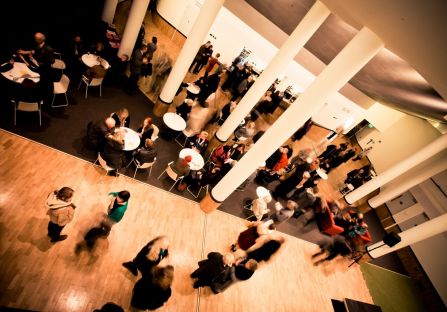
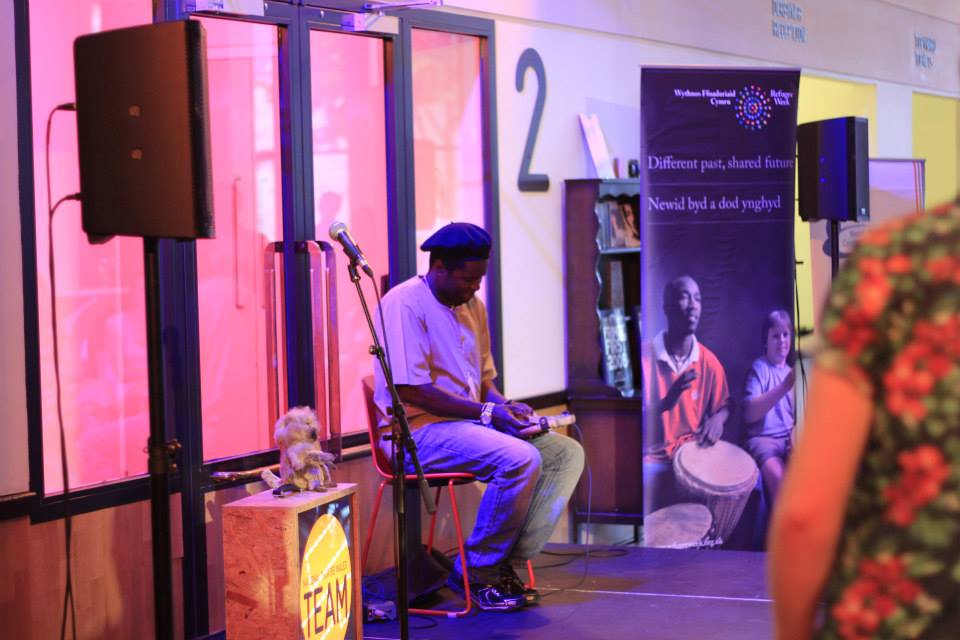
The Sherman isn’t just made up of the one theatre. In fact, the entire building has the potential to become a stage. Lighting rigs even adorn the walls of the foyer should the Sherman staff feel the need to break into spontaneous dance. A regular appearance in the foyer is an open mic artistic event called Scratch That Itch supported by National Theatre Wales TEAM, where ten artists perform for ten minutes each to relieve themselves of their, erm, itch. Not a literal itch, of course; otherwise I’d advise some sort of cream.
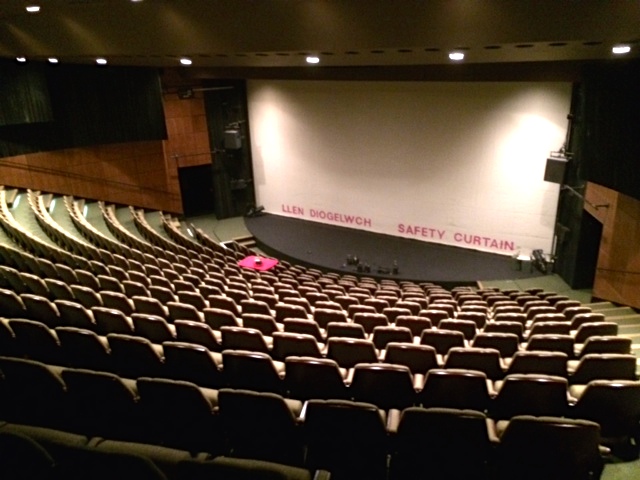
The main theatre is more of a Grecian coliseum blissfully devoid of a bad seat. It is that broad sense of inclusion and versatility that compliments the aim of the Sherman.
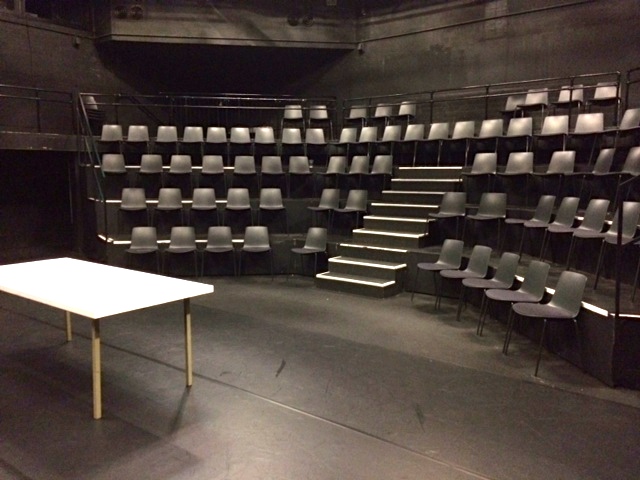
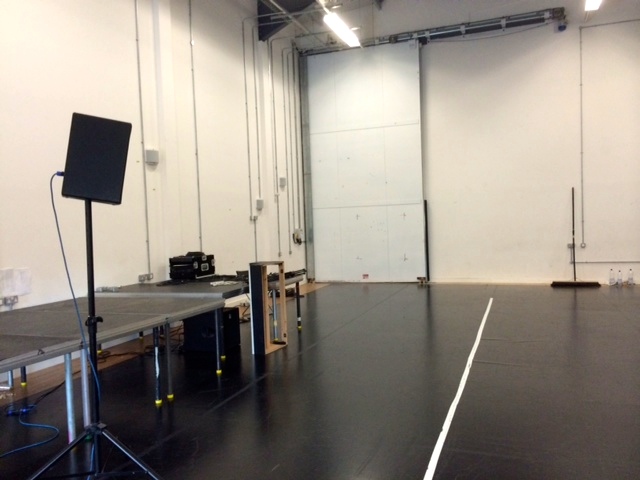
The ‘other’ theatre, soon to be named The Studio, is even more versatile – a bare, black room housing nothing but chairs and an eerie white table. This space clearly lends itself to new writing allowing the text to stand unadulterated and unobscured. If raw, unabashed performance is what you’re after, this is the place to go.
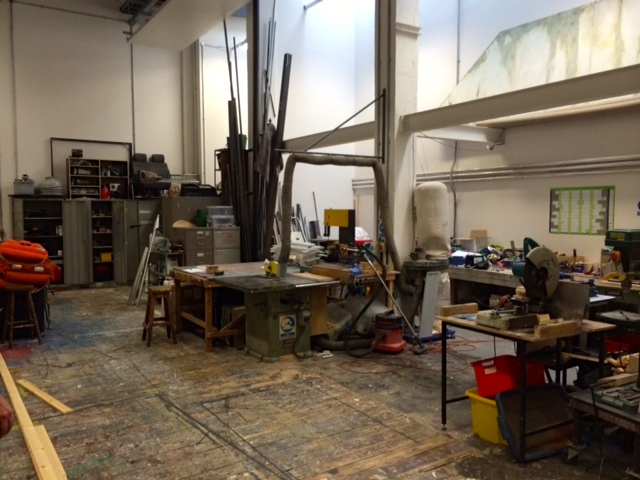
You’d think seeing the set design workshop would spoil the magic but I think it only enhances it. The workshop comprises assorted detritus that looks extracted from a plethora of different realms, but are all mere replicas fashioned in incredibly deceiving ways. For instance, the mirrors are not glass but Perspex to avoid smashing. I guess all that glitters really isn’t gold, but probably spray-painted plastic.
The versatility continues in the rehearsal rooms which act as essentially blank canvases for anything remotely arty ranging from Shakespeare to high-octane street dance. The rooms are so immodestly naked that not much can be said of them apart from the immense feeling of freedom they can provide.
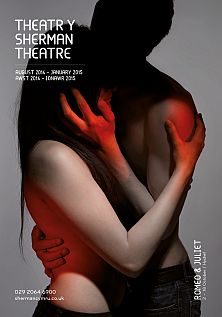
And that brings us to the end of our tour. Don’t stop there, though. Come and roam around there for yourself; I’d certainly advise you to visit this autumn with the wildly diverse season it’s boasting. Kicking off the autumnal season is the ‘unashamedly vulgar’ sexual comedy Wendy Hoose on 10th and 11th Sept. The romance continues with Shakespeare’s eternal tragedy of forbidden love Romeo and Juliet – the exciting first show by the Sherman’s new artistic director, Rachel O’Riordan and perfect for students who are fed up of over-analysing the text at school.
If love’s not the sort of thing you need in autumn, comedy could work instead. I’m looking forward to red-headed raconteur Ruby Wax who is bringing her show on mental illness and mutual insanity Sane New World after the release of her acclaimed book.Well, if that’s not your thing, novelist and Mock the Week regular Mark Watson will also be tickling audiences with his latest show Flaws.
As if the Sherman couldn’t get any more varied in their season, they’re also putting on a fusion of martial arts and hip-hop with The Five & The Prophecy of Prana just after a serious slice of contemporary opera in the form of Franz Kafka’s The Trial, composed by Philip Glass. Now that’s what I call diversity.
So, hopefully, this blog has urged you to get on the next train to Cathays and pop in to the Sherman. Please do. Hey, if you do it this week, you might see me there. Hope that doesn’t put you off!
Words and Pictures By Sam Pryce
All posts by Sam Pryce
‘In These Stones, Horizons Sing’ – a tour round Wales Millennium Centre, Cardiff by Sam Pryce
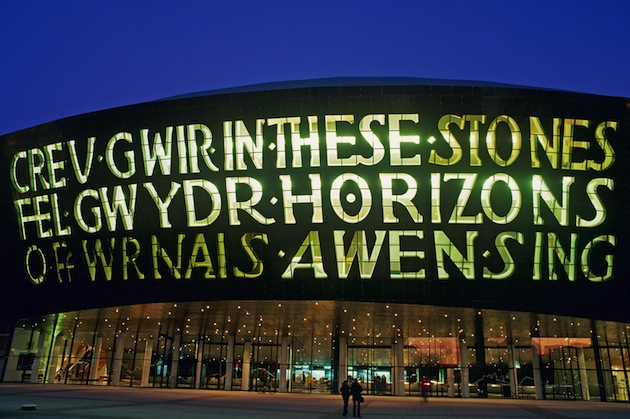
Ah, the WMC – like a great, big, brown armadillo dormant in Cardiff Bay. That’s my way of looking at it, I suppose. Yet on one of the many tours that the staff organise around the Centre, you are encouraged to look closely at various different aspects of the venue’s striking architecture (courtesy mainly of Jonathan Adams, among others) and reach your own conclusions as to what they mean. For example, the actual shape of the venue is intended to resemble the back of a ship while the two slate constructions either side represent cliffs with the glass acting as the ocean. But I don’t know – I still see an armadillo.
With our cheery guide Sophie, myself and two fascinated older folks were taken in, out, up, down and around nearly every nook and cranny a theatregoer could hope to go. Everything excluding the auditorium itself. Strange, I know, but understandable since the cast of War Horse were busy rehearsing and weren’t keen on a small group of tourists ooh-ing and ahh-ing at every move. Luckily, we gawped from the safety of the Technical Box instead and Sophie’s in-depth and factual tour was not purged of its intrigue in the slightest.
As you could guess, the tour also comprises prying behind-the-scenes into rehearsal rooms, dressing rooms and any other room that may be of interest (sadly not the bathroom). You’ll be swamped with anecdotes and factoids aplenty, – did you know, for superstitious reasons, there is no Dressing Room 13? Spooky!
Facts abound at every corner on this tour. It certainly equips you with an all-round knowledge of any and every aspect of this iconic arts hub. There’s a lot more to that armadillo than one might think. Plus, it’s always nice to spout off some fun facts on your next visit too. Just pre-warn whoever’s sitting next to you.
Preview The Homecoming, Rogue’z Theatre by Sam Pryce.
PREVIEW: ROGUE’Z The Homecoming
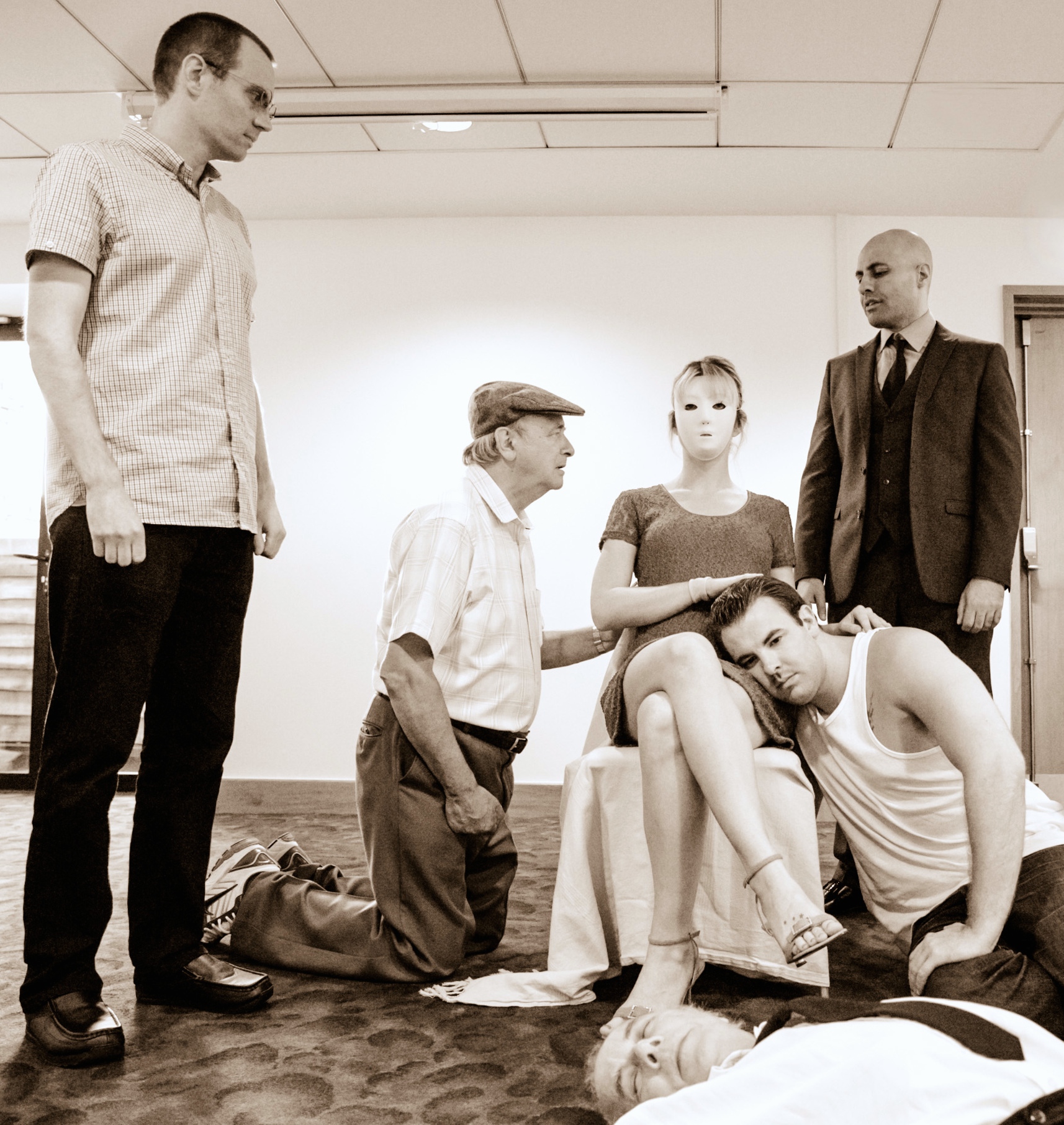
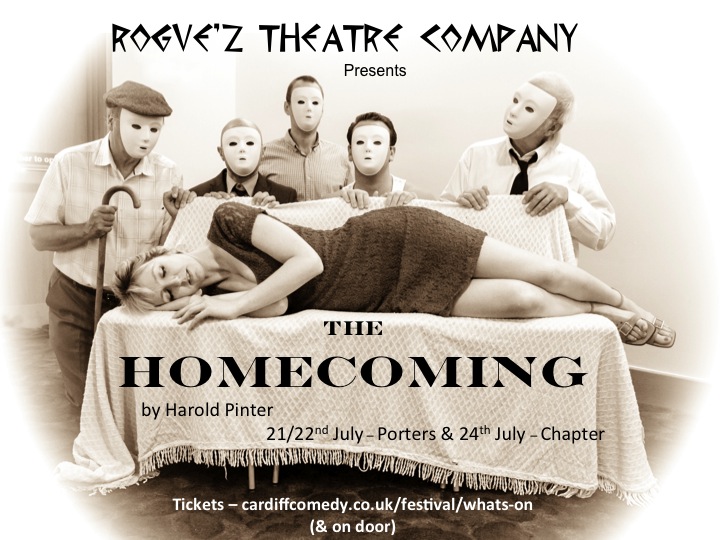
Playwright Harold Pinter believed The Homecoming – a prickly insight into a womanless family – was among his best work. It’s certainly one of his darkest, and, potentially, funniest. Therefore, it’s appropriate that the undeniably talented folks at ROGUE’Z Theatre Company have chosen to perform it as part of this year’s Cardiff Comedy Festival. They welcomed me into their apt rehearsal room – a grey-brown, disused church hall with the troubling presence of a Baby Jesus and Mary sculpture. If only Mary could have heard what goes on in this play, she’d be quick to cover her little boy’s ears.
In a North London living room, the relatively successful Teddy returns from America to his dysfunctional, all-male household with his wife. Together, they are berated and humiliated by imposing patriarch Max and his two sons: the suave, sexually aggressive Lenny and the brutish boxer Joey. The audience shall be left, like Max’s mild-mannered brother Sam, sitting very uncomfortably, unsure whether to laugh or cry.
It ran exceptionally smoothly for a rehearsal. However, the company assured me there were some creases I didn’t notice that require ironing out before they open this week at Porter’s (21st and 22nd) and subsequently at Chapter (24th).
Pinter is notorious for hinting at subtexts that are left unexplored. This company’s rehearsal process, however, aimed to delve deeper into each character’s past. Andreas Constantinou, who co-directs and plays pimping son Lenny, tells me, “We wanted to try and reveal the internal lives of the characters. And, in order to achieve that, we used improvisation to explore what these people went through beforehand. Pinter hints at all this but he never elaborates. There are only these words and subtle digs.”
This aspect is particularly evident in the character of Ruth, played as a femme fatale by Nerys Rees. She says, “One of the improvisations we tried was Ruth and Teddy’s time in America and it helped us discover a whole subtext that could translate into performance.”
“But why on earth should I see it?” I hear you (internally) ask. Well, here’s Constantinou’s opinion – “It’s darkly funny while being incredibly insightful. It reveals the uglier sides of human nature beneath the pleasant. And, of course, there’s the rampant, seething sexuality and barbarity.”
What more could you want?
ROGUE’Z production of The Homecoming is at Porter’s Cardiff on 21st and 22nd July and Chapter Arts Centre on 24th July 2014.
REVIEW: August012’s Roberto Zucco – Chapter Arts Centre, Cardiff by Sam Pryce

We all have a morbid fascination with serial killers. How can someone be that fearless and disturbed to commit such an act of forethought malice over and over again? In this 1988 absurdist play from French playwright Bernard-Marie Koltѐs, the notion that a killer is in fact influenced by the hypocrisy and corruption of others is explored via the real life Italian killer Roberto Zucco – infamous for first killing his parents before moving on to police officers, women and a child. Certainly not your usual protagonist, but what is especially unsettling is that you find yourself empathising with his character the most. That’s when a play has really done its job.
Such a provocative, audacious idea must be conveyed in an engaging enough way for its audience to listen and this company doubtlessly flourish. Under Mathilde Lόpez’s always revelatory direction, this production terminates your grasp of sanity from the moment you walk through the door. Much like Tonypandemonium in its impulsive, even primal spontaneity, no scene has a set beginning or end and, despite the traverse staging, the entire space is used. What erupts is an exhilarating if disorienting experience. With all those rapid head movements, it’s a bit like being at Wimbledon.
Yet another inventive aspect of this production comes in the form of a choir whose soaring voices underscore the piece adding fluidity to the act and a somewhat ethereal atmosphere. It gives Zucco’s story the feel of a great operatic tragedy.
The cast are boundless in their abilities. All hang-ups are lost, which is customary if you’re working with Lόpez. With Roberto Zucco being the only concrete character, the more-than-mutable supporting cast must resort to shifting personas in the space of seconds. Bethan Mai foams and fizzes with mischievous allure and emotional instability. Joanna Simpkins, with her arresting glare, delivers the text fiercely with vigour and verve. John Norton transcends gender and nationality to assume progressively ludicrous guises and, as a result, gains a lot of laughs. And, last but not least, Adam Redmore as the eponymous assassin is cleverly the most vulnerable, with a killer’s vacant gaze, blameless in a troupe of flippant coppers, manipulative mothers and incestuous siblings.
Of course, the best performances come from the (un)lucky audience members who, curiously, always oblige to joining in, whether they have lines to say or a chair to give. Lunacy is omnipresent and openly encouraged.
Explosive and uncompromising, Roberto Zucco shocks, excites, tickles and disturbs. The gusto never dips and the mood never dampens. Kill for a ticket. Sit in the front row. Leave your inhibitions at home.
PREVIEW: August012’s Roberto Zucco – Chapter Arts Centre, Cardiff by Sam Pryce

Roberto Zucco – natural or nurtured killer? That question, among others, is the sort of thing this production of Bernard-Marie Koltѐs’ final play shall attempt to answer. Not only is it sure to answer this, but I expect it will encourage its audience to pose many questions as well with its boldly original style, courtesy of the expertise of director Mathilde Lόpez. It opens tonight (Wed 9th July) at the Stiwdio venue of Chapter Arts Centre, but the company were generous enough to let me to sit and scribble in the dark while they had their tech rehearsal. And I can tell you: even the rehearsals are as erratic and exhilarating as the production itself.

Firstly, a word about the play. Written in 1988 by absurdist Bernard-Marie Koltѐs and translated by Martin Crimp, it appears to follow the life and murders of the real life Italian serial killer of the same name, charting his familial and romantic life along the way. Alas, it’s not as factual as you may think. While the storyline is generally accurate, it is the primitive dialogue and ferocious characters that are the most striking.
Director Mathilde Lόpez says, ‘I love the language. It switches so quickly from something almost Shakespearean to an American gangster movie.’
And she’s succeeded in injecting that almost manic conversion from comic hysteria to tenderness through several mediums that you’ll have to see for yourself. A lot of the questions I had prepared were somewhat irrelevant when I saw how the play worked. I realise that it’s not as much about Zucco himself, rather how he’s driven to it.
Discussing it with Lόpez, however, gave me a huge insight into what’s below the surface of Zucco. ‘He is almost like Jesus, in a way,’ she says. ‘The play is a kind of crucifixion. He himself is not an evil character; he is only made to do these things because people want him to. You know, a girl asks him to kidnap her and he does,’ muses Lόpez, intermittently popping a Skittle into her mouth.
She adds, ‘Zucco is also the only character with a name, which is interesting. The others are just called Mother, Sister, Girl, and so on.’
I notice too that Zucco, played expertly with disconcerted shyness by Adam Redmore, seems the most timid of all the characters. It, therefore, is a play about how perhaps we are not born evil but made that way.
The context of it being written in the 80s adds yet another layer for analysis. Since the playwright was a homosexual, the hostility he faced is reflected in his work. ‘Koltѐs wrote this when he was dying of AIDS,’ she continues. ‘So there’s a lot about secretion and filth and the sort of dirty desires of humans, which is how it was seen then. And yet, the actual subject of AIDS isn’t mentioned once.’
Watching Lόpez work is a privilege in itself. She changes seats regularly to ensure everyone has a good seat, occasionally adjusting the positioning of the actors accordingly. Sporadically and without warning, she barks mid-scene instructions or adjustments to actors – ‘Louder’; ‘Too far’; ‘Cry more.’ And the actors obey her every word and carry on, simply because, very often, she’s right. Lόpez, like any artist, is obsessively meticulous in all aspects of the performance – the speed of a crossfade, the tone of a voice, even the direction of a bucket of blood. All chaos is organised. Such carnage requires scrupulous direction.
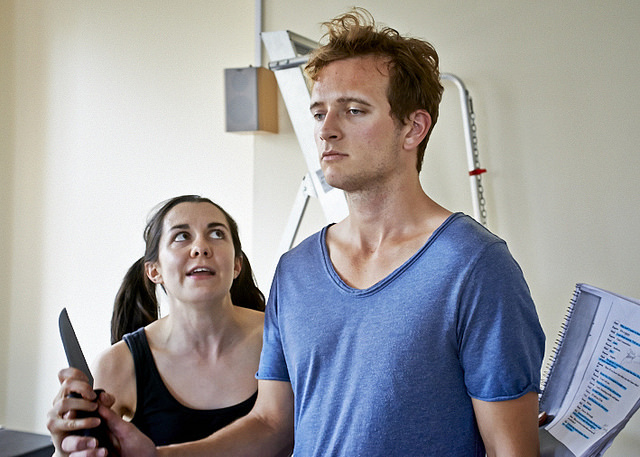
Every actor seems an artist in their own right too and perhaps that is the reason for Roberto Zucco feeling so dazzlingly volatile. Adam Redmore and his supporting cast (made up of Bethan Mai, Joanna Simpkins and John Norton) are equally brilliant showing no sign of exhaustion from these rehearsals, abandoning all the usual barriers of age, class and gender. They are empty vessels for the quirks of minor characters to fill. I was still unsure of what was to come even after watching scenes replayed over and over again so that a light or a noise was in the right place at the right time. It’s a real feat of the imagination. People, like Zucco, should kill for a ticket to this. (Don’t actually do that.) I know I am dying to see Thursday’s finished product.
Roberto Zucco is at Chapter Stiwdio, Cardiff from Wed 9th to Sat 19th July 2014.
Sam Pryce
Review: Equus – Chapter Arts Centre, Cardiff by Sam Pryce
Review: Equus – Chapter Arts Centre, Cardiff
Reviewed by Sam Pryce
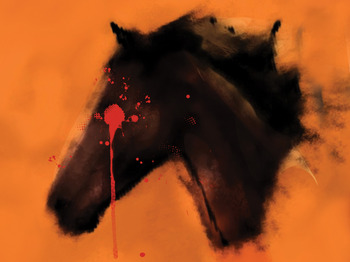
In this bare-boned, minimalist production, the ideas and themes of Peter Shaffer’s 1973 play of a boy’s profound worship of horses are put to the forefront. The play is not upstaged by any ostentatious dance interludes nor shadowed by innovative set pieces. This company provide a stripped-back, viscerally passionate performance of a play rife with psychological depth and emotional complexity.
Although one can delve into an intricate analysis of the motives of each character, the plot is fairly simple when laid bare. Martin Dysart, an initially cynical psychiatrist, is given the task of taking on Alan Strang, a 17 year-old boy who blinded six horses with a metal spike. On probing Strang’s intentions, Dysart is bewildered to comprehend him when learning of his conflicted familial life – a Marxist father fully informed of the world’s injustice and a devoutly religious mother eager to teach Strang the enriching security of ‘worship’, something that Dysart envies. As Strang becomes more and more frank as the sessions progress, the psychiatrist begins to contemplate his own sanity and realises the tragedy of his sexless marriage and absence of compassion. What emerges is a fascinating, multi-faceted and disturbing study of the human mind.
With a play so rich in emotion, it requires some accomplished actors. Passionate, powerful performances are given by the two leads: Steven Smith magnificently depicts the anguished, troubled genius of Dysart while Henry Nott superbly unsettles with his cold stare racked with perturbed purity. Under Thomas Hockey’s direction, the relationship progresses from firstly icy and distant to fervently parental. Other notable performances are given by Paul Fanning and Trish Gould as Strang’s taciturn parents, Trish Murphy as the concerned magistrate, Angharad Hodgetts as the seductive stable-girl, Alexander Wilson as a few comical characters and James Sidwell as the subject of the boy’s infatuation, portraying equine splendour with startling accuracy.
Equus can be seen to explore themes ranging from religious corruption to repressed sexuality, even the coming-of-age and adolescence. And yes, all these themes may sound slightly intimidating, but the emotional stamina of the cast, the meticulousness of the direction and the nuanced choreography ensure a gorgeously disturbing experience. It’s a splendid revival and surely one to see before the week is out.
And just to close, with all that shouting, let’s hope the actors’ voices don’t get too hoarse! (Sorry, I had to.)
Review The World of Work “catch this work of unhinged brilliance” Young Critic Sam Pryce
The World of Work – Chapter Arts Centre, Cardiff
Reviewed by Sam Pryce
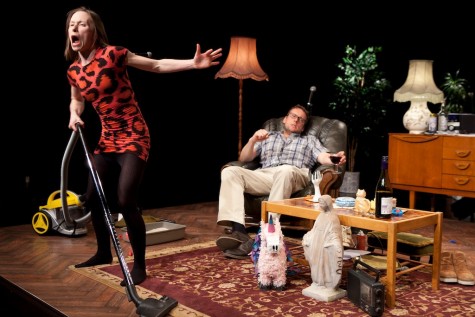
This wasn’t strictly a play – more of an out-of-body experience. Or at least that’s what it felt like. The aptly named Difficult Stage have brought us a black comedy of failure from the delightfully disturbed mind of Katy Owen. Presumably autobiographical, this hilariously dark reverie through Katy’s psyche comprises a birthday celebration, an acapella sing-off, a rather profane episode of The Archers and a minstrel (not the confectionery kind). Unlike anything you’ll ever see ever again in your life ever, The World of Work is an evening of utter absurdist hysteria. In fact, it’s so vibrantly original, I can guarantee that every critic will struggle trying to put it into words; alas, I’ll try my best.
Hemmed in by a jungle of potted plants and tasteless furniture, we find ourselves as guests to Katy’s birthday party welcomed by a charmingly witty Ben Tyreman who plays Neil, intermittently offering cheese to front row audience members (there’s a tip for any cheese-loving punters – nab a front row seat). Along with Neil, another of Katy’s motley crew is François Pandolfo playing an out-of-work, out-of-mind actor who’s penned what he believes to be a ground-breaking new play about Aborigine Australians moving to the Valleys (a performance of which is given as a painfully funny climax). And last but not least, Lisa Palfrey steals the show as the, shall we say, unstable Aunty Andrea guzzling vodka and yelling vulgarities.
The narrative is fragmented through discussions of Katy’s failures over the years – her bit-part inCasualty, her… Well, actually, that’s about it. Owen seems to be pleading for recognition of her impractical talents for mimicking demented leprechauns. In an attempt to console herself, through a mist of liquor, she lists of the failures of her guests and so grows to the point that we are all let-downs, and it’s those who can make something of it that succeed.
Though Lisa Palfrey’s virtuosic set of accents and deranged farcicality earns many guffaws, the comic timing is consistent throughout the company. With the addition of Jamie Garven’s direction, the audience are left with creased faces and damp seats.
What is reassuring though is a total absence of pretension – this is a play that ultimately has a heart and a truth to it, a genuinely optimistic love for behaving badly. With the brand ‘absurdist’ comes many presumptions, but the originality of Difficult Stage bypasses the label. You have until Saturday to catch this work of unhinged brilliance. I suppose, yes, your sanity will diminish slightly after you’ve seen it, but you’d be raving mad to miss it.
Review: ROGUE’Z Theatre – The Winter Gift at the Urdd Hall, Cardiff by Young Critic Sam Pryce.

Review: ROGUE’Z Theatre – The Winter Gift at the Urdd Hall, Cardiff
Reviewed by Sam Pryce
Apparently, there is no Garbo, and there is no Dietrich; there is only Louise Brooks. That’s according to French film pioneer Henri Langlois, and he should know his stuff. Louise Brooks is probably a name that doesn’t ring any bells. Indeed, it didn’t ring any of mine either. Her legacy remains something quite obscure, partly due to her contemporaries being the gloriously immodest likes of Greta Garbo and Marlene Dietrich. Yet, in this fond but frank portrait of the silent screen icon, award-winning writer TJ Davies attempts to discover what went wrong for “the girl with the black helmet.”
Director Nerys Rees presents a stripped-down production with a minimalist set that cunningly incorporates the monochrome palette of silent films. The cinematic atmosphere is enhanced through the integration of projection intermittently showing snatches of footage – some of Brooks herself, others made by the company. Lizzie Mulhall’s costume, hair and make-up by Natalie Wright compliment that black-and-white sophistication and pre-show introductions to the dramatis personae are thrown in for good measure.
The narrative flits back and forth from the feisty, fresh-faced Louise Brooks in her heyday (played with fire-cracking audacity by Rhian Cheyne) to the destitute, alcoholic recluse she became. Karen Thomas gives a reckless portrayal of this darker side, slumping about the apartment yelling in a hoarse rasp. Andreas Constantinou brilliantly plays the devoted fan James Card who visits Louise, pleading her to write her memoirs and allow the world to realise her worth. It is these duologues that prove the most engaging and well-written, sizzling with venomous ruckuses, whilst the vignettes from the past tend to have us stifling yawns. Other notable performances are given by: Louisa Marie Lorey who is monstrously funny as the eccentric Alice Roberts; James Pritchard as the silver-tongued Shulbberg; Andrew Ford as a comically deadpan Fritz Kortner; and Brian Smith as GW Pabst – the director who brought Brooks to fame. And, of course, à la Alfred Hitchcock, Nerys Rees makes her own scantily clad appearance as Marlene Dietrich, provoking more than a few chuckles.
Although the play’s subject is perhaps a little esoteric, Davies peppers the dialogue with enough context to not lose anyone along the way. Younger theatregoers (unless aficionados of silent cinema, of course) may not be downright enthralled, but if you’re up for a sprawling bio-play of one woman’s experiences of fame and (mis)fortune, you’ll be in for a treat.
Review ‘Sue, The Second Coming’ Chapter Arts Centre “It is Sue-perb” Young Critic Sam Pryce.
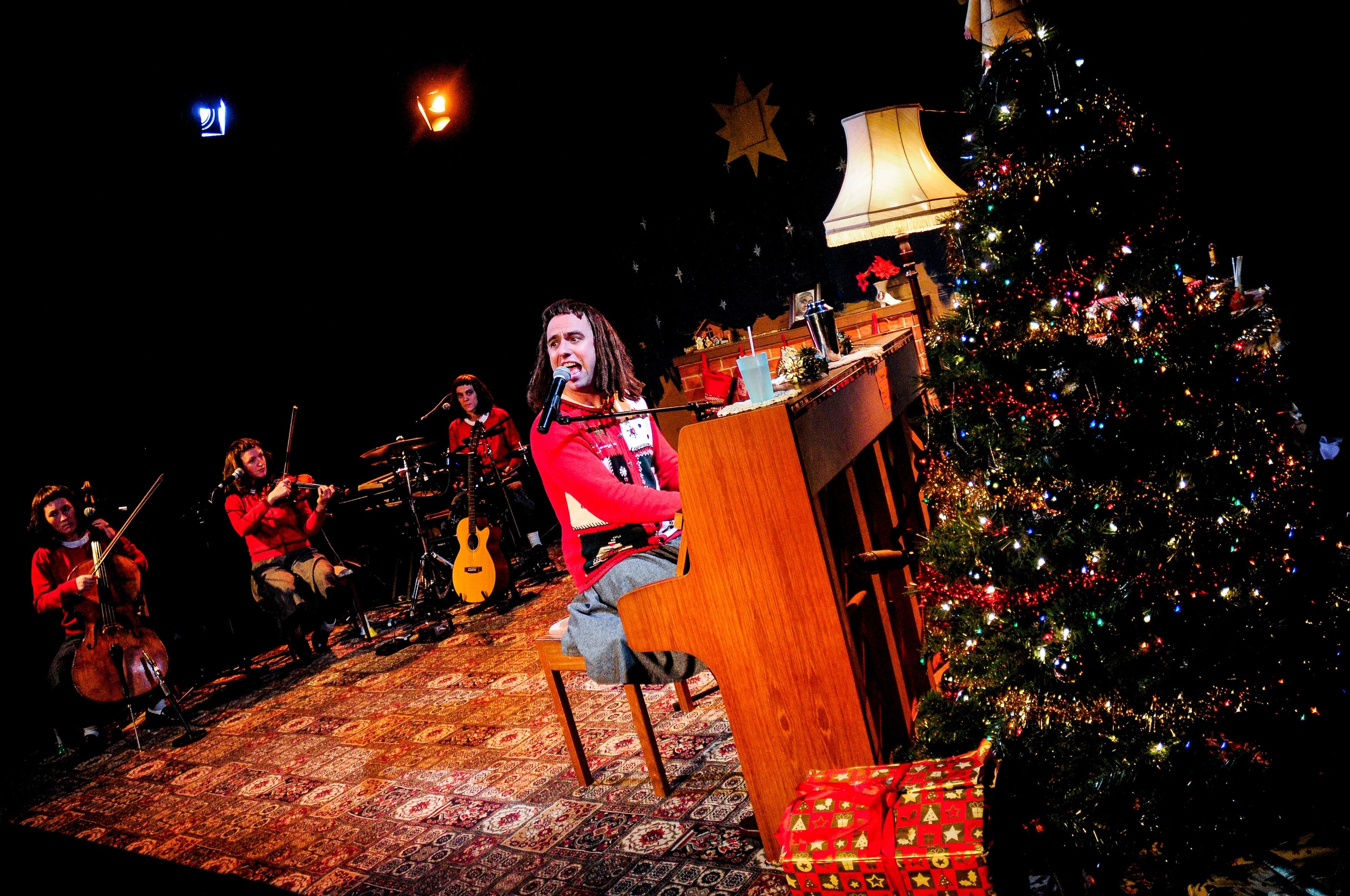
Photo Kirsten McTernan.
Sue – the lonesome, piano-plonking Christian – is back with a vengeance. In this, her ‘second coming’, she beckons us into her tastelessly-decorated living room, hands us a shot of eggnog and provides a festive freakshow armed with a piano, a soaring falsetto and a mini orchestra of deadpan, back-up Sues. After a cult-following developed at her Edinburgh Fringe show, My Name Is Sue, Sue is on tour to bring her unhinged joviality to audiences across the UK.
In a menacing medley of darkly funny ballads, Sue (embodied by the buttock-clenchingly hilarious Dafydd James) waxes lyrical on such subjects as the unfortunate vanishing of Macaulay Culkin, the lamentable tragedy of the Manky Goat and her intoxicated liaison with a dodgy Father Christmas.
In true seasonal spirit, the audience participates too in The Nativity According to Sue, in which Sue awaits the arrival of a new messiah from the very depths of her womb. Unsettled audience members are pulled up on stage to play wise men, lonely shepherds and the angel Gabrielle (‘Dreeeams can come true!’). It is Sue-perb.
The brilliantly disturbed minds behind this are Dafydd James and Ben Lewis, who, along with their indubitably talented company (Megan Affonso, Elena Pena and Francesca Simmons), have created something startlingly original that bears significance to almost nothing ever seen before in the comedy world. Although character comedy and comedy songs may be mediums that are considered to be one-dimensional, the company manage to blend in bracing musical interludes with a character exceedingly developed who has the (albeit slim) possibility of existing in the real world.
Sue Timms is a comic creation that has the potential to become something eternal in the comedy world. I know whose house I’m going to for Christmas dinner.
Review Script Slam, Sherman Cymru, Young Critic Sam Pryce
Cardiff’s Sherman Theatre is turning forty, can you believe? And it doesn’t look a day over twenty-one. Since life is meant to begin at forty, the theatre has themed this year’s Script Slam around anniversary material symbols – paper for one year and ruby for forty, and so on. If, like I was, you are unfamiliar with the Script Slam palaver, it’s essentially a competition stretched over three nights, each night hosting three short and original plays from local playwrights. À la X Factor, each play is then critiqued by a panel of theatrical aficionados who ponder its profundity and its extendibility before the audience decides via show of hands. And it’s all very casual – I mean, the actors have their scripts in the hands, for one thing. However, I should say that the acting is consistently excellent from Sara Harris-Davies, Gareth Milton and Hugh Thomas – all of whom interpreted the pieces with accomplished panache.
The panellists in question on the first night were: Sherman Cymru’s Associate Director, Roisin McBrinn; Associate Producer of Theatr Genedlaethol Cymru, Michael Salmon; and Wales Arts Review’s Senior Editor, Gary Raymond. Every night also boasts a different director and Tuesday’s director was the brilliant Matthew Bulgo, one sixth of Dirty Protest, who you may have seen in I’m With The Band. Well, I did, anyway.
The first play of three was Neil Walden’s GM – a quaint piece about a jeweller in search of the gold he shall use for the Queen’s 40th anniversary wedding ring. It was humorous in places and the characters well-honed but I could source no meaning behind it. Perhaps it was simply following the brief. This led it to receive from the audience no favouring hands. But who knows? I could’ve misinterpreted it completely. Walden’s no stranger to misunderstanding of his work. He once won an award for horror writing for what he thought was a comedy.
The second came from previous Script Slam winner, Neil Bebber. He brought us Together – not literally; that’s its name. This play brought us a wonderfully detestable couple who had been bound to each other for forty years and couldn’t wait until death could finally part them. Through acerbic remarks to and fro, we discover the sexual escapades and liaisons each party had indulged in throughout their relationship. It’s a savagely funny play with echoes of Pinter-esque wit but a truly original tone. My hand thrust up for this one. In the air, of course.
And the last was A Very Modern Office by David Harris – a delightful, faintly absurdist story about change and its effects. A man goes about his business in what he believes to be his lifelong office where he works with paper and paper alone. At least until a young temp visits. He then discovers the world outside his office is rapidly changing – his office is now a storage room, paper is dying a dreadful death and books are being listened to instead of read. Quite a thought-provoking one, this; made me think quite severely about paper.
‘And the winner?’ you ask. Neil Bebber’s Together took the, erm… Well, the accolade. There wasn’t actually a prize, unfortunately. But there we are. Something for the CV, eh?