A magnificent experience from start to end; if you haven’t been to see a live orchestra, I cannot recommend the experience enough, especially a performance by the BBC National Orchestra.
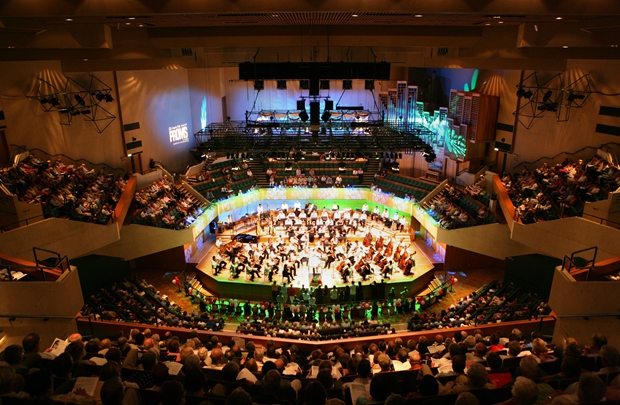
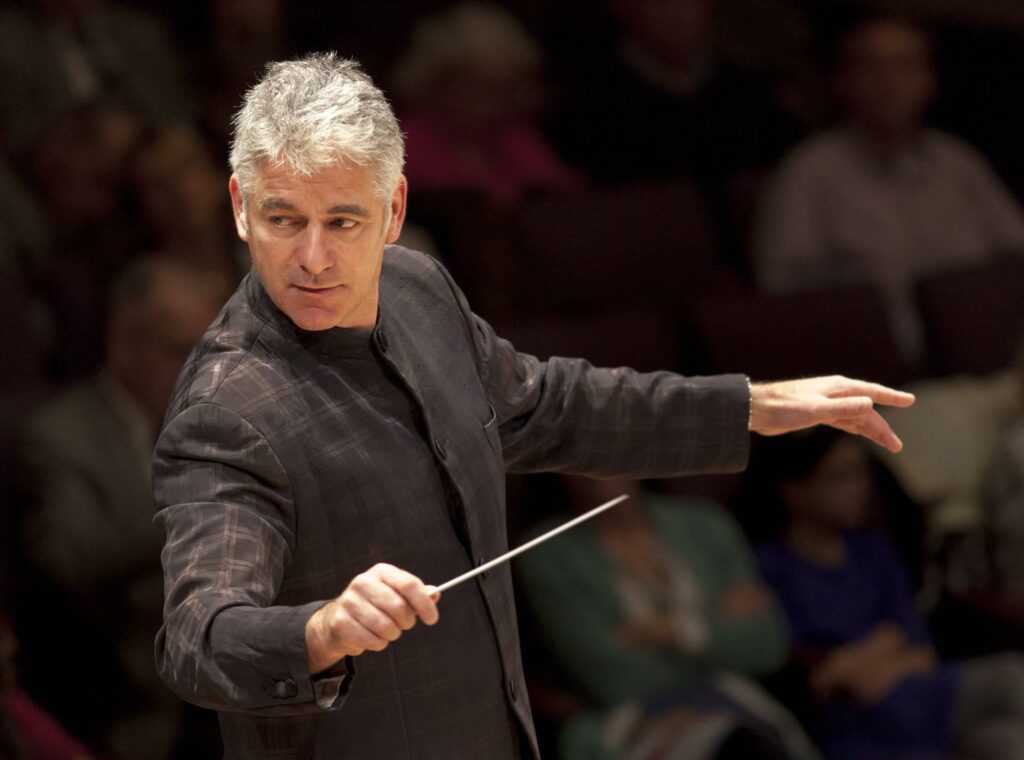
For the annual “Dydd Gwyl Dewi” by the BBC National Orchestra and chorus of Wales, a celebration of all things Welsh occurred. The event marks the start of a partnership with Orchestre Synphonique de Bretagne and was conducted by Musical Director Grant Llewellyn. This collaboration showcased performances from the National Youth Orchestra and the orchestra’s partnership with the Welsh folk band Calan.
Calan
The performance began with the string section and wow! The bows leaped and danced in bounds of rhythm and movement with each other. Mesmerised by the spiralling and winding of the violinists, the sound echoed both visually in front of us as well as audibly, surrounding our senses. It was only in the moments of rest in which the musicians once again became human. Otherwise, you were entranced by the bountiful immersion occurring on stage.
Whilst conducting Llewellyn, would dance (although often like a dad whilst making dinner in the kitchen) with the music taking over his physical being which would emit onto us, the audience. There were moments which were Matilda-esque, playing with the electricity between the different musicians.
Musical Director Grant Llewellyn
Flickers of imagery from time to time would overwhelm my
thoughts, either that of memories of children playing in fields or of the roaming
hills I would often watch through a train window. I felt at peace.
Each piece within the performance held its own providing a
new stimulus for us to focus on. The second was more heavily percussioned. Again,
the musicians danced, but this time it was those playing the Glockenspiel that
lead the way, bouncing from note to note. My only questions being that once the
choir was introduced, does the orchestra take a backseat? As the audience, both
parts seemed equally powerful and important so I questioned whether one should
be a lesser superior component.
With the third piece, there was also this playing of power. The soloist, Angharad Lynddon, sombre in tone but beautifully delicate with accent, teased between the everchanging balance between the orchestra and herself. This teasing continued into the fourth piece, with a sense of non- competitive play in rolling waves of triumph.
Angharad Lynddon
The fifth, probably my favourite of the day, balanced the
old and the new in the most magical way. It balanced the factors of delicate
comedy with moments that were boisterous with power in such a way we were
enchanted by the relentless percussion.
This continuation of a modern fusion with the more classical
was profound in the second half of the show. There was an explosion of life
with odes to all elements of traditional welsh culture, with references from
Caws to clog dancing. However, I do feel with the introduction of Calan, both
the orchestra and choir became neglected. The percussion was replaced by the
rhythmic plucking of the guitarist and the focus was turned more towards the
band. I desired a more equal balance between the components, whether this could
have occurred spatially, with the band in the centre of the orchestra or if it
was something musical that needed to be altered. Although, it was incredible to
watch Llewellyn conduct both the orchestra and the band, with the relationship
between the three was clearly evident.
To conclude, the whole experience and atmosphere was a magnificent experience from start to end; if you haven’t been to see a live orchestra, I cannot recommend the experience enough, especially a performance by the BBC National Orchestra.
I wasn’t exactly disappointed but I wasn’t
satisfied either – for several reasons.
This puts me in a minority of one, as it seems both the play and this
production have been universally well-received:
– A must see
– a talented young cast
– terrific energy as the fight goes on
– so good all you want to do is roll out one
superlative after another
– and so on. So, why dissatisfied?
‘Blue Stockings’ is issue-based. The subject – the refusal of Cambridge
University to recognise women’s equal intelligence by awarding female students
degrees and allowing them to graduate – takes precedence over the
characterisation of the cast and any personal drama. The general circumstance – that of an institution
pigheadedly refusing to accept women as men’s intellectual equals – is a given
and it replaces the normal dramatic tension set up in scenes where there is a rising
tension between the protagonists. So,
does this subject provide suitable material for a play? For one thing, we know the ending in advance,
so there is limited suspense.
The standard
approach to tackling issues is to show a sympathetic character – a hero or
heroine – as being involved in or effected by what is going on in society. Thus in ‘Henry
IV’, Prince Hal and Falstaff can play out their relationship against a
backdrop of what it means to be a king in waiting; in ‘The Crucible’, Proctor and Abigail’s story explores the immediate
meaning of national paranoia; Hedda Gabler’s passion has nowhere to go and her
behaviour when confronted by an unassailable patriarchy becomes both
fascinating and horrific.
None of the people
portrayed in ‘Blue Stockings’ are of
heroic stature. They are not intended to
be. By giving us a number of female and
male undergraduates and a number of men and women academics, Jessica Swayle
spreads the load, as it were. But I
think she has done this too evenly. She
avoids the problem sometimes caused by having a pre-eminent main character –
the feeling that his/her problem is
unique – by her spread approach, but she leaves an attentive audience wondering
exactly where and on whom to place their attention.
Swayle’s large
pool of dramatis personae gives her an additional problem. Those associated with Cambridge, whether
working or studying there, are not and never have been representative of wider
UK society. We can’t shrug off our view
of them as elitist and privileged. En
masse they put us on the defensive. ‘Why,’ we ask ourselves, ‘should we care tuppence
about these toffs?’
One answer is because
they are not all toffs. Even in the
nineteenth century there would have been those at Cambridge who did not fit the
mould. Swayle shows us this by having a
working-class female undergraduate, Maeve Sullivan, and a genuinely egalitarian
male lecturer, Thomas Banks. (Banks’
career is derailed because he refuses to give up his Girton teaching when offered
a fellowship at Trinity. I thought
though, because of a bit of injudicious staging in this production, he might
have got into trouble because of the proximity of his hand to a student bottom,
occurring when he pushes Tess around on a bicycle – but maybe I wasn’t meant to
notice this).
Swayle also sets
up an overarching tension by giving us two real historical characters: Elizabeth Welsh, the mistress of Girton, and
Henry Maudsley, the famous psychiatrist.
Mrs Welsh has been working patiently towards obtaining degrees for her
girl students; Maudsley has been diligently exploring hysteria and has a number
of theories about it.
The presentation
of Maudsley needs much more careful handling because he is shown as representative
of contemporary male thinking. Swayle
gives him the space to present ideas which today appear as complete nonsense
but the way she does this is quasi-farcical.
We are encouraged to find him ridiculous, to laugh uproariously at his
‘wandering womb’ theory, without being simultaneously obliged to place the idea
in its real context. It was not funny
for the women of the time to be considered wholly at the mercy of their
misunderstood biology.
Equally the
thinking that Maudlsey and others put into hysteria was well-intentioned,
insofar as it was part of the early attempts to understand why women were so
unhappy and why many of them succumbed to severe mental illness. In other words, today Maudsley is both absurd
and understandable. In fact he
made a huge contribution to the treatment of the insane, giving what Wikipedia
describes as an astonishing amount of his own money to ensure the completion of
the hospital that was named after him – and which is still providing mental
health services today. If he was shown
on stage as a more rounded and complex character and not just as a blithering
idiot he would be both funnier and more interesting.
Apparently –
Wikipedia again – Elizabeth Welsh managed to rise from being a tutor at Girton
to become the first mistress to have any say in the college’s direct
management. She did not, however, manage
to achieve what the play suggests was her great ambition – the awarding of
degrees to female undergraduates. Cambridge
obstinately continued its male-centred approach until 1948. It was the last British university to reach
this point, some seven hundred years after Bolgona, where a woman got a degree
in 1237. A couple of women were teaching
at Spanish universities in the seventeenth century. Ironically enough, the first woman to be given
a BA Cantab was the Queen Mother, and this was only an honorary award. What does that say about respect for women
academics?
The problem as far
as the play and this production is concerned is how to flesh out Elizabeth
Welsh. Again I think Swayle needed to
handle this more carefully. As it is there is just insufficient modulation in Welsh’s
behaviour. One moment she is seen
talking quietly and intelligently to her out of order or worried students and
the next she is shouting at a member of her staff she disagrees with. She comes across as more like a stressed out
secondary teacher than a thoughtful member of an intellectual community. In the end she is transformed into a
monstrous harridan, booming at all and sundry.
I was relieved when she was pushed over and the ranting came to an end.
Highly educated
people, whether female or male, don’t resort to shouting one another down in a
hurry, because they have been equipped with a wide variety of vocal and verbal
resources. They deploy these resources so
as to be able to avoid direct confrontation – which they normally consider to
be both pointless and ridiculous. (It’s only when they get to the House of
Commons that they forget what they have been taught and start behaving badly.) I don’t object to violent arguments on stage
but they require preparation: they are only effective when we have experienced
the build up behind them. You can’t fast
forward. Because Elizabeth Welsh is not
the primary focus of the play’s story, she appears in the way to have a very short
fuse. Thus, her mood swings work against
the play’s main theme – that women are not driven exclusively by their
emotions. Who, honestly, would want
someone like her in the common room?
I expected the plot
as it unravelled might centre on Maeve Sullivan and her struggles to integrate
with her peers whilst she laid the foundations for a professional career and her
escape from her family background.
Instead, when her brother brings news of her mother’s death she is told
– by Elizabeth Welsh, no less – that she has to go home and look after her
siblings and accept her limited destiny.
The glades of academe are not for such as she. But, as we have not got to know her properly
before this happens, we don’t feel very sorry for her. She is quickly forgotten – like the girl or
girls murdered at the beginning of a Scandi noir TV series. Rather than serving as a dramatic
counterbalance to the other, upper middle class female undergraduates, she
remains – as described in the cast list – ‘a mystery’. Why?
One of those other
female undergraduates who is given a bit more air space is Tess Moffat,
described as ‘a curious girl’. This sounds as if it might be ironic – aren’t
all Cambridge undergraduates curious? – but she is not given very much more
room to manoeuver than Maeve.
In an early scene,
we watch her pluck up the extraordinary courage required to confront Maudsley
in a lecture. But here again, Swayle’s
touch is wrong. Maudsley rapidly loses his temper when Tess interrupts and
throws the uppity girl out of the lecture hall.
In reality he would have resorted to irony, the favourite linguistic
device of the academic. He would simply
have cut her down to size with a few well-chosen put-downs. That’s all it takes in a tense public space
where a practiced sneer can reduce anyone a bit insecure to human jelly. Any presentation of Cambridge life which
doesn’t show irony as almost the lingua franca is just unconvincing.
Because she has
not been humiliated, Tess’s holds her head up high – until she falls for a
Trinity man – Ralph, a cad and a bounder.
Ralph bowls her over with the trick that must have been old even in the
1890s, reading her a piece of Italian poetry.
Being a romantic nineteenth century nineteen year old – rather than an
unsentimental modern miss who would collapse in fits of giggles – Tess succumbs to Ralph’s less than obvious
charms. We are not, therefore, surprised
when we find out he is going to propose to another. In any case, university love affairs are not
often of more than passing interest.
Does this sub-plot add anything to the main story? Only insofar as Tess’ stormy love-life
disturbs her concentration, so she flunks her exams. Female intellect being undermined by emotion. Why not show Tess as bouncing back
easily? Everyone gets dumped. Most shrug it off.
There seems to be
a minor error in the unfolding of the love story. Tess and her beau have a picnic on what is referred
to as a hill from which they can see Kings College Chapel. I believe you can see the chapel from a
distance – or you could until modern buildings got in the way – but this is
because Cambridge is almost completely flat.
There was another
minor error, too, in the conversation flowing from the male
undergraduates. One remarks that
‘employers all want firsts’. This is an anachronism. Gentlemen did not go up to Cambridge in the
nineteenth century to please prospective employers. They went up because it was expected that
they would complete their education. It
was only the poor – like Maeve Sullivan (remember her?) who had to think of
getting jobs. The gentlemen had ‘prospects’
that would not be affected by the class of degree they took. They would be supported by Papa until friends
of the family set them up and opened the necessary doors. I understand even today it can be a bit like
that for some of them…
All the male
students appear to be paid-up members of the Cambridge equivalent of the
Bullingdon Club, with the exception of one, Will, who for some reason is hiding
the fact that he has known Tess all his life.
The aristocracy certainly behaved in the way shown but, yet again, it
would have been more interesting if there had been depth and variation in this
group of characters– if we had seen some of them worried about debt, others
obsessed with sport, even some concerned about their sexuality. Having Will as a student at Kings rather than
Trinity hardly counts as variation.
A scene which had
potential and which went awry involved a confrontation between one of the
Trinity men, Lloyd, and one of the Girton students, Carolyn Addison, – ‘an early bohemian’ – in a shop. Carolyn falls back, cowed into silence, when
Lloyd launches a tirade against her. I
think he would have been rude rather than bombastic, sniggering cleverly in the
way that misogynists do when they don’t have a gallery to play to. I’m also sure that Carolyn, smart and
demi-mondaine, would have had a killer riposte at the ready for when he refers
to female students as unnatural. Young
post -adolescent men like Lloyd are terrified of women. It doesn’t take much – a gesture, a movement
referring to real femininity – to reduce them to nothing. Lloyd is not in any position of power over
Carolyn and she has nothing at all to lose from ridiculing him. By having her turn away, as beaten down as
the female shopkeeper obliged to serve him, Swayle suggests that women were all
powerless. This goes too far. There is ample evidence in the literature of
the nineteenth century, from Trollope to George Eliot, showing women could hold
their own in social exchanges. That’s
one reason why they did get degrees in the end. You can’t imagine a Jane Austen
character backing off like Carolyn – and they had to operate a century earlier.
In terms of
holding their own, one of the reasons why women were finally admitted to
Cambridge was that they began getting better marks than men in exams. Not only were they acquiring knowledge but they
had the confidence and the skills necessary to use it and present new
ideas. This is an important historical
and sociological point but – can it make for great theatre?
Swayle shows us the
Girton undergraduates coming out with snippets of knowledge about more or less
every conceivable subject. They are bright,
well informed and well prepared for University Challenge. We do not see, however, what this
intellectual attainment has cost them, so it is hard to connect with it. We are informed by one – Celia, ‘a fragile hard-worker’ – in the course
of a conversation, that she has had a nervous breakdown. This hardly seems important as shortly
afterwards she sails through her viva.
I confess to being
puzzled by what seems to be another anachronism. In this viva, Celia refers to
Einstein, although relativity didn’t appear on the scientific scene publically
until 1915, about twenty years after the period in which ‘Blue Stockings’ is
set. Time and space may be relative but
Celia would not have been able to travel through them, however brilliant she
was.
I think most of
the problems this production faced came from weaknesses within the play itself,
rather than the performers. It’s hard to
fail with some plays but it’s not easy to deliver on a combination of cameos
and set-pieces. Other than Polly Lister as
Mrs Welsh going over the top, nobody did anything wrong. The trouble was that
nobody did anything very right or memorable, either. If there are no characters with depth and complexity, actors
have to work very hard to ensure they can find individual ways of differentiating
themselves from one another. Groups of
undergraduates are rarely exciting on stage and there was a lack of detail
here: both the young women and the young men appeared to be little more than
their normal selves, with a touch of acting applied. Neve Kelman did manage to squeeze some
original life into Carolyn but none of the others were remarkable in any
way. If the production is revived this
could be addressed. Everything and
everyone was a little too safe and conventional. Nobody went mad or was truly weird – even though these are staple quantities of
Cambridge university life.
I gather that ‘Blue Stockings’ has entered the national
curriculum, where it is used for teaching purposes. This seems to me reasonable, although I hope
it won’t displace any major works. With
its large cast, there is scope for student productions and the ideas in the
play are of interest. In many ways, the
play is more suitable for a young audience than for adults. It’s easy to see
how it would spark off writing projects and further reading.
Whilst it left me
unsatisfied, ‘Blue Stockings’ did
prompt me to go away and look into the background – and to write an overlong
review. I’m grateful for this, of
course, but plays are about a lot more than education. I need to be distracted and fascinated,
disturbed and enthralled, when I go to the theatre. I don’t want to have to do background study
work afterwards. I may not normally have
the time.
Jessica Swayle is
adapting ‘Blue Stockings’ for TV. This is
probably where it belongs as material, not on the stage. TV is a medium suited to docu-drama, because
it operates on its audience in a different way.
Good camera work, for example, can make up for brief moments of
dialogue. By and large, too, there seems
to be an insatiable escapist demand for period drama on TV, where there is more
room to explore a wide range of people on a superficial level. Production
companies love the challenge of recreating the nineteenth century and you can
include scenes that are impossible in a theatre.
One of the most
extraordinary events associated with the issue of women at Cambridge was the
huge riot that took place in 1897, when an effigy of woman cyclist was
suspended from the Cambridge University Press bookshop. Showing this would make for a tremendous
start for a series and it might really open up the world of the play’s time. The repressed violence that emerged in the
riot connects after all to what was to happen only seventeen years later in a
war where the sons and younger male relations of the Cambridge blue stockings
were ordered to don red-ribboned caps and walk across open ground towards
machine guns.
In the year of that
riot, too, one Vladimir Ilyich Ulyanov, deemed only a minor threat, was
sentenced to three years exile and found himself in to a hut in Siberia. Away from Cambridge, the times they really were
a-changin’. For me, Swayle needed to tap
into the Zeitgeist of the period a lot more thoroughly.
We are both saddened to see the vast array of cultural cancellations over the past day and proud to see so many companies putting the health of their staff, participants and audiences first.
The arts are an important part of many of our lives, and we’re also excited to see so many isolation friendly options arising. We’ve started a list of online dance and yoga classes, digital only festivals and a huge array of dance, opera, theatre, museums and CPD activities you can do from home – including full NDCWales performances. Please share this resource and let us know of other fab things we can add to it.
______________________ Mae’r ddau ohonom yn drist iawn o weld yr ystod eang o ddigwyddiadau diwylliannol sydd wedi cael eu canslo ers ddoe ac yn falch o weld cymaint o gwmnïau yn rhoi iechyd eu staff, cyfranogwyr a chynulleidfaoedd yn gyntaf. Mae’r celfyddydau yn rhan bwysig o fywydau sawl un ohonom, ac rydym hefyd yn teimlo’n gyffrous i weld cynifer o opsiynau y gellir eu gwneud wrth hunan-ynysu yn codi.Rydym wedi dechrau rhestr o ddosbarthiadau dawns ac ioga ar-lein, gwyliau digidol yn unig a llu o bethau yn seiliedig ar ddawns, opera, y theatr ac amgueddfeydd, a gweithgareddau y gallwch eu gwneud adref – gan gynnwys perfformiadau CDCCymru llawn.
Rhannwch yr adnodd hwn a rhowch wybod i ni am bethau gwych, eraill y gallwn eu hychwanegu ato.
NDCWales P.A.R.A.D.E. including choreography by Caroline Finn, Marcos Morau and Lee Johnson, in collaboration with BBC National Orchestra of Wales, Rubicon Dance and Vertical Dance Kate Lawrence; filmed by The Space Arts. https://vimeo.com/248459479
David Bowie is At the V&A MuseumAn augmented reality tour of the singer’s costumes, notebooks and life’s work. https://davidbowieisreal.com/
CPD FROM HOME ETC have made their online training courses free during this time: training for technicians Courses.etcconnect.com The following performers offer one to one tuition, find them on facebook.
Rubyyy Jones – Cabaret MCing Paul L Martin – mentoring for cabaret performers John Celestus – one to one Flexibiliy and Strength, contortion, compare Skillshare International Offers photography, illustration, design with a 2 month free trial available https://www.skillshare.com/
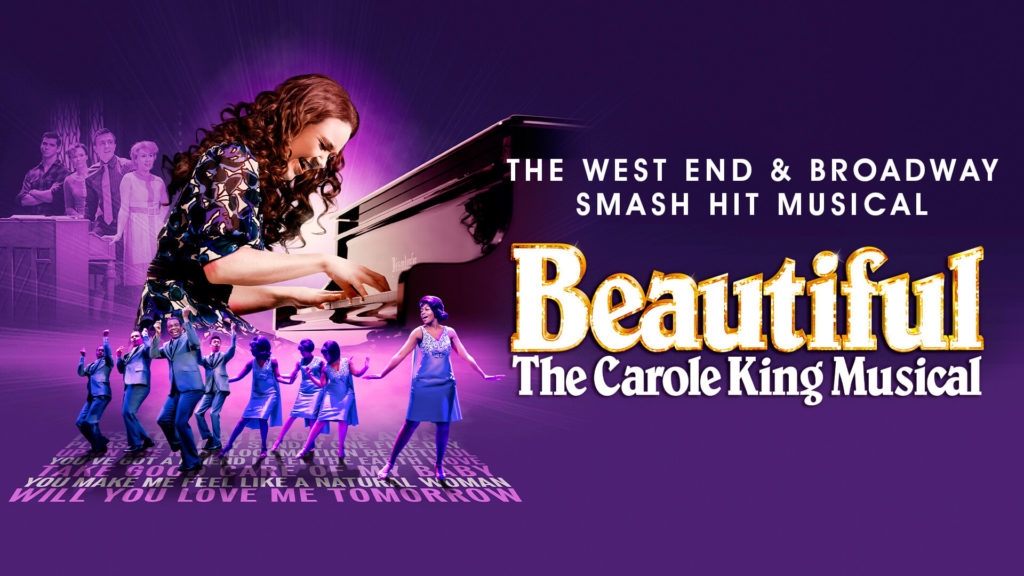
Review of ‘Beautiful’ – the Carole King Musical
at WMC
(1 / 5)
It is hard to overstate the talent and
importance of Carole King as a songwriter.
118 top fifty hits in the US gives some indication of the success she
has enjoyed, but doesn’t in itself demonstrate the quality of her writing or
its importance. Her first hit, written
with Gerry Goffin as lyricist, when she was just sixteen, ‘Will You Still Love
Me Tomorrow’ is astonishing in its quality, particularly for one so young and
from such a non-musical background.
Writing a string of hits for women and black artists, predominantly
though not exclusively, in the sixties and then the move to LA after finally
having enough of Goffin’s faithless behaviour, shows her incredible courage. The weeks recording ‘Tapestry’ – one of the
most successful albums of all time – next door to Joni Mitchell recording
‘Blue’ and Jackson Browne recording ‘Late For The Sky’ have gone into modern
musical folklore with some justification.
Carole King is essential and central in the rise of the
singer-songwriter. She is an essential
and wonderful part of the story of women’s voices being heard and
celebrated. She is a wonderful,
wonderful talent.
Given all this, a musical telling the story of
her early years, leading up to her legendary solo performance at Carnegie Hall,
should be a glorious and fascinating thing.
‘Beautiful’ certainly is not that.
What this is, unfortunately, is a cut and paste comic-book story homage
of the sort which might have been serialised in ‘Jackie’ in 1973. A sequence of incredibly short and trivial
scenes, fly in or slide in, at bewildering pace, with cardboard cut out
characters of managers and mothers and friends, who speak in ghastly and
trivial cliches before being whirled away to be replaced with more cliches on
the breakdown of married life from a cardboard Carole and Gerry, who seem to
have stumbled onstage from a black and white episode of ‘Bewitched’ circa 1968.
The songs and the dances which attend them are adequately
delivered at very best. These are
amazing and wonderfully memorable songs, loved by the audience, and, given the
budget of this kind of show and the talent pool available, should have been
superbly and innovatively choreographed, orchestrated and sung. However, on an expensive but deeply
unimaginative set, some very, very ordinary dance and movement did nothing to
enhance the songs or bring the stage to life.
There was nothing wrong with Daisy Wood-Davis,
Adam Gillian or Laura Baldwin in the lead roles. I quite liked Wood-Davis – she had an energy
and commitment which was pleasing and a decent voice. But it is hard to imagine what anyone could
have done with a script like this. When
you think of the issues Carole King’s story throws up around women, race, the
music industry, the sexual revolution, the inequalities marriage imposes etc –
this is a playwright’s goldmine, surely?
There was not a memorable line or genuinely
theatrical moment in the entire piece.
When Carole decides to leave New York to set off for LA as a performer
as well as songwriter, she sits at her piano and tells her friends that she is
‘saying goodbye with a song’ and sings them, ‘You’ve Got A Friend’ as they
circle her at the piano and join in.
There is a ghastly level of embarrassment to this smaltz.
Cards on the table, juke-box musicals are not
my favourite forms of entertainment and I wouldn’t dream of paying money to see
anything about Abba or Queen under any circumstances, but this is Carole King
and what an opportunity to tell explore her incredibly important story is
missed in this silly fluff-piece.
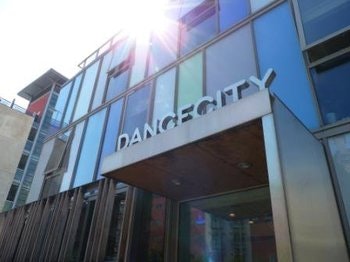
I had the pleasure of seeing KiN, performed by visiting dance company, National Dance Company Wales at Dance City, Newcastle upon Tyne, a couple of weeks ago. I really do love dance, and yet I don’t get many opportunities to see a performance. What I have seen has usually been reworked productions of well-known pieces. Think Swan Lake.
I was looking forward to seeing the work of a company that describes itself as a company which creates dance ‘With and for all kinds of people in all kinds of places’. A young, vibrant repertory company, whose aim is to innovate, make accessible and include.
The
current production on tour is KiN. This brings together three very different
dance performances, Rygbi:Yma/Here, 2067:Timeand Time and Time and Lunatic.
Here
I offer you a review of Rygbi.
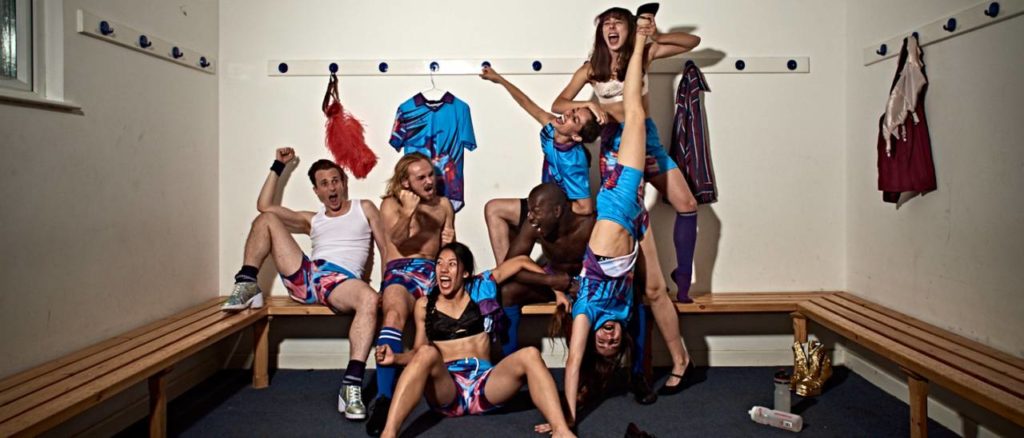
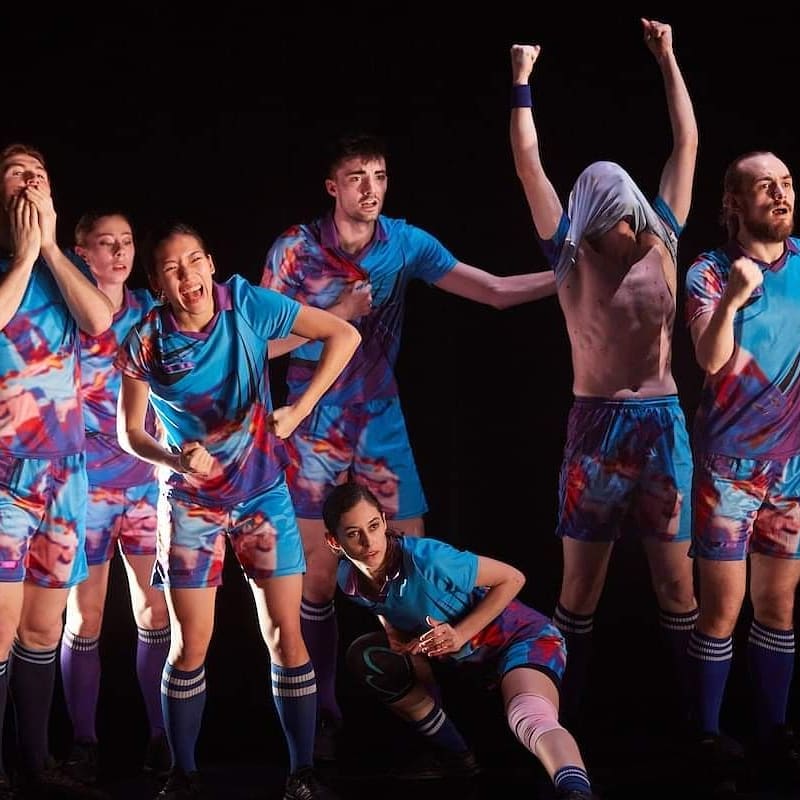
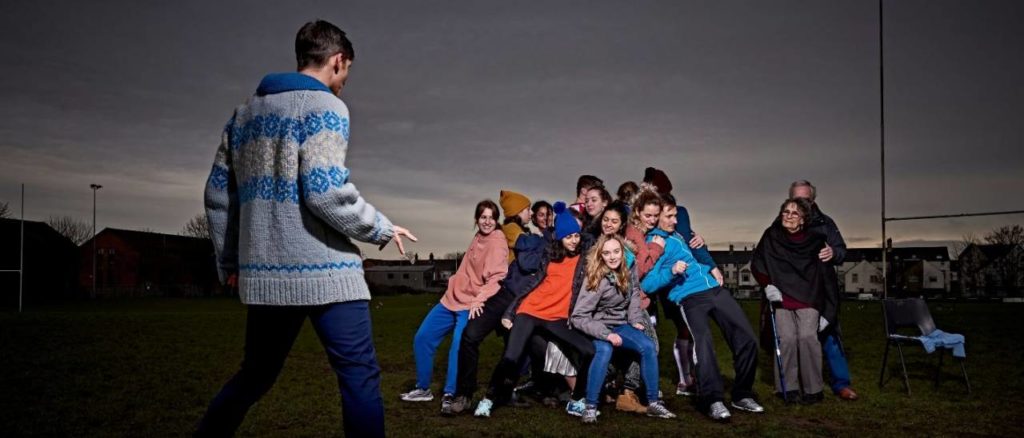
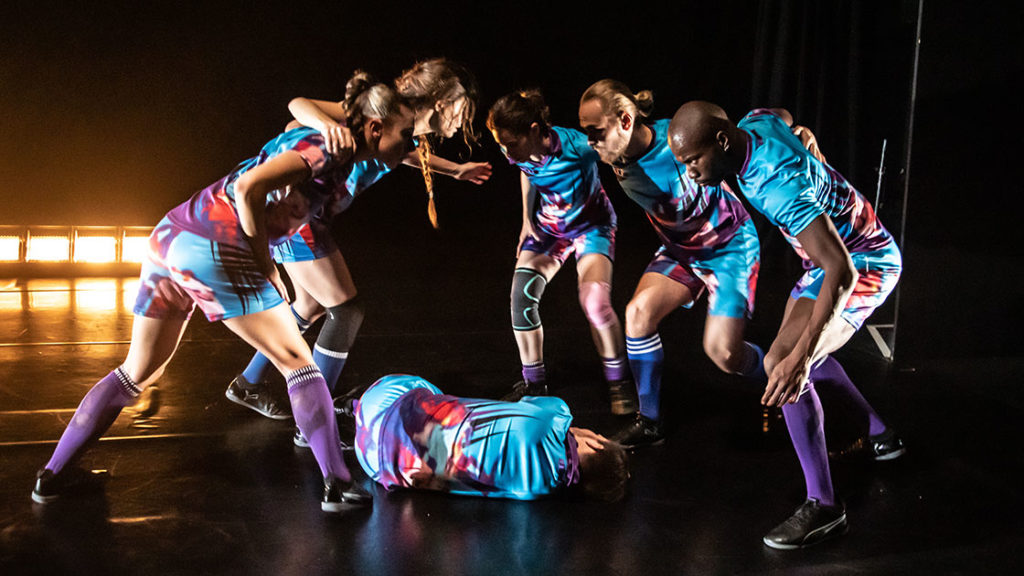
If a dance company is going to aim to be a company of the community then it makes sense it would devise a performance conjuring up Wales’ national sport. Choreographed by Fearghus O Conchuir along with the performers, music composed by Tic Ashfield, the intention of Rygbi, as we are told, is to express and celebrate the sense of ‘pride and passion’, ‘commitment and camaraderie’. This piece came together with the help of rugby players and fans.
The piece begins with an explosion of energy. From the very beginning there is a felt tension, an anticipation for the match ahead. As an audience we can’t help but be lifted by the fast-paced athleticism of the dancers moving together, representing the way in which a team does work in unison. Just as with a real rugby match though, the energy levels wax and wane, the action slows down or speeds up. There are times for composure and times for full on attack. The performance captures every nerve tingling moment. Every high, every disappointment, every resurgence is danced with true conviction.
I
enjoy watching rugby, which is probably why I was so interested in seeing this
piece. Watching this performance feels like I am experiencing a match in its
entirety. A first kick, a scrum, a conversion. The desperation to succeed is
etched on each and every face of the dancers. All play their part extremely
well, connecting as they do to the audience and taking it on the journey of one
game.
The
music is never intrusive but serves to enhance the constant roller-coaster.
I
can’t fault the performance. I can only sit back in awe at how this is
simultaneously experienced as dance, theatre and sport. The choreography, as
well devised as it is, works that magic.
I
find myself thinking that what I am seeing cannot be defined, it crosses
boundaries and has a way of connecting with anyone.
National Dance Company Wales say they want to make ‘dance for all kinds of people’ and with this they delivered.
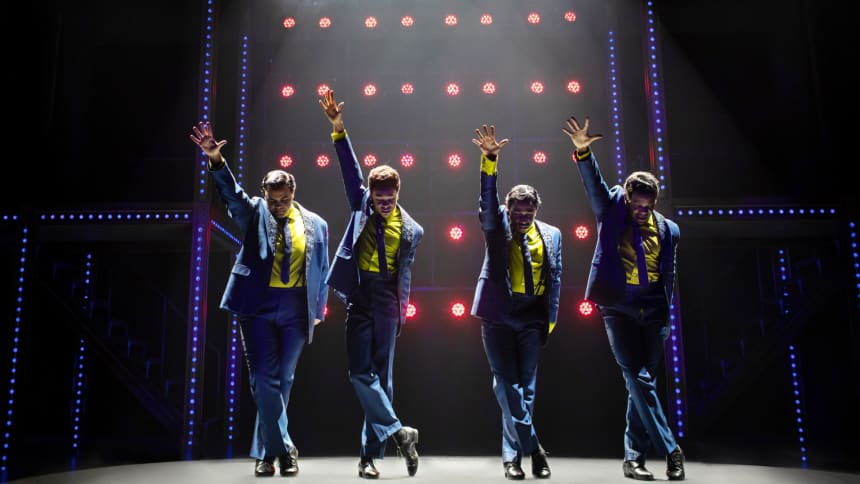
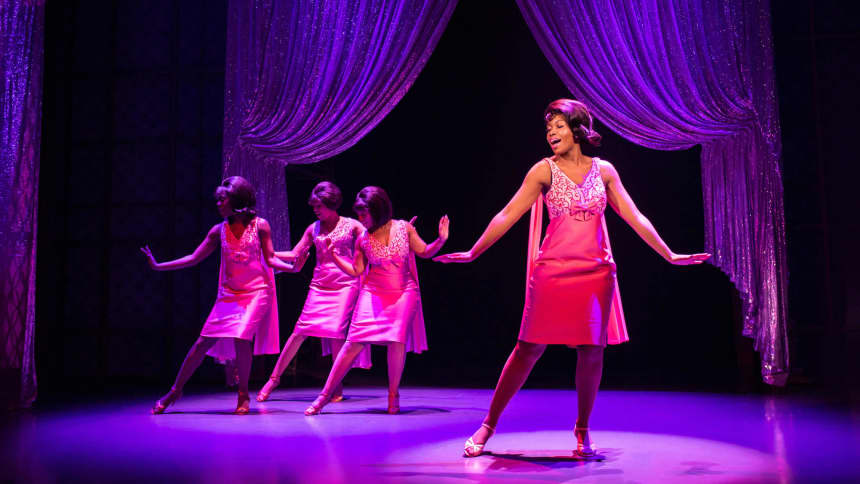
This is an enchanting show which is both pacey and entertaining. It follows the early life story of Carole King, an aspiring young American songwriter and musician who teamed up with her then partner and later husband, Gerry Goffin, moving to Manhattan to compose songs to sell to other artists in the 1960’s – some of the most evocative and iconic songs of their generation. The plot shows the struggles and frustrations facing the fledgeling composers and how they were controlled and ultimately manipulated by the dog eat dog nature of the music industry. We witness each song constructed in their purest form, before being transformed into full production numbers sung by various top chart artists and groups, from The Drifters and Aretha Franklin to James Taylor and The Shirelles and Neil Sedaka and King herself.
The audience were engrossed by the litany of hits which were performed most authentically, proceeding to sing along to the likes of ‘Locomotion’, ‘Natural Woman’, ‘Will you Still Love me Tomorrow’, ‘You’ve got a friend’ and ‘Take good care of my Baby’ to name but a few.
I particularly enjoyed the staging which
was very effective, without fuss and with efficient transitions. We
were transported from one location to another by way of an array of moving
rostra and backdrops creating the perfect mood and atmosphere for each scene.
Costumes were in keeping with the style, reminding us of the quirky, colourful
fashion of this heady creative period.
However, without doubt the main highlight was the music – the crisp, vibrant band arrangements by the eminent Steve Sidwell to the well known tunes and songs written by Carole King. The majority were sung with vigour and enthusiasm by a number of the talented ensemble cast.
The performances of the two main characters – Daisy Wood Davis as King and Adam Gillian as Goffin – were believable and emotional with lovely interaction. They were accompanied by many other actors who sang and danced and multi roled throughout the show providing a very compelling overall experience for the audience.
https://youtu.be/BUQ9F9M0Swg
I thoroughly enjoyed my evening with these 60s legends and it was very pleasing to see the Donald Gordon Theatre full and bopping to the hits. If you are around, check it out – I’m certain you won’t be disappointed. You’ll no doubt feel the earth move and you won’t want to get out of this place!! The production is in Cardiff until March the 14th before resuming their UK tour.
This is a BSL video review. You can read a written version of the review by Chris below.
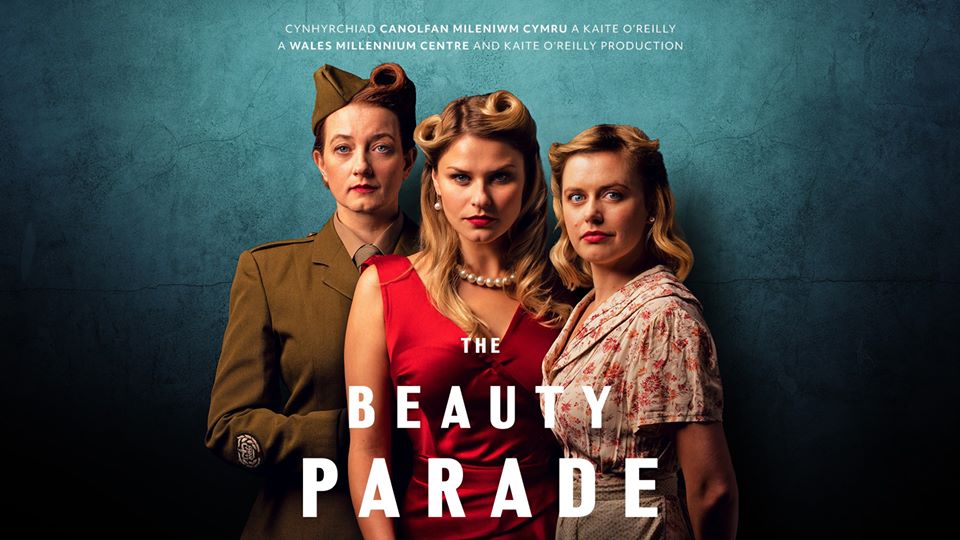
Hello my name is Chris Coles, I went to the WMC to watch Beauty Parade. The play itself was about three woman who were spies in World War Two. It showed what life was like being spies, that they don’t live for long during the War, it was a max of 6 weeks if they were lucky.
The play itself was amazing showing the good relationship between deaf people and hearing people can work. Special effect, captions and music were brilliant and written well into this play. I recommend you see this play if you like period drama.
Heather a Deaf friend of Chris also attended, Heather said that it was great to see a Deaf actress in a mainstream production and she enjoyed the way the captions and effects were presented.
The Beauty Parade plays at The Wales Millenium Centre until the 14th of March.
(Please note this review contains detailed discussion of the play’s plot) Based on the hugely popular novel by Khaled Hosseini, The Kite Runner, adapted for the stage by Matthew Spangler, had a lot to prove. Despite enjoying two runs in the West End in 2016 and ’17, I wasn’t as enamoured with the piece as many other audience members. Having studied the novel at A-Level, the boldness of the story and the narrative poetry which I had loved, weren’t quite captured in the theatrical language of this adaptation. Though it still packs an emotional punch and features innovative staging ideas, overall the play felt a little slow and watered down.
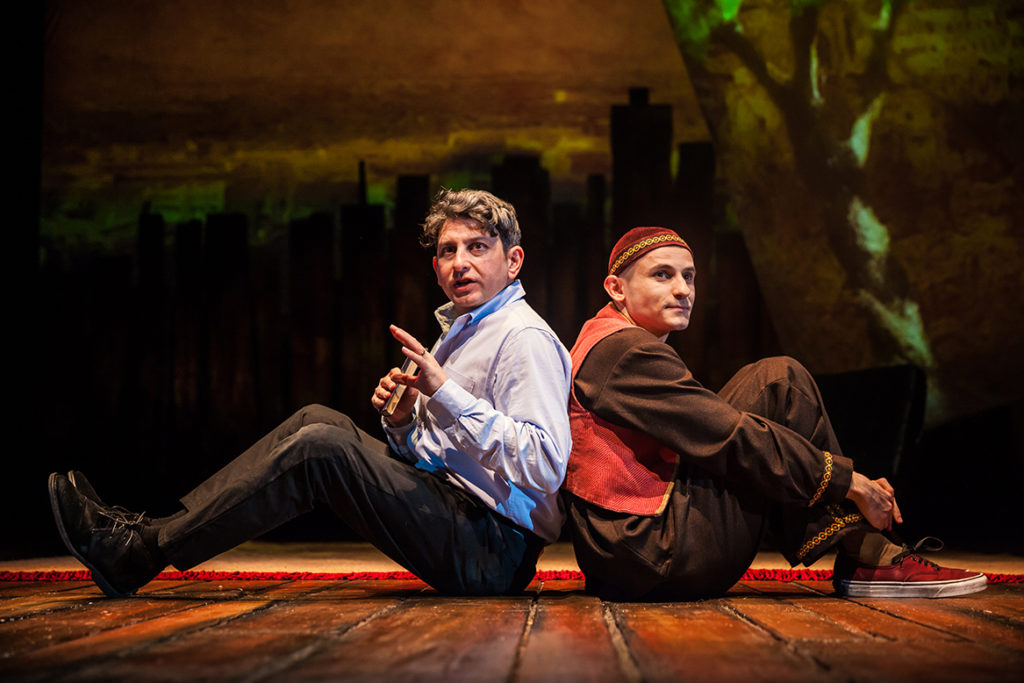
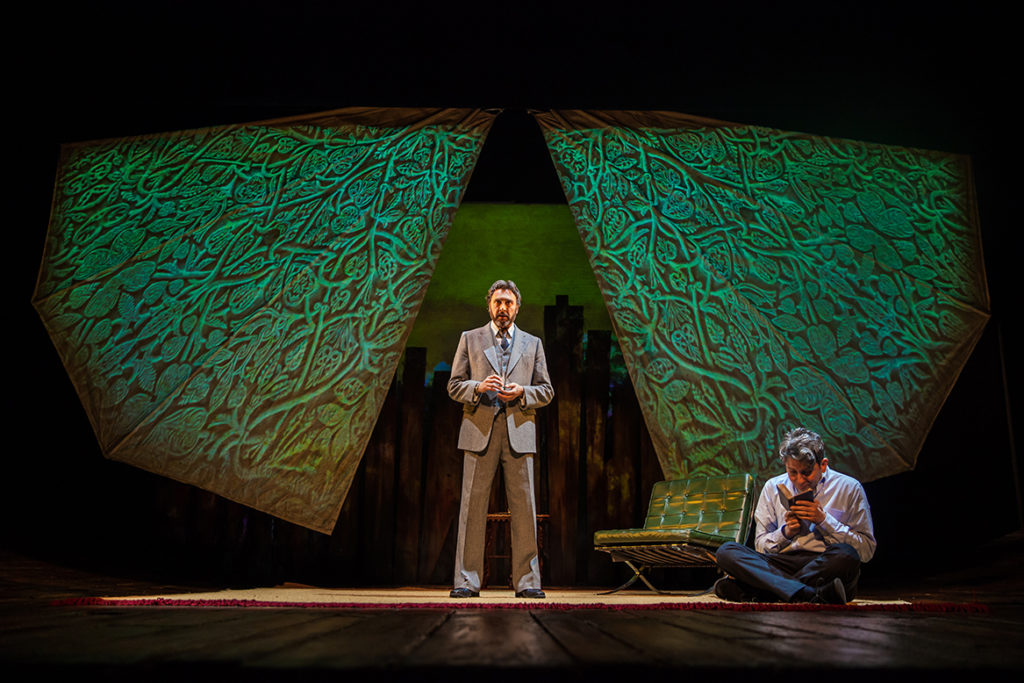
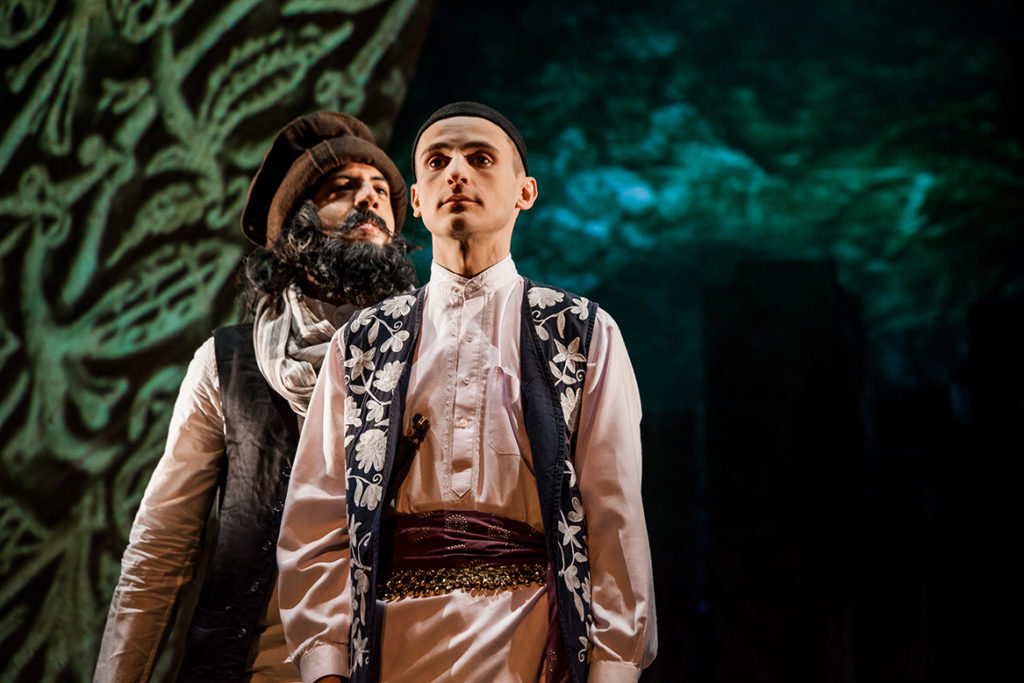
An unlikely friendship: Amir (David Ahmad) and Hassan (Andrei Costin). Image: Betty Laura Zapata
The story is narrated by Amir (David Ahmad) as a grown man, recounting his life in almost verbatim style, which, as a confessional story is a sensible choice but this sometimes takes away from the drama of the moment. Told in chronological order, the play begins with Amir’s childhood in Afghanistan where, as a wealthy Sunni Pashtun, he enjoyed a comfortable life and spent his days playing with his father’s servant, Hassan (Andrei Costin), ostracised for being a Hazara Shiite. On the fateful day of the kite tournament, Amir witnesses a horrific assault on his best friend, and his passivity haunts him decades later; when a phone call from an old friend comes out of the blue, Amir travels from his new home in California to Pakistan in an attempt to finally atone for his sins.
The whole production of this adaptation is minimally staged. The music is mostly provided by onstage tabla player, Hanif Khan, as well as Tibetan singing bowls used to create atmosphere. The live music is one of the play’s shining factors and it draws us into the world immediately.
https://youtu.be/qJtaNjoY5hQ
Barney George’s set is equally sparse: just a wooden floor which curves like a skateboard ramp and alternating patterns projected onto a central rug. The backdrop changes colour and is decked with mounted wooden posts to vaguely resemble city skylines, but neither adds much to the production. There are also two giant canvas kites which swing down to conceal scenes and characters, which are effective, and which also show us Amir’s childhood pomegranate tree and later, Hassan’s death, through William Simpson’s projection design.
Baba (Dean Rehman) and Amir (David Ahmad) on the minimal set. Image: Betty Laura Zapata
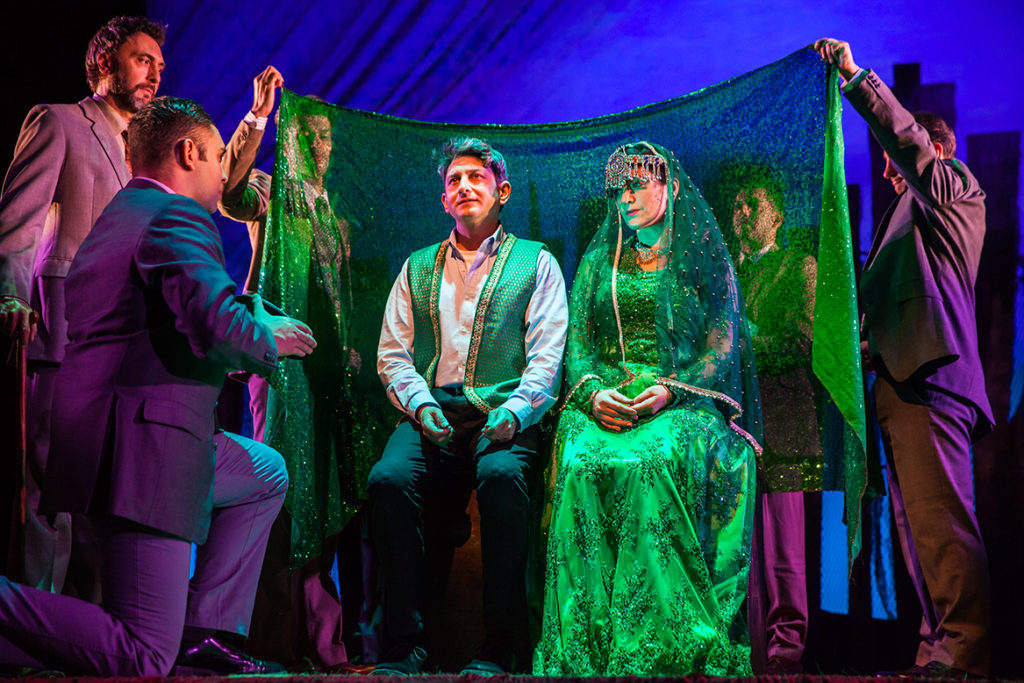
The sparseness of the stage works for the more distressing scenes where we only need to see characters and their expressions, but it makes the joyous ones like Amir and Soraya’s (Lisa Zahra) wedding feel a bit flat. Kitty Winter’s dancing is not quite lively enough to bring up the energy, nor is Charles Balfour’s lighting and Drew Baumohl’s sound really utilised to inject a party atmosphere either. This theme continues with the kite flying scene; there were only two tissue-paper kites, and they were clutched, not flown, in the hands of ensemble cast members, while Amir and Hassan’s kite was just mimed. The whole cast did do a good job of creating the tournament’s excitable tone and the use of several large, wooden Schwirrbögen, swung to create the sound of the wind, was very effective, but I wanted more kites – whether projected, or suspended in the auditorium. Now I wasn’t expecting a Mary Poppins moment, but I had hoped for much more of a spectacle for the novel’s most iconic scene.
The wedding of Amir (David Ahmad) and Soraya (Lisa Zahra). Image: Betty Laura Zapata.
The performances are strong, with David Ahmad bearing most of the weight as the central character who almost never leaves the stage; he does a great job of capturing Amir’s selfish, self-pitying persona and is given plenty of fodder to do it with routinely interjected monologues. Andrei Costin is well cast as the faithful lamb Hassan, and he brings real pathos with Sorab; having Costin play both characters is a clever yet logical choice on director Giles Croft’s part, fitting in with the idea that father and son share an unmistakable resemblance. The decision to represent the characters as children through adopting somewhat whiny children’s voices, however, is a bit of a misstep, sounding inauthentic and becoming a little grating. Child-like physically (which Costin and Ahmad already perform well), coupled with simply speaking with an Afghan accent would have sufficed, and would still have contrasted with adult, American-accented Amir; Hassan’s voice need not contrast anyway as we never see him grow into a man. Dean Rehman is also great at grounding the piece as Amir’s father, Baba, bringing a nuance to the role with both power and sensitivity.
The most harrowing moments such as Assef’s assault on Hassan and Sorab’s attempted suicide are neatly hidden or dealt with offstage but still manage to evoke a few audible gasps and genuine sniffling from the audience. The subject matter is difficult enough that visual representation is not needed but I did want Sorab’s dancing scene to be more poignant. In the book, it’s an exploitative and sinister moment where Amir realises the suffering of Hassan has multiplied in his son, and is the catalyst for Amir finally fighting for someone other than himself. In the same vein, author Hosseini’s Assef is more sadistic – leering yet captivating – but Bhavin Bhatt plays him with a gravelly voice which makes him almost a caricature. Despite his strong portrayal as the teenage bully, Bhatt doesn’t quite manage to evolve the character convincingly into the wild, paedophilic fanatic. The fighting (directed by Philip D’Orléans), even with a knuckleduster in the mix, is also a bit lacklustre.
There is one incredibly emotional scene in the hospital however, where Amir prays for Sorab’s recovery on a prayer mat made by a rectangle of light, and where Ahmad gives a tear-jerking performance of desperation. There’s also a touching point at the end where Amir finally stands up to Soraya‘s racist father (Ian Abeysekera) and shows Sorab how to fly a kite, causing a flicker of a smile on the boy’s face. Amir asks Sorab if he would like him to run to capture the kite they have won together and Sorab nods; Amir tells him, ‘For you, a thousand times over’ – a moving and cyclical moment of atonement which I feel should have been the final line.
The Kite Runner is a faithful adaptation with a hard-working ensemble cast and great use of use music, but it’s a little bland and lacks the vitality of its original medium. It is well-crafted and unspools nicely over its 130 minutes, but never fully takes off and gives us the spectacle we need.
The Kite Runner continues its UK-wide tour until 4th July.
After the fairytale grotesque of Series 1, writer Carys Lewis has done a far better job than her predecessors Mark Andrew and Ed Talfan, with this second slice of Snowdonian Scandi-Noir.
The cinematography and direction, which was accomplished and stylish in the first outing, is now established, highly honed, consistent and heavy with painterly symbolism. The police characters and their families are becoming more familiar and a depth is being added to the character of DI Cadi John, played with gruelling conviction by Sian Rees-Williams. The other recurring characters have been downgraded to background figures for the most part, only interesting as they interact with Cadi John and provide foils for her story.
The bleakness mist-ridden and unremitting; a pallet of every shade of grey and blue grey and ink is smeared with heavy cloud and drizzle. Every interior is chaotic – oozing poverty and misery with its browns and umbers and filthy, greasy greens. No-one smiles unless it is ironic or through gritted teeth.
The building blocks of misery are familiar ones: poverty, family death and other tragedy, loss of reputation, illness and disfigurement, drug abuse and sexual abuse are all rife in these dark and exposed wildernesses around Snowdonia. But, after the awful cliches of Series 1, with its house in the woods peopled by a serial killer and his insane, grotesque mother, we now have something altogether more worthwhile. The plot takes a small group of dysfunctional and damaged youngsters and explores two of them with real depth and quality of writing, acting and directing. There is cliche here too but it is managed and gone beyond.
There is a wonderful sub-plot around a petrol station and shop with a father and daughter, wonderfully played in her case. The tenderness which develops between her and the ex-convict who helps out at the garage is beautifully written and realised.
The pace is slow – painfully slow and over-self conscious at times and there is perhaps too much focus on style and the noir market; but, having said that, the acting throughout is excellent: Annes Elwy and Steffan Cennydd being outstanding and time and care has patiently shaped a very fine piece of original Welsh drama.
Kin, a triple bill of two
new works and one revival performed by National Dance Company Wales at Dance City,
Newcastle is deceptively simple and unspectacular but leaves a warm and deeply
satisfying feeling. Performed by a fine tuned and yet relaxed ensemble this is
beautiful dance with an underlying humanity.
National Dance Company Wales, based in the Wales Millennium Centre, Cardiff is a contemporary dance company in existence since 1983, first as Diversions and, since 2009 as the National Dance Company of Wales. Kin is the latest touring triple bill with works by the current Artistic Director Fearghus O’ Conchuir, Dussledorf based English choreographer Alexandra Waierstall and the late Nigel Charnock, co funder of internationally acclaimed DV8.
Rygbi, (Rugby in Welsh) the opening work is by Fearghus O Conchuir and is inspired by the, as the title suggests, game of rugby and is a fun, beautifully researched and choreographed piece. That choreographic detail even includes the slightly tight concentrated expressions of the players/dancers, who occasionally break out in victorious smiles. Physically both fluid and dynamic, with rhythmic, fast paced changes of direction and slow motion moments it’s an easily understood piece full of quirks and camaraderie.
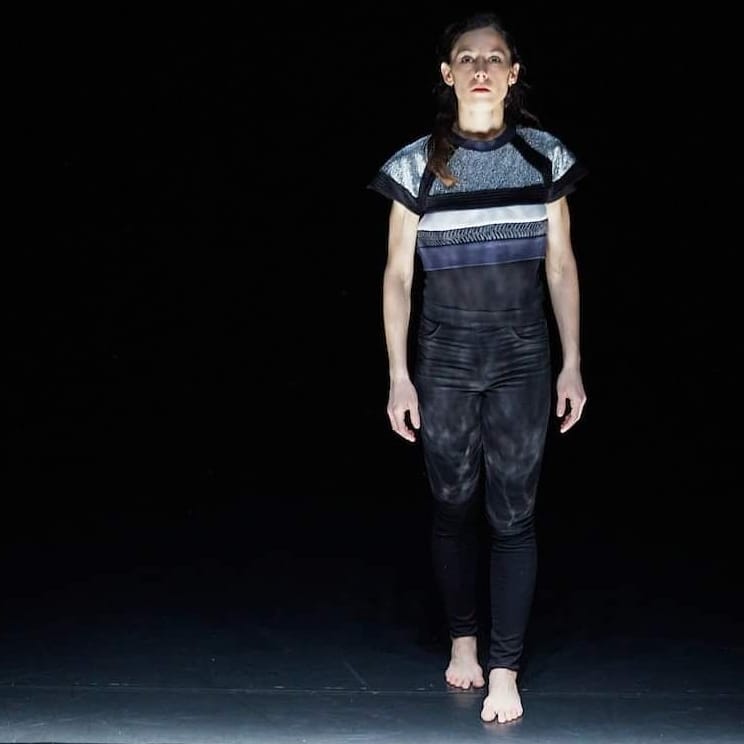
Next up 2067 Time and Time and Time is a much more meditative piece with structured improvisational movement, which though sensitively performed felt diffuse and sometimes obscure. Clearly created with great care and skill I was left wondering what the choreographer really intended even down to the compositional devices and use of props .
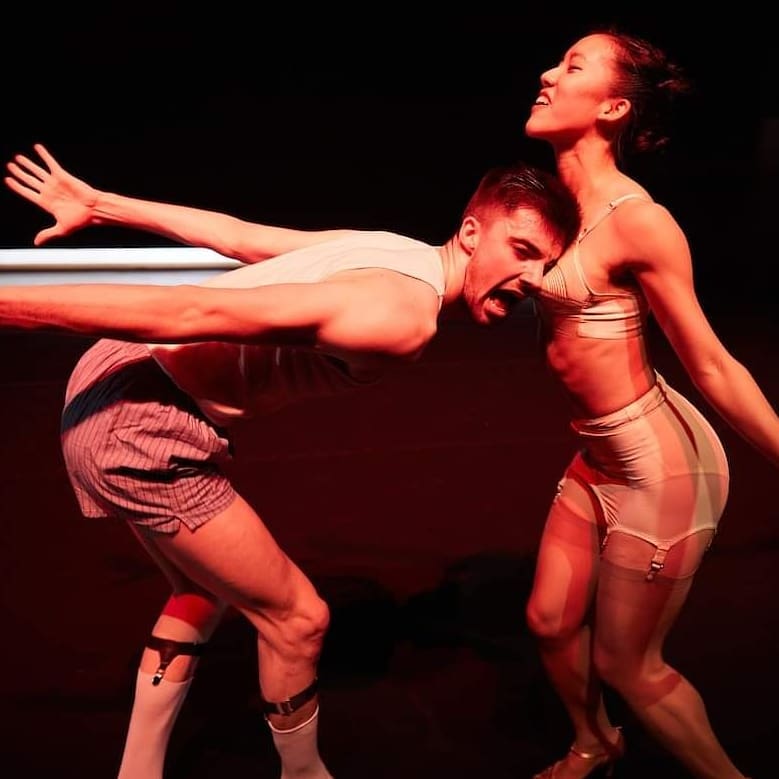
Lunatic by the late, great
Nigel Charnock known for his intense theatricality both as performer and
choreographer and important among LGBTQ artists, who tested new ways of
expressing their sexuality and their social situation was created in 2009. It
is expertly restaged by Jo Fong and feels uncanny in its’ relevance to today,
from the period style of the 1950s sequences through drag to joyously mad
ballet movement. A mix of dance and gesture filled with despair, madness and
joy using voice, props and costume changes to create a fantastic piece of choreography
which is highly relevant to today. It is also a test for the six dancers who perform
it with panache and humour.
“It is a kind of madness. All my work – to the public – doesn’t look chaotic, but mad. A little bit lunatic. People say, ‘I didn’t know what was going to happen next, what you were going to do next’.” Nigel Charnock interviewed by Emily Lambert, Wales Online 2009
The evening has a clear overarching theme of the group, how important we all are and how connected we are; there’s a sense of humanity and kindness. Superbly curated by Fearghus O’Conchuir it is contemporary dance that seeks to reach out without losing any integrity and it does.
Choreographer Alexandra Waierstall Composer Hauschka Costume Concept and Set Design Alexandra Waierstall Lighting Design Caty Olive Costume Design Brighde Penn
Lunatic
Choreographer Nigel Charnock Costume Design Shanti Freed Costume Make Brighde Penn Lighting Design Jackie Shemesh Costume Design Consultant Joseff Fletcher Restaging & Rehearsal Director Jo Fong. With thanks to the Nigel Charnock Estate
Creating opportunities for a diverse range of people to experience and respond to sport, arts, culture and live events. / Lleisiau amrywiol o Gymru yn ymateb i'r celfyddydau a digwyddiadau byw

 (5 / 5)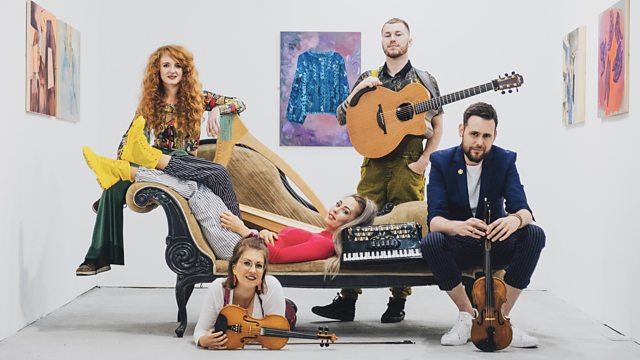

 (1 / 5)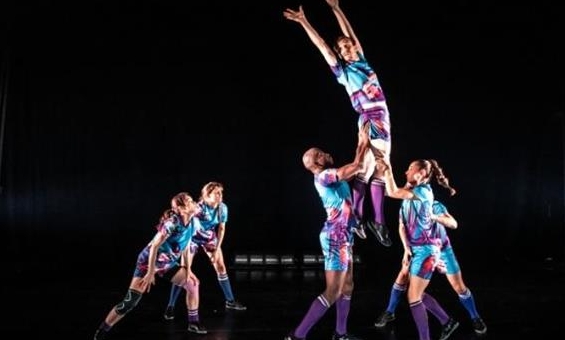
 (4 / 5)