
 (3 / 5)
Photo credit: Kings Place/Viktor Erik Emanuel
This wrap up gig for me in London saw an extensive week of opera and classical. I’ve heard new work and standards all in the space of same evenings. London really is a true cultural capital in many ways for arts and music. Not to be confused with the Manchester Collective, the Manchester Camerata are an other fine musical group who are proud of making music and getting it out there to people. Saying this, I was rather sad to see sways of seats, certainly in the first few rows near empty. Could audiences not handle the work to come?
An evening inspired by mental health would delve the depths of misery and lamentation. Judith Weir and their typically Scottish themed Blue Green Hill would start and set the tone for vision and brilliance. Errollyn Wallen took a snippet of Hamlet, in Ophelia’s famous mad scene. Both singer, Rebecca Hardwick and the instrumentalists shout and mirror each others outbursts. By Gis and by Saint Charity, the name of this piece is odd, perfect for tonight’s theme. A clever, brief companion piece to the 8 Songs that would follow. Wallen has written music with bizarre undertones and even delighted us as well. Schumann’s Kreisleriana, in an arrangement by Simon Parking, would end the first half and this position in the programme a loaded one. Schumann has such mental anguish we might say he had this or that by today’s standard. This take on the piano piece, gently alludes to these troubles, though is still extremely faithful. Light in nature and some moments not the most alluring, we did get a fine cello duet with Hannah Roberts and Ben Powell on piano, towards the finish.
One thing I did find annoying is the pocket programme when trying to write this review, constant flipping and flapping back and forth. No to this. Yet, the big guns of the night was Peter Maxwell Davies and his 8 Songs for a Mad King. An icon of the British Avant-Garde, there is so much that goes on in this swift thirty minutes. John Andrews as maestro is militant, keeping all the antics in check, are attentive circus leader for this. Company Chameleon teamed up with the Camerata to focus on the music yet still have the expected music theatre elements that are baked into the work (the musicians wore jumpsuits suits). But was it enough?
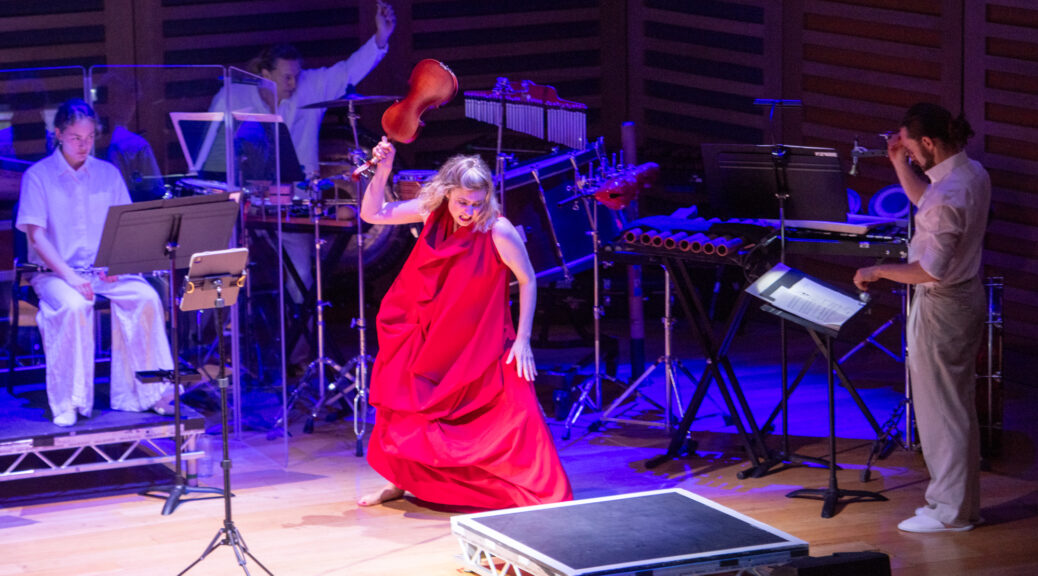
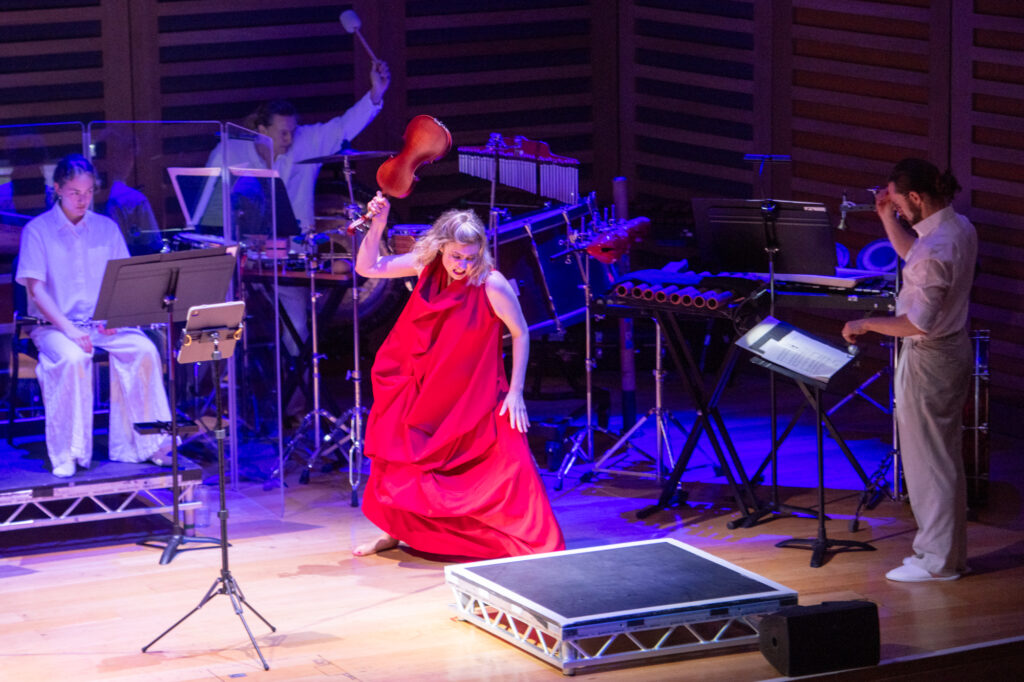
Mezzo Roșie Andrews (in a billowy red dress) might be a first for the role as King George here. We have seen many great men attack the role: Julius Eastman, Roy Hart (who premiered the piece) and Leigh Melrose to name but a few. There may not have been a clear intent to have this figure a king, yet I also doubt if this is even a queen either. The character’s lucidity comes and goes, as we hear shrieks, vocal fries, mutterings, neighs, bird song and rattles just in the voice. The sheet music is equally fascinating, one sheet famously made the bars resemble a bird cage, a theme there. The players are rather busy through out, percussionist Ben Powell has his work cut out for him. King George’s writings are the basis of the variable word-song play, his stranger moments where nothing made sense and a chasm emerged between himself, his family and his subjects.
Andrews has fun and also seem to grasp the role well. Yet I wonder if something was missing? Maybe it was the touches of staging you expect. Thinking down this experiment made me realise just how thrilling Barbara Hannigan would be in the role and perhaps…even Björk! There appears many more ideas could come about for this Mad King.