All posts by admin

Review You’ve Got Dragons, Taking Flight Theatre at Chapter, Cardiff by Nick Davies

If you’ve ever wondered what lurks beneath your bed, what clouds your brain when you’re asked a question in front of the whole class, or even what snaps at your heels when confronted with a physical challenge, then Taking Flight’s new show has the answer: Dragons.

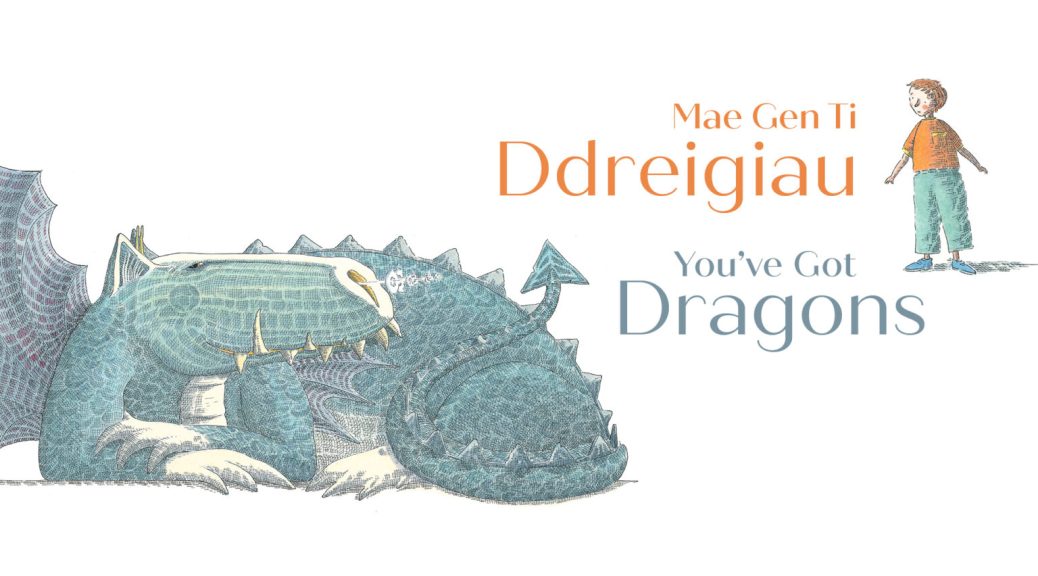
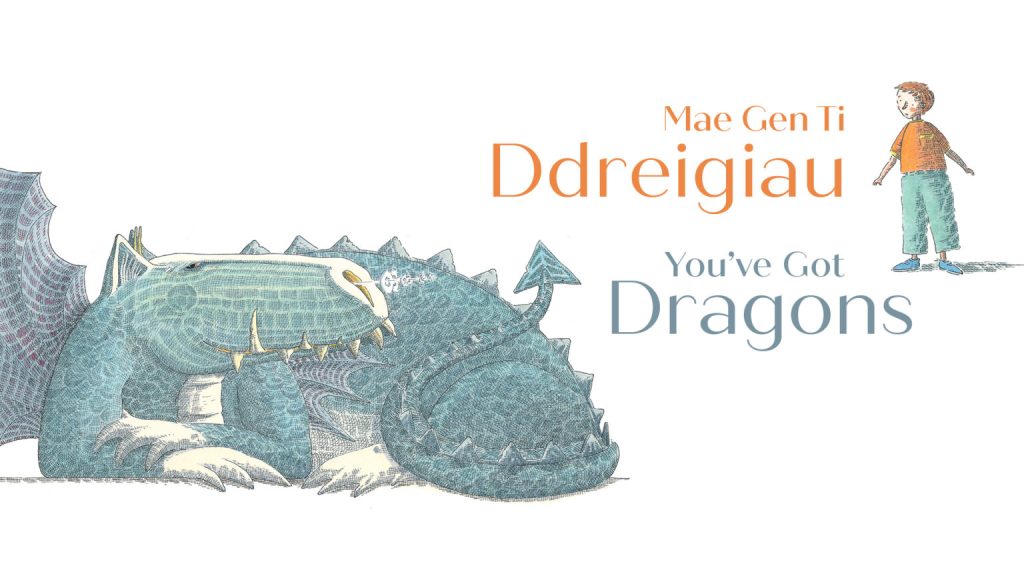
You’ve Got Dragons is a deeply imaginative play for primary-age children by Manon Steffan Ros, adapted from Kathryn Cave’s book. Directed by Elise Davison, the concept is as simple as it is brilliant – all the fears and anxieties that plague us in our everyday lives are actually dragons, stubbornly immoveable. But how do we learn to live with them?

Six young friends hang out in a cityscape of brick, iron and electric light – a superb set by Ruth Stringer gloriously lit by Garrin Clarke – that suggests the dangers, real and imagined, hanging over an uncertain world. Grace (Grace O’Brien) watches her friends scale a low roof, but a dragon on her shoulder holds her back from completing the climb herself. She’s terrified. Rather than berate her, Grace’s companions recall a story they’ve been told of Ben, a boy who has to learn to combat his metaphorical (we think) dragons as he navigates homelife and school.

This Brechtian play-within-a-play device allows the characters to explore their fears in a safe environment without prospect of recrimination. The tension may have been ramped up further had the perils happened to the characters first hand, but Taking Flight has clearly considered the target audience of younger children, some of whom would find this once-removed conceit more palatable.

Ben – played by two cast members, O’Brien and Amy Helena (the latter signing BSL throughout) – demonstrates that we can all get “a case of the dragons” often in situations that our peers might find quite normal. And this personalisation of fears is so often what makes them feel worse. The trick, they discover, is not to defeat your dragons, but to learn to accept them and recontextualise them. Ros’s script communicates this sophisticated metaphorical conflict with skill, pathos and humour, the messages remaining clear amid the magic and madness of the tale. This is a play packed with honesty, and about how opening up to our friends can minimise our anxieties.

Elise Davison’s staging is brimming with physical wit. The dragons’ appearances are at different times represented by silhouetted puppetry, prosthetics, flourishes of costume design and most cleverly by the movement of the ensemble themselves as well as the use of wire-cage gates to create the beast’s wings. It eschews cinematic effects, remaining joyously theatrical.

As ever, Taking Flight celebrates diversity in a way that is wholly truthful and unostentatious, normalising the inclusion of BSL and ensuring it remains an equal language in the text. The quiet impact this philosophy has on the company’s young audience is immeasurable and an absolute good. You’ve Got Dragons is much more than a brilliant example of inclusive art; it is a beautifully performed piece of theatre with which all of us can relate.

Performance reviewed: 17th July 2024

You’ve Got Dragons

Chapter, Cardiff

Adaptation: Manon Steffan Ros, from the book by Kathryn Cave

Director: Elise Davison

BSL and Participation Director: Stephanie Bailey-Scott

Composer and Sound Designer: Dan Lawrence

Set and Costume Designer: Ruth Stringer

Lighting Designer: Garrin Clarke

Creative Captions: Ben Glover

Producer: Ffion Glyn

Performers: Alex Nowak, Amy Helena, Catrin Mai Edwards, Eben James, Grace O’Brien, Gethin Roberts

Running time: 1 hour
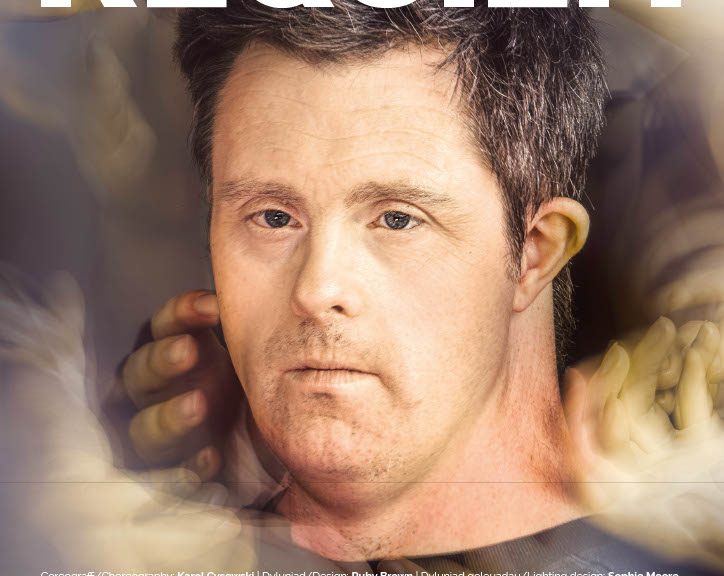
Review Karol Cysewski in association with Hijinx Theatre & Chapter presents: Requiem by Matt Gough

Requiem (Cysewski) Immerses us  labyrinth of hospital curtains (Brown), and a tinnitus-like soundscape of voices, tones, and reverberating melodies (Orgon). We are led through a constantly shifting space by six performers (Cicolani, Clark, Fedorovykh, Relf, Rust, Tadd) and dynamic lighting (Moore). The proximity of this promenade performance reminds us of our (in)action as we witness abstracted fragments of care, hope, and despair.  

Movement, and spoken words occur throughout the space, at times forcing us to make a choice of who, or what to observe. Do we leave someone alone without care? or follow caregivers as they navigate  the needs of others and themselves. 

The spoken text offers limited insights into the lived experiences of people with learning disabilities under NHS care. Instead we are invited to meditate on touch as a medium for communicating needs, and observe its failure to be understood  in tender, emotional vignettes. 

Requiem drifts between highlighting the general reduced life expectancy, and the impact of COVID of people with learning disabilities and/or autism. The lack of distinction serves the audience well, allowing us to reflect on our memories and experiences of COVID. 

Data on mortality rates is repeated throughout the performance, sometimes spoken aloud, other times whispered into individual audience members’ ears. Both publicly, and personally we are given no room to escape the information, and experiences being shared with us. Each moment is a requiem for those who have died, especially the lives that have been lost early, and avoidably (42%). 

Cysewski, and Harris  reference data from Learning from Lives and Deaths (LeDeR) in the performance text, and promotional materials. Whilst a knowledge of this research is not essential to understanding Requiem , it grounds the abstracted narrative in an ongoing call for action and change. But it is here that I question the decision to partially excise information on gender differences, and fully omit ethnicity differences from the performance text (and casting). A requiem for the disabled should honour the intersections of identities.

Outside of the Unity festival we see too little inclusive dance work from professional companies in Wales. I hope in the future we will see more, and performances that have disabled people in senior creative roles. 

Requiem

Chapter, Cardiff

5th July 2024

Choreographer: Karol Cysewski

Designer: Ruby Brown

Lighting Designer: Sophie Erin Moore

Sound Designer: Sion Orgon

Dramaturg / Additional Text: Simon Harris

Producer: Simon Harris

Performers: Gaia Cicolani, Gareth Clark, Kseniia Fedorovykh, Aaron Relf, Harlan Rust, Andrew Tadd

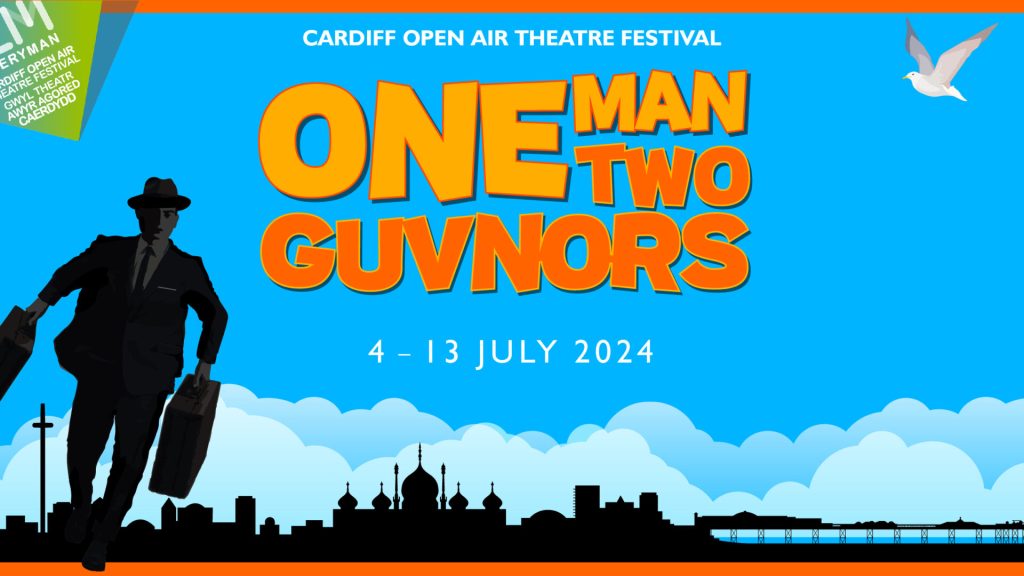
Review, One Man, Two Guvnors, Cardiff Open Air Theatre Festival by Bethan England

 out of 5 stars (4 / 5)

I had expected to be viewing this 1963 set comedia dell’arte in glorious sunshine…it is July after all! However, the Harlequin, Francis, and his motley crew had a typical wet Welsh summer to perform in…on the 5th July!

After weeks of General Election coverage, voting and exit polls, I was feeling in need of a few good belly laughs and I knew One Man, Two Guvnors by Richard Bean would not disappoint. The set was as colourful as the subject matter, not even dented by the constant downpour of rain that evening. The bright backdrop is versatile throughout, with a space reserved on the roof for some very catchy musical numbers!

One Man Two Guvnors is an adaptation of Servant of Two Masters, a comedy play, from 1746 by Carlo Goldoni. The exotic Italian location is replaced with 1963 Brighton, the Harlequin becomes an out of work skiffle player, the food he is constantly pining for becomes the haddock, chips and mushy peas served by the Cricketer’s Arms (a pub…that does food!). The plot is remarkably faithful to the original play; the woman in disguise as her murdered brother, the Harlequin bemoaning his empty stomach and the confusion that arises when he attempts (ill-advisedly) to take on and serve two masters, without one, or the other, discovering.

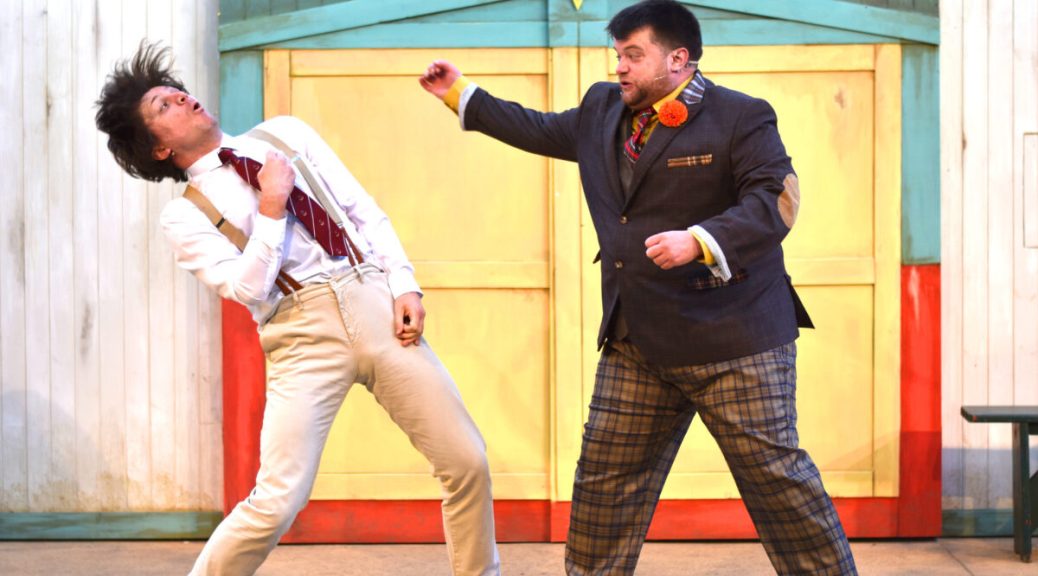
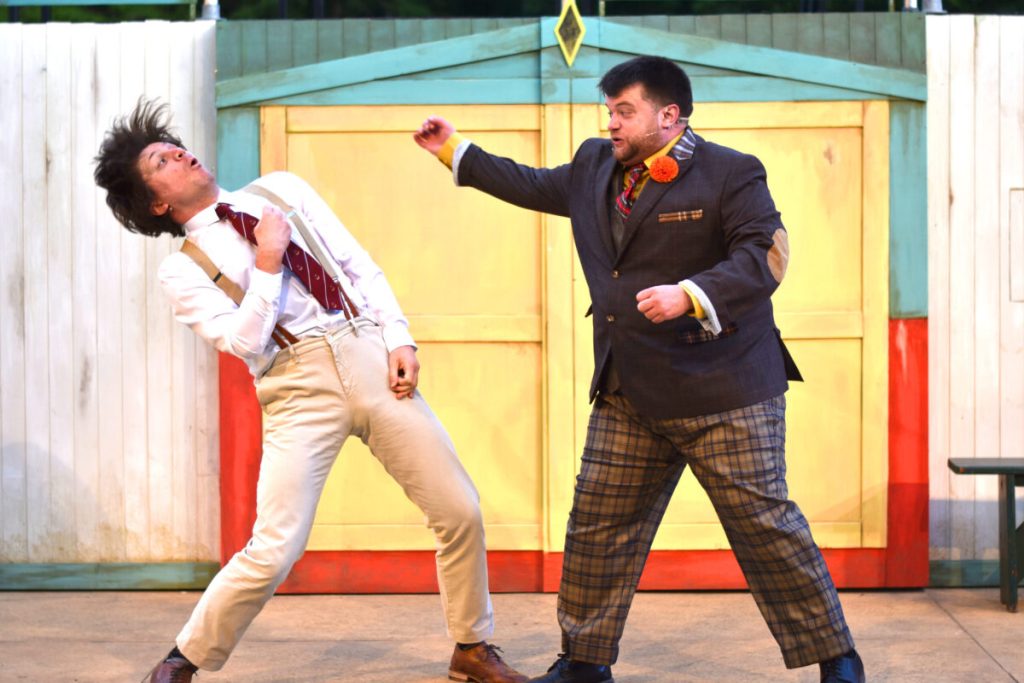
One Man Two Guvnors takes that storyline and slaps the action firmly in 1963. The script is smart; hilarious, pacey and full of puns and tongue twisters. The farce and physical humour elements are particularly strong, such as when Francis argues with, and manages to knock out, himself. I must say, I had huge admiration for the entire cast as they, clearly drenched and getting wetter by the minute, rolled around on the floor space, dived from railings, rode food trolleys and much more.

The action is ably directed and there is no stone left unturned in the pursuit of comedy. Simon H West, in his 24th year as a part of the festival, ensures that there is no let up of side splitting humour; whether it’s the clever use of his stage crew (a moving crew), interactions with the audience (such as the policeman handing out flyers to look for Rachel who ‘looks a bit like Ringo Starr’ in her mugshot), musical interludes which had me cackling and the sheer pace and delivery of the script, Simon has clearly ensured that every opportunity is utilised.

The cast are all brilliant in their roles and the casting is spot on. They’re clearly having an absolute ball performing this script, and the camaraderie and trust they have in one another is clear to see. The comedic chops are strong throughout, but particular mention must be made of the Harlequin himself, Francis Henshall, played by Matthew Preece. His physicality and timing are both excellent, as is his ability to ad lib and create new humour out of audience interactions. I must admit that, when Francis asked for a sandwich (a cry usually left unanswered) and somebody offered one, only for it to turn out to be hummus, I thought the audience would die laughing at Matthew’s lightning-fast responses and ability to turn the unexpected addition to his advantage.

The cast features fantastic performances from Bethan Maddocks as Rachel Crabbe who also had a beautiful singing voice, Joshua Ogle as the hilarious Stanley Stubbers (aka Dustin Pubsign) and Gregory Owens as Harry Dangle, the ‘no win, same fee’ lawyer. Brogan Rogers is Pauline who, cracked me up every time she proclaimed loudly, ‘I don’t understand!’ She is joined by Tom Price as Alan (Orlando) Dangle who played the ham to perfection, Toby Harris as hard-nosed but ultimately soft-hearted Charlie Clench and Jess Courtney as the ultimate feminist bookkeeper and love interest of Francis. Her proclamation about us one day having a female prime minister who would show compassion and love for the people certainly got some laughs! Completing the cast is Devante Fleming as Lloyd Boateng whose side glances at the audience as he mentioned ‘Parkhurst’ had us giggling away. The ensemble is also excellent, but Joan Hoctor as Elsie made my night. She had the whole audience spluttering with laughter and she stole every scene she was in, even if she just walked (slowly) across the stage pulling her shopping troller behind her.

All in all, I thoroughly enjoyed the new interpretation of this very funny play. The cast should be highly commended for their very well executed performances, even as the rain poured down around them. It proves that farce is still alive and well, whether it’s performed in the 18th or the 21st century! In these often doom and gloom times, it’s so lovely to leave a show with a huge smile on my face, that even the torrential downpour could not wash away.

Review ‘Romeo & Juliet’ Everyman Youth Theatre, Cardiff Open Air Theatre Festival by Georgia Bevan

 out of 5 stars (4 / 5)

Arguably William Shakespeare’s most timeless receives a twist from the Everyman Youth Theatre, and it’s another success from the always-strong ensemble. ‘Romeo & Juliet’ is well-crafted adaptation that brings out the undeniable talent in its young performers.

The show has some interesting technical ideas, despite its authentically Shakespearean dialogue, it frequently incorporates modern music into its storytelling. It’s all very ‘Romeo + Juliet’, the 1996 movie (which is absolutely fine by me), and it even has some of the same songs. The costuming has the actors all wearing these stained shirts, and almost all of them have something unique written on them. I did spend an inordinate amount of time while watching trying to read every shirt I could. Every character has their name written down, for the newcomers, and a thematically-relevant quote, which was actively rewarding for people like me who know the play well. It added a level of depth that was creatively executed. This applies to every character except for Romeo and Juliet themselves, their clothes are unstained by blood, they are pure. I appreciated the metaphor. The youth theatre productions always have some constraints to contend with, the stage itself is still set up for the festival’s ongoing production of ‘One Man Two Guvnors’, but I’m grateful for the little things like that which leaves it deftly directed, with a great level of immersion despite contrasting circumstances.

The two leads are especially convincing, Romeo (Sidney Evans) and Juliet (Gracie Booth) are totally dedicated to selling their star-crossed love with an impressive maturity. Another standout is Mercutio (Seb Rex), a hilarious scene-stealer. But the entire cast is ever-present and almost always on stage, letting every individual contribute to the overall feel. It is a true ensemble piece, giving every actor their time to shine. Additionally, the discipline and commitment of the children in this production added to its high quality, making for a complete experience well on-par with any older-age equivalent.

The high standard set by this production is nothing less than inspiring, director Sarah Bawler clearly understands the original play and, with the talented performers in tow, turns the popular play into a seamless performance that is efficient in its simplicity and impressive in its quality. The good work of the Everyman Youth Theatre pays off in another fantastic production.

‘Romeo & Juliet’ is at the Cardiff Open Air Theatre Festival, July 7th & July 21st.

Review Cardiff Open Air Theatre Festival ‘One Man Two Guvnors’ by Georgia Bevan

 out of 5 stars (4 / 5)

The Cardiff Open Air Theatre festival’s next show, ‘One Man Two Guvnors’, has arrived, and it’s obvious from the opening night that this comedy is going to be another great hit.

The play follows Francis Henshall (Matthew Preece), a man with, well, two ‘guvnors’. The simple idea of a man working two jobs leads to both expected and unexpected shenanigans. The original West End show starred James Corden, and the character has some obvious Corden-isms that can be a little draining at times, but Preece does very well to elevate himself from some of the constraints of that character. Some of the show’s funniest moments came from his improvised banter with the audience. With that, and elements of heavy audience participation, which ends up being very comedically well-implemented, every performance of this show entirely unique.

The rest of the cast with an eclectic bunch, with all sorts of different hilarious personalities. There’s Dolly (Jess Courtney), who brings some great humour with her feminist attitude, and Alan (Tom Price), a Hamlet-lite character who is deeply entertaining. The standouts are the two ‘guvnors’, Roscoe (Rachel Crabbe), who is not who they appear to be, and the borderline-murderous Stanley (Joshua Ogle), who are hilarious apart and especially together. The latter engages in some of show’s best physical comedy- which the whole show has in well-executed droves- and has some absolutely priceless exclamations that really stand out in my mind. I do hope that he says “oopsie-diddly-die-doe” every night.

On a technical level, the staging has a level of unexpected depth, folding out to create different rooms. Every part of the stage is milked for all the comedy it’s worth, the top being used for musical performances, the area behind the on-stage doors to make imaginary rooms, and even the railing along the top of the stage for Stanley to throw himself off of later. There are also a great deal of set-dressings and props, and in order to make time for the scene changes to have their details carefully placed, the show patches in song and dance numbers during the transitions. Their variance keeps things fresh, so there’s never a dull moment.

As a result, ‘One Man Two Guvnors’ is a hilarious time, especially with the older viewers, the audience around me was practically rolling in their seats. Everyman Theatre’s take on the hit West End hit was a home run with the audience here at the Cardiff Open Air Theatre Festival, and another real crowd-pleaser.

‘One Man Two Guvnors’ is at the Cardiff Open Air Theatre Festival, July 5th – July 13th.

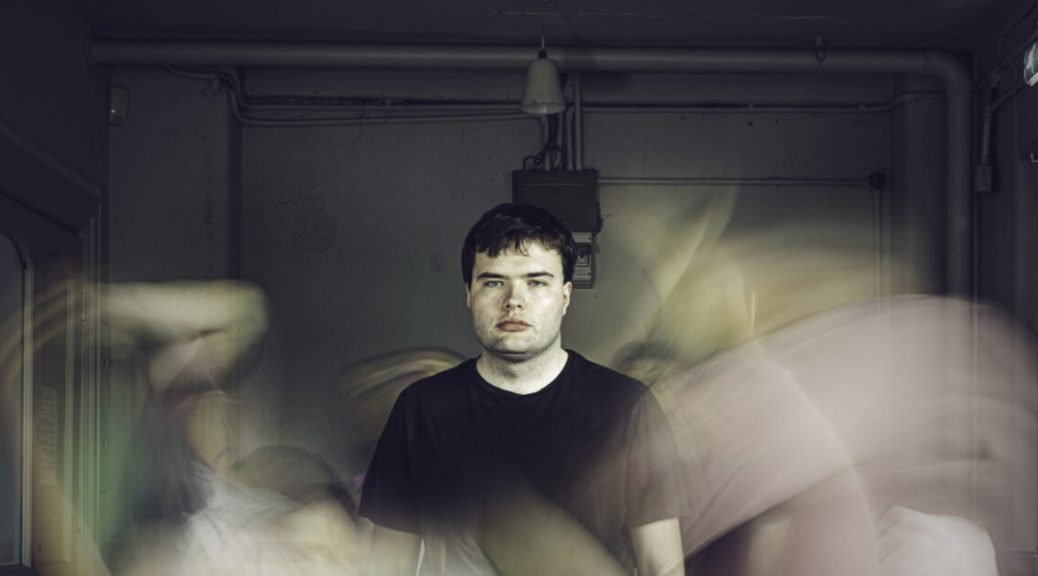
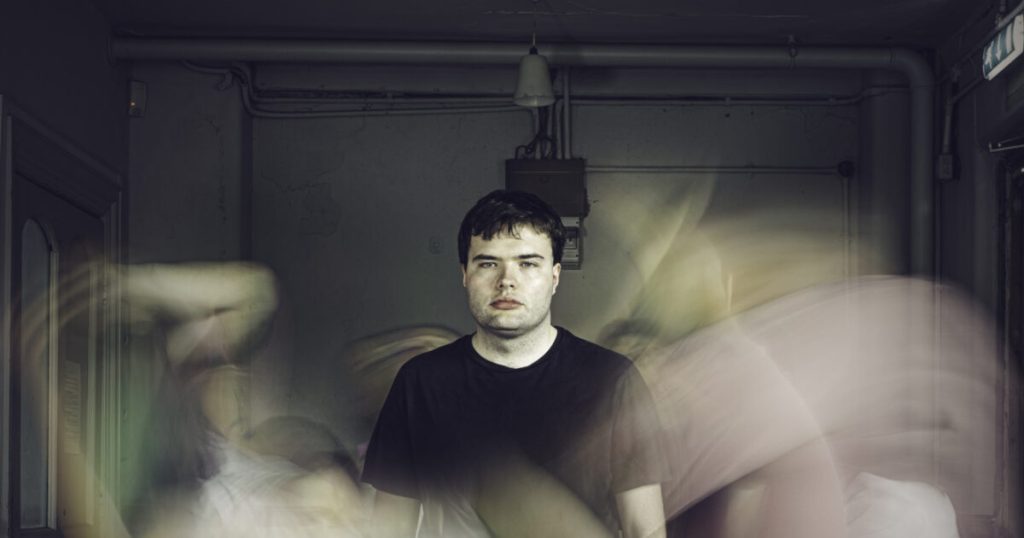
Review Requiem at Chapter, Cardiff, Karol Cysewski, in association with Hijinx Theatre and Chapter by Nick Davies

Life expectancy for a neurodivergent person in Britain is anything between 14 and 18 years shorter than the rest of the population. This issue was further exacerbated by Covid when risk of death was more than three times greater for disabled people. Choreographer Karol Cysewski explores this startling inequality in our health system with three neurodivergent performers and three dancers. The resulting work, Requiem, is a meditative, almost spiritual lament for those lost, and yet it retains a hopefulness, a stirring refusal to give in, that inspires and provokes.

Chapter is a contemporary arts centre at the heart of its Cardiff community – performers Clark, Tadd and Relf attend the Hijinx Academy there each week – and yet it was carved out of the remnants of a turn-of-the-twentieth-century school. From the beginning of Requiem it again becomes an institution from the Victorian age – cracked red brick and bath tile walls harking to an outdated hospital system in need of change. As we enter the foyer, we see trails of fingers running along wire-enforced windowpanes – behind the glass, bedecked in white, there are ghosts, demons, possibly angels. Cicolani, Fedorvykh and Rust lead us further inside the main promenade space.

Ruby Brown’s design – a maze of hospital curtains – is a dark fever dream of a set, lit cinematically by Sophie Erin Moore. It is nightmarish, all rails and cloth and upturned beds. It tells of a labyrinthine system impossible to navigate. It is easy to become lost, disoriented, in the half-lit space.

Requiem is a series of vignettes played out in these small, curtained voids. Gareth Clark, Andrew Tadd and Aaron Relf contend with the dancers for attention, for their voices to be heard. Much of this communication is physical, Cysewski’s choreography pushing and pulling them against and among the dancers in white. Cicolani, Fedorovykh and Rust are at times grim reaper, at times healthcare workers desperately trying to work out how to help their patients. An especially poignant moment is when Harlan Rust’s doctor frustratedly asks Andrew Tadd how he expects to be helped if he can’t say what’s wrong with him. It is a small moment that speaks volumes of the dangers faced by people with communication barriers, and the lack of time and resources afforded NHS staff. Although a dance piece, Requiem may have benefitted from more of these verbal exchanges. Aaron Relf’s Shakespeare soliloquy as he is pulled further into the darkness is deeply moving, even chilling, forming the words as if an almost silent prayer. Gareth Clark simply saying, “I want to live,” reminds us that the threat to our neurodivergent community within the healthcare system is not just a shameful statistic but a very pertinent, heartbreaking threat to each individual.

For all the horror (an especially resonant image is a patient being grabbed by disembodied limbs emerging from under his bed) Cysewski’s choreography, backed magnificently by Sion Orgon’s ecclesiastical soundscape, is wonderfully meditative, allowing the audience to process the difficult truths with which they are confronted. When all six performers conjoin and glide around one another there are moments of genuine beauty and joy amidst the madness. And in the performances of Clark, Relf and Tadd there are moments of real, raging defiance.

Requiem
Chapter, Cardiff
4th-6th July 2024 at Chapter, Cardiff
Choreographer: Karol Cysewski
Designer: Ruby Brown
Lighting Designer: Sophie Erin Moore
Sound Designer: Sion Orgon
Dramaturg / Additional Text: Simon Harris
Producer: Simon Harris
Performers: Gaia Cicolani, Gareth Clark, Kseniia Fedorovykh, Aaron Relf, Harlan Rust, Andrew Tadd
Running time: 1 hour

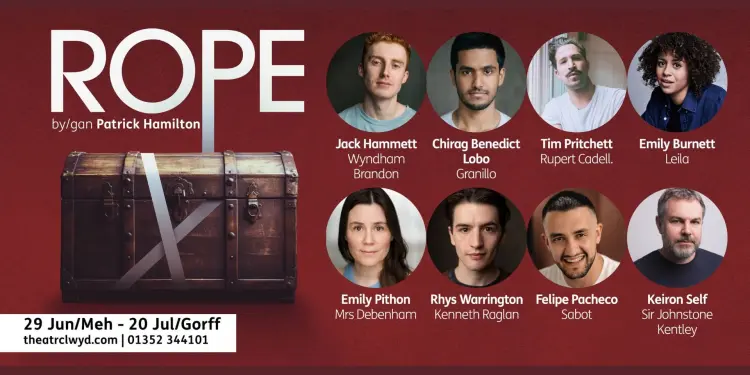
Review Rope, Theatr Clwyd by Donna Williams

 out of 5 stars (5 / 5)

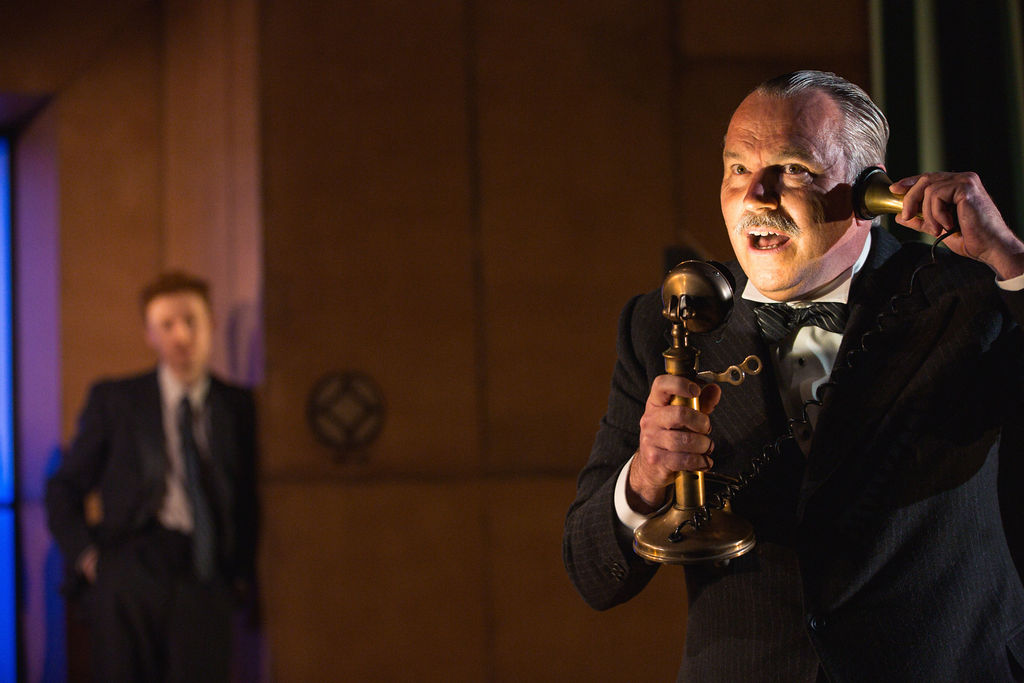
There’s nothing like a good murder mystery to inspire the senses and get the cogs whirring as to whodunnit. Yet, with Rope we are aware from the outset of the identity of the victim as well as knowing who the guilty parties are. The question is, will they get away with it?

Rope is said to be inspired by a real-life crime: the murder of 14-year-old Bobby Franks in 1924 by University of Chicago students Nathan Leopold and Richard Loeb. Written by playwright Patrick Hamilton in 1929, also the year in which the piece is set, this intense, dark comic drama is one that deals with death, power, superiority, and jealousy.

In 1948, Alfred Hitchcock’s film version was released, although several changes were made to the original play- the setting relocated to New York City and various character names and traits altered. It was the first of Hitchcock’s technicolour films but unfortunately it failed to succeed at the box office; with Chicago Tribune‘s Mae Tinee stating ‘if Mr. Hitchcock’s purpose in producing this macabre tale of murder was to shock and horrify, he has succeeded all too well. The opening scene is sickeningly graphic, establishing a feeling of revulsion which seldom left me during the entire film’- not a tactic this cast and creative team needed to rely on.

For anyone interested, there is also a 1983 BBC Radio 4 dramatisation of the play starring Alan Rickman as Rupert Cadell.

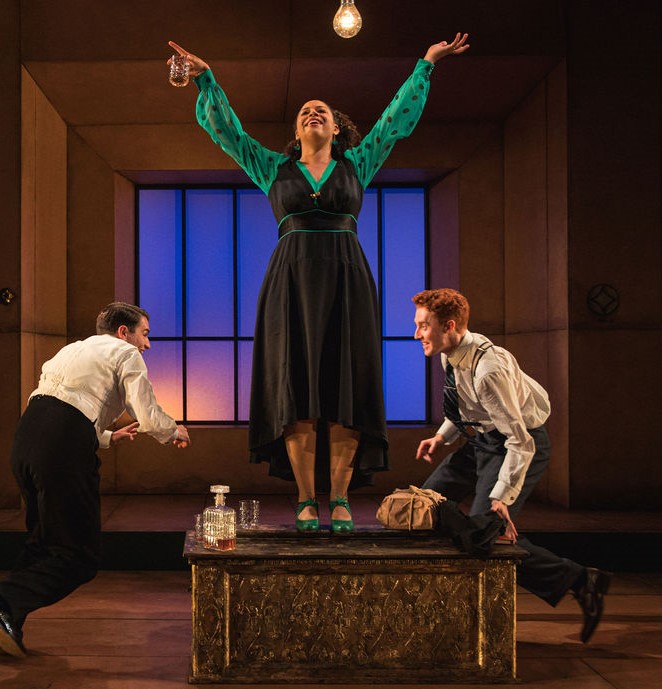
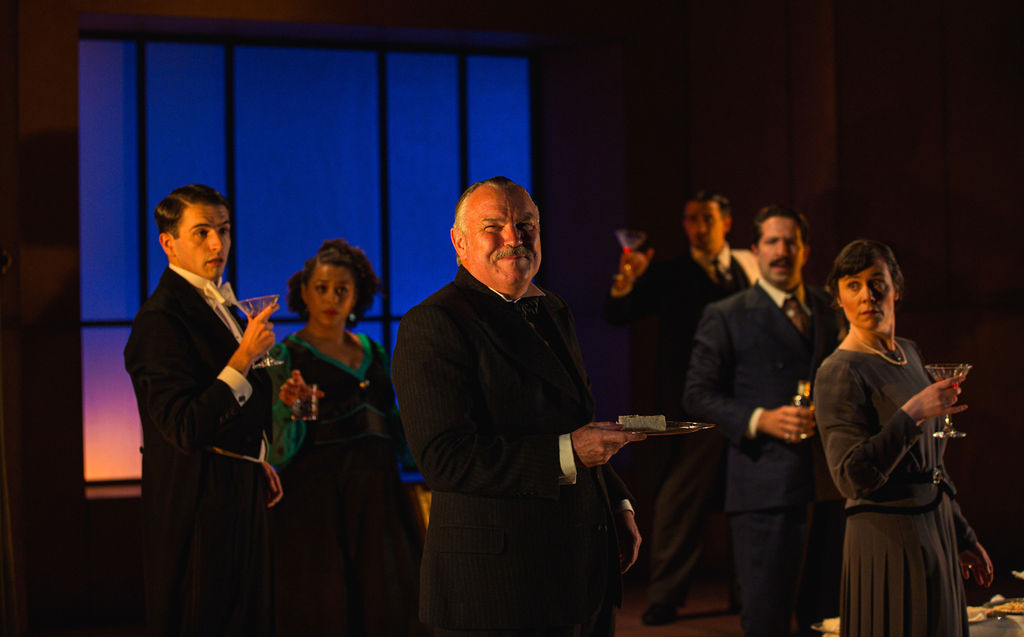
Set on the first floor of a London house, two young men have murdered a fellow student, merely for ‘adventure,’ and they have hidden the body in a large chest. In a macabre turn, they host a party for the victim’s oblivious family, utilising said chest as a buffet table! We arrive to an open set- a simple set with large French windows (perhaps to the soul?!), a non-descript chest in the centre and a single light bulb dangling from the roof. We know the action is about to begin when the light bulb flickers and we are plunged into darkness. The lighting in this production is a character in itself- a constant play between light and dark, not only physically (through the use of matches, stage lights, lanterns and much more besides) but also in its qualities and dialogue. We see the growing madness of Granillo, racked with fear and guilt, juxtaposed with the calm, sadistic exterior of Brandon, as well as the genius comic timing and nature of Sabot, the butler, who seems to be the welcome lightness- with his witty banter and wonderful physical presence..

(Photo credits: Andrew AB)

Physical theatre lends itself perfectly to this production and is employed brilliantly- not only for individual characters and in varying other forms, but, most impressively, to imply the passage of time as the guests make their way around the chest, picking their chosen nibbles, pouring their drinks etc. You could be led to believe that these sections are cleverly improvised but we know they are choreographed to the inch- staging of the highest quality!

Another interesting addition to the staging is the era-appropriate speakeasy style tables and chairs and a piano, placed on the floor either side of the stage where our characters watch the action unfold. During the 1920s, radio also emerged as a cornerstone of entertainment and communication, so in keeping with this idea, we are offered radio-esque announcements which introduce us to each character as they appear for the first time. This not only adds to the atmosphere of the piece but clarifies characters and context for the audience.

The piece is cast perfectly, each performer faultless in their delivery. The dialogue is gripping, despite its age and the aesthetics leave us wanting more. The ‘rope’ is an emblem for everything that this play is about- the physical portion of rope the light bulb swings from and that which is used to kill its victim, the question of how much ‘rope’ will the guilty be given as time ticks by and the thought of the rope which may eventually be used to hang our perpetrators should they be found out.

An innovative, captivating, and timeless performance. Rope is theatre at its most alluring and everyone should see it!

Rope completes its run at Theatr Clwyd on July 20th.

Rope | Theatr Clwyd

Cast:

Jack Hammett: Wyndham Brandon

Chirag Benedict Lobo: Granillo

Felipe Pacheco: Sabot

Rhys Warrington: Kenneth Raglan

Emily Burnett: Leila

Keiron Self: Sir Johnstone Kentley

Emily Pithon: Mrs Debenham

Tim Pritchett: Rupert Cadell

Creative Team:

Director: Francesca Goodridge
Set and Costume Design: Good Teeth
Lighting Design: Ryan Joseph Stafford
Composer and Sound Design: Dyfan Jones
Movement Director: Jess Williams
Fight Director: Kev McCurdy

Assistant Director: Dena Davies
Casting Director: Polly Jerrold
Company Stage Manager: Lizzie O’Sullivan
Deputy Stage Manager: Natasha Guzel
Assistant Stage Manager: Emma Hardwick

Review, Madagascar the Musical –Wales Millennium Centre by Bethan England

 out of 5 stars (4 / 5)

Adapting a film for the stage is never an easy feat; audience members come in with all sorts of preconceptions and expectations, and this is particularly true of an animated classic such as Madagascar. This obviously succeeded with another of Dreamworks’ properties, Shrek…so they have a strong track record!

The audience was packed to the rafters with families, school groups and animal ears and tails galore, all eagerly anticipating the tale of Alex the Lion, Melman the Giraffe, Marty the Zebra and Gloria the Hippo. So, does Madagascar stack up to the film that so many people know and love?

The set is colourful, bright, with clever use of the crates from later in the tale as a frame to the action. The set is simple but ably moved around the stage by the Central Park Zookeepers who introduce us to our motley crew of animals; the stars of the zoo. Alex, Melman and Gloria are happy with their lot at the zoo, especially Alex who is the ‘King of New York,’ but Marty is dreaming of going to the wild and the hilarious penguins are dreaming of Antarctica.

The best part of the show is easily the costumes and the puppets. Aside from the main four creatures, the talented cast multi role, leaping with ease from two legs to four. The puppets, especially the penguins, are amazing. Their puppeteers bound across the stage with so much energy and we easily forget that we are watching puppets and can only see penguins and lemurs cavorting across the stage.

The leads are excellent. It’s a tall order to take roles that have been made famous by Chris Rock, Ben Stiller and David Schwimmer, to name but a few. But the physicality and voices are silly, energetic and loads of fun. The dancing and singing are brilliant and the songs are catchy and easy to clap along to. There’s actually a lot of heart and adult humour that did get slightly lost in the rustling of sweet packets but the script is actually really clever, capturing the essence of the original film.
Act Two picks up the action and runs with it, as we reach the shores of Madagascar and meet the lemurs and the charismatic, slightly insane, King Julien.

The highlight of the show is ‘I Like to Move It’ which has the audience delighted. The whole cast join in with a joyous explosion of music and colour and the audience clap along with glee. It is lovely to see children seeing theatre, likely for the first time, and experiencing the thrill watching live performance can bring.

The show is very cheesy and silly, but I left my seat with a smile on my face after the audience was on its feet, dancing along to the encore. It’s a funny, happy show, which is perfect for kids and big kids alike.

This is a great way to introduce little audience members to the stage or if you loved the film in 2005 (and are still young at heart!). Make sure you escape to Madagascar before it gets crated up and sails away from the Millennium Centre!

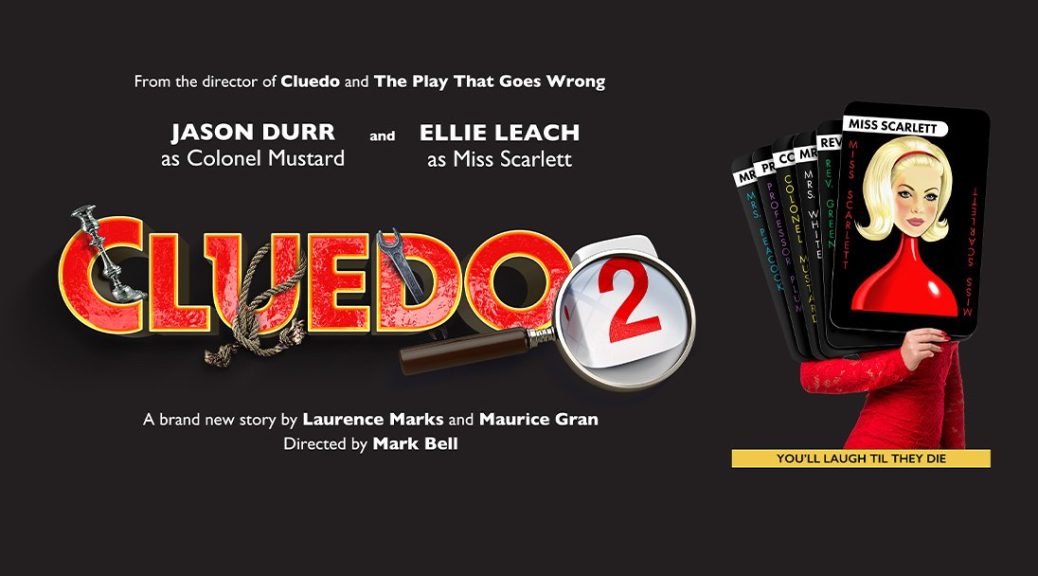
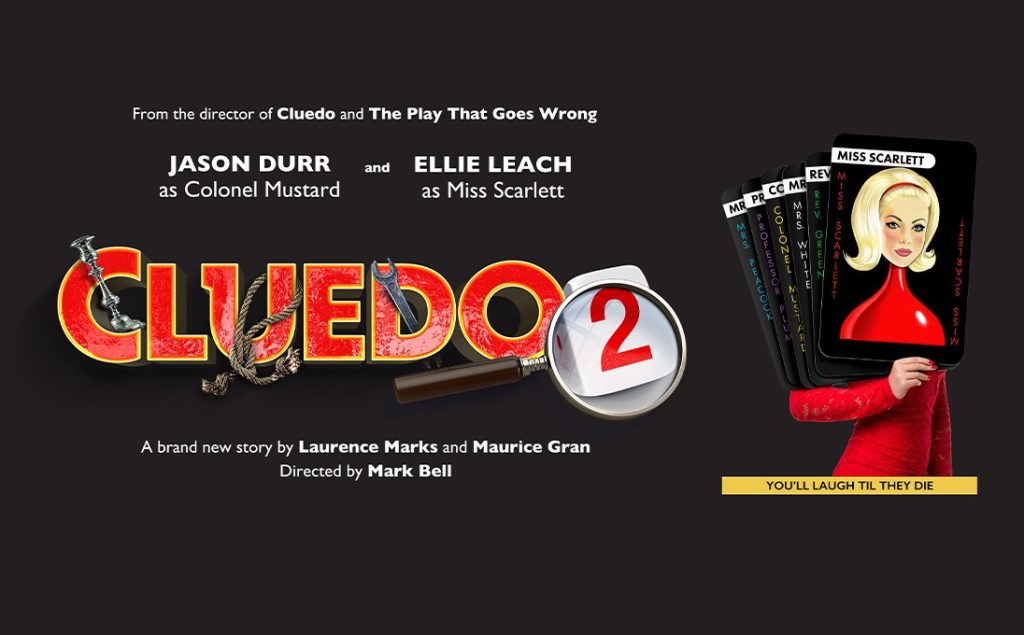
Review, Cluedo 2, New Theatre, Cardiff by Jane Bisett

 out of 5 stars (5 / 5)

Imagine a stormy night in a manor house on Tudor Close in 1968 and there you have it, the start of the murder mystery – Cluedo.

It all began in 1943, when Anthony Pratt challenged his wife, Elva, to create a board game. by way of alleviating the boredom between wartime air raids. Cluedo was born and subsequently turned into the internationally acclaimed murder mystery game we are still playing 75 years later in over 70 countries worldwide.

As a lover of female crime writers, Agatha Christie and Dorothy L Sayers I enjoyed the challenge that Cluedo gave me. Although the two things remained a puzzle to me, what was the motive for murder? and why was Coronal Mustard always the killer? Maybe we were just bad at shuffling the cards.

Writers Laurence Marks and Maurice Gran are also fans of this great game and jointly they embarked on Cluedo 2. Clearly their love of playing the game throughout their childhoods was an inspiration. The characters felt familiar and updated and had a realness about them as they emerged from the game as fully formed personalities rather the more anonymous people on the cards.

Even if, by some remote chance, you have never played or aware of the game Cluedo you will enjoy the unfolding of this who done it.

This Murder/Mystery/Comedy is utter genius, expertly directed by Mark Bell you get a real sense of the scale of the manor and the dashing from room to room.

The set, designed by David Farley, is a triumph. It first appears to be simple and minimalistic but as the play unfolds you get a sense of size and scale of the manor with the ingenious props and moving doors. Farley also designed the first stage production of Cluedo. To come up with another original set that has the ability to allow you to move with the characters from room to room was brilliant I especially enjoyed the billiard room, it was clever and funny.

This was a play in which every cast member was equally important to the plot. The first half was a bit of a slow burn which for people not familiar with the game was invaluable. However, the second half was joyful. Quick, witty and full of fun with British ‘in’ jokes, it did not disappoint.

As Cluedo is an internationally acclaimed game so are the characters. In this production there are personalities from the British isles and across the pond. This led to the discovery that English is indeed the language that separates us rather than brings us together and this was played with great humour and at times almost had a slap stick feel.

The production team of Jason Taylor (lighting designer) Jon Fiber (sound designer) and Anna Healey (movement director) brought so much to the stage. The lighting during the scene changes holds you and then suddenly you are in a different room.

Thank you to an amazing cast of actors for bringing these much loved fictional characters from our imaginations to life. They did not disappoint and gave us an evening of fun and laughter and for the first time I discovered the motive(s).

Even if you are not Cluedo aware, this play will be a great introduction and a fabulous evening out.

Review, Christian Mason’s Flute Concerto – Thaleia, BBC NOW, Hoddinott Hall, Cardiff by James Ellis

 out of 5 stars (4 / 5)

The BBC National Orchestra season has now officially ended in Cardiff. Whilst a showy wrap up was usually at St David’s Hall, we didn’t get it there this year due, to an ongoing cladding discrepancy. Most if not all concerts have been at Hoddinott Hall in the WMC this season and the year usually finishes with an extra concert there, though it would have ended there anyway. Are you following me?

The themes of Greek myth and a focus on the flute made up the evening. A Debussy heavy first half had the typical Prélude à l’après-midi d’un faune. Opening with the famous theme for flute, the seven odd minutes are evocative and sweetly scented. This brief ballet caused a stir at its premiere, Nijinski the dancer always up to provoke. Our national orchestra seduces us in this opening gambit, they make it looks like child’s play. Following on was the French composer’s Nocturnes, a powerhouse display of orchestration through merriment, nature and seascapes. The final movement of Sirens sees the ladies of the BBC National Orchestra of Wales give into some lovely wooing. The sailors who would wreck their ships, are lured by said sirens and there song is an exquisite offering. It is…a bit mawkish, though I cannot deny my palette for these sirens.

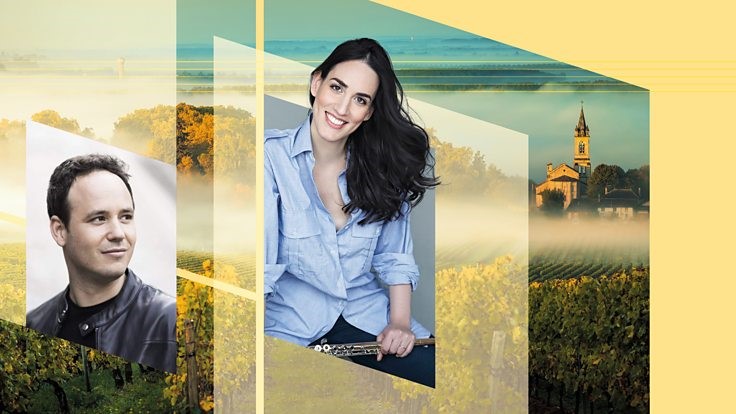
With the composer present on the night, Christian Mason’s Flute Concerto, dubbed ‘Thaleia’ proved to be the real highlight. With same orchestration as the previous Debussy Prélude, the story is of Thaleia, the Naiad-nymph from Mount Etna, with her exploits with the stroppy, amorous Zeus. With Gergely Madaras conducting and his wife, Noémi Győri as soloist this was a personal and powerful conjuring. Playing both flute and piccolo, Győri is a sensation in what must be a deeply challenging role written for her. Trills, flutter tongue techniques and whispering harmonics were all part of the demands. Musically strange, crammed with earthy allure and with many dramatic bouts, I was thoroughly taken with this geeky, Greek mythological inspired oddity.

Madaras, who introduced all the music on the night, for the last venture bigged up Belgiam native César Franck. The orchestra has recorded some select scores in the past, though he doesn’t always get a lot of loving. That changed with our finale: Part 3 of his oratorio Psyché. A small, patient selection of the Gents of BBC National Chorus of Wales joined the mass of ladies for a gutsy showing. This was a taster of the full, proud work and it left wanting more. Madaras, who stirred all night, was most alive here. Some sumptuous bars were compelling, I just would like to hear the full hour long work.

Review aside – Next season, we kindly request we have physical programmes back and some of the lumbering, black microphone stands be moved away from the front of the orchestra.

Here’s to more music making in the Hoddinott!

Listen out for this concert in the near future on BBC Radio 3, then BBC Sounds for 30 days.