
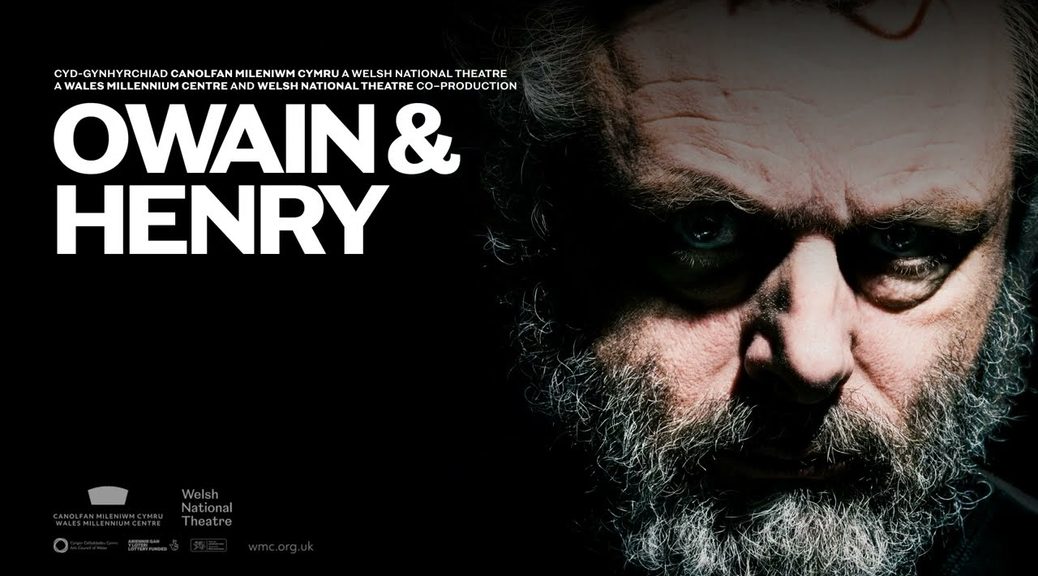
Last night was press night for the hugely anticipated Owain & Henry at Wales Millennium Centre. The great, good and unwashed of Welsh theatre were out in force, with every one of the 1,900 seats in the Donald Gordon Theatre taken to watch this new epic about Welsh history and Welsh identity, starring Michael Sheen as Owain Glyndŵr.
Going into the show, I found myself being pulled by two opposing feelings. Firstly, the hope that a project of this scale and ambition might deliver something truly extraordinary. But alongside that are the nagging questions that have surrounded the formation, structure and transparency of Welsh National Theatre itself: a national theatre company founded and artistically led by one man, whose productions to date have also starred that same man.
Writer Gary Owen’s script skilfully navigates an extremely complex period of history, mixing historical fact and dramatic invention in language that feels pithy and accessible. On a mammoth set of girders and steel, suggestive of Wales’s recent industrial past, Michael Sheen carries much of the narrative as Glyndŵr – a reluctant rebel, gradually pushed towards insurrection by Rakie Ayola’s Lady Macbeth-ish Mared, who is excellent throughout. The production manages to make complicated Welsh history involving kingship, rebellion and factional nobles compelling and not infrequently funny, too. I was genuinely intrigued to see where it would all take us.
But then we came to the second half. And the ending.
My problem isn’t that Gary Owen takes liberties with history. Theatre should take liberties with history. Having Prince Hal murder his father in order to seize the crown, for example, is an audacious invention. What bothered me was that, after spending so long constructing something complex and inventive, the production eventually seemed to abandon that complexity for caricature: England becomes embodied in a lager-loutish Prince Hal, goading the audience into singing Jerusalem. Wales becomes the humble, peace-loving nation of poets and singers, responding with a pitch-perfect choral rendition of the Welsh national anthem.
And that, for me, was heart-wrenchingly disappointing. Not because I object to Welsh patriotism, but because the production had spent the previous hours suggesting that history, identity and nationhood were much more complicated than that.
Enormous resources and extraordinary talent have been poured into Owain & Henry, and in many places it shows. There is ambition, scale, craft and some genuinely impressive work on display. Which is why the failure of both nerve and verve at the end feels so frustrating. Somewhere in the chain of artistic decisions, complexity gives way to a simplistic platitude as a finale. The production stops asking difficult questions about nation, power, violence and identity and instead tells us to stand up and sing along to the national anthem. For me, that doesn’t serve either the history or the enormous cultural potential of the production.
And perhaps that is where the production connects to a wider concern. For many years, mid-scale Welsh theatres such as Sherman Theatre and Theatr Clwyd have shown that artistic ambition and rigour can coexist, while the early years of National Theatre Wales produced work that was genuinely innovative and nationally significant. Against that background, questions have increasingly been raised within Welsh theatre about how some of our largest artistic organisations are led, for whom they exist, how decisions are made and where accountability sits.
For me, Owain & Henry does little to quiet those wider questions. If anything, a production with this much talent, resource and cultural significance behind it makes them harder to ignore.